
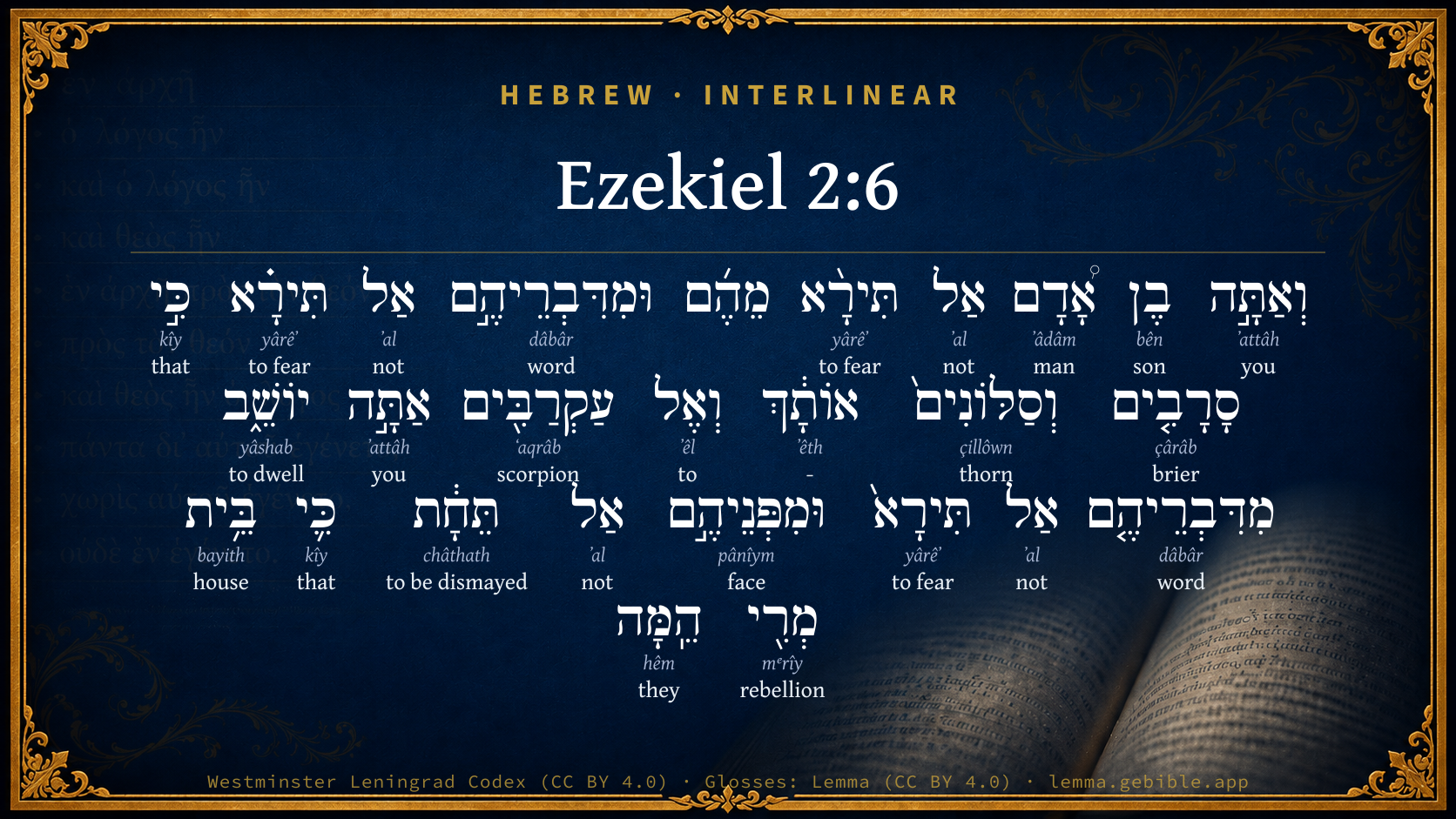
Ezekiel 2:6

Hebrew (Westminster Leningrad Codex) Ezekiel 2:6 appears in the Hebrew Old Testament. The text above is from the Westminster Leningrad Codex. Each word links to its Strong’s number, a concise gloss, and parsing drawn from the Open Scriptures Hebrew Bible morphology. Click any word for its full Brown-Driver-Briggs (BDB) entry.
Download image
Cite this verse

Ezekiel 2:6 (World English Bible). Public Domain. Lemma interlinear Bible study tool, https://lemma.gebible.app/v/ezekiel/2/6.

Show BibTeX & RIS
BibTeX
RIS
English Translation
You, son of man, don't be afraid of them, neither be afraid of their words, though briers and thorns are with you, and you do dwell among scorpions: don't be afraid of their words, nor be dismayed at their looks, though they are a rebellious house.
World English Bible · Public Domain
Highlights
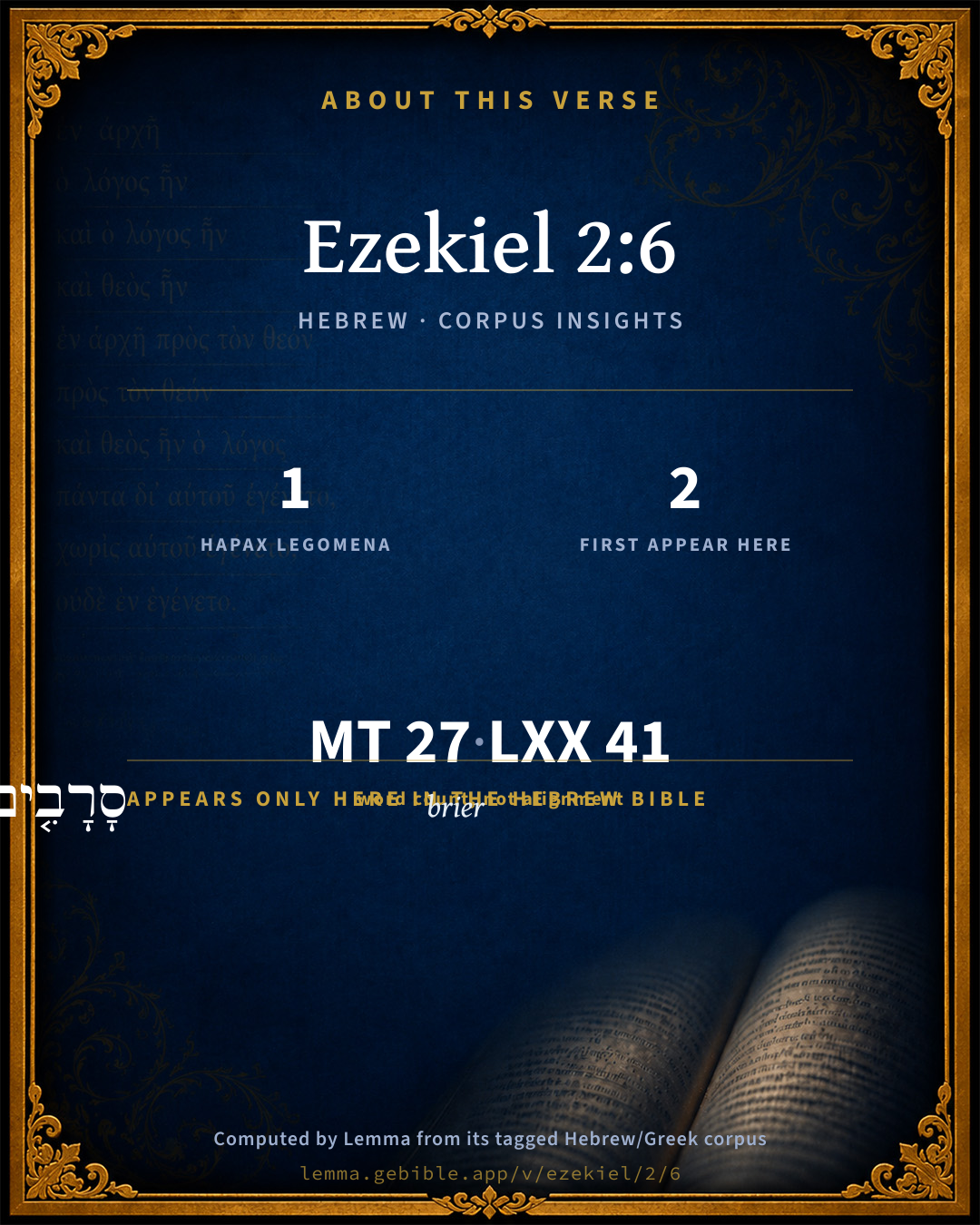
  • 1 hapax legomenon — only here in the Hebrew Bible
  • 2 first appearances in the Hebrew Bible
Full analysis ↓
Download a study sheet

One document with this verse’s original text, its word-by-word gloss line, the meaning frame, cross-references with their text, attributed commentary, and full source and license credits — printable, and it pastes into notes with its structure intact.

This verse Autodidact and up

Study sheet (.html) Plain text (.txt)

A passage Seminary Student

Up to 50 verses in one chapter. A passage sheet keeps up to 6 commentary sources and 12 cross-references per verse, in the order this page ranks them, and says so on the sheet whenever that leaves anything out. Ask for a single verse and you get the Autodidact verse sheet above.

Everything on this page stays free to read, with no account — the sheet is a download of what is already on screen, not access to it.

Want to remove ads? Support Godless Engineer
Compare translations 3

The same verse in 3 English versions, stacked beneath the original-language interlinear above. Click any original word for its lexicon entry.

Each is an independent rendering of the whole verse — the interlinear is not word-aligned to these translations.

Highlighted words mark where these versions differ — a whole-verse word diff, not a word-by-word alignment.

  • World English Bible Public Domain
    You, son of man, don't be afraid of them, neither be afraid of their words, though briers and thorns are with you, and you do dwell among scorpions: don't be afraid of their words, nor be dismayed at their looks, though they are a rebellious house.
  • King James Version Public Domain
    And thou, son of man, be not afraid of them, neither be afraid of their words, though briers and thorns be with thee, and thou dost dwell among scorpions: be not afraid of their words, nor be dismayed at their looks, though they be a rebellious house.
  • unfoldingWord Literal Text CC BY-SA 4.0
    You, son of man, do not be afraid of them or their words. Do not be afraid, although you are with briers and thorns and although you live with scorpions. Do not fear their words or be dismayed by their faces, since they are a rebellious house.

unfoldingWord Literal Text — © unfoldingWord, licensed CC BY-SA 4.0. Word-aligned USFM3 via Door43 (git.door43.org/unfoldingWord/en_ult).

Versions to compare (up to 4)

3 of 4 selected

Show all 18 translations

Every available English version of this verse, each an independent rendering of the whole verse.

  • World English Bible Public Domain
    You, son of man, don't be afraid of them, neither be afraid of their words, though briers and thorns are with you, and you do dwell among scorpions: don't be afraid of their words, nor be dismayed at their looks, though they are a rebellious house.
  • Berean Standard Bible Public Domain
    But you, son of man, do not be afraid of them or their words. Do not be afraid, though briers and thorns surround you, and you dwell among scorpions. Do not be afraid of their words or dismayed by their presence, though they are a rebellious house.
  • Majority Standard Bible Public Domain
    But you, son of man, do not be afraid of them or their words. Do not be afraid, though briers and thorns surround you, and you dwell among scorpions. Do not be afraid of their words or dismayed by their presence, though they are a rebellious house.
  • King James Version Public Domain
    And thou, son of man, be not afraid of them, neither be afraid of their words, though briers and thorns be with thee, and thou dost dwell among scorpions: be not afraid of their words, nor be dismayed at their looks, though they be a rebellious house.
  • American Standard Version (1901) Public Domain
    And thou, son of man, be not afraid of them, neither be afraid of their words, though briers and thorns are with thee, and thou dost dwell among scorpions: be not afraid of their words, nor be dismayed at their looks, though they are a rebellious house.
  • Revised Version (1885) Public Domain
    And thou, son of man, be not afraid of them, neither be afraid of their words, though briers and thorns be with thee, and thou dost dwell among scorpions: be not afraid of their words, nor be dismayed at their looks, though they be a rebellious house.
  • Geneva Bible (1599) Public Domain
    And thou sonne of man, feare them not, neither be afraide of their wordes, although rebels, and thornes be with thee, and thou remainest with scorpions: feare not their wordes, nor be afrayde at their lookes, for they are a rebellious house.
  • Douay-Rheims (1899) Public Domain
    And thou, O son of man, fear not, neither be thou afraid of their words: for thou art among unbelievers and destroyers, and thou dwellest with scorpions. Fear not their words, neither be thou dismayed at their looks: for they are a provoking house.
  • Young's Literal Translation Public Domain
    `And thou, son of man, thou art not afraid of them, yea, of their words thou art not afraid, for briers and thorns are with thee, and near scorpions thou art dwelling, of their words thou art not afraid, and of their faces thou art not affrighted, for they `are' a rebellious house,
  • Literal Standard Version CC BY-SA 4.0
    And you, son of man, you are not afraid of them, indeed, you are not afraid of their words, for briers and thorns are with you, and you are dwelling near scorpions, you are not afraid of their words, and you are not frightened of their faces, for they [are] a house of rebellion,
  • Unlocked Literal Bible CC BY-SA 4.0
    You, son of man, do not be afraid of them or their words. Do not be afraid, although you are with briers and thorns and although you live with scorpions. Do not fear their words or be dismayed by their faces, since they are a rebellious house.
  • unfoldingWord Literal Text CC BY-SA 4.0
    You, son of man, do not be afraid of them or their words. Do not be afraid, although you are with briers and thorns and although you live with scorpions. Do not fear their words or be dismayed by their faces, since they are a rebellious house.
  • Darby Bible Public Domain
    And thou, son of man, be not afraid of them, and be not afraid of their words; for briars and thorns are with thee, and thou dwellest among scorpions: be not afraid of their words, and be not dismayed at their faces; for they are a rebellious house.
  • World Messianic Bible Public Domain
    You, son of man, don’t be afraid of them, neither be afraid of their words, though briers and thorns are with you, and you dwell among scorpions. Don’t be afraid of their words, nor be dismayed at their looks, though they are a rebellious house.
  • Webster's Bible Public Domain
    And thou, son of man, be not afraid of them, neither be afraid of their words, though briers and thorns are with thee, and thou dost dwell among scorpions: be not afraid of their words, nor be dismayed at their looks, though they are a rebellious house.
  • Free Bible Version CC BY-SA 4.0
    Son of man, don't be afraid of them or what they say. You don't need to be afraid even though you're surrounded by brambles and thorns, even though you live among scorpions. Don't be afraid of what they say or be discouraged by the way they look at you, even though they are a rebellious family.
  • Bible in Basic English Public Domain
    And you, son of man, have no fear of them or of their words, even if sharp thorns are round you and you are living among scorpions: have no fear of their words and do not be overcome by their looks, for they are an uncontrolled people.
  • JPS Tanakh (1917) Public Domain
    And thou, son of man, be not afraid of them, neither be afraid of their words, though defiers and despisers be with thee, and thou dost dwell among scorpions; be not afraid of their words, nor be dismayed at their looks, for they are a rebellious house.

Literal Standard Version (2020), Covenant Press — licensed CC BY-SA 4.0. Text via the HelloAO Bible API (eBible.org). Unlocked Literal Bible (unfoldingWord) — licensed CC BY-SA 4.0. Text via the HelloAO Bible API (eBible.org). unfoldingWord Literal Text — © unfoldingWord, licensed CC BY-SA 4.0. Word-aligned USFM3 via Door43 (git.door43.org/unfoldingWord/en_ult). Free Bible Version, Dr. Jonathan Gallagher — licensed CC BY-SA 4.0. Text via the HelloAO Bible API (eBible.org).

Word by word

More ways to search: Search by grammar → Find every occurrence → Compare this word →

Practice this passage: Drill this verse → Learn its vocabulary →

סָרָבִ֤ים
çârâb
H5621
“briers”
Noun, Common, Masculine, Plural, Absolute
Part of Speech
Noun
Type
Common
Gender
Masculine
Number
Plural
State
Absolute
Full BDB Definition

Origin: from an unused root meaning to sting

TWOT: 1542

brier, rebel - meaning dubious
  1. וְאַתָּ֣ה ʼattâh H859 “and · you” Conjunction + Pronoun, Personal, 2nd Person, Masculine, Singular
  2. בֶן bên H1121 “son of” Noun, Common, Masculine, Singular, Construct
  3. אָ֠דָם ʼâdâm H120 “man” Noun, Common, Masculine, Singular, Absolute
  4. אַל ʼal H408 “not” Particle, Negative
  5. תִּירָ֨א yârêʼ H3372 “to fear” Verb, Qal, Jussive, 2nd Person, Masculine, Singular
  6. וּמִדִּבְרֵיהֶ֣ם dâbâr H1697 “and · from · words · their” Conjunction + Preposition + Noun, Common, Masculine, Plural, Construct + Suffix, Personal, 3rd Person, Masculine, Plural
  7. אַל ʼal H408 “not” Particle, Negative
  8. תִּירָ֗א yârêʼ H3372 “to fear” Verb, Qal, Jussive, 2nd Person, Masculine, Singular
  9. כִּ֣י kîy H3588 “that” Conjunction
  10. וְסַלּוֹנִים֙ çillôwn H5544 “and · thorns” Conjunction + Noun, Common, Masculine, Plural, Absolute
  11. אוֹתָ֔ךְ ʼêth H853 “- · you” Particle, Direct Object + Suffix, Personal, 2nd Person, Feminine, Singular
  12. וְאֶל ʼêl H413 “and · to” Conjunction + Preposition
  13. עַקְרַבִּ֖ים ʻaqrâb H6137 “scorpions” Noun, Common, Masculine, Plural, Absolute
  14. אַתָּ֣ה ʼattâh H859 “you” Pronoun, Personal, 2nd Person, Masculine, Singular
  15. יוֹשֵׁ֑ב yâshab H3427 “dwelling” Verb, Qal, Participle Active, Masculine, Singular, Absolute
  16. מִדִּבְרֵיהֶ֤ם dâbâr H1697 “from · words · their” Preposition + Noun, Common, Masculine, Plural, Construct + Suffix, Personal, 3rd Person, Masculine, Plural
  17. אַל ʼal H408 “not” Particle, Negative
  18. תִּירָא֙ yârêʼ H3372 “to fear” Verb, Qal, Jussive, 2nd Person, Masculine, Singular
  19. וּמִפְּנֵיהֶ֣ם pânîym H6440 “and · from · face(s) · their” Conjunction + Preposition + Noun, Common, Both, Plural, Construct + Suffix, Personal, 3rd Person, Masculine, Plural
  20. אַל ʼal H408 “not” Particle, Negative
  21. תֵּחָ֔ת châthath H2865 “to be dismayed” Verb, Niphal, Jussive, 2nd Person, Masculine, Singular
  22. כִּ֛י kîy H3588 “that” Conjunction
  23. בֵּ֥ית bayith H1004 “house of” Noun, Common, Masculine, Singular, Construct
  24. מְרִ֖י mᵉrîy H4805 “rebellion” Noun, Common, Masculine, Singular, Absolute
  25. הֵֽמָּה hêm H1992 “they” Pronoun, Personal, 3rd Person, Masculine, Plural

About this verse

These counts appear in no published source. They are computed here, from the morphology-tagged text and Lemma’s own curated glosses. What Lemma adds →

27
words
18
distinct lemmas
Prophets
section

Notable vocabulary

1 hapax legomenon — a word that appears only here in the entire Hebrew Bible:

  • סָרָבִ֤ים brier H5621

First appearance in Scripture

These words make their first canonical appearance in the Hebrew Bible here:

  • סָרָבִ֤ים brier H5621
  • וְסַלּוֹנִים֙ thorn H5544

Shared distinctive vocabulary

וְסַלּוֹנִים֙ thorn H5544 occurs in 2 verses of the Hebrew Bible. Also found in:

Grammatical profile

  • 5 verbs
  • 10 nouns
  • 3 pronouns
  • 2 prepositions
  • 2 conjunctions
  • 5 particles

Verb forms

  • תִּירָ֨א Qal · Jussive
  • תִּירָ֗א Qal · Jussive
  • יוֹשֵׁ֑ב Qal · Participle Active
  • תִּירָא֙ Qal · Jussive
  • תֵּחָ֔ת Niphal · Jussive

Repetition

Words recur within this verse — often emphatic in Hebrew:

  • תִּירָ֨א to fear H3372 ×3
  • וּמִדִּבְרֵיהֶ֣ם word H1697 ×2
  • אַל not H408 ×4
  • וְאַתָּ֣ה you H859 ×2
  • כִּ֣י that H3588 ×2

Hebrew & Septuagint length

In English translation the verse runs 46 words from the Hebrew and 52 from the Septuagint (LXX English) — closely comparable.

A rough comparison of the two English renderings, which tokenize alike — not a word-level alignment.

Word counts can differ between the Hebrew and the Greek without any difference in meaning — e.g. the Hebrew direct-object marker אֵת has no separate Greek word, and Greek often adds the article ὁ.

In the original languages it is 27 Hebrew tokens and 41 Greek tokens — but the two are counted differently (Hebrew bundles its prefixes and suffixes into one token; the Greek is in lemma form), so that isn’t a like-for-like length.

Cross-references

28

Topical passages linked to Ezekiel 2:6 in the Treasury of Scripture Knowledge — connected by theme and wording, ordered by reader-vote popularity; previews shown in the World English Bible.

  • Jeremiah 1:8 Don't be afraid because of them; for I am with you to deliver you, says Yahweh.
  • Isaiah 51:12 I, even I, am he who comforts you: who are you, that you are afraid of man who shall die, and of the son of man who shall be made as grass;
  • 1 Peter 3:14 But even if you should suffer for righteousness' sake, you are blessed. "Don't fear what they fear, neither be troubled."
  • Luke 10:19 Behold, I give you authority to tread on serpents and scorpions, and over all the power of the enemy. Nothing will in any way hurt you.
  • 2 Timothy 1:7 For God didn't give us a spirit of fear, but of power, love, and self-control.
  • Jeremiah 1:17 You therefore gird up your loins, and arise, and speak to them all that I command you: don't be dismayed at them, lest I dismay you before them.
  • Micah 7:4 The best of them is like a brier. The most upright is worse than a thorn hedge. The day of your watchmen, Even your visitation, has come; Now is the time of their confusion.
  • Matthew 10:28 Don't be afraid of those who kill the body, but are not able to kill the soul. Rather, fear him who is able to destroy both soul and body in Gehenna.
  • Ezekiel 3:8–9 Behold, I have made your face hard against their faces, and your forehead hard against their foreheads.
  • Jeremiah 18:18 Then said they, Come, and let us devise devices against Jeremiah; for the law shall not perish from the priest, nor counsel from the wise, nor the word from the prophet. Come, and let us strike him with the tongue, and let us not give heed to any of his words.
  • Micah 3:8 But as for me, I am full of power by the Spirit of Yahweh, And of judgment, and of might, To declare to Jacob his disobedience, And to Israel his sin.
  • 2 Samuel 23:6–7 But the ungodly shall be all of them as thorns to be thrust away, Because they can't be taken with the hand
  • Proverbs 30:13–14 There is a generation, oh how lofty are their eyes! Their eyelids are lifted up.
  • Isaiah 9:18 For wickedness burns as the fire; it devours the briers and thorns; yes, it kindles in the thickets of the forest, and they roll upward in a column of smoke.
  • Acts 4:29 Now, Lord, look at their threats, and grant to your servants to speak your word with all boldness,
  • 2 Kings 1:15 The angel of Yahweh said to Elijah, Go down with him: don't be afraid of him. He arose, and went down with him to the king.
  • Ezekiel 28:24 There shall be no more a pricking brier to the house of Israel, nor a hurting thorn of any that are round about them, that did despite to them; and they shall know that I am the Lord Yahweh.
  • Hebrews 11:27 By faith, he left Egypt, not fearing the wrath of the king; for he endured, as seeing him who is invisible.
  • Ezekiel 3:26–27 and I will make your tongue cleave to the roof of your mouth, that you shall be mute, and shall not be to them a reprover; for they are a rebellious house.
  • Amos 7:10–17 Then Amaziah the priest of Beth El sent to Jeroboam king of Israel, saying, "Amos has conspired against you in the midst of the house of Israel. The land is not able to bear all his words.
  • Luke 12:4 "I tell you, my friends, don't be afraid of those who kill the body, and after that have no more that they can do.
  • Acts 4:13 Now when they saw the boldness of Peter and John, and had perceived that they were unlearned and ignorant men, they marveled. They recognized that they had been with Jesus.
  • Acts 4:19 But Peter and John answered them, "Whether it is right in the sight of God to listen to you rather than to God, judge for yourselves,
  • Ephesians 6:19 on my behalf, that utterance may be given to me in opening my mouth, to make known with boldness the mystery of the Gospel,
  • Philippians 1:28 and in nothing frightened by the adversaries, which is for them a proof of destruction, but to you of salvation, and that from God.
  • Isaiah 51:7 Listen to me, you who know righteousness, the people in whose heart is my law; don't you fear the reproach of men, neither be you dismayed at their insults.
  • Revelation 9:3–6 Then out of the smoke came forth locusts on the earth, and power was given to them, as the scorpions of the earth have power.
  • Jeremiah 6:28 They are all grievous rebels, going about with slanders; they are brass and iron: they all of them deal corruptly.

Cross-references courtesy of OpenBible.info (CC BY 4.0).

Hebrew and Greek witnesses Masoretic Hebrew ↔ Greek Septuagint

The same verse in the two great witnesses to the Old Testament, shown verse-for-verse.

These are two independent witnesses, not word-aligned to each other, and the Septuagint is shown in lemma (dictionary) form.

Hebrew Ezekiel 2:6 Masoretic · Westminster Leningrad Codex

וְאַתָּ֣ה בֶן אָ֠דָם אַל תִּירָ֨א מֵהֶ֜ם וּמִדִּבְרֵיהֶ֣ם אַל תִּירָ֗א כִּ֣י סָרָבִ֤ים וְסַלּוֹנִים֙ אוֹתָ֔ךְ וְאֶל עַקְרַבִּ֖ים אַתָּ֣ה יוֹשֵׁ֑ב מִדִּבְרֵיהֶ֤ם אַל תִּירָא֙ וּמִפְּנֵיהֶ֣ם אַל תֵּחָ֔ת כִּ֛י בֵּ֥ית מְרִ֖י הֵֽמָּה

You, son of man, don't be afraid of them, neither be afraid of their words, though briers and thorns are with you, and you do dwell among scorpions: don't be afraid of their words, nor be dismayed at their looks, though they are a rebellious house.

World English Bible · Public Domain

Greek LXX Ezekiel 2:6 Septuagint · lemma form

καί σύ υἱός ἄνθρωπος μή φοβέω αὐτός μηδέ ἐκἵστημι ἀπό πρόσωπον αὐτός διότι παραοἰστράω καί ἐπι συνἵστημι ἐπί σύ κύκλος καί ἐν μέσος σκορπίος σύ καταοἰκέω ὁ λόγος αὐτός μή φοβέω καί ἀπό πρόσωπον αὐτός μή ἐκἵστημι διότι οἶκος παραπικραίνω εἰμί

And you, son of man, fear them not, nor be dismayed at their face; (for they will madden and will rise up against you round about, and you dwell in the midst of scorpions): be not afraid of their words, nor be dismayed at their countenance, for it is a provoking house.

LXX2012 (modern English Septuagint) · Public Domain

On this verse, The Pulpit Commentary discusses the Septuagint’s reading. Read the note in Commentary ↓

Hebrew: Westminster Leningrad Codex (CC BY 4.0). Greek: Septuagint (public domain); English from LXX2012 (modern English Septuagint) (Public Domain). How the Septuagint differs from the Hebrew →

Targum (Aramaic paraphrase)

1

The Targum is the ancient Jewish Aramaic paraphrase of the Hebrew Scriptures — an interpretive translation, not the Hebrew text itself. Onkelos (literal) and Pseudo-Jonathan (expansive) render the Torah, and Jonathan the Prophets. Coverage is partial: where no permissively-licensed English translation exists for a verse, only the Aramaic is shown. This is verse-level text, not a word-by-word alignment to the Hebrew.

  1. Targum Jonathan Prophets (Joshua–Malachi)
    וְאַתְּ בַּר אָדָם לָא תִדְחַל מִנְהוֹן וּמִפִּתְגְמֵיהוֹן לָא תִדְחַל אֲרֵי מְסָרְבִין וּמַקְשִׁין לְקִבְלָךְ וּבְגוֹ עַמָא דְעוֹבָדֵיהוֹן דָמָן לְעַקְרַבִּין אַתְּ יָתֵיב מִפִּתְגָמֵיהוֹן לָא תִדְחַל וּמִן קֳדָמֵיהוֹן לָא תִתְּבַר אֲרֵי עַם סַרְבָן אִינוּן:

    (no public-domain English translation for this verse)

    Targum Jonathan — Aramaic: “Mikraot Gedolot” (public domain). English: “Sefaria Community Translation” (CC0 1.0 (public-domain dedication)); “London "Chaldee Paraphrase," 1871” (public domain). Text via Sefaria.

Commentary

Notes on Ezekiel 2:6 from classic Christian and Jewish commentators (each source and its license shown beneath its notes). The classic Christian expositions comment on the surrounding passage and are grouped to its opening verse, so a note may address several verses; the Jewish commentaries on the Tanakh (Rashi and others) are per-verse, so they appear only where the commentator wrote on this verse.

Lemma curates 59 commentaries, every one of them public domain or Creative Commons licensed, each selected and text-cleaned for this edition rather than reprinted as found. About our sources →

Matthew Henry's Commentary

The prophet, having received his commission, here receives a charge with it. It is a post of honour to which he is advanced, but withal it is a post of service and work, and it is here required of him,

I. That he be bold. He must act in the discharge of this trust with an undaunted courage and resolution, and not be either driven off from his work or made to drive on heavily, by the difficulties and oppositions that he would be likely to meet with in it: Son of man, be not afraid of them, Eze 2:6. Note, Those that will do any thing to purpose in the service of God must not be afraid of the face of man; for the fear of men will bring a snare, which will be very entangling to us in the work of God. 1. God tells the prophet what was the character of those to whom he sent him, as before, Eze 2:3, Eze 2:4. They are briers and thorns, scratching, and tearing, and vexing a man, which way soever he turns. They are continually teazing God's prophets and entangling them in their talk (Mat 22:15); they are pricking briers and grieving thorns. The best of them is as a brier, and the most upright sharper than a thorn-hedge, Mic 7:4. Thorns and briers are the fruit of sin and the curse, and of equal date with the enmity between the seed of the woman and the seed of the serpent. Note, Wicked men, especially the persecutors of God's prophets and people, are as briers and thorns, which are hurtful to the ground, choke the good seed, hinder God's husbandry, are vexatious to his husbandmen; but they are nigh unto cursing and their end is to be burned. Yet God makes use of them sometimes for the correction and instruction of his people, as Gideon taught the men of Succoth with thorns and briers, Jdg 8:16. Yet this is not the worst of their character: they are scorpions, venomous and malignant. The sting of a scorpion is a thousand times more hurtful than the scratch of a brier. persecutors are a generation of vipers, are of the serpent's seed, and the poison of asps is under their tongue; and they are more subtle than any beast of the field. And, which makes the prophet's case the more grievous, he dwells among these scorpions; they are continually about him, so that he cannot be safe nor quiet in his own house; these bad men are his bad neighbours, who thereby have many opportunities, and will let slip none, to do him a mischief. God takes notice of this to the prophet, as Christ to the angel of one of the churches, Rev 2:13. I know thy works, and where thou dwellest, even where Satan's seat is. Ezekiel had been, in vision, conversing with angels, but when he comes down from this mount he finds he dwells with scorpions. 2. He tells him what would be their conduct towards him, that they would do what they could to frighten him with their looks and their words; they would hector him and threaten him, would look scornfully and spitefully at him, and do their utmost to face him down and put him our of countenance, that they might drive him off from being a prophet, or at least from telling them of their faults and threatening them with the judgments of God; or, if they could not prevail in this, that they might vex and perplex him, and disturb the repose of his mind. They were now themselves in subjection, divested of all power, so that they had no other way of persecuting the prophet than with their looks and their words; and so they did persecute him. Behold, thou hast spoken and done evil things as thou couldest, Jer 3:5. If they had had more power, they would have done more mischief. They were now in captivity, smarting for their rebellion, and particularly their misusing God's prophets; and yet they are as bad as ever. Though thou brag a fool in a mortar, yet will not his foolishness depart from him; no providences will of themselves humble and reform men, unless the grace of God work with them. But, how malicious soever they were, Ezekiel must not be afraid of them nor dismayed, he must not be deterred from his work, or any part of it, nor be disheartened or dispirited in it by all their menaces, but go on in it with resolution and cheerfulness, assuring himself of safety under the divine protection.

II. It is required that he be faithful, Eze 2:7. 1. he must be faithful to Christ who sent him: Thou shalt speak my words unto them. Note, As it is the honour of prophets that they are entrusted to speak God's words, so it is their duty to cleave closely to them and to speak nothing but what is agreeable to the words of God. Ministers must always speak according to that rule. 2. He must be faithful to the souls of those to whom he was sent: Whether they will hear of whether they will forbear, he must deliver his message to them as he received it. He must bring them to comply with the word, and not study to accommodate the word to their humours. "It is true they are most rebellious, they are rebellion itself; but, however, speak my words to them, whether they are pleasing or unpleasing." Note, The untractableness and unprofitableness of people under the word are no good reason why ministers should leave off preaching to them; nor must we decline an opportunity by which good may be done, though we have a great deal of reason to think no good will be done.

III. It is required that he be observant of his instructions.

1. Here is a general intimation what the instructions were that were given him, in the contents of the book which was spread before him, Eze 2:10. (1.) His instructions were large; for the roll was written within and without, on the inside and on the outside of the roll. It was as a sheet of paper written on all the four sides. One side contained their sins; the other side contained the judgments of God coming upon them for those sins. Note, God has a great deal to say to his people when they have degenerated and become rebellious. (2.) His instructions were melancholy. He was sent on a sad errand; the matter contained in the book was, lamentations, and mourning, and woe. The idea of his message is taken from the impression it would make upon the minds of those that carefully attended to it; it would set them a weeping and crying out, Woe! and, Alas! Both the discoveries of sin and the denunciations of wrath would be matter of lamentation. What could be more lamentable, more mournful, more woeful, than to see a holy happy people sunk into such a state of sin and misery as it appears by the prophecy of this book the Jews were at this time? Ezekiel echoes to Jeremiah's lamentations. Note, Though God is rich in mercy, yet impenitent sinners will find there are even among his words lamentations and woe.

2. Here is an express charge given to the prophet to observe his instructions, both in receiving his message and delivering it. he is now to receive it and is here commanded, (1.) To attend diligently to it: son of man, hear what I say unto thee, Eze 2:8. Note, Those that speak from God to others must be sure to hear from God themselves and be obedient to his voice: "Be not thou rebellious; do not refuse to go on this errand, or to deliver it; do not fly off, as Jonah did, for fear of disobliging thy countrymen. They are a rebellious house, among whom thou livest; but be not thou like them, do not comply with them in any thing that is evil." If ministers, who are reprovers by office, connive at sin and indulge sinners, either show them not their wickedness or show them not the fatal consequences of it, for fear of displeasing them and getting their ill-will, they hereby make themselves partakers of their guilt and are rebellious like them. If people will not do their duty in reforming, yet let ministers do theirs in reproving, and they will have the comfort of it in the reflection, whatever the success be, as that prophet had, Isa 50:5. The Lord God has opened my ear, and I was not rebellious. Even the best of men, when their lot is cast in bad times and places, have need to be cautioned against the worst of crimes. (2.) To digest it in his own mind by an experience of the favour and power of it: "Do not only hear what I say unto thee, but open thy mouth, and eat that which I give thee. Prepare to eat it and eat it willingly and with an appetite." All God's children are content to be at their heavenly father's finding, and to eat whatever he gives them. That which God's hand reached out to Ezekiel was a roll of a book, or the volume of a book, a book or scroll of paper or parchment fully written and rolled up. Divine revelation comes to us from the hand of Christ; he gave it to the prophets, Rev 1:1. When we look at the roll of thy book we must have an eye to the hand by which it is sent to us. He that brought it to the prophet spread it before him, that he might now swallow it with an implicit faith, but might fully understand the contents of it, and then receive it and make it his own. Be not rebellious, says Christ, but eat what I give thee. If we receive not what Christ in his ordinances and providences allots for us, if we submit not to his word and rod, and reconcile not ourselves to both, we shall be accounted rebellious.

Matthew Henry's Commentary on the Whole Bible (1708–1710) — public domain (CC PDM 1.0). Text via the HelloAO Bible API.

Trapp's Complete Commentary

John Trapp

Eze 2:6 And thou, son of man, be not afraid of them, neither be afraid of their words, though briers and thorns [be] with thee, and thou dost dwell among scorpions: be not afraid of their words, nor be dismayed at their looks, though they [be] a rebellious house.

Ver. 6. Be not afraid of them.] Of their lordly looks - such as Steven Gardiner set upon Dr Taylor, and was well told of it {a} - of their bitter scoffs, dreadful threats, as if they could undo us at their pleasure. Our times are in God’s hands; kill us they may, but hurt us they cannot. See Jer 1:17 Mat 10:25. When Bonner said to Hawkes, A faggot will make you turn; No, no, said Hawkes, a point for your faggot, you shall do no more than God permits you. {b} A minister of God should live by faith, and not die by fear. He should make his hearers afraid of him rather, as Herod was of the Baptist, Valens of Basil, &c. When Euxodia the Empress threatened Chrysostom, Go tell her, said he, that I fear nothing but sin. I will rather choose to die, said Calvin, than comply with those that refuse to submit to Church discipline.

Though briers (or rebels) and thorns be with thee.] Refractarii et spinei, {c} such as thou canst not handle without hurt, deal with without danger; {2Sa 23:6 Psa 55:21; Psa 58:10 Mic 7:4} catching, they are and scratching, as sharp pointed thorns. {Num 33:55}

And thou dost dwell among scorpions.] Which are most venomous and perilous creatures, joined with fiery serpents. {Deu 8:15} Pliny saith that there is not one minute wherein it doth not put forth the sting to do mischief. {d} It is also a crafty creature, et occultis machinationibus ferit and it kills with hidden devices. The Church’s enemies are cruel crafties. {Neh 4:11}

Be not afraid of their words.] Their bubbles of words.

Nor be dismayed at their looks.] Their swellings and browbeatings.

Though they be a rebellious house.] A race of rebels.

{a} Acts and Mon.

{b} Ibid., 1443.

{c} Quasi boves aestro agitati. - Theodoret. Monitoribus asperi. - Hor.

{d} Semper in ictu est. - Plin., lib. viii. cap. 29. Ferit obliquo ictu et inflexu.

John Trapp, A Commentary or Exposition upon All the Books of the Old and New Testament (1647–1656) — public domain. Text from a community e-Sword module.

The Biblical Illustrator

Joseph S. Exell

Eze_2:6

Be not afraid of them.

Endurance of the worlds censure

What is here implied, as the trial of the prophet Ezekiel, was fulfilled more or less in the case of all the prophets. They were not teachers merely, but confessors. This world is a scene of conflict between good and evil. The evil not only avoids, but persecutes the good; the good cannot conquer, except by suffering. When was it that this conflict, and this character and issue of it, have not been fulfilled? Cain, for instance, was envious of his brother Abel, and slew him. Ishmael mocked at Isaac; Esau was full of wrath with Jacob, and resolved to kill him. Josephs brethren were filled with bitter hatred of him, debated about killing him, cast him into a pit, and at last sold him into Egypt. Saul persecuted David; and Ahab and Jezebel, Elijah; and the priests and the prophets the prophet Jeremiah. Lastly, not to dwell on other instances, the chief priests and the Pharisees, full of envy, rose up against our Lord Jesus Christ, and delivered Him to the heathen governor Pontius Pilate, to be crucified. So the apostles, after Him, and especially St. Paul, were persecuted by their fierce and revengeful countrymen. The case seems to be this:--those who do not serve God with a single heart, know they ought to do so, and they do not like to be reminded that they ought. And when they fall in with anyone who does live to God, he serves to remind them of it, and that is unpleasant to them, and that is the first reason why they are angry with a religious man; the sight of him disturbs them and makes them uneasy. And, in the next place, they feel in their hearts that he is in much better case than they are. They cannot help wishing, though they are hardly conscious of their own wish, they cannot help wishing that they were like him; yet they have no intention of imitating him, and this makes men jealous and envious. Instead of being angry with themselves, they are angry with him. These are their first feelings: what follows? Next they are very much tempted to deny that he is religious. They wish to get the thought of him out of their minds. Nothing would so relieve their minds as to find that there were no religious persons in the world, none better than themselves. Accordingly, they do all they can to believe that he is making a pretence of religion; they do their utmost to find out what looks like inconsistency in him. They call him a hypocrite and other names. And all this, if the truth must be spoken, because they hate the things of God and therefore they hate His servants. Accordingly, as far as they have power to do it, they persecute him, either, as the text implies, with cruel, untrue words, or with cold, or fierce, or jealous looks, or in some worse ways. A good man is an offence to a bad man. The sight of him is a sort of insult; and he is irritated at him, and does him what harm he can. Thus Christians, in former times, were put to death by the heathen. Even now, no one can give his mind to God, and show by his actions that he fears God, but he will incur the dislike and opposition of the world; and it is important he should be aware of this, and be prepared for it. He must not mind it, he must bear it, and in time (if God so will) he will overcome it. There are a number of lesser ways in which careless, ungodly persons may annoy and inconvenience those who desire to do their duty humbly and fully. Such, especially, are those, which seem intended in the text, unkind censure, carping, slander, ridicule, cold looks, rude language, insult, and, in some cases, oppression and tyranny. Whoever, therefore, sets about a religious life, must be prepared for these--must be thankful if they do not befall him; but must not be put out, must not think it a strange thing, if they do. For instance, persons may press you to do something which you know to be wrong--to tell an untruth, or to do what is not quite honest, or to go to companies whither you should not go; and they may show that they are vexed at the notion of your not complying. Still you must not comply. You must not do what you feel to be wrong, though you should thereby displease even those whom you would most wish to please. Again: you must not be surprised, should you find that you are called a hypocrite, and other hard names; you must not mind it. Again: you may be jeered at and mocked by your acquaintance, for being strict and religious, for carefully coming to church, keeping from bad language, and the like: you must not care for it. Again, you may, perhaps, discover, to your great vexation, that untruths are told of you by careless persons behind your backs, that what you do has been misrepresented, and that in consequence a number of evil things are believed about you by the world at large. Hard though it be, you must not care for it; remembering that more untruths were told of our Saviour and His apostles than can possibly be told of you. Again, you may find that not only the common run of men believe what is said against you, but even those with whom you wish to stand well. But if this happens through your conscientiousness, you must not mind it, but must be cheerful, leaving your case in the hand of God, and knowing that He will bring it out into the light one day or another, in His own good time. Again: persons may try to threaten or frighten you into doing something wrong, but you must not mind that; you must be firm. In conclusion, I will call your attention to two points--First, do not be too eager to suppose you are ill-treated for your religions sake. Make as light of matters as you can. And beware of being severe on those who lead careless lives, or whom you think or know to be ill-treating you. Be kind and gentle to those who are perverse, and you will very often, please God, gain them over. Pray for those who lead careless lives, and especially if they are unkind to you. Secondly, recollect you cannot do any one thing of all the duties I have been speaking of without Gods help. When brought into temptation of any kind, we Should lift up our hearts to God. We should say to Him, Good Lord deliver us. (Plain Sermons by Contributors to the Tracts for the Times.)

Reasons against the fear of men

1. Fears are prejudicial: they take away our liberty; they put halters about our necks, and strangle our comforts; they multiply and prolong our miseries; they wound and disable us.

2. They are to be men of courage who are in public place.

3. God is with His, those He calls and employs in public service. This should put life into us.

4. Those who are in public place are in Gods place, and they must be like unto God, fearless of men, but dreadful unto men.

5. They that are godly, true Christians, their godliness, their cause, suffer by their fearfulness.

6. There is not that in wicked men that should make us to fear them, if we consider they are briers, thorns, scorpions, contemptible things, rather to be despised than feared.

7. God will dismay and confound us if we fear men (Jer_1:17). (W. Greenhill, M. A.)

Helps against the fear of men

1. Let your fear be exercised about God; He is an object fit to be feared. When the dictator ruled at Rome, then all other officers ceased; and when this fear of God rules, all other fears will be hushed. And that is not all; if God be sanctified by us, he will be a sanctuary unto us.

2. Set faith to work. Men in public places should have their hands at work on earth, and their faith in heaven. The just live by faith, and will not die by fear.

3. Labour for purity and holiness. The most holy men are the least fearing men.

4. Value not life too much. Be willing to spend and be spent for God. (W. Greenhill, M. A.)

A burdensome ministry

We are not to suppose that a faithful ministry is an easy task. No man can continually rebuke his age, and yet be living a luxurious life, unless indeed he be the victim of hypocrisy, or the tool of some vicious hallucination. The prophets of the Lord have always been opposed to the age in which they lived. Whenever the ministry has fallen into accord with the age, it is not the age that has gone up, it is the ministry that has gone down. A reproachful, corrective, stimulating voice should always be characteristic of a spiritual ministry. No evil shall be able to live in its presence, and no custom, how fashionable or popular soever, should be able to lift up its head without condemnation in the presence of a man who is filled with the burden or doctrine of the Lord. We should have persecution revive were we to revive the highest type of godliness. Sin has not altered, but righteousness may have modified its terms; the earth remains as it was from the beginning, but they who represent the kingdom of heaven may have committed themselves to an unworthy and degrading compromise. Evermore shall the wicked hate the godly, unless the godly take down their banners and are contented to live in dumbness and in traitorous suppression of the truth. (J. Parker, D. D.)

Boldness in preaching

The Rev. Styleman Herring of Clerkenwell, London, could say that there was not a street or court in the whole of his parish in which he had not preached. When he first commenced this work, some of his parishioners threatened what they would do if he came to preach in their streets. But he persevered until he was not only allowed to preach in peace, but was invited to do so by some of the inhabitants of the worst streets.

A fearless preacher

It is said that when a Roundhead in St. Andrews, Holborn, levelled a musket at the breast of the venerable prelate Hacker, and bade him desist from preaching, he never hesitated for one moment, but simply said, Soldier, do your duty; I shall continue to do mine. (W. Denton.)

Fearless speaking

During the Chartist agitation many of Kingsleys friends and relations tried to withdraw him from the peoples cause, fearful lest his prospects in life might be seriously prejudiced; but to all of them he turned a deaf ear, and in writing to his wife on the subject, he says: I will not be a liar. I will speak in season and out of season. I will not shun to declare the whole counsel of God. My path is clear, and I will follow in it. (A. Bell, B. A.)

Fearfulness in the preacher

We were sitting under the shade of an oak tree comparing notes and conferring one with another as to the best methods of service, especially in reference to effective preaching. I always write my sermons, said my friend, and then carefully revise them, so that if anything is written calculated to offend any of my hearers, I may at once erase it. This was said by a young clergyman who was evidently anxious to make his mark as a preacher. Desirous to know that I heard correctly, I replied, Do you mean that forcible statements, either of your own writing or from Scripture, concerning sin, and the terrors of the judgment to come, are either toned down or avoided? Yes, was the reply; if I think they will offend anyone, I do so. I fear this candid testimony, indicates the reason why so many ministers are powerless amongst their fellows. The fear of man bringeth a snare indeed. (Henry Varley.)

The Biblical Illustrator, edited by Joseph S. Exell (c. 1880s–1900s) — public domain. Text from a community e-Sword module.

Joseph Benson's Commentary

Eze 2:6-8. And thou, be not afraid of them — “The prophets and messengers of God are often exhorted to take courage, and are promised a proportionable assistance in the discharge of their office, without fearing any man’s person, or standing in awe of any man’s greatness.” — Lowth. Neither be afraid of their words — Their accusations, threats, or whatever else a malicious heart can suggest to the tongue. Though briers and thorns be with thee — Though thou art among such as study to vex and torment thee. Briers, usually running up among thorns, are a very fit emblem of the frowardness and keenness of sinners against God and his prophets, and therefore wicked and persecuting men are often denoted by this expression in the prophetical writings. And thou dost dwell among scorpions — Among men that are malicious and revengeful, and as dangerous and hurtful as the worst of serpents. Nor be dismayed at their looks — Wherewith they would brow-beat thee. They that would do any thing to purpose in the service of God, must not fear the faces of men. And thou shalt speak my words unto them — Do not forbear or desist from speaking to them what I have given thee in charge to speak, let them threaten and behave as they will, for thou shalt not receive any hurt from them, whether they pay regard to thee as a prophet or not. But thou, hear what I say unto thee — Obey when thou hearest. Those that would speak from God to their fellow-creatures, must be sure first to hear from God themselves, and then must be obedient to his voice. Be not thou rebellious, &c. — That is, do not refuse to go on this errand, or to deliver the message wherewith I send thee; do not fly off, as Jonah did, for fear of offending thy countrymen. If ministers, whose office it is to reprove sinners, connive at sin, and gratify sinners, either not showing them their wickedness, or not setting before them the fatal consequences of it, for fear of displeasing them, and exposing themselves to their ill will, they hereby make themselves partakers of their guilt, and are rebellious like them. If people will not do their duty in reforming, yet let ministers do theirs in reproving, and this will yield them comfort on reflection, whatever the success may be. Open thy mouth, and eat that I give thee — Receive into thy mind and heart, meditate upon, and digest the things which I reveal to thee. God’s words were to sink into him, that he might faithfully deliver them to others. The knowledge of divine truths is often expressed in Scripture by the metaphors of eating, digesting, and being nourished by bodily food: see Isa 55:1-2; Joh 6:27.

Joseph Benson's Commentary on the Old and New Testaments (1811–1818) — public domain. Text from a community e-Sword module.

Tyndale Open Study Notes

Tyndale Open Resources

2:6 Ezekiel’s ministry would be as painful as traversing a thicket of nettles and briers and stinging scorpions.

Tyndale Open Study Notes — © Tyndale Open Resources, licensed CC BY-SA 4.0. Text via the HelloAO Bible API.

Geneva Bible (1599)

Geneva Bible translators

Read Jer. 1:17, he showeth that for none afflictions they should cease to do their duties.

Geneva Bible (1599) marginal notes — public domain. Text via Bolls.life.

Jamieson, Fausset & Brown

Robert Jamieson, A. R. Fausset & David Brown

briers--not as the Margin and GESENIUS, "rebels," which would not correspond so well to "thorns." The Hebrew is from a root meaning "to sting" as nettles do. The wicked are often so called (Sa2 23:6; Sol 2:2; Isa 9:18).

scorpions--a reptile about six inches long with a deadly sting at the end of the tail.

be not afraid-- (Luk 12:4; Pe1 3:14).

Jamieson, Fausset & Brown — Commentary Critical and Explanatory on the Whole Bible (1871) — public domain (CC PDM 1.0). Text via the HelloAO Bible API.

Adam Clarke's Commentary

Verse 6. Be not afraid of them] They will maltreat thee for thy message; but let not the apprehension of this induce thee to suppress it. Though they be rebels, fear them not; I will sustain and preserve thee.

Adam Clarke's Commentary on the Bible (1810–1826) — public domain. Text from a community e-Sword/MySword module.

John Calvin's Commentaries

Here God again commands his servant to break forth boldly, even if the people deny him all approach through their malice and wickedness. But because we often fail through terror; God arms his Prophet with impregnable confidence against the threats of the people, and then against all discourses of every sort. He brings forward no other reason than they are a rebellious house, or a rebellious and perverse nation. For we said, though at the first glance it might seem cold, yet it suffices to animate the servants of God to know that he commands nothing rashly, and when they acknowledge that God is pleased by their spending their breath upon the deaf, yet they do not cease to discharge their duty, although they fatigue themselves in vain as far as the world is concerned. But now when this thought is added, that God will take care of his own servants, it doubles their confidence and good spirits. Thus it happens, that all threats and terrors being despised, they discharge their duty boldly. For this reason he now says, thou, son of man, do not be afraid of them, nor be terrified at their words By “words,” I do not understand simply threats but calumnies by which we know the servants of God to be oppressed. For hypocrites rise up with great confidence and complain of the injury done to them, and then presumptuously take upon themselves the name of God, as at this time the Papists not only vomit out threats by which they disturb us, but haughtily boast themselves to be the Church, and confirm this by perpetual succession; then they say that the Church never is without the Holy Spirit, and hence it cannot happen that God should ever desert them. We see, therefore, that the domestic enemies of God not only use threats against his servants, but at the same time bring many false pretenses by which they load the true and faithful Prophets with envy and hatred. But, however such calumnies have some appearance of truth when its enemies unjustly press us, God orders us to proceed with unconquered fortitude. Be not afraid, therefore, he says, of either them, or their words And since the same phrase is repeated shortly afterwards, hence we infer that it has no common meaning. It is therefore worthy of observation, that God once, yea twice, pronounces that we ought not to fear their words who boast themselves to be the Church of God, and doubt not petulantly to render that sacred name a laughing-stock by their use of it. Since, therefore, God allows us to despise language of this kind, there is no reason why the Papists of this day should daunt us, when, with inflated cheeks, they thunder out the name of the Church and the Apostolic authority; for just honor is not attributed to God, unless every lofty thing in the world is compelled to obey him, so that the doctrine alone may shine forth which comes direct from the mouth of God.

Now he adjoins, because, (or although, for this causal particle may be resolved adversatively,) however rebellious they may be, and like thorns, however thou mayest dwell among scorpions, yet do not fear their words, and do not be broken down by their appearance, חתת, chetheth, signifies to be rubbed and broken, and it is here transferred to the mind, and is to be metaphorically understood for being broken in spirit, as if it had been said, be thou intrepid in receiving all threats and calumnies, because they are a rebellious house This passage teaches us that none are fit to undertake the prophetic office, unless those who are armed with fortitude and perseverance whatever may happen, so that they do not fear any threats, nor hesitate or vacillate when oppressed by unjust calamities. So Paul says, (2 Corinthians 6:8,) that he persevered through both evil report and good report, although he was unworthily slandered by the wicked. Whoever, therefore, wishes to prepare himself faithfully for undertaking the office of a teacher, should be endued with such constancy that he may oppose, as it were, an iron front to all calumnies and curses, threats and terrors.

We cannot doubt but that the Israelites were much enraged when they heard themselves called thorns and scorpions. But they ought to be thus stung, since if they had been attacking a mortal man only, they would conduct themselves far more petulantly. But when God pronounces them scorpions and thorns, and they see the Prophet performing commands of this kind fearlessly and without hesitation, they are necessarily impelled to either fury or silence. But when they have striven to the very last in their obstinacy and hardness, yet God at length causes them to yield through shame, because truth has prevailed, of which the Prophet was a minister endued with such great fortitude of mind. We also perceive from this passage, that the Prophets often spoke with great asperity when the wickedness of those with whom they had to deal required it: yet they were not hurried away into any excess, or carried forward with intemperance against their adversaries. But they could not in any other way vindicate their doctrine against the wicked, who, impelled by a diabolical fury, strove with even God himself. We must hold, therefore, that although they were cruel and severe in language, yet they breathed pure humanity from the heart. For our Prophet was not a barbarous man, who excited by indignation, vomited out coarse reproaches against his own people, but the Spirit of God dictated, as we see, what might seem too severe to soft and delicate ears.

John Calvin's Commentaries (1540-1563) — public domain. Text from the Calvin Translation Society English edition (1840s-50s) via the Christian Classics Ethereal Library (ccel.org). Calvin's coverage is partial (roughly two-thirds of the Bible); uncommented books and verses are honest gaps, never fabricated. The 19th-century editor's footnotes and remarks are omitted so the notes are faithfully Calvin's own voice.

Ellicott's Commentary for English Readers

(6) Briers and thorns.—These words occur only here, but their meaning is sufficiently plain. Briers, indeed, might admit of the marginal translation, rebels, but both words should be taken together, either as adjectives or nouns, and the latter is more in accordance with the following “scorpions,” and with the general strongly figurative style of Ezekiel.

A Bible Commentary for English Readers, edited by Charles John Ellicott (1878–1897) — public domain. Text from a community e-Sword module.

The Cambridge Bible for Schools and Colleges

gen. ed. J. J. S. Perowne

6. Thorns and briars, that pierce and wound, and scorpions, that strike and sting, are figures for intractable and injurious men. The prophet must understand their character and not fear them.

though they be a rebellious] Rather: for they are. Stubborn opposition and injurious words may be expected of them; such conduct has always characterized them, for they are a rebellious house. Be not deceived by them nor dismayed before them, as if they were in the right and not thou; thou art in the right, and thou shalt speak my words to them (Eze_2:7).

The Cambridge Bible for Schools and Colleges (gen. ed. J. J. S. Perowne; Cambridge University Press, 1878–1918) — public domain. Text from a community e-Sword module.

John Gill's Exposition

And thou, son of man, be not afraid of them,.... Of any of them, the greatest among them, their princes and nobles; who, by their grandeur and authority, their stern looks, and big words, might awe and terrify him; wherefore it follows:

neither be afraid of their words; of their calumnies, revilings, and reproaches, their scoffs and jeers, their menaces and threatenings:

though briers and thorns be with thee; that is, men comparable to such; wicked men are like to briers and thorns, Sa2 23:6; are grieving, pricking, and distressing to good men, and are of no worth and value; are useless and unprofitable, and fit fuel for everlasting burning. The Targum is,

"for they are rebellious, and hard against thee;''

so Jarchi and Kimchi explain the first word, translated "briers", as signifying rebellious and disobedient; though the former observes, that R. Donesh interprets it of a kind of thorns, of which there are twenty names, and this is one:

and thou dost dwell among scorpions; that is, as the Targum paraphrases it,

"thou dwellest in the midst of a people whose works are like to scorpions.''

Some interpret it, as Kimchi observes, of sharp thorns, of a thorny plant that grows in the form of a scorpion (a); but scorpions here are a kind of serpents, subtle, venomous, and mischievous, which have stings in their tails; which, as Pliny says, they are continually thrusting out, and striking with, that they may lose no opportunity of doing hurt (b); and fitly describe wicked men their subtlety and mischievous nature,

be not afraid of their words; as before; with which they are like briers, thorns, and scorpions, being very grievous, defamatory, and mischievous:

nor be dismayed at their looks: their frowning furious, and angry countenances; forbidding with which, as well as with their words, the prophet from prophesying unto them:

though, or "for",

they be a rebellious house; See Gill on Eze 2:5.

(a) Plin. Nat. Hist. l. 21. c. 15. and l. 22. c. 16. (b) Plin. Nat. Hist. l. 11. c. 25.

John Gill's Exposition of the Whole Bible (1746–1763) — public domain (CC PDM 1.0). Text via the HelloAO Bible API.

Haydock's Catholic Bible Commentary

Scorpions. This people is no less destructive (Haydock) and hardened, Psalm cxvii. 12. --- For might be better rendered, "though." (Calmet)

George Leo Haydock (1774–1849), Haydock's Catholic Family Bible and Commentary, 1859 edition — public domain. Excludes Psalms (Douay-Rheims chapter numbering differs from Protestant) and Deuterocanonical books (Catholic canon only).

Matthew Poole's English Annotations

Thou, son of man; thou a prophet, sent by him whose throne is highest, whom thou sawest as the appearance of a man in glory, and provided with power to protect thee.

Be not afraid of them; cast away discouraging fear, be not dismayed at their persons; rulers, priests, and pretended prophets will oppose, but yet in the delivery of thy message fear none of them.

Words, Heb. will bear counsels, or words, misreports, accusations, threats, flouts, or whatever else an envious and malicious heart can suggest to the tongue.

Briers: here two words in the Hebrew are used, the first used only in this place, though frequently used in the Chaldee paraphrase, where it expresseth contumacy, as Exo 7:14, of Pharaoh refusing to let Israel go, and Jer 5:3, obstinate refusing to learn. But our translators, guided by the proper signification of the other word, have rendered it

briers, which usually run up among thorns, and are a very fit emblem of the frowardness and keenness of sinners against God and his prophet, and of the sure destruction which will befall these briers and thorns when God shall send his judgments like fire amongst them.

With thee; against thee.

Scorpions: some say this is an herb which, because it is every way armed with sharp, pricking stings, hath this name given it; but if we retain the more common interpretation, it speaks the rage and heat, the poisonous malice, and the sly lurking craft and irreconcilableness, of these apostate Jews, and of all other contemners of God and religion. These men, like scorpions, undiscerned, wound, torment, and kill.

Be not afraid; the admonition against sinful fear is repeated; lest Ezekiel should forget, or we in like case should fail of our duty, it is four times given in charge.

Matthew Poole's English Annotations on the Holy Bible (1683–1685) — public domain. Text from a community e-Sword/MySword module.

Whedon's Commentary on the Bible

Daniel D. Whedon

6. Briers… thorns… scorpions — The work of a true prophet is not easy, and will necessarily arouse the most bitter opposition. To suffer the grief of exile is bad enough (Psalms 137), but extra torments are in reserve for the faithful preacher. Ezekiel must be prepared for “thorns in the flesh” and scorpion stings. (Compare Mat_10:16-23.) The constant irritation of the brier is as bad for the temper as the sting of the scorpion. Many who could go into the lion’s jaws without shrinking are beaten back from the path of daily duty by the briers in the path.

Though they be a rebellious house — Literally, for they be a house of rebelliousness. They always have been and are yet rebellious, and therefore they could not do otherwise than dislike and persecute one who tells them the truth.

Daniel D. Whedon (gen. ed.), Commentary on the Old and New Testaments (1874–1909) — public domain. Text from a community e-Sword module.

The Pulpit Commentary

Though briers and thorns be with thee. The two Hebrew nouns are not found elsewhere, and have consequently puzzled translators. The LXX gives two verbs, paroistrhspusin kaisontai ejpi se; the Vulgate, increduli et subversores. The words, however, are formed from roots that imply "pricking" or "burning," and the Authorized Version rendering, followed by the Revised Version, is tenable enough. A cognate form of the first is found in Eze_28:24, and there the LXX gives skoloy, and the Vulgate, spina. A like figurative use of "scorpions" is found in 1Ki_12:11 (but here the reference may be to some scorpion like scourge) and Ecc 26:7. (compare also our Lord"s words in Luk_10:19) Be not afraid Compare the like command in Jer_1:17. The words imply, probably, a past as well as a future experience.Ezekiel had already known what it was to dwell among those whose hearts were venomous as scorpions. The comparison was a sufficiently familiar one among both Eastern and Greek writers.

Dwelling among scorpions.

I THE DISTRESS. Ezekiel lay on no bed of roses. His messages of stern denunciation raised up enemies who gave him worse than a thorny couch a very house of scorpions to dwell in. No more hideous picture ofdistress can well be conceived than that of the faithful prophet thrust into a thicket of briers, which turns out to be a scorpions" nest. The thorns are bad enough, yet fierce stinging creatures are added. This is a prophet"s Inferno. Captives who only suffered from the grief of exile would hang their harps on the willows in heart-broken despair. Ezekiel"s is a far worse case to be tormented by his fellow captives in return for his faithful words.

1. A great mission may bring a great distress. The common people are spared; the prophet is tormented. Ezekiel has his scorpion-neighbours; St. Paul, exalted to the third heaven, receives his thorn in the flesh; Christ, the Holy One, is crowned with thorns, pierced with nails, and more terribly wounded with cruel hatred.

2. A man"s worst enemies may be those of his own household. The scorpions are not pagan Babylonians, but Jews. No rancour is so bad as that of one whose milk of natural affection is turned to the venom of a brother"s hatred. This is the murder spirit of Cain the fratricide, the devilry of Judas the traitor.

3. A guilty conscience is a dangerous sting. If it does not wound its owner, it is likely to turn on its accuser. Ezekiel had to accuse the Jews of sin. We may often take the very ferocity of the attack made upon the gospel as a sign that its opponents are not at ease in their own hearts.

4. A spiteful tongue stings like a scorpion. Ezekiel was cruelly hurt when no bodily harm was done to him. Possibly his enemies were scarcely conscious of the keenness of their words. But the rankling wound which comes from venomous speech is more painful than the fiery swelling of the worst scorpion sting. Spiteful slanderers are more mischievous than the most repulsive insects.

II THE DUTY. Though scorpions infest the sphere of his labours, still the faithful prophet must toil on, braving their threatening stings. The people at Banias build leafy booths on the tops of poles, for residence during the hot season, in order to escape the attacks of scorpions, which are very abundant in their neighbourhood. No, such escape is permitted to the prophet of God.

1. Unpopularity may be a sign of fidelity. This is a shamefully forgotten doctrine in our day of easy living. Now the popular preacher is regarded as the great preacher, and the unpopular servant of God is regarded, even by his brethren, as a "failure." If so, then Ezekiel and Jeremiah were "failures," while their now-forgotten comrades, who prophesied smooth things, were great "successes." Such a doctrine would have given us no Hebrew prophets to stand in the first rank of God"s heroes. But time is a great avenger. Frederick Robertson of Brighton, whose sensitive spirit was assailed by a scorpion press during his lifetime, is now recognized as a prince of Divine teachers; while the very names of his enemies happily for them are forgotten.

2. The duty of fidelity in the midst of persecution is blessed with heavenly rewards. The rewards begin on earth in the soul"s culture. Mediaeval monks would roll in thorns for self-chastisement. Persecuted prophets needed to invent no such fantastic devices. The thorns were thrust upon them; their path was beset by scorpions. There is danger in the path of ease. It is better to be stung by the vicious scorpion than bitten by the deadly cobra. The thorn bush of persecution has its venomous insects, but in the flower beds of pleasure lies the serpent whose bite is death.

Vers. 6-8. God"s ambassador a warrior.

The path of duty, since the Fall, is never smooth. We may have an inward sense of delight tranquil satisfaction, arising from the approval of conscience and the smile of God but from without we must expect sharp opposition. There is demand for vigilance, skill, and courage.

I OPPOSITION FORESEEN. Men who have long time departed from God are not easily induced to return. The tree that has grown wildly crooked, cannot readily be restored to straightness and shape. Those who have abandoned the paths of truth and righteousness, sadly degrade their original nature. The cedars are reduced to thorns and briers. Sinners are unprofitable and injurious in the world a curse to society. They bear no fruit, or only sour and poisonous fruit. They choke the promise of better things. Or they are like scorpions, bent only on mischief. Originally lords of nature, they have sunk to the level of the meanest insects. There is poison in their crafty words. There is a danger in their very looks.

II COURAGE DEMANDED. "Be not afraid of them." Why should God"s servants fear? Our adversaries" words are mere breath. Not a particle of power have they but such as is permitted them by our Master. While they open their mouths in loud boasting, the finger of death is loosening the silver cord within. As the mighty God hath said to the angry waves, so hath he said to these, "Thus far shall ye go, and no further." They may loudly bark, but it is seldom they have power to bite. The fierce opposition of the ungodly may turn to our good; it may and ought to develop our courage. The severer the conflict, the more strength we may gather, and the greater will be our triumph. As they are so zealous in a bad cause, how much more zealous should we be in the very best of enterprises?

III THE ONLY WEAPON PERMITTED. In this conflict with human folly and rebellion, our only weapon is to be "the sword of the Spirit, which is the Word of God." "Thou shalt speak ray words unto them." If they meet us with contempt and malice, we have but to repeat in calmer tones, and with undisturbed patience, the same facts the message from the lips of God. Any addition of ours, however suitable it may seem, only weakens the force of the message. We must see to it that the edge of the weapon is not blunted by our own carelessness. Our only concern should be that we do speak all the counsel of God that it is the Word of God, both in substance and form, which we utter.

IV AN INSIDIOUS DANGER EXPOSED. "Be not thou rebellious like that rebellions house." One foe within the camp is more injurious than a thousand outside. If a germ of disease be in the medicine, it will invalidate all its efficacy. Rebellion assumes a myriad forms. It is a hydra with more than a hundred heads. Listlessness in hearing the heavenly commission a tampering with its fixed terms, a rash attempt to improve the Divine original these and such-like acts are seed germs of rebellion in the soul. "If the salt be deprived of its savour," wherewith shall the corruptions of the world be purged out? An unfaithful ambassador adds fresh aggravation to the revolt of a province. Sin is a contagious evil. D.

The Pulpit Commentary (1880–1919), ed. H.D.M. Spence-Jones & Joseph S. Exell — public domain. Text from a community e-Sword module.

John Wesley's Explanatory Notes

Words - Accusations, threats, or whatever else a malicious heart can suggest to the tongue. Briars - Which usually run up among thorns, are a very fit emblem of the frowardness and keenness of sinners against God and his prophet. Scorpious - Malicious, revengeful men. They that will do any thing to purpose in the service of God, must not fear the faces of men.

John Wesley, Explanatory Notes Upon the Whole Bible (1754–1765) — public domain. Text via the GEBible commentary corpus.

unfoldingWord translationNotes

Door43 World Missions Community

General Information:

God continues to speak to Ezekiel

son of man

"son of a human being" or "son of humanity." God calls Ezekiel this to emphasize that Ezekiel is only a human being. God is eternal and powerful, but humans are not. See how you translated this in Ezekiel 2:1. AT: "mortal person" or "human"

briers and thorns and ... scorpions

These words describe the people of Israel who will not treat Ezekiel kindly when he tells them what God says. (See: Metaphor)

briers and thorns

Briers are bushes with sharp points on the branches. The sharp points on the branches are called thorns.

scorpions

A scorpion is a small animal with two front claws, six legs, and a large tail with a poisonous stinger. Its sting is very painful.

Do not fear their words

"Do not be afraid of what they say."

be dismayed by their faces

The words "their faces" are a metonym for the message the people express with their faces. AT: "lose your desire to serve me because of the way they look at you" (See: Metonymy)

translationWords

Son of Man

fear

word

unfoldingWord translationNotes — © Distant Shores Media and the Door43 World Missions Community, licensed CC BY-SA 4.0. Source: git.door43.org/Door43/en_tn.

Rashi

Rabbi Shlomo Yitzchaki (Rashi)

obstinate Heb. סָרָבִים, a term for disobedience, like סָרְבָנִים (Menachem p.129), but Dunash (p. 77) interpreted it as a word for thorns [like the next word, סלונים. Consequently] there are two words [for thorns].

and thorny Heb. וְסַלוֹנִים, a word for thorns, and so (below 28:24) “a pricking briar (סִלוֹן) and a piercing thorn.”

and you sit on eglantines Heb. עַקְרַבִּים. The people whom you reprove will weary you and provoke you [making you feel] as if you were sitting on eglantines, which prick you on all sides.

עַקְרַבִּים are eglantiers in French, eglantines. Another interpretation: literally scorpions [the usual meaning of עַקְרַבִּים] and so did Jonathan render: “and among people whose deeds are like scorpions, you dwell.”

Rashi on the Tanakh — English translations: “The Judaica Press complete Tanach with Rashi, translated by A. J. Rosenberg” (CC BY 4.0); “Pentateuch with Rashi's commentary by M. Rosenbaum and A.M. Silbermann, 1929-1934” (public domain); “The Metsudah Tanach series, Lakewood, N.J” (CC BY 4.0); and “The Book of Joshua, Metsudah Publications, 1997” (CC BY 4.0). Text via Sefaria.

Lesson kit

Teaching starters — assembled from the data on this page, not authored interpretation. Every prompt links to the verse data it draws on. Edit before teaching.

Ezekiel, in the Prophets, opens this verse with 27 words (18 distinct Hebrew lemmas). Its most distinctive word is çârâb (“brier”). A historical commentator’s framing appears above. Read the whole chapter for the surrounding context.

Discussion questions

  1. The word çârâb carries the sense “brier.” How does it shape the verse?
  2. 1 word here appears nowhere else in the Hebrew Bible. Why might the author reach for such rare wording?
  3. 2 words make their first appearance in Scripture here. What does this debut establish?
  4. How does Ezekiel 28:24, which shares the word «thorn», read alongside this verse?
  5. What does the repetition of “to fear” (3× in this one verse) do in this verse?
  6. These translations render this verse differently. What is at stake in choosing one wording over another?
  7. «תִּירָ֨א» is a Qal Jussive verb. How does that grammatical form shape the action described?
  8. Compare how Matthew Henry's Commentary and Trapp's Complete Commentary read this verse. Where do they agree or differ?

Things to notice

  • 1 word in this verse appears nowhere else in the Hebrew Bible.
  • 2 words make their first canonical appearance in Scripture here.
  • This verse counts 27 Hebrew ↔ 41 Greek words.
  • These translations choose different wording for 13 words in this verse.
  • “to fear” occurs 3× in this single verse.

Reading settings

Reading text

Shown beneath each verse's original-language words.

Old Testament
Old Testament edition

Read the OT as the Masoretic Hebrew (MT) or the Greek Septuagint (LXX).

English shown for the Greek Septuagint (in the Hebrew ↔ Greek comparison).

Comparing translations? Open the Compare panel on any verse page to stack up to four side by side.