
Jeremiah 3:18

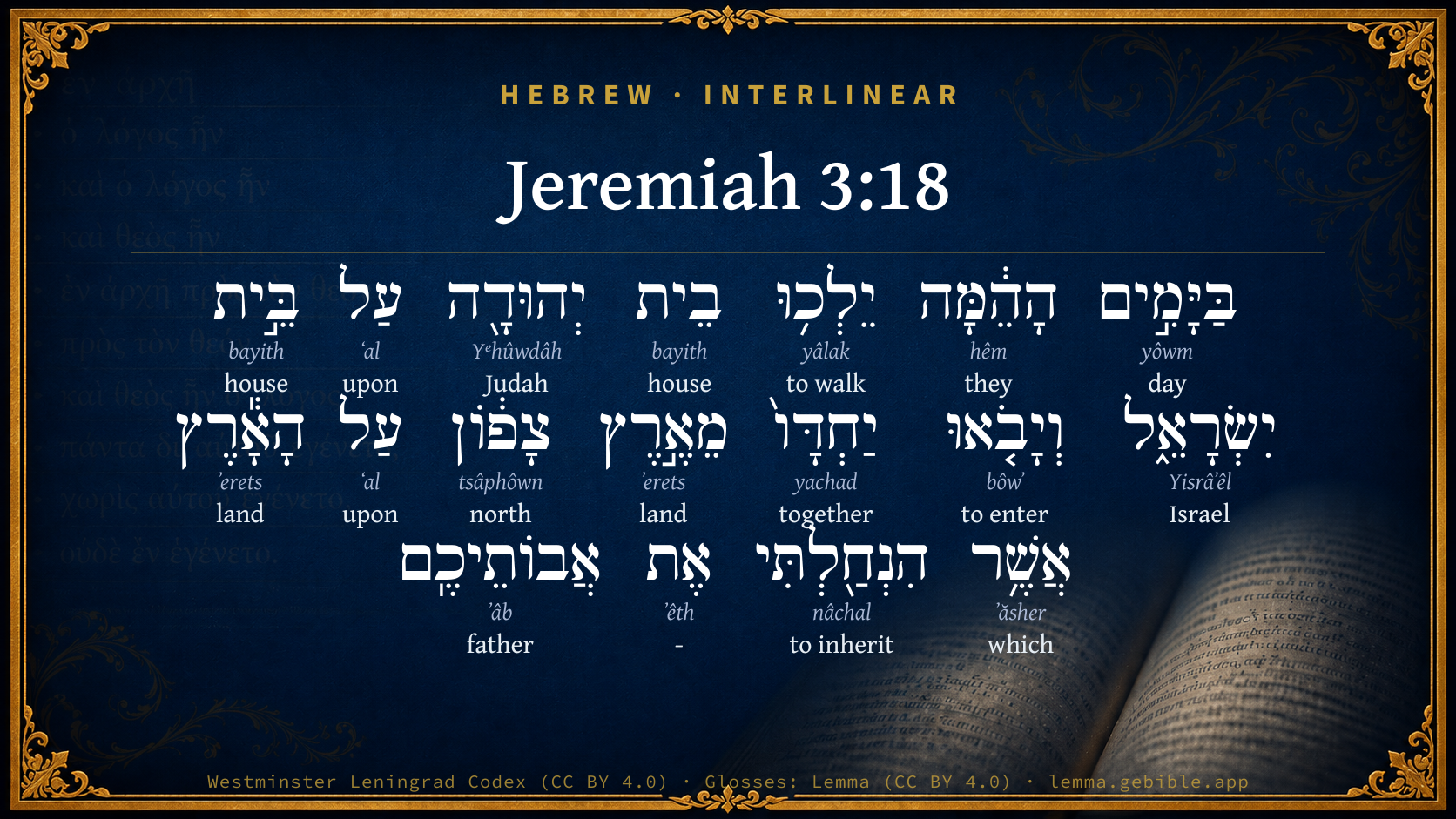
Hebrew (Westminster Leningrad Codex) Jeremiah 3:18 appears in the Hebrew Old Testament. The text above is from the Westminster Leningrad Codex. Each word links to its Strong’s number, a concise gloss, and parsing drawn from the Open Scriptures Hebrew Bible morphology. Click any word for its full Brown-Driver-Briggs (BDB) entry.
Download image
Cite this verse

Jeremiah 3:18 (World English Bible). Public Domain. Lemma interlinear Bible study tool, https://lemma.gebible.app/v/jeremiah/3/18.

Show BibTeX & RIS
BibTeX
RIS
English Translation
In those days the house of Judah shall walk with the house of Israel, and they shall come together out of the land of the north to the land that I gave for an inheritance to your fathers.
World English Bible · Public Domain
Download a study sheet

One document with this verse’s original text, its word-by-word gloss line, the meaning frame, cross-references with their text, attributed commentary, and full source and license credits — printable, and it pastes into notes with its structure intact.

This verse Autodidact and up

Study sheet (.html) Plain text (.txt)

A passage Seminary Student

Up to 50 verses in one chapter. A passage sheet keeps up to 6 commentary sources and 12 cross-references per verse, in the order this page ranks them, and says so on the sheet whenever that leaves anything out. Ask for a single verse and you get the Autodidact verse sheet above.

Everything on this page stays free to read, with no account — the sheet is a download of what is already on screen, not access to it.

Want to remove ads? Support Godless Engineer
Compare translations 3

The same verse in 3 English versions, stacked beneath the original-language interlinear above. Click any original word for its lexicon entry.

Each is an independent rendering of the whole verse — the interlinear is not word-aligned to these translations.

Highlighted words mark where these versions differ — a whole-verse word diff, not a word-by-word alignment.

  • World English Bible Public Domain
    In those days the house of Judah shall walk with the house of Israel, and they shall come together out of the land of the north to the land that I gave for an inheritance to your fathers.
  • King James Version Public Domain
    In those days the house of Judah shall walk with the house of Israel, and they shall come together out of the land of the north to the land that I have given for an inheritance unto your fathers.
  • unfoldingWord Literal Text CC BY-SA 4.0
    In those days, the house of Judah will walk with the house of Israel. And they will come together from the land of the north to the land that I caused your fathers to inherit.

unfoldingWord Literal Text — © unfoldingWord, licensed CC BY-SA 4.0. Word-aligned USFM3 via Door43 (git.door43.org/unfoldingWord/en_ult).

Versions to compare (up to 4)

3 of 4 selected

Show all 18 translations

Every available English version of this verse, each an independent rendering of the whole verse.

  • World English Bible Public Domain
    In those days the house of Judah shall walk with the house of Israel, and they shall come together out of the land of the north to the land that I gave for an inheritance to your fathers.
  • Berean Standard Bible Public Domain
    In those days the house of Judah will walk with the house of Israel, and they will come together from the land of the north to the land that I gave to your fathers as an inheritance.
  • Majority Standard Bible Public Domain
    In those days the house of Judah will walk with the house of Israel, and they will come together from the land of the north to the land that I gave to your fathers as an inheritance.
  • King James Version Public Domain
    In those days the house of Judah shall walk with the house of Israel, and they shall come together out of the land of the north to the land that I have given for an inheritance unto your fathers.
  • American Standard Version (1901) Public Domain
    In those days the house of Judah shall walk with the house of Israel, and they shall come together out of the land of the north to the land that I gave for an inheritance unto your fathers.
  • Revised Version (1885) Public Domain
    In those days the house of Judah shall walk with the house of Israel, and they shall come together out of the land of the north to the land that I gave for an inheritance unto your fathers.
  • Geneva Bible (1599) Public Domain
    In those daies ye house of Iudah shall walke with the house of Israel, and they shall come together out of the lande of the North, into the lande, that I haue giuen for an inheritance vnto your fathers.
  • Douay-Rheims (1899) Public Domain
    In those days the house of Juda shall go to the house of Israel, and they shall come together out of the land of the north to the land which I gave to your fathers.
  • Young's Literal Translation Public Domain
    In those days do the house of Judah Go unto the house of Israel, And they come together from the land of the south, unto the land That I caused your fathers to inherit.
  • Literal Standard Version CC BY-SA 4.0
    In those days the house of Judah || Goes to the house of Israel, || And they come together from the land of the south, || To the land that I caused your fathers to inherit.
  • Unlocked Literal Bible CC BY-SA 4.0
    In those days, the house of Judah will walk with the house of Israel. They will come together from the land of the north to the land that I gave your ancestors as an inheritance.
  • unfoldingWord Literal Text CC BY-SA 4.0
    In those days, the house of Judah will walk with the house of Israel. And they will come together from the land of the north to the land that I caused your fathers to inherit.
  • Darby Bible Public Domain
    In those days the house of Judah shall walk with the house of Israel; and they shall come together out of the land of the north, to the land which I caused your fathers to inherit.
  • World Messianic Bible Public Domain
    In those days the house of Judah will walk with the house of Israel, and they will come together out of the land of the north to the land that I gave for an inheritance to your fathers.
  • Webster's Bible Public Domain
    In those days the house of Judah shall walk with the house of Israel, and they shall come together from the land of the north to the land that I have given for an inheritance to your fathers.
  • Free Bible Version CC BY-SA 4.0
    At that time the people of Judah will join with the people of Israel, and they will return from the land of the north to the country I gave to your forefathers to own.
  • Bible in Basic English Public Domain
    In those days the family of Judah will go with the family of Israel, and they will come together out of the land of the north into the land which I gave for a heritage to your fathers.
  • JPS Tanakh (1917) Public Domain
    In those days the house of Judah shall walk with the house of Israel, and they shall come together out of the land of the north to the land that I have given for an inheritance unto your fathers.'

Literal Standard Version (2020), Covenant Press — licensed CC BY-SA 4.0. Text via the HelloAO Bible API (eBible.org). Unlocked Literal Bible (unfoldingWord) — licensed CC BY-SA 4.0. Text via the HelloAO Bible API (eBible.org). unfoldingWord Literal Text — © unfoldingWord, licensed CC BY-SA 4.0. Word-aligned USFM3 via Door43 (git.door43.org/unfoldingWord/en_ult). Free Bible Version, Dr. Jonathan Gallagher — licensed CC BY-SA 4.0. Text via the HelloAO Bible API (eBible.org).

Word by word

More ways to search: Search by grammar → Find every occurrence → Compare this word →

Practice this passage: Drill this verse → Learn its vocabulary →

הִנְחַ֖לְתִּי
nâchal
H5157
“to inherit”
Verb, Hiphil, Perfect, 1st Person, Common, Singular
Part of Speech
Verb
Stem
Hiphil
Form
Perfect
Person
1st Person
Gender
Common
Number
Singular
Full BDB Definition

Origin: a primitive root

TWOT: 1342

to get as a possession, acquire, inherit, possess - (Qal) - to take possession, inherit - to have or get as a possession or property (figuratively) - to divide the land for a possession - to acquire (testimonies) (figuratively) - (Piel) to divide for a possession - (Hithpael) to possess oneself of - (Hiphil) - to give as a possession - to cause to inherit, give as an inheritance - (Hophal) to be allotted, be made to possess
  1. בַּיָּמִ֣ים yôwm H3117 “in/at the · days” Preposition, Determined + Noun, Common, Masculine, Plural, Absolute
  2. הָהֵ֔מָּה hêm H1992 “the · they” Particle, Definite Article + Pronoun, Personal, 3rd Person, Masculine, Plural
  3. יֵלְכ֥וּ yâlak H3212 “to walk” Verb, Qal, Imperfect, 3rd Person, Masculine, Plural
  4. בֵית bayith H1004 “house of” Noun, Common, Masculine, Singular, Construct
  5. יְהוּדָ֖ה Yᵉhûwdâh H3063 “Judah” Noun, Proper
  6. עַל ʻal H5921 “upon” Preposition
  7. בֵּ֣ית bayith H1004 “house of” Noun, Common, Masculine, Singular, Construct
  8. יִשְׂרָאֵ֑ל Yisrâʼêl H3478 “Israel” Noun, Proper
  9. וְיָבֹ֤אוּ bôwʼ H935 “and · to enter” Conjunction + Verb, Qal, Imperfect, 3rd Person, Masculine, Plural
  10. יַחְדָּו֙ yachad H3162 “together” Adverb
  11. מֵאֶ֣רֶץ ʼerets H776 “from · land of” Preposition + Noun, Common, Both, Singular, Construct
  12. צָפ֔וֹן tsâphôwn H6828 “north” Noun, Common, Feminine, Singular, Absolute
  13. עַל ʻal H5921 “upon” Preposition
  14. הָאָ֕רֶץ ʼerets H776 “the · land” Particle, Definite Article + Noun, Common, Both, Singular, Absolute
  15. אֲשֶׁ֥ר ʼăsher H834 “which” Particle, Relative
  16. אֶת ʼêth H853 “-” Particle, Direct Object
  17. אֲבוֹתֵיכֶֽם ʼâb H1 “fathers · your” Noun, Common, Masculine, Plural, Construct + Suffix, Personal, 2nd Person, Masculine, Plural

About this verse

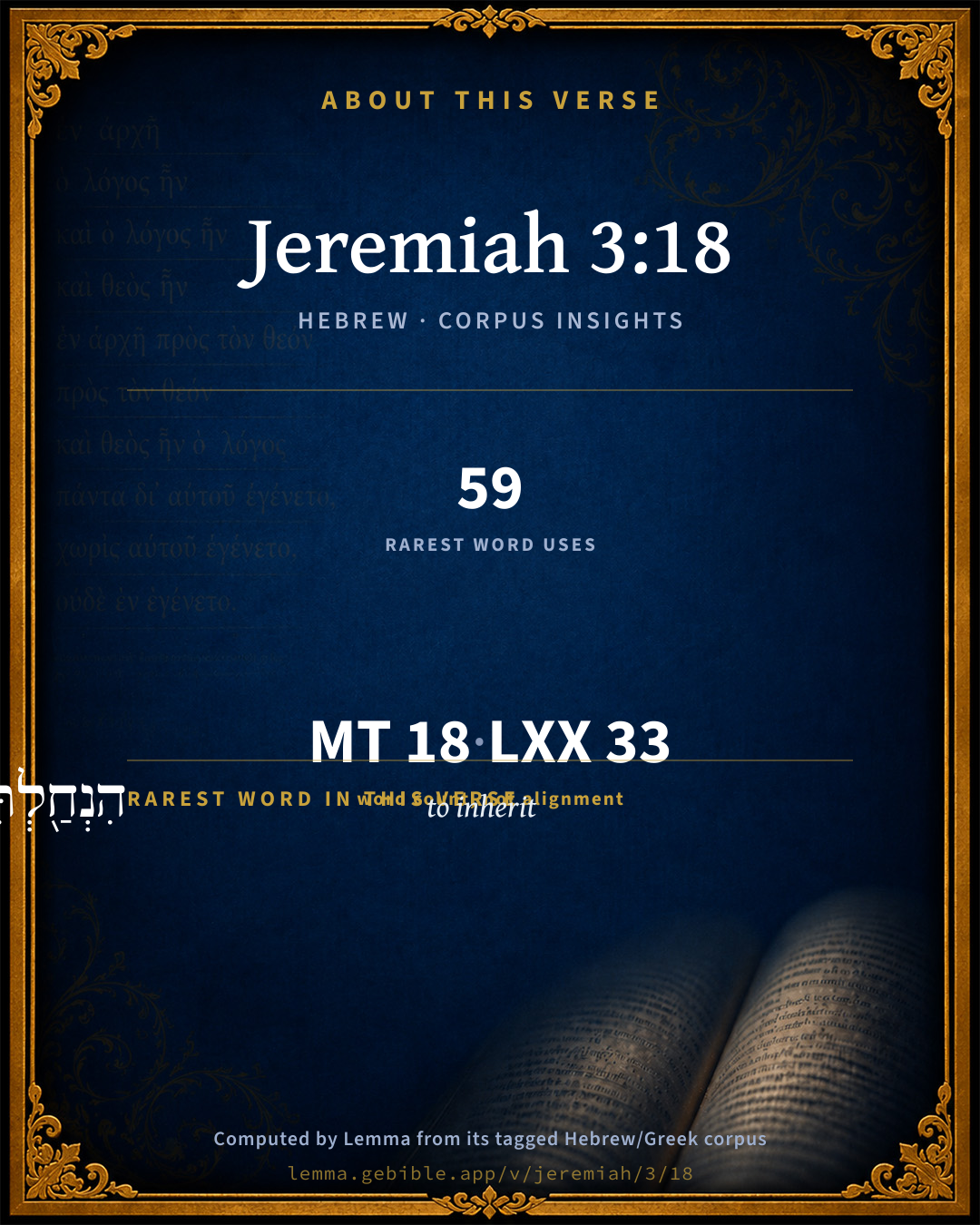
These counts appear in no published source. They are computed here, from the morphology-tagged text and Lemma’s own curated glosses. What Lemma adds →

18
words
15
distinct lemmas
Prophets
section

Shared distinctive vocabulary

הִנְחַ֖לְתִּי to inherit H5157 occurs in 57 verses of the Hebrew Bible. Also found in:

Grammatical profile

  • 3 verbs
  • 9 nouns
  • 1 pronoun
  • 2 prepositions
  • 1 adverb
  • 2 particles

Verb forms

  • יֵלְכ֥וּ Qal · Imperfect
  • וְיָבֹ֤אוּ Qal · Imperfect
  • הִנְחַ֖לְתִּי Hiphil · Perfect

Repetition

Words recur within this verse — often emphatic in Hebrew:

  • בֵית house H1004 ×2
  • עַל upon H5921 ×2
  • מֵאֶ֣רֶץ land H776 ×2

Hebrew & Septuagint length

In the original languages it is 18 Hebrew tokens and 33 Greek tokens — but the two are counted differently (Hebrew bundles its prefixes and suffixes into one token; the Greek is in lemma form), so that isn’t a like-for-like length.

Cross-references

14

Topical passages linked to Jeremiah 3:18 in the Treasury of Scripture Knowledge — connected by theme and wording, ordered by reader-vote popularity; previews shown in the World English Bible.

  • Jeremiah 31:8 Behold, I will bring them from the north country, and gather them from the uttermost parts of the earth, [and] with them the blind and the lame, the woman with child and her who travails with child together: a great company shall they return here.
  • Jeremiah 23:8 but, As Yahweh lives, who brought up and who led the seed of the house of Israel out of the north country, and from all the countries where I had driven them. They shall dwell in their own land.
  • Jeremiah 50:4 In those days, and in that time, says Yahweh, the children of Israel shall come, they and the children of Judah together; they shall go on their way weeping, and shall seek Yahweh their God.
  • Hosea 1:11 The children of Judah and the children of Israel will be gathered together, and they will appoint themselves one head, and will go up from the land; for great will be the day of Jezreel.
  • Amos 9:15 I will plant them on their land, And they will no more be plucked up out of their land which I have given them," says Yahweh your God.
  • Jeremiah 3:12 Go, and proclaim these words toward the north, and say, Return, you backsliding Israel, says Yahweh; I will not look in anger on you; for I am merciful, says Yahweh, I will not keep [anger] forever.
  • Jeremiah 16:15 but, As Yahweh lives, who brought up the children of Israel from the land of the north, and from all the countries where he had driven them. I will bring them again into their land that I gave to their fathers.
  • Zechariah 10:6 "I will strengthen the house of Judah, And I will save the house of Joseph, And I will bring them back; For I have mercy on them; And they will be as though I had not cast them off: For I am Yahweh their God, and I will hear them.
  • Isaiah 11:11–13 It shall happen in that day, that the Lord will set his hand again the second time to recover the remnant of his people, who shall remain, from Assyria, and from Egypt, and from Pathros, and from Cush, and from Elam, and from Shinar, and from Hamath, and from the islands of the sea.
  • Jeremiah 30:3 For, behold, the days come, says Yahweh, that I will turn again the captivity of my people Israel and Judah, says Yahweh; and I will cause them to return to the land that I gave to their fathers, and they shall possess it.
  • Jeremiah 50:20 In those days, and in that time, says Yahweh, the iniquity of Israel shall be sought for, and there shall be none; and the sins of Judah, and they shall not be found: for I will pardon them whom I leave as a remnant.
  • Ezekiel 37:16–22 You, son of man, take one stick, and write on it, For Judah, and for the children of Israel his companions: then take another stick, and write on it, For Joseph, the stick of Ephraim, and [for] all the house of Israel his companions:
  • Ezekiel 39:25–28 Therefore thus says the Lord Yahweh: Now will I bring back the captivity of Jacob, and have mercy on the whole house of Israel; and I will be jealous for my holy name.
  • Hosea 11:12 Ephraim surrounds me with falsehood, And the house of Israel with deceit; And Judah still us unruly with God, And is unfaithful to the Holy One.

Cross-references courtesy of OpenBible.info (CC BY 4.0).

Hebrew and Greek witnesses Masoretic Hebrew ↔ Greek Septuagint

The same verse in the two great witnesses to the Old Testament, shown verse-for-verse.

These are two independent witnesses, not word-aligned to each other, and the Septuagint is shown in lemma (dictionary) form.

Hebrew Jeremiah 3:18 Masoretic · Westminster Leningrad Codex

בַּיָּמִ֣ים הָהֵ֔מָּה יֵלְכ֥וּ בֵית יְהוּדָ֖ה עַל בֵּ֣ית יִשְׂרָאֵ֑ל וְיָבֹ֤אוּ יַחְדָּו֙ מֵאֶ֣רֶץ צָפ֔וֹן עַל הָאָ֕רֶץ אֲשֶׁ֥ר הִנְחַ֖לְתִּי אֶת אֲבוֹתֵיכֶֽם

In those days the house of Judah shall walk with the house of Israel, and they shall come together out of the land of the north to the land that I gave for an inheritance to your fathers.

World English Bible · Public Domain

Greek LXX Structure differs

In the Septuagint, Jeremiah is about an eighth shorter than the Hebrew and arranges its material differently — the Oracles Against the Nations (Hebrew chapters 46–51) appear in the middle of the Greek book, after 25:13. Because the chapter and verse boundaries do not line up, a verse-for-verse comparison with the Hebrew is not shown.

A verse-for-verse comparison isn’t shown here because the chapters and verses don’t line up. Switch to the LXX edition with the MT / LXX toggle above to read the Greek directly.

On this verse, Haydock's Catholic Bible Commentary discusses the Septuagint’s reading. Read the note in Commentary ↓

Hebrew: Westminster Leningrad Codex (CC BY 4.0). Greek: Septuagint (public domain); English from a public-domain English Septuagint. How the Septuagint differs from the Hebrew →

Targum (Aramaic paraphrase)

1

The Targum is the ancient Jewish Aramaic paraphrase of the Hebrew Scriptures — an interpretive translation, not the Hebrew text itself. Onkelos (literal) and Pseudo-Jonathan (expansive) render the Torah, and Jonathan the Prophets. Coverage is partial: where no permissively-licensed English translation exists for a verse, only the Aramaic is shown. This is verse-level text, not a word-by-word alignment to the Hebrew.

  1. Targum Jonathan Prophets (Joshua–Malachi)
    בְּיוֹמַיָא הָאִינוּן יִתְחַבְּרוּן דְבֵית יְהוּדָה עִם בֵּית יִשְׂרָאֵל וְיֵתוּן כַּחֲדָא מֵאֲרַע צִפּוּנָא לְאַרְעָא דְאַחֲסֵינִית יַת אֲבָהַתְכוֹן:

    (no public-domain English translation for this verse)

    Targum Jonathan — Aramaic: “Mikraot Gedolot” (public domain). English: “Sefaria Community Translation” (CC0 1.0 (public-domain dedication)); “London "Chaldee Paraphrase," 1871” (public domain). Text via Sefaria.

Commentary

Notes on Jeremiah 3:18 from classic Christian and Jewish commentators (each source and its license shown beneath its notes). The classic Christian expositions comment on the surrounding passage and are grouped to its opening verse, so a note may address several verses; the Jewish commentaries on the Tanakh (Rashi and others) are per-verse, so they appear only where the commentator wrote on this verse.

Lemma curates 59 commentaries, every one of them public domain or Creative Commons licensed, each selected and text-cleaned for this edition rather than reprinted as found. About our sources →

Trapp's Complete Commentary

John Trapp

Jer 3:18 In those days the house of Judah shall walk with the house of Israel, and they shall come together out of the land of the north to the land that I have given for an inheritance unto your fathers.

Ver. 18. In that day shall the house of Judah walk with the house of Israel.] All the elect shall be reunited in Christ; unless we shall understand it of the last reduction of the nation into one. {Isa 11:13 Eze 37:16; Eze 37:22 Hos 1:11}

And they shall come together out of the land of the north,] i.e., Out of the place of their captivity, whereby was figured our spiritual captivity, &c.

John Trapp, A Commentary or Exposition upon All the Books of the Old and New Testament (1647–1656) — public domain. Text from a community e-Sword module.

Joseph Benson's Commentary

Jer 3:18. In those days the house of Judah, &c. — Judah and Israel shall be happily united; the enmity that was between them shall be taken away, and they shall walk one with another, in a friendly manner, in the ways of God. This implies their being incorporated in one body, by one spirit, under Christ their head, and that without distinction of nations. This reunion of Israel and Judah, and their joint participation of the blessings of the Messiah’s kingdom, is elsewhere foretold. See the margin. And they shall come together out of the land of the north — Namely, out of their captivity; to the land that I have given them — That is, the land of Canaan. Both Assyria and Chaldea fell into the hands of Cyrus, and his proclamation extended to all the Jews in all his dominions. And therefore we have reason to think that many of the house of Israel came with those of Judah out of the land of the north; though at first there returned but forty-two thousand, of whom we have an account, Ezra 2., yet Josephus saith, (Antiq., lib. 11. cap. 4,) that some years after, under Darius, Zerubbabel went and fetched up above four million of souls to the land that was given for an inheritance to their fathers. And we never read of such animosities and enmities between Israel and Judah as had been formerly. And the happy coalescence between Israel and Judah in Canaan was a type of their union, and that of Jews and Gentiles in the gospel church, when, all enmities being slain, they should become one flock under one shepherd. It may also be implied in these words, as many commentators think is expressly declared in many other passages of the ancient prophets, that in the latter days the Jews and Israelites, after their conversion to Christianity, shall actually return from their several dispersions to dwell, as a nation, in their own land.

Joseph Benson's Commentary on the Old and New Testaments (1811–1818) — public domain. Text from a community e-Sword module.

Tyndale Open Study Notes

Tyndale Open Resources

3:18 Judah and Israel would be among the people flowing to Jerusalem. The Lord would mercifully bring them from exile and once again settle them in the Promised Land (31:8; Isa 11:13; Ezek 37:16-22; Hos 1:11; Amos 9:15).

Tyndale Open Study Notes — © Tyndale Open Resources, licensed CC BY-SA 4.0. Text via the HelloAO Bible API.

Geneva Bible (1599)

Geneva Bible translators

Where they are now in captivity.

Geneva Bible (1599) marginal notes — public domain. Text via Bolls.life.

Jamieson, Fausset & Brown

Robert Jamieson, A. R. Fausset & David Brown

Judah . . . Israel . . . together--Two distinct apostasies, that of Israel and that of Judah, were foretold (Jer 3:8, Jer 3:10). The two have never been united since the Babylonish captivity; therefore their joint restoration must be still future (Isa 11:12-13; Eze 37:16-22; Hos 1:11).

north-- (Jer 3:12).

land . . . given . . . inheritance-- (Amo 9:15).

Jamieson, Fausset & Brown — Commentary Critical and Explanatory on the Whole Bible (1871) — public domain (CC PDM 1.0). Text via the HelloAO Bible API.

Adam Clarke's Commentary

Verse 18. The house of Judah shall walk with the house of Israel] That is, in those days in which the Jews shall be brought in with the fulness of the Gentiles.

Out of the land of the north] From Chaldea. This prophecy has two aspects: one refers to the return from the Babylonish captivity; the other, to the glorious days of Christianity. But the words may refer to that gathering together of the Jews, not only from Chaldea, but from the countries of their dispersion over the face of the whole earth, and uniting them in the Christian Church.

Adam Clarke's Commentary on the Bible (1810–1826) — public domain. Text from a community e-Sword/MySword module.

John Calvin's Commentaries

Then is added, what is of the same meaning, In those days shall come the house of Judah with the house of Israel It hence appears, that the Prophet speaks of the posterity of Abraham and not of other nations; for he adds this verse as explanatory. It might, indeed, have been asked, “What does this mean, All nations shall come?” To this he answers, “The house of Israel shall unite with the house of Judah;” that is, there shall be no more hatred between these two nations, for they shall acknowledge one another as brethren, and know that they have arisen from the same source, and that they ought to be one people. In short, the Prophet explains in this verse what he had said before. And we ought especially to notice what he adds, Come shall they together from the land of the north into the land which I have given to be possessed by their fathers The Jews had not yet gone into exile; the Prophet said this to them while they were quiet, as it were, in their own nest at Jerusalem, and in the country around; nor could he convince them of what they afterwards found to be true to their great loss, — that an exile was nigh them, like that which they then saw had happened to their brethren, the Israelites. But yet the Prophet spoke of them, as though they had been exiled and dwelt like the Israelites in the north country; Come together , he says, shall they from the land of the north

They might have objected and said, “We are as yet enjoying our own inheritance, and no one can drive us hence, for it cannot be that God shall be deprived of his own temple, as he has chosen for himself a perpetual habitation among us.” Such words were no doubt clamorously spoken by them. But the Prophet here repels their vain confidence, and says, that their only hope of deliverance was in looking forward to the restoration which the Lord would grant them after they had been for a time banished from their country. Now the Prophet here sets forth to them the benefit which would arise from exile, in order that they might bear with more submission the punishment they were to endure: for they might have a hundred times despaired, had they no hope that this exile would be only for a time, and that they would again be gathered together with their brethren the Israelites. It now follows —

John Calvin's Commentaries (1540-1563) — public domain. Text from the Calvin Translation Society English edition (1840s-50s) via the Christian Classics Ethereal Library (ccel.org). Calvin's coverage is partial (roughly two-thirds of the Bible); uncommented books and verses are honest gaps, never fabricated. The 19th-century editor's footnotes and remarks are omitted so the notes are faithfully Calvin's own voice.

Ellicott's Commentary for English Readers

(18) In those days . . .—As with Isaiah (Isa_11:13), so with Jeremiah, the hope, however distant, of national reformation was bound up with that of a restoration of national unity. The healing of the long-standing breach between Israel and Judah, coeval almost with the commencement of Israel as a people, was to be the glory of the Messiah’s kingdom.

Out of the land of the north.—The thoughts of the prophet turn chiefly to the land of the exile of the ten tribes; but his words imply that he foresees a like exile also in the north for Judah. In that far-off land the house of Judah shall walk to (rather than with) the house of Israel, seeking its alliance, asking for reconciliation, and both should once again dwell in the land of their inheritance.

A Bible Commentary for English Readers, edited by Charles John Ellicott (1878–1897) — public domain. Text from a community e-Sword module.

The Cambridge Bible for Schools and Colleges

gen. ed. J. J. S. Perowne

18. For the reunion of the returned Israel and Judah cp. Eze_37:16-28; also Isa_11:12-14.

The Cambridge Bible for Schools and Colleges (gen. ed. J. J. S. Perowne; Cambridge University Press, 1878–1918) — public domain. Text from a community e-Sword module.

John Gill's Exposition

In those days the house of Judah shall walk with the house of Israel,.... Which had its accomplishment when some of the ten tribes, scattered among the nations whither the Gospel came, as well as in the land of Judea, being converted under it, joined together in a Gospel church state, and walked together in all the commandments and ordinances of Christ: and it may also denote the agreement of all Christian confessors, as Judah signifies, and of all Israelites indeed, in worship, whether Jews or Gentiles; becoming through Christ members of one body, fellow heirs and partakers of the same grace, promises, and privileges; and which harmony will still be more manifest in the latter day, Isa 11:7,

and they shall come together out of the land of the north; out of these northern kingdoms of ours, and other parts of Europe, where they chiefly are; this will be when the fulness of the Gentiles is brought in, and the Jews are converted and joined to Christian churches: the allusion is to the return of the Jews from Babylon, which lay north of Judea:

to the land that I have given for an inheritance unto your fathers; for when the Jews are converted they shall return to their own land, which God gave for an inheritance to Abraham, Isaac, and Jacob, and to their seed after them.

John Gill's Exposition of the Whole Bible (1746–1763) — public domain (CC PDM 1.0). Text via the HelloAO Bible API.

Albert Barnes' Notes on the Bible

With - To (margin). The prophet has just described the return of the ten tribes Jer 3:14, etc. Israel is represented as the first to repent, and Judah must go to her, in order that they may come together back to the holy land, divided no longer into Jews and Israelites, but merged into one people.

Out of the land of the north - The objection that the Jews were not carried like the Israelites into the northern provinces of Assyria Jer 3:12, but into Babylonia, misinterprets the whole prophecy, the gist of which is that in case of Israel’s repentance, Judah must humbly seek her out, and be content henceforward to take the inferior place, as having been the more guilty (see Jer 3:11).

Albert Barnes' Notes on the Bible (1834–1885) — public domain. Text from a community e-Sword/MySword module.

Haydock's Catholic Bible Commentary

North. Septuagint add, "and from all places" where the Jews were in captivity. (Haydock) --- Many thus returned to their own country, ver. 14. (Calmet) --- Israel had been led into captivity sooner, but all were released at once. (Theodoret) (Worthington)

George Leo Haydock (1774–1849), Haydock's Catholic Family Bible and Commentary, 1859 edition — public domain. Excludes Psalms (Douay-Rheims chapter numbering differs from Protestant) and Deuterocanonical books (Catholic canon only).

Matthew Poole's English Annotations

The house of Judah shall walk with the house of Israel; these two kingdoms shall become one, that had been so long divided; the enmity that was between them shall be taken away, and they shall walk hand in hand in a friendly manner one with another, which is implied in this phrase of walking together, Psa 55:14; Amo 3:3; and this points at their incorporating into one body united by the same Spirit, as members of the same body under Christ their Head, and that without distinction of nations. See Isa 11:12,13; Eze 37:16,17; Eph 2:14-16; 3:6.

Of the north, viz. of their captivity: see the place, Jer 3:12.

To the land, viz. Canaan; both a promise of their enjoying again their ancient possession at their last conversion, and typifying the church of Christ, which they shall be of, when brought out of their spiritual captivity.

Matthew Poole's English Annotations on the Holy Bible (1683–1685) — public domain. Text from a community e-Sword/MySword module.

Whedon's Commentary on the Bible

Daniel D. Whedon

18. Judah shall walk with… Israel — The lost harmony shall be restored. Partners in a common exile, they shall rejoice in a common deliverance. Hand in hand shall these wanderers return from the land of “the north,” or midnight, into the warmth and light, the safety and the glory, of the city of God.

Daniel D. Whedon (gen. ed.), Commentary on the Old and New Testaments (1874–1909) — public domain. Text from a community e-Sword module.

The Pulpit Commentary

The reunion of the separated portions of the nation. (comp. Eze_37:16, 17 Hos_1:11 Isa_11:12, Isa_11:13) Observe, Israel is converted first, then Judah. This detail in the prophecy is not to be pressed. Not that the force of any prophecy is to be evaded, but that in this case the form of the statement is so clearly conditioned by the abounding sympathy of the prophet for the ten tribes. These had been so long languishing in captivity that they needed a special premise. The form of the promise is imaginative; this seems clearly to follow from the fact that in no other passage (except, indeed, Jer_31:9) is there a reference to the spiritual primacy of Etihraim in the restored nation. Out of the land of the north; i.e. Assyria and (Jer_1:14) Babylonia. The Septuagint inserts, "and from all the countries," agreeably to Jer_16:15 Jer_23:3 Jer_32:37. Of course, it would not be an accurate statement that the exiles from Judah were confined to "the land of the north." This is a fair specimen of the supplementing tendency of the Septuagint, though it is possible, and even probable, that the Hebrew text has suffered in a less degree from the same tendency on the part of later copyists.

The Pulpit Commentary (1880–1919), ed. H.D.M. Spence-Jones & Joseph S. Exell — public domain. Text from a community e-Sword module.

John Wesley's Explanatory Notes

Judah - The two kingdoms shall become one. Shall come - Of their captivity, a promise of their enjoying again their ancient possession at their last conversion.

John Wesley, Explanatory Notes Upon the Whole Bible (1754–1765) — public domain. Text via the GEBible commentary corpus.

Keil & Delitzsch

C. F. Keil & F. Delitzsch

In those days when Jerusalem is glorified by being made the throne of the Lord, Judah along with Israel will come out of the north into the land which the Lord gave to their fathers. As the destruction of Jerusalem and of the temple is foretold implicite in Jer 3:16, so here the expulsion of Judah into exile is assumed as having already taken place, and the return not of Israel, only, but of Judah too is announced, as in Hos 2:2, and more fully in Eze 27:16. We should note the arrangement, the house of Judah with (על, prop. on) the house of Israel; this is as much as to say that Israel is the first to resolve on a return and to arise, and that Judah joins itself to the house of Israel. Judah is thus subordinated to the house of Israel, because the prophet is here seeking chiefly to announce the return of Israel to the Lord. It can surely not be necessary to say that, as regards the fulfilment, we are not entitled hence to infer that the remnant of the ten tribes will positively be converted to the Lord and redeemed out of exile sooner than the remnant of Judah. For more on this point see on Jer 31:8.

Keil & Delitzsch — Biblical Commentary on the Old Testament (1861–1891) — public domain (CC PDM 1.0). Text via the HelloAO Bible API. (Old Testament only.)

Rashi

Rabbi Shlomo Yitzchaki (Rashi)

the house of Judah will go with the house of Israel They will join them and they will be added to them to be one kingdom.

Rashi on the Tanakh — English translations: “The Judaica Press complete Tanach with Rashi, translated by A. J. Rosenberg” (CC BY 4.0); “Pentateuch with Rashi's commentary by M. Rosenbaum and A.M. Silbermann, 1929-1934” (public domain); “The Metsudah Tanach series, Lakewood, N.J” (CC BY 4.0); and “The Book of Joshua, Metsudah Publications, 1997” (CC BY 4.0). Text via Sefaria.

Lesson kit

Teaching starters — assembled from the data on this page, not authored interpretation. Every prompt links to the verse data it draws on. Edit before teaching.

Jeremiah, in the Prophets, opens this verse with 18 words (15 distinct Hebrew lemmas). Its most distinctive word is nâchal (“to inherit”). A historical commentator’s framing appears above. Read the whole chapter for the surrounding context.

Discussion questions

  1. The word nâchal carries the sense “to inherit.” How does it shape the verse?
  2. How does Exodus 23:30, which shares the word «to inherit», read alongside this verse?
  3. What does the repetition of “house” (2× in this one verse) do in this verse?
  4. These translations render this verse differently; the difference is in the English rendering, not the original. What questions does that raise?
  5. «יֵלְכ֥וּ» is a Qal Imperfect verb. How does that grammatical form shape the action described?
  6. Compare how Trapp's Complete Commentary and Joseph Benson's Commentary read this verse. Where do they agree or differ?

Things to notice

Reading settings

Reading text

Shown beneath each verse's original-language words.

Old Testament
Old Testament edition

Read the OT as the Masoretic Hebrew (MT) or the Greek Septuagint (LXX).

English shown for the Greek Septuagint (in the Hebrew ↔ Greek comparison).

Comparing translations? Open the Compare panel on any verse page to stack up to four side by side.