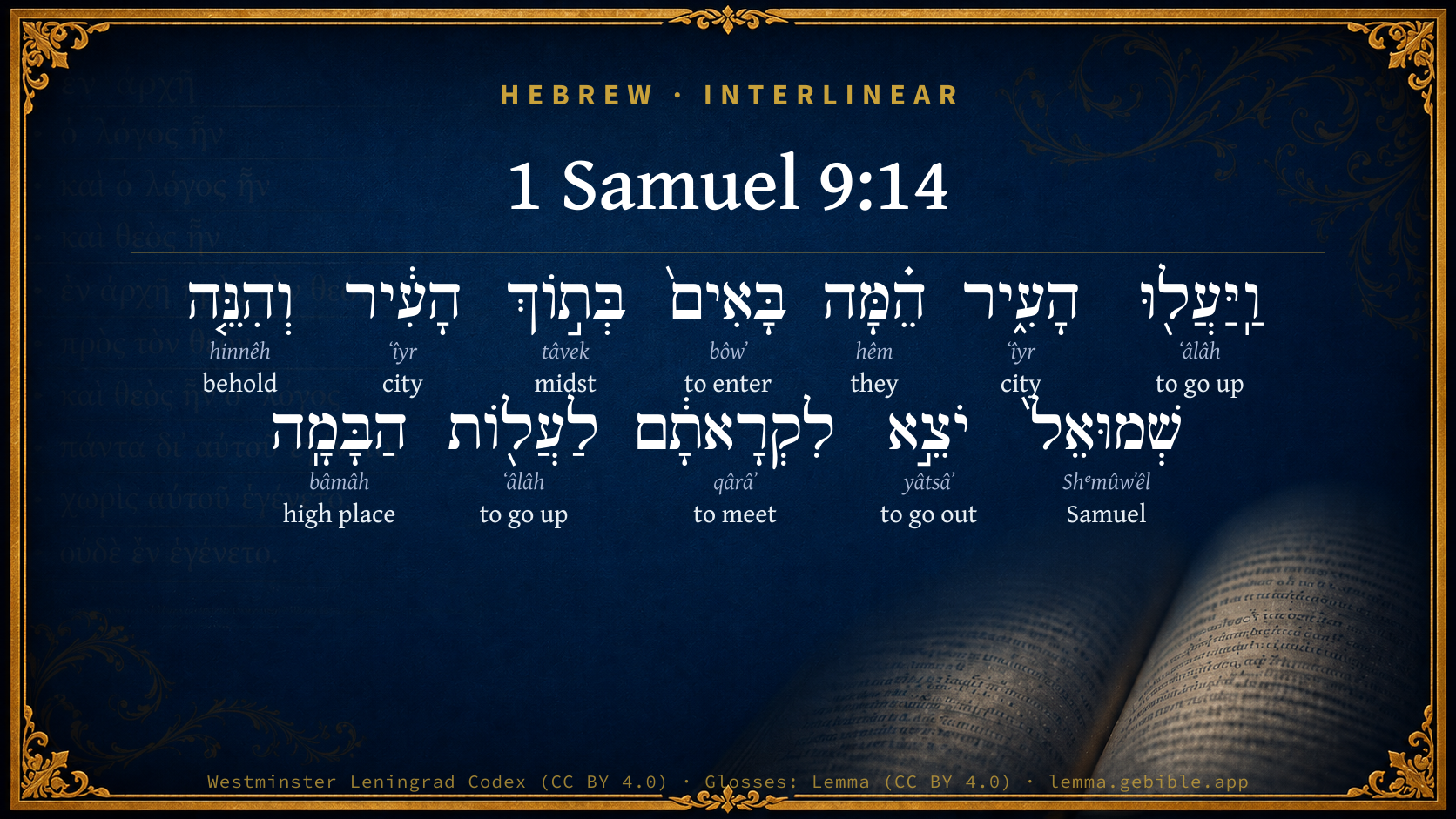
1 Samuel 9:14

Hebrew (Westminster Leningrad Codex) 1 Samuel 9:14 appears in the Hebrew Old Testament. The text above is from the Westminster Leningrad Codex. Each word links to its Strong’s number, a concise gloss, and parsing drawn from the Open Scriptures Hebrew Bible morphology. Click any word for its full Brown-Driver-Briggs (BDB) entry.
Download image
Cite this verse

1 Samuel 9:14 (World English Bible). Public Domain. Lemma interlinear Bible study tool, https://lemma.gebible.app/v/1-samuel/9/14.

Show BibTeX & RIS
BibTeX
RIS
English Translation
They went up to the city; [and] as they came within the city, behold, Samuel came out toward them, to go up to the high place.
World English Bible · Public Domain
Download a study sheet

One document with this verse’s original text, its word-by-word gloss line, the meaning frame, cross-references with their text, attributed commentary, and full source and license credits — printable, and it pastes into notes with its structure intact.

This verse Autodidact and up

Study sheet (.html) Plain text (.txt)

A passage Seminary Student

Up to 50 verses in one chapter. A passage sheet keeps up to 6 commentary sources and 12 cross-references per verse, in the order this page ranks them, and says so on the sheet whenever that leaves anything out. Ask for a single verse and you get the Autodidact verse sheet above.

Everything on this page stays free to read, with no account — the sheet is a download of what is already on screen, not access to it.

Want to remove ads? Support Godless Engineer
Compare translations 3

The same verse in 3 English versions, stacked beneath the original-language interlinear above. Click any original word for its lexicon entry.

Each is an independent rendering of the whole verse — the interlinear is not word-aligned to these translations.

Highlighted words mark where these versions differ — a whole-verse word diff, not a word-by-word alignment.

  • World English Bible Public Domain
    They went up to the city; [and] as they came within the city, behold, Samuel came out toward them, to go up to the high place.
  • King James Version Public Domain
    And they went up into the city: and when they were come into the city, behold, Samuel came out against them, for to go up to the high place.
  • unfoldingWord Literal Text CC BY-SA 4.0
    So they went up the city. They were entering into the midst of the city, and behold, Samuel was coming out to meet them to go up the high place.

unfoldingWord Literal Text — © unfoldingWord, licensed CC BY-SA 4.0. Word-aligned USFM3 via Door43 (git.door43.org/unfoldingWord/en_ult).

Versions to compare (up to 4)

3 of 4 selected

Show all 18 translations

Every available English version of this verse, each an independent rendering of the whole verse.

  • World English Bible Public Domain
    They went up to the city; [and] as they came within the city, behold, Samuel came out toward them, to go up to the high place.
  • Berean Standard Bible Public Domain
    So Saul and his servant went up toward the city, and as they were entering it, there was Samuel coming toward them on his way up to the high place.
  • Majority Standard Bible Public Domain
    So Saul and his servant went up toward the city, and as they were entering it, there was Samuel coming toward them on his way up to the high place.
  • King James Version Public Domain
    And they went up into the city: and when they were come into the city, behold, Samuel came out against them, for to go up to the high place.
  • American Standard Version (1901) Public Domain
    And they went up to the city; `and' as they came within the city, behold, Samuel came out toward them, to go up to the high place.
  • Revised Version (1885) Public Domain
    And they went up to the city; and as they came within the city, behold, Samuel came out against them, for to go up to the high place.
  • Geneva Bible (1599) Public Domain
    Then they went vp into the citie, and when they were come into the middes of the citie, Samuel came out against them, to goe vp to the hie place.
  • Douay-Rheims (1899) Public Domain
    And they went up into the city. And when they were walking in the midst of the city, behold Samuel was coming out over against them, to go up to the high place.
  • Young's Literal Translation Public Domain
    And they go up in to the city; they are coming in to the midst of the city, and lo, Samuel is coming out to meet them, to go up to the high place;
  • Literal Standard Version CC BY-SA 4.0
    And they go up to the city; they are coming into the midst of the city, and behold, Samuel is coming out to meet them, to go up to the high place;
  • Unlocked Literal Bible CC BY-SA 4.0
    So they went up to the city. As they were entering the city, they saw Samuel coming out toward them, to go up to the high place.
  • unfoldingWord Literal Text CC BY-SA 4.0
    So they went up the city. They were entering into the midst of the city, and behold, Samuel was coming out to meet them to go up the high place.
  • Darby Bible Public Domain
    And they went up into the city. As they were coming into the midst of the city, behold, Samuel was coming out towards them, to go up to the high place.
  • World Messianic Bible Public Domain
    They went up to the city. As they came within the city, behold, Samuel came out toward them to go up to the high place.
  • Webster's Bible Public Domain
    And they went up into the city: and when they had come into the city, behold, Samuel came out meeting them, to go up to the high place.
  • Free Bible Version CC BY-SA 4.0
    So they carried on their way up to the town. As they arrived there was Samuel going in the opposite direction. They met him on his way up to the high place.
  • Bible in Basic English Public Domain
    So they went up to the town, and when they came inside the town, Samuel came face to face with them on his way to the high place.
  • JPS Tanakh (1917) Public Domain
    And they went up to the city; and as they came within the city, behold, Samuel came out toward them, to go up to the high place.

Literal Standard Version (2020), Covenant Press — licensed CC BY-SA 4.0. Text via the HelloAO Bible API (eBible.org). Unlocked Literal Bible (unfoldingWord) — licensed CC BY-SA 4.0. Text via the HelloAO Bible API (eBible.org). unfoldingWord Literal Text — © unfoldingWord, licensed CC BY-SA 4.0. Word-aligned USFM3 via Door43 (git.door43.org/unfoldingWord/en_ult). Free Bible Version, Dr. Jonathan Gallagher — licensed CC BY-SA 4.0. Text via the HelloAO Bible API (eBible.org).

Word by word

More ways to search: Search by grammar → Find every occurrence → Compare this word →

Practice this passage: Drill this verse → Learn its vocabulary →

לִקְרָאתָ֔ם
qârâʼ
H7122
“to meet · them”
Preposition + Verb, Qal, Infinitive Construct + Suffix, Personal, 3rd Person, Masculine, Plural
Part of Speech
Preposition + Verb
Stem
Qal
Form
Infinitive Construct
Full BDB Definition

Origin: a primitive root, to encounter, whether accidentally or in a hostile manner

TWOT: 2064

to encounter, befall, meet - (Qal) - to meet, encounter - to befall (figuratively) - (Niphal) to meet, meet unexpectedly - (Hiphil) to cause to meet
  1. וַֽיַּעֲל֖וּ ʻâlâh H5927 “and · to go up” Conjunction + Verb, Qal, Sequential Imperfect, 3rd Person, Masculine, Plural
  2. הָעִ֑יר ʻîyr H5892 “the · city” Particle, Definite Article + Noun, Common, Feminine, Singular, Absolute
  3. הֵ֗מָּה hêm H1992 “they” Pronoun, Personal, 3rd Person, Masculine, Plural
  4. בָּאִים֙ bôwʼ H935 “entering” Verb, Qal, Participle Active, Masculine, Plural, Absolute
  5. בְּת֣וֹךְ tâvek H8432 “in/at · midst of” Preposition + Noun, Common, Masculine, Singular, Construct
  6. הָעִ֔יר ʻîyr H5892 “the · city” Particle, Definite Article + Noun, Common, Feminine, Singular, Absolute
  7. וְהִנֵּ֤ה hinnêh H2009 “and · behold” Conjunction + Particle, Demonstrative
  8. שְׁמוּאֵל֙ Shᵉmûwʼêl H8050 “Samuel” Noun, Proper
  9. יֹצֵ֣א yâtsâʼ H3318 “going out” Verb, Qal, Participle Active, Masculine, Singular, Absolute
  10. לַעֲל֖וֹת ʻâlâh H5927 “to go up” Preposition + Verb, Qal, Infinitive Construct
  11. הַבָּמָֽה bâmâh H1116 “the · high place” Particle, Definite Article + Noun, Common, Feminine, Singular, Absolute

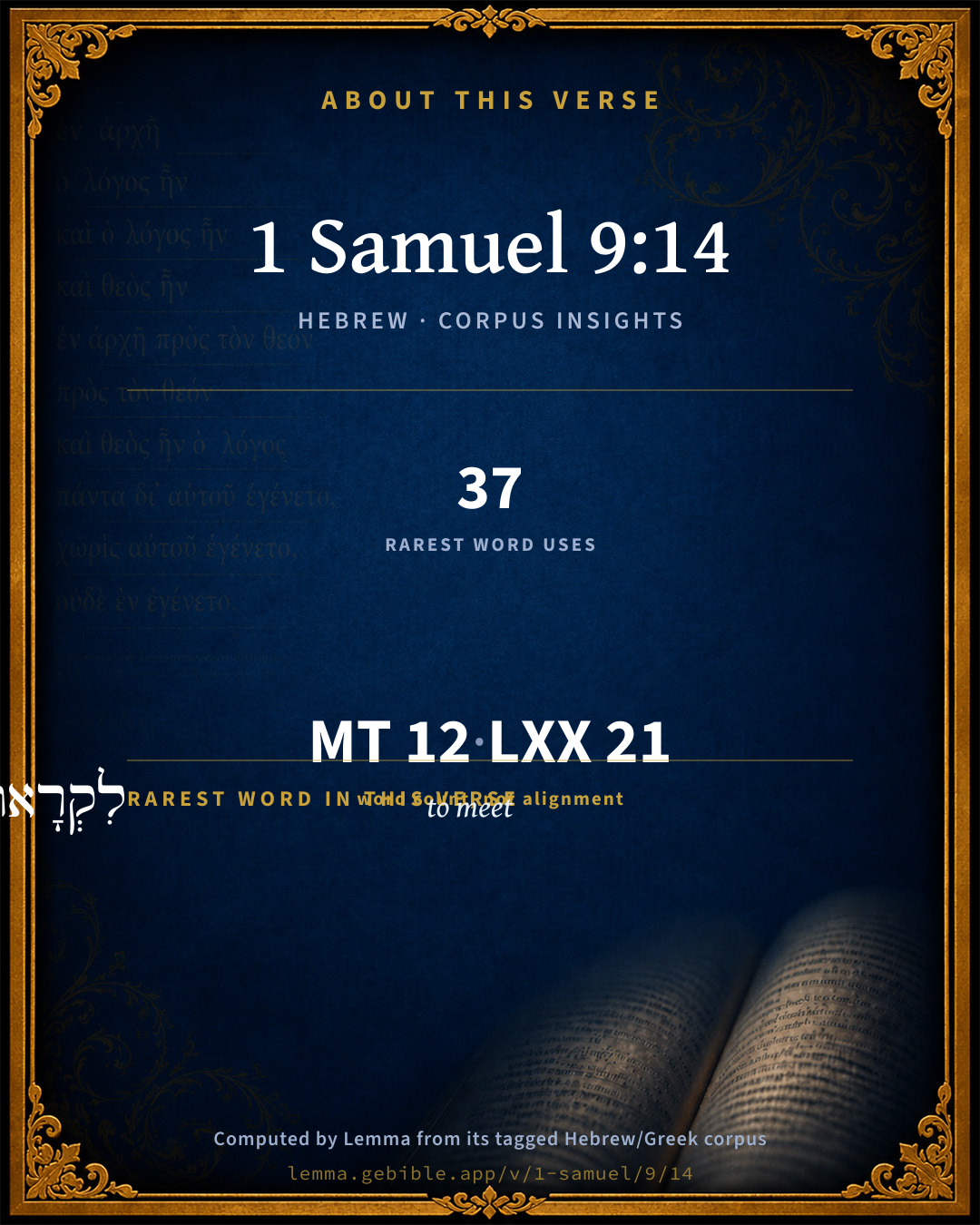
About this verse

These counts appear in no published source. They are computed here, from the morphology-tagged text and Lemma’s own curated glosses. What Lemma adds →

12
words
10
distinct lemmas
Historical
section

Shared distinctive vocabulary

לִקְרָאתָ֔ם to meet H7122 occurs in 35 verses of the Hebrew Bible. Also found in:

Grammatical profile

  • 5 verbs
  • 5 nouns
  • 1 pronoun
  • 1 particle

Verb forms

  • וַֽיַּעֲל֖וּ Qal · Sequential Imperfect
  • בָּאִים֙ Qal · Participle Active
  • יֹצֵ֣א Qal · Participle Active
  • לִקְרָאתָ֔ם Qal · Infinitive Construct
  • לַעֲל֖וֹת Qal · Infinitive Construct

Repetition

Words recur within this verse — often emphatic in Hebrew:

  • וַֽיַּעֲל֖וּ to go up H5927 ×2
  • הָעִ֑יר city H5892 ×2

Hebrew & Septuagint length

In English translation the verse runs 26 words from the Hebrew and 30 from the Septuagint (LXX English) — closely comparable.

A rough comparison of the two English renderings, which tokenize alike — not a word-level alignment.

Word counts can differ between the Hebrew and the Greek without any difference in meaning — e.g. the Hebrew direct-object marker אֵת has no separate Greek word, and Greek often adds the article ὁ.

In the original languages it is 12 Hebrew tokens and 21 Greek tokens — but the two are counted differently (Hebrew bundles its prefixes and suffixes into one token; the Greek is in lemma form), so that isn’t a like-for-like length.

Hebrew and Greek witnesses Masoretic Hebrew ↔ Greek Septuagint

The same verse in the two great witnesses to the Old Testament, shown verse-for-verse.

These are two independent witnesses, not word-aligned to each other, and the Septuagint is shown in lemma (dictionary) form.

Hebrew 1 Samuel 9:14 Masoretic · Westminster Leningrad Codex

וַֽיַּעֲל֖וּ הָעִ֑יר הֵ֗מָּה בָּאִים֙ בְּת֣וֹךְ הָעִ֔יר וְהִנֵּ֤ה שְׁמוּאֵל֙ יֹצֵ֣א לִקְרָאתָ֔ם לַעֲל֖וֹת הַבָּמָֽה

They went up to the city; [and] as they came within the city, behold, Samuel came out toward them, to go up to the high place.

World English Bible · Public Domain

Greek LXX 1 Samuel 9:14 Septuagint · lemma form

καί ἀναβαίνω ὁ πόλις αὐτός εἰςπορεύομαι εἰς μέσος ὁ πόλις καί ἰδού σαμουηλ ἐκἔρχομαι εἰς ἀπάντησις αὐτός ὁ ἀναβαίνω εἰς βαμα

And they go up to the city; and as they were entering into the midst of the city, behold, Samuel came out to meet them, to go up to Bama.

LXX2012 (modern English Septuagint) · Public Domain

Hebrew: Westminster Leningrad Codex (CC BY 4.0). Greek: Septuagint (public domain); English from LXX2012 (modern English Septuagint) (Public Domain). How the Septuagint differs from the Hebrew →

Targum (Aramaic paraphrase)

1

The Targum is the ancient Jewish Aramaic paraphrase of the Hebrew Scriptures — an interpretive translation, not the Hebrew text itself. Onkelos (literal) and Pseudo-Jonathan (expansive) render the Torah, and Jonathan the Prophets. Coverage is partial: where no permissively-licensed English translation exists for a verse, only the Aramaic is shown. This is verse-level text, not a word-by-word alignment to the Hebrew.

  1. Targum Jonathan Prophets (Joshua–Malachi)
    וּסְלִיקוּ לְקַרְתָּא אִינוּן עָלִין בְּגוֹ קַרְתָּא וְהָא שְׁמוּאֵל נָפֵיק לָקֳדָמוּתְהוֹן לְמִיסַק לְבֵית אַסְחֲרוּתָא:

    (no public-domain English translation for this verse)

    Targum Jonathan — Aramaic: “Mikraot Gedolot” (public domain). English: “Sefaria Community Translation” (CC0 1.0 (public-domain dedication)); “London "Chaldee Paraphrase," 1871” (public domain). Text via Sefaria.

Commentary

Notes on 1 Samuel 9:14 from classic Christian and Jewish commentators (each source and its license shown beneath its notes). The classic Christian expositions comment on the surrounding passage and are grouped to its opening verse, so a note may address several verses; the Jewish commentaries on the Tanakh (Rashi and others) are per-verse, so they appear only where the commentator wrote on this verse.

Lemma curates 59 commentaries, every one of them public domain or Creative Commons licensed, each selected and text-cleaned for this edition rather than reprinted as found. About our sources →

Trapp's Complete Commentary

John Trapp

1Sa 9:14 And they went up into the city: [and] when they were come into the city, behold, Samuel came out against them, for to go up to the high place.

Ver. 14. Samuel came out against them.] Not without divine direction. {1Sa 9:15} When God will have a thing done, there shall be a sweet subordination of causes, and all things shall cooperate.

John Trapp, A Commentary or Exposition upon All the Books of the Old and New Testament (1647–1656) — public domain. Text from a community e-Sword module.

Joseph Benson's Commentary

1Sa 9:14-15. Behold, Samuel came out against them — Met them directly in his way to the sacrifice. For so God, in his providence, had disposed things, as it follows in the next words. The Lord had told Samuel in his ear — That is, secretly, perhaps by a small, still voice. In the Hebrew it is, He revealed, or uncovered the ear of Samuel.

Joseph Benson's Commentary on the Old and New Testaments (1811–1818) — public domain. Text from a community e-Sword module.

Jamieson, Fausset & Brown

Robert Jamieson, A. R. Fausset & David Brown

Samuel came out against them, for to go up to the high place--Such were the simple manners of the times that this prophet, the chief man in Israel, was seen going to preside at a high festival undistinguished either by his dress or equipage from any ordinary citizen.

Jamieson, Fausset & Brown — Commentary Critical and Explanatory on the Whole Bible (1871) — public domain (CC PDM 1.0). Text via the HelloAO Bible API.

Adam Clarke's Commentary

Verse 14. Come out against them] Met them.

Adam Clarke's Commentary on the Bible (1810–1826) — public domain. Text from a community e-Sword/MySword module.

Ellicott's Commentary for English Readers

(14) Behold, Samuel came out against them.—“Saul comes before Samuel, bashfully pursuing his humble quest, in apparent unconsciousness of the power slumbering within him of aspiring and attaining to the highest place; the great seer receives him in a way quite different from all that he could have hoped or feared. At the moment of their meeting the seer has come forth from his house on the way to the solitary sacred heights of Ramah, the city of his residence, where he sacrifices on the altar to Jahveh, or is wont to partake of a sacred sacrificial repast with some of his closest friends. He at once desires to take Saul also with him, telling him beforehand how unimportant was the immediate object of his inquiries, and that the matter was already settled; but that for him and his whole house was reserved a very different and far better destiny in Israel. And though Saul, in his unassuming simplicity, would fain waive the honour which is obscurely hinted (so little does he yet know his better self), the holy man, more discerning, takes him with him to the sacrificial meal, which is already prepared; nay, assigns him the place of honour among the thirty guests before invited, while he is served with a portion of the sacrificial meat, put by, as it were, specially for him: for in like manner a portion other and higher than that of ordinary men had been long reserved for him by heaven.”—Ewald.

A Bible Commentary for English Readers, edited by Charles John Ellicott (1878–1897) — public domain. Text from a community e-Sword module.

The Cambridge Bible for Schools and Colleges

gen. ed. J. J. S. Perowne

14. and when they were come into the city] Rather, as they were coming into the midst of the city, behold Samuel was coming out to meet them. In the E. V. this verse apparently disagrees with 1Sa_9:18. The correct translation makes all clear. Saul and his servant ascend the hill. As they enter the city they meet Samuel “in the gate” (1Sa_9:18).

The Sept. reads “gate” here, and “city” in 1Sa_9:18, but the change is unnecessary.

The high place was either on the top of the hill on the slope of which the city stood, or on the adjacent hill from which the city had its name Ramathaim (“the two heights”). See note on 1Sa_1:1.

‘Against’ here = ‘opposite to,’ as in Gen_15:10. So Tyndale in Gen_32:1 has “Jacob saw the angels of God come against him.”

The Cambridge Bible for Schools and Colleges (gen. ed. J. J. S. Perowne; Cambridge University Press, 1878–1918) — public domain. Text from a community e-Sword module.

John Gill's Exposition

And they went up into the city,.... Saul and his servant went up the hill to the city of Ramah: and

when they were come into the city; were within it, within the walls of it:

behold, Samuel came out against them; came out of a door of his house upon them, just as they came up: or "to meet them" (i); his way to the high place lay where they were coming; unless it can be thought he went out purposely to meet them, having, as in the following verse, an intimation, that about that time one from the tribe of Benjamin, who should be king, would come to him, and so made this his way, knowing that one coming from that tribe must come that way; but it seems most likely that this was his readiest way:

for to go up to the high place; or place of sitting down, or feasting, as the Targum; see Gill on Sa1 9:12.

(i) "in occursum eorum", Pagninus, Montanus; "eis obviam", V. L. Tigurine version.

John Gill's Exposition of the Whole Bible (1746–1763) — public domain (CC PDM 1.0). Text via the HelloAO Bible API.

Haydock's Catholic Bible Commentary

Midst. That is, simply in the city, or entering the gate, where Samuel met them, ver. 18.

George Leo Haydock (1774–1849), Haydock's Catholic Family Bible and Commentary, 1859 edition — public domain. Excludes Psalms (Douay-Rheims chapter numbering differs from Protestant) and Deuterocanonical books (Catholic canon only).

Matthew Poole's English Annotations

Samuel came out; out of his own house, just as they passed by.

Matthew Poole's English Annotations on the Holy Bible (1683–1685) — public domain. Text from a community e-Sword/MySword module.

The Pulpit Commentary

When they were come into. More correctly, "As they were going into the city." This agrees with what is said in ver. 18, that Saul and Samuel met in the gateway. As Ramah occupied two hills, the Bamah would be on the summit of one, while the city probably nestled between them.

The Pulpit Commentary (1880–1919), ed. H.D.M. Spence-Jones & Joseph S. Exell — public domain. Text from a community e-Sword module.

Keil & Delitzsch

C. F. Keil & F. Delitzsch

When they went into the town, Samuel met them on his way out to go to the high place of sacrifice. Before the meeting itself is described, the statement is introduced in Sa1 9:15-17, that the day before Jehovah had foretold to Samuel that the man was coming to him whom he was to anoint as captain over his people. אזן גּלה, to open any one's ear, equivalent to reveal something to him (Sa1 20:12; Sa2 7:27, etc.). אשׁלח, I will send thee, i.e., "I will so direct his way in my overruling providence, that he shall come to thee" (J. H. Mich. ). The words, "that he may save my people out of the hand of the Philistines; for I have looked upon my people, for their cry is come unto me," are not at all at variance with Sa1 7:13. In that passage there is simply the assertion, that there was no more any permanent oppression on the part of the Philistines in the days of Samuel, such as had taken place before; but an attempt to recover their supremacy over Israel is not only not precluded, but is even indirectly affirmed (see the comm. on Sa1 7:13). The words before us simply show that the Philistines had then begun to make a fresh attempt to contend for dominion over the Israelites. "I have looked upon my people:" this is to be explained like the similar passage in Exo 2:25, "God looked upon the children of Israel," and Exo 3:7, "I have looked upon the misery of my people." God's looking was not a quiet, inactive looking on, but an energetic look, which brought help in trouble. "Their cry is come unto me:" this is word for word the same as in Exo 3:9. As the Philistines wanted to tread in the footsteps of the Egyptians, it was necessary that Jehovah should also send His people a deliverer from these new oppressors, by giving them a king. The reason here assigned for the establishment of a monarchy is by no means at variance with the displeasure which God had expressed to Samuel at the desire of the people for a king (Sa1 8:7.); since this displeasure had reference to the state of heart from which the desire had sprung.

Keil & Delitzsch — Biblical Commentary on the Old Testament (1861–1891) — public domain (CC PDM 1.0). Text via the HelloAO Bible API. (Old Testament only.)

unfoldingWord translationNotes

Door43 World Missions Community

to go up to the high place

This is a place that the people had designated as holy to make sacrifices and offerings to Yahweh. The writer writes as though it were outside the wall that was around the city.

translationWords

Samuel

high place

unfoldingWord translationNotes — © Distant Shores Media and the Door43 World Missions Community, licensed CC BY-SA 4.0. Source: git.door43.org/Door43/en_tn.

Lesson kit

Teaching starters — assembled from the data on this page, not authored interpretation. Every prompt links to the verse data it draws on. Edit before teaching.

1 Samuel, in the Historical, opens this verse with 12 words (10 distinct Hebrew lemmas). Its most distinctive word is qârâʼ (“to meet”). A historical commentator’s framing appears above. Read the whole chapter for the surrounding context.

Discussion questions

  1. The word qârâʼ carries the sense “to meet.” How does it shape the verse?
  2. Genesis 42:4 shares the word «to meet» with this verse. How do the two illuminate each other?
  3. “to go up” occurs 2× in this one verse. What is the effect of the repetition?
  4. The translations on this page render this verse differently — a whole-verse word diff, not a word-by-word alignment. What might account for the different wordings?
  5. The verb «וַֽיַּעֲל֖וּ» is Qal Sequential Imperfect. How does its form color the action?
  6. Reading how Trapp's Complete Commentary and Joseph Benson's Commentary read this verse, where do the two commentators agree and where do they part?

Things to notice

Reading settings

Reading text

Shown beneath each verse's original-language words.

Old Testament
Old Testament edition

Read the OT as the Masoretic Hebrew (MT) or the Greek Septuagint (LXX).

English shown for the Greek Septuagint (in the Hebrew ↔ Greek comparison).

Comparing translations? Open the Compare panel on any verse page to stack up to four side by side.