
Numbers 9:7

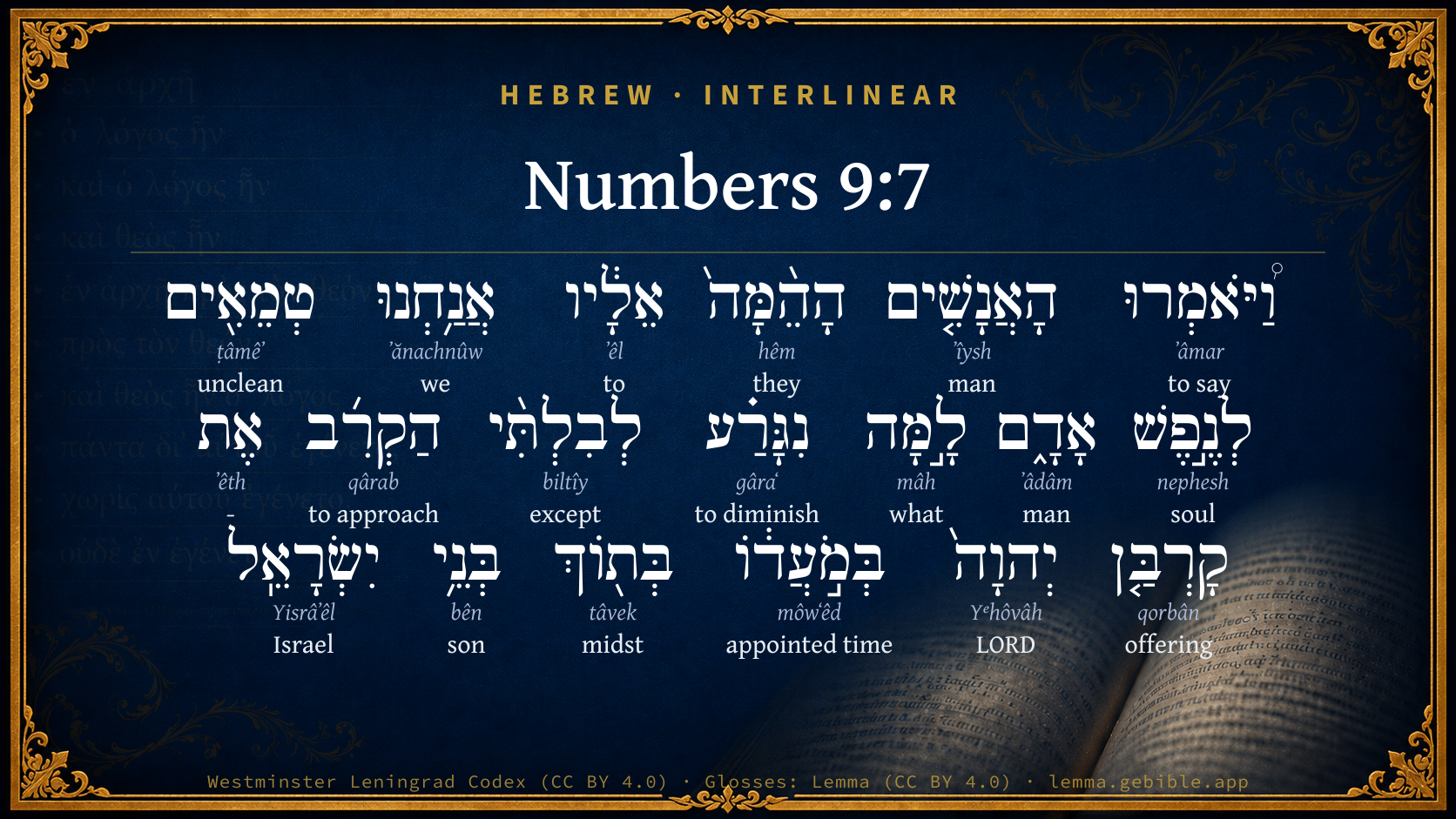
Hebrew (Westminster Leningrad Codex) Numbers 9:7 appears in the Hebrew Old Testament. The text above is from the Westminster Leningrad Codex. Each word links to its Strong’s number, a concise gloss, and parsing drawn from the Open Scriptures Hebrew Bible morphology. Click any word for its full Brown-Driver-Briggs (BDB) entry.
Download image
Cite this verse

Numbers 9:7 (World English Bible). Public Domain. Lemma interlinear Bible study tool, https://lemma.gebible.app/v/numbers/9/7.

Show BibTeX & RIS
BibTeX
RIS
English Translation
Those men said to him, "We are unclean because of the dead body of a man. Why are we kept back, that we may not offer the offering of Yahweh in its appointed season among the children of Israel?"
World English Bible · Public Domain
Download a study sheet

One document with this verse’s original text, its word-by-word gloss line, the meaning frame, cross-references with their text, attributed commentary, and full source and license credits — printable, and it pastes into notes with its structure intact.

This verse Autodidact and up

Study sheet (.html) Plain text (.txt)

A passage Seminary Student

Up to 50 verses in one chapter. A passage sheet keeps up to 6 commentary sources and 12 cross-references per verse, in the order this page ranks them, and says so on the sheet whenever that leaves anything out. Ask for a single verse and you get the Autodidact verse sheet above.

Everything on this page stays free to read, with no account — the sheet is a download of what is already on screen, not access to it.

Want to remove ads? Support Godless Engineer
Compare translations 3

The same verse in 3 English versions, stacked beneath the original-language interlinear above. Click any original word for its lexicon entry.

Each is an independent rendering of the whole verse — the interlinear is not word-aligned to these translations.

Highlighted words mark where these versions differ — a whole-verse word diff, not a word-by-word alignment.

  • World English Bible Public Domain
    Those men said to him, "We are unclean because of the dead body of a man. Why are we kept back, that we may not offer the offering of Yahweh in its appointed season among the children of Israel?"
  • King James Version Public Domain
    And those men said unto him, We are defiled by the dead body of a man: wherefore are we kept back, that we may not offer an offering of the LORD in his appointed season among the children of Israel?
  • unfoldingWord Literal Text CC BY-SA 4.0
    And those men said to him, “We unclean to a person of a man. Why are we taken away not to present the offering of Yahweh in its appointed time in the midst of the sons of Israel?”

unfoldingWord Literal Text — © unfoldingWord, licensed CC BY-SA 4.0. Word-aligned USFM3 via Door43 (git.door43.org/unfoldingWord/en_ult).

Versions to compare (up to 4)

3 of 4 selected

Show all 18 translations

Every available English version of this verse, each an independent rendering of the whole verse.

  • World English Bible Public Domain
    Those men said to him, "We are unclean because of the dead body of a man. Why are we kept back, that we may not offer the offering of Yahweh in its appointed season among the children of Israel?"
  • Berean Standard Bible Public Domain
    and said to Moses, “We are unclean because of a dead body, but why should we be excluded from presenting the LORD’s offering with the other Israelites at the appointed time?”
  • Majority Standard Bible Public Domain
    and said to Moses, “We are unclean because of a dead body, but why should we be excluded from presenting the LORD’s offering with the other Israelites at the appointed time?”
  • King James Version Public Domain
    And those men said unto him, We are defiled by the dead body of a man: wherefore are we kept back, that we may not offer an offering of the LORD in his appointed season among the children of Israel?
  • American Standard Version (1901) Public Domain
    and those men said unto him, We are unclean by reason of the dead body of a man: wherefore are we kept back, that we may not offer the oblation of Jehovah in its appointed season among the children of Israel?
  • Revised Version (1885) Public Domain
    and those men said unto him, We are unclean by the dead body of a man: wherefore are we kept back, that we may not offer the oblation of the LORD in its appointed season among the children of Israel?
  • Geneva Bible (1599) Public Domain
    And those men said vnto him, We are defiled by a dead man: wherefore are wee kept backe that we may not offer an offering vnto the Lord in the time thereunto appointed among the children of Israel?
  • Douay-Rheims (1899) Public Domain
    Said to them: We are unclean by occasion of the soul of a man. Why are we kept back that we may not offer in its season the offering to the Lord among the children of Israel?
  • Young's Literal Translation Public Domain
    and those men say unto him, `We are defiled by the body of a man; why are we withheld so as not to bring near the offering of Jehovah in its appointed season, in the midst of the sons of Israel?'
  • Literal Standard Version CC BY-SA 4.0
    and those men say to him, “We are defiled by the body of a man; why are we withheld so as not to bring the offering of YHWH near in its appointed time, in the midst of the sons of Israel?”
  • Unlocked Literal Bible CC BY-SA 4.0
    Those men said to Moses, “We are unclean because of the dead body of a man. Why do you keep us from offering the sacrifice to Yahweh at the fixed time of year among the people of Israel?”
  • unfoldingWord Literal Text CC BY-SA 4.0
    And those men said to him, “We unclean to a person of a man. Why are we taken away not to present the offering of Yahweh in its appointed time in the midst of the sons of Israel?”
  • Darby Bible Public Domain
    And those men said to him, We are unclean by reason of the dead body of a man: why are we kept back, that we may not present the offering of Jehovah at its set time among the children of Israel?
  • World Messianic Bible Public Domain
    Those men said to him, “We are unclean because of the dead body of a man. Why are we kept back, that we may not offer the offering of the LORD in its appointed season among the children of Israel?”
  • Webster's Bible Public Domain
    And those men said to him, We are defiled by the dead body of a man: why are we kept back, that we may not offer an offering of the LORD in its appointed season among the children of Israel?
  • Free Bible Version CC BY-SA 4.0
    and explained to Moses, “We are unclean because of a dead body, but why should that mean we're prevented from giving our offering to the Lord with the other Israelites at the appropriate time?”
  • Bible in Basic English Public Domain
    And these men said to him, We have been made unclean by the dead body of a man; why may we not make the offering of the Lord at the regular time among the children of Israel?
  • JPS Tanakh (1917) Public Domain
    And those men said unto him: 'We are unclean by the dead body of a man; wherefore are we to be kept back, so as not to bring the offering of the LORD in its appointed season among the children of Israel?'

Literal Standard Version (2020), Covenant Press — licensed CC BY-SA 4.0. Text via the HelloAO Bible API (eBible.org). Unlocked Literal Bible (unfoldingWord) — licensed CC BY-SA 4.0. Text via the HelloAO Bible API (eBible.org). unfoldingWord Literal Text — © unfoldingWord, licensed CC BY-SA 4.0. Word-aligned USFM3 via Door43 (git.door43.org/unfoldingWord/en_ult). Free Bible Version, Dr. Jonathan Gallagher — licensed CC BY-SA 4.0. Text via the HelloAO Bible API (eBible.org).

Word by word

More ways to search: Search by grammar → Find every occurrence → Compare this word →

Practice this passage: Drill this verse → Learn its vocabulary →

נִגָּרַ֗ע
gâraʻ
H1639
“to diminish”
Verb, Niphal, Imperfect, 1st Person, Common, Plural
Part of Speech
Verb
Stem
Niphal
Form
Imperfect
Person
1st Person
Gender
Common
Number
Plural
Full BDB Definition

Origin: a primitive root

TWOT: 384

to diminish, restrain, withdraw, abate, keep back, do away, take from, clip - (Qal) - to diminish - to restrain - to withdraw - (Niphal) - to be withdrawn - to be restrained - (Piel) to withdraw, draw up
  1. וַ֠יֹּאמְרוּ ʼâmar H559 “and · to say” Conjunction + Verb, Qal, Sequential Imperfect, 3rd Person, Masculine, Plural
  2. הָאֲנָשִׁ֤ים ʼîysh H376 “the · men” Particle, Definite Article + Noun, Common, Masculine, Plural, Absolute
  3. הָהֵ֨מָּה֙ hêm H1992 “the · they” Particle, Definite Article + Pronoun, Personal, 3rd Person, Masculine, Plural
  4. אֵלָ֔יו ʼêl H413 “to · him” Preposition + Suffix, Personal, 3rd Person, Masculine, Singular
  5. אֲנַ֥חְנוּ ʼănachnûw H587 “we” Pronoun, Personal, 1st Person, Common, Plural
  6. טְמֵאִ֖ים ṭâmêʼ H2931 “unclean” Adjective, Adjective, Masculine, Plural, Absolute
  7. לְנֶ֣פֶשׁ nephesh H5315 “to/for · soul of” Preposition + Noun, Common, Both, Singular, Construct
  8. אָדָ֑ם ʼâdâm H120 “man” Noun, Common, Masculine, Singular, Absolute
  9. לָ֣מָּה mâh H4100 “to/for · what” Preposition + Particle, Interrogative
  10. לְבִלְתִּ֨י biltîy H1115 “to/for · except” Preposition + Conjunction
  11. הַקְרִ֜ב qârab H7126 “to approach” Verb, Hiphil, Infinitive Construct
  12. אֶת ʼêth H853 “-” Particle, Direct Object
  13. קָרְבַּ֤ן qorbân H7133 “offering of” Noun, Common, Masculine, Singular, Construct
  14. יְהוָה֙ Yᵉhôvâh H3068 “LORD” Noun, Proper
  15. בְּמֹ֣עֲד֔וֹ môwʻêd H4150 “in/at · appointed time · his” Preposition + Noun, Common, Masculine, Singular, Construct + Suffix, Personal, 3rd Person, Masculine, Singular
  16. בְּת֖וֹךְ tâvek H8432 “in/at · midst of” Preposition + Noun, Common, Masculine, Singular, Construct
  17. בְּנֵ֥י bên H1121 “sons of” Noun, Common, Masculine, Plural, Construct
  18. יִשְׂרָאֵֽל Yisrâʼêl H3478 “Israel” Noun, Proper

About this verse

These counts appear in no published source. They are computed here, from the morphology-tagged text and Lemma’s own curated glosses. What Lemma adds →

19
words
19
distinct lemmas
Pentateuch
section

Notable vocabulary

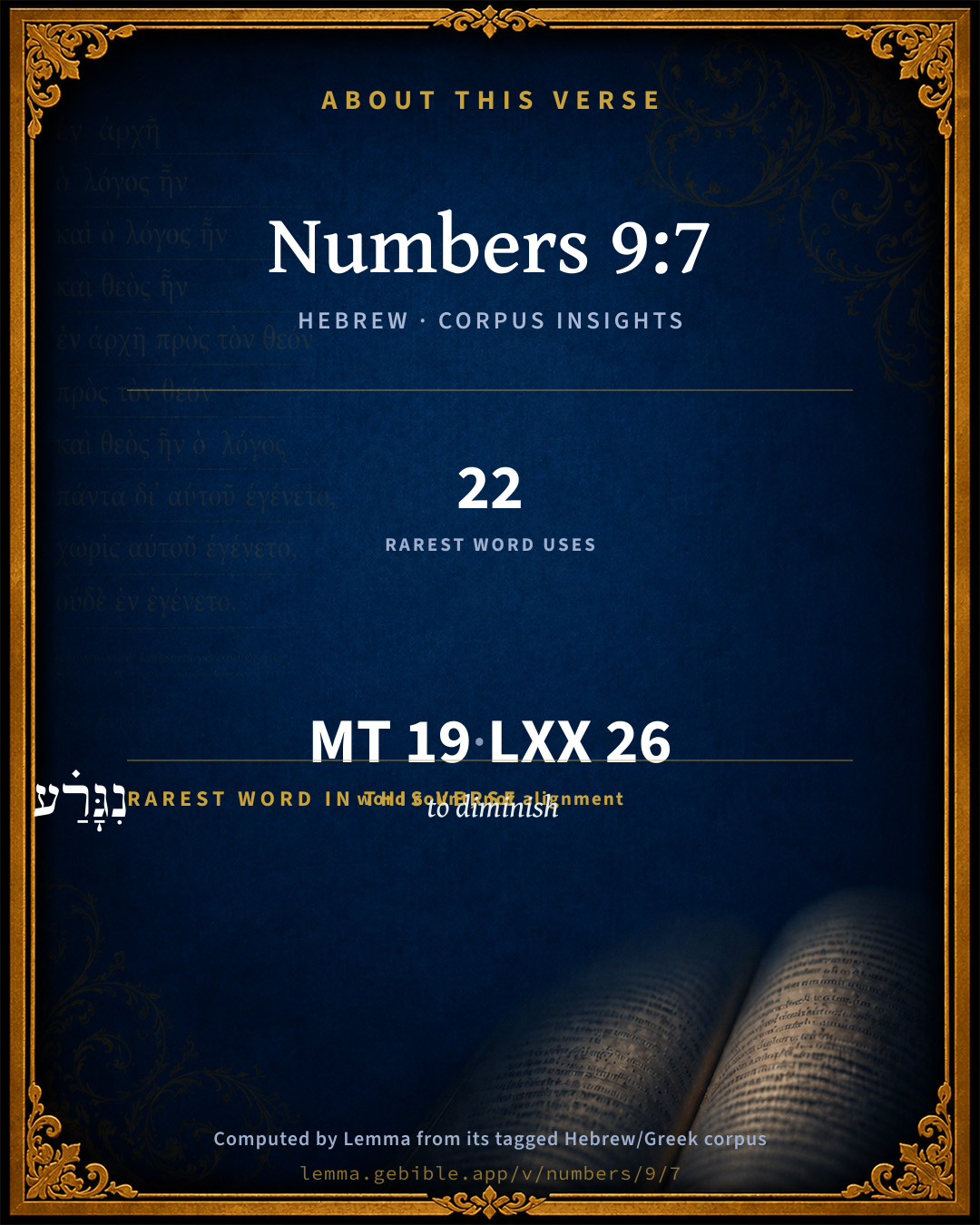
The rarest word here is נִגָּרַ֗ע to diminish H1639 — appearing just 22 times in the whole Hebrew Bible.

Shared distinctive vocabulary

נִגָּרַ֗ע to diminish H1639 occurs in 21 verses of the Hebrew Bible. Also found in:

Grammatical profile

  • 3 verbs
  • 9 nouns
  • 1 adjective
  • 2 pronouns
  • 1 preposition
  • 1 conjunction
  • 2 particles

Verb forms

  • וַ֠יֹּאמְרוּ Qal · Sequential Imperfect
  • נִגָּרַ֗ע Niphal · Imperfect
  • הַקְרִ֜ב Hiphil · Infinitive Construct

Hebrew & Septuagint length

In English translation the verse runs 39 words from the Hebrew and 40 from the Septuagint (LXX English) — closely comparable.

A rough comparison of the two English renderings, which tokenize alike — not a word-level alignment.

Word counts can differ between the Hebrew and the Greek without any difference in meaning — e.g. the Hebrew direct-object marker אֵת has no separate Greek word, and Greek often adds the article ὁ.

In the original languages it is 19 Hebrew tokens and 26 Greek tokens — but the two are counted differently (Hebrew bundles its prefixes and suffixes into one token; the Greek is in lemma form), so that isn’t a like-for-like length.

Cross-references

5

Topical passages linked to Numbers 9:7 in the Treasury of Scripture Knowledge — connected by theme and wording, ordered by reader-vote popularity; previews shown in the World English Bible.

  • Exodus 12:27 that you shall say, 'It is the sacrifice of Yahweh's Passover, who passed over the houses of the children of Israel in Egypt, when he struck the Egyptians, and spared our houses.'" The people bowed their heads and worshiped.
  • Numbers 9:2 "Moreover let the children of Israel keep the Passover in its appointed season.
  • Deuteronomy 16:2 You shall sacrifice the Passover to Yahweh your God, of the flock and the herd, in the place which Yahweh shall choose, to cause his name to dwell there.
  • 2 Chronicles 30:17–19 For there were many in the assembly who had not sanctified themselves: therefore the Levites had the charge of killing the Passovers for everyone who was not clean, to sanctify them to Yahweh.
  • 1 Corinthians 5:7–8 Purge out the old yeast, that you may be a new lump, even as you are unleavened. For indeed Christ, our Passover, has been sacrificed in our place.

Cross-references courtesy of OpenBible.info (CC BY 4.0).

Hebrew and Greek witnesses Masoretic Hebrew ↔ Greek Septuagint

The same verse in the two great witnesses to the Old Testament, shown verse-for-verse.

These are two independent witnesses, not word-aligned to each other, and the Septuagint is shown in lemma (dictionary) form.

Hebrew Numbers 9:7 Masoretic · Westminster Leningrad Codex

וַ֠יֹּאמְרוּ הָאֲנָשִׁ֤ים הָהֵ֨מָּה֙ אֵלָ֔יו אֲנַ֥חְנוּ טְמֵאִ֖ים לְנֶ֣פֶשׁ אָדָ֑ם לָ֣מָּה נִגָּרַ֗ע לְבִלְתִּ֨י הַקְרִ֜ב אֶת קָרְבַּ֤ן יְהוָה֙ בְּמֹ֣עֲד֔וֹ בְּת֖וֹךְ בְּנֵ֥י יִשְׂרָאֵֽל

Those men said to him, "We are unclean because of the dead body of a man. Why are we kept back, that we may not offer the offering of Yahweh in its appointed season among the children of Israel?"

World English Bible · Public Domain

Greek LXX Numbers 9:7 Septuagint · lemma form

καί εἶπον ὁ ἀνήρ ἐκεῖνος πρός αὐτός ἐγώ ἀκάθαρτος ἐπί ψυχή ἄνθρωπος μή οὖν ὑστερέω προςφέρω ὁ δῶρον κύριος κατά καιρός αὐτός ἐν μέσος υἱός ἰσραήλ

And those men said to Moses, We are unclean by reason of the dead body of a man: shall we therefore fail to offer the gift to the Lord in its season in the midst of the children of Israel?

LXX2012 (modern English Septuagint) · Public Domain

Hebrew: Westminster Leningrad Codex (CC BY 4.0). Greek: Septuagint (public domain); English from LXX2012 (modern English Septuagint) (Public Domain). How the Septuagint differs from the Hebrew →

Targum (Aramaic paraphrase)

2

The Targum is the ancient Jewish Aramaic paraphrase of the Hebrew Scriptures — an interpretive translation, not the Hebrew text itself. Onkelos (literal) and Pseudo-Jonathan (expansive) render the Torah, and Jonathan the Prophets. Coverage is partial: where no permissively-licensed English translation exists for a verse, only the Aramaic is shown. This is verse-level text, not a word-by-word alignment to the Hebrew.

  1. Targum Onkelos Torah (Genesis–Deuteronomy)
    וַאֲמָרוּ גֻבְרַיָא הָאִנוּן לֵהּ אֲנַחְנָא מְסָאֲבִין לִטְמֵי נַפְשָׁא דֶאֱנָשָׁא לְמָא נִתְמְנַע בְּדִיל דְלָא לְקָרָבָא יָת קֻרְבָּנָא דַיְיָ בִּזִמְנֵיה בְּגוֹ בְּנֵי יִשְׂרָאֵל

    (no public-domain English translation for this verse)

    Targum Onkelos — Aramaic: “Onkelos Genesis” (public domain); “Onkelos Exodus” (public domain); “Onkelos Leviticus” (public domain); “Onkelos Numbers” (public domain); “Onkelos Deuteronomy” (public domain). English: “Sefaria Community Translation” (CC0 1.0 (public-domain dedication)); “J.W. Etheridge. The Targums of Onkelos and Jonathan Ben Uzziel on the Pentateuch. London: Longmans, Green, 1862” (public domain). Text via Sefaria.

  2. Targum Pseudo-Jonathan Torah (Genesis–Deuteronomy)
    וְאָמָרוּ גוּבְרַיָא הָאִינוּן לֵיהּ אֲנַחְנָא אִסְתְּאַבְנָא לְבַר נַשׁ דְמִית עֲלָנָא לְמָה כְעַן נִתְמְנַע בְּגִין דְלָא לְמֵיכוֹס פִּסְחָא וּלְמִזְרוֹק אַדְמָא דְקוּרְבָּנָא דַיְיָ עַל מַדְבְּחָא בִּזְמַנֵיהּ וּבִשְרֵיהּ יֵיכְלוּן דַכְיָין בְּגוֹ בְּנֵי יִשְרָאֵל

    and these men said to him, We are unclean, on account of a man who died with us: therefore we are hindered from killing the Pascha, and shedding the blood of the Lord's oblation upon the altar at its time, that we may eat its flesh, being clean, among the children of Israel.

    Targum Pseudo-Jonathan — Aramaic: “Targum Jonathan on Genesis” (public domain); “Targum Jonathan on Exodus” (public domain); “Targum Jonathan on Leviticus” (public domain); “Targum Jonathan on Numbers” (public domain); “Targum Jonathan on Deuteronomy” (public domain). English: “The Targum of Jonathan ben Uzziel, trans. J. W. Etheridge, London, 1862” (public domain). Text via Sefaria.

Commentary

Notes on Numbers 9:7 from classic Christian and Jewish commentators (each source and its license shown beneath its notes). The classic Christian expositions comment on the surrounding passage and are grouped to its opening verse, so a note may address several verses; the Jewish commentaries on the Tanakh (Rashi and others) are per-verse, so they appear only where the commentator wrote on this verse.

Lemma curates 59 commentaries, every one of them public domain or Creative Commons licensed, each selected and text-cleaned for this edition rather than reprinted as found. About our sources →

Trapp's Complete Commentary

John Trapp

Num 9:7 And those men said unto him, We [are] defiled by the dead body of a man: wherefore are we kept back, that we may not offer an offering of the LORD in his appointed season among the children of Israel?

Ver. 7. And those men said unto him.] Moses they knew was a meet man to resolve this case of conscience. He was a messenger, an interpreter, "one among a thousand, to show unto man his uprightness," {Job 33:23} a merchant to sell oil and balm from Gilead, to cure consciences. {Mat 25:9} Others may write cases, that is, covers of conscience; but resolve none. Conscience is a diamond, and will be wrought on by nothing but dust of diamond, such as contrition hath ground it to.

John Trapp, A Commentary or Exposition upon All the Books of the Old and New Testament (1647–1656) — public domain. Text from a community e-Sword module.

Joseph Benson's Commentary

Num 9:7. Wherefore are we kept back — They thus confidently expostulate with Moses, because in the first institution of the passover no mention is made of excluding such unclean persons from that ordinance. And although it might possibly have been inferred from the law recorded Lev 7:20, that persons in their condition were not to partake of that sacrifice; yet, considering that all the Israelites were expressly commanded to celebrate the passover, (Exo 12:47,) they might well entertain doubts respecting their duty in this matter, and therefore have recourse to Moses for decision. That we may not offer an offering — Which if we neglect we must be cut off, and if we keep it in these circumstances, we must also be cut off. What shall we do?

Joseph Benson's Commentary on the Old and New Testaments (1811–1818) — public domain. Text from a community e-Sword module.

Geneva Bible (1599)

Geneva Bible translators

Or, celebrate the Passover the fourteenth day of the first month.

Geneva Bible (1599) marginal notes — public domain. Text via Bolls.life.

Adam Clarke's Commentary

Verse 7. We are defiled by the dead body of a man] It is probable that the defilement mentioned here was occasioned by assisting at the burial of some person - a work both of necessity and mercy. This circumstance however gave rise to the ordinance delivered in Nu 9:10-14, so that on particular occasions the passover might be twice celebrated:

1. At its regular time, the 14th of the first month;

2. An extra time, the 14th of the second month.

But the man who had no legal hinderance, and did not celebrate it on one or other of these times, was to be cut off from the people of God; and the reason given for this cutting off is, that he brought not the offering of God in his appointed season-therefore that man shall bear his sin, Nu 9:13.

We have already seen, from the authority of St. Paul, that Christ, our Passover, is sacrificed for us; and that it was his sacrifice that was pointed out by the paschal lamb: on this, therefore, we may observe, that those who do not sooner or later eat the true Passover, and get the salvation procured by the sprinkling of his blood, shall be cut off from among those that shall enter into the rest prepared for the people of God; and for the same reason too; they bring not the offering of God in its appointed season, and therefore they shall bear their sin.

Adam Clarke's Commentary on the Bible (1810–1826) — public domain. Text from a community e-Sword/MySword module.

Ellicott's Commentary for English Readers

(7) An offering.—Better, the offering, or oblation.

A Bible Commentary for English Readers, edited by Charles John Ellicott (1878–1897) — public domain. Text from a community e-Sword module.

John Gill's Exposition

And Moses said unto them, stand still,.... Where they were; Aben Ezra says, at the door of the tabernacle of the congregation:

and I will hear what the Lord will command concerning you; as it was a singular case, of which there had been no instance before, Moses would not determine anything about it himself, but would inquire of the Lord his mind and will concerning it; and for that purpose, very probably, went into the most holy place, where the Lord had promised to meet him and commune with him, from off the mercy seat, about any matter of difficulty he should inquire about, Exo 25:22.

John Gill's Exposition of the Whole Bible (1746–1763) — public domain (CC PDM 1.0). Text via the HelloAO Bible API.

Matthew Poole's English Annotations

Which if we neglect, we must be cut off; and if we keep it in these circumstances, we must also be cut off. What shall we do? The passover is called

an offering of the Lord, because it was both killed and eaten in obedience to God’s command, and to God’s honour, and as a thank-offering to God for his great mercies.

Matthew Poole's English Annotations on the Holy Bible (1683–1685) — public domain. Text from a community e-Sword/MySword module.

Whedon's Commentary on the Bible

Daniel D. Whedon

7. Kept back — Greek, fall short or fail; Vulgate, defrauded. Since their defilement was involuntary, and even commendable, arising as it did from attending to the burial of the dead, the demand was reasonable, and worthy of being carried to the Lord.

Daniel D. Whedon (gen. ed.), Commentary on the Old and New Testaments (1874–1909) — public domain. Text from a community e-Sword module.

The Pulpit Commentary

Wherefore are we kept back. The direction to remove from the camp all that were defiled by the dead (Num_5:2) had not apparently been given at this time, nor was there any express command that such should not partake of the passover, for Lev_7:20 may probably refer only to such uncleannesses as are mentioned in Lev_15:3; but that men were in fact considered as defiled by contact with the dead is clear from Lev_21:1. The men, therefore, had reason for asking why they were excommunicated, and Moses for referring the matter to the Divine decision.

The Pulpit Commentary (1880–1919), ed. H.D.M. Spence-Jones & Joseph S. Exell — public domain. Text from a community e-Sword module.

John Wesley's Explanatory Notes

An offering - Which if we neglect, we must be cut off, and if we keep it in these circumstances, we must also be cut off. What shall we do?

John Wesley, Explanatory Notes Upon the Whole Bible (1754–1765) — public domain. Text via the GEBible commentary corpus.

Rashi

Rabbi Shlomo Yitzchaki (Rashi)

למה נגרע WHEREFORE ARE WE KEPT BACK? — He (Moses) had said to them, “Sacrifices are not permitted to be offered by anyone who is in a state of uncleanness”. They retorted, “למה נגרע” — Why should that prevent us? Let the blood be sprinkled on our behalf by clean priests, and let the flesh be eaten by the clean”. (i.e. let us partake of the flesh at night when we shall already be clean: see Note). Thereupon he said to them: “Stand still (i.e. wait a short time) and I will hear [what the Lord will command concerning you]” — he said this with confidence, like a pupil who is certain that he will get information from his teacher at any time. Happy, indeed, is a human being (lit., one born of woman) who may so confidently rely that at any time when he wishes to do so he may speak with the Shechinah! — This section, in fact, ought to have been said by Moses, just as all the other sections of the Torah, only that these men were privileged that it should be promulgated through their intervention, because “meritorious deeds are brought about by worthy men” (Sifrei Bamidbar 68; Bava Batra 119b).

Rashi on the Tanakh — English translations: “The Judaica Press complete Tanach with Rashi, translated by A. J. Rosenberg” (CC BY 4.0); “Pentateuch with Rashi's commentary by M. Rosenbaum and A.M. Silbermann, 1929-1934” (public domain); “The Metsudah Tanach series, Lakewood, N.J” (CC BY 4.0); and “The Book of Joshua, Metsudah Publications, 1997” (CC BY 4.0). Text via Sefaria.

Sforno

Rabbi Ovadia Sforno

Why should we be excluded. Their claim was that since their impurity had been caused by a mitzvah, why should it be something that causes a transgression?

In its proper time. The opportunity for this mitzvah will pass when the time passes.

Sforno on the Tanakh — English translation: “Yalkut, Sifsei Chachomim Chumash, Metsudah Publications, 2009” (CC BY 4.0). Text via Sefaria.

Lesson kit

Teaching starters — assembled from the data on this page, not authored interpretation. Every prompt links to the verse data it draws on. Edit before teaching.

Numbers, in the Pentateuch, opens this verse with 19 words (19 distinct Hebrew lemmas). Its most distinctive word is gâraʻ (“to diminish”). A historical commentator’s framing appears above. Read the whole chapter for the surrounding context.

Discussion questions

  1. The word gâraʻ carries the sense “to diminish.” How does it shape the verse?
  2. Exodus 5:8 shares the word «to diminish» with this verse. How do the two illuminate each other?
  3. These translations render this verse differently. What is at stake in choosing one wording over another?
  4. The verb «וַ֠יֹּאמְרוּ» is Qal Sequential Imperfect. How does its form color the action?
  5. Reading how Trapp's Complete Commentary and Joseph Benson's Commentary read this verse, where do the two commentators agree and where do they part?

Things to notice

Reading settings

Reading text

Shown beneath each verse's original-language words.

Old Testament
Old Testament edition

Read the OT as the Masoretic Hebrew (MT) or the Greek Septuagint (LXX).

English shown for the Greek Septuagint (in the Hebrew ↔ Greek comparison).

Comparing translations? Open the Compare panel on any verse page to stack up to four side by side.