Exodus 14:3

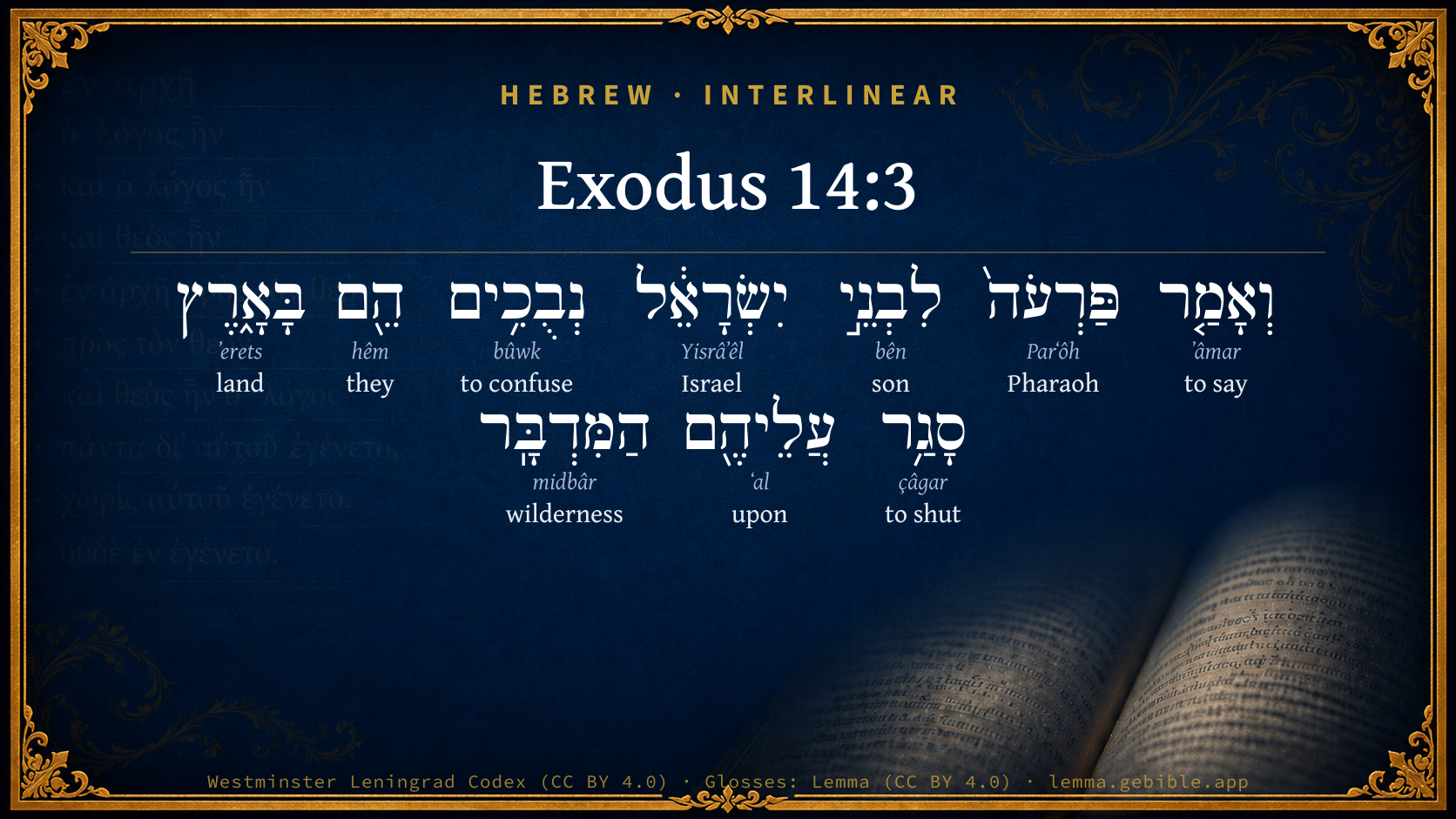
Hebrew (Westminster Leningrad Codex) Exodus 14:3 appears in the Hebrew Old Testament. The text above is from the Westminster Leningrad Codex. Each word links to its Strong’s number, a concise gloss, and parsing drawn from the Open Scriptures Hebrew Bible morphology. Click any word for its full Brown-Driver-Briggs (BDB) entry.
Download image
Cite this verse

Exodus 14:3 (World English Bible). Public Domain. Lemma interlinear Bible study tool, https://lemma.gebible.app/v/exodus/14/3.

Show BibTeX & RIS
BibTeX
RIS
English Translation
Pharaoh will say of the children of Israel, 'They are entangled in the land. The wilderness has shut them in.'
World English Bible · Public Domain
Highlights
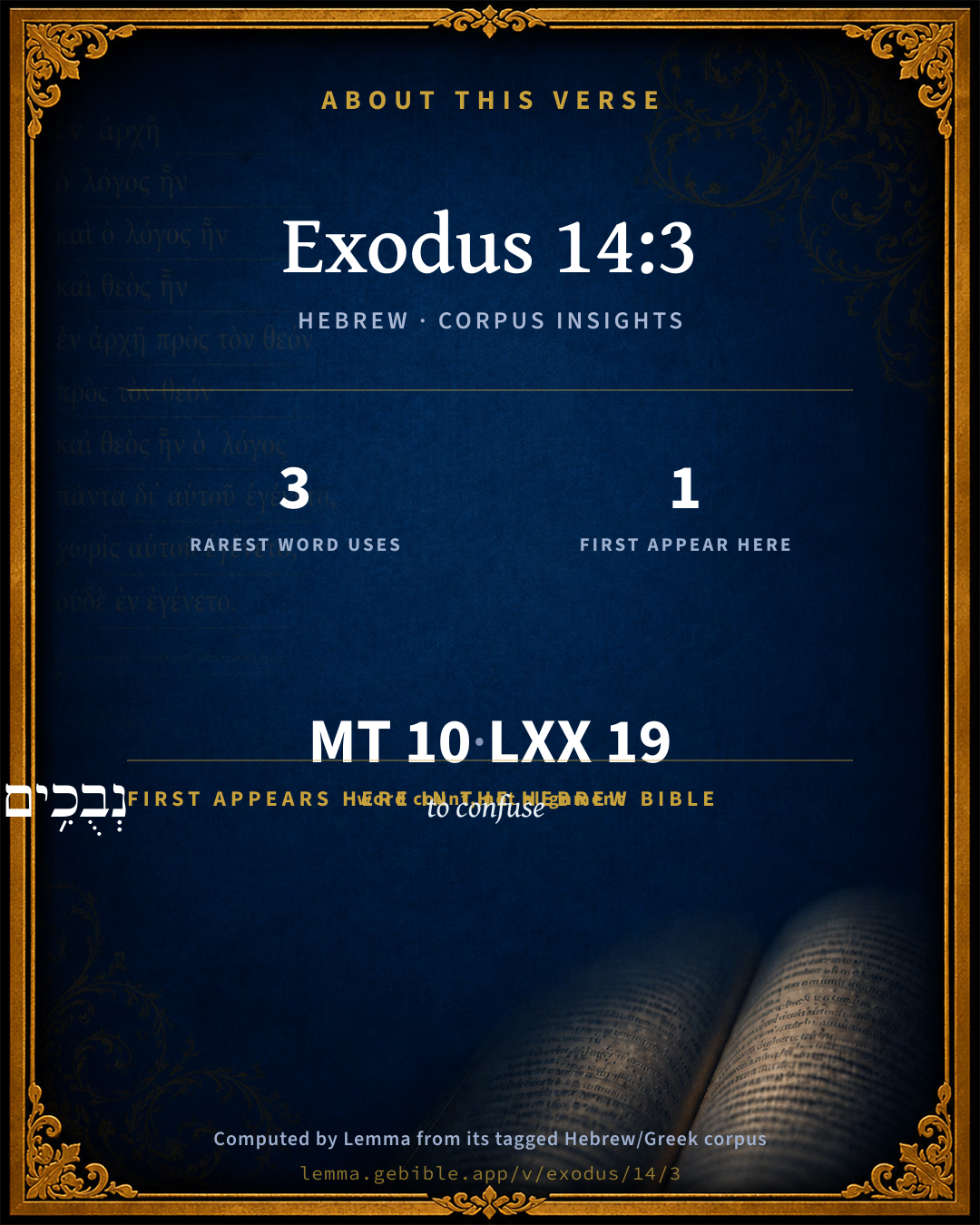
  • 1 first appearance in the Hebrew Bible
Full analysis ↓
Download a study sheet

One document with this verse’s original text, its word-by-word gloss line, the meaning frame, cross-references with their text, attributed commentary, and full source and license credits — printable, and it pastes into notes with its structure intact.

This verse Autodidact and up

Study sheet (.html) Plain text (.txt)

A passage Seminary Student

Up to 50 verses in one chapter. A passage sheet keeps up to 6 commentary sources and 12 cross-references per verse, in the order this page ranks them, and says so on the sheet whenever that leaves anything out. Ask for a single verse and you get the Autodidact verse sheet above.

Everything on this page stays free to read, with no account — the sheet is a download of what is already on screen, not access to it.

Want to remove ads? Support Godless Engineer
Compare translations 3

The same verse in 3 English versions, stacked beneath the original-language interlinear above. Click any original word for its lexicon entry.

Each is an independent rendering of the whole verse — the interlinear is not word-aligned to these translations.

Highlighted words mark where these versions differ — a whole-verse word diff, not a word-by-word alignment.

  • World English Bible Public Domain
    Pharaoh will say of the children of Israel, 'They are entangled in the land. The wilderness has shut them in.'
  • King James Version Public Domain
    For Pharaoh will say of the children of Israel, They are entangled in the land, the wilderness hath shut them in.
  • unfoldingWord Literal Text CC BY-SA 4.0
    And Pharaoh will say about the sons of Israel, ‘They are confused in the land. The wilderness has closed in on them.’

unfoldingWord Literal Text — © unfoldingWord, licensed CC BY-SA 4.0. Word-aligned USFM3 via Door43 (git.door43.org/unfoldingWord/en_ult).

Versions to compare (up to 4)

3 of 4 selected

Show all 18 translations

Every available English version of this verse, each an independent rendering of the whole verse.

  • World English Bible Public Domain
    Pharaoh will say of the children of Israel, 'They are entangled in the land. The wilderness has shut them in.'
  • Berean Standard Bible Public Domain
    For Pharaoh will say of the Israelites, ‘They are wandering the land in confusion; the wilderness has boxed them in.’
  • Majority Standard Bible Public Domain
    For Pharaoh will say of the Israelites, ‘They are wandering the land in confusion; the wilderness has boxed them in.’
  • King James Version Public Domain
    For Pharaoh will say of the children of Israel, They are entangled in the land, the wilderness hath shut them in.
  • American Standard Version (1901) Public Domain
    And Pharaoh will say of the children of Israel, They are entangled in the land, the wilderness hath shut them in.
  • Revised Version (1885) Public Domain
    And Pharaoh will say of the children of Israel, They are entangled in the land, the wilderness hath shut them in.
  • Geneva Bible (1599) Public Domain
    For Pharaoh will say of the children of Israel, They are tangled in the land: the wildernesse hath shut them in.
  • Douay-Rheims (1899) Public Domain
    And Pharao will say of the children of Israel: They are straitened in the land, the desert hath shut them in.
  • Young's Literal Translation Public Domain
    and Pharaoh hath said of the sons of Israel, They are entangled in the land, the wilderness hath shut upon them;
  • Literal Standard Version CC BY-SA 4.0
    and Pharaoh has said of the sons of Israel, They are entangled in the land, the wilderness has shut on them;
  • Unlocked Literal Bible CC BY-SA 4.0
    Pharaoh will say about the Israelites, 'They are wandering in the land. The wilderness has closed in on them.'
  • unfoldingWord Literal Text CC BY-SA 4.0
    And Pharaoh will say about the sons of Israel, ‘They are confused in the land. The wilderness has closed in on them.’
  • Darby Bible Public Domain
    And Pharaoh will say of the children of Israel, They are entangled in the land, the wilderness has hemmed them in.
  • World Messianic Bible Public Domain
    Pharaoh will say of the children of Israel, ‘They are entangled in the land. The wilderness has shut them in.’
  • Webster's Bible Public Domain
    For Pharaoh will say of the children of Israel, They are entangled in the land, the wilderness hath shut them in.
  • Free Bible Version CC BY-SA 4.0
    Pharaoh will conclude about the Israelites: ‘They're wandering about the country in confusion—the desert has blocked them from leaving.’
  • Bible in Basic English Public Domain
    And Pharaoh will say of the children of Israel, They are wandering without direction, they are shut in by the waste land.
  • JPS Tanakh (1917) Public Domain
    And Pharaoh will say of the children of Israel: They are entangled in the land, the wilderness hath shut them in.

Literal Standard Version (2020), Covenant Press — licensed CC BY-SA 4.0. Text via the HelloAO Bible API (eBible.org). Unlocked Literal Bible (unfoldingWord) — licensed CC BY-SA 4.0. Text via the HelloAO Bible API (eBible.org). unfoldingWord Literal Text — © unfoldingWord, licensed CC BY-SA 4.0. Word-aligned USFM3 via Door43 (git.door43.org/unfoldingWord/en_ult). Free Bible Version, Dr. Jonathan Gallagher — licensed CC BY-SA 4.0. Text via the HelloAO Bible API (eBible.org).

Word by word

More ways to search: Search by grammar → Find every occurrence → Compare this word →

Practice this passage: Drill this verse → Learn its vocabulary →

נְבֻכִ֥ים
bûwk
H943
“confusing”
Verb, Niphal, Participle Active, Masculine, Plural, Absolute
Part of Speech
Verb
Stem
Niphal
Form
Participle Active
Gender
Masculine
Number
Plural
State
Absolute
Full BDB Definition

Origin: a primitive root

TWOT: 214

to perplex, confuse, be confused - (Niphal) to be confused, be in confusion
  1. וְאָמַ֤ר ʼâmar H559 “and · to say” Conjunction + Verb, Qal, Sequential Perfect, 3rd Person, Masculine, Singular
  2. פַּרְעֹה֙ Parʻôh H6547 “Pharaoh” Noun, Proper
  3. לִבְנֵ֣י bên H1121 “to/for · sons of” Preposition + Noun, Common, Masculine, Plural, Construct
  4. יִשְׂרָאֵ֔ל Yisrâʼêl H3478 “Israel” Noun, Proper
  5. הֵ֖ם hêm H1992 “they” Pronoun, Personal, 3rd Person, Masculine, Plural
  6. בָּאָ֑רֶץ ʼerets H776 “in/at the · land” Preposition, Determined + Noun, Common, Both, Singular, Absolute
  7. סָגַ֥ר çâgar H5462 “to shut” Verb, Qal, Perfect, 3rd Person, Masculine, Singular
  8. עֲלֵיהֶ֖ם ʻal H5921 “upon · them” Preposition + Suffix, Personal, 3rd Person, Masculine, Plural
  9. הַמִּדְבָּֽר midbâr H4057 “the · wilderness” Particle, Definite Article + Noun, Common, Masculine, Singular, Absolute

About this verse

These counts appear in no published source. They are computed here, from the morphology-tagged text and Lemma’s own curated glosses. What Lemma adds →

10
words
10
distinct lemmas
Pentateuch
section

Notable vocabulary

The rarest word here is נְבֻכִ֥ים to confuse H943 — appearing just 3 times in the whole Hebrew Bible.

First appearance in Scripture

This word makes its first canonical appearance in the Hebrew Bible here:

  • נְבֻכִ֥ים to confuse H943

Shared distinctive vocabulary

נְבֻכִ֥ים to confuse H943 occurs in 3 verses of the Hebrew Bible. Also found in:

Grammatical profile

  • 3 verbs
  • 5 nouns
  • 1 pronoun
  • 1 preposition

Verb forms

  • וְאָמַ֤ר Qal · Sequential Perfect
  • נְבֻכִ֥ים Niphal · Participle Active
  • סָגַ֥ר Qal · Perfect

Hebrew & Septuagint length

In English translation the verse runs 20 words from the Hebrew and 26 from the Septuagint (LXX English) — closely comparable.

A rough comparison of the two English renderings, which tokenize alike — not a word-level alignment.

Word counts can differ between the Hebrew and the Greek without any difference in meaning — e.g. the Hebrew direct-object marker אֵת has no separate Greek word, and Greek often adds the article ὁ.

In the original languages it is 10 Hebrew tokens and 19 Greek tokens — but the two are counted differently (Hebrew bundles its prefixes and suffixes into one token; the Greek is in lemma form), so that isn’t a like-for-like length.

Cross-references

13

Topical passages linked to Exodus 14:3 in the Treasury of Scripture Knowledge — connected by theme and wording, ordered by reader-vote popularity; previews shown in the World English Bible.

  • Acts 4:28 to do whatever your hand and your council foreordained to happen.
  • Exodus 7:3–4 I will harden Pharaoh's heart, and multiply my signs and my wonders in the land of Egypt.
  • Deuteronomy 31:21 It shall happen, when many evils and troubles are come on them, that this song shall testify before them as a witness; for it shall not be forgotten out of the mouths of their seed: for I know their imagination which they frame this day, before I have brought them into the land which I swore.
  • 1 Samuel 23:7 It was told Saul that David was come to Keilah. Saul said, God has delivered him into my hand; for he is shut in, by entering into a town that has gates and bars.
  • 1 Samuel 23:23 See therefore, and take knowledge of all the lurking-places where he hides himself, and come you again to me of a certainty, and I will go with you: and it shall happen, if he be in the land, that I will search him out among all the thousands of Judah.
  • Psalms 3:2 Many there are who say of my soul, "There is no help for him in God." Selah.
  • Psalms 71:11 Saying, "God has forsaken him. Pursue and take him, for no one will rescue him."
  • Psalms 139:2 You know my sitting down and my rising up. You perceive my thoughts from afar.
  • Psalms 139:4 For there is not a word on my tongue, But, behold, Yahweh, you know it altogether.
  • Jeremiah 20:10–11 For I have heard the defaming of many, terror on every side. Denounce, and we will denounce him, [say] all my familiar friends, those who watch for my fall; peradventure he will be persuaded, and we shall prevail against him, and we shall take our revenge on him.
  • Ezekiel 38:10–11 Thus says the Lord Yahweh: It shall happen in that day, that things shall come into your mind, and you shall devise an evil device:
  • Ezekiel 38:17 Thus says the Lord Yahweh: Are you he of whom I spoke in old time by my servants the prophets of Israel, who prophesied in those days for [many] years that I would bring you against them?
  • Judges 16:2 [It was told] the Gazites, saying, Samson is come here. They compassed him in, and laid wait for him all night in the gate of the city, and were quiet all the night, saying, [Let be] until morning light, then we will kill him.

Cross-references courtesy of OpenBible.info (CC BY 4.0).

Hebrew and Greek witnesses Masoretic Hebrew ↔ Greek Septuagint

The same verse in the two great witnesses to the Old Testament, shown verse-for-verse.

These are two independent witnesses, not word-aligned to each other, and the Septuagint is shown in lemma (dictionary) form.

Hebrew Exodus 14:3 Masoretic · Westminster Leningrad Codex

וְאָמַ֤ר פַּרְעֹה֙ לִבְנֵ֣י יִשְׂרָאֵ֔ל נְבֻכִ֥ים הֵ֖ם בָּאָ֑רֶץ סָגַ֥ר עֲלֵיהֶ֖ם הַמִּדְבָּֽר

Pharaoh will say of the children of Israel, 'They are entangled in the land. The wilderness has shut them in.'

World English Bible · Public Domain

Greek LXX Exodus 14:3 Septuagint · lemma form

καί εἶπον φαραώ ὁ λαός αὐτός ὁ υἱός ἰσραήλ πλανάω οὗτος ἐν ὁ γῆ συνκλείω γάρ αὐτός ὁ ἔρημος

And Pharao will say to his people, As for these children of Israel, they are wandering in the land, for the wilderness has shut them in.

LXX2012 (modern English Septuagint) · Public Domain

On this verse, John Gill's Exposition discusses the Septuagint’s reading. Read the note in Commentary ↓

Hebrew: Westminster Leningrad Codex (CC BY 4.0). Greek: Septuagint (public domain); English from LXX2012 (modern English Septuagint) (Public Domain). How the Septuagint differs from the Hebrew →

Targum (Aramaic paraphrase)

2

The Targum is the ancient Jewish Aramaic paraphrase of the Hebrew Scriptures — an interpretive translation, not the Hebrew text itself. Onkelos (literal) and Pseudo-Jonathan (expansive) render the Torah, and Jonathan the Prophets. Coverage is partial: where no permissively-licensed English translation exists for a verse, only the Aramaic is shown. This is verse-level text, not a word-by-word alignment to the Hebrew.

  1. Targum Onkelos Torah (Genesis–Deuteronomy)
    וְיֵימַר פַּרְעֹה עַל בְּנֵי יִשְׂרָאֵל מְעַרְבְּלִין אִנוּן בְּאַרְעָא אֲחַד עֲלֵיהוֹן מַדְבְּרָא:

    (no public-domain English translation for this verse)

    Targum Onkelos — Aramaic: “Onkelos Genesis” (public domain); “Onkelos Exodus” (public domain); “Onkelos Leviticus” (public domain); “Onkelos Numbers” (public domain); “Onkelos Deuteronomy” (public domain). English: “Sefaria Community Translation” (CC0 1.0 (public-domain dedication)); “J.W. Etheridge. The Targums of Onkelos and Jonathan Ben Uzziel on the Pentateuch. London: Longmans, Green, 1862” (public domain). Text via Sefaria.

  2. Targum Pseudo-Jonathan Torah (Genesis–Deuteronomy)
    וְיֵמַר פַּרְעה לְדָתָן וְלַאֲבִירָם בְּנֵי יִשְרָאֵל דְּמִשְׁתַּיְירוּן בְּמִצְרַיִם מְטַרְפִין הִינוּן עַמָּא בֵּית יִשְרָאֵל בְּאַרְעָא טָרַד עֲלֵיהוֹן טַעֲוַות צְפוֹן נַגְדוֹי דְּמַדְבְּרָא

    And Pharoh said to Dathan and Abiram, sons of Israel, who had remained in Mizraim, The people of the house of Israel are bewildered in the land: the idol Zephon hath shut them in close upon the desert.

    Targum Pseudo-Jonathan — Aramaic: “Targum Jonathan on Genesis” (public domain); “Targum Jonathan on Exodus” (public domain); “Targum Jonathan on Leviticus” (public domain); “Targum Jonathan on Numbers” (public domain); “Targum Jonathan on Deuteronomy” (public domain). English: “The Targum of Jonathan ben Uzziel, trans. J. W. Etheridge, London, 1862” (public domain). Text via Sefaria.

Commentary

Notes on Exodus 14:3 from classic Christian and Jewish commentators (each source and its license shown beneath its notes). The classic Christian expositions comment on the surrounding passage and are grouped to its opening verse, so a note may address several verses; the Jewish commentaries on the Tanakh (Rashi and others) are per-verse, so they appear only where the commentator wrote on this verse.

Lemma curates 59 commentaries, every one of them public domain or Creative Commons licensed, each selected and text-cleaned for this edition rather than reprinted as found. About our sources →

Trapp's Complete Commentary

John Trapp

Exo 14:3 For Pharaoh will say of the children of Israel, They [are] entangled in the land, the wilderness hath shut them in.

Ver. 3. They are entangled.] Perplexed; intricated; they know not what to do, or which way to turn. Enemies watch opportunities, but oft miss of their meaning.

John Trapp, A Commentary or Exposition upon All the Books of the Old and New Testament (1647–1656) — public domain. Text from a community e-Sword module.

Joseph Benson's Commentary

Exo 14:3-4. Pharaoh will say they are entangled — He will presume that you are hemmed in between the rocks and the sea. I will harden Pharaoh’s heart — See note on Exo 4:21; Exo 7:13-14. The meaning is, that Pharaoh would take occasion, from the apparently distressed situation the Israelites were now in, enclosed with mountains, deserts, and Egyptian garrisons, to harden his heart. He would even be so desperate as to attempt to follow and bring them back again into their former state of bondage. I will be honoured upon Pharaoh — By the manifestation of my power and justice.

Joseph Benson's Commentary on the Old and New Testaments (1811–1818) — public domain. Text from a community e-Sword module.

Jamieson, Fausset & Brown

Robert Jamieson, A. R. Fausset & David Brown

the wilderness hath shut them in--Pharaoh, who would eagerly watch their movements, was now satisfied that they were meditating flight, and he naturally thought from the error into which they appeared to have fallen by entering that defile, he could intercept them. He believed them now entirely in his power, the mountain chain being on one side, the sea on the other, so that, if he pursued them in the rear, escape seemed impossible.

Jamieson, Fausset & Brown — Commentary Critical and Explanatory on the Whole Bible (1871) — public domain (CC PDM 1.0). Text via the HelloAO Bible API.

Adam Clarke's Commentary

Verse 3. They are entangled in the land] God himself brought them into straits from which no human power or art could extricate them. Consider their situation when once brought out of the open country, where alone they had room either to fight or fly. Now they had the Red Sea before them, Pharaoh and his host behind them, and on their right and left hand fortresses of the Egyptians to prevent their escape; nor had they one boat or transport prepared for their passage! If they be now saved, the arm of the Lord must be seen, and the vanity and nullity of the Egyptian idols be demonstrated. By bringing them into such a situation he took from them all hope of human help, and gave their adversaries every advantage against them, so that they themselves said, They are entangled in the land, the wilderness hath shut them in.

Adam Clarke's Commentary on the Bible (1810–1826) — public domain. Text from a community e-Sword/MySword module.

Ellicott's Commentary for English Readers

(3) Entangled in the land.—Literally, confused, perplexed. (Comp. Est_3:15.) Pharaoh, seeing that the Israelites had placed the Bitter Lakes on their left, and were marching southward, in a direction which would soon put the Red Sea on one side of them and a desert region—that about the Jebel Atakah—on the other, thought that they must be quite ignorant of the geography, and have, as it were, “lost their way.” He observed, moreover, that “the wilderness had shut them in.” The desert tract between the Nile Valley and the Red Sea lay upon their left and in their front: they would soon be unable to proceed, and would not know which way to turn.

A Bible Commentary for English Readers, edited by Charles John Ellicott (1878–1897) — public domain. Text from a community e-Sword module.

The Cambridge Bible for Schools and Colleges

gen. ed. J. J. S. Perowne

3. entangled, &c.] rather, perplexed, confused (Est_3:15, Joe_1:18) in the land: they do not know which way to turn in order to escape: the wilderness (the Egyptian wilderness, S. of Wâdy Ṭumîlât) hath shut them in: the implicit thought being, They will not dream of crossing the sea; so we have but to follow them (v. 4), and they will be in our power.

The Cambridge Bible for Schools and Colleges (gen. ed. J. J. S. Perowne; Cambridge University Press, 1878–1918) — public domain. Text from a community e-Sword module.

John Gill's Exposition

For Pharaoh will say of the children of Israel,.... The Septuagint version adds, "to his people", his ministers and courtiers, when he hears where they are:

they are entangled in the land; have lost their way, and got into places they cannot easily get out of, and are perplexed in their minds, and do not know what way to take or course to steer:

the wilderness hath shut them in; or, "shut up the way to them" (n); the wilderness between the mountains the above mentioned traveller speaks of (o) the mountains of Gewoubee; these would stop their flight or progress to the southward, as those of the Attackah would do the same towards the land of the Philistines; the Red sea likewise lay before them to the east, while Pharaoh (could) close up the valley behind them, with his chariots and his horsemen; and which, no doubt, appeared very advantageous and encouraging to him, as it must be very distressing to the Israelites.

(n) "clausit viam illis", Pagninus, "praeclusit sese illis", Vatablus. (o) Dr. Shaw's Travels, p. 309. Ed. 2.

John Gill's Exposition of the Whole Bible (1746–1763) — public domain (CC PDM 1.0). Text via the HelloAO Bible API.

Albert Barnes' Notes on the Bible

They are entangled ... - The original intention of Moses was to go toward Palestine by the wilderness: when that purpose was changed by God’s direction and they moved southwards, Pharaoh, on receiving information, was of course aware that they were completely shut in, since the waters of the Red Sea then extended to the Bitter Lakes. It is known that the Red Sea at some remote period extended considerably further toward the north than it does at present. In the time of Moses the water north of Kolsum joined the Bitter Lakes, though at present the constant accumulation of sand has covered the intervening space to the extent of 8000 to 10,000 yards.

Albert Barnes' Notes on the Bible (1834–1885) — public domain. Text from a community e-Sword/MySword module.

Haydock's Catholic Bible Commentary

In. Between craggy mountains and the Red Sea. (Haydock)

George Leo Haydock (1774–1849), Haydock's Catholic Family Bible and Commentary, 1859 edition — public domain. Excludes Psalms (Douay-Rheims chapter numbering differs from Protestant) and Deuterocanonical books (Catholic canon only).

Matthew Poole's English Annotations

There are enclosed with mountains, and garrisons, and deserts.

Matthew Poole's English Annotations on the Holy Bible (1683–1685) — public domain. Text from a community e-Sword/MySword module.

The Pulpit Commentary

They are entangled in the land. Or they are confused," perplexed i.e.. they have lost their way. " Pharaoh could not conceive that they would have taken the route to the west of the Bitter Lakes, which conducted to no tolerable territory, unless they were hopelessly at sea with respect to the geography of the country. In this perplexity" of theirs he thought he saw his own opportunity. The wilderness hath shut them in. Pharaoh is thinking of his own wilderness," the desert country between the Nile valley and the Red Sea. This desert, he says, blocks their way, and shuts them in they cannot escape if he follows in their steps, for they will have the sea on one hand, the desert on the other, and in their front, while he himself presses upon their rear.

The Pulpit Commentary (1880–1919), ed. H.D.M. Spence-Jones & Joseph S. Exell — public domain. Text from a community e-Sword module.

John Wesley's Explanatory Notes

They are entangled - Inclosed with mountains, and garrisons, and deserts.

John Wesley, Explanatory Notes Upon the Whole Bible (1754–1765) — public domain. Text via the GEBible commentary corpus.

Keil & Delitzsch

C. F. Keil & F. Delitzsch

This turn in their route was not out of the way for the passage through the Red Sea; but apart from this, it was not only out of the way, but a very foolish way, according to human judgment. God commanded Moses to take this road, that He might be honoured upon Pharaoh, and show the Egyptians that He was Jehovah (cf. Exo 14:30, Exo 14:31). Pharaoh would say of the Israelites, They have lost their way; they are wandering about in confusion; the desert has shut them in, as in a prison upon which the door is shut (על סנר as in Job 12:14); and in his obduracy he would resolve to go after them with his army, and bring them under his sway again.

Exo 14:4-9

When it was announced that Israel had fled, "the heart of Pharaoh and his servants turned against the people," and they repented that they had let them go. When and whence the information came, we are not told. The common opinion, that it was brought after the Israelites changed their route, has no foundation in the text. For the change in Pharaoh's feelings towards the Israelites, and his regret that he had let them go, were caused not by their supposed mistake, but by their flight. Now the king and his servants regarded the exodus as a flight, as soon as they recovered from the panic caused by the death of the first-born, and began to consider the consequences of the permission given to the people to leave his service. This may have occurred as early as the second day after the exodus. In that case, Pharaoh would have had time to collect chariots and horsemen, and overtake the Israelites at Hachiroth, as they could easily perform the same journey in two days, or one day and a half, to which the Israelites had taken more than three. "He yoked his chariot (had it yoked, cf. Kg1 6:14), and took his people (i.e., his warriors) with him," viz., "six hundred chosen war chariots (Exo 14:7), and all the chariots of Egypt" (sc., that he could get together in the time), and "royal guards upon them all." שׁלשׁים, τριστάται, tristatae qui et terni statores vocantur, nomen est secundi gradus post regiam dignitatem (Jerome on Eze 23:23), not charioteers (see my Com. on Kg1 9:22). According to Exo 14:9, the army raised by Pharaoh consisted of chariot horses (רכב סוּס), riding horses (פּרשׁים, lit., runners, Kg1 5:6), and חיל, the men belonging to them. War chariots and cavalry were always the leading force of the Egyptians (cf. Isa 31:1; Isa 36:9). Three times (Exo 14:4, Exo 14:8, and Exo 14:17) it is stated that Jehovah hardened Pharaoh's heart, so that he pursued the Israelites, to show that God had decreed this hardening, to glorify Himself in the judgment and death of the proud king, who would not honour God, the Holy One, in his life. "And the children of Israel were going out with a high hand:" Exo 14:8. is a conditional clause in the sense of, "although they went out" (Ewald, 341). רמה יד, the high hand, is the high hand of Jehovah with the might which it displayed (Isa 26:11), not the armed hand of the Israelites. This is the meaning also in Num 33:3; it is different in Num 15:30. The very fact that Pharaoh did not discern the lifting up of Jehovah's hand in the exodus of Israel displayed the hardening of his heart. "Beside Pihachiroth:" see Exo 14:2.

Keil & Delitzsch — Biblical Commentary on the Old Testament (1861–1891) — public domain (CC PDM 1.0). Text via the HelloAO Bible API. (Old Testament only.)

Rashi

Rabbi Shlomo Yitzchaki (Rashi)

ואמר פרעה THEN PHARAOH WILL SAY — when he hears that they are turning back.

לבני ישראל means על בני ABOUT THE CHILDREN OF ISRAEL. Similarly. (v. 14) “The Lord will fight לכם”, i. e. עליכם for you; (Genesis 20:13) “Say לי, he is my brother” i. e. say about me.

נבכים הם means, shut up and sunk deep. old French serrer. Of similar meaning are (Job 38:16) “the depths of (נבכי) the sea”; (Psalms 84:7) “in the vale of dejection (הבכא)”; (Job 28:11) “from the depths (מבכי) of the rivers.”

נבכים הם means THEY ARE SHUT UP in the wilderness — so that they do not know how to get out of it and whither they should go.

Rashi on the Tanakh — English translations: “The Judaica Press complete Tanach with Rashi, translated by A. J. Rosenberg” (CC BY 4.0); “Pentateuch with Rashi's commentary by M. Rosenbaum and A.M. Silbermann, 1929-1934” (public domain); “The Metsudah Tanach series, Lakewood, N.J” (CC BY 4.0); and “The Book of Joshua, Metsudah Publications, 1997” (CC BY 4.0). Text via Sefaria.

Lesson kit

Teaching starters — assembled from the data on this page, not authored interpretation. Every prompt links to the verse data it draws on. Edit before teaching.

Exodus, in the Pentateuch, opens this verse with 10 words (10 distinct Hebrew lemmas). Its most distinctive word is bûwk (“to confuse”). A historical commentator’s framing appears above. Read the whole chapter for the surrounding context.

Discussion questions

  1. The word bûwk carries the sense “to confuse.” How does it shape the verse?
  2. The word “to confuse” first appears here in Scripture. What is being introduced at this debut?
  3. Esther 3:15 shares the word «to confuse» with this verse. How do the two illuminate each other?
  4. These translations render this verse differently; the difference is in the English rendering, not the original. What questions does that raise?
  5. The verb «וְאָמַ֤ר» is Qal Sequential Perfect. How does its form color the action?
  6. Reading how Trapp's Complete Commentary and Joseph Benson's Commentary read this verse, where do the two commentators agree and where do they part?

Things to notice

Reading settings

Reading text

Shown beneath each verse's original-language words.

Old Testament
Old Testament edition

Read the OT as the Masoretic Hebrew (MT) or the Greek Septuagint (LXX).

English shown for the Greek Septuagint (in the Hebrew ↔ Greek comparison).

Comparing translations? Open the Compare panel on any verse page to stack up to four side by side.