
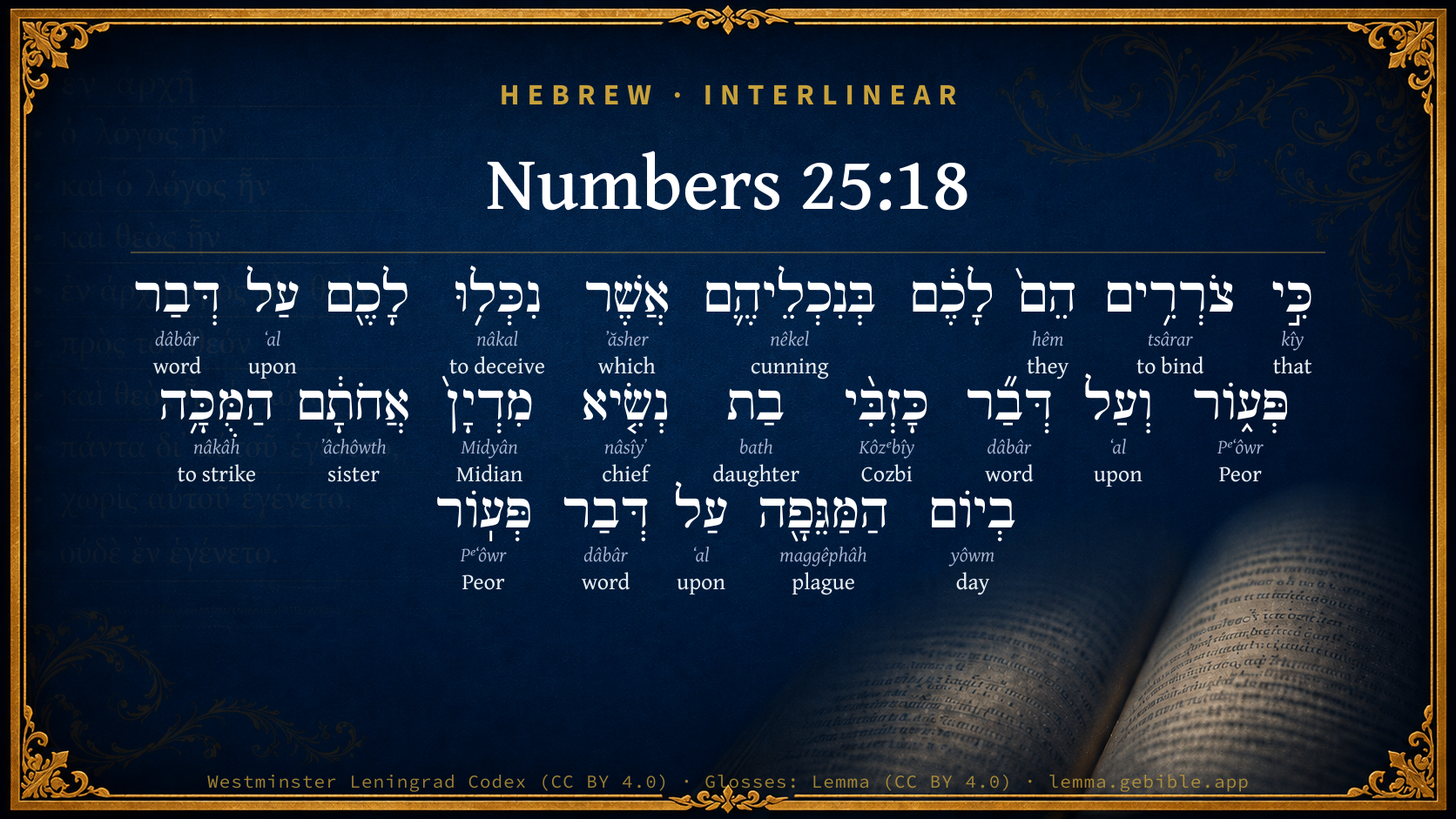
Numbers 25:18

Hebrew (Westminster Leningrad Codex) Numbers 25:18 appears in the Hebrew Old Testament. The text above is from the Westminster Leningrad Codex. Each word links to its Strong’s number, a concise gloss, and parsing drawn from the Open Scriptures Hebrew Bible morphology. Click any word for its full Brown-Driver-Briggs (BDB) entry.
Download image
Cite this verse

Numbers 25:18 (World English Bible). Public Domain. Lemma interlinear Bible study tool, https://lemma.gebible.app/v/numbers/25/18.

Show BibTeX & RIS
BibTeX
RIS
English Translation
for they vex you with their wiles, with which they have deceived you in the matter of Peor, and in the matter of Cozbi, the daughter of the prince of Midian, their sister, who was slain on the day of the plague in the matter of Peor.
World English Bible · Public Domain
Highlights
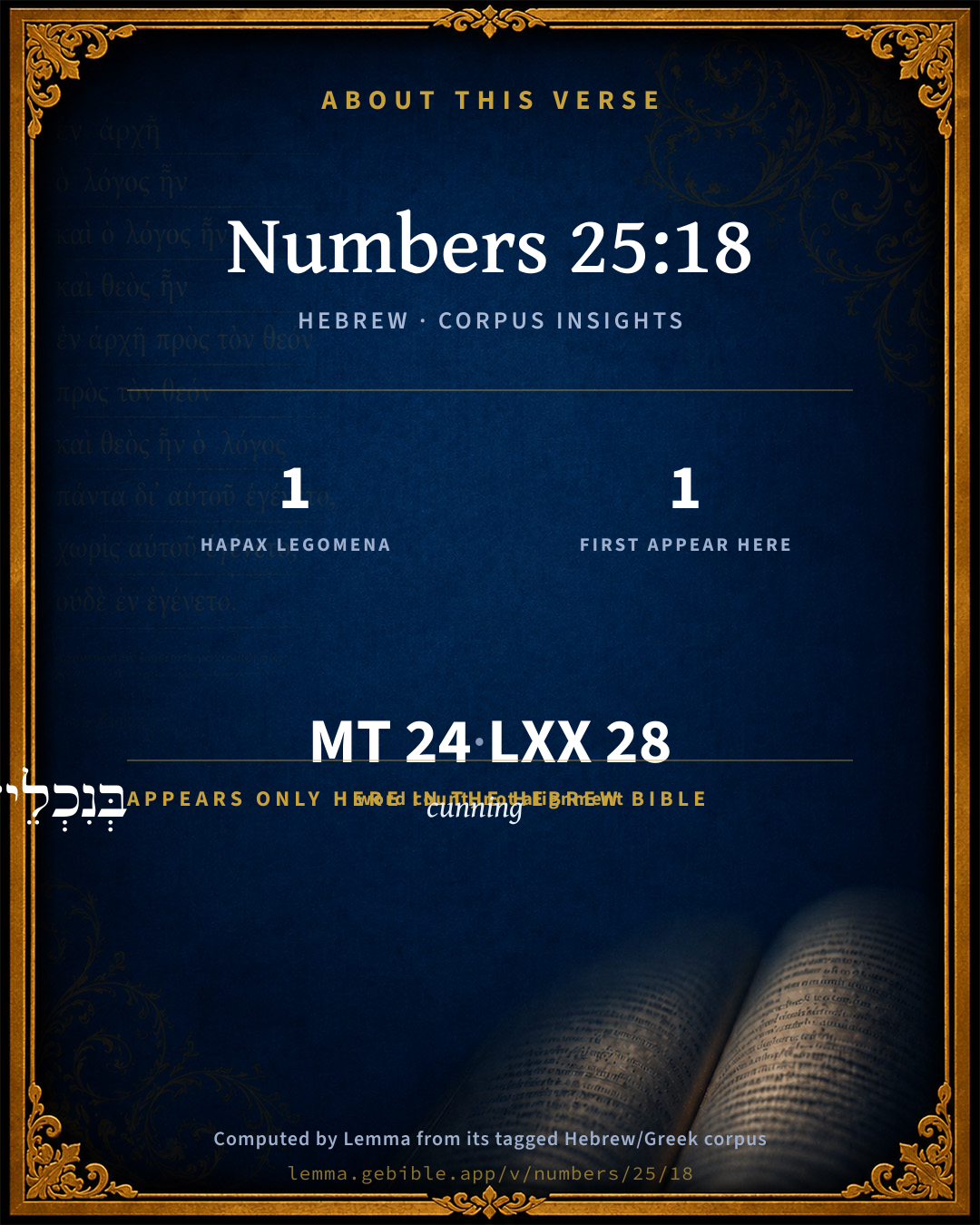
  • 1 hapax legomenon — only here in the Hebrew Bible
  • 1 first appearance in the Hebrew Bible
Full analysis ↓
Download a study sheet

One document with this verse’s original text, its word-by-word gloss line, the meaning frame, cross-references with their text, attributed commentary, and full source and license credits — printable, and it pastes into notes with its structure intact.

This verse Autodidact and up

Study sheet (.html) Plain text (.txt)

A passage Seminary Student

Up to 50 verses in one chapter. A passage sheet keeps up to 6 commentary sources and 12 cross-references per verse, in the order this page ranks them, and says so on the sheet whenever that leaves anything out. Ask for a single verse and you get the Autodidact verse sheet above.

Everything on this page stays free to read, with no account — the sheet is a download of what is already on screen, not access to it.

Want to remove ads? Support Godless Engineer
Compare translations 3

The same verse in 3 English versions, stacked beneath the original-language interlinear above. Click any original word for its lexicon entry.

Each is an independent rendering of the whole verse — the interlinear is not word-aligned to these translations.

Highlighted words mark where these versions differ — a whole-verse word diff, not a word-by-word alignment.

  • World English Bible Public Domain
    for they vex you with their wiles, with which they have deceived you in the matter of Peor, and in the matter of Cozbi, the daughter of the prince of Midian, their sister, who was slain on the day of the plague in the matter of Peor.
  • King James Version Public Domain
    For they vex you with their wiles, wherewith they have beguiled you in the matter of Peor, and in the matter of Cozbi, the daughter of a prince of Midian, their sister, which was slain in the day of the plague for Peor's sake.
  • unfoldingWord Literal Text CC BY-SA 4.0
    For they were vexing you by their deceitfulness when they deceived you over the matter of Peor and over the matter of Kozbi the daughter of the leader of Midian, their sister, the one struck down on the plague day over the matter of Peor.”

unfoldingWord Literal Text — © unfoldingWord, licensed CC BY-SA 4.0. Word-aligned USFM3 via Door43 (git.door43.org/unfoldingWord/en_ult).

Versions to compare (up to 4)

3 of 4 selected

Show all 18 translations

Every available English version of this verse, each an independent rendering of the whole verse.

  • World English Bible Public Domain
    for they vex you with their wiles, with which they have deceived you in the matter of Peor, and in the matter of Cozbi, the daughter of the prince of Midian, their sister, who was slain on the day of the plague in the matter of Peor.
  • Berean Standard Bible Public Domain
    For they assailed you deceitfully when they seduced you in the matter of Peor and their sister Cozbi, the daughter of the Midianite leader, the woman who was killed on the day the plague came because of Peor.”
  • Majority Standard Bible Public Domain
    For they assailed you deceitfully when they seduced you in the matter of Peor and their sister Cozbi, the daughter of the Midianite leader, the woman who was killed on the day the plague came because of Peor.”
  • King James Version Public Domain
    For they vex you with their wiles, wherewith they have beguiled you in the matter of Peor, and in the matter of Cozbi, the daughter of a prince of Midian, their sister, which was slain in the day of the plague for Peor's sake.
  • American Standard Version (1901) Public Domain
    for they vex you with their wiles, wherewith they have beguiled you in the matter of Peor, and in the matter of Cozbi, the daughter of the prince of Midian, their sister, who was slain on the day of the plague in the matter of Peor.
  • Revised Version (1885) Public Domain
    for they vex you with their wiles, wherewith they have beguiled you in the matter of Peor, and in the matter of Cozbi, the daughter of the prince of Midian, their sister, which was slain on the day of the plague in the matter of Peor.
  • Geneva Bible (1599) Public Domain
    For they trouble you with their wiles, wherewith they haue beguiled you as concerning Peor, and as concerning their sister Cozbi ye daughter of a prince of Midian, which was slayne in the day of the plague because of Peor.
  • Douay-Rheims (1899) Public Domain
    Because they also have acted like enemies against you, and have guilefully deceived you by the idol Phogor, and Cozbi their sister, a daughter of a prince of Madian, who was slain in the day the plague for the sacrilege of Phogor.
  • Young's Literal Translation Public Domain
    for they are adversaries to you with their frauds, `with' which they have acted fraudulently to you, concerning the matter of Peor, and concerning the matter of Cozbi, daughter of a prince of Midian, their sister, who is smitten in the day of the plague for the matter of Peor.'
  • Literal Standard Version CC BY-SA 4.0
    for they are adversaries to you with their frauds, [with] which they have acted fraudulently to you, concerning the matter of Peor and concerning the matter of Cozbi, daughter of a prince of Midian, their sister, who is struck in the day of the plague for the matter of Peor.”
  • Unlocked Literal Bible CC BY-SA 4.0
    for they treated you like enemies with their deceitfulness. They led you into evil in the case of Peor and in the case of their sister Kozbi, the daughter of a leader in Midian, who was killed on the day of the plague in the matter of Peor.”
  • unfoldingWord Literal Text CC BY-SA 4.0
    For they were vexing you by their deceitfulness when they deceived you over the matter of Peor and over the matter of Kozbi the daughter of the leader of Midian, their sister, the one struck down on the plague day over the matter of Peor.”
  • Darby Bible Public Domain
    for they have harassed you with their wiles, wherewith they have beguiled you in the matter of Peor, and in the matter of Cozbi, the daughter of a prince of Midian, their sister, who was slain on the day of the plague because of the matter of Peor.
  • World Messianic Bible Public Domain
    for they harassed you with their wiles, wherein they have deceived you in the matter of Peor, and in the incident regarding Cozbi, the daughter of the prince of Midian, their sister, who was slain on the day of the plague in the matter of Peor.”
  • Webster's Bible Public Domain
    For they distress you with their wiles, with which they have beguiled you in the matter of Peor, and in the matter of Cozbi, the daughter of a prince of Midian their sister, who was slain in the day of the plague for Peor's sake.
  • Free Bible Version CC BY-SA 4.0
    because they attacked you deceptively, leading you astray by using Peor and their woman Cozbi, the daughter of the Midianite leader—the woman who was killed on the day the plague came because of their devotion to Peor.”
  • Bible in Basic English Public Domain
    For they are a danger to you with their false ways, causing sin to come on you in the question of Peor, and because of Cozbi, their sister, the daughter of the chief of Midian, who was put to death at the time of the disease which came on you because of Peor.
  • JPS Tanakh (1917) Public Domain
    for they harass you, by their wiles wherewith they have beguiled you in the matter of Peor, and in the matter of Cozbi, the daughter of the prince of Midian, their sister, who was slain on the day of the plague in the matter of Peor.'

Literal Standard Version (2020), Covenant Press — licensed CC BY-SA 4.0. Text via the HelloAO Bible API (eBible.org). Unlocked Literal Bible (unfoldingWord) — licensed CC BY-SA 4.0. Text via the HelloAO Bible API (eBible.org). unfoldingWord Literal Text — © unfoldingWord, licensed CC BY-SA 4.0. Word-aligned USFM3 via Door43 (git.door43.org/unfoldingWord/en_ult). Free Bible Version, Dr. Jonathan Gallagher — licensed CC BY-SA 4.0. Text via the HelloAO Bible API (eBible.org).

Word by word

More ways to search: Search by grammar → Find every occurrence → Compare this word →

Practice this passage: Drill this verse → Learn its vocabulary →

בְּנִכְלֵיהֶ֛ם
nêkel
H5231
“in/at · wiles · their”
Preposition + Noun, Common, Masculine, Plural, Construct + Suffix, Personal, 3rd Person, Masculine, Plural
Part of Speech
Preposition + Noun
Type
Common
Gender
Masculine
Number
Plural
State
Construct
Full BDB Definition

Origin: from H5230

TWOT: 1366a

cunning, wiliness, craft, knavery
  1. כִּ֣י kîy H3588 “that” Conjunction
  2. צֹרְרִ֥ים tsârar H6887 “binding” Verb, Qal, Participle Active, Masculine, Plural, Absolute
  3. הֵם֙ hêm H1992 “they” Pronoun, Personal, 3rd Person, Masculine, Plural
  4. אֲשֶׁר ʼăsher H834 “which” Particle, Relative
  5. נִכְּל֥וּ nâkal H5230 “to deceive” Verb, Piel, Perfect, 3rd Person, Common, Plural
  6. עַל ʻal H5921 “upon” Preposition
  7. דְּבַר dâbâr H1697 “word of” Noun, Common, Masculine, Singular, Construct
  8. פְּע֑וֹר Pᵉʻôwr H6465 “Peor” Noun, Proper
  9. וְעַל ʻal H5921 “and · upon” Conjunction + Preposition
  10. דְּבַ֞ר dâbâr H1697 “word of” Noun, Common, Masculine, Singular, Construct
  11. כָּזְבִּ֨י Kôzᵉbîy H3579 “Cozbi” Noun, Proper
  12. בַת bath H1323 “daughter of” Noun, Common, Feminine, Singular, Construct
  13. נְשִׂ֤יא nâsîyʼ H5387 “chief of” Noun, Common, Masculine, Singular, Construct
  14. מִדְיָן֙ Midyân H4080 “Midian” Noun, Proper
  15. אֲחֹתָ֔ם ʼâchôwth H269 “sister · their” Noun, Common, Feminine, Singular, Construct + Suffix, Personal, 3rd Person, Masculine, Plural
  16. הַמֻּכָּ֥ה nâkâh H5221 “the · struck” Particle, Definite Article + Verb, Hophal, Participle Passive, Feminine, Singular, Absolute
  17. בְיוֹם yôwm H3117 “in/at · day of” Preposition + Noun, Common, Masculine, Singular, Construct
  18. הַמַּגֵּפָ֖ה maggêphâh H4046 “the · plague” Particle, Definite Article + Noun, Common, Feminine, Singular, Absolute
  19. עַל ʻal H5921 “upon” Preposition
  20. דְּבַר dâbâr H1697 “word of” Noun, Common, Masculine, Singular, Construct
  21. פְּעֽוֹר Pᵉʻôwr H6465 “Peor” Noun, Proper

About this verse

These counts appear in no published source. They are computed here, from the morphology-tagged text and Lemma’s own curated glosses. What Lemma adds →

24
words
17
distinct lemmas
Pentateuch
section

Notable vocabulary

1 hapax legomenon — a word that appears only here in the entire Hebrew Bible:

  • בְּנִכְלֵיהֶ֛ם cunning H5231

First appearance in Scripture

This word makes its first canonical appearance in the Hebrew Bible here:

  • בְּנִכְלֵיהֶ֛ם cunning H5231

Shared distinctive vocabulary

כָּזְבִּ֨י Cozbi H3579 occurs in 2 verses of the Hebrew Bible. Also found in:

Grammatical profile

  • 3 verbs
  • 13 nouns
  • 1 pronoun
  • 5 prepositions
  • 1 conjunction
  • 1 particle

Verb forms

  • צֹרְרִ֥ים Qal · Participle Active
  • נִכְּל֥וּ Piel · Perfect
  • הַמֻּכָּ֥ה Hophal · Participle Passive

Repetition

Words recur within this verse — often emphatic in Hebrew:

  • עַל upon H5921 ×3
  • דְּבַר word H1697 ×3
  • פְּע֑וֹר Peor H6465 ×2

Hebrew & Septuagint length

In English translation the verse runs 47 words from the Hebrew and 38 from the Septuagint (LXX English) — closely comparable.

A rough comparison of the two English renderings, which tokenize alike — not a word-level alignment.

Word counts can differ between the Hebrew and the Greek without any difference in meaning — e.g. the Hebrew direct-object marker אֵת has no separate Greek word, and Greek often adds the article ὁ.

In the original languages it is 24 Hebrew tokens and 28 Greek tokens — but the two are counted differently (Hebrew bundles its prefixes and suffixes into one token; the Greek is in lemma form), so that isn’t a like-for-like length.

Cross-references

9

Topical passages linked to Numbers 25:18 in the Treasury of Scripture Knowledge — connected by theme and wording, ordered by reader-vote popularity; previews shown in the World English Bible.

  • Revelation 2:14 But I have a few things against you, because you have there some who hold the teaching of Balaam, who taught Balak to throw a stumbling block before the children of Israel, to eat things sacrificed to idols, and to commit sexual immorality.
  • Genesis 3:13 Yahweh God said to the woman, "What is this you have done?" The woman said, "The serpent deceived me, and I ate."
  • Genesis 26:10 Abimelech said, "What is this you have done to us? One of the people might easily have lain with your wife, and you would have brought guilt on us!"
  • Exodus 32:21 Moses said to Aaron, "What did these people do to you, that you have brought a great sin on them?"
  • Exodus 32:35 Yahweh struck the people, because they made the calf, which Aaron made.
  • Numbers 31:15–16 Moses said to them, Have you saved all the women alive?
  • 2 Corinthians 11:3 But I am afraid that somehow, as the serpent deceived Eve in his craftiness, so your minds might be corrupted from the simplicity that is in Christ.
  • 2 Peter 2:14–15 having eyes full of adultery, and who can't cease from sin; enticing unsettled souls; having a heart trained in greed; children of cursing;
  • 2 Peter 2:18 For, uttering great swelling words of emptiness, they entice in the lusts of the flesh, by licentiousness, those who are indeed escaping from those who live in error;

Cross-references courtesy of OpenBible.info (CC BY 4.0).

Hebrew and Greek witnesses Masoretic Hebrew ↔ Greek Septuagint

The same verse in the two great witnesses to the Old Testament, shown verse-for-verse.

These are two independent witnesses, not word-aligned to each other, and the Septuagint is shown in lemma (dictionary) form.

Hebrew Numbers 25:18 Masoretic · Westminster Leningrad Codex

כִּ֣י צֹרְרִ֥ים הֵם֙ לָכֶ֔ם בְּנִכְלֵיהֶ֛ם אֲשֶׁר נִכְּל֥וּ לָכֶ֖ם עַל דְּבַר פְּע֑וֹר וְעַל דְּבַ֞ר כָּזְבִּ֨י בַת נְשִׂ֤יא מִדְיָן֙ אֲחֹתָ֔ם הַמֻּכָּ֥ה בְיוֹם הַמַּגֵּפָ֖ה עַל דְּבַר פְּעֽוֹר

for they vex you with their wiles, with which they have deceived you in the matter of Peor, and in the matter of Cozbi, the daughter of the prince of Midian, their sister, who was slain on the day of the plague in the matter of Peor.

World English Bible · Public Domain

Greek LXX Numbers 25:18 Septuagint · lemma form

ὅτι ἐχθραίνω αὐτός σύ ἐν δολιότης ὅσος δολιόω σύ διά φογωρ καί διά χασβι θυγάτηρ ἄρχων μαδιαν ἀδελφή αὐτός ὁ πλήσσω ἐν ὁ ἡμέρα ὁ πληγή διά φογωρ

for they are enemies to you by the treachery wherein they ensnare you through Phogor, and through Chasbi their sister, daughter of a prince of Madiam, who was struck in the day of the plague because of Phogor.

LXX2012 (modern English Septuagint) · Public Domain

Hebrew: Westminster Leningrad Codex (CC BY 4.0). Greek: Septuagint (public domain); English from LXX2012 (modern English Septuagint) (Public Domain). How the Septuagint differs from the Hebrew →

Targum (Aramaic paraphrase)

2

The Targum is the ancient Jewish Aramaic paraphrase of the Hebrew Scriptures — an interpretive translation, not the Hebrew text itself. Onkelos (literal) and Pseudo-Jonathan (expansive) render the Torah, and Jonathan the Prophets. Coverage is partial: where no permissively-licensed English translation exists for a verse, only the Aramaic is shown. This is verse-level text, not a word-by-word alignment to the Hebrew.

  1. Targum Onkelos Torah (Genesis–Deuteronomy)
    אֲרֵי מְעִיקִין אִינוּן לְכוֹן בְּנִכְלֵיהוֹן דִי נְכִילוּ לְכוֹן עַל עֵיסַק פְּעוֹר וְעַל עֵיסַק כָּזְבִּי בַּת רַבָּא דְמִדְיָן אֲחַתְהוֹן דְאִתְקְטִילַת בְּיוֹמָא דְמוֹתָנָא עַל עֵיסַק פְּעוֹר

    (no public-domain English translation for this verse)

    Targum Onkelos — Aramaic: “Onkelos Genesis” (public domain); “Onkelos Exodus” (public domain); “Onkelos Leviticus” (public domain); “Onkelos Numbers” (public domain); “Onkelos Deuteronomy” (public domain). English: “Sefaria Community Translation” (CC0 1.0 (public-domain dedication)); “J.W. Etheridge. The Targums of Onkelos and Jonathan Ben Uzziel on the Pentateuch. London: Longmans, Green, 1862” (public domain). Text via Sefaria.

  2. Targum Pseudo-Jonathan Torah (Genesis–Deuteronomy)
    אֲרוּם עַיְיקוּן הִינוּן לְכוֹן בְּעֵיטַת רַמְיוּתֵיהוֹן דְרַמְיַין לְכוֹן עַל עֵיסַק פְּעוֹר וְעַל עֵיסַק כָּזְבִּי בְּרַת רַבָּא דְמִדְיָן אֲחַתְהוֹן דְאִתְקְטִילַת בְּיוֹמָא דְמוֹתָנָא עַל עֵיסַק פְּעוֹר

    because they troubled you by their deceitful counsels when they beguiled you in the matter of Peor, and of Kosbi their sister, daughter of the prince of Midian, who was slain in the day of the plague for the matter of Peor.

    Targum Pseudo-Jonathan — Aramaic: “Targum Jonathan on Genesis” (public domain); “Targum Jonathan on Exodus” (public domain); “Targum Jonathan on Leviticus” (public domain); “Targum Jonathan on Numbers” (public domain); “Targum Jonathan on Deuteronomy” (public domain). English: “The Targum of Jonathan ben Uzziel, trans. J. W. Etheridge, London, 1862” (public domain). Text via Sefaria.

Commentary

Notes on Numbers 25:18 from classic Christian and Jewish commentators (each source and its license shown beneath its notes). The classic Christian expositions comment on the surrounding passage and are grouped to its opening verse, so a note may address several verses; the Jewish commentaries on the Tanakh (Rashi and others) are per-verse, so they appear only where the commentator wrote on this verse.

Lemma curates 59 commentaries, every one of them public domain or Creative Commons licensed, each selected and text-cleaned for this edition rather than reprinted as found. About our sources →

Trapp's Complete Commentary

John Trapp

Num 25:18 For they vex you with their wiles, wherewith they have beguiled you in the matter of Peor, and in the matter of Cozbi, the daughter of a prince of Midian, their sister, which was slain in the day of the plague for Peor’s sake.

Ver. 18. For they vex you with their wiles.] Not with their wars; they outwit you, out smart by counterfeit courtesy, cut-throat kindness; they have deceived you into those sister sins, fornication and idolatry, which God hath so severely punished.

John Trapp, A Commentary or Exposition upon All the Books of the Old and New Testament (1647–1656) — public domain. Text from a community e-Sword module.

Joseph Benson's Commentary

Num 25:18. With their wiles — For under pretence of kindred, and friendship, and leagues, which they offered to them, instead of that war which the Israelites expected, they sought only an opportunity to insinuate themselves into their familiarity, and execute their hellish plot of bringing that curse upon the Israelites which they had in vain attempted to bring another way. We see here that we have more to fear from our passions than from the malice of our enemies, and that it is a very dangerous thing to suffer ourselves to be seduced by voluptuousness and the desires of the flesh. This is the application which St. Paul makes of this history in the passage above referred to; where he tells us that “these things were written for our admonition, on whom the ends of the world are come.” Again, the zeal which Moses and Phinehas showed on this occasion, and God’s rewarding Phinehas, prove that we must zealously oppose, by all just and lawful means, those that offend God openly; that this is in particular the duty of magistrates and ministers of religion; and that God rewards the fidelity of those who thus express their zeal for his glory.

Joseph Benson's Commentary on the Old and New Testaments (1811–1818) — public domain. Text from a community e-Sword module.

Geneva Bible (1599)

Geneva Bible translators

Causing you to commit both corporal and spiritual fornication by Balaam’s counsel, Num. 31:16; Rev. 2:14.

Geneva Bible (1599) marginal notes — public domain. Text via Bolls.life.

Jamieson, Fausset & Brown

Robert Jamieson, A. R. Fausset & David Brown

they vex you with their wiles--Instead of open war, they plot insidious ways of accomplishing your ruin by idolatry and corruption.

their sister--their countrywoman.

Next: Numbers Chapter 26

Jamieson, Fausset & Brown — Commentary Critical and Explanatory on the Whole Bible (1871) — public domain (CC PDM 1.0). Text via the HelloAO Bible API.

Matthew Poole's English Annotations

For under pretence of kindred, and friendship, and leagues, yea, and marriages, which they offered to them, instead of that war which the Israelites expected from them, they sought only an opportunity to insinuate themselves into their familiarity, and execute their hellish plot of bringing that curse upon the Israelites, which they had in vain attempted to bring another way.

In the matter of Peor, and in the matter of Cozbi; by drawing you both to spiritual and corporal whoredom.

Their sister, in a large sense, to wit, their countrywoman.

Matthew Poole's English Annotations on the Holy Bible (1683–1685) — public domain. Text from a community e-Sword/MySword module.

Whedon's Commentary on the Bible

Daniel D. Whedon

18. For they vex you — Not with wars but with wiles, which were more destructive to Israel. The vigorous prosecution of this war is detailed in chap. 31.

Daniel D. Whedon (gen. ed.), Commentary on the Old and New Testaments (1874–1909) — public domain. Text from a community e-Sword module.

John Wesley's Explanatory Notes

With their wiles - For under pretense of kindred and friendship and leagues, which they offered to them, instead of that war which the Israelites expected, they sought only an opportunity to insinuate themselves into their familiarity, and execute their hellish plot of bringing that curse upon the Israelites, which they had in vain attempted to bring another way.

John Wesley, Explanatory Notes Upon the Whole Bible (1754–1765) — public domain. Text via the GEBible commentary corpus.

Rashi

Rabbi Shlomo Yitzchaki (Rashi)

כי צררים הם לכם וגו׳ על דבר פעור FOR THEY SHOWED THEMSELVES YOUR ENEMIES etc. IN THE MATTER OF PEOR — i.e., in that they abandoned their daughters to prostitution in order to lead you astray after Peor; but He did not command them to destroy the Moabites — on account of Ruth who would later on issue from them, just as we state in Bava Kamma 38b.

Rashi on the Tanakh — English translations: “The Judaica Press complete Tanach with Rashi, translated by A. J. Rosenberg” (CC BY 4.0); “Pentateuch with Rashi's commentary by M. Rosenbaum and A.M. Silbermann, 1929-1934” (public domain); “The Metsudah Tanach series, Lakewood, N.J” (CC BY 4.0); and “The Book of Joshua, Metsudah Publications, 1997” (CC BY 4.0). Text via Sefaria.

Ramban (Nachmanides)

Rabbi Moshe ben Nachman (Ramban / Nachmanides)

FOR THEY [the Midianites] HARASS YOU BY THEIR WILES. The meaning [of the expression by their wiles] is, as I have explained, that this evil plan [to lead the Israelites astray through their seduction by the Moabite women] was contrived by the elders of Midian, as it is said, And Moab said unto the elders of Midian, 22:4. [thus showing] that it was with them [the elders of Midian] that the Moabites originally took counsel. And they gave this advice [later on] to Moab, to encourage their daughters to prostitute themselves with them [the Israelites], and thereby cause them to join Baal-peor, and to draw them away from G-d, even though this advice is not [explicitly] mentioned there. Moreover, [a proof that the Midianites gave this idea to the Moabites is] that they even sent them their own king’s daughter to commit harlotry with them, this being the meaning of the expression, and in the matter of Cozbi, the daughter of the prince of Midian, their sister. For were this not done with the knowledge [and encouragement] of the counsellors of the [Midianite] kingdom, what was the distinguished Midianite princess seeking in Shittim, in the plains of Moab, that she should come to the camp of a foreign people, for Israel was in the plains of Moab, in Shittim, and how did this [important] Midianite woman come to be there? But [the only reasonable explanation of this is that] she was very beautiful, and therefore the elders of Midian sent her there, because they said: “Through the figure of a beautiful woman many people become corrupted.” It is probable that Balaam was also involved in [giving] this counsel, for on his return from the land of Moab [after he departed from Balak] he passed through Midian, from where he had come, and he deliberated with the counsellors of the kingdom. Perhaps Balaam stayed there a while in order to know what would [ultimately] happen to them [i.e., the Israelites], and that is why the Israelites found him in Midian and killed him. In that case the meaning [of the verse], And Balaam rose up, and went and returned to his place is that Balaam “went on his way [with the intention] of returning to his land” [but he did not actually get there, since he stayed on the way in Midian]. And it indeed appears so [that Balaam participated in giving this evil advice], for the Israelites would not have killed one who had prophesied except after [receiving a special] permission of the Torah [to do so, and we do not find any mention of such permission]. But after they had been told [that they were to punish the Midianites because] they harass you by their wiles wherewith they have beguiled you etc., [it is self-understood] that all those who took part in this beguilment were liable to the death penalty, and therefore they killed Balaam as well, since they knew that he was the one who had proposed this evil design.Now the Holy One, blessed be He, commanded [the Israelites] to avenge themselves of them [the Midianites], but as for the Moabites, He had already warned them, Be not at enmity with Moab. For Israel had at first come to the border of Edom, and He had warned them [against fighting] them, [as it is said], and take ye good heed unto yourselves;, Verse 4. and afterwards they arrived at the border of Moab, and He told Moses, Be not at enmity with Moab. He said furthermore, Thou art this day to pass over the border of Moab, even Ar; and when thou comest nigh over against the children of Ammon, harass them not, Verses 18-19. and He [further] stated, Rise ye up, take your journey, and pass over the valley of Arnon; behold, I have given into thy hand Sihon., Verse 24. And after all this Balak saw all that Israel had done to the Amorites, that is, to the two Amorite kings, Sihon and Og, and then this whole episode [of the blessings of Balaam, and the seduction at Shittim by the Moabite women] took place. If so, [we must perforce say] that the warning Be not at enmity with Moab was declared before the command Harass the Midianites. And therefore I am astonished at the expression of the Agadah [homiletic exposition], where the Rabbis say in Tractate Baba Kamma: “Be not at enmity with Moab, [neither contend with them in battle]. But would it have entered Moses’ mind to wage war [against Moab] without the permission [of G-d, so that he had to be especially told to refrain from doing so]! But Moses of his own accord reasoned by [the syllogism of] a kal vachomer, saying: ‘If, in the case of the Midianites, who only came to assist the Moabites, the Torah said, Harass the Midianites, and smite them, surely [this duty applies] even more so to the Moabites!’ But the Holy One, blessed be He, said to Moses: ‘It is not so as it has entered your mind! I have two [good] doves who are to come forth from them — Ruth the Moabitess, and Naamah the Ammonitess.’” But He had already warned Moses [against waging war on Moab] long before the kal vachomer [could have occurred to Moses, since He had, as explained above, given the command not to harass Moab before the incident with the women, and thus before the command to punish Midian for their share in that incident]! Moreover, if [it was only to negate] Moses’ kal vachomer [that he had to be warned against fighting Moab], why did He have to warn him [also] not to fight the children of Ammon, Verses 18-19. [since they played no part at all in the incident at Shittim]! Perhaps the Rabbis were not so particular in their language in the Agadah [about the actual chronological order of events]; since their main [intention] was to say that it was known [beforehand] to Him, blessed be He, that when He would command Moses, Harass the Midianites, Moses would have [an opportunity to argue by the syllogism of] a kal vachomer that he ought to wage war against Moab, without any other [special] permission, therefore He warned him in advance not to do so. And because He warned him about Moab, therefore He also admonished him with respect to the children of Ammon, so that Moses should not think that [the fact that] He only forbade him [not to fight] Moab was [tantamount to an implied] permission to [wage war] against the children of Ammon who had also dealt evil to the Israelites because they met them not with bread and with water., who were guilty of this, whereas the Moabites [also mentioned there] did meet the Israelites with bread and water. They are excluded, however, from the assembly of the Eternal because they hired Balaam to curse the Israelites. According to another Midrash [the reason why Israel was commanded to punish Midian but not to attack Moab], was because the Moabites acted out of fear that they [the Israelites] would plunder them, but the Midianites meddled with a strife not their own, as Rashi wrote in the section of Eileh Mas’ei. — further, 31:2.According to the plain meaning of Scripture, a further reason [for the different treatment that G-d commanded with respect to the Midianites and with respect to the Moabites] is that the lands of Ammon and Moab G-d had given unto the children of Lot for a possession, because of Lot their father who ministered to the righteous one [Abraham] and went into exile with him to that Land; therefore He did not allow [anyone] to do them evil in their countries. However, because of their sin in showing hostility to Israel and not treating them in a friendly manner, He punished them by excluding them from [the possibility of joining] His people, by commanding, An Ammonite or a Moabite shall not enter into the assembly of the Eternal, 23:4. measure for measure.

Ramban (Nachmanides) on the Tanakh — English translation: “Commentary on the Torah by Ramban (Nachmanides). Translated and annotated by Charles B. Chavel. New York, Shilo Pub. House, 1971-1976” (CC BY 4.0). Text via Sefaria.

Lesson kit

Teaching starters — assembled from the data on this page, not authored interpretation. Every prompt links to the verse data it draws on. Edit before teaching.

Numbers, in the Pentateuch, opens this verse with 24 words (17 distinct Hebrew lemmas). Its most distinctive word is nêkel (“cunning”). A historical commentator’s framing appears above. Read the whole chapter for the surrounding context.

Discussion questions

  1. How does “cunning” (nêkel) shape what this verse is saying?
  2. This verse holds 1 word here found nowhere else in the Hebrew Bible. What might the rare word draw attention to?
  3. The word “cunning” first appears here in Scripture. What is being introduced at this debut?
  4. Numbers 25:15 shares the word «Cozbi» with this verse. How do the two illuminate each other?
  5. “upon” occurs 3× in this one verse. What is the effect of the repetition?
  6. These translations render this verse differently; the difference is in the English rendering, not the original. What questions does that raise?
  7. The verb «צֹרְרִ֥ים» is Qal Participle Active. How does its form color the action?
  8. Reading how Trapp's Complete Commentary and Joseph Benson's Commentary read this verse, where do the two commentators agree and where do they part?

Things to notice

  • 1 word in this verse appears nowhere else in the Hebrew Bible.
  • 1 word makes its first canonical appearance in Scripture here.
  • This verse counts 24 Hebrew ↔ 28 Greek words.
  • These translations choose different wording for 22 words in this verse.
  • “upon” occurs 3× in this single verse.

Reading settings

Reading text

Shown beneath each verse's original-language words.

Old Testament
Old Testament edition

Read the OT as the Masoretic Hebrew (MT) or the Greek Septuagint (LXX).

English shown for the Greek Septuagint (in the Hebrew ↔ Greek comparison).

Comparing translations? Open the Compare panel on any verse page to stack up to four side by side.