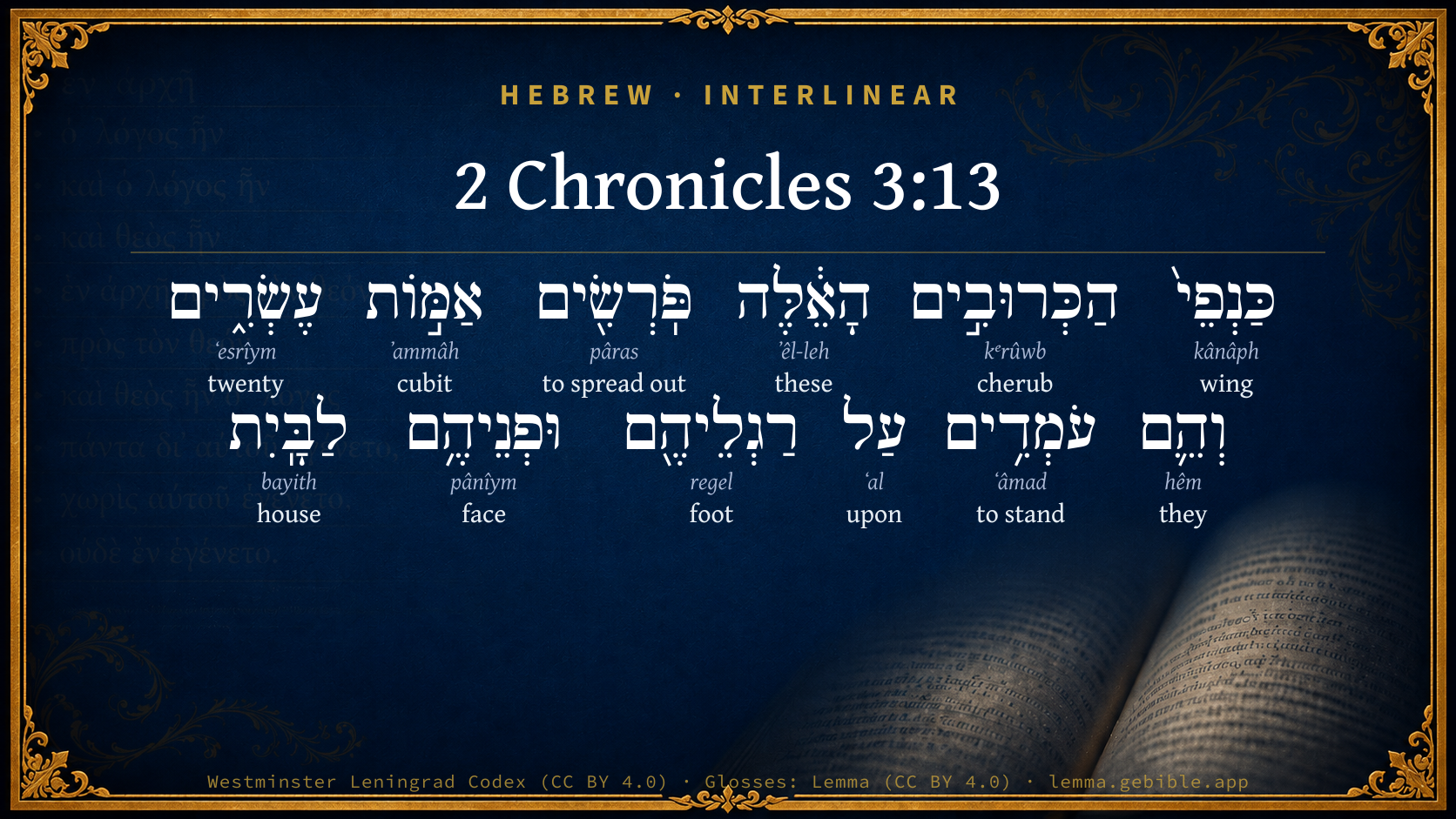
2 Chronicles 3:13

Hebrew (Westminster Leningrad Codex) 2 Chronicles 3:13 appears in the Hebrew Old Testament. The text above is from the Westminster Leningrad Codex. Each word links to its Strong’s number, a concise gloss, and parsing drawn from the Open Scriptures Hebrew Bible morphology. Click any word for its full Brown-Driver-Briggs (BDB) entry.
Download image
Cite this verse

2 Chronicles 3:13 (World English Bible). Public Domain. Lemma interlinear Bible study tool, https://lemma.gebible.app/v/2-chronicles/3/13.

Show BibTeX & RIS
BibTeX
RIS
English Translation
The wings of these cherubim spread themselves forth twenty cubits: and they stood on their feet, and their faces were toward the house.
World English Bible · Public Domain
Download a study sheet

One document with this verse’s original text, its word-by-word gloss line, the meaning frame, cross-references with their text, attributed commentary, and full source and license credits — printable, and it pastes into notes with its structure intact.

This verse Autodidact and up

Study sheet (.html) Plain text (.txt)

A passage Seminary Student

Up to 50 verses in one chapter. A passage sheet keeps up to 6 commentary sources and 12 cross-references per verse, in the order this page ranks them, and says so on the sheet whenever that leaves anything out. Ask for a single verse and you get the Autodidact verse sheet above.

Everything on this page stays free to read, with no account — the sheet is a download of what is already on screen, not access to it.

Want to remove ads? Support Godless Engineer
Compare translations 3

The same verse in 3 English versions, stacked beneath the original-language interlinear above. Click any original word for its lexicon entry.

Each is an independent rendering of the whole verse — the interlinear is not word-aligned to these translations.

Highlighted words mark where these versions differ — a whole-verse word diff, not a word-by-word alignment.

  • World English Bible Public Domain
    The wings of these cherubim spread themselves forth twenty cubits: and they stood on their feet, and their faces were toward the house.
  • King James Version Public Domain
    The wings of these cherubim spread themselves forth twenty cubits: and they stood on their feet, and their faces were inward.
  • unfoldingWord Literal Text CC BY-SA 4.0
    The wings of these cherubim spread out 20 cubits. And they were standing on their feet, and their faces toward the house.

unfoldingWord Literal Text — © unfoldingWord, licensed CC BY-SA 4.0. Word-aligned USFM3 via Door43 (git.door43.org/unfoldingWord/en_ult).

Versions to compare (up to 4)

3 of 4 selected

Show all 18 translations

Every available English version of this verse, each an independent rendering of the whole verse.

  • World English Bible Public Domain
    The wings of these cherubim spread themselves forth twenty cubits: and they stood on their feet, and their faces were toward the house.
  • Berean Standard Bible Public Domain
    So the total wingspan of these cherubim was twenty cubits. They stood on their feet, facing the main room.
  • Majority Standard Bible Public Domain
    So the total wingspan of these cherubim was twenty cubits. They stood on their feet, facing the main room.
  • King James Version Public Domain
    The wings of these cherubim spread themselves forth twenty cubits: and they stood on their feet, and their faces were inward.
  • American Standard Version (1901) Public Domain
    The wings of these cherubim spread themselves forth twenty cubits: and they stood on their feet, and their faces were toward the house.
  • Revised Version (1885) Public Domain
    The wings of these cherubim spread themselves forth twenty cubits: and they stood on their feet, and their faces were toward the house.
  • Geneva Bible (1599) Public Domain
    The wings of these Cherubims were spread abroade twentie cubites: they stoode on their feete, and their faces were toward the house.
  • Douay-Rheims (1899) Public Domain
    So the wings of the two cherubims were spread forth, and were extended twenty cubits: and they stood upright on their feet, and their faces were turned toward the house without.
  • Young's Literal Translation Public Domain
    The wings of these cherubs are spreading forth twenty cubits, and they are standing on their feet and their faces `are' inward.
  • Literal Standard Version CC BY-SA 4.0
    The wings of these cherubim are spreading forth twenty cubits, and they are standing on their feet and their faces [are] inward.
  • Unlocked Literal Bible CC BY-SA 4.0
    The wings of these cherubs spread a total of twenty cubits. The cherubs stood on their feet, with their faces toward the main hall.
  • unfoldingWord Literal Text CC BY-SA 4.0
    The wings of these cherubim spread out 20 cubits. And they were standing on their feet, and their faces toward the house.
  • Darby Bible Public Domain
    The wings of these cherubim spread forth were twenty cubits; and they stood on their feet, and their faces were toward the house.
  • World Messianic Bible Public Domain
    The wings of these cherubim spread themselves out twenty cubits. They stood on their feet, and their faces were toward the house.
  • Webster's Bible Public Domain
    The wings of these cherubim spread themselves forth twenty cubits: and they stood on their feet, and their faces were inward.
  • Free Bible Version CC BY-SA 4.0
    So the wingspan of these cherubim together was twenty cubits. They stood on their feet, facing the main room.
  • Bible in Basic English Public Domain
    Their outstretched wings were twenty cubits across; they were placed upright on their feet, facing the inner part of the house.
  • JPS Tanakh (1917) Public Domain
    The wings of these cherubim spread themselves forth twenty cubits; and they stood on their feet, and their faces were inward.

Literal Standard Version (2020), Covenant Press — licensed CC BY-SA 4.0. Text via the HelloAO Bible API (eBible.org). Unlocked Literal Bible (unfoldingWord) — licensed CC BY-SA 4.0. Text via the HelloAO Bible API (eBible.org). unfoldingWord Literal Text — © unfoldingWord, licensed CC BY-SA 4.0. Word-aligned USFM3 via Door43 (git.door43.org/unfoldingWord/en_ult). Free Bible Version, Dr. Jonathan Gallagher — licensed CC BY-SA 4.0. Text via the HelloAO Bible API (eBible.org).

Word by word

More ways to search: Search by grammar → Find every occurrence → Compare this word →

Practice this passage: Drill this verse → Learn its vocabulary →

פֹּֽרְשִׂ֖ים
pâras
H6566
“spreading out”
Verb, Qal, Participle Active, Masculine, Plural, Absolute
Part of Speech
Verb
Stem
Qal
Form
Participle Active
Gender
Masculine
Number
Plural
State
Absolute
Full BDB Definition

Origin: a primitive root

TWOT: 1832

to spread, spread out, stretch, break in pieces - (Qal) - to spread out, display - to spread over - (Niphal) to be scattered, be spread out - (Piel) - to spread out - to scatter
  1. כַּנְפֵי֙ kânâph H3671 “wings of” Noun, Common, Feminine, Dual, Construct
  2. הַכְּרוּבִ֣ים kᵉrûwb H3742 “the · cherubim” Particle, Definite Article + Noun, Common, Masculine, Plural, Absolute
  3. הָאֵ֔לֶּה ʼêl-leh H428 “the · these” Particle, Definite Article + Pronoun, Demonstrative, Common, Plural
  4. אַמּ֣וֹת ʼammâh H520 “cubits” Noun, Common, Feminine, Plural, Absolute
  5. עֶשְׂרִ֑ים ʻesrîym H6242 “twenty” Adjective, Cardinal number, Both, Plural, Absolute
  6. וְהֵ֛ם hêm H1992 “and · they” Conjunction + Pronoun, Personal, 3rd Person, Masculine, Plural
  7. עֹמְדִ֥ים ʻâmad H5975 “standing” Verb, Qal, Participle Active, Masculine, Plural, Absolute
  8. עַל ʻal H5921 “upon” Preposition
  9. רַגְלֵיהֶ֖ם regel H7272 “feet · their” Noun, Common, Feminine, Dual, Construct + Suffix, Personal, 3rd Person, Masculine, Plural
  10. וּפְנֵיהֶ֥ם pânîym H6440 “and · face(s) · their” Conjunction + Noun, Common, Both, Plural, Construct + Suffix, Personal, 3rd Person, Masculine, Plural
  11. לַבָּֽיִת bayith H1004 “to/for the · house” Preposition, Determined + Noun, Common, Masculine, Singular, Absolute

About this verse

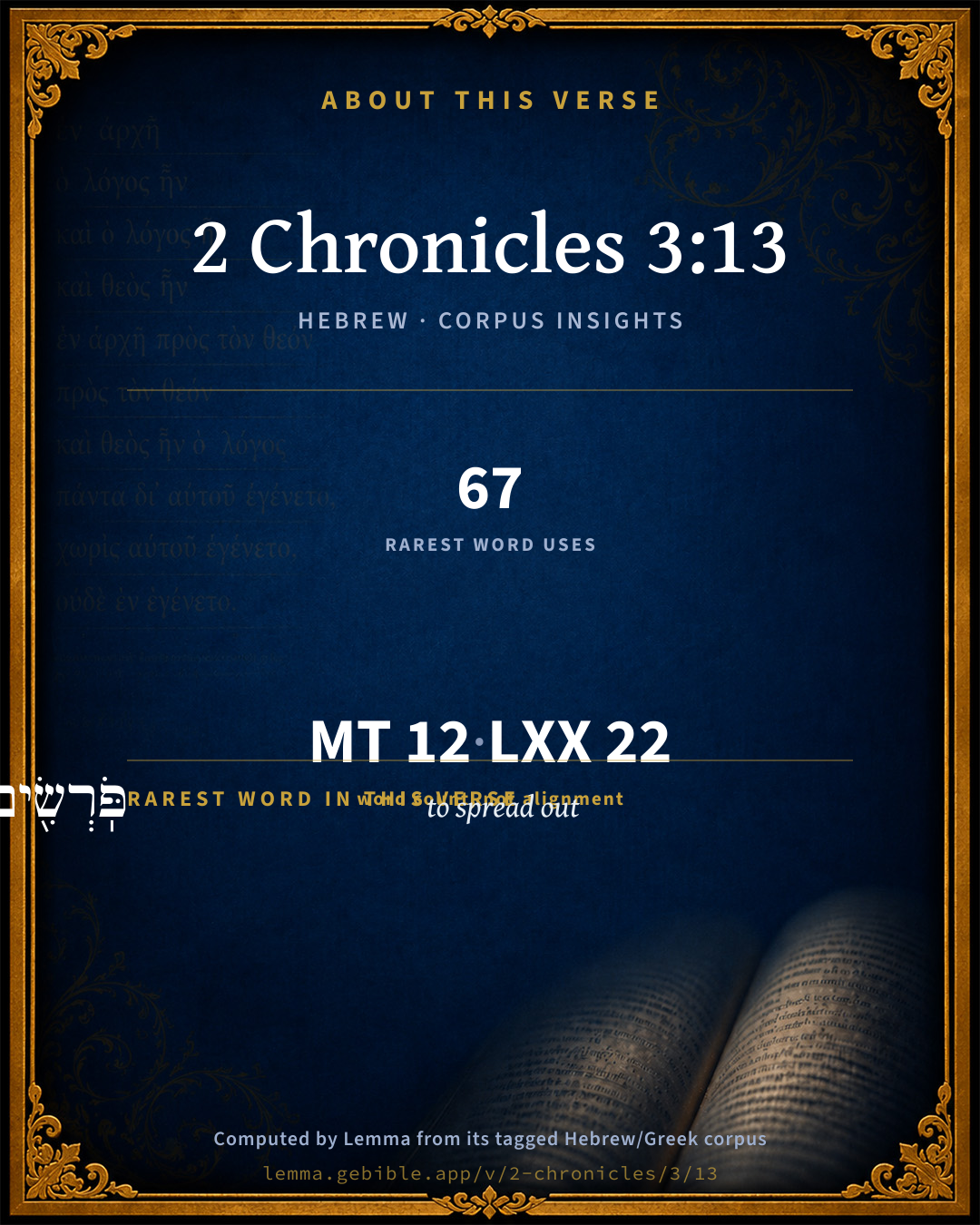
These counts appear in no published source. They are computed here, from the morphology-tagged text and Lemma’s own curated glosses. What Lemma adds →

12
words
12
distinct lemmas
Historical
section

Grammatical profile

  • 2 verbs
  • 6 nouns
  • 1 adjective
  • 2 pronouns
  • 1 preposition

Verb forms

  • פֹּֽרְשִׂ֖ים Qal · Participle Active
  • עֹמְדִ֥ים Qal · Participle Active

Hebrew & Septuagint length

In English translation the verse runs 23 words from the Hebrew and 27 from the Septuagint (LXX English) — closely comparable.

A rough comparison of the two English renderings, which tokenize alike — not a word-level alignment.

Word counts can differ between the Hebrew and the Greek without any difference in meaning — e.g. the Hebrew direct-object marker אֵת has no separate Greek word, and Greek often adds the article ὁ.

In the original languages it is 12 Hebrew tokens and 22 Greek tokens — but the two are counted differently (Hebrew bundles its prefixes and suffixes into one token; the Greek is in lemma form), so that isn’t a like-for-like length.

Cross-references

1

Topical passages linked to 2 Chronicles 3:13 in the Treasury of Scripture Knowledge — connected by theme and wording, ordered by reader-vote popularity; previews shown in the World English Bible.

  • Exodus 25:20 The cherubim shall spread out their wings upward, covering the mercy seat with their wings, with their faces toward one another. The faces of the cherubim shall be toward the mercy seat.

Cross-references courtesy of OpenBible.info (CC BY 4.0).

Hebrew and Greek witnesses Masoretic Hebrew ↔ Greek Septuagint

The same verse in the two great witnesses to the Old Testament, shown verse-for-verse.

These are two independent witnesses, not word-aligned to each other, and the Septuagint is shown in lemma (dictionary) form.

Hebrew 2 Chronicles 3:13 Masoretic · Westminster Leningrad Codex

כַּנְפֵי֙ הַכְּרוּבִ֣ים הָאֵ֔לֶּה פֹּֽרְשִׂ֖ים אַמּ֣וֹת עֶשְׂרִ֑ים וְהֵ֛ם עֹמְדִ֥ים עַל רַגְלֵיהֶ֖ם וּפְנֵיהֶ֥ם לַבָּֽיִת

The wings of these cherubim spread themselves forth twenty cubits: and they stood on their feet, and their faces were toward the house.

World English Bible · Public Domain

Greek LXX 2 Chronicles 3:13 Septuagint · lemma form

καί ὁ πτέρυξ ὁ χερουβιν διαπετάζω πῆχυς εἴκοσι καί αὐτός ἵστημι ἐπί ὁ πούς αὐτός καί ὁ πρόσωπον αὐτός εἰς ὁ οἶκος

And the wings of these cherubs expanded were of the length of twenty cubits: and they stood upon their feet, and their faces were toward the house.

LXX2012 (modern English Septuagint) · Public Domain

Hebrew: Westminster Leningrad Codex (CC BY 4.0). Greek: Septuagint (public domain); English from LXX2012 (modern English Septuagint) (Public Domain). How the Septuagint differs from the Hebrew →

Commentary

Notes on 2 Chronicles 3:13 from classic Christian and Jewish commentators (each source and its license shown beneath its notes). The classic Christian expositions comment on the surrounding passage and are grouped to its opening verse, so a note may address several verses; the Jewish commentaries on the Tanakh (Rashi and others) are per-verse, so they appear only where the commentator wrote on this verse.

Lemma curates 59 commentaries, every one of them public domain or Creative Commons licensed, each selected and text-cleaned for this edition rather than reprinted as found. About our sources →

Trapp's Complete Commentary

John Trapp

2Ch 3:13 The wings of these cherubims spread themselves forth twenty cubits: and they stood on their feet, and their faces [were] inward.

Ver. 13. And their faces were inward.] Heb., Toward the house; i.e., toward the holy place, called the greater house. {2Ch 3:5}

John Trapp, A Commentary or Exposition upon All the Books of the Old and New Testament (1647–1656) — public domain. Text from a community e-Sword module.

Ellicott's Commentary for English Readers

(13) The wings of these cherubims.—Or, These wings of the cherubim.

Spread themselves forth.—Were outspreading (participle), 1Ch_28:18.

And they stood.—Were standing. They were ten cubits high (1Ki_6:26).

Inward.—See margin. Translate, toward the chamber. The cherubs did not face each other like the cherubim on the mercy seat (Exo_25:20).

A Bible Commentary for English Readers, edited by Charles John Ellicott (1878–1897) — public domain. Text from a community e-Sword module.

The Cambridge Bible for Schools and Colleges

gen. ed. J. J. S. Perowne

13. twenty cubits] Extending across the width of the whole house.

on their feet] Not “couchant” nor “rampant” but standing as the winged bulls of Assyria stand.

inward] R.V. towards the house, as though to protect the Holiest Place from violation from anyone advancing through the house.

The Cambridge Bible for Schools and Colleges (gen. ed. J. J. S. Perowne; Cambridge University Press, 1878–1918) — public domain. Text from a community e-Sword module.

Albert Barnes' Notes on the Bible

Their faces were inward - literally, as in the margin. Instead of looking toward one another, with heads bent downward over the mercy Seat, like the cherubim of Moses Exo 37:9, these of Solomon looked out from the sanctuary into the great chamber (“the house”). The cherubim thus stood upright on either side of the ark, like two sentinels guarding it.

Albert Barnes' Notes on the Bible (1834–1885) — public domain. Text from a community e-Sword/MySword module.

Haydock's Catholic Bible Commentary

Toward. Hebrew, "inward;" looking at each other, (Exodus xxv. 20.) or towards the altar of holocausts.

George Leo Haydock (1774–1849), Haydock's Catholic Family Bible and Commentary, 1859 edition — public domain. Excludes Psalms (Douay-Rheims chapter numbering differs from Protestant) and Deuterocanonical books (Catholic canon only).

Matthew Poole's English Annotations

Heb. Towards the house, or rather, that house; not the holy house, as divers understand it; for then their backs must have been turned towards the ark, which was indecent, and directly contrary to the posture of Moses’s cherubims, which looked towards it; but the most holy house, which was last named, 1Ch 3:8, and of which he continues yet to speak; this posture being most agreeable to their use, which was with their wings to close in the ark and cover it, as it is expressly affirmed below, 1Ch 5:8.

Matthew Poole's English Annotations on the Holy Bible (1683–1685) — public domain. Text from a community e-Sword/MySword module.

The Pulpit Commentary

Their faces were inward; Hebrew, "were to the house," viz. to the holy place. The position of these cherubim, both as to wings and faces, was clearly different from that of those for the tabernacle of Moses. There they "cover the mercy-seat with their wings, and their faces are one to another toward the mercy-seat were the faces of the cherubim". (Exo_25:20 Exo_37:9) May this alteration in the time of Solomon indicate possibly one more advance in the developing outlook of Divine mercy to a whole world? Neither this place nor the parallel makes it certain whether the cherubim, that are here said to stand on their feet, stood on the ground, as some say they did. As regards those of the tabernacle, the prepositions used in Exo_25:18, 19 and Exo_37:7, 8 appear to lay stress on their position being a fixture at and on each extremity of the mercy-seat.

The Pulpit Commentary (1880–1919), ed. H.D.M. Spence-Jones & Joseph S. Exell — public domain. Text from a community e-Sword module.

John Wesley's Explanatory Notes

Inward - Hebrew. towards the house, that is, the most holy house.

John Wesley, Explanatory Notes Upon the Whole Bible (1754–1765) — public domain. Text via the GEBible commentary corpus.

unfoldingWord translationNotes

Door43 World Missions Community

twenty cubits

A cubit is 46 centimeters. AT: "9.2 meters" (See: Biblical Distance)

He made ... he fashioned

The readers should understand that Solomon probably commanded other people to do the actual work. AT: "Solomon's workers made ... they fashioned" (See: Metonymy)

blue, purple, and crimson wool

Translate these words as you did in 2 Chronicles 2:7.

fine linen

"high quality cloth" or "the best cloth"

translationWords

curtain

unfoldingWord translationNotes — © Distant Shores Media and the Door43 World Missions Community, licensed CC BY-SA 4.0. Source: git.door43.org/Door43/en_tn.

Rashi

Rabbi Shlomo Yitzchaki (Rashi)

standing on their feet on the floor of the House to the west.

with their faces to the House To the inside, for their heads were not erect, so that they should appear as though looking outward, but their heads were bent and looking before them, as it is written (Exod. 25:20): “and their faces [shall be] one toward the other,” but here it says. “with their faces to the House,” but rather their heads were facing each other, and their heads were also bent toward the House, toward the inside, and the Ark was standing in the place of the wing spread of the two cherubim, and the wings of the cherubim were inclined from the wall and shielded the Ark cover and the Ark with their wings. Aside from these cherubim were the cherubim that Moses had made from the Ark cover, still attached and clinging to the Ark cover and standing upon it. Do not be surprised about this, because likewise, Solomon made ten tables and ten candelabra, besides those of Moses.

Rashi on the Tanakh — English translations: “The Judaica Press complete Tanach with Rashi, translated by A. J. Rosenberg” (CC BY 4.0); “Pentateuch with Rashi's commentary by M. Rosenbaum and A.M. Silbermann, 1929-1934” (public domain); “The Metsudah Tanach series, Lakewood, N.J” (CC BY 4.0); and “The Book of Joshua, Metsudah Publications, 1997” (CC BY 4.0). Text via Sefaria.

Lesson kit

Teaching starters — assembled from the data on this page, not authored interpretation. Every prompt links to the verse data it draws on. Edit before teaching.

2 Chronicles, in the Historical, opens this verse with 12 words (12 distinct Hebrew lemmas). Its most distinctive word is pâras (“to spread out”). A historical commentator’s framing appears above. Read the whole chapter for the surrounding context.

Discussion questions

  1. What does “to spread out” (pâras) contribute to the verse as a whole?
  2. How does Exodus 25:20, which shares this passage’s theme, read alongside this verse?
  3. These translations render this verse differently. What is at stake in choosing one wording over another?
  4. «פֹּֽרְשִׂ֖ים» is a Qal Participle Active verb. How does that grammatical form shape the action described?
  5. Compare how Trapp's Complete Commentary and Ellicott's Commentary for English Readers read this verse. Where do they agree or differ?

Things to notice

Reading settings

Reading text

Shown beneath each verse's original-language words.

Old Testament
Old Testament edition

Read the OT as the Masoretic Hebrew (MT) or the Greek Septuagint (LXX).

English shown for the Greek Septuagint (in the Hebrew ↔ Greek comparison).

Comparing translations? Open the Compare panel on any verse page to stack up to four side by side.