
Judges 19:11

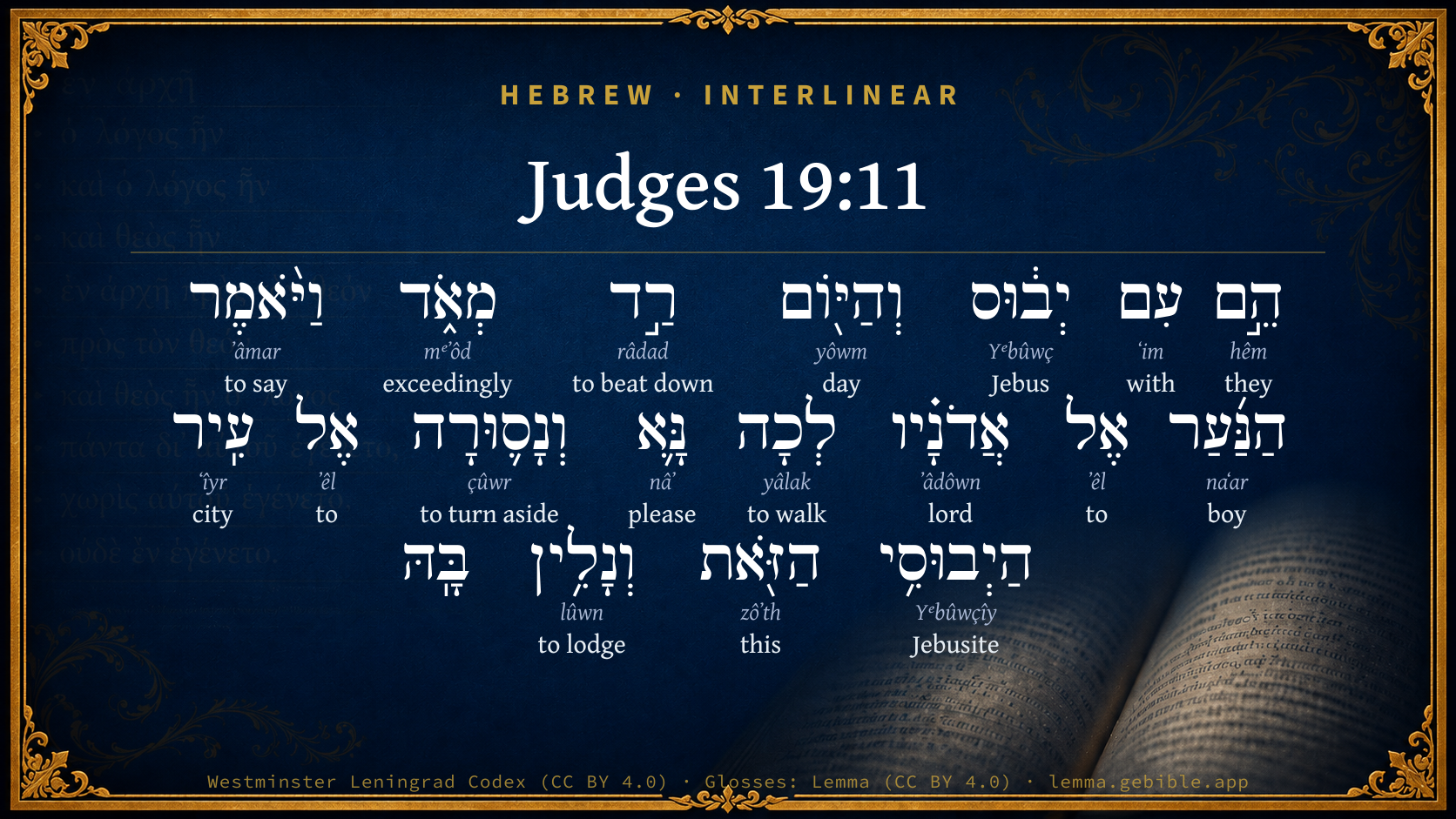
Hebrew (Westminster Leningrad Codex) Judges 19:11 appears in the Hebrew Old Testament. The text above is from the Westminster Leningrad Codex. Each word links to its Strong’s number, a concise gloss, and parsing drawn from the Open Scriptures Hebrew Bible morphology. Click any word for its full Brown-Driver-Briggs (BDB) entry.
Download image
Cite this verse

Judges 19:11 (World English Bible). Public Domain. Lemma interlinear Bible study tool, https://lemma.gebible.app/v/judges/19/11.

Show BibTeX & RIS
BibTeX
RIS
English Translation
When they were by Jebus, the day was far spent; and the servant said to his master, Please come and let us turn aside into this city of the Jebusites, and lodge in it.
World English Bible · Public Domain
Highlights
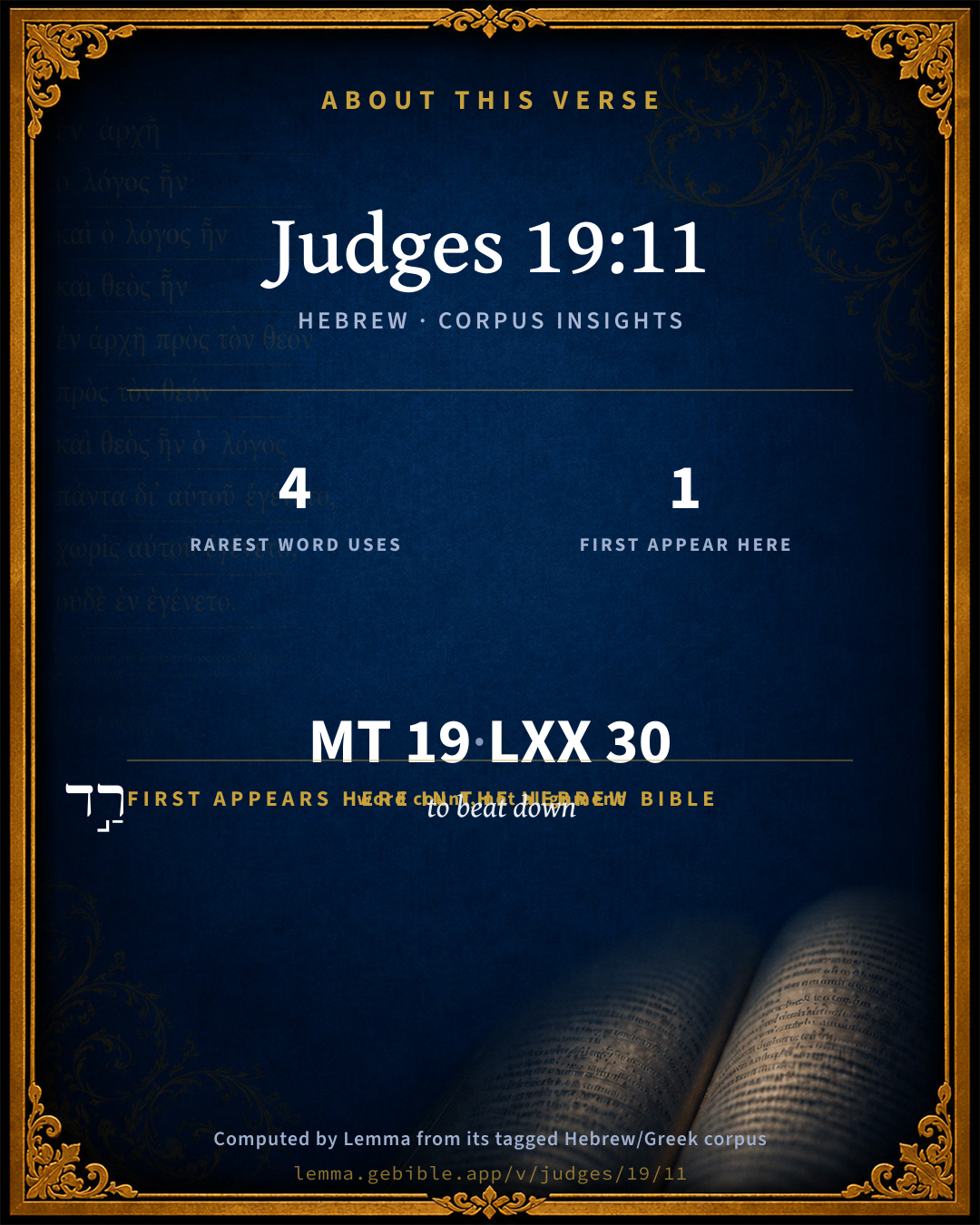
  • 1 first appearance in the Hebrew Bible
Full analysis ↓
Download a study sheet

One document with this verse’s original text, its word-by-word gloss line, the meaning frame, cross-references with their text, attributed commentary, and full source and license credits — printable, and it pastes into notes with its structure intact.

This verse Autodidact and up

Study sheet (.html) Plain text (.txt)

A passage Seminary Student

Up to 50 verses in one chapter. A passage sheet keeps up to 6 commentary sources and 12 cross-references per verse, in the order this page ranks them, and says so on the sheet whenever that leaves anything out. Ask for a single verse and you get the Autodidact verse sheet above.

Everything on this page stays free to read, with no account — the sheet is a download of what is already on screen, not access to it.

Want to remove ads? Support Godless Engineer
Compare translations 3

The same verse in 3 English versions, stacked beneath the original-language interlinear above. Click any original word for its lexicon entry.

Each is an independent rendering of the whole verse — the interlinear is not word-aligned to these translations.

Highlighted words mark where these versions differ — a whole-verse word diff, not a word-by-word alignment.

  • World English Bible Public Domain
    When they were by Jebus, the day was far spent; and the servant said to his master, Please come and let us turn aside into this city of the Jebusites, and lodge in it.
  • King James Version Public Domain
    And when they were by Jebus, the day was far spent; and the servant said unto his master, Come, I pray thee, and let us turn in into this city of the Jebusites, and lodge in it.
  • unfoldingWord Literal Text CC BY-SA 4.0
    They beside Jebus, and the day had gone down greatly. So the young man said to his master, “Come, please, and let us turn aside into this city of the Jebusite, and we shall lodge in it.”

unfoldingWord Literal Text — © unfoldingWord, licensed CC BY-SA 4.0. Word-aligned USFM3 via Door43 (git.door43.org/unfoldingWord/en_ult).

Versions to compare (up to 4)

3 of 4 selected

Show all 18 translations

Every available English version of this verse, each an independent rendering of the whole verse.

  • World English Bible Public Domain
    When they were by Jebus, the day was far spent; and the servant said to his master, Please come and let us turn aside into this city of the Jebusites, and lodge in it.
  • Berean Standard Bible Public Domain
    When they were near Jebus and the day was almost gone, the servant said to his master, “Please, let us stop at this Jebusite city and spend the night here.”
  • Majority Standard Bible Public Domain
    When they were near Jebus and the day was almost gone, the servant said to his master, “Please, let us stop at this Jebusite city and spend the night here.”
  • King James Version Public Domain
    And when they were by Jebus, the day was far spent; and the servant said unto his master, Come, I pray thee, and let us turn in into this city of the Jebusites, and lodge in it.
  • American Standard Version (1901) Public Domain
    When they were by Jebus, the day was far spent; and the servant said unto his master, Come, I pray thee, and let us turn aside into this city of the Jebusites, and lodge in it.
  • Revised Version (1885) Public Domain
    When they were by Jebus, the day was far spent; and the servant said unto his master, Come, I pray thee, and let us turn aside into this city of the Jebusites, and lodge in it.
  • Geneva Bible (1599) Public Domain
    When they were neere to Iebus, the day was sore spent, and the seruant said vnto his master, Come, I pray thee, and let vs turne into this citie of the Iebusites, and lodge all night there.
  • Douay-Rheims (1899) Public Domain
    And now they were come near Jebus, and the day was far spent: and the servant said to his master: Come, I beseech thee, let us turn into the city of the Jebusites, and lodge there.
  • Young's Literal Translation Public Domain
    They `are' near Jebus, and the day hath gone greatly down, and the young man saith unto his lord, `Come, I pray thee, and we turn aside unto this city of the Jebusite, and lodge in it.'
  • Literal Standard Version CC BY-SA 4.0
    They [are] near Jebus, and the day has greatly gone down, and the young man says to his lord, “Please come, and we turn aside to this city of the Jebusite and lodge in it.”
  • Unlocked Literal Bible CC BY-SA 4.0
    When they were near Jebus, the day was nearly over, and the servant said to his master, “Come, let us turn aside to the city of the Jebusites and spend the night in it.”
  • unfoldingWord Literal Text CC BY-SA 4.0
    They beside Jebus, and the day had gone down greatly. So the young man said to his master, “Come, please, and let us turn aside into this city of the Jebusite, and we shall lodge in it.”
  • Darby Bible Public Domain
    When they were near Jebus, the day was far spent, and the servant said to his master, "Come now, let us turn aside to this city of the Jeb'usites, and spend the night in it."
  • World Messianic Bible Public Domain
    When they were by Jebus, the day was far spent; and the servant said to his master, “Please come and let’s enter into this city of the Jebusites, and stay in it.”
  • Webster's Bible Public Domain
    And when they were by Jebus, the day was far spent; and the servant said to his master, Come, I pray thee, and let us turn in to this city of the Jebusites, and lodge in it.
  • Free Bible Version CC BY-SA 4.0
    As they approached Jebus the day was over, and the servant said to his master, “Sir, why don't we stop here at this Jebusite town for the night?”
  • Bible in Basic English Public Domain
    When they got near Jebus the day was far gone; and the servant said to his master, Now let us go from our road into this town of the Jebusites and take our night's rest there.
  • JPS Tanakh (1917) Public Domain
    When they were by Jebus — the day was far spent — the servant said unto his master: 'Come, I pray thee, and let us turn aside into this city of the Jebusites, and lodge in it.'

Literal Standard Version (2020), Covenant Press — licensed CC BY-SA 4.0. Text via the HelloAO Bible API (eBible.org). Unlocked Literal Bible (unfoldingWord) — licensed CC BY-SA 4.0. Text via the HelloAO Bible API (eBible.org). unfoldingWord Literal Text — © unfoldingWord, licensed CC BY-SA 4.0. Word-aligned USFM3 via Door43 (git.door43.org/unfoldingWord/en_ult). Free Bible Version, Dr. Jonathan Gallagher — licensed CC BY-SA 4.0. Text via the HelloAO Bible API (eBible.org).

Word by word

More ways to search: Search by grammar → Find every occurrence → Compare this word →

Practice this passage: Drill this verse → Learn its vocabulary →

יְב֔וּס
Yᵉbûwç
H2982
“Jebus”
Noun, Proper
Part of Speech
Noun
Type
Proper
Full BDB Definition

Origin: from H947

TWOT: None

Jebus = "threshing place" - an early name for Jerusalem, the city of the Jebusites; also 'Jebusi'
  1. הֵ֣ם hêm H1992 “they” Pronoun, Personal, 3rd Person, Masculine, Plural
  2. עִם ʻim H5973 “with” Preposition
  3. וְהַיּ֖וֹם yôwm H3117 “and · the · day” Conjunction + Particle, Definite Article + Noun, Common, Masculine, Singular, Absolute
  4. רַ֣ד râdad H7286 “to beat down” Verb, Qal, Perfect, 3rd Person, Masculine, Singular
  5. מְאֹ֑ד mᵉʼôd H3966 “exceedingly” Adverb
  6. וַיֹּ֨אמֶר ʼâmar H559 “and · to say” Conjunction + Verb, Qal, Sequential Imperfect, 3rd Person, Masculine, Singular
  7. הַנַּ֜עַר naʻar H5288 “the · boy” Particle, Definite Article + Noun, Common, Masculine, Singular, Absolute
  8. אֶל ʼêl H413 “to” Preposition
  9. אֲדֹנָ֗יו ʼâdôwn H113 “lords · his” Noun, Common, Masculine, Plural, Construct + Suffix, Personal, 3rd Person, Masculine, Singular
  10. לְכָה yâlak H3212 “walk” Verb, Qal, Imperative, 2nd Person, Masculine, Singular + Suffix, h
  11. נָּ֛א nâʼ H4994 “please” Particle, Interjection
  12. וְנָס֛וּרָה çûwr H5493 “and · to turn aside” Conjunction + Verb, Qal, Cohortative, 1st Person, Common, Plural
  13. אֶל ʼêl H413 “to” Preposition
  14. עִֽיר ʻîyr H5892 “city of” Noun, Common, Feminine, Singular, Construct
  15. הַיְבוּסִ֥י Yᵉbûwçîy H2983 “the · Jebusite” Particle, Definite Article + Noun, Gentilic, Masculine, Singular, Absolute
  16. הַזֹּ֖את zôʼth H2063 “the · this” Particle, Definite Article + Pronoun, Demonstrative, Feminine, Singular
  17. וְנָלִ֥ין lûwn H3885 “and · to lodge” Conjunction + Verb, Qal, Imperfect, 1st Person, Common, Plural

About this verse

These counts appear in no published source. They are computed here, from the morphology-tagged text and Lemma’s own curated glosses. What Lemma adds →

19
words
17
distinct lemmas
Historical
section

Notable vocabulary

The rarest word here is יְב֔וּס Jebus H2982 — appearing just 4 times in the whole Hebrew Bible.

First appearance in Scripture

This word makes its first canonical appearance in the Hebrew Bible here:

  • רַ֣ד to beat down H7286

Shared distinctive vocabulary

יְב֔וּס Jebus H2982 occurs in 4 verses of the Hebrew Bible. Also found in:

Grammatical profile

  • 5 verbs
  • 6 nouns
  • 2 pronouns
  • 4 prepositions
  • 1 adverb
  • 1 particle

Verb forms

  • רַ֣ד Qal · Perfect
  • וַיֹּ֨אמֶר Qal · Sequential Imperfect
  • לְכָה Qal · Imperative
  • וְנָס֛וּרָה Qal · Cohortative
  • וְנָלִ֥ין Qal · Imperfect

Repetition

A word recurs within this verse — often emphatic in Hebrew:

  • אֶל to H413 ×2

Hebrew & Septuagint length

In English translation the verse runs 34 words from the Hebrew and 42 from the Septuagint (LXX English) — closely comparable.

A rough comparison of the two English renderings, which tokenize alike — not a word-level alignment.

Word counts can differ between the Hebrew and the Greek without any difference in meaning — e.g. the Hebrew direct-object marker אֵת has no separate Greek word, and Greek often adds the article ὁ.

In the original languages it is 19 Hebrew tokens and 30 Greek tokens — but the two are counted differently (Hebrew bundles its prefixes and suffixes into one token; the Greek is in lemma form), so that isn’t a like-for-like length.

Cross-references

5

Topical passages linked to Judges 19:11 in the Treasury of Scripture Knowledge — connected by theme and wording, ordered by reader-vote popularity; previews shown in the World English Bible.

  • Genesis 10:16 the Jebusite, the Amorite, the Girgashite,
  • Joshua 15:63 As for the Jebusites, the inhabitants of Jerusalem, the children of Judah couldn't drive them out: but the Jebusites dwell with the children of Judah at Jerusalem to this day.
  • Judges 1:21 The children of Benjamin did not drive out the Jebusites who inhabited Jerusalem; but the Jebusites dwell with the children of Benjamin in Jerusalem to this day.
  • Judges 19:10 But the man wouldn't stay that night, but he rose up and departed, and came over against Jebus (the same is Jerusalem): and there were with him a couple of donkeys saddled; his concubine also was with him.
  • 2 Samuel 5:6 The king and his men went to Jerusalem against the Jebusites, the inhabitants of the land, who spoke to David, saying, Except you take away the blind and the lame, you shall not come in here; thinking, David can't come in here.

Cross-references courtesy of OpenBible.info (CC BY 4.0).

Hebrew and Greek witnesses Masoretic Hebrew ↔ Greek Septuagint

The same verse in the two great witnesses to the Old Testament, shown verse-for-verse.

These are two independent witnesses, not word-aligned to each other, and the Septuagint is shown in lemma (dictionary) form.

Hebrew Judges 19:11 Masoretic · Westminster Leningrad Codex

הֵ֣ם עִם יְב֔וּס וְהַיּ֖וֹם רַ֣ד מְאֹ֑ד וַיֹּ֨אמֶר הַנַּ֜עַר אֶל אֲדֹנָ֗יו לְכָה נָּ֛א וְנָס֛וּרָה אֶל עִֽיר הַיְבוּסִ֥י הַזֹּ֖את וְנָלִ֥ין בָּֽהּ

When they were by Jebus, the day was far spent; and the servant said to his master, Please come and let us turn aside into this city of the Jebusites, and lodge in it.

World English Bible · Public Domain

Greek LXX Judges 19:11 Septuagint · lemma form

καί ἔρχομαι ἕως ιεβους καί ὁ ἡμέρα προβαίνω σφόδρα καί εἶπον ὁ νεανίας πρός ὁ κύριος αὐτός δεῦρο δή καί ἐκκλίνω εἰς πόλις ὁ ιεβουσι οὗτος καί αὐλίζω ἐν αὐτός

And they came as far as Jebus: and the day had far advanced, and the young man said to his master, Come, I pray you, and let us turn aside to this city of the Jebusites, and let us lodge in it.

LXX2012 (modern English Septuagint) · Public Domain

Hebrew: Westminster Leningrad Codex (CC BY 4.0). Greek: Septuagint (public domain); English from LXX2012 (modern English Septuagint) (Public Domain). How the Septuagint differs from the Hebrew →

Targum (Aramaic paraphrase)

1

The Targum is the ancient Jewish Aramaic paraphrase of the Hebrew Scriptures — an interpretive translation, not the Hebrew text itself. Onkelos (literal) and Pseudo-Jonathan (expansive) render the Torah, and Jonathan the Prophets. Coverage is partial: where no permissively-licensed English translation exists for a verse, only the Aramaic is shown. This is verse-level text, not a word-by-word alignment to the Hebrew.

  1. Targum Jonathan Prophets (Joshua–Malachi)
    אִינוּן עִם יְבוּס וְיוֹמָא מְאַךְ לַחֲדָא וַאֲמַר עוּלֵימָא לְרִבּוֹנֵיהּ אִיתָא כְעַן וּנְזוּר לְקַרְתָּא דִיבוּסָאֵי הָדָא וּנְבֵית בָּהּ:

    (no public-domain English translation for this verse)

    Targum Jonathan — Aramaic: “Mikraot Gedolot” (public domain). English: “Sefaria Community Translation” (CC0 1.0 (public-domain dedication)); “London "Chaldee Paraphrase," 1871” (public domain). Text via Sefaria.

Commentary

Notes on Judges 19:11 from classic Christian and Jewish commentators (each source and its license shown beneath its notes). The classic Christian expositions comment on the surrounding passage and are grouped to its opening verse, so a note may address several verses; the Jewish commentaries on the Tanakh (Rashi and others) are per-verse, so they appear only where the commentator wrote on this verse.

Lemma curates 59 commentaries, every one of them public domain or Creative Commons licensed, each selected and text-cleaned for this edition rather than reprinted as found. About our sources →

Trapp's Complete Commentary

John Trapp

Jdg 19:11 [And] when they [were] by Jebus, the day was far spent; and the servant said unto his master, Come, I pray thee, and let us turn in into this city of the Jebusites, and lodge in it.

Ver. 11. Come, I pray thee, and let us turn, &c.] This was not the worst counsel that ever the Levite had given him.

“ Saepe etiam est holitor valde opportuna locutus. ”

But he thought to have done otherwise for the better, though it fell out for the worse. Counsels are not to be valued by events, but by the reasons whereupon they are grounded; and God’s direction, above all, is to be implored.

John Trapp, A Commentary or Exposition upon All the Books of the Old and New Testament (1647–1656) — public domain. Text from a community e-Sword module.

Geneva Bible (1599)

Geneva Bible translators

Or, went down.

Geneva Bible (1599) marginal notes — public domain. Text via Bolls.life.

Adam Clarke's Commentary

Verse 11. When they were by Jebus] This was Jerusalem, in which, though after the death of Joshua it appears to have been partly conquered by the tribe of Judah, yet the Jebusites kept the strong hold of Zion till the days of David, by whom they were finally expelled. See Clarke on Jdg 1:8.

Adam Clarke's Commentary on the Bible (1810–1826) — public domain. Text from a community e-Sword/MySword module.

Ellicott's Commentary for English Readers

(11) The day was far spent.—Jerusalem is only two hours distant from Bethlehem. The father of the woman, by his unwise neglect to “speed the parting guest,” had greatly added to the perils of their journey in a half-conquered country, and in such wild times.

Unto his master.—Literally, to his lord, a mere form of respect, as in Gen_39:2.

This city of the Jebusites.—Their complete and undisturbed possession shows that this narrative falls at an early date (Jdg_1:7-8; Jdg_1:11; Jdg_1:21; Jos_15:63). The travellers would reach the town from Bethlehem at about five o’clock.

A Bible Commentary for English Readers, edited by Charles John Ellicott (1878–1897) — public domain. Text from a community e-Sword module.

John Gill's Exposition

And when they were by Jebus the day was far spent,.... Or "was gone down very much" (q), the sun was going down apace, and near setting:

and the servant said unto his master, come, I pray thee: he proposed it to him in a submissive manner, and might use some entreaty for his master's good and safety:

and let us turn in unto this city of the Jebusites, and lodge in it; for though that part of the city which belonged to the tribe of Judah was taken by them after the death of Joshua, yet that which belonged to the tribe of Benjamin, part of it was still possessed by the Jebusites, whom the Benjamites could not expel, Jdg 1:21 and Ben Gersom thinks, that this affair of this Levite, and his concubine, was before the men of Judah fought against it, and took it; which not unlikely, seeing it is called here a city of the Jebusites, and because the Levite objected going into it on that account; whereas there would not have been much in his objection, if one part or it was in the session of the men of Judah, and the other in the hands of the tribe of Benjamin, though they had some Jebusites dwelling among them.

(q) "descenderat valde", Pagninus, Montanus, Tigurine version.

John Gill's Exposition of the Whole Bible (1746–1763) — public domain (CC PDM 1.0). Text via the HelloAO Bible API.

Keil & Delitzsch

C. F. Keil & F. Delitzsch

But as the day had gone far down when they were by Jebus (רד, third pers. perf., either of ירד with י dropped like תּתּה in Sa2 22:41 for נתתּה, or from רדד in the sense of ירד), the attendant said to his master, "Come, let us turn aside into this Jebusite city, and pass the night in it." But his master was unwilling to enter a city of the foreigners (נכרי( sre is a genitive), where there were none of the sons of Israel, and would pass over to Gibeah. "Come (לך = לכה, Num 23:13), we will draw near to one of the places (which he immediately names), and pass the night in Gibeah or Ramah." These two towns, the present Jeba and er Rm, were not a full hour's journey apart, and stood opposite to one another, only about two and a half or three hours from Jerusalem (see at Jos 18:25, Jos 18:28).

Keil & Delitzsch — Biblical Commentary on the Old Testament (1861–1891) — public domain (CC PDM 1.0). Text via the HelloAO Bible API. (Old Testament only.)

Lesson kit

Teaching starters — assembled from the data on this page, not authored interpretation. Every prompt links to the verse data it draws on. Edit before teaching.

Judges, in the Historical, opens this verse with 19 words (17 distinct Hebrew lemmas). Its most distinctive word is Yᵉbûwç (“Jebus”). A historical commentator’s framing appears above. Read the whole chapter for the surrounding context.

Discussion questions

  1. The word Yᵉbûwç carries the sense “Jebus.” How does it shape the verse?
  2. The word “to beat down” first appears here in Scripture. What is being introduced at this debut?
  3. Judges 19:10 shares the word «Jebus» with this verse. How do the two illuminate each other?
  4. “to” occurs 2× in this one verse. What is the effect of the repetition?
  5. The translations on this page render this verse differently — a whole-verse word diff, not a word-by-word alignment. What might account for the different wordings?
  6. The verb «רַ֣ד» is Qal Perfect. How does its form color the action?
  7. Reading how Trapp's Complete Commentary and Geneva Bible (1599) read this verse, where do the two commentators agree and where do they part?

Things to notice

Reading settings

Reading text

Shown beneath each verse's original-language words.

Old Testament
Old Testament edition

Read the OT as the Masoretic Hebrew (MT) or the Greek Septuagint (LXX).

English shown for the Greek Septuagint (in the Hebrew ↔ Greek comparison).

Comparing translations? Open the Compare panel on any verse page to stack up to four side by side.