Ecclesiastes 1:7

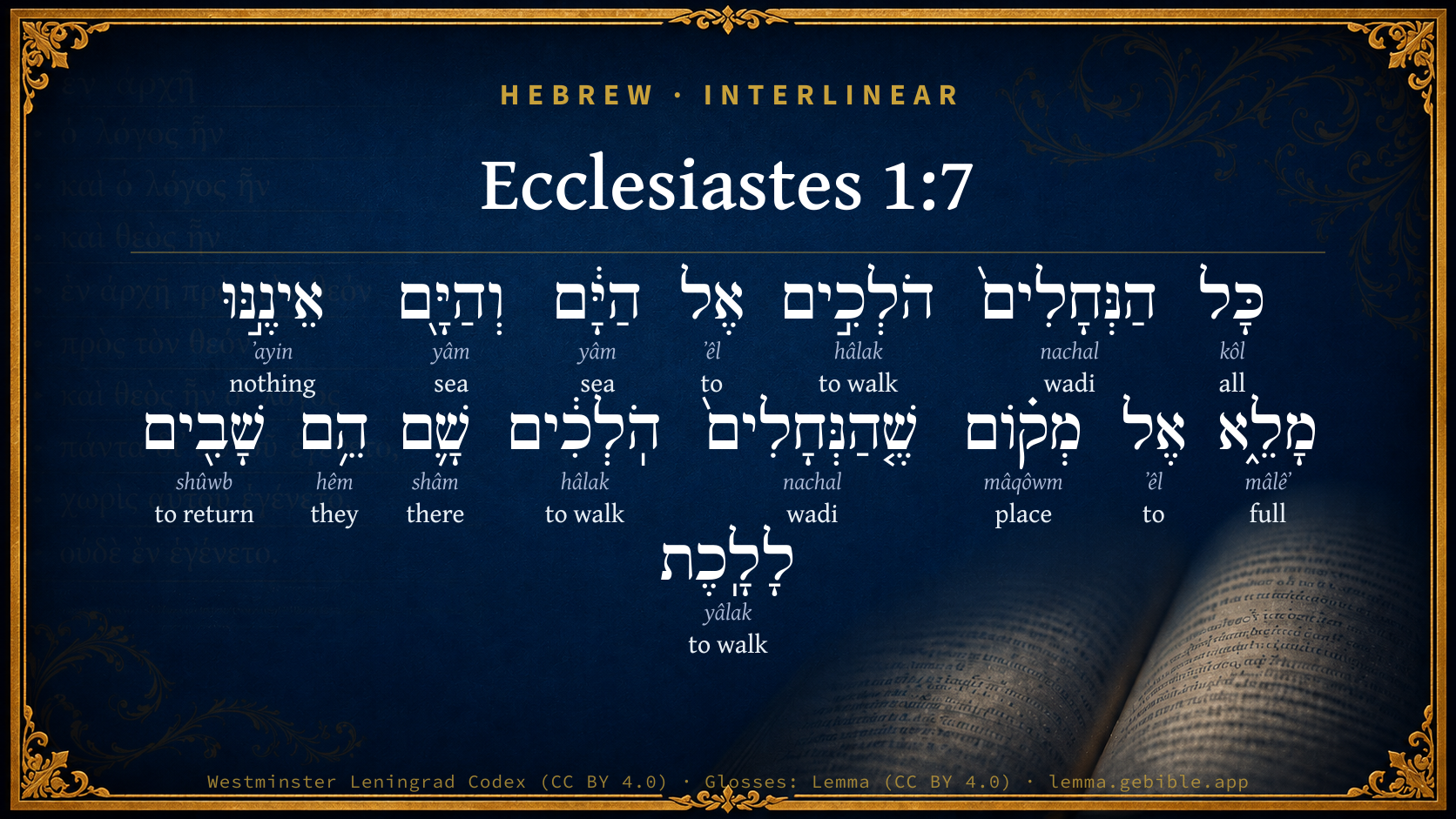
Hebrew (Westminster Leningrad Codex) Ecclesiastes 1:7 appears in the Hebrew Old Testament. The text above is from the Westminster Leningrad Codex. Each word links to its Strong’s number, a concise gloss, and parsing drawn from the Open Scriptures Hebrew Bible morphology. Click any word for its full Brown-Driver-Briggs (BDB) entry.
Download image
Cite this verse

Ecclesiastes 1:7 (World English Bible). Public Domain. Lemma interlinear Bible study tool, https://lemma.gebible.app/v/ecclesiastes/1/7.

Show BibTeX & RIS
BibTeX
RIS
English Translation
All the rivers run into the sea, yet the sea is not full. To the place where the rivers flow, there they flow again.
World English Bible · Public Domain
Download a study sheet

One document with this verse’s original text, its word-by-word gloss line, the meaning frame, cross-references with their text, attributed commentary, and full source and license credits — printable, and it pastes into notes with its structure intact.

This verse Autodidact and up

Study sheet (.html) Plain text (.txt)

A passage Seminary Student

Up to 50 verses in one chapter. A passage sheet keeps up to 6 commentary sources and 12 cross-references per verse, in the order this page ranks them, and says so on the sheet whenever that leaves anything out. Ask for a single verse and you get the Autodidact verse sheet above.

Everything on this page stays free to read, with no account — the sheet is a download of what is already on screen, not access to it.

Want to remove ads? Support Godless Engineer
Compare translations 3

The same verse in 3 English versions, stacked beneath the original-language interlinear above. Click any original word for its lexicon entry.

Each is an independent rendering of the whole verse — the interlinear is not word-aligned to these translations.

Highlighted words mark where these versions differ — a whole-verse word diff, not a word-by-word alignment.

  • World English Bible Public Domain
    All the rivers run into the sea, yet the sea is not full. To the place where the rivers flow, there they flow again.
  • King James Version Public Domain
    All the rivers run into the sea; yet the sea is not full; unto the place from whence the rivers come, thither they return again.
  • unfoldingWord Literal Text CC BY-SA 4.0
    All the rivers are going to the sea, but the sea—there is no fullness of it. To a place that the rivers are going— there, they are going again.

unfoldingWord Literal Text — © unfoldingWord, licensed CC BY-SA 4.0. Word-aligned USFM3 via Door43 (git.door43.org/unfoldingWord/en_ult).

Versions to compare (up to 4)

3 of 4 selected

Show all 18 translations

Every available English version of this verse, each an independent rendering of the whole verse.

  • World English Bible Public Domain
    All the rivers run into the sea, yet the sea is not full. To the place where the rivers flow, there they flow again.
  • Berean Standard Bible Public Domain
    All the rivers flow into the sea, yet the sea is never full; to the place from which the streams come, there again they flow.
  • Majority Standard Bible Public Domain
    All the rivers flow into the sea, yet the sea is never full; to the place from which the streams come, there again they flow.
  • King James Version Public Domain
    All the rivers run into the sea; yet the sea is not full; unto the place from whence the rivers come, thither they return again.
  • American Standard Version (1901) Public Domain
    All the rivers run into the sea, yet the sea is not full; unto the place whither the rivers go, thither they go again.
  • Revised Version (1885) Public Domain
    All the rivers run into the sea, yet the sea is not full; unto the place whither the rivers go, thither they go again.
  • Geneva Bible (1599) Public Domain
    All the riuers goe into the sea, yet the sea is not full: for the riuers goe vnto ye place, whence they returne, and goe.
  • Douay-Rheims (1899) Public Domain
    All the rivers run into the sea, yet the sea doth not overflow: unto the place from whence the rivers come, they return, to flow again.
  • Young's Literal Translation Public Domain
    All the streams are going unto the sea, and the sea is not full; unto a place whither the streams are going, thither they are turning back to go.
  • Literal Standard Version CC BY-SA 4.0
    All the streams are going to the sea, and the sea is not full; to a place to where the streams are going, there they are turning back to go.
  • Unlocked Literal Bible CC BY-SA 4.0
    All the rivers flow into the sea, but the sea is never full. To the place where the rivers go, there they go again.
  • unfoldingWord Literal Text CC BY-SA 4.0
    All the rivers are going to the sea, but the sea—there is no fullness of it. To a place that the rivers are going— there, they are going again.
  • Darby Bible Public Domain
    All the rivers run into the sea, yet the sea is not full: unto the place whither the rivers go, thither they go again.
  • World Messianic Bible Public Domain
    All the rivers run into the sea, yet the sea is not full. To the place where the rivers flow, there they flow again.
  • Webster's Bible Public Domain
    All the rivers run into the sea; yet the sea is not full; to the place from whence the rivers come, thither they return again.
  • Free Bible Version CC BY-SA 4.0
    Streams all flow into the sea, but the sea never becomes full. The streams return to the place from where they came.
  • Bible in Basic English Public Domain
    All the rivers go down to the sea, but the sea is not full; to the place where the rivers go, there they go again.
  • JPS Tanakh (1917) Public Domain
    All the rivers run into the sea, yet the sea is not full; unto the place whither the rivers go, thither they go again.

Literal Standard Version (2020), Covenant Press — licensed CC BY-SA 4.0. Text via the HelloAO Bible API (eBible.org). Unlocked Literal Bible (unfoldingWord) — licensed CC BY-SA 4.0. Text via the HelloAO Bible API (eBible.org). unfoldingWord Literal Text — © unfoldingWord, licensed CC BY-SA 4.0. Word-aligned USFM3 via Door43 (git.door43.org/unfoldingWord/en_ult). Free Bible Version, Dr. Jonathan Gallagher — licensed CC BY-SA 4.0. Text via the HelloAO Bible API (eBible.org).

Word by word

More ways to search: Search by grammar → Find every occurrence → Compare this word →

Practice this passage: Drill this verse → Learn its vocabulary →

מָלֵ֑א
mâlêʼ
H4392
“full”
Adjective, Adjective, Masculine, Singular, Absolute
Part of Speech
Adjective
Type
Adjective
Gender
Masculine
Number
Singular
State
Absolute
Full BDB Definition

Origin: from H4390

TWOT: 1195a

full, fulness, that which fills - fully (adverb)
  1. כָּל kôl H3605 “all of” Noun, Common, Masculine, Singular, Construct
  2. הַנְּחָלִים֙ nachal H5158 “the · wadis” Particle, Definite Article + Noun, Common, Masculine, Plural, Absolute
  3. הֹלְכִ֣ים hâlak H1980 “walking” Verb, Qal, Participle Active, Masculine, Plural, Absolute
  4. אֶל ʼêl H413 “to” Preposition
  5. הַיָּ֔ם yâm H3220 “the · sea” Particle, Definite Article + Noun, Common, Masculine, Singular, Absolute
  6. וְהַיָּ֖ם yâm H3220 “and · the · sea” Conjunction + Particle, Definite Article + Noun, Common, Masculine, Singular, Absolute
  7. אֵינֶ֣נּוּ ʼayin H369 “nothing · him” Particle, Negative + Suffix, Personal, 3rd Person, Masculine, Singular
  8. אֶל ʼêl H413 “to” Preposition
  9. מְק֗וֹם mâqôwm H4725 “place of” Noun, Common, Masculine, Singular, Construct
  10. שֶׁ֤הַנְּחָלִים֙ nachal H5158 “who/which · the · wadis” Particle, Relative + Particle, Definite Article + Noun, Common, Masculine, Plural, Absolute
  11. הֹֽלְכִ֔ים hâlak H1980 “walking” Verb, Qal, Participle Active, Masculine, Plural, Absolute
  12. שָׁ֛ם shâm H8033 “there” Adverb
  13. הֵ֥ם hêm H1992 “they” Pronoun, Personal, 3rd Person, Masculine, Plural
  14. שָׁבִ֖ים shûwb H7725 “returning” Verb, Qal, Participle Active, Masculine, Plural, Absolute
  15. לָלָֽכֶת yâlak H3212 “to walk” Preposition + Verb, Qal, Infinitive Construct

About this verse

These counts appear in no published source. They are computed here, from the morphology-tagged text and Lemma’s own curated glosses. What Lemma adds →

16
words
12
distinct lemmas
Wisdom
section

Shared distinctive vocabulary

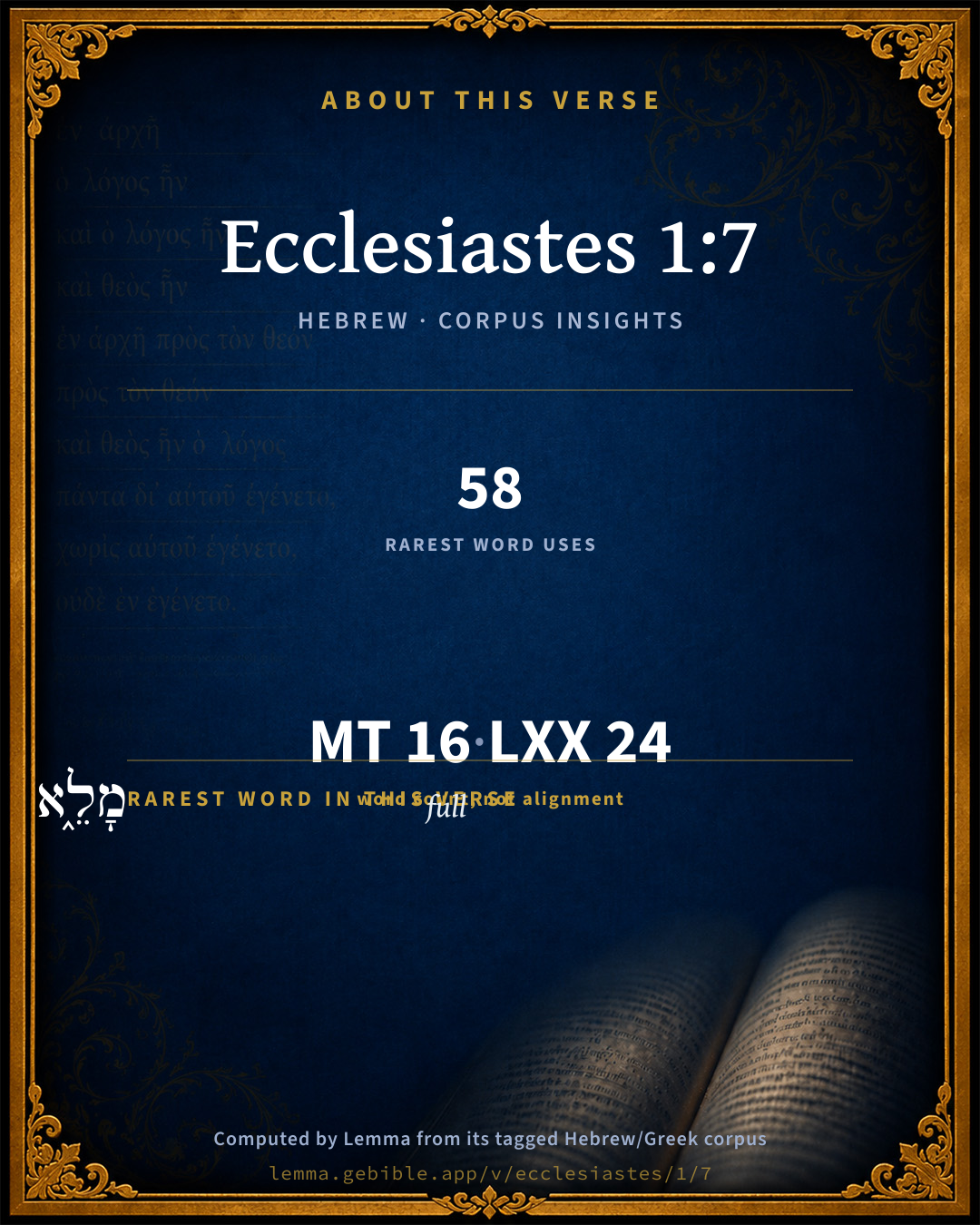
מָלֵ֑א full H4392 occurs in 57 verses of the Hebrew Bible. Also found in:

Grammatical profile

  • 4 verbs
  • 6 nouns
  • 1 adjective
  • 1 pronoun
  • 2 prepositions
  • 1 adverb
  • 1 particle

Verb forms

  • הֹלְכִ֣ים Qal · Participle Active
  • הֹֽלְכִ֔ים Qal · Participle Active
  • שָׁבִ֖ים Qal · Participle Active
  • לָלָֽכֶת Qal · Infinitive Construct

Repetition

Words recur within this verse — often emphatic in Hebrew:

  • הַנְּחָלִים֙ wadi H5158 ×2
  • הֹלְכִ֣ים to walk H1980 ×2
  • הַיָּ֔ם sea H3220 ×2
  • אֶל to H413 ×2

Hebrew & Septuagint length

In English translation the verse runs 24 words from the Hebrew and 25 from the Septuagint (LXX English) — closely comparable.

A rough comparison of the two English renderings, which tokenize alike — not a word-level alignment.

Word counts can differ between the Hebrew and the Greek without any difference in meaning — e.g. the Hebrew direct-object marker אֵת has no separate Greek word, and Greek often adds the article ὁ.

In the original languages it is 16 Hebrew tokens and 24 Greek tokens — but the two are counted differently (Hebrew bundles its prefixes and suffixes into one token; the Greek is in lemma form), so that isn’t a like-for-like length.

Cross-references

1

Topical passages linked to Ecclesiastes 1:7 in the Treasury of Scripture Knowledge — connected by theme and wording, ordered by reader-vote popularity; previews shown in the World English Bible.

Cross-references courtesy of OpenBible.info (CC BY 4.0).

Hebrew and Greek witnesses Masoretic Hebrew ↔ Greek Septuagint

The same verse in the two great witnesses to the Old Testament, shown verse-for-verse.

These are two independent witnesses, not word-aligned to each other, and the Septuagint is shown in lemma (dictionary) form.

Hebrew Ecclesiastes 1:7 Masoretic · Westminster Leningrad Codex

כָּל הַנְּחָלִים֙ הֹלְכִ֣ים אֶל הַיָּ֔ם וְהַיָּ֖ם אֵינֶ֣נּוּ מָלֵ֑א אֶל מְק֗וֹם שֶׁ֤הַנְּחָלִים֙ הֹֽלְכִ֔ים שָׁ֛ם הֵ֥ם שָׁבִ֖ים לָלָֽכֶת

All the rivers run into the sea, yet the sea is not full. To the place where the rivers flow, there they flow again.

World English Bible · Public Domain

Greek LXX Ecclesiastes 1:7 Septuagint · lemma form

πᾶς ὁ χειμάρρους πορεύομαι εἰς ὁ θάλασσα καί ὁ θάλασσα οὐ εἰμί ἐνπίμπλημι εἰς τόπος ὅς ὁ χειμάρρους πορεύομαι ἐκεῖ αὐτός ἐπιστρέφω ὁ πορεύομαι

All the rivers run into the sea; and yet the sea is not filled: to the place whence the rivers come, there they return again.

LXX2012 (modern English Septuagint) · Public Domain

Hebrew: Westminster Leningrad Codex (CC BY 4.0). Greek: Septuagint (public domain); English from LXX2012 (modern English Septuagint) (Public Domain). How the Septuagint differs from the Hebrew →

Commentary

Notes on Ecclesiastes 1:7 from classic Christian and Jewish commentators (each source and its license shown beneath its notes). The classic Christian expositions comment on the surrounding passage and are grouped to its opening verse, so a note may address several verses; the Jewish commentaries on the Tanakh (Rashi and others) are per-verse, so they appear only where the commentator wrote on this verse.

Lemma curates 59 commentaries, every one of them public domain or Creative Commons licensed, each selected and text-cleaned for this edition rather than reprinted as found. About our sources →

Trapp's Complete Commentary

John Trapp

Ecc 1:7 All the rivers run into the sea; yet the sea [is] not full; unto the place from whence the rivers come, thither they return again.

Ver. 7. All the rivers run into the sea.] And the nearer they come to the sea, the sooner they are met by the tide; sent out, as it were, to take their tribute due to the sea, that seat and source of waters. Surely as the rivers lead a man to the sea, so do all these creatures carry him to God by their circular motion. A circle, we say, is the most perfect figure, because it begins and ends; the points do meet together; the last point meets in the first from whence it came; so shall we never come to perfection or satisfaction till our souls come to God, till he make the circle meet. A wise philosopher could say, that man is the end of all things in a semicircle; that is, all things in the world are made for him, and he is made for God, to whom he must therefore hasten.

Unto the place from whence the rivers come.] Sc., From the sea, through the pores and passages of the earth, where they leave their saltness. This is Solomon’s opinion, as it was likewise the opinion of the ancient philosophers, which yet Aristotle finds fault with, and assigns another cause of the perennity of rivers, of their beginning and origin - viz., that the air thickened in the earth by reason of cold, doth resolve and turn into water, &c. {a} This agrees not with that which Solomon here saith by the instinct of the Holy Ghost. And therefore Averroes is by no means to be hearkened unto in that excessive commendation he gives Aristotle - viz., that there was no error in his writings, that his doctrine was the chiefest truths, and that his understanding was the utmost that was by any one attainable; himself the rule and pattern that Nature invented to show her most perfect skill, &c. {b}

{a} Hinc poetae fingunt Inachum fluvium ex Oceano genitum.

{b} Alsted. Chronol., p. 460.

John Trapp, A Commentary or Exposition upon All the Books of the Old and New Testament (1647–1656) — public domain. Text from a community e-Sword module.

The Biblical Illustrator

Joseph S. Exell

Ecc_1:7

All the rivers run into the sea, yet the sea is not full.

The turn of the year

There is a truth underlying the old conceit which pictured the universe as moving in cycles. History repeats itself. Our individual experience--which is only history in its minuter detail--shows us how little of originality there is in any one of us, and how like to one another are the multifarious incidents of our daily life.

I. The year has reached its prime through stages differing little from those of former years. Every now and then some meteorologist, careful day by day to register the markings of his rain-gauges, his thermometers, and such other apparatus as may enable him to compare the weather of to-day with that of yesterday, comes out of his observatory to tell us of extreme heat or cold, of excursiverains or drought, or of some other phenomena which mark the year as exceptional since--well, since some other year, not so very long ago, after all, when he or his predecessors had a like tale to tell, which even then was not new, but old as the hills. Now, how true all this is in relation to human life. Some historians never tire as they tell us of the changes wrought from one age to another. They point out, and very truly, how the age of Victoria differs from that of Elizabeth; and in eloquent periods they describe how the face of society has changed, say, from the seventeenth century to the nineteenth. But they forget that the face of society may have changed a very great deal, while the heart of it may have changed but slightly. Shakespeares master hand has left us the widest range of human character ever sketched by one pen; and that we so quickly recognize the truthfulness of every picture in that vast gallery of portraits arises from the fact that, being true to nature then, they are true to nature now.

II. But though the year has reached its prime, it has not attained its maturity. It is not the midsummer, but the autumn that brings us the season of harvest. It is not when the days are longest, nor when the earth is covered with the brightest flowers, nor when the trees of the forest wear their richest green, that men thrust in the sickle and reap. It is rather when the prime, and, in some sense, the beauty of the year is past. Nor, happily, does human life attain maturity at its meridian. There is a sense, indeed, in which the earlier manhood possesses a freshness and a vigour in which the later years of life must necessarily be wanting, and those who have thrown away the glorious opportunities of youth have lost what can never be recalled. But they who have lived half the allotted span of life, have, humanly speaking, their richest and noblest days still before them. The promises of youth have now to be followed by the ripe performances of manhood. Each season has its appointed work.

III. The turn of the year is indicated by appearances most fitting to the time. Year by year, in spite of human forebodings, the summer comes, and the earth is satisfied with the fruit of Gods works. With Him, stability is not dependent upon uniformity; nor is diversity of operation inimical to the unity of His plans. Hence it comes to pass that while the seasons of succeeding years afford us the never-ending variety which ministers to our pleasure at the same time that it excites our admiration, our delight and wonder are not less excited by the unfailing unity which marks all the operations of the Divine hand. So, too, in the still more complex workings of human life. Take, for example, that period of which we have already spoken as the turn of life, the age when the last tie that bound us to the days of youth has been snapped, and when, standing on the broad plateau of middle age, we can look forward only to such changes as shall prepare the way slowly but surely for the end. It is at this time we begin to realize most clearly how distinct are the successive generations of mankind. In earlier life there were about us many upon whom, in various ways, we were more or less dependent. But one by one they have gone; and so far at least as the past is concerned, we begin to stand alone. In later life, too, those about us will be found to belong to another generation--a generation younger than we, and destined to take our place when we have passed away. Some of us need, perhaps, to learn more thoroughly how little the world is dependent for its life upon us who dwell in it but for a little time. Creatures of a day, we are so apt to live as if assured of an eternal stay. It is thus we fail to regard the fitness of things, and forget that advancing age demands thoughts and words and deeds more becoming to it than would be those of our earlier life.

IV. The turn of the year reminds us how slow ripening is succeeded by a swift harvest. For months the grain has been growing slowly, and though the midsummer is past, it will yet be long before the fields will be generally white unto the harvest. Behold the husbandman waiteth for the precious fruit of the earth, and hath long patience for it until he receive the early and the latter rain. Not less varied and protracted is the discipline by which our Father seeks to produce in us the fruits of His heavenly husbandry. The restraints of childhood, the education of youth, and the cares of manhood are but so many processes by which He would lead us onward towards that perfection which is His ultimate object concerning every one. As the steady warmth of July days will prepare for the harvest the corn-blades produced by the months just past, so may the discipline of a life that has outgrown the inexperience of youth be expected to bring into fuller and more perfect maturity those graces of which but the germs have yet been formed. Anyhow, let us never suppose that, having left behind us the days of youth which were so fittingly emblemed by the changeful shine and shower of the early summer, we have lost our best opportunities for growth. It may be hard to form new habits now; but those we have formed may become more consolidated, and so our after lives, by stability of growth, may go somewhat to compensate for the shortcomings and waywardness of youth.

V. The turn of the year reminds us that nature provides for the fruitfulness of even short-lived growths. Very early in the springtime there were buds and blossoms that were none the less beautiful because their stay with us was short. The snowdrop never drank in the glory of the summer sunshine; yet the world would not have been complete without it. There are other plants that have a lesson for us beside the corn that ripens slowly, and, so to speak, centres upon itself the labours of the year. There is but one standard by which we may infallibly judge of the products of the earth, a standard applicable alike to the plant that blossoms and fades in one summer day and to the aloe blooming but once in its century, and to the oak tree that outlives many generations of men. That standard is the testing question Is its Makers purpose served? To live to Him and grow like Him--here is the great end of our being, by the serving or failing which we shall be approved or stand condemned. (F. Wagstaff.)

Views of life; false and true

What outward things are to us, depends very much on what we are ourselves. Take a landscape for instance. What various thoughts it suggests to different people. To the farmer it suggests land for pasture, the sportsman looks at it from another point of view, the artist sees in it the varying lights and shadows. It suggests to the poet great thoughts or feelings, to the devout man the power and love of God, and so forth. The writer of this book from which our text is taken is in one of his bad moods; he is disheartened and weary of life; nature seems to reflect the sadness of his soul Rivers running into the sea, and not accomplishing anything, all seem to proclaim the vanity of life, the emptiness of life. All the rivers run into the sea; yet the sea is not full. As a statement of fact, it is correct. And what is the sea better for them? They make no visible change in it, they do not even make it less salt; as far as an unthinking person goes, it seems sheer loss. But the sea is never full. And so we might think it is with man. Humanity, struggling and suffering, only to pass into the sea of nothingness. Egypt was a great nation at the time of Moses, what remains now? Some pyramids and a few mummies. In our sadder moments we are inclined to cry, Wherefore hast Thou made all men in vain? After all, this is not the true lesson of All the rivers run into the sea. The joy of mere living is worth the labour and is reward enough. Every little brook expresses gladness, irrespective of the end it accomplishes. Life is worth living and full of joy. In moments of health and activity we feel like that, but this will not always satisfy. Here is where the true lesson of the Rivers run into the sea; yet the sea is not full comes in. Why is the sea not full? The remainder of the verse answers the question. Unto the place from whence the rivers come, thither they return again. Solomon accepted the explanation of the mystery given in his day. We know the true reason. It is because the water is continually evaporating, the sun drawing the water up into the clouds, descending again, and giving beauty and fertility all around. Thus the rivers fulfil their true end. They lose life to find it again in new and more beautiful forms--not one drop is lost; every brooklet has its share in the beauty of the earth. Nothing is spent in vain in Gods universe; He is a workman who never wastes a particle of force or matter. This thought is comforting and helpful. Life is a brief span--trivial and vain, nay; no life is lost--its effect remains. No self-sacrifice, no deed of kindness is ever utterly lost. All goodness--every deed done, adds to the permanent stock on earth. It increases the heritage of truth and right which we hand on to remote ages. Thousands of years ago a man left his home and went, to live among strangers, he gave up his country and his kindred. His life was not lost, he became Abraham, the Father of the Faithful. Yes; the rivers of life run into the sea, but they are not lost. No life lived faithfully is utterly lost. It must be so, for Christ is at once the great explanation and pledge of this truth. His Cross seemed the end of all hope; yet the Cross was the triumph of His life--the beginning of everything. Without it there would have been no Resurrection, no Ascension. God brings gain out of loss. Christ has given us the assurance we shall live for ever; living to-day we shall live on for ever. The little rivers of life run into the sea of eternity, but they are not lost. Towards what sea is the river of our life flowing on unceasingly? In every continent the rivers are flowing on. There is a watershed in life, down either side our life may run. In which direction does our life run? Towards God--or away from Him, into darkness. (J. A. Campbell, M. A.)

Pursuit of happiness

Vanity of vanities, all is vanity. Now, this view of the monotony of things has a great deal of truth in it. If you look at the matter in one aspect, there is a striking lack of originality displayed in creation. Everything material goes through the same process of birth, maturity, decay and death, whether it be a star or a universe, or the humblest insect that crawls. Our own lives, too, what a sameness there is about them, looked at from this old writers point of view, which is very often our own. What a monotony there is about it all--what a lack of originality. We all go through the same programme in the main. We are each of us, as it were, given the main outlines of our little drama, and we are at liberty to fill in the scanty details for ourselves, all the plots are on the same model, and we seldom strike out any original line in the details. But is there not something more to be said on the matter? It is true that all things go through the same process of birth, maturity, decay and death; that in some aspects there is a deadly sameness throughout all creation from top to bottom. But there is also infinite variety, endless difference, nothing is precisely like anything else in the world. Examine as many as you like of any species of plants or animals, and no one will be found to be precisely like any other. Every dawn is different, and no two sunsets are alike; and though day succeeds day in orderly procession, yet no two days are alike in their combination of cold and heat, sunshine and shower, hurricane or sultry calm. Nor are the events they witness ever exactly reduplicated. And so with our daily lives and experiences. It is true that the plots of our little dramas are much alike, that the main outline is sketched in for us, and that we may only fill in the details of our lives. But it is those very details that we are apt to contemptuously pass by, that make our lives what they are, for better or for worse. It is in the details that individuality is shown--not in the main outline. There is no such thing as mere detail--detail is everything in this world. No two lives are alike, every existence is different, there is infinite variety in these very things that make our lives what they are. And the assertion that all things are full of weariness, because of their eternal sameness, is without foundation in fact. If the world seems full of weariness, the fault is in you, not in a world of infinite variety. This miserable plaint of the weariness of all things, then, is nothing new, and it is a cry that is still repeated in our ears only too often in the present day. What was the reason of it in the case of this philosophic grumbler of old? What was the reason of this unhappiness, in one who had everything that is commonly supposed to make life worth living--is the moral of the book that riches, power of intellect, artistic taste, refinement, learning, are all without value, and are powerless to give any pleasure to their possessor? By no means. All these things are good in themselves, may confer vast pleasure on those who have them, so long as they are not the end and aim of existence. Happiness is not the one aim and end of existence--it is the result of a well-lived life. If you make the attainment of happiness and pleasure the one object of existence as the Preacher did, then it will always elude you even as it did him. The Preacher was essentially an egoist, a selfish man. How can I obtain happiness for myself? was the cry of his soul, and although he tried every method, he never did obtain it. Just compare, for an instant, the life of this writer with its comfort, ease and luxury, to that of Jesus with its hardships, disappointments and sufferings. Both see the misery in the world, but while one sets to work to remedy it, the other sits and looks at it, and wrings his hands over it. Jesus saw the crookedness in life just as plainly as Ecclesiastes did, but instead of crooning a coronach over all human hopes and aspirations and endeavours, He set to work to make the crooked straight, bind up the brokenhearted, preach good tidings to the prisoners in the bonds of sin, and give a gospel of hope and encouragement to all; and in losing Himself in the service of others, He found a joy and peace that never left Him. It has ever been so, and it is so now. It is not from the toilers of earth that the cry of the weariness of all things goes up. It is not those who have to work from morning till night, and who are found day after day drudging away their lives at the same employments--it is not from these, as a rule, that the cry of the Preacher goes up. It is those who have nothing better to do with their time than to sit and brood over their little petty ailments or misfortunes, whose time hangs heavy on their hands, because of want of occupation, who have no conception of there being anything better in life than to pass through it as easily as possible--these are the people who are bored with existence. The men, however, who do the worlds work, who try to right the wrong, straighten the crooked, raise the fallen, and improve the world, are not so; they have no time in which to indulge in the luxury of the blues. They always find too much to do in the world, and in doing something for others they find a happiness that nothing else can bestow. (E. S. Hicks, M. A.)

The Biblical Illustrator, edited by Joseph S. Exell (c. 1880s–1900s) — public domain. Text from a community e-Sword module.

Joseph Benson's Commentary

Ecc 1:7. The sea is not full — So as to overflow the earth, which might be expected from such vast accessions of waters to it. Whereby also he intimates the emptiness of men’s minds, notwithstanding the abundance of creature comforts. Unto the place from whence the rivers come — Unto their springs or fountains; thither they return — By secret passages of the earth: or their waters, after flowing into the sea, and being mixed with its waters, are exhaled by the heat of the sun, become vapours and clouds, descend in showers on the hills and mountains, and feed the springs from which they flow again, in streams and rivers, into the lakes, seas, and oceans. He seems to speak of the visible and constant motion of the waters, both to the sea and from it, and then to it again in a perpetual reciprocation.

Joseph Benson's Commentary on the Old and New Testaments (1811–1818) — public domain. Text from a community e-Sword module.

Tyndale Open Study Notes

Tyndale Open Resources

1:7-8 the sea is never full . . . we are never satisfied: This image introduces the unfulfilling nature of life.

Tyndale Open Study Notes — © Tyndale Open Resources, licensed CC BY-SA 4.0. Text via the HelloAO Bible API.

Geneva Bible (1599)

Geneva Bible translators

The sea which compasseth all the earth, filleth the veins thereof, the which pour out springs and rivers into the sea again.

Geneva Bible (1599) marginal notes — public domain. Text via Bolls.life.

Jamieson, Fausset & Brown

Robert Jamieson, A. R. Fausset & David Brown

By subterraneous cavities, and by evaporation forming rain clouds, the fountains and rivers are supplied from the sea, into which they then flow back. The connection is: Individual men are continually changing, while the succession of the race continues; just as the sun, wind, and rivers are ever shifting about, while the cycle in which they move is invariable; they return to the point whence they set out. Hence is man, as in these objects of nature which are his analogue, with all the seeming changes "there is no new thing" (Ecc 1:9).

Jamieson, Fausset & Brown — Commentary Critical and Explanatory on the Whole Bible (1871) — public domain (CC PDM 1.0). Text via the HelloAO Bible API.

Adam Clarke's Commentary

Verse 7. All the rivers run into the sea; yet the sea is not full] The reason is, nothing goes into it either by the; rivers or by rain, that does not come from it: and to the place whence the rivers come, whether from the sea originally by evaporation, or immediately by rain, thither they return again; for the water exhaled from the sea by evaporation is collected in the clouds, and in rain, c., falls upon the tops of the mountains and, filtered through their fissures, produce streams, several of which uniting, make rivers, which flow into the sea. The water is again evaporated by the sun; the vapours collected are precipitated; and, being filtered through the earth, become streams, &c., as before.

Adam Clarke's Commentary on the Bible (1810–1826) — public domain. Text from a community e-Sword/MySword module.

Ellicott's Commentary for English Readers

(7) Whence the rivers come.—Better, whither the rivers go. (Comp. Sir_40:11.)

A Bible Commentary for English Readers, edited by Charles John Ellicott (1878–1897) — public domain. Text from a community e-Sword module.

The Cambridge Bible for Schools and Colleges

gen. ed. J. J. S. Perowne

7. All the rivers run into the sea; yet the sea is not full] The words express the wonder of the earliest observers of the phenomena of nature: as they observed, the poet described.

So we have in Aristophanes (Clouds, 1248),

αὕτη μὲν (ἡ θάλαττα) οὐδὲν γίγνεται

ἐπιῤῥεοντων τῶν ποταμῶν, πλείων.

“The sea, though all the rivers flow to it,

Increaseth not in volume.”

Lucretius, representing the physical science of the school of Epicurus, thought it worth his while to give a scientific explanation of the fact:

“Principio, mare mirantur non reddere majus

Naturam, quo sit tantus decursus aquarum.”

“And first men wonder Nature leaves the sea

Not greater than before, though to it flows

So great a rush of waters.”

Lucret. vi. 608.

thither they return again] We are apt to read into the words the theories of modern science as to the evaporation from the sea, the clouds formed by evaporation, the rain falling from the clouds and replenishing the streams. It may be questioned, however, whether that theory, which Lucretius states almost as if it were a discovery, were present to the mind of the Debater and whether he did not rather think of the waters of the ocean filtering through the crevices of the earth and so feeding its wells and fountains. The Epicurean poet himself accepts this as a partial solution of phenomena, and on the view taken in the Introduction as to the date of Ecclesiastes it may well have been known to the author as one of the physical theories of the school of Epicurus. We can scarcely fail, at any rate, to be struck with the close parallelism of expression.

“Postremo quoniam raro cum corpore tellus

Est, et conjuncta est, oras maris undique cingens,

Debet, ut in mare de terris venit umor aquai,

In terras itidem manare ex aequore salso;

Percolatur enim virus, retroque remanat

Materies humoris, et ad caput amnibus omnis

Confluit; inde super terras redit agmine dulci.”

“Lastly since earth has open pores and rare,

And borders on the sea, and girds its shores,

Need must its waters, as from earth to sea

They flow, flow back again from sea to earth,

And so the brackish taint is filtered off

And to the source the water back distils,

And from fresh fountains streams o’er all the fields.”

Lucret. vi. 631–637.

The same thought is found in Homer, Il. xxi. 96,

“Ocean’s strength

From which all rivers flow,”

and is definitely stated in the Chaldee paraphrase of the verse now before us. Comp. also Lucret. v. 270–273. An alternative rendering gives “to the place whither the rivers go, thither they return again” or “thence they return again.”

The Cambridge Bible for Schools and Colleges (gen. ed. J. J. S. Perowne; Cambridge University Press, 1878–1918) — public domain. Text from a community e-Sword module.

John Gill's Exposition

All the rivers run into the sea; yet the sea is not full,.... Which flow from fountains or an formed by hasty rains; these make their way to the sea, yet the sea is not filled therewith, and made to abound and overflow the earth, as it might be expected it would. So Seneca says (z) we wonder that the accession of rivers is not perceived in the sea; and Lucretius (a) observes the same, that it is wondered at that the sea should not increase, when there is such a flow of waters to it from all quarters; besides the wandering showers and flying storms that fall into it, and yet scarce increased a drop; which he accounts for by the exhalations of the sun, by sweeping and drying winds, and by what the clouds take up. Homer (b) makes every sea, all the rivers, fountains, and wells, flow, from the main ocean. Hence Pindar (c) calls the lake or fountain Camarina the daughter of the ocean But Virgil (d) makes the rivers to flow into it, as the wise man here; with which Aristotle (e) agrees. So Lactantius (f) says, "mare quod ex fluminibus constat", the sea consists of rivers. Both may be true, for, through secret passages under ground, the waters of it are caused to pass back again to their respective places from whence they flowed, as follows;

unto the place from whence the rivers come, thither they return again; this also illustrates the succession of men, age after age, and the revolution of things in the world, their unquiet and unsettled state; and the unsatisfying nature of all things; as the sea is never full with what comes into it, so the mind of man is never satisfied with all the riches and honour he gains, or the knowledge of natural things he acquires; and it suggests that even water, as fluctuating a body as it is, yet has the advantage of men; that though it is always flowing and reflowing, yet it returns to its original place, which man does not. And from all these instances it appears that all things are vanity, and man has no profit of all his labour under the sun.

(z) Nat. Quaest. l. 3. c. 4. (a) De Rerum Natura, l. 6. (b) Iliad. 21. v. 193, &c. (c) Olymp. Ode 5. v. 4. (d) "Omnia sub magna", &c. Georgic. l. 4. v. 366, &c. (e) Meterolog. l. 1. c. 13. (f) De Orig. Error. l. 2. c. 6.

John Gill's Exposition of the Whole Bible (1746–1763) — public domain (CC PDM 1.0). Text via the HelloAO Bible API.

Albert Barnes' Notes on the Bible

The place - i. e., The spring or river-head. It would seem that the ancient Hebrews regarded the clouds as the immediate feeders of the springs (Pro 8:28, and Psa 104:10, Psa 104:13). Gen 2:6 indicates some acquaintance with the process and result of evaporation.

Albert Barnes' Notes on the Bible (1834–1885) — public domain. Text from a community e-Sword/MySword module.

Haydock's Catholic Bible Commentary

Again. The sea furnishes vapours, &c. Homer (Iliad Greek: Ph.) expresses himself in the same manner.

George Leo Haydock (1774–1849), Haydock's Catholic Family Bible and Commentary, 1859 edition — public domain. Excludes Psalms (Douay-Rheims chapter numbering differs from Protestant) and Deuterocanonical books (Catholic canon only).

Matthew Poole's English Annotations

Is not full, to wit, to the brink, or so as to overflow the earth, which might be expected from such vast accessions to it; whereby also he intimates the emptiness and dissatisfaction of men’s minds, not withstanding all the abundance of creature-comforts.

Unto the place from whence the rivers come; either,

1. Unto the sea, from whence they are supposed to return into their proper channels, and then, as it is expressed, thither (i.e. into the sea) they return again. Or,

2. Unto their springs or fountains, to which the waters return by secret passages of the earth, as is manifest from the Caspian Sea, and reasonably supposed in other places. Or rather,

3. Unto the earth in general, from whence they come or How into the sea, and to which they return again by the reflux of the sea. For he seems to speak of the visible and constant motion of the waters, both to the sea and from it, and then to it again in a perpetual reciprocation; which agrees best with the former similitudes, Ecc 1:5,6.

Matthew Poole's English Annotations on the Holy Bible (1683–1685) — public domain. Text from a community e-Sword/MySword module.

Whedon's Commentary on the Bible

Daniel D. Whedon

7. All the rivers run into the sea — None of the ancients understood the system of evaporation, how the sun lifts daily from the sea millions of tons of water, which, carried by clouds, (and even by the blue air,) is returned as rain and snow to the sources of the rivers. They supposed that the rivers returned from the sea by secret, subterranean routes. All their views of nature were childlike, yet in their simplicity they were near to nature’s God.

Daniel D. Whedon (gen. ed.), Commentary on the Old and New Testaments (1874–1909) — public domain. Text from a community e-Sword module.

The Pulpit Commentary

All the rivers run into the sea; yet the sea is not full. Here is another instance of unvarying operation producing no tangible result. The phenomenon mentioned is often the subject of remark and speculation in classical authors. Commentators cite Aristophanes, "Clouds," 1293

Auth men (sc. hJ qalatta) oujdegnetai jEpirjrJeontwn twn potamwn pleiwn,

The sea, though all the rivers flow therein, Waxeth no greater.

Lucretius attempts to account for the fact, De Rer. Nat.," 6:608

Nunc ratio reddunda, augmen quin nesciat sequor.

Principio mare mirantur non reddere majus

Naturam, quo sit tantus decursus aquarum,

Omnia quo veniant ex omni fiumina parte.

This Dr. Busby thus versifies

Now in due order, Muse, proceed to show Why the deep seas no augmentation know, In ocean that such numerous streams discharge Their waters, yet that ocean ne"er enlarge," etc.

No particular sea is intended, though some have fancied that the peculiarities of the Dead Sea gave occasion to the thought in the text. Doubtless the idea is general, and such as would strike every observer, however little he might trouble himself with the reason of the circumstance (comp. Ecc 40:11). Unto the place from whence the rivers come, thither they return again; rather, unto the place whither the rivers go, thither they go again. As Wright and Delitzsch observe, after verbs of motion has often the signification of hM; v; ; and the idea is that the streams continue to make their way into the sea with ceaseless iteration. The other rendering, which is supported by the Vulgate undo, seems rather to favor the Epicurean poet"s solution of the phenomenon. Lucretius, in the passage cited above, explains that the amount of water contributed by rivers is a mere drop in the ocean; that a vast quantity rises in exhalations and is spread far and wide over the earth; and that another large portion finds its way back through the pores of the ground to the bed of the sea. Plumptre considers that this theory was known to Koheleth, and was introduced by him here. The rendering which we have given above would make this opinion untenable; it likewise excludes the idea (though that, indeed, may have been entertained by the Hebrews, (Psa_109:10 and Pro_8:28) of the clouds being produced by the sea and feeding the springs. Thus Ecc 40:11, "All things that are of the earth do turn to the earth again; and that which is of the waters doth return into the sea.

Vers. 7, 8.

Weariness and rest.

We have here

I THE COMPLAINT OF THE UNSATISFIED. "All things are full of weariness" (Revised Version).

1. There are many obvious sources of satisfaction. Life has many pleasures, and many happy activities, and much coveted treasure. Human affection, congenial employment, the pursuit of knowledge, "the joys of contest," the excitements of the field of sport, the attainment of ambition, etc.

2. All of them together fail to satisfy the heart. The eye is act satisfied with seeing, nor the ear with hearing, nor the tongue with tasting, nor the hand with handling, nor the mind with investigating and discovering. All the streams of temporal and worldly pleasure run into the sea of the human soul, but they do not fill it. The heart, on whatsoever it feeds, is still a-hungered, is still athirst. It may seem surprising that when so much that was craved has been possessed and enjoyed, that when so many things have ministered to the mind, there should still be heart-ache, unrest, spiritual disquietude, the painful question Who will show us any good? Is life worth having? The profundity, the commonness and constancy of this complaint, is a very baffling and perplexing problem. We surely ought to be satisfied, but we are not. The unillumined mind cannot explain it, the uninspired tongue "cannot utter it." What is the solution?

II ITS EXPLANATION. Its solution is not far to seek; it is found in the truth so finely uttered by Augustine, "O God, thou hast made us for thyself, and our heart findeth no rest until it resteth in thee." The human spirit, created in God"s image, constituted to possess his own spiritual likeness, formed for truth and righteousness, intended to spend its noble and ever-unfolding powers in the high service of the Divine, is it likely that such a one as this, that can be so much, that can know so much, that can love the best and highest, that can aspire to the loftiest and purest well-being, can be satisfied with the love that is human, with the knowledge that is earthly, with the treasure that is material and transient? The marvel is, and the pity is, that man, with such powers within him and with such a destiny before him, can sometimes sink so low as to be filled and satisfied with the husks of earth, unfilled with the bread of heaven.

III ITS REMEDY. To us, to whom Jesus Christ has spoken, there is a plain and open way of escape from this profound disquietude. We hear the Master say, "Come unto me, all ye that labor and are heavy laden, and I will give you rest. Take my yoke upon you and ye shall find rest unto your souls.

(1) In the reconciliation to God, our Divine Father, which we have in Jesus Christ;

(2) in the happy love of our souls to that Divine Friend and Savior;

(3) in the blessed service of our rightful, faithful, considerate Lord;

(4) in the not unavailing service we render to those whom he loved and for whom he died;

(5) in the glorious hope of immortal life beyond the grave, we do "find rest unto our souls. C.

The Pulpit Commentary (1880–1919), ed. H.D.M. Spence-Jones & Joseph S. Exell — public domain. Text from a community e-Sword module.

John Wesley's Explanatory Notes

Is not full - So as to overflow the earth. Whereby also he intimates the emptiness of mens minds, notwithstanding all the abundance of creature comforts. Rivers come - Unto the earth in general, from whence they come or flow into the sea, and to which they return by the reflux of the sea. For he seems to speak of the visible and constant motion of the waters, both to the sea and from it, and then to it again in a perpetual reciprocation.

John Wesley, Explanatory Notes Upon the Whole Bible (1754–1765) — public domain. Text via the GEBible commentary corpus.

Keil & Delitzsch

C. F. Keil & F. Delitzsch

"All rivers run into the sea, and the sea becomes not full; to the place whence the rivers came, thither they always return again." Instead of nehhárim, nehhalim was preferred, because it is the more general name for flowing waters, brooks, and rivers; נחל (from נחל, cavare), אפיק (from אפק, continere), and (Arab.) wadin (from the root-idea of stretching, extending), all three denote the channel or bed, and then the water flowing in it. The sentence, "all rivers run into the sea," is consistent with fact. Manifestly the author does not mean that they all immediately flow thither; and by "the sea" he does not mean this or that sea; nor does he think, as the Targ. explains, of the earth as a ring (גּוּשׁפּנקא, Pers. angusht-bâne, properly "finger-guard") surrounding the ocean: but the sea in general is meant, perhaps including also the ocean that is hidden. If we include this internal ocean, then the rivers which lose themselves in hollows, deserts, or inland lakes, which have no visible outlet, form no exception. But the expression refers first of all to the visible sea-basins, which gain no apparent increase by these masses of water being emptied into them: "the sea, it becomes not full;" איננּוּ (Mishn. אינו) has the reflex. pron., as at Exo 3:2; Lev 13:34, and elsewhere. If the sea became full, then there would be a real change; but this sea, which, as Aristophanes says (Clouds, 1294f.), οὐδὲν γίγνεται ἐπιῤῥηεόντων τῶν ποταμῶν πλείων, represents also the eternal sameness. In Lev 13:7, Symm., Jer., Luther, and also Zckler, translate שׁ in the sense of "from whence;" others, as Ginsburg, venture to take שׁם in the sense of משּׁם; both interpretations are linguistically inadmissible.

Generally the author does not mean to say that the rivers return to their sources, since the sea replenishes the fountains, but that where they once flow, they always for ever flow without changing their course, viz., into the all-devouring sea (Elst.); for the water rising out of the sea in vapour, and collecting itself in rain-clouds, fills the course anew, and the rivers flow on anew, for the old repeats itself in the same direction to the same end. מקום is followed by what is a virtual genitive (Psa 104:8); the accentuation rightly extends this only to הלכים; for אשׁר, according to its relation, signifies in itself ubi, Gen 39:20, and quo, Num 13:27; Kg1 12:2 (never unde). שׁם, however, has after verbs of motion, as e.g., Jer 22:27 after שׁוב, and Sa1 9:6 after הלך, frequently the sense of שׁמּה. And שׁוּב with ל and the infin. signifies to do something again, Hos 11:9; Job 7:7, thus: to the place whither the rivers flow, thither they flow again, eo rursus eunt. The author here purposely uses only participles, because although there is constant change, yet that which renews itself is ever the same. He now proceeds, after this brief but comprehensive induction of particulars, to that which is general.

Keil & Delitzsch — Biblical Commentary on the Old Testament (1861–1891) — public domain (CC PDM 1.0). Text via the HelloAO Bible API. (Old Testament only.)

unfoldingWord translationNotes

Door43 World Missions Community

General Information:

The writer continues with observations about the natural order.

Everything becomes wearisome

"Everything becomes tiring." Since man is unable to explain these things, it becomes useless to try.

The eye is not satisfied by what it sees

Here the "eye" represents the whole person. AT: "A person is not satisfied by what his eyes see" (See: Synecdoche)

nor is the ear fulfilled by what it hears

Here the "ear" represents the whole person. AT: "nor is a person content by what his ears hear" (See: Synecdoche)

unfoldingWord translationNotes — © Distant Shores Media and the Door43 World Missions Community, licensed CC BY-SA 4.0. Source: git.door43.org/Door43/en_tn.

Rashi

Rabbi Shlomo Yitzchaki (Rashi)

All the rivers flow into the sea because they do not remain therein, for the ocean is higher than the entire world, as it is said (Amos 5:8): “He calls the water of the sea and pours it, etc.” Now from where does a person pour? From above downward, and the rivers flow in the tunnels under the mountains from the ocean and repeatedly flow, and this is the meaning of: “to the place where the rivers flow, there they repeatedly go.” Also, the wicked man, (below 5:15) “just as it came, so shall it go.”

Rashi on the Tanakh — English translations: “The Judaica Press complete Tanach with Rashi, translated by A. J. Rosenberg” (CC BY 4.0); “Pentateuch with Rashi's commentary by M. Rosenbaum and A.M. Silbermann, 1929-1934” (public domain); “The Metsudah Tanach series, Lakewood, N.J” (CC BY 4.0); and “The Book of Joshua, Metsudah Publications, 1997” (CC BY 4.0). Text via Sefaria.

Lesson kit

Teaching starters — assembled from the data on this page, not authored interpretation. Every prompt links to the verse data it draws on. Edit before teaching.

Ecclesiastes, in the Wisdom, opens this verse with 16 words (12 distinct Hebrew lemmas). Its most distinctive word is mâlêʼ (“full”). A historical commentator’s framing appears above. Read the whole chapter for the surrounding context.

Discussion questions

  1. How does “full” (mâlêʼ) shape what this verse is saying?
  2. Genesis 23:9 shares the word «full» with this verse. How do the two illuminate each other?
  3. “wadi” occurs 2× in this one verse. What is the effect of the repetition?
  4. These translations render this verse differently. What is at stake in choosing one wording over another?
  5. The verb «הֹלְכִ֣ים» is Qal Participle Active. How does its form color the action?
  6. Reading how Trapp's Complete Commentary and The Biblical Illustrator read this verse, where do the two commentators agree and where do they part?

Things to notice

Reading settings

Reading text

Shown beneath each verse's original-language words.

Old Testament
Old Testament edition

Read the OT as the Masoretic Hebrew (MT) or the Greek Septuagint (LXX).

English shown for the Greek Septuagint (in the Hebrew ↔ Greek comparison).

Comparing translations? Open the Compare panel on any verse page to stack up to four side by side.