Deuteronomy 9:29

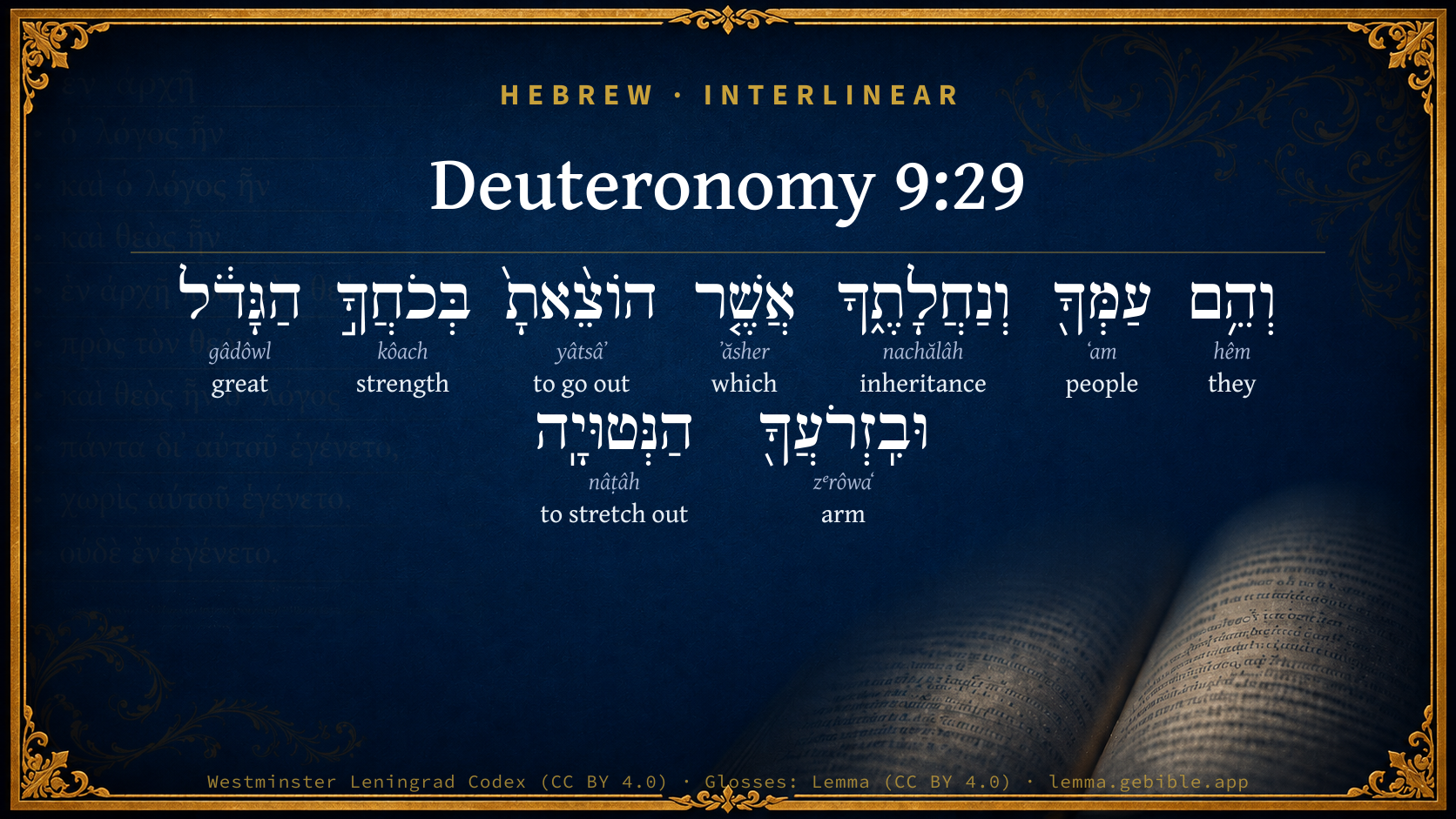
Hebrew (Westminster Leningrad Codex) Deuteronomy 9:29 appears in the Hebrew Old Testament. The text above is from the Westminster Leningrad Codex. Each word links to its Strong’s number, a concise gloss, and parsing drawn from the Open Scriptures Hebrew Bible morphology. Click any word for its full Brown-Driver-Briggs (BDB) entry.
Download image
Cite this verse

Deuteronomy 9:29 (World English Bible). Public Domain. Lemma interlinear Bible study tool, https://lemma.gebible.app/v/deuteronomy/9/29.

Show BibTeX & RIS
BibTeX
RIS
English Translation
Yet they are your people and your inheritance, which you brought out by your great power and by your outstretched arm.
World English Bible · Public Domain
Download a study sheet

One document with this verse’s original text, its word-by-word gloss line, the meaning frame, cross-references with their text, attributed commentary, and full source and license credits — printable, and it pastes into notes with its structure intact.

This verse Autodidact and up

Study sheet (.html) Plain text (.txt)

A passage Seminary Student

Up to 50 verses in one chapter. A passage sheet keeps up to 6 commentary sources and 12 cross-references per verse, in the order this page ranks them, and says so on the sheet whenever that leaves anything out. Ask for a single verse and you get the Autodidact verse sheet above.

Everything on this page stays free to read, with no account — the sheet is a download of what is already on screen, not access to it.

Want to remove ads? Support Godless Engineer
Compare translations 3

The same verse in 3 English versions, stacked beneath the original-language interlinear above. Click any original word for its lexicon entry.

Each is an independent rendering of the whole verse — the interlinear is not word-aligned to these translations.

Highlighted words mark where these versions differ — a whole-verse word diff, not a word-by-word alignment.

  • World English Bible Public Domain
    Yet they are your people and your inheritance, which you brought out by your great power and by your outstretched arm.
  • King James Version Public Domain
    Yet they are thy people and thine inheritance, which thou broughtest out by thy mighty power and by thy stretched out arm.
  • unfoldingWord Literal Text CC BY-SA 4.0
    And they your people and your inheritance, whom you brought out by your great power and by your outstretched arm.’

unfoldingWord Literal Text — © unfoldingWord, licensed CC BY-SA 4.0. Word-aligned USFM3 via Door43 (git.door43.org/unfoldingWord/en_ult).

Versions to compare (up to 4)

3 of 4 selected

Show all 18 translations

Every available English version of this verse, each an independent rendering of the whole verse.

  • World English Bible Public Domain
    Yet they are your people and your inheritance, which you brought out by your great power and by your outstretched arm.
  • Berean Standard Bible Public Domain
    But they are Your people, Your inheritance, whom You brought out by Your great power and outstretched arm.”
  • Majority Standard Bible Public Domain
    But they are Your people, Your inheritance, whom You brought out by Your great power and outstretched arm.”
  • King James Version Public Domain
    Yet they are thy people and thine inheritance, which thou broughtest out by thy mighty power and by thy stretched out arm.
  • American Standard Version (1901) Public Domain
    Yet they are thy people and thine inheritance, which thou broughtest out by thy great power and by thine outstretched arm.
  • Revised Version (1885) Public Domain
    Yet they are thy people and thine inheritance, which thou broughtest out by thy great power and by thy stretched out arm.
  • Geneva Bible (1599) Public Domain
    Yet they are thy people, and thine inheritance, which thou broughtest out by thy mightie power, and by thy stretched out arme.
  • Douay-Rheims (1899) Public Domain
    Who are thy people and thy inheritance, whom thou hast brought out by thy great strength, and in thy stretched out arm.
  • Young's Literal Translation Public Domain
    and they `are' Thy people, and Thine inheritance, whom Thou hast brought out by Thy great power, and by Thy stretched-out arm!
  • Literal Standard Version CC BY-SA 4.0
    And they [are] Your people and Your inheritance, whom You have brought out by Your great power and by Your outstretched arm!”
  • Unlocked Literal Bible CC BY-SA 4.0
    Yet they are your people and your inheritance, whom you brought out by your great strength and by the display of your power.'
  • unfoldingWord Literal Text CC BY-SA 4.0
    And they your people and your inheritance, whom you brought out by your great power and by your outstretched arm.’
  • Darby Bible Public Domain
    They are indeed thy people and thine inheritance, which thou broughtest out with thy great power and with thy stretched-out arm.
  • World Messianic Bible Public Domain
    Yet they are your people and your inheritance, which you brought out by your great power and by your outstretched arm.”
  • Webster's Bible Public Domain
    Yet they are thy people and thy inheritance which thou hast brought out by thy mighty power and by thy out-stretched arm.
  • Free Bible Version CC BY-SA 4.0
    But they are your people, Lord! They belong to you! You led them out of Egypt by your amazing power and might!”
  • Bible in Basic English Public Domain
    But still they are your people and your heritage, whom you took out by your great power and by your stretched-out arm.
  • JPS Tanakh (1917) Public Domain
    Yet they are Thy people and Thine inheritance, that Thou didst bring out by Thy great power and by Thy outstretched arm.'

Literal Standard Version (2020), Covenant Press — licensed CC BY-SA 4.0. Text via the HelloAO Bible API (eBible.org). Unlocked Literal Bible (unfoldingWord) — licensed CC BY-SA 4.0. Text via the HelloAO Bible API (eBible.org). unfoldingWord Literal Text — © unfoldingWord, licensed CC BY-SA 4.0. Word-aligned USFM3 via Door43 (git.door43.org/unfoldingWord/en_ult). Free Bible Version, Dr. Jonathan Gallagher — licensed CC BY-SA 4.0. Text via the HelloAO Bible API (eBible.org).

Word by word

More ways to search: Search by grammar → Find every occurrence → Compare this word →

Practice this passage: Drill this verse → Learn its vocabulary →

וּבִֽזְרֹעֲךָ֖
zᵉrôwaʻ
H2220
“and · in/at · arm · your”
Conjunction + Preposition + Noun, Common, Both, Singular, Construct + Suffix, Personal, 2nd Person, Masculine, Singular
Part of Speech
Conjunction + Preposition + Noun
Type
Common
Gender
Both
Number
Singular
State
Construct
Full BDB Definition

Origin: from H2232

TWOT: 583a

arm, forearm, shoulder, strength - arm - arm (as symbol of strength) - forces (political and military) - shoulder (of animal sacrificed)
  1. וְהֵ֥ם hêm H1992 “and · they” Conjunction + Pronoun, Personal, 3rd Person, Masculine, Plural
  2. עַמְּךָ֖ ʻam H5971 “people · your” Noun, Common, Masculine, Singular, Construct + Suffix, Personal, 2nd Person, Masculine, Singular
  3. וְנַחֲלָתֶ֑ךָ nachălâh H5159 “and · inheritance · your” Conjunction + Noun, Common, Feminine, Singular, Construct + Suffix, Personal, 2nd Person, Masculine, Singular
  4. אֲשֶׁ֤ר ʼăsher H834 “which” Particle, Relative
  5. הוֹצֵ֨אתָ֙ yâtsâʼ H3318 “to go out” Verb, Hiphil, Perfect, 2nd Person, Masculine, Singular
  6. בְּכֹחֲךָ֣ kôach H3581 “in/at · strength · your” Preposition + Noun, Common, Masculine, Singular, Construct + Suffix, Personal, 2nd Person, Masculine, Singular
  7. הַגָּדֹ֔ל gâdôwl H1419 “the · great” Particle, Definite Article + Adjective, Adjective, Masculine, Singular, Absolute
  8. הַנְּטוּיָֽה nâṭâh H5186 “the · stretched out” Particle, Definite Article + Verb, Qal, Participle Passive, Feminine, Singular, Absolute

About this verse

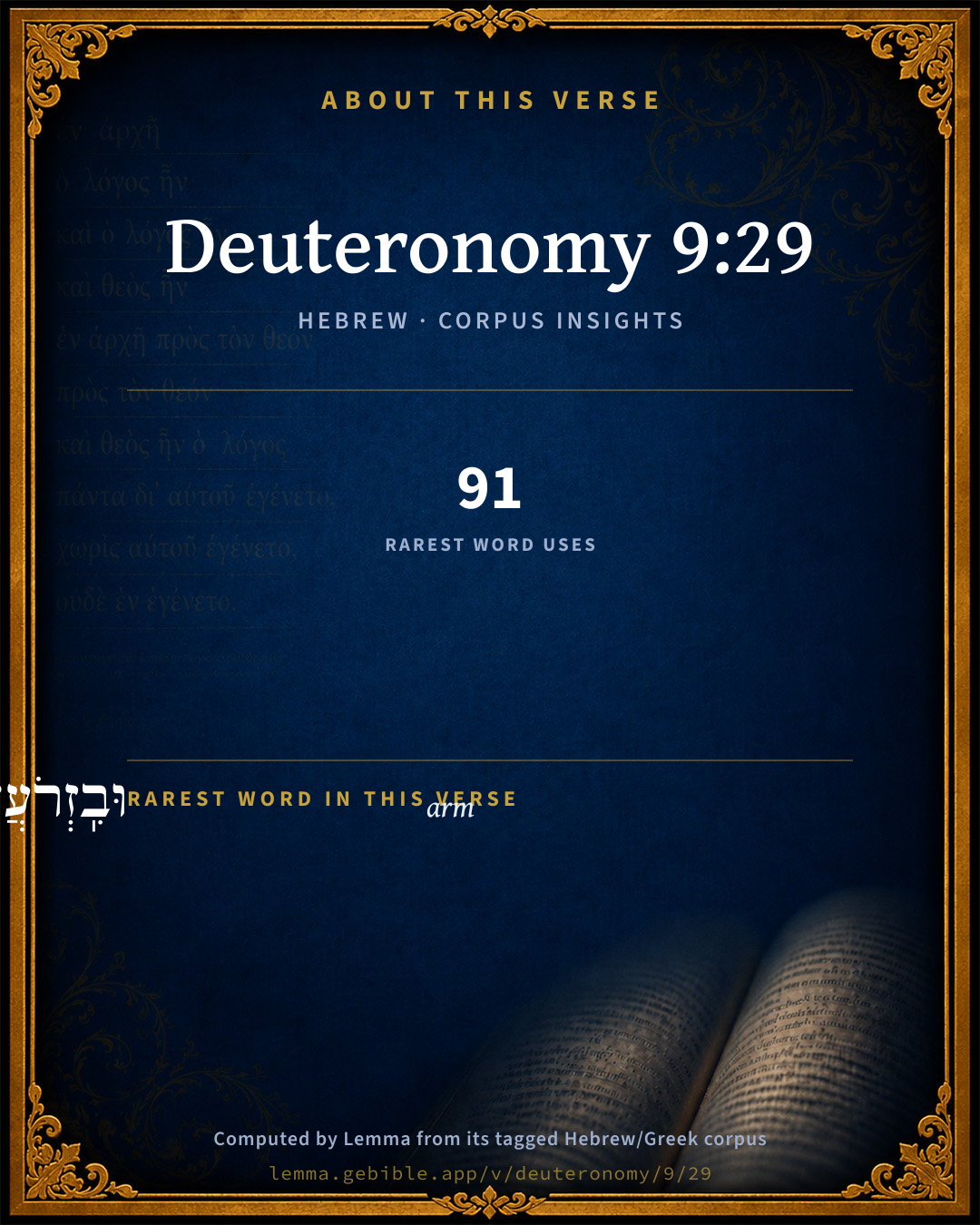
These counts appear in no published source. They are computed here, from the morphology-tagged text and Lemma’s own curated glosses. What Lemma adds →

9
words
9
distinct lemmas
Pentateuch
section

Grammatical profile

  • 2 verbs
  • 4 nouns
  • 1 adjective
  • 1 pronoun
  • 1 particle

Verb forms

  • הוֹצֵ֨אתָ֙ Hiphil · Perfect
  • הַנְּטוּיָֽה Qal · Participle Passive

Hebrew & Septuagint length

In English translation the verse runs 21 words from the Hebrew and 31 from the Septuagint (LXX English) — the Septuagint runs noticeably longer here. See the side-by-side →

A rough comparison of the two English renderings, which tokenize alike — not a word-level alignment.

Word counts can differ between the Hebrew and the Greek without any difference in meaning — e.g. the Hebrew direct-object marker אֵת has no separate Greek word, and Greek often adds the article ὁ.

Cross-references

9

Topical passages linked to Deuteronomy 9:29 in the Treasury of Scripture Knowledge — connected by theme and wording, ordered by reader-vote popularity; previews shown in the World English Bible.

  • Nehemiah 1:10 Now these are your servants and your people, whom you have redeemed by your great power, and by your strong hand.
  • Deuteronomy 4:34 Or has God tried to go and take him a nation from the midst of [another] nation, by trials, by signs, and by wonders, and by war, and by a mighty hand, and by an outstretched arm, and by great terrors, according to all that Yahweh your God did for you in Egypt before your eyes?
  • Deuteronomy 9:26 I prayed to Yahweh, and said, Lord Yahweh, don't destroy your people and your inheritance, that you have redeemed through your greatness, that you have brought forth out of Egypt with a mighty hand.
  • 1 Kings 8:51 (for they are your people, and your inheritance, which you brought forth out of Egypt, from the midst of the furnace of iron);
  • Deuteronomy 4:20 But Yahweh has taken you, and brought you forth out of the iron furnace, out of Egypt, to be to him a people of inheritance, as at this day.
  • Psalms 95:7 For he is our God. We are the people of his pasture, And the sheep in his care. Today, oh that you would hear his voice!
  • Psalms 100:3 Know that Yahweh, he is God. It is he who has made us, and we are his. We are his people, and the sheep of his pasture.
  • Isaiah 63:19 We are become as they over whom you never bear rule, as those who were not called by your name.
  • 1 Kings 8:15 He said, Blessed be Yahweh, the God of Israel, who spoke with his mouth to David your father, and has with his hand fulfilled it, saying,

Cross-references courtesy of OpenBible.info (CC BY 4.0).

Hebrew and Greek witnesses Masoretic Hebrew ↔ Greek Septuagint

The same verse in the two great witnesses to the Old Testament, shown verse-for-verse.

Here the Septuagint runs noticeably longer than the Hebrew — LXX2012 (modern English Septuagint) 31 words vs World English Bible 21. A rough length comparison of the two English translations, not a word-level alignment — read both below.

These are two independent witnesses, not word-aligned to each other, and the Septuagint is shown in lemma (dictionary) form.

Hebrew Deuteronomy 9:29 Masoretic · Westminster Leningrad Codex

וְהֵ֥ם עַמְּךָ֖ וְנַחֲלָתֶ֑ךָ אֲשֶׁ֤ר הוֹצֵ֨אתָ֙ בְּכֹחֲךָ֣ הַגָּדֹ֔ל וּבִֽזְרֹעֲךָ֖ הַנְּטוּיָֽה

Yet they are your people and your inheritance, which you brought out by your great power and by your outstretched arm.

World English Bible · Public Domain

Greek LXX Deuteronomy 9:29 Septuagint · lemma form

καί οὗτος λαός σύ καί κλῆρος σύ ὅς ἐκἄγω ἐκ γῆ αἴγυπτος ἐν ὁ ἰσχύς σύ ὁ μέγας καί ἐν ὁ βραχίων σύ ὁ ὑψηλός

And these are your people and your portion, whom you brought out of the land of Egypt with your great strength, and with your mighty hand, and with your high arm.

LXX2012 (modern English Septuagint) · Public Domain

Hebrew: Westminster Leningrad Codex (CC BY 4.0). Greek: Septuagint (public domain); English from LXX2012 (modern English Septuagint) (Public Domain). How the Septuagint differs from the Hebrew →

Targum (Aramaic paraphrase)

2

The Targum is the ancient Jewish Aramaic paraphrase of the Hebrew Scriptures — an interpretive translation, not the Hebrew text itself. Onkelos (literal) and Pseudo-Jonathan (expansive) render the Torah, and Jonathan the Prophets. Coverage is partial: where no permissively-licensed English translation exists for a verse, only the Aramaic is shown. This is verse-level text, not a word-by-word alignment to the Hebrew.

  1. Targum Onkelos Torah (Genesis–Deuteronomy)
    וְאִנוּן עַמָךְ וְאַחֲסַנְתָּךְ דִי אַפֶּקְתָּא בְּחֵילָךְ רַבָּא וּבִדְרָעָךְ מְרָמְמָא

    (no public-domain English translation for this verse)

    Targum Onkelos — Aramaic: “Onkelos Genesis” (public domain); “Onkelos Exodus” (public domain); “Onkelos Leviticus” (public domain); “Onkelos Numbers” (public domain); “Onkelos Deuteronomy” (public domain). English: “Sefaria Community Translation” (CC0 1.0 (public-domain dedication)); “J.W. Etheridge. The Targums of Onkelos and Jonathan Ben Uzziel on the Pentateuch. London: Longmans, Green, 1862” (public domain). Text via Sefaria.

  2. Targum Pseudo-Jonathan Torah (Genesis–Deuteronomy)
    וְהִינוּן עַמָּךְ וְאַחְסַנְתָּךְ דְּאַפֵּיקְתָּא בְּחֵילָךְ רַבָּא וּבִדְרָעָךְ מְרַמְמָא

    But they are Thy people and Thy heritage, whom Thou didst bring out by Thy great power, and with Thy uplifted arm.

    Targum Pseudo-Jonathan — Aramaic: “Targum Jonathan on Genesis” (public domain); “Targum Jonathan on Exodus” (public domain); “Targum Jonathan on Leviticus” (public domain); “Targum Jonathan on Numbers” (public domain); “Targum Jonathan on Deuteronomy” (public domain). English: “The Targum of Jonathan ben Uzziel, trans. J. W. Etheridge, London, 1862” (public domain). Text via Sefaria.

Commentary

Notes on Deuteronomy 9:29 from classic Christian and Jewish commentators (each source and its license shown beneath its notes). The classic Christian expositions comment on the surrounding passage and are grouped to its opening verse, so a note may address several verses; the Jewish commentaries on the Tanakh (Rashi and others) are per-verse, so they appear only where the commentator wrote on this verse.

Lemma curates 59 commentaries, every one of them public domain or Creative Commons licensed, each selected and text-cleaned for this edition rather than reprinted as found. About our sources →

Trapp's Complete Commentary

John Trapp

Deu 9:29 Yet they [are] thy people and thine inheritance, which thou broughtest out by thy mighty power and by thy stretched out arm.

Ver. 29. Yet they are thy people.] In praying to God we must "fill our mouths with arguments," and urge them lustily.

John Trapp, A Commentary or Exposition upon All the Books of the Old and New Testament (1647–1656) — public domain. Text from a community e-Sword module.

The Biblical Illustrator

Joseph S. Exell

Deu_9:26; Deu_9:29

I prayed therefore unto the Lord, and said, O Lord God, destroy not Thy people.

A covenant people

This prayer brings out in its greatest strength a contrast which goes through the Book of Deuteronomy, and through the whole Bible. The Israelites are the people of God, His inheritance, redeemed by His mighty hand. They are stubborn, stiff-necked, wicked. One all-important contrast suggests itself the moment we open the Scriptures. They do not set forth the history of man seeking for God, but of God seeking for men. In the Book of Exodus we have very distinct records of the life of Moses, but no one could possibly think that it was the object of that book to give us a biography of him or of any other man. Moses is called out by God to know His name and to do His work; that is the account which he gives of himself. This was his holiness; he was separated, set apart by God to act as His minister. He who set him apart revealed to him His character--showed him that righteousness, and not self-will, was governing the universe. To separate Moses the righteous man from Moses the deliverer of the Israelites is impossible. He could not have been righteous if he had not fulfilled that task, he could not have been righteous if he had not testified in all his acts and words that God, not he, was the deliverer. We miss the whole meaning of the story--the saintship of Moses disappears altogether--if we try to conceive of him apart from his people. It was a holy nation because God had called it out, had chosen it to be His, had put His name upon it. The family of Abraham was signed with Gods covenant, and was declared to be holy. Was it not so actually? Was it only so because Jacob was the head of it, or because Joseph was a member of it? The Scripture is careful to preserve us from any such feeble notions. It forces us to see that Joseph was better than his brethren, just because he identified himself with the family, and they acted as if they did not belong to it; because he believed that God had chosen it, and they forgot that He had; because he did, and they did not, believe it to be holy. The nation of Israel was told that the invisible God was actually their king; that He had brought them out of the house of bondage; that He was with them in the wilderness; that He would be with them in the promised laud. Supposing any Israelite to believe this, he was a strong, brave, free man; he could overcome the enemies of his land; he could tread his own underfoot. See, then, how reasonable the prayer was which I have taken for nay text. Because Moses regarded the Israelites as a holy and chosen people, redeemed by Gods own hand; because he believed that this description belonged to the whole covenant people at all times; therefore he felt with intense anguish their stubbornness, their wickedness, and their sin. Had they not been a holy people he would not have known in what their sin consisted. It was the forgetfulness of their holy state--the choice of another--which he confessed with such shame and sorrow before God; it was because they had gone out of the right way, forgetting that they were a nation, each man preferring a selfish way of his own--each thinking that he had an interest apart from his neighbour, apart from the body to which he belonged--that they needed his intercession and Gods renewing and restoring mercy. And Moses could ask for that restoring mercy; he had the power to pray, because he was sure that he was asking according to Gods will, because he was sure that he was asking that that which resisted His will might be taken away. (F. D. Maurice, M. A.)

Moses at the highest level of his ministry

Here we learn what Moses was--in spite of his imperfections--in the sight of God and men; and to what place of honour he attained among that great cloud of witnesses whose lives pass before us in Scripture. In this part of his history which he recounts he stands conspicuous.

I. In his zeal for the Divine honour.

1. Moses had been, forty days and nights on Sinai in the Divine presence, receiving revelations of Gods mind and will The people had become impatient, had forgotten the near presence of God, and fell away from Him. When Moses came near the camp, on descending from the mount, the idolatrous Scene that met his gaze roused him to anger, and he broke the tables of the law which he had brought from the mount, and only at his intercession the people were saved.

2. God has given His people many proofs of His goodness, condescension, etc. But around are many evidences of languor, of lukewarmness, and even of apostasy. If not outwardly, then in heart many, have turned back from God. Should not a holy indignation fill the breasts of Gods true servants; should not they, and all who belong to the Lord, strive against this defection, call those sins by their right names, etc.? There are situations in which such a zeal should characterise the office-bearers of the Church and all true members of the same.

II. In his earnest entreaty for his people.

1. He fell down before the Lord, etc., in earnest prayer for the people, as he had often done. So earnest that he asked that he himself might be blotted out of the book God had written if their sins were not forgiven (Exo_32:32). And his effectual fervent prayer was answered.

2. How like in spirit to the great apostles prayers was the prayer of Moses! (Rom_9:3.) If we go through the books of holy writ we see what may be done through prayer. The prayers of a Samuel, Hezekiah, Isaiah, Daniel, and the prayers of our Lord (Heb_5:5-7) all encourage to earnest prayer. Oh, that we could pray as earnestly and believingly as a Monica, a Luther, etc., or as Moses here prayed for his people! that we could wrestle in prayer for the lost and erring, for every soul sunk in sin, and remind God of His gracious promises, etc.! In these days, where means and ways must be considered whereby the channels of a true spiritual and moral life may be laid among the people, prayer and supplication are chief means. Let us use them earnestly. (Albert Kyphe.)

Deu_9:29

Yet they are Thy people and Thine inheritance.

The history of the Jews a convincing argument in favour of Christianity

It is related of a certain royal chaplain, that being asked offhand by his sovereign to give a concise and convincing argument in favour of Christianity, he replied in two words--The Jews. He could not have given a better answer. You may question, if you will, every single prophecy in the Old Testament; but the whole of the history of the Jews is one continuous prophecy, more distinct and more articulate than all. You may deny, if you will, every successive miracle which is recorded therein; but again, the history of the Jews, from first to last, remains one stupendous miracle, more convincing than all. Look, first, at the capacities of the people themselves. They had no remarkable gifts which might have led us to anticipate for them this unique distinction. Nor does their land help us to solve the enigma. Palestine does, indeed, occupy a very large space in our imagination, but it is a very minute and insignificant spot in the map of the world. It was, moreover, incapable of expansion; for it was bounded on all sides either by the sea or by mountain ranges, or by vast and impracticable deserts. It is largely made up of barren and stony mountains; and even this meagre and contracted territory was not all their own. The sea coast would have been a valuable acquisition to a people gifted with commercial instincts; but from the sea coast they were almost wholly excluded; the Phoenicians on the north, the Philistines on the south, occupied all the most important harbours. And this territory, so small, so inexpansive, so unpromising, appears at a still greater disadvantage when compared with the surrounding people. The Jews were environed on all sides with the most formidable neighbours. What chance has Israel? Must it not be crushed, ground to powder, annihilated by its foes? But, at all events, it might be supposed that the Israelites would at least be united amongst themselves; loyal to their country; faithful to their laws and institutions; true to their God. But what do we find as a matter of fact? Their national history is one continuous record of murmurings, of rebellions, of internal feuds, of moral and spiritual defection. Not once or twice only, when the Almighty Archer had strung His weapon, and pointed His shaft, His aim was frustrated by Israels disobedience, His chosen instrument swerved in His hands, starting aside like a broken bow. So then, however we look at the matter, there is nothing which affords ground of hope; and when we question the actual facts we find that they correspond altogether to the expectations which we should have formed beforehand from the character and position of the people. Never has any people lived on this earth which has passed through such terrible disasters. Never has any people been so near to absolute extinction again and again, and yet has survived. Again and again the vision of the prophet has been renewed; again and again the valley of the shadow of death has been strewn with the bones of caresses seemingly extinct. Again and again lookers-on have despaired, and even the most hopeful, when challenged by the Divine call, could only respond, O Lord God, Thou knowest. But again and again there has been a noise and a shaking, and the bones have come together bone to bone, and they have been strung with sinews and clothed with flesh, and the breath has been breathed into them, and they have lived, and stood up an exceeding great army . . . And do we ask what it was which gave to the Jewish people this toughness, this vitality, this power? The answer is simply, They are Thy people, and Thine inheritance. It was the consciousness of their close relation to Jehovah, the omnipotent and ever-present God; it was the sense of a glorious destiny marking them out as the teachers of mankind; it was the conviction that they were possessors of magnificent truths, and that these truths must in the end prevail, whatever present appearances might suggest--this was the secret of their strength notwithstanding all their faults, this was the ever-sustaining breath of their life despite all their disasters. And do we ask, again, how it came to pass that when Israel called to the Gentiles, the Gentiles responded to the call, and flocked to the standard set up in Zion? Here, again, the answer is simple: Because of the Lord thy God, and for the Holy One of Israel. The Gentiles had everything else in profusion, but this one thing they lacked--this knowledge of God their Father; and without this all their magnificent gifts could not satisfy or save them. Therefore when at length the cry went forth, He, everyone that thirsteth, etc., they hurried to the fountain of salvation to slake their burning thirst. (Bp. Lightfoot.)

.

The Biblical Illustrator, edited by Joseph S. Exell (c. 1880s–1900s) — public domain. Text from a community e-Sword module.

Ellicott's Commentary for English Readers

(29) Thy people . . . which thou broughtest out.—So Exo_32:11. It is noticeable that God said to Moses, “Thy people which thou broughtest out . . . have corrupted themselves” (Exo_32:7). Moses said, “Lord, why doth thy wrath wax hot against thy people which thou hast brought forth?”

A Bible Commentary for English Readers, edited by Charles John Ellicott (1878–1897) — public domain. Text from a community e-Sword module.

Matthew Poole's English Annotations

Thy people, whom thou hast chosen to thyself out of all mankind, and publicly owned them for thine, and hast purchased and redeemed them from the Egyptians.

Matthew Poole's English Annotations on the Holy Bible (1683–1685) — public domain. Text from a community e-Sword/MySword module.

John Wesley's Explanatory Notes

Thy people - Whom thou hast chosen to thyself out of all mankind, and publickly owned them for thine, and hast purchased and redeemed them from the Egyptians.

John Wesley, Explanatory Notes Upon the Whole Bible (1754–1765) — public domain. Text via the GEBible commentary corpus.

Lesson kit

Teaching starters — assembled from the data on this page, not authored interpretation. Every prompt links to the verse data it draws on. Edit before teaching.

Deuteronomy, in the Pentateuch, opens this verse with 9 words (9 distinct Hebrew lemmas). Its most distinctive word is zᵉrôwaʻ (“arm”). The Greek Septuagint runs longer here. A historical commentator’s framing appears above. Read the whole chapter for the surrounding context.

Discussion questions

  1. The word zᵉrôwaʻ carries the sense “arm.” How does it shape the verse?
  2. How does Nehemiah 1:10, which shares this passage’s theme, read alongside this verse?
  3. The Septuagint runs longer here than the Hebrew. What might account for the difference?
  4. The translations on this page render this verse differently — a whole-verse word diff, not a word-by-word alignment. What might account for the different wordings?
  5. «הוֹצֵ֨אתָ֙» is a Hiphil Perfect verb. How does that grammatical form shape the action described?
  6. Compare how Trapp's Complete Commentary and The Biblical Illustrator read this verse. Where do they agree or differ?

Things to notice

Reading settings

Reading text

Shown beneath each verse's original-language words.

Old Testament
Old Testament edition

Read the OT as the Masoretic Hebrew (MT) or the Greek Septuagint (LXX).

English shown for the Greek Septuagint (in the Hebrew ↔ Greek comparison).

Comparing translations? Open the Compare panel on any verse page to stack up to four side by side.