
Numbers 14:9

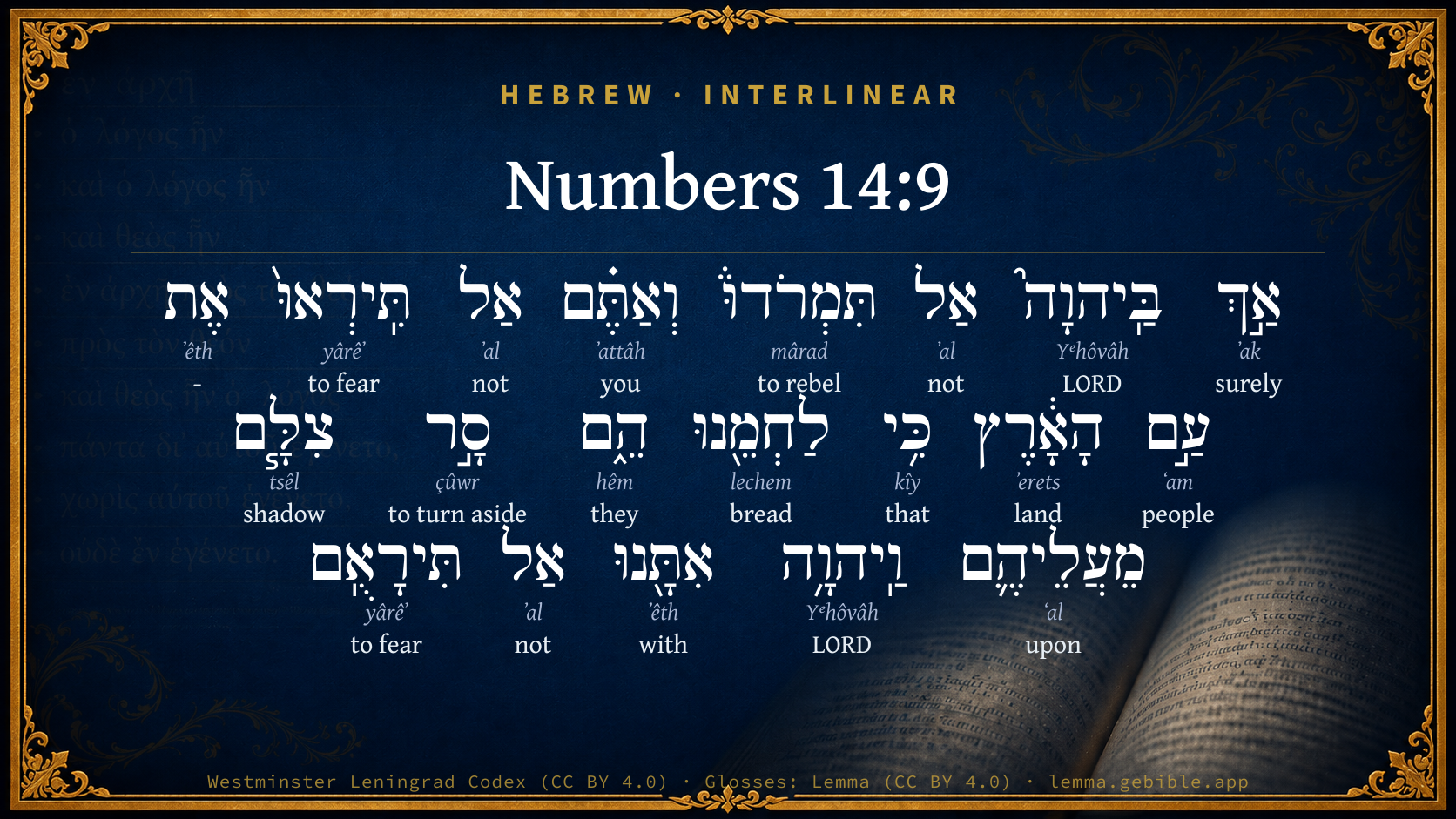
Hebrew (Westminster Leningrad Codex) Numbers 14:9 appears in the Hebrew Old Testament. The text above is from the Westminster Leningrad Codex. Each word links to its Strong’s number, a concise gloss, and parsing drawn from the Open Scriptures Hebrew Bible morphology. Click any word for its full Brown-Driver-Briggs (BDB) entry.
Download image
Cite this verse

Numbers 14:9 (World English Bible). Public Domain. Lemma interlinear Bible study tool, https://lemma.gebible.app/v/numbers/14/9.

Show BibTeX & RIS
BibTeX
RIS
English Translation
Only don't rebel against Yahweh, neither fear the people of the land; for they are bread for us: their defense is removed from over them, and Yahweh is with us: don't fear them.
World English Bible · Public Domain
Download a study sheet

One document with this verse’s original text, its word-by-word gloss line, the meaning frame, cross-references with their text, attributed commentary, and full source and license credits — printable, and it pastes into notes with its structure intact.

This verse Autodidact and up

Study sheet (.html) Plain text (.txt)

A passage Seminary Student

Up to 50 verses in one chapter. A passage sheet keeps up to 6 commentary sources and 12 cross-references per verse, in the order this page ranks them, and says so on the sheet whenever that leaves anything out. Ask for a single verse and you get the Autodidact verse sheet above.

Everything on this page stays free to read, with no account — the sheet is a download of what is already on screen, not access to it.

Want to remove ads? Support Godless Engineer
Compare translations 3

The same verse in 3 English versions, stacked beneath the original-language interlinear above. Click any original word for its lexicon entry.

Each is an independent rendering of the whole verse — the interlinear is not word-aligned to these translations.

Highlighted words mark where these versions differ — a whole-verse word diff, not a word-by-word alignment.

  • World English Bible Public Domain
    Only don't rebel against Yahweh, neither fear the people of the land; for they are bread for us: their defense is removed from over them, and Yahweh is with us: don't fear them.
  • King James Version Public Domain
    Only rebel not ye against the LORD, neither fear ye the people of the land; for they are bread for us: their defense is departed from them, and the LORD is with us: fear them not.
  • unfoldingWord Literal Text CC BY-SA 4.0
    Only you shall not rebel against Yahweh, and you, you shall not fear the people of the land, for they our bread. Their shadow turned aside from upon them, and Yahweh with us. You shall not fear them!”

unfoldingWord Literal Text — © unfoldingWord, licensed CC BY-SA 4.0. Word-aligned USFM3 via Door43 (git.door43.org/unfoldingWord/en_ult).

Versions to compare (up to 4)

3 of 4 selected

Show all 18 translations

Every available English version of this verse, each an independent rendering of the whole verse.

  • World English Bible Public Domain
    Only don't rebel against Yahweh, neither fear the people of the land; for they are bread for us: their defense is removed from over them, and Yahweh is with us: don't fear them.
  • Berean Standard Bible Public Domain
    Only do not rebel against the LORD, and do not be afraid of the people of the land, for they will be like bread for us. Their protection has been removed, and the LORD is with us. Do not be afraid of them!”
  • Majority Standard Bible Public Domain
    Only do not rebel against the LORD, and do not be afraid of the people of the land, for they will be like bread for us. Their protection has been removed, and the LORD is with us. Do not be afraid of them!”
  • King James Version Public Domain
    Only rebel not ye against the LORD, neither fear ye the people of the land; for they are bread for us: their defense is departed from them, and the LORD is with us: fear them not.
  • American Standard Version (1901) Public Domain
    Only rebel not against Jehovah, neither fear ye the people of the land; for they are bread for us: their defence is removed from over them, and Jehovah is with us: fear them not.
  • Revised Version (1885) Public Domain
    Only rebel not against the LORD, neither fear ye the people of the land; for they are bread for us: their defence is removed from over them, and the LORD is with us: fear them not.
  • Geneva Bible (1599) Public Domain
    But rebell not ye against the Lord, neither feare ye the people of the land: for they are but bread for vs: their shielde is departed from the, and the Lord is with vs, feare them not.
  • Douay-Rheims (1899) Public Domain
    Be not rebellious against the Lord: and fear ye not the people of this land, for we are able to eat them up as bread. All aid is gone from them: the Lord is with us, fear ye not.
  • Young's Literal Translation Public Domain
    only, against Jehovah rebel not ye: and ye, fear not ye the people of the land, for our bread they `are'; their defence hath turned aside from off them, and Jehovah `is' with us; fear them not.'
  • Literal Standard Version CC BY-SA 4.0
    only, do not rebel against YHWH: and you, do not fear the people of the land, for they [are] our bread; their defense has turned aside from off them, and YHWH [is] with us; do not fear them.”
  • Unlocked Literal Bible CC BY-SA 4.0
    But do not rebel against Yahweh, and do not fear the people in the land, for they are bread to us. Their protection will be removed from them, because Yahweh is with us. Do not fear them.”
  • unfoldingWord Literal Text CC BY-SA 4.0
    Only you shall not rebel against Yahweh, and you, you shall not fear the people of the land, for they our bread. Their shadow turned aside from upon them, and Yahweh with us. You shall not fear them!”
  • Darby Bible Public Domain
    only rebel not against Jehovah; and fear not the people of the land; for they shall be our food. Their defence is departed from them, and Jehovah is with us: fear them not.
  • World Messianic Bible Public Domain
    Only don’t rebel against the LORD, neither fear the people of the land; for they are bread for us. Their defense is removed from over them, and the LORD is with us. Don’t fear them.”
  • Webster's Bible Public Domain
    Only rebel not ye against the LORD, neither fear ye the people of the land; for they are bread for us: their defense has departed from them, and the LORD is with us: fear them not.
  • Free Bible Version CC BY-SA 4.0
    Don't rebel and fight against the Lord. You don't need to be afraid of the people living there in the country—we can take them easily! They're defenseless and the Lord is with us. Don't be frightened of them!”
  • Bible in Basic English Public Domain
    Only, do not go against the Lord or go in fear of the people of the land, for they will be our food; their strength has been taken from them and the Lord is with us: have no fear of them.
  • JPS Tanakh (1917) Public Domain
    Only rebel not against the LORD, neither fear ye the people of the land; for they are bread for us; their defence is removed from over them, and the LORD is with us; fear them not.'

Literal Standard Version (2020), Covenant Press — licensed CC BY-SA 4.0. Text via the HelloAO Bible API (eBible.org). Unlocked Literal Bible (unfoldingWord) — licensed CC BY-SA 4.0. Text via the HelloAO Bible API (eBible.org). unfoldingWord Literal Text — © unfoldingWord, licensed CC BY-SA 4.0. Word-aligned USFM3 via Door43 (git.door43.org/unfoldingWord/en_ult). Free Bible Version, Dr. Jonathan Gallagher — licensed CC BY-SA 4.0. Text via the HelloAO Bible API (eBible.org).

Word by word

More ways to search: Search by grammar → Find every occurrence → Compare this word →

Practice this passage: Drill this verse → Learn its vocabulary →

תִּמְרֹדוּ֒
mârad
H4775
“to rebel”
Verb, Qal, Jussive, 2nd Person, Masculine, Plural
Part of Speech
Verb
Stem
Qal
Form
Jussive
Person
2nd Person
Gender
Masculine
Number
Plural
Full BDB Definition

Origin: a primitive root

TWOT: 1240

to rebel, revolt, be rebellious - (Qal) to rebel, revolt - against human king - against God - against light (poetic)
  1. אַ֣ךְ ʼak H389 “surely” Particle, Accusative
  2. בַּֽיהוָה֮ Yᵉhôvâh H3068 “in/at · LORD” Preposition + Noun, Proper
  3. אַל ʼal H408 “not” Particle, Negative
  4. וְאַתֶּ֗ם ʼattâh H859 “and · you” Conjunction + Pronoun, Personal, 2nd Person, Masculine, Plural
  5. אַל ʼal H408 “not” Particle, Negative
  6. תִּֽירְאוּ֙ yârêʼ H3372 “to fear” Verb, Qal, Jussive, 2nd Person, Masculine, Plural
  7. אֶת ʼêth H853 “-” Particle, Direct Object
  8. עַ֣ם ʻam H5971 “people of” Noun, Common, Masculine, Singular, Construct
  9. הָאָ֔רֶץ ʼerets H776 “the · land” Particle, Definite Article + Noun, Common, Both, Singular, Absolute
  10. כִּ֥י kîy H3588 “that” Conjunction
  11. לַחְמֵ֖נוּ lechem H3899 “bread · our” Noun, Common, Both, Singular, Construct + Suffix, Personal, 1st Person, Common, Plural
  12. הֵ֑ם hêm H1992 “they” Pronoun, Personal, 3rd Person, Masculine, Plural
  13. סָ֣ר çûwr H5493 “to turn aside” Verb, Qal, Perfect, 3rd Person, Masculine, Singular
  14. צִלָּ֧ם tsêl H6738 “shadow · their” Noun, Common, Masculine, Singular, Construct + Suffix, Personal, 3rd Person, Masculine, Plural
  15. מֵעֲלֵיהֶ֛ם ʻal H5921 “from · upon · them” Preposition + Preposition + Suffix, Personal, 3rd Person, Masculine, Plural
  16. וַֽיהוָ֥ה Yᵉhôvâh H3068 “and · LORD” Conjunction + Noun, Proper
  17. אִתָּ֖נוּ ʼêth H854 “with · us” Preposition + Suffix, Personal, 1st Person, Common, Plural
  18. אַל ʼal H408 “not” Particle, Negative
  19. תִּירָאֻֽם yârêʼ H3372 “to fear · them” Verb, Qal, Jussive, 2nd Person, Masculine, Plural + Suffix, Personal, 3rd Person, Masculine, Plural

About this verse

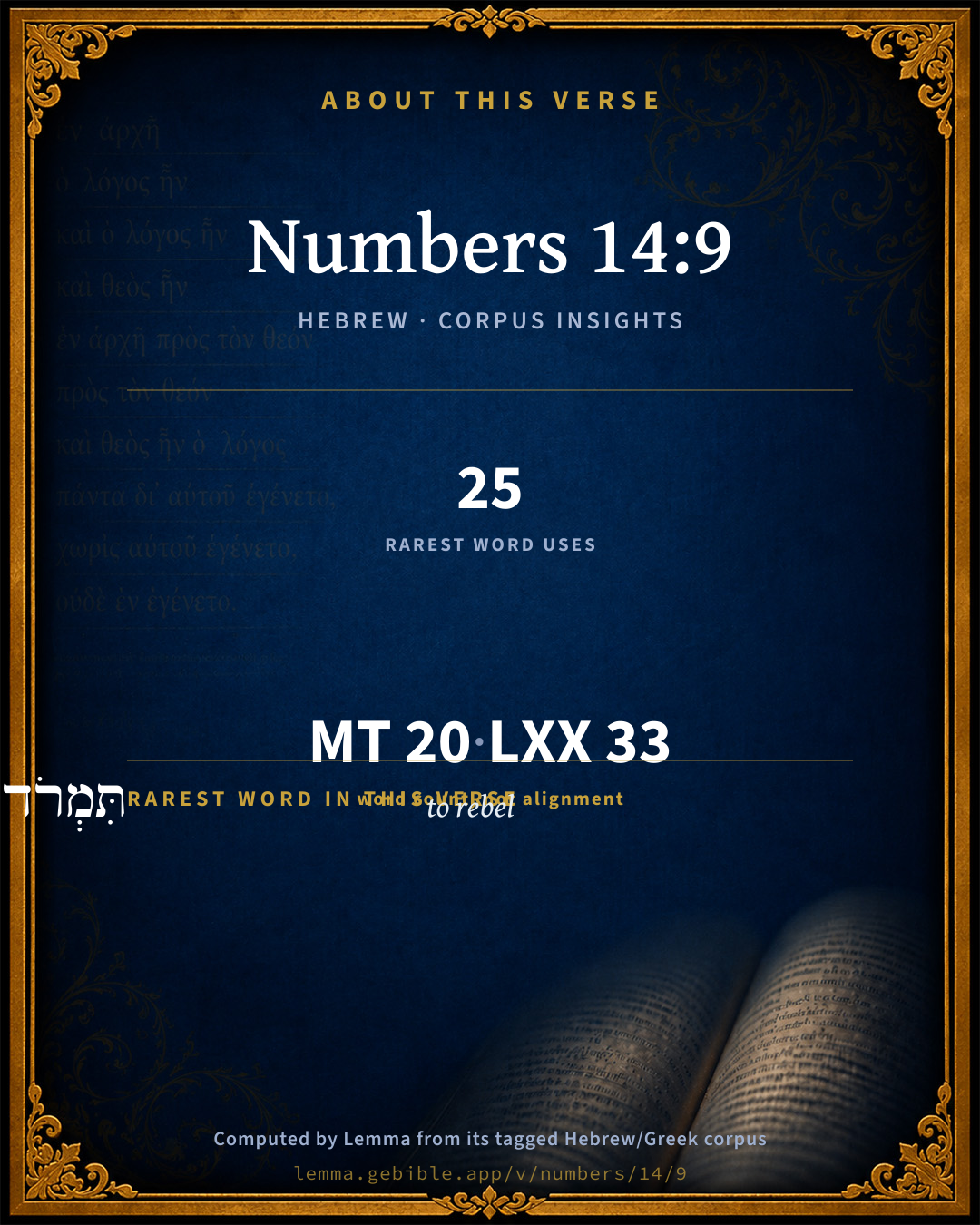
These counts appear in no published source. They are computed here, from the morphology-tagged text and Lemma’s own curated glosses. What Lemma adds →

20
words
16
distinct lemmas
Pentateuch
section

Notable vocabulary

The rarest word here is תִּמְרֹדוּ֒ to rebel H4775 — appearing just 25 times in the whole Hebrew Bible.

Shared distinctive vocabulary

תִּמְרֹדוּ֒ to rebel H4775 occurs in 23 verses of the Hebrew Bible. Also found in:

Grammatical profile

  • 4 verbs
  • 6 nouns
  • 2 pronouns
  • 2 prepositions
  • 1 conjunction
  • 5 particles

Verb forms

  • תִּמְרֹדוּ֒ Qal · Jussive
  • תִּֽירְאוּ֙ Qal · Jussive
  • סָ֣ר Qal · Perfect
  • תִּירָאֻֽם Qal · Jussive

Repetition

Words recur within this verse — often emphatic in Hebrew:

  • בַּֽיהוָה֮ LORD H3068 ×2
  • תִּֽירְאוּ֙ to fear H3372 ×2
  • אַל not H408 ×3

Hebrew & Septuagint length

In English translation the verse runs 33 words from the Hebrew and 39 from the Septuagint (LXX English) — closely comparable.

A rough comparison of the two English renderings, which tokenize alike — not a word-level alignment.

Word counts can differ between the Hebrew and the Greek without any difference in meaning — e.g. the Hebrew direct-object marker אֵת has no separate Greek word, and Greek often adds the article ὁ.

In the original languages it is 20 Hebrew tokens and 33 Greek tokens — but the two are counted differently (Hebrew bundles its prefixes and suffixes into one token; the Greek is in lemma form), so that isn’t a like-for-like length.

Cross-references

38

Topical passages linked to Numbers 14:9 in the Treasury of Scripture Knowledge — connected by theme and wording, ordered by reader-vote popularity; previews shown in the World English Bible.

  • Deuteronomy 7:18 you shall not be afraid of them: you shall well remember what Yahweh your God did to Pharaoh, and to all Egypt;
  • Deuteronomy 31:6 Be strong and of good courage, don't be afraid, nor be scared of them: for Yahweh your God, he it is who does go with you; he will not fail you, nor forsake you.
  • Romans 8:31 What then shall we say about these things? If God is for us, who can be against us?
  • Psalms 74:14 You broke the heads of Leviathan in pieces. You gave him as food to people and desert creatures.
  • Numbers 24:8 God brings him forth out of Egypt; He has as it were the strength of the wild-ox: He shall eat up the nations his adversaries, Shall break their bones in pieces, Smite [them] through with his arrows.
  • Deuteronomy 31:8 Yahweh, he it is who does go before you; he will be with you, he will not fail you, neither forsake you: don't be afraid, neither be dismayed.
  • 2 Chronicles 20:17 You shall not need to fight in this [battle]: set yourselves, stand you still, and see the salvation of Yahweh with you, O Judah and Jerusalem; don't be afraid, nor be dismayed: tomorrow go out against them: for Yahweh is with you.
  • 2 Chronicles 32:8 with him is an arm of flesh; but with us is Yahweh our God to help us, and to fight our battles. The people rested themselves on the words of Hezekiah king of Judah.
  • Joshua 1:5 There shall not any man be able to stand before you all the days of your life. As I was with Moses, so I will be with you; I will not fail you, nor forsake you.
  • Deuteronomy 20:1–4 When you go forth to battle against your enemies, and see horses, and chariots, [and] a people more than you, you shall not be afraid of them; for Yahweh your God is with you, who brought you up out of the land of Egypt.
  • Psalms 121:5 Yahweh is your keeper. Yahweh is your shade on your right hand.
  • Deuteronomy 1:26 Yet you wouldn't go up, but rebelled against the commandment of Yahweh your God:
  • Deuteronomy 9:7 Remember, don't forget, how you provoked Yahweh your God to wrath in the wilderness: from the day that you went forth out of the land of Egypt, until you came to this place, you have been rebellious against Yahweh.
  • Deuteronomy 9:23–24 When Yahweh sent you from Kadesh-barnea, saying, Go up and possess the land which I have given you; then you rebelled against the commandment of Yahweh your God, and you didn't believe him, nor listen to his voice.
  • Psalms 14:4 Have all the workers of iniquity no knowledge, Who eat up my people as they eat bread, And don't call on Yahweh?
  • Deuteronomy 1:21 Behold, Yahweh your God has set the land before you: go up, take possession, as Yahweh, the God of your fathers, has spoken to you; don't be afraid, neither be dismayed.
  • Deuteronomy 7:21 You shall not be scared of them; for Yahweh your God is in the midst of you, a great and awesome God.
  • Deuteronomy 32:42 I will make my arrows drunk with blood, My sword shall devour flesh; With the blood of the slain and the captives, From the head of the leaders of the enemy.
  • Isaiah 8:9–10 Make an uproar, O you peoples, and be broken in pieces! And give ear, all you of far countries: gird yourselves, and be broken in pieces! Gird yourselves, and be broken in pieces!
  • Daniel 9:9 To the Lord our God belong mercies and forgiveness; for we have rebelled against him;
  • Genesis 48:21 Israel said to Joseph, "Behold, I am dying, but God will be with you, and bring you again to the land of your fathers.
  • Exodus 33:16 For how would people know that I have found favor in your sight, I and your people? Isn't it in that you go with us, so that we are separated, I and your people, from all the people who are on the surface of the earth?"
  • Judges 1:22 The house of Joseph, they also went up against Bethel; and Yahweh was with them.
  • 2 Chronicles 13:12 Behold, God is with us at our head, and his priests with the trumpets of alarm to sound an alarm against you. Children of Israel, don't you fight against Yahweh, the God of your fathers; for you shall not prosper.
  • 2 Chronicles 15:2 and he went out to meet Asa, and said to him, Hear you me, Asa, and all Judah and Benjamin: Yahweh is with you, while you are with him; and if you seek him, he will be found of you; but if you forsake him, he will forsake you.
  • Psalms 46:1–2 God is our refuge and strength, A very present help in trouble.
  • Psalms 46:7 Yahweh of Hosts is with us. The God of Jacob is our refuge. Selah.
  • Psalms 46:11 Yahweh of Hosts is with us. The God of Jacob is our refuge. Selah.
  • Psalms 91:1 He who dwells in the secret place of the Most High Will rest in the shadow of the Almighty.
  • Isaiah 1:2 Hear, heavens, And listen, earth; for Yahweh has spoken: I have nourished and brought up children, And they have rebelled against me.
  • Isaiah 30:2–3 that set out to go down into Egypt, and have not asked at my mouth; to strengthen themselves in the strength of Pharaoh, and to take refuge in the shadow of Egypt!
  • Isaiah 32:2 A man shall be as a hiding-place from the wind, and a covert from the tempest, as streams of water in a dry place, as the shade of a great rock in a weary land.
  • Isaiah 41:10 Don't you be afraid, for I am with you; don't be dismayed, for I am your God; I will strengthen you; yes, I will help you; yes, I will uphold you with the right hand of my righteousness.
  • Isaiah 41:14 Don't be afraid, you worm Jacob, and you men of Israel; I will help you, says Yahweh, and your Redeemer is the Holy One of Israel.
  • Isaiah 63:10 But they rebelled, and grieved his holy Spirit: therefore he was turned to be their enemy, [and] himself fought against them.
  • Jeremiah 48:45 Those who fled stand without strength under the shadow of Heshbon; for a fire is gone forth out of Heshbon, and a flame from the midst of Sihon, and has devoured the corner of Moab, and the crown of the head of the tumultuous ones.
  • Matthew 1:23 "Behold, the virgin shall be with child, And shall bring forth a son. They shall call his name Immanuel;" Which is, being interpreted, "God with us."
  • Philippians 1:27 Only let your manner of life be worthy of the Gospel of Christ, that, whether I come and see you or am absent, I may hear of your state, that you stand firm in one spirit, with one soul striving for the faith of the Gospel;

Cross-references courtesy of OpenBible.info (CC BY 4.0).

Hebrew and Greek witnesses Masoretic Hebrew ↔ Greek Septuagint

The same verse in the two great witnesses to the Old Testament, shown verse-for-verse.

These are two independent witnesses, not word-aligned to each other, and the Septuagint is shown in lemma (dictionary) form.

Hebrew Numbers 14:9 Masoretic · Westminster Leningrad Codex

אַ֣ךְ בַּֽיהוָה֮ אַל תִּמְרֹדוּ֒ וְאַתֶּ֗ם אַל תִּֽירְאוּ֙ אֶת עַ֣ם הָאָ֔רֶץ כִּ֥י לַחְמֵ֖נוּ הֵ֑ם סָ֣ר צִלָּ֧ם מֵעֲלֵיהֶ֛ם וַֽיהוָ֥ה אִתָּ֖נוּ אַל תִּירָאֻֽם

Only don't rebel against Yahweh, neither fear the people of the land; for they are bread for us: their defense is removed from over them, and Yahweh is with us: don't fear them.

World English Bible · Public Domain

Greek LXX Numbers 14:9 Septuagint · lemma form

ἀλλά ἀπό ὁ κύριος μή ἀποστάτης γίγνομαι σύ δέ μή φοβέω ὁ λαός ὁ γῆ ὅτι κατάβρωμα ἐγώ εἰμί ἀποἵστημι γάρ ὁ καιρός ἀπό αὐτός ὁ δέ κύριος ἐν ἐγώ μή φοβέω αὐτός

Only depart not from the Lord; and fear you⌃ not the people of the land, for they are meat for us; for the season of prosperity is departed from them, but the Lord is among us: fear them not.

LXX2012 (modern English Septuagint) · Public Domain

On this verse, Haydock's Catholic Bible Commentary discusses the Septuagint’s reading. Read the note in Commentary ↓

Hebrew: Westminster Leningrad Codex (CC BY 4.0). Greek: Septuagint (public domain); English from LXX2012 (modern English Septuagint) (Public Domain). How the Septuagint differs from the Hebrew →

Targum (Aramaic paraphrase)

2

The Targum is the ancient Jewish Aramaic paraphrase of the Hebrew Scriptures — an interpretive translation, not the Hebrew text itself. Onkelos (literal) and Pseudo-Jonathan (expansive) render the Torah, and Jonathan the Prophets. Coverage is partial: where no permissively-licensed English translation exists for a verse, only the Aramaic is shown. This is verse-level text, not a word-by-word alignment to the Hebrew.

  1. Targum Onkelos Torah (Genesis–Deuteronomy)
    בְּרַם בְּמֵימְרָא דַיְיָ לָא תִמְרְדוּן וְאַתּוּן לָא תִדַחֲלוּן מִן עַמָא דְאַרְעָא אֲרֵי בִידָנָא מְסִירִין אִנוּן עֲדָא תָקְפְהוֹן מִנְהוֹן וּמֵימְרָא דַיְיָ בְּסַעְדָנָא לָא תִדְחֲלוּן מִנְהוֹן

    (no public-domain English translation for this verse)

    Targum Onkelos — Aramaic: “Onkelos Genesis” (public domain); “Onkelos Exodus” (public domain); “Onkelos Leviticus” (public domain); “Onkelos Numbers” (public domain); “Onkelos Deuteronomy” (public domain). English: “Sefaria Community Translation” (CC0 1.0 (public-domain dedication)); “J.W. Etheridge. The Targums of Onkelos and Jonathan Ben Uzziel on the Pentateuch. London: Longmans, Green, 1862” (public domain). Text via Sefaria.

  2. Targum Pseudo-Jonathan Torah (Genesis–Deuteronomy)
    בְּרַם בְּפִיקוּדַיָא דַיְיָ לָא תְבַטְשׁוּן וְאַתּוּן לָא תְדַחֲלוּן מִן עַמָא דְאַרְעָא אֲרוּם בִּידָנָא מְסִירִין הִינוּן תַּשׁ חֵיל גְבוּרַתְהוֹן מֵעֲלֵיהוֹן וּמֵימְרָא דַיְיָ בְּסַעֲדָנָא לָא תִדַחֲלוּן מִנְהוֹן

    Only do not rebel against the commandments of the Lord, and you need not fear the people of the land, for they are delivered into our hands; the strength of their power hath failed from them, but the Word of the Lord will be our helper; fear them not.

    Targum Pseudo-Jonathan — Aramaic: “Targum Jonathan on Genesis” (public domain); “Targum Jonathan on Exodus” (public domain); “Targum Jonathan on Leviticus” (public domain); “Targum Jonathan on Numbers” (public domain); “Targum Jonathan on Deuteronomy” (public domain). English: “The Targum of Jonathan ben Uzziel, trans. J. W. Etheridge, London, 1862” (public domain). Text via Sefaria.

Commentary

Notes on Numbers 14:9 from classic Christian and Jewish commentators (each source and its license shown beneath its notes). The classic Christian expositions comment on the surrounding passage and are grouped to its opening verse, so a note may address several verses; the Jewish commentaries on the Tanakh (Rashi and others) are per-verse, so they appear only where the commentator wrote on this verse.

Lemma curates 59 commentaries, every one of them public domain or Creative Commons licensed, each selected and text-cleaned for this edition rather than reprinted as found. About our sources →

Trapp's Complete Commentary

John Trapp

Num 14:9 Only rebel not ye against the LORD, neither fear ye the people of the land; for they [are] bread for us: their defence is departed from them, and the LORD [is] with us: fear them not.

Ver. 9. They are bread for us,] q.d., We shall make but a breakfast of them. So that valiant Prince of Orange told his soldiers at the battle of Newport, when they had the sea on the one side, and the Spaniards on the other, that they must either eat up those Spaniards, or drink up that sea.

John Trapp, A Commentary or Exposition upon All the Books of the Old and New Testament (1647–1656) — public domain. Text from a community e-Sword module.

Geneva Bible (1599)

Geneva Bible translators

We shall easily overcome them.

Geneva Bible (1599) marginal notes — public domain. Text via Bolls.life.

Jamieson, Fausset & Brown

Robert Jamieson, A. R. Fausset & David Brown

their defence is departed--Hebrew, "their shadow." The Sultan of Turkey and the Shah of Persia are called "the shadow of God," "the refuge of the world." So that the meaning of the clause, "their defence is departed from them," is, that the favor of God was now lost to those whose iniquities were full (Gen 15:16), and transferred to the Israelites.

Jamieson, Fausset & Brown — Commentary Critical and Explanatory on the Whole Bible (1871) — public domain (CC PDM 1.0). Text via the HelloAO Bible API.

Adam Clarke's Commentary

Verse 9. Their defence] צלם tsillam, their shadow, a metaphor highly expressive of protection and support in the sultry eastern countries. The protection of God is so called; see Ps 91:1; Ps 121:5; see also Isa 51:16; Isa 49:2; Isa 30:2.

The Arabs and Persians have the same word to express the same thing. [Persian] nemayeed zulli doulet mamdood bad. "May the shadow of thy prosperity be extended!" [Persian] nemayced zulli doulet ber mufareki khayr khwahen mamdood bad. "May the shadow of thy prosperity be spread over the heads of thy well-wishers!" They have also the following elegant distich: -

[Persian]

[Persian]

Sayahat kem mubad az seri ma

Bast Allah zullikem abeda.

"May thy protection never be removed from my head!

May God extend thy shadow eternally!"

Here the Arabic [Arabic] zull answers exactly to the Hebrew צל tsel, both signifying that which overspreads or overshadows. See Clarke on Nu 14:14.

Adam Clarke's Commentary on the Bible (1810–1826) — public domain. Text from a community e-Sword/MySword module.

Ellicott's Commentary for English Readers

(9) Their defence is departed from them.—Literally, their shadow. This is a natural and frequently recurring figure of speech in the East, where protection from the scorching rays of the sun is a boon of incalculable worth. (Comp. Gen_19:8; Psa_17:8; Psa_91:1; Isa_25:4; Isa_30:2.) The measure of the iniquity of the Canaanites was now full, and they were ripe for

destruction. (Comp. Gen_15:16; Lev_18:25; Lev_20:23.)

A Bible Commentary for English Readers, edited by Charles John Ellicott (1878–1897) — public domain. Text from a community e-Sword module.

The Cambridge Bible for Schools and Colleges

gen. ed. J. J. S. Perowne

9. they are our bread] i.e. we shall swallow them up, annihilate them; cf. Psa_14:4 = Psa_53:4, Num_24:8.

their defence] Lit. ‘shadow’ (as R.V. marg. states); a common metaphor of great significance in a hot country; see Jdg_9:15, Isa_25:4; Isa_32:2, and the name Bezalel (Exo_31:2) which denotes ‘in the shadow of El (God).’ The passage means that the gods in whom the Canaanites trust will be powerless against Jehovah the God of Israel. Cf. Deu_32:31 ‘their rock is not as our Rock.’

The Cambridge Bible for Schools and Colleges (gen. ed. J. J. S. Perowne; Cambridge University Press, 1878–1918) — public domain. Text from a community e-Sword module.

John Gill's Exposition

Only rebel not ye against the Lord,.... Nothing, it is suggested, could hinder them from the, possession of it but their rebellion against the Lord; which might provoke him to cut them off by his immediate hand, or to deliver them into the hands of their enemies; for rebellion is a dreadful sin, and highly provoking, Sa1 15:23,

neither fear ye the people the land; on account of their number, strength, the walled cities they dwell in; they had nothing to fear from them, so be it they feared the Lord, and were not disobedient to him:

for they are bread for us; as easy to be cut to pieces, and to be devoured, consumed, and destroyed as thoroughly, as bread is when eaten; and their fields, vineyards, all they have without and within, even all their substance, will be a prey to us, and furnish out sufficient provision for us, on which we may pleasantly and plentifully live, as on bread: see Psa 14:4,

their defence is departed from them; they had no heart nor spirit left in them; no courage to defend themselves, and therefore the strength of their bodies and their walled towns would be of no avail unto them; see Jos 2:9; or "their shadow" (r), which covered and protected them, the providence of God which was over them, and continued them in the land, and quiet possession of it, until the measure of their iniquity was filled up, and the time come for his people Israel to inhabit it; but now it was departed:

and the Lord is with us; as was evident by the cloud upon the tabernacle, and by the manna being spread around their camp every morning: the Targums of Onkelos and Jonathan are,"the Word of the Lord is for our help:"

fear them not; the Canaanites, notwithstanding the strength of their bodies, or of their cities, the Lord is mightier than they.

(r) "umbra eorum", Montanus, Tigurine version, Fagius, Vatablus; so Junius & Tremellius, Piscator.

John Gill's Exposition of the Whole Bible (1746–1763) — public domain (CC PDM 1.0). Text via the HelloAO Bible API.

Albert Barnes' Notes on the Bible

Their defense - literally, “their shadow,” i. e. their shelter as from the scorching sun: an Oriental figure. Compare the marginal references.

Albert Barnes' Notes on the Bible (1834–1885) — public domain. Text from a community e-Sword/MySword module.

Haydock's Catholic Bible Commentary

To eat, or consume them, as easily as we devour a piece of bread. The expression is proverbial, Psalm xiii. 4. --- All aid. Hebrew, "their shadow," which is taken in the same sense. Septuagint, "their time or opportunity is gone." The Rabbins refer this to holy Job, who, they say, died at this time. (Cornelius a Lapide) --- He dwelt near the Jordan. (Pineda in Job.) (Chap. i. 1, and 27.

George Leo Haydock (1774–1849), Haydock's Catholic Family Bible and Commentary, 1859 edition — public domain. Excludes Psalms (Douay-Rheims chapter numbering differs from Protestant) and Deuterocanonical books (Catholic canon only).

Matthew Poole's English Annotations

They are bread for us; we shall destroy them as easily as we do our bread or common food. Compare Num 24:8; Psa 14:4.

Their defence, i.e. their counsel, conduct, and courage, and especially God, who was pleased to afford them his protection till their iniquities were full, Gen 15:16, is utterly departed from them, and hath given them up as a prey to us.

The Lord is with us, by his special grace and almighty power, to save us from them; and from all our enemies.

Matthew Poole's English Annotations on the Holy Bible (1683–1685) — public domain. Text from a community e-Sword/MySword module.

Whedon's Commentary on the Bible

Daniel D. Whedon

9. Rebel not… neither fear… the people — Disobedience to God is the soil out of which the fear of man always grows. If the presence of Napoleon on the battle-field was equal, in the courage which he inspired, to a re-enforcement of ten thousand men, how much more inspiring to the Hebrews would be a realizing faith in the presence of the omnipotent Jehovah.

They are bread for us — We shall destroy them as easily as we eat bread. Psa_14:4. The simile is natural to a Hebrew, in whose language the verbs to eat, to fight, to destroy in war, are the same. We have a similar proverb in “Food for our powder.” As the faint-hearted spies had declared that the Canaanites were giants before whom the Hebrews were dwarfed to grasshoppers, so the brave spies, with equal strength of expression, style them “bread for us.”

Their defence — Hebrew, shadow, covering.

Is departed — They are wholly destitute of courage. The Sultan of Turkey and the Shah of Persia are called “the shadow of God,” “the refuge of the whole world.” (Critici Sacri.)

Daniel D. Whedon (gen. ed.), Commentary on the Old and New Testaments (1874–1909) — public domain. Text from a community e-Sword module.

The Pulpit Commentary

They are bread for us. "They are our food," i.e., we shall easily devour them. (cf. Num_24:8 Psa_14:4) Perhaps it has the further significance that their enemies would be an absolute advantage to them, because they would (however unwillingly) supply them with the necessaries of life. So apparently the Septuagint: mh fobhyhte tobrwma umin estin . Their defense is departed from them. Literally, "their shadow," that which shielded them for a while from the fierce blast of Divine wrath. This "shadow" was not positively the Divine protection, (as in Psa_91:1, and elsewhere) but negatively that Providence which left them a space wherein to walk in their own ways. (cf. to katecon of 2Th_2:6)

The Pulpit Commentary (1880–1919), ed. H.D.M. Spence-Jones & Joseph S. Exell — public domain. Text from a community e-Sword module.

John Wesley's Explanatory Notes

Bread - We shall destroy them as easily as we eat our bread. Their defense - Their conduct and courage, and especially God, who was pleased to afford them his protection 'till their iniquities were full, is utterly departed from them, and hath given them up as a prey to us. With us - By his special grace and almighty power, to save us from them and all our enemies. Only rebel not against the Lord - Nothing can ruin sinners but their own rebellion. If God leaves them, 'tis because they drive him from them, and they die, because they will die.

John Wesley, Explanatory Notes Upon the Whole Bible (1754–1765) — public domain. Text via the GEBible commentary corpus.

unfoldingWord translationNotes

Door43 World Missions Community

Connecting Statement:

Joshua and Caleb continue speaking to the people of Israel.

for they are bread to us

Joshua and Caleb speak of destroying their enemies as easily as if they were eating bread. AT: "We will destroy them as easily as we can eat food" (See: Metaphor and Simile)

Their protection will be removed from them

This can be stated in active form. AT: "Yahweh will remove their protection from them" (See: Active or Passive)

Their protection

The abstract noun "protection" can be stated as "protect." AT: "Anyone that might protect them" (See: Abstract Nouns)

translationWords

rebel

Yahweh

fear

consume

stone

die

glory

tent of meeting

Israel

unfoldingWord translationNotes — © Distant Shores Media and the Door43 World Missions Community, licensed CC BY-SA 4.0. Source: git.door43.org/Door43/en_tn.

Rashi

Rabbi Shlomo Yitzchaki (Rashi)

אל תמרדו [ONLY] REBEL NOT YE [AGAINST THE LORD], and consequently ואתם אל תיראו YOU WILL NOT HAVE TO FEAR [THE PEOPLE OF THE LAND].

כי לחמנו הם FOR THEY ARE BREAD FOR US — i.e. we shall consume them as bread.

סר צלם THEIR DEFENSE (lit., shade) IS DEPARTED [FROM THEM] — i.e. their shield and their strength is departed from them: the virtuous among them are dead; one of them was Job, who had protected them by his righteousness (Sotah 35a; cf. Bava Batra 15a). [Another explanation is: the shade (protection) of the Omnipresent is departed from them]. (Cf. Psalms 121:5).

Rashi on the Tanakh — English translations: “The Judaica Press complete Tanach with Rashi, translated by A. J. Rosenberg” (CC BY 4.0); “Pentateuch with Rashi's commentary by M. Rosenbaum and A.M. Silbermann, 1929-1934” (public domain); “The Metsudah Tanach series, Lakewood, N.J” (CC BY 4.0); and “The Book of Joshua, Metsudah Publications, 1997” (CC BY 4.0). Text via Sefaria.

Ramban (Nachmanides)

Rabbi Moshe ben Nachman (Ramban / Nachmanides)

ONLY REBEL NOT AGAINST THE ETERNAL. This means that [Moses and Aaron told the people]: “Your being afraid [to go up] because of the strength of the people that dwell in the Land is [in itself] a rebellion against the Glorious Name, for it was not because of your [own] strength that you came out of Egypt, but it was the hand of the Eternal that hath dealt wondrously with you. And He has assured you that He will drive them out from before you; if so, believe [in Him] and you will succeed.” They [Moses and Aaron] continued: neither fear ye the people, for they are bread for us, meaning that “even in the natural course of events and through normal methods of [warfare as practiced in] the world, they will fall before us, for the fear of us has overcome them and they will let us consume them like bread.”

TZILAM’ (literally: “their shadow”) IS REMOVED FROM THEM. “That is, their shield and their strength [are departed from them]. The worthy ones among them have died. Another interpretation: the shade (protection) of G-d is departed from them.” This is Rashi’s language. And Rabbi Abraham ibn Ezra commented that “tzilam means the buckler and shield which form a shade [and protection] to people in battle, and they [Moses and Aaron] are thus saying that our fear has fallen upon them, so that they will not take buckler, shield nor helmet to arm themselves and fight against us.” He has explained it well.But it is possible that Scripture is alluding to the well-known fact that there will be no shadow over the head of a person who is [destined] to die that year, on “the night of the seal.” Therefore it says: “their ‘shade’ is already removed from them, meaning that death has been decreed upon them, and the Eternal is with us, for it is He Who dwells in our midst and does miracles and wonders for us in the eyes of all who behold us; therefore, fear them not.” Or it is possible that the verse alludes to the princes above [in heaven], for no nation falls unless its prince falls first, as it is written, The Eternal will punish the host of the high heaven on high etc., and afterwards, on the kings of the earth upon the earth, and as is explained in the Book of Daniel., 11:16. Thus the verse is saying: “the power under whose protection the nations [in the land of Canaan] live is already removed, and the Eternal Who lowered them is with us, therefore fear them not.” And thus the Rabbis said in Midrash Shir Hashirim: Vol. II, p. 528). “And the shadows flee away. These are the princes of the nations and their angels,” for they are the protection over the nations. I have already mentioned this in other places.

Ramban (Nachmanides) on the Tanakh — English translation: “Commentary on the Torah by Ramban (Nachmanides). Translated and annotated by Charles B. Chavel. New York, Shilo Pub. House, 1971-1976” (CC BY 4.0). Text via Sefaria.

Ibn Ezra

Rabbi Abraham ibn Ezra

For they are [as] our bread. We will consume them like bread, as in, “Those who devoured My people partook of bread” (Tehillim 14:4).

Their protection is removed. Even a mighty warrior, if he has no shield to protect him, will be afraid.

Ibn Ezra on the Tanakh — English translations: “Sefaria Community Translation” (CC0 1.0 (public-domain dedication)); “Yalkut, Sifsei Chachomim Chumash, Metsudah Publications, 2009” (CC BY 4.0); and “Commentary of Ibn Ezra on Isaiah - trans. by M. Friedlander, 1873” (public domain). Text via Sefaria.

Lesson kit

Teaching starters — assembled from the data on this page, not authored interpretation. Every prompt links to the verse data it draws on. Edit before teaching.

Numbers, in the Pentateuch, opens this verse with 20 words (16 distinct Hebrew lemmas). Its most distinctive word is mârad (“to rebel”). A historical commentator’s framing appears above. Read the whole chapter for the surrounding context.

Discussion questions

  1. How does “to rebel” (mârad) shape what this verse is saying?
  2. Genesis 14:4 shares the word «to rebel» with this verse. How do the two illuminate each other?
  3. “LORD” occurs 2× in this one verse. What is the effect of the repetition?
  4. These translations render this verse differently. What is at stake in choosing one wording over another?
  5. The verb «תִּמְרֹדוּ֒» is Qal Jussive. How does its form color the action?
  6. Reading how Trapp's Complete Commentary and Geneva Bible (1599) read this verse, where do the two commentators agree and where do they part?

Things to notice

Reading settings

Reading text

Shown beneath each verse's original-language words.

Old Testament
Old Testament edition

Read the OT as the Masoretic Hebrew (MT) or the Greek Septuagint (LXX).

English shown for the Greek Septuagint (in the Hebrew ↔ Greek comparison).

Comparing translations? Open the Compare panel on any verse page to stack up to four side by side.