
Deuteronomy 32:28

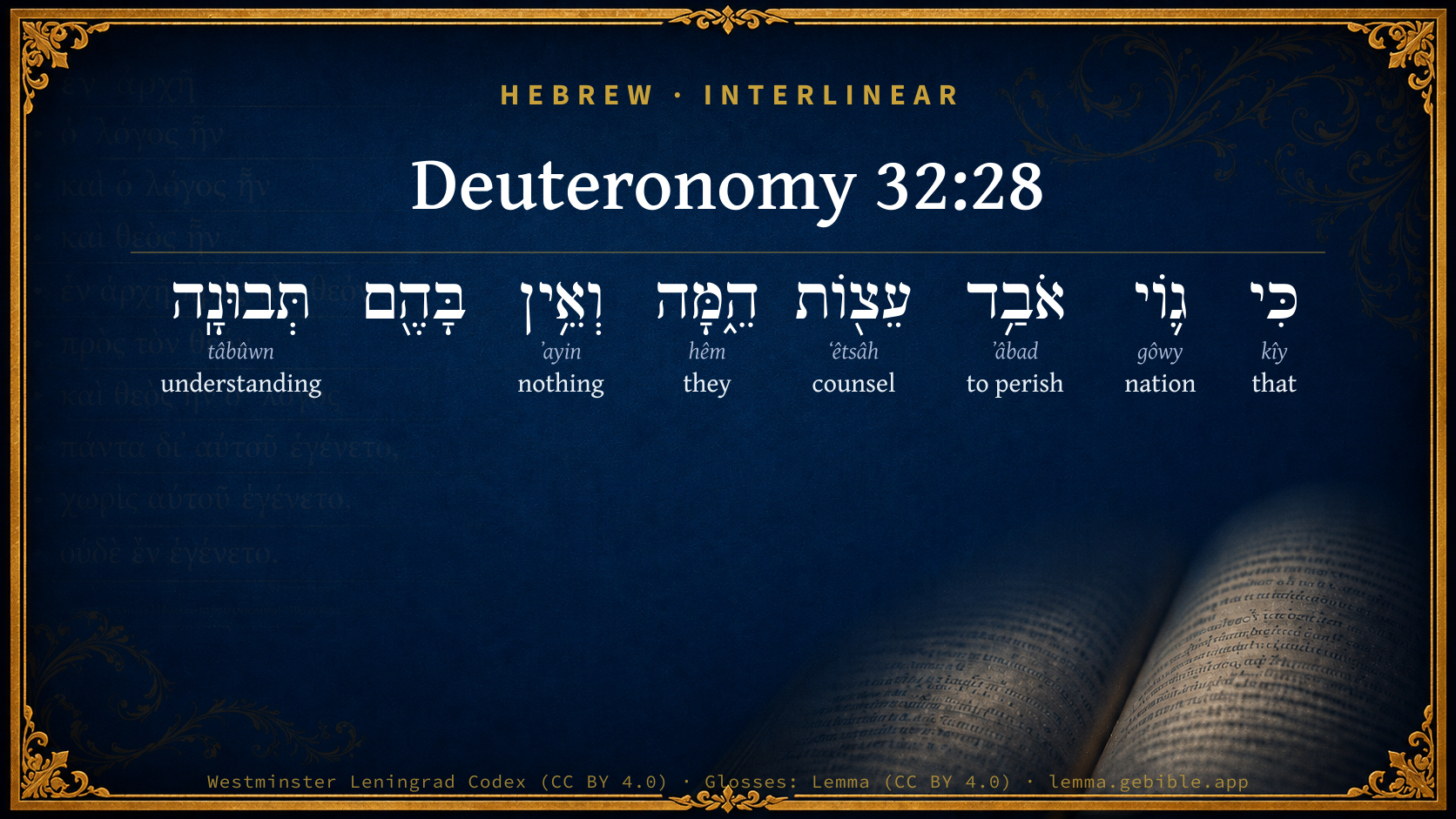
Hebrew (Westminster Leningrad Codex) Deuteronomy 32:28 appears in the Hebrew Old Testament. The text above is from the Westminster Leningrad Codex. Each word links to its Strong’s number, a concise gloss, and parsing drawn from the Open Scriptures Hebrew Bible morphology. Click any word for its full Brown-Driver-Briggs (BDB) entry.
Download image
Cite this verse

Deuteronomy 32:28 (World English Bible). Public Domain. Lemma interlinear Bible study tool, https://lemma.gebible.app/v/deuteronomy/32/28.

Show BibTeX & RIS
BibTeX
RIS
English Translation
For they are a nation void of counsel, There is no understanding in them.
World English Bible · Public Domain
Highlights
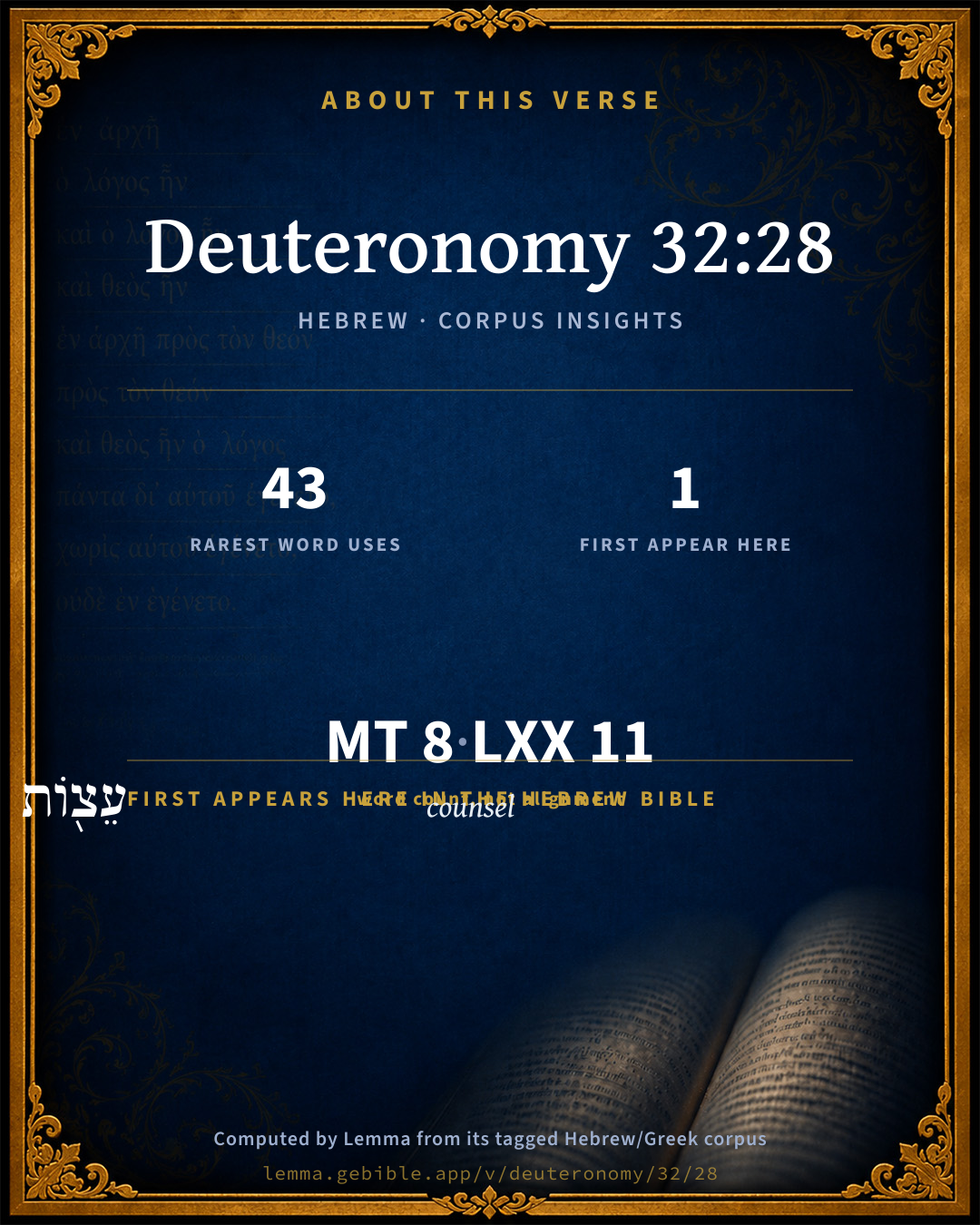
  • 1 first appearance in the Hebrew Bible
Full analysis ↓
Download a study sheet

One document with this verse’s original text, its word-by-word gloss line, the meaning frame, cross-references with their text, attributed commentary, and full source and license credits — printable, and it pastes into notes with its structure intact.

This verse Autodidact and up

Study sheet (.html) Plain text (.txt)

A passage Seminary Student

Up to 50 verses in one chapter. A passage sheet keeps up to 6 commentary sources and 12 cross-references per verse, in the order this page ranks them, and says so on the sheet whenever that leaves anything out. Ask for a single verse and you get the Autodidact verse sheet above.

Everything on this page stays free to read, with no account — the sheet is a download of what is already on screen, not access to it.

Want to remove ads? Support Godless Engineer
Compare translations 3

The same verse in 3 English versions, stacked beneath the original-language interlinear above. Click any original word for its lexicon entry.

Each is an independent rendering of the whole verse — the interlinear is not word-aligned to these translations.

Highlighted words mark where these versions differ — a whole-verse word diff, not a word-by-word alignment.

  • World English Bible Public Domain
    For they are a nation void of counsel, There is no understanding in them.
  • King James Version Public Domain
    For they are a nation void of counsel, neither is there any understanding in them.
  • unfoldingWord Literal Text CC BY-SA 4.0
    For a nation devoid of counsel they, and without understanding in them.

unfoldingWord Literal Text — © unfoldingWord, licensed CC BY-SA 4.0. Word-aligned USFM3 via Door43 (git.door43.org/unfoldingWord/en_ult).

Versions to compare (up to 4)

3 of 4 selected

Show all 18 translations

Every available English version of this verse, each an independent rendering of the whole verse.

  • World English Bible Public Domain
    For they are a nation void of counsel, There is no understanding in them.
  • Berean Standard Bible Public Domain
    Israel is a nation devoid of counsel, with no understanding among them.
  • Majority Standard Bible Public Domain
    Israel is a nation devoid of counsel, with no understanding among them.
  • King James Version Public Domain
    For they are a nation void of counsel, neither is there any understanding in them.
  • American Standard Version (1901) Public Domain
    For they are a nation void of counsel, And there is no understanding in them.
  • Revised Version (1885) Public Domain
    For they are a nation void of counsel, And there is no understanding in them.
  • Geneva Bible (1599) Public Domain
    For they are a nation voide of counsel, neither is there any vnderstanding in them.
  • Douay-Rheims (1899) Public Domain
    They are a nation without counsel, and without wisdom.
  • Young's Literal Translation Public Domain
    For a nation lost to counsels `are' they, And there is no understanding in them.
  • Literal Standard Version CC BY-SA 4.0
    For they [are] a nation lost to counsels, || And there is no understanding in them.
  • Unlocked Literal Bible CC BY-SA 4.0
    For Israel is a nation devoid of wisdom, and there is no understanding in them.
  • unfoldingWord Literal Text CC BY-SA 4.0
    For a nation devoid of counsel they, and without understanding in them.
  • Darby Bible Public Domain
    For they are a nation void of counsel, And understanding is not in them.
  • World Messianic Bible Public Domain
    For they are a nation void of counsel. There is no understanding in them.
  • Webster's Bible Public Domain
    For they are a nation void of counsel, neither is there any understanding in them.
  • Free Bible Version CC BY-SA 4.0
    Israel is a nation that doesn't think straight; none of them understand anything.
  • Bible in Basic English Public Domain
    For they are a nation without wisdom; there is no sense in them.
  • JPS Tanakh (1917) Public Domain
    For they are a nation void of counsel, and there is no understanding in them.

Literal Standard Version (2020), Covenant Press — licensed CC BY-SA 4.0. Text via the HelloAO Bible API (eBible.org). Unlocked Literal Bible (unfoldingWord) — licensed CC BY-SA 4.0. Text via the HelloAO Bible API (eBible.org). unfoldingWord Literal Text — © unfoldingWord, licensed CC BY-SA 4.0. Word-aligned USFM3 via Door43 (git.door43.org/unfoldingWord/en_ult). Free Bible Version, Dr. Jonathan Gallagher — licensed CC BY-SA 4.0. Text via the HelloAO Bible API (eBible.org).

Word by word

More ways to search: Search by grammar → Find every occurrence → Compare this word →

Practice this passage: Drill this verse → Learn its vocabulary →

About this verse

These counts appear in no published source. They are computed here, from the morphology-tagged text and Lemma’s own curated glosses. What Lemma adds →

8
words
7
distinct lemmas
Pentateuch
section

First appearance in Scripture

This word makes its first canonical appearance in the Hebrew Bible here:

  • עֵצ֖וֹת counsel H6098

Shared distinctive vocabulary

תְּבוּנָֽה understanding H8394 occurs in 42 verses of the Hebrew Bible. Also found in:

Grammatical profile

  • 1 verb
  • 3 nouns
  • 1 pronoun
  • 1 preposition
  • 1 conjunction
  • 1 particle

Verb forms

  • אֹבַ֥ד Qal · Participle Active

Hebrew & Septuagint length

In English translation the verse runs 14 words from the Hebrew and 14 from the Septuagint (LXX English) — the same length.

A rough comparison of the two English renderings, which tokenize alike — not a word-level alignment.

Word counts can differ between the Hebrew and the Greek without any difference in meaning — e.g. the Hebrew direct-object marker אֵת has no separate Greek word, and Greek often adds the article ὁ.

In the original languages it is 8 Hebrew tokens and 11 Greek tokens — but the two are counted differently (Hebrew bundles its prefixes and suffixes into one token; the Greek is in lemma form), so that isn’t a like-for-like length.

Cross-references

12

Topical passages linked to Deuteronomy 32:28 in the Treasury of Scripture Knowledge — connected by theme and wording, ordered by reader-vote popularity; previews shown in the World English Bible.

  • Jeremiah 4:22 For my people are foolish, they don't know me; they are foolish children, and they have no understanding; they are wise to do evil, but to do good they have no knowledge.
  • Job 28:28 To man he said, 'Behold, the fear of the Lord, that is wisdom. To depart from evil is understanding.'"
  • Proverbs 1:7 The fear of Yahweh is the beginning of knowledge; But the foolish despise wisdom and instruction.
  • Isaiah 27:11 When the boughs of it are withered, they shall be broken off; the women shall come, and set them on fire; for it is a people of no understanding: therefore he who made them will not have compassion on them, and he who formed them will show them no favor.
  • Hosea 4:6 My people are destroyed for lack of knowledge. Because you have rejected knowledge, I will also reject you, That you may be no priest to me. Because you have your God's law, I will also forget your children.
  • Deuteronomy 32:6 Do you thus requite Yahweh, Foolish people and unwise? Isn't he your father who has bought you? He has made you, and established you.
  • Psalms 81:12 So I let them go after the stubbornness of their hearts, That they might walk in their own counsels.
  • Isaiah 29:14 therefore, behold, I will proceed to do a marvelous work among this people, even a marvelous work and a wonder; and the wisdom of their wise men shall perish, and the understanding of their prudent men shall be hid.
  • Jeremiah 8:9 The wise men are disappointed, they are dismayed and taken: behold, they have rejected the word of Yahweh; and what manner of wisdom is in them?
  • Matthew 13:14–15 In them the prophecy of Isaiah is fulfilled, which says, 'By hearing you will hear, And will in no way understand; Seeing you will see, And will in no way perceive:
  • Romans 11:25 For I don't desire, brothers, to have you ignorant of this mystery, so that you won't be wise in your own conceits, that a partial hardening has happened to Israel, until the fullness of the Gentiles has come in,
  • 1 Corinthians 3:19 For the wisdom of this world is foolishness with God. For it is written, "He has taken the wise in their craftiness."

Cross-references courtesy of OpenBible.info (CC BY 4.0).

Hebrew and Greek witnesses Masoretic Hebrew ↔ Greek Septuagint

The same verse in the two great witnesses to the Old Testament, shown verse-for-verse.

These are two independent witnesses, not word-aligned to each other, and the Septuagint is shown in lemma (dictionary) form.

Hebrew Deuteronomy 32:28 Masoretic · Westminster Leningrad Codex

כִּי ג֛וֹי אֹבַ֥ד עֵצ֖וֹת הֵ֑מָּה וְאֵ֥ין בָּהֶ֖ם תְּבוּנָֽה

For they are a nation void of counsel, There is no understanding in them.

World English Bible · Public Domain

Greek LXX Deuteronomy 32:28 Septuagint · lemma form

ὅτι ἔθνος ἀποὀλλύω βουλή εἰμί καί οὐ εἰμί ἐν αὐτός ἐπιστήμη

It is a nation that has lost counsel, neither is there understanding in them.

LXX2012 (modern English Septuagint) · Public Domain

Hebrew: Westminster Leningrad Codex (CC BY 4.0). Greek: Septuagint (public domain); English from LXX2012 (modern English Septuagint) (Public Domain). How the Septuagint differs from the Hebrew →

Targum (Aramaic paraphrase)

2

The Targum is the ancient Jewish Aramaic paraphrase of the Hebrew Scriptures — an interpretive translation, not the Hebrew text itself. Onkelos (literal) and Pseudo-Jonathan (expansive) render the Torah, and Jonathan the Prophets. Coverage is partial: where no permissively-licensed English translation exists for a verse, only the Aramaic is shown. This is verse-level text, not a word-by-word alignment to the Hebrew.

  1. Targum Onkelos Torah (Genesis–Deuteronomy)
    אֲרֵי עַם מְאַבְּדֵי עֵצָה אִנוּן וְלֵית בְּהוֹן סוּכְלְתָנוּ

    (no public-domain English translation for this verse)

    Targum Onkelos — Aramaic: “Onkelos Genesis” (public domain); “Onkelos Exodus” (public domain); “Onkelos Leviticus” (public domain); “Onkelos Numbers” (public domain); “Onkelos Deuteronomy” (public domain). English: “Sefaria Community Translation” (CC0 1.0 (public-domain dedication)); “J.W. Etheridge. The Targums of Onkelos and Jonathan Ben Uzziel on the Pentateuch. London: Longmans, Green, 1862” (public domain). Text via Sefaria.

  2. Targum Pseudo-Jonathan Torah (Genesis–Deuteronomy)
    אֲרוּם אוּמָא מְאַבְּדָן עֵיטִין טָבָן הִנוּן וְלֵית בְּהוֹן סוּכְלְתָנוּ

    for they are a people lost to good counsel and void of understanding.

    Targum Pseudo-Jonathan — Aramaic: “Targum Jonathan on Genesis” (public domain); “Targum Jonathan on Exodus” (public domain); “Targum Jonathan on Leviticus” (public domain); “Targum Jonathan on Numbers” (public domain); “Targum Jonathan on Deuteronomy” (public domain). English: “The Targum of Jonathan ben Uzziel, trans. J. W. Etheridge, London, 1862” (public domain). Text via Sefaria.

Commentary

Notes on Deuteronomy 32:28 from classic Christian and Jewish commentators (each source and its license shown beneath its notes). The classic Christian expositions comment on the surrounding passage and are grouped to its opening verse, so a note may address several verses; the Jewish commentaries on the Tanakh (Rashi and others) are per-verse, so they appear only where the commentator wrote on this verse.

Lemma curates 59 commentaries, every one of them public domain or Creative Commons licensed, each selected and text-cleaned for this edition rather than reprinted as found. About our sources →

John Gill's Exposition

O that they were wise,.... These are not the words of God, and so no instances of mere velleities, and unsuccessful wishes in him, and as arguing a power in man to make himself wise if he would; but of Moses, under a spirit of prophecy, foreseeing the ignorance and stupidity of the above persons; or as representing a true believer in Christ, in the times in which such men should live; for the person speaking is one that had faith in Christ, the rock of salvation, and built upon him alone for it; and who had enemies on that account, as appears from Deu 32:31, and these words are spoken not of the Jews, with whom this song has no more concern, unless it be in what respects, their conversion in the latter day; but of false Christians, Pelagians, Arians, &c. whose language and character are expressed in Deu 32:28, and contain a pathetic wish that they might have wisdom to see their follies, errors, and mistakes, and renounce them: or, "if they were wise" (k); as they are not, and their tenets show it:

that they would understand this; namely what follows:

that they would consider their latter end; either the latter end of the Jews; had they wisdom, they would understand and observe that the displeasure of God against them, and his destruction of them, was for their lightly esteeming the rock of salvation, as Arians do; and for setting up their own righteousness, in opposition to the righteousness of Christ, as do Pelagians and Arminians; and were they wise, they would be hereby cautioned against such notions; and though imbibed by them, would relinquish them; as they may justly fear some such like end will be theirs: for if God does not give them repentance to the acknowledging of the truth their end must be miserable; since the errors they embrace and profess are what the apostle calls "damnable heresies"; who, denying the Lord that bought them, bring on themselves swift destruction; and whose judgment, he says, lingers not, and their damnation slumbers not, Pe2 2:1.

(k) "o si sapcrent", Tigurine version; "si sapuissent", Vatablus; "si saperent", Cocceius.

John Gill's Exposition of the Whole Bible (1746–1763) — public domain (CC PDM 1.0). Text via the HelloAO Bible API.

Trapp's Complete Commentary

John Trapp

Deu 32:28 For they [are] a nation void of counsel, neither [is there any] understanding in them.

Ver. 28. For they are a nation.] {See Trapp on "Deu 4:6"} was Chrysippus that offered that strict and tetrical division to the world, Aut mentem aut restim comparandum.

John Trapp, A Commentary or Exposition upon All the Books of the Old and New Testament (1647–1656) — public domain. Text from a community e-Sword module.

Ellicott's Commentary for English Readers

(28) Void of counsel.—Literally, perishing in counsels, or, perhaps, spoiling the plans of Jehovah. Yet they said, “Come, and let us devise devices against Jeremiah; for the law shall not perish from the priest, nor counsel from the wise, nor the word from the prophet” (Jer_18:18).

A Bible Commentary for English Readers, edited by Charles John Ellicott (1878–1897) — public domain. Text from a community e-Sword module.

The Cambridge Bible for Schools and Colleges

gen. ed. J. J. S. Perowne

28. void] More exactly forlorn, Heb. ’obed, cp. Deu_22:3, Deu_26:5.

28–33. It is doubtful whether these vv. relate to Israel or its arrogant foes. The latter I deem the more probable. So already Geddes.

The Cambridge Bible for Schools and Colleges (gen. ed. J. J. S. Perowne; Cambridge University Press, 1878–1918) — public domain. Text from a community e-Sword module.

Haydock's Catholic Bible Commentary

Wisdom. Interpreters generally explain this and the eight following verses, of those nations whom God employed to scourge his people, though some understand it all of the Israelites. (Calmet) --- The words may be applied to all who transgress the law of God, as this is a sure mark of folly and impiety, and the Lord earnestly wishes that all should be converted, ver. 29. True wisdom reflects on the past, present, and future, (Worthington) in order to make provision for the last great conflict. (Haydock)

George Leo Haydock (1774–1849), Haydock's Catholic Family Bible and Commentary, 1859 edition — public domain. Excludes Psalms (Douay-Rheims chapter numbering differs from Protestant) and Deuterocanonical books (Catholic canon only).

Matthew Poole's English Annotations

They; either,

1. The enemies last mentioned, who are foolish people, and therefore make so false and foolish a judgment upon things. Or rather,

2. The Israelites themselves, of whom he speaks both in the foregoing Deu 32:26, and in the whole foregoing chapter, and in the next verse Deu 32:29, and afterwards.

Void of counsel; that have not wisdom to direct themselves, nor discretion to desire and receive counsel from others, but rashly and madly go on in those courses which will certainly ruin them.

Matthew Poole's English Annotations on the Holy Bible (1683–1685) — public domain. Text from a community e-Sword/MySword module.

The Pulpit Commentary

Vers 28-33. The cause of Israel"s rejection was that they were a people utterly destitute of counsel and without understanding. Had they been wise, they would have looked to the end, and acted in a way conducive to their own welfare, instead of rushing upon ruin.

Vers. 28, 29The true wisdom.

Consider

I IN WHAT WISDOM CONSISTS.

1. The choice of right ends.

2. Of right means to secure these ends.

3. In harmony with a just and proportioned view of all the circumstances of our situation.

When essential circumstances are omitted in the calculation, when the horizon is unduly narrowed, when all-important factors of the situation are left wholly out of account, it is vain to speak of wisdom. Absolutely, and as regards our standing as moral beings, wisdom embraces:

1. The choice of a true end, i.e. the choice, as our end in life, of that end for which we were created.

2. The practical sharing of conduct with a view to that end, and in the way best calculated to attain it. And this:

3. In view of all the circumstances of the case, i.e. with right apprehensions of God, of the issues of moral conduct, of eternity. What wisdom is more to be desired than this? What efforts ought to be put forth to attain it! What incalculable value ought to be set upon it!

II SIN IS THE ABSOLUTE UNWISDOM.

1. For the true end of life it substitutes a false one. The end for which we were made was holiness the service of God with all our powers of soul, body, and spirit. In this consists our life, our happiness, our well-being. In pursuit of this end, our nature works harmoniously with itself, and With the general constitution of the world. But sin substitutes for this an end which violates, disturbs, perverts the harmony of every sphere of our existence. It asserts a false independence of the creature. It bids us use our powers for self, and not for God. It holds up as an end a shadowy good which is never realized. It cheats with insincere promises. By perverting the nature, it gives to fleshly lusts a tyrannical predominance, and degrades the spirit to the position of a bondservant. For unity there is thus established anarchy each lust, as its own master, seeking an independent gratification. Life in this way falls asunder it has a proper end no longer and the strife continues till a new equilibrium is established by one lust or passion usurping the mastery over the rest.

2. For the true conduct of life it substitutes a course of conduct resting on false bases. The false end yields its natural fruit in false principles of life. The sinner"s whole career, whatever he may think of it himself, is one tissue of errors and illogicalities. If measured by the end he ought to set before him, it is seen to be a course leading him wildly and hopelessly astray. The more skillfully and assiduously he applies himself to his ends, only the more conspicuously does he convict himself of folly.

3. Instead of taking all the factors of the case into account, it usually leaves God and eternity out of it. This is that which most convincingly brands the sinner"s course as folly. If God exist, and if he have the power to bless or blast our schemes, and if in the end we have to meet him as our Judge, it surely cannot be wisdom to leave this fact unnoticed. So, if we are beings made for eternity, destined to exist forever, he must be a fool who makes preparations for everything but for eternity. If, again, the issues of obedience and sin are on the one hand life, and on the other death, he must be insane who deliberately makes a preference of the latter. Even if the choice is not deliberately made, but the eyes are kept closed to the issues, this does not alter the unwisdom of the choice itself. We can see, therefore, how a man may be most wise as regards this world, and yet the veriest fool as regards the whole scope of his existence. He may be gifted, talented, energetic, a shrewd man of the world, sagacious in pursuit of earthly ends, yet totally blind to his eternal interests. He may be neglecting the "one thing needful," making no preparation for a hereafter, missing the end of his existence, treasuring up wrath and sorrow for himself at the end. "Thou fool!" was the stern word of Heaven to a man who, in earthly respects, was probably deemed very wise. (Luk_12:20) Men are fools who neglect the voice of religion. J.O.

The Pulpit Commentary (1880–1919), ed. H.D.M. Spence-Jones & Joseph S. Exell — public domain. Text from a community e-Sword module.

John Wesley's Explanatory Notes

Void of counsel - Their enemies are foolish people, and therefore make so false and foolish a judgment upon things.

John Wesley, Explanatory Notes Upon the Whole Bible (1754–1765) — public domain. Text via the GEBible commentary corpus.

unfoldingWord translationNotes

Door43 World Missions Community

General Information:

Moses speaks a poetic song to the people of Israel. He continues to quote Yahweh's words. (See: Parallelism)

Oh, that they were wise, that they understood this, that they would consider their coming fate

Moses states something that he wishes were true, but he knows that they are not wise and do not understand that their disobedience will cause Yahweh to bring this disaster on them. (See: Hypothetical Situations)

their coming fate

The abstract noun "fate" can be translated as a verb. AT: "what is going to happen to them" (See: Abstract Nouns)

translationWords

Israel

nation

wise

understand

unfoldingWord translationNotes — © Distant Shores Media and the Door43 World Missions Community, licensed CC BY-SA 4.0. Source: git.door43.org/Door43/en_tn.

Rashi

Rabbi Shlomo Yitzchaki (Rashi)

כי FOR that nation גוי אבד עצות המה ואין בהם תבונה IS A NATION OF ERRING COUNSEL, NEITHER IS THERE ANY UNDERSTANDING IN THEM — for if they were wise (לו חכמו),‎ ישכילו זאת THEY WOULD UNDERSTAND THIS viz., איכה ירדף וגו׳ HOW COULD ONE PURSUE [A THOUSAND] etc.

Rashi on the Tanakh — English translations: “The Judaica Press complete Tanach with Rashi, translated by A. J. Rosenberg” (CC BY 4.0); “Pentateuch with Rashi's commentary by M. Rosenbaum and A.M. Silbermann, 1929-1934” (public domain); “The Metsudah Tanach series, Lakewood, N.J” (CC BY 4.0); and “The Book of Joshua, Metsudah Publications, 1997” (CC BY 4.0). Text via Sefaria.

Ramban (Nachmanides)

Rabbi Moshe ben Nachman (Ramban / Nachmanides)

FOR THEY ARE A NATION VOID OF COUNSEL. [This verse and] the entire section [further on] refers to the aforementioned enemy, according to the words of Rabbi Nechemyah. 322. And, so too, the verse, For their Rock is not as our rock is to be understood as the words of the enemy. Scripture thus states, the enemy should have considered and understood that what was done with Israel had been brought about by G-d because of their sin, and from it they should have realized their own ultimate punishment, for He would do the same to all the nations since they rebel against G-d more than does Israel. They should have been wise and said: “How should one pursue a thousand from Israel except their Rock had given them over. For their Rock is powerful and possesses the capability to help and save more than does our rock, and our enemies [i.e., the Israelites] were ‘pelilim’ (judges) over us originally to execute judgments upon us as they wished. And now, why do a thousand [of the Israelites] flee from before us at the shout of one man, except that their mighty Rock gave them over and sent a faintness into their heart and they fell when there was no pursuer.”, Verse 37. The term ‘pelilim’ (judges) is associated with the expressions: that ‘pilalt’ (thou hast given judgment) for thy sisters; Then stood up Phinehas ‘vayephaleil’ (and wrought judgment).

Ramban (Nachmanides) on the Tanakh — English translation: “Commentary on the Torah by Ramban (Nachmanides). Translated and annotated by Charles B. Chavel. New York, Shilo Pub. House, 1971-1976” (CC BY 4.0). Text via Sefaria.

Lesson kit

Teaching starters — assembled from the data on this page, not authored interpretation. Every prompt links to the verse data it draws on. Edit before teaching.

Deuteronomy, in the Pentateuch, opens this verse with 8 words (7 distinct Hebrew lemmas). Its most distinctive word is tâbûwn (“understanding”). A historical commentator’s framing appears above. Read the whole chapter for the surrounding context.

Discussion questions

  1. How does “understanding” (tâbûwn) shape what this verse is saying?
  2. The word “counsel” first appears here in Scripture. What is being introduced at this debut?
  3. Exodus 31:3 shares the word «understanding» with this verse. How do the two illuminate each other?
  4. These translations render this verse differently; the difference is in the English rendering, not the original. What questions does that raise?
  5. The verb «אֹבַ֥ד» is Qal Participle Active. How does its form color the action?
  6. Reading how John Gill's Exposition and Trapp's Complete Commentary read this verse, where do the two commentators agree and where do they part?

Things to notice

Reading settings

Reading text

Shown beneath each verse's original-language words.

Old Testament
Old Testament edition

Read the OT as the Masoretic Hebrew (MT) or the Greek Septuagint (LXX).

English shown for the Greek Septuagint (in the Hebrew ↔ Greek comparison).

Comparing translations? Open the Compare panel on any verse page to stack up to four side by side.