
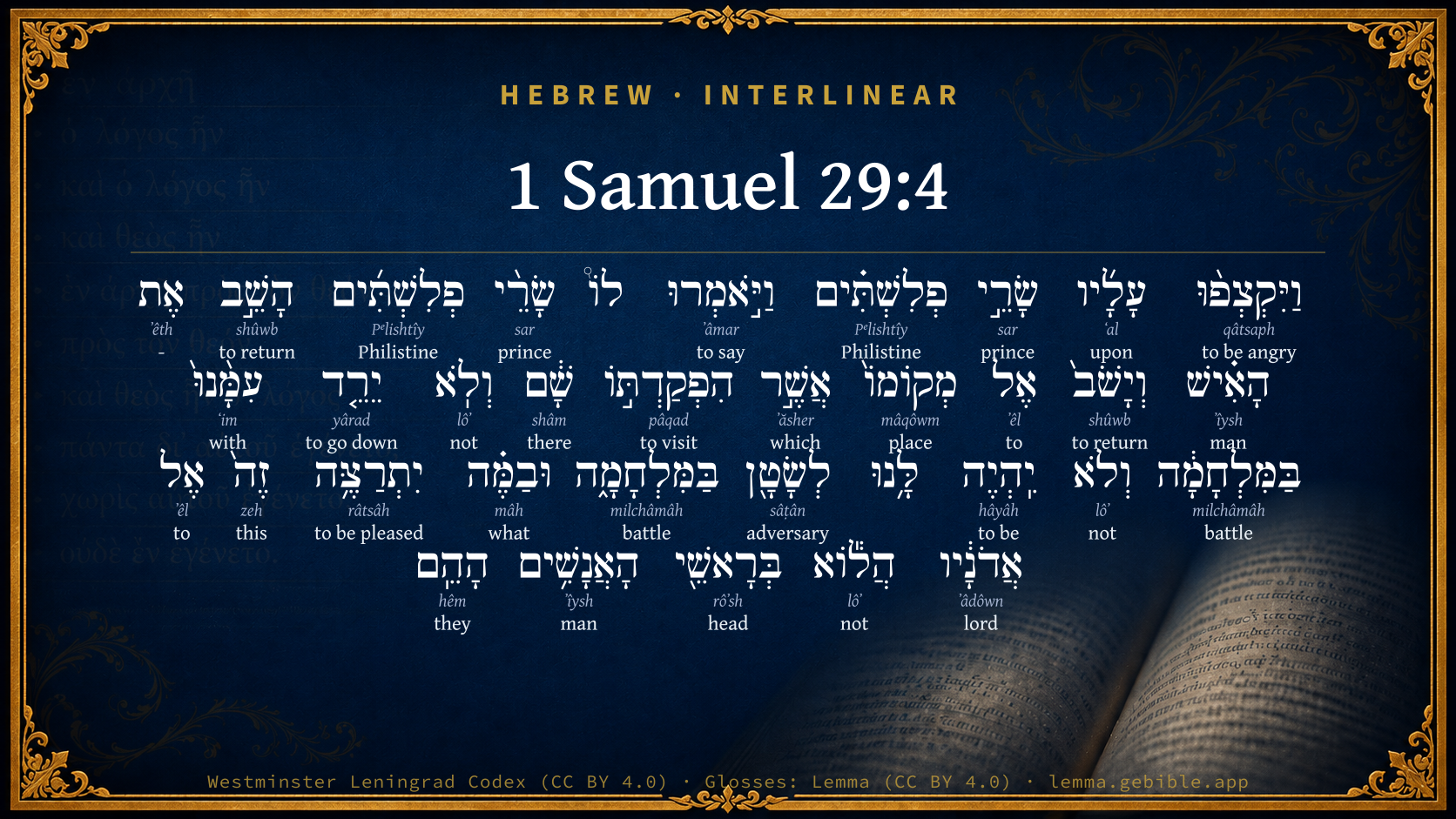
1 Samuel 29:4

Hebrew (Westminster Leningrad Codex) 1 Samuel 29:4 appears in the Hebrew Old Testament. The text above is from the Westminster Leningrad Codex. Each word links to its Strong’s number, a concise gloss, and parsing drawn from the Open Scriptures Hebrew Bible morphology. Click any word for its full Brown-Driver-Briggs (BDB) entry.
Download image
Cite this verse

1 Samuel 29:4 (World English Bible). Public Domain. Lemma interlinear Bible study tool, https://lemma.gebible.app/v/1-samuel/29/4.

Show BibTeX & RIS
BibTeX
RIS
English Translation
But the princes of the Philistines were angry with him; and the princes of the Philistines said to him, Make the man return, that he may go back to his place where you have appointed him, and let him not go down with us to battle, lest in the battle he become an adversary to us: for with what should this [fellow] reconcile himself to his lord? should it not be with the heads of these men?
World English Bible · Public Domain
Download a study sheet

One document with this verse’s original text, its word-by-word gloss line, the meaning frame, cross-references with their text, attributed commentary, and full source and license credits — printable, and it pastes into notes with its structure intact.

This verse Autodidact and up

Study sheet (.html) Plain text (.txt)

A passage Seminary Student

Up to 50 verses in one chapter. A passage sheet keeps up to 6 commentary sources and 12 cross-references per verse, in the order this page ranks them, and says so on the sheet whenever that leaves anything out. Ask for a single verse and you get the Autodidact verse sheet above.

Everything on this page stays free to read, with no account — the sheet is a download of what is already on screen, not access to it.

Want to remove ads? Support Godless Engineer
Compare translations 3

The same verse in 3 English versions, stacked beneath the original-language interlinear above. Click any original word for its lexicon entry.

Each is an independent rendering of the whole verse — the interlinear is not word-aligned to these translations.

Highlighted words mark where these versions differ — a whole-verse word diff, not a word-by-word alignment.

  • World English Bible Public Domain
    But the princes of the Philistines were angry with him; and the princes of the Philistines said to him, Make the man return, that he may go back to his place where you have appointed him, and let him not go down with us to battle, lest in the battle he become an adversary to us: for with what should this [fellow] reconcile himself to his lord? should it not be with the heads of these men?
  • King James Version Public Domain
    And the princes of the Philistines were wroth with him; and the princes of the Philistines said unto him, Make this fellow return, that he may go again to his place which thou hast appointed him, and let him not go down with us to battle, lest in the battle he be an adversary to us: for wherewith should he reconcile himself unto his master? should it not be with the heads of these men?
  • unfoldingWord Literal Text CC BY-SA 4.0
    But the lords of the Philistines were angry with him. And the lords of the Philistines said to him, “Make the man return, that he may return to his place that you assigned him there. For he shall not go down with us into the battle, so he does not become an adversary for us in the battle. For by what shall this make himself acceptable to his master? not by the heads of these men?

unfoldingWord Literal Text — © unfoldingWord, licensed CC BY-SA 4.0. Word-aligned USFM3 via Door43 (git.door43.org/unfoldingWord/en_ult).

Versions to compare (up to 4)

3 of 4 selected

Show all 18 translations

Every available English version of this verse, each an independent rendering of the whole verse.

  • World English Bible Public Domain
    But the princes of the Philistines were angry with him; and the princes of the Philistines said to him, Make the man return, that he may go back to his place where you have appointed him, and let him not go down with us to battle, lest in the battle he become an adversary to us: for with what should this [fellow] reconcile himself to his lord? should it not be with the heads of these men?
  • Berean Standard Bible Public Domain
    But the commanders of the Philistines were angry with Achish and told him, “Send that man back and let him return to the place you assigned him. He must not go down with us into battle only to become our adversary during the war. What better way for him to regain the favor of his master than with the heads of our men?
  • Majority Standard Bible Public Domain
    But the commanders of the Philistines were angry with Achish and told him, “Send that man back and let him return to the place you assigned him. He must not go down with us into battle only to become our adversary during the war. What better way for him to regain the favor of his master than with the heads of our men?
  • King James Version Public Domain
    And the princes of the Philistines were wroth with him; and the princes of the Philistines said unto him, Make this fellow return, that he may go again to his place which thou hast appointed him, and let him not go down with us to battle, lest in the battle he be an adversary to us: for wherewith should he reconcile himself unto his master? should it not be with the heads of these men?
  • American Standard Version (1901) Public Domain
    But he princes of the Philistines were wroth with him; and the princes of the Philistines said unto him, Make the man return, that he may go back to his place where thou hast appointed him, and let him not go down with us to battle, lest in the battle he become an adversary to us: for wherewith should this `fellow' reconcile himself unto his lord? should it not be with the heads of these men?
  • Revised Version (1885) Public Domain
    But the princes of the Philistines were wroth with him; and the princes of the Philistines said unto him, Make the man return, that he may go back to his place where thou hast appointed him, and let him not go down with us to battle, lest in the battle he become an adversary to us: for wherewith should this fellow reconcile himself unto his lord? should it not be with the heads of these men?
  • Geneva Bible (1599) Public Domain
    But the princes of the Philistims were wroth with him, and the princes of the Philistims said vnto him, Sende this fellow backe, that he may goe againe to his place which thou hast appointed him, and let him not goe downe with vs to battell, least that in the battell he be an aduersarie to vs: for wherewith should he obteine the fauour of his master? shoulde it not be with the heades of these men?
  • Douay-Rheims (1899) Public Domain
    But the princes of the Philistines were angry with him, and they said to him: Let this man return, and abide in his place, which thou hast appointed him, and let him not go down with us to battle, lest he be an adversary to us, when we shall begin to fight: for how can he otherwise appease his master, but with our heads?
  • Young's Literal Translation Public Domain
    And the heads of the Philistines are wroth against him, and the heads of the Philistines say to him, `Send back the man, and he doth turn back unto his place whither thou hast appointed him, and doth not go down with us into battle, and is not to us for an adversary in battle; and wherewith doth this one reconcile himself unto his lord -- is it not with the heads of those men?'
  • Literal Standard Version CC BY-SA 4.0
    And the heads of the Philistines are angry against him, and the heads of the Philistines say to him, “Send back the man, and he turns back to his place to where you have appointed him, and does not go down with us into battle, and is not for an adversary to us in battle; and with what does this one reconcile himself to his lord—is it not with the heads of those men?
  • Unlocked Literal Bible CC BY-SA 4.0
    But the princes of the Philistines were angry with him and said, “Send the man back, that he may return to the place you assigned him. He will not go down with us into battle, for he will turn against us during the fighting. For how else could he make himself acceptable to his master than by taking the heads of our own men?
  • unfoldingWord Literal Text CC BY-SA 4.0
    But the lords of the Philistines were angry with him. And the lords of the Philistines said to him, “Make the man return, that he may return to his place that you assigned him there. For he shall not go down with us into the battle, so he does not become an adversary for us in the battle. For by what shall this make himself acceptable to his master? not by the heads of these men?
  • Darby Bible Public Domain
    But the princes of the Philistines were wroth with him; and the princes of the Philistines said to him, Make the man return, that he may go again to his place where thou hast appointed him, that he go not down with us to the battle, that in the battle he be not an adversary to us; for wherewith should this [fellow] reconcile himself to his master? should it not be with the heads of these men?
  • World Messianic Bible Public Domain
    But the princes of the Philistines were angry with him; and the princes of the Philistines said to him, “Make the man return, that he may go back to his place where you have appointed him, and let him not go down with us to battle, lest in the battle he become an adversary to us. For with what should this fellow reconcile himself to his lord? Should it not be with the heads of these men?
  • Webster's Bible Public Domain
    And the princes of the Philistines were wroth with him; and the princes of the Philistines said to him, Make this man return, that he may go again to his place which thou hast appointed him, and let him not go down with us to battle, lest in the battle he should be an adversary to us: for with what would he reconcile himself to his master? would it not be with the heads of these men?
  • Free Bible Version CC BY-SA 4.0
    But the Philistine commanders got angry with Achish, and told him, “Send him back to the place he came from, to the town you assigned to him. He can't go with us into battle. What if he turns on us during the fighting? What a great way for him to please his master—by handing over the heads of our men!
  • Bible in Basic English Public Domain
    But the rulers of the Philistines were angry with him, and said to him, Make the man go back to the place you have given him; do not let him go down with us to the fight, or he may be turned against us and be false to us: for how will this man make peace with his lord? will it not be with the heads of these men?
  • JPS Tanakh (1917) Public Domain
    But the princes of the Philistines were wroth with him; and the princes of the Philistines said unto him: 'Make the man return, that he may go back to his place where thou hast appointed him, and let him not go down with us to battle, lest in the battle he become an adversary to us; for wherewith should this fellow reconcile himself unto his lord? should it not be with the heads of these men?

Literal Standard Version (2020), Covenant Press — licensed CC BY-SA 4.0. Text via the HelloAO Bible API (eBible.org). Unlocked Literal Bible (unfoldingWord) — licensed CC BY-SA 4.0. Text via the HelloAO Bible API (eBible.org). unfoldingWord Literal Text — © unfoldingWord, licensed CC BY-SA 4.0. Word-aligned USFM3 via Door43 (git.door43.org/unfoldingWord/en_ult). Free Bible Version, Dr. Jonathan Gallagher — licensed CC BY-SA 4.0. Text via the HelloAO Bible API (eBible.org).

Word by word

More ways to search: Search by grammar → Find every occurrence → Compare this word →

Practice this passage: Drill this verse → Learn its vocabulary →

לְשָׂטָ֖ן
sâṭân
H7854
“to/for · adversary”
Preposition + Noun, Common, Masculine, Singular, Absolute
Part of Speech
Preposition + Noun
Type
Common
Gender
Masculine
Number
Singular
State
Absolute
Full BDB Definition

Origin: from H7853

TWOT: 2252a

adversary, one who withstands - adversary (in general - personal or national) - superhuman adversary - Satan (as noun proper)
  1. וַיִּקְצְפ֨וּ qâtsaph H7107 “and · to be angry” Conjunction + Verb, Qal, Sequential Imperfect, 3rd Person, Masculine, Plural
  2. עָלָ֜יו ʻal H5921 “upon · him” Preposition + Suffix, Personal, 3rd Person, Masculine, Singular
  3. שָׂרֵ֣י sar H8269 “princes of” Noun, Common, Masculine, Plural, Construct
  4. פְלִשְׁתִּ֗ים Pᵉlishtîy H6430 “Philistines” Noun, Gentilic, Masculine, Plural, Absolute
  5. וַיֹּ֣אמְרוּ ʼâmar H559 “and · to say” Conjunction + Verb, Qal, Sequential Imperfect, 3rd Person, Masculine, Plural
  6. שָׂרֵ֨י sar H8269 “princes of” Noun, Common, Masculine, Plural, Construct
  7. פְלִשְׁתִּ֜ים Pᵉlishtîy H6430 “Philistines” Noun, Gentilic, Masculine, Plural, Absolute
  8. הָשֵׁ֣ב shûwb H7725 “return” Verb, Hiphil, Imperative, 2nd Person, Masculine, Singular
  9. אֶת ʼêth H853 “-” Particle, Direct Object
  10. הָאִ֗ישׁ ʼîysh H376 “the · man” Particle, Definite Article + Noun, Common, Masculine, Singular, Absolute
  11. וְיָשֹׁב֙ shûwb H7725 “and · to return” Conjunction + Verb, Qal, Jussive, 3rd Person, Masculine, Singular
  12. אֶל ʼêl H413 “to” Preposition
  13. מְקוֹמוֹ֙ mâqôwm H4725 “place · his” Noun, Common, Masculine, Singular, Construct + Suffix, Personal, 3rd Person, Masculine, Singular
  14. אֲשֶׁ֣ר ʼăsher H834 “which” Particle, Relative
  15. הִפְקַדְתּ֣וֹ pâqad H6485 “to visit · him” Verb, Hiphil, Perfect, 2nd Person, Masculine, Singular + Suffix, Personal, 3rd Person, Masculine, Singular
  16. שָׁ֔ם shâm H8033 “there” Adverb
  17. וְלֹֽא lôʼ H3808 “and · not” Conjunction + Particle, Negative
  18. יֵרֵ֤ד yârad H3381 “to go down” Verb, Qal, Imperfect, 3rd Person, Masculine, Singular
  19. עִמָּ֨נוּ֙ ʻim H5973 “with · us” Preposition + Suffix, Personal, 1st Person, Common, Plural
  20. בַּמִּלְחָמָ֔ה milchâmâh H4421 “in/at the · battle” Preposition, Determined + Noun, Common, Feminine, Singular, Absolute
  21. וְלֹא lôʼ H3808 “and · not” Conjunction + Particle, Negative
  22. יִֽהְיֶה hâyâh H1961 “to be” Verb, Qal, Imperfect, 3rd Person, Masculine, Singular
  23. בַּמִּלְחָמָ֑ה milchâmâh H4421 “in/at the · battle” Preposition, Determined + Noun, Common, Feminine, Singular, Absolute
  24. וּבַמֶּ֗ה mâh H4100 “and · in/at · what” Conjunction + Preposition + Particle, Interrogative
  25. יִתְרַצֶּ֥ה râtsâh H7521 “to be pleased” Verb, Hithpael, Imperfect, 3rd Person, Masculine, Singular
  26. זֶה֙ zeh H2088 “this” Pronoun, Demonstrative, Masculine, Singular
  27. אֶל ʼêl H413 “to” Preposition
  28. אֲדֹנָ֔יו ʼâdôwn H113 “lords · his” Noun, Common, Masculine, Plural, Construct + Suffix, Personal, 3rd Person, Masculine, Singular
  29. הֲל֕וֹא lôʼ H3808 “not” Particle, Interrogative + Particle, Negative
  30. בְּרָאשֵׁ֖י rôʼsh H7218 “in/at · heads of” Preposition + Noun, Common, Masculine, Plural, Construct
  31. הָאֲנָשִׁ֥ים ʼîysh H376 “the · men” Particle, Definite Article + Noun, Common, Masculine, Plural, Absolute
  32. הָהֵֽם hêm H1992 “the · they” Particle, Definite Article + Pronoun, Personal, 3rd Person, Masculine, Plural

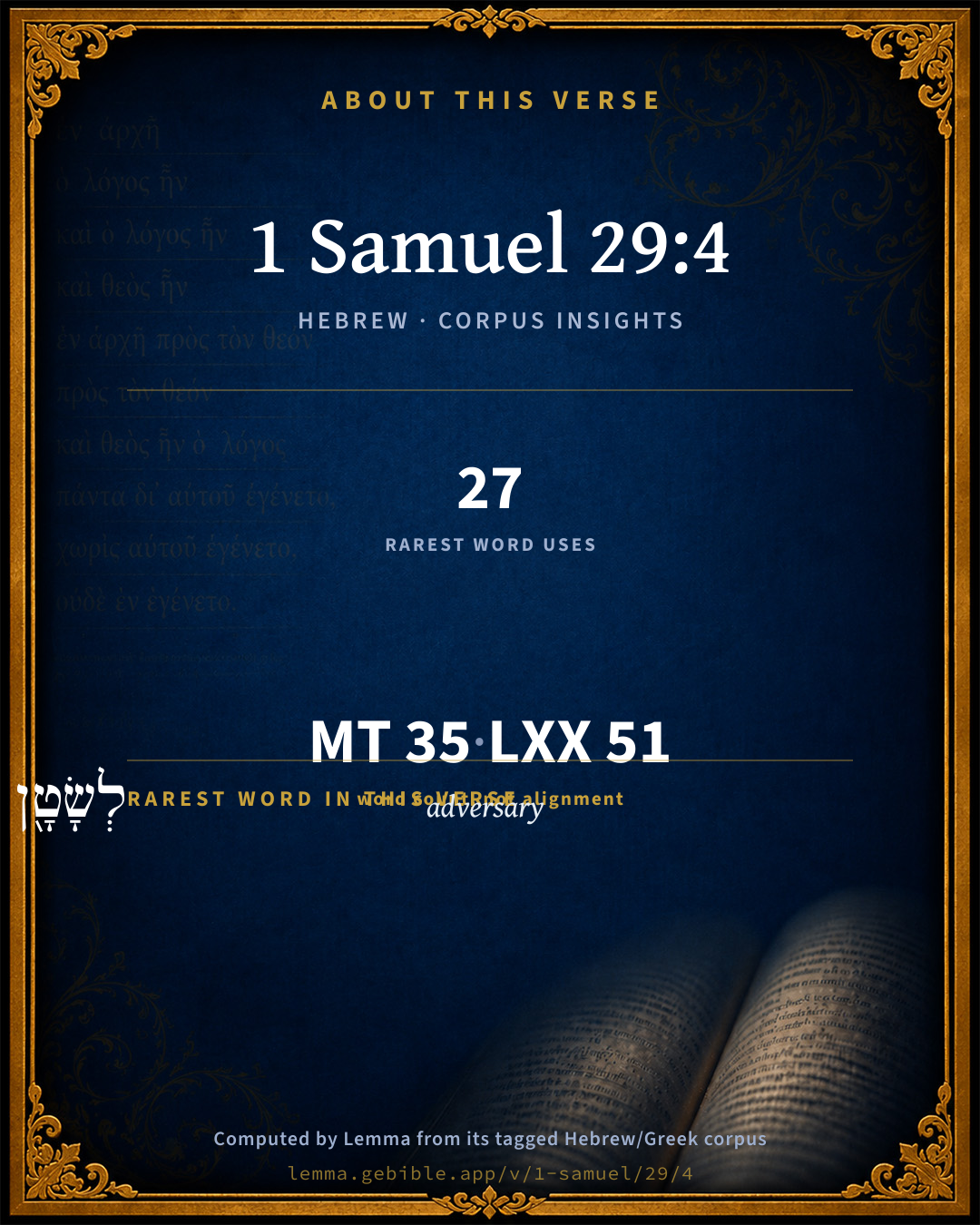
About this verse

These counts appear in no published source. They are computed here, from the morphology-tagged text and Lemma’s own curated glosses. What Lemma adds →

35
words
25
distinct lemmas
Historical
section

Shared distinctive vocabulary

לְשָׂטָ֖ן adversary H7854 occurs in 23 verses of the Hebrew Bible. Also found in:

Grammatical profile

  • 8 verbs
  • 12 nouns
  • 2 pronouns
  • 6 prepositions
  • 1 adverb
  • 6 particles

Verb forms

  • וַיִּקְצְפ֨וּ Qal · Sequential Imperfect
  • וַיֹּ֣אמְרוּ Qal · Sequential Imperfect
  • הָשֵׁ֣ב Hiphil · Imperative
  • וְיָשֹׁב֙ Qal · Jussive
  • הִפְקַדְתּ֣וֹ Hiphil · Perfect
  • יֵרֵ֤ד Qal · Imperfect
  • יִֽהְיֶה Qal · Imperfect
  • יִתְרַצֶּ֥ה Hithpael · Imperfect

Repetition

Words recur within this verse — often emphatic in Hebrew:

  • שָׂרֵ֣י prince H8269 ×2
  • פְלִשְׁתִּ֗ים Philistine H6430 ×2
  • הָשֵׁ֣ב to return H7725 ×2
  • הָאִ֗ישׁ man H376 ×2
  • בַּמִּלְחָמָ֔ה battle H4421 ×2
  • וְלֹֽא not H3808 ×3
  • אֶל to H413 ×2

Hebrew & Septuagint length

In English translation the verse runs 77 words from the Hebrew and 70 from the Septuagint (LXX English) — closely comparable.

A rough comparison of the two English renderings, which tokenize alike — not a word-level alignment.

Word counts can differ between the Hebrew and the Greek without any difference in meaning — e.g. the Hebrew direct-object marker אֵת has no separate Greek word, and Greek often adds the article ὁ.

In the original languages it is 35 Hebrew tokens and 51 Greek tokens — but the two are counted differently (Hebrew bundles its prefixes and suffixes into one token; the Greek is in lemma form), so that isn’t a like-for-like length.

Cross-references

4

Topical passages linked to 1 Samuel 29:4 in the Treasury of Scripture Knowledge — connected by theme and wording, ordered by reader-vote popularity; previews shown in the World English Bible.

  • 1 Samuel 14:21 Now the Hebrews who were with the Philistines as before, and who went up with them into the camp, [from the country] round about, even they also [turned] to be with the Israelites who were with Saul and Jonathan.
  • 1 Samuel 27:6 Then Achish gave him Ziklag that day: why Ziklag pertains to the kings of Judah to this day.
  • 1 Chronicles 12:19 Of Manasseh also there fell away some to David, when he came with the Philistines against Saul to battle: but they didn't help them; for the lords of the Philistines sent him away after consultation, saying, He will fall away to his master Saul to the jeopardy of our heads.
  • Luke 16:8 "His lord commended the dishonest manager because he had done wisely, for the children of this world are, in their own generation, wiser than the children of the light.

Cross-references courtesy of OpenBible.info (CC BY 4.0).

Hebrew and Greek witnesses Masoretic Hebrew ↔ Greek Septuagint

The same verse in the two great witnesses to the Old Testament, shown verse-for-verse.

These are two independent witnesses, not word-aligned to each other, and the Septuagint is shown in lemma (dictionary) form.

Hebrew 1 Samuel 29:4 Masoretic · Westminster Leningrad Codex

וַיִּקְצְפ֨וּ עָלָ֜יו שָׂרֵ֣י פְלִשְׁתִּ֗ים וַיֹּ֣אמְרוּ לוֹ֩ שָׂרֵ֨י פְלִשְׁתִּ֜ים הָשֵׁ֣ב אֶת הָאִ֗ישׁ וְיָשֹׁב֙ אֶל מְקוֹמוֹ֙ אֲשֶׁ֣ר הִפְקַדְתּ֣וֹ שָׁ֔ם וְלֹֽא יֵרֵ֤ד עִמָּ֨נוּ֙ בַּמִּלְחָמָ֔ה וְלֹא יִֽהְיֶה לָּ֥נוּ לְשָׂטָ֖ן בַּמִּלְחָמָ֑ה וּבַמֶּ֗ה יִתְרַצֶּ֥ה זֶה֙ אֶל אֲדֹנָ֔יו הֲל֕וֹא בְּרָאשֵׁ֖י הָאֲנָשִׁ֥ים הָהֵֽם

But the princes of the Philistines were angry with him; and the princes of the Philistines said to him, Make the man return, that he may go back to his place where you have appointed him, and let him not go down with us to battle, lest in the battle he become an adversary to us: for with what should this [fellow] reconcile himself to his lord? should it not be with the heads of these men?

World English Bible · Public Domain

Greek LXX 1 Samuel 29:4 Septuagint · lemma form

καί λυπέω ἐπί αὐτός ὁ στρατηγός ὁ ἀλλόφυλος καί λέγω αὐτός ἀποστρέφω ὁ ἀνήρ εἰς ὁ τόπος αὐτός οὗ καταἵστημι αὐτός ἐκεῖ καί μή ἔρχομαι μετά ἐγώ εἰς ὁ πόλεμος καί μή γίγνομαι ἐπίβουλος ὁ παρεμβολή καί ἐν τίς διαἀλλάσσω οὗτος ὁ κύριος αὐτός οὐ ἐν ὁ κεφαλή ὁ ἀνήρ ἐκεῖνος

And the captains of the Philistines were displeased at him, and they say to him, Send the man away, and let him return to his place, where you did set him; and let him not come with us to the war, and let him not be a traitor in the camp: and wherewith will he be reconciled to his master? Will it not be with the heads of those men?

LXX2012 (modern English Septuagint) · Public Domain

Hebrew: Westminster Leningrad Codex (CC BY 4.0). Greek: Septuagint (public domain); English from LXX2012 (modern English Septuagint) (Public Domain). How the Septuagint differs from the Hebrew →

Targum (Aramaic paraphrase)

1

The Targum is the ancient Jewish Aramaic paraphrase of the Hebrew Scriptures — an interpretive translation, not the Hebrew text itself. Onkelos (literal) and Pseudo-Jonathan (expansive) render the Torah, and Jonathan the Prophets. Coverage is partial: where no permissively-licensed English translation exists for a verse, only the Aramaic is shown. This is verse-level text, not a word-by-word alignment to the Hebrew.

  1. Targum Jonathan Prophets (Joshua–Malachi)
    וּרְגִיזוּ עֲלוֹהִי רַבְרְבֵי פְלִשְׁתָּאֵי וַאֲמַרוּ לֵיהּ רַבְרְבֵי פְלִשְׁתָּאֵי אָתֵיב יַת גַבְרָא וִיתוּב לְאַתְרֵיהּ דְמַנִיתֵיהּ תַּמָן וְלָא יֵחוֹת עִמָנָא בִּקְרָבָא וְלָא יְהֵי לְשָׂטָן בִּקְרָבָא וּבַמֶה יִתְרְעֵי דֵין לְוַת רִבּוֹנֵיהּ הֲלֹא בְּרֵישֵׁי גַבְרַיָא הָאִינוּן:

    (no public-domain English translation for this verse)

    Targum Jonathan — Aramaic: “Mikraot Gedolot” (public domain). English: “Sefaria Community Translation” (CC0 1.0 (public-domain dedication)); “London "Chaldee Paraphrase," 1871” (public domain). Text via Sefaria.

Commentary

Notes on 1 Samuel 29:4 from classic Christian and Jewish commentators (each source and its license shown beneath its notes). The classic Christian expositions comment on the surrounding passage and are grouped to its opening verse, so a note may address several verses; the Jewish commentaries on the Tanakh (Rashi and others) are per-verse, so they appear only where the commentator wrote on this verse.

Lemma curates 59 commentaries, every one of them public domain or Creative Commons licensed, each selected and text-cleaned for this edition rather than reprinted as found. About our sources →

Trapp's Complete Commentary

John Trapp

1Sa 29:4 And the princes of the Philistines were wroth with him; and the princes of the Philistines said unto him, Make this fellow return, that he may go again to his place which thou hast appointed him, and let him not go down with us to battle, lest in the battle he be an adversary to us: for wherewith should he reconcile himself unto his master? [should it] not [be] with the heads of these men?

Ver. 4. And the princes of the Philistines were wroth.] Therefore it appeareth they were his fellow princes, of the four other Satrapies, since they thus roughly ruffle with him: as also did Achilles in Homer with Agamemnon, -

“οινοβαρες, κυνος ομματ εχων, κραδιην δ ελαφοιο”

- Iliad., lib. i.

Make this fellow return.] A happy word for David, who was now in a great perplexity and peril, either of betraying his trust or fighting against his own people: neither of which he could have done with a good conscience. Here, therefore, God cut asunder this gordian knot, which David knew not how to untie. It would be ill with us sometimes, were it not for God’s good providence, and others’ malice.

Lest in the battle he be an adversary to us.] As some others have been. {1Sa 14:21} He is but a reconciled enemy at best: and Reconciliationes sunt vulpinae amicitiae: he is not to be trusted. This was military prudence in these princes, though Achish had endeavoured to justify David against their jealousies.

John Trapp, A Commentary or Exposition upon All the Books of the Old and New Testament (1647–1656) — public domain. Text from a community e-Sword module.

Joseph Benson's Commentary

1Sa 29:4. Make this fellow return to his place — To Ziklag, which they were content he should possess. For wherewith should he reconcile, &c. Should it not be with the heads of these men? — That is, of the Philistines. They reasoned wisely, according to the common maxims of prudence and true policy; for by such a course great enemies have sometimes been reconciled together. But the Divine Providence was no doubt concerned in suggesting these prudential considerations to their minds; for by this means David was delivered from that great strait and difficulty into which he had brought himself, and from which no human wisdom could have extricated him; either of being an enemy to, and fighting against his country, (as before observed,) or being false to his friend and to his trust. And, by the same providential incident, he was sent back time enough to recover his wives, and the wives and children of his men, and his all, from the Amalekites, which would have been irrecoverably lost if he had gone to this battle. And the kindness of God to David was the greater, because it would have been most just for God to have left him in those distresses into which his own sinful counsel had brought him.

Joseph Benson's Commentary on the Old and New Testaments (1811–1818) — public domain. Text from a community e-Sword module.

Tyndale Open Study Notes

Tyndale Open Resources

29:4 handing our heads over: The commanders’ fears were justified (cp. 17:51; 18:27).

Tyndale Open Study Notes — © Tyndale Open Resources, licensed CC BY-SA 4.0. Text via the HelloAO Bible API.

Geneva Bible (1599)

Geneva Bible translators

Would not Saul receive him to favor, if he would betray us?

Geneva Bible (1599) marginal notes — public domain. Text via Bolls.life.

Jamieson, Fausset & Brown

Robert Jamieson, A. R. Fausset & David Brown

the princes of the Philistines were wroth with him--It must be considered a happy circumstance in the overruling providence of God to rescue David out of the dangerous dilemma in which he was now placed. But David is not free from censure in his professions to Achish (Sa1 29:8), to do what he probably had not the smallest purpose of doing--of fighting with Achish against his enemies. It is just an instance of the unhappy consequences into which a false step--a departure from the straight course of duty--will betray everyone who commits it.

Jamieson, Fausset & Brown — Commentary Critical and Explanatory on the Whole Bible (1871) — public domain (CC PDM 1.0). Text via the HelloAO Bible API.

Adam Clarke's Commentary

Verse 4. The princes of the Philistines were wroth] It is strange that they had not yet heard of David's destruction of a village of the Geshurites, Gezrites, and Amalekites, 1Sa 27:8-9. Had they heard of this, they would have seen much more cause for suspicion.

Adam Clarke's Commentary on the Bible (1810–1826) — public domain. Text from a community e-Sword/MySword module.

Ellicott's Commentary for English Readers

(4) Go down.—This is a technical military expression, used constantly, on account of the necessity of the troops descending from the hill country in which they were encamped to the plain in order to fight.

A Bible Commentary for English Readers, edited by Charles John Ellicott (1878–1897) — public domain. Text from a community e-Sword module.

The Cambridge Bible for Schools and Colleges

gen. ed. J. J. S. Perowne

4. this fellow] Simply, “the man:” but below, “wherewith should this fellow make himself acceptable unto his master? should it not be with the heads of those men?” Pointing to the troops marching past.

The Cambridge Bible for Schools and Colleges (gen. ed. J. J. S. Perowne; Cambridge University Press, 1878–1918) — public domain. Text from a community e-Sword module.

John Gill's Exposition

And the princes of the Philistines were wroth with him,.... With Achish, for giving such a character of David, and taking his part, in order to detain him, if possible:

and the princes of the Philistines said unto him, make this fellow return; they speak of him with contempt, and insist on it that Achish order him to turn back, and go no further with them:

that he may go again to his place which thou hast appointed him; to Ziklag, the place that Achish had given him for his residence, Sa1 27:6; they did not desire to have him sent to his own country, and to Saul, since should a reconciliation be made between them, he would be of great service to Saul against them:

and let him not go down with us to battle; into the valley of Jezreel, where the Israelites had pitched:

lest in the battle he be an adversary to us: and fall upon them behind, being in the rear, while they were engaging in the front with Israel:

for wherewith should he reconcile himself unto his master? to Saul he had offended, and fled from:

should it not be with the heads of these men? the Philistines; or unless by the heads of these men (m); he had no other way of making his peace with his master but by cutting off the heads of the Philistines; and therefore he was a dangerous man to take with them into the battle.

(m) "nisi per capita", Noldius, p. 257. No. 1147.

John Gill's Exposition of the Whole Bible (1746–1763) — public domain (CC PDM 1.0). Text via the HelloAO Bible API.

Haydock's Catholic Bible Commentary

Adversary. Hebrew Satan, "a calumniator, enemy," &c. (Calmet) --- Tacitus (Hist. iv.) speaking of the Batavian corps, says, "which, being bribed, pretended to be faithful, that it might flee, and become more acceptable after it had betrayed the Romans in the heat of the engagement."

George Leo Haydock (1774–1849), Haydock's Catholic Family Bible and Commentary, 1859 edition — public domain. Excludes Psalms (Douay-Rheims chapter numbering differs from Protestant) and Deuterocanonical books (Catholic canon only).

Matthew Poole's English Annotations

Were wroth with him; were unsatisfied and offended with Achish for this intention and declaration.

Make this fellow return: herein the wise and gracious providence of God appeared, both in helping him out of those snares and difficulties, out of which no human wit could have extricated him, but he must either have been, or have been thought, to be a traitor, and an ungrateful, unworthy person either to the one or to the other side; and moreover in giving him the happy opportunity of recovering his own and his all from the Amalekites, which had been irrecoverably lost if he had gone into this battle. And the kindness of God to David was the greater, because it had been most just for God to have left David in all those distresses into which his own sinful counsel and course had brought him.

Of these men, i.e. of these our soldiers: they speak according to the rules of reason and true policy, for by this very course great enemies have sometimes been reconciled together.

Matthew Poole's English Annotations on the Holy Bible (1683–1685) — public domain. Text from a community e-Sword/MySword module.

Whedon's Commentary on the Bible

Daniel D. Whedon

4. With the heads of these men — When the princes uttered these words they meant, and probably pointed towards, the Philistine soldiers that stood around them.

Daniel D. Whedon (gen. ed.), Commentary on the Old and New Testaments (1874–1909) — public domain. Text from a community e-Sword module.

The Pulpit Commentary

Vers. 4-6. Angrily rejecting the testimony of Achish in David"s favour, they say, Make this fellow (Hebrew, "the man") return, that he may go again to his place, i.e. to Ziklag. He shall not go down with us to battle. Though the Philistines marched up into the Israelite territory, yet they speak naturally of going down into battle, because while armies usually encamped on opposite ranges of hills, they descended into the plain between for the encounter. An adversary. Hebrew, "a satan," without the article, and so in 1Ch_21:1. As a proper name it has the article, as in the books of Job and Zechariah. Should he reconcile himself. The verb means, "to make himself pleasing," "to commend himself." The heads of these men, pointing to the Philistine ranks. David of whom they sang, etc. The song of the Jewish maidens seems to have been as well known in Philistia as in the land of Israel On the former occasion it had made the Philistines drive him away from the court of Achish; (1Sa_21:11-15) here, too, it made them drive him from their army, but he was thereby saved from the painful necessity of making war on his own country, and returned just in time to rescue his wives and property.

The Pulpit Commentary (1880–1919), ed. H.D.M. Spence-Jones & Joseph S. Exell — public domain. Text from a community e-Sword module.

John Wesley's Explanatory Notes

Make this fellow - Herein the wise and gracious providence of God appeared, both in helping him out of these difficulties, out of which no human wit could have extricated him, but he must have been, an ungrateful person either to the one or the other side, and moreover in giving him the happy opportunity of recovering his own, and his all from the Amalekites, which had been irrecoverably lost, if he had gone into this battle. And the kindness of God to David was the greater, because it had been most just for God to have left David in those distresses into which his own sinful counsel had brought him. These men - That is, of these our soldiers, they speak according to the rules of true policy; for by this very course, great enemies have sometimes been reconciled together.

John Wesley, Explanatory Notes Upon the Whole Bible (1754–1765) — public domain. Text via the GEBible commentary corpus.

Scofield Reference Notes

C. I. Scofield

reconcile Or, make himself pleasing. (See Scofield "Dan 9:24").

The Scofield Reference Bible (1917 edition), notes by C. I. Scofield — public domain. Text from a community e-Sword module.

unfoldingWord translationNotes

Door43 World Missions Community

He will not go down with us into battle

The person here is a synecdoche for the army he commands. AT: "Do not let his army join with our army against our enemies"

For how else could he make himself acceptable to his master than by taking the heads of our own men?

This rhetorical question can be translated as a statement. Here "taking the heads" is a metonym for killing. AT: "The best way for David to make peace with his master would be by killing our soldiers!"

translationWords

prince

Philistines

anger

adversary

peace

lord

head

unfoldingWord translationNotes — © Distant Shores Media and the Door43 World Missions Community, licensed CC BY-SA 4.0. Source: git.door43.org/Door43/en_tn.

Lesson kit

Teaching starters — assembled from the data on this page, not authored interpretation. Every prompt links to the verse data it draws on. Edit before teaching.

1 Samuel, in the Historical, opens this verse with 35 words (25 distinct Hebrew lemmas). Its most distinctive word is sâṭân (“adversary”). A historical commentator’s framing appears above. Read the whole chapter for the surrounding context.

Discussion questions

  1. How does “adversary” (sâṭân) shape what this verse is saying?
  2. How does Numbers 22:22, which shares the word «adversary», read alongside this verse?
  3. What does the repetition of “prince” (2× in this one verse) do in this verse?
  4. These translations render this verse differently. What is at stake in choosing one wording over another?
  5. «וַיִּקְצְפ֨וּ» is a Qal Sequential Imperfect verb. How does that grammatical form shape the action described?
  6. Compare how Trapp's Complete Commentary and Joseph Benson's Commentary read this verse. Where do they agree or differ?

Things to notice

Reading settings

Reading text

Shown beneath each verse's original-language words.

Old Testament
Old Testament edition

Read the OT as the Masoretic Hebrew (MT) or the Greek Septuagint (LXX).

English shown for the Greek Septuagint (in the Hebrew ↔ Greek comparison).

Comparing translations? Open the Compare panel on any verse page to stack up to four side by side.