Judges 20:27

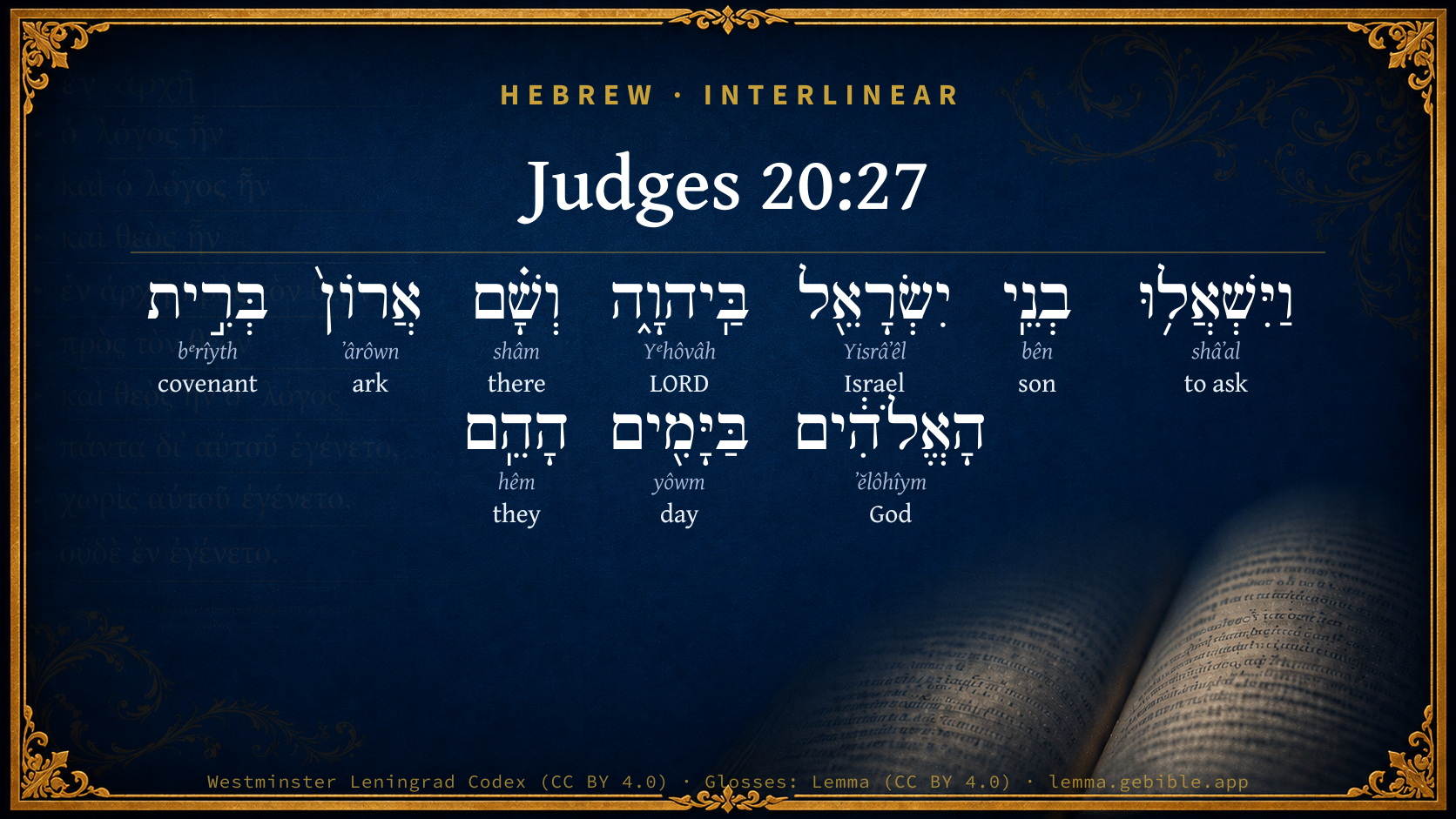
Hebrew (Westminster Leningrad Codex) Judges 20:27 appears in the Hebrew Old Testament. The text above is from the Westminster Leningrad Codex. Each word links to its Strong’s number, a concise gloss, and parsing drawn from the Open Scriptures Hebrew Bible morphology. Click any word for its full Brown-Driver-Briggs (BDB) entry.
Download image
Cite this verse

Judges 20:27 (World English Bible). Public Domain. Lemma interlinear Bible study tool, https://lemma.gebible.app/v/judges/20/27.

Show BibTeX & RIS
BibTeX
RIS
English Translation
The children of Israel asked of Yahweh (for the ark of the covenant of God was there in those days,
World English Bible · Public Domain
Download a study sheet

One document with this verse’s original text, its word-by-word gloss line, the meaning frame, cross-references with their text, attributed commentary, and full source and license credits — printable, and it pastes into notes with its structure intact.

This verse Autodidact and up

Study sheet (.html) Plain text (.txt)

A passage Seminary Student

Up to 50 verses in one chapter. A passage sheet keeps up to 6 commentary sources and 12 cross-references per verse, in the order this page ranks them, and says so on the sheet whenever that leaves anything out. Ask for a single verse and you get the Autodidact verse sheet above.

Everything on this page stays free to read, with no account — the sheet is a download of what is already on screen, not access to it.

Want to remove ads? Support Godless Engineer
Compare translations 3

The same verse in 3 English versions, stacked beneath the original-language interlinear above. Click any original word for its lexicon entry.

Each is an independent rendering of the whole verse — the interlinear is not word-aligned to these translations.

Highlighted words mark where these versions differ — a whole-verse word diff, not a word-by-word alignment.

  • World English Bible Public Domain
    The children of Israel asked of Yahweh (for the ark of the covenant of God was there in those days,
  • King James Version Public Domain
    And the children of Israel inquired of the LORD, (for the ark of the covenant of God was there in those days,
  • unfoldingWord Literal Text CC BY-SA 4.0
    Then the sons of Israel inquired of Yahweh, for the Box of the Covenant of God there in those days

unfoldingWord Literal Text — © unfoldingWord, licensed CC BY-SA 4.0. Word-aligned USFM3 via Door43 (git.door43.org/unfoldingWord/en_ult).

Versions to compare (up to 4)

3 of 4 selected

Show all 18 translations

Every available English version of this verse, each an independent rendering of the whole verse.

  • World English Bible Public Domain
    The children of Israel asked of Yahweh (for the ark of the covenant of God was there in those days,
  • Berean Standard Bible Public Domain
    And the Israelites inquired of the LORD. (In those days the ark of the covenant of God was there,
  • Majority Standard Bible Public Domain
    And the Israelites inquired of the LORD. (In those days the ark of the covenant of God was there,
  • King James Version Public Domain
    And the children of Israel inquired of the LORD, (for the ark of the covenant of God was there in those days,
  • American Standard Version (1901) Public Domain
    And the children of Israel asked of Jehovah (for the ark of the covenant of God was there in those days,
  • Revised Version (1885) Public Domain
    And the children of Israel asked of the LORD, (for the ark of the covenant of God was there in those days,
  • Geneva Bible (1599) Public Domain
    And the children of Israel asked the Lord (for there was the Arke of the couenat of God in those dayes,
  • Douay-Rheims (1899) Public Domain
    And inquired of him concerning their state. At that time the ark of the covenant of the Lord was there,
  • Young's Literal Translation Public Domain
    And the sons of Israel ask of Jehovah, -- and there `is' the ark of the covenant of God in those days,
  • Literal Standard Version CC BY-SA 4.0
    And the sons of Israel ask of YHWH—and the Ark of the Covenant of God [is] there in those days,
  • Unlocked Literal Bible CC BY-SA 4.0
    The people of Israel asked Yahweh—for the ark of the covenant of God was there in those days,
  • unfoldingWord Literal Text CC BY-SA 4.0
    Then the sons of Israel inquired of Yahweh, for the Box of the Covenant of God there in those days
  • Darby Bible Public Domain
    And the people of Israel inquired of the LORD (for the ark of the covenant of God was there in those days,
  • World Messianic Bible Public Domain
    The children of Israel asked the LORD (for the ark of the covenant of God was there in those days,
  • Webster's Bible Public Domain
    And the children of Israel inquired of the LORD, (for the ark of the covenant of God was there in those days,
  • Free Bible Version CC BY-SA 4.0
    The Israelites asked the Lord what to do. At that time the Ark of God's Agreement was kept there.
  • Bible in Basic English Public Domain
    And the children of Israel made request to the Lord, (for the ark of the agreement of the Lord was there in those days,
  • JPS Tanakh (1917) Public Domain
    And the children of Israel asked of the LORD — for the ark of the covenant of God was there in those days,

Literal Standard Version (2020), Covenant Press — licensed CC BY-SA 4.0. Text via the HelloAO Bible API (eBible.org). Unlocked Literal Bible (unfoldingWord) — licensed CC BY-SA 4.0. Text via the HelloAO Bible API (eBible.org). unfoldingWord Literal Text — © unfoldingWord, licensed CC BY-SA 4.0. Word-aligned USFM3 via Door43 (git.door43.org/unfoldingWord/en_ult). Free Bible Version, Dr. Jonathan Gallagher — licensed CC BY-SA 4.0. Text via the HelloAO Bible API (eBible.org).

Word by word

More ways to search: Search by grammar → Find every occurrence → Compare this word →

Practice this passage: Drill this verse → Learn its vocabulary →

וַיִּשְׁאֲל֥וּ
shâʼal
H7592
“and · to ask”
Conjunction + Verb, Qal, Sequential Imperfect, 3rd Person, Masculine, Plural
Part of Speech
Conjunction + Verb
Stem
Qal
Form
Sequential Imperfect
Person
3rd Person
Gender
Masculine
Number
Plural
Full BDB Definition

Origin: a primitive root

TWOT: 2303

to ask, enquire, borrow, beg - (Qal) - to ask, ask for - to ask (as a favour), borrow - to enquire, enquire of - to enquire of, consult (of deity, oracle) - to seek - (Niphal) to ask for oneself, ask leave of absence - (Piel) - to enquire, enquire carefully - to beg, practise beggary - (Hiphil) - to be given on request - to grant, make over to, let (one) ask (successfully) or give or lend on request (then) grant or make over to
  1. בְנֵֽי bên H1121 “sons of” Noun, Common, Masculine, Plural, Construct
  2. יִשְׂרָאֵ֖ל Yisrâʼêl H3478 “Israel” Noun, Proper
  3. בַּֽיהוָ֑ה Yᵉhôvâh H3068 “in/at · LORD” Preposition + Noun, Proper
  4. וְשָׁ֗ם shâm H8033 “and · there” Conjunction + Adverb
  5. אֲרוֹן֙ ʼârôwn H727 “ark of” Noun, Common, Both, Singular, Construct
  6. בְּרִ֣ית bᵉrîyth H1285 “covenant of” Noun, Common, Feminine, Singular, Construct
  7. הָאֱלֹהִ֔ים ʼĕlôhîym H430 “the · God(s)” Particle, Definite Article + Noun, Common, Masculine, Plural, Absolute
  8. בַּיָּמִ֖ים yôwm H3117 “in/at the · days” Preposition, Determined + Noun, Common, Masculine, Plural, Absolute
  9. הָהֵֽם hêm H1992 “the · they” Particle, Definite Article + Pronoun, Personal, 3rd Person, Masculine, Plural

About this verse

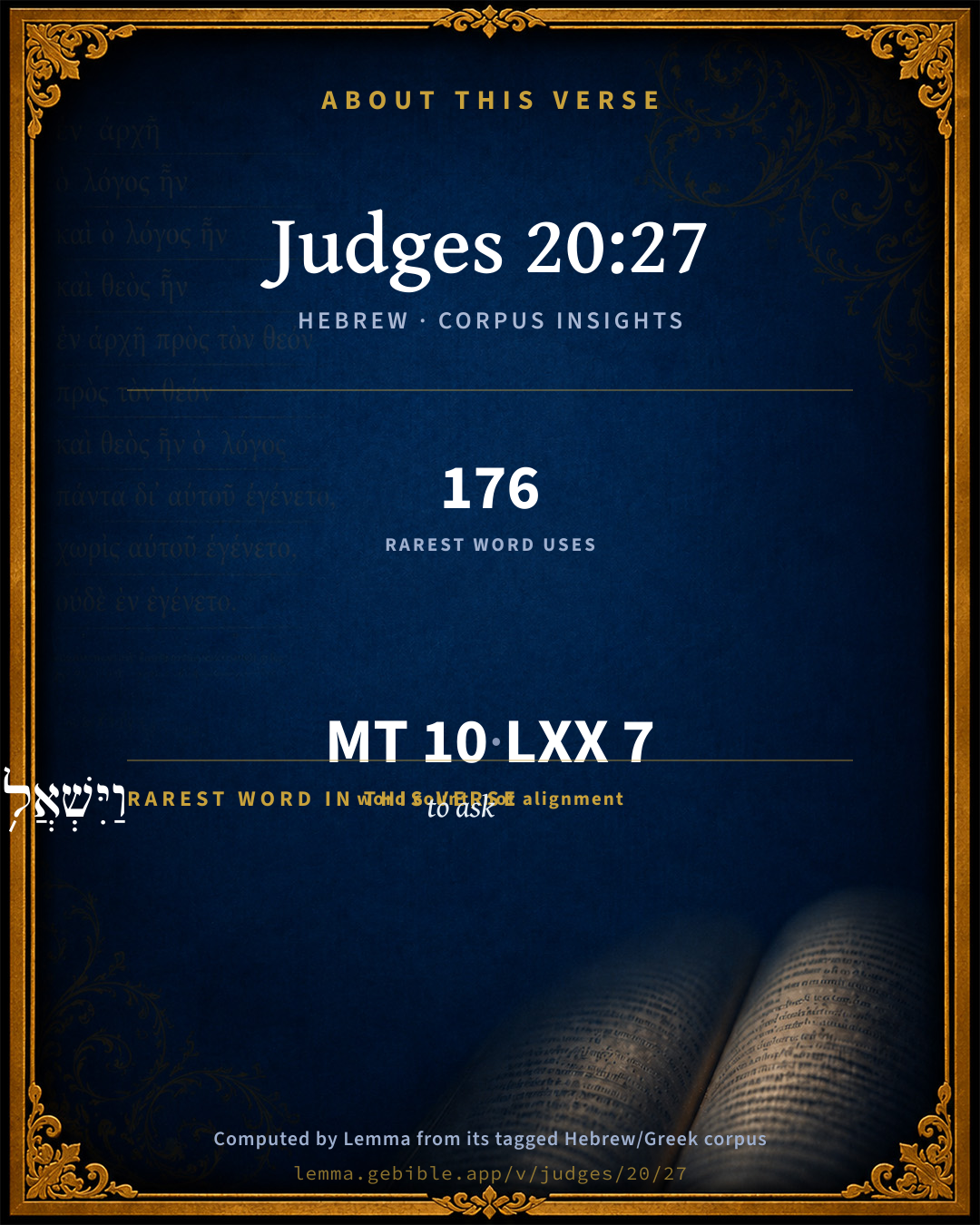
These counts appear in no published source. They are computed here, from the morphology-tagged text and Lemma’s own curated glosses. What Lemma adds →

10
words
10
distinct lemmas
Historical
section

Grammatical profile

  • 1 verb
  • 7 nouns
  • 1 pronoun
  • 1 adverb

Verb forms

  • וַיִּשְׁאֲל֥וּ Qal · Sequential Imperfect

Hebrew & Septuagint length

In English translation the verse runs 20 words from the Hebrew and 12 from the Septuagint (LXX English) — the Septuagint runs noticeably shorter here. See the side-by-side →

A rough comparison of the two English renderings, which tokenize alike — not a word-level alignment.

Word counts can differ between the Hebrew and the Greek without any difference in meaning — e.g. the Hebrew direct-object marker אֵת has no separate Greek word, and Greek often adds the article ὁ.

In the original languages it is 10 Hebrew tokens and 7 Greek tokens — but the two are counted differently (Hebrew bundles its prefixes and suffixes into one token; the Greek is in lemma form), so that isn’t a like-for-like length.

Cross-references

8

Topical passages linked to Judges 20:27 in the Treasury of Scripture Knowledge — connected by theme and wording, ordered by reader-vote popularity; previews shown in the World English Bible.

  • Joshua 18:1 The whole congregation of the children of Israel assembled themselves together at Shiloh, and set up the tent of meeting there: and the land was subdued before them.
  • 1 Samuel 4:3–4 When the people were come into the camp, the elders of Israel said, Why has Yahweh struck us today before the Philistines? Let us get the ark of the covenant of Yahweh out of Shiloh to us, that it may come among us, and save us out of the hand of our enemies.
  • Judges 20:18 The children of Israel arose, and went up to Bethel, and asked counsel of God; and they said, Who shall go up for us first to battle against the children of Benjamin? Yahweh said, Judah [shall go up] first.
  • Numbers 27:21 He shall stand before Eleazar the priest, who shall inquire for him by the judgment of the Urim before Yahweh: at his word shall they go out, and at his word they shall come in, both he, and all the children of Israel with him, even all the congregation.
  • Judges 20:23 The children of Israel went up and wept before Yahweh until even; and they asked of Yahweh, saying, Shall I again draw near to battle against the children of Benjamin my brother? Yahweh said, Go up against him.
  • Psalms 78:60–61 So that he forsook the tent of Shiloh, The tent which he placed among men;
  • Isaiah 59:1 Behold, Yahweh's hand is not shortened, that it can't save; neither his ear heavy, that it can't hear:
  • Jeremiah 7:12 But go you now to my place which was in Shiloh, where I caused my name to dwell at the first, and see what I did to it for the wickedness of my people Israel.

Cross-references courtesy of OpenBible.info (CC BY 4.0).

Hebrew and Greek witnesses Masoretic Hebrew ↔ Greek Septuagint

The same verse in the two great witnesses to the Old Testament, shown verse-for-verse.

Here the Septuagint runs noticeably shorter than the Hebrew — LXX2012 (modern English Septuagint) 12 words vs World English Bible 20. A rough length comparison of the two English translations, not a word-level alignment — read both below.

These are two independent witnesses, not word-aligned to each other, and the Septuagint is shown in lemma (dictionary) form.

Hebrew Judges 20:27 Masoretic · Westminster Leningrad Codex

וַיִּשְׁאֲל֥וּ בְנֵֽי יִשְׂרָאֵ֖ל בַּֽיהוָ֑ה וְשָׁ֗ם אֲרוֹן֙ בְּרִ֣ית הָאֱלֹהִ֔ים בַּיָּמִ֖ים הָהֵֽם

The children of Israel asked of Yahweh (for the ark of the covenant of God was there in those days,

World English Bible · Public Domain

Greek LXX Judges 20:27 Septuagint · lemma form

ὅτι ἐκεῖ κιβωτός διαθήκη κύριος ὁ θεός

for the ark of the Lord God was there in those days,

LXX2012 (modern English Septuagint) · Public Domain

Hebrew: Westminster Leningrad Codex (CC BY 4.0). Greek: Septuagint (public domain); English from LXX2012 (modern English Septuagint) (Public Domain). How the Septuagint differs from the Hebrew →

Targum (Aramaic paraphrase)

1

The Targum is the ancient Jewish Aramaic paraphrase of the Hebrew Scriptures — an interpretive translation, not the Hebrew text itself. Onkelos (literal) and Pseudo-Jonathan (expansive) render the Torah, and Jonathan the Prophets. Coverage is partial: where no permissively-licensed English translation exists for a verse, only the Aramaic is shown. This is verse-level text, not a word-by-word alignment to the Hebrew.

  1. Targum Jonathan Prophets (Joshua–Malachi)
    וּשְׁאִילוּ בְנֵי יִשְׂרָאֵל בְּמֵימְרָא דַייָ וְתַמָן אֲרוֹן קְיָמָא דַייָ בְּיוֹמַיָא הָאִנוּן:

    (no public-domain English translation for this verse)

    Targum Jonathan — Aramaic: “Mikraot Gedolot” (public domain). English: “Sefaria Community Translation” (CC0 1.0 (public-domain dedication)); “London "Chaldee Paraphrase," 1871” (public domain). Text via Sefaria.

Commentary

Notes on Judges 20:27 from classic Christian and Jewish commentators (each source and its license shown beneath its notes). The classic Christian expositions comment on the surrounding passage and are grouped to its opening verse, so a note may address several verses; the Jewish commentaries on the Tanakh (Rashi and others) are per-verse, so they appear only where the commentator wrote on this verse.

Lemma curates 59 commentaries, every one of them public domain or Creative Commons licensed, each selected and text-cleaned for this edition rather than reprinted as found. About our sources →

Trapp's Complete Commentary

John Trapp

Jdg 20:27 And the children of Israel enquired of the LORD, (for the ark of the covenant of God [was] there in those days,

Ver. 27. And the children of Israel inquired of the Lord.] Now they could find the way to do everything well, as having paid for their learning. Affliction exciteth devotion; but

“ Rarae fumant felicibus arae. ”

John Trapp, A Commentary or Exposition upon All the Books of the Old and New Testament (1647–1656) — public domain. Text from a community e-Sword module.

Joseph Benson's Commentary

Jdg 20:27. The children of Israel inquired of the Lord — They had inquired of the Lord before, but not as they ought to have done. For, confiding in the justice of their cause, and their vast forces, they seem to have made but slight and languid addresses to God before they undertook the war.

Joseph Benson's Commentary on the Old and New Testaments (1811–1818) — public domain. Text from a community e-Sword module.

Geneva Bible (1599)

Geneva Bible translators

To wit, in Shiloh.

Geneva Bible (1599) marginal notes — public domain. Text via Bolls.life.

Ellicott's Commentary for English Readers

(27) Enquired of the Lord—i.e., of Jehovah, as in Jdg_20:23. On the occasion of their first general inquiry (Jdg_20:18) it is said that they “enquired of Elohim,” but it is impossible to draw any certain inferences from this change of expression. It is clear, however, that the nation had been thoroughly and beneficially humiliated by these two terrible reverses, and that their approach to Jehovah on this occasion was far more solemn and devout than it had been at first.

Was there—i.e., at Bethel, though Bethel has not been mentioned in the English Version, owing to the erroneous rendering of the name by “House of God” in Jdg_20:18-26.

A Bible Commentary for English Readers, edited by Charles John Ellicott (1878–1897) — public domain. Text from a community e-Sword module.

John Gill's Exposition

And the children of Israel inquired of the Lord,.... By the Word of the Lord, as the Targum, and which has the same expression in Jdg 20:18 for the ark of the covenant of God was there in those days; in Shiloh, where the tabernacle was.

for the ark of the covenant of God was there in those days; in Shiloh, where the tabernacle was.

Judges 20:28

jdg 20:28

jdg 20:28

jdg 20:28And Phinehas the son of Eleazar, the son of Aaron, stood before it in those days,.... Before the ark, ministering before the Lord, which shows that this affair was long before the times of Samson, though placed after them; or otherwise Phinehas must have been more than three hundred years of age, which is not probable (r). Phinehas's standing before the ark was the posture of the priest when he inquired of the Lord for any by Urim and Thummim; the person that inquired stood before him that was inquired of, as Kimchi observes, and he that was inquired of stood before the Shechinah, or the presence of the divine Majesty, of which the ark was a symbol:

saying, shall I yet again go out to battle against the children of Benjamin my brother, or shall I cease? in which the question is put in somewhat different manner than before, not only desiring to know whether it was the will of God they should renew the battle or not, since Benjamin was their brother, but whether they should have success or not; intimating, that if the Lord would bless and help them, they were willing to go up, but if not they chose to desist; for they were fully convinced now they were wrong in depending on their numbers, or the justness of their cause; whereas success depended wholly on the will and pleasure of God, to which they desired to submit:

and the Lord said, go up, for tomorrow I will deliver them into thine hand; now they are not only directed to go up to the battle, but are promised victory.

(r) Vid. Rainold. de lib. Apocryph. Praelect. 149, 150. p. 345, 353, 354.

John Gill's Exposition of the Whole Bible (1746–1763) — public domain (CC PDM 1.0). Text via the HelloAO Bible API.

Matthew Poole's English Annotations

Inquired of the Lord, to wit, by Urim and Thummim, Num 27:21.

Was there in Shiloh, where they were now assembled.

Matthew Poole's English Annotations on the Holy Bible (1683–1685) — public domain. Text from a community e-Sword/MySword module.

Whedon's Commentary on the Bible

Daniel D. Whedon

27. The ark… was there in those days — When and why it was brought there, and how many days it continued there, the sacred writer does not tell us, and we must be content to remain uninformed. Some understand, as our translators seem to have done, that the adverb there refers to Shiloh, and that Beth-el in the Hebrew text of Jdg_20:26; Jdg_20:18 should be rendered house of God, meaning the tabernacle at Shiloh; but the tabernacle is never called Beth-el. Hengstenberg and Keil suppose that the ark was brought only temporarily to Beth-el, and to serve some special design on this occasion; but the phrase in those days is hardly consistent with such an explanation. Compare the same phrase in Jdg_18:1; Jdg_19:1; Jdg_21:25, and frequently. And if the ark had been brought from Shiloh merely for this occasion, it is not clear why it was not brought to Mizpeh rather than to Beth-el. More plausible is the supposition, that as Beth-el was a sacred place in Israelitish history, the ark was sometimes brought there, accompanied by the high priest, and abode there for many days at a time, in honour of the holy spot which Jacob regarded as the gate of heaven. Gen_28:17. Hence, after Shiloh’s desolation, it naturally became a central seat of worship. See 1Sa_10:3, note.

Daniel D. Whedon (gen. ed.), Commentary on the Old and New Testaments (1874–1909) — public domain. Text from a community e-Sword module.

The Pulpit Commentary

Enquired of the Lord. In the Hebrew, Asked the Lord, as in vers. 18, 23. For the ark of the covenant, etc. A most important statement, defining the time of these occurrences, within the lifetime of Phinehas, and also giving a strong intimation that the writer of these words lived after the tabernacle had been removed from Shiloh and its neighbourhood to Jerusalem. Was there. Where? The natural answer to be given is, At Bethel; for Bethel is the only place that has been named. But it is not in accordance with the other intimations given us concerning the tabernacle, that Bethel should be its resting-place under the high priesthood of Phinehas. In Jos_18:1 we have the formal pitching of the tabernacle of the congregation at Shiloh; in Jos_22:12 we find it there, and Phinehas the son of Eleazar the priest before it; in 1Sa_1:3 1Sa_2:14 1Sa_3:21 1Sa_4:3, we find it settled there till taken by the Philistines; and Psa_78:60 we find Shiloh described as the abode of the tabernacle till its capture by the Philistines, and there is no hint anywhere of Bethel or any other place having been the resting-place of the ark before it fell into the hands of the Philistines. Neither, again, is the explanation of some commentators, that the words the ark... was there in those days implies "that the ark of the covenant was only temporarily at Bethel," at all satisfactory. In those days has naturally a much wider and broader application, like the expression, (Jud_1:17:6 18:1) In those days there was no king in Israel, and contrasts the time of Phinehas and the judges with the times of the monarchy, when the ark and the high priest were at Jerusalem. Unless, therefore, we understand Bethel in vers. 18, 26, 31 to mean the house of God, which seems quite impossible, we must interpret the word there to mean Shiloh, and suppose that the writer took no count of the temporary removal to Bethel for the convenience of consultation, but considered that it was at Shiloh in one sense, though momentarily it was a few miles off. Possibly too in the fuller narrative, of which we have here the abridgment, the name of Shiloh was mentioned as that to which there referred.

The Pulpit Commentary (1880–1919), ed. H.D.M. Spence-Jones & Joseph S. Exell — public domain. Text from a community e-Sword module.

Keil & Delitzsch

C. F. Keil & F. Delitzsch

Having made these preparations, they inquired of the Lord whether they should continue the war, and received this reply: "Go up (against Benjamin); for to-morrow I will give it unto thy hand" (ידך, the hand of the congregation carrying on the war). To this the supplementary remark is appended, that the ark of the covenant was at Bethel in those days, and the high priest served before it. The expression "in those days" implies that the ark of the covenant was only temporarily at Bethel, and therefore had been brought thither from the tabernacle at Shiloh during this war.

Keil & Delitzsch — Biblical Commentary on the Old Testament (1861–1891) — public domain (CC PDM 1.0). Text via the HelloAO Bible API. (Old Testament only.)

unfoldingWord translationNotes

Door43 World Missions Community

for the ark of the covenant of God ... was serving before the ark in those days

This is background information that the author inserted to help the reader understand how the people asked Yahweh for an answer. (See: Background Information)

was there in those days

"was at Bethel in those days"

was serving before the ark

The full meaning of this statement can be made explicit. AT: "was serving as priest before the ark" (See: Assumed Knowledge and Implicit Information)

Attack

The full meaning of this statement can be made explicit. AT: "Attack the army of Benjamin" (See: Assumed Knowledge and Implicit Information)

translationWords

ark of the covenant

God

Phinehas

Eleazar

Aaron

brother

unfoldingWord translationNotes — © Distant Shores Media and the Door43 World Missions Community, licensed CC BY-SA 4.0. Source: git.door43.org/Door43/en_tn.

Lesson kit

Teaching starters — assembled from the data on this page, not authored interpretation. Every prompt links to the verse data it draws on. Edit before teaching.

Judges, in the Historical, opens this verse with 10 words (10 distinct Hebrew lemmas). Its most distinctive word is shâʼal (“to ask”). The Greek Septuagint runs shorter here. A historical commentator’s framing appears above. Read the whole chapter for the surrounding context.

Discussion questions

  1. The word shâʼal carries the sense “to ask.” How does it shape the verse?
  2. How does Joshua 18:1, which shares this passage’s theme, read alongside this verse?
  3. The Septuagint runs shorter here than the Hebrew. What might account for the difference?
  4. The translations on this page render this verse differently — a whole-verse word diff, not a word-by-word alignment. What might account for the different wordings?
  5. «וַיִּשְׁאֲל֥וּ» is a Qal Sequential Imperfect verb. How does that grammatical form shape the action described?
  6. Compare how Trapp's Complete Commentary and Joseph Benson's Commentary read this verse. Where do they agree or differ?

Things to notice

Reading settings

Reading text

Shown beneath each verse's original-language words.

Old Testament
Old Testament edition

Read the OT as the Masoretic Hebrew (MT) or the Greek Septuagint (LXX).

English shown for the Greek Septuagint (in the Hebrew ↔ Greek comparison).

Comparing translations? Open the Compare panel on any verse page to stack up to four side by side.