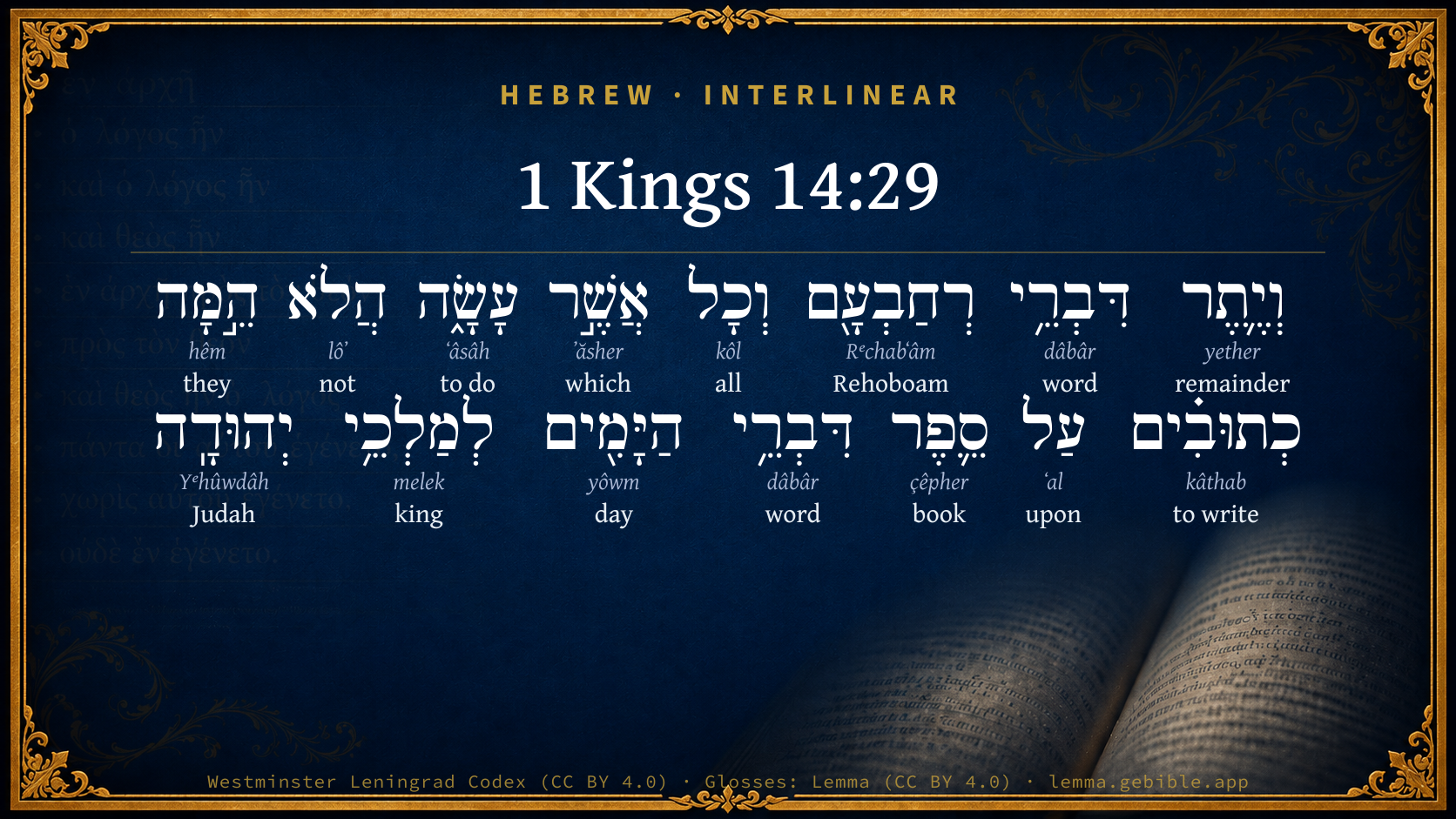
1 Kings 14:29

Hebrew (Westminster Leningrad Codex) 1 Kings 14:29 appears in the Hebrew Old Testament. The text above is from the Westminster Leningrad Codex. Each word links to its Strong’s number, a concise gloss, and parsing drawn from the Open Scriptures Hebrew Bible morphology. Click any word for its full Brown-Driver-Briggs (BDB) entry.
Download image
Cite this verse

1 Kings 14:29 (World English Bible). Public Domain. Lemma interlinear Bible study tool, https://lemma.gebible.app/v/1-kings/14/29.

Show BibTeX & RIS
BibTeX
RIS
English Translation
Now the rest of the acts of Rehoboam, and all that he did, aren't they written in the book of the chronicles of the kings of Judah?
World English Bible · Public Domain
Download a study sheet

One document with this verse’s original text, its word-by-word gloss line, the meaning frame, cross-references with their text, attributed commentary, and full source and license credits — printable, and it pastes into notes with its structure intact.

This verse Autodidact and up

Study sheet (.html) Plain text (.txt)

A passage Seminary Student

Up to 50 verses in one chapter. A passage sheet keeps up to 6 commentary sources and 12 cross-references per verse, in the order this page ranks them, and says so on the sheet whenever that leaves anything out. Ask for a single verse and you get the Autodidact verse sheet above.

Everything on this page stays free to read, with no account — the sheet is a download of what is already on screen, not access to it.

Want to remove ads? Support Godless Engineer
Compare translations 3

The same verse in 3 English versions, stacked beneath the original-language interlinear above. Click any original word for its lexicon entry.

Each is an independent rendering of the whole verse — the interlinear is not word-aligned to these translations.

Highlighted words mark where these versions differ — a whole-verse word diff, not a word-by-word alignment.

  • World English Bible Public Domain
    Now the rest of the acts of Rehoboam, and all that he did, aren't they written in the book of the chronicles of the kings of Judah?
  • King James Version Public Domain
    Now the rest of the acts of Rehoboam, and all that he did, are they not written in the book of the chronicles of the kings of Judah?
  • unfoldingWord Literal Text CC BY-SA 4.0
    Now the rest of the matters of Rehoboam and all that he did, are they not written in the book of the matters of the days of the kings of Judah?

unfoldingWord Literal Text — © unfoldingWord, licensed CC BY-SA 4.0. Word-aligned USFM3 via Door43 (git.door43.org/unfoldingWord/en_ult).

Versions to compare (up to 4)

3 of 4 selected

Show all 18 translations

Every available English version of this verse, each an independent rendering of the whole verse.

  • World English Bible Public Domain
    Now the rest of the acts of Rehoboam, and all that he did, aren't they written in the book of the chronicles of the kings of Judah?
  • Berean Standard Bible Public Domain
    As for the rest of the acts of Rehoboam, along with all that he did, are they not written in the Book of the Chronicles of the Kings of Judah?
  • Majority Standard Bible Public Domain
    As for the rest of the acts of Rehoboam, along with all that he did, are they not written in the Book of the Chronicles of the Kings of Judah?
  • King James Version Public Domain
    Now the rest of the acts of Rehoboam, and all that he did, are they not written in the book of the chronicles of the kings of Judah?
  • American Standard Version (1901) Public Domain
    Now the rest of the acts of Rehoboam, and all that he did, are they not written in the book of the chronicles of the kings of Judah?
  • Revised Version (1885) Public Domain
    Now the rest of the acts of Rehoboam, and all that he did, are they not written in the book of the chronicles of the kings of Judah?
  • Geneva Bible (1599) Public Domain
    And the rest of the actes of Rehoboam, and all that hee did, are they not written in the booke of the Chronicles of the Kings of Iudah?
  • Douay-Rheims (1899) Public Domain
    Now the rest of the sets of Roboam, end all that he did, behold they are written in the book of the words of the days of the kings of Juda.
  • Young's Literal Translation Public Domain
    And the rest of the matters of Rehoboam, and all that he did, are they not written on the book of the Chronicles of the kings of Judah?
  • Literal Standard Version CC BY-SA 4.0
    And the rest of the matters of Rehoboam and all that he did, are they not written on the scroll of the Chronicles of the Kings of Judah?
  • Unlocked Literal Bible CC BY-SA 4.0
    As for the other matters concerning Rehoboam, and all that he did, are they not written in the book of the events of the kings of Judah?
  • unfoldingWord Literal Text CC BY-SA 4.0
    Now the rest of the matters of Rehoboam and all that he did, are they not written in the book of the matters of the days of the kings of Judah?
  • Darby Bible Public Domain
    And the rest of the acts of Rehoboam, and all that he did, are they not written in the book of the chronicles of the kings of Judah?
  • World Messianic Bible Public Domain
    Now the rest of the acts of Rehoboam, and all that he did, aren’t they written in the book of the chronicles of the kings of Judah?
  • Webster's Bible Public Domain
    Now the rest of the acts of Rehoboam, and all that he did, are they not written in the book of the chronicles of the kings of Judah?
  • Free Bible Version CC BY-SA 4.0
    The rest of what happened in Rehoboam's reign and everything that he did are recorded in the Book of Chronicles of the Kings of Judah.
  • Bible in Basic English Public Domain
    Now the rest of the acts of Rehoboam, and all he did, are they not recorded in the book of the history of the kings of Judah?
  • JPS Tanakh (1917) Public Domain
    Now the rest of the acts of Rehoboam, and all that he did, are they not written in the book of the chronicles of the kings of Judah?

Literal Standard Version (2020), Covenant Press — licensed CC BY-SA 4.0. Text via the HelloAO Bible API (eBible.org). Unlocked Literal Bible (unfoldingWord) — licensed CC BY-SA 4.0. Text via the HelloAO Bible API (eBible.org). unfoldingWord Literal Text — © unfoldingWord, licensed CC BY-SA 4.0. Word-aligned USFM3 via Door43 (git.door43.org/unfoldingWord/en_ult). Free Bible Version, Dr. Jonathan Gallagher — licensed CC BY-SA 4.0. Text via the HelloAO Bible API (eBible.org).

Word by word

More ways to search: Search by grammar → Find every occurrence → Compare this word →

Practice this passage: Drill this verse → Learn its vocabulary →

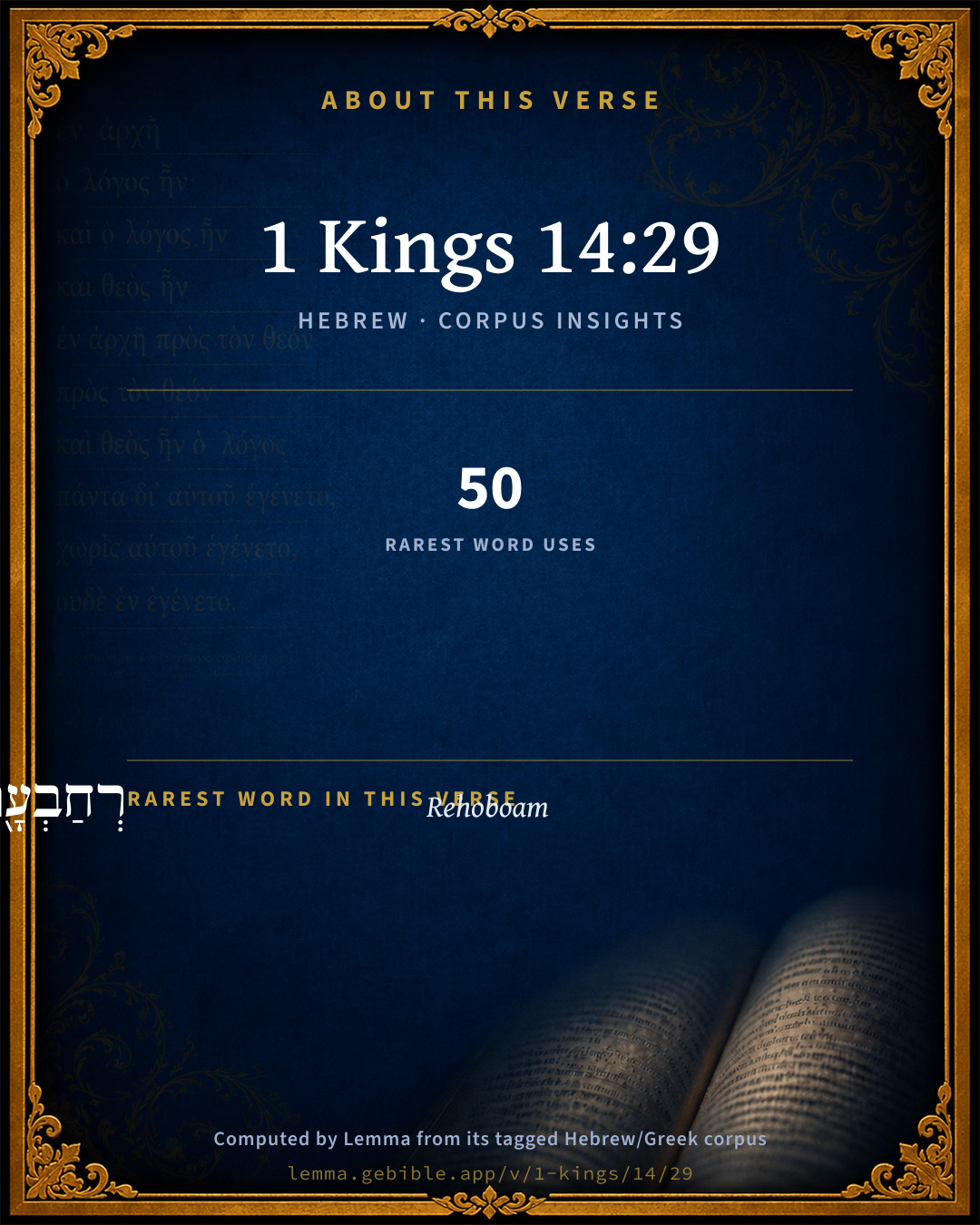
רְחַבְעָ֖ם
Rᵉchabʻâm
H7346
“Rehoboam”
Noun, Proper
Part of Speech
Noun
Type
Proper
Full BDB Definition

Origin: from H7337 and H5971

TWOT: None

Rehoboam = "a people has enlarged" - son of Solomon and the 1st king of Judah after the split up of the kingdom of Israel
  1. וְיֶ֛תֶר yether H3499 “and · remainder of” Conjunction + Noun, Common, Masculine, Singular, Construct
  2. דִּבְרֵ֥י dâbâr H1697 “words of” Noun, Common, Masculine, Plural, Construct
  3. וְכָל kôl H3605 “and · all of” Conjunction + Noun, Common, Masculine, Singular, Construct
  4. אֲשֶׁ֣ר ʼăsher H834 “which” Particle, Relative
  5. עָשָׂ֑ה ʻâsâh H6213 “to do” Verb, Qal, Perfect, 3rd Person, Masculine, Singular
  6. הֲלֹא lôʼ H3808 “not” Particle, Interrogative + Particle, Negative
  7. הֵ֣מָּה hêm H1992 “they” Pronoun, Personal, 3rd Person, Masculine, Plural
  8. כְתוּבִ֗ים kâthab H3789 “written” Verb, Qal, Participle Passive, Masculine, Plural, Absolute
  9. עַל ʻal H5921 “upon” Preposition
  10. סֵ֛פֶר çêpher H5612 “book of” Noun, Common, Masculine, Singular, Construct
  11. דִּבְרֵ֥י dâbâr H1697 “words of” Noun, Common, Masculine, Plural, Construct
  12. הַיָּמִ֖ים yôwm H3117 “the · days” Particle, Definite Article + Noun, Common, Masculine, Plural, Absolute
  13. לְמַלְכֵ֥י melek H4428 “to/for · kings of” Preposition + Noun, Common, Masculine, Plural, Construct
  14. יְהוּדָֽה Yᵉhûwdâh H3063 “Judah” Noun, Proper

About this verse

These counts appear in no published source. They are computed here, from the morphology-tagged text and Lemma’s own curated glosses. What Lemma adds →

15
words
14
distinct lemmas
Historical
section

Shared distinctive vocabulary

רְחַבְעָ֖ם Rehoboam H7346 occurs in 41 verses of the Hebrew Bible. Also found in:

Grammatical profile

  • 2 verbs
  • 9 nouns
  • 1 pronoun
  • 1 preposition
  • 2 particles

Verb forms

  • עָשָׂ֑ה Qal · Perfect
  • כְתוּבִ֗ים Qal · Participle Passive

Repetition

A word recurs within this verse — often emphatic in Hebrew:

  • דִּבְרֵ֥י word H1697 ×2

Hebrew & Septuagint length

In English translation the verse runs 27 words from the Hebrew and 29 from the Septuagint (LXX English) — closely comparable.

A rough comparison of the two English renderings, which tokenize alike — not a word-level alignment.

Word counts can differ between the Hebrew and the Greek without any difference in meaning — e.g. the Hebrew direct-object marker אֵת has no separate Greek word, and Greek often adds the article ὁ.

Cross-references

5

Topical passages linked to 1 Kings 14:29 in the Treasury of Scripture Knowledge — connected by theme and wording, ordered by reader-vote popularity; previews shown in the World English Bible.

  • 1 Kings 11:41 Now the rest of the acts of Solomon, and all that he did, and his wisdom, aren't they written in the book of the acts of Solomon?
  • 1 Kings 14:19 The rest of the acts of Jeroboam, how he warred, and how he reigned, behold, they are written in the book of the chronicles of the kings of Israel.
  • 1 Kings 15:23 Now the rest of all the acts of Asa, and all his might, and all that he did, and the cities which he built, aren't they written in the book of the chronicles of the kings of Judah? But in the time of his old age he was diseased in his feet.
  • 1 Kings 22:45 Now the rest of the acts of Jehoshaphat, and his might that he shown, and how he warred, aren't they written in the book of the chronicles of the kings of Judah?
  • 2 Chronicles 12:15–16 Now the acts of Rehoboam, first and last, aren't they written in the histories of Shemaiah the prophet and of Iddo the seer, after the manner of genealogies? There were wars between Rehoboam and Jeroboam continually.

Cross-references courtesy of OpenBible.info (CC BY 4.0).

Hebrew and Greek witnesses Masoretic Hebrew ↔ Greek Septuagint

The same verse in the two great witnesses to the Old Testament, shown verse-for-verse.

These are two independent witnesses, not word-aligned to each other, and the Septuagint is shown in lemma (dictionary) form.

Hebrew 1 Kings 14:29 Masoretic · Westminster Leningrad Codex

וְיֶ֛תֶר דִּבְרֵ֥י רְחַבְעָ֖ם וְכָל אֲשֶׁ֣ר עָשָׂ֑ה הֲלֹא הֵ֣מָּה כְתוּבִ֗ים עַל סֵ֛פֶר דִּבְרֵ֥י הַיָּמִ֖ים לְמַלְכֵ֥י יְהוּדָֽה

Now the rest of the acts of Rehoboam, and all that he did, aren't they written in the book of the chronicles of the kings of Judah?

World English Bible · Public Domain

Greek LXX 1 Kings 14:29 Septuagint · lemma form
And the rest of the history of Roboam, and all that he did, behold, are they not written in the book of the chronicles of the kings of Juda?

LXX2012 (modern English Septuagint) · Public Domain

Hebrew: Westminster Leningrad Codex (CC BY 4.0). Greek: Septuagint (public domain); English from LXX2012 (modern English Septuagint) (Public Domain). How the Septuagint differs from the Hebrew →

Targum (Aramaic paraphrase)

1

The Targum is the ancient Jewish Aramaic paraphrase of the Hebrew Scriptures — an interpretive translation, not the Hebrew text itself. Onkelos (literal) and Pseudo-Jonathan (expansive) render the Torah, and Jonathan the Prophets. Coverage is partial: where no permissively-licensed English translation exists for a verse, only the Aramaic is shown. This is verse-level text, not a word-by-word alignment to the Hebrew.

  1. Targum Jonathan Prophets (Joshua–Malachi)
    וּשְׁאַר פִּתְגָמֵי רְחַבְעָם וְכָל דַעֲבַד הֲלָא אִינוּן כְּתִיבִין עַל סְפַר פִּתְגָמֵי יוֹמַיָא לְמַלְכֵי דְבֵית יְהוּדָה:

    (no public-domain English translation for this verse)

    Targum Jonathan — Aramaic: “Mikraot Gedolot” (public domain). English: “Sefaria Community Translation” (CC0 1.0 (public-domain dedication)); “London "Chaldee Paraphrase," 1871” (public domain). Text via Sefaria.

Commentary

Notes on 1 Kings 14:29 from classic Christian and Jewish commentators (each source and its license shown beneath its notes). The classic Christian expositions comment on the surrounding passage and are grouped to its opening verse, so a note may address several verses; the Jewish commentaries on the Tanakh (Rashi and others) are per-verse, so they appear only where the commentator wrote on this verse.

Lemma curates 59 commentaries, every one of them public domain or Creative Commons licensed, each selected and text-cleaned for this edition rather than reprinted as found. About our sources →

Trapp's Complete Commentary

John Trapp

1Ki 14:29 Now the rest of the acts of Rehoboam, and all that he did, [are] they not written in the book of the chronicles of the kings of Judah?

Ver. 29. Now the rest.] See on 1Ki 14:19.

John Trapp, A Commentary or Exposition upon All the Books of the Old and New Testament (1647–1656) — public domain. Text from a community e-Sword module.

The Biblical Illustrator

Joseph S. Exell

1Ki_14:29-31

Now the rest of the acts of Rehoboam.

The power and weakness of external circumstances in the life of man

Though this man lived fifty-eight years in this world, and for seventeen years occupied the throne, how little is said of him! Inspired historians pay no more attention to the life of kings than to the life of ordinary men.

I. The power of external circumstances. Whilst we are far enough from admitting that man is by necessity the creature of circumstances, we cannot gainsay the fact that they tend greatly to shape his character and determine his fortunes. Here we find them investing the most worthless man with worldly opulence and regal power. Some men amass wealth and climb to power by skillful and persevering industry. But here is a man born to it. His ancestors made his position for him. He was not the architect of his own fortune. This is the case with thousands to-day. Experience teaches that to get wealth and power in this way is as undesirable as it is unmeritorious. Many sons have had reason to curse the day when their fathers bequeathed them a fortune. Here is a man whom circumstances made a king, who had nothing kingly in his soul.

II. The weakness of external circumstances.

1. They did not give him wisdom and piety.

2. They did not give him social respect. We are so constituted that we can have no true moral respect for a man, however elevated his position, if he is destitute of moral worth. To true souls corrupt men on a throne are far more contemptible than if they lived in hovels of obscurity.

Conclusion:--

1. That a mans external circumstances are no just criteria by which to judge his character. To regard them as such, has been the tendency of men in all ages.

2. That mans external circumstances do not necessarily shape his character. The circumstances into which the life of Rehoboam was thrown, did not by necessity make him the vile man and ruthless despot which he became. The fact is, there is a sovereign power in the soul, to subordinate external circumstances to its own interest. It can turn apparently the most adverse circumstances into blessings. (Homilist.)

.

The Biblical Illustrator, edited by Joseph S. Exell (c. 1880s–1900s) — public domain. Text from a community e-Sword module.

Joseph Benson's Commentary

1Ki 14:29-30. Are they not written, &c. — A register was kept of the acts of the kings of Judah, as well as of those of the kings of Israel. And there was war, &c. — But how does this agree with 1Ki 12:23, &c., where God forbids Rehoboam and his people to go up and fight against their brethren? We must observe, that though the Jews were forbidden to make war upon the Israelites, they were not forbidden to defend themselves, in case the Israelites should make war on them. “And considering that they were now become two rival nations, they might, upon the borders, be continually endeavouring to gain ground upon each other, and so run into frequent acts of hostility, without ever once engaging in a pitched battle.” — Dodd.

Joseph Benson's Commentary on the Old and New Testaments (1811–1818) — public domain. Text from a community e-Sword module.

Tyndale Open Study Notes

Tyndale Open Resources

14:29-31 The closing report concerning Rehoboam’s reign notes his constant strife with Jeroboam.

Tyndale Open Study Notes — © Tyndale Open Resources, licensed CC BY-SA 4.0. Text via the HelloAO Bible API.

Geneva Bible (1599)

Geneva Bible translators

Which books were called the books of Shemaiah and Iddo the Prophets, 2 Chron. 12:15.

Geneva Bible (1599) marginal notes — public domain. Text via Bolls.life.

Jamieson, Fausset & Brown

Robert Jamieson, A. R. Fausset & David Brown

Now the rest of the acts of Rehoboam . . ., are they not written in the book of the chronicles?--not the book so called and comprehended in the sacred canon, but the national archives of Judah.

Jamieson, Fausset & Brown — Commentary Critical and Explanatory on the Whole Bible (1871) — public domain (CC PDM 1.0). Text via the HelloAO Bible API.

Ellicott's Commentary for English Readers

(29) The chronicles of the kings of Judah.—In 2Ch_12:15 the acts of Rehoboam are said to be “written in the book of Shemaiah the prophet, and of Iddo the seer concerning genealogies.”

A Bible Commentary for English Readers, edited by Charles John Ellicott (1878–1897) — public domain. Text from a community e-Sword module.

John Gill's Exposition

And there was war between Rehoboam and Jeroboam all their days. For though Rehoboam did not enter into an offensive war, and attack the children of Israel, being dissuaded from it by Shemaiah the prophet in the name of the Lord, yet he might maintain a defensive war; and though there were no pitched battles between them as afterwards, in his son's time, yet there might be skirmishes and bickerings on the borders of their countries.

1 Kings 14:31

John Gill's Exposition of the Whole Bible (1746–1763) — public domain (CC PDM 1.0). Text via the HelloAO Bible API.

Matthew Poole's English Annotations

Such a book of chronicles as that mentioned above, 1Ki 14:19.

Matthew Poole's English Annotations on the Holy Bible (1683–1685) — public domain. Text from a community e-Sword/MySword module.

Whedon's Commentary on the Bible

Daniel D. Whedon

29. Book of the Chronicles of the kings of Judah — This was in the kingdom of Judah what the book mentioned in 1Ki_14:19 was in the kingdom of Israel, namely, the roll of state papers prepared and kept by the king’s recorder, and containing the annals of the kings. 2Ch_12:15, informs us that the acts of Rehoboam were also written by Shemaiah and Iddo. See Introduction.

Daniel D. Whedon (gen. ed.), Commentary on the Old and New Testaments (1874–1909) — public domain. Text from a community e-Sword module.

The Pulpit Commentary

Now the rest of the acts of Rehoboam, and all that he did, are they not written in the book of the chronicles of the kings of Judah? See on ver. 19.

The Pulpit Commentary (1880–1919), ed. H.D.M. Spence-Jones & Joseph S. Exell — public domain. Text from a community e-Sword module.

unfoldingWord translationNotes

Door43 World Missions Community

are they not written in the book of the events of the kings of Judah?

This can be expressed in active form and assumes that the answer is positive. The question is rhetorical and is used for emphasis. AT: "they are written in the book of the events of the kings of Judah." or "you can read about them in the book of the events of the kings of Judah." (See: Active or Passive and Rhetorical Question)

the book of the events of the kings of Judah

This refers to a book that no longer exists.

There was constant warfare

"There was continuing war" or "There were constant battles"

warfare between Rehoboam and Jeroboam

The names of the kings represent themselves and their armies. AT: "the armies of Rehoboam and Jeroboam fought in battle again and again" or "Rehoboam and his people and Jeroboam and his people engaged in battle continually" (See: Synecdoche)

slept with his ancestors

Rehoboam dying is spoken of as if he had fallen asleep. See how you translated this in 1 Kings 2:10. AT: "died" (See: Metaphor and Euphemism)

was buried with them

This can be stated in active form. AT: "people buried him" (See: Active or Passive)

Naamah

This is the name of a woman. See how you translated this in 1 Kings 14:21. (See: How to Translate Names)

Abijah his son

"Abijah the son of Rehoboam"

became king in his place

The phrase "in his place" is a metaphor meaning "instead of him." AT: "became king instead of Rehoboam" (See: Metaphor)

translationWords

written

kingdom of Judah

Jeroboam

asleep

bury

city of David

Ammon

Abijah

unfoldingWord translationNotes — © Distant Shores Media and the Door43 World Missions Community, licensed CC BY-SA 4.0. Source: git.door43.org/Door43/en_tn.

Lesson kit

Teaching starters — assembled from the data on this page, not authored interpretation. Every prompt links to the verse data it draws on. Edit before teaching.

1 Kings, in the Historical, opens this verse with 15 words (14 distinct Hebrew lemmas). Its most distinctive word is Rᵉchabʻâm (“Rehoboam”). A historical commentator’s framing appears above. Read the whole chapter for the surrounding context.

Discussion questions

  1. The word Rᵉchabʻâm carries the sense “Rehoboam.” How does it shape the verse?
  2. How does 1 Kings 11:43, which shares the word «Rehoboam», read alongside this verse?
  3. What does the repetition of “word” (2× in this one verse) do in this verse?
  4. The translations on this page render this verse differently — a whole-verse word diff, not a word-by-word alignment. What might account for the different wordings?
  5. «עָשָׂ֑ה» is a Qal Perfect verb. How does that grammatical form shape the action described?
  6. Compare how Trapp's Complete Commentary and The Biblical Illustrator read this verse. Where do they agree or differ?

Things to notice

Reading settings

Reading text

Shown beneath each verse's original-language words.

Old Testament
Old Testament edition

Read the OT as the Masoretic Hebrew (MT) or the Greek Septuagint (LXX).

English shown for the Greek Septuagint (in the Hebrew ↔ Greek comparison).

Comparing translations? Open the Compare panel on any verse page to stack up to four side by side.