Numbers 3:21

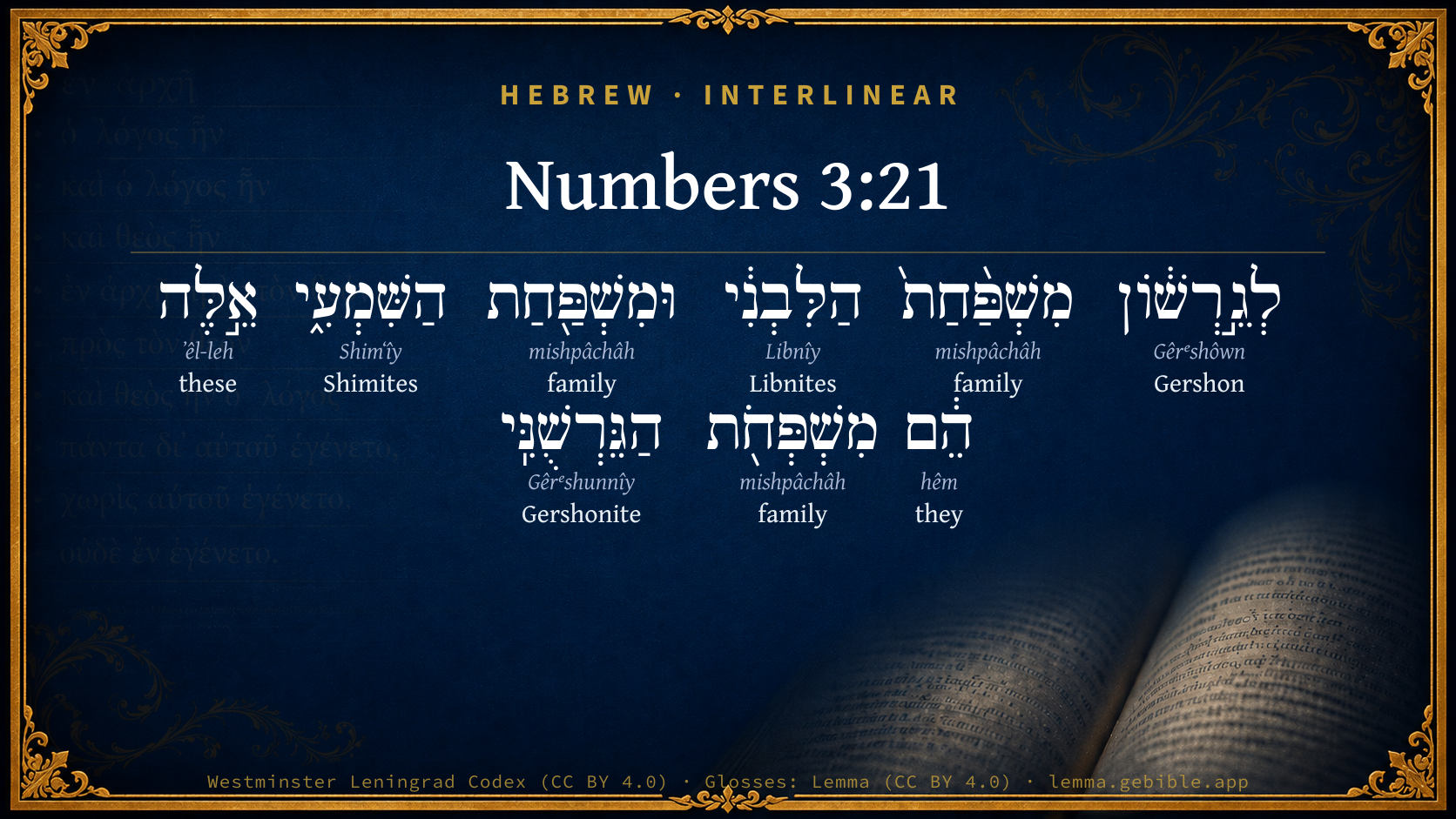
Hebrew (Westminster Leningrad Codex) Numbers 3:21 appears in the Hebrew Old Testament. The text above is from the Westminster Leningrad Codex. Each word links to its Strong’s number, a concise gloss, and parsing drawn from the Open Scriptures Hebrew Bible morphology. Click any word for its full Brown-Driver-Briggs (BDB) entry.
Download image
Cite this verse

Numbers 3:21 (World English Bible). Public Domain. Lemma interlinear Bible study tool, https://lemma.gebible.app/v/numbers/3/21.

Show BibTeX & RIS
BibTeX
RIS
English Translation
Of Gershon was the family of the Libnites, and the family of the Shimeites: these are the families of the Gershonites.
World English Bible · Public Domain
Highlights
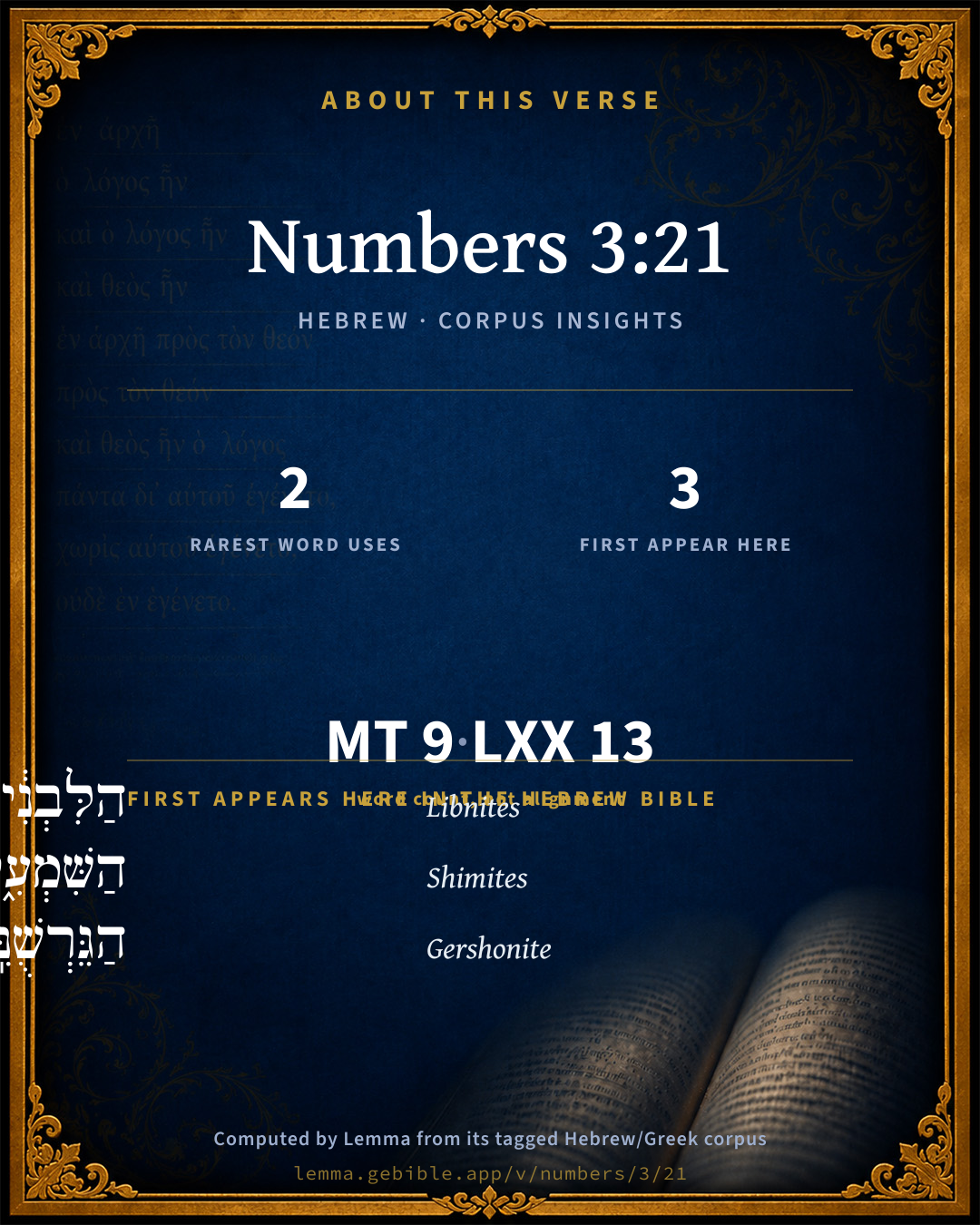
  • 3 first appearances in the Hebrew Bible
Full analysis ↓
Download a study sheet

One document with this verse’s original text, its word-by-word gloss line, the meaning frame, cross-references with their text, attributed commentary, and full source and license credits — printable, and it pastes into notes with its structure intact.

This verse Autodidact and up

Study sheet (.html) Plain text (.txt)

A passage Seminary Student

Up to 50 verses in one chapter. A passage sheet keeps up to 6 commentary sources and 12 cross-references per verse, in the order this page ranks them, and says so on the sheet whenever that leaves anything out. Ask for a single verse and you get the Autodidact verse sheet above.

Everything on this page stays free to read, with no account — the sheet is a download of what is already on screen, not access to it.

Want to remove ads? Support Godless Engineer
Compare translations 3

The same verse in 3 English versions, stacked beneath the original-language interlinear above. Click any original word for its lexicon entry.

Each is an independent rendering of the whole verse — the interlinear is not word-aligned to these translations.

Highlighted words mark where these versions differ — a whole-verse word diff, not a word-by-word alignment.

  • World English Bible Public Domain
    Of Gershon was the family of the Libnites, and the family of the Shimeites: these are the families of the Gershonites.
  • King James Version Public Domain
    Of Gershon was the family of the Libnites, and the family of the Shimites: these are the families of the Gershonites.
  • unfoldingWord Literal Text CC BY-SA 4.0
    Of Gershon the clan of the Libnite and the clan of the Shimeite. These they, the clans of the Gershonite.

unfoldingWord Literal Text — © unfoldingWord, licensed CC BY-SA 4.0. Word-aligned USFM3 via Door43 (git.door43.org/unfoldingWord/en_ult).

Versions to compare (up to 4)

3 of 4 selected

Show all 18 translations

Every available English version of this verse, each an independent rendering of the whole verse.

  • World English Bible Public Domain
    Of Gershon was the family of the Libnites, and the family of the Shimeites: these are the families of the Gershonites.
  • Berean Standard Bible Public Domain
    From Gershon came the Libnite clan and the Shimeite clan; these were the Gershonite clans.
  • Majority Standard Bible Public Domain
    From Gershon came the Libnite clan and the Shimeite clan; these were the Gershonite clans.
  • King James Version Public Domain
    Of Gershon was the family of the Libnites, and the family of the Shimites: these are the families of the Gershonites.
  • American Standard Version (1901) Public Domain
    Of Gershon was the family of the Libnites, and the family of the Shimeites: these are the families of the Gershonites.
  • Revised Version (1885) Public Domain
    Of Gershon was the family of the Libnites, and the family of the Shimeites: these are the families of the Gershonites.
  • Geneva Bible (1599) Public Domain
    Of Gershon came the familie of the Libnites, and the familie of the Shimeites: these are the families of the Gershonites.
  • Douay-Rheims (1899) Public Domain
    Of Gerson were two families, the Lebnites, and the Semeites:
  • Young's Literal Translation Public Domain
    Of Gershon `is' the family of the Libnite, and the family of the Shimite; these are the families of the Gershonite.
  • Literal Standard Version CC BY-SA 4.0
    Of Gershon—the family of the Libnite and the family of the Shimite; these are the families of the Gershonite.
  • Unlocked Literal Bible CC BY-SA 4.0
    The clans of the Libnites and the Shimeites come from Gershon. These are the clans of the Gershonites.
  • unfoldingWord Literal Text CC BY-SA 4.0
    Of Gershon the clan of the Libnite and the clan of the Shimeite. These they, the clans of the Gershonite.
  • Darby Bible Public Domain
    Of Gershon, the family of the Libnites, and the family of the Shimites: these are the families of the Gershonites.
  • World Messianic Bible Public Domain
    Of Gershon was the family of the Libnites, and the family of the Shimeites. These are the families of the Gershonites.
  • Webster's Bible Public Domain
    Of Gershon was the family of the Libnites, and the family of the Shimites: these are the families of the Gershonites.
  • Free Bible Version CC BY-SA 4.0
    The family of Libni and the family of Shimei came from Gershon. These were the families of Gershon.
  • Bible in Basic English Public Domain
    From Gershon come the Libnites and the Shimeites; these are the families of the Gershonites.
  • JPS Tanakh (1917) Public Domain
    Of Gershon was the family of the Libnites, and the family of the Shimeites; these are the families of the Gershonites.

Literal Standard Version (2020), Covenant Press — licensed CC BY-SA 4.0. Text via the HelloAO Bible API (eBible.org). Unlocked Literal Bible (unfoldingWord) — licensed CC BY-SA 4.0. Text via the HelloAO Bible API (eBible.org). unfoldingWord Literal Text — © unfoldingWord, licensed CC BY-SA 4.0. Word-aligned USFM3 via Door43 (git.door43.org/unfoldingWord/en_ult). Free Bible Version, Dr. Jonathan Gallagher — licensed CC BY-SA 4.0. Text via the HelloAO Bible API (eBible.org).

Word by word

More ways to search: Search by grammar → Find every occurrence → Compare this word →

Practice this passage: Drill this verse → Learn its vocabulary →

הַלִּבְנִ֔י
Libnîy
H3846
“the · Libnites”
Particle, Definite Article + Noun, Gentilic, Masculine, Singular, Absolute
Part of Speech
Particle + Noun
Type
Gentilic
Gender
Masculine
Number
Singular
State
Absolute
Full BDB Definition

Origin: patronymically from H3845

TWOT: None

Libnites = see Libni " white" - the descendants of Libni
  1. לְגֵ֣רְשׁ֔וֹן Gêrᵉshôwn H1648 “to/for · Gershon” Preposition + Noun, Proper
  2. מִשְׁפַּ֨חַת֙ mishpâchâh H4940 “family of” Noun, Common, Feminine, Singular, Construct
  3. וּמִשְׁפַּ֖חַת mishpâchâh H4940 “and · family of” Conjunction + Noun, Common, Feminine, Singular, Construct
  4. הַשִּׁמְעִ֑י Shimʻîy H8097 “the · Shimites” Particle, Definite Article + Noun, Gentilic, Masculine, Singular, Absolute
  5. אֵ֣לֶּה ʼêl-leh H428 “these” Pronoun, Demonstrative, Common, Plural
  6. הֵ֔ם hêm H1992 “they” Pronoun, Personal, 3rd Person, Masculine, Plural
  7. מִשְׁפְּחֹ֖ת mishpâchâh H4940 “families of” Noun, Common, Feminine, Plural, Construct
  8. הַגֵּרְשֻׁנִּֽי Gêrᵉshunnîy H1649 “the · Gershonite” Particle, Definite Article + Noun, Gentilic, Masculine, Singular, Absolute

About this verse

These counts appear in no published source. They are computed here, from the morphology-tagged text and Lemma’s own curated glosses. What Lemma adds →

9
words
7
distinct lemmas
Pentateuch
section

Notable vocabulary

The rarest word here is הַלִּבְנִ֔י Libnites H3846 — appearing just 2 times in the whole Hebrew Bible.

First appearance in Scripture

These words make their first canonical appearance in the Hebrew Bible here:

  • הַלִּבְנִ֔י Libnites H3846
  • הַשִּׁמְעִ֑י Shimites H8097
  • הַגֵּרְשֻׁנִּֽי Gershonite H1649

Shared distinctive vocabulary

הַלִּבְנִ֔י Libnites H3846 occurs in 2 verses of the Hebrew Bible. Also found in:

Grammatical profile

  • 7 nouns
  • 2 pronouns

Repetition

A word recurs within this verse — often emphatic in Hebrew:

  • מִשְׁפַּ֨חַת֙ family H4940 ×3

Hebrew & Septuagint length

In English translation the verse runs 21 words from the Hebrew and 18 from the Septuagint (LXX English) — closely comparable.

A rough comparison of the two English renderings, which tokenize alike — not a word-level alignment.

Word counts can differ between the Hebrew and the Greek without any difference in meaning — e.g. the Hebrew direct-object marker אֵת has no separate Greek word, and Greek often adds the article ὁ.

In the original languages it is 9 Hebrew tokens and 13 Greek tokens — but the two are counted differently (Hebrew bundles its prefixes and suffixes into one token; the Greek is in lemma form), so that isn’t a like-for-like length.

Hebrew and Greek witnesses Masoretic Hebrew ↔ Greek Septuagint

The same verse in the two great witnesses to the Old Testament, shown verse-for-verse.

These are two independent witnesses, not word-aligned to each other, and the Septuagint is shown in lemma (dictionary) form.

Hebrew Numbers 3:21 Masoretic · Westminster Leningrad Codex

לְגֵ֣רְשׁ֔וֹן מִשְׁפַּ֨חַת֙ הַלִּבְנִ֔י וּמִשְׁפַּ֖חַת הַשִּׁמְעִ֑י אֵ֣לֶּה הֵ֔ם מִשְׁפְּחֹ֖ת הַגֵּרְשֻׁנִּֽי

Of Gershon was the family of the Libnites, and the family of the Shimeites: these are the families of the Gershonites.

World English Bible · Public Domain

Greek LXX Numbers 3:21 Septuagint · lemma form

ὁ γεδσων δῆμος ὁ λοβενι καί δῆμος ὁ σεμεϊ οὗτος δῆμος ὁ γεδσων

To Gedson belongs the family of Lobeni, and the family of Semei: these are the families of Gedson.

LXX2012 (modern English Septuagint) · Public Domain

Hebrew: Westminster Leningrad Codex (CC BY 4.0). Greek: Septuagint (public domain); English from LXX2012 (modern English Septuagint) (Public Domain). How the Septuagint differs from the Hebrew →

Targum (Aramaic paraphrase)

2

The Targum is the ancient Jewish Aramaic paraphrase of the Hebrew Scriptures — an interpretive translation, not the Hebrew text itself. Onkelos (literal) and Pseudo-Jonathan (expansive) render the Torah, and Jonathan the Prophets. Coverage is partial: where no permissively-licensed English translation exists for a verse, only the Aramaic is shown. This is verse-level text, not a word-by-word alignment to the Hebrew.

  1. Targum Onkelos Torah (Genesis–Deuteronomy)
    לְגֵרְשׁוֹן זַרְעִית לִבְנִי וְזַרְעִית שִׁמְעִי אִלֵין אִנוּן זַרְעֲיַת גֵרְשׁוֹן

    (no public-domain English translation for this verse)

    Targum Onkelos — Aramaic: “Onkelos Genesis” (public domain); “Onkelos Exodus” (public domain); “Onkelos Leviticus” (public domain); “Onkelos Numbers” (public domain); “Onkelos Deuteronomy” (public domain). English: “Sefaria Community Translation” (CC0 1.0 (public-domain dedication)); “J.W. Etheridge. The Targums of Onkelos and Jonathan Ben Uzziel on the Pentateuch. London: Longmans, Green, 1862” (public domain). Text via Sefaria.

  2. Targum Pseudo-Jonathan Torah (Genesis–Deuteronomy)
    לְגֵרְשׁוֹן גְנִיסַת לִבְנִי וּגְנִיסַת שִׁמְעִי אִילֵין הִינוּן גְנִיסַת גֵרְשׁוֹן

    Of Gershon, the family of Libni, and the family of Shemei; these are the families of Gershon.

    Targum Pseudo-Jonathan — Aramaic: “Targum Jonathan on Genesis” (public domain); “Targum Jonathan on Exodus” (public domain); “Targum Jonathan on Leviticus” (public domain); “Targum Jonathan on Numbers” (public domain); “Targum Jonathan on Deuteronomy” (public domain). English: “The Targum of Jonathan ben Uzziel, trans. J. W. Etheridge, London, 1862” (public domain). Text via Sefaria.

Commentary

Notes on Numbers 3:21 from classic Christian and Jewish commentators (each source and its license shown beneath its notes). The classic Christian expositions comment on the surrounding passage and are grouped to its opening verse, so a note may address several verses; the Jewish commentaries on the Tanakh (Rashi and others) are per-verse, so they appear only where the commentator wrote on this verse.

Lemma curates 59 commentaries, every one of them public domain or Creative Commons licensed, each selected and text-cleaned for this edition rather than reprinted as found. About our sources →

The Cambridge Bible for Schools and Colleges

gen. ed. J. J. S. Perowne

21–39. The Levitical families and their duties.

Notice that narrative in Num_3:21 f., 27 f., 33 f., 39 alternates with commands in Num_3:23-26; Num_3:29-32; Num_3:35-38. It is one of the many indications that the priestly portions of the book were the composite work of more than one writer.

The Cambridge Bible for Schools and Colleges (gen. ed. J. J. S. Perowne; Cambridge University Press, 1878–1918) — public domain. Text from a community e-Sword module.

John Gill's Exposition

Of Gershon was the family of the Libnites, and the family of the Shimites,.... The first son of Levi:

these are the family of the Gershonites; that were now, numbered.

John Gill's Exposition of the Whole Bible (1746–1763) — public domain (CC PDM 1.0). Text via the HelloAO Bible API.

Keil & Delitzsch

C. F. Keil & F. Delitzsch

The Gershonites were divided into two families, containing 7500 males. They were to encamp under their chief Eliasaph, behind the tabernacle, i.e., on the western side (Num 3:23, Num 3:24), and were to take charge of the dwelling-place and the tent, the covering, the curtain at the entrance, the hangings round the court with the curtains at the door, and the cords of the tent, "in relation to all the service thereof" (Num 3:25.); that is to say, according to the more precise injunctions in Num 4:25-27, they were to carry the tapestry of the dwelling (the inner covering, Exo 26:1.), and of the tent (i.e., the covering made of goats' hair, Exo 26:7.), the covering thereof (i.e., the covering of rams' skins dyed red, and the covering of sea-cow skin upon the top of it, Exo 27:16), the hangings of the court and the curtain at the entrance (Exo 27:9, Exo 27:16), which surrounded the altar (of burnt-offering) and the dwelling round about, and their cords, i.e., the cords of the tapestry, coverings, and curtains (Exo 27:14), and all the instruments of their service, i.e., the things used in connection with their service (Exo 27:19), and were to attend to everything that had to be done to them; in other words, to perform whatever was usually done with those portions of the sanctuary that are mentioned here, especially in setting up the tabernacle or taking it down. The suffix in מיתריו (Num 3:26) does not refer to the court mentioned immediately before; for, according to Num 3:37, the Merarites were to carry the cords of the hangings of the court, but to the "dwelling and tent," which stand farther off. In the same way the words, "for all the service thereof," refer to all those portions of the sanctuary that are mentioned, and mean "everything that had to be done or attended to in connection with these things."

Keil & Delitzsch — Biblical Commentary on the Old Testament (1861–1891) — public domain (CC PDM 1.0). Text via the HelloAO Bible API. (Old Testament only.)

Kretzmann's Popular Commentary

Paul E. Kretzmann

The Charges of the Various Divisions among the Levites

v. 21. of Gershon was the family of the Libnites and the family of the Shimites; these are the families of the Gershonites.

v. 22. Those that were numbered of them, mustered or entered into the rolls of service, according to the number of all the males, from a month old and upward, for at that age the first-born boy babies were liable for the service of the Lord, even those that were numbered of them were seven thousand and five hundred.

v. 23. The families of the Gershonites shall pitch behind the Tabernacle westward, inside the armies led by the tribe of Ephraim.

v. 24. And the chief of the house of the father of the Gershonites shall be Eliasaph, the son of Lael.

v. 25. And the charge of the sons of Gershon in the Tabernacle of the Congregation shall be the tabernacle, the inner curtains of variegated cloth, and the tent, the outer covering or curtain of goat-hair, the covering thereof, that of rams’ skins and that of the leather of sea-cows, and the hanging for the door of the Tabernacle of the Congregation, the entrance to the Holy Place,

v. 26. and the hangings of the court, and the curtain for the door of the court, which is by the Tabernacle, the white byssus curtains as well as the beautiful entrance curtain of variegated material, and by the altar round about, and the cords of it for all the service thereof, the various guy-ropes for the Tabernacle, but not for the court,

v. 37. The Gershonites had to tend to all the drapery and the curtains but the screen of the Most Holy Place.

v. 27. And of Kohath was the family of the Amramites, and the family of the Izeharites, and the family of the Hebronites, and the family of the Uzzielites; these are the families of the Kohathites.

v. 28. In the number of all the males, from a month old and upward, were eight thousand and six hundred, keeping the charge of the Sanctuary, taking their share in the ministry of the Holy Place.

v. 29. The families of the sons of Kohath shall pitch on the side of the Tabernacle southward, inside the armies led by the tribe of Reuben.

v. 30. And the chief of the house of the father of the families of the Kohathites shall be Elizaphan, the son of Uzziel.

v. 31. And their charge, for which they would be held responsible, shall be the ark, and the table, that of showbread, and the candlestick, and the altars, both the golden altar of the Holy Place and the altar of burnt offering in the court, and the vessels of the Sanctuary wherewith they minister, and the hanging, the screen of the Most Holy Place, and all the service thereof, everything that was connected with the actual carrying of these appointments from one station to the next.

v. 32. And Eleazar, the son of Aaron, the priest, shall be chief over the chief of the Levites, and have the oversight of them that keep the charge of the Sanctuary; he was the superintendent of the work as here described.

v. 33. of Merari was the family of the Mahlites and the family of the Mushites; these are the families of Merari.

v. 34. And those that were numbered of them, mustered as in the other cases, according to the number of all the males, from a month old and upward, were six thousand and two hundred.

v. 35. And the chief of the house of the father of the families of Merari was Zuriel, the son of Abihail; these shall pitch on the side of the Tabernacle northward, inside the armies under the leadership of the tribe of Dan.

v. 36. And under the custody and charge of the sons of Merari shall be the boards of the Tabernacle, the great planks which formed its walls, and the bars thereof, the cross-bars which held the planks upright, and the pillars thereof, at the entrance to the Tabernacle and to the Most Holy Place, and the sockets thereof, the bases of the planks and of the pillars, and all the vessels thereof, the pins and the tools, and all that serveth thereto,

v. 37. and the pillars of the court round about, and their sockets, the bronze bases which held the pillars upright, and their pins, and their cords, the guy-ropes which held them in place. Theirs was the last work when camp was struck and the first when a new station was reached. The work was thus divided in a manner which practically excluded all friction and made for the greatest efficiency. In this respect we Christians of the New Testament may learn a lesson from the children of Israel.

Paul E. Kretzmann, Popular Commentary of the Bible (1921–1924) — public domain. Text from a community e-Sword module.

unfoldingWord translationNotes

Door43 World Missions Community

come from Gershon

Here the author speaks of "descending" as if it were "coming." AT: "descend from Gershon" (See: Metaphor)

Libnites ... Shimeites ... Gershonites

"Libnites" and "Shimeites" are the name of clans, named after the head of their family. The "Gershonites" is the name of people who descended from Gershon. (See: How to Translate Names)

All the males from a month old and older were counted

This can be stated in active form. AT: "Moses counted all the males from a month old and older" (See: Active or Passive)

7,500

"seventy-five hundred" or "seven thousand five hundred" (See: Numbers)

translationWords

tabernacle

unfoldingWord translationNotes — © Distant Shores Media and the Door43 World Missions Community, licensed CC BY-SA 4.0. Source: git.door43.org/Door43/en_tn.

Rashi

Rabbi Shlomo Yitzchaki (Rashi)

לגרשון משפחת הלבני OF GERSHON, THE FAMILY OF THE LIBNITES — that is to say: Of Gershon, those who were numbered were the family of the Libnites and the family of the Shimites; and the section concludes with the statement (v. 22) “those who were numbered of them were so-and-so many”.

Rashi on the Tanakh — English translations: “The Judaica Press complete Tanach with Rashi, translated by A. J. Rosenberg” (CC BY 4.0); “Pentateuch with Rashi's commentary by M. Rosenbaum and A.M. Silbermann, 1929-1934” (public domain); “The Metsudah Tanach series, Lakewood, N.J” (CC BY 4.0); and “The Book of Joshua, Metsudah Publications, 1997” (CC BY 4.0). Text via Sefaria.

Lesson kit

Teaching starters — assembled from the data on this page, not authored interpretation. Every prompt links to the verse data it draws on. Edit before teaching.

Numbers, in the Pentateuch, opens this verse with 9 words (7 distinct Hebrew lemmas). Its most distinctive word is Libnîy (“Libnites”). A historical commentator’s framing appears above. Read the whole chapter for the surrounding context.

Discussion questions

  1. What does “Libnites” (Libnîy) contribute to the verse as a whole?
  2. 3 words here appear for the first time in Scripture. What is being introduced at this debut?
  3. Numbers 26:58 shares the word «Libnites» with this verse. How do the two illuminate each other?
  4. “family” occurs 3× in this one verse. What is the effect of the repetition?
  5. The translations on this page render this verse differently — a whole-verse word diff, not a word-by-word alignment. What might account for the different wordings?
  6. Reading how The Cambridge Bible for Schools and Colleges and John Gill's Exposition read this verse, where do the two commentators agree and where do they part?

Things to notice

Reading settings

Reading text

Shown beneath each verse's original-language words.

Old Testament
Old Testament edition

Read the OT as the Masoretic Hebrew (MT) or the Greek Septuagint (LXX).

English shown for the Greek Septuagint (in the Hebrew ↔ Greek comparison).

Comparing translations? Open the Compare panel on any verse page to stack up to four side by side.