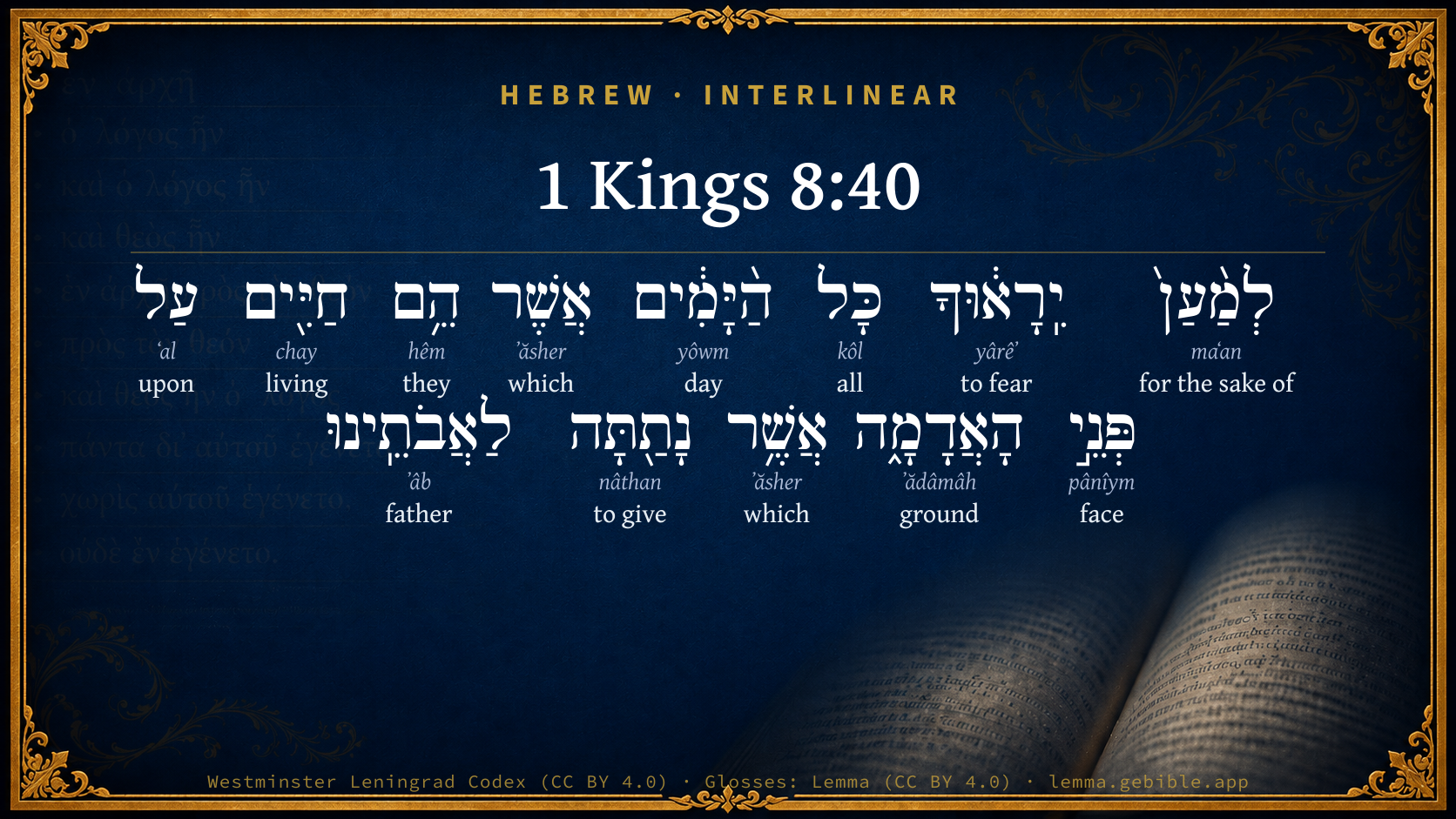
1 Kings 8:40

Hebrew (Westminster Leningrad Codex) 1 Kings 8:40 appears in the Hebrew Old Testament. The text above is from the Westminster Leningrad Codex. Each word links to its Strong’s number, a concise gloss, and parsing drawn from the Open Scriptures Hebrew Bible morphology. Click any word for its full Brown-Driver-Briggs (BDB) entry.
Download image
Cite this verse

1 Kings 8:40 (World English Bible). Public Domain. Lemma interlinear Bible study tool, https://lemma.gebible.app/v/1-kings/8/40.

Show BibTeX & RIS
BibTeX
RIS
English Translation
that they may fear you all the days that they live in the land which you gave to our fathers.
World English Bible · Public Domain
Download a study sheet

One document with this verse’s original text, its word-by-word gloss line, the meaning frame, cross-references with their text, attributed commentary, and full source and license credits — printable, and it pastes into notes with its structure intact.

This verse Autodidact and up

Study sheet (.html) Plain text (.txt)

A passage Seminary Student

Up to 50 verses in one chapter. A passage sheet keeps up to 6 commentary sources and 12 cross-references per verse, in the order this page ranks them, and says so on the sheet whenever that leaves anything out. Ask for a single verse and you get the Autodidact verse sheet above.

Everything on this page stays free to read, with no account — the sheet is a download of what is already on screen, not access to it.

Want to remove ads? Support Godless Engineer
Compare translations 3

The same verse in 3 English versions, stacked beneath the original-language interlinear above. Click any original word for its lexicon entry.

Each is an independent rendering of the whole verse — the interlinear is not word-aligned to these translations.

Highlighted words mark where these versions differ — a whole-verse word diff, not a word-by-word alignment.

  • World English Bible Public Domain
    that they may fear you all the days that they live in the land which you gave to our fathers.
  • King James Version Public Domain
    That they may fear thee all the days that they live in the land which thou gavest unto our fathers.
  • unfoldingWord Literal Text CC BY-SA 4.0
    so that they may fear you all of the days that they alive on the face of the land that you gave to our fathers.

unfoldingWord Literal Text — © unfoldingWord, licensed CC BY-SA 4.0. Word-aligned USFM3 via Door43 (git.door43.org/unfoldingWord/en_ult).

Versions to compare (up to 4)

3 of 4 selected

Show all 18 translations

Every available English version of this verse, each an independent rendering of the whole verse.

  • World English Bible Public Domain
    that they may fear you all the days that they live in the land which you gave to our fathers.
  • Berean Standard Bible Public Domain
    so that they may fear You all the days they live in the land that You gave to our fathers.
  • Majority Standard Bible Public Domain
    so that they may fear You all the days they live in the land that You gave to our fathers.
  • King James Version Public Domain
    That they may fear thee all the days that they live in the land which thou gavest unto our fathers.
  • American Standard Version (1901) Public Domain
    that they may fear thee all the days that they live in the land which thou gavest unto our fathers.
  • Revised Version (1885) Public Domain
    that they may fear thee all the days that they live in the land which thou gavest unto our fathers.
  • Geneva Bible (1599) Public Domain
    That they may feare thee as long as they liue in ye lad, which thou gauest vnto our fathers.
  • Douay-Rheims (1899) Public Domain
    That they may fear thee all the days that they live upon the face of the land, which thou hast given to our fathers.
  • Young's Literal Translation Public Domain
    so that they fear Thee all the days that they are living on the face of the ground that Thou hast given to our fathers.
  • Literal Standard Version CC BY-SA 4.0
    so that they fear You all the days that they are living on the face of the ground that You have given to our fathers.
  • Unlocked Literal Bible CC BY-SA 4.0
    Do this so that they may fear you all the days that they live on the land that you gave to our ancestors.
  • unfoldingWord Literal Text CC BY-SA 4.0
    so that they may fear you all of the days that they alive on the face of the land that you gave to our fathers.
  • Darby Bible Public Domain
    that they may fear thee all the days that they live upon the land which thou gavest unto our fathers.
  • World Messianic Bible Public Domain
    that they may fear you all the days that they live in the land which you gave to our fathers.
  • Webster's Bible Public Domain
    That they may fear thee all the days that they live in the land which thou gavest to our fathers.
  • Free Bible Version CC BY-SA 4.0
    Then they will respect you and follow your ways all the time they live in the land you gave to our forefathers.
  • Bible in Basic English Public Domain
    So that they may give you worship all the days of their life in the land which you gave to our fathers.
  • JPS Tanakh (1917) Public Domain
    that they may fear Thee all the days that they live in the land which Thou gavest unto our fathers.

Literal Standard Version (2020), Covenant Press — licensed CC BY-SA 4.0. Text via the HelloAO Bible API (eBible.org). Unlocked Literal Bible (unfoldingWord) — licensed CC BY-SA 4.0. Text via the HelloAO Bible API (eBible.org). unfoldingWord Literal Text — © unfoldingWord, licensed CC BY-SA 4.0. Word-aligned USFM3 via Door43 (git.door43.org/unfoldingWord/en_ult). Free Bible Version, Dr. Jonathan Gallagher — licensed CC BY-SA 4.0. Text via the HelloAO Bible API (eBible.org).

Word by word

More ways to search: Search by grammar → Find every occurrence → Compare this word →

Practice this passage: Drill this verse → Learn its vocabulary →

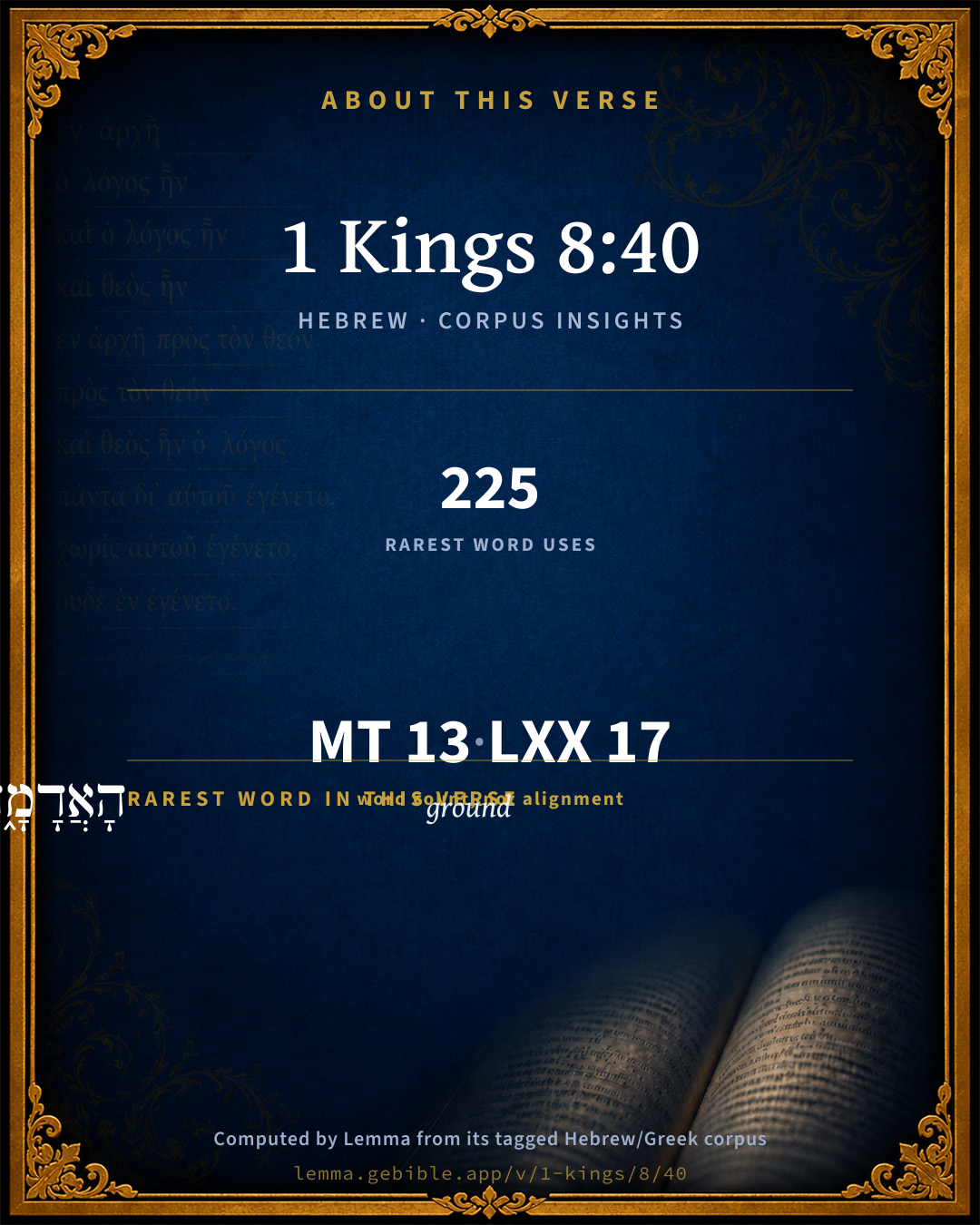
הָאֲדָמָ֑ה
ʼădâmâh
H127
“the · ground”
Particle, Definite Article + Noun, Common, Feminine, Singular, Absolute
Part of Speech
Particle + Noun
Type
Common
Gender
Feminine
Number
Singular
State
Absolute
Full BDB Definition

Origin: from H119

TWOT: 25b

ground, land - ground (as general, tilled, yielding sustenance) - piece of ground, a specific plot of land - earth substance (for building or constructing) - ground as earth's visible surface - land, territory, country - whole inhabited earth - city in Naphtali
  1. לְמַ֨עַן֙ maʻan H4616 “for the sake of” Preposition
  2. יִֽרָא֔וּךָ yârêʼ H3372 “to fear · you” Verb, Qal, Imperfect, 3rd Person, Masculine, Plural + Suffix, Personal, 2nd Person, Masculine, Singular
  3. כָּל kôl H3605 “all of” Noun, Common, Masculine, Singular, Construct
  4. הַ֨יָּמִ֔ים yôwm H3117 “the · days” Particle, Definite Article + Noun, Common, Masculine, Plural, Absolute
  5. אֲשֶׁר ʼăsher H834 “which” Particle, Relative
  6. הֵ֥ם hêm H1992 “they” Pronoun, Personal, 3rd Person, Masculine, Plural
  7. חַיִּ֖ים chay H2416 “living” Adjective, Adjective, Masculine, Plural, Absolute
  8. עַל ʻal H5921 “upon” Preposition
  9. פְּנֵ֣י pânîym H6440 “face(s) of” Noun, Common, Both, Plural, Construct
  10. אֲשֶׁ֥ר ʼăsher H834 “which” Particle, Relative
  11. נָתַ֖תָּה nâthan H5414 “to give” Verb, Qal, Perfect, 2nd Person, Masculine, Singular
  12. לַאֲבֹתֵֽינוּ ʼâb H1 “to/for · fathers · our” Preposition + Noun, Common, Masculine, Plural, Construct + Suffix, Personal, 1st Person, Common, Plural

About this verse

These counts appear in no published source. They are computed here, from the morphology-tagged text and Lemma’s own curated glosses. What Lemma adds →

13
words
12
distinct lemmas
Historical
section

Grammatical profile

  • 2 verbs
  • 5 nouns
  • 1 adjective
  • 1 pronoun
  • 2 prepositions
  • 2 particles

Verb forms

  • יִֽרָא֔וּךָ Qal · Imperfect
  • נָתַ֖תָּה Qal · Perfect

Repetition

A word recurs within this verse — often emphatic in Hebrew:

  • אֲשֶׁר which H834 ×2

Hebrew & Septuagint length

In English translation the verse runs 20 words from the Hebrew and 21 from the Septuagint (LXX English) — closely comparable.

A rough comparison of the two English renderings, which tokenize alike — not a word-level alignment.

Word counts can differ between the Hebrew and the Greek without any difference in meaning — e.g. the Hebrew direct-object marker אֵת has no separate Greek word, and Greek often adds the article ὁ.

In the original languages it is 13 Hebrew tokens and 17 Greek tokens — but the two are counted differently (Hebrew bundles its prefixes and suffixes into one token; the Greek is in lemma form), so that isn’t a like-for-like length.

Cross-references

14

Topical passages linked to 1 Kings 8:40 in the Treasury of Scripture Knowledge — connected by theme and wording, ordered by reader-vote popularity; previews shown in the World English Bible.

  • Psalms 130:4 But there is forgiveness with you, Therefore you are feared.
  • Revelation 19:5 A voice came forth from the throne, saying, "Give praise to our God, all you his servants, you who fear him, the small and the great!"
  • Genesis 22:12 He said, "Don't lay your hand on the boy, neither do anything to him. For now I know that you fear God, seeing you have not withheld your son, your only son, from me."
  • Exodus 20:20 Moses said to the people, "Don't be afraid, for God has come to test you, and that his fear may be before you, that you won't sin."
  • Deuteronomy 6:2 that you might fear Yahweh your God, to keep all his statutes and his commandments, which I command you, you, and your son, and your son's son, all the days of your life; and that your days may be prolonged.
  • Deuteronomy 6:13 You shall fear Yahweh your God; and him shall you serve, and shall swear by his name.
  • 1 Samuel 12:24 Only fear Yahweh, and serve him in truth with all your heart; for consider how great things he has done for you.
  • Psalms 115:13 He will bless those who fear Yahweh, Both small and great.
  • Jeremiah 32:39–40 and I will give them one heart and one way, that they may fear me forever, for the good of them, and of their children after them:
  • Hosea 3:5 Afterward the children of Israel shall return, and seek Yahweh their God, and David their king, and shall come with trembling to Yahweh and to his blessings in the last days.
  • Acts 10:2 a devout man, and one who feared God with all his house, who gave gifts for the needy generously to the people, and always prayed to God.
  • Hebrews 12:28 Therefore, receiving a Kingdom that can't be shaken, let us have grace, through which we serve God acceptably, with reverence and awe,
  • Revelation 15:4 Who wouldn't fear you, Lord, And glorify your name? For you only are holy. For all the nations will come and worship before you. For your righteous acts have been revealed."
  • Acts 9:31 So the assemblies throughout all Judea and Galilee and Samaria had peace, and were built up. They were multiplied, walking in the fear of the Lord and in the comfort of the Holy Spirit.

Cross-references courtesy of OpenBible.info (CC BY 4.0).

Hebrew and Greek witnesses Masoretic Hebrew ↔ Greek Septuagint

The same verse in the two great witnesses to the Old Testament, shown verse-for-verse.

These are two independent witnesses, not word-aligned to each other, and the Septuagint is shown in lemma (dictionary) form.

Hebrew 1 Kings 8:40 Masoretic · Westminster Leningrad Codex

לְמַ֨עַן֙ יִֽרָא֔וּךָ כָּל הַ֨יָּמִ֔ים אֲשֶׁר הֵ֥ם חַיִּ֖ים עַל פְּנֵ֣י הָאֲדָמָ֑ה אֲשֶׁ֥ר נָתַ֖תָּה לַאֲבֹתֵֽינוּ

that they may fear you all the days that they live in the land which you gave to our fathers.

World English Bible · Public Domain

Greek LXX 1 Kings 8:40 Septuagint · lemma form

ὅπως φοβέω σύ πᾶς ὁ ἡμέρα ὅς αὐτός ζάω ἐπί ὁ γῆ ὅς δίδωμι ὁ πατήρ ἐγώ

that they may fear you all the days that they live upon the land, which you have given to our fathers.

LXX2012 (modern English Septuagint) · Public Domain

Hebrew: Westminster Leningrad Codex (CC BY 4.0). Greek: Septuagint (public domain); English from LXX2012 (modern English Septuagint) (Public Domain). How the Septuagint differs from the Hebrew →

Targum (Aramaic paraphrase)

1

The Targum is the ancient Jewish Aramaic paraphrase of the Hebrew Scriptures — an interpretive translation, not the Hebrew text itself. Onkelos (literal) and Pseudo-Jonathan (expansive) render the Torah, and Jonathan the Prophets. Coverage is partial: where no permissively-licensed English translation exists for a verse, only the Aramaic is shown. This is verse-level text, not a word-by-word alignment to the Hebrew.

  1. Targum Jonathan Prophets (Joshua–Malachi)
    בְּדִיל דְיִדְחֲלוּן מִן קֳדָמָךְ כָּל יוֹמַיָא דְאִינוּן קַיָמִין עַל אַפֵּי אַרְעָא דִי יְהַבְתְּ לְאַבְהָתָנָא:

    (no public-domain English translation for this verse)

    Targum Jonathan — Aramaic: “Mikraot Gedolot” (public domain). English: “Sefaria Community Translation” (CC0 1.0 (public-domain dedication)); “London "Chaldee Paraphrase," 1871” (public domain). Text via Sefaria.

Commentary

Notes on 1 Kings 8:40 from classic Christian and Jewish commentators (each source and its license shown beneath its notes). The classic Christian expositions comment on the surrounding passage and are grouped to its opening verse, so a note may address several verses; the Jewish commentaries on the Tanakh (Rashi and others) are per-verse, so they appear only where the commentator wrote on this verse.

Lemma curates 59 commentaries, every one of them public domain or Creative Commons licensed, each selected and text-cleaned for this edition rather than reprinted as found. About our sources →

Trapp's Complete Commentary

John Trapp

1Ki 8:40 That they may fear thee all the days that they live in the land which thou gavest unto our fathers.

Ver. 40. That they may fear thee.] For thy just judgments on hypocrites, and mercies to the sincere. {Psa 130:4 Hos 3:5}

John Trapp, A Commentary or Exposition upon All the Books of the Old and New Testament (1647–1656) — public domain. Text from a community e-Sword module.

The Cambridge Bible for Schools and Colleges

gen. ed. J. J. S. Perowne

40. that they may fear thee] i.e. Being instructed and warned by God’s judgements may cease to offend and in consequence need no more correction. Cf. Psa_130:4. ‘There is forgiveness with thee, that thou mayest be feared.’

The Cambridge Bible for Schools and Colleges (gen. ed. J. J. S. Perowne; Cambridge University Press, 1878–1918) — public domain. Text from a community e-Sword module.

John Gill's Exposition

That they may fear thee,.... For his goodness sake in hearing their prayer, removing their affliction, and bestowing his blessings on them, particularly in forgiving their sins, see Psa 130:4.

all the days that they live in the land which thou gavest unto our fathers; not only for the present, while the mercy is fresh, but all the days of their lives; to which they were the more obliged by the good land they possessed as a divine gift, and which they held by the tenure of their obedience, Isa 1:19.

John Gill's Exposition of the Whole Bible (1746–1763) — public domain (CC PDM 1.0). Text via the HelloAO Bible API.

Matthew Poole's English Annotations

That they may fear thee; that when thou hast first smitten them, and then so eminently delivered them, and that in answer to their prayer, they may hereby be taught to fear thee, and thy justice, and thy goodness.

Matthew Poole's English Annotations on the Holy Bible (1683–1685) — public domain. Text from a community e-Sword/MySword module.

The Pulpit Commentary

That they may fear thee all the days that they live in the land which thou gavest unto their fathers. Solomon anticipates that a godly fear will be the result of forgiveness and restoration. We find the same thought in Psa_130:4. The mercy and goodness of God should lead to repentance, but unhappily it not unseldom fails to do so.

The fifth petition contemplates the prayers which foreigners, attracted by the fame of Jerusalem, of its religion and sanctuary could offer towards the house. The Gentiles who should visit Jerusalem would assuredly, with their polytheistic ideas and their belief in local or tribal deities, invoke the aid and blessing of the mighty God of Jacob. This mention of aliens from the commonwealth of Israel in the prayer of dedication, especially when viewed in the light of the exclusiveness and bigotry which characterized the Jews of later days, is especially to be noticed. As Rawlinson (in loco) observes, "Nothing is more remarkable in the Mosaic law than its liberality with regard to strangers." He then quotes Exo_22:21; Leviticus Deu_10:19 Deu_31:12 Num_15:14-16; and adds: "It is quite in the spirit of these enactments that Solomon, having first prayed God on behalf of his fellow countrymen, should next go on to intercede for the strangers," etc. The intercourse of the Hebrews at this period with foreign nations, and the influence they exercised on the Jewish thought and manners (see Stanley, "Jewish Ch." 2. Leer. 26.), are also to be remembered. These new relations with the stranger would no doubt have widened Solomon"s views.

The Pulpit Commentary (1880–1919), ed. H.D.M. Spence-Jones & Joseph S. Exell — public domain. Text from a community e-Sword module.

Scofield Reference Notes

C. I. Scofield

fear

(See Scofield "Psa 19:9").

The Scofield Reference Bible (1917 edition), notes by C. I. Scofield — public domain. Text from a community e-Sword module.

Lesson kit

Teaching starters — assembled from the data on this page, not authored interpretation. Every prompt links to the verse data it draws on. Edit before teaching.

1 Kings, in the Historical, opens this verse with 13 words (12 distinct Hebrew lemmas). Its most distinctive word is ʼădâmâh (“ground”). A historical commentator’s framing appears above. Read the whole chapter for the surrounding context.

Discussion questions

  1. How does “ground” (ʼădâmâh) shape what this verse is saying?
  2. How does Psalms 130:4, which shares this passage’s theme, read alongside this verse?
  3. What does the repetition of “which” (2× in this one verse) do in this verse?
  4. These translations render this verse differently; the difference is in the English rendering, not the original. What questions does that raise?
  5. «יִֽרָא֔וּךָ» is a Qal Imperfect verb. How does that grammatical form shape the action described?
  6. Compare how Trapp's Complete Commentary and The Cambridge Bible for Schools and Colleges read this verse. Where do they agree or differ?

Things to notice

Reading settings

Reading text

Shown beneath each verse's original-language words.

Old Testament
Old Testament edition

Read the OT as the Masoretic Hebrew (MT) or the Greek Septuagint (LXX).

English shown for the Greek Septuagint (in the Hebrew ↔ Greek comparison).

Comparing translations? Open the Compare panel on any verse page to stack up to four side by side.