
Exodus 38:17

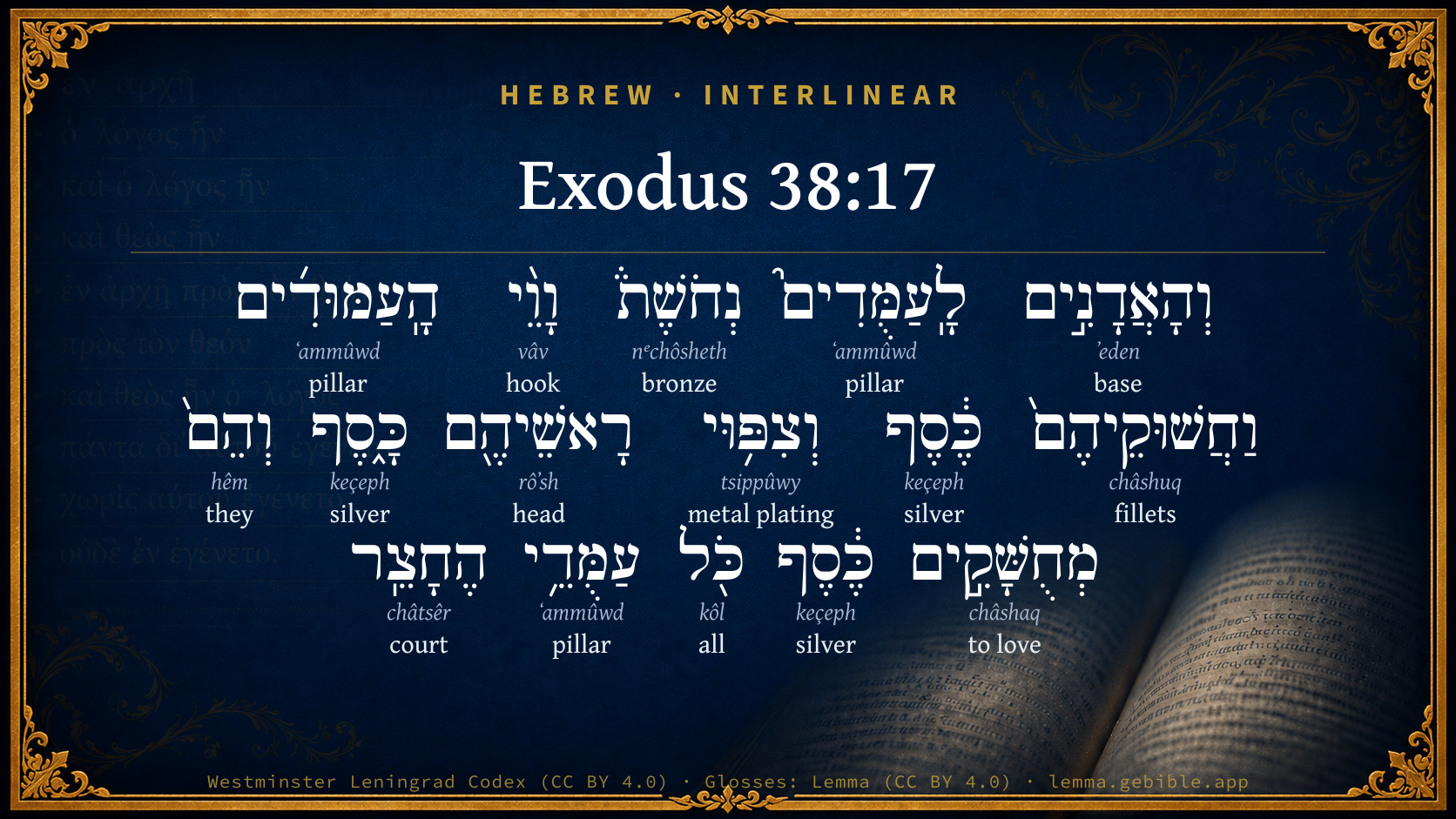
Hebrew (Westminster Leningrad Codex) Exodus 38:17 appears in the Hebrew Old Testament. The text above is from the Westminster Leningrad Codex. Each word links to its Strong’s number, a concise gloss, and parsing drawn from the Open Scriptures Hebrew Bible morphology. Click any word for its full Brown-Driver-Briggs (BDB) entry.
Download image
Cite this verse

Exodus 38:17 (World English Bible). Public Domain. Lemma interlinear Bible study tool, https://lemma.gebible.app/v/exodus/38/17.

Show BibTeX & RIS
BibTeX
RIS
English Translation
The sockets for the pillars were of brass. The hooks of the pillars and their fillets were of silver; and the overlaying of their capitals, of silver; and all the pillars of the court were filleted with silver.
World English Bible · Public Domain
Highlights Full analysis ↓
Download a study sheet

One document with this verse’s original text, its word-by-word gloss line, the meaning frame, cross-references with their text, attributed commentary, and full source and license credits — printable, and it pastes into notes with its structure intact.

This verse Autodidact and up

Study sheet (.html) Plain text (.txt)

A passage Seminary Student

Up to 50 verses in one chapter. A passage sheet keeps up to 6 commentary sources and 12 cross-references per verse, in the order this page ranks them, and says so on the sheet whenever that leaves anything out. Ask for a single verse and you get the Autodidact verse sheet above.

Everything on this page stays free to read, with no account — the sheet is a download of what is already on screen, not access to it.

Want to remove ads? Support Godless Engineer
Compare translations 3

The same verse in 3 English versions, stacked beneath the original-language interlinear above. Click any original word for its lexicon entry.

Each is an independent rendering of the whole verse — the interlinear is not word-aligned to these translations.

Highlighted words mark where these versions differ — a whole-verse word diff, not a word-by-word alignment.

  • World English Bible Public Domain
    The sockets for the pillars were of brass. The hooks of the pillars and their fillets were of silver; and the overlaying of their capitals, of silver; and all the pillars of the court were filleted with silver.
  • King James Version Public Domain
    And the sockets for the pillars were of brass; the hooks of the pillars and their fillets of silver; and the overlaying of their chapiters of silver; and all the pillars of the court were filleted with silver.
  • unfoldingWord Literal Text CC BY-SA 4.0
    And the bases for the pillars bronze. The hooks of the pillars and their rings silver, and the plating of their tops silver. And all of the pillars of the courtyard filleted silver.

unfoldingWord Literal Text — © unfoldingWord, licensed CC BY-SA 4.0. Word-aligned USFM3 via Door43 (git.door43.org/unfoldingWord/en_ult).

Versions to compare (up to 4)

3 of 4 selected

Show all 18 translations

Every available English version of this verse, each an independent rendering of the whole verse.

  • World English Bible Public Domain
    The sockets for the pillars were of brass. The hooks of the pillars and their fillets were of silver; and the overlaying of their capitals, of silver; and all the pillars of the court were filleted with silver.
  • Berean Standard Bible Public Domain
    The bases for the posts were bronze, the hooks and bands were silver, and the plating for the tops of the posts was silver. So all the posts of the courtyard were banded with silver.
  • Majority Standard Bible Public Domain
    The bases for the posts were bronze, the hooks and bands were silver, and the plating for the tops of the posts was silver. So all the posts of the courtyard were banded with silver.
  • King James Version Public Domain
    And the sockets for the pillars were of brass; the hooks of the pillars and their fillets of silver; and the overlaying of their chapiters of silver; and all the pillars of the court were filleted with silver.
  • American Standard Version (1901) Public Domain
    And the sockets for the pillars were of brass; the hooks of the pillars, and their fillets, of silver; and the overlaying of their capitals, of silver; and all the pillars of the court were filleted with silver.
  • Revised Version (1885) Public Domain
    And the sockets for the pillars were of brass; the hooks of the pillars and their fillets of silver; and the overlaying of their chapiters of silver; and all the pillars of the court were filleted with silver.
  • Geneva Bible (1599) Public Domain
    But the sockets of ye pillars were of brasse: the hookes of the pillars and their filets of siluer, and the couering of their chapiters of siluer: and all the pillars of the court were hooped about with siluer.
  • Douay-Rheims (1899) Public Domain
    The sockets of the pillars were of brass, and their heads with all their gravings of silver: and he overlaid the pillars of the court also with silver.
  • Young's Literal Translation Public Domain
    and the sockets for the pillars of brass, the pegs of the pillars and their fillets of silver, and the overlaying of their tops of silver, and all the pillars of the court are filleted with silver.
  • Literal Standard Version CC BY-SA 4.0
    and the sockets for the pillars of bronze, the pegs of the pillars and their fillets of silver, and the overlaying of their tops of silver, and all the pillars of the court are filleted with silver.
  • Unlocked Literal Bible CC BY-SA 4.0
    The bases for the posts were made of bronze. The hooks and rods for the posts were made of silver, and the covering for the tops of the posts was also made of silver. All the courtyard posts were covered with silver.
  • unfoldingWord Literal Text CC BY-SA 4.0
    And the bases for the pillars bronze. The hooks of the pillars and their rings silver, and the plating of their tops silver. And all of the pillars of the courtyard filleted silver.
  • Darby Bible Public Domain
    and the bases of the pillars of copper, the hooks of the pillars and their connecting-rods of silver, and the overlaying of their capitals of silver; and all the pillars of the court were fastened together with [rods of] silver.
  • World Messianic Bible Public Domain
    The sockets for the pillars were of bronze. The hooks of the pillars and their fillets were of silver. Their capitals were overlaid with silver. All the pillars of the court had silver bands.
  • Webster's Bible Public Domain
    And the sockets for the pillars were of brass; the hooks of the pillars, and their fillets, of silver; and the overlaying of their capitals of silver; and all the pillars of the court were filleted with silver.
  • Free Bible Version CC BY-SA 4.0
    The stands for the posts were bronze, the hooks and bands were silver, and the tops of the posts were covered with silver. All the posts around the courtyard had silver bands.
  • Bible in Basic English Public Domain
    And the bases of the pillars were of brass; their hooks and the bands round the tops of them were of silver; all the pillars were ringed with silver.
  • JPS Tanakh (1917) Public Domain
    And the sockets for the pillars were of brass; the hooks of the pillars and their fillets of silver; and the overlaying of their capitals of silver; and all the pillars of the court were filleted with silver.

Literal Standard Version (2020), Covenant Press — licensed CC BY-SA 4.0. Text via the HelloAO Bible API (eBible.org). Unlocked Literal Bible (unfoldingWord) — licensed CC BY-SA 4.0. Text via the HelloAO Bible API (eBible.org). unfoldingWord Literal Text — © unfoldingWord, licensed CC BY-SA 4.0. Word-aligned USFM3 via Door43 (git.door43.org/unfoldingWord/en_ult). Free Bible Version, Dr. Jonathan Gallagher — licensed CC BY-SA 4.0. Text via the HelloAO Bible API (eBible.org).

Word by word

More ways to search: Search by grammar → Find every occurrence → Compare this word →

Practice this passage: Drill this verse → Learn its vocabulary →

וְצִפּ֥וּי
tsippûwy
H6826
“and · metal plating of”
Conjunction + Noun, Common, Masculine, Singular, Construct
Part of Speech
Conjunction + Noun
Type
Common
Gender
Masculine
Number
Singular
State
Construct
Full BDB Definition

Origin: from H6823

TWOT: 1951a

plating (of metal), metal plating
  1. וְהָאֲדָנִ֣ים ʼeden H134 “and · the · bases” Conjunction + Particle, Definite Article + Noun, Common, Masculine, Plural, Absolute
  2. לָֽעַמֻּדִים֮ ʻammûwd H5982 “to/for the · pillars” Preposition, Determined + Noun, Common, Masculine, Plural, Absolute
  3. נְחֹשֶׁת֒ nᵉchôsheth H5178 “bronze” Noun, Common, Feminine, Singular, Absolute
  4. וָוֵ֨י vâv H2053 “hooks of” Noun, Common, Masculine, Plural, Construct
  5. הָֽעַמּוּדִ֜ים ʻammûwd H5982 “the · pillars” Particle, Definite Article + Noun, Common, Masculine, Plural, Absolute
  6. וַחֲשׁוּקֵיהֶם֙ châshuq H2838 “and · fillets · their” Conjunction + Noun, Common, Masculine, Plural, Construct + Suffix, Personal, 3rd Person, Masculine, Plural
  7. כֶּ֔סֶף keçeph H3701 “silver” Noun, Common, Masculine, Singular, Absolute
  8. רָאשֵׁיהֶ֖ם rôʼsh H7218 “heads · their” Noun, Common, Masculine, Plural, Construct + Suffix, Personal, 3rd Person, Masculine, Plural
  9. כָּ֑סֶף keçeph H3701 “silver” Noun, Common, Masculine, Singular, Absolute
  10. וְהֵם֙ hêm H1992 “and · they” Conjunction + Pronoun, Personal, 3rd Person, Masculine, Plural
  11. מְחֻשָּׁקִ֣ים châshaq H2836 “loved” Verb, Pual, Participle Passive, Masculine, Plural, Absolute
  12. כֶּ֔סֶף keçeph H3701 “silver” Noun, Common, Masculine, Singular, Absolute
  13. כֹּ֖ל kôl H3605 “all of” Noun, Common, Masculine, Singular, Construct
  14. עַמֻּדֵ֥י ʻammûwd H5982 “pillars of” Noun, Common, Masculine, Plural, Construct
  15. הֶחָצֵֽר châtsêr H2691 “the · court” Particle, Definite Article + Noun, Common, Both, Singular, Absolute

About this verse

These counts appear in no published source. They are computed here, from the morphology-tagged text and Lemma’s own curated glosses. What Lemma adds →

16
words
12
distinct lemmas
Pentateuch
section

Notable vocabulary

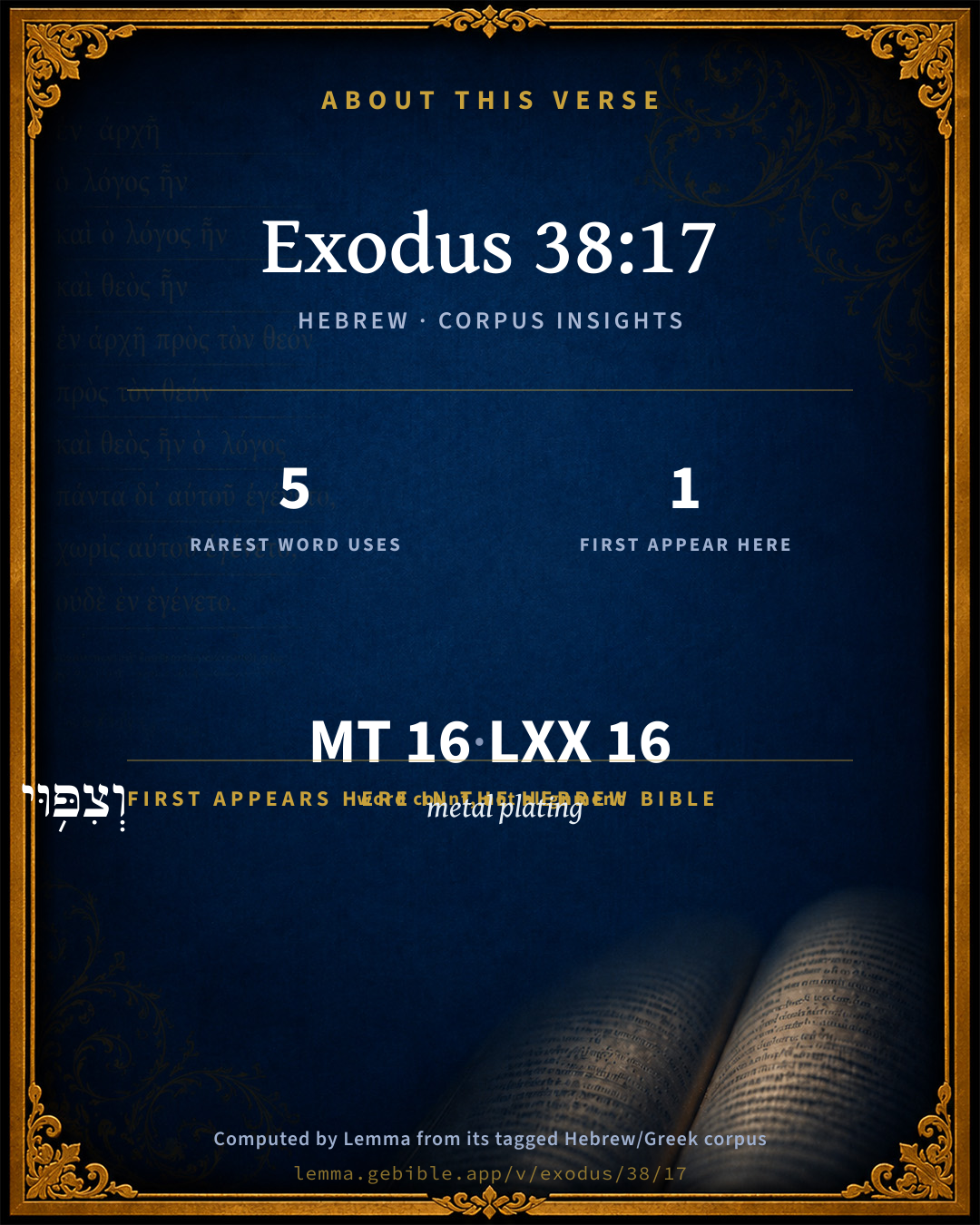
The rarest word here is וְצִפּ֥וּי metal plating H6826 — appearing just 5 times in the whole Hebrew Bible.

First appearance in Scripture

This word makes its first canonical appearance in the Hebrew Bible here:

  • וְצִפּ֥וּי metal plating H6826

Shared distinctive vocabulary

וְצִפּ֥וּי metal plating H6826 occurs in 5 verses of the Hebrew Bible. Also found in:

Grammatical profile

  • 1 verb
  • 14 nouns
  • 1 pronoun

Verb forms

  • מְחֻשָּׁקִ֣ים Pual · Participle Passive

Repetition

Words recur within this verse — often emphatic in Hebrew:

  • לָֽעַמֻּדִים֮ pillar H5982 ×3
  • כֶּ֔סֶף silver H3701 ×3

Hebrew & Septuagint length

In English translation the verse runs 38 words from the Hebrew and 15 from the Septuagint (LXX English) — the Septuagint runs noticeably shorter here. See the side-by-side →

A rough comparison of the two English renderings, which tokenize alike — not a word-level alignment.

Word counts can differ between the Hebrew and the Greek without any difference in meaning — e.g. the Hebrew direct-object marker אֵת has no separate Greek word, and Greek often adds the article ὁ.

In the original languages it is 16 Hebrew tokens and 16 Greek tokens — but the two are counted differently (Hebrew bundles its prefixes and suffixes into one token; the Greek is in lemma form), so that isn’t a like-for-like length.

Hebrew and Greek witnesses Masoretic Hebrew ↔ Greek Septuagint

The same verse in the two great witnesses to the Old Testament, shown verse-for-verse.

Here the Septuagint runs noticeably shorter than the Hebrew — LXX2012 (modern English Septuagint) 15 words vs World English Bible 38. A rough length comparison of the two English translations, not a word-level alignment — read both below.

These are two independent witnesses, not word-aligned to each other, and the Septuagint is shown in lemma (dictionary) form.

Hebrew Exodus 38:17 Masoretic · Westminster Leningrad Codex

וְהָאֲדָנִ֣ים לָֽעַמֻּדִים֮ נְחֹשֶׁת֒ וָוֵ֨י הָֽעַמּוּדִ֜ים וַחֲשׁוּקֵיהֶם֙ כֶּ֔סֶף וְצִפּ֥וּי רָאשֵׁיהֶ֖ם כָּ֑סֶף וְהֵם֙ מְחֻשָּׁקִ֣ים כֶּ֔סֶף כֹּ֖ל עַמֻּדֵ֥י הֶחָצֵֽר

The sockets for the pillars were of brass. The hooks of the pillars and their fillets were of silver; and the overlaying of their capitals, of silver; and all the pillars of the court were filleted with silver.

World English Bible · Public Domain

Greek LXX Exodus 38:17 Septuagint · lemma form

καί ἑπτά λύχνος ἐπί αὐτός χρυσοῦς καί ὁ λαβίς αὐτός χρυσοῦς καί ὁ ἐπαρυστρίς αὐτός χρυσοῦς

And on the candlestick seven golden lamps, and its snuffers gold, and its funnels gold.

LXX2012 (modern English Septuagint) · Public Domain

Hebrew: Westminster Leningrad Codex (CC BY 4.0). Greek: Septuagint (public domain); English from LXX2012 (modern English Septuagint) (Public Domain). How the Septuagint differs from the Hebrew →

Targum (Aramaic paraphrase)

2

The Targum is the ancient Jewish Aramaic paraphrase of the Hebrew Scriptures — an interpretive translation, not the Hebrew text itself. Onkelos (literal) and Pseudo-Jonathan (expansive) render the Torah, and Jonathan the Prophets. Coverage is partial: where no permissively-licensed English translation exists for a verse, only the Aramaic is shown. This is verse-level text, not a word-by-word alignment to the Hebrew.

  1. Targum Onkelos Torah (Genesis–Deuteronomy)
    וְסַמְכַיָא לְעַמוּדַיָא נְחָשָׁא וָוֵי עַמוּדַיָא וְכִבּוּשֵׁיהוֹן דִכְסַף וְחִפּוּי רֵישֵׁיהוֹן דִכְסָף וְאִנוּן מְכַבְּשִׁין דִכְסָף כָּל עַמוּדֵי דַרְתָּא:

    (no public-domain English translation for this verse)

    Targum Onkelos — Aramaic: “Onkelos Genesis” (public domain); “Onkelos Exodus” (public domain); “Onkelos Leviticus” (public domain); “Onkelos Numbers” (public domain); “Onkelos Deuteronomy” (public domain). English: “Sefaria Community Translation” (CC0 1.0 (public-domain dedication)); “J.W. Etheridge. The Targums of Onkelos and Jonathan Ben Uzziel on the Pentateuch. London: Longmans, Green, 1862” (public domain). Text via Sefaria.

  2. Targum Pseudo-Jonathan Torah (Genesis–Deuteronomy)
    וְחוֹמְרַיָא לַעֲמוּדַיָא דִנְחָשָׁא וָוֵי עַמּוּדַיָא וְכִבּוּשֵׁיהוֹן כְּסַף וְחִפּוּי רֵישֵׁיהוֹן כְּסָף וְהִינוּן מְכַבְּשִׁין כְּסַף הֵיכְדֵין הֲווֹ מִתְעַבְּדִין כָּל עַמּוּדֵי דָרְתָא

    And the bases of the pillars were of brass, the hooks of the pillars and their rods of silver, and the overlaying of their capitals silver, and the rods silver; so were made all the pillars of the court.

    Targum Pseudo-Jonathan — Aramaic: “Targum Jonathan on Genesis” (public domain); “Targum Jonathan on Exodus” (public domain); “Targum Jonathan on Leviticus” (public domain); “Targum Jonathan on Numbers” (public domain); “Targum Jonathan on Deuteronomy” (public domain). English: “The Targum of Jonathan ben Uzziel, trans. J. W. Etheridge, London, 1862” (public domain). Text via Sefaria.

Commentary

Notes on Exodus 38:17 from classic Christian and Jewish commentators (each source and its license shown beneath its notes). The classic Christian expositions comment on the surrounding passage and are grouped to its opening verse, so a note may address several verses; the Jewish commentaries on the Tanakh (Rashi and others) are per-verse, so they appear only where the commentator wrote on this verse.

Lemma curates 59 commentaries, every one of them public domain or Creative Commons licensed, each selected and text-cleaned for this edition rather than reprinted as found. About our sources →

unfoldingWord translationNotes

Door43 World Missions Community

The bases ... courtyard were made of bronze

For Exo 38:17-20, see how you translated many of these words in Exodus 27:16 and Exodus 27:17-19.

The bases for the posts were made of bronze

This can be stated in active form. AT: "Bezalel and the workers made the bases for the posts out of bronze" (See: Active or Passive)

The hooks and rods for the posts were made of silver, and the covering for the tops of the posts was also made of silver

This can be stated in active form. AT: "They made the hooks, the rods for the posts, and the covering for the tops of the posts out of silver" (See: Active or Passive)

All the courtyard posts were covered with silver

This can be stated in active form. AT: "They covered the courtyard posts with silver" (See: Active or Passive)

twenty ... five ... four

"20 ... 5 ... 4" (See: Numbers)

cubits

A cubit is 46 centimeters. (See: Biblical Distance)

The curtain was made of

This can be stated in active form. "They made the curtain out of" (See: Active or Passive)

The covering for their tops and its rods were made of silver

This can be stated in active form. AT: "They made the covering for the tops of the posts and their rods out of silver" (See: Active or Passive)

All the tent pegs for the tabernacle and courtyard were made of bronze

This can be stated in active form. AT: "They made all of the tent pegs for the tabernacle and courtyard out of bronze" (See: Active or Passive)

translationWords

bronze

silver

court

tent

tabernacle

unfoldingWord translationNotes — © Distant Shores Media and the Door43 World Missions Community, licensed CC BY-SA 4.0. Source: git.door43.org/Door43/en_tn.

Jamieson, Fausset & Brown

Robert Jamieson, A. R. Fausset & David Brown

chapiters--or capitals of the pillars, were wooden posts which ran along their top, to which were attached the hooks for the hangings.

Jamieson, Fausset & Brown — Commentary Critical and Explanatory on the Whole Bible (1871) — public domain (CC PDM 1.0). Text via the HelloAO Bible API.

Adam Clarke's Commentary

Verse 17. The hooks - and their fillets] The capitals, and the silver bands that went round them; See Clarke on Ex 26:32.

Adam Clarke's Commentary on the Bible (1810–1826) — public domain. Text from a community e-Sword/MySword module.

Ellicott's Commentary for English Readers

(17) The overlaying of their chapiters of silver.—Just as in Exo_36:38, we are informed that Moses, travelling beyond the letter of his instructions, overlaid the capitals of the pillars at the door of the Tabernacle itself with gold, so now we find that, without any express orders, he overlaid those at the door of the court with silver. In each case he was probably following his remembrance of the pattern seen in the mount (Exo_25:9; Exo_25:40).

A Bible Commentary for English Readers, edited by Charles John Ellicott (1878–1897) — public domain. Text from a community e-Sword module.

The Cambridge Bible for Schools and Colleges

gen. ed. J. J. S. Perowne

17. Expanded from Exo_27:17.

the hooks of the pillars and their fillets of silver] Sam. their hooks of silver (Exo_27:17), relieving the tautology with the last clause of the verse.

their chapiters] not mentioned in Exo_27:17.

The Cambridge Bible for Schools and Colleges (gen. ed. J. J. S. Perowne; Cambridge University Press, 1878–1918) — public domain. Text from a community e-Sword module.

Haydock's Catholic Bible Commentary

The, &c. Some render the Hebrew, "The bases of the pillars were of brass, the hooks of the pillars and circles were of silver, their chaptrels were covered with silver." Bonfrere supposes that the pillars were of the Ionic order, and that the chaptrels here designate the summit or abacus; while the hooks (vuim) mean the voluta, (Menochius) or bolster, representing the head-dress of virgins in their long hair. (Vitruvius.) (Haydock)

George Leo Haydock (1774–1849), Haydock's Catholic Family Bible and Commentary, 1859 edition — public domain. Excludes Psalms (Douay-Rheims chapter numbering differs from Protestant) and Deuterocanonical books (Catholic canon only).

The Pulpit Commentary

The overlaying of their chapiters of silver. This is additional to what is recorded in ch. 27, and is parallel to what we find related of the tabernacle pillars in Exo_36:38. Filleted with silver. Rather, "connected with silver rods." Compare Exo_27:17.

The Pulpit Commentary (1880–1919), ed. H.D.M. Spence-Jones & Joseph S. Exell — public domain. Text from a community e-Sword module.

Lesson kit

Teaching starters — assembled from the data on this page, not authored interpretation. Every prompt links to the verse data it draws on. Edit before teaching.

Exodus, in the Pentateuch, opens this verse with 16 words (12 distinct Hebrew lemmas). Its most distinctive word is tsippûwy (“metal plating”). The Greek Septuagint runs shorter here. A historical commentator’s framing appears above. Read the whole chapter for the surrounding context.

Discussion questions

  1. What does “metal plating” (tsippûwy) contribute to the verse as a whole?
  2. This is the first place “metal plating” appears in Scripture (first appears here). What does its debut here establish?
  3. How does Exodus 38:19, which shares the word «metal plating», read alongside this verse?
  4. What does the repetition of “pillar” (3× in this one verse) do in this verse?
  5. The Septuagint runs shorter here than the Hebrew. What might account for the difference?
  6. The translations on this page render this verse differently — a whole-verse word diff, not a word-by-word alignment. What might account for the different wordings?
  7. «מְחֻשָּׁקִ֣ים» is a Pual Participle Passive verb. How does that grammatical form shape the action described?
  8. Compare how unfoldingWord translationNotes and Jamieson, Fausset & Brown read this verse. Where do they agree or differ?

Things to notice

Reading settings

Reading text

Shown beneath each verse's original-language words.

Old Testament
Old Testament edition

Read the OT as the Masoretic Hebrew (MT) or the Greek Septuagint (LXX).

English shown for the Greek Septuagint (in the Hebrew ↔ Greek comparison).

Comparing translations? Open the Compare panel on any verse page to stack up to four side by side.