
1 Samuel 26:19

Hebrew (Westminster Leningrad Codex) 1 Samuel 26:19 appears in the Hebrew Old Testament. The text above is from the Westminster Leningrad Codex. Each word links to its Strong’s number, a concise gloss, and parsing drawn from the Open Scriptures Hebrew Bible morphology. Click any word for its full Brown-Driver-Briggs (BDB) entry.
Download image
Cite this verse

1 Samuel 26:19 (World English Bible). Public Domain. Lemma interlinear Bible study tool, https://lemma.gebible.app/v/1-samuel/26/19.

Show BibTeX & RIS
BibTeX
RIS
English Translation
Now therefore, please let my lord the king hear the words of his servant. If it be Yahweh that has stirred you up against me, let him accept an offering: but if it be the children of men, cursed be they before Yahweh: for they have driven me out this day that I shouldn't cling to Yahweh's inheritance, saying, Go, serve other gods.
World English Bible · Public Domain
Download a study sheet

One document with this verse’s original text, its word-by-word gloss line, the meaning frame, cross-references with their text, attributed commentary, and full source and license credits — printable, and it pastes into notes with its structure intact.

This verse Autodidact and up

Study sheet (.html) Plain text (.txt)

A passage Seminary Student

Up to 50 verses in one chapter. A passage sheet keeps up to 6 commentary sources and 12 cross-references per verse, in the order this page ranks them, and says so on the sheet whenever that leaves anything out. Ask for a single verse and you get the Autodidact verse sheet above.

Everything on this page stays free to read, with no account — the sheet is a download of what is already on screen, not access to it.

Want to remove ads? Support Godless Engineer
Compare translations 3

The same verse in 3 English versions, stacked beneath the original-language interlinear above. Click any original word for its lexicon entry.

Each is an independent rendering of the whole verse — the interlinear is not word-aligned to these translations.

Highlighted words mark where these versions differ — a whole-verse word diff, not a word-by-word alignment.

  • World English Bible Public Domain
    Now therefore, please let my lord the king hear the words of his servant. If it be Yahweh that has stirred you up against me, let him accept an offering: but if it be the children of men, cursed be they before Yahweh: for they have driven me out this day that I shouldn't cling to Yahweh's inheritance, saying, Go, serve other gods.
  • King James Version Public Domain
    Now therefore, I pray thee, let my lord the king hear the words of his servant. If the LORD have stirred thee up against me, let him accept an offering: but if they be the children of men, cursed be they before the LORD; for they have driven me out this day from abiding in the inheritance of the LORD, saying, Go, serve other gods.
  • unfoldingWord Literal Text CC BY-SA 4.0
    And now, may my lord the king please hear the words of his servant. If Yahweh has incited you against me, may he smell an offering. But if sons of man, may they be cursed to the face of Yahweh. For they have driven me out today from joining myself with the inheritance of Yahweh, saying, ‘Go, serve other gods.’

unfoldingWord Literal Text — © unfoldingWord, licensed CC BY-SA 4.0. Word-aligned USFM3 via Door43 (git.door43.org/unfoldingWord/en_ult).

Versions to compare (up to 4)

3 of 4 selected

Show all 18 translations

Every available English version of this verse, each an independent rendering of the whole verse.

  • World English Bible Public Domain
    Now therefore, please let my lord the king hear the words of his servant. If it be Yahweh that has stirred you up against me, let him accept an offering: but if it be the children of men, cursed be they before Yahweh: for they have driven me out this day that I shouldn't cling to Yahweh's inheritance, saying, Go, serve other gods.
  • Berean Standard Bible Public Domain
    Now please, may my lord the king hear the words of his servant: If the LORD has stirred you up against me, then may He accept an offering. But if men have done it, may they be cursed in the presence of the LORD! For today they have driven me away from sharing in the inheritance of the LORD, saying, ‘Go, serve other gods.’
  • Majority Standard Bible Public Domain
    Now please, may my lord the king hear the words of his servant: If the LORD has stirred you up against me, then may He accept an offering. But if men have done it, may they be cursed in the presence of the LORD! For today they have driven me away from sharing in the inheritance of the LORD, saying, ‘Go, serve other gods.’
  • King James Version Public Domain
    Now therefore, I pray thee, let my lord the king hear the words of his servant. If the LORD have stirred thee up against me, let him accept an offering: but if they be the children of men, cursed be they before the LORD; for they have driven me out this day from abiding in the inheritance of the LORD, saying, Go, serve other gods.
  • American Standard Version (1901) Public Domain
    Now therefore, I pray thee, let my lord the king hear the words of his servant. If it be Jehovah that hath stirred thee up against me, let him accept an offering: but if it be the children of men, cursed be they before Jehovah: for they have driven me out this day that I should not cleave unto the inheritance of Jehovah, saying, Go, serve other gods.
  • Revised Version (1885) Public Domain
    Now therefore, I pray thee, let my lord the king hear the words of his servant. If it be the LORD that hath stirred thee up against me, let him accept an offering: but if it be the children of men, cursed be they before the LORD; for they have driven me out this day that I should not cleave unto the inheritance of the LORD, saying, Go, serve other gods.
  • Geneva Bible (1599) Public Domain
    Now therefore, I beseech thee, let my lord the King heare the wordes of his seruant. If the Lord haue stirred thee vp against me, let him smell the sauour of a sacrifice: but if the children of men haue done it, cursed be they before the Lord: for they haue cast me out this day from abiding in the inheritance of the Lord, saying, Goe, serue other gods.
  • Douay-Rheims (1899) Public Domain
    Now therefore hear, I pray thee, my lord the king, the words of thy servant: If the Lord stir thee up against me, let him accept of sacrifice: but if the sons of men, they are cursed in the sight of the Lord, who have cast me out this day, that I should not dwell in the inheritance of the Lord, saying: Go, serve strange gods.
  • Young's Literal Translation Public Domain
    And, now, let, I pray thee, my lord the king hear the words of his servant: if Jehovah hath moved thee against me, let Him accept a present; and if the sons of men -- cursed `are' they before Jehovah, for they have cast me out to-day from being admitted into the inheritance of Jehovah, saying, Go, serve other gods.
  • Literal Standard Version CC BY-SA 4.0
    And now, please let my lord the king hear the words of his servant: if YHWH has moved you against me, let Him accept a present; but if [merely] the sons of men, they [are] cursed before YHWH, for today they have cast me out from being admitted into the inheritance of YHWH, saying, Go, serve other gods.
  • Unlocked Literal Bible CC BY-SA 4.0
    Now therefore, I beg you, let my master the king listen to the words of his servant. If it is Yahweh who has stirred you up against me, let him accept an offering; but if it is human beings, may they be cursed in the sight of Yahweh, for they have today driven me out, that I should not cling to the inheritance of Yahweh; they have said to me, 'Go worship other gods.'
  • unfoldingWord Literal Text CC BY-SA 4.0
    And now, may my lord the king please hear the words of his servant. If Yahweh has incited you against me, may he smell an offering. But if sons of man, may they be cursed to the face of Yahweh. For they have driven me out today from joining myself with the inheritance of Yahweh, saying, ‘Go, serve other gods.’
  • Darby Bible Public Domain
    And now, I pray thee, let my lord the king hear the words of his servant. If Jehovah have moved thee against me, let him accept an oblation; but if the sons of men, cursed be they before Jehovah; for they have driven me out this day from adhering to the inheritance of Jehovah, saying, Go, serve other gods.
  • World Messianic Bible Public Domain
    Now therefore, please let my lord the king hear the words of his servant. If it is so that the LORD has stirred you up against me, let him accept an offering. But if it is the children of men, they are cursed before the LORD; for they have driven me out today that I shouldn’t cling to the LORD’s inheritance, saying, ‘Go, serve other gods!’
  • Webster's Bible Public Domain
    Now therefore, I pray thee, let my lord the king hear the words of his servant. If the LORD hath stirred thee up against me, let him accept an offering: but if they are the children of men, cursed be they before the LORD; for they have driven me out this day from abiding in the inheritance of the LORD, saying, Go, serve other gods.
  • Free Bible Version CC BY-SA 4.0
    “Please listen to me, my lord and king. If the Lord has made you angry with me, then may he be happy to accept an offering. But if it's men that have done it, may they be cursed before the Lord for all this. They've been driving me away from living among God's chosen people, telling me, ‘Go away and worship other gods.’
  • Bible in Basic English Public Domain
    Let my lord the king give ear now to the words of his servant. If it is the Lord who is moving you against me, let him take an offering: but if it is the children of men, may they be cursed before the Lord, for driving me out today and keeping me from my place in the heritage of the Lord, saying, Go, be the servant of other gods.
  • JPS Tanakh (1917) Public Domain
    Now therefore, I pray thee, let my lord the king hear the words of his servant. If it be the LORD that hath stirred thee up against me, let Him accept an offering; but if it be the children of men, cursed be they before the LORD; for they have driven me out this day that I should not cleave unto the inheritance of the LORD, saying: Go, serve other gods.

Literal Standard Version (2020), Covenant Press — licensed CC BY-SA 4.0. Text via the HelloAO Bible API (eBible.org). Unlocked Literal Bible (unfoldingWord) — licensed CC BY-SA 4.0. Text via the HelloAO Bible API (eBible.org). unfoldingWord Literal Text — © unfoldingWord, licensed CC BY-SA 4.0. Word-aligned USFM3 via Door43 (git.door43.org/unfoldingWord/en_ult). Free Bible Version, Dr. Jonathan Gallagher — licensed CC BY-SA 4.0. Text via the HelloAO Bible API (eBible.org).

Word by word

More ways to search: Search by grammar → Find every occurrence → Compare this word →

Practice this passage: Drill this verse → Learn its vocabulary →

מֵהִסְתַּפֵּ֜חַ
çâphach
H5596
“from · to join”
Preposition + Verb, Hithpael, Infinitive Construct
Part of Speech
Preposition + Verb
Stem
Hithpael
Form
Infinitive Construct
Full BDB Definition

Origin: a primitive root

TWOT: 1532 , 1534

to join, attach to, join together - (Qal) to join, attach to - (Niphal) to attach oneself - (Piel) joining (participle) - (Pual) to be joined together, hold oneself together - (Hithpael) to join oneself - (Piel) to cause a scab upon, smite with scab
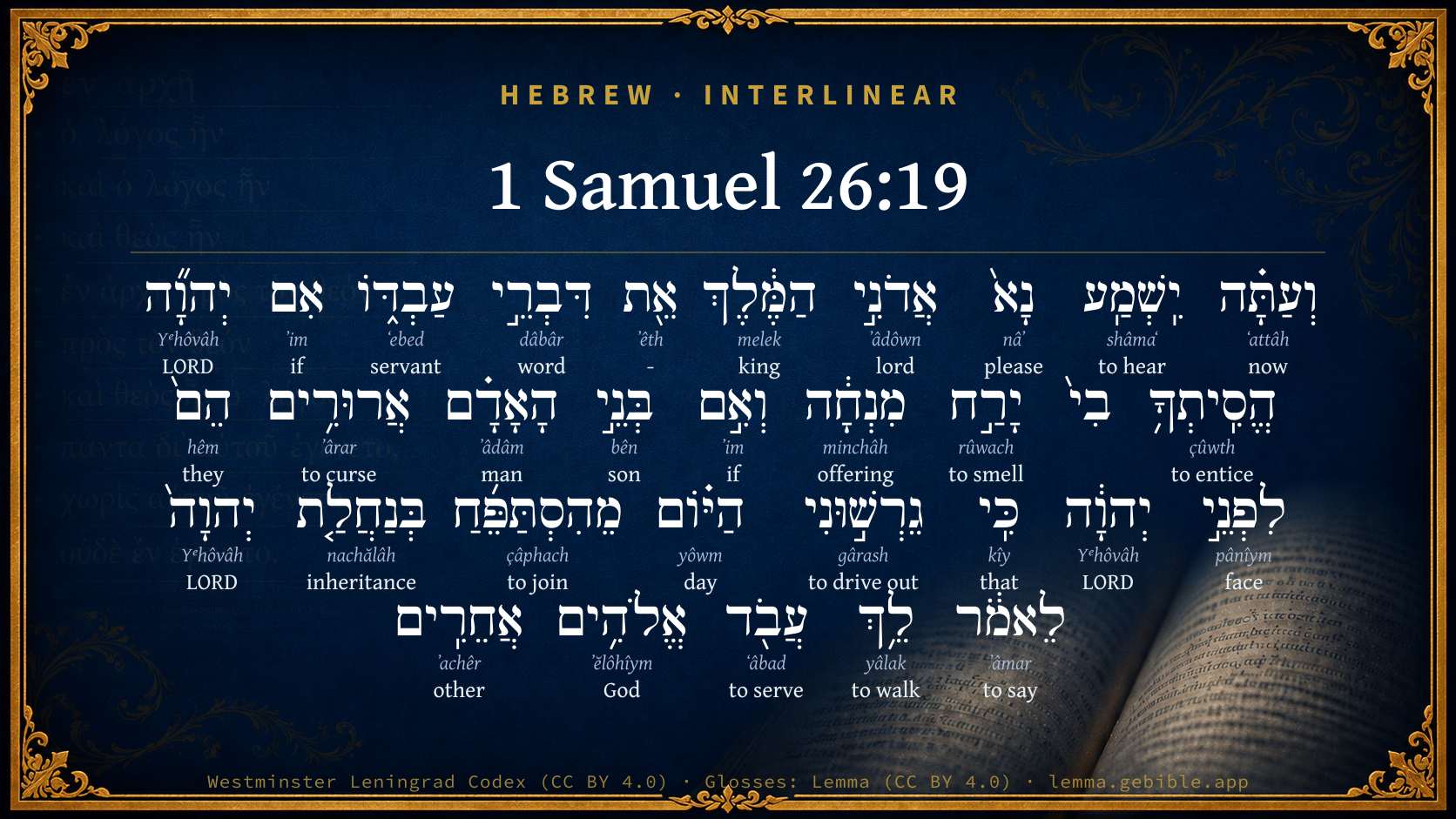
  1. וְעַתָּ֗ה ʻattâh H6258 “and · now” Conjunction + Adverb
  2. יִֽשְׁמַֽע shâmaʻ H8085 “to hear” Verb, Qal, Jussive, 3rd Person, Masculine, Singular
  3. נָא֙ nâʼ H4994 “please” Particle, Exhortation
  4. אֲדֹנִ֣י ʼâdôwn H113 “lord · my” Noun, Common, Masculine, Singular, Construct + Suffix, Personal, 1st Person, Common, Singular
  5. הַמֶּ֔לֶךְ melek H4428 “the · king” Particle, Definite Article + Noun, Common, Masculine, Singular, Absolute
  6. אֵ֖ת ʼêth H853 “-” Particle, Direct Object
  7. דִּבְרֵ֣י dâbâr H1697 “words of” Noun, Common, Masculine, Plural, Construct
  8. עַבְדּ֑וֹ ʻebed H5650 “servant · his” Noun, Common, Masculine, Singular, Construct + Suffix, Personal, 3rd Person, Masculine, Singular
  9. אִם ʼim H518 “if” Conjunction
  10. יְהוָ֞ה Yᵉhôvâh H3068 “LORD” Noun, Proper
  11. הֱסִֽיתְךָ֥ çûwth H5496 “to entice · you” Verb, Hiphil, Perfect, 3rd Person, Masculine, Singular + Suffix, Personal, 2nd Person, Masculine, Singular
  12. יָרַ֣ח rûwach H7306 “to smell” Verb, Hiphil, Imperfect, 3rd Person, Masculine, Singular
  13. מִנְחָ֔ה minchâh H4503 “offering” Noun, Common, Feminine, Singular, Absolute
  14. וְאִ֣ם ʼim H518 “and · if” Conjunction + Conjunction
  15. בְּנֵ֣י bên H1121 “sons of” Noun, Common, Masculine, Plural, Construct
  16. הָאָדָ֗ם ʼâdâm H120 “the · man” Particle, Definite Article + Noun, Common, Masculine, Singular, Absolute
  17. אֲרוּרִ֥ים ʼârar H779 “cursed” Verb, Qal, Participle Passive, Masculine, Plural, Absolute
  18. הֵם֙ hêm H1992 “they” Pronoun, Personal, 3rd Person, Masculine, Plural
  19. לִפְנֵ֣י pânîym H6440 “to/for · face(s) of” Preposition + Noun, Common, Both, Plural, Construct
  20. יְהוָ֔ה Yᵉhôvâh H3068 “LORD” Noun, Proper
  21. כִּֽי kîy H3588 “that” Conjunction
  22. גֵרְשׁ֣וּנִי gârash H1644 “to drive out · me” Verb, Piel, Perfect, 3rd Person, Common, Plural + Suffix, Personal, 1st Person, Common, Singular
  23. הַיּ֗וֹם yôwm H3117 “the · day” Particle, Definite Article + Noun, Common, Masculine, Singular, Absolute
  24. בְּנַחֲלַ֤ת nachălâh H5159 “in/at · inheritance of” Preposition + Noun, Common, Feminine, Singular, Construct
  25. יְהוָה֙ Yᵉhôvâh H3068 “LORD” Noun, Proper
  26. לֵאמֹ֔ר ʼâmar H559 “to say” Preposition + Verb, Qal, Infinitive Construct
  27. לֵ֥ךְ yâlak H3212 “walk” Verb, Qal, Imperative, 2nd Person, Masculine, Singular
  28. עֲבֹ֖ד ʻâbad H5647 “serve” Verb, Qal, Imperative, 2nd Person, Masculine, Singular
  29. אֱלֹהִ֥ים ʼĕlôhîym H430 “God(s)” Noun, Common, Masculine, Plural, Absolute
  30. אֲחֵרִֽים ʼachêr H312 “other” Adjective, Adjective, Masculine, Plural, Absolute

About this verse

These counts appear in no published source. They are computed here, from the morphology-tagged text and Lemma’s own curated glosses. What Lemma adds →

32
words
28
distinct lemmas
Historical
section

Notable vocabulary

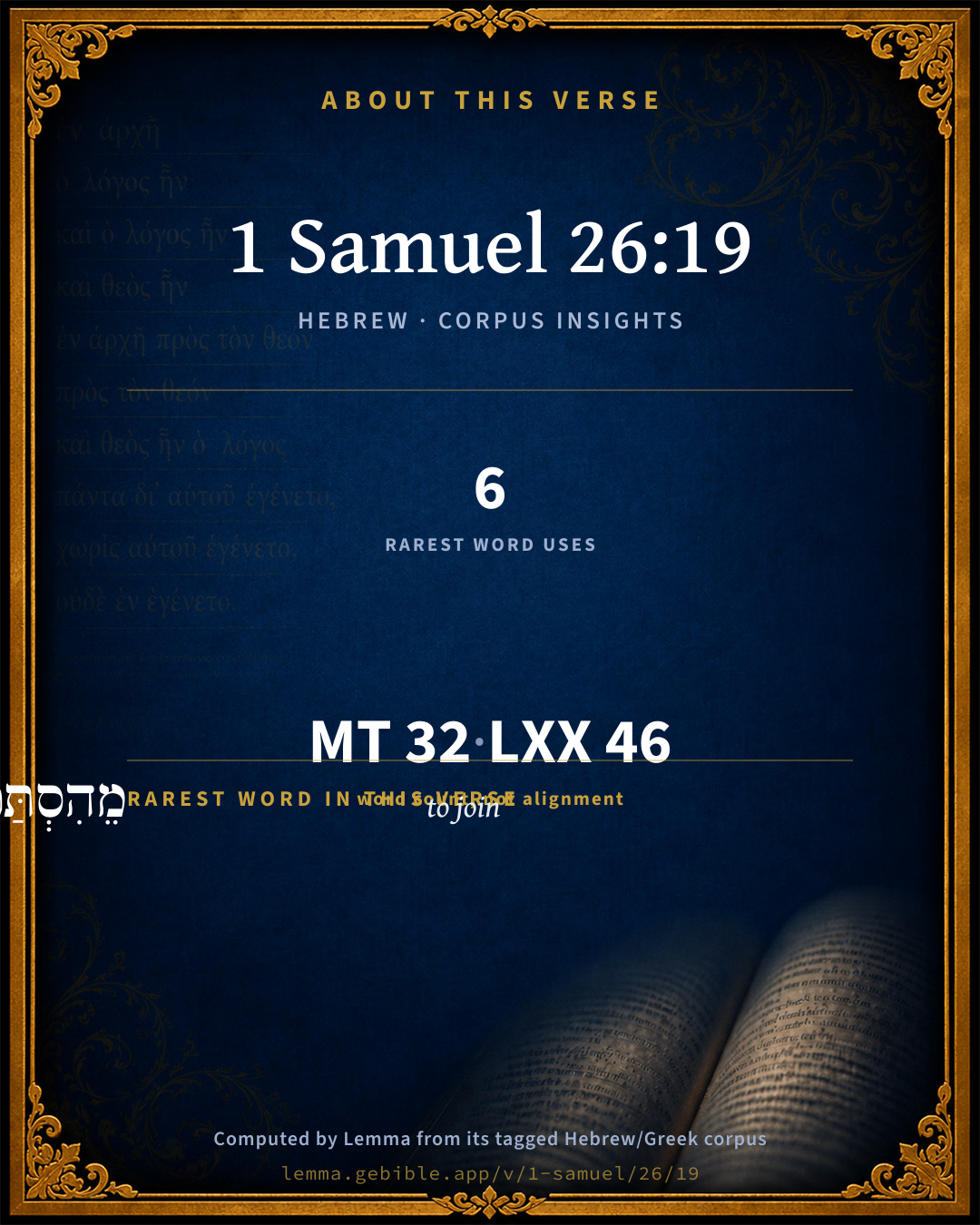
The rarest word here is מֵהִסְתַּפֵּ֜חַ to join H5596 — appearing just 6 times in the whole Hebrew Bible.

Shared distinctive vocabulary

מֵהִסְתַּפֵּ֜חַ to join H5596 occurs in 6 verses of the Hebrew Bible. Also found in:

Grammatical profile

  • 9 verbs
  • 14 nouns
  • 1 adjective
  • 1 pronoun
  • 1 preposition
  • 3 conjunctions
  • 1 adverb
  • 2 particles

Verb forms

  • יִֽשְׁמַֽע Qal · Jussive
  • הֱסִֽיתְךָ֥ Hiphil · Perfect
  • יָרַ֣ח Hiphil · Imperfect
  • אֲרוּרִ֥ים Qal · Participle Passive
  • גֵרְשׁ֣וּנִי Piel · Perfect
  • מֵהִסְתַּפֵּ֜חַ Hithpael · Infinitive Construct
  • לֵאמֹ֔ר Qal · Infinitive Construct
  • לֵ֥ךְ Qal · Imperative
  • עֲבֹ֖ד Qal · Imperative

Repetition

Words recur within this verse — often emphatic in Hebrew:

  • יְהוָ֞ה LORD H3068 ×3
  • אִם if H518 ×2

Hebrew & Septuagint length

In English translation the verse runs 63 words from the Hebrew and 63 from the Septuagint (LXX English) — the same length.

A rough comparison of the two English renderings, which tokenize alike — not a word-level alignment.

Word counts can differ between the Hebrew and the Greek without any difference in meaning — e.g. the Hebrew direct-object marker אֵת has no separate Greek word, and Greek often adds the article ὁ.

In the original languages it is 32 Hebrew tokens and 46 Greek tokens — but the two are counted differently (Hebrew bundles its prefixes and suffixes into one token; the Greek is in lemma form), so that isn’t a like-for-like length.

Cross-references

24

Topical passages linked to 1 Samuel 26:19 in the Treasury of Scripture Knowledge — connected by theme and wording, ordered by reader-vote popularity; previews shown in the World English Bible.

  • 2 Samuel 14:16 For the king will hear, to deliver his servant out of the hand of the man who would destroy me and my son together out of the inheritance of God.
  • 2 Samuel 16:11 David said to Abishai, and to all his servants, Behold, my son, who came forth from my bowels, seeks my life: how much more [may] this Benjamite now [do it]? let him alone, and let him curse; for Yahweh has invited him.
  • 2 Samuel 20:19 I am of those who are peaceable and faithful in Israel: you seek to destroy a city and a mother in Israel: why will you swallow up the inheritance of Yahweh?
  • Genesis 8:21 Yahweh smelled the sweet savor. Yahweh said in his heart, "I will not again curse the ground any more for man's sake, because the imagination of man's heart is evil from his youth; neither will I ever again strike everything living, as I have done.
  • Joshua 22:25–27 for Yahweh has made the Jordan a border between us and you, you children of Reuben and children of Gad; you have no portion in Yahweh: so might your children make our children cease from fearing Yahweh.
  • 1 Samuel 18:10 It happened on the next day, that an evil spirit from God came mightily on Saul, and he prophesied in the midst of the house: and David played with his hand, as he did day by day. Saul had his spear in his hand;
  • 1 Chronicles 21:1 Satan stood up against Israel, and moved David to number Israel.
  • Psalms 120:5 Woe is me, that I live in Meshech, That I dwell among the tents of Kedar!
  • Galatians 1:8–9 But even though we, or an angel from heaven, should preach to you any gospel other than that which we preached to you, let him be cursed.
  • Genesis 44:18 Then Judah came near to him, and said, "Oh, my lord, please let your servant speak a word in my lord's ears, and don't let your anger burn against your servant; for you are even as Pharaoh.
  • Leviticus 26:31 I will lay your cities waste, and will bring your sanctuaries to desolation, and I will not take delight in the sweet fragrence of your offerings.
  • Deuteronomy 4:27–28 Yahweh will scatter you among the peoples, and you shall be left few in number among the nations, where Yahweh shall lead you away.
  • 1 Samuel 16:14–23 Now the Spirit of Yahweh departed from Saul, and an evil spirit from Yahweh troubled him.
  • 1 Samuel 25:24 She fell at his feet, and said, On me, my lord, on me be the iniquity; and please let your handmaid speak in your ears. Hear the words of your handmaid.
  • 2 Samuel 24:1 Again the anger of Yahweh was kindled against Israel, and he moved David against them, saying, Go, number Israel and Judah.
  • 1 Kings 22:22 Yahweh said to him, 'How?' He said, 'I will go forth, and will be a lying spirit in the mouth of all his prophets.' He said, 'You shall entice him, and shall prevail also: go forth, and do so.'
  • Psalms 42:1–2 As the deer pants for the water brooks, So my soul pants after you, God.
  • Psalms 119:1–8 Blessed are those whose ways are blameless, Who walk according to Yahweh's law.
  • Proverbs 6:16–19 There are six things which Yahweh hates; Yes, seven which are an abomination to him:
  • Proverbs 30:10 "Don't slander a servant to his master, Lest he curse you, and you be held guilty.
  • Isaiah 60:5 Then you shall see and be radiant, and your heart shall thrill and be enlarged; because the abundance of the sea shall be turned to you, the wealth of the nations shall come to you.
  • Romans 14:15 Yet if because of food your brother is grieved, you walk no longer in love. Don't destroy with your food him for whom Christ died.
  • Galatians 5:12 I wish that those who disturb you would cut themselves off.
  • 2 Timothy 4:14 Alexander, the coppersmith, did much evil to me. The Lord will repay him according to his works,

Cross-references courtesy of OpenBible.info (CC BY 4.0).

Hebrew and Greek witnesses Masoretic Hebrew ↔ Greek Septuagint

The same verse in the two great witnesses to the Old Testament, shown verse-for-verse.

These are two independent witnesses, not word-aligned to each other, and the Septuagint is shown in lemma (dictionary) form.

Hebrew 1 Samuel 26:19 Masoretic · Westminster Leningrad Codex

וְעַתָּ֗ה יִֽשְׁמַֽע נָא֙ אֲדֹנִ֣י הַמֶּ֔לֶךְ אֵ֖ת דִּבְרֵ֣י עַבְדּ֑וֹ אִם יְהוָ֞ה הֱסִֽיתְךָ֥ בִי֙ יָרַ֣ח מִנְחָ֔ה וְאִ֣ם בְּנֵ֣י הָאָדָ֗ם אֲרוּרִ֥ים הֵם֙ לִפְנֵ֣י יְהוָ֔ה כִּֽי גֵרְשׁ֣וּנִי הַיּ֗וֹם מֵהִסְתַּפֵּ֜חַ בְּנַחֲלַ֤ת יְהוָה֙ לֵאמֹ֔ר לֵ֥ךְ עֲבֹ֖ד אֱלֹהִ֥ים אֲחֵרִֽים

Now therefore, please let my lord the king hear the words of his servant. If it be Yahweh that has stirred you up against me, let him accept an offering: but if it be the children of men, cursed be they before Yahweh: for they have driven me out this day that I shouldn't cling to Yahweh's inheritance, saying, Go, serve other gods.

World English Bible · Public Domain

Greek LXX 1 Samuel 26:19 Septuagint · lemma form

καί νῦν ἀκούω δή ὁ κύριος ἐγώ ὁ βασιλεύς ὁ ῥῆμα ὁ δοῦλος αὐτός εἰ ὁ θεός ἐπισείω σύ ἐπί ἐγώ ὀσφραίνομαι θυσία σύ καί εἰ υἱός ἄνθρωπος ἐπικατάρατος οὗτος ἐνώπιον κύριος ὅτι ἐκβάλλω ἐγώ σήμερον μή στηρίζω ἐν κληρονομία κύριος λέγω πορεύομαι δουλεύω θεός ἕτερος

And now let my lord the king hear the word of his servant. If God stirs you up against me, let your offering be acceptable: but if the sons of men, they are cursed before the Lord, for they have cast me out this day so that I should not be established in the inheritance of the Lord, saying, Go, serve other Gods.

LXX2012 (modern English Septuagint) · Public Domain

Hebrew: Westminster Leningrad Codex (CC BY 4.0). Greek: Septuagint (public domain); English from LXX2012 (modern English Septuagint) (Public Domain). How the Septuagint differs from the Hebrew →

Targum (Aramaic paraphrase)

1

The Targum is the ancient Jewish Aramaic paraphrase of the Hebrew Scriptures — an interpretive translation, not the Hebrew text itself. Onkelos (literal) and Pseudo-Jonathan (expansive) render the Torah, and Jonathan the Prophets. Coverage is partial: where no permissively-licensed English translation exists for a verse, only the Aramaic is shown. This is verse-level text, not a word-by-word alignment to the Hebrew.

  1. Targum Jonathan Prophets (Joshua–Malachi)
    וּכְעַן יִשְׁמַע כְּעַן רִבּוֹנִי מַלְכָּא יַת פִּתְגָמֵי עַבְדֵיהּ אִם מִן קֳדָם יְיָ אִתְגָרִית בִּי יְקַבֵּל קוּרְבָּנִי בְּרַעֲוָא וְאִם בְּנֵי אֱנָשָׁא לִיטִין אִנוּן קֳדָם יְיָ אֲרֵי תָרֵיכוּנִי יוֹמָא דֵין מִלְמֵידַר בְּאַחֲסָנַת עַמָא דַייָ לְמֵימַר אֱזֵיל דָוִד בֵּינֵי עַמְמַיָא פַּלְחֵי טַעֲוָתָא:

    (no public-domain English translation for this verse)

    Targum Jonathan — Aramaic: “Mikraot Gedolot” (public domain). English: “Sefaria Community Translation” (CC0 1.0 (public-domain dedication)); “London "Chaldee Paraphrase," 1871” (public domain). Text via Sefaria.

Commentary

Notes on 1 Samuel 26:19 from classic Christian and Jewish commentators (each source and its license shown beneath its notes). The classic Christian expositions comment on the surrounding passage and are grouped to its opening verse, so a note may address several verses; the Jewish commentaries on the Tanakh (Rashi and others) are per-verse, so they appear only where the commentator wrote on this verse.

Lemma curates 59 commentaries, every one of them public domain or Creative Commons licensed, each selected and text-cleaned for this edition rather than reprinted as found. About our sources →

Trapp's Complete Commentary

John Trapp

1Sa 26:19 Now therefore, I pray thee, let my lord the king hear the words of his servant. If the LORD have stirred thee up against me, let him accept an offering: but if [they be] the children of men, cursed [be] they before the LORD; for they have driven me out this day from abiding in the inheritance of the LORD, saying, Go, serve other gods.

Ver. 19. Let him accept an offering.] Heb., Let him smell, viz., the savour of a sacrifice, and be reconciled through the passion of Christ, whereof those sacrifices were sacraments. And hereunto David doubted not but God would condescend, for he is gracious, and doth abundantly pardon. {Isa 55:7}

From abiding in the inheritance of the Lord.] This troubled David more than the loss of all other comforts and accommodations.

Saying, Go, serve other gods.] This they said not verbally, but interpretatively, and upon the matter, when they compelled him to sojourn in Mesech and Kedar.

John Trapp, A Commentary or Exposition upon All the Books of the Old and New Testament (1647–1656) — public domain. Text from a community e-Sword module.

Joseph Benson's Commentary

1Sa 26:19. If the Lord hath stirred thee up against me — If he hath, by the evil spirit which he hath sent, or by his secret providence, directed thy rage against me for the punishment of thine or my sins; let him accept an offering — Let us offer up a sacrifice to him to appease his wrath against us. They have driven me — From the land which God hath given to his people for their inheritance, and where he hath established his presence and worship. Saying, Go, serve other gods — This was the language of their actions. For by driving him from God’s land, and the place of his worship, into foreign and idolatrous lands, they exposed him to the peril of being either insnared by their counsels or examples, or forced by their power to worship idols.

Joseph Benson's Commentary on the Old and New Testaments (1811–1818) — public domain. Text from a community e-Sword module.

Tyndale Open Study Notes

Tyndale Open Resources

26:19 If the Lord has stirred you up against me: David was perplexed by Saul’s behavior and concerned with the possibility of unintentional sin on his part. • a human scheme: Possibly a reference to Doeg (22:9-10). • worship pagan gods: The sentiment parallels Ps 137:4. Anyone who was exiled from the holy land was unable to worship the Lord by participating in sacrifice at the central sanctuary.

Tyndale Open Study Notes — © Tyndale Open Resources, licensed CC BY-SA 4.0. Text via the HelloAO Bible API.

Geneva Bible (1599)

Geneva Bible translators

Let his anger toward us be pacified by a sacrifice.

As much as lay in them, they compelled him to idolatry because they forced him to flee to the idolaters.

Geneva Bible (1599) marginal notes — public domain. Text via Bolls.life.

Jamieson, Fausset & Brown

Robert Jamieson, A. R. Fausset & David Brown

If the Lord have stirred thee up against me--By the evil spirit He had sent, or by any spiritual offenses by which we have mutually displeased Him.

let him accept an offering--that is, let us conjointly offer a sacrifice for appeasing His wrath against us.

if they be the children of men--The prudence, meekness, and address of David in ascribing the king's enmity to the instigations of some malicious traducers, and not to the jealousy of Saul himself, is worthy of notice.

saying, Go, serve other gods--This was the drift of their conduct. By driving him from the land and ordinances of the true worship, into foreign and heathen countries, they were exposing him to all the seductions of idolatry.

Jamieson, Fausset & Brown — Commentary Critical and Explanatory on the Whole Bible (1871) — public domain (CC PDM 1.0). Text via the HelloAO Bible API.

Adam Clarke's Commentary

Verse 19. Let him accept an offering] If God have stirred thee up against me, why, then, let him deliver my life into thy hand, and accept it as a sacrifice. But as the word is מנחה minchah, a gratitude-offering, perhaps the sense may be this: Let God accept a gratitude-offering from thee, for having purged the land of a worker of iniquity; for, were I not such, God would never stir thee up against me.

But if they be the children of men] If men have, by false representations, lies, and slanders, stirred thee up against an innocent man, then let them be cursed before the Lord. If I am guilty, I deserve to die; if not, those who seek my life should be destroyed.

Saying, Go, serve other gods.] His being obliged to leave the tabernacle, and the place where the true worship of God was performed, and take refuge among idolaters, said in effect, Go, serve other gods.

Adam Clarke's Commentary on the Bible (1810–1826) — public domain. Text from a community e-Sword/MySword module.

Ellicott's Commentary for English Readers

(19) Let him accept an offering.—The words here are difficult ones in a theological point of view. If, however, we are content to interpret them with Bishop Wordsworth according to the Arabic Version of the Chaldee Targum, the difficulty vanishes: “If the Lord hath stirred thee up against me for any fault of mine, let me know mine offence, and I am ready to make an offering for it to the Lord, that I may be forgiven.”—Wordsworth. But by far the greater number of scholars and expositors understand the words of David in what seems to be their plain literal sense, viz.: “If Jehovah has incited you to do this evil thing, let Him smell an offering.” The word for offering in the Hebrew is minchah, the meat offering, which signifies “sanctification of life and devotion to the Lord.” In other words, “If you think or feel that God stirs you up to take this course against me—the innocent one—pray to God that He may take the temptation—if it be a temptation—from thee.” This conception that the movement comes from God runs through the Old Testament. It is apparently expressed in such passages as “the Lord hardened Pharaoh’s heart,” and in such sayings as we find here in this Book of Samuel of an evil spirit from the Lord haunting Saul. “Some have explained the conception by referring it to the intensity with which the Israelites had grasped the idea of the omnipresence of the Deity, and of His being the one power by whose energy all things exist and all acts are done; alike evil and good come from God, for He alone is the source of all . . . but it does not follow that everything to which His providence seems to lead is therefore right for man to do; on the contrary, all leadings of Providence are to be judged by God’s immutable law.”—Dean Payne Smith. These seeming leadings must be tested by prayer offered by an earnest heart: that is the meaning of the offering (minchah) here. The conception—strange as it may seem at first—is a true one, as in the case of Pharaoh, and also—though with some important modifications—of Saul. The Holy Spirit had pleaded long, and had pleaded in vain. It is possible, we know, for us to weary, or, as St. Paul puts it, quench that Spirit of God pleading within us; then at length, wearied or quenched, it wings its flight away from the wicked soul. This spreading its wings in flight may be said to be God’s work. The sad and invariable result is, the deserted heart becomes hardened, as in the case of Pharaoh; the empty shrine becomes the swept and garnished home for the evil spirit, as in the case of Saul.

But if they be the children of men.—But David goes on to say, “If the cruel, unjust thoughts are the result of the envy and hatred of men who are my enemies, may God punish them as they deserve; for see what they have done for me: they have by their calumnies—whispered in your ears—driven me into exile; they have violently bidden me to go and serve other and strange gods.” He means that, far away from the only country where Jehovah is loved and honoured, away from the influence of Jehovah’s prophets and beloved priests, he and his would be tempted to serve other gods, and to share in the foul and impious practice of the heathen nations.

A Bible Commentary for English Readers, edited by Charles John Ellicott (1878–1897) — public domain. Text from a community e-Sword module.

The Cambridge Bible for Schools and Colleges

gen. ed. J. J. S. Perowne

19. If the Lord &c.] Saul may be acting as the executioner of a divine punishment. In that case David desires to obtain pardon by a propitiatory offering. This seems the obvious explanation. But according to the view of many commentators, David suggests that this perverse persecution is the consequence of the evil spirit continuing to vex Saul as a punishment for his sin, and advises him to seek the removal of it by an expiatory sacrifice.

In the language of the O. T. God is sometimes said to incite or command men to do acts in themselves evil. See 2Sa_16:11; 2Sa_24:1. The Hebrew mind was profoundly impressed with the great truth of the universal sovereignty of God, and regarding Him as the Cause of all things, did not distinguish, as we do, between what is caused or commanded, and what is permitted by Him.

let him accept an offering] Lit. smell. Cp. Gen_8:21.

if they be the children of men] See on 1Sa_24:9.

from abiding in, &c.] From being associated with the people of Israel who are Jehovah’s inheritance (1Sa_10:1). The word “to-day” is emphatic: as much as to say, ‘It has at last come to this that I must flee the country: and such a banishment is tantamount to bidding me go serve false gods, for it is only in the land of promise and at the place which He has chosen that Jehovah manifests Himself and can be worshipped.’ Cp. note on 1Sa_10:3.

The Cambridge Bible for Schools and Colleges (gen. ed. J. J. S. Perowne; Cambridge University Press, 1878–1918) — public domain. Text from a community e-Sword module.

John Gill's Exposition

Now therefore, I pray thee, let my lord the king hear the words of his servant,.... Whether David waited for an answer to his question is not certain; probably he did, and observing none returned, desired audience of what he had further to say:

if the Lord have stirred thee up against me; if he had put it into his heart to persecute him after this manner, for some sin he had committed against him, though not against Saul: did that appear to be the case:

let him accept an offering; my offering, as the Targum; or my prayer, as Jarchi; I would offer a sin offering according to the law, to make atonement for my offence, and might hope it would be accepted; or I would make my supplication to God, and entreat him to forgive mine iniquity, and so an issue be put to these troubles; or should it be a capital crime deserving of death he was guilty of, he was content to die, and satisfy for his fault in that way; or if both of them had sinned, in any respect, he proposed to join in an acceptable sacrifice to God, and so reconciliation be made, and matters adjusted in such a religious way; if it was the evil spirit from the Lord that had entered into Saul, or God had suffered a melancholy disorder to seize him, which had put him upon those measures, let an offering agreeable to the will of God be offered, or supplication made for the removal of it:

but if they be the children of men; that incited him to such violent methods, as Abner his general, or Doeg the Edomite, and others:

cursed be they before the Lord; an imprecation of the vengeance of God upon them:

for they have driven me out this day from abiding in the inheritance of the Lord; meaning not from his own house and fatally, nor from the palace of Saul, but from the land of Canaan the Lord had given to his people Israel for an inheritance, and from the worship of God in it, which made it dear and precious to him; he knew if Saul went on pursuing him in this manner, he mast be obliged to quit the land, and go into a foreign country, as he quickly did; so the Targum renders it the inheritance of the people of the Lord: by being driven out of the land which was their inheritance, he should be deprived of their company and conversation, and of all social worship; the consideration of which was cutting to him, and caused the above imprecation from him on those who were concerned in it, and who in effect by their actions were

saying, go, serve other gods; for by being forced to go into an idolatrous country, he would be in the way of temptation, and be liable to be corrupted by ill examples, and to be persuaded and enticed into idolatrous practices; and if he was kept from them it would be no thanks to them, they did all they could to lead him into them; and if he was preserved, it would be owing to the power and grace of God; the Targum is,"go David among the people that worship idols;''the Jews have a saying, that he that dwells without the land of Israel, it is as if he had no God and as if he served an idol (q).

(q) T. Bab. Cetubot, fol. 110. 2.

John Gill's Exposition of the Whole Bible (1746–1763) — public domain (CC PDM 1.0). Text via the HelloAO Bible API.

Albert Barnes' Notes on the Bible

If the Lord have stirred thee up - The meaning is clear from the preceding history. “An evil spirit from God troubling him” was the beginning of the persecution. And this evil spirit was sent in punishment of Saul’s sin 1Sa 16:1, 1Sa 16:14. If the continued persecution was merely the consequence of this evil spirit continuing to vex Saul, David advises Saul to seek God’s pardon, and, as a consequence, the removal of the evil spirit, by offering a sacrifice. But if the persecution was the consequence of the false accusations of slanderers, then “cursed” be his enemies who, by their actions, drove David out from the only land where Yahweh was worshipped, and forced him to take refuge in the country of pagan and idolaters (compare Deu 4:27; Deu 28:36).

Albert Barnes' Notes on the Bible (1834–1885) — public domain. Text from a community e-Sword/MySword module.

Haydock's Catholic Bible Commentary

Sacrifice, that he may be appeased; (Jonathan; Vatable) or rather, I am willing to fall a victim, (Menochius) and pray that thy sacrifice may be acceptable, and all thy designs against me succeed, Psalm xix. 4. --- They are. The opposition of this sentence to the preceding seems to require "let them be," &c. What in effect did not those deserve who wished to make David adore false gods? (Calmet) --- Lord in the land of Israel. --- Gods. They said so, at least by their actions. (Menochius) --- All other countries were in a manner abandoned to idol-worship, so that a person could not dwell in them, without the most imminent danger. See 2 Kings xiv. 16., and Psalm lxxxiii. 12. (Calmet)

George Leo Haydock (1774–1849), Haydock's Catholic Family Bible and Commentary, 1859 edition — public domain. Excludes Psalms (Douay-Rheims chapter numbering differs from Protestant) and Deuterocanonical books (Catholic canon only).

Matthew Poole's English Annotations

If the Lord have stirred thee up against me; if the Lord have by the evil spirit which he hath sent, or by his secret providence, directed thy rage against me for the punishment of thine or my sins.

Let him accept an offering; let us offer up a sacrifice to God to appease his wrath against us.

If they be the children of men; who by their crafty insinuations and calumnies have incensed thee against me. He showeth his prudence, and reverence, and meekness; that he accuseth not the king, but translateth the fault wholly upon his evil ministers; as the Israelites do in the like case, Exo 5:16.

From abiding in the inheritance of the Lord; from the land which God hath given to his people for their inheritance, and where he hath established his presence and worship.

Saying, Go, serve other gods: this was the language of their actions; for by driving him from God’s land, and the place of his worship, into foreign and idolatrous lands, they exposed him to the peril of being either insnared by their counsels or examples, or forced by their threats and power to worship idols.

Matthew Poole's English Annotations on the Holy Bible (1683–1685) — public domain. Text from a community e-Sword/MySword module.

Whedon's Commentary on the Bible

Daniel D. Whedon

19. If the Lord have stirred thee up against me — That God sometimes impels men into evil actions is seen from 2Sa_16:10; 2Sa_24:1; but those very examples show that such instigation is but a part of the punishment of sins already committed. God tempts no man to sin, and the instigations to evil above referred to are not temptations, but judgments for sins already done and demanding punishment. David therefore tells the king that if the Lord has stirred him up to this evil persecution, then he (Saul) should regard himself as a sinner, and seek reconciliation by an offering.

Let him accept an offering — Both at thy hands and at mine. David here implies that he himself is a sinner and may need atonement, but that fact does not lessen Saul’s sin.

If… the children of men — Such as the Ziphites and Doeg the Edomite.

Go, serve other gods — This was the effect of their driving him out of the inheritance of the Lord, that is, from among the chosen people, Israel. They thereby obliged him to be far away from the tabernacle and all the sacred services required by the law. Perhaps Psalms xlii and xliii were composed about this time.

Daniel D. Whedon (gen. ed.), Commentary on the Old and New Testaments (1874–1909) — public domain. Text from a community e-Sword module.

John Wesley's Explanatory Notes

The Lord - If the Lord hath by the evil spirit which he hath sent, or by his secret providence, directed thy rage against me for the punishment of thine, or my sins. An offering - Let us offer up a sacrifice to God to appease his wrath against us. Driven me - From the land which God hath given to his people for their inheritance, and where he hath established his presence and worship. Go serve - This was the language of their actions. For by driving him from God's land, and the place of his worship, into foreign and idolatrous lands, they exposed him to the peril of being either ensnared by their counsels, or examples; or forced by their power to worship idols.

John Wesley, Explanatory Notes Upon the Whole Bible (1754–1765) — public domain. Text via the GEBible commentary corpus.

unfoldingWord translationNotes

Door43 World Missions Community

you, let my master the king listen to the words of his servant ... the king of Israel

David speaks as if he and the king were other people to show respect to Saul. AT: "you my king, listen to my words ... you" (See: Pronouns)

stirred you up against me

"caused you to be angry with me"

let him accept an offering

You may need to make explicit the reason he will give an offering. AT: "I will give him an offering so he will no longer cause you to be angry with me" (See: Assumed Knowledge and Implicit Information)

may they be cursed in the sight of Yahweh

This can be translated in active form. AT: "may Yahweh decide to punish them" (See: Active or Passive)

for they have today driven me out, that I should not cling to the inheritance of Yahweh; they have said to me, 'Go worship other gods.'

"for they have today driven me out. It is as if they want me to stop clinging to the inheritance of Yahweh. It is as if they have said to me, 'Go worship other gods.'"

that I should not cling to the inheritance of Yahweh

"so that I will no longer trust that Yahweh will give me what he has promised me"

do not let my blood fall to the earth

This is a polite way of saying "do not kill me." (See: Euphemism)

the one flea

David uses the word "flea" as a metaphor for a person, himself, who cannot do any great harm. AT: "this single flea" or "me, and I cannot harm you any more than one flea can" (See: Metaphor)

as when one hunts a partridge in the mountains

Saul is chasing David as if he were hunting a valuable wild bird. (See: Simile and Translate Unknowns)

translationWords

lord

king

word

servant

Yahweh

sacrifice

curse

inherit

worship

false god

blood

Israel

unfoldingWord translationNotes — © Distant Shores Media and the Door43 World Missions Community, licensed CC BY-SA 4.0. Source: git.door43.org/Door43/en_tn.

Rashi

Rabbi Shlomo Yitzchaki (Rashi)

Who has incited you against me. To hate me. Every expression of הֲסָתָה means setting; ametement in O.F.

Let my offering be pleasing to Him. He will accept with mercy my prayer to turn your anger away from me.

For they have driven me away. From Eretz Yisroel.

Go serve other gods. Whoever goes out of Eretz Yisroel to other lands during the time of the Temple is considered as though he worshipped idols. Targum Yonoson renders, 'Go, Dovid, among nations who worship idols.'

Rashi on the Tanakh — English translations: “The Judaica Press complete Tanach with Rashi, translated by A. J. Rosenberg” (CC BY 4.0); “Pentateuch with Rashi's commentary by M. Rosenbaum and A.M. Silbermann, 1929-1934” (public domain); “The Metsudah Tanach series, Lakewood, N.J” (CC BY 4.0); and “The Book of Joshua, Metsudah Publications, 1997” (CC BY 4.0). Text via Sefaria.

Lesson kit

Teaching starters — assembled from the data on this page, not authored interpretation. Every prompt links to the verse data it draws on. Edit before teaching.

1 Samuel, in the Historical, opens this verse with 32 words (28 distinct Hebrew lemmas). Its most distinctive word is çâphach (“to join”). A historical commentator’s framing appears above. Read the whole chapter for the surrounding context.

Discussion questions

  1. How does “to join” (çâphach) shape what this verse is saying?
  2. 1 Samuel 2:36 shares the word «to join» with this verse. How do the two illuminate each other?
  3. “LORD” occurs 3× in this one verse. What is the effect of the repetition?
  4. These translations render this verse differently; the difference is in the English rendering, not the original. What questions does that raise?
  5. The verb «יִֽשְׁמַֽע» is Qal Jussive. How does its form color the action?
  6. Reading how Trapp's Complete Commentary and Joseph Benson's Commentary read this verse, where do the two commentators agree and where do they part?

Things to notice

Reading settings

Reading text

Shown beneath each verse's original-language words.

Old Testament
Old Testament edition

Read the OT as the Masoretic Hebrew (MT) or the Greek Septuagint (LXX).

English shown for the Greek Septuagint (in the Hebrew ↔ Greek comparison).

Comparing translations? Open the Compare panel on any verse page to stack up to four side by side.