Numbers 13:3

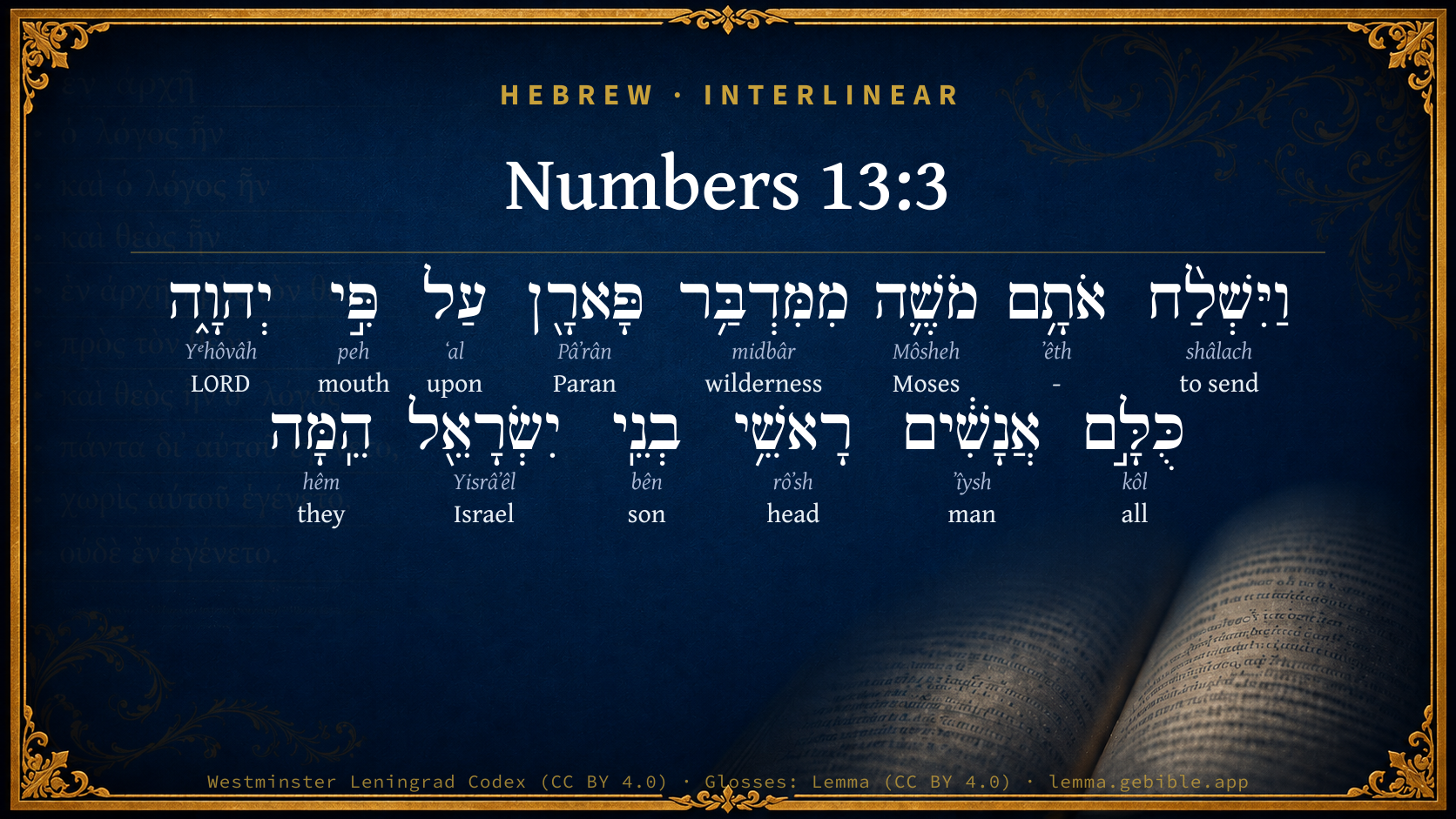
Hebrew (Westminster Leningrad Codex) Numbers 13:3 appears in the Hebrew Old Testament. The text above is from the Westminster Leningrad Codex. Each word links to its Strong’s number, a concise gloss, and parsing drawn from the Open Scriptures Hebrew Bible morphology. Click any word for its full Brown-Driver-Briggs (BDB) entry.
Download image
Cite this verse

Numbers 13:3 (World English Bible). Public Domain. Lemma interlinear Bible study tool, https://lemma.gebible.app/v/numbers/13/3.

Show BibTeX & RIS
BibTeX
RIS
English Translation
Moses sent them from the wilderness of Paran according to the commandment of Yahweh: all of them men who were heads of the children of Israel.
World English Bible · Public Domain
Download a study sheet

One document with this verse’s original text, its word-by-word gloss line, the meaning frame, cross-references with their text, attributed commentary, and full source and license credits — printable, and it pastes into notes with its structure intact.

This verse Autodidact and up

Study sheet (.html) Plain text (.txt)

A passage Seminary Student

Up to 50 verses in one chapter. A passage sheet keeps up to 6 commentary sources and 12 cross-references per verse, in the order this page ranks them, and says so on the sheet whenever that leaves anything out. Ask for a single verse and you get the Autodidact verse sheet above.

Everything on this page stays free to read, with no account — the sheet is a download of what is already on screen, not access to it.

Want to remove ads? Support Godless Engineer
Compare translations 3

The same verse in 3 English versions, stacked beneath the original-language interlinear above. Click any original word for its lexicon entry.

Each is an independent rendering of the whole verse — the interlinear is not word-aligned to these translations.

Highlighted words mark where these versions differ — a whole-verse word diff, not a word-by-word alignment.

  • World English Bible Public Domain
    Moses sent them from the wilderness of Paran according to the commandment of Yahweh: all of them men who were heads of the children of Israel.
  • King James Version Public Domain
    And Moses by the commandment of the LORD sent them from the wilderness of Paran: all those men were heads of the children of Israel.
  • unfoldingWord Literal Text CC BY-SA 4.0
    And Moses sent them from the wilderness of Paran upon the mouth of Yahweh. All of them men; they heads of the sons of Israel.

unfoldingWord Literal Text — © unfoldingWord, licensed CC BY-SA 4.0. Word-aligned USFM3 via Door43 (git.door43.org/unfoldingWord/en_ult).

Versions to compare (up to 4)

3 of 4 selected

Show all 18 translations

Every available English version of this verse, each an independent rendering of the whole verse.

  • World English Bible Public Domain
    Moses sent them from the wilderness of Paran according to the commandment of Yahweh: all of them men who were heads of the children of Israel.
  • Berean Standard Bible Public Domain
    So at the consent of the LORD, Moses sent them out from the Wilderness of Paran. All the men were leaders of the Israelites,
  • Majority Standard Bible Public Domain
    So at the command of the LORD, Moses sent them out from the Wilderness of Paran. All the men were leaders of the Israelites,
  • King James Version Public Domain
    And Moses by the commandment of the LORD sent them from the wilderness of Paran: all those men were heads of the children of Israel.
  • American Standard Version (1901) Public Domain
    And Moses sent them from the wilderness of Paran according to the commandment of Jehovah: all of them men who were heads of the children of Israel.
  • Revised Version (1885) Public Domain
    And Moses sent them from the wilderness of Paran according to the commandment of the LORD: all of them men who were heads of the children of Israel.
  • Geneva Bible (1599) Public Domain
    Sende thou men out to search the lande of Canaan which I giue vnto the children of Israel: of euery tribe of their fathers shall ye sende a man, such as are all rulers among them.
  • Douay-Rheims (1899) Public Domain
    Send men to view the land of Chanaan, which I will give to the children of Israel, one of every tribe, of the rulers.
  • Young's Literal Translation Public Domain
    And Moses sendeth them from the wilderness of Paran by the command of Jehovah; all of them `are' men, heads of the sons of Israel they are,
  • Literal Standard Version CC BY-SA 4.0
    And Moses sends them from the wilderness of Paran by the command of YHWH; all of them [are] men, [and] they are heads of the sons of Israel,
  • Unlocked Literal Bible CC BY-SA 4.0
    Moses sent them from the wilderness of Paran, so that they might obey Yahweh's command. All of them were leaders among the people of Israel.
  • unfoldingWord Literal Text CC BY-SA 4.0
    And Moses sent them from the wilderness of Paran upon the mouth of Yahweh. All of them men; they heads of the sons of Israel.
  • Darby Bible Public Domain
    And Moses sent them from the wilderness of Paran: according to the commandment of Jehovah, all of them heads of the children of Israel.
  • World Messianic Bible Public Domain
    Moses sent them from the wilderness of Paran according to the commandment of the LORD. All of them were men who were heads of the children of Israel.
  • Webster's Bible Public Domain
    And Moses, by the commandment of the LORD, sent them from the wilderness of Paran: all those men were heads of the children of Israel.
  • Free Bible Version CC BY-SA 4.0
    Moses did as the Lord had ordered and sent the men out from the Desert of Paran. They were all leaders of the Israelites.
  • Bible in Basic English Public Domain
    And Moses sent them from the waste land of Paran as the Lord gave orders, all of them men who were heads of the children of Israel.
  • JPS Tanakh (1917) Public Domain
    And Moses sent them from the wilderness of Paran according to the commandment of the LORD; all of them men who were heads of the children of Israel.

Literal Standard Version (2020), Covenant Press — licensed CC BY-SA 4.0. Text via the HelloAO Bible API (eBible.org). Unlocked Literal Bible (unfoldingWord) — licensed CC BY-SA 4.0. Text via the HelloAO Bible API (eBible.org). unfoldingWord Literal Text — © unfoldingWord, licensed CC BY-SA 4.0. Word-aligned USFM3 via Door43 (git.door43.org/unfoldingWord/en_ult). Free Bible Version, Dr. Jonathan Gallagher — licensed CC BY-SA 4.0. Text via the HelloAO Bible API (eBible.org).

Word by word

More ways to search: Search by grammar → Find every occurrence → Compare this word →

Practice this passage: Drill this verse → Learn its vocabulary →

פָּארָ֖ן
Pâʼrân
H6290
“Paran”
Noun, Proper
Part of Speech
Noun
Type
Proper
Full BDB Definition

Origin: from H6286

TWOT: 1728

Paran = "place of caverns" - wilderness area bounded on the north by Palestine, on the west by the wilderness of Etham, on the south by the desert of Sinai, and on the east by the valley of Arabah; the exodus was through this area and probably all 18 stops were in this area
  1. וַיִּשְׁלַ֨ח shâlach H7971 “and · to send” Conjunction + Verb, Qal, Sequential Imperfect, 3rd Person, Masculine, Singular
  2. אֹתָ֥ם ʼêth H853 “- · them” Particle, Direct Object + Suffix, Personal, 3rd Person, Masculine, Plural
  3. מֹשֶׁ֛ה Môsheh H4872 “Moses” Noun, Proper
  4. מִמִּדְבַּ֥ר midbâr H4057 “from · wilderness of” Preposition + Noun, Common, Masculine, Singular, Construct
  5. עַל ʻal H5921 “upon” Preposition
  6. פִּ֣י peh H6310 “mouth of” Noun, Common, Masculine, Singular, Construct
  7. יְהוָ֑ה Yᵉhôvâh H3068 “LORD” Noun, Proper
  8. כֻּלָּ֣ם kôl H3605 “all · their” Noun, Common, Masculine, Singular, Construct + Suffix, Personal, 3rd Person, Masculine, Plural
  9. אֲנָשִׁ֔ים ʼîysh H376 “men” Noun, Common, Masculine, Plural, Absolute
  10. רָאשֵׁ֥י rôʼsh H7218 “heads of” Noun, Common, Masculine, Plural, Construct
  11. בְנֵֽי bên H1121 “sons of” Noun, Common, Masculine, Plural, Construct
  12. יִשְׂרָאֵ֖ל Yisrâʼêl H3478 “Israel” Noun, Proper
  13. הֵֽמָּה hêm H1992 “they” Pronoun, Personal, 3rd Person, Masculine, Plural

About this verse

These counts appear in no published source. They are computed here, from the morphology-tagged text and Lemma’s own curated glosses. What Lemma adds →

14
words
14
distinct lemmas
Pentateuch
section

Notable vocabulary

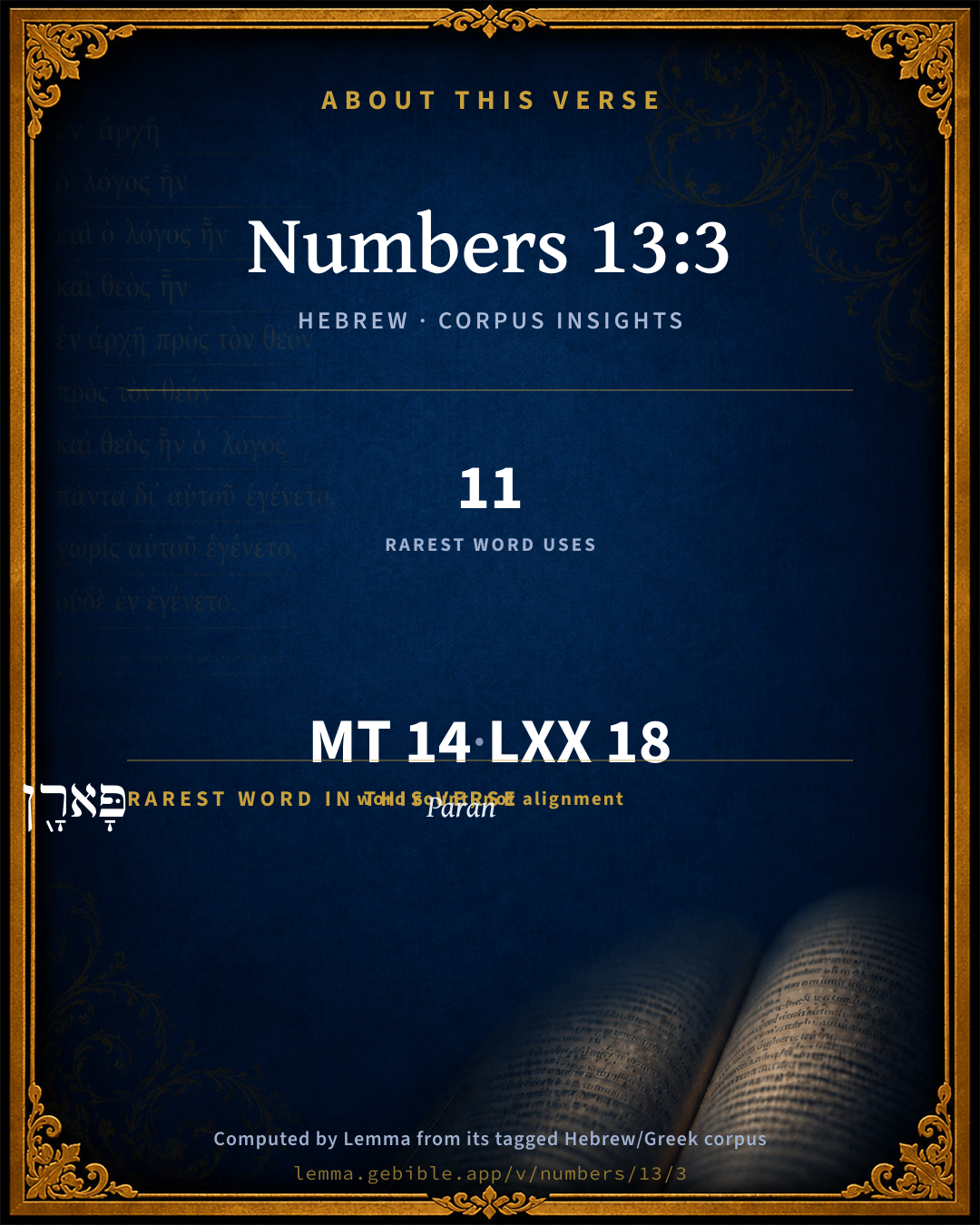
The rarest word here is פָּארָ֖ן Paran H6290 — appearing just 11 times in the whole Hebrew Bible.

Shared distinctive vocabulary

פָּארָ֖ן Paran H6290 occurs in 10 verses of the Hebrew Bible. Also found in:

Grammatical profile

  • 1 verb
  • 10 nouns
  • 1 pronoun
  • 1 preposition
  • 1 particle

Verb forms

  • וַיִּשְׁלַ֨ח Qal · Sequential Imperfect

Hebrew & Septuagint length

In English translation the verse runs 26 words from the Hebrew and 44 from the Septuagint (LXX English) — the Septuagint runs noticeably longer here. See the side-by-side →

A rough comparison of the two English renderings, which tokenize alike — not a word-level alignment.

Word counts can differ between the Hebrew and the Greek without any difference in meaning — e.g. the Hebrew direct-object marker אֵת has no separate Greek word, and Greek often adds the article ὁ.

In the original languages it is 14 Hebrew tokens and 18 Greek tokens — but the two are counted differently (Hebrew bundles its prefixes and suffixes into one token; the Greek is in lemma form), so that isn’t a like-for-like length.

Cross-references

5

Topical passages linked to Numbers 13:3 in the Treasury of Scripture Knowledge — connected by theme and wording, ordered by reader-vote popularity; previews shown in the World English Bible.

  • Numbers 12:16 Afterward the people traveled from Hazeroth, and encamped in the wilderness of Paran.
  • Numbers 32:8 Thus did your fathers, when I sent them from Kadesh-barnea to see the land.
  • Deuteronomy 1:19 We traveled from Horeb, and went through all that great and terrible wilderness which you saw, by the way to the hill-country of the Amorites, as Yahweh our God commanded us; and we came to Kadesh-barnea.
  • Deuteronomy 9:23 When Yahweh sent you from Kadesh-barnea, saying, Go up and possess the land which I have given you; then you rebelled against the commandment of Yahweh your God, and you didn't believe him, nor listen to his voice.
  • Deuteronomy 1:23 The thing pleased me well; and I took twelve men of you, one man for every tribe:

Cross-references courtesy of OpenBible.info (CC BY 4.0).

Hebrew and Greek witnesses Masoretic Hebrew ↔ Greek Septuagint

The same verse in the two great witnesses to the Old Testament, shown verse-for-verse.

Here the Septuagint runs noticeably longer than the Hebrew — LXX2012 (modern English Septuagint) 44 words vs World English Bible 26. A rough length comparison of the two English translations, not a word-level alignment — read both below.

These are two independent witnesses, not word-aligned to each other, and the Septuagint is shown in lemma (dictionary) form.

Hebrew Numbers 13:3 Masoretic · Westminster Leningrad Codex

וַיִּשְׁלַ֨ח אֹתָ֥ם מֹשֶׁ֛ה מִמִּדְבַּ֥ר פָּארָ֖ן עַל פִּ֣י יְהוָ֑ה כֻּלָּ֣ם אֲנָשִׁ֔ים רָאשֵׁ֥י בְנֵֽי יִשְׂרָאֵ֖ל הֵֽמָּה

Moses sent them from the wilderness of Paran according to the commandment of Yahweh: all of them men who were heads of the children of Israel.

World English Bible · Public Domain

Greek LXX Numbers 13:3 Septuagint · lemma form

καί ἐκ ἀποστέλλω αὐτός μωυσῆς ἐκ ὁ ἔρημος φαραν διά φωνή κύριος πᾶς ἀνήρ ἀρχηγός υἱός ἰσραήλ οὗτος

Send for you men, and let them spy the land of the Chananites, which I give to the sons of Israel for a possession; one man for a tribe, you shall send them away according to their families, every one of them a prince.

LXX2012 (modern English Septuagint) · Public Domain

Hebrew: Westminster Leningrad Codex (CC BY 4.0). Greek: Septuagint (public domain); English from LXX2012 (modern English Septuagint) (Public Domain). How the Septuagint differs from the Hebrew →

Targum (Aramaic paraphrase)

2

The Targum is the ancient Jewish Aramaic paraphrase of the Hebrew Scriptures — an interpretive translation, not the Hebrew text itself. Onkelos (literal) and Pseudo-Jonathan (expansive) render the Torah, and Jonathan the Prophets. Coverage is partial: where no permissively-licensed English translation exists for a verse, only the Aramaic is shown. This is verse-level text, not a word-by-word alignment to the Hebrew.

  1. Targum Onkelos Torah (Genesis–Deuteronomy)
    וּשְׁלַח יָתְהוֹן משֶׁה מִמַדְבְּרָא דְפָארָן עַל מֵימְרָא דַיְיָ כֻּלְהוֹן גֻבְרִין רֵישֵׁי בְנֵי יִשְׂרָאֵל אִנוּן

    (no public-domain English translation for this verse)

    Targum Onkelos — Aramaic: “Onkelos Genesis” (public domain); “Onkelos Exodus” (public domain); “Onkelos Leviticus” (public domain); “Onkelos Numbers” (public domain); “Onkelos Deuteronomy” (public domain). English: “Sefaria Community Translation” (CC0 1.0 (public-domain dedication)); “J.W. Etheridge. The Targums of Onkelos and Jonathan Ben Uzziel on the Pentateuch. London: Longmans, Green, 1862” (public domain). Text via Sefaria.

  2. Targum Pseudo-Jonathan Torah (Genesis–Deuteronomy)
    וְשַׁדַר יַתְהוֹן משֶׁה מִמַדְבְּרָא דְפָארָן עַל פּוּם מֵימְרָא דַיְיָ כֻּלְהוֹן גוּבְרִין חֲרִיפִין דְמִתְמְנָן רֵישֵׁי עַל בְּנֵי יִשְרָאֵל הִינוּן

    And Mosheh sent them from the wilderness of Pharan, according to the mouth of the Word of the Lord; all of them acute men, who had been appointed heads over the sons of Israel.

    Targum Pseudo-Jonathan — Aramaic: “Targum Jonathan on Genesis” (public domain); “Targum Jonathan on Exodus” (public domain); “Targum Jonathan on Leviticus” (public domain); “Targum Jonathan on Numbers” (public domain); “Targum Jonathan on Deuteronomy” (public domain). English: “The Targum of Jonathan ben Uzziel, trans. J. W. Etheridge, London, 1862” (public domain). Text via Sefaria.

Commentary

Notes on Numbers 13:3 from classic Christian and Jewish commentators (each source and its license shown beneath its notes). The classic Christian expositions comment on the surrounding passage and are grouped to its opening verse, so a note may address several verses; the Jewish commentaries on the Tanakh (Rashi and others) are per-verse, so they appear only where the commentator wrote on this verse.

Lemma curates 59 commentaries, every one of them public domain or Creative Commons licensed, each selected and text-cleaned for this edition rather than reprinted as found. About our sources →

Trapp's Complete Commentary

John Trapp

Num 13:3 And Moses by the commandment of the LORD sent them from the wilderness of Paran: all those men [were] heads of the children of Israel.

Ver. 3. By the commandment of the Lord.] That is, by his permission; {See Trapp on "Num 13:1"} God’s command was, that they should forthwith, without any further search, go up and possess the land. {Deu 1:21} Now wicked men are esteemed unjust, because they act against God’s command, though according to his decree; like as believers are esteemed just, not because they obey God’s decree, but his command.

John Trapp, A Commentary or Exposition upon All the Books of the Old and New Testament (1647–1656) — public domain. Text from a community e-Sword module.

Geneva Bible (1599)

Geneva Bible translators

After the people had required it of Moses, as it is in Deut. 1:22, then the Lord spake to Moses so to do.

Geneva Bible (1599) marginal notes — public domain. Text via Bolls.life.

Jamieson, Fausset & Brown

Robert Jamieson, A. R. Fausset & David Brown

those men were heads of the children of Israel--Not the princes who are named (Num 10:14-16, Num 10:18-20, Num 10:22-27), but chiefs, leading men though not of the first rank.

Jamieson, Fausset & Brown — Commentary Critical and Explanatory on the Whole Bible (1871) — public domain (CC PDM 1.0). Text via the HelloAO Bible API.

Ellicott's Commentary for English Readers

(3) And Moses, by the commandment of the Lord, sent them, &c.—Better, And Moses sent them, from the wilderness of Paran, according to the command (literally, the mouth) of the Lord, i.e., as appears from Deu_1:19. from Kadesh-barnea.

A Bible Commentary for English Readers, edited by Charles John Ellicott (1878–1897) — public domain. Text from a community e-Sword module.

John Gill's Exposition

And Moses, by the commandment of the Lord,.... By his power, permission, and leave, as Jarchi, that there might be no delay through his means:

sent them from the wilderness of Paran; from Rithmah or Kadeshbarnea, which seem to be one and the same place in that wilderness: this, as before observed, was on the twenty ninth day of Sivan: See Gill on Num 13:1,

all those were heads of the children of Israel; were not mean and vulgar men, but persons of rule, who bore some office of magistracy ant government among the people in their respective tribes.

John Gill's Exposition of the Whole Bible (1746–1763) — public domain (CC PDM 1.0). Text via the HelloAO Bible API.

Haydock's Catholic Bible Commentary

Rulers of a hundred men, according to Hiscuni, inferior to those mentioned, chap. x. 14. (Calmet)

George Leo Haydock (1774–1849), Haydock's Catholic Family Bible and Commentary, 1859 edition — public domain. Excludes Psalms (Douay-Rheims chapter numbering differs from Protestant) and Deuterocanonical books (Catholic canon only).

The Pulpit Commentary

HOMILIES BY E.S. PROUT Vers. 3, 4. The sin and shame of apostasy.

The sin of the Israelites at this time is almost incredible. Their rash words (verse 3) prompt to reckless resolutions (verse 4), which, if not actually carried out, are laid to their charge. (Neh_9:17) Their crime includes the following sins:

1. Criminal forgetfulness, as though the bondage of Egypt were better than warfare under "Jehovah Nissi". (Exo_17:15)

2. Gross ingratitude. They imply that God has spared them and cared for them thus far in order to destroy them at last.

3. Shameful distrust, notwithstanding all the promises God has given, and the "signs" of his faithfulness he has shown (verse 11).

4. Obstinate disobedience a stubborn disregard of the word and will of their God.

5. Utter madness. In returning to Egypt they must part company with Moses their leader and Aaron their priest. They must abandon the ark and the altar. They could not expect the manna to feed them or the cloud to guide them. And if they ever reached Egypt, what a reception.would meet them there! All these sins are seen in a still more glaring form in the shameful crime of apostasy from Christ. Such a "drawing" back to perdition implies a previous coming near to Christ, and an enjoyment of blessings analogous to the covenanted blessings of ancient Israel. (Exo_19:3-6 Exo_24:4-8)

In apostasy we see

1. Criminal forgetfulness of the bondage of evil habits, the burden of an uneasy conscience, the yearnings of unsatisfied desire, and all the other evils from which we looked to Christ to deliver us. How can it be "better to return" to these?

2. Gross ingratitude to God for all the blessing"s enjoyed during the Christian pilgrimage so far; as though such a God could fail or forsake us, and not "perfect that which concerneth us," as all his previous blessings are a pledge that he will do. (Psa_138:8 Rom_8:32)

3. Shameful distrust. "An evil heart of unbelief" is generally the primary cause of departing from God. (Heb_3:12) Distrust makes us weak against temptations even of the grossest kind. We may lose courage amid foes or temptations which, but for shameful want of confidence in God, would have little power to alarm and divert us from the path of duty. (cf. Psa_27:1-3 Psa_118:6-12, and, in contrast, 1Sa_27:1)

4. Obstinate disobedience. For we are "under law to Christ;" and "his will is our sanctification," our perseverance, our conflict and victory till we reach the heavenly Canaan. (1Th_4:3 1Ti_6:11-14 Heb_3:14 Heb_6:12)

5. Utter madness; for to "draw back" is to forfeit the fellowship of Christ"s Church, the tokens of his favour, his promises, his consolations, and the good-will of God. To succeed is perdition. P. (Heb_10:26-39)

The Pulpit Commentary (1880–1919), ed. H.D.M. Spence-Jones & Joseph S. Exell — public domain. Text from a community e-Sword module.

unfoldingWord translationNotes

Door43 World Missions Community

Shammua son of Zaccur

These are men's names. (See: How to Translate Names)

translationWords

desert

Paran

obey

command

Reuben

son

unfoldingWord translationNotes — © Distant Shores Media and the Door43 World Missions Community, licensed CC BY-SA 4.0. Source: git.door43.org/Door43/en_tn.

Rashi

Rabbi Shlomo Yitzchaki (Rashi)

'על פי ה With His consent; i.e. that He did not prevent him from doing so....

כלם אנשים ALL OF THEM WERE MEN — Wherever the term אנשים, “men”, is used in Scripture it is a term denoting worthiness. These men, [though they later sinned] but at that time [when they were appointed] they were worthy men.

Rashi on the Tanakh — English translations: “The Judaica Press complete Tanach with Rashi, translated by A. J. Rosenberg” (CC BY 4.0); “Pentateuch with Rashi's commentary by M. Rosenbaum and A.M. Silbermann, 1929-1934” (public domain); “The Metsudah Tanach series, Lakewood, N.J” (CC BY 4.0); and “The Book of Joshua, Metsudah Publications, 1997” (CC BY 4.0). Text via Sefaria.

Lesson kit

Teaching starters — assembled from the data on this page, not authored interpretation. Every prompt links to the verse data it draws on. Edit before teaching.

Numbers, in the Pentateuch, opens this verse with 14 words (14 distinct Hebrew lemmas). Its most distinctive word is Pâʼrân (“Paran”). The Greek Septuagint runs longer here. A historical commentator’s framing appears above. Read the whole chapter for the surrounding context.

Discussion questions

  1. The word Pâʼrân carries the sense “Paran.” How does it shape the verse?
  2. How does Genesis 21:21, which shares the word «Paran», read alongside this verse?
  3. The Septuagint runs longer here than the Hebrew. What might account for the difference?
  4. These translations render this verse differently. What is at stake in choosing one wording over another?
  5. «וַיִּשְׁלַ֨ח» is a Qal Sequential Imperfect verb. How does that grammatical form shape the action described?
  6. Compare how Trapp's Complete Commentary and Geneva Bible (1599) read this verse. Where do they agree or differ?

Things to notice

Reading settings

Reading text

Shown beneath each verse's original-language words.

Old Testament
Old Testament edition

Read the OT as the Masoretic Hebrew (MT) or the Greek Septuagint (LXX).

English shown for the Greek Septuagint (in the Hebrew ↔ Greek comparison).

Comparing translations? Open the Compare panel on any verse page to stack up to four side by side.