
2 Samuel 17:8

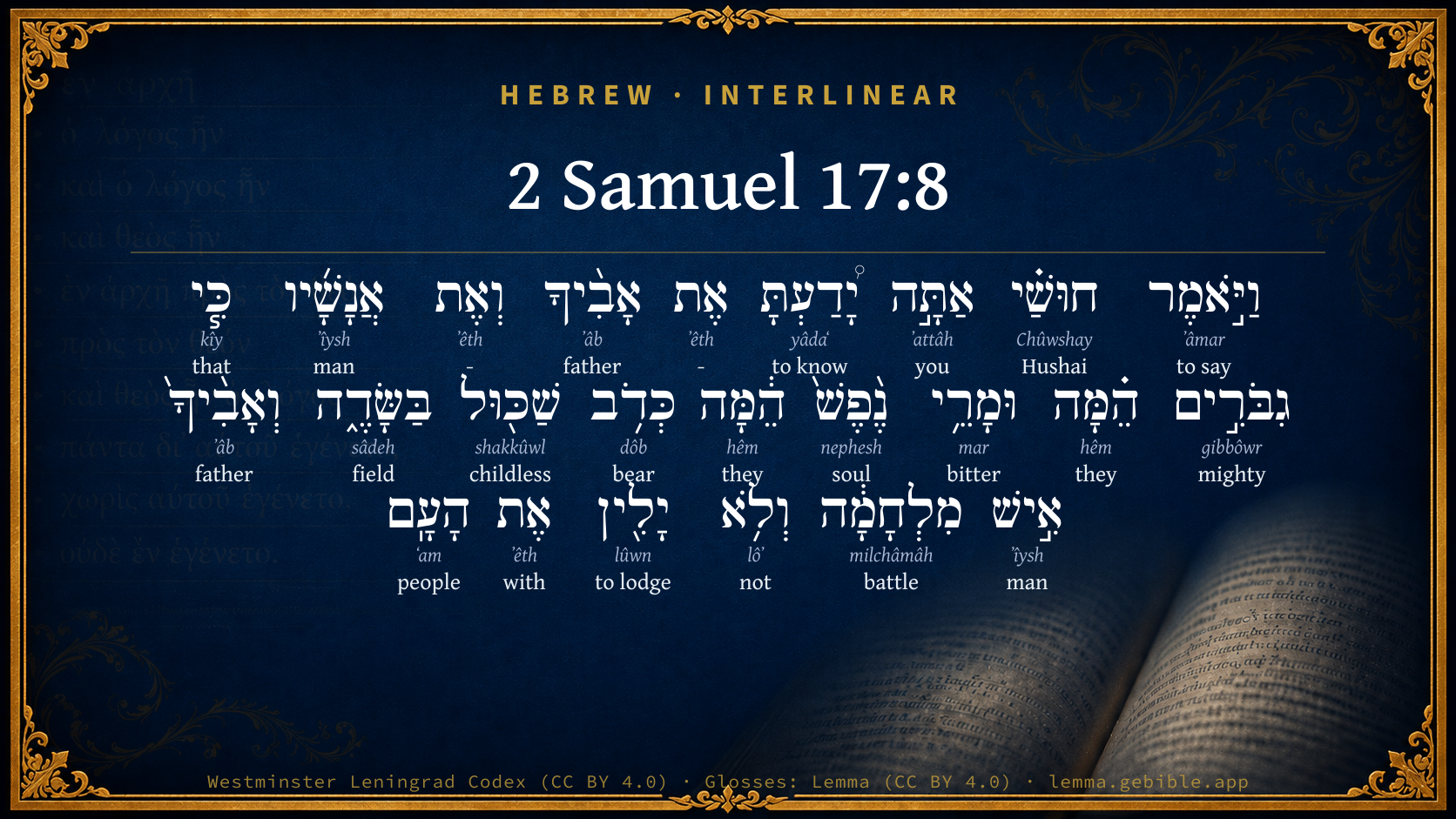
Hebrew (Westminster Leningrad Codex) 2 Samuel 17:8 appears in the Hebrew Old Testament. The text above is from the Westminster Leningrad Codex. Each word links to its Strong’s number, a concise gloss, and parsing drawn from the Open Scriptures Hebrew Bible morphology. Click any word for its full Brown-Driver-Briggs (BDB) entry.
Download image
Cite this verse

2 Samuel 17:8 (World English Bible). Public Domain. Lemma interlinear Bible study tool, https://lemma.gebible.app/v/2-samuel/17/8.

Show BibTeX & RIS
BibTeX
RIS
English Translation
Hushai said moreover, You know your father and his men, that they are mighty men, and they are fierce in their minds, as a bear robbed of her cubs in the field; and your father is a man of war, and will not lodge with the people.
World English Bible · Public Domain
Highlights
  • 1 first appearance in the Hebrew Bible
Full analysis ↓
Download a study sheet

One document with this verse’s original text, its word-by-word gloss line, the meaning frame, cross-references with their text, attributed commentary, and full source and license credits — printable, and it pastes into notes with its structure intact.

This verse Autodidact and up

Study sheet (.html) Plain text (.txt)

A passage Seminary Student

Up to 50 verses in one chapter. A passage sheet keeps up to 6 commentary sources and 12 cross-references per verse, in the order this page ranks them, and says so on the sheet whenever that leaves anything out. Ask for a single verse and you get the Autodidact verse sheet above.

Everything on this page stays free to read, with no account — the sheet is a download of what is already on screen, not access to it.

Want to remove ads? Support Godless Engineer
Compare translations 3

The same verse in 3 English versions, stacked beneath the original-language interlinear above. Click any original word for its lexicon entry.

Each is an independent rendering of the whole verse — the interlinear is not word-aligned to these translations.

Highlighted words mark where these versions differ — a whole-verse word diff, not a word-by-word alignment.

  • World English Bible Public Domain
    Hushai said moreover, You know your father and his men, that they are mighty men, and they are fierce in their minds, as a bear robbed of her cubs in the field; and your father is a man of war, and will not lodge with the people.
  • King James Version Public Domain
    For, said Hushai, thou knowest thy father and his men, that they be mighty men, and they be chafed in their minds, as a bear robbed of her whelps in the field: and thy father is a man of war, and will not lodge with the people.
  • unfoldingWord Literal Text CC BY-SA 4.0
    And Hushai said, “You, you know your father and his men, that they warriors and they bitter of soul, like a bear bereaved in the field. And your father a man of war, so he will not lodge with the people.

unfoldingWord Literal Text — © unfoldingWord, licensed CC BY-SA 4.0. Word-aligned USFM3 via Door43 (git.door43.org/unfoldingWord/en_ult).

Versions to compare (up to 4)

3 of 4 selected

Show all 18 translations

Every available English version of this verse, each an independent rendering of the whole verse.

  • World English Bible Public Domain
    Hushai said moreover, You know your father and his men, that they are mighty men, and they are fierce in their minds, as a bear robbed of her cubs in the field; and your father is a man of war, and will not lodge with the people.
  • Berean Standard Bible Public Domain
    He continued, “You know your father and his men. They are mighty men, and as fierce as a wild bear robbed of her cubs. Moreover, your father is a man of war who will not spend the night with the troops.
  • Majority Standard Bible Public Domain
    He continued, “You know your father and his men. They are mighty men, and as fierce as a wild bear robbed of her cubs. Moreover, your father is a man of war who will not spend the night with the troops.
  • King James Version Public Domain
    For, said Hushai, thou knowest thy father and his men, that they be mighty men, and they be chafed in their minds, as a bear robbed of her whelps in the field: and thy father is a man of war, and will not lodge with the people.
  • American Standard Version (1901) Public Domain
    Hushai said moreover, Thou knowest thy father and his men, that they are mighty men, and they are chafed in their minds, as a bear robbed of her whelps in the field; and thy father is a man of war, and will not lodge with the people.
  • Revised Version (1885) Public Domain
    Hushai said moreover, Thou knowest thy father and his men, that they be mighty men, and they be chafed in their minds, as a bear robbed of her whelps in the field: and thy father is a man of war, and will not lodge with the people.
  • Geneva Bible (1599) Public Domain
    For, said Hushai, thou knowest thy father, and his men, that they be strong men, and are chafed in minde as a beare robbed of her whelps in the fielde: also thy father is a valiant warrier, and will not lodge with the people.
  • Douay-Rheims (1899) Public Domain
    And again Chusai said: Thou knowest thy father, and the men that are with him, that they are very valiant, and bitter in their mind, as a bear raging in the wood when her whelps are taken away: and thy father is a warrior, and will not lodge with the people.
  • Young's Literal Translation Public Domain
    And Hushai saith, `Thou hast known thy father and his men, that they `are' heroes, and they are bitter in soul as a bereaved bear in a field, and thy father `is' a man of war, and doth not lodge with the people;
  • Literal Standard Version CC BY-SA 4.0
    And Hushai says, “You have known your father and his men, that they [are] heroes, and they are bitter in soul as a bereaved bear in a field, and your father [is] a man of war, and does not lodge with the people;
  • Unlocked Literal Bible CC BY-SA 4.0
    Hushai added, “You know your father and his men are strong warriors, and that they are bitter, and they are like a bear robbed of her cubs in a field. Your father is a man of war; he will not sleep with the army tonight.
  • unfoldingWord Literal Text CC BY-SA 4.0
    And Hushai said, “You, you know your father and his men, that they warriors and they bitter of soul, like a bear bereaved in the field. And your father a man of war, so he will not lodge with the people.
  • Darby Bible Public Domain
    And Hushai said, Thou knowest thy father and his men, that they are mighty men, and they are of exasperated spirit, as a bear robbed of her whelps in the field; and thy father is a man of war, and will not lodge with the people.
  • World Messianic Bible Public Domain
    Hushai said moreover, “You know your father and his men, that they are mighty men, and they are fierce in their minds, like a bear robbed of her cubs in the field. Your father is a man of war, and will not lodge with the people.
  • Webster's Bible Public Domain
    For, said Hushai, thou knowest thy father and his men, that they are mighty men, and they are chafed in their minds, as a bear robbed of her whelps in the field: and thy father is a man of war, and will not lodge with the people.
  • Free Bible Version CC BY-SA 4.0
    “You know what your father and his men are like. They're great fighters, and now they're as furious as a she-bear robbed of her cubs. In any case, your father is experienced in military tactics, and he won't spend the night with his men.
  • Bible in Basic English Public Domain
    Hushai said further, You have knowledge of your father and his men, that they are men of war, and that their feelings are bitter, like those of a bear in the field whose young ones have been taken from her: and your father is a man of war, and will not take his night's rest with the people;
  • JPS Tanakh (1917) Public Domain
    Hushai said moreover: 'Thou knowest thy father and his men, that they are mighty men, and they are embittered in their minds, as a bear robbed of her whelps in the field; and thy father is a man of war, and will not lodge with the people.

Literal Standard Version (2020), Covenant Press — licensed CC BY-SA 4.0. Text via the HelloAO Bible API (eBible.org). Unlocked Literal Bible (unfoldingWord) — licensed CC BY-SA 4.0. Text via the HelloAO Bible API (eBible.org). unfoldingWord Literal Text — © unfoldingWord, licensed CC BY-SA 4.0. Word-aligned USFM3 via Door43 (git.door43.org/unfoldingWord/en_ult). Free Bible Version, Dr. Jonathan Gallagher — licensed CC BY-SA 4.0. Text via the HelloAO Bible API (eBible.org).

Word by word

More ways to search: Search by grammar → Find every occurrence → Compare this word →

Practice this passage: Drill this verse → Learn its vocabulary →

שַׁכּ֖וּל
shakkûwl
H7909
“childless”
Adjective, Adjective, Masculine, Singular, Absolute
Part of Speech
Adjective
Type
Adjective
Gender
Masculine
Number
Singular
State
Absolute
Full BDB Definition

Origin: from H7921

TWOT: 2385b , 2385c

childless (through bereavement) - bereaved, robbed of offspring
  1. וַיֹּ֣אמֶר ʼâmar H559 “and · to say” Conjunction + Verb, Qal, Sequential Imperfect, 3rd Person, Masculine, Singular
  2. חוּשַׁ֗י Chûwshay H2365 “Hushai” Noun, Proper
  3. אַתָּ֣ה ʼattâh H859 “you” Pronoun, Personal, 2nd Person, Masculine, Singular
  4. יָ֠דַעְתָּ yâdaʻ H3045 “to know” Verb, Qal, Perfect, 2nd Person, Masculine, Singular
  5. אֶת ʼêth H853 “-” Particle, Direct Object
  6. אָבִ֨יךָ ʼâb H1 “father · your” Noun, Common, Masculine, Singular, Construct + Suffix, Personal, 2nd Person, Masculine, Singular
  7. וְאֶת ʼêth H853 “and · -” Conjunction + Particle, Direct Object
  8. אֲנָשָׁ֜יו ʼîysh H376 “men · his” Noun, Common, Masculine, Plural, Construct + Suffix, Personal, 3rd Person, Masculine, Singular
  9. כִּ֧י kîy H3588 “that” Conjunction
  10. גִבֹּרִ֣ים gibbôwr H1368 “mighty” Adjective, Adjective, Masculine, Plural, Absolute
  11. הֵ֗מָּה hêm H1992 “they” Pronoun, Personal, 3rd Person, Masculine, Plural
  12. וּמָרֵ֥י mar H4751 “and · bitter of” Conjunction + Adjective, Adjective, Masculine, Plural, Construct
  13. נֶ֨פֶשׁ֙ nephesh H5315 “soul” Noun, Common, Both, Singular, Absolute
  14. הֵ֔מָּה hêm H1992 “they” Pronoun, Personal, 3rd Person, Masculine, Plural
  15. כְּדֹ֥ב dôb H1677 “like/as · bear” Preposition + Noun, Common, Masculine, Singular, Absolute
  16. בַּשָּׂדֶ֑ה sâdeh H7704 “in/at the · field” Preposition, Determined + Noun, Common, Masculine, Singular, Absolute
  17. וְאָבִ֨יךָ֙ ʼâb H1 “and · father · your” Conjunction + Noun, Common, Masculine, Singular, Construct + Suffix, Personal, 2nd Person, Masculine, Singular
  18. אִ֣ישׁ ʼîysh H376 “man of” Noun, Common, Masculine, Singular, Construct
  19. מִלְחָמָ֔ה milchâmâh H4421 “battle” Noun, Common, Feminine, Singular, Absolute
  20. וְלֹ֥א lôʼ H3808 “and · not” Conjunction + Particle, Negative
  21. יָלִ֖ין lûwn H3885 “to lodge” Verb, Qal, Imperfect, 3rd Person, Masculine, Singular
  22. אֶת ʼêth H854 “with” Preposition
  23. הָעָֽם ʻam H5971 “the · people” Particle, Definite Article + Noun, Common, Masculine, Singular, Absolute

About this verse

These counts appear in no published source. They are computed here, from the morphology-tagged text and Lemma’s own curated glosses. What Lemma adds →

24
words
20
distinct lemmas
Historical
section

Notable vocabulary

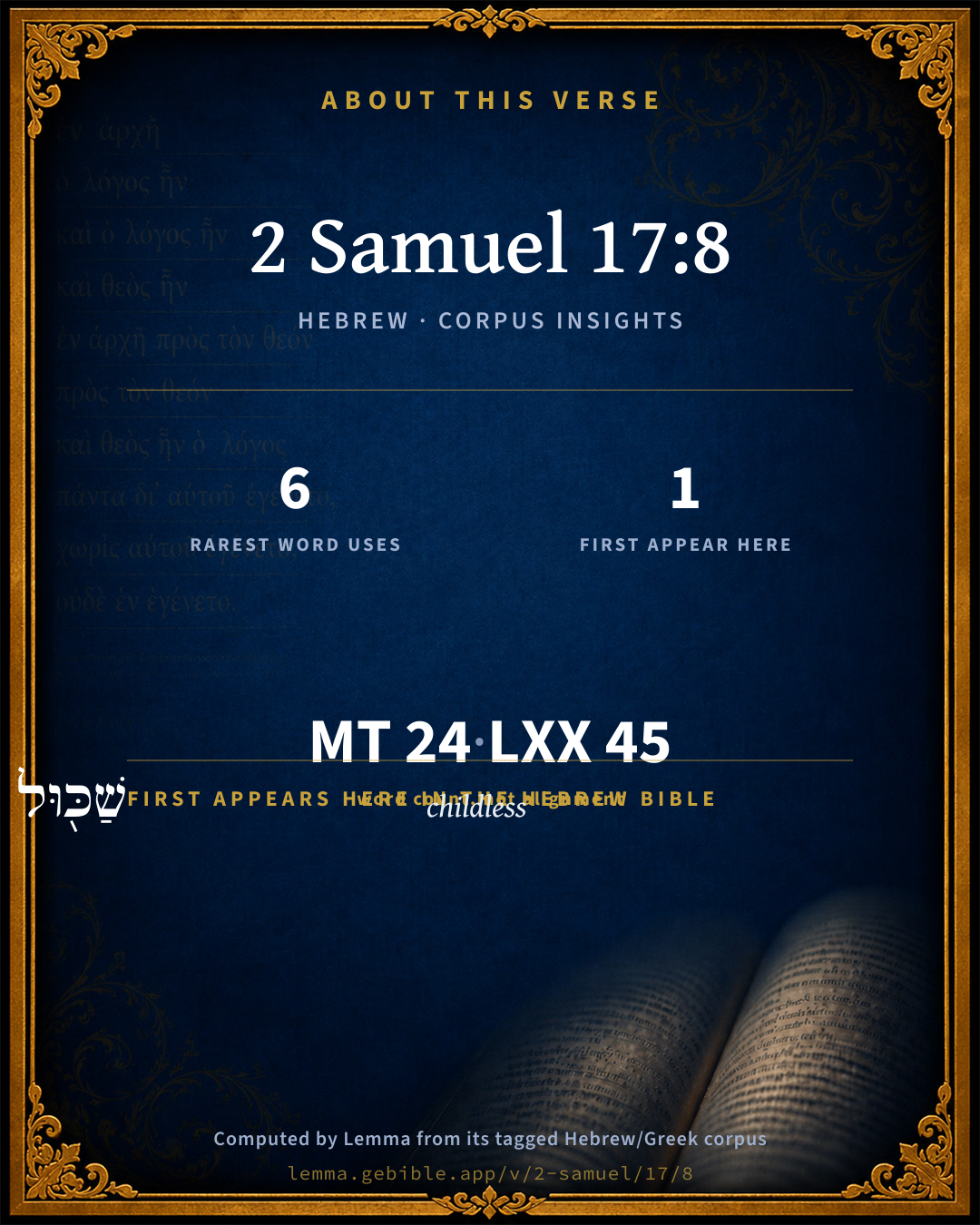
The rarest word here is שַׁכּ֖וּל childless H7909 — appearing just 6 times in the whole Hebrew Bible.

First appearance in Scripture

This word makes its first canonical appearance in the Hebrew Bible here:

  • שַׁכּ֖וּל childless H7909

Shared distinctive vocabulary

שַׁכּ֖וּל childless H7909 occurs in 6 verses of the Hebrew Bible. Also found in:

Grammatical profile

  • 3 verbs
  • 10 nouns
  • 3 adjectives
  • 3 pronouns
  • 1 preposition
  • 1 conjunction
  • 3 particles

Verb forms

  • וַיֹּ֣אמֶר Qal · Sequential Imperfect
  • יָ֠דַעְתָּ Qal · Perfect
  • יָלִ֖ין Qal · Imperfect

Repetition

Words recur within this verse — often emphatic in Hebrew:

  • אָבִ֨יךָ father H1 ×2
  • אֲנָשָׁ֜יו man H376 ×2
  • הֵ֗מָּה they H1992 ×2

Hebrew & Septuagint length

In English translation the verse runs 47 words from the Hebrew and 50 from the Septuagint (LXX English) — closely comparable.

A rough comparison of the two English renderings, which tokenize alike — not a word-level alignment.

Word counts can differ between the Hebrew and the Greek without any difference in meaning — e.g. the Hebrew direct-object marker אֵת has no separate Greek word, and Greek often adds the article ὁ.

In the original languages it is 24 Hebrew tokens and 45 Greek tokens — but the two are counted differently (Hebrew bundles its prefixes and suffixes into one token; the Greek is in lemma form), so that isn’t a like-for-like length.

Cross-references

18

Topical passages linked to 2 Samuel 17:8 in the Treasury of Scripture Knowledge — connected by theme and wording, ordered by reader-vote popularity; previews shown in the World English Bible.

  • Hosea 13:8 I will meet them like a bear that is bereaved of her cubs, And will tear the covering of their heart. And there I will devour them like a lioness. The wild animal will tear them.
  • 1 Samuel 16:18 Then answered one of the young men, and said, Behold, I have seen a son of Jesse the Bethlehemite, who is skillful in playing, and a mighty man of valor, and a man of war, and prudent in speech, and a comely person; and Yahweh is with him.
  • Proverbs 17:12 Let a bear robbed of her cubs meet a man, Rather than a fool in his folly.
  • Daniel 7:5 Behold, another animal, a second, like a bear; and it was raised up on one side, and three ribs were in its mouth between its teeth: and they said thus to it, Arise, devour much flesh.
  • Hebrews 11:32–34 What more shall I say? For the time would fail me if I told of Gideon, Barak, Samson, Jephthah, David, Samuel, and the prophets;
  • Judges 18:25 The children of Dan said to him, "Don't let your voice be heard among us, lest angry fellows fall on you, and you lose your life, with the lives of your household."
  • 1 Samuel 17:34–36 David said to Saul, Your servant was keeping his father's sheep; and when there came a lion, or a bear, and took a lamb out of the flock,
  • 1 Samuel 17:50 So David prevailed over the Philistine with a sling and with a stone, and struck the Philistine, and killed him; but there was no sword in the hand of David.
  • 1 Samuel 23:23 See therefore, and take knowledge of all the lurking-places where he hides himself, and come you again to me of a certainty, and I will go with you: and it shall happen, if he be in the land, that I will search him out among all the thousands of Judah.
  • 2 Samuel 15:18 All his servants passed on beside him; and all the Cherethites, and all the Pelethites, and all the Gittites, six hundred men who came after him from Gath, passed on before the king.
  • 2 Samuel 21:18–22 It came to pass after this, that there was again war with the Philistines at Gob: then Sibbecai the Hushathite killed Saph, who was of the sons of the giant.
  • 2 Samuel 23:8–9 These are the names of the mighty men whom David had: Josheb Basshebeth a Tahchemonite, chief of the captains; the same was Adino the Eznite, against eight hundred slain at one time.
  • 2 Samuel 23:16 The three mighty men broke through the host of the Philistines, and drew water out of the well of Bethlehem, that was by the gate, and took it, and brought it to David: but he would not drink of it, but poured it out to Yahweh.
  • 2 Samuel 23:18 Abishai, the brother of Joab, the son of Zeruiah, was chief of the three. He lifted up his spear against three hundred and killed them, and had a name among the three.
  • 2 Samuel 23:20–22 Benaiah the son of Jehoiada, the son of a valiant man of Kabzeel, who had done mighty deeds, he killed the two [sons of] Ariel of Moab: he went down also and killed a lion in the midst of a pit in time of snow.
  • 2 Kings 2:24 He looked behind him and saw them, and cursed them in the name of Yahweh. There came forth two she-bears out of the wood, and mauled forty-two lads of them.
  • 1 Chronicles 11:25–47 Behold, he was more honorable than the thirty, but he didn't attain to the [first] three: and David set him over his guard.
  • Proverbs 28:15 As a roaring lion or a charging bear, So is a wicked ruler over helpless people.

Cross-references courtesy of OpenBible.info (CC BY 4.0).

Hebrew and Greek witnesses Masoretic Hebrew ↔ Greek Septuagint

The same verse in the two great witnesses to the Old Testament, shown verse-for-verse.

These are two independent witnesses, not word-aligned to each other, and the Septuagint is shown in lemma (dictionary) form.

Hebrew 2 Samuel 17:8 Masoretic · Westminster Leningrad Codex

וַיֹּ֣אמֶר חוּשַׁ֗י אַתָּ֣ה יָ֠דַעְתָּ אֶת אָבִ֨יךָ וְאֶת אֲנָשָׁ֜יו כִּ֧י גִבֹּרִ֣ים הֵ֗מָּה וּמָרֵ֥י נֶ֨פֶשׁ֙ הֵ֔מָּה כְּדֹ֥ב שַׁכּ֖וּל בַּשָּׂדֶ֑ה וְאָבִ֨יךָ֙ אִ֣ישׁ מִלְחָמָ֔ה וְלֹ֥א יָלִ֖ין אֶת הָעָֽם

Hushai said moreover, You know your father and his men, that they are mighty men, and they are fierce in their minds, as a bear robbed of her cubs in the field; and your father is a man of war, and will not lodge with the people.

World English Bible · Public Domain

Greek LXX 2 Samuel 17:8 Septuagint · lemma form

καί εἶπον χουσι σύ οἶδα ὁ πατήρ σύ καί ὁ ἀνήρ αὐτός ὅτι δυνατός εἰμί σφόδρα καί κατάπικρος ὁ ψυχή αὐτός ὡς ἄρκος ἀτεκνόω ἐν ἀγρός καί ὡς ὗς τραχύς ἐν ὁ πεδίον καί ὁ πατήρ σύ ἀνήρ πολεμιστής καί οὐ μή καταλύω ὁ λαός

And Chusi said, You know your father and his men, that they are very mighty, and bitter in their spirit, as a bereaved bear in the field, and as a wild boar in the plain: and your father is a man of war, and will not give the people rest.

LXX2012 (modern English Septuagint) · Public Domain

Hebrew: Westminster Leningrad Codex (CC BY 4.0). Greek: Septuagint (public domain); English from LXX2012 (modern English Septuagint) (Public Domain). How the Septuagint differs from the Hebrew →

Targum (Aramaic paraphrase)

1

The Targum is the ancient Jewish Aramaic paraphrase of the Hebrew Scriptures — an interpretive translation, not the Hebrew text itself. Onkelos (literal) and Pseudo-Jonathan (expansive) render the Torah, and Jonathan the Prophets. Coverage is partial: where no permissively-licensed English translation exists for a verse, only the Aramaic is shown. This is verse-level text, not a word-by-word alignment to the Hebrew.

  1. Targum Jonathan Prophets (Joshua–Malachi)
    וַאֲמַר חוּשַׁי אַתְּ יְדַעְתָּא יַת אֲבוּךְ וְיַת גַבְרוֹהִי אֲרֵי גִבָּרִין אִינוּן וּמְרִירַן נַפְשָׁן אִינוּן כְּדוֹב תַּכֵּל בְּחַקְלָא וַאֲבוּךְ גְבַר עָבֵיד קְרָבִין וְלָא יְבִית יַת עַמָא:

    (no public-domain English translation for this verse)

    Targum Jonathan — Aramaic: “Mikraot Gedolot” (public domain). English: “Sefaria Community Translation” (CC0 1.0 (public-domain dedication)); “London "Chaldee Paraphrase," 1871” (public domain). Text via Sefaria.

Commentary

Notes on 2 Samuel 17:8 from classic Christian and Jewish commentators (each source and its license shown beneath its notes). The classic Christian expositions comment on the surrounding passage and are grouped to its opening verse, so a note may address several verses; the Jewish commentaries on the Tanakh (Rashi and others) are per-verse, so they appear only where the commentator wrote on this verse.

Lemma curates 59 commentaries, every one of them public domain or Creative Commons licensed, each selected and text-cleaned for this edition rather than reprinted as found. About our sources →

Trapp's Complete Commentary

John Trapp

2Sa 17:8 For, said Hushai, thou knowest thy father and his men, that they [be] mighty men, and they [be] chafed in their minds, as a bear robbed of her whelps in the field: and thy father [is] a man of war, and will not lodge with the people.

Ver. 8. They be mighty men.] Mighty indeed they were, whereas some one of them could lift up his hand against a hundred, two hundred, three hundred of the enemy. {2Sa 23:18-21} And David himself was of known valour. Our Richard II, when dethroned and committed to Pomfret Castle, was there assaulted by eight assassins, four of whom he valiantly killed. What would David have done then, think we? who as when he was young he fought with great Goliath and slew him, so, long after this rebellion of Absalom, and when he was well in years, he encountered Ishbibenob the giant, the weight of whose spear weighed three hundred shekels of brass in weight; {2Sa 21:16} surely he with his old soldiers would have made some work among Absalom’s raw men, fresh water soldiers.

As a bear robbed.] So they, forced to leave all they have, will redouble their resolution to recover what they have lost: and who knoweth not that anger is the whetstone of valour? and that men enraged will venture their utmost?

And thy father is a man of war.] A wary warrior, and expert in stratagems of all sorts: let him alone to look to one.

John Trapp, A Commentary or Exposition upon All the Books of the Old and New Testament (1647–1656) — public domain. Text from a community e-Sword module.

Geneva Bible (1599)

Geneva Bible translators

Or, tarry all night.

Geneva Bible (1599) marginal notes — public domain. Text via Bolls.life.

Adam Clarke's Commentary

Verse 8. As a bear robbed of her whelps] All wild beasts are very furious when robbed of their young; but we have some remarkable instances of the maternal affection of the bear in such circumstances; see one at the end of the chapter. 2Sa 17:28.

Adam Clarke's Commentary on the Bible (1810–1826) — public domain. Text from a community e-Sword/MySword module.

The Cambridge Bible for Schools and Colleges

gen. ed. J. J. S. Perowne

8. For, said Hushai] And Hushai said.

chafed in their minds] Lit. bitter of soul: embittered and exasperated. Cp. Jdg_18:25; 1Sa_22:2.

as a bear robbed of her whelps] Proverbial for its ferocity. Cp. Pro_17:12; Hos_13:8. The Syrian bear is said to be particularly ferocious. See 1Sa_17:34. The Sept. adds, “and like a savage sow in the plain,” which is rather a Greek than a Hebrew simile. Cp. Hom. Il. xiii. 471 ff.

The Cambridge Bible for Schools and Colleges (gen. ed. J. J. S. Perowne; Cambridge University Press, 1878–1918) — public domain. Text from a community e-Sword module.

John Gill's Exposition

Behold, he is hid now in some pit, or in some other place,.... Some lurking place, as he was acquainted with many when he fled from Saul, and where he preserved himself from him; so that he could never take him, as he would now from Absalom, as he insinuates: but this is not all; not only by this means he would shelter himself, and be in safety; but lying thus concealed with others, and in ambush, there would be danger of his staring out of his hiding place when opportunity should offer, and falling on some of Absalom's troops unawares:

and it will come to pass, when some of them be overthrown at the first; that is, some of Absalom's party, on whom David and his men coming out of an ambush should fall, and make a slaughter among them first, before they could do anything of consequence; and so having got the first advantage, it would serve to animate them, and dishearten their enemies:

that whosoever heareth it; at that time, or the next day:

will say, there is a slaughter among the people that follow Absalom; there has been a defeat of them, and that may cause a defection.

John Gill's Exposition of the Whole Bible (1746–1763) — public domain (CC PDM 1.0). Text via the HelloAO Bible API.

Matthew Poole's English Annotations

Mighty men; of approved courage and strength, therefore not so soon vanquished as Ahithophel supposeth.

Chafed in their minds, Heb. bitter of soul, inflamed with rage; desperate, and therefore resolved to sell their lives at a dear rate.

A man of war; a wise prince and general; who knowing of what importance it is to secure his own person, and that your great design is against his life, will doubtless use extraordinary care to keep out of your reach, which he may easily do.

Matthew Poole's English Annotations on the Holy Bible (1683–1685) — public domain. Text from a community e-Sword/MySword module.

unfoldingWord translationNotes

Door43 World Missions Community

they are like a bear robbed of her cubs

The anger of the soldiers here is being compared to that of a mother bear who cubs are taken from her. AT: "they are angry, like a mother bear whose cubs have been take from her" or "they are very angry" (See: Simile)

a bear

a large furry animal that walks on four legs and has sharp claws and teeth

is a man of war

This means that his has fought in many battles and knows well the ways of war. AT: "has fought in many battles" (See: Assumed Knowledge and Implicit Information)

Look

Here this word is used to draw someone's attention to what is said next. AT: "Listen"

pit

a deep hole in the ground

or in some other place

This is another place he may be hiding. AT: "or hidden in some other place" (See: Ellipsis)

when some of your men have been killed

This can be stated in active form. AT: "when his soldiers kill some of your men" (See: Active or Passive)

A slaughter has taken place among the soldiers who follow Absalom

The noun "slaughter" means an event where many people are brutally killed. This can be expressed as a verb. AT: "Many of the soldiers who follow Absalom have been slaughtered" or "The enemy soldiers have killed many of the soldiers who follow Absalom" (See: Abstract Nouns)

whose hearts are like the heart of a lion

Here the soldiers are refers to by their "hearts." Also, their strong bravery is compared to that of a lion's. AT: "who are as brave as lions" or "who are very brave" (See: Synecdoche and Simile)

translationWords

heart

lions

fear

might

unfoldingWord translationNotes — © Distant Shores Media and the Door43 World Missions Community, licensed CC BY-SA 4.0. Source: git.door43.org/Door43/en_tn.

Rashi

Rabbi Shlomo Yitzchaki (Rashi)

Your father is a man of war. He knows the concepts of war, its strategy and the nature of someone setting a trap. He is sure you will run after him tonight to get to him therefore he will not rest with the other people.

Rashi on the Tanakh — English translations: “The Judaica Press complete Tanach with Rashi, translated by A. J. Rosenberg” (CC BY 4.0); “Pentateuch with Rashi's commentary by M. Rosenbaum and A.M. Silbermann, 1929-1934” (public domain); “The Metsudah Tanach series, Lakewood, N.J” (CC BY 4.0); and “The Book of Joshua, Metsudah Publications, 1997” (CC BY 4.0). Text via Sefaria.

Lesson kit

Teaching starters — assembled from the data on this page, not authored interpretation. Every prompt links to the verse data it draws on. Edit before teaching.

2 Samuel, in the Historical, opens this verse with 24 words (20 distinct Hebrew lemmas). Its most distinctive word is shakkûwl (“childless”). A historical commentator’s framing appears above. Read the whole chapter for the surrounding context.

Discussion questions

  1. The word shakkûwl carries the sense “childless.” How does it shape the verse?
  2. This is the first place “childless” appears in Scripture (first appears here). What does its debut here establish?
  3. How does Proverbs 17:12, which shares the word «childless», read alongside this verse?
  4. What does the repetition of “father” (2× in this one verse) do in this verse?
  5. These translations render this verse differently; the difference is in the English rendering, not the original. What questions does that raise?
  6. «וַיֹּ֣אמֶר» is a Qal Sequential Imperfect verb. How does that grammatical form shape the action described?
  7. Compare how Trapp's Complete Commentary and Geneva Bible (1599) read this verse. Where do they agree or differ?

Things to notice

Reading settings

Reading text

Shown beneath each verse's original-language words.

Old Testament
Old Testament edition

Read the OT as the Masoretic Hebrew (MT) or the Greek Septuagint (LXX).

English shown for the Greek Septuagint (in the Hebrew ↔ Greek comparison).

Comparing translations? Open the Compare panel on any verse page to stack up to four side by side.