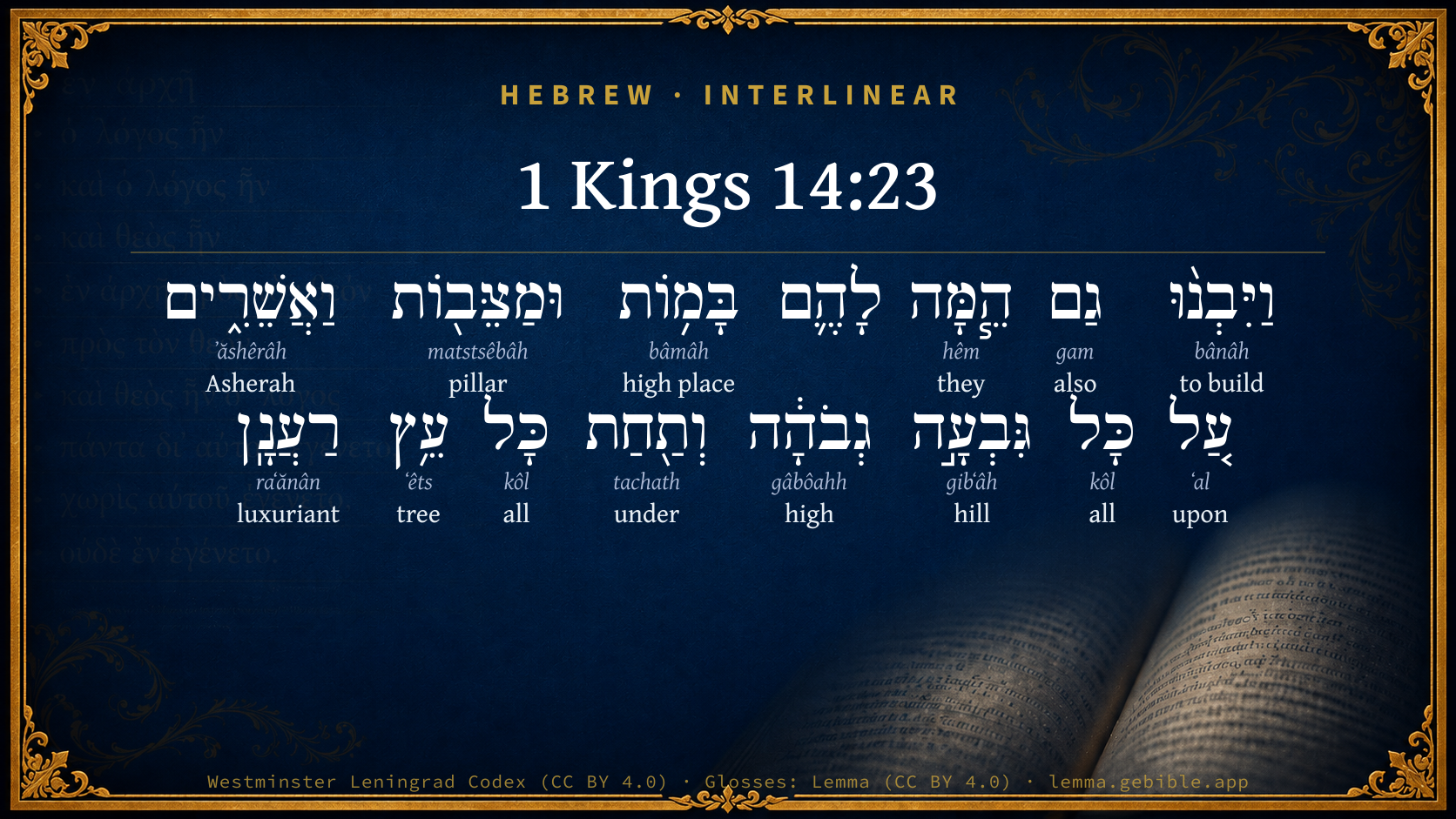
1 Kings 14:23

Hebrew (Westminster Leningrad Codex) 1 Kings 14:23 appears in the Hebrew Old Testament. The text above is from the Westminster Leningrad Codex. Each word links to its Strong’s number, a concise gloss, and parsing drawn from the Open Scriptures Hebrew Bible morphology. Click any word for its full Brown-Driver-Briggs (BDB) entry.
Download image
Cite this verse

1 Kings 14:23 (World English Bible). Public Domain. Lemma interlinear Bible study tool, https://lemma.gebible.app/v/1-kings/14/23.

Show BibTeX & RIS
BibTeX
RIS
English Translation
For they also built them high places, and pillars, and Asherim, on every high hill, and under every green tree;
World English Bible · Public Domain
Download a study sheet

One document with this verse’s original text, its word-by-word gloss line, the meaning frame, cross-references with their text, attributed commentary, and full source and license credits — printable, and it pastes into notes with its structure intact.

This verse Autodidact and up

Study sheet (.html) Plain text (.txt)

A passage Seminary Student

Up to 50 verses in one chapter. A passage sheet keeps up to 6 commentary sources and 12 cross-references per verse, in the order this page ranks them, and says so on the sheet whenever that leaves anything out. Ask for a single verse and you get the Autodidact verse sheet above.

Everything on this page stays free to read, with no account — the sheet is a download of what is already on screen, not access to it.

Want to remove ads? Support Godless Engineer
Compare translations 3

The same verse in 3 English versions, stacked beneath the original-language interlinear above. Click any original word for its lexicon entry.

Each is an independent rendering of the whole verse — the interlinear is not word-aligned to these translations.

Highlighted words mark where these versions differ — a whole-verse word diff, not a word-by-word alignment.

  • World English Bible Public Domain
    For they also built them high places, and pillars, and Asherim, on every high hill, and under every green tree;
  • King James Version Public Domain
    For they also built them high places, and images, and groves, on every high hill, and under every green tree.
  • unfoldingWord Literal Text CC BY-SA 4.0
    And they built for themselves, they also, high places and pillars and Asherahs on every high hill and under every green tree.

unfoldingWord Literal Text — © unfoldingWord, licensed CC BY-SA 4.0. Word-aligned USFM3 via Door43 (git.door43.org/unfoldingWord/en_ult).

Versions to compare (up to 4)

3 of 4 selected

Show all 18 translations

Every available English version of this verse, each an independent rendering of the whole verse.

  • World English Bible Public Domain
    For they also built them high places, and pillars, and Asherim, on every high hill, and under every green tree;
  • Berean Standard Bible Public Domain
    They also built for themselves high places, sacred pillars, and Asherah poles on every high hill and under every green tree.
  • Majority Standard Bible Public Domain
    They also built for themselves high places, sacred pillars, and Asherah poles on every high hill and under every green tree.
  • King James Version Public Domain
    For they also built them high places, and images, and groves, on every high hill, and under every green tree.
  • American Standard Version (1901) Public Domain
    For they also built them high places, and pillars, and Asherim, on every high hill, and under every green tree;
  • Revised Version (1885) Public Domain
    For they also built them high places, and pillars, and Asherim, on every high hill, and under every green tree;
  • Geneva Bible (1599) Public Domain
    For they also made them hie places, and images, and groues on euery hie hill, and vnder euery greene tree.
  • Douay-Rheims (1899) Public Domain
    For they also built them altars, and statues, and groves upon every high hill and under every green tree:
  • Young's Literal Translation Public Domain
    And they build -- also they -- for themselves high places, and standing-pillars, and shrines, on every high height, and under every green tree;
  • Literal Standard Version CC BY-SA 4.0
    And they build—they also—for themselves high places, and standing-pillars, and Asherim, on every high height, and under every green tree;
  • Unlocked Literal Bible CC BY-SA 4.0
    For they also built for themselves high places, stone pillars, and Asherah poles on every high hill and under every green tree.
  • unfoldingWord Literal Text CC BY-SA 4.0
    And they built for themselves, they also, high places and pillars and Asherahs on every high hill and under every green tree.
  • Darby Bible Public Domain
    And they also built for themselves high places, and columns, and Asherahs on every high hill and under every green tree;
  • World Messianic Bible Public Domain
    For they also built for themselves high places, sacred pillars, and Asherah poles on every high hill and under every green tree.
  • Webster's Bible Public Domain
    For they also built for themselves high places, and images and groves, on every high hill, and under every green tree.
  • Free Bible Version CC BY-SA 4.0
    They also set up for themselves high places, sacred pillars, and Asherah poles on every high hill and under every green tree.
  • Bible in Basic English Public Domain
    For they made high places and upright stones and wood pillars on every high hill and under every green tree;
  • JPS Tanakh (1917) Public Domain
    For they also built them high places, and pillars, and Asherim, on every high hill, and under every leafy tree;

Literal Standard Version (2020), Covenant Press — licensed CC BY-SA 4.0. Text via the HelloAO Bible API (eBible.org). Unlocked Literal Bible (unfoldingWord) — licensed CC BY-SA 4.0. Text via the HelloAO Bible API (eBible.org). unfoldingWord Literal Text — © unfoldingWord, licensed CC BY-SA 4.0. Word-aligned USFM3 via Door43 (git.door43.org/unfoldingWord/en_ult). Free Bible Version, Dr. Jonathan Gallagher — licensed CC BY-SA 4.0. Text via the HelloAO Bible API (eBible.org).

Word by word

More ways to search: Search by grammar → Find every occurrence → Compare this word →

Practice this passage: Drill this verse → Learn its vocabulary →

רַעֲנָֽן
raʻănân
H7488
“luxuriant”
Adjective, Adjective, Masculine, Singular, Absolute
Part of Speech
Adjective
Type
Adjective
Gender
Masculine
Number
Singular
State
Absolute
Full BDB Definition

Origin: from an unused root meaning to be green

TWOT: 2190a

(Palel) to be or grow luxuriant or fresh or green (verb) - luxuriant, fresh (adjective)
  1. וַיִּבְנ֨וּ bânâh H1129 “and · to build” Conjunction + Verb, Qal, Sequential Imperfect, 3rd Person, Masculine, Plural
  2. גַם gam H1571 “also” Adverb
  3. הֵ֧מָּה hêm H1992 “they” Pronoun, Personal, 3rd Person, Masculine, Plural
  4. בָּמ֥וֹת bâmâh H1116 “high places” Noun, Common, Feminine, Plural, Absolute
  5. וּמַצֵּב֖וֹת matstsêbâh H4676 “and · pillars” Conjunction + Noun, Common, Feminine, Plural, Absolute
  6. וַאֲשֵׁרִ֑ים ʼăshêrâh H842 “and · Asherah” Conjunction + Noun, Proper
  7. עַ֚ל ʻal H5921 “upon” Preposition
  8. כָּל kôl H3605 “all of” Noun, Common, Masculine, Singular, Construct
  9. גִּבְעָ֣ה gibʻâh H1389 “hill” Noun, Common, Feminine, Singular, Absolute
  10. גְבֹהָ֔ה gâbôahh H1364 “high” Adjective, Adjective, Feminine, Singular, Absolute
  11. וְתַ֖חַת tachath H8478 “and · under” Conjunction + Preposition
  12. כָּל kôl H3605 “all of” Noun, Common, Masculine, Singular, Construct
  13. עֵ֥ץ ʻêts H6086 “tree” Noun, Common, Masculine, Singular, Absolute

About this verse

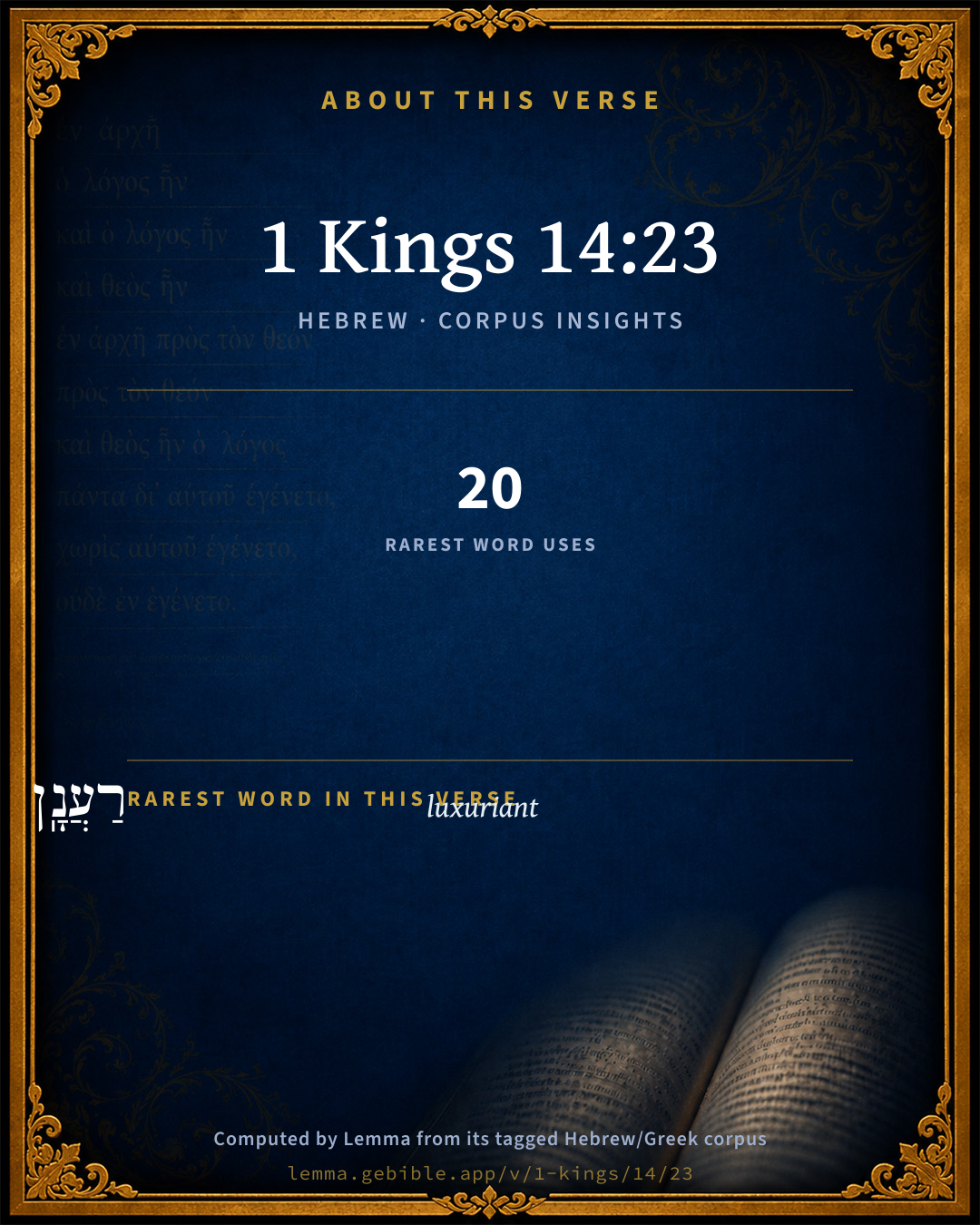
These counts appear in no published source. They are computed here, from the morphology-tagged text and Lemma’s own curated glosses. What Lemma adds →

15
words
13
distinct lemmas
Historical
section

Notable vocabulary

The rarest word here is רַעֲנָֽן luxuriant H7488 — appearing just 20 times in the whole Hebrew Bible.

Shared distinctive vocabulary

רַעֲנָֽן luxuriant H7488 occurs in 20 verses of the Hebrew Bible. Also found in:

Grammatical profile

  • 1 verb
  • 7 nouns
  • 2 adjectives
  • 1 pronoun
  • 3 prepositions
  • 1 adverb

Verb forms

  • וַיִּבְנ֨וּ Qal · Sequential Imperfect

Repetition

A word recurs within this verse — often emphatic in Hebrew:

Hebrew & Septuagint length

In English translation the verse runs 20 words from the Hebrew and 21 from the Septuagint (LXX English) — closely comparable.

A rough comparison of the two English renderings, which tokenize alike — not a word-level alignment.

Word counts can differ between the Hebrew and the Greek without any difference in meaning — e.g. the Hebrew direct-object marker אֵת has no separate Greek word, and Greek often adds the article ὁ.

Cross-references

15

Topical passages linked to 1 Kings 14:23 in the Treasury of Scripture Knowledge — connected by theme and wording, ordered by reader-vote popularity; previews shown in the World English Bible.

  • Deuteronomy 12:2 You shall surely destroy all the places in which the nations that you shall dispossess served their gods, on the high mountains, and on the hills, and under every green tree:
  • Isaiah 57:5 you who inflame yourselves among the oaks, under every green tree; who kill the children in the valleys, under the clefts of the rocks?
  • 2 Kings 17:9–10 The children of Israel did secretly things that were not right against Yahweh their God: and they built them high places in all their cities, from the tower of the watchmen to the fortified city;
  • Ezekiel 16:24–25 that you have built to you a vaulted place, and have made you a lofty place in every street.
  • Leviticus 26:1 "'You shall make for yourselves no idols, neither shall you raise up an engraved image or a pillar, neither shall you place any figured stone in your land, to bow down to it: for I am Yahweh your God.
  • Deuteronomy 16:22 Neither shall you set yourself up a pillar; which Yahweh your God hates.
  • 1 Kings 3:2 Only the people sacrificed in the high places, because there was no house built for the name of Yahweh until those days.
  • 1 Kings 14:15 For Yahweh will strike Israel, as a reed is shaken in the water; and he will root up Israel out of this good land which he gave to their fathers, and will scatter them beyond the River, because they have made their Asherim, provoking Yahweh to anger.
  • 2 Kings 21:3–7 For he built again the high places which Hezekiah his father had destroyed; and he reared up altars for Baal, and made an Asherah, as did Ahab king of Israel, and worshiped all the host of the sky, and served them.
  • 2 Chronicles 28:4 He sacrificed and burnt incense in the high places, and on the hills, and under every green tree.
  • Jeremiah 2:20 For of old time I have broken your yoke, and burst your bonds; and you said, I will not serve; for on every high hill and under every green tree you did bow yourself, playing the prostitute.
  • Jeremiah 3:13 Only acknowledge your iniquity, that you have transgressed against Yahweh your God, and have scattered your ways to the strangers under every green tree, and you have not obeyed my voice, says Yahweh.
  • Jeremiah 17:2 while their children remember their altars and their Asherim by the green trees on the high hills.
  • Ezekiel 20:28–29 For when I had brought them into the land, which I swore to give to them, then they saw every high hill, and every thick tree, and they offered there their sacrifices, and there they presented the provocation of their offering; there also they made their sweet savor, and they poured out there their drink-offerings.
  • Micah 5:14 I will uproot your Asherim out of your midst; And I will destroy your cities.

Cross-references courtesy of OpenBible.info (CC BY 4.0).

Hebrew and Greek witnesses Masoretic Hebrew ↔ Greek Septuagint

The same verse in the two great witnesses to the Old Testament, shown verse-for-verse.

These are two independent witnesses, not word-aligned to each other, and the Septuagint is shown in lemma (dictionary) form.

Hebrew 1 Kings 14:23 Masoretic · Westminster Leningrad Codex

וַיִּבְנ֨וּ גַם הֵ֧מָּה לָהֶ֛ם בָּמ֥וֹת וּמַצֵּב֖וֹת וַאֲשֵׁרִ֑ים עַ֚ל כָּל גִּבְעָ֣ה גְבֹהָ֔ה וְתַ֖חַת כָּל עֵ֥ץ רַעֲנָֽן

For they also built them high places, and pillars, and Asherim, on every high hill, and under every green tree;

World English Bible · Public Domain

Greek LXX 1 Kings 14:23 Septuagint · lemma form
And they built for themselves high places, and pillars, and planted groves on every high hill, and under every shady tree.

LXX2012 (modern English Septuagint) · Public Domain

On this verse, The Pulpit Commentary discusses the Septuagint’s reading. Read the note in Commentary ↓

Hebrew: Westminster Leningrad Codex (CC BY 4.0). Greek: Septuagint (public domain); English from LXX2012 (modern English Septuagint) (Public Domain). How the Septuagint differs from the Hebrew →

Targum (Aramaic paraphrase)

1

The Targum is the ancient Jewish Aramaic paraphrase of the Hebrew Scriptures — an interpretive translation, not the Hebrew text itself. Onkelos (literal) and Pseudo-Jonathan (expansive) render the Torah, and Jonathan the Prophets. Coverage is partial: where no permissively-licensed English translation exists for a verse, only the Aramaic is shown. This is verse-level text, not a word-by-word alignment to the Hebrew.

  1. Targum Jonathan Prophets (Joshua–Malachi)
    וּבְנוֹ אַף אִינוּן לְהוֹן כָּמָן וְקָמָן וַאֲשֵׁרִין עַל כָּל רְמָא מְנַטְלָא וּתְחוֹת כָּל אִילָן עַבּוּף:

    (no public-domain English translation for this verse)

    Targum Jonathan — Aramaic: “Mikraot Gedolot” (public domain). English: “Sefaria Community Translation” (CC0 1.0 (public-domain dedication)); “London "Chaldee Paraphrase," 1871” (public domain). Text via Sefaria.

Commentary

Notes on 1 Kings 14:23 from classic Christian and Jewish commentators (each source and its license shown beneath its notes). The classic Christian expositions comment on the surrounding passage and are grouped to its opening verse, so a note may address several verses; the Jewish commentaries on the Tanakh (Rashi and others) are per-verse, so they appear only where the commentator wrote on this verse.

Lemma curates 59 commentaries, every one of them public domain or Creative Commons licensed, each selected and text-cleaned for this edition rather than reprinted as found. About our sources →

Trapp's Complete Commentary

John Trapp

1Ki 14:23 For they also built them high places, and images, and groves, on every high hill, and under every green tree.

Ver. 23. For they also built them high places.] They fell to foul idolatry and sodomy, which are called evil by a specialty, {1Ki 14:22} like as war is called evil, that is, misery, antonomastice {Isa 45:7}

John Trapp, A Commentary or Exposition upon All the Books of the Old and New Testament (1647–1656) — public domain. Text from a community e-Sword module.

Tyndale Open Study Notes

Tyndale Open Resources

14:23-24 Solomon had married foreign wives, who led his family into idolatry. Judah, under Rehoboam’s leadership, then perpetuated the detestable practices of the pagan nations that occupied the land before the Israelites. The spiritual decline of a nation easily follows from debased leadership, which leads to disgrace and destruction (Prov 14:34). • Shrine prostitutes were not uncommon in Canaan but were prohibited for Israel (see study notes on Lev 17:7; Deut 23:17-18). They became a part of Israelite society as the people embraced Canaanite culture.

Tyndale Open Study Notes — © Tyndale Open Resources, licensed CC BY-SA 4.0. Text via the HelloAO Bible API.

Ellicott's Commentary for English Readers

(23) High places, and images, and groves.—On the “high places,” see 1Ki_3:2, and Note there. The “images” of this passage seem undoubtedly to have been stone pillars, as the “groves” (i.e., the asherahs) were wooden stumps of trees (possibly in both cases surmounted by some rude representation of the deity worshipped). The first mention of such a pillar is in Gen_28:18; Gen_31:13; Gen_35:14, there applied to the stone which Jacob raises and anoints, in order to mark the scene of the vision at Bethel; next, we find repeated commands to destroy them (with the asherahs also) as erected by the Canaanites (Exo_23:24; Exo_34:13; Lev_26:1; Deu_7:5; Deu_12:3), and to suffer neither near the altar of the Lord (Deu_16:21). Like the high places, it seems plain that both might be either unauthorised emblems of God’s presence or images of false gods; and, indeed, the stone pillar appears in some cases to be associated with the worship of Baal, as the Asherah with that of Ashtoreth. In this passage, from the strength of the language used, and from the notice in 1Ki_14:24, it seems that the grosser idolatry is referred to. It was practised “on every high hill, and every shady tree”—such trees as were notable for size and shade in the bareness of the hills of Palestine.

A Bible Commentary for English Readers, edited by Charles John Ellicott (1878–1897) — public domain. Text from a community e-Sword module.

The Cambridge Bible for Schools and Colleges

gen. ed. J. J. S. Perowne

23. high places] We read constantly of ‘houses’ of the high places, and it is to these erections on some lofty hills that the ‘building’ here spoken of applies. See above, 1Ki_12:31.

images] The R.V. renders by pillars, with ‘obelisks’ in the margin. And this appears more correct than A. V. There is nothing in the word itself to denote an image. The root signifies ‘to set up,’ and this noun is applied to the stones which Jacob set up (Gen_28:18; Gen_31:45; Gen_35:14), and which Joshua set up (Jos_4:9) when the people had passed over Jordan. Probably therefore the erections made in Judah were only large stones. The name is given also to the ‘obelisks’ which stood at the entrance of the Temple of the Sun in Heliopolis (Jer_43:13).

and groves] R.V. Ashêrim. See above on 1Ki_14:15.

The Cambridge Bible for Schools and Colleges (gen. ed. J. J. S. Perowne; Cambridge University Press, 1878–1918) — public domain. Text from a community e-Sword module.

John Gill's Exposition

And there were also Sodomites in the land, Such as were addicted to unnatural lusts between men and men, which the men of Sodom were guilty of, from whence they had their name: Jarchi interprets the word adultery and some versions render it whoremongers; and filthy actions of this nature, both by men and women, usually attended idolatrous practices among the heathens; in their temples and groves such wickednesses were privately perpetrated:

and they did according to all the abominations of the nations which the Lord cast out before the children of Israel; the Canaanites, of whose uncleannesses, incests, and bestialities, see Lev 18:1.

John Gill's Exposition of the Whole Bible (1746–1763) — public domain (CC PDM 1.0). Text via the HelloAO Bible API.

Albert Barnes' Notes on the Bible

The words “they also” are emphatic. Not only did the Israelites make themselves high places 1Ki 12:31; 1Ki 13:32, but the people of Judah also. The “high places,” which are said to have been “built,” were probably small shrines or tabernacles hung with bright-colored tapestry Eze 16:16, like the “sacred tent” of the Carthaginians.

The “images” were rather “pillars” (Gen 28:18 note).

Groves - See 1Ki 14:15, note. The “groves,” it will be observed, were “built” on high hills and “under green trees.”

Under every green tree - i. e., under all those remarkable trees which, standing singly about the land, were landmarks to their respective neighborhoods, and places of resort to travelers, who gladly rested under their shade Deu 12:2.

Albert Barnes' Notes on the Bible (1834–1885) — public domain. Text from a community e-Sword/MySword module.

Haydock's Catholic Bible Commentary

High hill. Such places of devotion had been tolerated, before the temple was built: but now they were deemed profane. (Calmet)

George Leo Haydock (1774–1849), Haydock's Catholic Family Bible and Commentary, 1859 edition — public domain. Excludes Psalms (Douay-Rheims chapter numbering differs from Protestant) and Deuterocanonical books (Catholic canon only).

Matthew Poole's English Annotations

They also built them high places; they followed the example of the Israelites, although they were better instructed, and had the temple in their kingdom, and liberty of access to it, which was denied to the Israelites; and the privilege of worshipping God in his own way, and the counsels, and sermons, and examples of the priests and Levites to and stablish them, and the dreadful example of Israel’s horrid apostacy to caution and terrify them. The building of high places was unlawful, and now especially when the temple was built, and ready to receive them; unnecessary, and therefore expressed a greater contempt of God and his express command to the contrary.

Images and groves; not only after the manner of the heathens and Israelites, but against a direct and particular prohibition.

Under every green tree: the people were universally corrupted; which is a prodigious sin, all things considered, and is a clear evidence of the greatness and depth of the original corruption of man’s nature, which without God’s grace is ready to break forth into all sorts of wickedness.

Matthew Poole's English Annotations on the Holy Bible (1683–1685) — public domain. Text from a community e-Sword/MySword module.

Whedon's Commentary on the Bible

Daniel D. Whedon

23. High places — Altars on hilltops. See note on 1Ki_3:2.

Images — Monumental pillars or statues erected to the honor of false gods.

Groves — Rather, wooden idols, erected to the honour of Ashtoreth. See note on 1Ki_14:15. A prominent height and a shady grove were the places desired by idolaters.

Daniel D. Whedon (gen. ed.), Commentary on the Old and New Testaments (1874–1909) — public domain. Text from a community e-Sword module.

The Pulpit Commentary

For they also i.e. , they as well as the ten tribes built them high places i.e. , houses of high places. See on 1Ki_3:2 1Ki_13:32 and images Heb. pillars or statues (twObXem LXX, sthlav). These were, no doubt, originally memorial pillars or stones, erected to commemorate some Divine manifestation, and with no thought of idolatry. (Gen_31:13 Gen_35:14, 20 28:18) But the Canaanites erected pillars, which were also statues or images, to their god, Baal. Hence we read of the "image" (hbXem) of Baal; (2Ki_3:2 2Ki_10:26, 2Ki_10:27; cf. 2Ki_18:4 2Ki_23:14) and hence also we find such images frequently mentioned side byside with the so-called "groves," i.e., the "Asherahs" (ver. 15; Exodus Deu_7:5 Deu_12:3 Deu_16:21, etc.) Both the Mazzebah and the Asherah, consequently, was an upright pillar or post, but the former was of stone, the latter of wood; the former dedicated to Baal, the god of nature, of generation; the latter to Ashtoreth, the goddess of nature and productive power. The gradual transition of the memorial pillar into the Baal statue is hinted at in Lev_26:1. It is observable that these idolatrous and immoral rites seem to have found a home in Judah before they were introduced into Israel and groves Asherahs, idols; see on ver. 15. This verse proves conclusively that the translation "grove" is a mistaken one on every high hill, and under every green tree. The phrase is from the Pentateuch, Deu_12:2; cf. Jer_2:20 Jer_3:6; Hos_4:13. "Probably the evil example of Maachah, his favourite wife, (2Ch_11:20-22) whose idolatrous tastes were displayed under Asa, (2Ch_15:16) was not without a pernicious effect on Rehoboam" (Wordsworth).

The Pulpit Commentary (1880–1919), ed. H.D.M. Spence-Jones & Joseph S. Exell — public domain. Text from a community e-Sword module.

John Wesley's Explanatory Notes

They also - Followed the example of the Israelites, although they were better instructed, and had the temple in their kingdom, and liberty of access to it, and the privilege of worshipping God in his own way, and the counsels, and sermons, and examples of the priests and Levites, and the dreadful example of Israel's horrid apostacy, to caution and terrify them. High places - Which was unlawful, and, now especially when the temple was built, and ready to receive them; unnecessary, and therefore expressed a greater contempt of God and his express command. Groves - Not only after the manner of the Heathens and Israelites, but against a direct and particular prohibition. Under every green tree - The people were universally corrupted: which is prodigious, all things considered, and is a clear evidence of the greatness and depth of the original corruption of man's nature.

John Wesley, Explanatory Notes Upon the Whole Bible (1754–1765) — public domain. Text via the GEBible commentary corpus.

unfoldingWord translationNotes

Door43 World Missions Community

For they also built

The word "they" here refers to the people of Judah.

built for themselves

The words "for themselves" are a metonym for what they will do with the high places. AT: "built for their own use" (See: Metonymy and Reflexive Pronouns)

on every high hill and under every green tree

This is likely to be an exaggeration that indicates there were many places like these for false worship all over the country. AT: "on the high hills and under the green trees" (See: Hyperbole and Generalization)

cultic prostitutes

"religious prostitutes" or "male prostitutes." This probably refers to male prostitutes who were associated with idol worship.

the same despicable practices as the nations that

Here the word "nations" represents the people in those nations. AT: "the same disgusting things that the people did, whom" (See: Metonymy)

translationWords

high place

column

Asherah

prostitute

nation

cast out

Israel

unfoldingWord translationNotes — © Distant Shores Media and the Door43 World Missions Community, licensed CC BY-SA 4.0. Source: git.door43.org/Door43/en_tn.

Rashi

Rabbi Shlomo Yitzchaki (Rashi)

They too. Like the other tribes.

Rashi on the Tanakh — English translations: “The Judaica Press complete Tanach with Rashi, translated by A. J. Rosenberg” (CC BY 4.0); “Pentateuch with Rashi's commentary by M. Rosenbaum and A.M. Silbermann, 1929-1934” (public domain); “The Metsudah Tanach series, Lakewood, N.J” (CC BY 4.0); and “The Book of Joshua, Metsudah Publications, 1997” (CC BY 4.0). Text via Sefaria.

Lesson kit

Teaching starters — assembled from the data on this page, not authored interpretation. Every prompt links to the verse data it draws on. Edit before teaching.

1 Kings, in the Historical, opens this verse with 15 words (13 distinct Hebrew lemmas). Its most distinctive word is raʻănân (“luxuriant”). A historical commentator’s framing appears above. Read the whole chapter for the surrounding context.

Discussion questions

  1. What does “luxuriant” (raʻănân) contribute to the verse as a whole?
  2. How does Deuteronomy 12:2, which shares the word «luxuriant», read alongside this verse?
  3. What does the repetition of “all” (2× in this one verse) do in this verse?
  4. These translations render this verse differently; the difference is in the English rendering, not the original. What questions does that raise?
  5. «וַיִּבְנ֨וּ» is a Qal Sequential Imperfect verb. How does that grammatical form shape the action described?
  6. Compare how Trapp's Complete Commentary and Tyndale Open Study Notes read this verse. Where do they agree or differ?

Things to notice

Reading settings

Reading text

Shown beneath each verse's original-language words.

Old Testament
Old Testament edition

Read the OT as the Masoretic Hebrew (MT) or the Greek Septuagint (LXX).

English shown for the Greek Septuagint (in the Hebrew ↔ Greek comparison).

Comparing translations? Open the Compare panel on any verse page to stack up to four side by side.