
1 Kings 1:41

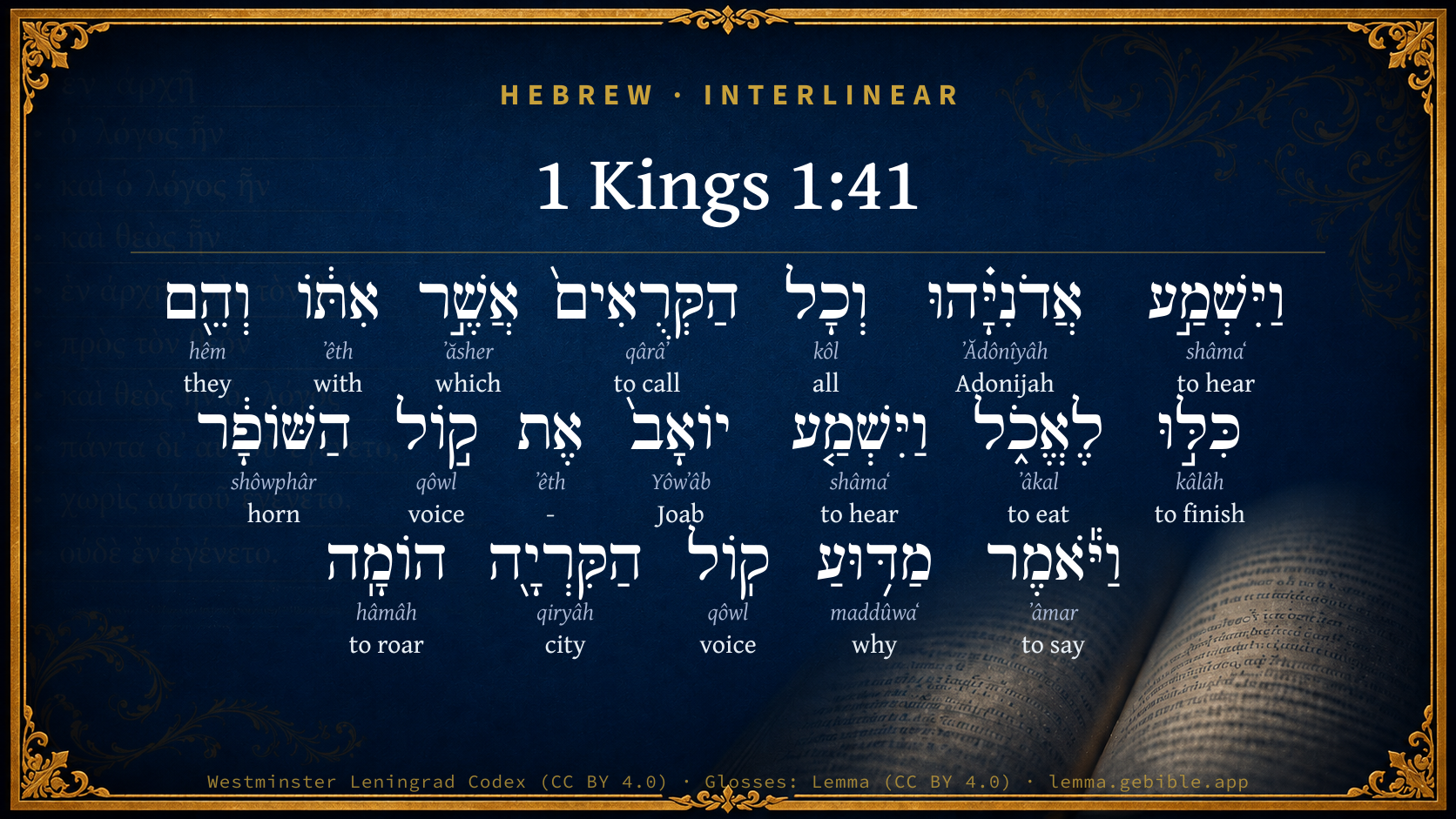
Hebrew (Westminster Leningrad Codex) 1 Kings 1:41 appears in the Hebrew Old Testament. The text above is from the Westminster Leningrad Codex. Each word links to its Strong’s number, a concise gloss, and parsing drawn from the Open Scriptures Hebrew Bible morphology. Click any word for its full Brown-Driver-Briggs (BDB) entry.
Download image
Cite this verse

1 Kings 1:41 (World English Bible). Public Domain. Lemma interlinear Bible study tool, https://lemma.gebible.app/v/1-kings/1/41.

Show BibTeX & RIS
BibTeX
RIS
English Translation
Adonijah and all the guests who were with him heard it as they had made an end of eating. When Joab heard the sound of the trumpet, he said, Why is this noise of the city being in an uproar?
World English Bible · Public Domain
Highlights
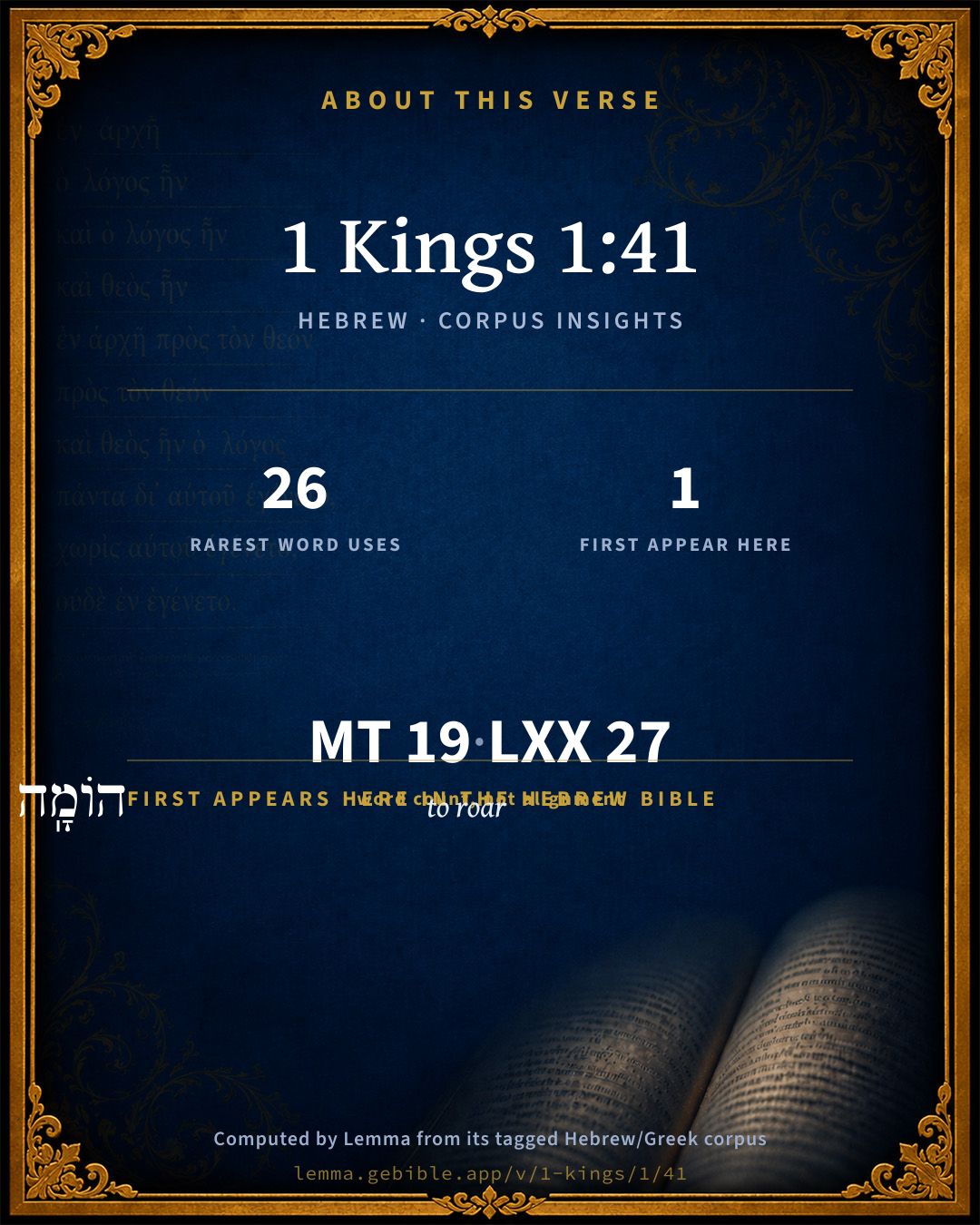
  • 1 first appearance in the Hebrew Bible
Full analysis ↓
Download a study sheet

One document with this verse’s original text, its word-by-word gloss line, the meaning frame, cross-references with their text, attributed commentary, and full source and license credits — printable, and it pastes into notes with its structure intact.

This verse Autodidact and up

Study sheet (.html) Plain text (.txt)

A passage Seminary Student

Up to 50 verses in one chapter. A passage sheet keeps up to 6 commentary sources and 12 cross-references per verse, in the order this page ranks them, and says so on the sheet whenever that leaves anything out. Ask for a single verse and you get the Autodidact verse sheet above.

Everything on this page stays free to read, with no account — the sheet is a download of what is already on screen, not access to it.

Want to remove ads? Support Godless Engineer
Compare translations 3

The same verse in 3 English versions, stacked beneath the original-language interlinear above. Click any original word for its lexicon entry.

Each is an independent rendering of the whole verse — the interlinear is not word-aligned to these translations.

Highlighted words mark where these versions differ — a whole-verse word diff, not a word-by-word alignment.

  • World English Bible Public Domain
    Adonijah and all the guests who were with him heard it as they had made an end of eating. When Joab heard the sound of the trumpet, he said, Why is this noise of the city being in an uproar?
  • King James Version Public Domain
    And Adonijah and all the guests that were with him heard it as they had made an end of eating. And when Joab heard the sound of the trumpet, he said, Wherefore is this noise of the city being in an uproar?
  • unfoldingWord Literal Text CC BY-SA 4.0
    And Adonijah and all of the called ones who with him heard, and they had finished eating. And Joab heard the sound of the shofar, and he said, “Why is the sound of the city being noisy?”

unfoldingWord Literal Text — © unfoldingWord, licensed CC BY-SA 4.0. Word-aligned USFM3 via Door43 (git.door43.org/unfoldingWord/en_ult).

Versions to compare (up to 4)

3 of 4 selected

Show all 18 translations

Every available English version of this verse, each an independent rendering of the whole verse.

  • World English Bible Public Domain
    Adonijah and all the guests who were with him heard it as they had made an end of eating. When Joab heard the sound of the trumpet, he said, Why is this noise of the city being in an uproar?
  • Berean Standard Bible Public Domain
    Now Adonijah and all his guests were finishing their feast when they heard the sound of the ram’s horn. “Why is the city in such a loud uproar?” asked Joab.
  • Majority Standard Bible Public Domain
    Now Adonijah and all his guests were finishing their feast when they heard the sound of the ram’s horn. “Why is the city in such a loud uproar?” asked Joab.
  • King James Version Public Domain
    And Adonijah and all the guests that were with him heard it as they had made an end of eating. And when Joab heard the sound of the trumpet, he said, Wherefore is this noise of the city being in an uproar?
  • American Standard Version (1901) Public Domain
    And Adonijah and all the guests that were with him heard it as they had made an end of eating. And when Joab heard the sound of the trumpet, he said, Wherefore is this noise of the city being in an uproar?
  • Revised Version (1885) Public Domain
    And Adonijah and all the guests that were with him heard it as they had made an end of eating. And when Joab heard the sound of the trumpet, he said, Wherefore is this noise of the city being in an uproar?
  • Geneva Bible (1599) Public Domain
    And Adoniiah and all the ghestes that were with him, heard it: (and they had made an ende of eating) and when Ioab heard the sound of the trumpet, he said, What meaneth this noise and vprore in the citie?
  • Douay-Rheims (1899) Public Domain
    And Adonias, and all that were invited by him, heard it, and now the feast was at an end: Joab also hearing the sound of the trumpet, said: What meaneth this noise of the city in an uproar?
  • Young's Literal Translation Public Domain
    And Adonijah heareth, and all those called, who `are' with him, and they have finished to eat, and Joab heareth the noise of the trumpet, and saith, `Wherefore `is' the noise of the city roaring?'
  • Literal Standard Version CC BY-SA 4.0
    And Adonijah hears, and all those called who [are] with him, and they have finished to eat, and Joab hears the noise of the horn and says, “Why [is] the noise of the city roaring?”
  • Unlocked Literal Bible CC BY-SA 4.0
    Adonijah and all the guests who were with him heard it as they finished eating. When Joab heard the sound of the trumpet, he said, “Why is there an uproar in the city?”
  • unfoldingWord Literal Text CC BY-SA 4.0
    And Adonijah and all of the called ones who with him heard, and they had finished eating. And Joab heard the sound of the shofar, and he said, “Why is the sound of the city being noisy?”
  • Darby Bible Public Domain
    And Adonijah and all the guests that were with him heard [it] as they were finishing their repast; and Joab heard the sound of the trumpet, and he said, Wherefore this noise of the city in an uproar?
  • World Messianic Bible Public Domain
    Adonijah and all the guests who were with him heard it as they had finished eating. When Joab heard the sound of the shofar, he said, “Why is this noise of the city being in an uproar?”
  • Webster's Bible Public Domain
    And Adonijah and all the guests that were with him heard it as they had made an end of eating. And when Joab heard the sound of the trumpet, he said, Why is this noise of the city being in an uproar?
  • Free Bible Version CC BY-SA 4.0
    Adonijah and all his guests heard the noise as they were finishing eating. When Joab heard the sound of the trumpet, he asked, “What's all this noise coming from the city?”
  • Bible in Basic English Public Domain
    And it came to the ears of Adonijah and all the guests who were with him, when their meal was ended. And Joab, hearing the sound of the horn, said, What is the reason of this noise as if the town was worked up?
  • JPS Tanakh (1917) Public Domain
    And Adonijah and all the guests that were with him heard it as they had made an end of eating. And when Joab heard the sound of the horn, he said: 'Wherefore is this noise of the city being in an uproar?'

Literal Standard Version (2020), Covenant Press — licensed CC BY-SA 4.0. Text via the HelloAO Bible API (eBible.org). Unlocked Literal Bible (unfoldingWord) — licensed CC BY-SA 4.0. Text via the HelloAO Bible API (eBible.org). unfoldingWord Literal Text — © unfoldingWord, licensed CC BY-SA 4.0. Word-aligned USFM3 via Door43 (git.door43.org/unfoldingWord/en_ult). Free Bible Version, Dr. Jonathan Gallagher — licensed CC BY-SA 4.0. Text via the HelloAO Bible API (eBible.org).

Word by word

More ways to search: Search by grammar → Find every occurrence → Compare this word →

Practice this passage: Drill this verse → Learn its vocabulary →

אֲדֹנִיָּ֗הוּ
ʼĂdônîyâh
H138
“Adonijah”
Noun, Proper
Part of Speech
Noun
Type
Proper
Full BDB Definition

Origin: from H113 and H3050

TWOT: None

Adonijah = "my lord is Jehovah" - fourth son of David and Solomon's rival for the throne - Levite sent by Jehoshaphat to teach the Law - a chief of the people who co-operated with Nehemiah
  1. וַיִּשְׁמַ֣ע shâmaʻ H8085 “and · to hear” Conjunction + Verb, Qal, Sequential Imperfect, 3rd Person, Masculine, Singular
  2. וְכָל kôl H3605 “and · all of” Conjunction + Noun, Common, Masculine, Singular, Construct
  3. הַקְּרֻאִים֙ qârâʼ H7121 “the · called” Particle, Definite Article + Verb, Qal, Participle Passive, Masculine, Plural, Absolute
  4. אֲשֶׁ֣ר ʼăsher H834 “which” Particle, Relative
  5. אִתּ֔וֹ ʼêth H854 “with · him” Preposition + Suffix, Personal, 3rd Person, Masculine, Singular
  6. וְהֵ֖ם hêm H1992 “and · they” Conjunction + Pronoun, Personal, 3rd Person, Masculine, Plural
  7. כִּלּ֣וּ kâlâh H3615 “to finish” Verb, Piel, Perfect, 3rd Person, Common, Plural
  8. לֶאֱכֹ֑ל ʼâkal H398 “to eat” Preposition + Verb, Qal, Infinitive Construct
  9. וַיִּשְׁמַ֤ע shâmaʻ H8085 “and · to hear” Conjunction + Verb, Qal, Sequential Imperfect, 3rd Person, Masculine, Singular
  10. יוֹאָב֙ Yôwʼâb H3097 “Joab” Noun, Proper
  11. אֶת ʼêth H853 “-” Particle, Direct Object
  12. ק֣וֹל qôwl H6963 “voice of” Noun, Common, Masculine, Singular, Construct
  13. הַשּׁוֹפָ֔ר shôwphâr H7782 “the · horn” Particle, Definite Article + Noun, Common, Masculine, Singular, Absolute
  14. וַיֹּ֕אמֶר ʼâmar H559 “and · to say” Conjunction + Verb, Qal, Sequential Imperfect, 3rd Person, Masculine, Singular
  15. מַדּ֥וּעַ maddûwaʻ H4069 “why” Particle, Interrogative
  16. קֽוֹל qôwl H6963 “voice of” Noun, Common, Masculine, Singular, Construct
  17. הַקִּרְיָ֖ה qiryâh H7151 “the · city” Particle, Definite Article + Noun, Common, Feminine, Singular, Absolute
  18. הוֹמָֽה hâmâh H1993 “roaring” Verb, Qal, Participle Active, Feminine, Singular, Absolute

About this verse

These counts appear in no published source. They are computed here, from the morphology-tagged text and Lemma’s own curated glosses. What Lemma adds →

19
words
17
distinct lemmas
Historical
section

First appearance in Scripture

This word makes its first canonical appearance in the Hebrew Bible here:

  • הוֹמָֽה to roar H1993

Shared distinctive vocabulary

אֲדֹנִיָּ֗הוּ Adonijah H138 occurs in 26 verses of the Hebrew Bible. Also found in:

Grammatical profile

  • 7 verbs
  • 7 nouns
  • 1 pronoun
  • 1 preposition
  • 3 particles

Verb forms

  • וַיִּשְׁמַ֣ע Qal · Sequential Imperfect
  • הַקְּרֻאִים֙ Qal · Participle Passive
  • כִּלּ֣וּ Piel · Perfect
  • לֶאֱכֹ֑ל Qal · Infinitive Construct
  • וַיִּשְׁמַ֤ע Qal · Sequential Imperfect
  • וַיֹּ֕אמֶר Qal · Sequential Imperfect
  • הוֹמָֽה Qal · Participle Active

Repetition

Words recur within this verse — often emphatic in Hebrew:

  • וַיִּשְׁמַ֣ע to hear H8085 ×2
  • ק֣וֹל voice H6963 ×2

Hebrew & Septuagint length

In English translation the verse runs 40 words from the Hebrew and 33 from the Septuagint (LXX English) — closely comparable.

A rough comparison of the two English renderings, which tokenize alike — not a word-level alignment.

Word counts can differ between the Hebrew and the Greek without any difference in meaning — e.g. the Hebrew direct-object marker אֵת has no separate Greek word, and Greek often adds the article ὁ.

In the original languages it is 19 Hebrew tokens and 27 Greek tokens — but the two are counted differently (Hebrew bundles its prefixes and suffixes into one token; the Greek is in lemma form), so that isn’t a like-for-like length.

Cross-references

11

Topical passages linked to 1 Kings 1:41 in the Treasury of Scripture Knowledge — connected by theme and wording, ordered by reader-vote popularity; previews shown in the World English Bible.

  • Exodus 32:17 When Joshua heard the noise of the people as they shouted, he said to Moses, "There is the noise of war in the camp."
  • Job 15:21–22 A sound of terrors is in his ears; In prosperity the destroyer shall come on him.
  • Job 20:5 That the triumphing of the wicked is short, The joy of the godless but for a moment?
  • Psalms 73:18–20 Surely you set them in slippery places. You throw them down to destruction.
  • Proverbs 14:13 Even in laughter the heart may be sorrowful, And mirth may end in heaviness.
  • Ecclesiastes 7:4–6 The heart of the wise is in the house of mourning; but the heart of fools is in the house of mirth.
  • Matthew 21:9–11 The multitudes who went before him, and who followed kept shouting, "Hosanna to the son of David! Blessed is he who comes in the name of the Lord! Hosanna in the highest!"
  • Matthew 21:15 But when the chief priests and the scribes saw the wonderful things that he did, and the children who were crying in the temple and saying, "Hosanna to the son of David!" they were indignant,
  • Matthew 24:38–39 For as in those days which were before the flood they were eating and drinking, marrying and giving in marriage, until the day that Noah entered into the ark,
  • Luke 17:26–29 As it happened in the days of Noah, even so will it be also in the days of the Son of Man.
  • Acts 21:31 As they were trying to kill him, news came up to the commanding officer of the regiment that all Jerusalem was in an uproar.

Cross-references courtesy of OpenBible.info (CC BY 4.0).

Hebrew and Greek witnesses Masoretic Hebrew ↔ Greek Septuagint

The same verse in the two great witnesses to the Old Testament, shown verse-for-verse.

These are two independent witnesses, not word-aligned to each other, and the Septuagint is shown in lemma (dictionary) form.

Hebrew 1 Kings 1:41 Masoretic · Westminster Leningrad Codex

וַיִּשְׁמַ֣ע אֲדֹנִיָּ֗הוּ וְכָל הַקְּרֻאִים֙ אֲשֶׁ֣ר אִתּ֔וֹ וְהֵ֖ם כִּלּ֣וּ לֶאֱכֹ֑ל וַיִּשְׁמַ֤ע יוֹאָב֙ אֶת ק֣וֹל הַשּׁוֹפָ֔ר וַיֹּ֕אמֶר מַדּ֥וּעַ קֽוֹל הַקִּרְיָ֖ה הוֹמָֽה

Adonijah and all the guests who were with him heard it as they had made an end of eating. When Joab heard the sound of the trumpet, he said, Why is this noise of the city being in an uproar?

World English Bible · Public Domain

Greek LXX 1 Kings 1:41 Septuagint · lemma form

καί ἀκούω αδωνίας καί πᾶς ὁ κλητός αὐτός καί αὐτός συντελέω ἐσθίω καί ἀκούω ιωαβ ὁ φωνή ὁ κερατίνη καί εἶπον τίς ὁ φωνή ὁ πόλις ἠχέω

And Adonias and all his guests heard, and they had just left off eating: and Joab heard the sound of the trumpet, and said, What means the voice of the city in tumult?

LXX2012 (modern English Septuagint) · Public Domain

Hebrew: Westminster Leningrad Codex (CC BY 4.0). Greek: Septuagint (public domain); English from LXX2012 (modern English Septuagint) (Public Domain). How the Septuagint differs from the Hebrew →

Targum (Aramaic paraphrase)

1

The Targum is the ancient Jewish Aramaic paraphrase of the Hebrew Scriptures — an interpretive translation, not the Hebrew text itself. Onkelos (literal) and Pseudo-Jonathan (expansive) render the Torah, and Jonathan the Prophets. Coverage is partial: where no permissively-licensed English translation exists for a verse, only the Aramaic is shown. This is verse-level text, not a word-by-word alignment to the Hebrew.

  1. Targum Jonathan Prophets (Joshua–Malachi)
    וּשְׁמַע אֲדֹנִיָה וְכָל זַמִינַיָא דִי עִמֵיהּ וְאִינוּן סַפִּיקוּ לְמֵיכַל וּשְׁמַע יוֹאָב יַת קַל שׁוֹפָרָא וַאֲמַר מָא דֵין קַל קַרְתָּא אִשְׁתַּגֵישַׁת:

    (no public-domain English translation for this verse)

    Targum Jonathan — Aramaic: “Mikraot Gedolot” (public domain). English: “Sefaria Community Translation” (CC0 1.0 (public-domain dedication)); “London "Chaldee Paraphrase," 1871” (public domain). Text via Sefaria.

Commentary

Notes on 1 Kings 1:41 from classic Christian and Jewish commentators (each source and its license shown beneath its notes). The classic Christian expositions comment on the surrounding passage and are grouped to its opening verse, so a note may address several verses; the Jewish commentaries on the Tanakh (Rashi and others) are per-verse, so they appear only where the commentator wrote on this verse.

Lemma curates 59 commentaries, every one of them public domain or Creative Commons licensed, each selected and text-cleaned for this edition rather than reprinted as found. About our sources →

Matthew Henry's Commentary

We have here,

I. The tidings of Solomon's inauguration brought to Adonijah and his party, in the midst of their jollity: They had made an end of eating, and, it should seem, it was a great while before they made an end, for all the affair of Solomon's anointing was ordered and finished while they were at dinner, glutting themselves. Thus those who serve not our Lord Christ, but oppose him, are commonly such as serve their own belly (Rom 16:18) and made a god of it, Phi 3:19. Their long feast intimates likewise that they were very secure and confident of their interest, else they would not have lost so much time. The old world and Sodom were eating and drinking, secure and sensual, when their destruction came, Luk 17:26, etc. When they made an end of eating, and were preparing themselves to proclaim their king, and bring him in triumph into the city, they heard the sound of the trumpet (Kg1 1:41), and a dreadful sound it was in their ears, Job 15:21. Joab was an old man, and was alarmed at it, apprehending the city to be in an uproar; but Adonijah was very confident that the messenger, being a worthy man, brought good tidings, Kg1 1:42. Usurpers flatter themselves with the hopes of success, and those are commonly least timorous whose condition is most dangerous. But how can those who do evil deeds expect to have good tidings? No, the worthiest man will bring them the worst news, as the priest's son did here to Adonijah, Kg1 1:43. "Verily, the best tidings I have to bring you is that Solomon is made king, so that your pretensions are all quashed." He relates to them very particularly, 1. With what great solemnity Solomon was made king (Kg1 1:44, Kg1 1:45), and that he was now sitting on the throne of the kingdom, Kg1 1:46. Adonijah thought to have stepped into the throne before him, but Solomon was too quick for him. 2. With what general satisfaction Solomon was made king, so that that which was done was not likely to be undone again. (1.) The people were pleased, witness their joyful acclamations, Kg1 1:45. (2.) The courtiers were pleased: The kings servants attended him with an address of congratulation upon this occasion, Kg1 1:47. We have here the heads of their address: They blessed king David, applauded his prudent care for the public welfare, acknowledged their happiness under his government, and prayed heartily for his recovery. They also prayed for Solomon, that God would make his name better than his father's, which it might well be when he had his father's foundation to build upon. A child, on a giant's shoulders, is higher than the giant himself. (3.) The king himself was pleased: He bowed himself upon the bed, not only to signify his acceptance of his servants' address, but to offer up his own address to God (Kg1 1:48): "Blessed be the Lord God of Israel, who, as Israel's God, for Israel's good, has brought this matter to such a happy issue, my eyes even seeing it." Note, It is a great satisfaction to good men, when they are going out of the world, to see the affairs of their families in a good posture, their children rising up in their stead to serve God and their generation, and especially to see peace upon Israel and the establishment of it.

II. The effectual crush which this gave to Adonijah's attempt. It spoiled the sport of his party, dispersed the company, and obliged every man to shift for his own safety. The triumphing of the wicked is short. They were building a castle in the air, which, having no foundation, would soon fall and crush them. They were afraid of being taken in the fact, while they were together hatching their treason, and therefore each one made the best of his way.

III. The terror Adonijah himself was in, and the course he took to secure himself. he was now as much depressed as he had been elevated, Kg1 1:42, Kg1 1:50. He had despised Solomon as not worthy to be his guest (Kg1 1:10), but now he dreads him as his judge: He feared because of Solomon. Thus those who oppose Christ and his kingdom will shortly be made to tremble before him, and call in vain to rocks and mountains to shelter them from his wrath. He took hold on the horns of the altar, which was always looked upon as a sanctuary, or place of refuge (Exo 21:14), intimating hereby that he durst not stand a trial, but threw himself upon the mercy of his prince, in suing for which he relied upon no other plea than the mercy of God, which was manifested in the institution and acceptance of the sacrifices that were offered on that altar and the remission of sin thereupon. Perhaps Adonijah had formerly slighted the service of the altar, yet now he courts the protection of it. Many who in the day of their security neglect the great salvation, under the arrests of the terrors of the Lord would gladly be beholden to Christ and his merit, and, when it is too late, will catch hold of the horns of the altar.

IV. His humble address to Solomon for mercy. By those who brought Solomon tidings where he was, he sent a request for his life (Kg1 1:51): Let king Solomon swear to me that he will not slay his servant. He owns Solomon for his prince, and himself his servant, dares not justify himself, but makes supplication to his judge. It was a great change with him. He that in the morning was grasping at a crown is before night begging for his life. Then Adonijah reigned, now Adonijah trembles, and cannot think himself safe unless Solomon promise, with an oath, not to put him to death.

V. The orders Solomon gave concerning him. He discharges him upon his good behaviour, Kg1 1:52, Kg1 1:53. He considered that Adonijah was his brother, and that it was the first offence. Perhaps, being so soon made sensible of his error and then not persisting in his rebellion, he might prove not only a peaceable, but a serviceable subject, and therefore, if he will conduct himself well for the future, what is past shall be pardoned: but if he be fond disaffected, turbulent, and aspiring, this offence shall be remembered against him, he shall be called up upon his former conviction (as our law speaks), and execution shall be awarded against him. Thus the Son of David receives those to mercy that have been rebellious: if they will return to their allegiance, and be faithful to their Sovereign, their former crimes shall not be mentioned against them; but, if still they continue in the interests of the world and the flesh, this will be their ruin. Adonijah is sent for, and told upon what terms he stands, which he signifies his grateful submission to, and then is told to go to his house and live retired there. Solomon not only gave him his life, but his estate, thus establishing his throne by mercy.

Matthew Henry's Commentary on the Whole Bible (1708–1710) — public domain (CC PDM 1.0). Text via the HelloAO Bible API.

Trapp's Complete Commentary

John Trapp

1Ki 1:41 And Adonijah and all the guests that [were] with him heard [it] as they had made an end of eating. And when Joab heard the sound of the trumpet, he said, Wherefore [is this] noise of the city being in an uproar?

Ver. 41. As they had made an end of eating.] Ever after the meal is ended, comes the reckoning. Adonijah’s feast, as all wicked men’s, endeth in horror; for the last dish, is served up astonishment and fearful expectation of just revenge. So doth the wise and just God befool proud and insolent sinners in those secret plots wherein they hope to undermine the son of David, the Prince of peace.

John Trapp, A Commentary or Exposition upon All the Books of the Old and New Testament (1647–1656) — public domain. Text from a community e-Sword module.

Whedon's Commentary on the Bible

Daniel D. Whedon

ADONIJAH’S ALARM, 1Ki_1:41-53.

41. Joab heard — The old warrior’s ear is quick to catch the first signal of alarm.

Daniel D. Whedon (gen. ed.), Commentary on the Old and New Testaments (1874–1909) — public domain. Text from a community e-Sword module.

The Preacher's Complete Homiletical Commentary

Joseph S. Exell (gen. ed.)

CRITICAL AND EXPLANATORY NOTES.—

1Ki_1:47. King bowed himself upon his bed—His infirmities allowed him to do no more (compare Gen_47:31).

HOMILETICS OF 1Ki_1:41-49

THE DEFEAT OF REBELLION

I. That rebels are more intent on selfish indulgence than the public good. “As they had made an end of eating” (1Ki_1:41). Adonijah and his supporters had given themselves up to festivity; and the entertainment must have been greatly prolonged, as all the arrangements for crowning and proclaiming Solomon had been initiated and completed while his opponents were gluttonising. Rebellion originates in a feeling of intense selfishness, and when it grasps power it uses its advantage in a free, unchecked indulgence of those appetites which the force of constitutional order had restrained. How often has the conqueror of a tyrant become in turn a greater tyrant himself! He consults not the weal of the community, but the greed of his own passions. They who oppose the Lord Jesus Christ are such as serve their own bellies (Rom_16:18; Php_3:19). Excessive indulgence lulls the soul into a fatal security. The antediluvians, intent only on selfish indulgence, were deaf to all warnings, till the roaring waters roused them into concern; and then their frantic efforts were powerless to rescue from the suffocating waves. The dwellers in Sodom gave rein to the lowest tendencies of their nature, until the reeking stench of their abominations became intolerable, and was purged away with the fire from heaven. So shall it be at the end of the world (Luk_17:26-30).

II. That rebels are often surprised in the midst of fancied security. “Wherefore is this noise?” (1Ki_1:41). The blare of the same trumpet that proclaimed the coronation of Solomon startled the revellers, and revealed to the leaders of the revolt the critical position of their enterprise. What was an inspiriting note of triumph to one party was the dread signal of confusion and defeat to the other. “When sin spreads the table of riotous feasting, the end of that mirth will be heaviness. Ever after the meal is ended comes the reckoning. No doubt, at this feast, there was many a health drunk to Adonijah, many a confident boast of their prospering design, many a scorn of the despised faction of Solomon; and now for their last dish is served up astonishment and fearful expectation of a just revenge.”—Hall. The wicked are often overtaken when they are least on their guard. It requires a sleepless vigilance to detect the swift and silent approach of justice, and superhuman forethought to ward off its inevitable vengeance; and these are qualities the wicked do not possess. The rebel is like a man who struggles to secure possession of an ocean rock because of the fabulous treasure it is reputed to contain; and while he is gloating over his newly-found wealth, heedless of danger, he becomes suddenly aware that he is surrounded by the steadily rising sea, which, despite his shrieks of horror, enfolds him in its pitiless embrace, and sings a low, wild, mournful dirge as it entombs him in its liquid depths.

III. That rebels are compelled to listen to unwelcome tidings (1Ki_1:42-48). Jonathan, the son of Abiathar the priest, had probably been left behind to act as a spy upon the movements of the leading men in the city. He had seen much and heard more from reliable sources. His industry and acuteness in gathering information were amazing; and when, with breathless haste, he broke in upon the thoughtless banquetters, very different was his interpretation of the tumult which interrupted their revelry, from what Adonijah anticipated. Joab, an old campaigner, understood its significance, and trembled; but Adonijah, blinded by vanity and presumption, flattered himself that all events would be in his favour. That man is often least timorous who is in the most dangerous condition. The order in which Jonathan related his tidings was calculated to make a deep impression on his listeners, and to increase the consternation which they caused. David had formally nominated Solomon as his successor: therefore, the hopes of Adonijah were wrecked, and his attempt branded with rebellion and ingratitude. Zadok, Nathan, and Benaiah had been authorised to set Solomon on the royal mule: therefore, these men enjoyed the confidence of the aged king, and would occupy a foremost place in the court of the youthful monarch; and the leading men who supported the revolt of Adonijah had every reason to fear for the consequences of their perfidy. Solomon had been solemnly anointed: therefore, the king was in earnest, and everything had been done to secure the Divine approval. The youthful king had been brought to Jerusalem, and placed on the throne of his father: therefore, his triumph was complete. The utmost publicity had been given to the whole transaction: it was accomplished with becoming pomp and dignity: it was welcomed by the principal officers of state: it was applauded by the people with an extravagance of joy: it was approved and confirmed by the highest authority, the dying king bowing reverently upon his bed, and pouring out his soul in gratitude to God. This intelligence filled the rebels with dismay, and convinced them of the true character and utter hopelessness of their enterprise. Awful are the tidings that will soon break upon the ear of the sinner: in the midst of his boasting and merriment the message will come that will fill his soul with a nameless terror: “Thou fool, this night shall thy soul be required of thee.”

IV. That rebels are doomed ere long to an inglorious defeat (1Ki_1:49). The followers of Adonijah were stricken with fear, their faces paled, their hearts grew chill, their courage failed them, their sport was spoiled, and, their eyes being opened, they saw the wicked daring of their conduct. They were now liable to be punished as rebels. They took to flight, and thus sought to escape the consequence of their rash attempt. “They were afraid, and rose up and went every man his way.” Such is the fate of all unrighteous rebellion against God or man. Rebellion has in it no element of permanency. It clutches at a temporary advantage, while it outrages and tramples on eternal principles. It must sooner or later suffer defeat—defeat the most humiliating and disastrous. It is a bubble, inflated with pride and glittering with the many-coloured tints of vanity, but melting away before the gossamer thread stretched across its pathway. It is a cloud-wreath—light, gay, pretentious, aspiring; but vanishing into space before it reaches the summit of the mountain from the spongy flank of which it sprang.

LESSONS:—

1. Rebels are intensely selfish.

2. Rebels are ever in the greatest peril.

3. It is a mercy when rebels are convinced of their folly before recovery is hopeless.

GERM NOTES ON THE VERSES

1Ki_1:41-49. The frustration of the schemes of Adonijah.

1. The intelligence he obtains.

2. The effect produced by this intelligence. To an evil conscience (Joab) the trumpets which announce victory and joy are judgment trumpets which sound forth—Thou art weighed, and found wanting. The same message in which David expresses himself, Blessed be, &c. (1Ki_1:48), works terror and alarm in Adonijah and his party. So still ever sounds the “good message,” that the true Prince of Peace (Christ) has won the victory, and is seated at the right hand of God, which to some is for thanksgiving and praise, so that they support themselves upon it; but to others it is a stone of stumbling, so that they fall and are confounded (Isa_8:14; Luk_2:34).—Lange.

1Ki_1:42. A truthful messenger—

1. Is at great pains to ascertain the truth.

2. Has a good reputation to maintain. “Thou art a valiant man.”

3. Is unmoved by flattery. “Come in; thou bringest good tidings.”

4. Swerves not from the truth because it is unpleasant.

5. Is earnest and faithful in giving prominence to the main features of his message.

6. Is often the means of arresting mischief before it has gone too far.

1Ki_1:48. The joy of aged and dying saints in leaving their descendants prosperous, peaceful, and pious. David blessed God that He had given him a worthy successor. He had great satisfaction in Solomon’s character as one eminently wise and good, in whom the Israelites would heartily acquiesce and rejoice, and under whose government the kingdom would be peaceful, prosperous, and happy. Amidst all the languor of nature, David’s heart rejoiced in this happy settlement, and he ascribes the praise to that God from whom promotion cometh. Observe—

I. That the prospect of leaving their families in prosperous and peaceful circumstances and in the service of God is a matter of great joy to aged and dying saints.

1. It is a pleasure to an aged and dying saint to leave his family in prosperous circumstances. It is the character of a good man that he is not a lover of this world, nor anxiously solicitous about future events. Nevertheless, he considers himself as obliged by the laws of nature, reason, and the gospel, to provide for those of his own house; not only to furnish them with the necessaries of life while he liveth, but lay up for them such a share of its good things as he can, consistent with their present support and comfort, and the other demands which his great Lord hath upon him. He is particularly pleased and thankful that what he leaves is the fruit of his honest industry; that he has no ill-gotten money among his substance, to bring a curse upon it; and that his family will be likely to have the blessing of God with what he leaves them.

2. It is a greater pleasure to leave his descendants in unity and love. David had seen and felt much of the fatal mischiefs of discord in his own family; but he hoped that the settlement of so wise and benevolent a prince as Solomon on the throne would establish and secure its peace. Contentions and quarrels, between whomsoever they happen, are grievous to all the sons of peace, dishonourable to religion, and injurious to its power; but between those of the same stock and family they are most shameful and pernicious. The celebrated Phillip de Mornay (Lord Plessis) said, with an air of cheerfulness, just before his death: “I am arrived at the height of comfort, since I die with the assurance of leaving peace among my children.”

3. It is his greatest joy to leave his descendants in the way of holiness, and zealous for the support of religion. Next to the good hope of his own salvation, there is nothing can give the heart of a pious parent higher delight than such a prospect as this. He can adopt the dying words of Joseph to his brethren and posterity: “I die; but God will surely visit you, and bring you to the land which He hath promised” (Gen_50:24).

II. The reasons why such a prospect gives so much joy to aged and dying saints.

1. This joy arises in part from their natural love to their descendants. God hath implanted in all creatures a strong affection to their offspring, in order that they may preserve and sustain them till they are capable of providing for themselves. This natural instinct or affection is, in good men, sanctified by religion. Thus their children become dear to them by a stronger and more engaging tie than that of nature, even their common relation to God as their Father and Friend, and to Jesus as their Redeemer and Saviour.

2. The concern aged saints feel for the honour of God and for the continuance and spread of religion increases this joy. It is the joy of the good man to think that though he is dying, religion is not dying with him: that that will survive, and continue in the town and neighbourhood to which he is related, and, especially, in his own family. The more the dying saint loves God and His ways, the more he rejoices there are those rising up in his stead who will have the same love and care, and be the support of religion when he is laid in the dust.

3. But the principal ground of joy of the aged and dying saint is the prospect of meeting his pious descendants again in the heavenly world. The separation from loved ones is but short; and it is with unspeakable joy the dying saint looks around on his pious, dutiful children when he thinks that he shall soon meet them again in the presence of Christ, with their graces infinitely improved and all their imperfections done away.

Inferences.

1. It should be the earnest desire and diligent careofall parents that they may have this joy. The pious Dr. Annesty, when one of his friends hinted to him that his charity was too great considering the number of his children, answered: “You quite mistake the matter: I am laying up portions for my children.”

2. Aged saints who have this joy ought to be very thankful. A strong obligation is laid upon them to employ their remaining time and strength in endeavouring to promote higher degrees of piety, zeal, and usefulness in those who shall come after them.

3. It is the duty of young persons to fulfil their parents’ joy. It is mentioned, as an amiable part of the character of the judicious Hooker, that he used to say: “If I had no other reason and motive for being religious, I would strive earnestly to be so for the sake of my aged mother, that I may requite her care of me, and cause the widow’s heart to sing for joy.”—Orton.

1Ki_1:49. The inconstancy of wicked accomplices.

1. That the wicked vow undying friendship to each other when the lower instincts of their nature are gratified. When Adonijah prepared a feast he had troops of friends.

2. That the first tidings of calamity fill the wicked with fear. The sinner is essentially a coward. Having no righteous principle to sustain him, he is powerless in the day of adversity. 3 That the wicked, on the slightest alarm, seek safety in ignoble flight. When the message of misfortune was brought to Adonijah, all his professed adherents, even the astute Joab, forsook him (Ecc_6:10-12).

—“And went every man his way.” Individual responsibility—

1. Cannot be merged in the actions of the crowd.

2. Is vividly impressed upon the conscience in the hour of misfortune.

3. Recognises the desert of punishment for wrong-doing.

4. Anxiously strives to escape impending vengeance.

The Preacher's Complete Homiletical Commentary (gen. ed. Joseph S. Exell; Funk & Wagnalls, c. 1892) — public domain (pre-1929). A full-Bible homiletical/sermon-outline anthology covering 65 of 66 books (2 John is absent from the source module). Text from a community e-Sword module.

Jamieson, Fausset & Brown

Robert Jamieson, A. R. Fausset & David Brown

Adonijah and all the guests that were with him heard it as they had made an end of eating--The loud shouts raised by the populace at the joyous proclamation at Gihon, and echoed by assembled thousands, from Zion to En-rogel, were easily heard at that distance by Adonijah and his confederates. The arrival of a trusty messenger, who gave a full detail of the coronation ceremony [Kg1 1:43-48], spread dismay in their camp. The wicked and ambitious plot they had assembled to execute was dissipated, and every one of the conspirators consulted his safety by flight.

Jamieson, Fausset & Brown — Commentary Critical and Explanatory on the Whole Bible (1871) — public domain (CC PDM 1.0). Text via the HelloAO Bible API.

Ellicott's Commentary for English Readers

(41) When Joab heard.—It is one of the many life- like touches of the narrative that it is the old warrior Joab who, amidst the revelry of his companions, notices the sound of the trumpet, and the acclamation following. Adonijah affects to disregard it.

A Bible Commentary for English Readers, edited by Charles John Ellicott (1878–1897) — public domain. Text from a community e-Sword module.

The Cambridge Bible for Schools and Colleges

gen. ed. J. J. S. Perowne

41–53. Alarm and submission of Adonijah (Not in Chronicles)

41. as they had made an end of eating] Such a banquet would naturally last a good while; and if we suppose Nathan to have heard of it as the festivity began, or he even may have known as they left Jerusalem, there will be seen to be time enough for all that is described as done by the supporters of Solomon. For they had no banquet to prepare and eat, but only the religious ceremonial to discharge which marked their master’s chosen son for king.

Joab heard] Any preparation against opposition to their action would properly be left to the commander-in-chief, and so he is alert to mark any signs of a commotion. Josephus represents the interruption as coming before the meal was finished.

The Cambridge Bible for Schools and Colleges (gen. ed. J. J. S. Perowne; Cambridge University Press, 1878–1918) — public domain. Text from a community e-Sword module.

John Gill's Exposition

And Adonijah and all the guests that were with him,.... Or that were "called" (h); that is, invited to the entertainment he had made:

heard it, as they had made an end of eating; the shouting of the people, which reached their ears just as they had finished their meal, and before they had risen from the table, where they had been a long while; for when Nathan went in to David, they were then eating and drinking, Kg1 1:25; and when he had finished his speech to David, Bathsheba was called in, and the kingdom promised to her son with an oath, three persons of the first rank were sent for, and had their orders and instructions, for the immediate execution of which they made preparation, and had Solomon down to Gihon, and there anointed him king, and brought him up to Jerusalem again; all which were done before Adonijah and his guests rose from table:

and when Joab heard the sound of the trumpet, he said, wherefore is this noise of the city being in an uproar? the city is in a tumult by the noise that is made, what should be the meaning of it? he speaks as one surprised, and in great concern, being general of the army, whose care should be to preserve the peace of the city, and prevent mutiny and disorder.

(h) "invitati", V. L. Pagninus, Montanus, &c.

John Gill's Exposition of the Whole Bible (1746–1763) — public domain (CC PDM 1.0). Text via the HelloAO Bible API.

Haydock's Catholic Bible Commentary

Uproar. Nathan had conducted the affair with singular address. A little delay might have plunged the kingdom into all the horrors of a civil war.

George Leo Haydock (1774–1849), Haydock's Catholic Family Bible and Commentary, 1859 edition — public domain. Excludes Psalms (Douay-Rheims chapter numbering differs from Protestant) and Deuterocanonical books (Catholic canon only).

Matthew Poole's English Annotations

As they had made an end of eating; for Nathan having given wise counsel, took all due care to expedite the execution of it, that it might not be spoiled by delays, as frequently happens.

Matthew Poole's English Annotations on the Holy Bible (1683–1685) — public domain. Text from a community e-Sword/MySword module.

The Pulpit Commentary

And Adonijah and all the guests that were with him heard it it is probable they "were listening with some anxiety to hear if anything would occur." Rawlinson as they had made an end Heb. "and they had finished" of eating, And when Joab heard the sound of the trumpet the original almost implies that Joab"s practised ear was the first to catch the note of the trumpet. He seems to have been the first to suspect its significance, he said, Wherefore is this noise of the city being in an uproar? More exactly, "in commotion." hmwOh, an onomatopoetic word, like our English "hum." We speak of the "hum of the city," "the buzz of business," etc.

The Pulpit Commentary (1880–1919), ed. H.D.M. Spence-Jones & Joseph S. Exell — public domain. Text from a community e-Sword module.

Keil & Delitzsch

C. F. Keil & F. Delitzsch

The noise of this shouting reached the ears of Adonijah and his guests, when the feast was just drawing to a close. The music, therefore, and the joyful acclamations of the people must have been heard as far off as the fountain of Rogel. When Joab observed the sound of the trumpet, knowing what these tones must signify, he asked "wherefore the sound of the city in an uproar" (i.e., what does it mean)? At that moment Jonathan the son of Abiathar arrived (see Sa2 15:27; Sa2 17:17.). Adonijah called out to him: "Come, for thou art a brave man and bringest good tidings;' suppressing all anxiety with these words, as he knew his father's will with regard to the succession to the throne, and the powerful and influential friends of Solomon (see Kg1 1:5, Kg1 1:19, Kg1 1:26).

Keil & Delitzsch — Biblical Commentary on the Old Testament (1861–1891) — public domain (CC PDM 1.0). Text via the HelloAO Bible API. (Old Testament only.)

Kretzmann's Popular Commentary

Paul E. Kretzmann

Adonijah’s Life Spared

v. 41. And Adonijah and all the guests that were with him heard it as they had made an end of eating, for the noise sounded down from Zion as far as their place of assembly. And when Joab heard the sound of the trumpet, he said, knowing the significance of its signals, Wherefore is this noise of the city being in an uproar? What is the meaning of this sound of warlike noises?

v. 42. And while he yet spake, behold, Jonathan, the son of Abiathar, the priest, came; and Adonijah said unto him, Come in; for thou art a valiant, reliable, man and bringest good tidings. He had been left behind in the city to serve as messenger, to bring the report of anything which he might observe.

v. 43. And Jonathan answered and said to Adonijah, Verily, literally, "true indeed," but our lord, King David, hath made Solomon king.

v. 44. And the king hath sent with him Zadok, the priest, and Nathan, the prophet, and Benaiah, the son of Jehoiada, and the Cherethites, and the Pelethites, and they have caused him to ride upon the king’s mule;

v. 45. and Zadok, the priest, and Nathan, the prophet, have anointed him king in Gihon; and they are come up from thence rejoicing, so that the city rang again, with joyful excitement. This is the noise that ye have heard.

v. 46. And also Solomon sitteth on the throne of the kingdom, established and accepted as rightful king.

v. 47. And moreover, the king’s servants, represented by Benaiah, came to bless our lord, King David, saying, God make the name of Solomon better than thy name, and make his throne greater than thy throne. And the king bowed himself upon the bed, he arose from his lying posture and bent forward as far as he could, in an attitude of prayer.

v. 48. And also thus said the king, Blessed be the Lord God of Israel, which hath given one to sit on my throne this day, mine eyes even seeing it. Cf Gen 47:31.

v. 49. And all the guests that were with Adonijah were afraid, every added statement served to make their messenger’s report more unwelcome to the conspirators, and rose up, and went every man his way.

v. 50. And Adonijah, the chief conspirator, feared because of Solomon, and arose, having been abandoned by his panic-stricken followers, and went, and caught hold on the horns of the altar, for this was considered a place of refuge, since his action signified that he appealed to the pardoning power and grace of Jehovah.

v. 51. And it was told Solomon, saying, Behold, Adonijah feareth King Solomon; for, lo, he hath caught hold on the horns of the altar, saying, Let King Solomon swear unto me to-day that he will not slay his servant with the sword. He was in a panic lest he receive the reward of his transgression.

v. 52. And Solomon said, if he will show himself a worthy man, honorable and trustworthy, there shall not an hair of him fall to the earth, he would not be harmed; but if wickedness shall be found in him, he shall die, another crime of a similar nature would cost him his life.

v. 53. So King Solomon sent, and they brought him down from the altar. "Solomon regarded Adonijah’s flight to the horns of the altar as a confession of his guilt and repentance, and he exercised an act of clemency which could only produce the most favorable impression upon the people. " (Lange. ) And he came and bowed himself to King Solomon, acknowledging him as rightful king; and Solomon said unto him, Go to thine house. He was granted life and freedom. Note: All those who have left the kingdom of Christ, but return to Him while the-time of grace is still upon them, will not be cast out by Him; for with Him there is mercy and forgiveness.

Paul E. Kretzmann, Popular Commentary of the Bible (1921–1924) — public domain. Text from a community e-Sword module.

unfoldingWord translationNotes

Door43 World Missions Community

General Information:

Adonijah hears the loud noise and waits for the news.

translationWords

Adonijah

Joab

Jonathan

Abiathar

worthy

unfoldingWord translationNotes — © Distant Shores Media and the Door43 World Missions Community, licensed CC BY-SA 4.0. Source: git.door43.org/Door43/en_tn.

Lesson kit

Teaching starters — assembled from the data on this page, not authored interpretation. Every prompt links to the verse data it draws on. Edit before teaching.

1 Kings, in the Historical, opens this verse with 19 words (17 distinct Hebrew lemmas). Its most distinctive word is ʼĂdônîyâh (“Adonijah”). A historical commentator’s framing appears above. Read the whole chapter for the surrounding context.

Discussion questions

  1. How does “Adonijah” (ʼĂdônîyâh) shape what this verse is saying?
  2. This is the first place “to roar” appears in Scripture (first appears here). What does its debut here establish?
  3. How does 2 Samuel 3:4, which shares the word «Adonijah», read alongside this verse?
  4. What does the repetition of “to hear” (2× in this one verse) do in this verse?
  5. The translations on this page render this verse differently — a whole-verse word diff, not a word-by-word alignment. What might account for the different wordings?
  6. «וַיִּשְׁמַ֣ע» is a Qal Sequential Imperfect verb. How does that grammatical form shape the action described?
  7. Compare how Matthew Henry's Commentary and Trapp's Complete Commentary read this verse. Where do they agree or differ?

Things to notice

Reading settings

Reading text

Shown beneath each verse's original-language words.

Old Testament
Old Testament edition

Read the OT as the Masoretic Hebrew (MT) or the Greek Septuagint (LXX).

English shown for the Greek Septuagint (in the Hebrew ↔ Greek comparison).

Comparing translations? Open the Compare panel on any verse page to stack up to four side by side.