
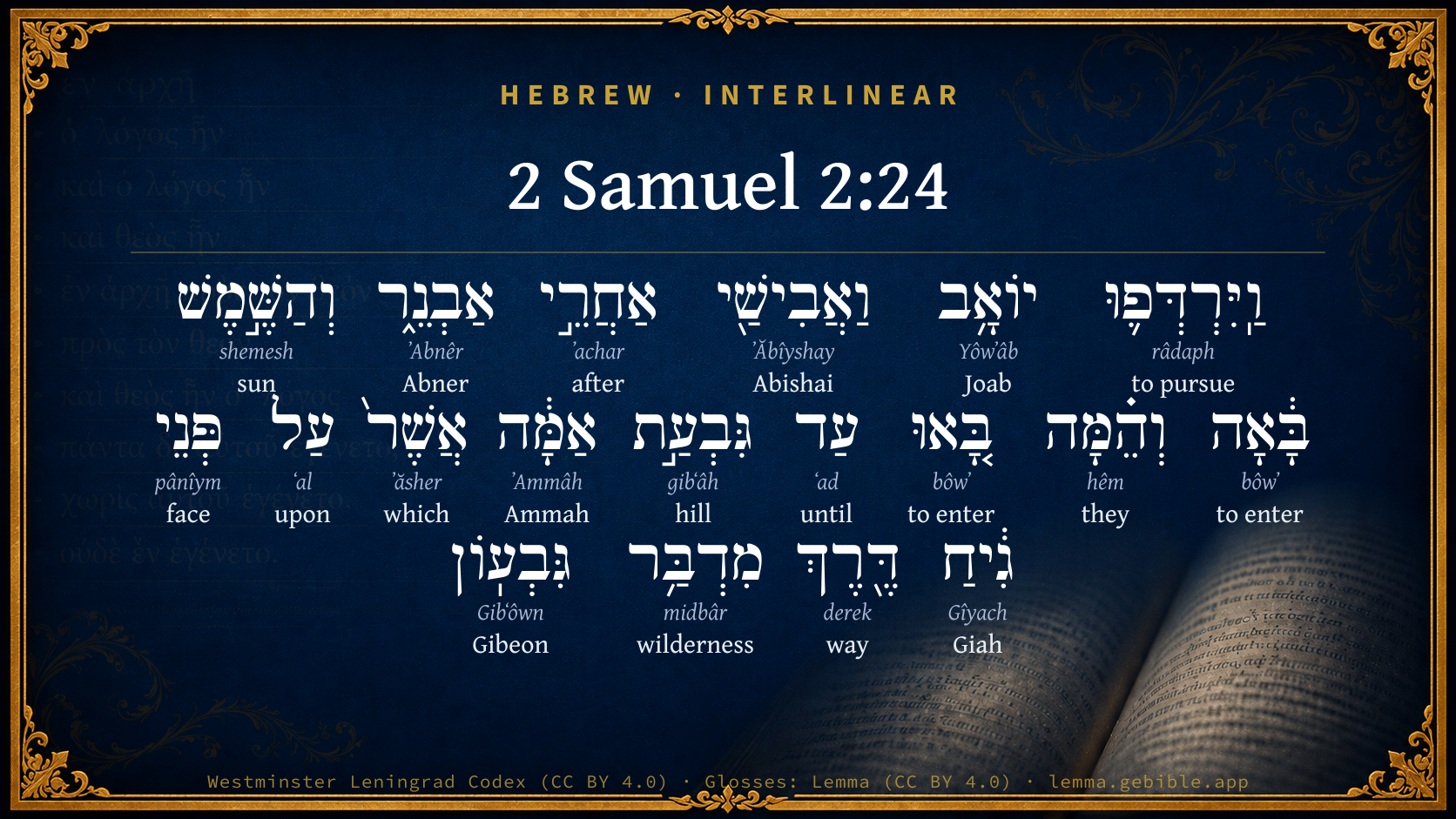
2 Samuel 2:24

Hebrew (Westminster Leningrad Codex) 2 Samuel 2:24 appears in the Hebrew Old Testament. The text above is from the Westminster Leningrad Codex. Each word links to its Strong’s number, a concise gloss, and parsing drawn from the Open Scriptures Hebrew Bible morphology. Click any word for its full Brown-Driver-Briggs (BDB) entry.
Download image
Cite this verse

2 Samuel 2:24 (World English Bible). Public Domain. Lemma interlinear Bible study tool, https://lemma.gebible.app/v/2-samuel/2/24.

Show BibTeX & RIS
BibTeX
RIS
English Translation
But Joab and Abishai pursued after Abner: and the sun went down when they were come to the hill of Ammah, that lies before Giah by the way of the wilderness of Gibeon.
World English Bible · Public Domain
Highlights
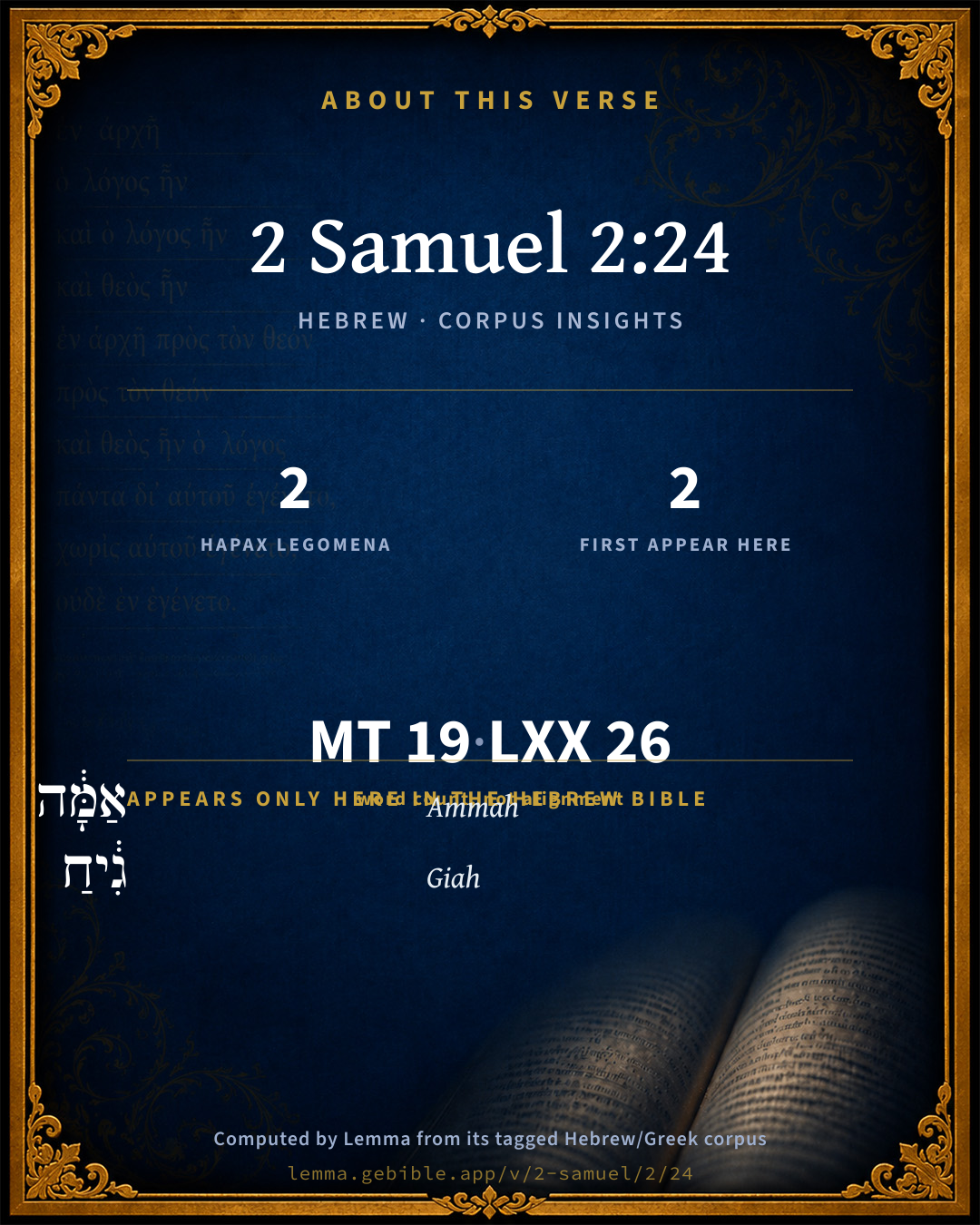
  • 2 hapax legomena — only here in the Hebrew Bible
  • 2 first appearances in the Hebrew Bible
Full analysis ↓
Download a study sheet

One document with this verse’s original text, its word-by-word gloss line, the meaning frame, cross-references with their text, attributed commentary, and full source and license credits — printable, and it pastes into notes with its structure intact.

This verse Autodidact and up

Study sheet (.html) Plain text (.txt)

A passage Seminary Student

Up to 50 verses in one chapter. A passage sheet keeps up to 6 commentary sources and 12 cross-references per verse, in the order this page ranks them, and says so on the sheet whenever that leaves anything out. Ask for a single verse and you get the Autodidact verse sheet above.

Everything on this page stays free to read, with no account — the sheet is a download of what is already on screen, not access to it.

Want to remove ads? Support Godless Engineer
Compare translations 3

The same verse in 3 English versions, stacked beneath the original-language interlinear above. Click any original word for its lexicon entry.

Each is an independent rendering of the whole verse — the interlinear is not word-aligned to these translations.

Highlighted words mark where these versions differ — a whole-verse word diff, not a word-by-word alignment.

  • World English Bible Public Domain
    But Joab and Abishai pursued after Abner: and the sun went down when they were come to the hill of Ammah, that lies before Giah by the way of the wilderness of Gibeon.
  • King James Version Public Domain
    Joab also and Abishai pursued after Abner: and the sun went down when they were come to the hill of Ammah, that lieth before Giah by the way of the wilderness of Gibeon.
  • unfoldingWord Literal Text CC BY-SA 4.0
    But Joab and Abishai pursued after Abner, and the sun was coming in, and they themselves came to the hill of Ammah, which on the face of Giah, the way of the wilderness of Gibeon.

unfoldingWord Literal Text — © unfoldingWord, licensed CC BY-SA 4.0. Word-aligned USFM3 via Door43 (git.door43.org/unfoldingWord/en_ult).

Versions to compare (up to 4)

3 of 4 selected

Show all 18 translations

Every available English version of this verse, each an independent rendering of the whole verse.

  • World English Bible Public Domain
    But Joab and Abishai pursued after Abner: and the sun went down when they were come to the hill of Ammah, that lies before Giah by the way of the wilderness of Gibeon.
  • Berean Standard Bible Public Domain
    But Joab and Abishai pursued Abner. By sunset, they had gone as far as the hill of Ammah opposite Giah on the way to the wilderness of Gibeon.
  • Majority Standard Bible Public Domain
    But Joab and Abishai pursued Abner. By sunset, they had gone as far as the hill of Ammah opposite Giah on the way to the wilderness of Gibeon.
  • King James Version Public Domain
    Joab also and Abishai pursued after Abner: and the sun went down when they were come to the hill of Ammah, that lieth before Giah by the way of the wilderness of Gibeon.
  • American Standard Version (1901) Public Domain
    But Joab and Abishai pursued after Abner: and the sun went down when they were come to the hill of Ammah, that lieth before Giah by the way of the wilderness of Gibeon.
  • Revised Version (1885) Public Domain
    But Joab and Abishai pursued after Abner: and the sun went down when they were come to the hill of Ammah, that lieth before Giah by the way of the wilderness of Gibeon.
  • Geneva Bible (1599) Public Domain
    Ioab also and Abishai pursued after Abner: and the sunne went downe, when they were come to the hill Ammah, that lieth before Giah, by the way of the wildernesse of Gibeon.
  • Douay-Rheims (1899) Public Domain
    Now while Joab and Abisai pursued after Abner, the sun went down: and they came as far as the hill of the aqueduct, that lieth over against the valley by the way of the wilderness in Gabaon.
  • Young's Literal Translation Public Domain
    And Joab and Abishai pursue after Abner, and the sun hath gone in, and they have come in unto the height of Ammah, which `is' on the front of Giah, the way of the wilderness of Gibeon.
  • Literal Standard Version CC BY-SA 4.0
    And Joab and Abishai pursue after Abner, and the sun has gone in, and they have come to the height of Ammah, which [is] on the front of Giah, the way of the wilderness of Gibeon.
  • Unlocked Literal Bible CC BY-SA 4.0
    But Joab and Abishai pursued Abner. When the sun was going down, they came to the hill of Ammah, which is near Giah by the road to the wilderness of Gibeon.
  • unfoldingWord Literal Text CC BY-SA 4.0
    But Joab and Abishai pursued after Abner, and the sun was coming in, and they themselves came to the hill of Ammah, which on the face of Giah, the way of the wilderness of Gibeon.
  • Darby Bible Public Domain
    And Joab and Abishai pursued after Abner; and the sun went down when they came to the hill of Ammah, which is before Giah on the way to the wilderness of Gibeon.
  • World Messianic Bible Public Domain
    But Joab and Abishai pursued Abner. The sun went down when they had come to the hill of Ammah, that lies before Giah by the way of the wilderness of Gibeon.
  • Webster's Bible Public Domain
    Joab also, and Abishai pursued Abner: and the sun went down when they had come to the hill of Ammah, that lieth before Giah by the way of the wilderness of Gibeon.
  • Free Bible Version CC BY-SA 4.0
    But Joab and Abishai set off to chase after Abner. By the time the sun went down they had got as far as the hill of Ammah near Giah, on the way to the wilderness of Gibeon.
  • Bible in Basic English Public Domain
    But Joab and Abishai went after Abner: and the sun went down when they came to the hill of Ammah, which is to the east of the road through the waste land of Geba.
  • JPS Tanakh (1917) Public Domain
    But Joab and Abishai pursued after Abner; and the sun went down when they were come to the hill of Ammah, that lieth before Giah by the way of the wilderness of Gibeon.

Literal Standard Version (2020), Covenant Press — licensed CC BY-SA 4.0. Text via the HelloAO Bible API (eBible.org). Unlocked Literal Bible (unfoldingWord) — licensed CC BY-SA 4.0. Text via the HelloAO Bible API (eBible.org). unfoldingWord Literal Text — © unfoldingWord, licensed CC BY-SA 4.0. Word-aligned USFM3 via Door43 (git.door43.org/unfoldingWord/en_ult). Free Bible Version, Dr. Jonathan Gallagher — licensed CC BY-SA 4.0. Text via the HelloAO Bible API (eBible.org).

Word by word

More ways to search: Search by grammar → Find every occurrence → Compare this word →

Practice this passage: Drill this verse → Learn its vocabulary →

אַמָּ֔ה
ʼAmmâh
H522
“Ammah”
Noun, Proper
Part of Speech
Noun
Type
Proper
Full BDB Definition

Origin: the same as H520

TWOT: None

Ammah = "a cubit" - a hill near Gibeon
  1. וַֽיִּרְדְּפ֛וּ râdaph H7291 “and · to pursue” Conjunction + Verb, Qal, Sequential Imperfect, 3rd Person, Masculine, Plural
  2. יוֹאָ֥ב Yôwʼâb H3097 “Joab” Noun, Proper
  3. וַאֲבִישַׁ֖י ʼĂbîyshay H52 “and · Abishai” Conjunction + Noun, Proper
  4. אַחֲרֵ֣י ʼachar H310 “after” Preposition
  5. אַבְנֵ֑ר ʼAbnêr H74 “Abner” Noun, Proper
  6. וְהַשֶּׁ֣מֶשׁ shemesh H8121 “and · the · sun” Conjunction + Particle, Definite Article + Noun, Common, Both, Singular, Absolute
  7. בָּ֔אָה bôwʼ H935 “to enter” Verb, Qal, Perfect, 3rd Person, Feminine, Singular
  8. וְהֵ֗מָּה hêm H1992 “and · they” Conjunction + Pronoun, Personal, 3rd Person, Masculine, Plural
  9. בָּ֚אוּ bôwʼ H935 “to enter” Verb, Qal, Perfect, 3rd Person, Common, Plural
  10. עַד ʻad H5704 “until” Preposition
  11. גִּבְעַ֣ת gibʻâh H1389 “hill of” Noun, Common, Feminine, Singular, Construct
  12. אֲשֶׁר֙ ʼăsher H834 “which” Particle, Relative
  13. עַל ʻal H5921 “upon” Preposition
  14. פְּנֵי pânîym H6440 “face(s) of” Noun, Common, Both, Plural, Construct
  15. גִ֔יחַ Gîyach H1520 “Giah” Noun, Proper
  16. דֶּ֖רֶךְ derek H1870 “way of” Noun, Common, Both, Singular, Construct
  17. מִדְבַּ֥ר midbâr H4057 “wilderness of” Noun, Common, Masculine, Singular, Construct
  18. גִּבְעֽוֹן Gibʻôwn H1391 “Gibeon” Noun, Proper

About this verse

These counts appear in no published source. They are computed here, from the morphology-tagged text and Lemma’s own curated glosses. What Lemma adds →

19
words
18
distinct lemmas
Historical
section

Notable vocabulary

2 hapax legomena — words that appear only here in the entire Hebrew Bible:

  • אַמָּ֔ה Ammah H522
  • גִ֔יחַ Giah H1520

First appearance in Scripture

These words make their first canonical appearance in the Hebrew Bible here:

  • אַמָּ֔ה Ammah H522
  • גִ֔יחַ Giah H1520

Shared distinctive vocabulary

וַאֲבִישַׁ֖י Abishai H52 occurs in 24 verses of the Hebrew Bible. Also found in:

Grammatical profile

  • 3 verbs
  • 11 nouns
  • 1 pronoun
  • 3 prepositions
  • 1 particle

Verb forms

  • וַֽיִּרְדְּפ֛וּ Qal · Sequential Imperfect
  • בָּ֔אָה Qal · Perfect
  • בָּ֚אוּ Qal · Perfect

Repetition

A word recurs within this verse — often emphatic in Hebrew:

  • בָּ֔אָה to enter H935 ×2

Hebrew & Septuagint length

In English translation the verse runs 33 words from the Hebrew and 35 from the Septuagint (LXX English) — closely comparable.

A rough comparison of the two English renderings, which tokenize alike — not a word-level alignment.

Word counts can differ between the Hebrew and the Greek without any difference in meaning — e.g. the Hebrew direct-object marker אֵת has no separate Greek word, and Greek often adds the article ὁ.

In the original languages it is 19 Hebrew tokens and 26 Greek tokens — but the two are counted differently (Hebrew bundles its prefixes and suffixes into one token; the Greek is in lemma form), so that isn’t a like-for-like length.

Hebrew and Greek witnesses Masoretic Hebrew ↔ Greek Septuagint

The same verse in the two great witnesses to the Old Testament, shown verse-for-verse.

These are two independent witnesses, not word-aligned to each other, and the Septuagint is shown in lemma (dictionary) form.

Hebrew 2 Samuel 2:24 Masoretic · Westminster Leningrad Codex

וַֽיִּרְדְּפ֛וּ יוֹאָ֥ב וַאֲבִישַׁ֖י אַחֲרֵ֣י אַבְנֵ֑ר וְהַשֶּׁ֣מֶשׁ בָּ֔אָה וְהֵ֗מָּה בָּ֚אוּ עַד גִּבְעַ֣ת אַמָּ֔ה אֲשֶׁר֙ עַל פְּנֵי גִ֔יחַ דֶּ֖רֶךְ מִדְבַּ֥ר גִּבְעֽוֹן

But Joab and Abishai pursued after Abner: and the sun went down when they were come to the hill of Ammah, that lies before Giah by the way of the wilderness of Gibeon.

World English Bible · Public Domain

Greek LXX 2 Samuel 2:24 Septuagint · lemma form

καί καταδιώκω ιωαβ καί αβεσσα ὀπίσω αβεννηρ καί ὁ ἥλιος δύω καί αὐτός εἰςἔρχομαι ἕως ὁ βουνός αμμαν ὅς εἰμί ἐπί πρόσωπον γαι ὁδός ἐρῆμος γαβαων

And Joab and Abessa pursued after Abenner, and the sun went down: and they went as far as the hill of Amman, which is in the front of Gai, by the desert way of Gabaon.

LXX2012 (modern English Septuagint) · Public Domain

Hebrew: Westminster Leningrad Codex (CC BY 4.0). Greek: Septuagint (public domain); English from LXX2012 (modern English Septuagint) (Public Domain). How the Septuagint differs from the Hebrew →

Targum (Aramaic paraphrase)

1

The Targum is the ancient Jewish Aramaic paraphrase of the Hebrew Scriptures — an interpretive translation, not the Hebrew text itself. Onkelos (literal) and Pseudo-Jonathan (expansive) render the Torah, and Jonathan the Prophets. Coverage is partial: where no permissively-licensed English translation exists for a verse, only the Aramaic is shown. This is verse-level text, not a word-by-word alignment to the Hebrew.

  1. Targum Jonathan Prophets (Joshua–Malachi)
    וּרְדָפוּ יוֹאָב וַאֲבִישַׁי בָּתַר אַבְנֵר וְשִׁמְשָׁא עָלַת וְאִינוּן מְטוֹ עַד גִבְעַת אַמְתָא דִי עַל אַפֵּי גִיחַ אוֹרַח מַדְבְּרָא דְגִבְעוֹן:

    (no public-domain English translation for this verse)

    Targum Jonathan — Aramaic: “Mikraot Gedolot” (public domain). English: “Sefaria Community Translation” (CC0 1.0 (public-domain dedication)); “London "Chaldee Paraphrase," 1871” (public domain). Text via Sefaria.

Commentary

Notes on 2 Samuel 2:24 from classic Christian and Jewish commentators (each source and its license shown beneath its notes). The classic Christian expositions comment on the surrounding passage and are grouped to its opening verse, so a note may address several verses; the Jewish commentaries on the Tanakh (Rashi and others) are per-verse, so they appear only where the commentator wrote on this verse.

Lemma curates 59 commentaries, every one of them public domain or Creative Commons licensed, each selected and text-cleaned for this edition rather than reprinted as found. About our sources →

Trapp's Complete Commentary

John Trapp

2Sa 2:24 Joab also and Abishai pursued after Abner: and the sun went down when they were come to the hill of Ammah, that [lieth] before Giah by the way of the wilderness of Gibeon.

Ver. 24. Joab also and Abishai pursued after Abner.] Notwithstanding the loss of their brother Asahel; which could not but be a great grief to them. The public cause was their main care.

John Trapp, A Commentary or Exposition upon All the Books of the Old and New Testament (1647–1656) — public domain. Text from a community e-Sword module.

Tyndale Open Study Notes

Tyndale Open Resources

2:24 they set out after Abner: See 3:27. • Ammah (“conduit”) and Giah (“gushing”) suggest that there was an aqueduct system connected to the pool at Gibeon (2:12-13).

Tyndale Open Study Notes — © Tyndale Open Resources, licensed CC BY-SA 4.0. Text via the HelloAO Bible API.

Ellicott's Commentary for English Readers

(24) The hill of Ammah.—No identification of either Ammah or Giah has yet been made, but as it was “by the way of the wilderness of Gibeon,” it may be conjectured that it was not far from that town, and hence that the pursuit was not long.

A Bible Commentary for English Readers, edited by Charles John Ellicott (1878–1897) — public domain. Text from a community e-Sword module.

The Cambridge Bible for Schools and Colleges

gen. ed. J. J. S. Perowne

24–32. The Pursuit. Asahel’s burial

24. Joab also, &c.] And Joab and Abishai continued the pursuit, in contrast to those who halted at the scene of Asahel’s death.

the hill of Ammah … Giah] Nothing is known of these places, but the minuteness of topographical detail is an indication that the history was written by one who was familiar with the circumstances.

the wilderness of Gibeon] The untilled tract of pasture-lands, lying east of the city.

The Cambridge Bible for Schools and Colleges (gen. ed. J. J. S. Perowne; Cambridge University Press, 1878–1918) — public domain. Text from a community e-Sword module.

John Gill's Exposition

Joab also and Abishai pursued after Abner,.... Or rather but Joab, &c. (n). They stood not still as the rest, but, filled with indignation and resentment, pursued after Abner, to be avenged on him:

and the sun went down when they came to the hill of Ammah; a hill by the side of which was a pool of water, as Kimchi thinks, and from thence so called:

that lieth before Giah; a place near Gibeon, but nowhere after mentioned:

by the way of the wilderness of Gibeon; very likely not far from the city from which it had its name.

(n) "Autem", V. L. Tiguriue version; "sed", Junius & Tremellius, Piscator; so Kimchi.

John Gill's Exposition of the Whole Bible (1746–1763) — public domain (CC PDM 1.0). Text via the HelloAO Bible API.

Albert Barnes' Notes on the Bible

Ammah ... Giah - Local, and otherwise unknown names.

Albert Barnes' Notes on the Bible (1834–1885) — public domain. Text from a community e-Sword/MySword module.

Haydock's Catholic Bible Commentary

Wilderness, or land which was not ploughed, though fruitful.

George Leo Haydock (1774–1849), Haydock's Catholic Family Bible and Commentary, 1859 edition — public domain. Excludes Psalms (Douay-Rheims chapter numbering differs from Protestant) and Deuterocanonical books (Catholic canon only).

Whedon's Commentary on the Bible

Daniel D. Whedon

24. Ammah… Giah — Places now unknown. Such incidental allusions to places long since forgotten furnish evidence of the genuineness and credibility of the history.

Daniel D. Whedon (gen. ed.), Commentary on the Old and New Testaments (1874–1909) — public domain. Text from a community e-Sword module.

The Pulpit Commentary

Josh also and Abishai pursued after Abner; really, but Joab and Abishai pursued, and so the Revised Version. The sight of their slaughtered brother made them only the more determined in the pursuit, and doubtless, at their command, the soldiers would leave Asahel and follow their commanders. Of the "hill of Ammah" and Giah we know nothing; but it is evident that no halt was made until sunset.

Vers. 24-29. (GIBEON)

War.

"Shall the sword devour forever?" (ver. 26; 2Sa_11:25) The sword is more destructive than ravenous beasts, famine, pestilence (2Sa_24:13; Lev_26:26) earthquake, tempest, or fire. The history of its ravages constitutes a considerable portion of the history of mankind. Of these we have here a slight but noteworthy instance. Twenty-four brave men of the same nation (half of them chosen from each of the opposing forces) fell, pierced by each other"s weapons. In the succeeding battle and flight several hundreds were slain (ver. 31). At sunset the defeated general rallied his scattered troops on the hill of Ammah, and appealed to the commander of the pursuing forces to withdraw them and avert the bitter consequences that would otherwise ensue. "Now the battle is going against him he complains of the devouring sword; and, though it had been employed but a few hours, it seemed long to him a sort of eternity" (Gill). Joab answered that but for his challenge in the morning there would have been no conflict at all; but (probably as yet unacquainted with the death of his brother Asahel) he sounded a retreat (ver. 28); and Abner and his men forthwith departed, not to Gibeon, but across the Jordan to Mahanaim (ver. 29). Regarding the question not merely as the utterance of Abner, nor from an Old Testament point of view, we may take it as expressive of

I A CONVICTION OF THE EVILS OF WAR. "Shall the sword devour forever?" By it:

1. Numberless lives are consumed. The immediate and avowed object of war is the destruction of men"s lives; and its most effective instruments (to the Construction of which the utmost ingenuity is devoted) are those that destroy the greatest number in the shortest possible time. "War is the work, the element, or rather the sport and triumph of death, who glories not only in the extent of his conquest, but in the richness of his spoil" (R. Hall, "Reflections on War"). Since its ravages began many times more than the whole number of the present population of the globe have probably been its victims.

2. Incalculable snfferings are inflicted; on those who are left to die on the field, or are borne to hospitals and linger out a miserable existence; on the non-combatant population among whom the devourer pursues his way; on whole nations and multitudes of desolate and sorrowing homes far distant from the scene of strife.

3. Enormous cost is incurred; in the maintenance of armies and the provision of materiel, besides the withdrawal of great numbers from the operations of productive industry and serious interference with commerce; immense national debts are accumulated and burdensome taxes imposed on present and succeeding generations. There are nearly thirteen millions of men in Europe who have been trained for arms, and between four and five millions actually under arms, costing in all ways about five hundred millions sterling a year. The sum total of the national debts of the European nations amounts to nearly five thousand millions of pounds ("Statesman"s Year-Book").

4. A pernicious influence is exerted, with respect to morality and religion.

does more harm to the morals of men than even their property and their persons" (Erasmus). It has its origin in unregulated desire (James, 1Jn_2:16) which it excites, manifests, and intensifies. "The causes of all wars may be reduced to five heads: ambition, avarice, revenge, providence (precaution), and defence" (Owen Feltham, "Resolves"). "If the existence of war always implies injustice in one at least of the parties concerned, it is also the fruitful parent of crimes. It reverses, with respect to its objects, all the rules of morality. It is nothing less than a temporary repeal of the principles of virtue. It is a system out of which almost all the virtues are excluded and on which nearly all the vices are incorporated" (R. Hall). What angry feelings does it stir up between nations whom "God hath made of one blood"! What infuriated passions does it arouse in contending armies! What cruel deeds does it commend! What iniquitous courses of conduct does it induce! What false views of glory does it inculcate! What bitter and lasting enmities does it leave behind!

One murder makes a villain, Millions a hero! Princes were privileged to kill, And numbers sanctified the crime! Ah! why will kings forget that they are men, And men that they are brethren? Why delight; In human sacrifice? Why burst the ties Of nature, that should knit their souls together In one soft bond of amity and love? (Bishop Porteus.)

Is war, then, under all circumstances, inexpedient and wrong? It is maintained that:

(1) The state, like the individual, has a natural right of self-defence, and is bound (in fulfilment of the purpose for which it exists) to protect its citizens by repelling external invasion as well as repressing internal violence (Whewell, "Elements of Morality;" Paley; Gisborne; Mozley, "University Sermons").

(2) By means of war national subjection is sometimes prevented, national grievances are redressed, national honour is upheld, aggression checked, pride abased, liberty, peace, and prosperity secured, patriotism kindled, powerful energies and heroic virtues developed.

(3) It has often received the Divine sanction (Exo_17:14; Joshua 1Sa_11:6) "Perpetual peace is a dream, and it is not even a beautiful dream. War is an element in the order of the world ordained by God. In it the noblest virtues of mankind are developed courage and the abnegation of self, faithfulness to duty, and the spirit of sacrifice; the soldier gives his life. Without war the world would stagnate and lose itself in materialism" (Von Moltke). But this is the view of one who has been "a man of war from his youth" and "shed much blood". (1Ch_22:8)

And it may be said that:

(1) War is not ordained by God like tempests and earthquakes or even pestilence, but is directly due to the wickedness of men. That which is in itself evil, however, often becomes an occasion of good.

(2) "There is at least equal scope for courage and magnanimity in blessing as in destroying mankind. The condition of the human race offers inexhaustible objects for enterprise and fortitude and magnanimity. In relieving the countless wants and sorrows of the world, in exploring unknown regions, in carrying the arts and virtues of civilization to unimproved communities, in extending the bounds of knowledge, in diffusing the spirit of freedom, and especially in spreading the light and influence of Christianity, how much may be dared, how much endured!" (Channing).

(3) The right of resistance to evil is limited, and does not justify the taking away of life (Wayland, "Elements of Moral Science;" Dymond, "Essays").

(4) No advantages gained by war are an adequate compensation for the miseries inflicted by it; less suffering is experienced and higher honour acquired by enduring wrong than avenging it; the exercise of justice, forbearance, and active benevolence is the most effectual means of averting injury and securing safety and happiness.

(5) The Divine sanction given to specific wars in the Old Testament was not given to war in general, and it does not justify the wars which are waged, without the like authority, at the present time.

(6) War is virtually forbidden by numerous precepts and the whole spirit of the New Testament (Mat_5:9, Mat_5:39, 44 26:52; Rom_12:18; 1Th_5:15; 1Pe_2:23 1Pe_3:9-13) The most that can be said is that "any principles upon which the Christian casuist would justify war in certain circumstances would not justify perhaps one in ten of the wars that have been waged" (J. Foster, "Lectures," vol. 2.).

II AN APPEAL FOB THE CESSATION OF STRIPE. "Shall the sword devour forever?" Its ravages may be stayed; and means must be employed for that end, such as:

1. The consideration of the real nature and terrible consequences of war; and the education of the people, especially the young, so that they may cease to admire military glory and to be beguiled by "the pomp and circumstance of war may feel an intense aversion to it, and seek in other ways their common interest and true elevation.

2. The adoption of political measures for the settlement of internationaldisputes and the removal of causes of strife; viE. arbitration by friendly powers, the reduction and disbandment of standing armies, etc.

3. The repression of evil passions in ourselves and others.

4. The practice and diffusion of Christian principles; which indispose all inwhom they dwell to break the peace themselves, and dispose them to make peace among others. "The sons of peace are the sons of God.

III AN ANTICIPATION OF TEE PREVALENCE or PEACE, "Shall the sword devour forever?" Surely not. The hope of universal peace is warranted from:

1. The advancing intelligence of men, the growth of popular government( making war less dependent than heretofore on the arbitrary will of rulers), the possession of "nobler modes of life, with sweeter manners, purer laws.

2. The better understanding and more perfect realization of the spirit ofChristianity.

3. The overruling Providence and quickening Spirit of "the God of peace.

4. The express predictions of his Word concerning the effects of the reignof "the Prince of Peace" (Isa_9:7; Mic_4:3 Mic_5:2, Mic_5:5; Psa_72:7) "It is in war that the power of the beast culminates in the history of the world. This beast will then be destroyed. The true humanity which sin has choked up will gain the mastery, and the world"s history will keep sabbath. What the prophetic words affirm is a moral postulate, the goal of sacred history, the predicted counsel of God" (Delitzsch, on Isa_2:4).

O scenes surpassing fable and yet true; Scenes of accomplished bliss; which who can see (Though but in distant prospect) and not feel His soul refreshed with foretaste and with joy? (Cowper.)

The Pulpit Commentary (1880–1919), ed. H.D.M. Spence-Jones & Joseph S. Exell — public domain. Text from a community e-Sword module.

Keil & Delitzsch

C. F. Keil & F. Delitzsch

But Joab and Abishai pursued Abner till the sun set, and until they had arrived at the hill Ammah, in front of Giah, on the way to the desert of Gibeon. Nothing further is known of the places mentioned here.

Keil & Delitzsch — Biblical Commentary on the Old Testament (1861–1891) — public domain (CC PDM 1.0). Text via the HelloAO Bible API. (Old Testament only.)

unfoldingWord translationNotes

Door43 World Missions Community

Abishai

This is the name of a man. (See: How to Translate Names)

hill of Ammah ... Giah

These are the names of places. (See: How to Translate Names)

translationWords

Abner

desert

Gibeon

Benjamin

unfoldingWord translationNotes — © Distant Shores Media and the Door43 World Missions Community, licensed CC BY-SA 4.0. Source: git.door43.org/Door43/en_tn.

Lesson kit

Teaching starters — assembled from the data on this page, not authored interpretation. Every prompt links to the verse data it draws on. Edit before teaching.

2 Samuel, in the Historical, opens this verse with 19 words (18 distinct Hebrew lemmas). Its most distinctive word is ʼAmmâh (“Ammah”). A historical commentator’s framing appears above. Read the whole chapter for the surrounding context.

Discussion questions

  1. The word ʼAmmâh carries the sense “Ammah.” How does it shape the verse?
  2. 2 words here appear nowhere else in the Hebrew Bible. Why might the author reach for such rare wording?
  3. 2 words make their first appearance in Scripture here. What does this debut establish?
  4. How does 1 Samuel 26:6, which shares the word «Abishai», read alongside this verse?
  5. What does the repetition of “to enter” (2× in this one verse) do in this verse?
  6. These translations render this verse differently. What is at stake in choosing one wording over another?
  7. «וַֽיִּרְדְּפ֛וּ» is a Qal Sequential Imperfect verb. How does that grammatical form shape the action described?
  8. Compare how Trapp's Complete Commentary and Tyndale Open Study Notes read this verse. Where do they agree or differ?

Things to notice

  • 2 words in this verse appear nowhere else in the Hebrew Bible.
  • 2 words make their first canonical appearance in Scripture here.
  • This verse counts 19 Hebrew ↔ 26 Greek words.
  • These translations choose different wording for 13 words in this verse.
  • “to enter” occurs 2× in this single verse.

Reading settings

Reading text

Shown beneath each verse's original-language words.

Old Testament
Old Testament edition

Read the OT as the Masoretic Hebrew (MT) or the Greek Septuagint (LXX).

English shown for the Greek Septuagint (in the Hebrew ↔ Greek comparison).

Comparing translations? Open the Compare panel on any verse page to stack up to four side by side.