
Ezekiel 2:3

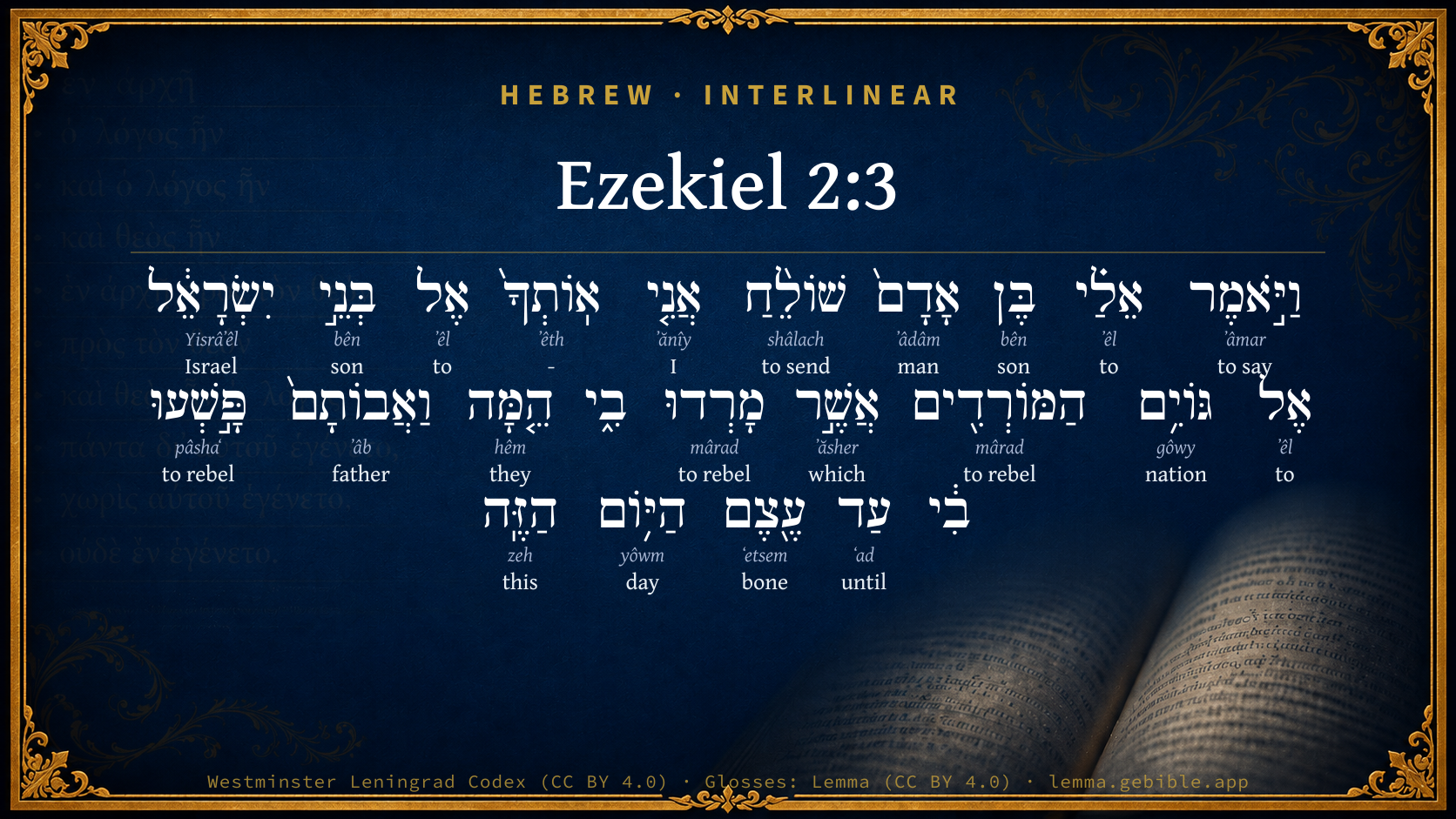
Hebrew (Westminster Leningrad Codex) Ezekiel 2:3 appears in the Hebrew Old Testament. The text above is from the Westminster Leningrad Codex. Each word links to its Strong’s number, a concise gloss, and parsing drawn from the Open Scriptures Hebrew Bible morphology. Click any word for its full Brown-Driver-Briggs (BDB) entry.
Download image
Cite this verse

Ezekiel 2:3 (World English Bible). Public Domain. Lemma interlinear Bible study tool, https://lemma.gebible.app/v/ezekiel/2/3.

Show BibTeX & RIS
BibTeX
RIS
English Translation
He said to me, Son of man, I send you to the children of Israel, to nations that are rebellious, which have rebelled against me: they and their fathers have transgressed against me even to this very day.
World English Bible · Public Domain
Download a study sheet

One document with this verse’s original text, its word-by-word gloss line, the meaning frame, cross-references with their text, attributed commentary, and full source and license credits — printable, and it pastes into notes with its structure intact.

This verse Autodidact and up

Study sheet (.html) Plain text (.txt)

A passage Seminary Student

Up to 50 verses in one chapter. A passage sheet keeps up to 6 commentary sources and 12 cross-references per verse, in the order this page ranks them, and says so on the sheet whenever that leaves anything out. Ask for a single verse and you get the Autodidact verse sheet above.

Everything on this page stays free to read, with no account — the sheet is a download of what is already on screen, not access to it.

Want to remove ads? Support Godless Engineer
Compare translations 3

The same verse in 3 English versions, stacked beneath the original-language interlinear above. Click any original word for its lexicon entry.

Each is an independent rendering of the whole verse — the interlinear is not word-aligned to these translations.

Highlighted words mark where these versions differ — a whole-verse word diff, not a word-by-word alignment.

  • World English Bible Public Domain
    He said to me, Son of man, I send you to the children of Israel, to nations that are rebellious, which have rebelled against me: they and their fathers have transgressed against me even to this very day.
  • King James Version Public Domain
    And he said unto me, Son of man, I send thee to the children of Israel, to a rebellious nation that hath rebelled against me: they and their fathers have transgressed against me, even unto this very day.
  • unfoldingWord Literal Text CC BY-SA 4.0
    He said to me, “Son of man, I am sending you to the people of Israel, to rebellious nations that have rebelled against me—both they and their ancestors have sinned against me up to this very day!

unfoldingWord Literal Text — © unfoldingWord, licensed CC BY-SA 4.0. Word-aligned USFM3 via Door43 (git.door43.org/unfoldingWord/en_ult).

Versions to compare (up to 4)

3 of 4 selected

Show all 18 translations

Every available English version of this verse, each an independent rendering of the whole verse.

  • World English Bible Public Domain
    He said to me, Son of man, I send you to the children of Israel, to nations that are rebellious, which have rebelled against me: they and their fathers have transgressed against me even to this very day.
  • Berean Standard Bible Public Domain
    “Son of man,” He said to me, “I am sending you to the Israelites, to a rebellious nation that has rebelled against Me. To this very day they and their fathers have rebelled against Me.
  • Majority Standard Bible Public Domain
    “Son of man,” He said to me, “I am sending you to the Israelites, to a rebellious nation that has rebelled against Me. To this very day they and their fathers have rebelled against Me.
  • King James Version Public Domain
    And he said unto me, Son of man, I send thee to the children of Israel, to a rebellious nation that hath rebelled against me: they and their fathers have transgressed against me, even unto this very day.
  • American Standard Version (1901) Public Domain
    And he said unto me, Son of man, I send thee to the children of Israel, to nations that are rebellious, which have rebelled against me: they and their fathers have transgressed against me even unto this very day.
  • Revised Version (1885) Public Domain
    And he said unto me, Son of man, I send thee to the children of Israel, to nations that are rebellious, which have rebelled against me: they and their fathers have transgressed against me, even unto this very day.
  • Geneva Bible (1599) Public Domain
    And he said vnto me, Sonne of man, I send thee to the children of Israel, to a rebellious nation that hath rebelled against me: for they and their fathers haue rebelled against me, euen vnto this very day.
  • Douay-Rheims (1899) Public Domain
    And saying: Son of man, I send thee to the children of Israel, to a rebellious people, that hath revolted from me, they, and their fathers, have transgressed my covenant even unto this day.
  • Young's Literal Translation Public Domain
    And He saith unto Me, `Son of man, I am sending thee unto the sons of Israel, unto nations who are rebels, who have rebelled against Me; they and their fathers have transgressed against Me, unto this self-same day.
  • Literal Standard Version CC BY-SA 4.0
    And He says to me, “Son of man, I am sending you to the sons of Israel, to rebelling nations who have rebelled against Me; they and their fathers have transgressed against Me, to this very day.
  • Unlocked Literal Bible CC BY-SA 4.0
    He said to me, “Son of man, I am sending you to the people of Israel, to rebellious nations that have rebelled against me—both they and their ancestors have sinned against me up to this very day!
  • unfoldingWord Literal Text CC BY-SA 4.0
    He said to me, “Son of man, I am sending you to the people of Israel, to rebellious nations that have rebelled against me—both they and their ancestors have sinned against me up to this very day!
  • Darby Bible Public Domain
    And he said unto me, Son of man, I send thee to the children of Israel, to nations that are rebellious, which have rebelled against me: they and their fathers have transgressed against me unto this very day;
  • World Messianic Bible Public Domain
    He said to me, “Son of man, I send you to the children of Israel, to a nation of rebels who have rebelled against me. They and their fathers have transgressed against me even to this very day.
  • Webster's Bible Public Domain
    And he said to me, Son of man, I send thee to the children of Israel, to a rebellious nation that hath rebelled against me: they and their fathers have transgressed against me: even to this very day.
  • Free Bible Version CC BY-SA 4.0
    “Son of man,” he told me, “I'm sending you to the people of Israel, a disobedient nation that has rebelled against me. They and their forefathers have continued to rebel against me, even up to today.
  • Bible in Basic English Public Domain
    And he said to me, Son of man, I am sending you to the children of Israel, to an uncontrolled nation which has gone against me: they and their fathers have been sinners against me even to this very day.
  • JPS Tanakh (1917) Public Domain
    And He said unto me: 'Son of man, I send thee to the children of Israel, to rebellious nations, that have rebelled against Me; they and their fathers have transgressed against Me, even unto this very day;

Literal Standard Version (2020), Covenant Press — licensed CC BY-SA 4.0. Text via the HelloAO Bible API (eBible.org). Unlocked Literal Bible (unfoldingWord) — licensed CC BY-SA 4.0. Text via the HelloAO Bible API (eBible.org). unfoldingWord Literal Text — © unfoldingWord, licensed CC BY-SA 4.0. Word-aligned USFM3 via Door43 (git.door43.org/unfoldingWord/en_ult). Free Bible Version, Dr. Jonathan Gallagher — licensed CC BY-SA 4.0. Text via the HelloAO Bible API (eBible.org).

Word by word

More ways to search: Search by grammar → Find every occurrence → Compare this word →

Practice this passage: Drill this verse → Learn its vocabulary →

הַמּוֹרְדִ֖ים
mârad
H4775
“the · rebelling”
Particle, Definite Article + Verb, Qal, Participle Active, Masculine, Plural, Absolute
Part of Speech
Particle + Verb
Stem
Qal
Form
Participle Active
Gender
Masculine
Number
Plural
State
Absolute
Full BDB Definition

Origin: a primitive root

TWOT: 1240

to rebel, revolt, be rebellious - (Qal) to rebel, revolt - against human king - against God - against light (poetic)
  1. וַיֹּ֣אמֶר ʼâmar H559 “and · to say” Conjunction + Verb, Qal, Sequential Imperfect, 3rd Person, Masculine, Singular
  2. אֵלַ֗י ʼêl H413 “to · me” Preposition + Suffix, Personal, 1st Person, Common, Singular
  3. בֶּן bên H1121 “son of” Noun, Common, Masculine, Singular, Construct
  4. אָדָם֙ ʼâdâm H120 “man” Noun, Common, Masculine, Singular, Absolute
  5. שׁוֹלֵ֨חַ shâlach H7971 “sending” Verb, Qal, Participle Active, Masculine, Singular, Absolute
  6. אֲנִ֤י ʼănîy H589 “I” Pronoun, Personal, 1st Person, Common, Singular
  7. אֽוֹתְךָ֙ ʼêth H853 “- · you” Particle, Direct Object + Suffix, Personal, 2nd Person, Masculine, Singular
  8. אֶל ʼêl H413 “to” Preposition
  9. בְּנֵ֣י bên H1121 “sons of” Noun, Common, Masculine, Plural, Construct
  10. יִשְׂרָאֵ֔ל Yisrâʼêl H3478 “Israel” Noun, Proper
  11. אֶל ʼêl H413 “to” Preposition
  12. גּוֹיִ֥ם gôwy H1471 “nations” Noun, Common, Masculine, Plural, Absolute
  13. אֲשֶׁ֣ר ʼăsher H834 “which” Particle, Relative
  14. מָרְדוּ mârad H4775 “to rebel” Verb, Qal, Perfect, 3rd Person, Common, Plural
  15. הֵ֤מָּה hêm H1992 “they” Pronoun, Personal, 3rd Person, Masculine, Plural
  16. וַאֲבוֹתָם֙ ʼâb H1 “and · fathers · their” Conjunction + Noun, Common, Masculine, Plural, Construct + Suffix, Personal, 3rd Person, Masculine, Plural
  17. פָּ֣שְׁעוּ pâshaʻ H6586 “to rebel” Verb, Qal, Perfect, 3rd Person, Common, Plural
  18. עַד ʻad H5704 “until” Preposition
  19. עֶ֖צֶם ʻetsem H6106 “bone of” Noun, Common, Feminine, Singular, Construct
  20. הַיּ֥וֹם yôwm H3117 “the · day” Particle, Definite Article + Noun, Common, Masculine, Singular, Absolute
  21. הַזֶּֽה zeh H2088 “the · this” Particle, Definite Article + Pronoun, Demonstrative, Masculine, Singular

About this verse

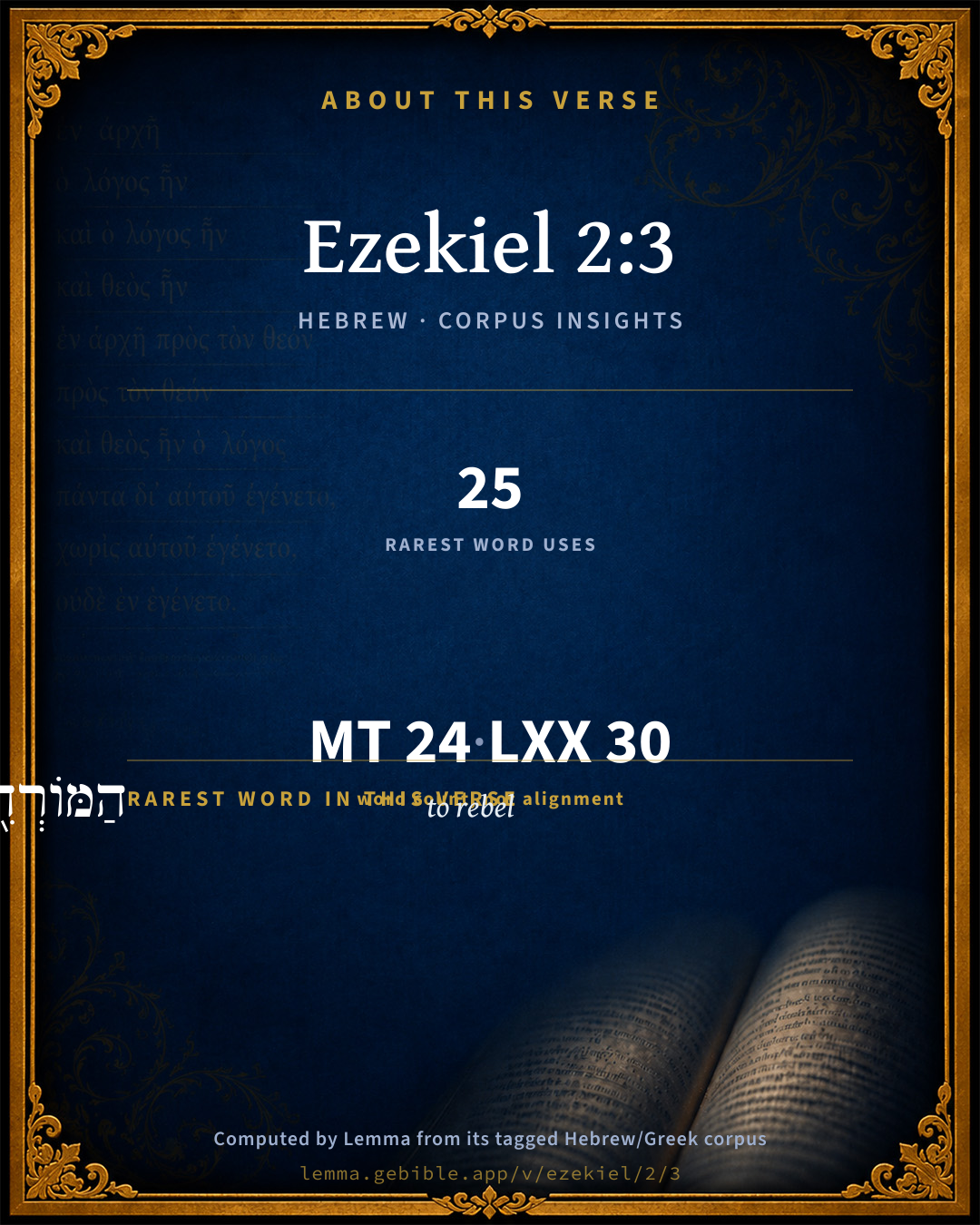
These counts appear in no published source. They are computed here, from the morphology-tagged text and Lemma’s own curated glosses. What Lemma adds →

24
words
18
distinct lemmas
Prophets
section

Notable vocabulary

The rarest word here is הַמּוֹרְדִ֖ים to rebel H4775 — appearing just 25 times in the whole Hebrew Bible.

Shared distinctive vocabulary

הַמּוֹרְדִ֖ים to rebel H4775 occurs in 23 verses of the Hebrew Bible. Also found in:

Grammatical profile

  • 5 verbs
  • 8 nouns
  • 3 pronouns
  • 6 prepositions
  • 2 particles

Verb forms

  • וַיֹּ֣אמֶר Qal · Sequential Imperfect
  • שׁוֹלֵ֨חַ Qal · Participle Active
  • הַמּוֹרְדִ֖ים Qal · Participle Active
  • מָרְדוּ Qal · Perfect
  • פָּ֣שְׁעוּ Qal · Perfect

Repetition

Words recur within this verse — often emphatic in Hebrew:

  • בֶּן son H1121 ×2
  • הַמּוֹרְדִ֖ים to rebel H4775 ×2
  • אֵלַ֗י to H413 ×3

Hebrew & Septuagint length

In English translation the verse runs 38 words from the Hebrew and 32 from the Septuagint (LXX English) — closely comparable.

A rough comparison of the two English renderings, which tokenize alike — not a word-level alignment.

Word counts can differ between the Hebrew and the Greek without any difference in meaning — e.g. the Hebrew direct-object marker אֵת has no separate Greek word, and Greek often adds the article ὁ.

In the original languages it is 24 Hebrew tokens and 30 Greek tokens — but the two are counted differently (Hebrew bundles its prefixes and suffixes into one token; the Greek is in lemma form), so that isn’t a like-for-like length.

Cross-references

33

Topical passages linked to Ezekiel 2:3 in the Treasury of Scripture Knowledge — connected by theme and wording, ordered by reader-vote popularity; previews shown in the World English Bible.

  • Jeremiah 3:25 Let us lie down in our shame, and let our confusion cover us; for we have sinned against Yahweh our God, we and our fathers, from our youth even to this day; and we have not obeyed the voice of Yahweh our God.
  • 1 Samuel 8:7–8 Yahweh said to Samuel, Listen to the voice of the people in all that they tell you; for they have not rejected you, but they have rejected me, that I should not be king over them.
  • Deuteronomy 9:24 You have been rebellious against Yahweh from the day that I knew you.
  • Daniel 9:5–13 we have sinned, and have dealt perversely, and have done wickedly, and have rebelled, even turning aside from your precepts and from your ordinances;
  • Numbers 20:10 Moses and Aaron gathered the assembly together before the rock, and he said to them, Hear now, you rebels; shall we bring you forth water out of this rock?
  • Numbers 32:13–14 Yahweh's anger was kindled against Israel, and he made them wander back and forth in the wilderness forty years, until all the generation, who had done evil in the sight of Yahweh, was consumed.
  • Deuteronomy 9:27 Remember your servants, Abraham, Isaac, and Jacob; don't look to the stubbornness of this people, nor to their wickedness, nor to their sin,
  • 2 Kings 17:17–20 They caused their sons and their daughters to pass through the fire, and used divination and enchantments, and sold themselves to do that which was evil in the sight of Yahweh, to provoke him to anger.
  • 2 Chronicles 36:15–16 Yahweh, the God of their fathers, sent to them by his messengers, rising up early and sending, because he had compassion on his people, and on his dwelling-place:
  • Ezra 9:7 Since the days of our fathers we have been exceeding guilty to this day; and for our iniquities have we, our kings, and our priests, been delivered into the hand of the kings of the lands, to the sword, to captivity, and to plunder, and to confusion of face, as it is this day.
  • Nehemiah 9:16–18 But they and our fathers dealt proudly and hardened their neck, and didn't listen to your commandments,
  • Nehemiah 9:26 Nevertheless they were disobedient, and rebelled against you, and cast your law behind their back, and killed your prophets that testified against them to turn them again to you, and they committed awful blasphemies.
  • Nehemiah 9:33–35 However you are just in all that is come on us; for you have dealt truly, but we have done wickedly;
  • Psalms 106:16–21 They envied Moses also in the camp, And Aaron, Yahweh's saint.
  • Psalms 106:28 They joined themselves also to Baal Peor, And ate the sacrifices of the dead.
  • Psalms 106:32–40 They angered him also at the waters of Meribah, So that Moses was troubled for their sakes;
  • Isaiah 6:8–10 I heard the Lord's voice, saying, "Whom shall I send, and who will go for us?" Then I said, "Here I am. Send me!"
  • Jeremiah 1:7 But Yahweh said to me, Don't say, I am a child; for to whoever I shall send you, you shall go, and whatever I shall command you, you shall speak.
  • Jeremiah 7:2 Stand in the gate of Yahweh's house, and proclaim there this word, and say, Hear the word of Yahweh, all you of Judah, who enter in at these gates to worship Yahweh.
  • Jeremiah 16:11–12 Then shall you tell them, Because your fathers have forsaken me, says Yahweh, and have walked after other gods, and have served them, and have worshiped them, and have forsaken me, and have not kept my law;
  • Jeremiah 25:3–7 From the thirteenth year of Josiah the son of Amon, king of Judah, even to this day, these twenty-three years, the word of Yahweh has come to me, and I have spoken to you, rising up early and speaking; but you have not listened.
  • Jeremiah 26:2–6 Thus says Yahweh: Stand in the court of Yahweh's house, and speak to all the cities of Judah, which come to worship in Yahweh's house, all the words that I command you to speak to them; don't diminish a word.
  • Jeremiah 36:2 Take a scroll of a book, and write therein all the words that I have spoken to you against Israel, and against Judah, and against all the nations, from the day I spoke to you, from the days of Josiah, even to this day.
  • Jeremiah 44:21 The incense that you burned in the cities of Judah, and in the streets of Jerusalem, you and your fathers, your kings and your princes, and the people of the land, didn't Yahweh remember them, and didn't it come into his mind?
  • Ezekiel 3:4–8 He said to me, Son of man, go, get you to the house of Israel, and speak with my words to them.
  • Ezekiel 16:1–63 Again the word of Yahweh came to me, saying,
  • Ezekiel 20:1–49 It happened in the seventh year, in the fifth [month], the tenth [day] of the month, that certain of the elders of Israel came to inquire of Yahweh, and sat before me.
  • Ezekiel 23:1–49 The word of Yahweh came again to me, saying,
  • Mark 12:2–5 When it was time, he sent a servant to the farmer to get from the farmer his share of the fruit of the vineyard.
  • Luke 24:47–48 and that repentance and remission of sins should be preached in his name to all the nations, beginning at Jerusalem.
  • John 20:21–22 Jesus therefore said to them again, "Peace be to you. As the Father has sent me, even so I send you."
  • Acts 7:51 "You stiff-necked and uncircumcised in heart and ears, you always resist the Holy Spirit! As your fathers did, so you do.
  • Romans 10:15 And how will they preach unless they are sent? As it is written: "How beautiful are the feet of those who preach the Gospel of peace, Who bring glad tidings of good things!"

Cross-references courtesy of OpenBible.info (CC BY 4.0).

Hebrew and Greek witnesses Masoretic Hebrew ↔ Greek Septuagint

The same verse in the two great witnesses to the Old Testament, shown verse-for-verse.

These are two independent witnesses, not word-aligned to each other, and the Septuagint is shown in lemma (dictionary) form.

Hebrew Ezekiel 2:3 Masoretic · Westminster Leningrad Codex

וַיֹּ֣אמֶר אֵלַ֗י בֶּן אָדָם֙ שׁוֹלֵ֨חַ אֲנִ֤י אֽוֹתְךָ֙ אֶל בְּנֵ֣י יִשְׂרָאֵ֔ל אֶל גּוֹיִ֥ם הַמּוֹרְדִ֖ים אֲשֶׁ֣ר מָרְדוּ בִ֑י הֵ֤מָּה וַאֲבוֹתָם֙ פָּ֣שְׁעוּ בִ֔י עַד עֶ֖צֶם הַיּ֥וֹם הַזֶּֽה

He said to me, Son of man, I send you to the children of Israel, to nations that are rebellious, which have rebelled against me: they and their fathers have transgressed against me even to this very day.

World English Bible · Public Domain

Greek LXX Ezekiel 2:3 Septuagint · lemma form

καί εἶπον πρός ἐγώ υἱός ἄνθρωπος ἐκ ἀποστέλλω ἐγώ σύ πρός ὁ οἶκος ὁ ἰσραήλ ὁ παραπικραίνω ἐγώ ὅστις παραπικραίνω ἐγώ αὐτός καί ὁ πατήρ αὐτός ἕως ὁ σήμερον ἡμέρα

And he said to me, Son of Man, I send you forth to the house of Israel, them that provoke me; who have provoked me, they and their fathers to this day.

LXX2012 (modern English Septuagint) · Public Domain

On this verse, Whedon's Commentary on the Bible discusses the Septuagint’s reading. Read the note in Commentary ↓

Hebrew: Westminster Leningrad Codex (CC BY 4.0). Greek: Septuagint (public domain); English from LXX2012 (modern English Septuagint) (Public Domain). How the Septuagint differs from the Hebrew →

Targum (Aramaic paraphrase)

1

The Targum is the ancient Jewish Aramaic paraphrase of the Hebrew Scriptures — an interpretive translation, not the Hebrew text itself. Onkelos (literal) and Pseudo-Jonathan (expansive) render the Torah, and Jonathan the Prophets. Coverage is partial: where no permissively-licensed English translation exists for a verse, only the Aramaic is shown. This is verse-level text, not a word-by-word alignment to the Hebrew.

  1. Targum Jonathan Prophets (Joshua–Malachi)
    וַאֲמַר לִי בַּר אָדָם שָׁלַח אֲנָא יָתָךְ לְוַת בְּנֵי יִשְׂרָאֵל לְוַת עַמְמַיָא סַרְבָנַיָא דְסָרִיבוּ עַל מֵימְרִי אִינוּן וַאֲבָהָתְהוֹן מְרָדוּ בְמֵימְרִי עַד כְּרַן יוֹמָא הָדֵים:

    (no public-domain English translation for this verse)

    Targum Jonathan — Aramaic: “Mikraot Gedolot” (public domain). English: “Sefaria Community Translation” (CC0 1.0 (public-domain dedication)); “London "Chaldee Paraphrase," 1871” (public domain). Text via Sefaria.

Commentary

Notes on Ezekiel 2:3 from classic Christian and Jewish commentators (each source and its license shown beneath its notes). The classic Christian expositions comment on the surrounding passage and are grouped to its opening verse, so a note may address several verses; the Jewish commentaries on the Tanakh (Rashi and others) are per-verse, so they appear only where the commentator wrote on this verse.

Lemma curates 59 commentaries, every one of them public domain or Creative Commons licensed, each selected and text-cleaned for this edition rather than reprinted as found. About our sources →

Trapp's Complete Commentary

John Trapp

Eze 2:3 And he said unto me, Son of man, I send thee to the children of Israel, to a rebellious nation that hath rebelled against me: they and their fathers have transgressed against me, [even] unto this very day.

Ver. 3. I send thee to the children of Israel.] So they will needs call themselves. But what saith God in Mic 2:7? "O thou that art named the house of Jacob, is the Spirit of the Lord straitened? are these his doings?" {See Trapp on "Mic 2:7"}

To a rebellious nation.] Heb., Gentiles. So the Jews call us Christians in scorn. So God calleth them here in great contempt "a rebellious nation." See Amo 9:7 Genres apostatrices, as the Vulgate here hath it. The Jews call the Turks Ishmaelites, the Ethiopians Cushites; but Christians they call Gojim, an abominable nation, and Mamzer-goll, a bastard people.

They and their fathers have transgressed against me.] A serpentine seed they are, a race of rebels; neither good egg nor bird, but mali corvi mala ova.

Even unto this very day.] Being nothing bettered by all that they have suffered. See Jer 16:13 Isa 1:5.

John Trapp, A Commentary or Exposition upon All the Books of the Old and New Testament (1647–1656) — public domain. Text from a community e-Sword module.

The Biblical Illustrator

Joseph S. Exell

Eze_2:3-5

I send thee to the children of Israel.

The commission of Ezekiel

I. The commission. Is it not an act of infinite condescension, that God should take any notice of us? For what are we? Poor finite creatures; of limited capacities, with tendencies to evil, tendencies to the very thing that God Almighty hates, detests, and abhors. Not only with tendencies to these things; but in the actual perpetration of sin; committing crime upon crime. And yet God sends His message to us. Why? Because He knows the original dignity of the soul of man; He knows what it was before he fell; He knows what it was capable of then; and He knows what the soul of man can yet be made through the blood of the Cross and through the power of the Holy Ghost: and, therefore, God sends messages to man. I do send; thou shalt say. We have no business to go and preach unless God send the outward call of the Church and the inward call of the Spirit. And hence our own Church asks all its candidates for holy orders--the bishop puts the question--Dost thou believe that thou art inwardly moved by the Holy Ghost to take upon thee this office? Oh, solemn question! But what shall they speak? They shall speak, Thus saith the Lord. The authority for the message is I do send; the nature of the message is what the Lord hath said.

II. The way in which this message, which the prophet had been commissioned to deliver, is treated. A twofold way: some receive it; others reject it. Concerning the apostolical ministry, concerning the word preached by the apostles, some believed the thing spoken, and some believed not.

III. They who receive this message, and they who reject it, shall both know at last that it came from the Lord. They who receive it, knew it long before. The indwelling Spirit of the living God testifies with your spirits that these things are true. But take the case of those who reject the Gospel. Oh, they find out also that it was all true. I appeal from the present to the future. You know there is a story in history of a poor woman who considered herself aggrieved, and applied to Philip, King of Macedon. She found him in a state of intoxication: I appeal, said she, from Philip, under the influence of wine, to Philip, sober and able to judge. And so I say, if the world, with its allurements, enchant and ensnare you now, and intoxicate your spirit. I appeal from that state to the hour when you shall turn your pale face to the waft, when friends and kindred and medical men shall whisper, It will soon be all over: then you shall find, as true as that there is a God, that the Bible is a Divine revelation, that the things which we said to you, concerning which you thought us too much in earnest, are all perfectly true. (T. Mortimer, B. D.)

Proximity not identification.

He was a prophet though the house was rebellious. Can the Lord find no better place for His prophets? Can He not make them a second garden? He made one: can He not make two? Can He not cause His prophet to stand in some high tower where he will be untainted by the pollution of place and time, and whence he can thunder out the Divine word? Has the prophet to mingle with the people, to live with them, to touch their corruptness, to feel the contagion of their evil manners? Might he not have a pedestal to himself? No. The Son of Man when He comes will go on eating and drinking, a social reformer, a brother, a fellow guest at tables; He will take the cup after we have partaken of it, and we may cut Him what morsel of bread He may eat, or He will hand them to us; He will be one of His fellowcreatures. And yet Ezekiel was a prophet. So is the Son of Man. Nothing could mingle Ezekiel with the rebellious house, so as to be unable to distinguish between the one and the other. Proximity is not identification. We may sit close to a murderer, and be quite distinct from him as to all our proclivities, and desires, and aspirations. We need not be corrupt because we live in a corrupt age; we need not go down because the neighbourhood is bad. It is poor pleading, it is irreligious and inexcusable defence, which says it could not resist atmospheric pressure, the subtle influence of social custom and habitude. It is the business of a prophet to stand right up from them, apart from them, and yet to be so near as to be able to teach them, exhort them, rebuke them, and comfort them, when they turn their face but a point towards the throne, the Cross, and the promised heaven. (J. Parker, D. D.)

Commission given to ministers

1. To declare Gods will;

2. To assert His authority;

3. To seek, notwithstanding all our discouragements, the salvation of their souls.

Learn hence--

1. The importance of the ministry;

2. The duty of those who are ministered unto. (G. Simeon, M. A.)

Sin a treason

How does any man know but the very oath he is swearing, the lewdness he is committing, may be scored up by God as one item for a new rebellion? We may be rebels, and yet neither vote in Parliament, sit in committees, or fight in armies. Every sin is virtually a treason, and we may be guilty of murder by breaking other commandments besides the sixth. (R South.)

Rebellion against God

There is as much felony in coming pence as shillings and pounds (Manton). The principle is the same, whatever the value of the coin may be: the prerogative of the Crown is trenched upon by the counterfeiter, even if he only imitates and utters the smallest coin of the realm. He has set the royal sign to his base metal, and the small money value of his coinage is no excuse for his offence. Anyone sin wilfully indulged and persevered in is quite sufficient to prove a man to be a traitor to his God. The spirit of rebellion is the same whatever be the manner of displaying it. A giant may look out through a very small window, and so may great obstinacy of rebellion manifest itself in a little act of wilfulness. (C. H. Spurgeon.)

The preachers duty

Like as the fountain, though no man draw of it, doth still send forth his springs; or as a river, though no man drink of it, yet doth it keep his course, and flow nevertheless; even so it behoveth him that preacheth the word of God, to do what lieth in his power, though no man give any attentiveness, or have any care to follow the same. (J. Spencer.)

Impudent children and stiff-hearted.

Impudence and stiff-heartedness

1. Progress in sin makes impudent. It is an exceeding evil to be past shame, to be impudent in sinning. If ever God show mercy to such sinners, they must be ashamed.

2. Where there is an impudent face there is a hard, stiff heart. And this is one of the greatest evils.

3. God sends His prophets and ministers about hard services, such as are full of discouragements when looked upon with a carnal eye.

4. Ministers should not so much look at the persons they are sent to, or the event of their ministry, as at their call. Gods will and command must content us, support us. What if we be scoffed at, reviled, made the offscouring and filth of the world; yet here is the comfort of a true prophet, of a true minister, Christ sent him; and He that set him to work will pay him his wages, whether they hear or hear not to whom he is sent.

5. Those who are sent of God must deliver, not their own, but Gods message. (W. Greenhill, M. A.)

A ministry to the unresponsive

We may preach and preach, said a great bishop once to his ordinands, and our words will seem to fall upon a stone, and not upon a mans heart. Under any such trials of patience and hopefulness, Ezekiels experience will prove helpful. How awful is the reason assigned! They will not hearken unto thee, for they will not hearken unto Me. As our Lord said long afterwards (Joh_15:18), the servant could not expect to be welcomed when the Lord had been in effect rejected, The exiles hearts were not right with God; therefore, of course, they could not appreciate Gods envoy. What they said, as he reports it, exhibits human perversity in some very advanced forms, which are by no means obsolete; it is only too easy to translate their objections into language which is anything but dead. Hear some of them complain that the fathers have eaten sour grapes, and the childrens teeth are set on edge. We are punished because our fathers sinned; is that fair? Can the way of the Lord be called straight: It is not straight, but twisted, contorted, and our sense of justice is shocked: as many nowadays declare that the inequalities of human condition, or other natural facts which cannot be smoothed over or explained away, have made them incapable of believing that the world is governed by a righteous Providence. Or there are these who openly say, We will be as the heathen: it is the cry of that wild impatience which would fain get rid of the responsibilities avowedly involved in the profession of religion. Or if the mood is not so distinctly rebellious, it is that of a sullen despair which masks itself under an apparent acknowledgment of sin: Our hope is lost, we are cut off, we pine away in our transgressions,--how then should we live? The gloom, we see, is faithless, even if it does not reach the point of revolt. Again, there are others who reject, as we might say, on the grounds of common sense and common experience, the supernatural character of prophecy; every vision faileth predictions are disproved, or, to quote a modern dictum, miracles do not happen. Ezekiel is, in effect, bluntly told that facts are against him. Or even, say others, if there is something in his prophecies, the vision is of times far off: things will last our time we need not disturb ourselves--as a comfortable selfishness has often persuaded itself before some great Day of the Son of Man, e.g., in the years that ushered in the French Revolution. Or others have their own prophets, much better worth hearing than Ezekiel, who tell them what is pleasant to think of, with no austere requirements, no rigid prohibitions, no croaking bodements of a dismal, intolerable future; the result of which is, that the hands of the wicked are strengthened to go on in their evil way by visions of a peace that is no peace. Or the style and contents of Ezekiels preaching are cavilled at: the misgivings which it secretly awakens are silenced by critical remarks on its obscurity: They say of me. Doth he not speak parables? Practical men, they assume, may web dispense with attending to a voice that cannot put plain meaning into plain words. Or there are others, probably among the younger sort, who at first sight seem more promising; they listen to the prophet with real enjoyment, as they might to one who can sing pleasantly and play well; only it is a mere aesthetic pleasure, a gratification of the sense of beauty for its own sake, with no moral movement of the will: they hear thy words, but they do them not. Or, lastly, there are men grave and highly respectable, who come with all appearance of seriousness to sit before Ezekiel as pupils, and inquire, through him of the Lord; but he is bidden to repel them as self-deceivers who have set up, and retain, their idols in their hearts: favourite sins with them prove stumbling blocks to bar all progress upward; therefore on them shall come the doom of being answered according to their idols. Ezekiels ministry was, as we thus see, preeminently a ministry of penetration into character. Its leading feature is a close, severe, persistent dealing with conscience; he has been truly called the prophet of personal responsibility. He shows that if, to some extent, heredity involves very real disadvantage, if children suffer because parents or ancestors have sinned, yet in the last resort no one soul will be spiritually rejected from the mercies and blessings of the Divine covenant simply on account of the sins of other persons, which he has not personally shared in or made his own. So does Ezekiel prepare the way for that Saviour who, while He built up His Church as a spiritual home for all believers, conferred a new dignity, sacredness, preciousness, on each individual soul for whom He died. What a thought it is, the interest that the Most High God takes in each one of us singly! That fact has a twofold bearing: it imposes on us the obligation of walking in the fear of the Lord, of standing in awe and striving not to sin, of recognising that the revelation of a true God, as culminating in the incarnation of a Son of God who gave Himself up for us all, must needs have a stern side. But the other aspect of our personal relation to God is that in which the Gospel mainly presents Him--that which was illuminated by the Cross and summarised in St. Johns assertion that He is Love. (Canon Bright.)

Shall know that there hath been a prophet among them.--

Wicked men left without excuse

God will leave wicked men without excuse. It is Gods intention; they shall never be able to challenge Me, nor to justify themselves. Gods primary intentions, where He sends prophets and means of grace, are the good of His elect, their comfort, sanctification, and salvation; but His secondary intentions are the iuexeusableness of the wicked, and their just damnation. When God sends His word to any place, it shall and must prosper in the thing whereunto He sends it (Isa_55:11); be it to win and draw, or to harden and make inexcusable. See Isa_6:9-10. (W. Greenhill, M. A.)

Prophets are witnesses for or against their hearers

They shall know there hath been a prophet amongst them; his person, his pains, his truths, his life, his sufferings, his death, will all come in for witnesses one day. Every prophet, every preacher that Christ sends, is a witness, as well as an officer or a minister; I have made thee a minister and a witness (Act_26:16). All faithfnl ministers are Christs witnesses (Act_1:8). They bear witness of Christ and His doctrine; and if we receive not Him and His doctrine, they will be Christs witnesses against us. As for Me and My prophets, My ministers, you despised, or only gave the hearing, and that was all: and My charge is not false; here are My witnesses. What say you to it? Speak, you ministers of such a city, and such a place. What, did you not preach many a sermon, shed many a tear, sweat many a drop, make many a prayer for them? did ye not early and late watch for the good of their souls? etc. Yea, Lord, but they would not receive us, they would not believe our report we made of Thee, they would not take Thy yoke upon them, etc.; we shook off the dust of our feet against them. This will be dreadful, when such witness of the prophets comes in against hearers. (W. Greenhill, M. A.)

The preacher a correcter of consciences

The verification of the compass is a matter of serious importance in navigation. The vessel is moored, and by means of warps to certain government buoys, she is placed with her head toward the various points of the compass, one after another. The bearing of her compass on board, influenced as that is by the attraction of the iron she carries, is taken accurately by one observer in the vessel, and the true bearing is signalled to him by another observer on shore, who has a compass out of reach of the local attraction of the ship. The error in each position is thus ascertained, and the necessary corrections are made. Now in the Church your people are like that observer on board ship. Their consciences have been all the week affected by the influence of things immediately around them, so that they are in danger of making serious mistakes even in their reading of the Book of God. But in the pulpit, you are like the observer on shore. You are away from the magnetic agencies--mostly metallic--which so seriously affect them; therefore you can signalise to them their true bearings, and thus prepare them for the voyage of the week which is to follow. (W. M. Taylor.)

The Biblical Illustrator, edited by Joseph S. Exell (c. 1880s–1900s) — public domain. Text from a community e-Sword module.

Joseph Benson's Commentary

Eze 2:3-5. I send thee to the children of Israel — God had for many ages been sending to them his servants the prophets, but to little purpose: they were now sent into captivity for abusing God’s messengers; and yet even there God raises up and sends a prophet among them, to try if their ears were open to receive instruction, now they were holden in the cords of affliction. To a rebellious nation — Hebrew, גוים, nations, the prophet’s commission extending to the dispersed Israelites, as well as the captive Jews, as also to the Jews still in Judea, to whom most of his predictions and reproofs related, and whom his writings would reach, in the order of Divine Providence. They and their fathers have transgressed against me — From age to age they had rebelled against him, and were now as much inclined to do so as ever. They are impudent children, and stiff-hearted — The Hebrew, קשׁי פנים וחזקי לב, may be more significantly rendered, They are children impudent in their countenance, and hardened in their hearts. “They are so far hardened in their wickedness as to have cast off all shame, and even the very outward show of modesty.” And whether they will hear, &c. — Whether they will regard what is said by thee or not, they shall know that there hath been a prophet, &c. — They that obey shall know by the good I will do them; those that will not, by the evil which I will bring upon them. So that the event, answering to thy predictions, shall render thy authority unquestionable, and them inexcusable for not hearkening to the warnings thou hast given them.

Joseph Benson's Commentary on the Old and New Testaments (1811–1818) — public domain. Text from a community e-Sword module.

Keil & Delitzsch

C. F. Keil & F. Delitzsch

The calling of the prophet begins with the Lord describing to Ezekiel the people to whom He is sending him, in order to make him acquainted with the difficulties of his vocation, and to encourage him for the discharge of the same. Eze 2:3. And He said to me, Son of man, I send thee to the children of Israel, to the rebels who have rebelled against me: they and their fathers have fallen away from me, even until this very day. Eze 2:4. And the children are of hard face, and hardened heart. To them I send thee; and to them shalt thou speak: Thus says the Lord Jehovah. Eze 2:5. And they - they may hear thee or fail (to do so); for they are a stiff-necked race - they shall experience that a prophet has been in their midst. Eze 2:6. But thou, son of man, fear not before them, and be not afraid of their words, if thistles and thorns are found about thee, and thou sittest upon scorpions; fear not before their words, and tremble not before their face; for they are a stiff-necked race. Eze 2:7. And speak my words to them, whether they may hear or fail (to do so); for they are stiff-necked.

The children of Israel have become heathen, no longer a people of God, not even a heathen nation (גּוי, Isa 1:4), but גּוים, "heathens," that is, as being rebels against God. המּורדים (with the article) is not to be joined as an adjective to גּוים, which is without the article, but is employed substantively in the form of an apposition. They have rebelled against God in this, that they, like their fathers, have separated themselves from Jehovah down to this day (as regards פּשׁע בּ, see on Isa 1:2; and עצם היּום הזּה, as in the Pentateuch; cf. Lev 23:14; Gen 7:13; Gen 17:23, etc.). Like their fathers, the sons are rebellious, and, in addition, they are קשׁי פנים, of hard countenance" = חזקי, "of hard brow" (Eze 3:7), i.e., impudent, without hiding the face, or lowering the look for shame. This shamelessness springs from hardness of heart. To these hardened sinners Ezekiel is to announce the word of the Lord. Whether they hear it or not (אם־ואם, sive-sive, as in Jos 24:15; Ecc 11:3; Ecc 12:14), they shall in any case experience that a prophet has been amongst them. That they will neglect to hear is very probable, because they are a stiff-necked race (בּית, "house" = family). The Vau before ידעוּ (Eze 2:5) introduces the apodosis. היה is perfect, not present. This is demanded by the usus loquendi and the connection of the thought. The meaning is not: they shall now from his testimony that a prophet is there; but they shall experience from the result, viz., when the word announced by him will have been fulfilled, that a prophet has been amongst them. Ezekiel, therefore, is not to be prevented by fear of them and their words from delivering a testimony against their sins. The ἁπάξ λεγόμενα, סרבים and סלּונים, are not, with the older expositors, to be explained adjectively: "rebelles et renuentes," but are substantives. As regards סלּון, the signification "thorn" is placed beyond doubt by סלּון in Eze 28:24, and סרב in Aramaic does indeed denote "refractarius;" but this signification is a derived one, and inappropriate here. סרב is related to צרב, "to burn, to singe," and means "urtica," "stinging-nettle, thistle," as Donasch in Raschi has already explained it. אותך is, according to the later usage, for אתּך, expressing the "by and with of association," and occurs frequently in Ezekiel. Thistles and thorns are emblems of dangerous, hostile men. The thought is strengthened by the words "to sit on (אל for על) scorpions," as these animals inflict a painful and dangerous wound. For the similitude of dangerous men to scorpions, cf. Sir. 26:10, and other proof passages in Bochart, Hierozoic. III. p. 551f., ed. Rosenmll.

Keil & Delitzsch — Biblical Commentary on the Old Testament (1861–1891) — public domain (CC PDM 1.0). Text via the HelloAO Bible API. (Old Testament only.)

Tyndale Open Study Notes

Tyndale Open Resources

2:3 The Lord addressed Ezekiel regularly as son of man (Hebrew ben-’adam, “son of Adam”). This phrase reminded Ezekiel that he was profoundly different from the heavenly beings before whom he stood. In contrast to them, he was a child of the dust, a mere mortal. It also marked him out from the nation of Israel (literally the sons of Israel). They were a rebellious nation, true descendants of Jacob, whose defining characteristic was striving with God and man (Gen 32:28). As a son of Adam, Ezekiel represented a new community of faith, empowered by the Spirit to form a life of radical obedience. He was a sign of hope to the exiles. Jesus is the ultimate son of man who combines in himself the human aspect of the title with the exalted heavenly aspect (Dan 7:13-14; Rev 1:13-20). By obeying where Adam failed, Jesus became the first member of God’s new community of faith. All other children of Adam find hope in him.

Tyndale Open Study Notes — © Tyndale Open Resources, licensed CC BY-SA 4.0. Text via the HelloAO Bible API.

Jamieson, Fausset & Brown

Robert Jamieson, A. R. Fausset & David Brown

nation--rather, "nations"; the word usually applied to the heathen or Gentiles; here to the Jews, as being altogether heathenized with idolatries. So in Isa 1:10, they are named "Sodom" and "Gomorrah." They were now become "Lo-ammi," not the people of God (Hos 1:9).

Jamieson, Fausset & Brown — Commentary Critical and Explanatory on the Whole Bible (1871) — public domain (CC PDM 1.0). Text via the HelloAO Bible API.

Adam Clarke's Commentary

Verse 3. Son of man] This appellative, so often mentioned in this book, seems to have been given first to this prophet; afterwards to Daniel; and after that to the MAN Christ Jesus. Perhaps it was given to the two former to remind them of their frailty, and that they should not be exalted in their own minds by the extraordinary revelations granted to them; and that they should feel themselves of the same nature with those to whom they were sent; and, from the common principle of humanity, deeply interest themselves in the welfare of their unhappy countrymen. To the latter it might have been appropriated merely to show that though all his actions demonstrated him to be GOD, yet that he was also really MAN; and that in the man Christ Jesus dwelt all the fulness of the Godhead bodily. When the acts of Christ are considered, it is more easy to believe his eternal Godhead, than to be convinced that the person we hear speaking, and see working, is also a man like unto ourselves.

I send thee to the children of Israel] To those who were now in captivity, in Chaldea particularly; and to the Jews in general, both far and near.

Adam Clarke's Commentary on the Bible (1810–1826) — public domain. Text from a community e-Sword/MySword module.

John Calvin's Commentaries

The Prophet now more clearly explains the object of the vision which he has formerly mentioned, namely, that being armed with authority he might more freely discharge the office of Prophet among the Israelites. For we know that God claims this honor to himself alone, that he should be head in his Church, and deservedly so, for he is not called our Lawgiver in vain, (Isaiah 33:22; James 4:12,) and our wisdom consists in nothing else but in attending to his instructions. Since, therefore, God alone is to be heard, every mortal, whatever he professes himself, must be rejected, unless he comes in the name of God, and can prove his calling, and really convince men that he does not speak except by God’s command. Therefore, that Ezekiel may not labor in vain, he ought to prove himself divinely inspired, and this was done by the vision. Now he more clearly explains that object of the vision. Here it may be remarked, that figures are illusory without an explanation. If the vision only had been offered to the eye of the Prophet, and no voice of God had followed, what would have been the advantage? But when God confirmed the vision by his word, the Prophet was enabled to say with advantage, I have seen the glory of God. And this can also be transferred to sacraments, because if signs only are presented to our eyes they will be, as it were, dead images. The word of God, then, throws life into the sacraments, as it has been said concerning visions.

Since Ezekiel so often uses this form of speech, saying, that he was called Son of man, I do not doubt that God wished to prevent the people from despising him as one of the common herd. For he had been dragged into exile not without ignominy: since then he differed from the generality in no outward appearance, his doctrine might be despised and rejected. God, therefore, takes him up, and, by way of concession, calls him Son of man. So, on the other hand, he signifies that the teaching ought not to be estimated by outward appearance, but rather by his calling. It is quite true, that his language was then more prolix, and we see how our Prophet differs from the rest. For his language has evidently a foreign tinge, since those who are in exile naturally contract many faults of language, and the Prophet was never anxious about elegance and polish, but, as he had been accustomed to homely language, so he spoke himself. But I have no doubt that God wished purposely to select a man from the multitude contemptible in outward appearance, and then to raise him above all mortals by dignifying him with the gift of prophecy.

We must now see how God prepares him for the discharge of his duties. I send thee, he says, to the children of Israel, a rebellious race, that is, disobedient and revolting. In this manner the Prophet was able to escape as soon as he saw the odious duty’ assigned to him, for its difficulty alone would frighten him. But a double trial is added when he saw himself engaged in a contest with numberless enemies. He challenged, as it were, to conflict all the Israelites of his day, and this was a most grievous trial. But another trial was, not only that he perceived himself beating the air, — to use a common proverb, rebut he must have felt it a profanation of heavenly doctrine to address it to impious men, and that too only for the purpose of exasperating them still further. We see, then, that the Prophet had no inducement of earthly gratification to urge him to undertake his duty. If God wished to use his agency, he ought to afford him some hope of success, or, at least, he ought to leave it sufficiently uncertain to urge him to make every effort. But when in the first instance this difficulty occurs, that he has to deal with a perverse and stubborn generation — next, that he is drawn into a hateful contest — thirdly, that he is advised to cast what is holy before dogs, and pearls before swine, and thus, as it were, to prostitute the word of God, surely his mind must despair a hundred times when he pondered these things within himself. Hence it was God’s plan to arm him with unconquerable constancy, so that he might go forward in the course of his calling.

We must bear in mind, then, this principle: when God wishes to stir us up to obedience, he does not always promise a happy result of our labor: but sometimes he so puts our obedience to the test, that he wishes us to be content with his command, even if our labor should be deemed ridiculous before men. Sometimes, indeed, he indulges our infirmity, and when he orders us to undertake any duty, he at the same time bears witness that our labor shall not be in vain, and our industry without its recompense: then indeed God spares us. But he sometimes proves his people as I have said, providing that whatever be the result of their labors, it is sufficient for them to obey his command. And from

passage we readily collect that our Prophet was thus dispirited. And we read the same of Isaiah; for when he is sent by God, he is not only told that he must speak to the deaf, but what God proposes to him is still harder. Go, says he, render the eyes of this people blind, and their ears dull, and their heart obstinate. (Isaiah 6:9, 10.) Not only therefore does Isaiah see that he would be exposed to ridicule, and so lose the fruit of his labor, but he sees that his address has but one tendency, and that the blinding of the Jews: nay, even their threefold destruction — though even one destruction is enough: but, as I have already said, God sometimes so wishes his servants to acquiesce in his government, that they should labor even without any hope of fruit: and this must be diligently marked. For as often as we are called upon by God before we apply ourselves to our work, these thoughts come into the mind: “What will be the result of this?” and “What shall I obtain by my labor?” And, then, when the event does not turn out according to our wish, we despond in our minds: but this is wresting from God a part of his government. For although our labor should be in vain, yet it is sufficiently pleasing to God himself; therefore let us learn to leave the event in the hand of God when he enjoins anything upon us; and although the whole world should deride us, and despair itself should render us inactive, yet let us be of good cheer and strive to the utmost, because it ought to suffice us that our obedience is pleasing to God.

For this reason Paul says, (2 Corinthians 2:15, 16,) that the gospel, although it is a savor of death unto death, is yet a sweet savor unto God. When it is said that the gospel brings death, our judgment might immediately suggest to us, that nothing is better than to leave it. Therefore Paul meets us, and says, we ought not to judge the gospel by its success. Although, therefore, men not only remain deaf, but even become worse, and rush headlong in fury against God, yet the gospel always retains its sweet savor before God. The doctrine of the Prophet is the same. Now, if any one objects that God acts cruelly while he so purposely blinds men, that those who are already sufficiently lost perish twice or thrice over, the answer is at hand — God offers his word indiscriminately to the good and bad, but it works by his Spirit in the elect, as I have already said; and as to the reprobate, the doctrine is useful, as it renders them without excuse. Next, that their obstinacy may be broken down — for since they refuse to yield willingly to God, it is necessary that they should yield when conquered — when, therefore, God sees the reprobate thus broken down, he strikes them with the hammer of his word. At length he takes away all excuse of ignorance, because being convicted of their own conscience, whether they will or not, they become their own judges, and their mouth is stopped. Although they do not cease their rebellion against God, yet they are subject to his judgment. Although, therefore, this may seem absurd, that God should send his Prophets to render the people blind, yet we must reverently submit to his counsel, even if the cause is unknown to us for a time. But, as I have said, we do understand, to a certain extent, why God thus strives with rebellious and obstinate men.

Now, therefore, since at the very beginning Ezekiel is informed of the result, it is scarcely doubtful that God wished to prepare him to descend to the discharge of his duty without yielding to any obstacles. For some who seem to be sufficiently ready to obey, yet when difficulties and obstacles occur, desist in the middle of their course, and many recede altogether; and some we see who have renounced their vocation, because they had conceived great and excessive hopes of success, but when the event does not answer their expectations, they think themselves discharged from duty, and even murmur against God, and reject the burden, or rather shake off what had been imposed upon them. Because, then, many retreat from the course they had undertaken, because they do not experience the success they had imagined, or had presumed upon in their minds, therefore before Ezekiel begins to speak, God sets before him trials of this kind, and informs him that he would have to deal with a rebellious people.

He says the children of Israel are a revolting nation; for מרד, mered, signifies to rebel or resist, and the noun “rebellious” is suitable enough. Therefore I send thee to the rebellions nations, because directly after follows the word מרדו, merdo, which means who have rebelled against me. We know that among the Jews this is a word of reproach; for they often call us גוימ, goim “Gentiles,” as if they called us “profane,” “rejected,” and altogether alienated from God. Lastly, this word goim means with them “pollution” and “abomination;” we are to the Jews like dung, and the off-scouring of the world, because we are goim. And there is no doubt that this pride filled the minds of the people in the days of the Prophet; God therefore calls them unbelieving nations. I confess, indeed, that this is sometimes used in a good sense; but because the Scriptures more usually call foreigners goim who are not partakers of God’s covenant, hence it became a mark of disgrace and reproach among the Jews. It is scarcely doubtful, then, but that God wished to abolish the honorable title which he had assigned to them; for it was a holy nation and a priestly kingdom. When, therefore, God calls them goim, it is just as if he should say, that they were cut off from all that dignity in which they formerly excelled, and differed in nothing from the profane and re-jeered nations, as we have a similar description in Hosea. There the Prophet is ordered to take a harlot to wife. (Hosea 1.) He says that he begat a son and a daughter, and that, he called the son לאעמי, lo-ammi that is, “not God people.” Then he called his daughter “not beloved.” By this vision the Prophet shows that the Jews were rejected, so that God no longer thinks of them as sons, but repels them as foreigners. So also in this place rejection is denoted, when the Prophet, as the mouth of God, calls them Gentiles. The plural number is used, that he may the better express the defection which oppressed the whole people. If a few only were such as this, the Prophet might still feel encouraged. But God here pronounced the severest sentence, because the whole people, taken both at large and separately, was rebellious; and this is the reason why the plural number is used.

Is ‘it then asked whether a single individual remained who would embrace the Prophet’s doctrine? The answer is easy. The discourse does not relate to individuals, but to the whole people; for the Prophets often use similar language, as when they call the Israelites degenerate and spurious, then sons of Sodom and Gomorrah, and the offspring of Canaan: they inveigh against the multitude promiscuously; for they had in fact a few disciples who could not be classed in that order. (Isaiah 1:10; Isaiah 8:16; Isaiah 57:3; Ezekiel 16:3.) But we must hold what is said by Isaiah 8. — “Bind my testimony upon my disciples.” There the Prophet is ordered from above to address the faithful, of whom a small number remained, and so to address them as if the letter were folded and sealed. But he spreads abroad this discourse among the whole people. So also when God pronounces the sons of Israel to be rebellious nations, he looks to the body of the people; at the same time there is no doubt that God always preserved a seed to serve him, although hidden from man. Daniel was then in exile with his colleagues, and he surely was not a rebel against God; but as I have already said, enough has been brought forward to show that the whole people were impious. God says that he had previously tried what the people was — They have rebelled, he says, against me; by which words he signifies that he was not making an experiment as if they were previously unknown. He says that he had already found out their perverseness by many trials; and yet he says that he sends to them, because he wished, as I have already said, to render their ignorance perfectly excuseless, and then he wished to break down their contumacy, which was otherwise untameable.

He says, they and their fathers have behaved themselves treacherously against me even to this very day He does not extenuate their crime when he says, that they imitated the example of their fathers, but he rather increases their own impiety when he says they were not the beginners of it, but were born of impious parents, as if he should say, according to the vulgar proverb, “a chip of the old block.” Hence it appears that there is no pretext for the error when we use the fathers as the Papists do, who oppose them as a shield to God; for whilst they have the fathers on their tongue, they esteem this a sufficient defense for every impiety. But we see that God not only reckons this as nothing, but that the crime of the children is exaggerated when they plead the evil example of their fathers as the cause of their own obstinacy. Now, not only does the Prophet desire to show this to be a frivolous excuse, if the Jews should object that they framed their life in imitation of their fathers, but as we see, it shows them doubly condemned, because they did not desist from provoking God at the beginning, and so by a continual succession, impiety and contempt of heavenly teaching prevailed through all ages, even to their own. Besides, this passage warns us against abusing the long-suffering of God; for when he sent his Prophet we see the purport of his doing so — the people was now on the brink of utter destruction, but God wished to plunge them deeper into the lowest abyss. Let us take care lest a similar punishment should be our lot if we remain obstinate. When, therefore, God sends some Prophets to one people, and some to another:, it ought to recall us to penitence, and to caution us, lest the word which is peculiarly destined to the salvation of men, should be to us a savor of death unto death, as it was to the ancient people. It follows —

John Calvin's Commentaries (1540-1563) — public domain. Text from the Calvin Translation Society English edition (1840s-50s) via the Christian Classics Ethereal Library (ccel.org). Calvin's coverage is partial (roughly two-thirds of the Bible); uncommented books and verses are honest gaps, never fabricated. The 19th-century editor's footnotes and remarks are omitted so the notes are faithfully Calvin's own voice.

Ellicott's Commentary for English Readers

(3) I send thee to the children of Israel.—Here properly begins the distinct commission of the prophet. After the captivity of the ten tribes, the two forming the kingdom of Judah, with such remnants of the others as had been induced by Hezekiah and others to cast in their lot with them, are constantly spoken of as “Israel.” (See Ezr_2:2.) The continuity of the whole nation was considered as preserved in the remnant, and hence this same mode of expression passed into the New Testament. (See Act_26:7.) It is only when there is especial occasion to distinguish between the two parts of the nation, as in Eze_4:5-6, that the name of Israel is used in contrast with that of Judah.

A rebellious nation.—Literally, as in the margin, rebellious nations, the word being the same as that commonly used distinctively for the heathen, so that the children of Israel are here spoken of as “rebellious heathen.” There could be no epithet which would carry home more forcibly to the mind of an Israelite the state of antagonism in which he had placed himself against his God. (Comp. the “Lo-ammi” of Hos_1:9, and also the discourse of our Lord in Joh_8:39.) Yet still, the God from whom they had turned aside was even now sending to them His prophet, and seeking to win them back to His love and obedience, in true correspondence to the vision of the bow in the cloud about the majesty on high.

The following verses enlarge, with a variety of epithets and repetitions, upon the hard-heartedness and perverseness of the people. This had always been the character of the Israelites from the time of Moses (see Exo_32:9; Exo_33:3; Exo_33:5, &c), and continued to be to the end (see Act_7:51); so entirely without ground is the allegation that they were chosen as a people peculiarly inclined to the right. It is to such a people that Ezekiel is to be sent, and he needed to be prepared and encouraged for his work.

A Bible Commentary for English Readers, edited by Charles John Ellicott (1878–1897) — public domain. Text from a community e-Sword module.

The Cambridge Bible for Schools and Colleges

gen. ed. J. J. S. Perowne

3. to a rebellious nation] Rather, nations. First the people are called the children of Israel, then described more particularly as “nations,” the reference being either to the two houses of Israel, the north and south, or to the people as a whole considered as consisting of larger divisions (Psa_106:5) as “peoples” is used elsewhere (Hos_10:14; Deu_33:19). There hardly lies in “nations” any suggestion that they were as the “heathen.” The general character of the people is described as “rebellious;” and they had “rebelled” continuously throughout all their history, they and their fathers; cf. ch. Eze_16:23. Israel is a moral person, with an unbroken identity all through its history; and its disposition has been uniformly disobedient—it is a rebellious house.

The Cambridge Bible for Schools and Colleges (gen. ed. J. J. S. Perowne; Cambridge University Press, 1878–1918) — public domain. Text from a community e-Sword module.

John Gill's Exposition

And he said unto me, son of man,.... Now follow his mission and commission, and an account of the persons to whom he was sent:

I send thee to the children of Israel; that were captives in Babylon, in Jehoiakim's captivity; so Christ was sent only to the lost sheep of the house of Israel, Mat 15:24;

to a rebellious nation, that hath rebelled against me; or, "rebellious Gentiles", (u); not the nations of the earth, though Ezekiel did prophesy many things concerning them; but the Jews, the two tribes of Judah and Benjamin; or the twelve tribes of Israel, called Gentiles, because they joined with them in their idolatries; and, as Kimchi says, were divided in their evil works; some worshipping the gods of the Ammonites; and some the gods of the Moabites; and all guilty of rebellion and treason in so doing against the God of heaven:

they and their fathers have transgressed against me, even unto this very day; which is an aggravation of their rebellion; their fathers had sinned, and they had followed their ill examples, and had continued therein to that day; and as they, did to the times of Christ, when they were about to till up the measure of their iniquity, Mat 23:31.

(u) "ad gentes, rebelles", Junius & Tremellius, Polanus, Starckius.

John Gill's Exposition of the Whole Bible (1746–1763) — public domain (CC PDM 1.0). Text via the HelloAO Bible API.

Albert Barnes' Notes on the Bible

Nation - literally, as in the margin - the word which usually distinguishes the pagan from God’s people. Here it expresses that Israel is cast off by God; and the plural is used to denote that the children of Israel are not even “one nation,” but scattered and disunited.

Translate: “I send thee to the children of Israel, the rebellious nation that have rebelled against Me (they and their fathers have transgressed against Me, even to this very day), and the children impudent and stiff-hearted: I do send thee unto them.”

Albert Barnes' Notes on the Bible (1834–1885) — public domain. Text from a community e-Sword/MySword module.

Haydock's Catholic Bible Commentary

Israel. His commission was chiefly to them. (Calmet)

George Leo Haydock (1774–1849), Haydock's Catholic Family Bible and Commentary, 1859 edition — public domain. Excludes Psalms (Douay-Rheims chapter numbering differs from Protestant) and Deuterocanonical books (Catholic canon only).

Matthew Poole's English Annotations

And he: see Eze 2:2.

Said unto me; either vocally, or by impression upon his mind.

Son of man: the prophet had seen, Eze 1:26 of the former chapter, a very glorious person on a throne above the firmament, and now the prophet is called son of man, perhaps, as the Jews conjecture, to encourage the prophet in his prophetic work, and to assure him he should be owned by that glorious One, who appeared as a man, and calls Ezekiel son of man: it is certain he would never forget what he had seen, and it is likely this בן־אדם as oft as it was spoken, would mind the prophet what relation it might have to the vision.

I send thee; I am sending, or he that sendeth thee is whom thou sawest on the throne advanced above angels, who directs them in their course of ministry subserving the will of God, and who will give them charge of thee in thy way.

Children, Heb. sons; God gives them still the name of sons and children, he is not hasty to abdicate, to disinherit, and cast off.

To the children of Israel, now in the low estate of captives: the lessening name of Jacob had been too great, one might think; but God tells the prophet they were the children of Israel, that prince who wrestled with God, and prevailed, Hos 12:3-5. It is very likely they had some that feared and sought the God of Jacob, and did wrestle as he had done before them: it insinuateth some hope, however, that God would redeem them, Psa 25:22, would be good unto them, Psa 73:1; his dominion was over them, Psa 114:2, and they were a peculiar people, Psa 135:4,12.

To a rebellious nation, Heb. nations that are rebellious, very disobedient: as rebellion is the highest crime against the supreme magistrate, so were Israel’s sins against God. Hence some will have Ezekiel to be commissioned a prophet to denounce God’s judgments against the heathen, who are in Scripture called by the word here used. But though Ezekiel did prophesy against the nations, as against Egypt. Babylon, Gog, and Magog, yet here these nations in this third verse are the Jews, who were like the nations in their idolatry and manners; they had degenerated from their father Israel, and rebelled against Israel’s God. If the title

Israel be comfort to the best, the appellation given to the rest, they were a

rebellious nation, is terror and menace as well as rebuke to the worst, and God intimates they were what they accounted the Gentiles to be, polluted, profane, and hated of God.

That hath rebelled against me: this was implied in the former word, but thus expressly added to ascertain the charge, and to aggravate the crime of this people, who were from their fathers’ days to this very day rebelling against God. It was the glory of St. Paul, he served God with pure conscience; it is the shame of this nation, they have rebelled from their fathers.

They and their fathers have transgressed against me, even unto this very day; their fathers before them, and they with their fathers, and all successively; God was provoked at once with two generations of rebels, fathers who gave example, and children which took it.

Matthew Poole's English Annotations on the Holy Bible (1683–1685) — public domain. Text from a community e-Sword/MySword module.

Whedon's Commentary on the Bible

Daniel D. Whedon

3. I send thee — Only a man can speak to men. Only one who is a child of man can sympathize enough with the woes of humanity to act as God’s messenger to them.

To a rebellious nation — Literally, nations; LXX., rebellious ones. Here each tribe or division of the people seems to be counted as a nation, for evidently the expression refers to the children of Israel and Judah. Ezekiel did have a message for the heathen, but this is not referred to here.

They and their fathers have transgressed — Disobedience is inbred and has been long continued. There must be a taint in the blood. This heredity is not an excuse, but an explanation of the faithlessness and guilty conduct of the present generation. (Compare Eze_16:23.)

Daniel D. Whedon (gen. ed.), Commentary on the Old and New Testaments (1874–1909) — public domain. Text from a community e-Sword module.

The Pulpit Commentary

To a rebellious nation; literally, with Revised Version, nations that are rebellious. The Hebrew word (goim) is that used elsewhere for "heathen" and that may be its sense here. As in Eze_28:22. Judah and Israel may be thought of as having fallen to the level of the heathen.

Part of Ezekiel"s work was actually addressed to the heathen as such (ch. 25-32.). The word may, however, be used in the plural to include both Judah and the remnant of the northern kingdom. They and their fathers. The words anticipate the teaching of ch. 18. The people to whom the prophet was sent could not say that they were suffering for the sins of their fathers. They, in their own persons, had transgressed up to the very day on which the prophet received his mission. They had rebelled as their fathers had done in the days of Moses and Joshua. (Num_14:9; Jos_22:18)

Vers. 3, 4. An embassy to rebels.

The people of Israel are regarded as a vassal nation that has added rebellion to disloyalty, and has gone so far as to throw off its allegiance to its suzerain lord, and now the Supreme Sovereign sends his prophet as an ambassador to declare his will at this terrible crisis.

I TRANSGRESSORS RIPEN INTO REBELS. They and their fathers had transgressed in the past. But the children have exceeded the wickedness of their parents by breaking out into open revolt. This may refer to the idolatry that follows neglect of the service of the true God, or to the abandonment of Jehovah after previously disobeying him.

1. All sin tends to aggravate its own evil. Rebellion is worse than transgression. The bad child may be more wicked than his corrupt parent at least, if only left to the evil influences of his home. In every man, ifsin is chosen, a downward course is being followed into blacker iniquity and more outrageous wickedness, till the goal is reached and the sinner has fully developed the kingdom of hell within him.

1. Moral transgression leads to personal opposition against God. At first the transgressor may have no desire to quarrel with God. He only wants to have his own way, and possibly regrets the misfortune that this happens to be opposed to the Divine will. For a time he tries to sever morality from devotion, and to retain his worship after he has broken up his obedience. This state of discord cannot last. The enemy of God"s Law cannot but become an enemy of God. He who resists the law opposes the government.

2. Concealed iniquity ends in confessed impiety. The transgression may be secret; the rebellion will be open. The sudden fall of a saint that sometimes surprises and shocks the Church may be only the step from disloyalty to rebellion.

3. The progress of sin coarsens and hardens the sinner, The parents "transgressed." The children are "impudent" and "stiff-hearted." Reverence cannot long outlive obedience. The conscience which is roughly used loses its sensitiveness and becomes harsh and callous, like the skin of the hand that works with rough materials. Thus the worst sin is least acknowledged, and the greatest sinner most impenitent.

II GOD DOES NOT NEGLECT HIS REBEL CHILDREN.

1. God has not lost his claims on them. Men may throw off their allegiance to God, but they cannot destroy his rightful authority over them. No soul can outlaw itself. To renounce a sovereign is not to escape from the power of his rule. If an English soldier declared himself a republican, he would not be exonerated from the service of the queen. God is the Judge of all the earth of those who reject his Law as surely as of those who obey it.

2. God desires to recover them. The message may come in wrath, threatening destruction. Yet it need never have been sent at all. The ambassador might have been spared, and an avenging army despatched to the rebellious nation. But God sends warnings before judgments, preaching prophets before destroying angels, invitations to return before mandates of extermination, gospels of grace before swords of doom. The darker the message of warning is, the more assuredly is it prompted by mercy; because, if an exceedingly dreadful punishment is deserved and is even impending, it is an especial mark of God"s forbearance towards the worst of sinners that he holds it back in the hope of urging to repentance those who have been treasuring up for themselves so fearful an accumulation of wrath. Much more, then is the gospel of Christ a message of mercy, inviting sinners back into the kingdom of heaven instead of trampling them underfoot as worthless rebels.

Rebellious nations.

This must have been a bard message for Ezekiel to deliver to his fellow countrymen. It was the heathen, the Gentiles, who were usually designated "nations;" and in applying this designation to Israel, he seemed to degrade the chosen people from their peculiar position of honour, and to rank them with the idolatrous nations whom they were accustomed to despise. And it has been surmised that, in employing the plural, the prophet intended to intimate that the Hebrews no longer constituted one people, one state, but were divided among themselves, dissolved as it were into disconnected and opposing sections and factions. It may be just and profitable to regard Israel as representative of the human race, in respect to this lamentable charge of rebellion, which may certainly be brought against mankind at large.

I REBELLION IMPLIES ON THE PART OF THOSE WHO ARE GUILTY OF IT THE POSSESSION OF A VOLUNTARY NATURE. If there is no liberty, there can be no rebellion. Rebellion implies intelligent apprehension, and it implies deliberate purpose. The rebel knows what is the authority which he defies, and he defies that authority, not only intelligently, but of purpose. Brutes do not rebel; but men and angels may do, and have done Hence the serious responsibility attaching to rebellion against God on the part of wilful though misguided men.

II REBELLION IMPLIES A JUST AUTHORITY AGAINST WHICH, CONTRARY TO EIGHT, THE REBEL SETS HIMSELF. There can be no rebellion where there is no government, no rebel where there is no governor. Neither can there be rebellion, properly speaking, against a usurper, who has no claim upon the loyalty and allegiance of those whom he may unjustly denominate his subjects. The moral government of the world is a fact, and its administration is characterized by equity. As the universal Legislator and Judge, God demands the subjection and obedience of mankind; all are his lawful subjects. There is no rebel against Divine authority who can bring against the rule and sway of the great Governor of the universe the charge of injustice and tyranny. "Shall not the Judge of all the earth do right?

III REBELLION AGAINST GOD INVOLVES GREAT GUILT AND MISERY. This awful fact is not to be questioned by any reasonable student of the moral history of mankind. Nowhere more strikingly than in the history of Israel has it been shown that they who resist Divine authority and violate Divine Law incur the most awful guilt and entail upon themselves the most awful punishments. Sentimentalists may complain that such assertions are the expression of severity and fanaticism; but it remains forever true that "the way of transgressors is hard," and "the wages of sin is death.

IV MAN"S GUILTY REBELLION PROMPTED INFINITE MERCY TO PROVIDE A VAST REDEMPTION AND DELIVERANCE. The history of the Hebrew people exhibits instances not only of human apostasy, but of Divine compassion and merciful interposition and deliverance. Thus the Captivity was itself a punishment for rebellion, for idolatry, and for all the evils idolatry brought upon the nation. Yet God did not forget to be gracious. He made the Captivity an occasion for displaying his grace; mercy triumphed over judgment. Repentance and submission took the place of resistance and defiance. Discipline, chastisement, answered its appointed purpose. God pitied the rebels even whilst he censured the rebellion. And very similar has been his treatment of mankind at large. The whole race has rebelled, and the whole race has been redeemed. There is spiritual amnesty provided through Christ Jesus, reconciliation through faith and repentance, restoration to affectionate loyalty and to happy subjection through the gracious influences of the Holy Spirit.

V WHEN REBELLION IS SUBDUED, AND THE REBEL HUMBLED, SUBJECTION IS FOLLOWED BY LOYALTY AND HAPPINESS. God does not leave his work half done. He pardons the penitent, but he blesses the loyal and the reconciled. Great is the change which takes place in the state of him who has laid down the weapons of rebellion and has cast himself in penitence and submission before the footstool of the throne. As rebellion is exchanged for loyalty, and defiance for submission and gratitude, so disgrace is exchanged for honour, and the just sentence of death for the merciful assurance of Divine favour and eternal life. T.

HOMILIES BY W. JONES Vers. 3-8. The commission to prophetic service.

he said unto me, Son of man, I send thee to the children of Israel," etc. We have here

I A DISCOURAGING SPHERE OF PROPHETIC SERVICE. (Vers. 3, 4.) Ezekiel was sent to:

1. A people who had mournfully fallen. "I send thee to the children of Israel, to a rebellious nation that hath rebelled against me." By descent they were sons of Israel, who had engaged in mighty wrestling with God, and by faith had prevailed; and they ought to have been his sons in character. But instead of that they are here spoken of as "the rebellious nations." The word is plural, as in the margin; and it is that which is used to denote the heathen as distinguished from the people of God. They are designated "nations," as if they had something of the sins of all heathen peoples. They were sadly degenerate branches of a noble root. In former times the Israelites had been the Lord"s "peculiar treasure a kingdom of priests and a holy nation"; (Exo_19:5, Exo_19:6) now they were "the rebellious nations that have rebelled against" him.

2. A people persistently rebellious against God. Observe the repetition of this charge against them in vers. 3, 5, 6, 7, 8. Their rebelliousness had existed long. Generation after generation they had been revolters against Jehovah. "They and their fathers have transgressed against me unto this very day." The children trod in the sinful steps of their rebellious fathers. Unless restrained by the grace of God, children will imitate their parents, however wicked they may be. Let parents remember the power of their example over their children, and so live that their children may imitate them with advantage.

3. A people openly obdulate in wickedness. "They are impudent children, and stiff-hearted." They were hard of face; they had lost shame; they had ceased to blush by reason of their sins. "Were they ashamed when they had committed abomination? Nay, they were not at all ashamed, neither could they blush". (Jer_6:15) And they were "stiff-hearted an expression which denotes steadfastness and determination in their evil ways; they were hardened in wickedness.

4. A people resolutely hostile to the Lords prophets. "Briers and thorns be with thee, and thou dost dwell among scorpions; be not afraid of their words, nor be dismayed at their looks." Three ideas are suggested concerning the people.

(1) Their barrenness. They were as destitute of the fruits of righteousness as dry thorns.

(2) Their injuriousness. They would prick and sting as briers and thorns.

(3) Their venomousness. Like scorpions, they would seek to poison the heart and life of the prophet. They would assail him with envenomed words, and scowling, threatening looks. The life of a prophet of Jehovah was generally one of trial and persecution. Ezekiel is here forewarned of the pains and penalties awaiting him in his future course. In like manner our Lord made known to the twelve apostles the persecutions they would have to encounter in the fulfilment of their mission. (Mat_10:16-22) What an evidence it is of the mercy of God that he should send his prophet to so rebellious a people! (cf. Hos_11:7-9)

II THE SUBLIME CHARACTER OF PROPHETIC SERVICE. It involves two main functions.

1. Reception of Divine communications. "Son of man, hear what I say unto thee." The prophet must be a devout listener in the glorious temple of God"s great universe. His spiritual ear must be keenly sensitive even to the whispers of the Divine voice.

2. Publication of Divine communications. "Thou shalt say unto them, Thus saith the Lord God" (ver. 4). "And thou shalt speak my words unto them." It is his business neither to expound the systems of other men, nor to propound his own opinions, but to declare the Word of the Lord. He must speak what he receives from God; and he must speak it in his Name and by his authority. The Christian minister is an ambassador of the Lord Jesus Christ, offering his pardon, etc. (cf. 2Co_5:20)

III THE UNCERTAIN RECEPTION OF PROPHETIC SERVICE. "Thou shalt speak my words unto them, whether: they will hear, or whether they will forbear." It was not granted to Ezekiel to know how his message would be regarded by his fellow countrymen. He received no assurance that they would hear and. heed it. Rather it was suggested to him that they might refuse to hear his testimony. Nevertheless, he must deliver to them the words which he received from God. He must

Learn a prophet"s duty: For this cause is he born, and for this cause, For this cause comes he to the world to bear Witness.

And now the ministers of Jesus Christ must speak his Word faithfully, irrespective of the treatment which is given to that Word. The treatment which the gospel receives from their hearers they are not responsible for; but for fidelity in the proclamation of that gospel they will be held responsible. (cf. Eze_3:16-21)

IV THE DIVINE ENCOURAGEMENT IN PROPHETIC SERVICE.

1. Obedience to the Divine call demands this service. "I send thee to the children of Israel" (ver. 3); "I do send thee unto them" (ver. 4); "Be not thou rebellious" (ver. 8). The true prophet, whether Hebrew or Christian, is called of God. He cannot decline the service without grievous unfaithfulness and disobedience. He is encouraged to fulfil it by the fact of the Divine commission; for he who calls strengthens and sustains his servants.

2. Attention to the Divine exhortations strengthens for this service. "Be not afraid of them, neither be afraid of their words," etc. (ver. 6). This exhortation implies that he who gives it will defend his servant. "Be not afraid of their faces; for I am with thee to deliver thee, saith the Lord". (Jer_1:8; and see Mat_10:26-31)

3. The assurance of its vindication encourages in this service. "They, whether they will hear, or whether they will forbear, yet shall know that there hath been a prophet among them." Because of his covenant relation to the children of Israel, the Lord will send his prophet unto them. "His testimony, the tidings from him, must be heard in the midst of Israel." The declaration of that testimony was a proof of the fidelity of the Lord to his covenant engagements. And the people should know the genuineness of that testimony. Those who truly heard it would know, by blessed experience of the results of obedience, that a prophet had been among them. And those who rejected it would know by bitter experience, know to their confusion, that a prophet had been among them, and that his words were true. So also shall the mission of every true Christian minister be vindicated, as we see from 2Co_2:14-16.

CONCLUSION.

1. Let those who have received a mission from the Lord be encouraged to fulfil it. (cf. 2Ti_2:1)

2. Let those to whom the Word of the Lord is preached take heed how they hear. W.J.

The Pulpit Commentary (1880–1919), ed. H.D.M. Spence-Jones & Joseph S. Exell — public domain. Text from a community e-Sword module.

Rashi

Rabbi Shlomo Yitzchaki (Rashi)

to rebellious nations Two tribes are called two nations.

Rashi on the Tanakh — English translations: “The Judaica Press complete Tanach with Rashi, translated by A. J. Rosenberg” (CC BY 4.0); “Pentateuch with Rashi's commentary by M. Rosenbaum and A.M. Silbermann, 1929-1934” (public domain); “The Metsudah Tanach series, Lakewood, N.J” (CC BY 4.0); and “The Book of Joshua, Metsudah Publications, 1997” (CC BY 4.0). Text via Sefaria.

Lesson kit

Teaching starters — assembled from the data on this page, not authored interpretation. Every prompt links to the verse data it draws on. Edit before teaching.

Ezekiel, in the Prophets, opens this verse with 24 words (18 distinct Hebrew lemmas). Its most distinctive word is mârad (“to rebel”). A historical commentator’s framing appears above. Read the whole chapter for the surrounding context.

Discussion questions

  1. The word mârad carries the sense “to rebel.” How does it shape the verse?
  2. Genesis 14:4 shares the word «to rebel» with this verse. How do the two illuminate each other?
  3. “son” occurs 2× in this one verse. What is the effect of the repetition?
  4. These translations render this verse differently; the difference is in the English rendering, not the original. What questions does that raise?
  5. The verb «וַיֹּ֣אמֶר» is Qal Sequential Imperfect. How does its form color the action?
  6. Reading how Trapp's Complete Commentary and The Biblical Illustrator read this verse, where do the two commentators agree and where do they part?

Things to notice

Reading settings

Reading text

Shown beneath each verse's original-language words.

Old Testament
Old Testament edition

Read the OT as the Masoretic Hebrew (MT) or the Greek Septuagint (LXX).

English shown for the Greek Septuagint (in the Hebrew ↔ Greek comparison).

Comparing translations? Open the Compare panel on any verse page to stack up to four side by side.