
Deuteronomy 28:65

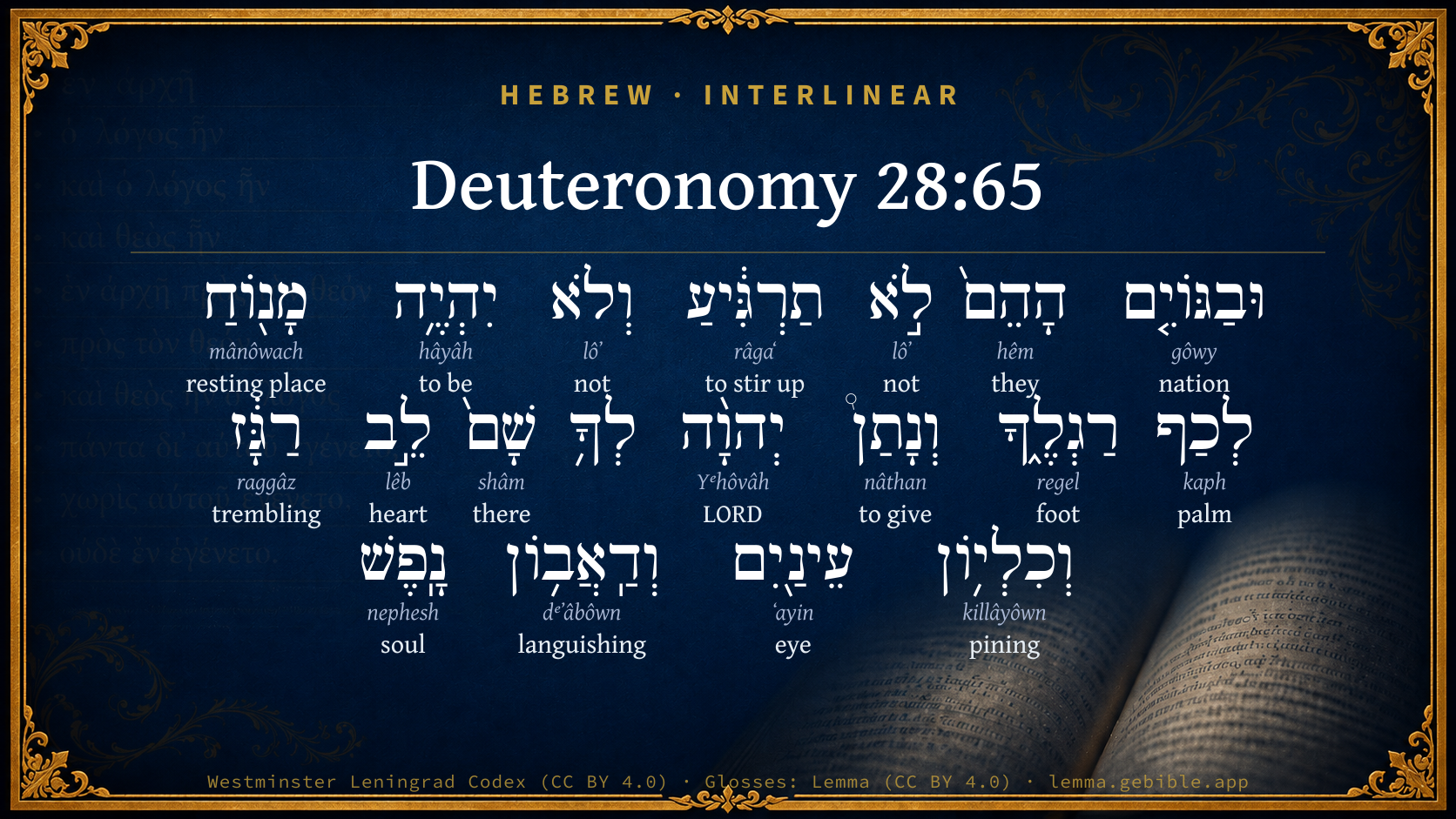
Hebrew (Westminster Leningrad Codex) Deuteronomy 28:65 appears in the Hebrew Old Testament. The text above is from the Westminster Leningrad Codex. Each word links to its Strong’s number, a concise gloss, and parsing drawn from the Open Scriptures Hebrew Bible morphology. Click any word for its full Brown-Driver-Briggs (BDB) entry.
Download image
Cite this verse

Deuteronomy 28:65 (World English Bible). Public Domain. Lemma interlinear Bible study tool, https://lemma.gebible.app/v/deuteronomy/28/65.

Show BibTeX & RIS
BibTeX
RIS
English Translation
Among these nations shall you find no ease, and there shall be no rest for the sole of your foot: but Yahweh will give you there a trembling heart, and failing of eyes, and pining of soul;
World English Bible · Public Domain
Highlights
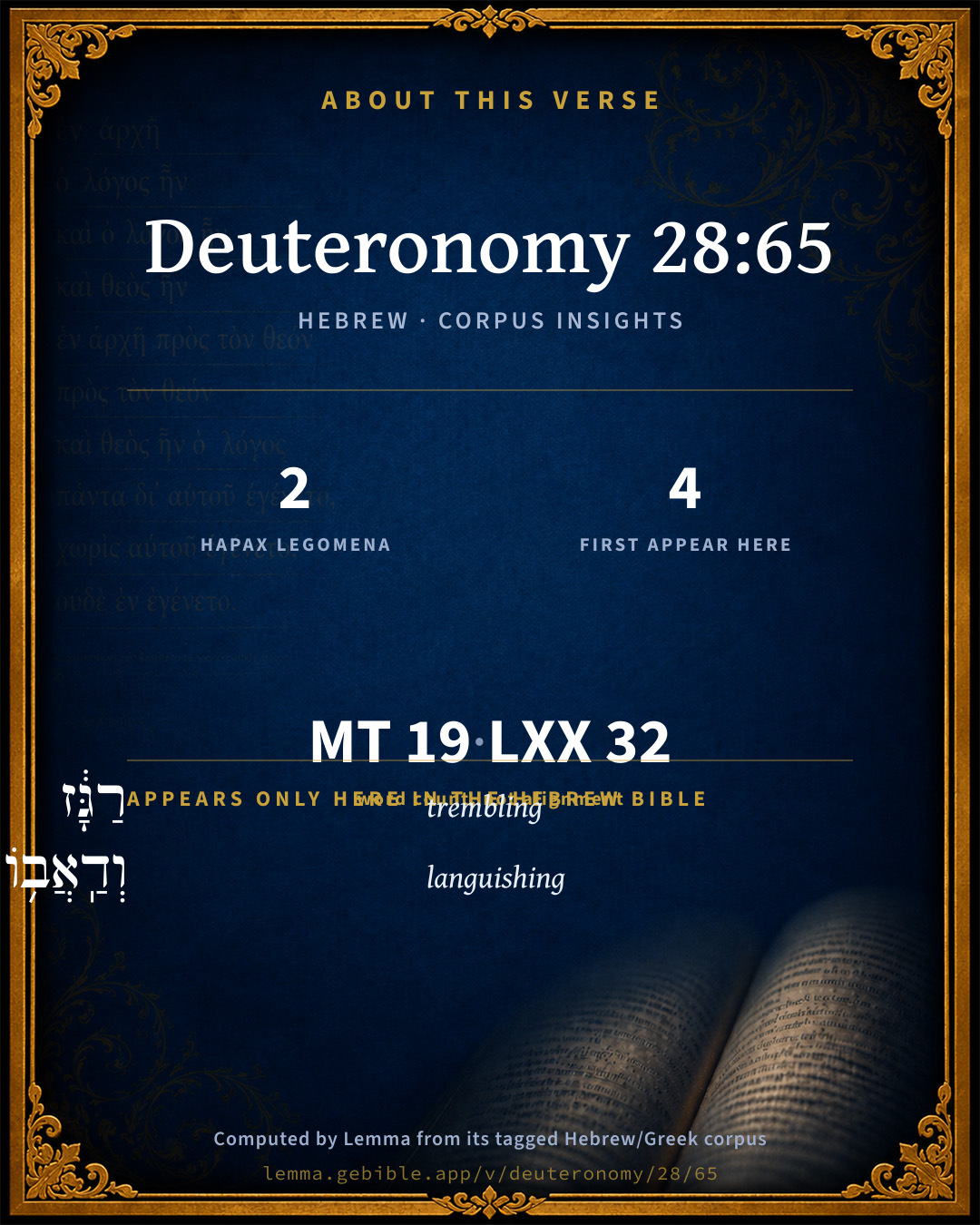
  • 2 hapax legomena — only here in the Hebrew Bible
  • 4 first appearances in the Hebrew Bible
Full analysis ↓
Download a study sheet

One document with this verse’s original text, its word-by-word gloss line, the meaning frame, cross-references with their text, attributed commentary, and full source and license credits — printable, and it pastes into notes with its structure intact.

This verse Autodidact and up

Study sheet (.html) Plain text (.txt)

A passage Seminary Student

Up to 50 verses in one chapter. A passage sheet keeps up to 6 commentary sources and 12 cross-references per verse, in the order this page ranks them, and says so on the sheet whenever that leaves anything out. Ask for a single verse and you get the Autodidact verse sheet above.

Everything on this page stays free to read, with no account — the sheet is a download of what is already on screen, not access to it.

Want to remove ads? Support Godless Engineer
Compare translations 3

The same verse in 3 English versions, stacked beneath the original-language interlinear above. Click any original word for its lexicon entry.

Each is an independent rendering of the whole verse — the interlinear is not word-aligned to these translations.

Highlighted words mark where these versions differ — a whole-verse word diff, not a word-by-word alignment.

  • World English Bible Public Domain
    Among these nations shall you find no ease, and there shall be no rest for the sole of your foot: but Yahweh will give you there a trembling heart, and failing of eyes, and pining of soul;
  • King James Version Public Domain
    And among these nations shalt thou find no ease, neither shall the sole of thy foot have rest: but the LORD shall give thee there a trembling heart, and failing of eyes, and sorrow of mind:
  • unfoldingWord Literal Text CC BY-SA 4.0
    And among these nations you will not have peace, and there will be no rest for the sole of your foot. And there Yahweh will give you a trembling heart and failing eyes and a mourning spirit.

unfoldingWord Literal Text — © unfoldingWord, licensed CC BY-SA 4.0. Word-aligned USFM3 via Door43 (git.door43.org/unfoldingWord/en_ult).

Versions to compare (up to 4)

3 of 4 selected

Show all 18 translations

Every available English version of this verse, each an independent rendering of the whole verse.

  • World English Bible Public Domain
    Among these nations shall you find no ease, and there shall be no rest for the sole of your foot: but Yahweh will give you there a trembling heart, and failing of eyes, and pining of soul;
  • Berean Standard Bible Public Domain
    Among those nations you will find no repose, not even a resting place for the sole of your foot. There the LORD will give you a trembling heart, failing eyes, and a despairing soul.
  • Majority Standard Bible Public Domain
    Among those nations you will find no repose, not even a resting place for the sole of your foot. There the LORD will give you a trembling heart, failing eyes, and a despairing soul.
  • King James Version Public Domain
    And among these nations shalt thou find no ease, neither shall the sole of thy foot have rest: but the LORD shall give thee there a trembling heart, and failing of eyes, and sorrow of mind:
  • American Standard Version (1901) Public Domain
    And among these nations shalt thou find no ease, and there shall be no rest for the sole of thy foot: but Jehovah will give thee there a trembling heart, and failing of eyes, and pining of soul;
  • Revised Version (1885) Public Domain
    And among these nations shalt thou find no ease, and there shall be no rest for the sole of thy foot: but the LORD shall give thee there a trembling heart, and failing of eyes, and pining of soul:
  • Geneva Bible (1599) Public Domain
    Also among these nations thou shalt finde no rest, neither shall the sole of thy foote haue rest: for the Lord shall giue thee there a trembling heart, and looking to returne till thine eyes fall out, and a sorowfull minde.
  • Douay-Rheims (1899) Public Domain
    Neither shalt thou be quiet, even in those nations, nor shall there be any rest for the sole of thy foot. For the Lord will give thee a fearful heart, and languishing eyes, and a soul consumed with pensiveness:
  • Young's Literal Translation Public Domain
    `And among those nations thou dost not rest, yea, there is no resting-place for the sole of thy foot, and Jehovah hath given to thee there a trembling heart, and failing of eyes, and grief of soul;
  • Literal Standard Version CC BY-SA 4.0
    And you do not rest among those nations, indeed, there is no resting place for the sole of your foot, and YHWH has given to you a trembling heart, and failing of eyes, and grief of soul there;
  • Unlocked Literal Bible CC BY-SA 4.0
    Among these nations will you find no ease, and there will be no rest for the bottoms of your feet; instead, Yahweh will give you there a trembling heart, failing eyes, and a soul that mourns.
  • unfoldingWord Literal Text CC BY-SA 4.0
    And among these nations you will not have peace, and there will be no rest for the sole of your foot. And there Yahweh will give you a trembling heart and failing eyes and a mourning spirit.
  • Darby Bible Public Domain
    And among these nations shalt thou have no rest, neither shall the sole of thy foot have a resting-place, and Jehovah shall give thee there a trembling heart, languishing of the eyes, and pining of the soul.
  • World Messianic Bible Public Domain
    Among these nations you will find no ease, and there will be no rest for the sole of your foot; but the LORD will give you there a trembling heart, failing of eyes, and pining of soul.
  • Webster's Bible Public Domain
    And among these nations shalt thou find no ease, neither shall the sole of thy foot have rest: but the LORD shall give thee there a trembling heart, and failing of eyes, and sorrow of mind:
  • Free Bible Version CC BY-SA 4.0
    You won't find any place to rest among those nations, no place of your own. The Lord will make you anxious, with failing eyesight and a mind full of despair.
  • Bible in Basic English Public Domain
    And even among these nations there will be no peace for you, and no rest for your feet: but the Lord will give you there a shaking heart and wasting eyes and weariness of soul:
  • JPS Tanakh (1917) Public Domain
    And among these nations shalt thou have no repose, and there shall be no rest for the sole of thy foot; but the LORD shall give thee there a trembling heart, and failing of eyes, and languishing of soul.

Literal Standard Version (2020), Covenant Press — licensed CC BY-SA 4.0. Text via the HelloAO Bible API (eBible.org). Unlocked Literal Bible (unfoldingWord) — licensed CC BY-SA 4.0. Text via the HelloAO Bible API (eBible.org). unfoldingWord Literal Text — © unfoldingWord, licensed CC BY-SA 4.0. Word-aligned USFM3 via Door43 (git.door43.org/unfoldingWord/en_ult). Free Bible Version, Dr. Jonathan Gallagher — licensed CC BY-SA 4.0. Text via the HelloAO Bible API (eBible.org).

Word by word

More ways to search: Search by grammar → Find every occurrence → Compare this word →

Practice this passage: Drill this verse → Learn its vocabulary →

רַגָּ֔ז
raggâz
H7268
“trembling”
Adjective, Adjective, Masculine, Singular, Absolute
Part of Speech
Adjective
Type
Adjective
Gender
Masculine
Number
Singular
State
Absolute
Full BDB Definition

Origin: intensive from H7264

TWOT: 2112c

trembling, quivering, quaking
  1. וּבַגּוֹיִ֤ם gôwy H1471 “and · in/at the · nations” Conjunction + Preposition, Determined + Noun, Common, Masculine, Plural, Absolute
  2. הָהֵם֙ hêm H1992 “the · they” Particle, Definite Article + Pronoun, Personal, 3rd Person, Masculine, Plural
  3. לֹ֣א lôʼ H3808 “not” Particle, Negative
  4. תַרְגִּ֔יעַ râgaʻ H7280 “to stir up” Verb, Hiphil, Imperfect, 2nd Person, Masculine, Singular
  5. וְלֹא lôʼ H3808 “and · not” Conjunction + Particle, Negative
  6. יִהְיֶ֥ה hâyâh H1961 “to be” Verb, Qal, Imperfect, 3rd Person, Masculine, Singular
  7. מָנ֖וֹחַ mânôwach H4494 “resting place” Noun, Common, Both, Singular, Absolute
  8. לְכַף kaph H3709 “to/for · palm of” Preposition + Noun, Common, Feminine, Singular, Construct
  9. רַגְלֶ֑ךָ regel H7272 “foot · your” Noun, Common, Feminine, Singular, Construct + Suffix, Personal, 2nd Person, Masculine, Singular
  10. וְנָתַן֩ nâthan H5414 “and · to give” Conjunction + Verb, Qal, Sequential Perfect, 3rd Person, Masculine, Singular
  11. יְהוָ֨ה Yᵉhôvâh H3068 “LORD” Noun, Proper
  12. שָׁם֙ shâm H8033 “there” Adverb
  13. לֵ֣ב lêb H3820 “heart” Noun, Common, Masculine, Singular, Absolute
  14. וְכִלְי֥וֹן killâyôwn H3631 “and · pining of” Conjunction + Noun, Common, Masculine, Singular, Construct
  15. עֵינַ֖יִם ʻayin H5869 “eyes” Noun, Common, Both, Dual, Absolute
  16. וְדַֽאֲב֥וֹן dᵉʼâbôwn H1671 “and · languishing of” Conjunction + Noun, Common, Masculine, Singular, Construct
  17. נָֽפֶשׁ nephesh H5315 “soul” Noun, Common, Both, Singular, Absolute

About this verse

These counts appear in no published source. They are computed here, from the morphology-tagged text and Lemma’s own curated glosses. What Lemma adds →

19
words
17
distinct lemmas
Pentateuch
section

Notable vocabulary

2 hapax legomena — words that appear only here in the entire Hebrew Bible:

  • רַגָּ֔ז trembling H7268
  • וְדַֽאֲב֥וֹן languishing H1671

First appearance in Scripture

These words make their first canonical appearance in the Hebrew Bible here:

  • תַרְגִּ֔יעַ to stir up H7280
  • רַגָּ֔ז trembling H7268
  • וְכִלְי֥וֹן pining H3631
  • וְדַֽאֲב֥וֹן languishing H1671

Shared distinctive vocabulary

וְכִלְי֥וֹן pining H3631 occurs in 2 verses of the Hebrew Bible. Also found in:

Grammatical profile

  • 3 verbs
  • 10 nouns
  • 1 adjective
  • 1 pronoun
  • 1 preposition
  • 1 adverb
  • 2 particles

Verb forms

  • תַרְגִּ֔יעַ Hiphil · Imperfect
  • יִהְיֶ֥ה Qal · Imperfect
  • וְנָתַן֩ Qal · Sequential Perfect

Repetition

A word recurs within this verse — often emphatic in Hebrew:

Hebrew & Septuagint length

In English translation the verse runs 37 words from the Hebrew and 41 from the Septuagint (LXX English) — closely comparable.

A rough comparison of the two English renderings, which tokenize alike — not a word-level alignment.

Word counts can differ between the Hebrew and the Greek without any difference in meaning — e.g. the Hebrew direct-object marker אֵת has no separate Greek word, and Greek often adds the article ὁ.

In the original languages it is 19 Hebrew tokens and 32 Greek tokens — but the two are counted differently (Hebrew bundles its prefixes and suffixes into one token; the Greek is in lemma form), so that isn’t a like-for-like length.

Cross-references

17

Topical passages linked to Deuteronomy 28:65 in the Treasury of Scripture Knowledge — connected by theme and wording, ordered by reader-vote popularity; previews shown in the World English Bible.

  • Leviticus 26:36 "'As for those of you who are left, I will send a faintness into their hearts in the lands of their enemies: and the sound of a driven leaf will put them to flight; and they shall flee, as one flees from the sword; and they will fall when no one pursues.
  • Genesis 8:9 but the dove found no place to rest her foot, and she returned to him into the ark; for the waters were on the surface of the whole earth. He put forth his hand, and took her, and brought her to him into the ark.
  • Leviticus 26:16 I also will do this to you: I will appoint terror over you, even consumption and fever, that shall consume the eyes, and make the soul to pine away; and you will sow your seed in vain, for your enemies will eat it.
  • Amos 9:4 Though they go into captivity before their enemies, there I will command the sword, and it will kill them. I will set my eyes on them for evil, and not for good.
  • Romans 11:10 Let their eyes be darkened, that they may not see. Bow down their back always."
  • Isaiah 51:17 Awake, awake, stand up, Jerusalem, that have drunk at the hand of Yahweh the cup of his wrath; you have drunken the bowl of the cup of staggering, and drained it.
  • Isaiah 57:21 There is no peace, says my God, to the wicked.
  • Isaiah 65:14 behold, my servants shall sing for joy of heart, but you shall cry for sorrow of heart, and shall wail for vexation of spirit.
  • Lamentations 3:65 You will give them hardness of heart, your curse to them.
  • Ezekiel 5:12–17 A third part of you shall die with the pestilence, and with famine shall they be consumed in the midst of you; and a third part shall fall by the sword round about you; and a third part I will scatter to all the winds, and will draw out a sword after them.
  • Ezekiel 12:18–19 Son of man, eat your bread with quaking, and drink your water with trembling and with fearfulness;
  • Ezekiel 20:32–35 and that which comes into your mind shall not be at all, in that you say, We will be as the nations, as the families of the countries, to serve wood and stone.
  • Hosea 11:10–11 They will walk after Yahweh, Who will roar like a lion; For he will roar, and the children will come trembling from the west.
  • Amos 9:9–10 "For, behold, I will command, and I will sift the house of Israel among all the nations, as grain is sifted in a sieve, yet not the least kernel will fall on the earth.
  • Habakkuk 3:16 I heard, and my body trembled. My lips quivered at the voice. Rottenness enters into my bones, and I tremble in my place, Because I must wait quietly for the day of trouble, For the coming up of the people who invade us.
  • Matthew 24:8 But all these things are the beginning of birth pains.
  • Luke 21:26 men fainting for fear, and for expectation of the things which are coming on the world: for the powers of the heavens will be shaken.

Cross-references courtesy of OpenBible.info (CC BY 4.0).

Hebrew and Greek witnesses Masoretic Hebrew ↔ Greek Septuagint

The same verse in the two great witnesses to the Old Testament, shown verse-for-verse.

These are two independent witnesses, not word-aligned to each other, and the Septuagint is shown in lemma (dictionary) form.

Hebrew Deuteronomy 28:65 Masoretic · Westminster Leningrad Codex

וּבַגּוֹיִ֤ם הָהֵם֙ לֹ֣א תַרְגִּ֔יעַ וְלֹא יִהְיֶ֥ה מָנ֖וֹחַ לְכַף רַגְלֶ֑ךָ וְנָתַן֩ יְהוָ֨ה לְךָ֥ שָׁם֙ לֵ֣ב רַגָּ֔ז וְכִלְי֥וֹן עֵינַ֖יִם וְדַֽאֲב֥וֹן נָֽפֶשׁ

Among these nations shall you find no ease, and there shall be no rest for the sole of your foot: but Yahweh will give you there a trembling heart, and failing of eyes, and pining of soul;

World English Bible · Public Domain

Greek LXX Deuteronomy 28:65 Septuagint · lemma form

ἀλλά καί ἐν ὁ ἔθνος ἐκεῖνος οὐ ἀναπαύω σύ οὐδέ οὐ μή γίγνομαι στάσις ὁ ἴχνος ὁ πούς σύ καί δίδωμι σύ κύριος ἐκεῖ καρδία ἀθυμέω καί ἐκλείπω ὀφθαλμός καί τήκω ψυχή

Moreover among those nations he will not give you quiet, neither by any means shall the sole of your foot have rest; and the Lord shall give you there another and a misgiving heart, and failing eyes, and a wasting soul.

LXX2012 (modern English Septuagint) · Public Domain

Hebrew: Westminster Leningrad Codex (CC BY 4.0). Greek: Septuagint (public domain); English from LXX2012 (modern English Septuagint) (Public Domain). How the Septuagint differs from the Hebrew →

Targum (Aramaic paraphrase)

2

The Targum is the ancient Jewish Aramaic paraphrase of the Hebrew Scriptures — an interpretive translation, not the Hebrew text itself. Onkelos (literal) and Pseudo-Jonathan (expansive) render the Torah, and Jonathan the Prophets. Coverage is partial: where no permissively-licensed English translation exists for a verse, only the Aramaic is shown. This is verse-level text, not a word-by-word alignment to the Hebrew.

  1. Targum Onkelos Torah (Genesis–Deuteronomy)
    וּבְעַמְמַיָא הָאִנוּן לָא תְנוּחַ וְלָא יְהֵי מְנָח לְפַרְסַת רַגְלָךְ וְיִתֵּן יְיָ לָךְ תַּמָן לֵב דָחֵל וְחַשְׁכַת עַיְנִין וּמַפְּחַן נְפָשׁ

    (no public-domain English translation for this verse)

    Targum Onkelos — Aramaic: “Onkelos Genesis” (public domain); “Onkelos Exodus” (public domain); “Onkelos Leviticus” (public domain); “Onkelos Numbers” (public domain); “Onkelos Deuteronomy” (public domain). English: “Sefaria Community Translation” (CC0 1.0 (public-domain dedication)); “J.W. Etheridge. The Targums of Onkelos and Jonathan Ben Uzziel on the Pentateuch. London: Longmans, Green, 1862” (public domain). Text via Sefaria.

  2. Targum Pseudo-Jonathan Torah (Genesis–Deuteronomy)
    וְאִין יִתְפְּלֵג דַעְתְּכוֹן לְמִפְלַח לְטַעֲוַותְהוֹן וְאִיגְרֵי בֵּינֵיכוֹן וּבֵינֵי עַמְמַיָא הָאִינוּן וְלָא תְּנוּחוּן וְלָא יֶהֱוֵי מַנַח לְפִירְסַת רִגְלֵיכוֹן וְיִתֵּן מֵימְרָא דַיְיָ לְכוֹן תַּמָן לִבָּא דַחֲלָא דְמֵחַשְׁכָן עַיְינִין וּמַפְחַת נְפָשׁ

    And if your mind be divided to worship their idols, He will send (that) between you and those nations that you shall have no repose or rest for the sole of your feet, and will give you there a fearful heart which darkens the eyes and wears out the soul.

    Targum Pseudo-Jonathan — Aramaic: “Targum Jonathan on Genesis” (public domain); “Targum Jonathan on Exodus” (public domain); “Targum Jonathan on Leviticus” (public domain); “Targum Jonathan on Numbers” (public domain); “Targum Jonathan on Deuteronomy” (public domain). English: “The Targum of Jonathan ben Uzziel, trans. J. W. Etheridge, London, 1862” (public domain). Text via Sefaria.

Commentary

Notes on Deuteronomy 28:65 from classic Christian and Jewish commentators (each source and its license shown beneath its notes). The classic Christian expositions comment on the surrounding passage and are grouped to its opening verse, so a note may address several verses; the Jewish commentaries on the Tanakh (Rashi and others) are per-verse, so they appear only where the commentator wrote on this verse.

Lemma curates 59 commentaries, every one of them public domain or Creative Commons licensed, each selected and text-cleaned for this edition rather than reprinted as found. About our sources →

Trapp's Complete Commentary

John Trapp

Deu 28:65 And among these nations shalt thou find no ease, neither shall the sole of thy foot have rest: but the LORD shall give thee there a trembling heart, and failing of eyes, and sorrow of mind:

Ver. 65. A trembling heart.] Juvenal by a jeer calls them Iudaeos trementes, trembling Jews (Sat. vi.). It seems they had Cain’s curse upon them.

John Trapp, A Commentary or Exposition upon All the Books of the Old and New Testament (1647–1656) — public domain. Text from a community e-Sword module.

Joseph Benson's Commentary

Deu 28:65. Among these nations shalt thou find no ease, neither shall thy foot have rest — They have been so far from finding rest, that they have been banished from city to city, from country to country. In many places they have been banished and recalled, and banished again. Several remarkable instances of this kind are mentioned by Bishop Newton here, to whom the reader is referred. In some of them the Jews must have suffered much, particularly when, in the latter end of the fifteenth century, they were banished from Spain by Ferdinand and Isabella. At that time, according to Mariana, there were one hundred and seventy thousand families, or, as some say, eight hundred thousand persons, who left the kingdom. Abarbinel, a Jewish writer, gives the following account of this their last expulsion from Spain. He says, “Three hundred thousand of them, old and young, men and women, (among whom he was one,) went away on foot, upon one day, not knowing whither to go. Some went into Portugal, others into Navarre, where they conflicted with many calamities: for some became a prey or perished by famine and pestilence; and therefore others committed themselves to sea, hoping to find a quiet seat in some other countries. But on the sea they met with new disasters; for many were sold for slaves when they came on any coast, many were drowned, many burned in the ships, which were set on fire. In short, all suffered the punishment of God the avenger: for, after all this, a plague came and swept away the rest of the miserable wretches, who were hated by all mankind; so all that vast number perished by some calamity or other, except a very few.” Some who sought for rest in the kingdom of Fez, lived there a long time upon grass, and ate its very roots, and then died, and their bodies lay exposed, none being so charitable as to bury them.

The Jewish writer just quoted mentions some taking refuge in Portugal. They paid dearly for this liberty to John II., but within a few years were expelled from thence also by his successor. And in the beginning of the next century a dreadful massacre was made of them at Lisbon, for three days together, where they were not suffered to die of their deadly wounds, but were dragged by their mangled limbs into the market-place, where the bodies of the living and the slain, with others half alive, half dead, were burned together in heaps. Two thousand of them perished in this barbarous manner. Parents durst not mourn for their children, nor children sigh for their parents, when they saw them haled to the place of torment. Fear so dispirited them, as an historian relates, that the living in their aspect did not much differ from the dead, so that they were exactly in the condition Moses here describes, when he says, And the Lord shall give thee a trembling heart, and failing of eyes, and sorrow of mind.

Joseph Benson's Commentary on the Old and New Testaments (1811–1818) — public domain. Text from a community e-Sword module.

Adam Clarke's Commentary

Verse 65. No ease - a trembling heart, and failing of eyes] The trembling of heart may refer to their state of continual insecurity, being, under every kind of government, proscribed, and, even under the most mild, uncertain of toleration and protection; and the failing of eyes, to their vain and ever-disappointed expectation of the Messiah.

Adam Clarke's Commentary on the Bible (1810–1826) — public domain. Text from a community e-Sword/MySword module.

Ellicott's Commentary for English Readers

(65) And among these nations shalt thou find no ease.—The repeated persecutions of the Jews by other nations in the time of their dispersion are among the most fearful and wonderful phenomena of history.

And failing of eyes.—“Looking for salvation, and it cometh not” (Rashi). How many years have they gone on praying that they may keep the feast “next year” in Jerusalem? and still the hope is deferred.

A Bible Commentary for English Readers, edited by Charles John Ellicott (1878–1897) — public domain. Text from a community e-Sword module.

The Cambridge Bible for Schools and Colleges

gen. ed. J. J. S. Perowne

65. shalt thou find no ease] The vb. is found only in Jer_31:2; Jer_47:6; Jer_50:34, Isa_52:4; its substantive in Isa_28:12.

no rest, etc.] Gen_8:9.

a quaking heart] The vb. occurs in Deu_2:25.

failing of eyes] With disappointment of hope: cp. Deu_28:32 and Lam_2:11; Lam_4:17.

pining of soul] Faintness of longing or of life; Heb. nephesh means either.

The Cambridge Bible for Schools and Colleges (gen. ed. J. J. S. Perowne; Cambridge University Press, 1878–1918) — public domain. Text from a community e-Sword module.

Haydock's Catholic Bible Commentary

Fearful, dejected, distrustful. The Jews are under continual alarms. (Calmet)

George Leo Haydock (1774–1849), Haydock's Catholic Family Bible and Commentary, 1859 edition — public domain. Excludes Psalms (Douay-Rheims chapter numbering differs from Protestant) and Deuterocanonical books (Catholic canon only).

Matthew Poole's English Annotations

Neither shall the sole of thy foot have rest; ye shall have no settlement in the land whither you are banished, but there you shall be tossed about from place to place, and sold from person to person, or, Cain-like, wander about like a vagabond.

Matthew Poole's English Annotations on the Holy Bible (1683–1685) — public domain. Text from a community e-Sword/MySword module.

The Pulpit Commentary

Vers. 65-69. Mental torture as a result of sin.

The picture here drawn is true in an especial sense of the Jews in their state of exile, maddened, affrighted, and kept in continual torture and suspense by the persecutions and miseries they have been made to endure. We apply it to the state of the ungodly generally a state of internal misery resulting from transgression.

I UNAPPEASABLE RESTLESSNESS. (Ver. 65.) The sinner is destitute of peace. (Isa_57:21)

1. There is nothing to give it. No inward source of comfort. No perennial spring of satisfaction.

1. There is everything to take it away.

1. An evil conscience.

2. Sense of God"s displeasure.

3. Inward disunion and anarchy.

The consequence is that the sinner cannot settle, tie does not feel at rest. He cannot be happy or contented in any place or occupation. Like a patient tossing under fever, he thinks that his uneasiness arises from his position, whereas it is his disorder. (Cf. "Childe Harold," 1:4, 5; or words of Tiberius to his senate to write to you, conscript fathers, or how to write, or what not to write, may all the gods and goddesses destroy me worse than I feel that they are daily destroying me, if I know.")

II FEAR AND TREMBLING OF HEART. (Vers. 65, 66.) "The wicked flee when no man pursueth". (Pro_28:1) The guilty conscience is full of terrors. It "does make cowards of us all." Gives rise to groundless fears. (Joseph"s brethren, Gen_45:3 Gen_50:15) Morbid working of imagination starting in sleep (Richard III), fancying sounds and movements (Macboth). Works despair. (Saul, 1Sa 28) It unnerves and unmans.

III LOATHING AND WEARINESS OF LIFE. (Ver. 67.) A sated despairing feeling, incapable of removal or alleviation. Ennui. Unbearable dragging on of time. I may say that in all my seventy-five years I have never had a month of genuine comfort. It has been the perpetual rolling of a stone, which I have always had to raise anew" (Goethe). Cf. "Childe Harold," as above

He felt the fullness of satiety, Then loathed he in his native land to dwell;

or Matthew Arnold"s lines

On that hard pagan world disgust And sated loathing fell; Deep weariness and sated lust Made human life a hell," etc. J.O.

The Pulpit Commentary (1880–1919), ed. H.D.M. Spence-Jones & Joseph S. Exell — public domain. Text from a community e-Sword module.

John Wesley's Explanatory Notes

Neither shall thy foot have rest - Ye shall have no settlement in the land whither you are banished, but there you shall be tossed about from place to place, and sold from person to person, or Cain - like, wander about.

John Wesley, Explanatory Notes Upon the Whole Bible (1754–1765) — public domain. Text via the GEBible commentary corpus.

unfoldingWord translationNotes

Door43 World Missions Community

General Information:

Moses speaks to the Israelites as if they were one man, so the words "you" and "your" here are singular. (See: Forms of You)

there will be no rest for the bottoms of your feet

Here the phrase "the bottoms of your feet" refer to the whole person. AT: "you will have to continually wander because you have no permanent home where you can rest" (See: Synecdoche)

Yahweh will give you there a trembling heart, failing eyes, and a soul that mourns

This is an idiom. AT: "Yahweh will cause you to be afraid, without hope, and sad" (See: Idiom)

Your life will hang in doubt before you

This is an idiom. AT: "You will not know whether you will live or die" (See: Idiom)

translationWords

nation

rest

heart

mourn

life

fear

unfoldingWord translationNotes — © Distant Shores Media and the Door43 World Missions Community, licensed CC BY-SA 4.0. Source: git.door43.org/Door43/en_tn.

Rashi

Rabbi Shlomo Yitzchaki (Rashi)

לא תרגיע means, THOU SHALT FIND NO REST, as (Isaiah 28:12) “This is the rest (המרגעה)

לב רגז means, A TREMBLING HEART, as the Targum has it: דחל, fearing. It is similar in meaning to (Isaiah 14:9) “The nether-world from beneath trembleth (רגזה) for thee”; (Exodus 15:14) “The peoples have heard, they trembled”; (II Samuel 22:8) “The foundations of heaven trembled”.

וכליון עינים AND A FAILING OF THE EYES — The phrase is used of one who expectantly looks for help and it does not come (cf. v. 32).

Rashi on the Tanakh — English translations: “The Judaica Press complete Tanach with Rashi, translated by A. J. Rosenberg” (CC BY 4.0); “Pentateuch with Rashi's commentary by M. Rosenbaum and A.M. Silbermann, 1929-1934” (public domain); “The Metsudah Tanach series, Lakewood, N.J” (CC BY 4.0); and “The Book of Joshua, Metsudah Publications, 1997” (CC BY 4.0). Text via Sefaria.

Lesson kit

Teaching starters — assembled from the data on this page, not authored interpretation. Every prompt links to the verse data it draws on. Edit before teaching.

Deuteronomy, in the Pentateuch, opens this verse with 19 words (17 distinct Hebrew lemmas). Its most distinctive word is raggâz (“trembling”). A historical commentator’s framing appears above. Read the whole chapter for the surrounding context.

Discussion questions

  1. The word raggâz carries the sense “trembling.” How does it shape the verse?
  2. This verse holds 2 words here found nowhere else in the Hebrew Bible. What might the rare words draw attention to?
  3. 4 words here appear for the first time in Scripture. What is being introduced at this debut?
  4. Isaiah 10:22 shares the word «pining» with this verse. How do the two illuminate each other?
  5. “not” occurs 2× in this one verse. What is the effect of the repetition?
  6. These translations render this verse differently. What is at stake in choosing one wording over another?
  7. The verb «תַרְגִּ֔יעַ» is Hiphil Imperfect. How does its form color the action?
  8. Reading how Trapp's Complete Commentary and Joseph Benson's Commentary read this verse, where do the two commentators agree and where do they part?

Things to notice

  • 2 words in this verse appear nowhere else in the Hebrew Bible.
  • 4 words make their first canonical appearance in Scripture here.
  • This verse counts 19 Hebrew ↔ 32 Greek words.
  • These translations choose different wording for 16 words in this verse.
  • “not” occurs 2× in this single verse.

Reading settings

Reading text

Shown beneath each verse's original-language words.

Old Testament
Old Testament edition

Read the OT as the Masoretic Hebrew (MT) or the Greek Septuagint (LXX).

English shown for the Greek Septuagint (in the Hebrew ↔ Greek comparison).

Comparing translations? Open the Compare panel on any verse page to stack up to four side by side.