1 Kings 9:20

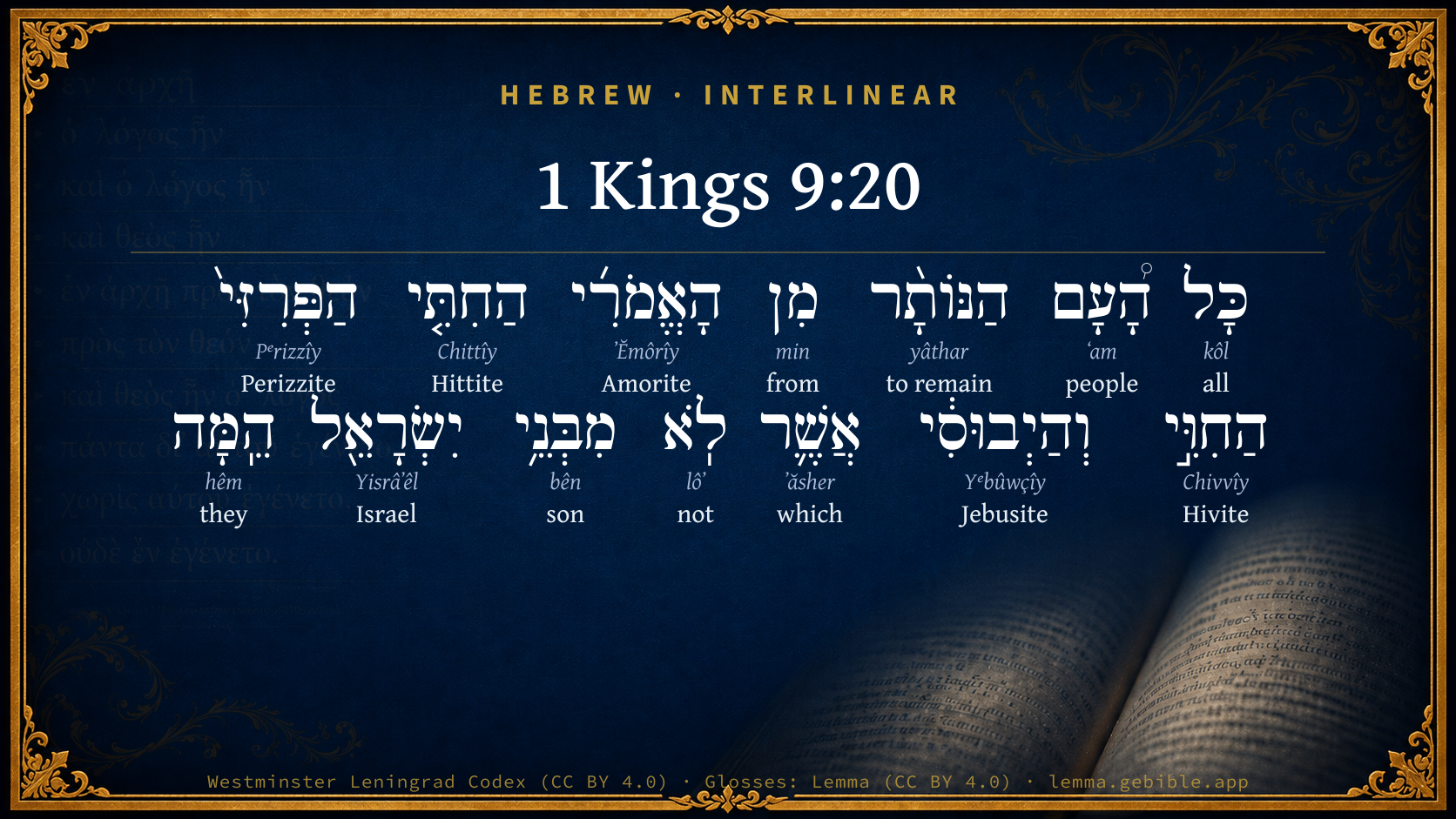
Hebrew (Westminster Leningrad Codex) 1 Kings 9:20 appears in the Hebrew Old Testament. The text above is from the Westminster Leningrad Codex. Each word links to its Strong’s number, a concise gloss, and parsing drawn from the Open Scriptures Hebrew Bible morphology. Click any word for its full Brown-Driver-Briggs (BDB) entry.
Download image
Cite this verse

1 Kings 9:20 (World English Bible). Public Domain. Lemma interlinear Bible study tool, https://lemma.gebible.app/v/1-kings/9/20.

Show BibTeX & RIS
BibTeX
RIS
English Translation
As for all the people who were left of the Amorites, the Hittites, the Perizzites, the Hivites, and the Jebusites, who were not of the children of Israel;
World English Bible · Public Domain
Download a study sheet

One document with this verse’s original text, its word-by-word gloss line, the meaning frame, cross-references with their text, attributed commentary, and full source and license credits — printable, and it pastes into notes with its structure intact.

This verse Autodidact and up

Study sheet (.html) Plain text (.txt)

A passage Seminary Student

Up to 50 verses in one chapter. A passage sheet keeps up to 6 commentary sources and 12 cross-references per verse, in the order this page ranks them, and says so on the sheet whenever that leaves anything out. Ask for a single verse and you get the Autodidact verse sheet above.

Everything on this page stays free to read, with no account — the sheet is a download of what is already on screen, not access to it.

Want to remove ads? Support Godless Engineer
Compare translations 3

The same verse in 3 English versions, stacked beneath the original-language interlinear above. Click any original word for its lexicon entry.

Each is an independent rendering of the whole verse — the interlinear is not word-aligned to these translations.

Highlighted words mark where these versions differ — a whole-verse word diff, not a word-by-word alignment.

  • World English Bible Public Domain
    As for all the people who were left of the Amorites, the Hittites, the Perizzites, the Hivites, and the Jebusites, who were not of the children of Israel;
  • King James Version Public Domain
    And all the people that were left of the Amorites, Hittites, Perizzites, Hivites, and Jebusites, which were not of the children of Israel,
  • unfoldingWord Literal Text CC BY-SA 4.0
    All of the people, the ones being left from the Amorite, the Hittite, the Perizzite, the Hivite, and the Jebusite, they who not from the sons of Israel,

unfoldingWord Literal Text — © unfoldingWord, licensed CC BY-SA 4.0. Word-aligned USFM3 via Door43 (git.door43.org/unfoldingWord/en_ult).

Versions to compare (up to 4)

3 of 4 selected

Show all 18 translations

Every available English version of this verse, each an independent rendering of the whole verse.

  • World English Bible Public Domain
    As for all the people who were left of the Amorites, the Hittites, the Perizzites, the Hivites, and the Jebusites, who were not of the children of Israel;
  • Berean Standard Bible Public Domain
    As for all the people who remained of the Amorites, Hittites, Perizzites, Hivites, and Jebusites (the people who were not Israelites)—
  • Majority Standard Bible Public Domain
    As for all the people who remained of the Amorites, Hittites, Perizzites, Hivites, and Jebusites (the people who were not Israelites)—
  • King James Version Public Domain
    And all the people that were left of the Amorites, Hittites, Perizzites, Hivites, and Jebusites, which were not of the children of Israel,
  • American Standard Version (1901) Public Domain
    As for all the people that were left of the Amorites, the Hittites, the Perizzites, the Hivites, and the Jebusites, who were not of the children of Israel;
  • Revised Version (1885) Public Domain
    As for all the people that were left of the Amorites, the Hittites, the Perizzites, the Hivites, and the Jebusites, which were not of the children of Israel;
  • Geneva Bible (1599) Public Domain
    Al the people that were left of the Amorites, Hittites, Perizzites, Hiuites, and Iebusites, which were not of the children of Israel:
  • Douay-Rheims (1899) Public Domain
    All the people that were left of the Amorrhites, and Hethites, and Pherezites, and Hevites, and Jebusites, that are not of the children of Israel:
  • Young's Literal Translation Public Domain
    The whole of the people that is left of the Amorite, the Hittite, the Perizzite, the Hivite, and the Jebusite, who `are' not of the sons of Israel --
  • Literal Standard Version CC BY-SA 4.0
    The whole of the people that is left of the Amorite, the Hittite, the Perizzite, the Hivite, and the Jebusite, who [are] not of the sons of Israel—
  • Unlocked Literal Bible CC BY-SA 4.0
    As for all the people who were left of the Amorites, the Hittites, the Perizzites, the Hivites, and the Jebusites, who were not of the people of Israel,
  • unfoldingWord Literal Text CC BY-SA 4.0
    All of the people, the ones being left from the Amorite, the Hittite, the Perizzite, the Hivite, and the Jebusite, they who not from the sons of Israel,
  • Darby Bible Public Domain
    All the people that were left of the Amorites, the Hittites, the Perizzites, the Hivites, and the Jebusites, who were not of the children of Israel,
  • World Messianic Bible Public Domain
    As for all the people who were left of the Amorites, the Hittites, the Perizzites, the Hivites, and the Jebusites, who were not of the children of Israel—
  • Webster's Bible Public Domain
    And all the people that were left of the Amorites, Hittites, Perizzites, Hivites, and Jebusites, who were not of the children of Israel,
  • Free Bible Version CC BY-SA 4.0
    The descendants of the Amorites, Hittites, Perizzites, Hivites and Jebusites (people who were not Israelites)
  • Bible in Basic English Public Domain
    As for the rest of the Amorites, the Hittites, the Perizzites, the Hivites, and the Jebusites, who were not children of Israel;
  • JPS Tanakh (1917) Public Domain
    All the people that were left of the Amorites, the Hittites, the Perizzites, the Hivites, and the Jebusites, who were not of the children of Israel;

Literal Standard Version (2020), Covenant Press — licensed CC BY-SA 4.0. Text via the HelloAO Bible API (eBible.org). Unlocked Literal Bible (unfoldingWord) — licensed CC BY-SA 4.0. Text via the HelloAO Bible API (eBible.org). unfoldingWord Literal Text — © unfoldingWord, licensed CC BY-SA 4.0. Word-aligned USFM3 via Door43 (git.door43.org/unfoldingWord/en_ult). Free Bible Version, Dr. Jonathan Gallagher — licensed CC BY-SA 4.0. Text via the HelloAO Bible API (eBible.org).

Word by word

More ways to search: Search by grammar → Find every occurrence → Compare this word →

Practice this passage: Drill this verse → Learn its vocabulary →

הַפְּרִזִּי֙
Pᵉrizzîy
H6522
“the · Perizzite”
Particle, Definite Article + Noun, Gentilic, Masculine, Singular, Absolute
Part of Speech
Particle + Noun
Type
Gentilic
Gender
Masculine
Number
Singular
State
Absolute
Full BDB Definition

Origin: for H6521

TWOT: None

Perizzite = "belonging to a village" - a people who inhabited southern Canaan prior to the conquest
  1. כָּל kôl H3605 “all of” Noun, Common, Masculine, Singular, Construct
  2. הָ֠עָם ʻam H5971 “the · people” Particle, Definite Article + Noun, Common, Masculine, Singular, Absolute
  3. הַנּוֹתָ֨ר yâthar H3498 “the · remaining” Particle, Definite Article + Verb, Niphal, Participle Active, Masculine, Singular, Absolute
  4. מִן min H4480 “from” Preposition
  5. הָאֱמֹרִ֜י ʼĔmôrîy H567 “the · Amorite” Particle, Definite Article + Noun, Gentilic, Masculine, Singular, Absolute
  6. הַחִתִּ֤י Chittîy H2850 “the · Hittite” Particle, Definite Article + Noun, Gentilic, Masculine, Singular, Absolute
  7. הַחִוִּ֣י Chivvîy H2340 “the · Hivite” Particle, Definite Article + Noun, Gentilic, Masculine, Singular, Absolute
  8. וְהַיְבוּסִ֔י Yᵉbûwçîy H2983 “and · the · Jebusite” Conjunction + Particle, Definite Article + Noun, Gentilic, Masculine, Singular, Absolute
  9. אֲשֶׁ֛ר ʼăsher H834 “which” Particle, Relative
  10. לֹֽא lôʼ H3808 “not” Particle, Negative
  11. מִבְּנֵ֥י bên H1121 “from · sons of” Preposition + Noun, Common, Masculine, Plural, Construct
  12. יִשְׂרָאֵ֖ל Yisrâʼêl H3478 “Israel” Noun, Proper
  13. הֵֽמָּה hêm H1992 “they” Pronoun, Personal, 3rd Person, Masculine, Plural

About this verse

These counts appear in no published source. They are computed here, from the morphology-tagged text and Lemma’s own curated glosses. What Lemma adds →

14
words
14
distinct lemmas
Historical
section

Notable vocabulary

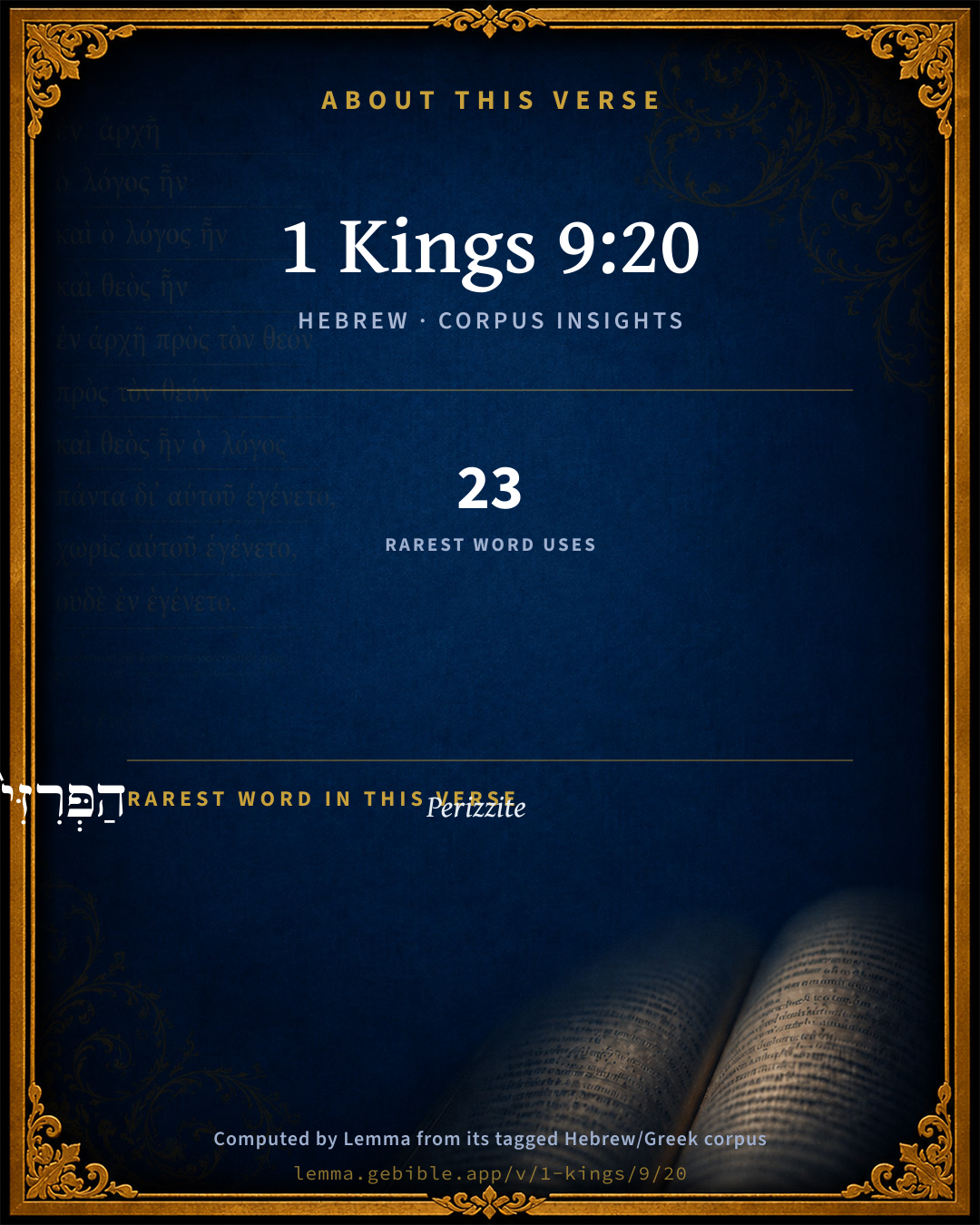
The rarest word here is הַפְּרִזִּי֙ Perizzite H6522 — appearing just 23 times in the whole Hebrew Bible.

Shared distinctive vocabulary

הַפְּרִזִּי֙ Perizzite H6522 occurs in 23 verses of the Hebrew Bible. Also found in:

Grammatical profile

  • 1 verb
  • 9 nouns
  • 1 pronoun
  • 1 preposition
  • 2 particles

Verb forms

  • הַנּוֹתָ֨ר Niphal · Participle Active

Cross-references

6

Topical passages linked to 1 Kings 9:20 in the Treasury of Scripture Knowledge — connected by theme and wording, ordered by reader-vote popularity; previews shown in the World English Bible.

  • Genesis 15:19–21 the Kenites, the Kenizzites, the Kadmonites,
  • Exodus 23:23 For my angel shall go before you, and bring you in to the Amorite, the Hittite, the Perizzite, the Canaanite, the Hivite, and the Jebusite; and I will cut them off.
  • Exodus 23:28–33 I will send the hornet before you, which will drive out the Hivite, the Canaanite, and the Hittite, from before you.
  • Exodus 34:11–12 Observe that which I command you this day. Behold, I drive out before you the Amorite, the Canaanite, the Hittite, the Perizzite, the Hivite, and the Jebusite.
  • Deuteronomy 7:1–3 When Yahweh your God shall bring you into the land where you go to possess it, and shall cast out many nations before you, the Hittite, and the Girgashite, and the Amorite, and the Canaanite, and the Perizzite, and the Hivite, and the Jebusite, seven nations greater and mightier than you;
  • 2 Chronicles 8:7–18 As for all the people who were left of the Hittites, and the Amorites, and the Perizzites, and the Hivites, and the Jebusites, who were not of Israel;

Cross-references courtesy of OpenBible.info (CC BY 4.0).

Hebrew and Greek witnesses Masoretic Hebrew ↔ Greek Septuagint

The same verse in the two great witnesses to the Old Testament, shown verse-for-verse.

These are two independent witnesses, not word-aligned to each other, and the Septuagint is shown in lemma (dictionary) form.

Hebrew 1 Kings 9:20 Masoretic · Westminster Leningrad Codex

כָּל הָ֠עָם הַנּוֹתָ֨ר מִן הָאֱמֹרִ֜י הַחִתִּ֤י הַפְּרִזִּי֙ הַחִוִּ֣י וְהַיְבוּסִ֔י אֲשֶׁ֛ר לֹֽא מִבְּנֵ֥י יִשְׂרָאֵ֖ל הֵֽמָּה

As for all the people who were left of the Amorites, the Hittites, the Perizzites, the Hivites, and the Jebusites, who were not of the children of Israel;

World English Bible · Public Domain

Hebrew: Westminster Leningrad Codex (CC BY 4.0). Greek: Septuagint (public domain); English from a public-domain English Septuagint. How the Septuagint differs from the Hebrew →

Targum (Aramaic paraphrase)

1

The Targum is the ancient Jewish Aramaic paraphrase of the Hebrew Scriptures — an interpretive translation, not the Hebrew text itself. Onkelos (literal) and Pseudo-Jonathan (expansive) render the Torah, and Jonathan the Prophets. Coverage is partial: where no permissively-licensed English translation exists for a verse, only the Aramaic is shown. This is verse-level text, not a word-by-word alignment to the Hebrew.

  1. Targum Jonathan Prophets (Joshua–Malachi)
    כָּל עַמָא דְאִשְׁתָּאַר מִן אֱמוֹרָאָה חִתָּאֵי פְרִיזָאֵי חִוָאֵי וִיבוּסָאֵי דְלָא מִבְּנֵי יִשְׂרָאֵל אִינוּן:

    (no public-domain English translation for this verse)

    Targum Jonathan — Aramaic: “Mikraot Gedolot” (public domain). English: “Sefaria Community Translation” (CC0 1.0 (public-domain dedication)); “London "Chaldee Paraphrase," 1871” (public domain). Text via Sefaria.

Commentary

Notes on 1 Kings 9:20 from classic Christian and Jewish commentators (each source and its license shown beneath its notes). The classic Christian expositions comment on the surrounding passage and are grouped to its opening verse, so a note may address several verses; the Jewish commentaries on the Tanakh (Rashi and others) are per-verse, so they appear only where the commentator wrote on this verse.

Lemma curates 59 commentaries, every one of them public domain or Creative Commons licensed, each selected and text-cleaned for this edition rather than reprinted as found. About our sources →

Trapp's Complete Commentary

John Trapp

1Ki 9:20 [And] all the people [that were] left of the Amorites, Hittites, Perizzites, Hivites, and Jebusites, which [were] not of the children of Israel,

Ver. 20. And all the people that were left.] These and their posterity seem to be called Solomon’s servants, {Ezr 2:55; Ezr 2:58 Neh 7:57; Neh 7:60; Neh 11:3} like as the Gibeonites were called Nethinims. {Ezr 2:43}

John Trapp, A Commentary or Exposition upon All the Books of the Old and New Testament (1647–1656) — public domain. Text from a community e-Sword module.

Joseph Benson's Commentary

1Ki 9:20-21. All the people that were left of the Amorites — Who, it is likely, by this time were become proselytes to the Jewish religion, as the Gibeonites were, or at least renounced their idolatry. Upon those did Solomon levy a tribute — He used them as bond-men, and imposed bodily labours upon them. “But why did not Solomon destroy them, as God had commanded, when now it was fully in his power to do so?” The command to destroy them, (Deu 7:2,) did chiefly, if not only, concern that generation of Canaanites who lived in or near the time of the Israelites entering into Canaan. And that command seems not to have been absolute, but conditional, and with some exception for those who should submit and embrace the true religion, as may be gathered both from Jos 11:19, and from the history of the Gibeonites. For if God’s command had been absolute, the oaths of Joshua, and of the princes, could not have obliged them, nor dispensed with such a command.

Joseph Benson's Commentary on the Old and New Testaments (1811–1818) — public domain. Text from a community e-Sword module.

Tyndale Open Study Notes

Tyndale Open Resources

9:20-23 Solomon’s conscripted slaves were made up of early Canaanite settlers; 550 chief supervisors, of whom 250 were Israelites, superintended the forced laborers (2 Chr 8:9-10; see 1 Kgs 5:15-16 with 2 Chr 2:17-18).

Tyndale Open Study Notes — © Tyndale Open Resources, licensed CC BY-SA 4.0. Text via the HelloAO Bible API.

Geneva Bible (1599)

Geneva Bible translators

These were as bondmen and paid what was required, either labor or money.

Geneva Bible (1599) marginal notes — public domain. Text via Bolls.life.

Ellicott's Commentary for English Readers

(20) A tribute of bond service.—This was probably not originated, but simply enforced and organised, by Solomon. It dated, in theory at least, from the Conquest. The most notable example of it is the case of the Gibeonites (Jos_9:21-27); but there are incidental notices of similar imposition of serfship in Jdg_1:28; Jdg_1:30; Jdg_1:33; Jdg_1:35. Many of the dangers of the stormy age of the Judges were due to the uprising of these subject races; as in the revival of the northern confederacy at Hazor under Sisera (Judges 4), and the usurpation of Abimelech by aid of the Shecliemites (Judges 9). Probably their subordination to Israel varied according to the strength or weakness of each age; but, when the monarchy became organised under David and Solomon, it was fixed definitely and permanently, although, like the serfship of the Middle Ages, it might vary in its severity in different times and in different regions.

A Bible Commentary for English Readers, edited by Charles John Ellicott (1878–1897) — public domain. Text from a community e-Sword module.

The Cambridge Bible for Schools and Colleges

gen. ed. J. J. S. Perowne

20. which were not of the children of Israel] This clause is added because the people of Canaan had become much mixed up among the Israelite population, being still allowed to live in some cities from which at first it had been found impossible to dislodge them (see above, 1Ki_9:16). But a distinction was made between these people and the people of Israel, now that Solomon was powerful enough to enforce it, in the kind of service they must render and the tribute they must bear. It may be that the five nations here mentioned were most largely represented in the surviving population, and that the other two out of the seven nations of Canaan had by this time been more nearly exterminated.

The Cambridge Bible for Schools and Colleges (gen. ed. J. J. S. Perowne; Cambridge University Press, 1878–1918) — public domain. Text from a community e-Sword module.

John Gill's Exposition

But of the children of Israel did Solomon make no bondmen,.... For that was contrary to the law; they might be hired servants, but not bond servants, Lev 25:39.

but they were men of war; which he kept in pay, a standing army, maintained even in time of peace, in case of necessity, should an enemy attempt to invade or surprise them:

and his servants; in his family and court, who had offices and employments there:

and his princes; ministers of state, counsellors, governors of cities, &c.

and his captains; officers in his army:

and rulers of his chariots and his horsemen; war chariots and troopers; see Kg1 9:19.

John Gill's Exposition of the Whole Bible (1746–1763) — public domain (CC PDM 1.0). Text via the HelloAO Bible API.

The Pulpit Commentary

And all the people that were left of the Amorites, Hittites, Perizzites, Hivites, and Jebusites (Jud 1:21-36 3:5; 1Ch_22:2) which were not of the children of Israel.

The Pulpit Commentary (1880–1919), ed. H.D.M. Spence-Jones & Joseph S. Exell — public domain. Text from a community e-Sword module.

unfoldingWord translationNotes

Door43 World Missions Community

translationWords

people group

Amorite

Hittite

Perizzite

Hivite

Jebus

Israel

descend

labor

unfoldingWord translationNotes — © Distant Shores Media and the Door43 World Missions Community, licensed CC BY-SA 4.0. Source: git.door43.org/Door43/en_tn.

Lesson kit

Teaching starters — assembled from the data on this page, not authored interpretation. Every prompt links to the verse data it draws on. Edit before teaching.

1 Kings, in the Historical, opens this verse with 14 words (14 distinct Hebrew lemmas). Its most distinctive word is Pᵉrizzîy (“Perizzite”). A historical commentator’s framing appears above. Read the whole chapter for the surrounding context.

Discussion questions

  1. The word Pᵉrizzîy carries the sense “Perizzite.” How does it shape the verse?
  2. Genesis 13:7 shares the word «Perizzite» with this verse. How do the two illuminate each other?
  3. These translations render this verse differently. What is at stake in choosing one wording over another?
  4. The verb «הַנּוֹתָ֨ר» is Niphal Participle Active. How does its form color the action?
  5. Reading how Trapp's Complete Commentary and Joseph Benson's Commentary read this verse, where do the two commentators agree and where do they part?

Things to notice

Reading settings

Reading text

Shown beneath each verse's original-language words.

Old Testament
Old Testament edition

Read the OT as the Masoretic Hebrew (MT) or the Greek Septuagint (LXX).

English shown for the Greek Septuagint (in the Hebrew ↔ Greek comparison).

Comparing translations? Open the Compare panel on any verse page to stack up to four side by side.