1 Samuel 9:11

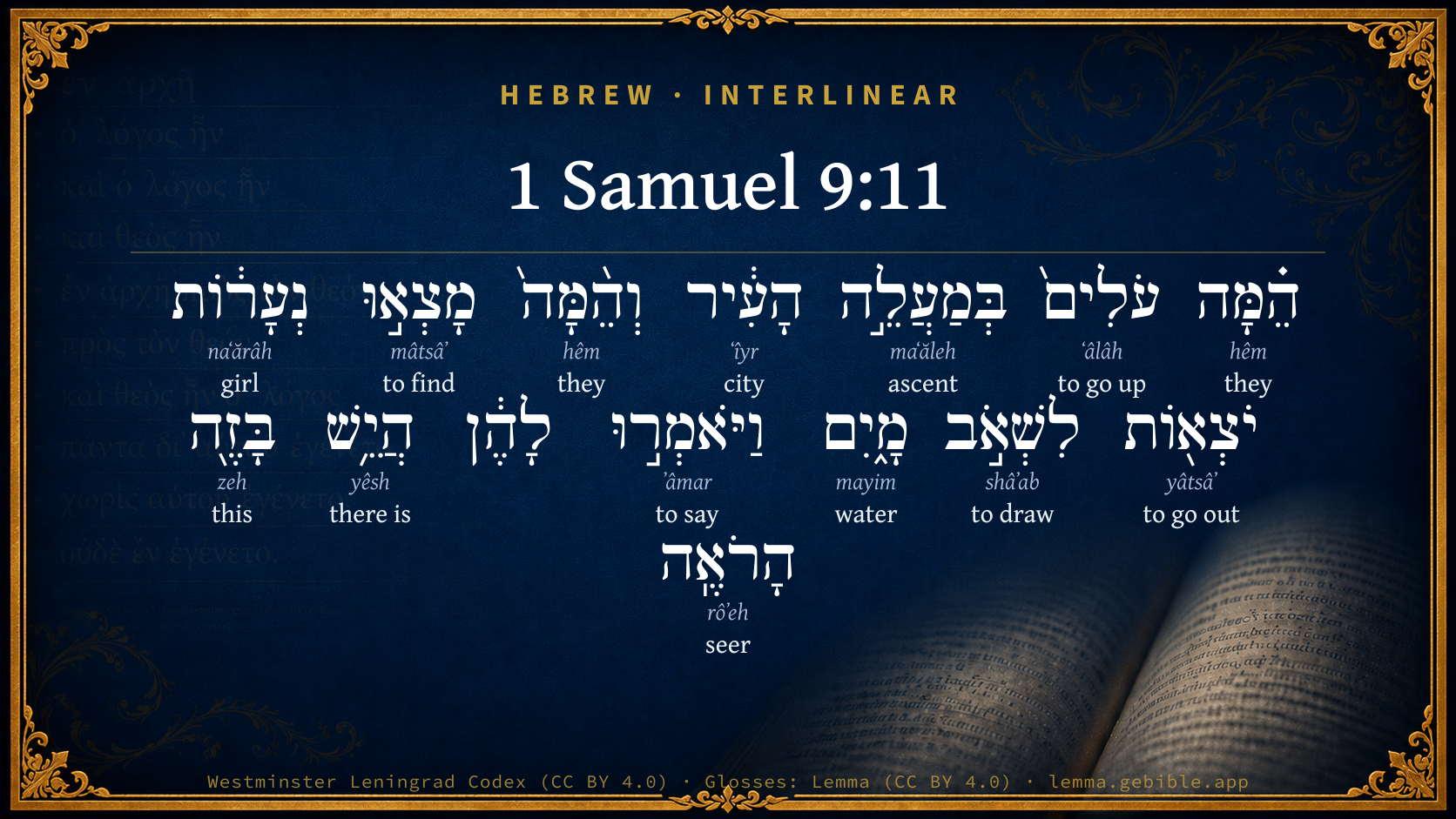
Hebrew (Westminster Leningrad Codex) 1 Samuel 9:11 appears in the Hebrew Old Testament. The text above is from the Westminster Leningrad Codex. Each word links to its Strong’s number, a concise gloss, and parsing drawn from the Open Scriptures Hebrew Bible morphology. Click any word for its full Brown-Driver-Briggs (BDB) entry.
Download image
Cite this verse

1 Samuel 9:11 (World English Bible). Public Domain. Lemma interlinear Bible study tool, https://lemma.gebible.app/v/1-samuel/9/11.

Show BibTeX & RIS
BibTeX
RIS
English Translation
As they went up the ascent to the city, they found young maidens going out to draw water, and said to them, Is the seer here?
World English Bible · Public Domain
Download a study sheet

One document with this verse’s original text, its word-by-word gloss line, the meaning frame, cross-references with their text, attributed commentary, and full source and license credits — printable, and it pastes into notes with its structure intact.

This verse Autodidact and up

Study sheet (.html) Plain text (.txt)

A passage Seminary Student

Up to 50 verses in one chapter. A passage sheet keeps up to 6 commentary sources and 12 cross-references per verse, in the order this page ranks them, and says so on the sheet whenever that leaves anything out. Ask for a single verse and you get the Autodidact verse sheet above.

Everything on this page stays free to read, with no account — the sheet is a download of what is already on screen, not access to it.

Want to remove ads? Support Godless Engineer
Compare translations 3

The same verse in 3 English versions, stacked beneath the original-language interlinear above. Click any original word for its lexicon entry.

Each is an independent rendering of the whole verse — the interlinear is not word-aligned to these translations.

Highlighted words mark where these versions differ — a whole-verse word diff, not a word-by-word alignment.

  • World English Bible Public Domain
    As they went up the ascent to the city, they found young maidens going out to draw water, and said to them, Is the seer here?
  • King James Version Public Domain
    And as they went up the hill to the city, they found young maidens going out to draw water, and said unto them, Is the seer here?
  • unfoldingWord Literal Text CC BY-SA 4.0
    They were going up on the ascent of the city, and they found young women going out to draw water. And they said to them, “Is the seer in this?”

unfoldingWord Literal Text — © unfoldingWord, licensed CC BY-SA 4.0. Word-aligned USFM3 via Door43 (git.door43.org/unfoldingWord/en_ult).

Versions to compare (up to 4)

3 of 4 selected

Show all 18 translations

Every available English version of this verse, each an independent rendering of the whole verse.

  • World English Bible Public Domain
    As they went up the ascent to the city, they found young maidens going out to draw water, and said to them, Is the seer here?
  • Berean Standard Bible Public Domain
    And as they were climbing the hill to the city, they met some young women coming out to draw water and asked, “Is the seer here?”
  • Majority Standard Bible Public Domain
    And as they were climbing the hill to the city, they met some young women coming out to draw water and asked, “Is the seer here?”
  • King James Version Public Domain
    And as they went up the hill to the city, they found young maidens going out to draw water, and said unto them, Is the seer here?
  • American Standard Version (1901) Public Domain
    As they went up the ascent to the city, they found young maidens going out to draw water, and said unto them, Is the seer here?
  • Revised Version (1885) Public Domain
    As they went up the ascent to the city, they found young maidens going out to draw water, and said unto them, Is the seer here?
  • Geneva Bible (1599) Public Domain
    And as they were going vp the hie way to the citie, they found maydes that came out to draw water, and said vnto them, Is there here a Seer?
  • Douay-Rheims (1899) Public Domain
    And when they went up the ascent to the city, they found maids coming out to draw water, and they said to them: Is the seer here?
  • Young's Literal Translation Public Domain
    They are going up in the ascent of the city, and have found young women going out to draw water, and say to them, `Is the seer in this `place'?'
  • Literal Standard Version CC BY-SA 4.0
    They are going up in the ascent of the city, and have found young women going out to draw water, and say to them, “Is the seer in this [place]?”
  • Unlocked Literal Bible CC BY-SA 4.0
    As they went up the hill to the city, they found young women coming out to draw water; Saul and his servant said to them, “Is the seer here?”
  • unfoldingWord Literal Text CC BY-SA 4.0
    They were going up on the ascent of the city, and they found young women going out to draw water. And they said to them, “Is the seer in this?”
  • Darby Bible Public Domain
    As they went up the ascent to the city, they met maidens going forth to draw water; and they said to them, Is the seer here?
  • World Messianic Bible Public Domain
    As they went up the ascent to the city, they found young maidens going out to draw water, and said to them, “Is the seer here?”
  • Webster's Bible Public Domain
    And as they went up the hill to the city, they found young maidens going out to draw water, and said to them, Is the seer here?
  • Free Bible Version CC BY-SA 4.0
    As they were going up the hill to the town, they met some young women coming out to draw water and asked them, “Is the seer here?”
  • Bible in Basic English Public Domain
    And when they were on the way up to the town, they saw some young girls going out to get water and said to them, Is the seer here?
  • JPS Tanakh (1917) Public Domain
    As they went up the ascent to the city, they found young maidens going out to draw water, and said unto them: 'Is the seer here?'

Literal Standard Version (2020), Covenant Press — licensed CC BY-SA 4.0. Text via the HelloAO Bible API (eBible.org). Unlocked Literal Bible (unfoldingWord) — licensed CC BY-SA 4.0. Text via the HelloAO Bible API (eBible.org). unfoldingWord Literal Text — © unfoldingWord, licensed CC BY-SA 4.0. Word-aligned USFM3 via Door43 (git.door43.org/unfoldingWord/en_ult). Free Bible Version, Dr. Jonathan Gallagher — licensed CC BY-SA 4.0. Text via the HelloAO Bible API (eBible.org).

Word by word

More ways to search: Search by grammar → Find every occurrence → Compare this word →

Practice this passage: Drill this verse → Learn its vocabulary →

הָרֹאֶֽה
rôʼeh
H7203
“the · seer”
Particle, Definite Article + Verb, Qal, Participle Active, Masculine, Singular, Absolute
Part of Speech
Particle + Verb
Stem
Qal
Form
Participle Active
Gender
Masculine
Number
Singular
State
Absolute
Full BDB Definition

Origin: act part of H7200

TWOT: 2095b , 2095c

seer, prophet - (prophetic) vision
  1. הֵ֗מָּה hêm H1992 “they” Pronoun, Personal, 3rd Person, Masculine, Plural
  2. עֹלִים֙ ʻâlâh H5927 “going up” Verb, Qal, Participle Active, Masculine, Plural, Absolute
  3. בְּמַעֲלֵ֣ה maʻăleh H4608 “in/at · ascent of” Preposition + Noun, Common, Masculine, Singular, Construct
  4. הָעִ֔יר ʻîyr H5892 “the · city” Particle, Definite Article + Noun, Common, Feminine, Singular, Absolute
  5. וְהֵ֨מָּה֙ hêm H1992 “and · they” Conjunction + Pronoun, Personal, 3rd Person, Masculine, Plural
  6. מָצְא֣וּ mâtsâʼ H4672 “to find” Verb, Qal, Perfect, 3rd Person, Common, Plural
  7. נְעָר֔וֹת naʻărâh H5291 “girls” Noun, Common, Feminine, Plural, Absolute
  8. יֹצְא֖וֹת yâtsâʼ H3318 “going out” Verb, Qal, Participle Active, Feminine, Plural, Absolute
  9. לִשְׁאֹ֣ב shâʼab H7579 “to draw” Preposition + Verb, Qal, Infinitive Construct
  10. מָ֑יִם mayim H4325 “water(s)” Noun, Common, Masculine, Plural, Absolute
  11. וַיֹּאמְר֣וּ ʼâmar H559 “and · to say” Conjunction + Verb, Qal, Sequential Imperfect, 3rd Person, Masculine, Plural
  12. הֲיֵ֥שׁ yêsh H3426 “there is” Particle, Interrogative + Particle, Demonstrative
  13. בָּזֶ֖ה zeh H2088 “in/at · this” Preposition + Pronoun, Demonstrative, Masculine, Singular

About this verse

These counts appear in no published source. They are computed here, from the morphology-tagged text and Lemma’s own curated glosses. What Lemma adds →

15
words
13
distinct lemmas
Historical
section

Notable vocabulary

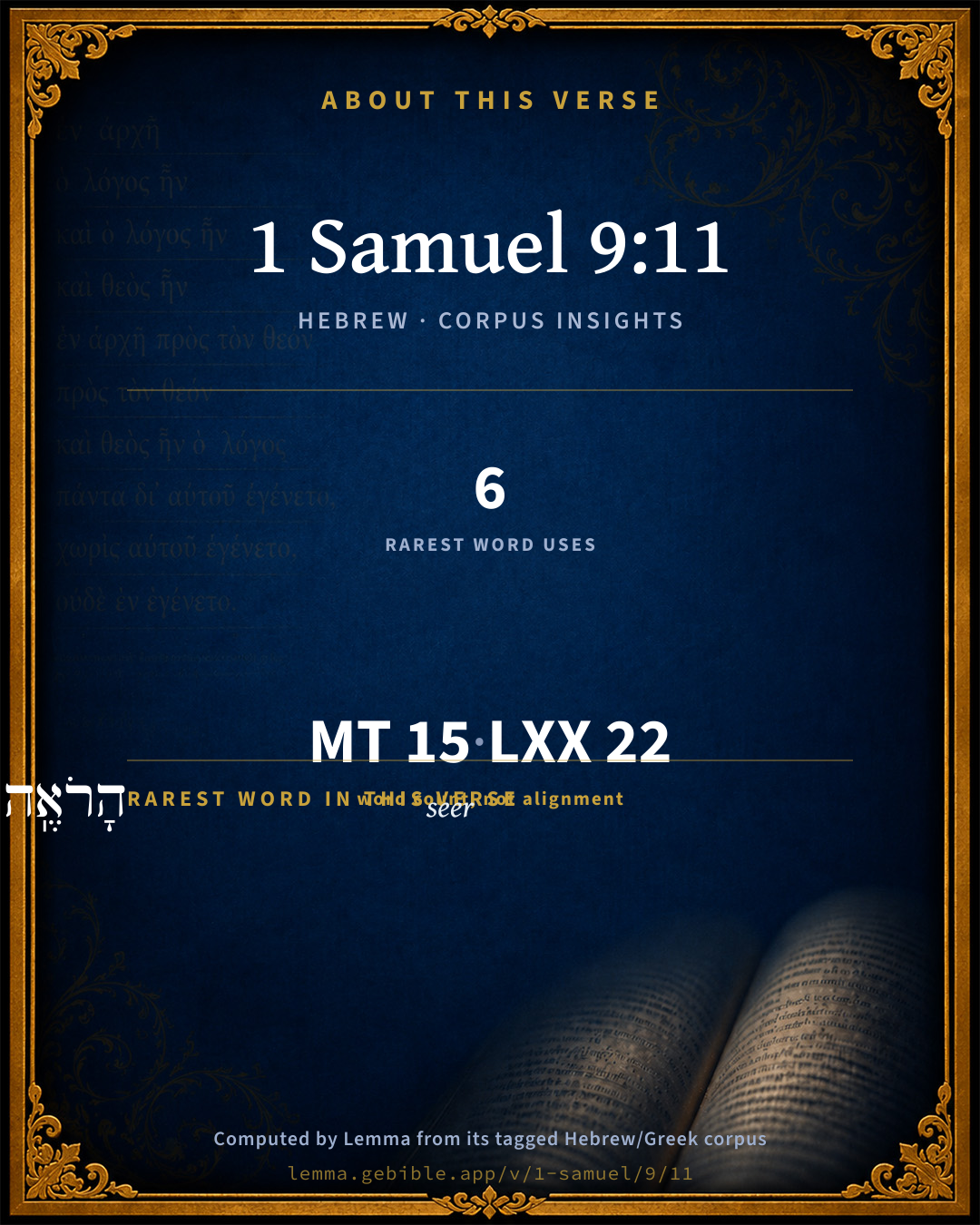
The rarest word here is הָרֹאֶֽה seer H7203 — appearing just 6 times in the whole Hebrew Bible.

Shared distinctive vocabulary

הָרֹאֶֽה seer H7203 occurs in 5 verses of the Hebrew Bible. Also found in:

Grammatical profile

  • 6 verbs
  • 4 nouns
  • 3 pronouns
  • 1 preposition
  • 1 particle

Verb forms

  • עֹלִים֙ Qal · Participle Active
  • מָצְא֣וּ Qal · Perfect
  • יֹצְא֖וֹת Qal · Participle Active
  • לִשְׁאֹ֣ב Qal · Infinitive Construct
  • וַיֹּאמְר֣וּ Qal · Sequential Imperfect
  • הָרֹאֶֽה Qal · Participle Active

Repetition

A word recurs within this verse — often emphatic in Hebrew:

  • הֵ֗מָּה they H1992 ×2

Hebrew & Septuagint length

In English translation the verse runs 26 words from the Hebrew and 28 from the Septuagint (LXX English) — closely comparable.

A rough comparison of the two English renderings, which tokenize alike — not a word-level alignment.

Word counts can differ between the Hebrew and the Greek without any difference in meaning — e.g. the Hebrew direct-object marker אֵת has no separate Greek word, and Greek often adds the article ὁ.

In the original languages it is 15 Hebrew tokens and 22 Greek tokens — but the two are counted differently (Hebrew bundles its prefixes and suffixes into one token; the Greek is in lemma form), so that isn’t a like-for-like length.

Cross-references

4

Topical passages linked to 1 Samuel 9:11 in the Treasury of Scripture Knowledge — connected by theme and wording, ordered by reader-vote popularity; previews shown in the World English Bible.

  • Genesis 24:11 He made the camels kneel down outside the city by the well of water at the time of evening, the time that women go out to draw water.
  • Exodus 2:16 Now the priest of Midian had seven daughters. They came and drew water, and filled the troughs to water their father's flock.
  • Genesis 24:18–20 She said, "Drink, my lord." She hurried, and let down her pitcher on her hand, and gave him drink.
  • Judges 5:11 Far from the noise of archers, in the places of drawing water, There shall they rehearse the righteous acts of Yahweh, [Even] the righteous acts of his rule in Israel. Then the people of Yahweh went down to the gates.

Cross-references courtesy of OpenBible.info (CC BY 4.0).

Hebrew and Greek witnesses Masoretic Hebrew ↔ Greek Septuagint

The same verse in the two great witnesses to the Old Testament, shown verse-for-verse.

These are two independent witnesses, not word-aligned to each other, and the Septuagint is shown in lemma (dictionary) form.

Hebrew 1 Samuel 9:11 Masoretic · Westminster Leningrad Codex

הֵ֗מָּה עֹלִים֙ בְּמַעֲלֵ֣ה הָעִ֔יר וְהֵ֨מָּה֙ מָצְא֣וּ נְעָר֔וֹת יֹצְא֖וֹת לִשְׁאֹ֣ב מָ֑יִם וַיֹּאמְר֣וּ לָהֶ֔ן הֲיֵ֥שׁ בָּזֶ֖ה הָרֹאֶֽה

As they went up the ascent to the city, they found young maidens going out to draw water, and said to them, Is the seer here?

World English Bible · Public Domain

Greek LXX 1 Samuel 9:11 Septuagint · lemma form

αὐτός ἀναβαίνω ὁ ἀνάβασις ὁ πόλις καί αὐτός εὑρίσκω ὁ κοράσιον ἐκἔρχομαι ὑδρεύω ὕδωρ καί λέγω αὐτός εἰ εἰμί ἐνταῦθα ὁ βλέπω

As they went up the ascent to the city, they find virgins who had come out to draw water, and they say to them, Is the seer here?

LXX2012 (modern English Septuagint) · Public Domain

Hebrew: Westminster Leningrad Codex (CC BY 4.0). Greek: Septuagint (public domain); English from LXX2012 (modern English Septuagint) (Public Domain). How the Septuagint differs from the Hebrew →

Targum (Aramaic paraphrase)

1

The Targum is the ancient Jewish Aramaic paraphrase of the Hebrew Scriptures — an interpretive translation, not the Hebrew text itself. Onkelos (literal) and Pseudo-Jonathan (expansive) render the Torah, and Jonathan the Prophets. Coverage is partial: where no permissively-licensed English translation exists for a verse, only the Aramaic is shown. This is verse-level text, not a word-by-word alignment to the Hebrew.

  1. Targum Jonathan Prophets (Joshua–Malachi)
    אִינוּן סַלְקִין בְּמַסְקָנָא דְקַרְתָּא וְאִינוּן אַשְׁכָּחוּ עוּלֵימָן נַפְקִין לְמִמְלֵי מַיָא וַאֲמַרוּ לְהֵן הֲאִית הָכָא חֶזְוַיָא:

    (no public-domain English translation for this verse)

    Targum Jonathan — Aramaic: “Mikraot Gedolot” (public domain). English: “Sefaria Community Translation” (CC0 1.0 (public-domain dedication)); “London "Chaldee Paraphrase," 1871” (public domain). Text via Sefaria.

Commentary

Notes on 1 Samuel 9:11 from classic Christian and Jewish commentators (each source and its license shown beneath its notes). The classic Christian expositions comment on the surrounding passage and are grouped to its opening verse, so a note may address several verses; the Jewish commentaries on the Tanakh (Rashi and others) are per-verse, so they appear only where the commentator wrote on this verse.

Lemma curates 59 commentaries, every one of them public domain or Creative Commons licensed, each selected and text-cleaned for this edition rather than reprinted as found. About our sources →

Matthew Henry's Commentary

Here, I. Saul, by an ordinary enquiry, is directed to Samuel, Sa1 9:11-14. Gibeah of Saul was not twenty miles from Ramah where Samuel dwelt, and was near to Mizpeh where he often judged Israel, and yet, it seems, Saul had lived so very privately, and had taken so little notice of public affairs, that he had never seen Samuel, for when he met him (Sa1 9:18) he did not know him, so that there was no cause to suspect any secret compact or collusion between them in this matter. I knew him not, says John Baptist concerning Christ, Joh 1:31. Yet I do not think it any commendation to Saul that he was a stranger to Samuel. However,

1. The maid-servants of Ramah, whom they met with at the places of drawing water, could give him and his servant intelligence concerning Samuel; and very particular they were in their directions, Sa1 9:12, Sa1 9:13. We should always be ready to give what assistance we can to those that are enquiring after God's prophets, and to further them in their enquiries. Even the maid-servants could tell them, (1.) That there was a sacrifice that day in the high place, it being either an ordinary festival or an extraordinary day of prayer and thanksgiving, with which sacrifices were joined. The tabernacle being deprived of the ark, the altar there had not now the reputation it formerly had, nor were they confined to it, as they would be when God had again chosen a place to put his name in; and therefore now other places were allowed. Samuel had built an altar at Ramah (Sa1 7:17), and here we have him making use of that altar. (2.) That Samuel came that day to the city, either from his circuit or from his country seat. He was such a public person that his movements were generally known. (3.) That this was just the time of their meeting to feast before the Lord upon the sacrifice: "About this time you will find him in the street going up to the high place." They knew the hour of the solemn feast. (4.) That the people would not eat till Samuel came, not only because he was the worthiest person, and they ought in good manners to stay for him, and he was, as some think, the maker of this feast, the sacrifice being offered at his charge and upon his account; but because, as a man of God, whoever made the feast, he must bless the sacrifice, that is, those parts of the sacrifice which they feasted upon, which may be considered, [1.] As a common meal, and so this is an instance of the great duty of craving a blessing upon our meat before we partake of it. We cannot expect benefit from our food without that blessing, and we have no reason to expect that blessing if we do not pray for it. Thus we must give glory to God as our benefactor, and own our dependence upon him and our obligations to him. Or, [2.] As a religious assembly. When the sacrifice was offered, which was the ceremony, Samuel blessed it, that is, he prayed over it, and offered up spiritual sacrifices with it, which were the substance; and afterwards, when the holy duties were performed, they did eat. Let the soul first be served. The feast upon the sacrifice being a sacred rite, it was requisite that it should in a particular manner be blessed, as is the Christian eucharist. They feasted in token of their reconciliation to God by virtue of the sacrifice, and their participation of the benefits of it; and Samuel blessed the feast, that is, he prayed to God to grace the solemnity with his special presence, that it might answer those great ends. Bishop Hall observes what a particular account those maid-servants could give of the usages of those sacred feasts, and infers from it that, "where there is the practice and example of piety in the better sort, there will be a reflection of it upon the meanest. It is no small advantage to live in religious places; for we shall be much to blame if all goodness fall beside us."

2. Saul and his servant followed the directions given them, and very opportunely met Samuel going to the high place, the synagogue of the city, Sa1 9:14. This seemed purely accidental, but the divine providence ordered it for the forwarding of this great event. The wise God serves very great and certain purposes by very small and casual occurrences. A sparrow falls not to the ground without our Father.

II. Samuel, by an extraordinary revelation, is informed concerning Saul. He was a seer, and therefore must see this in a way peculiar to himself.

1. God had told him, the day before, that he would, at this time, send him the man that should serve the people of Israel for such a king as they wished to have, like all the nations, Sa1 9:15, Sa1 9:16. He told him in his ear, that is, privately, by a secret whisper to his mind, or perhaps by a still small voice, some soft and gentle sounds conveyed to his ear, probably when he was praying in secret for direction in that and other affairs of the nation. He had spoken in the ears of the Lord (Sa1 8:21), and now God spoke in his ear, in token of friendship and familiarity, for he revealeth his secret to his servants the prophets, as secrets in their ear, Amo 3:7. God told him before, that it might not be a surprise to him; and perhaps it was in expectation of it that he appointed the feast and the sacrifice, for the imploring of God's blessing upon this great and important affair, though he might keep the particular occasion in his own breast, God having only told it to him in his ear. The Hebrew phrase is, He uncovered the ear of Samuel, to which some allude for the explication of the way of God's revealing himself to us; he not only speaks, but uncovers our ear. We have naturally a covering on our ears, so that we perceive not what God says (Job 33:14), but, when God will manifest himself to a soul, he uncovers the ear, says, Ephphratha, Be opened; he takes the veil from off the heart, Co2 3:16. Though God had, in displeasure, granted their request for a king, yet here he speaks tenderly of Israel; for even in wrath he remembers mercy. (1.) He calls them again and again his people; though a peevish and provoking people, yet mine still. (2.) He sends them a man to be captain over them, that they might not be a body without a head, and to save them out of the hand of the Philistines, which perhaps was more than many of them aimed at in desiring a king. (3.) He does it with a gracious respect to them and to their cry: I have looked upon my people, and their cry has come unto me. He gratified them with what they cried for, as the tender mother humours the froward child, lest it should break its heart. And (as bishop Patrick observes), though he would not hear their cry to relieve them against the oppression of their kings (Sa1 8:18), yet he was so gracious as to make those kings instruments of their deliverance from the oppression of their neighbours, which was more than they had reason to expect.

2. When Saul came up towards him in the street God again whispered Samuel in the ear (Sa1 9:17): Behold the man whom I spoke to thee of! Saul being a man of unusual stature, it is natural to think that Samuel fixed his eye upon him at a distance, and perhaps looked the more wistfully towards him because the hour had now come when God would send him the man that should be king of Israel, and he fancied this might be he; but, that he might be fully satisfied, God told him expressly, That is the man that shall restrain (for magistrates are heirs of restraint) my people Israel.

Matthew Henry's Commentary on the Whole Bible (1708–1710) — public domain (CC PDM 1.0). Text via the HelloAO Bible API.

Trapp's Complete Commentary

John Trapp

1Sa 9:11 [And] as they went up the hill to the city, they found young maidens going out to draw water, and said unto them, Is the seer here?

Ver. 11. Is the seer here?] Seers then the prophets were called, not only beforetime, but now also: though that name began to be antiquated.

“ Multa renascentur quae iam cecidere, cadentque

Quae nunc sunt in honore vocabula, si volet usus,

Quem penes arbitrium est, et vis et norma loquendi. ”

- Horat., De Arte Poet.

not only beforetime, but now also: though that name began to be not only beforetime, but now also: though that name began to be

John Trapp, A Commentary or Exposition upon All the Books of the Old and New Testament (1647–1656) — public domain. Text from a community e-Sword module.

Jamieson, Fausset & Brown

Robert Jamieson, A. R. Fausset & David Brown

as they went up the hill--The modern village, Er-Rameh, lies on an eminence; and on their way they met a band of young maidens going out to the well, which, like all similar places in Palestine, was beyond the precincts of the town. From these damsels they learned that the day was devoted to a festival occasion, in honor of which Samuel had arrived in the city; that a sacrifice had been offered, which was done by prophets in extraordinary circumstances at a distance from the tabernacle, and that a feast was to follow--implying that it had been a peace offering; and that, according to the venerable practice of the Israelites, the man of God was expected to ask a special blessing on the food in a manner becoming the high occasion.

Jamieson, Fausset & Brown — Commentary Critical and Explanatory on the Whole Bible (1871) — public domain (CC PDM 1.0). Text via the HelloAO Bible API.

Adam Clarke's Commentary

Verse 11. Young maidens going out to draw water] So far is it from being true, that young women were always kept closely shut up at home, that we find them often in the field, drawing and carrying water, as here.

Adam Clarke's Commentary on the Bible (1810–1826) — public domain. Text from a community e-Sword/MySword module.

The Cambridge Bible for Schools and Colleges

gen. ed. J. J. S. Perowne

11–14. Inquiry for the seer

11. as they went up] As they were ascending by the ascent to the city. The Hebrew has a peculiar construction, the repetition of which is characteristic of this chapter. Cp. 1Sa_9:5; 1Sa_9:14; 1Sa_9:17; 1Sa_9:27.

young maidens going out to draw water] Cp. Gen_24:15; Gen_29:9 ff.; Exo_2:16; Joh_4:7. The well was in the lower ground outside the city wall.

The Cambridge Bible for Schools and Colleges (gen. ed. J. J. S. Perowne; Cambridge University Press, 1878–1918) — public domain. Text from a community e-Sword module.

John Gill's Exposition

And as they went up the hill to the city,.... For the city was built upon an hill, from whence it had the name of Ramah, which signifies high and lifted up:

they found young maidens going out to draw water: going out of the city, to a fountain which was at the bottom of the hill; and this was the usual business of maidens in those countries to fetch water for the service of the family; see Gill on Gen 24:11; see Gill on Gen 24:15; see Gill on Gen 24:16. R. Akiba (e) makes this observation, that whenever a man meets maidens coming out of a city before he goes into it, it is a token of prosperity to him; and instances in the cases of Abraham's servant, of Jacob, and of Moses, and here of Saul, who was informed of a kingdom, and anointed for it, see Gen 24:14 Exo 2:16,

and said unto them, is the seer here? meaning, is he in the city? or is he at home? or is he in the country?

(e) In Pirke Eliezer, c. 36. fol. 39. 1. 2.

John Gill's Exposition of the Whole Bible (1746–1763) — public domain (CC PDM 1.0). Text via the HelloAO Bible API.

Haydock's Catholic Bible Commentary

Water, perhaps for the sacrifice. Thus Fab. Victor says, "Rhea, according to the established custom, by which young women went to draw water for the sacrifices, proceeded to the fountain in the grove of Mars." (Calmet)

George Leo Haydock (1774–1849), Haydock's Catholic Family Bible and Commentary, 1859 edition — public domain. Excludes Psalms (Douay-Rheims chapter numbering differs from Protestant) and Deuterocanonical books (Catholic canon only).

Matthew Poole's English Annotations

Going out, i.e. out of the city, and down to the bottom of the hill, where the fountain or river was.

Matthew Poole's English Annotations on the Holy Bible (1683–1685) — public domain. Text from a community e-Sword/MySword module.

Whedon's Commentary on the Bible

Daniel D. Whedon

11. Young maidens going out to draw water — Like Rebekah (Gen_24:15) and the daughters of Jethro. Exo_2:16.

Daniel D. Whedon (gen. ed.), Commentary on the Old and New Testaments (1874–1909) — public domain. Text from a community e-Sword module.

The Pulpit Commentary

Vers. 11, 12. As they went up. Ramah was situated on a double hill, whence its name Ramathaim. (1Sa_1:1) As, then, they go up the ascent so the Hebrew, literally they meet maidens on the way to the well, and ask them, Is the seer the roehhere? They answer, Yes; behold, he is before you. Ie. they are to go straightforward, and farther on in the town they will find him. He came today to the city. As Saul"s servant knew that this city was Samuel"s abode, the words must mean that he had just returned from visiting one of those places, probably, to which he was in the habit of going as judge. From 1Sa_16:2 we learn that Samuel went occasionally even to distant places to perform priestly duties. In the high place. Hebrew, Bamah. Samuel, we read, had built an altar at Ramah, (1Sa_7:17) and probably the present sacrifice was to be offered upon it. Such altars, and the worship of the true God upon high places, were at this time recognised as right, and were, in fact, in accordance with, and were even the remains of, the old patriarchal religion.

But gradually they were condemned, partly because of the glowing sanctity of the temple, but chiefly because of the tendency of religious rites celebrated in such places to degenerate into nature-worship, and orgies such as the heathen were in the habit of holding on the tops of mountains and hills. We thus find in the Bible an illustration of the principle that rites and ceremonies (as not being of the essentials of religion) may be changed, or even abolished, if they are abused, or lead on to evil consequences.

Vers. 11-17.

Man"s accidents God"s ordinations.

The facts are

1. On entering the city Saul inquires for the seer, and is informed that he ispresent for a special religious service.

2. Following the directions given, he meets Samuel ascending to the highplace.

3. Samuel is already instructed by God to expect during the day the manwhom he is to anoint as king.

4. On seeing Saul, an intimation is given from God that he is the chosenman. In some respects this narrative of events resembles what is occurring every day in every land, for we have here a set of independent actions converging on a common result. No single meeting of men occurs in society without a variety of acts and movements having directly or indirectly preceded it as links in the chain of causation. But the speciality in this instance is the information that the meeting of Saul and Samuel was preordained of God. Hence the incident is an illustration of the double side of what to men may appear to be only ordinary human occurrences. An uninformed person would have said that it was accidental that the asses went astray, and that maidens directed Saul to their city, where Samuel happened to be. To Saul it so appeared; but, guided by the inspired narrative, we know that the "accident" was "foreordained" without destroying its really accidental character. We may notice what light the record before us throws on the general question of special providences.

I We SEE HERE THE FREE ACTION OF MANY INDEPENDENT WILLS. In so far as asses exercise will, those were free in straying from home on that day. The action of Kish in selecting Saul rather than any one else to seek them was quite his own. The readiness of Saul to obey his father and not find a substitute in the toil was unconstrained. The mental and emotional antecedents of the citizens prompting their will to arrange for Samuel to visit their city were natural, and operated on wills perfectly independent. The suggestion of the servant that Saul should not return, but go to this very city, arose spontaneously; and Saul"s concern for his father was relieved by considerations which he freely yielded to. The action of Samuel, amidst his many public engagements, was free in deciding to offer sacrifice, and, so far as we can see, not exclusively connected with an expectation of meeting the coming king in that particular place. In addition to all these free and independent acts, there were events which tended to turn the free acts in the one direction. Lack of pasture in certain places may have influenced the asses to take the course they did. The distance to be traversed was just such as to bring Saul to the vicinity of Samuel where persons were at hand to answer his questions. The difficulty of approaching the prophet with a proper token of respect was overcome by the casual possession of a small coin. This analysis of fact accords with what may be affirmed of thousands of incidents every day. Independent lines of force converge on one point and issue in an historical resultant. In no case recorded in Scripture does any supreme power take away freedom of action.

II The FREE ACTION OF MANY IS ATTENDED BY THE UNRECOGNISED ACTION OF GOD. In the instance before us this is obvious, for it was ordained that Samuel should meet with Saul on that very day, though they were so far apart (vers. 15, 16). Whether it was "chance" that took Saul to that city or some influence exerted on him is easily answered by the fact that it was God"s purpose for Samuel to see and anoint him. God"s foreordination does not wait on "chance." The same reasoning would show that even the course taken by the asses, though free, was not without God"s action. The inspiration of Samuel"s conduct is a primary fact of the prophetic office. It is possible to start difficulties in relation to this subject; but they are difficulties of ignorance, not of knowledge, and therefore lose much of their force. We do not even know what the free act of will is, though we know the fact. We know that our actions are free, and yet that we are influenced by others. The point of junction between the external influence and the free act of our will has never been detected; therefore, any difficulties which men raise against these narratives in the Bible lie equally against all interaction of free natures. The Scripture doctrine is that God does act on mar, without destroying his freedom. God is not a latent energy. He assures us that he is a real Power, working in some "mightily to will and to do," and striving with others. The highest government is only possible on this supposition. The possibility of what are called special providences resolves itself into the free action of a supreme Spirit or, created spirits, so as to secure their free and independent action, and at the same time cause that action to converge on given points. We even can do that in some degree with children and feebler natures. Why do men wish to banish the eternal energy from all participation in human affairs? Do not these events with their issue stand out as a microcosm of the great converging lines which in the far distant future are to issue in one glorious resultant the realisation of a holy will through the free and independent action of created wills?

III The RECOGNITION OF GOD"S ACTION COMES OUT IN THE RESULT. The Divine action is silent, unobserved, often unknown while in process. Samuel saw it as a reality when Saul stood before him. The story of the asses and of the search then had another meaning. Men see not one half of the realities of life. The true, real world is the unseen. The great transactions are wrought in the inner man. We are often led by a hand we do not see, and drawn on by a sweet influence we cannot define. Only the more spiritual, saintly souls discern God. But as Samuel saw what God had been doing, so we at last come to see what God hath wrought. That will be a wondrous recognition of the all-working Spirit when a vast redeemed race shall, in review of life"s chequered course, sing the new song, and exclaim with deep significance, "Not unto us, O Lord, not unto us, but unto thy name give glory.

IV The DIVINE REASON FOR THE EXERCISE OF THIS SILENT POWER. The compassion of God for his wayward people (ver. 16) was the spring of the particular direction he gave on this day to the course of Saul and Samuel. Every small series of events affecting individuals and families is, so far as relates to the action of God in them, governed by some Divine reason. Though trouble be brought on, the reason is still one of mercy. The retributions of Providence are in mercy to the universe he governs. And it may certainly be said of the sum total of events, that when the great result shall be attained, it will be known then, if not before, that all was the expression of a compassion which sought to save the erring world from its own miseries.

General lessons:

1. The perfect government of God is secured by his mastery of every detail in the action and willing of his creatures.

2. There is consolation for his people in the fact that he directeth the spirit of man, and can subdue all things to himself.

3. It is blessed to go forth daily with the assurance that God works with us,in us, and for us, and will therefore perfect that which concerneth us.

The Pulpit Commentary (1880–1919), ed. H.D.M. Spence-Jones & Joseph S. Exell — public domain. Text from a community e-Sword module.

Keil & Delitzsch

C. F. Keil & F. Delitzsch

As they were going up to the high place of the town, they met maidens coming out of the town to draw water; and on asking them whether the seer was there, they received this answer: "Yes; behold, he is before thee: make haste, now, for he has come into the town to-day; for the people have a sacrifice to-day upon the high place." Bamah (in the singular) does not mean the height or hill generally; but throughout it signifies the high place, as a place of sacrifice or prayer.

Keil & Delitzsch — Biblical Commentary on the Old Testament (1861–1891) — public domain (CC PDM 1.0). Text via the HelloAO Bible API. (Old Testament only.)

Kretzmann's Popular Commentary

Paul E. Kretzmann

Saul the Guest of Samuel

v. 11. And as they went up the hill to the city, they found young maidens going out to draw water, they met them outside the city gates, as they were on their way to perform the duty still incumbent upon the women of the Orient, and said unto them, Is the seer here? that is, Is he at home now?

v. 12. And they answered them and said, He is; behold, he is before you. Make haste now, for he came today to the city, having returned from one of his periodical trips, 1Sa 7:16; for there is a sacrifice, a peace-offering with a sacrificial meal, of the people today in the high place, the elevation near the city on which the offerings were made;

v. 13. as soon as ye be come into the city, going directly ahead on the main street, ye shall straightway find him before he go up to the high place to eat, to take part in the sacrificial meal; for the people will not eat, namely, those invited, until he come, because he doth bless the sacrifice, by speaking the prayer of thanksgiving; and afterwards they eat that be bidden. Now, therefore, get you up; for about this time, on this very day, ye shall find him.

v. 14. And they went up into the city, passing in through the gate; and when they were come into the city, behold, Samuel came out against them, he met them on the main street, for to go up to the high place. Saul was apparently too diffident or bashful to address Samuel at once, but turned around and followed him.

v. 15. Now the Lord had told Samuel in his ear, literally, "uncovered his ear," revealed to him, a day before Saul came, saying,

v. 16. Tomorrow about this time I will send thee a man out of the land of Benjamin, and thou shalt anoint him to be captain over My people Israel, that he may save My people out of the hand of the Philistines, for the latter were harassing the Israelites more or less, trying to regain full dominion over them; for I have looked upon My people, because their cry is come unto Me. He had looked upon them in mercy, and with the definite intention of bringing them deliverance.

v. 17. And when Samuel saw Saul, as he met him on the main street of the city, the Lord said unto him, Samuel, Behold the man whom I spake to thee of! This same shall reign over My people, hold them in restraint by a sharp and strict government.

v. 18. Then Saul, having followed Samuel down the street, drew near to Samuel in the gate and said, Tell me, I pray thee, where the seer’s house Isaiah

v. 19. And Samuel answered Saul and said, I am the seer; go up before me unto the high place, this invitation being a mark of respect; for ye shall eat with me today, the kindness of Samuel causing him to include the servant also, and tomorrow I will let thee go and will tell thee all that is in thine heart, revealing to him his innermost thoughts and thus giving evidence of his prophetical ability.

v. 20. And as for thine asses that were lost three days ago, the search thus having taken since the second day before, set not thy mind on them, he should not be worried about them; for they are found. And on whom is all the desire of Israel? Is it not on thee and on all thy father’s house? The most desirable honor, the noblest possession in all Israel, was to be his, unsought and undesired: the royal dignity.

v. 21. And Saul, although ignorant of the full import of Samuel’s words, answered and said, Am not I a Benjamite, of the smallest of the tribes of Israel, and my family the least of all the families of the tribe of Benjamin? Wherefore, then, speakest thou so to me? The warlike tribe of Benjamin had, by the fearful execution carried out upon them, Jdg 20:20, been reduced to an inconsiderable power, and Saul was conscious of this fact. Besides, his modesty at that time would not permit him to consider himself worthy of any special honor in Israel.

v. 22. And Samuel, without pursuing the subject further, since he wanted to awaken expectation and hope in the mind of Saul, took Saul and his servant and brought them into the parlor, the room where the sacrificial meal was held, and made them sit in the chiefest place among them that were bidden, which were about thirty persons, probably the most influential men of the city. Here was another distinction for Saul.

v. 23. And Samuel said unto the cook, Bring the portion which I gave thee, when the sacrifice had been offered, earlier in the day, of which I said unto thee, Set it by thee, reserve it, subject to further orders.

v. 24. And the cook took up the shoulder, evidently the heave-shoulder, for Samuel exercised the functions of a priest in Israel, and that which was upon it, the fat of the flesh, and set it before Saul, another distinct honor. And Samuel said, Behold that which is left, reserved! Set it before thee and eat; for unto this time hath it been kept for thee since I said, I have invited the people, another proof of the prophetic foresight of Samuel. So Saul did eat with Samuel that day.

v. 25. And when they were come down from the high place into the city, at the close of the sacrificial meal, Samuel communed with Saul upon the top of the house, on the flat roof, where they were undisturbed, Deu 22:8, the purpose being gradually to prepare Saul for the announcement of the next day.

v. 26. And they arose early; and it came to pass about the spring of the day, at the rising of the dawn, that Samuel called Saul to the top of the house, rather, Samuel called to Saul, who had evidently slept on the roof, by no means unusual in that country, saying, Up, that I may send thee away. And Saul arose, made ready for his journey, and they went out, both of them, he and Samuel, abroad, out into the open.

v. 27. And as they were going down to the end of the city, Samuel, who accompanied his guest as another mark of respect, said to Saul, Bid the servant pass on before us, for he was not to be a witness of the next act of Samuel, (and he passed on,) but stand thou still a while that I may show thee the word of God. All those who are intended for the service of God’s people must be instructed in God’s Word and truth in order to do their work properly.

Paul E. Kretzmann, Popular Commentary of the Bible (1921–1924) — public domain. Text from a community e-Sword module.

Lesson kit

Teaching starters — assembled from the data on this page, not authored interpretation. Every prompt links to the verse data it draws on. Edit before teaching.

1 Samuel, in the Historical, opens this verse with 15 words (13 distinct Hebrew lemmas). Its most distinctive word is rôʼeh (“seer”). A historical commentator’s framing appears above. Read the whole chapter for the surrounding context.

Discussion questions

  1. The word rôʼeh carries the sense “seer.” How does it shape the verse?
  2. How does 1 Samuel 9:9, which shares the word «seer», read alongside this verse?
  3. What does the repetition of “they” (2× in this one verse) do in this verse?
  4. These translations render this verse differently. What is at stake in choosing one wording over another?
  5. «עֹלִים֙» is a Qal Participle Active verb. How does that grammatical form shape the action described?
  6. Compare how Matthew Henry's Commentary and Trapp's Complete Commentary read this verse. Where do they agree or differ?

Things to notice

Reading settings

Reading text

Shown beneath each verse's original-language words.

Old Testament
Old Testament edition

Read the OT as the Masoretic Hebrew (MT) or the Greek Septuagint (LXX).

English shown for the Greek Septuagint (in the Hebrew ↔ Greek comparison).

Comparing translations? Open the Compare panel on any verse page to stack up to four side by side.