
Deuteronomy 29:18

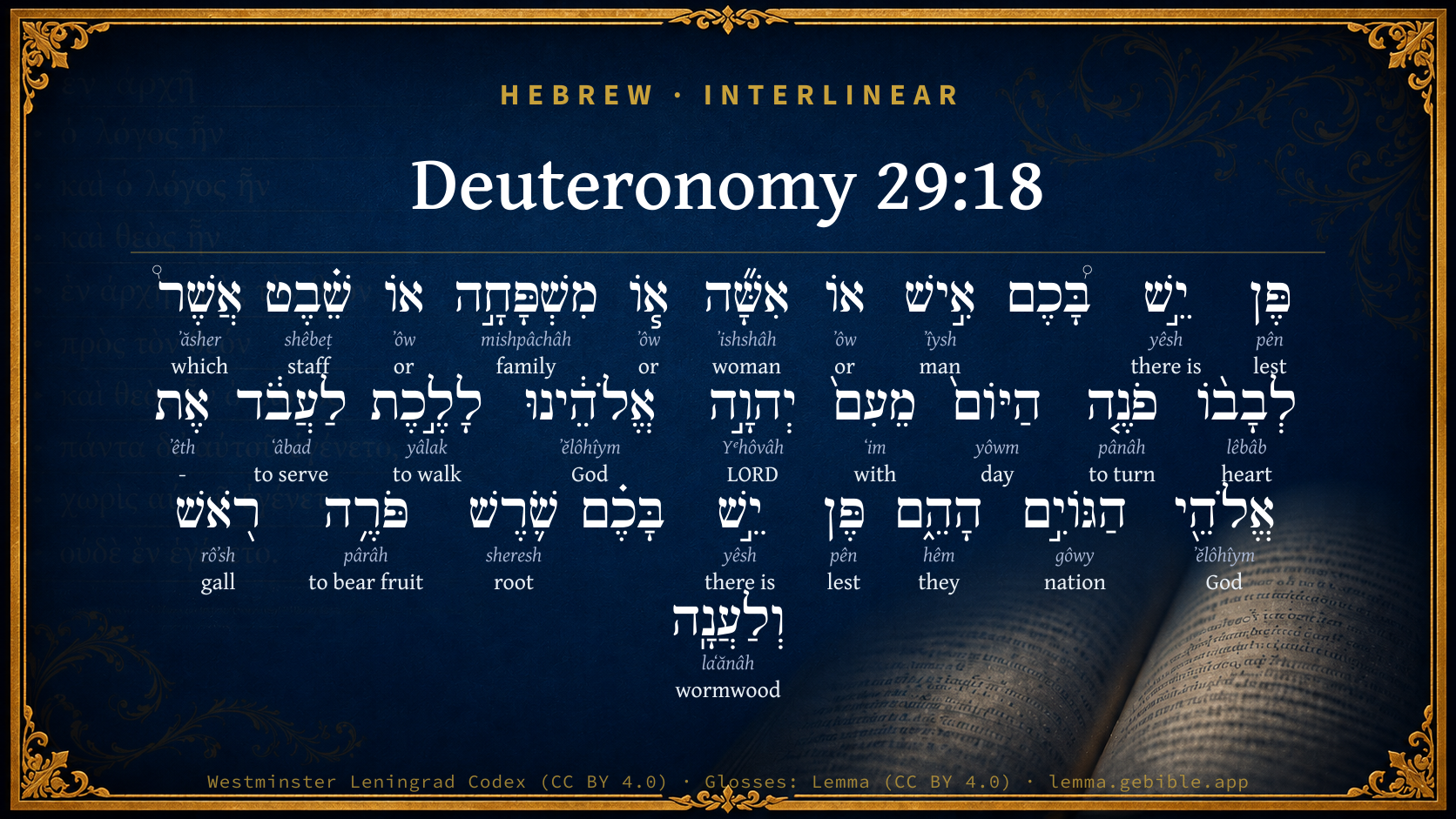
Hebrew (Westminster Leningrad Codex) Deuteronomy 29:18 appears in the Hebrew Old Testament. The text above is from the Westminster Leningrad Codex. Each word links to its Strong’s number, a concise gloss, and parsing drawn from the Open Scriptures Hebrew Bible morphology. Click any word for its full Brown-Driver-Briggs (BDB) entry.
Download image
Cite this verse

Deuteronomy 29:18 (World English Bible). Public Domain. Lemma interlinear Bible study tool, https://lemma.gebible.app/v/deuteronomy/29/18.

Show BibTeX & RIS
BibTeX
RIS
English Translation
lest there should be among you man, or woman, or family, or tribe, whose heart turns away this day from Yahweh our God, to go to serve the gods of those nations; lest there should be among you a root that bears gall and wormwood;
World English Bible · Public Domain
Highlights
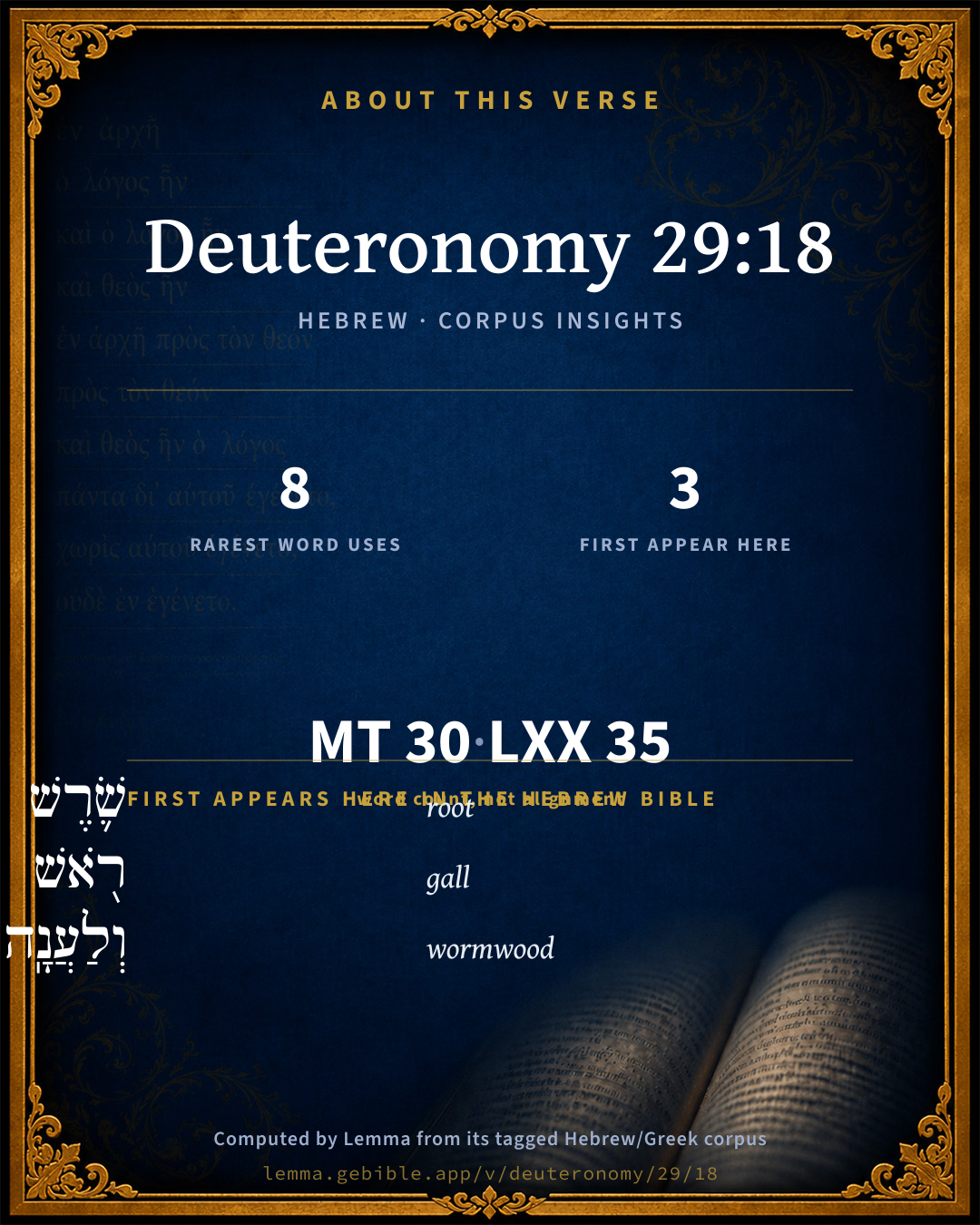
  • 3 first appearances in the Hebrew Bible
Full analysis ↓
Download a study sheet

One document with this verse’s original text, its word-by-word gloss line, the meaning frame, cross-references with their text, attributed commentary, and full source and license credits — printable, and it pastes into notes with its structure intact.

This verse Autodidact and up

Study sheet (.html) Plain text (.txt)

A passage Seminary Student

Up to 50 verses in one chapter. A passage sheet keeps up to 6 commentary sources and 12 cross-references per verse, in the order this page ranks them, and says so on the sheet whenever that leaves anything out. Ask for a single verse and you get the Autodidact verse sheet above.

Everything on this page stays free to read, with no account — the sheet is a download of what is already on screen, not access to it.

Want to remove ads? Support Godless Engineer
Compare translations 3

The same verse in 3 English versions, stacked beneath the original-language interlinear above. Click any original word for its lexicon entry.

Each is an independent rendering of the whole verse — the interlinear is not word-aligned to these translations.

Highlighted words mark where these versions differ — a whole-verse word diff, not a word-by-word alignment.

  • World English Bible Public Domain
    lest there should be among you man, or woman, or family, or tribe, whose heart turns away this day from Yahweh our God, to go to serve the gods of those nations; lest there should be among you a root that bears gall and wormwood;
  • King James Version Public Domain
    Lest there should be among you man, or woman, or family, or tribe, whose heart turneth away this day from the LORD our God, to go and serve the gods of these nations; lest there should be among you a root that beareth gall and wormwood;
  • unfoldingWord Literal Text CC BY-SA 4.0
    lest there is among you a man or woman or clan or tribe whose heart is turning away today from Yahweh our God to go serve the gods of those nations, lest there is among you a root bearing gall and wormwood.

unfoldingWord Literal Text — © unfoldingWord, licensed CC BY-SA 4.0. Word-aligned USFM3 via Door43 (git.door43.org/unfoldingWord/en_ult).

Versions to compare (up to 4)

3 of 4 selected

Show all 18 translations

Every available English version of this verse, each an independent rendering of the whole verse.

  • World English Bible Public Domain
    lest there should be among you man, or woman, or family, or tribe, whose heart turns away this day from Yahweh our God, to go to serve the gods of those nations; lest there should be among you a root that bears gall and wormwood;
  • Berean Standard Bible Public Domain
    Make sure there is no man or woman, clan or tribe among you today whose heart turns away from the LORD our God to go and worship the gods of those nations. Make sure there is no root among you that bears such poisonous and bitter fruit,
  • Majority Standard Bible Public Domain
    Make sure there is no man or woman, clan or tribe among you today whose heart turns away from the LORD our God to go and worship the gods of those nations. Make sure there is no root among you that bears such poisonous and bitter fruit,
  • King James Version Public Domain
    Lest there should be among you man, or woman, or family, or tribe, whose heart turneth away this day from the LORD our God, to go and serve the gods of these nations; lest there should be among you a root that beareth gall and wormwood;
  • American Standard Version (1901) Public Domain
    lest there should be among you man, or woman, or family, or tribe, whose heart turneth away this day from Jehovah our God, to go to serve the gods of those nations; lest there should be among you a root that beareth gall and wormwood;
  • Revised Version (1885) Public Domain
    lest there should be among you man, or woman, or family, or tribe, whose heart turneth away this day from the LORD our God, to go to serve the gods of those nations; lest there should be among you a root that beareth gall and wormwood;
  • Geneva Bible (1599) Public Domain
    That there should not be among you man nor woman, nor familie, nor tribe, which should turne his heart away this day from the Lord our God, to goe and serue the gods of these nations, and that there shoulde not be among you any roote that bringeth forth gall and wormewood,
  • Douay-Rheims (1899) Public Domain
    Lest perhaps there should be among you a man or a woman, a family or a tribe, whose heart is turned away this day from the Lord our God, to go and serve the gods of those nations: and there should be among you a root bringing forth gall and bitterness.
  • Young's Literal Translation Public Domain
    lest there be among you a man or woman, or family or tribe, whose heart is turning to-day from Jehovah our God, to go to serve the gods of those nations, lest there be in you a root fruitful of gall and wormwood:
  • Literal Standard Version CC BY-SA 4.0
    lest there be among you a man or woman, or family or tribe, whose heart is turning from our God YHWH today, to go to serve the gods of those nations, lest there be in you a root bearing the fruit of gall and wormwood;
  • Unlocked Literal Bible CC BY-SA 4.0
    Make sure there is not among you any man, woman, clan, or tribe whose heart is turning away today from Yahweh our God, so as to go worship the gods of those nations. Make sure there is not among you any root that produces gall and wormwood.
  • unfoldingWord Literal Text CC BY-SA 4.0
    lest there is among you a man or woman or clan or tribe whose heart is turning away today from Yahweh our God to go serve the gods of those nations, lest there is among you a root bearing gall and wormwood.
  • Darby Bible Public Domain
    lest there should be among you man, or woman, or family, or tribe, whose heart turneth away this day from Jehovah our God, to go and serve the gods of these nations; lest there should be among you a root that beareth gall and wormwood,
  • World Messianic Bible Public Domain
    lest there should be among you man, woman, family, or tribe whose heart turns away today from the LORD our God, to go to serve the gods of those nations; lest there should be among you a root that produces bitter poison;
  • Webster's Bible Public Domain
    Lest there should be among you man, or woman, or family, or tribe, whose heart turneth away this day from the LORD our God, to go and serve the gods of these nations; lest there should be among you a root that beareth gall and wormwood;
  • Free Bible Version CC BY-SA 4.0
    You need to make sure today that there's no man or woman, family or tribe of yours who wants to turn from the Lord our God and go and worship the gods of these nations. Make sure there is nothing like that among you that would produce such poison and bitterness.
  • Bible in Basic English Public Domain
    So that there may not be among you any man or woman or family or tribe whose heart is turned away from the Lord our God today, to go after other gods and give them worship; or any root among you whose fruit is poison and bitter sorrow;
  • JPS Tanakh (1917) Public Domain
    (29-17) lest there should be among you man, or woman, or family, or tribe, whose heart turneth away this day from the LORD our God, to go to serve the gods of those nations; lest there should be among you a root that beareth gall and wormwood;

Literal Standard Version (2020), Covenant Press — licensed CC BY-SA 4.0. Text via the HelloAO Bible API (eBible.org). Unlocked Literal Bible (unfoldingWord) — licensed CC BY-SA 4.0. Text via the HelloAO Bible API (eBible.org). unfoldingWord Literal Text — © unfoldingWord, licensed CC BY-SA 4.0. Word-aligned USFM3 via Door43 (git.door43.org/unfoldingWord/en_ult). Free Bible Version, Dr. Jonathan Gallagher — licensed CC BY-SA 4.0. Text via the HelloAO Bible API (eBible.org).

Word by word

More ways to search: Search by grammar → Find every occurrence → Compare this word →

Practice this passage: Drill this verse → Learn its vocabulary →

וְלַעֲנָֽה
laʻănâh
H3939
“and · wormwood”
Conjunction + Noun, Common, Feminine, Singular, Absolute
Part of Speech
Conjunction + Noun
Type
Common
Gender
Feminine
Number
Singular
State
Absolute
Full BDB Definition

Origin: from an unused root supposed to mean to curse

TWOT: 1121

wormwood - bitterness (metaphorically)
  1. פֶּן pên H6435 “lest” Conjunction
  2. יֵ֣שׁ yêsh H3426 “there is” Particle, Demonstrative
  3. אִ֣ישׁ ʼîysh H376 “man” Noun, Common, Masculine, Singular, Absolute
  4. אוֹ ʼôw H176 “or” Conjunction
  5. אִשָּׁ֞ה ʼishshâh H802 “woman” Noun, Common, Feminine, Singular, Absolute
  6. א֧וֹ ʼôw H176 “or” Conjunction
  7. מִשְׁפָּחָ֣ה mishpâchâh H4940 “family” Noun, Common, Feminine, Singular, Absolute
  8. אוֹ ʼôw H176 “or” Conjunction
  9. שֵׁ֗בֶט shêbeṭ H7626 “staff” Noun, Common, Masculine, Singular, Absolute
  10. אֲשֶׁר֩ ʼăsher H834 “which” Particle, Relative
  11. לְבָב֨וֹ lêbâb H3824 “heart · his” Noun, Common, Masculine, Singular, Construct + Suffix, Personal, 3rd Person, Masculine, Singular
  12. פֹנֶ֤ה pânâh H6437 “turning” Verb, Qal, Participle Active, Masculine, Singular, Absolute
  13. הַיּוֹם֙ yôwm H3117 “the · day” Particle, Definite Article + Noun, Common, Masculine, Singular, Absolute
  14. מֵעִם֙ ʻim H5973 “from · with” Preposition + Preposition
  15. יְהוָ֣ה Yᵉhôvâh H3068 “LORD” Noun, Proper
  16. אֱלֹהֵ֔ינוּ ʼĕlôhîym H430 “God(s) · our” Noun, Common, Masculine, Plural, Construct + Suffix, Personal, 1st Person, Common, Plural
  17. לָלֶ֣כֶת yâlak H3212 “to walk” Preposition + Verb, Qal, Infinitive Construct
  18. לַעֲבֹ֔ד ʻâbad H5647 “to serve” Preposition + Verb, Qal, Infinitive Construct
  19. אֶת ʼêth H853 “-” Particle, Direct Object
  20. אֱלֹהֵ֖י ʼĕlôhîym H430 “God(s) of” Noun, Common, Masculine, Plural, Construct
  21. הַגּוֹיִ֣ם gôwy H1471 “the · nations” Particle, Definite Article + Noun, Common, Masculine, Plural, Absolute
  22. הָהֵ֑ם hêm H1992 “the · they” Particle, Definite Article + Pronoun, Personal, 3rd Person, Masculine, Plural
  23. פֶּן pên H6435 “lest” Conjunction
  24. יֵ֣שׁ yêsh H3426 “there is” Particle, Demonstrative
  25. שֹׁ֛רֶשׁ sheresh H8328 “root” Noun, Common, Masculine, Singular, Absolute
  26. פֹּרֶ֥ה pârâh H6509 “bearing fruit” Verb, Qal, Participle Active, Masculine, Singular, Absolute
  27. רֹ֖אשׁ rôʼsh H7219 “gall” Noun, Common, Masculine, Singular, Absolute

About this verse

These counts appear in no published source. They are computed here, from the morphology-tagged text and Lemma’s own curated glosses. What Lemma adds →

30
words
23
distinct lemmas
Pentateuch
section

Notable vocabulary

The rarest word here is וְלַעֲנָֽה wormwood H3939 — appearing just 8 times in the whole Hebrew Bible.

First appearance in Scripture

These words make their first canonical appearance in the Hebrew Bible here:

  • שֹׁ֛רֶשׁ root H8328
  • רֹ֖אשׁ gall H7219
  • וְלַעֲנָֽה wormwood H3939

Shared distinctive vocabulary

וְלַעֲנָֽה wormwood H3939 occurs in 8 verses of the Hebrew Bible. Also found in:

Grammatical profile

  • 4 verbs
  • 13 nouns
  • 1 pronoun
  • 3 prepositions
  • 5 conjunctions
  • 4 particles

Verb forms

  • פֹנֶ֤ה Qal · Participle Active
  • לָלֶ֣כֶת Qal · Infinitive Construct
  • לַעֲבֹ֔ד Qal · Infinitive Construct
  • פֹּרֶ֥ה Qal · Participle Active

Repetition

Words recur within this verse — often emphatic in Hebrew:

  • פֶּן lest H6435 ×2
  • יֵ֣שׁ there is H3426 ×2
  • אֱלֹהֵ֔ינוּ God H430 ×2
  • אוֹ or H176 ×3

Hebrew & Septuagint length

In English translation the verse runs 45 words from the Hebrew and 44 from the Septuagint (LXX English) — closely comparable.

A rough comparison of the two English renderings, which tokenize alike — not a word-level alignment.

Word counts can differ between the Hebrew and the Greek without any difference in meaning — e.g. the Hebrew direct-object marker אֵת has no separate Greek word, and Greek often adds the article ὁ.

In the original languages it is 30 Hebrew tokens and 35 Greek tokens — but the two are counted differently (Hebrew bundles its prefixes and suffixes into one token; the Greek is in lemma form), so that isn’t a like-for-like length.

Cross-references

9

Topical passages linked to Deuteronomy 29:18 in the Treasury of Scripture Knowledge — connected by theme and wording, ordered by reader-vote popularity; previews shown in the World English Bible.

  • Hebrews 12:15 looking carefully lest there be any man who falls short of the grace of God; lest any root of bitterness springing up trouble you, and thereby the many be defiled;
  • Deuteronomy 11:16–17 Take heed to yourselves, lest your heart be deceived, and you turn aside, and serve other gods, and worship them;
  • Deuteronomy 13:1–15 If there arise in the midst of you a prophet, or a dreamer of dreams, and he give you a sign or a wonder,
  • Jeremiah 9:15 therefore thus says Yahweh of Hosts, the God of Israel, Behold, I will feed them, even this people, with wormwood, and give them water of gall to drink.
  • Hosea 10:4 They make promises, swearing falsely in making covenants. Therefore judgment springs up like poisonous weeds in the furrows of the field.
  • Amos 6:12 Do horses run on the rocky crags? Does one plow there with oxen? But you have turned justice into poison, And the fruit of righteousness into bitterness;
  • Acts 8:23 For I see that you are in the gall of bitterness and in the bondage of iniquity."
  • Hebrews 3:12 Beware, brothers, lest perhaps there be in any one of you an evil heart of unbelief, in falling away from the living God;
  • Deuteronomy 17:2–7 If there be found in the midst of you, within any of your gates which Yahweh your God gives you, man or woman, who does that which is evil in the sight of Yahweh your God, in transgressing his covenant,

Cross-references courtesy of OpenBible.info (CC BY 4.0).

Hebrew and Greek witnesses Masoretic Hebrew ↔ Greek Septuagint

The same verse in the two great witnesses to the Old Testament, shown verse-for-verse.

These are two independent witnesses, not word-aligned to each other, and the Septuagint is shown in lemma (dictionary) form.

Hebrew Deuteronomy 29:18 Masoretic · Westminster Leningrad Codex

פֶּן יֵ֣שׁ בָּ֠כֶם אִ֣ישׁ אוֹ אִשָּׁ֞ה א֧וֹ מִשְׁפָּחָ֣ה אוֹ שֵׁ֗בֶט אֲשֶׁר֩ לְבָב֨וֹ פֹנֶ֤ה הַיּוֹם֙ מֵעִם֙ יְהוָ֣ה אֱלֹהֵ֔ינוּ לָלֶ֣כֶת לַעֲבֹ֔ד אֶת אֱלֹהֵ֖י הַגּוֹיִ֣ם הָהֵ֑ם פֶּן יֵ֣שׁ בָּכֶ֗ם שֹׁ֛רֶשׁ פֹּרֶ֥ה רֹ֖אשׁ וְלַעֲנָֽה

lest there should be among you man, or woman, or family, or tribe, whose heart turns away this day from Yahweh our God, to go to serve the gods of those nations; lest there should be among you a root that bears gall and wormwood;

World English Bible · Public Domain

Greek LXX Deuteronomy 29:18 Septuagint · lemma form

καί εἰμί ἐάν ἀκούω ὁ ῥῆμα ὁ ἀρά οὗτος καί ἐπίφημίζω ἐν ὁ καρδία αὐτός λέγω ὅσιος ἐγώ γίγνομαι ὅτι ἐν ὁ ἀποπλάνησις ὁ καρδία ἐγώ πορεύομαι ἵνα μή συν ἀποὀλλύω ὁ ἁμαρτωλός ὁ ἀναμάρτητος

Lest there be among you man, or woman, or family, or tribe, whose heart has turned aside from the Lord your God, having gone to serve the gods of these nations; lest there be in you a root springing up with gall and bitterness.

LXX2012 (modern English Septuagint) · Public Domain

On this verse, Ellicott's Commentary for English Readers discusses the Septuagint’s reading. Read the note in Commentary ↓

Hebrew: Westminster Leningrad Codex (CC BY 4.0). Greek: Septuagint (public domain); English from LXX2012 (modern English Septuagint) (Public Domain). How the Septuagint differs from the Hebrew →

Targum (Aramaic paraphrase)

2

The Targum is the ancient Jewish Aramaic paraphrase of the Hebrew Scriptures — an interpretive translation, not the Hebrew text itself. Onkelos (literal) and Pseudo-Jonathan (expansive) render the Torah, and Jonathan the Prophets. Coverage is partial: where no permissively-licensed English translation exists for a verse, only the Aramaic is shown. This is verse-level text, not a word-by-word alignment to the Hebrew.

  1. Targum Onkelos Torah (Genesis–Deuteronomy)
    וִיהֵי בְּמִשְׁמְעֵהּ יָת פִּתְגָמֵי מוֹמָתָא הָדָא וִיחַשַׁב בְּלִבֵּהּ לְמֵימַר שְׁלָמָא יְהֵי לִי אֲרֵי בְּהַרְהוֹר לִבִּי אֲנָא אָזֵל בְּדִיל לְאוֹסָפָא לֵהּ חֶטְאֵי שָׁלוּתָא עַל זְדָנוּתָא

    (no public-domain English translation for this verse)

    Targum Onkelos — Aramaic: “Onkelos Genesis” (public domain); “Onkelos Exodus” (public domain); “Onkelos Leviticus” (public domain); “Onkelos Numbers” (public domain); “Onkelos Deuteronomy” (public domain). English: “Sefaria Community Translation” (CC0 1.0 (public-domain dedication)); “J.W. Etheridge. The Targums of Onkelos and Jonathan Ben Uzziel on the Pentateuch. London: Longmans, Green, 1862” (public domain). Text via Sefaria.

  2. Targum Pseudo-Jonathan Torah (Genesis–Deuteronomy)
    וִיהֵי בְּמִשְׁמְעֵיהּ יַת פִּתְגָמֵי מוֹמָתָא הָדָא וְיִתְיָיאֵשׁ בְּלִבֵּיהּ לְמֵימָר שְׁלָמָא יְהֵא לִי אֲרוּם בִּתְקוֹף יִצְרָא בִישָׁא דְלִבִּי אֵיזִיל מִן בִּגְלַל לְמוֹסְפָא חוֹבֵי שָׁלוּתָא עַל זְדוֹנוֹתָא

    or it be that when he heareth the words of this curse he become reprobate in his heart, saying: I shall have peace, though I go on in the strength of the evil desires of my heart: so that he will add presumption to the sins of ignorance.

    Targum Pseudo-Jonathan — Aramaic: “Targum Jonathan on Genesis” (public domain); “Targum Jonathan on Exodus” (public domain); “Targum Jonathan on Leviticus” (public domain); “Targum Jonathan on Numbers” (public domain); “Targum Jonathan on Deuteronomy” (public domain). English: “The Targum of Jonathan ben Uzziel, trans. J. W. Etheridge, London, 1862” (public domain). Text via Sefaria.

Commentary

Notes on Deuteronomy 29:18 from classic Christian and Jewish commentators (each source and its license shown beneath its notes). The classic Christian expositions comment on the surrounding passage and are grouped to its opening verse, so a note may address several verses; the Jewish commentaries on the Tanakh (Rashi and others) are per-verse, so they appear only where the commentator wrote on this verse.

Lemma curates 59 commentaries, every one of them public domain or Creative Commons licensed, each selected and text-cleaned for this edition rather than reprinted as found. About our sources →

The Biblical Illustrator

Joseph S. Exell

Deu_29:18

A root that beareth gall and wormwood.

The root that beareth wormwood

I. Sin is the root which beareth gall and wormwood.

1. That this was true in the case of the Israelites is very manifest. Their history tells us the whole generation which came up out of Egypt died in the wilderness because of their sins. Their sin then was a root which bore to them the poisonous hemlock, for they left a line of graves along their line of march as a sad memorial to their iniquities, and only Joshua and Caleb ever entered into the promised land.

2. Again, not only does the history of the Jews prove that sin is a root of bitterness, but our judgment tells us that it is most fitting it should be so. If sin were in the long run pleasurable, and really produced advantage to man, it would be a very strange arrangement in the Divine economy. Sin is a root which has not always budded and blossomed in this life, but which will bud and blossom and bring forth its fruit in the life to come, and the fruit of sin will be more bitter than hemlock and wormwood. I gather this from my reason. Let an intelligent person only think a minute, and I am sure he will be convinced that there must be a terrible punishment for sin. Reflect, there are other laws in the world besides moral laws: there are what is called by the philosopher physical laws, that is to say, laws which concern matter rather than mind. Now, if men break these laws, does any ill result follow from the violation? For instance, the law of attraction, or gravitation, that certain bodies shall attract other bodies, can that be infringed without risk? If you rebel against gravitation, it will just crush you up as a man would a beetle, or a fly, and without a particle of pity will avenge its insulted authority. Again, we are not left to this argument alone, for there is one out of the Ten Commandments, to which I can only allude, which involves more especially the bodies of men. Now, when a man offends against the one command, we shall see if God does really punish sin; we shall see in the mans body whether or not sin does produce gall and wormwood. I allude, of course, to the command, Thou shalt not commit adultery, which forbids all classes of lasciviousness and uncleanness. The men or women who violate this precept soon find that they have not only done wrong to God, but wrong to themselves. Our hospitals and asylums could tell you into what a fearful state men have brought themselves by sins of the flesh. Now, if the violation of this one command, which happens to touch the body, does beyond all doubt make men smart for it, why not with the rest?

3. But we are not, happily, left to our reason about it; we can turn to the Book of God, and call up the witnesses. Ask Noah, as he looks out of his ark, Does sin bring bitterness? and he points to the floating carcasses of innumerable thousands that died because of sin. Turn to Abraham: does sin bear bitterness? he points to the smoke of Sodom and Gomorrah that God destroyed because of their wickedness. Listen to James, or Jude, or Peter, and you hear them speak of chains of darkness and flaming fire. Let the Saviour Himself speak to you. He cries, These shall go away into everlasting punishment.

II. Is there such a root as this growing in the heart of any one of us here? Some have this root that will bear gall and wormwood in them who are not actually gross outward sinners: they are described as those who forget God.

1. The non-loving of the Most High, even though you never curse or swear, even though you do not break the Sabbath, is that root that will hear gall and wormwood.

2. Next we read of men seeking after another God. Are you loving someone better than God? Are you living for money--is that your great object? Is there no one here who is living for self? If so, though you may be outwardly most respectable people, if you are living for anything but God, that root will bring forth gall and wormwood.

3. Again, this root is in every man who disbelieves the penalty. The verse following the text speaks of one who said, I shall have peace though I walk after my own heart. Are you saying that? If so, you have the evil root in your heart. There is no more sure sign of reprobation than callousness and carelessness.

III. The last point was to be, how are we to get rid of it? Is there a possibility of being delivered from the gall and wormwood? There is. As many as trust in Christ shall be rid of the gall and wormwood. (C. H. Spurgeon.)

The Biblical Illustrator, edited by Joseph S. Exell (c. 1880s–1900s) — public domain. Text from a community e-Sword module.

Joseph Benson's Commentary

Deu 29:18. Lest there be among you man or woman — These words are to be considered as connected with Deu 29:14-15, and as signifying the end for which he engaged them to renew their covenant with God, that none of them might revolt from him to serve other gods. Lest there should be a root — An evil heart inclining you to such cursed idolatry, and bringing forth bitter fruits: or rather, some secret or subtle apostate from the true God and his religion, secretly lurking and working as a root under ground, and spreading his poison to the infection of others; for both the foregoing and following words speak of some particular person. Gall and wormwood — Which though for the present it may please his fancy, yet in the end will produce bitter fruits; not only distasteful to God, but also destructive to yourselves. The word which we translate gall, is thought to signify some noxious and poisonous herb, but what herb, is difficult to say. It is rendered hemlock, (Hos 10:4,) and is commonly joined with wormwood, as here, Jer 9:15; Lam 3:19; Amo 6:12. To this passage the apostle alludes Heb 12:15, Lest any root of bitterness springing up trouble you.

Joseph Benson's Commentary on the Old and New Testaments (1811–1818) — public domain. Text from a community e-Sword module.

Tyndale Open Study Notes

Tyndale Open Resources

29:18 This metaphor describes idolatry (the root), which, if cultivated, would result in idol worship (the fruit).

Tyndale Open Study Notes — © Tyndale Open Resources, licensed CC BY-SA 4.0. Text via the HelloAO Bible API.

Geneva Bible (1599)

Geneva Bible translators

Such sin, as the bitter fruit thereof might choke and destroy you.

Geneva Bible (1599) marginal notes — public domain. Text via Bolls.life.

Adam Clarke's Commentary

Verse 18. A root that beareth gall and wormwood] That is, as the apostle expresses it, Heb 3:12, An evil heart of unbelief departing from the living God; for to this place he evidently refers. It may also signify false doctrines, or idolatrous persons among themselves.

Adam Clarke's Commentary on the Bible (1810–1826) — public domain. Text from a community e-Sword/MySword module.

Ellicott's Commentary for English Readers

(18) Lest there should be.—The connection with Deu_29:15 seems to be this. “I make this covenant binding with all your generations, in case there should even now be any root of idolatry among you which may grow up and bring forth fruit in later times, and bring a curse upon your whole country.” That there were such roots of idolatry is only too plain from Deu_31:16, and from what followed after the death of the elders of this generation. (Comp. Jdg_2:10-12.)

A root that beareth gall and wormwood.—The same two words occur in Lam_3:19, and one of them (gall) in Psa_69:21. From whatever root it came, there was One to whom it was given to drink. The LXX. form of this expression, “lest there is among you any root that springeth up in gall and bitterness,” is incorporated into the warning in Heb_12:15 : “Looking diligently, lest any man fail of the grace of God; lest any root of bitterness springing up trouble you, and thereby many be defiled.”

A Bible Commentary for English Readers, edited by Charles John Ellicott (1878–1897) — public domain. Text from a community e-Sword module.

The Cambridge Bible for Schools and Colleges

gen. ed. J. J. S. Perowne

18. lest there should be] Perhaps better, may there not be!

this day] Not in LXX and here out of place.

to go to serve] Deu_13:6; Deu_13:13 (7, 14), Deu_17:3.

a root that beareth] Only here.

gall] Heb. rôsh, lit. head, sometimes interpreted of the poppy; either that or some poison: Deu_32:32, Amo_6:12, Hos_10:4; with wormwood, Amo_5:7; Amo_6:12, Jer_9:15 (14), Deu_23:15, Lam_3:15; Lam_3:19, Pro_5:4. Such are the fruits of idolatry!

The Cambridge Bible for Schools and Colleges (gen. ed. J. J. S. Perowne; Cambridge University Press, 1878–1918) — public domain. Text from a community e-Sword module.

John Gill's Exposition

And it cometh to pass, when he heareth the words of this curse,.... That is, the man before compared to a root bearing bitter herbs, when he should hear the curses pronounced by the law against such persons as himself:

that he bless himself in his heart; inwardly pronounce himself blessed, thinking himself secure from the curse of the law, and flattering himself it will never reach him nor come upon him:

saying, I shall have peace; all happiness and prosperity, in soul, body, and estate; inward peace of mind now, and eternal peace hereafter:

though I walk in the imagination of my heart; in worshipping idols which he vainly and wickedly imagined to be gods; to the worship of which his wicked heart prompted him, and he was resolutely and stubbornly bent upon, and in which he continued:

to add drunkenness to thirst; as a thirsty man to quench his thirst drinks, and adds to that, or drinks yet more and more until he is drunken; so a man inclined to idolatry, that has a secret desire after it, thirsts after such stolen or forbidden waters, and drinks of them, adds thereunto, drinks again and again until he is drunk with the wine of fornication, or idolatry, as it is called Rev 17:2; so the Targums of Onkelos and Jonathan understand the words of adding sin to sin, particularly of adding sins of ignorance to pride, or to presumptuous ones. Wicked men, deceivers and deceived, always grow worse and worse, increasing to more ungodliness, and yet promise themselves peace and impunity, Th1 5:3.

John Gill's Exposition of the Whole Bible (1746–1763) — public domain (CC PDM 1.0). Text via the HelloAO Bible API.

Albert Barnes' Notes on the Bible

The word here and in Deu 32:32 rendered “gall,” is in Hos 10:4 translated “hemlock.” It is the name of a plant of intense bitterness, and of quick growth; and is therefore repeatedly used in conjunction with “wormwood” (compare Jer 9:15; Lam 3:19; Amo 6:12), to express figuratively the nature and effects of sin (compare the marginal references.). The herb is probably the poppy. Hence, the “water” (i. e. juice) “of gall” Jer 8:14; Jer 23:15 would be opium. This would explain its employment in the stupefying drink given to criminals at the time of execution (compare Psa 69:21; Mat 27:34), and the use of the word as synonymous with poison (compare Deu 32:33; Job 20:16).

Wormwood - is the plant “absinthium.” It is used to denote metaphorically the distress and trouble which result from sin.

“The root that beareth gall and wormwood,” means in this place any person lurking among them who is tainted with apostasy.

Albert Barnes' Notes on the Bible (1834–1885) — public domain. Text from a community e-Sword/MySword module.

Haydock's Catholic Bible Commentary

Bitterness; an Israelite, who cherishes now in his heart any idol, (Haydock) and who may draw God’s judgments upon the people, (Calmet) or induce them to follow his wicked example. (Haydock) --- Let all watch over their children, lest they fall off. Chaldean, "Let there be none among you now whose heart may be filled with the sin of pride." See Acts viii. 13., and Hebrew xii. 15., where this text is cited. The Hebrew seems to allude to some very bitter herbs. Rass is mentioned as growing in the ground, and the juice of it is often alluded to, Osee x. 4., Jeremias viii. 13., and Psalm lxviii. 22. Lane is generally joined with the former term, and God threatens to make the faithless Israelites eat of it, Jeremias ix. 15., and Proverbs v. 4. It may denote a poisonous bitter herb, as well as rass, which signifies "the head, gall, wormwood, aconite," &c. (Calmet) --- The root designates a mind secretly infected with idolatry, and the appetite, being once drunken with pleasures, thirsteth still more. (Worthington)

George Leo Haydock (1774–1849), Haydock's Catholic Family Bible and Commentary, 1859 edition — public domain. Excludes Psalms (Douay-Rheims chapter numbering differs from Protestant) and Deuterocanonical books (Catholic canon only).

Matthew Poole's English Annotations

Lest there should be; or take heed or beware lest there be; for it seems to be an ellipsis, or defect of a verb, which is usual in Scripture, and which we have in a case parallel to this. Gen 3:22. And now we must take care lest he put forth, &c. Or this particle lest may be joined with Deu 29:14,15, to this purpose, I now renew the covenant with you, and with your posterity, lest any of you or yours should be tempted to depart from God, &c. Whose heart turneth away, i.e. who turneth away from God to idols, not by constraint, but by choice, and the inclination of his own heart. By this phrase he leads them to the spring of their sin and ruin, even their own hearts, which he admonisheth them hereby to look to above all things.

A root; either,

1. An evil heart inclining you to such cursed idolatry, and bringing forth bitter fruits. Or rather,

2. Some secret and subtle apostate, who lurks and works like a root under ground, and slyly conveys his poison to the infection of others; for both the foregoing and following words speak of some particular person.

Gall and wormwood, i.e. which though for the present it may please your fancy, yet in the end, assure yourselves, will produce bitter fruits, not only distasteful to God, but also poisonful and destructive to yourselves.

Matthew Poole's English Annotations on the Holy Bible (1683–1685) — public domain. Text from a community e-Sword/MySword module.

Whedon's Commentary on the Bible

Daniel D. Whedon

18. Lest there should be among you a root that beareth gall and wormwood — This figurative expression may be compared with the passage in Heb_12:15, “Lest any man fail of the grace of God; lest any root of bitterness springing up trouble you, and thereby many be defiled.” The word translated gall probably does not denote a poisonous plant.

Daniel D. Whedon (gen. ed.), Commentary on the Old and New Testaments (1874–1909) — public domain. Text from a community e-Sword module.

The Pulpit Commentary

Lest there should be among you; rather, See that there be not among you, etc. The part. pe, lest, at the beginning of a sentence, sometimes implies a prohibition or dissuasion, as Job_32:13, "say not;". Isa_36:18," beware of saying" (Gesenius, Noldius in voc.) Gall. The Hebrew word so rendered (vaOr) is supposed by Gesenius to be the poppy plant, by Celsius to be the hemlock (it is so rendered, Hos_10:4; Amo_6:12, and by Aedman to be colocynth. It is probably a general name for what is poisonous and bitter; for it is used of poison generally Deu_32:32) and of the venom of asps, (Job_20:16) as well as of poisonous roots and bitter fruits (see Kitto, "Bibl. Cycl.," 3:701). Coupled here with wormwood, it must be a plant that is referred to; and the union of the two affords "a striking image of the destructive fruit borne by idolatry" (Keil).

The Pulpit Commentary (1880–1919), ed. H.D.M. Spence-Jones & Joseph S. Exell — public domain. Text from a community e-Sword module.

John Wesley's Explanatory Notes

A root - An evil heart inclining you to such cursed idolatry, and bringing forth bitter fruits.

John Wesley, Explanatory Notes Upon the Whole Bible (1754–1765) — public domain. Text via the GEBible commentary corpus.

Keil & Delitzsch

C. F. Keil & F. Delitzsch

"That there may not be among you," etc.: this sentence may be easily explained by introducing a thought which may be easily supplied, such as "consider this," or "do not forget what ye have seen, that no one, either man or woman, family or tribe, may turn away from Jehovah our God." - "That there may not be a root among you which bears poison and wormwood as fruit." A striking image of the destructive fruit borne by idolatry (cf. Heb 12:15). Rosh stands for a plant of a very bitter taste, as we may see from the frequency with which it is combined with לענה, wormwood: it is not, strictly speaking, a poisonous plant, although the word is used in Job 20:16 to denote the poison of serpents, because, in the estimation of a Hebrew, bitterness and poison were kindred terms. There is no other passage in which it can be shown to have the meaning "poison." The sense of the figure is given in plain terms in Deu 29:19, "that no one when he hears the words of this oath may bless himself in his heart, saying, I will prosper with me, for I walk in the firmness of my heart." To bless himself in his heart is to congratulate himself. שׁרירוּת, firmness, a vox media; in Syriac, firmness, in a good sense, equivalent to truth; in Hebrew, generally in a bad sense, denoting hardness of heart; and this is the sense in which Moses uses it here. - "To sweep away that which is saturated with the thirsty:" a proverbial expression, of which very different interpretations have been given (see Rosenmller ad h. l.), taken no doubt from the land and transferred to persons or souls; so that we might supply Nephesh in this sense, "to destroy all, both those who have drunk its poison, and those also who are still thirsting for it" (Knobel). But even if we were to supply ארץ (the land), we should not have to think of the land itself, but simply of its inhabitants, so that the thought would still remain the same.

Keil & Delitzsch — Biblical Commentary on the Old Testament (1861–1891) — public domain (CC PDM 1.0). Text via the HelloAO Bible API. (Old Testament only.)

Rashi

Rabbi Shlomo Yitzchaki (Rashi)

והתברך בלבבו AND HE BLESS HIMSELF IN HIS HEART — The word והתברך has the meaning of “blessing”. In his heart he will imagine for himself a blessing of peace, saying, “These curses will not come upon me, I shall have peace”.

והתברך is benoir soi in old French, i.e. the verb is reflexive like והתגלח, “he shall shave himself”, והתפלל, he shall pray lit., he shall make himself the object of intercession.

בשררות לבי אלך means IN THE VIEWS OF MY HEART WILL I WALK, שררות being of a root which means to look, to see, as (Numbers 25:17): “I shall see him (אשרנו), but not now”; it is as much as to say, I will follow what my heart sees good to do.

למען ספות הרוה TO ADD DRUNKENNESS [TO THE THIRST] — In order that I may add punishment for him even for the sins he has committed until now inadvertently (for which the figurative expression in this sentence is הרוה, drunkenness: cf. the following passage in Rashi), and which I used to overlook; — but now he causes Me to combine them with those committed with premeditation and to exact punishment from him for everything. Onkelos, too, rendered it in a similar sense: “in order to add for him the sins of inadvertence to those of premeditation”, which can only mean. “In order that “I” may add sins of inadvertence to those of presumption”.

הרוה DRUNKENNESS figuratively describes the condition of a שוגג, one who acts inadvertently. The expression is an apt one because he acts like a drunken man who does things unwittingly,

הצמאה THE THIRST aptly describes the attitude of one who acts wittingly and out of desire.

Rashi on the Tanakh — English translations: “The Judaica Press complete Tanach with Rashi, translated by A. J. Rosenberg” (CC BY 4.0); “Pentateuch with Rashi's commentary by M. Rosenbaum and A.M. Silbermann, 1929-1934” (public domain); “The Metsudah Tanach series, Lakewood, N.J” (CC BY 4.0); and “The Book of Joshua, Metsudah Publications, 1997” (CC BY 4.0). Text via Sefaria.

Ramban (Nachmanides)

Rabbi Moshe ben Nachman (Ramban / Nachmanides)

AND HE BLESS HIMSELF IN HIS HEART, SAYING: [‘I SHALL HAVE PEACE’]. When he will hear others imprecating themselves with these oaths, he will in his imagination bless himself, saying in his heart, “I shall have peace from any curse when I follow the desire of my heart.” G-d will not pardon him; instead, His anger will then be kindled against him whenever he sins, in that generation or [when his descendants sin] in later generations. applies to one who has already been beguiled after the idols; or lest there should be among you an evil root refers to the descendants. It is with reference to these two types of idol-worshippers that Ramban says here that G-d’s anger will be kindled when he sins in that generation, or when his descendants sin in future generations (Kur Zahav). Or the sense of the verses may be as follows: “Because he says [publicly]: I shall have peace, since in my heart I do not accept the oath upon myself, for I shall walk in the stubborness of my heart all my days and carry out all my desires. And the Eternal will not be willing to pardon him because he did not accept His imprecation; instead, His anger will be kindled against him since he came into the covenant in My presence with all [the people of] Israel.” [Therefore the refusal of an individual to accept the covenant constitutes a punishable defiance.]A desire that grows stronger and more in one’s heart is termed [in Hebrew] shriruth [‘ki bishriruth libi eileich’ — for I shall walk in ‘the stubborness’ of my heart], similar to the expression of the Sages: “sharir (strong) and established.” So also, ‘bishrirei’ (in the muscles of) his body.

L’MA’AN’ (THAT) THE WATERED BE SWEPT AWAY WITH THE THIRSTY. The meaning thereof is “‘to supplement’ the watered with the thirsty,” for the satisfied soul is called ravah (satiated), similar to, And I will ‘satiate the soul’ of the priests with fatness, and My people shall be satisfied with My goodness; and their soul shall be as a watered garden, Verse 11. while the desiring soul is called tz’meiah (thirsty): My ‘soul thirsteth’ for Thee. Therefore, the sense of the verse is: when into a person’s satisfied soul — one that does not desire harmful things — there comes a slight craving, and he satisfies his lust, then there will grow in his soul a craving even greater than the original one, for the thing that he ate or that he did, and it [the soul] will lust [even] after evil things for which he never craved at first. Thus, if someone craves for lewdness with beautiful women and becomes carried away in unchastity, his lust will ultimately bring him to sodomy and to bestiality and the like with other forms of lust. This is akin to what the Sages have mentioned [with respect to sexual craving]: “The more one satisfies it, the more it hungers, the more one starves it, the more it is satisfied.” Therefore Scripture states concerning him who follows the stubborness of his heart, that if he will satisfy his soul with those stubborn and overpowering desires for which it thirsts, his soul “will add the watered to the thirsty,” for then he will desire and thirst after things for which he had been satisfied, and with which his soul was satiated [meaning that, up to then, he felt no desire for them]. And, because he used the expression ‘shoresh poreh’ (a root that beareth), he follows this usage, saying that this root shall add a branch that will be satiated and leafy to the thirsty one and they will all become thirsty. Thus the word l’ma’an (that) in this place does not refer to the reason [i.e., “so that”]: “I will go in the stubborness of my heart so that I supplement the watered with the thirsty.” Instead its meaning is like “to add” — Scripture is saying that because of his conduct, this will be the result. (so that) I supplement the watered etc.” but it is Scripture which declares “L’ma’an etc.” that “to add” the watered etc., will result from his conduct. For in every result of a particular action, Scripture uses the term l’ma’an, whether the responsible person does it intentionally to effect that result, as ‘l’ma’an’ (so that) it may be well with us, is not found there in connection with this expression. or whether the person effecting the result does so unintentionally, as in the expressions: ‘l’ma’an’ (that) their heart may melt; ‘l’ma’an’ (that) your altars may be laid waste;, 6:6. Of their silver and their gold have they made them idols, ‘l’ma’an’ (that) they may be cut off, and many other similar verses. In my opinion this is the best and most correct of all that has been written about this verse from many aspects.It is also possible to explain that the phrase [that the watered …] refers back to the expression a root that beareth gall and wormwood, the verse stating that he will bless himself in his heart, saying, ‘I shall have peace,’ so that his watered branch, on which grow and sprout the wormwood and gall, should be added to the thirsty one on which nothing has grown. Or the watered may be a surname for the aforementioned wormwood, meaning that the watered wormwood which sprouts and grows exceedingly will be added to the thirsty which until now has grown but little — so that now both will sprout. Thus the intent is to state that anyone who will hear the imprecation and will imagine himself to be immune against it, holding strongly to [this] stubborness, and, as a result, his thoughts will bring him to [further] sin sprouting transgressions greater than the first [the Eternal will not be willing to pardon him etc.]. This also is a correct interpretation.

Ramban (Nachmanides) on the Tanakh — English translation: “Commentary on the Torah by Ramban (Nachmanides). Translated and annotated by Charles B. Chavel. New York, Shilo Pub. House, 1971-1976” (CC BY 4.0). Text via Sefaria.

Lesson kit

Teaching starters — assembled from the data on this page, not authored interpretation. Every prompt links to the verse data it draws on. Edit before teaching.

Deuteronomy, in the Pentateuch, opens this verse with 30 words (23 distinct Hebrew lemmas). Its most distinctive word is laʻănâh (“wormwood”). A historical commentator’s framing appears above. Read the whole chapter for the surrounding context.

Discussion questions

  1. What does “wormwood” (laʻănâh) contribute to the verse as a whole?
  2. 3 words make their first appearance in Scripture here. What does this debut establish?
  3. How does Proverbs 5:4, which shares the word «wormwood», read alongside this verse?
  4. What does the repetition of “lest” (2× in this one verse) do in this verse?
  5. These translations render this verse differently; the difference is in the English rendering, not the original. What questions does that raise?
  6. «פֹנֶ֤ה» is a Qal Participle Active verb. How does that grammatical form shape the action described?
  7. Compare how The Biblical Illustrator and Joseph Benson's Commentary read this verse. Where do they agree or differ?

Things to notice

Reading settings

Reading text

Shown beneath each verse's original-language words.

Old Testament
Old Testament edition

Read the OT as the Masoretic Hebrew (MT) or the Greek Septuagint (LXX).

English shown for the Greek Septuagint (in the Hebrew ↔ Greek comparison).

Comparing translations? Open the Compare panel on any verse page to stack up to four side by side.