Genesis 34:23

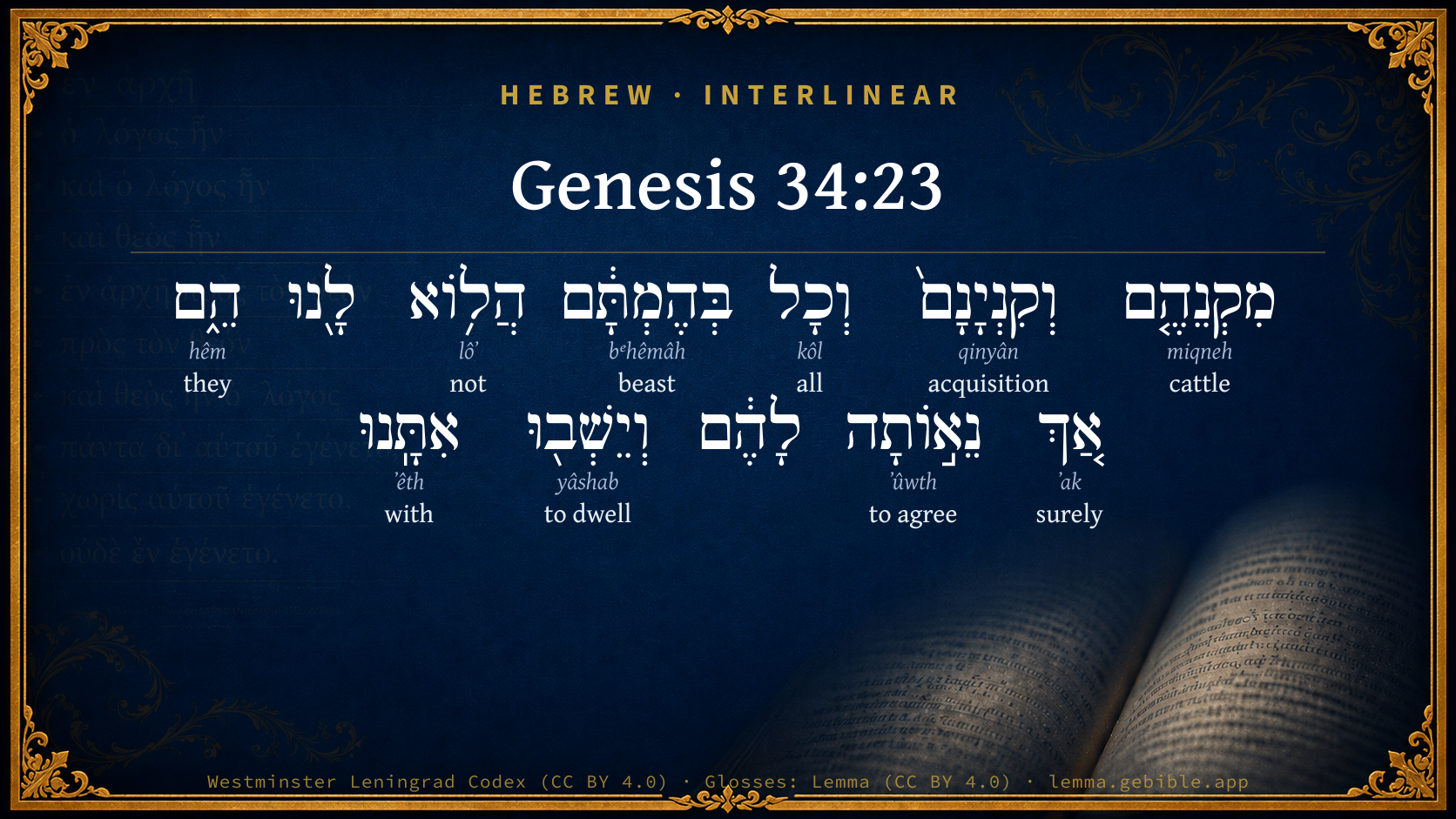
Hebrew (Westminster Leningrad Codex) Genesis 34:23 appears in the Hebrew Old Testament. The text above is from the Westminster Leningrad Codex. Each word links to its Strong’s number, a concise gloss, and parsing drawn from the Open Scriptures Hebrew Bible morphology. Click any word for its full Brown-Driver-Briggs (BDB) entry.
Download image
Cite this verse

Genesis 34:23 (World English Bible). Public Domain. Lemma interlinear Bible study tool, https://lemma.gebible.app/v/genesis/34/23.

Show BibTeX & RIS
BibTeX
RIS
English Translation
Won't their cattle and their substance and all their animals be ours? Only let us give our consent to them, and they will dwell with us."
World English Bible · Public Domain
Download a study sheet

One document with this verse’s original text, its word-by-word gloss line, the meaning frame, cross-references with their text, attributed commentary, and full source and license credits — printable, and it pastes into notes with its structure intact.

This verse Autodidact and up

Study sheet (.html) Plain text (.txt)

A passage Seminary Student

Up to 50 verses in one chapter. A passage sheet keeps up to 6 commentary sources and 12 cross-references per verse, in the order this page ranks them, and says so on the sheet whenever that leaves anything out. Ask for a single verse and you get the Autodidact verse sheet above.

Everything on this page stays free to read, with no account — the sheet is a download of what is already on screen, not access to it.

Want to remove ads? Support Godless Engineer
Compare translations 3

The same verse in 3 English versions, stacked beneath the original-language interlinear above. Click any original word for its lexicon entry.

Each is an independent rendering of the whole verse — the interlinear is not word-aligned to these translations.

Highlighted words mark where these versions differ — a whole-verse word diff, not a word-by-word alignment.

  • World English Bible Public Domain
    Won't their cattle and their substance and all their animals be ours? Only let us give our consent to them, and they will dwell with us."
  • King James Version Public Domain
    Shall not their cattle and their substance and every beast of theirs be ours? only let us consent unto them, and they will dwell with us.
  • unfoldingWord Literal Text CC BY-SA 4.0
    Their livestock and their property and all their animals, will they not to us? Only let us consent with them, and they will settle with us!”

unfoldingWord Literal Text — © unfoldingWord, licensed CC BY-SA 4.0. Word-aligned USFM3 via Door43 (git.door43.org/unfoldingWord/en_ult).

Versions to compare (up to 4)

3 of 4 selected

Show all 18 translations

Every available English version of this verse, each an independent rendering of the whole verse.

  • World English Bible Public Domain
    Won't their cattle and their substance and all their animals be ours? Only let us give our consent to them, and they will dwell with us."
  • Berean Standard Bible Public Domain
    Will not their livestock, their possessions, and all their animals become ours? Only let us consent to them, and they will dwell among us.”
  • Majority Standard Bible Public Domain
    Will not their livestock, their possessions, and all their animals become ours? Only let us consent to them, and they will dwell among us.”
  • King James Version Public Domain
    Shall not their cattle and their substance and every beast of theirs be ours? only let us consent unto them, and they will dwell with us.
  • American Standard Version (1901) Public Domain
    Shall not their cattle and their substance and all their beasts be ours? only let us consent unto them, and they will dwell with us.
  • Revised Version (1885) Public Domain
    Shall not their cattle and their substance and all their beasts be ours? only let us consent unto them, and they will dwell with us.
  • Geneva Bible (1599) Public Domain
    Shall not their flockes and their substance and all their cattell be ours? onely let vs consent herein vnto them, and they will dwell with vs.
  • Douay-Rheims (1899) Public Domain
    And their substance, and cattle, and all that they possess, shall be ours: only in this let us condescend, and by dwelling together, we shall make one people.
  • Young's Literal Translation Public Domain
    their cattle, and their substance, and all their beasts -- are they not ours? only let us consent to them, and they dwell with us.'
  • Literal Standard Version CC BY-SA 4.0
    their livestock, and their substance, and all their beasts—are they not ours? Only let us consent to them, and they dwell with us.”
  • Unlocked Literal Bible CC BY-SA 4.0
    Will not their livestock and their property—all their animals be ours? So let us agree with them, and they will live among us.”
  • unfoldingWord Literal Text CC BY-SA 4.0
    Their livestock and their property and all their animals, will they not to us? Only let us consent with them, and they will settle with us!”
  • Darby Bible Public Domain
    Their cattle, and their possessions, and every beast of theirs, shall they not be ours? only let us consent to them, and they will dwell with us.
  • World Messianic Bible Public Domain
    Won’t their livestock and their possessions and all their animals be ours? Only let’s give our consent to them, and they will dwell with us.”
  • Webster's Bible Public Domain
    Will not their cattle, and their substance, and every beast of theirs be ours? only let us consent to them, and they will dwell with us.
  • Free Bible Version CC BY-SA 4.0
    If that happens, won't all their livestock and property—all their animals—end up belonging to us? We just have to agree to this and they will come and live among us.”
  • Bible in Basic English Public Domain
    Then will not their cattle and their goods and all their beasts be ours? so let us come to an agreement with them so that they may go on living with us.
  • JPS Tanakh (1917) Public Domain
    Shall not their cattle and their substance and all their beasts be ours? only let us consent unto them, and they will dwell with us.'

Literal Standard Version (2020), Covenant Press — licensed CC BY-SA 4.0. Text via the HelloAO Bible API (eBible.org). Unlocked Literal Bible (unfoldingWord) — licensed CC BY-SA 4.0. Text via the HelloAO Bible API (eBible.org). unfoldingWord Literal Text — © unfoldingWord, licensed CC BY-SA 4.0. Word-aligned USFM3 via Door43 (git.door43.org/unfoldingWord/en_ult). Free Bible Version, Dr. Jonathan Gallagher — licensed CC BY-SA 4.0. Text via the HelloAO Bible API (eBible.org).

Word by word

More ways to search: Search by grammar → Find every occurrence → Compare this word →

Practice this passage: Drill this verse → Learn its vocabulary →

נֵא֣וֹתָה
ʼûwth
H225
“to agree”
Verb, Niphal, Cohortative, 1st Person, Common, Plural
Part of Speech
Verb
Stem
Niphal
Form
Cohortative
Person
1st Person
Gender
Common
Number
Plural
Full BDB Definition

Origin: a primitive root

TWOT: 53

(Niphal) to consent, agree
  1. מִקְנֵהֶ֤ם miqneh H4735 “cattle · their” Noun, Common, Masculine, Singular, Construct + Suffix, Personal, 3rd Person, Masculine, Plural
  2. וְקִנְיָנָם֙ qinyân H7075 “and · acquisition · their” Conjunction + Noun, Common, Masculine, Singular, Construct + Suffix, Personal, 3rd Person, Masculine, Plural
  3. וְכָל kôl H3605 “and · all of” Conjunction + Noun, Common, Masculine, Singular, Construct
  4. בְּהֶמְתָּ֔ם bᵉhêmâh H929 “beast · their” Noun, Common, Feminine, Singular, Construct + Suffix, Personal, 3rd Person, Masculine, Plural
  5. הֲל֥וֹא lôʼ H3808 “not” Particle, Interrogative + Particle, Negative
  6. הֵ֑ם hêm H1992 “they” Pronoun, Personal, 3rd Person, Masculine, Plural
  7. אַ֚ךְ ʼak H389 “surely” Particle, Accusative
  8. וְיֵשְׁב֖וּ yâshab H3427 “and · to dwell” Conjunction + Verb, Qal, Imperfect, 3rd Person, Masculine, Plural
  9. אִתָּֽנוּ ʼêth H854 “with · us” Preposition + Suffix, Personal, 1st Person, Common, Plural

About this verse

These counts appear in no published source. They are computed here, from the morphology-tagged text and Lemma’s own curated glosses. What Lemma adds →

12
words
10
distinct lemmas
Pentateuch
section

Notable vocabulary

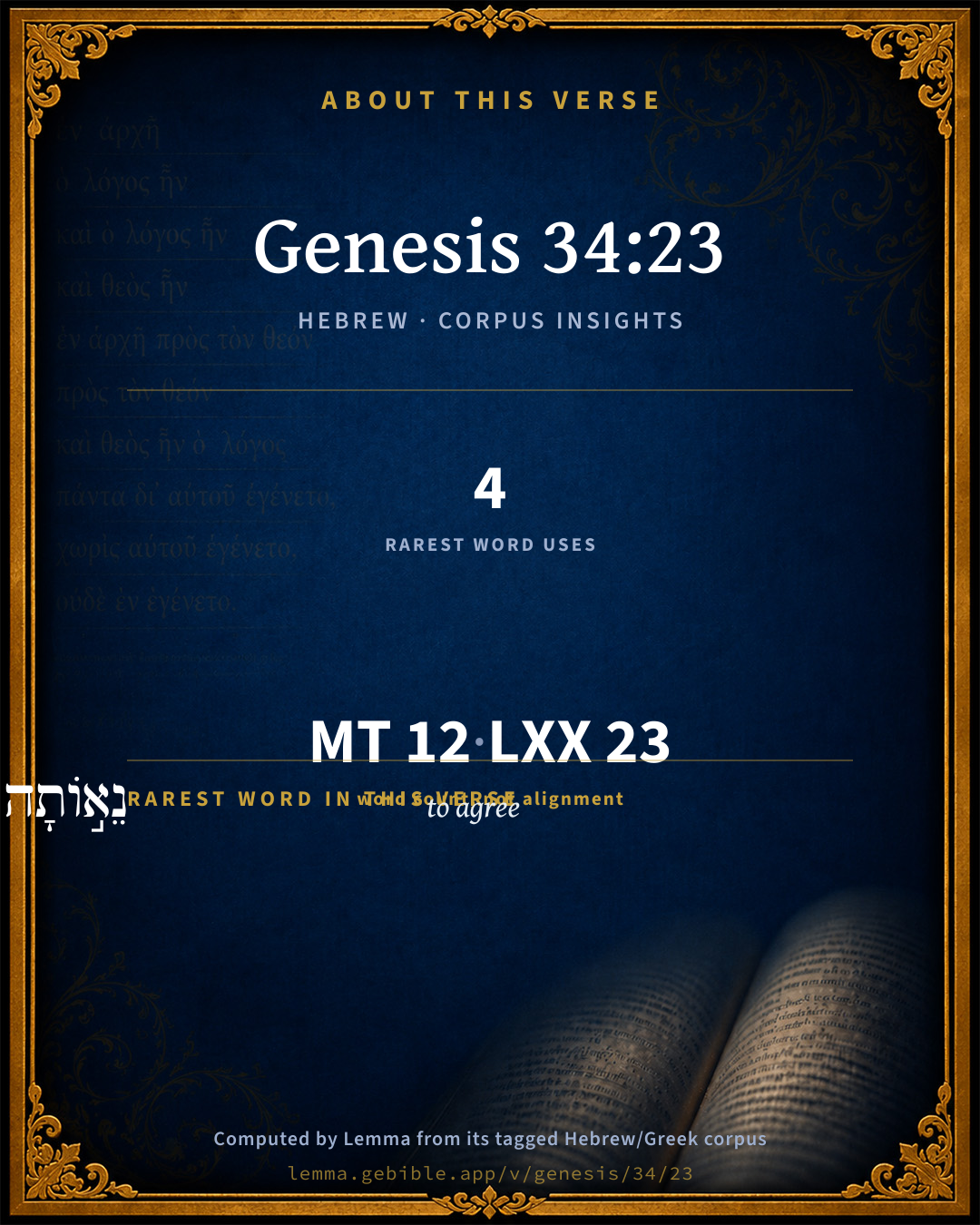
The rarest word here is נֵא֣וֹתָה to agree H225 — appearing just 4 times in the whole Hebrew Bible.

Shared distinctive vocabulary

נֵא֣וֹתָה to agree H225 occurs in 4 verses of the Hebrew Bible. Also found in:

Grammatical profile

  • 2 verbs
  • 4 nouns
  • 1 pronoun
  • 3 prepositions
  • 2 particles

Verb forms

  • נֵא֣וֹתָה Niphal · Cohortative
  • וְיֵשְׁב֖וּ Qal · Imperfect

Hebrew & Septuagint length

In English translation the verse runs 26 words from the Hebrew and 27 from the Septuagint (LXX English) — closely comparable.

A rough comparison of the two English renderings, which tokenize alike — not a word-level alignment.

Word counts can differ between the Hebrew and the Greek without any difference in meaning — e.g. the Hebrew direct-object marker אֵת has no separate Greek word, and Greek often adds the article ὁ.

In the original languages it is 12 Hebrew tokens and 23 Greek tokens — but the two are counted differently (Hebrew bundles its prefixes and suffixes into one token; the Greek is in lemma form), so that isn’t a like-for-like length.

Cross-references

7

Topical passages linked to Genesis 34:23 in the Treasury of Scripture Knowledge — connected by theme and wording, ordered by reader-vote popularity; previews shown in the World English Bible.

  • Proverbs 1:12–13 Let's swallow them up alive like Sheol, And whole, like those who go down into the pit.
  • Proverbs 23:4–5 Don't weary yourself to be rich. In your wisdom, show restraint.
  • Proverbs 28:20 A faithful man is rich with blessings; But one who is eager to be rich will not go unpunished.
  • John 2:16 To those who sold the doves, he said, "Take these things out of here! Don't make my Father's house a marketplace!"
  • John 6:26–27 Jesus answered them, "Most assuredly I tell you, you seek me, not because you saw signs, but because you ate of the loaves, and were filled.
  • Acts 19:24–26 For a certain man named Demetrius, a silversmith, who made silver shrines of Artemis, brought no little business to the craftsmen,
  • 1 Timothy 6:6–10 But godliness with contentment is great gain.

Cross-references courtesy of OpenBible.info (CC BY 4.0).

Hebrew and Greek witnesses Masoretic Hebrew ↔ Greek Septuagint

The same verse in the two great witnesses to the Old Testament, shown verse-for-verse.

These are two independent witnesses, not word-aligned to each other, and the Septuagint is shown in lemma (dictionary) form.

Hebrew Genesis 34:23 Masoretic · Westminster Leningrad Codex

מִקְנֵהֶ֤ם וְקִנְיָנָם֙ וְכָל בְּהֶמְתָּ֔ם הֲל֥וֹא לָ֖נוּ הֵ֑ם אַ֚ךְ נֵא֣וֹתָה לָהֶ֔ם וְיֵשְׁב֖וּ אִתָּֽנוּ

Won't their cattle and their substance and all their animals be ours? Only let us give our consent to them, and they will dwell with us."

World English Bible · Public Domain

Greek LXX Genesis 34:23 Septuagint · lemma form

καί ὁ κτῆνος αὐτός καί ὁ ὑποἄρχω αὐτός καί ὁ τετράποδος οὐ ἐγώ εἰμί μόνον ἐν οὗτος ὁμοιόω αὐτός καί οἰκέω μετά ἐγώ

And shall not their cattle and their herds, and their possessions, be ours? only in this let us conform to them, and they will dwell with us.

LXX2012 (modern English Septuagint) · Public Domain

Hebrew: Westminster Leningrad Codex (CC BY 4.0). Greek: Septuagint (public domain); English from LXX2012 (modern English Septuagint) (Public Domain). How the Septuagint differs from the Hebrew →

Targum (Aramaic paraphrase)

2

The Targum is the ancient Jewish Aramaic paraphrase of the Hebrew Scriptures — an interpretive translation, not the Hebrew text itself. Onkelos (literal) and Pseudo-Jonathan (expansive) render the Torah, and Jonathan the Prophets. Coverage is partial: where no permissively-licensed English translation exists for a verse, only the Aramaic is shown. This is verse-level text, not a word-by-word alignment to the Hebrew.

  1. Targum Onkelos Torah (Genesis–Deuteronomy)
    גֵּיתֵיהוֹן וְקִנְיָנְהוֹן וְכָל בְּעִירְהוֹן הֲלָא דִּילָנָא אִנּוּן בְּרַם נִתְפֵּס לְהוֹן וִיתִיבוּן עִמָּנָא

    (no public-domain English translation for this verse)

    Targum Onkelos — Aramaic: “Onkelos Genesis” (public domain); “Onkelos Exodus” (public domain); “Onkelos Leviticus” (public domain); “Onkelos Numbers” (public domain); “Onkelos Deuteronomy” (public domain). English: “Sefaria Community Translation” (CC0 1.0 (public-domain dedication)); “J.W. Etheridge. The Targums of Onkelos and Jonathan Ben Uzziel on the Pentateuch. London: Longmans, Green, 1862” (public domain). Text via Sefaria.

  2. Targum Pseudo-Jonathan Torah (Genesis–Deuteronomy)
    גֵיתֵיהוֹן וְנִכְסֵיהוֹן וְכָל בְּעִירֵיהוֹם הֲלָא דִי לָנָא אִינוּן בְּרַם נִתְפַּיֵיס לְהוֹם וְיֵיתְבוּן עִמָנָא

    Their flocks, and their substance, and all their cattle, will they not be ours? Only let us consent to them, and they will dwell with us.

    Targum Pseudo-Jonathan — Aramaic: “Targum Jonathan on Genesis” (public domain); “Targum Jonathan on Exodus” (public domain); “Targum Jonathan on Leviticus” (public domain); “Targum Jonathan on Numbers” (public domain); “Targum Jonathan on Deuteronomy” (public domain). English: “The Targum of Jonathan ben Uzziel, trans. J. W. Etheridge, London, 1862” (public domain). Text via Sefaria.

Commentary

Notes on Genesis 34:23 from classic Christian and Jewish commentators (each source and its license shown beneath its notes). The classic Christian expositions comment on the surrounding passage and are grouped to its opening verse, so a note may address several verses; the Jewish commentaries on the Tanakh (Rashi and others) are per-verse, so they appear only where the commentator wrote on this verse.

Lemma curates 59 commentaries, every one of them public domain or Creative Commons licensed, each selected and text-cleaned for this edition rather than reprinted as found. About our sources →

Trapp's Complete Commentary

John Trapp

Gen 34:23 [Shall] not their cattle and their substance and every beast of theirs [be] ours? only let us consent unto them, and they will dwell with us.

Ver. 23. Shall not their cattle, &c.] Profit persuades mightily with the multitude. They all look to their own way; "Every one for his gain from his quarter". {Isa 56:11} "Who will show us any good?" is Vox populi .{ Psa 4:6} And who begs not attention, or inoculates not his faithful endeavour into his friend’s creed and belief, with a tale of gain!

John Trapp, A Commentary or Exposition upon All the Books of the Old and New Testament (1647–1656) — public domain. Text from a community e-Sword module.

Joseph Benson's Commentary

Gen 34:23. Shall not their cattle and substance be ours? — Either for our use and benefit in the way of trade and commerce, or because they will descend to the issue of our children as well as theirs. Thus they cover their private designs with the specious show of public good.

Joseph Benson's Commentary on the Old and New Testaments (1811–1818) — public domain. Text from a community e-Sword module.

Geneva Bible (1599)

Geneva Bible translators

Thus they lack no kind of persuasion, which prefer their own commodities before the commonwealth.

Geneva Bible (1599) marginal notes — public domain. Text via Bolls.life.

Adam Clarke's Commentary

Verse 23. Shall not their cattle and their substance - be ours? This was a bait held out for the poor unsuspecting people of Hamor by their prince and his son, who were not much less deceived than the people themselves.

Adam Clarke's Commentary on the Bible (1810–1826) — public domain. Text from a community e-Sword/MySword module.

The Cambridge Bible for Schools and Colleges

gen. ed. J. J. S. Perowne

23. cattle … substance] It would be a good business transaction.

The Cambridge Bible for Schools and Colleges (gen. ed. J. J. S. Perowne; Cambridge University Press, 1878–1918) — public domain. Text from a community e-Sword module.

John Gill's Exposition

And unto Hamor and unto Shechem his son hearkened all that went out of the gate of his city,.... That is, all the inhabitants of the city who came to the gate of it, upon the summons given them, and departed from thence to their habitations, having a great opinion of their prince and his son; and moved either with awe of them or love to them, and influenced both by their arguments and example, they agreed to what was proposed to them:

and every male was circumcised, all that went out of the gate of his city; all the men citizens; and not only the adult, and who now went out by the gate of the city, but all their male children likewise were circumcised.

John Gill's Exposition of the Whole Bible (1746–1763) — public domain (CC PDM 1.0). Text via the HelloAO Bible API.

Haydock's Catholic Bible Commentary

Ours, by mutual commerce. The Rabbin pretend the Sichemite designed to circumvent Jacob and his family. But their conduct seems to screen them from any reproach of this kind, and Jacob throws the blame upon his own sons, chap. xlix. 6. If Hemor said more than he was authorized by them to do, this will not palliate their injustice and sacrilegious perfidy. (Calmet) (Menochius)

George Leo Haydock (1774–1849), Haydock's Catholic Family Bible and Commentary, 1859 edition — public domain. Excludes Psalms (Douay-Rheims chapter numbering differs from Protestant) and Deuterocanonical books (Catholic canon only).

Matthew Poole's English Annotations

Shall not their substance be ours? Either for our use and benefit in the way of commerce and trade; or because they will descend to the issue of our children as well as theirs; or because we being more numerous and potent than they, can easily overrule them, and when we think meet, dispose all things to our own advantage. Thus they cover their private design with the specious show of public good.

Matthew Poole's English Annotations on the Holy Bible (1683–1685) — public domain. Text from a community e-Sword/MySword module.

John Wesley's Explanatory Notes

Shall not their cattle and their substance be ours? - They observed that Jacob's sons were industrious, thriving people, and promised themselves and their neighbours advantage by an alliance with them: it would improve ground and trade, and bring money into their country.

John Wesley, Explanatory Notes Upon the Whole Bible (1754–1765) — public domain. Text via the GEBible commentary corpus.

Rashi

Rabbi Shlomo Yitzchaki (Rashi)

אך נאותה להם LET US CONSENT UNTO THEM in this matter, and because of this they will dwell with us.

Rashi on the Tanakh — English translations: “The Judaica Press complete Tanach with Rashi, translated by A. J. Rosenberg” (CC BY 4.0); “Pentateuch with Rashi's commentary by M. Rosenbaum and A.M. Silbermann, 1929-1934” (public domain); “The Metsudah Tanach series, Lakewood, N.J” (CC BY 4.0); and “The Book of Joshua, Metsudah Publications, 1997” (CC BY 4.0). Text via Sefaria.

Ramban (Nachmanides)

Rabbi Moshe ben Nachman (Ramban / Nachmanides)

‘MIKNEIHEM’ AND THEIR SUBSTANCE AND ALL THEIR BEASTS. The reason for referring to cattle by the word mikneihem is that beasts of the herds which are in the field are called mikneh — [from the root kanah, which means “acquire”] — because whether they are clean or unclean, they are the mainstay of a man’s substance, just as it is written, Behold, the hand of the Eternal is ‘b’miknecha’ (upon thy cattle) which are in the field, upon the horses, upon the asses, upon the camels, upon the herds, and upon the flocks. And those which do not constitute a herd, as, for example, single beasts in the house, are not called mikneh, and they are included in the term, and all their beasts. It may be that [mikneh and “all their beasts” both refer to the same cattle], and the redundancy is for the purpose of emphasis, meaning, and all their beasts which were very numerous.

Ramban (Nachmanides) on the Tanakh — English translation: “Commentary on the Torah by Ramban (Nachmanides). Translated and annotated by Charles B. Chavel. New York, Shilo Pub. House, 1971-1976” (CC BY 4.0). Text via Sefaria.

Radak

Rabbi David Kimhi (Radak)

מקניהם, this is one of 3 instances where the letter י after the נ is missing in this word. As spelled, the word means “they are cattle.” [Ibn Ezra sees in this a hint that the people of Shechem saw in Yaakov’s family and belongings prospective property of theirs, placing man and beast on the same footing. Ed.]

Radak on the Tanakh — English translations: “Sefaria Community Translation” (CC0 1.0 (public-domain dedication)); “Eliyahu Munk, HaChut Hameshulash” (CC BY 4.0); “Rabbi Mike Feuer, Jerusalem Anthology” (CC BY 4.0); and “R. David Kimhi on the first book of Psalms, Translated by R.G. Finch, London, 1919” (public domain). Text via Sefaria.

Lesson kit

Teaching starters — assembled from the data on this page, not authored interpretation. Every prompt links to the verse data it draws on. Edit before teaching.

Genesis, in the Pentateuch, opens this verse with 12 words (10 distinct Hebrew lemmas). Its most distinctive word is ʼûwth (“to agree”). A historical commentator’s framing appears above. Read the whole chapter for the surrounding context.

Discussion questions

  1. How does “to agree” (ʼûwth) shape what this verse is saying?
  2. Genesis 34:15 shares the word «to agree» with this verse. How do the two illuminate each other?
  3. These translations render this verse differently. What is at stake in choosing one wording over another?
  4. The verb «נֵא֣וֹתָה» is Niphal Cohortative. How does its form color the action?
  5. Reading how Trapp's Complete Commentary and Joseph Benson's Commentary read this verse, where do the two commentators agree and where do they part?

Things to notice

Reading settings

Reading text

Shown beneath each verse's original-language words.

Old Testament
Old Testament edition

Read the OT as the Masoretic Hebrew (MT) or the Greek Septuagint (LXX).

English shown for the Greek Septuagint (in the Hebrew ↔ Greek comparison).

Comparing translations? Open the Compare panel on any verse page to stack up to four side by side.