
Judges 20:32

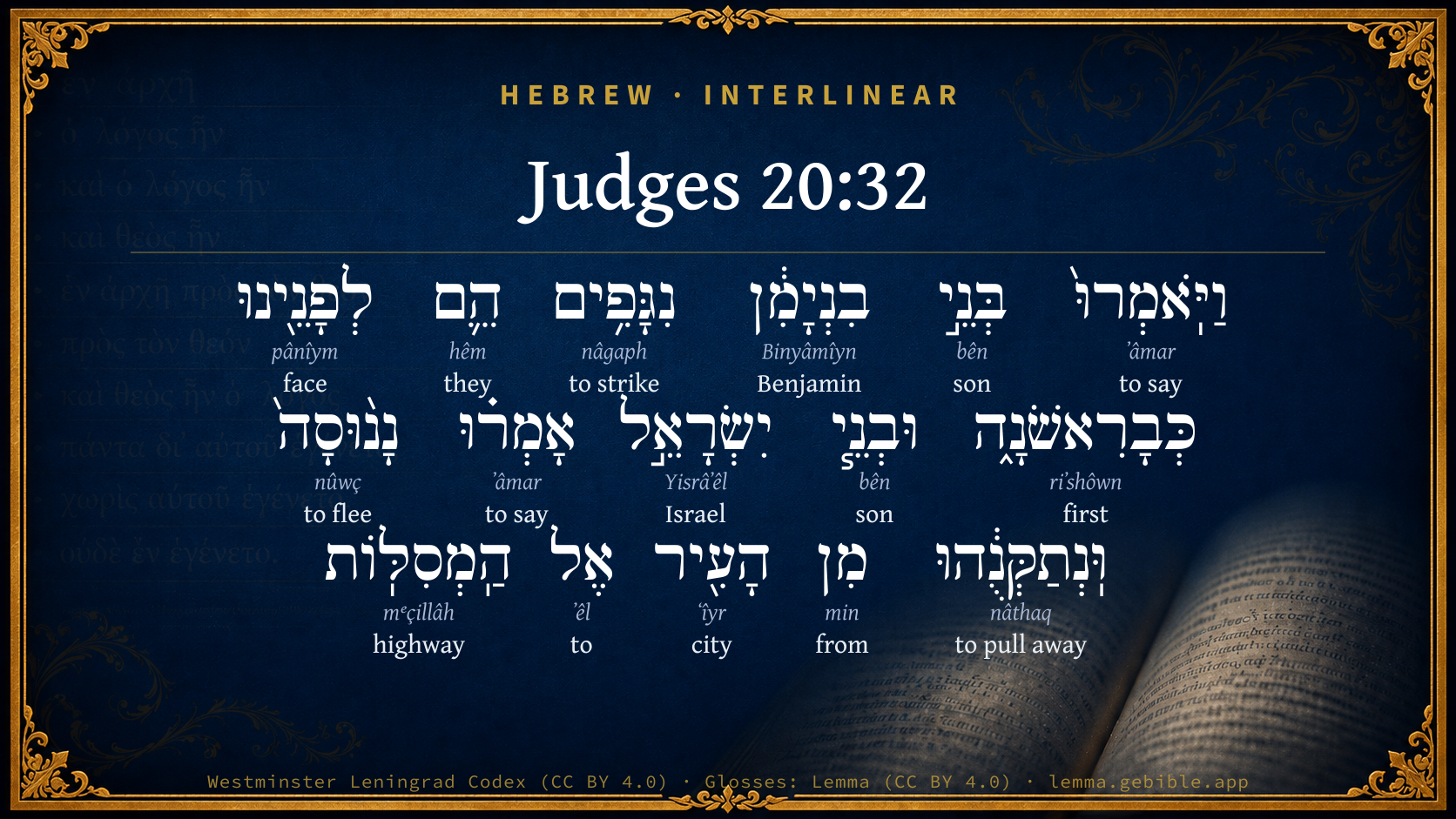
Hebrew (Westminster Leningrad Codex) Judges 20:32 appears in the Hebrew Old Testament. The text above is from the Westminster Leningrad Codex. Each word links to its Strong’s number, a concise gloss, and parsing drawn from the Open Scriptures Hebrew Bible morphology. Click any word for its full Brown-Driver-Briggs (BDB) entry.
Download image
Cite this verse

Judges 20:32 (World English Bible). Public Domain. Lemma interlinear Bible study tool, https://lemma.gebible.app/v/judges/20/32.

Show BibTeX & RIS
BibTeX
RIS
English Translation
The children of Benjamin said, They are struck down before us, as at the first. But the children of Israel said, Let us flee, and draw them away from the city to the highways.
World English Bible · Public Domain
Download a study sheet

One document with this verse’s original text, its word-by-word gloss line, the meaning frame, cross-references with their text, attributed commentary, and full source and license credits — printable, and it pastes into notes with its structure intact.

This verse Autodidact and up

Study sheet (.html) Plain text (.txt)

A passage Seminary Student

Up to 50 verses in one chapter. A passage sheet keeps up to 6 commentary sources and 12 cross-references per verse, in the order this page ranks them, and says so on the sheet whenever that leaves anything out. Ask for a single verse and you get the Autodidact verse sheet above.

Everything on this page stays free to read, with no account — the sheet is a download of what is already on screen, not access to it.

Want to remove ads? Support Godless Engineer
Compare translations 3

The same verse in 3 English versions, stacked beneath the original-language interlinear above. Click any original word for its lexicon entry.

Each is an independent rendering of the whole verse — the interlinear is not word-aligned to these translations.

Highlighted words mark where these versions differ — a whole-verse word diff, not a word-by-word alignment.

  • World English Bible Public Domain
    The children of Benjamin said, They are struck down before us, as at the first. But the children of Israel said, Let us flee, and draw them away from the city to the highways.
  • King James Version Public Domain
    And the children of Benjamin said, They are smitten down before us, as at the first. But the children of Israel said, Let us flee, and draw them from the city unto the highways.
  • unfoldingWord Literal Text CC BY-SA 4.0
    And the sons of Benjamin said, “They being beaten to our faces as at the first.” But the sons of Israel had said, “Let us flee and let us draw him from the city to the roads.”

unfoldingWord Literal Text — © unfoldingWord, licensed CC BY-SA 4.0. Word-aligned USFM3 via Door43 (git.door43.org/unfoldingWord/en_ult).

Versions to compare (up to 4)

3 of 4 selected

Show all 18 translations

Every available English version of this verse, each an independent rendering of the whole verse.

  • World English Bible Public Domain
    The children of Benjamin said, They are struck down before us, as at the first. But the children of Israel said, Let us flee, and draw them away from the city to the highways.
  • Berean Standard Bible Public Domain
    “We are defeating them as before,” said the Benjamites. But the Israelites said, “Let us retreat and draw them away from the city onto the roads.”
  • Majority Standard Bible Public Domain
    “We are defeating them as before,” said the Benjamites. But the Israelites said, “Let us retreat and draw them away from the city onto the roads.”
  • King James Version Public Domain
    And the children of Benjamin said, They are smitten down before us, as at the first. But the children of Israel said, Let us flee, and draw them from the city unto the highways.
  • American Standard Version (1901) Public Domain
    And the children of Benjamin said, They are smitten down before us, as at the first. But the children of Israel said, Let us flee, and draw them away from the city unto the highways.
  • Revised Version (1885) Public Domain
    And the children of Benjamin said, They are smitten down before us, as at the first. But the children of Israel said, Let us rise, and draw them away from the city unto the highways.
  • Geneva Bible (1599) Public Domain
    (For the children of Beniamin sayd, They are fallen before vs, as at the first. But the children of Israel saide, Let vs flee and plucke them away from the citie vnto the hie wayes)
  • Douay-Rheims (1899) Public Domain
    For they thought to cut them off, as they did before. But they artfully feigning a flight, designed to draw them away from the city, and by their seeming to flee to bring them to the highways aforesaid.
  • Young's Literal Translation Public Domain
    And the sons of Benjamin say, `They are smitten before us as at the beginning;' but the sons of Israel said, `Let us flee, and draw them away out of the city, unto the highways.'
  • Literal Standard Version CC BY-SA 4.0
    And the sons of Benjamin say, “They are struck before us as at the beginning”; but the sons of Israel said, “Let us flee, and draw them away out of the city, to the highways.”
  • Unlocked Literal Bible CC BY-SA 4.0
    Then the people of Benjamin said, “They are defeated and they are running away from us, just as at first.” But the soldiers of Israel said, “Let us run back and draw them away from the city to the roads.”
  • unfoldingWord Literal Text CC BY-SA 4.0
    And the sons of Benjamin said, “They being beaten to our faces as at the first.” But the sons of Israel had said, “Let us flee and let us draw him from the city to the roads.”
  • Darby Bible Public Domain
    And the Benjaminites said, "They are routed before us, as at the first." But the men of Israel said, "Let us flee, and draw them away from the city to the highways."
  • World Messianic Bible Public Domain
    The children of Benjamin said, “They are struck down before us, as at the first.” But the children of Israel said, “Let’s flee, and draw them away from the city to the highways.”
  • Webster's Bible Public Domain
    And the children of Benjamin said, They are smitten down before us, as at the first. But the children of Israel said, Let us flee, and draw them from the city to the highways.
  • Free Bible Version CC BY-SA 4.0
    “We're defeating them, just like before,” the Benjamites shouted. But the Israelites said, “Let's run away from them and lure them away from the town towards the roads.”
  • Bible in Basic English Public Domain
    And the children of Benjamin said, They are giving way before us as at first. But the children of Israel said, Let us go in flight and get them away from the town, into the highways.
  • JPS Tanakh (1917) Public Domain
    And the children of Benjamin said: 'They are smitten down before us, as at the first.' But the children of Israel said: 'Let us flee, and draw them away from the city unto the highways.'

Literal Standard Version (2020), Covenant Press — licensed CC BY-SA 4.0. Text via the HelloAO Bible API (eBible.org). Unlocked Literal Bible (unfoldingWord) — licensed CC BY-SA 4.0. Text via the HelloAO Bible API (eBible.org). unfoldingWord Literal Text — © unfoldingWord, licensed CC BY-SA 4.0. Word-aligned USFM3 via Door43 (git.door43.org/unfoldingWord/en_ult). Free Bible Version, Dr. Jonathan Gallagher — licensed CC BY-SA 4.0. Text via the HelloAO Bible API (eBible.org).

Word by word

More ways to search: Search by grammar → Find every occurrence → Compare this word →

Practice this passage: Drill this verse → Learn its vocabulary →

וּֽנְתַקְּנֻ֔הוּ
nâthaq
H5423
“and · to pull away · him”
Conjunction + Verb, Qal, Sequential Perfect, 1st Person, Common, Plural + Suffix, Personal, 3rd Person, Masculine, Singular
Part of Speech
Conjunction + Verb
Stem
Qal
Form
Sequential Perfect
Person
1st Person
Gender
Common
Number
Plural
Full BDB Definition

Origin: a primitive root

TWOT: 1447

to pull or tear or draw off or away or apart, draw out, pluck up, break, lift, root out - (Qal) - to draw away - to draw or pull off - to pull or tear away - (Niphal) - to be drawn away, be drawn out - to be torn apart or in two, be snapped - to be separated - (Piel) - to tear apart, snap - to tear out, tear up, tear away - (Hiphil) - to draw away - to drag away - (Hophal) to be drawn away
  1. וַיֹּֽאמְרוּ֙ ʼâmar H559 “and · to say” Conjunction + Verb, Qal, Sequential Imperfect, 3rd Person, Masculine, Plural
  2. בְּנֵ֣י bên H1121 “sons of” Noun, Common, Masculine, Plural, Construct
  3. בִנְיָמִ֔ן Binyâmîyn H1144 “Benjamin” Noun, Proper
  4. נִגָּפִ֥ים nâgaph H5062 “striking” Verb, Niphal, Participle Active, Masculine, Plural, Absolute
  5. הֵ֛ם hêm H1992 “they” Pronoun, Personal, 3rd Person, Masculine, Plural
  6. לְפָנֵ֖ינוּ pânîym H6440 “to/for · face(s) · our” Preposition + Noun, Common, Both, Plural, Construct + Suffix, Personal, 1st Person, Common, Plural
  7. כְּבָרִאשֹׁנָ֑ה riʼshôwn H7223 “like/as · in/at the · first” Preposition + Preposition, Determined + Adjective, Adjective, Feminine, Singular, Absolute
  8. וּבְנֵ֧י bên H1121 “and · sons of” Conjunction + Noun, Common, Masculine, Plural, Construct
  9. יִשְׂרָאֵ֣ל Yisrâʼêl H3478 “Israel” Noun, Proper
  10. אָמְר֗וּ ʼâmar H559 “to say” Verb, Qal, Perfect, 3rd Person, Common, Plural
  11. נָנ֨וּסָה֙ nûwç H5127 “to flee” Verb, Qal, Cohortative, 1st Person, Common, Plural
  12. מִן min H4480 “from” Preposition
  13. הָעִ֖יר ʻîyr H5892 “the · city” Particle, Definite Article + Noun, Common, Feminine, Singular, Absolute
  14. אֶל ʼêl H413 “to” Preposition
  15. הַֽמְסִלּֽוֹת mᵉçillâh H4546 “the · highways” Particle, Definite Article + Noun, Common, Feminine, Plural, Absolute

About this verse

These counts appear in no published source. They are computed here, from the morphology-tagged text and Lemma’s own curated glosses. What Lemma adds →

16
words
14
distinct lemmas
Historical
section

Shared distinctive vocabulary

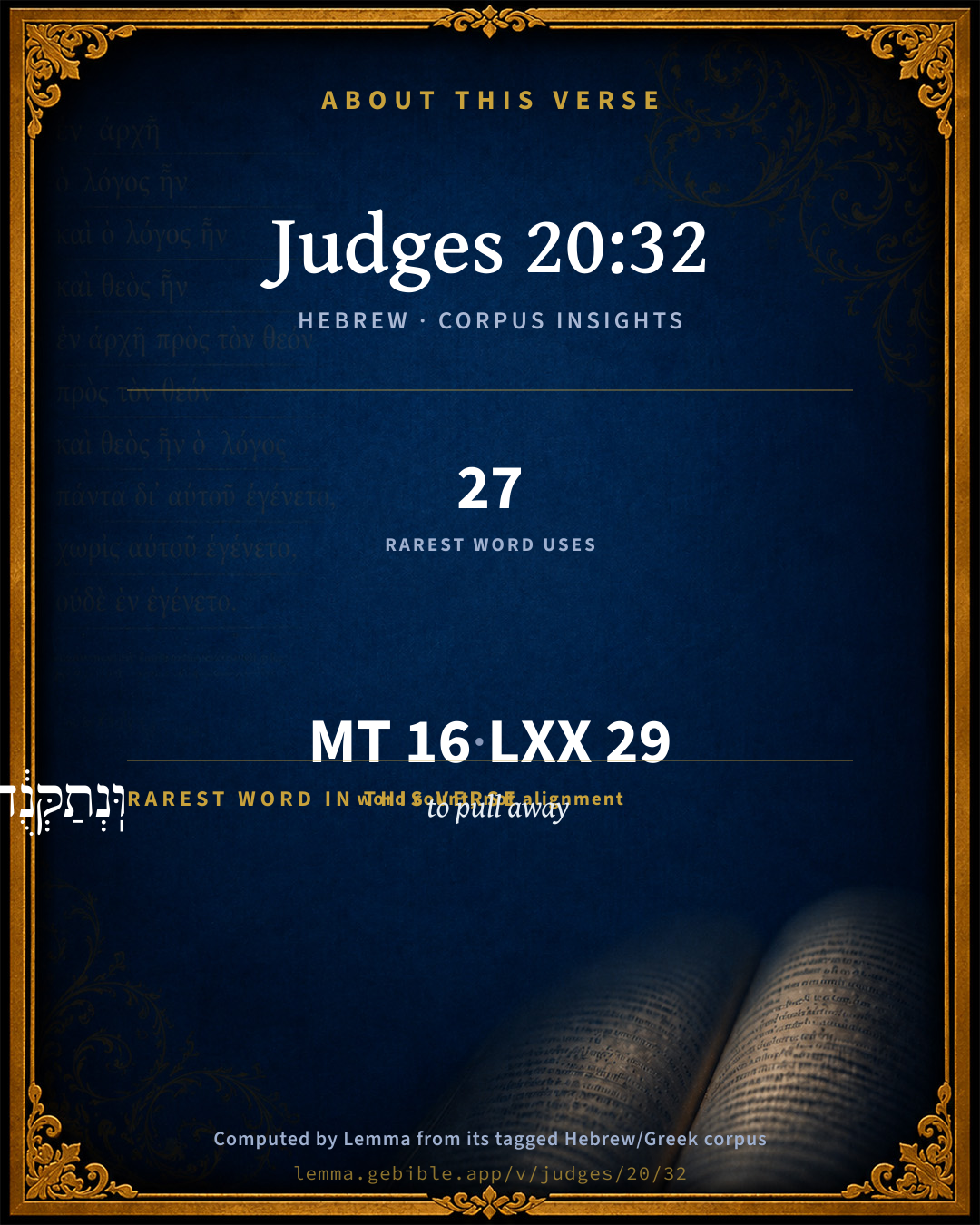
וּֽנְתַקְּנֻ֔הוּ to pull away H5423 occurs in 26 verses of the Hebrew Bible. Also found in:

Grammatical profile

  • 5 verbs
  • 7 nouns
  • 1 adjective
  • 1 pronoun
  • 2 prepositions

Verb forms

  • וַיֹּֽאמְרוּ֙ Qal · Sequential Imperfect
  • נִגָּפִ֥ים Niphal · Participle Active
  • אָמְר֗וּ Qal · Perfect
  • נָנ֨וּסָה֙ Qal · Cohortative
  • וּֽנְתַקְּנֻ֔הוּ Qal · Sequential Perfect

Repetition

Words recur within this verse — often emphatic in Hebrew:

  • וַיֹּֽאמְרוּ֙ to say H559 ×2
  • בְּנֵ֣י son H1121 ×2

Hebrew & Septuagint length

In English translation the verse runs 34 words from the Hebrew and 37 from the Septuagint (LXX English) — closely comparable.

A rough comparison of the two English renderings, which tokenize alike — not a word-level alignment.

Word counts can differ between the Hebrew and the Greek without any difference in meaning — e.g. the Hebrew direct-object marker אֵת has no separate Greek word, and Greek often adds the article ὁ.

In the original languages it is 16 Hebrew tokens and 29 Greek tokens — but the two are counted differently (Hebrew bundles its prefixes and suffixes into one token; the Greek is in lemma form), so that isn’t a like-for-like length.

Cross-references

1

Topical passages linked to Judges 20:32 in the Treasury of Scripture Knowledge — connected by theme and wording, ordered by reader-vote popularity; previews shown in the World English Bible.

  • Joshua 8:15–16 Joshua and all Israel made as if they were beaten before them, and fled by the way of the wilderness.

Cross-references courtesy of OpenBible.info (CC BY 4.0).

Hebrew and Greek witnesses Masoretic Hebrew ↔ Greek Septuagint

The same verse in the two great witnesses to the Old Testament, shown verse-for-verse.

These are two independent witnesses, not word-aligned to each other, and the Septuagint is shown in lemma (dictionary) form.

Hebrew Judges 20:32 Masoretic · Westminster Leningrad Codex

וַיֹּֽאמְרוּ֙ בְּנֵ֣י בִנְיָמִ֔ן נִגָּפִ֥ים הֵ֛ם לְפָנֵ֖ינוּ כְּבָרִאשֹׁנָ֑ה וּבְנֵ֧י יִשְׂרָאֵ֣ל אָמְר֗וּ נָנ֨וּסָה֙ וּֽנְתַקְּנֻ֔הוּ מִן הָעִ֖יר אֶל הַֽמְסִלּֽוֹת

The children of Benjamin said, They are struck down before us, as at the first. But the children of Israel said, Let us flee, and draw them away from the city to the highways.

World English Bible · Public Domain

Greek LXX Judges 20:32 Septuagint · lemma form

καί εἶπον ὁ υἱός βενιαμίν πίπτω ἐνώπιον ἐγώ ὡς ὁ πρῶτος καί ὁ υἱός ἰσραήλ εἶπον φεύγω καί ἐκκενόω αὐτός ἀπό ὁ πόλις εἰς ὁ ὁδός καί ποιέω οὕτως

And the children of Benjamin said, They fall before us as at the first: but the children of Israel said, Let us flee, and draw them out from the city into the roads; and they did so.

LXX2012 (modern English Septuagint) · Public Domain

Hebrew: Westminster Leningrad Codex (CC BY 4.0). Greek: Septuagint (public domain); English from LXX2012 (modern English Septuagint) (Public Domain). How the Septuagint differs from the Hebrew →

Targum (Aramaic paraphrase)

1

The Targum is the ancient Jewish Aramaic paraphrase of the Hebrew Scriptures — an interpretive translation, not the Hebrew text itself. Onkelos (literal) and Pseudo-Jonathan (expansive) render the Torah, and Jonathan the Prophets. Coverage is partial: where no permissively-licensed English translation exists for a verse, only the Aramaic is shown. This is verse-level text, not a word-by-word alignment to the Hebrew.

  1. Targum Jonathan Prophets (Joshua–Malachi)
    וַאֲמַרוּ בְּנֵי בִּנְיָמִין תְּבִירִין אִנוּן קֳדָמָנָא כִּדְבְּקַדְמֵיתָא וּבְנֵי יִשְׂרָאֵל אֲמַרוּ נְפַךְ וְנִגוֹדִנּוּן מִן קַרְתָּא לְכִבְשַׁיָא:

    (no public-domain English translation for this verse)

    Targum Jonathan — Aramaic: “Mikraot Gedolot” (public domain). English: “Sefaria Community Translation” (CC0 1.0 (public-domain dedication)); “London "Chaldee Paraphrase," 1871” (public domain). Text via Sefaria.

Commentary

Notes on Judges 20:32 from classic Christian and Jewish commentators (each source and its license shown beneath its notes). The classic Christian expositions comment on the surrounding passage and are grouped to its opening verse, so a note may address several verses; the Jewish commentaries on the Tanakh (Rashi and others) are per-verse, so they appear only where the commentator wrote on this verse.

Lemma curates 59 commentaries, every one of them public domain or Creative Commons licensed, each selected and text-cleaned for this edition rather than reprinted as found. About our sources →

Trapp's Complete Commentary

John Trapp

Jdg 20:32 And the children of Benjamin said, They [are] smitten down before us, as at the first. But the children of Israel said, Let us flee, and draw them from the city unto the highways.

Ver. 32. They are smitten down before us.] This was their επινικιον, which they sang too soon; for their destruction was at next door by. But sorry man knoweth not his time. "As the fishes that are taken in an evil net, and as the birds that are caught in the snare, so are the sons of men snared in an evil time, when it falleth suddenly upon them." {Ecc 9:12}

John Trapp, A Commentary or Exposition upon All the Books of the Old and New Testament (1647–1656) — public domain. Text from a community e-Sword module.

Geneva Bible (1599)

Geneva Bible translators

Meaning, crossways or paths to divers places.

Geneva Bible (1599) marginal notes — public domain. Text via Bolls.life.

Adam Clarke's Commentary

Verse 32. Let us - draw them from the city] They had two reasons for this:

1. They had placed an ambuscade behind Gibeah, which was to enter and burn the city as soon as the Benjamites had left it.

2. It would seem that the slingers, by being within the city and its fortifications, had great advantage against the Israelites by their slings, whom they could not annoy with their swords, unless they got them to the plain country.

Adam Clarke's Commentary on the Bible (1810–1826) — public domain. Text from a community e-Sword/MySword module.

Ellicott's Commentary for English Readers

(32) Said, Let us flee.—In a later historical style the plan of the feigned flight would have been mentioned earlier.

Unto the highways.—This would have the double effect of allowing the ambuscade to cut off their retreat, and of dividing their forces at the point where the roads branched off.

A Bible Commentary for English Readers, edited by Charles John Ellicott (1878–1897) — public domain. Text from a community e-Sword module.

John Gill's Exposition

And all the men of Israel rose up out of their place,.... The main body of the army, which fled before Benjamin, when they were come to a proper place, stopped, and rose up out of it, and stood in their own defence:

and put themselves in array at Baaltamar; drew up in a line of battle at that place, facing their enemies, in order to engage with them: this place the Targum calls the plains of Jericho, that being the city of palm trees, which Tamar signifies; and so Jarchi interprets it; but these are too far off; it must be some place near Gibeah. Jerom (w) speaks of a little village in his time in those parts, called Bethamari, and may be thought to be this same place; perhaps in the times of the old Canaanites here was a grove of palm trees, in which Baal was worshipped, from whence it had its name:

and the liers in wait of Israel came forth out of their places, even out of the meadows of Gibeah; or plain of Gibeah, as the Targum; for as the city was built on a hill, at the bottom of it were a plain and fine meadows of grass, and here an ambush was placed at some little distance from the city; and when the army of the Benjaminites were drawn off from it, in pursuit of Israel, these came forth and placed themselves between them and the city.

(w) De loc. Heb. fol. 89. I.

John Gill's Exposition of the Whole Bible (1746–1763) — public domain (CC PDM 1.0). Text via the HelloAO Bible API.

The Pulpit Commentary

And the children of Benjamin, etc. This verse is parenthetical, being explanatory of the conduct of both parties. The Benjamites pursued recklessly, because they thought the fight was going as on the two previous days; the Israelites fled in order to draw them to the highways, and so to enable the ambushment to get between the Benjamite army and the city.

The Pulpit Commentary (1880–1919), ed. H.D.M. Spence-Jones & Joseph S. Exell — public domain. Text from a community e-Sword module.

unfoldingWord translationNotes

Door43 World Missions Community

just as at first

"just as before" or "just like the first two times"

Baal Tamar

This is the name of a city. (See: How to Translate Names)

Maareh Gibeah

This is the name of a place. Other translations may read "fields of Gibeah" or "west of Gibeah" or "Maareh Geba." (See: How to Translate Names)

translationWords

Benjamin

Israel

raise

unfoldingWord translationNotes — © Distant Shores Media and the Door43 World Missions Community, licensed CC BY-SA 4.0. Source: git.door43.org/Door43/en_tn.

Lesson kit

Teaching starters — assembled from the data on this page, not authored interpretation. Every prompt links to the verse data it draws on. Edit before teaching.

Judges, in the Historical, opens this verse with 16 words (14 distinct Hebrew lemmas). Its most distinctive word is nâthaq (“to pull away”). A historical commentator’s framing appears above. Read the whole chapter for the surrounding context.

Discussion questions

  1. How does “to pull away” (nâthaq) shape what this verse is saying?
  2. How does Leviticus 22:24, which shares the word «to pull away», read alongside this verse?
  3. What does the repetition of “to say” (2× in this one verse) do in this verse?
  4. These translations render this verse differently; the difference is in the English rendering, not the original. What questions does that raise?
  5. «וַיֹּֽאמְרוּ֙» is a Qal Sequential Imperfect verb. How does that grammatical form shape the action described?
  6. Compare how Trapp's Complete Commentary and Geneva Bible (1599) read this verse. Where do they agree or differ?

Things to notice

Reading settings

Reading text

Shown beneath each verse's original-language words.

Old Testament
Old Testament edition

Read the OT as the Masoretic Hebrew (MT) or the Greek Septuagint (LXX).

English shown for the Greek Septuagint (in the Hebrew ↔ Greek comparison).

Comparing translations? Open the Compare panel on any verse page to stack up to four side by side.