
Numbers 15:25

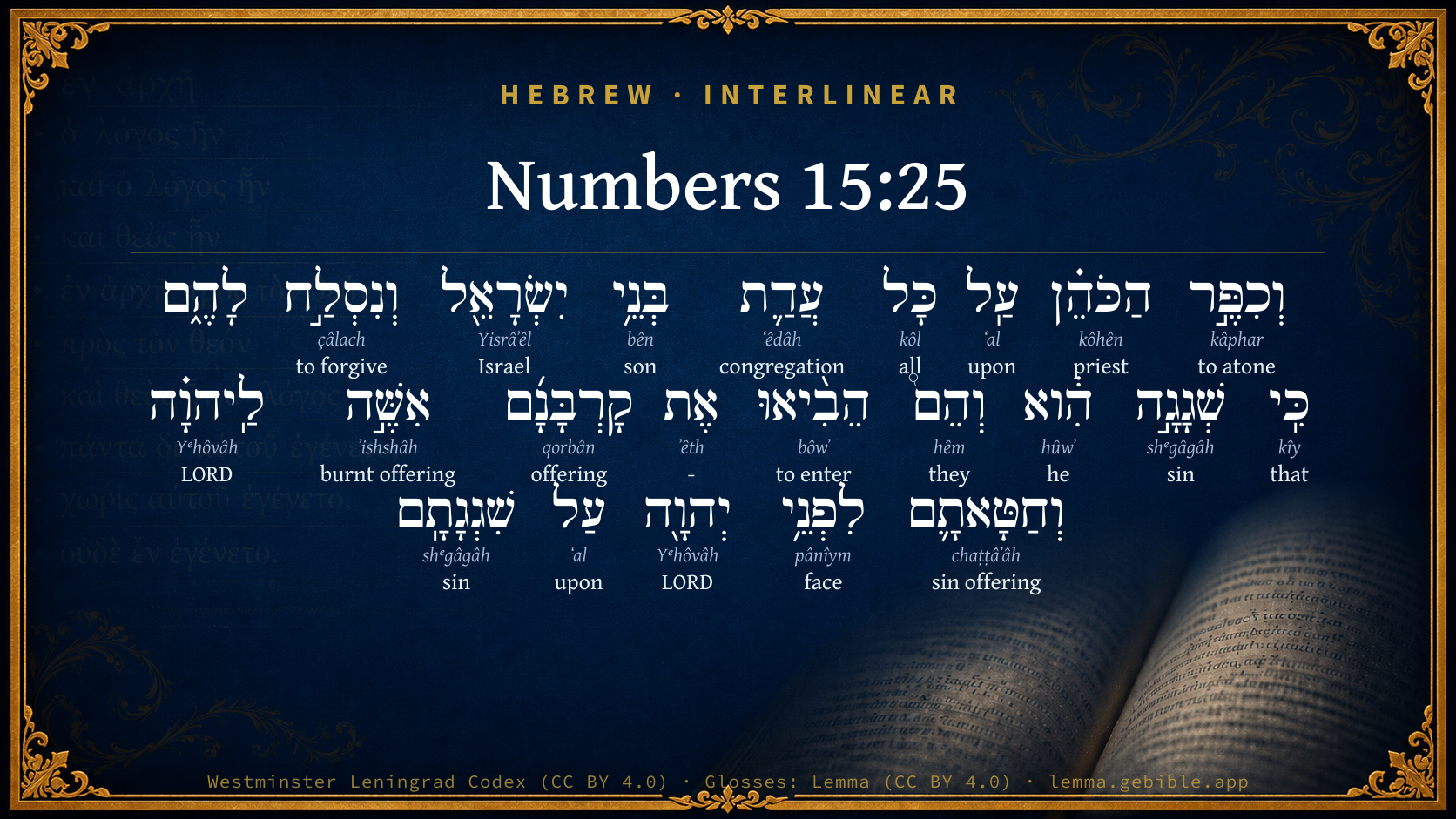
Hebrew (Westminster Leningrad Codex) Numbers 15:25 appears in the Hebrew Old Testament. The text above is from the Westminster Leningrad Codex. Each word links to its Strong’s number, a concise gloss, and parsing drawn from the Open Scriptures Hebrew Bible morphology. Click any word for its full Brown-Driver-Briggs (BDB) entry.
Download image
Cite this verse

Numbers 15:25 (World English Bible). Public Domain. Lemma interlinear Bible study tool, https://lemma.gebible.app/v/numbers/15/25.

Show BibTeX & RIS
BibTeX
RIS
English Translation
The priest shall make atonement for all the congregation of the children of Israel, and they shall be forgiven; for it was an error, and they have brought their offering, an offering made by fire to Yahweh, and their sin-offering before Yahweh, for their error:
World English Bible · Public Domain
Download a study sheet

One document with this verse’s original text, its word-by-word gloss line, the meaning frame, cross-references with their text, attributed commentary, and full source and license credits — printable, and it pastes into notes with its structure intact.

This verse Autodidact and up

Study sheet (.html) Plain text (.txt)

A passage Seminary Student

Up to 50 verses in one chapter. A passage sheet keeps up to 6 commentary sources and 12 cross-references per verse, in the order this page ranks them, and says so on the sheet whenever that leaves anything out. Ask for a single verse and you get the Autodidact verse sheet above.

Everything on this page stays free to read, with no account — the sheet is a download of what is already on screen, not access to it.

Want to remove ads? Support Godless Engineer
Compare translations 3

The same verse in 3 English versions, stacked beneath the original-language interlinear above. Click any original word for its lexicon entry.

Each is an independent rendering of the whole verse — the interlinear is not word-aligned to these translations.

Highlighted words mark where these versions differ — a whole-verse word diff, not a word-by-word alignment.

  • World English Bible Public Domain
    The priest shall make atonement for all the congregation of the children of Israel, and they shall be forgiven; for it was an error, and they have brought their offering, an offering made by fire to Yahweh, and their sin-offering before Yahweh, for their error:
  • King James Version Public Domain
    And the priest shall make an atonement for all the congregation of the children of Israel, and it shall be forgiven them; for it is ignorance: and they shall bring their offering, a sacrifice made by fire unto the LORD, and their sin offering before the LORD, for their ignorance:
  • unfoldingWord Literal Text CC BY-SA 4.0
    And the priest shall make atonement for all the congregation of the sons of Israel, and it shall be forgiven for them, for it a mistake, and they, they brought their offering, a gift, to Yahweh, and their sin offering to the face of Yahweh according to their mistake.

unfoldingWord Literal Text — © unfoldingWord, licensed CC BY-SA 4.0. Word-aligned USFM3 via Door43 (git.door43.org/unfoldingWord/en_ult).

Versions to compare (up to 4)

3 of 4 selected

Show all 18 translations

Every available English version of this verse, each an independent rendering of the whole verse.

  • World English Bible Public Domain
    The priest shall make atonement for all the congregation of the children of Israel, and they shall be forgiven; for it was an error, and they have brought their offering, an offering made by fire to Yahweh, and their sin-offering before Yahweh, for their error:
  • Berean Standard Bible Public Domain
    The priest is to make atonement for the whole congregation of Israel, so that they may be forgiven; for the sin was unintentional and they have brought to the LORD an offering made by fire and a sin offering, presented before the LORD for their unintentional sin.
  • Majority Standard Bible Public Domain
    The priest is to make atonement for the whole congregation of Israel, so that they may be forgiven; for the sin was unintentional and they have brought to the LORD a food offering and a sin offering, presented before the LORD for their unintentional sin.
  • King James Version Public Domain
    And the priest shall make an atonement for all the congregation of the children of Israel, and it shall be forgiven them; for it is ignorance: and they shall bring their offering, a sacrifice made by fire unto the LORD, and their sin offering before the LORD, for their ignorance:
  • American Standard Version (1901) Public Domain
    And the priest shall make atonement for all the congregation of the children of Israel, and they shall be forgiven; for it was an error, and they have brought their oblation, an offering made by fire unto Jehovah, and their sin-offering before Jehovah, for their error:
  • Revised Version (1885) Public Domain
    And the priest shall make atonement for all the congregation of the children of Israel, and they shall be forgiven; for it was an error, and they have brought their oblation, an offering made by fire unto the LORD, and their sin offering before the LORD, for their error:
  • Geneva Bible (1599) Public Domain
    And the Priest shall make an atonement for al the Congregation of the children of Israel, and it shalbe forgiuen them: for it is ignorance: and they shall bring their offring for an offring made by fire vnto the Lord, and their sinne offering before the Lord for their ignorance.
  • Douay-Rheims (1899) Public Domain
    And the priest shall pray for all the multitude of the children of Israel: and it shall be forgiven them, because they sinned ignorantly, offering notwithstanding a burnt offering to the Lord for themselves and for their sin and their ignorance:
  • Young's Literal Translation Public Domain
    `And the priest hath made atonement for all the company of the sons of Israel, and it hath been forgiven them, for it `is' ignorance, and they -- they have brought in their offering, a fire-offering to Jehovah, even their sin-offering before Jehovah for their ignorance;
  • Literal Standard Version CC BY-SA 4.0
    And the priest has made atonement for all the congregation of the sons of Israel, and it has been forgiven them, for it [is] ignorance, and they have brought in their offering, a fire-offering to YHWH, and their sin-offering before YHWH for their ignorance;
  • Unlocked Literal Bible CC BY-SA 4.0
    The priest must make atonement for all the community of the people of Israel. They will be forgiven because the sin was an error. They have brought their sacrifice, an offering made by fire to me. They have brought their sin offering before me for their error.
  • unfoldingWord Literal Text CC BY-SA 4.0
    And the priest shall make atonement for all the congregation of the sons of Israel, and it shall be forgiven for them, for it a mistake, and they, they brought their offering, a gift, to Yahweh, and their sin offering to the face of Yahweh according to their mistake.
  • Darby Bible Public Domain
    And the priest shall make atonement for the whole assembly of the children of Israel, and it shall be forgiven them; for it was a sin of inadvertence, and they have brought before Jehovah their offering, as an offering by fire to Jehovah, and their sin-offering for their [sin of] inadvertence;
  • World Messianic Bible Public Domain
    The priest shall make atonement for all the congregation of the children of Israel, and they shall be forgiven; for it was an error, and they have brought their offering, an offering made by fire to the LORD, and their sin offering before the LORD, for their error.
  • Webster's Bible Public Domain
    And the priest shall make an atonement for all the congregation of the children of Israel, and it shall be forgiven them; for it is ignorance: and they shall bring their offering, a sacrifice made by fire to the LORD, and their sin-offering before the LORD, for their ignorance:
  • Free Bible Version CC BY-SA 4.0
    In this way the priest is to make the whole congregation of Israel right with the Lord so that they can be forgiven, because the sin was unintentional and they have presented the Lord with a burnt offering and a sin offering, offered before the Lord for their unintentional sin.
  • Bible in Basic English Public Domain
    So the priest will make the people free from sin, and they will have forgiveness; for it was an error, and they have given their offering made by fire to the Lord, and their sin-offering before the Lord, on account of their error:
  • JPS Tanakh (1917) Public Domain
    And the priest shall make atonement for all the congregation of the children of Israel, and they shall be forgiven; for it was an error, and they have brought their offering, an offering made by fire unto the LORD, and their sin-offering before the LORD, for their error.

Literal Standard Version (2020), Covenant Press — licensed CC BY-SA 4.0. Text via the HelloAO Bible API (eBible.org). Unlocked Literal Bible (unfoldingWord) — licensed CC BY-SA 4.0. Text via the HelloAO Bible API (eBible.org). unfoldingWord Literal Text — © unfoldingWord, licensed CC BY-SA 4.0. Word-aligned USFM3 via Door43 (git.door43.org/unfoldingWord/en_ult). Free Bible Version, Dr. Jonathan Gallagher — licensed CC BY-SA 4.0. Text via the HelloAO Bible API (eBible.org).

Word by word

More ways to search: Search by grammar → Find every occurrence → Compare this word →

Practice this passage: Drill this verse → Learn its vocabulary →

שְׁגָגָ֣ה
shᵉgâgâh
H7684
“sin”
Noun, Common, Feminine, Singular, Absolute
Part of Speech
Noun
Type
Common
Gender
Feminine
Number
Singular
State
Absolute
Full BDB Definition

Origin: from H7683

TWOT: 2324a

sin, sin of error or inadvertence, inadvertent sin - error
  1. וְכִפֶּ֣ר kâphar H3722 “and · to atone” Conjunction + Verb, Piel, Sequential Perfect, 3rd Person, Masculine, Singular
  2. הַכֹּהֵ֗ן kôhên H3548 “the · priest” Particle, Definite Article + Noun, Common, Masculine, Singular, Absolute
  3. עַֽל ʻal H5921 “upon” Preposition
  4. כָּל kôl H3605 “all of” Noun, Common, Masculine, Singular, Construct
  5. עֲדַ֛ת ʻêdâh H5712 “congregation of” Noun, Common, Feminine, Singular, Construct
  6. בְּנֵ֥י bên H1121 “sons of” Noun, Common, Masculine, Plural, Construct
  7. יִשְׂרָאֵ֖ל Yisrâʼêl H3478 “Israel” Noun, Proper
  8. וְנִסְלַ֣ח çâlach H5545 “and · to forgive” Conjunction + Verb, Niphal, Perfect, 3rd Person, Masculine, Singular
  9. כִּֽי kîy H3588 “that” Conjunction
  10. הִ֔וא hûwʼ H1931 “he” Pronoun, Personal, 3rd Person, Feminine, Singular
  11. וְהֵם֩ hêm H1992 “and · they” Conjunction + Pronoun, Personal, 3rd Person, Masculine, Plural
  12. הֵבִ֨יאוּ bôwʼ H935 “to enter” Verb, Hiphil, Perfect, 3rd Person, Common, Plural
  13. אֶת ʼêth H853 “-” Particle, Direct Object
  14. קָרְבָּנָ֜ם qorbân H7133 “offering · their” Noun, Common, Masculine, Singular, Construct + Suffix, Personal, 3rd Person, Masculine, Plural
  15. אִשֶּׁ֣ה ʼishshâh H801 “burnt offering” Noun, Common, Masculine, Singular, Absolute
  16. לַֽיהוָ֗ה Yᵉhôvâh H3068 “to/for · LORD” Preposition + Noun, Proper
  17. וְחַטָּאתָ֛ם chaṭṭâʼâh H2403 “and · sin offering · their” Conjunction + Noun, Common, Feminine, Singular, Construct + Suffix, Personal, 3rd Person, Masculine, Plural
  18. לִפְנֵ֥י pânîym H6440 “to/for · face(s) of” Preposition + Noun, Common, Both, Plural, Construct
  19. יְהוָ֖ה Yᵉhôvâh H3068 “LORD” Noun, Proper
  20. עַל ʻal H5921 “upon” Preposition
  21. שִׁגְגָתָֽם shᵉgâgâh H7684 “sin · their” Noun, Common, Feminine, Singular, Construct + Suffix, Personal, 3rd Person, Masculine, Plural

About this verse

These counts appear in no published source. They are computed here, from the morphology-tagged text and Lemma’s own curated glosses. What Lemma adds →

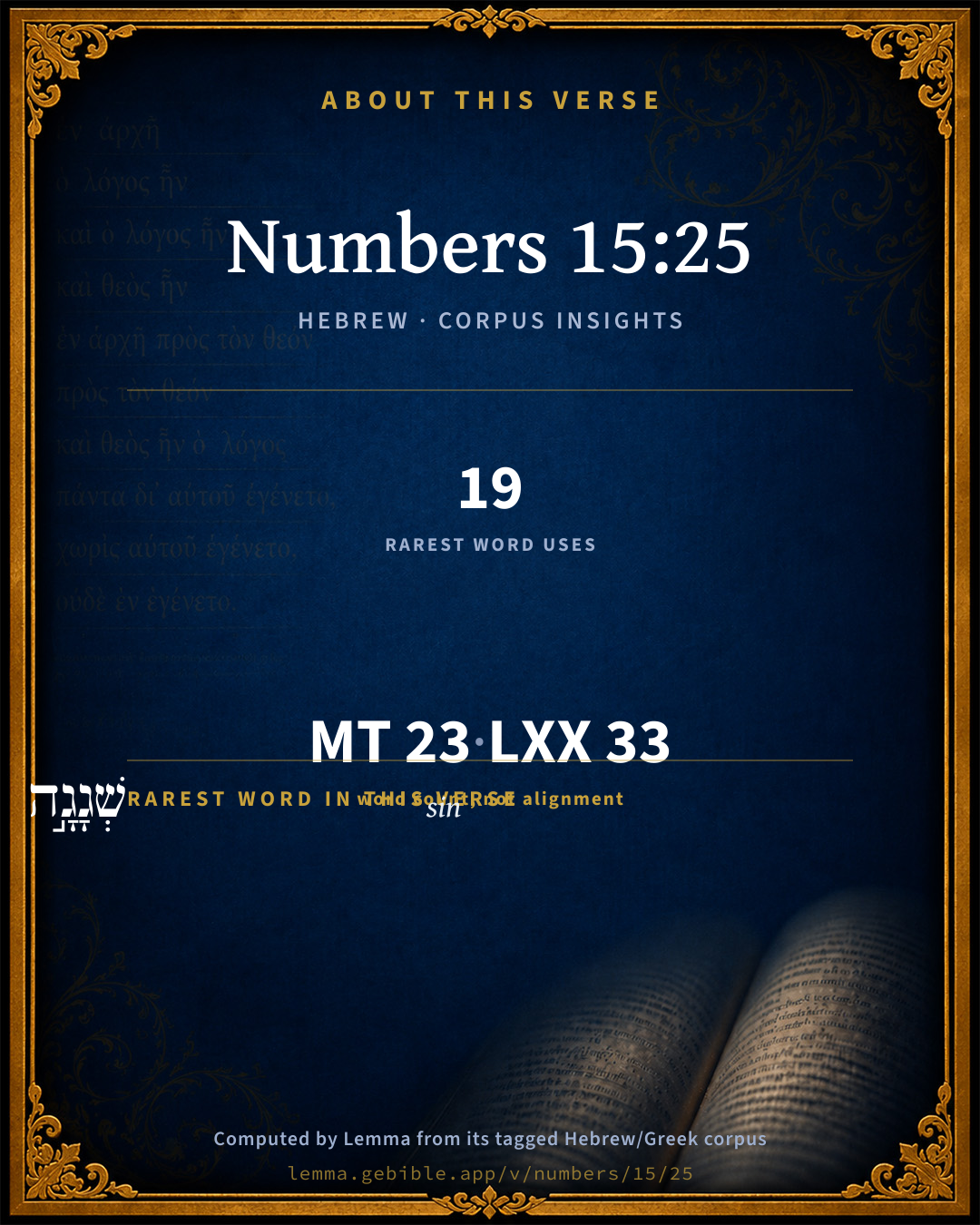
23
words
19
distinct lemmas
Pentateuch
section

Notable vocabulary

The rarest word here is שְׁגָגָ֣ה sin H7684 — appearing just 19 times in the whole Hebrew Bible.

Shared distinctive vocabulary

שְׁגָגָ֣ה sin H7684 occurs in 18 verses of the Hebrew Bible. Also found in:

Grammatical profile

  • 3 verbs
  • 13 nouns
  • 2 pronouns
  • 3 prepositions
  • 1 conjunction
  • 1 particle

Verb forms

  • וְכִפֶּ֣ר Piel · Sequential Perfect
  • וְנִסְלַ֣ח Niphal · Perfect
  • הֵבִ֨יאוּ Hiphil · Perfect

Repetition

Words recur within this verse — often emphatic in Hebrew:

  • עַֽל upon H5921 ×2
  • שְׁגָגָ֣ה sin H7684 ×2
  • לַֽיהוָ֗ה LORD H3068 ×2

Hebrew & Septuagint length

In English translation the verse runs 45 words from the Hebrew and 49 from the Septuagint (LXX English) — closely comparable.

A rough comparison of the two English renderings, which tokenize alike — not a word-level alignment.

Word counts can differ between the Hebrew and the Greek without any difference in meaning — e.g. the Hebrew direct-object marker אֵת has no separate Greek word, and Greek often adds the article ὁ.

In the original languages it is 23 Hebrew tokens and 33 Greek tokens — but the two are counted differently (Hebrew bundles its prefixes and suffixes into one token; the Greek is in lemma form), so that isn’t a like-for-like length.

Cross-references

7

Topical passages linked to Numbers 15:25 in the Treasury of Scripture Knowledge — connected by theme and wording, ordered by reader-vote popularity; previews shown in the World English Bible.

  • Leviticus 4:20 Thus shall he do with the bull; as he did with the bull of the sin offering, so shall he do with this; and the priest shall make atonement for them, and they shall be forgiven.
  • Romans 3:25 whom God set forth to be an atoning sacrifice, through faith in his blood, for a demonstration of his righteousness through the passing over of prior sins, in God's forbearance;
  • Hebrews 2:17 Therefore he was obligated in all things to be made like his brothers, that he might become a merciful and faithful high priest in things pertaining to God, to make atonement for the sins of the people.
  • Leviticus 4:26 All its fat he shall burn on the altar, like the fat of the sacrifice of peace offerings; and the priest shall make atonement for him concerning his sin, and he will be forgiven.
  • Luke 23:34 Jesus said, "Father, forgive them, for they don't know what they are doing." Dividing his garments among them, they cast lots.
  • Acts 13:39 and by him everyone who believes is justified from all things, from which you could not be justified by the law of Moses.
  • 1 John 2:2 And he is the atoning sacrifice for our sins, and not for ours only, but also for the whole world.

Cross-references courtesy of OpenBible.info (CC BY 4.0).

Hebrew and Greek witnesses Masoretic Hebrew ↔ Greek Septuagint

The same verse in the two great witnesses to the Old Testament, shown verse-for-verse.

These are two independent witnesses, not word-aligned to each other, and the Septuagint is shown in lemma (dictionary) form.

Hebrew Numbers 15:25 Masoretic · Westminster Leningrad Codex

וְכִפֶּ֣ר הַכֹּהֵ֗ן עַֽל כָּל עֲדַ֛ת בְּנֵ֥י יִשְׂרָאֵ֖ל וְנִסְלַ֣ח לָהֶ֑ם כִּֽי שְׁגָגָ֣ה הִ֔וא וְהֵם֩ הֵבִ֨יאוּ אֶת קָרְבָּנָ֜ם אִשֶּׁ֣ה לַֽיהוָ֗ה וְחַטָּאתָ֛ם לִפְנֵ֥י יְהוָ֖ה עַל שִׁגְגָתָֽם

The priest shall make atonement for all the congregation of the children of Israel, and they shall be forgiven; for it was an error, and they have brought their offering, an offering made by fire to Yahweh, and their sin-offering before Yahweh, for their error:

World English Bible · Public Domain

Greek LXX Numbers 15:25 Septuagint · lemma form

καί ἐκἱλάσκομαι ὁ ἱερεύς περί πᾶς συναγωγή υἱός ἰσραήλ καί ἀποἵημι αὐτός ὅτι ἀκούσιος εἰμί καί αὐτός φέρω ὁ δῶρον αὐτός κάρπωμα κύριος περί ὁ ἁμαρτία αὐτός ἔναντι κύριος περί ὁ ἀκούσιος αὐτός

And the priest shall make atonement for all the congregation of the children of Israel, and the trespass shall be forgiven them, because it is involuntary; and they have brought their gift, a burnt offering to the Lord for their trespass before the Lord, even for their involuntary sins.

LXX2012 (modern English Septuagint) · Public Domain

Hebrew: Westminster Leningrad Codex (CC BY 4.0). Greek: Septuagint (public domain); English from LXX2012 (modern English Septuagint) (Public Domain). How the Septuagint differs from the Hebrew →

Targum (Aramaic paraphrase)

2

The Targum is the ancient Jewish Aramaic paraphrase of the Hebrew Scriptures — an interpretive translation, not the Hebrew text itself. Onkelos (literal) and Pseudo-Jonathan (expansive) render the Torah, and Jonathan the Prophets. Coverage is partial: where no permissively-licensed English translation exists for a verse, only the Aramaic is shown. This is verse-level text, not a word-by-word alignment to the Hebrew.

  1. Targum Onkelos Torah (Genesis–Deuteronomy)
    וִיכַפַּר כַּהֲנָא עַל כָּל כְּנִשְׁתָּא דִבְנֵי יִשְׂרָאֵל וְיִשְׁתְּבֵק לְהוֹן אֲרֵי שָׁלוּתָא הִיא וְאִנוּן אַיְתִיאוּ יָת קֻרְבַּנְהוֹן קֻרְבָּנָא קֳדָם יְיָ וְחוֹבַתְהוֹן קֳדָם יְיָ עַל שָׁלוּתְהוֹן

    (no public-domain English translation for this verse)

    Targum Onkelos — Aramaic: “Onkelos Genesis” (public domain); “Onkelos Exodus” (public domain); “Onkelos Leviticus” (public domain); “Onkelos Numbers” (public domain); “Onkelos Deuteronomy” (public domain). English: “Sefaria Community Translation” (CC0 1.0 (public-domain dedication)); “J.W. Etheridge. The Targums of Onkelos and Jonathan Ben Uzziel on the Pentateuch. London: Longmans, Green, 1862” (public domain). Text via Sefaria.

  2. Targum Pseudo-Jonathan Torah (Genesis–Deuteronomy)
    וִיכַפֵּר כַּהֲנָא עַל כָּל כְּנִשְׁתָּא דִבְנֵי יִשְרָאֵל וְיִשְׁתְּרֵי לְהוֹן אֲרוּם שְׁלוּתָא הִיא וְהִינוּן הַיְיתִיאוּ יַת קוּרְבָּנֵיהוֹן קָרְבָּנָא קֳדָם יְיָ וְקָרְבַּן סוּרְחָנוּתְהוֹן קְרִיבוּ קֳדָם יְיָ עַל שְׁלוּתְהוֹן

    and let the priest make atonement for all the congregation of the sons of Israel, and it shall be forgiven them; for it was an error, and they have brought their oblation, an offering before the Lord, even an offering for their sin have they presented before the Lord for their error;

    Targum Pseudo-Jonathan — Aramaic: “Targum Jonathan on Genesis” (public domain); “Targum Jonathan on Exodus” (public domain); “Targum Jonathan on Leviticus” (public domain); “Targum Jonathan on Numbers” (public domain); “Targum Jonathan on Deuteronomy” (public domain). English: “The Targum of Jonathan ben Uzziel, trans. J. W. Etheridge, London, 1862” (public domain). Text via Sefaria.

Commentary

Notes on Numbers 15:25 from classic Christian and Jewish commentators (each source and its license shown beneath its notes). The classic Christian expositions comment on the surrounding passage and are grouped to its opening verse, so a note may address several verses; the Jewish commentaries on the Tanakh (Rashi and others) are per-verse, so they appear only where the commentator wrote on this verse.

Lemma curates 59 commentaries, every one of them public domain or Creative Commons licensed, each selected and text-cleaned for this edition rather than reprinted as found. About our sources →

John Gill's Exposition

And it shall be forgiven all the congregation of the children of Israel,.... Which is repeated for the certainty of it, and for the sake of what follows:

and the stranger that sojourneth among them; the proselyte of righteousness; so the blessing of pardon, through the propitiatory sacrifice of Christ, comes upon believing Gentiles as well as Jews, Rom 4:9,

seeing all the people were in ignorance; both the congregation of Israel and the stranger; See Gill on Num 15:25.

John Gill's Exposition of the Whole Bible (1746–1763) — public domain (CC PDM 1.0). Text via the HelloAO Bible API.

The Biblical Illustrator

Joseph S. Exell

Num_15:25

Sin-offering . . . for their ignorance.

Pardon of unknown sins through Christ

1. Because of our ignorance we are not fully aware of our sins of ignorance. Yet they are many, in the form both of commission and omission. We may be doing in all sincerity, as a service to God, that which He has not commanded and can never accept.

2. The Lord knows these sins of ignorance every one. This may well alarm us, since in justice He will require these trespasses at our hand; but, again, faith spies comfort in this fact, for the Lord will see to it that stains unseen by us shall yet be washed away. He sees the sin that He may cease to see it by casting it behind His back.

3. Our great comfort is that Jesus, the true Priest, has made atonement for all the congregation of Israel. That atonement secures the pardon of unknown sins. His precious blood cleanses us from all sin. (C. H. Spurgeon.)

The Biblical Illustrator, edited by Joseph S. Exell (c. 1880s–1900s) — public domain. Text from a community e-Sword module.

Joseph Benson's Commentary

Num 15:25. It shall be forgiven, for it is ignorance — Proceeding from some mistake, and not from contempt of God and his laws; for then the guilty person was to be utterly cut off.

Joseph Benson's Commentary on the Old and New Testaments (1811–1818) — public domain. Text from a community e-Sword module.

Adam Clarke's Commentary

Verse 25. The priest shall make an atonement] Even sins committed through ignorance required an atonement; and God in his mercy has provided one for them.

Adam Clarke's Commentary on the Bible (1810–1826) — public domain. Text from a community e-Sword/MySword module.

Ellicott's Commentary for English Readers

(25) For it is ignorance.—Rather, for it is a sin of ignorance, or an error. So also at the end of the verse.

A Bible Commentary for English Readers, edited by Charles John Ellicott (1878–1897) — public domain. Text from a community e-Sword module.

Haydock's Catholic Bible Commentary

And for. Hebrew, "and their sin (offering) in the presence of the Lord, for their ignorance." (Calmet)

George Leo Haydock (1774–1849), Haydock's Catholic Family Bible and Commentary, 1859 edition — public domain. Excludes Psalms (Douay-Rheims chapter numbering differs from Protestant) and Deuterocanonical books (Catholic canon only).

Whedon's Commentary on the Bible

Daniel D. Whedon

25. An atonement — “In all our inquiries into the various senses wherein this term is used, and into the significance of the different ceremonies connected with the act of atonement, the fundamental meaning, to cover or conceal, must be kept in mind.” — Suskind. The word occurs in its proper sense only in Gen_6:14. In Piel usage has affixed to it the meaning “to atone.” Atonement, therefore, must be equivalent to the covering up or concealing of that which God cannot allow to appear in his presence. It is a constructive disappearance or annihilation. Thus in Jer_18:23, forgiveness of sin and blotting it out are convertible expressions. With the rabbins, “to atone” means to deny existence to — to deem as not being. That which creates estrangement between God and the sinner is in effect annihilated. “We cannot reasonably say that in this case the divine punitive justice terminates in nothing; on the contrary, that justice is honoured when the offerer declares that he is destitute of a covering before the holy God, and thereby acknowledges him as one who, though sinning in weakness, is exposed to the divine judgment.” — Oehler. The common objection that the soul, or life, of the sacrificial animal, laden with the curse of the sinner, might not be laid upon the holy altar as his substitute is effectually answered by the consideration that through death, the wages of sin, the blood is to be viewed as pure and free from guilt. See Lev_1:4; Lev_4:20; Lev_12:7, notes.

For it is ignorance — R.V., “error.” See Lev_4:2, and the concluding notes to the same chapter; also Heb_9:7, note.

Daniel D. Whedon (gen. ed.), Commentary on the Old and New Testaments (1874–1909) — public domain. Text from a community e-Sword module.

Scofield Reference Notes

C. I. Scofield

atonement

(See Scofield "Exo 29:33").

The Scofield Reference Bible (1917 edition), notes by C. I. Scofield — public domain. Text from a community e-Sword module.

unfoldingWord translationNotes

Door43 World Missions Community

They will be forgiven

This can be stated in active form. AT: "I will forgive them" (See: Active or Passive)

made by fire

This can be stated in active form. AT: "that they made by fire" or "that they burned on the altar" (See: Active or Passive)

all the community of the people of Israel will be forgiven

This can be stated in active form. AT: "I will forgive all the community of the people of Israel" (See: Active or Passive)

translationWords

priest

atonement

Israel

forgive

sacrifice

burnt offering

alien

unfoldingWord translationNotes — © Distant Shores Media and the Door43 World Missions Community, licensed CC BY-SA 4.0. Source: git.door43.org/Door43/en_tn.

Rashi

Rabbi Shlomo Yitzchaki (Rashi)

הביאו את קרבנם אשה לה׳ [AND] THEY HAVE BROUGHT THEIR OFFERING, A FIRE OFFERING UNTO THE LORD — This is that offering mentioned previously in this chapter (v. 24), viz., the bullock for a burnt offering, since it says here, “a fire offering to the Lord” (which is a description of a burnt offering) (Sifrei Bamidbar 111:3).

וחטאתם AND THEIR SIN OFFERING — This is the he-goat (mentioned in v. 24).

Rashi on the Tanakh — English translations: “The Judaica Press complete Tanach with Rashi, translated by A. J. Rosenberg” (CC BY 4.0); “Pentateuch with Rashi's commentary by M. Rosenbaum and A.M. Silbermann, 1929-1934” (public domain); “The Metsudah Tanach series, Lakewood, N.J” (CC BY 4.0); and “The Book of Joshua, Metsudah Publications, 1997” (CC BY 4.0). Text via Sefaria.

Ramban (Nachmanides)

Rabbi Moshe ben Nachman (Ramban / Nachmanides)

AND THEY HAVE BROUGHT THEIR OFFERING, AN OFFERING MADE BY FIRE UNTO THE ETERNAL. This refers to the bullock as a burnt-offering mentioned [in the preceding verse]. AND THEIR SIN-OFFERING, which refers to the he-goat for a sin-offering [mentioned there]. Scripture states this on account of the greatness of the sin, involving as it does all the commandments of G-d, and is thereby saying that although the sin was exceedingly grave, since it was in error and they have brought their offerings for it, the burnt-offering and the sin-offering, they are worthy of atonement. And in the Sifre 111. the Rabbis interpreted this verse on the basis of its [apparent] redundancy: “Rabbi Yashiyah says: If the whole of one tribe [unwittingly] acted [committed idolatry] on the basis of a [mistaken] decision of the [chief] court of that tribe, and the other tribes did so [too, on their word], whence do we know that they [the other tribes] must also bring [these prescribed offerings] on account of them [i.e., the people of the particular tribe who acted according to the decision of its chief court]? Scripture therefore states, ‘and they’ have brought their offering, an offering made by fire unto the Eternal. Rabbi Yonathan says etc.” ).And by way of the Truth, [the mystic teachings of the Cabala], I have already informed you that wherever the Tetragrammaton is mentioned it refers to the attribute of mercy, and the expression ‘liphnei Hashem’ [before the Eternal — as here in the phrase: and their sin-offering ‘before the Eternal’] is like ‘al panai’ (before Me), 20:3. Literally “upon My face.” and this is similar to what the Rabbis of blessed memory have said: “He and His Celestial Court.” Thus the verse is stating that “they have brought their offering to the Proper Name of G-d [i.e., the Tetragrammaton], (an offering made by fire to the Eternal) where the Hebrew for the Eternal is the Tetragrammaton. Ramban explained at the beginning of his commentary on this verse that their offering refers to the burnt-offering, which was thus offered to the Tetragrammaton, the Divine Name symbolizing G-d’s attribute of mercy; and the second half of the verse speaks of sin-offering brought l’phanai, i.e., to the Name symbolizing the attribute of judgment. Hence [in the concluding words of Ramban] “the sin is atoned for in the attribute of mercy and in the attribute of judgment.” and their sin-offering ‘l’phanai’ (before Me),” and thus the sin is atoned for in the attribute of mercy and in the attribute of judgment. He mentioned this in the case of idolatry [due to the gravity of the sin, because of which they need to be forgiven in both attributes], but in Seder Vayikra where [the sin-offering for violation of] the other commandments is commanded, He mentioned many times ‘liphnei Hashem’ (before the Eternal). and the reason for this is clear.

Ramban (Nachmanides) on the Tanakh — English translation: “Commentary on the Torah by Ramban (Nachmanides). Translated and annotated by Charles B. Chavel. New York, Shilo Pub. House, 1971-1976” (CC BY 4.0). Text via Sefaria.

Lesson kit

Teaching starters — assembled from the data on this page, not authored interpretation. Every prompt links to the verse data it draws on. Edit before teaching.

Numbers, in the Pentateuch, opens this verse with 23 words (19 distinct Hebrew lemmas). Its most distinctive word is shᵉgâgâh (“sin”). A historical commentator’s framing appears above. Read the whole chapter for the surrounding context.

Discussion questions

  1. The word shᵉgâgâh carries the sense “sin.” How does it shape the verse?
  2. How does Leviticus 4:2, which shares the word «sin», read alongside this verse?
  3. What does the repetition of “upon” (2× in this one verse) do in this verse?
  4. These translations render this verse differently. What is at stake in choosing one wording over another?
  5. «וְכִפֶּ֣ר» is a Piel Sequential Perfect verb. How does that grammatical form shape the action described?
  6. Compare how John Gill's Exposition and The Biblical Illustrator read this verse. Where do they agree or differ?

Things to notice

Reading settings

Reading text

Shown beneath each verse's original-language words.

Old Testament
Old Testament edition

Read the OT as the Masoretic Hebrew (MT) or the Greek Septuagint (LXX).

English shown for the Greek Septuagint (in the Hebrew ↔ Greek comparison).

Comparing translations? Open the Compare panel on any verse page to stack up to four side by side.