
1 Samuel 9:22

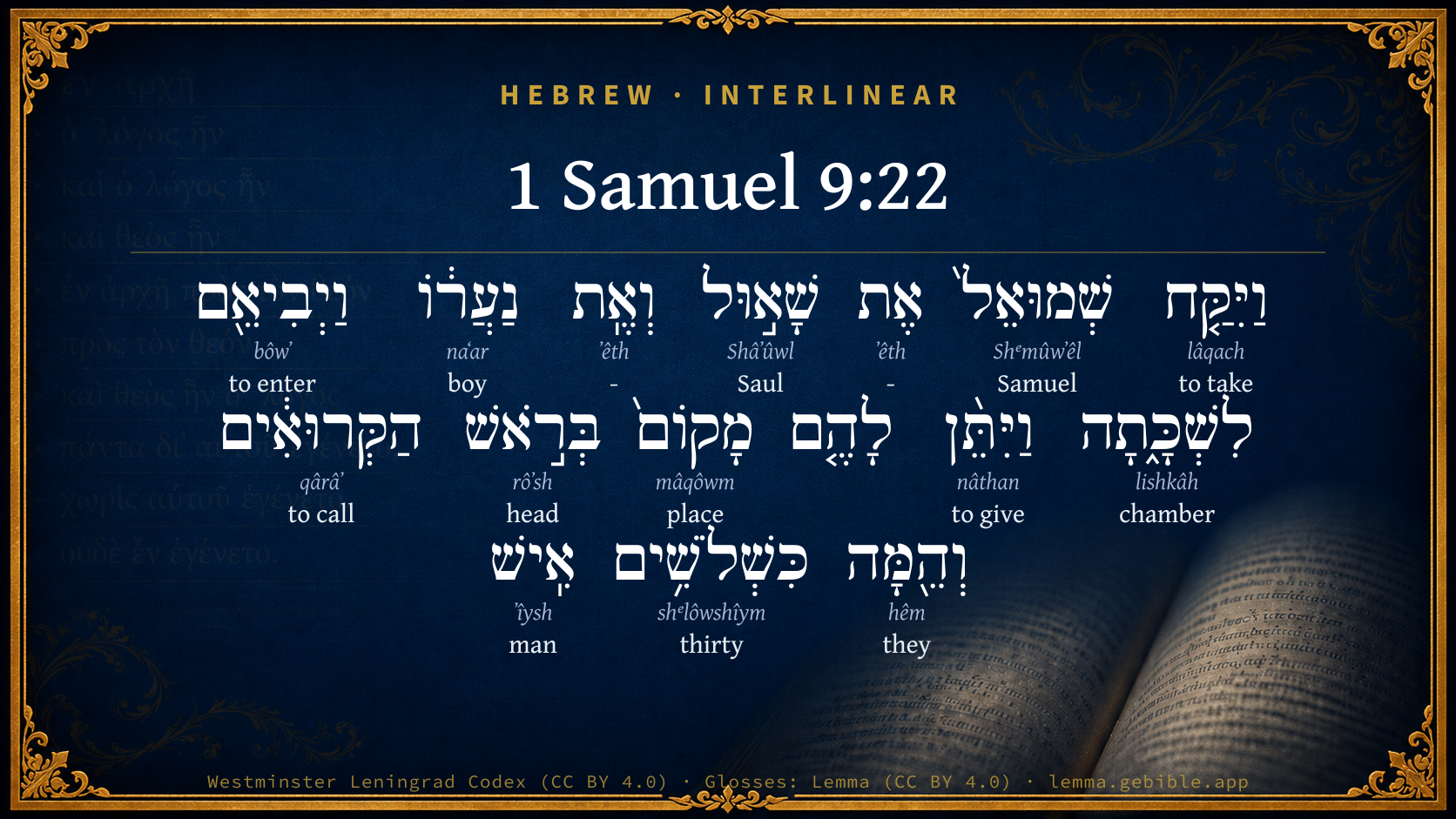
Hebrew (Westminster Leningrad Codex) 1 Samuel 9:22 appears in the Hebrew Old Testament. The text above is from the Westminster Leningrad Codex. Each word links to its Strong’s number, a concise gloss, and parsing drawn from the Open Scriptures Hebrew Bible morphology. Click any word for its full Brown-Driver-Briggs (BDB) entry.
Download image
Cite this verse

1 Samuel 9:22 (World English Bible). Public Domain. Lemma interlinear Bible study tool, https://lemma.gebible.app/v/1-samuel/9/22.

Show BibTeX & RIS
BibTeX
RIS
English Translation
Samuel took Saul and his servant, and brought them into the guest-chamber, and made them sit in the best place among those who were invited, who were about thirty persons.
World English Bible · Public Domain
Highlights
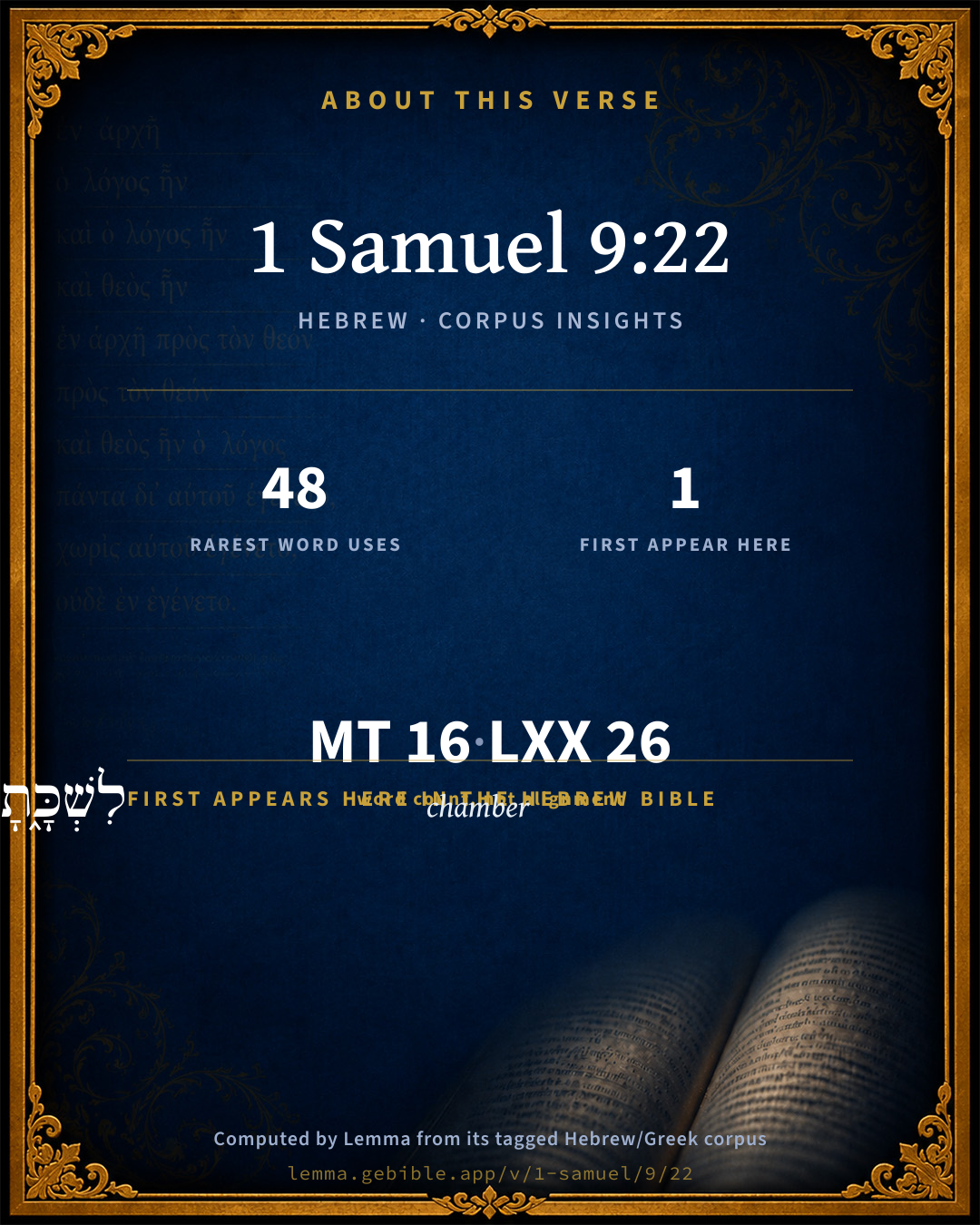
  • 1 first appearance in the Hebrew Bible
Full analysis ↓
Download a study sheet

One document with this verse’s original text, its word-by-word gloss line, the meaning frame, cross-references with their text, attributed commentary, and full source and license credits — printable, and it pastes into notes with its structure intact.

This verse Autodidact and up

Study sheet (.html) Plain text (.txt)

A passage Seminary Student

Up to 50 verses in one chapter. A passage sheet keeps up to 6 commentary sources and 12 cross-references per verse, in the order this page ranks them, and says so on the sheet whenever that leaves anything out. Ask for a single verse and you get the Autodidact verse sheet above.

Everything on this page stays free to read, with no account — the sheet is a download of what is already on screen, not access to it.

Want to remove ads? Support Godless Engineer
Compare translations 3

The same verse in 3 English versions, stacked beneath the original-language interlinear above. Click any original word for its lexicon entry.

Each is an independent rendering of the whole verse — the interlinear is not word-aligned to these translations.

Highlighted words mark where these versions differ — a whole-verse word diff, not a word-by-word alignment.

  • World English Bible Public Domain
    Samuel took Saul and his servant, and brought them into the guest-chamber, and made them sit in the best place among those who were invited, who were about thirty persons.
  • King James Version Public Domain
    And Samuel took Saul and his servant, and brought them into the parlor, and made them sit in the chiefest place among them that were bidden, which were about thirty persons.
  • unfoldingWord Literal Text CC BY-SA 4.0
    But Samuel took Saul and his servant and brought them to the room. And he gave to them a place at the head of the invited. (Now they about 30 men.)

unfoldingWord Literal Text — © unfoldingWord, licensed CC BY-SA 4.0. Word-aligned USFM3 via Door43 (git.door43.org/unfoldingWord/en_ult).

Versions to compare (up to 4)

3 of 4 selected

Show all 18 translations

Every available English version of this verse, each an independent rendering of the whole verse.

  • World English Bible Public Domain
    Samuel took Saul and his servant, and brought them into the guest-chamber, and made them sit in the best place among those who were invited, who were about thirty persons.
  • Berean Standard Bible Public Domain
    Then Samuel took Saul and his servant, brought them into the hall, and seated them in the place of honor among those who were invited—about thirty in all.
  • Majority Standard Bible Public Domain
    Then Samuel took Saul and his servant, brought them into the hall, and seated them in the place of honor among those who were invited—about thirty in all.
  • King James Version Public Domain
    And Samuel took Saul and his servant, and brought them into the parlor, and made them sit in the chiefest place among them that were bidden, which were about thirty persons.
  • American Standard Version (1901) Public Domain
    And Samuel took Saul and his servant, and brought them into the guest-chamber, and made them sit in the chiefest place among them that were bidden, who were about thirty persons.
  • Revised Version (1885) Public Domain
    And Samuel took Saul and his servant, and brought them into the guest-chamber, and made them sit in the chiefest place among them that were bidden, which were about thirty persons.
  • Geneva Bible (1599) Public Domain
    And Samuel tooke Saul and his seruant, and brought them into the chamber, and made them sit in the chiefest place among them that were bidden: which were about thirtie persons.
  • Douay-Rheims (1899) Public Domain
    Then Samuel taking Saul and his servant, brought them into the parlour, and gave them a place at the head of them that were invited. For there were about thirty men.
  • Young's Literal Translation Public Domain
    And Samuel taketh Saul, and his young man, and bringeth them in to the chamber, and giveth to them a place at the head of those called; and they `are' about thirty men.
  • Literal Standard Version CC BY-SA 4.0
    And Samuel takes Saul, and his young man, and brings them into the chamber, and gives a place to them at the head of those called; and they [are] about thirty men.
  • Unlocked Literal Bible CC BY-SA 4.0
    So Samuel took Saul and his servant, brought them into the hall, and seated them at the head place of those who had been invited, who were about thirty people.
  • unfoldingWord Literal Text CC BY-SA 4.0
    But Samuel took Saul and his servant and brought them to the room. And he gave to them a place at the head of the invited. (Now they about 30 men.)
  • Darby Bible Public Domain
    And Samuel took Saul and his servant, and brought them into the chamber, and gave them a place at the head of them that were invited; and they were about thirty persons.
  • World Messianic Bible Public Domain
    Samuel took Saul and his servant and brought them into the guest room, and made them sit in the best place among those who were invited, who were about thirty persons.
  • Webster's Bible Public Domain
    And Samuel took Saul, and his servant, and brought them into the parlor, and made them sit in the chief place among them that were invited, who were about thirty persons.
  • Free Bible Version CC BY-SA 4.0
    Then Samuel brought Saul and his servant into the hall, and sat them at the head of the thirty people who'd been invited.
  • Bible in Basic English Public Domain
    Then Samuel took Saul and his servant into the guest room, and made them take the chief place among all the guests who were there, about thirty persons.
  • JPS Tanakh (1917) Public Domain
    And Samuel took Saul and his servant, and brought them into the chamber, and made them sit in the chiefest place among them that were bidden, who were about thirty persons.

Literal Standard Version (2020), Covenant Press — licensed CC BY-SA 4.0. Text via the HelloAO Bible API (eBible.org). Unlocked Literal Bible (unfoldingWord) — licensed CC BY-SA 4.0. Text via the HelloAO Bible API (eBible.org). unfoldingWord Literal Text — © unfoldingWord, licensed CC BY-SA 4.0. Word-aligned USFM3 via Door43 (git.door43.org/unfoldingWord/en_ult). Free Bible Version, Dr. Jonathan Gallagher — licensed CC BY-SA 4.0. Text via the HelloAO Bible API (eBible.org).

Word by word

More ways to search: Search by grammar → Find every occurrence → Compare this word →

Practice this passage: Drill this verse → Learn its vocabulary →

לִשְׁכָּ֑תָה
lishkâh
H3957
“chamber · toward”
Noun, Common, Feminine, Singular, Absolute + Suffix, Demonstrative
Part of Speech
Noun
Type
Common
Gender
Feminine
Number
Singular
State
Absolute
Full BDB Definition

Origin: from an unused root of uncertain meaning

TWOT: 1129a

room, chamber, hall, cell
  1. וַיִּקַּ֤ח lâqach H3947 “and · to take” Conjunction + Verb, Qal, Sequential Imperfect, 3rd Person, Masculine, Singular
  2. שְׁמוּאֵל֙ Shᵉmûwʼêl H8050 “Samuel” Noun, Proper
  3. אֶת ʼêth H853 “-” Particle, Direct Object
  4. שָׁא֣וּל Shâʼûwl H7586 “Saul” Noun, Proper
  5. וְאֶֽת ʼêth H853 “and · -” Conjunction + Particle, Direct Object
  6. נַעֲר֔וֹ naʻar H5288 “boy · his” Noun, Common, Masculine, Singular, Construct + Suffix, Personal, 3rd Person, Masculine, Singular
  7. וַיְבִיאֵ֖ם bôwʼ H935 “and · to enter · them” Conjunction + Verb, Hiphil, Sequential Imperfect, 3rd Person, Masculine, Singular + Suffix, Personal, 3rd Person, Masculine, Plural
  8. וַיִּתֵּ֨ן nâthan H5414 “and · to give” Conjunction + Verb, Qal, Sequential Imperfect, 3rd Person, Masculine, Singular
  9. מָקוֹם֙ mâqôwm H4725 “place” Noun, Common, Masculine, Singular, Absolute
  10. בְּרֹ֣אשׁ rôʼsh H7218 “in/at · head of” Preposition + Noun, Common, Masculine, Singular, Construct
  11. הַקְּרוּאִ֔ים qârâʼ H7121 “the · called” Particle, Definite Article + Verb, Qal, Participle Passive, Masculine, Plural, Absolute
  12. וְהֵ֖מָּה hêm H1992 “and · they” Conjunction + Pronoun, Personal, 3rd Person, Masculine, Plural
  13. כִּשְׁלֹשִׁ֥ים shᵉlôwshîym H7970 “like/as · thirty” Preposition + Adjective, Cardinal number, Both, Plural, Absolute
  14. אִֽישׁ ʼîysh H376 “man” Noun, Common, Masculine, Singular, Absolute

About this verse

These counts appear in no published source. They are computed here, from the morphology-tagged text and Lemma’s own curated glosses. What Lemma adds →

16
words
14
distinct lemmas
Historical
section

First appearance in Scripture

This word makes its first canonical appearance in the Hebrew Bible here:

  • לִשְׁכָּ֑תָה chamber H3957

Shared distinctive vocabulary

לִשְׁכָּ֑תָה chamber H3957 occurs in 41 verses of the Hebrew Bible. Also found in:

Grammatical profile

  • 4 verbs
  • 7 nouns
  • 1 adjective
  • 1 pronoun
  • 1 preposition
  • 2 particles

Verb forms

  • וַיִּקַּ֤ח Qal · Sequential Imperfect
  • וַיְבִיאֵ֖ם Hiphil · Sequential Imperfect
  • וַיִּתֵּ֨ן Qal · Sequential Imperfect
  • הַקְּרוּאִ֔ים Qal · Participle Passive

Hebrew & Septuagint length

In English translation the verse runs 30 words from the Hebrew and 30 from the Septuagint (LXX English) — the same length.

A rough comparison of the two English renderings, which tokenize alike — not a word-level alignment.

Word counts can differ between the Hebrew and the Greek without any difference in meaning — e.g. the Hebrew direct-object marker אֵת has no separate Greek word, and Greek often adds the article ὁ.

In the original languages it is 16 Hebrew tokens and 26 Greek tokens — but the two are counted differently (Hebrew bundles its prefixes and suffixes into one token; the Greek is in lemma form), so that isn’t a like-for-like length.

Cross-references

2

Topical passages linked to 1 Samuel 9:22 in the Treasury of Scripture Knowledge — connected by theme and wording, ordered by reader-vote popularity; previews shown in the World English Bible.

  • Genesis 43:32 They served him by himself, and them by themselves, and the Egyptians, that ate with him, by themselves, because the Egyptians don't eat bread with the Hebrews, for that is an abomination to the Egyptians.
  • Luke 14:10 But when you are invited, go and sit in the lowest place, so that when he who invited you comes, he may tell you, 'Friend, move up higher.' Then you will be honored in the presence of all who sit at the table with you.

Cross-references courtesy of OpenBible.info (CC BY 4.0).

Hebrew and Greek witnesses Masoretic Hebrew ↔ Greek Septuagint

The same verse in the two great witnesses to the Old Testament, shown verse-for-verse.

These are two independent witnesses, not word-aligned to each other, and the Septuagint is shown in lemma (dictionary) form.

Hebrew 1 Samuel 9:22 Masoretic · Westminster Leningrad Codex

וַיִּקַּ֤ח שְׁמוּאֵל֙ אֶת שָׁא֣וּל וְאֶֽת נַעֲר֔וֹ וַיְבִיאֵ֖ם לִשְׁכָּ֑תָה וַיִּתֵּ֨ן לָהֶ֤ם מָקוֹם֙ בְּרֹ֣אשׁ הַקְּרוּאִ֔ים וְהֵ֖מָּה כִּשְׁלֹשִׁ֥ים אִֽישׁ

Samuel took Saul and his servant, and brought them into the guest-chamber, and made them sit in the best place among those who were invited, who were about thirty persons.

World English Bible · Public Domain

Greek LXX 1 Samuel 9:22 Septuagint · lemma form

καί λαμβάνω σαμουηλ ὁ σαούλ καί ὁ παιδάριον αὐτός καί εἰςἄγω αὐτός εἰς ὁ κατάλυμα καί τίθημι αὐτός τόπος ἐν πρῶτος ὁ καλέω ὡσεί ἑβδομήκοντα ἀνήρ

And Samuel took Saul and his servant, and brought them to the inn, and set them there a place among the chief of those that were called, about seventy men.

LXX2012 (modern English Septuagint) · Public Domain

On this verse, John Gill's Exposition discusses the Septuagint’s reading. Read the note in Commentary ↓

Hebrew: Westminster Leningrad Codex (CC BY 4.0). Greek: Septuagint (public domain); English from LXX2012 (modern English Septuagint) (Public Domain). How the Septuagint differs from the Hebrew →

Targum (Aramaic paraphrase)

1

The Targum is the ancient Jewish Aramaic paraphrase of the Hebrew Scriptures — an interpretive translation, not the Hebrew text itself. Onkelos (literal) and Pseudo-Jonathan (expansive) render the Torah, and Jonathan the Prophets. Coverage is partial: where no permissively-licensed English translation exists for a verse, only the Aramaic is shown. This is verse-level text, not a word-by-word alignment to the Hebrew.

  1. Targum Jonathan Prophets (Joshua–Malachi)
    וּדְבַר שְׁמוּאֵל יַת שָׁאוּל וְיַת עוּלֵימֵיהּ וְאָעֵלִינוּן לְאַסְחֲרוּתָא וִיהַב לְהוֹן אֲתַר בְּרֵישׁ זְמִינַיָא וְאִינוּן כִּתְלָתִין גַבְרָא:

    (no public-domain English translation for this verse)

    Targum Jonathan — Aramaic: “Mikraot Gedolot” (public domain). English: “Sefaria Community Translation” (CC0 1.0 (public-domain dedication)); “London "Chaldee Paraphrase," 1871” (public domain). Text via Sefaria.

Commentary

Notes on 1 Samuel 9:22 from classic Christian and Jewish commentators (each source and its license shown beneath its notes). The classic Christian expositions comment on the surrounding passage and are grouped to its opening verse, so a note may address several verses; the Jewish commentaries on the Tanakh (Rashi and others) are per-verse, so they appear only where the commentator wrote on this verse.

Lemma curates 59 commentaries, every one of them public domain or Creative Commons licensed, each selected and text-cleaned for this edition rather than reprinted as found. About our sources →

Trapp's Complete Commentary

John Trapp

1Sa 9:22 And Samuel took Saul and his servant, and brought them into the parlour, and made them sit in the chiefest place among them that were bidden, which [were] about thirty persons.

Ver. 22. And made them sit in the chiefest place.] He envied not Saul’s new dignity, though it were to the diminution of his own: sed excipit eum et tractat humanissime atque honorificentissime; { a} but giveth him the place.

{a} Piscat.

John Trapp, A Commentary or Exposition upon All the Books of the Old and New Testament (1647–1656) — public domain. Text from a community e-Sword module.

Joseph Benson's Commentary

1Sa 9:22. In the chiefest place — Thereby to raise their expectation, and to prepare them for giving that honour to Saul which his approaching dignity required.

Joseph Benson's Commentary on the Old and New Testaments (1811–1818) — public domain. Text from a community e-Sword module.

Geneva Bible (1599)

Geneva Bible translators

Where the feast was.

Geneva Bible (1599) marginal notes — public domain. Text via Bolls.life.

Jamieson, Fausset & Brown

Robert Jamieson, A. R. Fausset & David Brown

Samuel took Saul and his servant, and brought them into the parlour--The toil-worn but noble-looking traveller found himself suddenly seated among the principal men of the place and treated as the most distinguished guest.

Jamieson, Fausset & Brown — Commentary Critical and Explanatory on the Whole Bible (1871) — public domain (CC PDM 1.0). Text via the HelloAO Bible API.

Adam Clarke's Commentary

Verse 22. Brought them into the parlour] It might as well be called kitchen; it was the place where they sat down to feast.

Adam Clarke's Commentary on the Bible (1810–1826) — public domain. Text from a community e-Sword/MySword module.

Ellicott's Commentary for English Readers

(22) And Samuel took Saul.—The seer gave Saul no answer to this question, in which the young man’s wonderment was expressed that one so insignificant should be chosen for so high a destiny. Samuel merely wished, in the first instance, to awaken new and grander thoughts and aspirations in this young heart, and without reply he proceeded to conduct his guests to the scene of the sacrifice on the high place. In the guest-chamber, where thirty of the most distinguished persons present at the solemn sacrifice were assembled. Samuel places Saul and his companion, no doubt to their great surprise, in the principal seats. “The parlour” is an unfortunate rendering of the Hebrew word here, which signifies the “cell,” or “chamber” attached to the building on the high place, for such purposes as the present. These solemn sacrificial meals were the usual adjuncts of a solemn sacrifice.

Not only was Saul thus highly honoured in public as the future king, but his servant also. If, as tradition tells us, this servant was Doeg the Edomite, he, too, on this occasion had a foretaste of his future position, an earnest of the rank and power which he would receive when one of Saul’s great officers of state.

A Bible Commentary for English Readers, edited by Charles John Ellicott (1878–1897) — public domain. Text from a community e-Sword module.

The Cambridge Bible for Schools and Colleges

gen. ed. J. J. S. Perowne

22. the parlour] Or, the chamber, a room at the high place specially used for sacrificial feasts. In later times the word was applied to the “chambers” in the precincts of the temple used for the residence of priests and Levites, and for sacred purposes in general.

made them sit in the chiefest place] Lit. “gave them a place at the head of those who were invited.” “Chiefest” is an instance of the double superlatives common in the E. V. Cp. “most highest.” See the Bible Word Book.

about thirty persons] Only the more distinguished citizens would be specially invited to the chamber. The rest would feast in the open air outside.

The Cambridge Bible for Schools and Colleges (gen. ed. J. J. S. Perowne; Cambridge University Press, 1878–1918) — public domain. Text from a community e-Sword module.

John Gill's Exposition

And Samuel took Saul and his servant, and brought them into the parlour,.... The dining room of the house, which belonged to the high place:

and made them sit in the chiefest place among them that were bidden; and who very probably were the principal persons in the city; and yet Saul was placed at the head of them by Samuel, to convince him that what he had said to him was in earnest, and to do him honour before all the people; and for the sake of him, and to show his respect to him, he placed his servant; his minister, also in the chief place with him; what was reckoned the highest and most honourable places at table; see Gill on Mat 23:6. The guests were placed by the master of the feast according to their rank; and the dignity of the person, as Jarchi observes, was known by his manners and place of sitting:

which were about thirty persons; more or less; Josephus (n) says seventy, disagreeing with the text, the Targum, Syriac and Arabic versions, but agreeing with the Septuagint.

(n) Antiqu. l. 6. c. 4. sect. 1.

John Gill's Exposition of the Whole Bible (1746–1763) — public domain (CC PDM 1.0). Text via the HelloAO Bible API.

Albert Barnes' Notes on the Bible

The parlour - The “hall” or “cell” attached to the chapel on the high place, in which the sacrificial feast was accustomed to be held. (Compare 1Ch 9:26.)

Albert Barnes' Notes on the Bible (1834–1885) — public domain. Text from a community e-Sword/MySword module.

Haydock's Catholic Bible Commentary

At the head. Septuagint, "among the first of those....seventy men," which number Josephus also has instead of 30. Saul’s servant was probably an Israelite, who had hired himself for a time. The first place, at the head of the table, was the most honourable, Luke xiv. 8. The king of Persia placed his most trusty friend at his left hand, and those of the highest dignity, in order at his right. (Cyropæd. vii., &c.) (Calmet)

George Leo Haydock (1774–1849), Haydock's Catholic Family Bible and Commentary, 1859 edition — public domain. Excludes Psalms (Douay-Rheims chapter numbering differs from Protestant) and Deuterocanonical books (Catholic canon only).

Matthew Poole's English Annotations

He honoured his servant for Saul’s sake; thereby both giving all the guests occasion to think how great that person was, or should be, whose very servant was advanced above the chief persons of the city, who were doubtless present upon this occasion; and showing how far himself was from envying Saul that honour and power, which was to be translated from him to Saul.

Made them sit in the chiefest place; thereby to raise all their expectation, and to prepare them for giving that honour to Saul which his approaching dignity required.

Matthew Poole's English Annotations on the Holy Bible (1683–1685) — public domain. Text from a community e-Sword/MySword module.

Whedon's Commentary on the Bible

Daniel D. Whedon

22. Parlour — לשׁכה is rendered chamber, 2Ki_23:11; Neh_13:5; Jer_35:4; Eze_40:45-46. Here it means the dining room set apart for Samuel and the thirty distinguished guests — chief citizens of the place — who were invited to eat with him. The rest of the people probably ate of the sacrifice in the open air.

Daniel D. Whedon (gen. ed.), Commentary on the Old and New Testaments (1874–1909) — public domain. Text from a community e-Sword module.

The Pulpit Commentary

Vers. 22, 23. Into the parlour. Strictly the cell or room attached to the chapel of the high place, now used as the guest chamber, wherein the thirty chief men, who came as invited guests, were to dine. The rest of the people would be in the open air. There Samuel not only placed Saul in the seat of honour, but also his servant, as representing the king"s officers of state, and commanded the cook to set before him a portion that had been reserved. This was the shoulder; but whether it was the left shoulder, of which the laity might eat, or the right shoulder, which was sacred, as belonging to the priest, (Lev_7:32) is not mentioned. If the latter, it was Samuel s own share, and he may by his prophetic authority have assigned it to Saul, in token that the priesthood would be subject to the royal power. Be this, however, as it may, it was the portion of honour, and it seems that Samuel, on receiving intimation the previous day of Saul"s visit (ver. 6), had given orders that it should be carefully reserved for him (ver. 24). He now orders it to be set before Saul, with that which was upon it, i.e. all the flesh and the fat not appointed to be burnt upon the altar.

The Pulpit Commentary (1880–1919), ed. H.D.M. Spence-Jones & Joseph S. Exell — public domain. Text from a community e-Sword module.

John Wesley's Explanatory Notes

Chief place - Thereby to raise their expectation, and to prepare them for giving that honour to Saul, which his approaching dignity required.

John Wesley, Explanatory Notes Upon the Whole Bible (1754–1765) — public domain. Text via the GEBible commentary corpus.

unfoldingWord translationNotes

Door43 World Missions Community

the hall

The writer assumes that the reader knows that near the place where they would offer sacrifices there was a large building in which people would eat together.

head place

This is the seat of honor.

thirty people

"30 people" (See: Numbers)

translationWords

head

unfoldingWord translationNotes — © Distant Shores Media and the Door43 World Missions Community, licensed CC BY-SA 4.0. Source: git.door43.org/Door43/en_tn.

Rashi

Rabbi Shlomo Yitzchaki (Rashi)

At the head of the invited guests. In the place where the important people are seated; by the manner of the seating, it was obvious in which place the most important person was seated.

Rashi on the Tanakh — English translations: “The Judaica Press complete Tanach with Rashi, translated by A. J. Rosenberg” (CC BY 4.0); “Pentateuch with Rashi's commentary by M. Rosenbaum and A.M. Silbermann, 1929-1934” (public domain); “The Metsudah Tanach series, Lakewood, N.J” (CC BY 4.0); and “The Book of Joshua, Metsudah Publications, 1997” (CC BY 4.0). Text via Sefaria.

Lesson kit

Teaching starters — assembled from the data on this page, not authored interpretation. Every prompt links to the verse data it draws on. Edit before teaching.

1 Samuel, in the Historical, opens this verse with 16 words (14 distinct Hebrew lemmas). Its most distinctive word is lishkâh (“chamber”). A historical commentator’s framing appears above. Read the whole chapter for the surrounding context.

Discussion questions

  1. The word lishkâh carries the sense “chamber.” How does it shape the verse?
  2. This is the first place “chamber” appears in Scripture (first appears here). What does its debut here establish?
  3. How does 2 Kings 23:11, which shares the word «chamber», read alongside this verse?
  4. The translations on this page render this verse differently — a whole-verse word diff, not a word-by-word alignment. What might account for the different wordings?
  5. «וַיִּקַּ֤ח» is a Qal Sequential Imperfect verb. How does that grammatical form shape the action described?
  6. Compare how Trapp's Complete Commentary and Joseph Benson's Commentary read this verse. Where do they agree or differ?

Things to notice

Reading settings

Reading text

Shown beneath each verse's original-language words.

Old Testament
Old Testament edition

Read the OT as the Masoretic Hebrew (MT) or the Greek Septuagint (LXX).

English shown for the Greek Septuagint (in the Hebrew ↔ Greek comparison).

Comparing translations? Open the Compare panel on any verse page to stack up to four side by side.