
Joshua 22:14

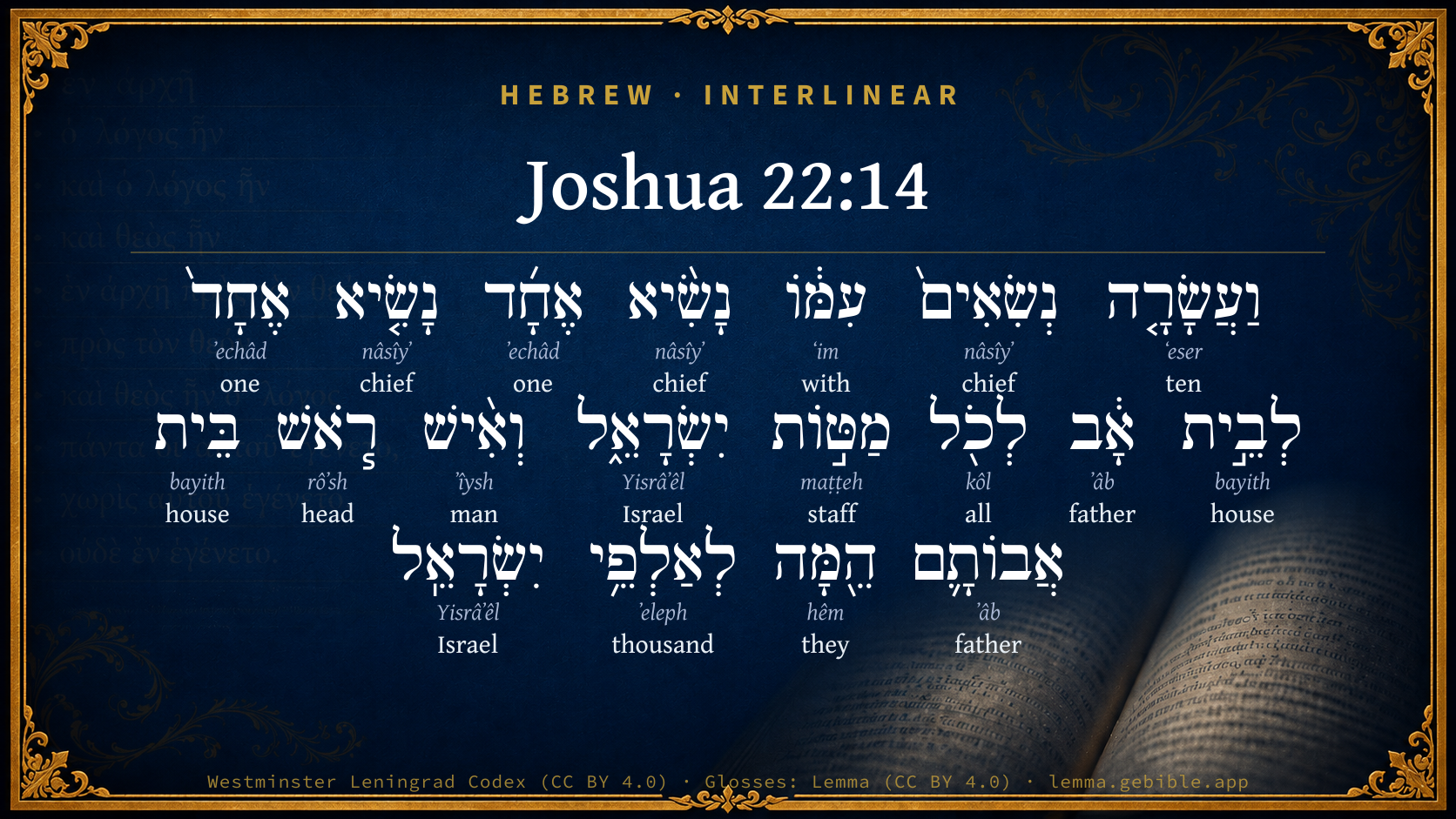
Hebrew (Westminster Leningrad Codex) Joshua 22:14 appears in the Hebrew Old Testament. The text above is from the Westminster Leningrad Codex. Each word links to its Strong’s number, a concise gloss, and parsing drawn from the Open Scriptures Hebrew Bible morphology. Click any word for its full Brown-Driver-Briggs (BDB) entry.
Download image
Cite this verse

Joshua 22:14 (World English Bible). Public Domain. Lemma interlinear Bible study tool, https://lemma.gebible.app/v/joshua/22/14.

Show BibTeX & RIS
BibTeX
RIS
English Translation
and with him ten princes, one prince of a fathers' house for each of the tribes of Israel; and they were everyone of them head of their fathers' houses among the thousands of Israel.
World English Bible · Public Domain
Download a study sheet

One document with this verse’s original text, its word-by-word gloss line, the meaning frame, cross-references with their text, attributed commentary, and full source and license credits — printable, and it pastes into notes with its structure intact.

This verse Autodidact and up

Study sheet (.html) Plain text (.txt)

A passage Seminary Student

Up to 50 verses in one chapter. A passage sheet keeps up to 6 commentary sources and 12 cross-references per verse, in the order this page ranks them, and says so on the sheet whenever that leaves anything out. Ask for a single verse and you get the Autodidact verse sheet above.

Everything on this page stays free to read, with no account — the sheet is a download of what is already on screen, not access to it.

Want to remove ads? Support Godless Engineer
Compare translations 3

The same verse in 3 English versions, stacked beneath the original-language interlinear above. Click any original word for its lexicon entry.

Each is an independent rendering of the whole verse — the interlinear is not word-aligned to these translations.

Highlighted words mark where these versions differ — a whole-verse word diff, not a word-by-word alignment.

  • World English Bible Public Domain
    and with him ten princes, one prince of a fathers' house for each of the tribes of Israel; and they were everyone of them head of their fathers' houses among the thousands of Israel.
  • King James Version Public Domain
    And with him ten princes, of each chief house a prince throughout all the tribes of Israel; and each one was an head of the house of their fathers among the thousands of Israel.
  • unfoldingWord Literal Text CC BY-SA 4.0
    And ten leaders with him, one leader, one leader, to the house of the father to all of the tribes of Israel. And they a man, the head of the house of their fathers to the thousands of Israel.

unfoldingWord Literal Text — © unfoldingWord, licensed CC BY-SA 4.0. Word-aligned USFM3 via Door43 (git.door43.org/unfoldingWord/en_ult).

Versions to compare (up to 4)

3 of 4 selected

Show all 18 translations

Every available English version of this verse, each an independent rendering of the whole verse.

  • World English Bible Public Domain
    and with him ten princes, one prince of a fathers' house for each of the tribes of Israel; and they were everyone of them head of their fathers' houses among the thousands of Israel.
  • Berean Standard Bible Public Domain
    With him they sent ten chiefs—one family leader from each tribe of Israel, each the head of a family among the clans of Israel.
  • Majority Standard Bible Public Domain
    With him they sent ten chiefs—one family leader from each tribe of Israel, each the head of a family among the clans of Israel.
  • King James Version Public Domain
    And with him ten princes, of each chief house a prince throughout all the tribes of Israel; and each one was an head of the house of their fathers among the thousands of Israel.
  • American Standard Version (1901) Public Domain
    and with him ten princes, one prince of a fathers' house for each of the tribes of Israel; and they were every one of them head of their fathers' houses among the thousands of Israel.
  • Revised Version (1885) Public Domain
    and with him ten princes, one prince of a fathers’ house for each of the tribes of Israel; and they were every one of them head of their fathers’ houses among the thousands of Israel.
  • Geneva Bible (1599) Public Domain
    And with him ten princes, of euery chiefe house a prince, according to all the tribes of Israel: for euery one was chiefe of their fathers housholde among the thousands of Israel.
  • Douay-Rheims (1899) Public Domain
    And ten princes with him, one of every tribe.
  • Young's Literal Translation Public Domain
    and ten princes with him, one prince, one prince, for a house of a father, for all the tribes of Israel, and each of them a head of a house of their fathers, for the thousands of Israel.
  • Literal Standard Version CC BY-SA 4.0
    and ten princes with him, one prince—one prince for a house of a father, for all the tribes of Israel, and each of them a head of a house of their fathers, for the thousands of Israel.
  • Unlocked Literal Bible CC BY-SA 4.0
    and with him ten leaders, one from each of the tribal families of Israel, and every one of them was the head of a family among the clan of Israel.
  • unfoldingWord Literal Text CC BY-SA 4.0
    And ten leaders with him, one leader, one leader, to the house of the father to all of the tribes of Israel. And they a man, the head of the house of their fathers to the thousands of Israel.
  • Darby Bible Public Domain
    and with him ten princes, of each father's house a prince, out of all the tribes of Israel; and each of them was head of a father's house, of the thousands of Israel.
  • World Messianic Bible Public Domain
    With him were ten princes, one prince of a fathers’ house for each of the tribes of Israel; and they were each head of their fathers’ houses among the thousands of Israel.
  • Webster's Bible Public Domain
    And with him ten princes, of each chief house a prince throughout all the tribes of Israel; and each one was a head of the house of their fathers among the thousands of Israel.
  • Free Bible Version CC BY-SA 4.0
    Ten leaders went with him, one from each of the ten tribes of Israel, and each the head of his family.
  • Bible in Basic English Public Domain
    And with him they sent ten chiefs, one for every tribe of the children of Israel, every one of them the head of his house among the families of Israel.
  • JPS Tanakh (1917) Public Domain
    and with him ten princes, one prince of a fathers' house for each of the tribes of Israel; and they were every one of them head of their fathers' houses among the thousands of Israel.

Literal Standard Version (2020), Covenant Press — licensed CC BY-SA 4.0. Text via the HelloAO Bible API (eBible.org). Unlocked Literal Bible (unfoldingWord) — licensed CC BY-SA 4.0. Text via the HelloAO Bible API (eBible.org). unfoldingWord Literal Text — © unfoldingWord, licensed CC BY-SA 4.0. Word-aligned USFM3 via Door43 (git.door43.org/unfoldingWord/en_ult). Free Bible Version, Dr. Jonathan Gallagher — licensed CC BY-SA 4.0. Text via the HelloAO Bible API (eBible.org).

Word by word

More ways to search: Search by grammar → Find every occurrence → Compare this word →

Practice this passage: Drill this verse → Learn its vocabulary →

נְשִׂאִים֙
nâsîyʼ
H5387
“chiefs”
Noun, Common, Masculine, Plural, Absolute
Part of Speech
Noun
Type
Common
Gender
Masculine
Number
Plural
State
Absolute
Full BDB Definition

Origin: from H5375

TWOT: 1421b , 1421c

one lifted up, chief, prince, captain, leader - rising mist, vapour
  1. וַעֲשָׂרָ֤ה ʻeser H6235 “and · ten” Conjunction + Adjective, Cardinal number, Masculine, Singular, Absolute
  2. עִמּ֔וֹ ʻim H5973 “with · him” Preposition + Suffix, Personal, 3rd Person, Masculine, Singular
  3. נָשִׂ֨יא nâsîyʼ H5387 “chief” Noun, Common, Masculine, Singular, Absolute
  4. אֶחָ֜ד ʼechâd H259 “one” Adjective, Cardinal number, Masculine, Singular, Absolute
  5. נָשִׂ֤יא nâsîyʼ H5387 “chief” Noun, Common, Masculine, Singular, Absolute
  6. אֶחָד֙ ʼechâd H259 “one” Adjective, Cardinal number, Masculine, Singular, Absolute
  7. לְבֵ֣ית bayith H1004 “to/for · house of” Preposition + Noun, Common, Masculine, Singular, Construct
  8. אָ֔ב ʼâb H1 “father” Noun, Common, Masculine, Singular, Absolute
  9. לְכֹ֖ל kôl H3605 “to/for · all of” Preposition + Noun, Common, Masculine, Singular, Construct
  10. מַטּ֣וֹת maṭṭeh H4294 “staffs of” Noun, Common, Masculine, Plural, Construct
  11. יִשְׂרָאֵ֑ל Yisrâʼêl H3478 “Israel” Noun, Proper
  12. וְאִ֨ישׁ ʼîysh H376 “and · man” Conjunction + Noun, Common, Masculine, Singular, Absolute
  13. רֹ֧אשׁ rôʼsh H7218 “head of” Noun, Common, Masculine, Singular, Construct
  14. בֵּית bayith H1004 “house of” Noun, Common, Masculine, Singular, Construct
  15. אֲבוֹתָ֛ם ʼâb H1 “fathers · their” Noun, Common, Masculine, Plural, Construct + Suffix, Personal, 3rd Person, Masculine, Plural
  16. הֵ֖מָּה hêm H1992 “they” Pronoun, Personal, 3rd Person, Masculine, Plural
  17. לְאַלְפֵ֥י ʼeleph H505 “to/for · thousand” Preposition + Adjective, Cardinal number, Both, Plural, Construct
  18. יִשְׂרָאֵֽל Yisrâʼêl H3478 “Israel” Noun, Proper

About this verse

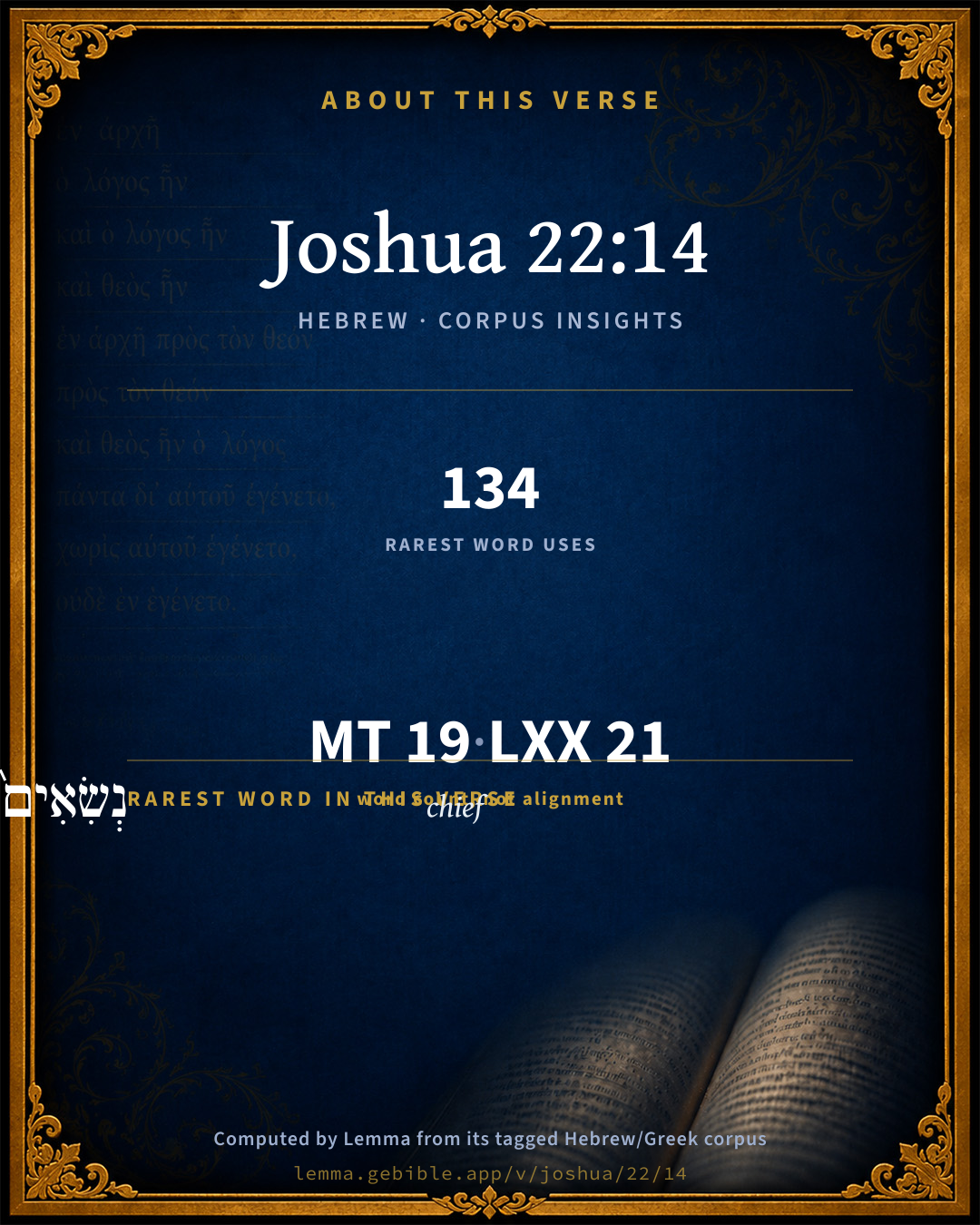
These counts appear in no published source. They are computed here, from the morphology-tagged text and Lemma’s own curated glosses. What Lemma adds →

19
words
13
distinct lemmas
Historical
section

Grammatical profile

  • 13 nouns
  • 4 adjectives
  • 1 pronoun
  • 1 preposition

Repetition

Words recur within this verse — often emphatic in Hebrew:

  • נְשִׂאִים֙ chief H5387 ×3
  • אֶחָ֜ד one H259 ×2
  • לְבֵ֣ית house H1004 ×2
  • אָ֔ב father H1 ×2
  • יִשְׂרָאֵ֑ל Israel H3478 ×2

Hebrew & Septuagint length

In English translation the verse runs 34 words from the Hebrew and 32 from the Septuagint (LXX English) — closely comparable.

A rough comparison of the two English renderings, which tokenize alike — not a word-level alignment.

Word counts can differ between the Hebrew and the Greek without any difference in meaning — e.g. the Hebrew direct-object marker אֵת has no separate Greek word, and Greek often adds the article ὁ.

In the original languages it is 19 Hebrew tokens and 21 Greek tokens — but the two are counted differently (Hebrew bundles its prefixes and suffixes into one token; the Greek is in lemma form), so that isn’t a like-for-like length.

Cross-references

2

Topical passages linked to Joshua 22:14 in the Treasury of Scripture Knowledge — connected by theme and wording, ordered by reader-vote popularity; previews shown in the World English Bible.

  • Numbers 1:4 With you there shall be a man of every tribe; everyone head of his fathers' house.
  • Exodus 18:25 Moses chose able men out of all Israel, and made them heads over the people, rulers of thousands, rulers of hundreds, rulers of fifties, and rulers of tens.

Cross-references courtesy of OpenBible.info (CC BY 4.0).

Hebrew and Greek witnesses Masoretic Hebrew ↔ Greek Septuagint

The same verse in the two great witnesses to the Old Testament, shown verse-for-verse.

These are two independent witnesses, not word-aligned to each other, and the Septuagint is shown in lemma (dictionary) form.

Hebrew Joshua 22:14 Masoretic · Westminster Leningrad Codex

וַעֲשָׂרָ֤ה נְשִׂאִים֙ עִמּ֔וֹ נָשִׂ֨יא אֶחָ֜ד נָשִׂ֤יא אֶחָד֙ לְבֵ֣ית אָ֔ב לְכֹ֖ל מַטּ֣וֹת יִשְׂרָאֵ֑ל וְאִ֨ישׁ רֹ֧אשׁ בֵּית אֲבוֹתָ֛ם הֵ֖מָּה לְאַלְפֵ֥י יִשְׂרָאֵֽל

and with him ten princes, one prince of a fathers' house for each of the tribes of Israel; and they were everyone of them head of their fathers' houses among the thousands of Israel.

World English Bible · Public Domain

Greek LXX Joshua 22:14 Septuagint · lemma form

καί δέκα ὁ ἄρχων μετά αὐτός ἄρχων εἷς ἀπό οἶκος πατριά ἀπό πᾶς φυλή ἰσραήλ ἄρχων οἶκος πατριά εἰμί χιλίαρχος ἰσραήλ

and ten of the chiefs with him; there was one chief of every household out of all the tribes of Israel; (the heads of families are the captains of thousands in Israel.)

LXX2012 (modern English Septuagint) · Public Domain

Hebrew: Westminster Leningrad Codex (CC BY 4.0). Greek: Septuagint (public domain); English from LXX2012 (modern English Septuagint) (Public Domain). How the Septuagint differs from the Hebrew →

Targum (Aramaic paraphrase)

1

The Targum is the ancient Jewish Aramaic paraphrase of the Hebrew Scriptures — an interpretive translation, not the Hebrew text itself. Onkelos (literal) and Pseudo-Jonathan (expansive) render the Torah, and Jonathan the Prophets. Coverage is partial: where no permissively-licensed English translation exists for a verse, only the Aramaic is shown. This is verse-level text, not a word-by-word alignment to the Hebrew.

  1. Targum Jonathan Prophets (Joshua–Malachi)
    וְעַשְׂרָא רַבְרְבִין עִמֵיהּ רַבָּא חָד רַבָּא חָד לְבֵית אַבָּא לְכָל שִׁבְטַיָא דְיִשְׂרָאֵל וּגְבַר רֵישׁ בֵּית אֲבָהַתְהוֹן אִינוּן לְאַלְפַיָא דְיִשְׂרָאֵל:

    (no public-domain English translation for this verse)

    Targum Jonathan — Aramaic: “Mikraot Gedolot” (public domain). English: “Sefaria Community Translation” (CC0 1.0 (public-domain dedication)); “London "Chaldee Paraphrase," 1871” (public domain). Text via Sefaria.

Commentary

Notes on Joshua 22:14 from classic Christian and Jewish commentators (each source and its license shown beneath its notes). The classic Christian expositions comment on the surrounding passage and are grouped to its opening verse, so a note may address several verses; the Jewish commentaries on the Tanakh (Rashi and others) are per-verse, so they appear only where the commentator wrote on this verse.

Lemma curates 59 commentaries, every one of them public domain or Creative Commons licensed, each selected and text-cleaned for this edition rather than reprinted as found. About our sources →

Trapp's Complete Commentary

John Trapp

Jos 22:14 And with him ten princes, of each chief house a prince throughout all the tribes of Israel; and each one [was] an head of the house of their fathers among the thousands of Israel.

Ver. 14. Of each chief house.] Of the half tribe of Manasseh for one; which is here reckoned for a tribe, because they had a stomach for God against those of their own flesh and blood.

John Trapp, A Commentary or Exposition upon All the Books of the Old and New Testament (1647–1656) — public domain. Text from a community e-Sword module.

Geneva Bible (1599)

Geneva Bible translators

Or, multitude.

Geneva Bible (1599) marginal notes — public domain. Text via Bolls.life.

The Cambridge Bible for Schools and Colleges

gen. ed. J. J. S. Perowne

14. ten princes] Representing the nine and a half tribes west of the Jordan.

head of the house] Each of them was prince of a fathers’ house among the thousands of Israel. Comp. Jdg_6:15; 1Sa_10:19; 1Sa_10:21. “They were thus persons of great weight of character and approved discretion, entitled by their position to demand an explanation, and less likely than younger men to have their judgments warped or compromised by the hasty impulses of passion.”

The Cambridge Bible for Schools and Colleges (gen. ed. J. J. S. Perowne; Cambridge University Press, 1878–1918) — public domain. Text from a community e-Sword module.

John Gill's Exposition

And they came unto the children of Reuben, and to the children of Gad, and to the half tribe of Manasseh, unto the land of Gilead,.... The deputation came thither; they either sent for the chiefs among the two tribes and a half, to meet them at some place, or they, having a notion of their coming, assembled together to receive them, and hear what they had to say to them:

and they spake with them, saying; as follows; very probably Phinehas was the mouth of the whole, for there could be but one speaker.

John Gill's Exposition of the Whole Bible (1746–1763) — public domain (CC PDM 1.0). Text via the HelloAO Bible API.

Haydock's Catholic Bible Commentary

Tribe. Another of the tribe of Levi, and deputies from the other nine tribes, accompanied Phinees on this important occasion. The Levites were most of all concerned, as their rights seemed to be particularly invaded. (Haydock) --- The princes of the tribes did not (Calmet) perhaps (Haydock) go, but only men of high rank. Kimchi says, men set over a thousand. Hebrew, "ten princes with him of each chief house, a prince of all the tribes of Israel." (Calmet) --- These were commissioned by Eleazar, Josue, and all the congregation, to endeavour to bring back their brethren to a sense of their duty, if they had so soon forgotten God, (Haydock) or if they should persist in their rebellion, to denounce an eternal war against them. (Menochius)

George Leo Haydock (1774–1849), Haydock's Catholic Family Bible and Commentary, 1859 edition — public domain. Excludes Psalms (Douay-Rheims chapter numbering differs from Protestant) and Deuterocanonical books (Catholic canon only).

Whedon's Commentary on the Bible

Daniel D. Whedon

14. Ten princes — Who these princes were is so obscurely told in the rest of the verse that it is difficult to decide as to the precise meaning. The rest of the verse is, literally: One prince, one prince to the house of a father to all the tribes of Israel, and a chief man of the house of their fathers were they to all the thousands of Israel. It could not be that one was chosen from each chief house in all Israel, for then must more than ten have been chosen. Keil probably explains correctly when he says that this delegation, called in Jos_22:30 princes of the congregation, “was composed partly of princes of tribes and partly of heads of families, some tribes being represented in one way and others in the other; and that the latter were sent in cases in which the heads of the tribes were either too old, or otherwise unfitted to take part in the deputation. This supposition is strongly confirmed by the fact that the tribe of Levi was not represented by the chief of the tribe, the high priest Eleazar, but by his son and presumptive successor, Phinehas, who was chosen instead.”

Daniel D. Whedon (gen. ed.), Commentary on the Old and New Testaments (1874–1909) — public domain. Text from a community e-Sword module.

The Pulpit Commentary

And with him ten princes. Phinehas represented the tribe of Levi, the high priest being too great to permit of his forming part of such a deputation. The actual head of each tribe accompanied him; that is, the head of the family, as we should call it, in each tribe. This seems preferable to Keil"s idea, that some tribes were represented by a prince, and some by heads of families, which seems inadmissible from the fact that the Hebrew states that each tribe was represented in the same manner, aycin dja aycin dja. What is doubtless intended here is to emphasize the weight and importance of the deputation sent with Phinehas, a weight and importance befitting an embassy which might have to announce the determination to exterminate the two and a half tribes as completely as Jericho had been exterminated. The mention of ten princes shows that the cis-Jordanic half tribe of Manasseh was represented. Tribes. The word here, after "father"s house," is the genealogical hFm not the political fbv. The thousands. Or families. (as in Jud_1:6:15 1Sa_10:19) See however Introduction, p. 29.

The Pulpit Commentary (1880–1919), ed. H.D.M. Spence-Jones & Joseph S. Exell — public domain. Text from a community e-Sword module.

Lesson kit

Teaching starters — assembled from the data on this page, not authored interpretation. Every prompt links to the verse data it draws on. Edit before teaching.

Joshua, in the Historical, opens this verse with 19 words (13 distinct Hebrew lemmas). Its most distinctive word is nâsîyʼ (“chief”). A historical commentator’s framing appears above. Read the whole chapter for the surrounding context.

Discussion questions

  1. How does “chief” (nâsîyʼ) shape what this verse is saying?
  2. How does Numbers 1:4, which shares this passage’s theme, read alongside this verse?
  3. What does the repetition of “chief” (3× in this one verse) do in this verse?
  4. These translations render this verse differently. What is at stake in choosing one wording over another?
  5. Compare how Trapp's Complete Commentary and Geneva Bible (1599) read this verse. Where do they agree or differ?

Things to notice

Reading settings

Reading text

Shown beneath each verse's original-language words.

Old Testament
Old Testament edition

Read the OT as the Masoretic Hebrew (MT) or the Greek Septuagint (LXX).

English shown for the Greek Septuagint (in the Hebrew ↔ Greek comparison).

Comparing translations? Open the Compare panel on any verse page to stack up to four side by side.