
Leviticus 17:7

Hebrew (Westminster Leningrad Codex) Leviticus 17:7 appears in the Hebrew Old Testament. The text above is from the Westminster Leningrad Codex. Each word links to its Strong’s number, a concise gloss, and parsing drawn from the Open Scriptures Hebrew Bible morphology. Click any word for its full Brown-Driver-Briggs (BDB) entry.
Download image
Cite this verse

Leviticus 17:7 (World English Bible). Public Domain. Lemma interlinear Bible study tool, https://lemma.gebible.app/v/leviticus/17/7.

Show BibTeX & RIS
BibTeX
RIS
English Translation
They shall no more sacrifice their sacrifices to the goat idols, after which they play the prostitute. This shall be a statute forever to them throughout their generations.'
World English Bible · Public Domain
Download a study sheet

One document with this verse’s original text, its word-by-word gloss line, the meaning frame, cross-references with their text, attributed commentary, and full source and license credits — printable, and it pastes into notes with its structure intact.

This verse Autodidact and up

Study sheet (.html) Plain text (.txt)

A passage Seminary Student

Up to 50 verses in one chapter. A passage sheet keeps up to 6 commentary sources and 12 cross-references per verse, in the order this page ranks them, and says so on the sheet whenever that leaves anything out. Ask for a single verse and you get the Autodidact verse sheet above.

Everything on this page stays free to read, with no account — the sheet is a download of what is already on screen, not access to it.

Want to remove ads? Support Godless Engineer
Compare translations 3

The same verse in 3 English versions, stacked beneath the original-language interlinear above. Click any original word for its lexicon entry.

Each is an independent rendering of the whole verse — the interlinear is not word-aligned to these translations.

Highlighted words mark where these versions differ — a whole-verse word diff, not a word-by-word alignment.

  • World English Bible Public Domain
    They shall no more sacrifice their sacrifices to the goat idols, after which they play the prostitute. This shall be a statute forever to them throughout their generations.'
  • King James Version Public Domain
    And they shall no more offer their sacrifices unto devils, after whom they have gone a whoring. This shall be a statute for ever unto them throughout their generations.
  • unfoldingWord Literal Text CC BY-SA 4.0
    And they shall no longer sacrifice their sacrifices to goat demons, after whom they are prostituting themselves. This will be an enduring statute for them for their generations.”’

unfoldingWord Literal Text — © unfoldingWord, licensed CC BY-SA 4.0. Word-aligned USFM3 via Door43 (git.door43.org/unfoldingWord/en_ult).

Versions to compare (up to 4)

3 of 4 selected

Show all 18 translations

Every available English version of this verse, each an independent rendering of the whole verse.

  • World English Bible Public Domain
    They shall no more sacrifice their sacrifices to the goat idols, after which they play the prostitute. This shall be a statute forever to them throughout their generations.'
  • Berean Standard Bible Public Domain
    They must no longer offer their sacrifices to the goat demons to which they have prostituted themselves. This will be a permanent statute for them for the generations to come.’
  • Majority Standard Bible Public Domain
    They must no longer offer their sacrifices to the goat demons to which they have prostituted themselves. This will be a permanent statute for them for the generations to come.’
  • King James Version Public Domain
    And they shall no more offer their sacrifices unto devils, after whom they have gone a whoring. This shall be a statute for ever unto them throughout their generations.
  • American Standard Version (1901) Public Domain
    And they shall no more sacrifice their sacrifices unto the he-goats, after which they play the harlot. This shall be a statute forever unto them throughout their generations.
  • Revised Version (1885) Public Domain
    And they shall no more sacrifice their sacrifices unto the he-goats, after whom they go a whoring. This shall be a statute for ever unto them throughout their generations.
  • Geneva Bible (1599) Public Domain
    And they shall no more offer their offerings vnto deuils, after whom they haue gone a whoring: this shalbe an ordinance for euer vnto them in their generations.
  • Douay-Rheims (1899) Public Domain
    And they shall no more sacrifice their victims to devils, with whom they have committed fornication. It shall be an ordinance for ever to them and to their posterity.
  • Young's Literal Translation Public Domain
    and they sacrifice not any more their sacrifices to goats after which they are going a-whoring; a statute age-during is this to them, to their generations.
  • Literal Standard Version CC BY-SA 4.0
    and they do not sacrifice their sacrifices anymore to the goat [idols] after which they are going whoring; this is a continuous statute to them, throughout their generations.
  • Unlocked Literal Bible CC BY-SA 4.0
    The people must no longer offer their sacrifices to goat idols, for which they act as prostitutes. This will be a permanent statute for them throughout their people's generations.'
  • unfoldingWord Literal Text CC BY-SA 4.0
    And they shall no longer sacrifice their sacrifices to goat demons, after whom they are prostituting themselves. This will be an enduring statute for them for their generations.”’
  • Darby Bible Public Domain
    And they shall no more sacrifice their sacrifices unto demons, after whom they go a whoring. This shall be an everlasting statute unto them for their generations.
  • World Messianic Bible Public Domain
    They shall no more sacrifice their sacrifices to the goat idols, after which they play the prostitute. This shall be a statute forever to them throughout their generations.’
  • Webster's Bible Public Domain
    And they shall no more offer their sacrifices to idols, with which they have committed idolatry: This shall be a statute for ever to them throughout their generations.
  • Free Bible Version CC BY-SA 4.0
    They must not continue to offer their sacrifices to the goat devils with whom they have acted like prostitutes. This is a regulation for all time and for all future generations.
  • Bible in Basic English Public Domain
    And let them make no more offerings to evil spirits, after which they have gone, turning away from the Lord. Let this be a law to them for ever, through all their generations.
  • JPS Tanakh (1917) Public Domain
    And they shall no more sacrifice their sacrifices unto the satyrs, after whom they go astray. This shall be a statute for ever unto them throughout their generations.

Literal Standard Version (2020), Covenant Press — licensed CC BY-SA 4.0. Text via the HelloAO Bible API (eBible.org). Unlocked Literal Bible (unfoldingWord) — licensed CC BY-SA 4.0. Text via the HelloAO Bible API (eBible.org). unfoldingWord Literal Text — © unfoldingWord, licensed CC BY-SA 4.0. Word-aligned USFM3 via Door43 (git.door43.org/unfoldingWord/en_ult). Free Bible Version, Dr. Jonathan Gallagher — licensed CC BY-SA 4.0. Text via the HelloAO Bible API (eBible.org).

Word by word

More ways to search: Search by grammar → Find every occurrence → Compare this word →

Practice this passage: Drill this verse → Learn its vocabulary →

לַשְּׂעִירִ֕ם
sâʻîyr
H8163
“to/for the · goats”
Preposition, Determined + Noun, Common, Masculine, Plural, Absolute
Part of Speech
Preposition + Noun
Type
Common
Gender
Masculine
Number
Plural
State
Absolute
Full BDB Definition

Origin: from H8175

TWOT: 2274c , 2274e

hairy (adjective) - he-goat, buck (noun masculine) - as sacrificial animal - satyr, may refer to a demon possessed goat like the swine of Gadara ( Mat 8:30-32 )
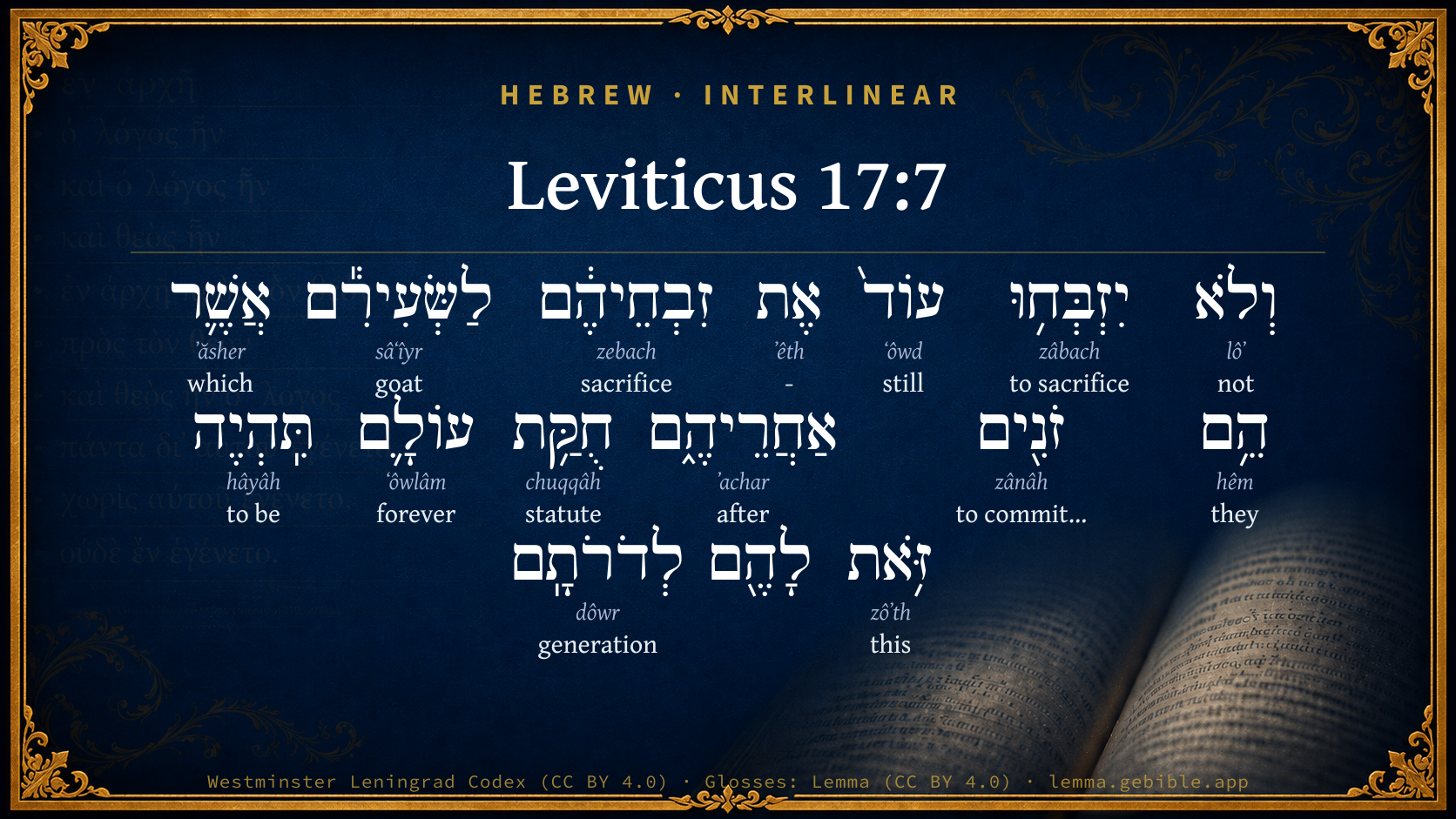
  1. וְלֹא lôʼ H3808 “and · not” Conjunction + Particle, Negative
  2. יִזְבְּח֥וּ zâbach H2076 “to sacrifice” Verb, Qal, Imperfect, 3rd Person, Masculine, Plural
  3. עוֹד֙ ʻôwd H5750 “still” Adverb
  4. אֶת ʼêth H853 “-” Particle, Direct Object
  5. זִבְחֵיהֶ֔ם zebach H2077 “sacrifices · their” Noun, Common, Masculine, Plural, Construct + Suffix, Personal, 3rd Person, Masculine, Plural
  6. אֲשֶׁ֛ר ʼăsher H834 “which” Particle, Relative
  7. הֵ֥ם hêm H1992 “they” Pronoun, Personal, 3rd Person, Masculine, Plural
  8. זֹנִ֖ים zânâh H2181 “committing fornication” Verb, Qal, Participle Active, Masculine, Plural, Absolute
  9. אַחֲרֵיהֶ֑ם ʼachar H310 “after · them” Preposition + Suffix, Personal, 3rd Person, Masculine, Plural
  10. חֻקַּ֥ת chuqqâh H2708 “statute of” Noun, Common, Both, Singular, Construct
  11. עוֹלָ֛ם ʻôwlâm H5769 “forever” Noun, Common, Masculine, Singular, Absolute
  12. תִּֽהְיֶה hâyâh H1961 “to be” Verb, Qal, Imperfect, 3rd Person, Feminine, Singular
  13. זֹּ֥את zôʼth H2063 “this” Pronoun, Demonstrative, Feminine, Singular
  14. לְדֹרֹתָֽם dôwr H1755 “to/for · generations · their” Preposition + Noun, Common, Masculine, Plural, Construct + Suffix, Personal, 3rd Person, Masculine, Plural

About this verse

These counts appear in no published source. They are computed here, from the morphology-tagged text and Lemma’s own curated glosses. What Lemma adds →

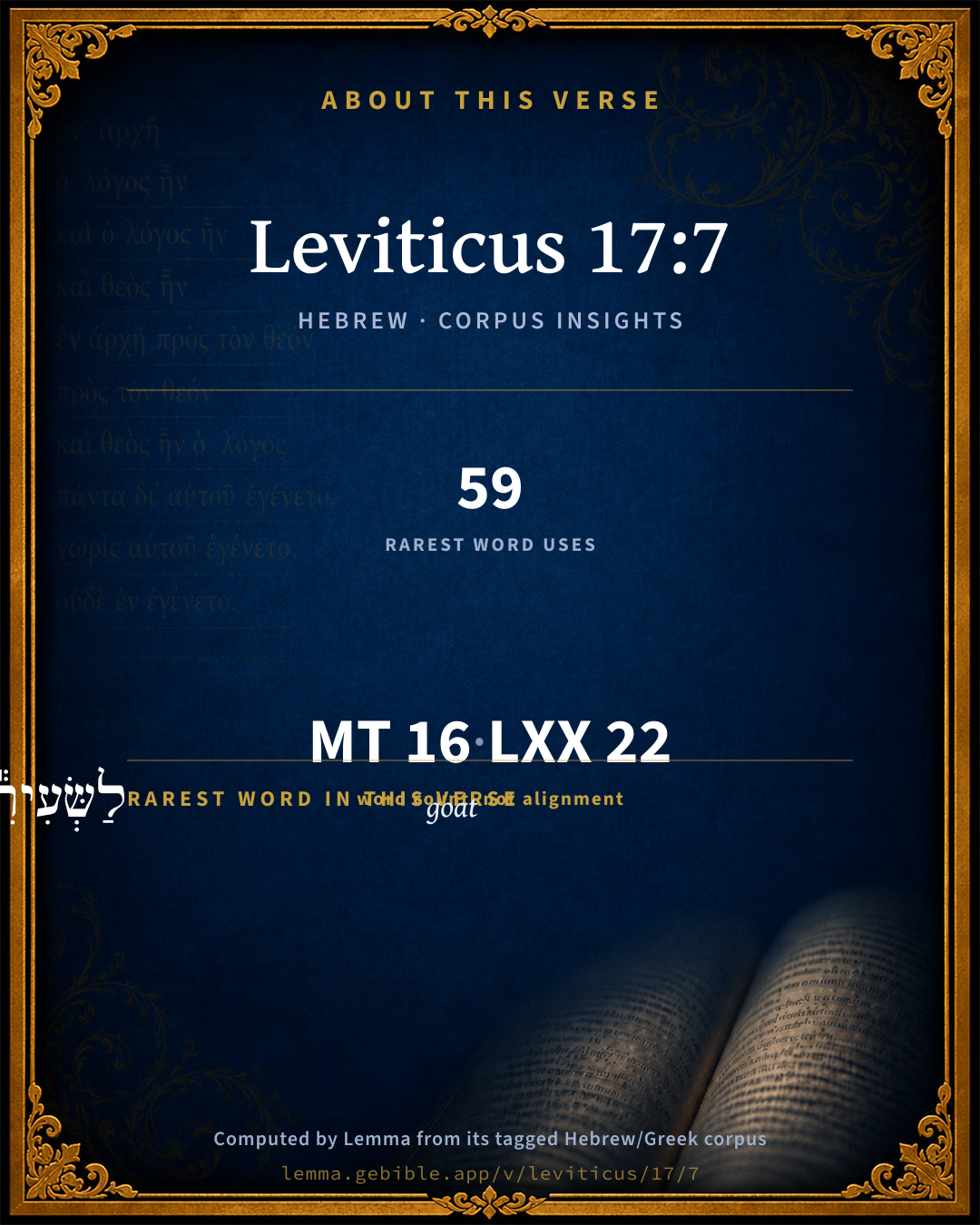
16
words
15
distinct lemmas
Pentateuch
section

Shared distinctive vocabulary

לַשְּׂעִירִ֕ם goat H8163 occurs in 57 verses of the Hebrew Bible. Also found in:

Grammatical profile

  • 3 verbs
  • 5 nouns
  • 2 pronouns
  • 2 prepositions
  • 1 adverb
  • 3 particles

Verb forms

  • יִזְבְּח֥וּ Qal · Imperfect
  • זֹנִ֖ים Qal · Participle Active
  • תִּֽהְיֶה Qal · Imperfect

Hebrew & Septuagint length

In English translation the verse runs 28 words from the Hebrew and 28 from the Septuagint (LXX English) — the same length.

A rough comparison of the two English renderings, which tokenize alike — not a word-level alignment.

Word counts can differ between the Hebrew and the Greek without any difference in meaning — e.g. the Hebrew direct-object marker אֵת has no separate Greek word, and Greek often adds the article ὁ.

In the original languages it is 16 Hebrew tokens and 22 Greek tokens — but the two are counted differently (Hebrew bundles its prefixes and suffixes into one token; the Greek is in lemma form), so that isn’t a like-for-like length.

Cross-references

17

Topical passages linked to Leviticus 17:7 in the Treasury of Scripture Knowledge — connected by theme and wording, ordered by reader-vote popularity; previews shown in the World English Bible.

  • 1 Corinthians 10:20 But I say that the things which the Gentiles sacrifice, they sacrifice to demons, and not to God, and I don't desire that you would have communion with demons.
  • Exodus 34:15 Don't make a covenant with the inhabitants of the land, lest they play the prostitute after their gods, and sacrifice to their gods, and one call you and you eat of his sacrifice;
  • Deuteronomy 32:17 They sacrificed to demons, [which were] no God, To gods that they didn't know, To new [gods] that came up of late, Which your fathers didn't dread.
  • 2 Chronicles 11:15 and he appointed him priests for the high places, and for the male goats, and for the calves which he had made.
  • Psalms 106:37 Yes, they sacrificed their sons and their daughters to demons.
  • Exodus 22:20 "He who sacrifices to any god, except to Yahweh only, shall be utterly destroyed.
  • Exodus 32:8 They have turned aside quickly out of the way which I commanded them. They have made themselves a molten calf, and have worshiped it, and have sacrificed to it, and said, 'These are your gods, Israel, which brought you up out of the land of Egypt.'"
  • Leviticus 20:5 then I will set my face against that man, and against his family, and will cut him off, and all who play the prostitute after him, to play the prostitute with Molech, from among their people.
  • Deuteronomy 31:16 Yahweh said to Moses, Behold, you shall sleep with your fathers; and this people will rise up, and play the prostitute after the strange gods of the land, where they go to be among them, and will forsake me, and break my covenant which I have made with them.
  • Ezekiel 23:8 Neither has she left her prostitution since [the days of] Egypt; for in her youth they lay with her, and they handled the bosom of her virginity; and they poured out their prostitution on her.
  • Revelation 9:20 The rest of mankind, who were not killed with these plagues, didn't repent of the works of their hands, that they wouldn't worship demons, and the idols of gold, and of silver, and of brass, and of stone, and of wood; which can neither see, nor hear, nor walk.
  • Revelation 17:1–5 One of the seven angels who had the seven bowls came and spoke with me, saying, "Come here. I will show you the judgment of the great prostitute who sits on many waters,
  • Jeremiah 3:1 They say, If a man put away his wife, and she go from him, and become another man's, will he return to her again? Won't that land be greatly polluted? But you have played the prostitute with many lovers; yet return again to me, says Yahweh.
  • John 12:31 Now is the judgment of this world. Now the prince of this world will be cast out.
  • John 14:30 I will no more speak much with you, for the prince of the world comes, and he has nothing in me.
  • 2 Corinthians 4:4 in whom the god of this world has blinded the minds of the unbelieving, that the light of the Gospel of the glory of Christ, who is the image of God, should not dawn on them.
  • Ephesians 2:2 in which you once walked according to the course of this world, according to the prince of the powers of the air, the spirit who now works in the children of disobedience;

Cross-references courtesy of OpenBible.info (CC BY 4.0).

Hebrew and Greek witnesses Masoretic Hebrew ↔ Greek Septuagint

The same verse in the two great witnesses to the Old Testament, shown verse-for-verse.

These are two independent witnesses, not word-aligned to each other, and the Septuagint is shown in lemma (dictionary) form.

Hebrew Leviticus 17:7 Masoretic · Westminster Leningrad Codex

וְלֹא יִזְבְּח֥וּ עוֹד֙ אֶת זִבְחֵיהֶ֔ם לַשְּׂעִירִ֕ם אֲשֶׁ֛ר הֵ֥ם זֹנִ֖ים אַחֲרֵיהֶ֑ם חֻקַּ֥ת עוֹלָ֛ם תִּֽהְיֶה זֹּ֥את לָהֶ֖ם לְדֹרֹתָֽם

They shall no more sacrifice their sacrifices to the goat idols, after which they play the prostitute. This shall be a statute forever to them throughout their generations.'

World English Bible · Public Domain

Greek LXX Leviticus 17:7 Septuagint · lemma form

καί οὐ θύω ἔτι ὁ θυσία αὐτός ὁ μάταιος ὅς αὐτός ἐκπορνεύω ὀπίσω αὐτός νόμιμος αἰώνιος εἰμί σύ εἰς ὁ γενεά σύ

And they shall no longer offer their sacrifices to vain gods after which they go a whoring; it shall be a perpetual statute to you for your generations.

LXX2012 (modern English Septuagint) · Public Domain

Hebrew: Westminster Leningrad Codex (CC BY 4.0). Greek: Septuagint (public domain); English from LXX2012 (modern English Septuagint) (Public Domain). How the Septuagint differs from the Hebrew →

Targum (Aramaic paraphrase)

2

The Targum is the ancient Jewish Aramaic paraphrase of the Hebrew Scriptures — an interpretive translation, not the Hebrew text itself. Onkelos (literal) and Pseudo-Jonathan (expansive) render the Torah, and Jonathan the Prophets. Coverage is partial: where no permissively-licensed English translation exists for a verse, only the Aramaic is shown. This is verse-level text, not a word-by-word alignment to the Hebrew.

  1. Targum Onkelos Torah (Genesis–Deuteronomy)
    וְלָא יִדְבְּחוּן עוֹד יָת דִבְחֵיהוֹן לַשֵׁדִין דִי אִנוּן טָעָן בַּתְרֵיהוֹן קְיַם עָלָם תְּהֵי דָא לְהוֹן לְדָרֵיהוֹן

    (no public-domain English translation for this verse)

    Targum Onkelos — Aramaic: “Onkelos Genesis” (public domain); “Onkelos Exodus” (public domain); “Onkelos Leviticus” (public domain); “Onkelos Numbers” (public domain); “Onkelos Deuteronomy” (public domain). English: “Sefaria Community Translation” (CC0 1.0 (public-domain dedication)); “J.W. Etheridge. The Targums of Onkelos and Jonathan Ben Uzziel on the Pentateuch. London: Longmans, Green, 1862” (public domain). Text via Sefaria.

  2. Targum Pseudo-Jonathan Torah (Genesis–Deuteronomy)
    וְלָא יְדַבְּחוּן תּוּב יַת דִיבְחֵיהוֹן לְטַעֲוָון דִמְתִילִין לְשֵׁידִין דְהִינוּן טָעַן בַּתְרֵיהוֹן קְיַים עֲלָם תְּהֵי דָא לְהוֹן לְדָרֵיהוֹן

    Neither shall they offer any more their sacrifices unto idols which are like unto demons, after which they have wandered. This shall be an everlasting statute to them, unto their generations.

    Targum Pseudo-Jonathan — Aramaic: “Targum Jonathan on Genesis” (public domain); “Targum Jonathan on Exodus” (public domain); “Targum Jonathan on Leviticus” (public domain); “Targum Jonathan on Numbers” (public domain); “Targum Jonathan on Deuteronomy” (public domain). English: “The Targum of Jonathan ben Uzziel, trans. J. W. Etheridge, London, 1862” (public domain). Text via Sefaria.

Commentary

Notes on Leviticus 17:7 from classic Christian and Jewish commentators (each source and its license shown beneath its notes). The classic Christian expositions comment on the surrounding passage and are grouped to its opening verse, so a note may address several verses; the Jewish commentaries on the Tanakh (Rashi and others) are per-verse, so they appear only where the commentator wrote on this verse.

Lemma curates 59 commentaries, every one of them public domain or Creative Commons licensed, each selected and text-cleaned for this edition rather than reprinted as found. About our sources →

Trapp's Complete Commentary

John Trapp

Lev 17:7 And they shall no more offer their sacrifices unto devils, after whom they have gone a whoring. This shall be a statute for ever unto them throughout their generations.

Ver. 7. Unto devils.] {a} As they had done in Egypt. {Eze 23:8 Deu 32:17} And as both Pagans and Papagans do. {1Co 10:20 Rev 9:20} The Americans in Canada worship the devil; who, when he is offended with them, flings dust in their eyes. At Calecutta, the chief city of Malabar, they worship Satan with flowers on his altars, and sacrifices of cocks. The Brahmins, or priests, wash his image, sitting in a fiery throne with three crowns and four horns, with sweet water every morning. The king of Calecutta eats no meat till it be first offered by his priests to this idol. When a man lies a dying, they show him the picture of the devil, that he may be the better acquainted with him in the other world. The word here rendered devils signifieth rough ones, satyrs. {Isa 34:14} Satan is a rough, rugged, harsh spirit: and such also are his imps, as Esau, Ismael, &c.

{a} Synesius saith, the devil is ειδωλοχαρης, an idol lover.

John Trapp, A Commentary or Exposition upon All the Books of the Old and New Testament (1647–1656) — public domain. Text from a community e-Sword module.

Joseph Benson's Commentary

Lev 17:7. Unto devils — So they did, not directly or intentionally, but by construction and consequence, because the devil is the author of idolatry, and is eminently served and honoured by it. And as the Egyptians were notorious for their idolatry, so the Israelites were infected with their leaven, Jos 24:14; Eze 20:7; Eze 23:2-3. And some of them continued to practise the same in the wilderness, Amo 5:25-26,

compared with Deu 12:8. The Hebrew word which we render devils, שׂעירים, segnirim, properly signifies goats, from their rough and shaggy hair, and hence denotes those idols, probably deified dead men, who were worshipped under the symbol of goats. It is the same word that we translate satyrs, Isa 13:21. What gives light to so obscure a passage is what we read in Maimonides, that the Zabian idolaters worshipped demons under the figure of goats, imagining them to appear in that form, whence they called them by the name here mentioned, segnirim, or goats; and that this custom being general in Moses’s time, gave occasion to this precept. After whom they have gone a whoring — Idolatry, especially in God’s people, is commonly termed whoredom in Scripture, because it is a violation of that covenant by which they were peculiarly betrothed or married to God. And here the phrase has a peculiar propriety, and denotes their having worshipped those goats, or goat-like demons, with rites horribly impure, after the manner of the idolatrous pagans.

Joseph Benson's Commentary on the Old and New Testaments (1811–1818) — public domain. Text from a community e-Sword module.

Tyndale Open Study Notes

Tyndale Open Resources

17:7 be unfaithful (Hebrew zanah, “commit fornication”): Israel was not to worship any god but the Lord (Exod 20:3). Israel’s covenant relationship to the Lord was even compared to a marriage (see Hos 1:2), and worshiping other gods could be described as spiritual adultery. In addition, many of the Canaanite religions were fertility cults. This verb reflects the prostitution conducted at Canaanite shrines to induce fertility in the land through rites of magic involving sexual intercourse. • The Hebrew word translated goat idols is the plural for a male goat. In the ancient world, the male goat was often a symbol of fertility or of a god of the underworld. During the reign of Jeroboam I, many Levites from the northern kingdom moved south to Jerusalem; they had been appalled by the use of goats and bulls in the northern kingdom’s worship (2 Chr 11:15-16).

Tyndale Open Study Notes — © Tyndale Open Resources, licensed CC BY-SA 4.0. Text via the HelloAO Bible API.

Geneva Bible (1599)

Geneva Bible translators

Meaning, whatsoever is not the true God, 1 Cor. 10:10; Ps. 95:5.

For idolatry is spiritual whoredom, because faith toward God is broken.

Geneva Bible (1599) marginal notes — public domain. Text via Bolls.life.

Jamieson, Fausset & Brown

Robert Jamieson, A. R. Fausset & David Brown

they shall no more offer their sacrifices unto devils--literally, "goats." The prohibition evidently alludes to the worship of the hirei-footed kind, such as Pan, Faunus, and Saturn, whose recognized symbol was a goat. This was a form of idolatry enthusiastically practised by the Egyptians, particularly in the nome or province of Mendes. Pan was supposed especially to preside over mountainous and desert regions, and it was while they were in the wilderness that the Israelites seem to have been powerfully influenced by a feeling to propitiate this idol. Moreover, the ceremonies observed in this idolatrous worship were extremely licentious and obscene, and the gross impurity of the rites gives great point and significance to the expression of Moses, "they have gone a-whoring."

Jamieson, Fausset & Brown — Commentary Critical and Explanatory on the Whole Bible (1871) — public domain (CC PDM 1.0). Text via the HelloAO Bible API.

Adam Clarke's Commentary

Verse 7. They shall no more offer their sacrifices unto devils] They shall not sacrifice לשעירים lasseirim, to the hairy ones, to goats. The famous heathen god, Pan, was represented as having the posteriors, horns, and ears of a goat; and the Mendesians, a people of Egypt, had a deity which they worshipped under this form. Herodotus says that all goats were worshipped in Egypt, but the he-goat particularly. It appears also that the different ape and monkey species were objects of superstitious worship; and from these sprang, not only Mendes and Jupiter Ammon, who was worshipped under the figure of a ram, but also Pan and the Sileni, with the innumerable herd of those imaginary beings, satyrs, dryads, hamadryads, c. c., all woodland gods, and held in veneration among the Egyptians, Greeks, and Romans.

After whom they have gone a whoring.] Though this term is frequently used to express idolatry, yet we are not to suppose that it is not to be taken in a literal sense in many places in Scripture, even where it is used in connection with idolatrous acts of worship. It is well known that Baal-Peor and Ashtaroth were worshipped with unclean rites and that public prostitution formed a grand part of the worship of many deities among the Egyptians, Moabites, Canaanites, Greeks, and Romans. The great god of the two latter nations, Jupiter, was represented as the general corrupter of women and of Venus, Flora, Priapus, and others, it is needless to speak. That there was public prostitution in the patriarchal times, See Clarke on Ge 38:21. And that there was public prostitution of women to goats in Egypt, see Herodotus, lib. ii., c. 46, p. 108, edit. Gale, who gives a case of this abominable kind that took place in Egypt while he was in that country. See also many examples in Bochart, vol. ii., col. 641; and See Clarke on Le 20:16.

Adam Clarke's Commentary on the Bible (1810–1826) — public domain. Text from a community e-Sword/MySword module.

Ellicott's Commentary for English Readers

(7) And they shall no more offer their sacrifices unto devils.—The word (sçirim) here translated “devils,” literally denotes hairy or shaggy goats, and then goat-like deities, or demons. The Egyptians, and other nations of antiquity, worshipped goats as gods. Not only was there a celebrated temple in Thmuis, the capital of the Mendesian Nomos in Lower Egypt, dedicated to the goat-image Pan, whom they called Mendes, and worshipped as the oracle, and as the fertilising principle in nature, but they erected statues of him everywhere. Hence the Pan, Silenus, satyrs, fauns, and the woodland gods among the Greeks and Romans; and hence, too, the goat-like form of the devil, with a tail, horns, and cloven feet, which obtain in medieval Christianity, and which may still be seen in some European cities. The terror which the devil, appearing in this Pan-like form, created among those who were thought to have seen him, has given rise to our expression panic. This is the form of idolatrous worship which the Jews brought with them from Egypt, and to which reference is continually made. (See Jos_24:14; Eze_20:7; Eze_23:3, &c.; and especially 2Ch_11:15.) The expression “and they shall no more offer” shows that the Israelites were hitherto in the habit of first dedicating their ordinary food to these deities; whilst the words “gone a whoring” indicate the orgies connected with this form of idol worship, It has been urged that the demand to offer up, in so confined a space as the entrance of the sanctuary, the domestic animals intended for the daily consumption of more than 600,000 people, imposed a task upon the people which it was impossible for them to carry out. Hence it has been urged that the injunction here (Lev_17:2-7) must refer to sacrifices. But this difficulty arises from importing our modern notions into the ancient mode of living. The ancient Israelites, like the modem Orientals, especially the nomadic tribes, ate very little flesh meat apart from the seasons of sacrifice, which were the occasions of feasting. Besides, those who urge this difficulty ignore the fact that the injunction before us is restricted to the three kinds of animals; that none of the wild clean quadrupeds, as stags, roes, &c, nor any of the feathered tribes, as pigeons, turtle doves, &c, which formed an essential part of the daily diet, is here included; and that even the three kinds of sacrificial quadrupeds only come within this restriction when they are qualified by age, which was within two years, and by physical condition, which demanded that it should have no external defect, as blindness of one eye, lameness of one foot, &c., to be offered first to the Lord. Moreover, the injunction was only intended to operate temporarily, whilst the Jews sojourned and wandered about in the wilderness, where, besides the propensity to sacrifice these animals to idols, they would have been in danger of extirpating their most useful animals. The law was repealed when the Israelites entered the promised land. (Comp. Deu_12:13-15.)

A Bible Commentary for English Readers, edited by Charles John Ellicott (1878–1897) — public domain. Text from a community e-Sword module.

The Cambridge Bible for Schools and Colleges

gen. ed. J. J. S. Perowne

7. he-goats] satyrs, as R.V. mg., i.e. demons of the desert believed to take the shape of goats, like the satyrs of classical mythology. For the survival of Canaanitish rites, as practised by Israelites, cp. Exo_34:15-16; Isa_13:21; Isa_34:14; Isa_57:6 (with note in Camb. Bible), Isa_65:7.

go a whoring] A frequent expression (e.g. Exo_34:15-16) for the worship of other gods.

The Cambridge Bible for Schools and Colleges (gen. ed. J. J. S. Perowne; Cambridge University Press, 1878–1918) — public domain. Text from a community e-Sword module.

John Gill's Exposition

And they shall no more offer their sacrifices unto devils,.... As it seems they had done, which was monstrously shocking, and especially by a people that had the knowledge of the true God. Such shocking idolatry has been committed, and still is among the Indians, both East and West: when Columbus discovered Hispaniola, and entered it, he found the inhabitants worshippers of images they called Zemes, which were in the likeness of painted devils, which they took to be the mediators and messengers of the great God, the only one, eternal, omnipotent, and invisible (a); and so at Calecut and Pego in the East Indies, and in other parts thereof, they sacrifice to the devil (b): one can hardly think the Israelites would give into such gross idolatry as this; wherefore by "devils" may be meant idols in general; for if men do not worship God and Christ, let them worship what they will, it is only worshipping devils, Co1 10:20; and so the calves of Jeroboam are called devils, Ch2 11:15; hence the golden calf also, the Israelites worshipped but lately in the wilderness, might go by the same name; to which sense is the Targum of Jonathan,"and they shall not offer again their sacrifices to idols, which are like to devils.''The word here used signifies "goats", and these creatures were worshipped by the Egyptians, and so might be by the Israelites, while among them; this is asserted by several writers. Diodorus Siculus says (c), they deified the goat, as the Grecians did Priapus, and for the same reason; and that the Pans and the Satyrs were had in honour by men on the same account; and Herodotus (d) observes, that the Egyptians paint and engrave Pan as the Greeks do, with the face and thighs of a goat, and therefore do not kill a goat, because the Mendesians reckon Pan among the gods; and of the Mendesians he says, that they worship goats, and the he goats rather than the she goats; wherefore in the Egyptian language both Pan and a goat are called Mendes; and Strabo (e) reports of Mendes, that there Pan and the goat are worshipped: if these sort of creatures were worshipped by the Egyptians in the times of Moses, which is to be questioned, the Israelites might be supposed to have followed them in it; but if that be true, which Maimonides (f) says of the Zabii, a set of idolaters among the Chaldeans, and other people, long before the times of Moses, that some of them worshipped devils, whom they supposed to be in the form of goats, the Israelites might have given in to this idolatry from them, and be the occasion of this prohibition:

after whom they have gone a whoring; idolatry being a spiritual adultery, a forsaking God, who had taken them into a conjugal relation, and been as an husband to them, and cleaving to idols, which were as paramours; see Jer 31:32,

this shall be a statute for ever unto them throughout their generations: not only this of not sacrificing to devils, but all before commanded, particularly that they should bring their sacrifices to the priest, at the door of the tabernacle of the congregation.

(a) P. Martyr. de Angleria, Decad. 1. l. 9. (b) Vartoman. Navigat. l. 5. c. 2. 23. & 1. 6. c. 16. 27. (c) Bibliothec. l. 1. p. 58, 79. (d) Euterpe, sive, l. 2. c. 46. (e) Geograph. l. 17. p. 551. (f) Moreh Nevochim, p. 3. c. 46.

John Gill's Exposition of the Whole Bible (1746–1763) — public domain (CC PDM 1.0). Text via the HelloAO Bible API.

Haydock's Catholic Bible Commentary

Devils. Hebrew schirim: which some translate goats, (the hairy ones,) satyrs, &c. The Egyptians adored the goat, (which they represented like the god Pan) particularly in the territory of Mendes, near which the Hebrews had dwelt. Its worship was very abominable and obscene. (Strabo xvii.) (Calmet) --- Ezechiel (xvi. 22) intimates that the Hebrews were given to idolatry in Egypt. They had also recently adored the calf. (Haydock)

George Leo Haydock (1774–1849), Haydock's Catholic Family Bible and Commentary, 1859 edition — public domain. Excludes Psalms (Douay-Rheims chapter numbering differs from Protestant) and Deuterocanonical books (Catholic canon only).

Matthew Poole's English Annotations

Unto devils; so they did, not directly or intentionally, but by construction and consequence, because the devil is the author of idolatry, and is eminently served, pleased, and honoured by it. And as the Egyptians were notorious for their idolatry, as appears by the testimony of Scripture, and of all ancient writers, so the Israelites were infected with their leaven, Jos 24:14; Eze 20:7; 23:2,3. And the name of devils is commonly given in Scripture to idols, yea, even to those which seemed most innocent, as to Jeroboam’s calves, 2Ch 11:15, by which he and the people designed and professed to worship the true God, as is manifest from the nature of the thing, and from many places of Scripture; and the worshippers of idols are esteemed and called worshippers of devils. See Deu 32:17; Psa 106:37; 1Co 10:20; Rev 9:20. The Hebrew word rendered devils signifies goats, either because goats were eminently worshipped by the Egyptians, as Herodotus, Strabo, and others note, and divers of the idols of the heathens were of that or a like form; or because the devil did oft appear to the heathens in that shape, as their own authors note.

After whom they have gone a whoring; for idolatry, especially in God’s people, is commonly called whoredom, as Eze 16:16,26; 23:8,19,21, &c., and that justly, because it is a violation of that covenant by which they were peculiarly betrothed or married to God. See Hos 2:18-20.

Matthew Poole's English Annotations on the Holy Bible (1683–1685) — public domain. Text from a community e-Sword/MySword module.

Whedon's Commentary on the Bible

Daniel D. Whedon

7. Devils — The Hebrew seirim, literally, the shaggy ones, or goats, has a wonderful variety of renderings in the Authorized Version. See Lev_23:19, note. The Vulgate renders it daemones, and Luther “field devils;” the Seventy, τοις ματαιοις, usually translated idols; but Schleusner here renders it demons, the Revised Version, “devils.” These were supposed by the Egyptians to inhabit the desert. The Israelites had brought this superstition out of Egypt, where goats were worshipped as gods, particularly Pan, the impersonation of the male principle in nature, under the name of Mendes. From these arose the innumerable herd of satyrs, fauns, and dryads which figure so largely in Grecian and Roman mythology.

Gone a whoring — This strong metaphor for the practice of idolatry expresses Jehovah’s abhorrence of polytheistic rites celebrated by his people. As Jehovah by his covenant had married Israel, their worship of other gods was like the infidelities of a wife. Jer_3:1; Jer_3:14; Jas_4:4-5, R.V. But since most of the ancient idolatries were grossly licentious, the term whoring may be used in a sense not altogether figurative. See Num_14:33, note.

A statute forever — Since there was a repeal of the laws relating to the place of killing animals for food, (see Lev_17:4, note,) the unchangeable statute must relate to the worship of demons and false gods. No command is more scrupulously kept by the Jews of to-day. The first sentence taught to every Hebrew child is the Shema Israel, “Hear, O Israel, Jehovah thy God is one God.” This safeguard against polytheism rings out in all their synagogues whenever the scroll of the law is taken from its sacred depository, every reading being prefaced by this loud proclamation.

Daniel D. Whedon (gen. ed.), Commentary on the Old and New Testaments (1874–1909) — public domain. Text from a community e-Sword module.

The Pulpit Commentary

And they shall no more offer their sacrifices unto devils, after whom they have gone a whoring. The word rightly translated devils means, literally, shaggy goats. (see 2Ch_11:15 Isa_13:21 Isa_34:14; where the word occurs) It is generally supposed that the Israelites borrowed their worship of the goat-like spirits of the woods and fields from Egypt. That goat-worship prevailed there in a very foul shape we know (Herod., 2:42), but sacrifices in the open fields are rather a Persian habit (Herod., 1:132). Pan-worship, however, was common to most if not to all agricultural nations. The injunction which follows, This shall be a statute for ever unto them throughout their generations, which cannot be confined to the last few words or verses, shows that the command of verse 3 refers to sacrifices, not to ordinary slaughtering. Had slaughtering been meant, the statute could not have been intended to be more than temporary in its obligation. The importance attributed to the regulation is further shown by the declaration previously made, that whoever transgressed it should be cut off from among his people, or excommunicated. In fact, it makes an era in the history of the chosen people. The old patriarchal priesthood having ceased, and the Aaronic priesthood substituted for it, the tabernacle is appointed to serve as a religious centre to the race. Whenever, from this time onwards, sacrifices were offered, without offense, elsewhere than in the court of the tabernacle or temple, as by Samuel, (see 1Sa_13:8) and by Elijah, (1Ki_18:32) it was done by the direct order or dispensation of God.

The Pulpit Commentary (1880–1919), ed. H.D.M. Spence-Jones & Joseph S. Exell — public domain. Text from a community e-Sword module.

John Wesley's Explanatory Notes

Unto devils - So they did, not directly or intentionally, but by construction and consequence, because the devil is the author of idolatry, and is eminently served, and honoured by it. And as the Egyptians were notorious for their idolatry, so the Israelites were infected with their leaven, Josh. xxiv, 14, Ezek. xx, 7, xxiii, 2, 3. A whoring - Idolatry, especially in God's people, is commonly called whoredom, because it is a violation of that covenant by which they were peculiarly betrothed or married to God.

John Wesley, Explanatory Notes Upon the Whole Bible (1754–1765) — public domain. Text via the GEBible commentary corpus.

unfoldingWord translationNotes

Door43 World Missions Community

for which they act as prostitutes

The people being unfaithful to Yahweh by worshiping false gods is spoken of as if they were acting like a man who betrays his wife by committing adultery. AT: "for which they are unfaithful to Yahweh" (See: Metaphor)

a permanent statute for them throughout their people's generations

See how you translated this phrase in Leviticus 3:17.

translationWords

false god

prostitute

statute

generation

unfoldingWord translationNotes — © Distant Shores Media and the Door43 World Missions Community, licensed CC BY-SA 4.0. Source: git.door43.org/Door43/en_tn.

Rashi

Rabbi Shlomo Yitzchaki (Rashi)

לשעירים.means TO THE DEMONS. Similar is (Isaiah 13:21) “and demons (ושעירים) shall dance there" (Sifra, Acharei Mot, Chapter 9 8).

Rashi on the Tanakh — English translations: “The Judaica Press complete Tanach with Rashi, translated by A. J. Rosenberg” (CC BY 4.0); “Pentateuch with Rashi's commentary by M. Rosenbaum and A.M. Silbermann, 1929-1934” (public domain); “The Metsudah Tanach series, Lakewood, N.J” (CC BY 4.0); and “The Book of Joshua, Metsudah Publications, 1997” (CC BY 4.0). Text via Sefaria.

Ramban (Nachmanides)

Rabbi Moshe ben Nachman (Ramban / Nachmanides)

AND THEY SHALL NO MORE SACRIFICE THEIR SACRIFICES ‘LA’SE’IRIM’ AFTER WHOM THEY GO ASTRAY. “La’se’irim means ‘unto the demons.’ Similarly it states, ‘u’se’irim’ (and demons) shall dance there.” This is Rashi’s language, derived from the Torath Kohanim. 9:8. Now Rabbi Abraham ibn Ezra wrote that “the demons are so called [se’irim, a word which is connected with sei’ar, meaning ‘hair’], because on seeing them a person’s hair stands up on his body. But it is likely that they are called se’irim [a word which also means ‘goats’], because mentally deranged persons see them in the form of goats. And the word ‘more’ [in the verse before us, and they shall no ‘more’ sacrifice …] indicates that the Israelites used to do so in Egypt. After whom they go astray denotes that whoever seeks after them and believes in them ‘goes astray’ from his G-d, since he thinks that there is a power that can cause good or evil apart from the Glorious and Fearful Name.” [Thus far the words of Ibn Ezra.]Now Rabbi Abraham ibn Ezra has indeed hinted at the truth concerning the word “more,” as I have written above. The name se’irim will also be made clear to you there. They are also called sheidim [“demons,” as Rashi interpreted here — a word which is connected with shodad, meaning “devastate, despoil, ruin”], because they dwell in “devastated” places, such as the desert, and their principal habitat is in the far corners [of the earth], such as the northern extremity of the earth which is wasteland on account of the cold climate.Know that just as the formation at the original Creation of man’s body as well as that of all living creatures, vegetation and minerals, was from the four elements, which were combined by Divine power to form material bodies which as a result of their thickness and coarseness could be perceived by the five senses, even so there was a creation from only two elements, fire and air, resulting in a body which cannot be felt, nor perceived by any of the [five] senses, just as the soul of an animal cannot be perceived by human senses because of its delicacy. The body [of these creatures of two elements] is of a spiritual nature; on account of its delicacy and lightness it can fly through fire and air. And just as the combination of the four elements in any object is the cause of its existence and its destruction [since everything that is composite must ultimately revert to its original components], so is it with these beings created from a combination of only two elements; when the elements combine, the creature lives, and when they separate [decompose], it is like the dead. It is for this reason that our Rabbis have said: “Six characteristics have been said of sheidim, in three they are comparable to the ministering angels and in three to human beings. The three things in which they are comparable to the ministering angels are that they have wings, they fly, and they know what is about to happen, as do the ministering angels. [On this statement the Gemara asked:] ‘How can it enter your mind to say that the sheidim know the future [when even the ministering angels do not know it]! Say rather thus: They hear [from behind the Curtain of heaven] what is about to happen.’ The three things in which they are comparable to human beings are that they eat and drink, procreate, and die as do human beings.” Now the cause of death generally is the separation [decomposition] of the components of the body, this being true of all kinds of bodies [whether they are composed of the four elements like humans or of only two, like sheidim]. The reason for their ability to fly is because of the lightness of the [two] elements [fire and air] of which they are composed, as may also be seen in the case of a fowl, in which, because the elements of fire and air dominate over the small parts of the other two elements [earth and water], the fowl can hover in the air and fly [although it is composed of all four elements]. Surely, then, the above-mentioned creatures that have nothing in them of the heavy elements [earth and water], possess great hovering power in the air, to be able to fly tirelessly. The matter of “eating” [mentioned above in connection with these creatures] means their deriving nourishment from the moisture of water and the odors of fire, something like the fire that licked up the water that was in the trench. This is the purpose of the burnings which necromancers perform to the demons. The reason [for their need to “eat”] is that the fire in the air causes the drying up of their bodies, which must therefore be restored just as man’s need for food is due to depletion in his body. As for that which has been said concerning their “hearing what is about to happen,” it is because in the course of their flying on high they become aware of things that are about to happen from the powerful forces contained in the atmosphere, these being “the princes of the quiver.” It is also from there that “those who have wings tell matters”. of the future, as has been tested by enchanters, and as I will explain in its place with the help of G-d. But neither of them know what is to happen for many days to come and for times that are far off; but they can only inform of that which is to happen in the near future, as we know from their encounters [i.e., those of enchanters], that they gain knowledge from the sheidim as to what has been decreed to come. Therefore Onkelos rendered the verse, They sacrificed unto demons, ‘lo eloha’ (no gods), as “they sacrificed unto demons in which there is no utility,” meaning that there is no need for them, as they do not prevent harm that is destined to come, neither do they do anything productive, nor do they inform of times far off so that a person may knowingly guard himself. It is this which is the sense of the expression, lo eloha, which is as if it said, “no power or rulership,” for the word Elokim is an expression of strength and power, [a composite word consisting of the words] e-il heim. (Force), heim (they), the word “they” alluding to all other forces. Thus Elokim means “the Force of all forces.” Thus the verse is stating that demons have no strength or power whatsoever, and hence there is no need for them, for they cannot do evil, neither is it in them to do good.

Ramban (Nachmanides) on the Tanakh — English translation: “Commentary on the Torah by Ramban (Nachmanides). Translated and annotated by Charles B. Chavel. New York, Shilo Pub. House, 1971-1976” (CC BY 4.0). Text via Sefaria.

Ibn Ezra

Rabbi Abraham ibn Ezra

To the demons [לשעירם]. These are the demons, and they are called שעירים because they cause a storm (panic) [ישתער] to the body of one who sees them. The closest meaning is that they are seen in the form of goats by the insane people who are prone to see them. The word עוד [no longer] indicates that Israel would stray after them in Egypt.

After which they go astray. Anyone that seeks them and believes in them is straying away from his God, for he thinks that there is something that will benefit him or cause him harm besides Hashem, the Honorable and Awesome One.

Ibn Ezra on the Tanakh — English translations: “Sefaria Community Translation” (CC0 1.0 (public-domain dedication)); “Yalkut, Sifsei Chachomim Chumash, Metsudah Publications, 2009” (CC BY 4.0); and “Commentary of Ibn Ezra on Isaiah - trans. by M. Friedlander, 1873” (public domain). Text via Sefaria.

Lesson kit

Teaching starters — assembled from the data on this page, not authored interpretation. Every prompt links to the verse data it draws on. Edit before teaching.

Leviticus, in the Pentateuch, opens this verse with 16 words (15 distinct Hebrew lemmas). Its most distinctive word is sâʻîyr (“goat”). A historical commentator’s framing appears above. Read the whole chapter for the surrounding context.

Discussion questions

  1. What does “goat” (sâʻîyr) contribute to the verse as a whole?
  2. How does Genesis 27:11, which shares the word «goat», read alongside this verse?
  3. The translations on this page render this verse differently — a whole-verse word diff, not a word-by-word alignment. What might account for the different wordings?
  4. «יִזְבְּח֥וּ» is a Qal Imperfect verb. How does that grammatical form shape the action described?
  5. Compare how Trapp's Complete Commentary and Joseph Benson's Commentary read this verse. Where do they agree or differ?

Things to notice

Reading settings

Reading text

Shown beneath each verse's original-language words.

Old Testament
Old Testament edition

Read the OT as the Masoretic Hebrew (MT) or the Greek Septuagint (LXX).

English shown for the Greek Septuagint (in the Hebrew ↔ Greek comparison).

Comparing translations? Open the Compare panel on any verse page to stack up to four side by side.