
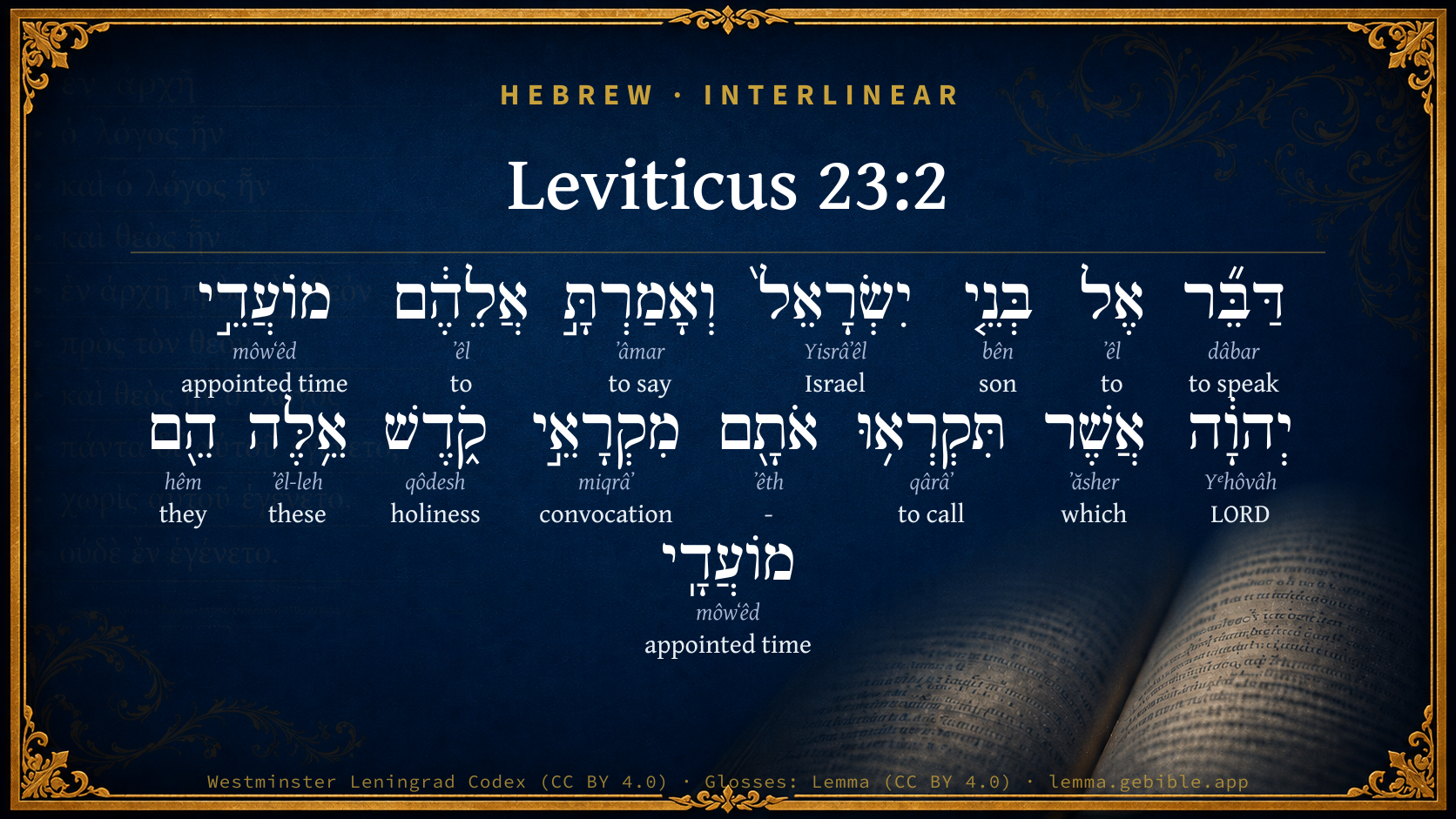
Leviticus 23:2

Hebrew (Westminster Leningrad Codex) Leviticus 23:2 appears in the Hebrew Old Testament. The text above is from the Westminster Leningrad Codex. Each word links to its Strong’s number, a concise gloss, and parsing drawn from the Open Scriptures Hebrew Bible morphology. Click any word for its full Brown-Driver-Briggs (BDB) entry.
Download image
Cite this verse

Leviticus 23:2 (World English Bible). Public Domain. Lemma interlinear Bible study tool, https://lemma.gebible.app/v/leviticus/23/2.

Show BibTeX & RIS
BibTeX
RIS
English Translation
"Speak to the children of Israel, and tell them, 'The set feasts of Yahweh, which you shall proclaim to be holy convocations, even these are my set feasts.
World English Bible · Public Domain
Download a study sheet

One document with this verse’s original text, its word-by-word gloss line, the meaning frame, cross-references with their text, attributed commentary, and full source and license credits — printable, and it pastes into notes with its structure intact.

This verse Autodidact and up

Study sheet (.html) Plain text (.txt)

A passage Seminary Student

Up to 50 verses in one chapter. A passage sheet keeps up to 6 commentary sources and 12 cross-references per verse, in the order this page ranks them, and says so on the sheet whenever that leaves anything out. Ask for a single verse and you get the Autodidact verse sheet above.

Everything on this page stays free to read, with no account — the sheet is a download of what is already on screen, not access to it.

Want to remove ads? Support Godless Engineer
Compare translations 3

The same verse in 3 English versions, stacked beneath the original-language interlinear above. Click any original word for its lexicon entry.

Each is an independent rendering of the whole verse — the interlinear is not word-aligned to these translations.

Highlighted words mark where these versions differ — a whole-verse word diff, not a word-by-word alignment.

  • World English Bible Public Domain
    "Speak to the children of Israel, and tell them, 'The set feasts of Yahweh, which you shall proclaim to be holy convocations, even these are my set feasts.
  • King James Version Public Domain
    Speak unto the children of Israel, and say unto them, Concerning the feasts of the LORD, which ye shall proclaim to be holy convocations, even these are my feasts.
  • unfoldingWord Literal Text CC BY-SA 4.0
    “Speak to the sons of Israel, and you shall say to them, ‘The appointed times of Yahweh, which you shall proclaim them assemblies of holiness, these them, my appointed times.

unfoldingWord Literal Text — © unfoldingWord, licensed CC BY-SA 4.0. Word-aligned USFM3 via Door43 (git.door43.org/unfoldingWord/en_ult).

Versions to compare (up to 4)

3 of 4 selected

Show all 18 translations

Every available English version of this verse, each an independent rendering of the whole verse.

  • World English Bible Public Domain
    "Speak to the children of Israel, and tell them, 'The set feasts of Yahweh, which you shall proclaim to be holy convocations, even these are my set feasts.
  • Berean Standard Bible Public Domain
    “Speak to the Israelites and say to them, ‘These are My appointed feasts, the feasts of the LORD that you are to proclaim as sacred assemblies.
  • Majority Standard Bible Public Domain
    “Speak to the Israelites and say to them, ‘These are My appointed feasts, the feasts of the LORD that you are to proclaim as sacred assemblies.
  • King James Version Public Domain
    Speak unto the children of Israel, and say unto them, Concerning the feasts of the LORD, which ye shall proclaim to be holy convocations, even these are my feasts.
  • American Standard Version (1901) Public Domain
    Speak unto the children of Israel, and say unto them, The set feasts of Jehovah, which ye shall proclaim to be holy convocations, even these are my set feasts.
  • Revised Version (1885) Public Domain
    Speak unto the children of Israel, and say unto them, The set feasts of the LORD, which ye shall proclaim to be holy convocations, even these are my set feasts.
  • Geneva Bible (1599) Public Domain
    Speake vnto the children of Israel, and say vnto them, The feastes of ye Lord which yee shall call ye holie assemblies, euen these are my feasts.
  • Douay-Rheims (1899) Public Domain
    Speak to the children of Israel, and thou shalt say to them: These are the feasts of the Lord, which you shall call holy.
  • Young's Literal Translation Public Domain
    `Speak unto the sons of Israel, and thou hast said unto them, Appointed seasons of Jehovah, which ye proclaim, holy convocations, `are' these: they `are' My appointed seasons:
  • Literal Standard Version CC BY-SA 4.0
    “Speak to the sons of Israel, and you have said to them: Appointed times of YHWH, which you proclaim [as] holy convocations, these [are] My appointed times.
  • Unlocked Literal Bible CC BY-SA 4.0
    “Speak to the people of Israel, and say to them, 'These are the appointed festivals for Yahweh, which you must proclaim as holy assemblies; they are my regular festivals.
  • unfoldingWord Literal Text CC BY-SA 4.0
    “Speak to the sons of Israel, and you shall say to them, ‘The appointed times of Yahweh, which you shall proclaim them assemblies of holiness, these them, my appointed times.
  • Darby Bible Public Domain
    Speak unto the children of Israel, and say unto them, [Concerning] the set feasts of Jehovah, which ye shall proclaim as holy convocations -- these are my set feasts.
  • World Messianic Bible Public Domain
    “Speak to the children of Israel, and tell them, ‘The set feasts of the LORD, which you shall proclaim to be holy convocations, even these are my set feasts.
  • Webster's Bible Public Domain
    Speak to the children of Israel, and say to them, Concerning the feasts of the LORD, which ye shall proclaim to be holy convocations, even these are my feasts.
  • Free Bible Version CC BY-SA 4.0
    “Tell the Israelites that these are my religious festivals, the festivals of the Lord that you are to call as the holy times when we meet together.
  • Bible in Basic English Public Domain
    Say to the children of Israel, These are the fixed feasts of the Lord, which you will keep for holy meetings: these are my feasts.
  • JPS Tanakh (1917) Public Domain
    Speak unto the children of Israel, and say unto them: The appointed seasons of the LORD, which ye shall proclaim to be holy convocations, even these are My appointed seasons.

Literal Standard Version (2020), Covenant Press — licensed CC BY-SA 4.0. Text via the HelloAO Bible API (eBible.org). Unlocked Literal Bible (unfoldingWord) — licensed CC BY-SA 4.0. Text via the HelloAO Bible API (eBible.org). unfoldingWord Literal Text — © unfoldingWord, licensed CC BY-SA 4.0. Word-aligned USFM3 via Door43 (git.door43.org/unfoldingWord/en_ult). Free Bible Version, Dr. Jonathan Gallagher — licensed CC BY-SA 4.0. Text via the HelloAO Bible API (eBible.org).

Word by word

More ways to search: Search by grammar → Find every occurrence → Compare this word →

Practice this passage: Drill this verse → Learn its vocabulary →

מִקְרָאֵ֣י
miqrâʼ
H4744
“convocations of”
Noun, Common, Masculine, Plural, Construct
Part of Speech
Noun
Type
Common
Gender
Masculine
Number
Plural
State
Construct
Full BDB Definition

Origin: from H7121

TWOT: 2063d

convocation, convoking, reading, a calling together - convocation, sacred assembly - convoking - reading
  1. דַּבֵּ֞ר dâbar H1696 “speak” Verb, Piel, Imperative, 2nd Person, Masculine, Singular
  2. אֶל ʼêl H413 “to” Preposition
  3. בְּנֵ֤י bên H1121 “sons of” Noun, Common, Masculine, Plural, Construct
  4. יִשְׂרָאֵל֙ Yisrâʼêl H3478 “Israel” Noun, Proper
  5. וְאָמַרְתָּ֣ ʼâmar H559 “and · to say” Conjunction + Verb, Qal, Sequential Perfect, 2nd Person, Masculine, Singular
  6. אֲלֵהֶ֔ם ʼêl H413 “to · them” Preposition + Suffix, Personal, 3rd Person, Masculine, Plural
  7. מוֹעֲדֵ֣י môwʻêd H4150 “appointed times of” Noun, Common, Masculine, Plural, Construct
  8. יְהוָ֔ה Yᵉhôvâh H3068 “LORD” Noun, Proper
  9. אֲשֶׁר ʼăsher H834 “which” Particle, Relative
  10. תִּקְרְא֥וּ qârâʼ H7121 “to call” Verb, Qal, Imperfect, 2nd Person, Masculine, Plural
  11. אֹתָ֖ם ʼêth H853 “- · them” Particle, Direct Object + Suffix, Personal, 3rd Person, Masculine, Plural
  12. קֹ֑דֶשׁ qôdesh H6944 “holiness” Noun, Common, Masculine, Singular, Absolute
  13. אֵ֥לֶּה ʼêl-leh H428 “these” Pronoun, Demonstrative, Common, Plural
  14. הֵ֖ם hêm H1992 “they” Pronoun, Personal, 3rd Person, Masculine, Plural
  15. מוֹעֲדָֽי môwʻêd H4150 “appointed times · my” Noun, Common, Masculine, Plural, Construct + Suffix, Personal, 1st Person, Common, Singular

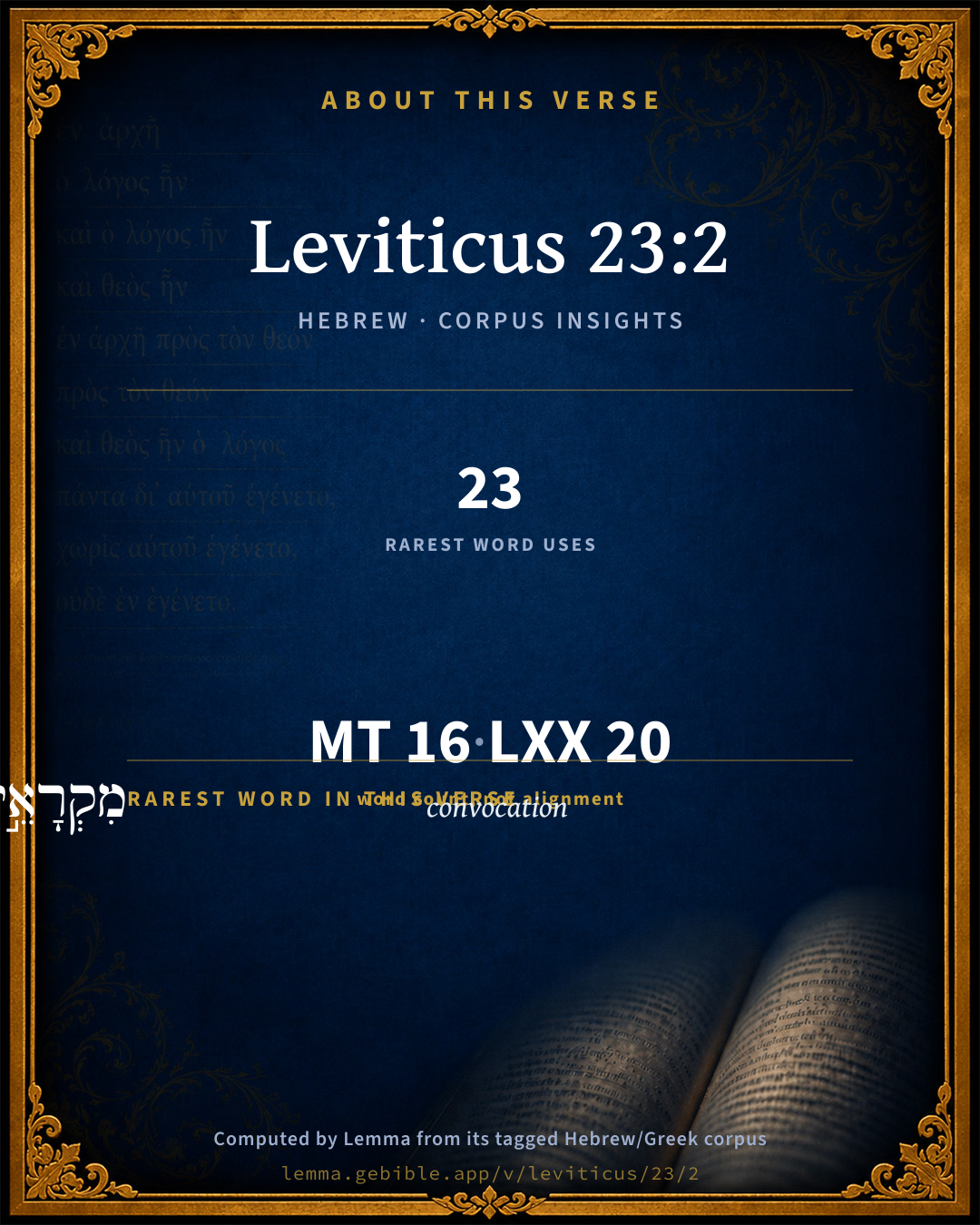
About this verse

These counts appear in no published source. They are computed here, from the morphology-tagged text and Lemma’s own curated glosses. What Lemma adds →

16
words
14
distinct lemmas
Pentateuch
section

Notable vocabulary

The rarest word here is מִקְרָאֵ֣י convocation H4744 — appearing just 23 times in the whole Hebrew Bible.

Shared distinctive vocabulary

מִקְרָאֵ֣י convocation H4744 occurs in 22 verses of the Hebrew Bible. Also found in:

Grammatical profile

  • 3 verbs
  • 7 nouns
  • 2 pronouns
  • 2 prepositions
  • 2 particles

Verb forms

  • דַּבֵּ֞ר Piel · Imperative
  • וְאָמַרְתָּ֣ Qal · Sequential Perfect
  • תִּקְרְא֥וּ Qal · Imperfect

Repetition

Words recur within this verse — often emphatic in Hebrew:

  • מוֹעֲדֵ֣י appointed time H4150 ×2
  • אֶל to H413 ×2

Hebrew & Septuagint length

In English translation the verse runs 28 words from the Hebrew and 27 from the Septuagint (LXX English) — closely comparable.

A rough comparison of the two English renderings, which tokenize alike — not a word-level alignment.

Word counts can differ between the Hebrew and the Greek without any difference in meaning — e.g. the Hebrew direct-object marker אֵת has no separate Greek word, and Greek often adds the article ὁ.

In the original languages it is 16 Hebrew tokens and 20 Greek tokens — but the two are counted differently (Hebrew bundles its prefixes and suffixes into one token; the Greek is in lemma form), so that isn’t a like-for-like length.

Cross-references

21

Topical passages linked to Leviticus 23:2 in the Treasury of Scripture Knowledge — connected by theme and wording, ordered by reader-vote popularity; previews shown in the World English Bible.

  • Leviticus 23:4 "'These are the set feasts of Yahweh, even holy convocations, which you shall proclaim in their appointed season.
  • Leviticus 23:37 "'These are the appointed feasts of Yahweh, which you shall proclaim to be holy convocations, to offer an offering made by fire to Yahweh, a burnt offering, and a meal offering, a sacrifice, and drink offerings, each on its own day;
  • Exodus 23:14–17 "You shall observe a feast to me three times a year.
  • Numbers 10:10 Also in the day of your gladness, and in your set feasts, and in the beginnings of your months, you shall blow the trumpets over your burnt offerings, and over the sacrifices of your peace-offerings; and they shall be to you for a memorial before your God: I am Yahweh your God.
  • Numbers 29:39 These you shall offer to Yahweh in your set feasts, besides your vows, and your freewill-offerings, for your burnt offerings, and for your meal-offerings, and for your drink-offerings, and for your peace-offerings.
  • Psalms 81:3 Blow the trumpet at the New Moon, At the full moon, on our feast day.
  • Hosea 2:11 I will also cause all her celebrations to cease: Her feasts, her new moons, her Sabbaths, and all her solemn assemblies.
  • Joel 2:15 Blow the trumpet in Zion! Sanctify a fast. Call a solemn assembly.
  • Exodus 32:5 When Aaron saw this, he built an altar before it; and Aaron made a proclamation, and said, "Tomorrow shall be a feast to Yahweh."
  • Leviticus 23:21 You shall make proclamation on the same day: there shall be a holy convocation to you; you shall do no regular work. This is a statute forever in all your dwellings throughout your generations.
  • Leviticus 23:44 Moses declared to the children of Israel the appointed feasts of Yahweh.
  • Numbers 10:2–3 Make you two trumpets of silver; of beaten work shall you make them: and you shall use them for the calling of the congregation, and for the journeying of the camps.
  • 2 Kings 10:20 Jehu said, Sanctify a solemn assembly for Baal. They proclaimed it.
  • 2 Chronicles 30:5 So they established a decree to make proclamation throughout all Israel, from Beersheba even to Dan, that they should come to keep the Passover to Yahweh, the God of Israel, at Jerusalem: for they had not kept it in great numbers in such sort as it is written.
  • Isaiah 1:13–14 Bring no more vain offerings. Incense is an abomination to me; New moons, Sabbaths, and convocations: I can't bear with evil assemblies.
  • Isaiah 33:20 Look on Zion, the city of our solemnities: your eyes shall see Jerusalem a quiet habitation, a tent that shall not be removed, the stakes of it shall never be plucked up, neither shall any of the cords of it be broken.
  • Lamentations 1:4 The ways of Zion do mourn, because none come to the solemn assembly; All her gates are desolate, her priests do sigh: Her virgins are afflicted, and she herself is in bitterness.
  • Joel 1:14 Sanctify a fast. Call a solemn assembly. Gather the elders, And all the inhabitants of the land, to the house of Yahweh, your God, And cry to Yahweh.
  • Jonah 3:5–9 The people of Nineveh believed God; and they proclaimed a fast, and put on sackcloth, from the greatest of them even to the least of them.
  • Nahum 1:15 Behold, on the mountains the feet of him who brings good news, who publishes peace! Keep your feasts, Judah! Perform your vows, for the wicked one will no more pass through you. He is utterly cut off.
  • John 5:1 After these things, there was a feast of the Jews, and Jesus went up to Jerusalem.

Cross-references courtesy of OpenBible.info (CC BY 4.0).

Hebrew and Greek witnesses Masoretic Hebrew ↔ Greek Septuagint

The same verse in the two great witnesses to the Old Testament, shown verse-for-verse.

These are two independent witnesses, not word-aligned to each other, and the Septuagint is shown in lemma (dictionary) form.

Hebrew Leviticus 23:2 Masoretic · Westminster Leningrad Codex

דַּבֵּ֞ר אֶל בְּנֵ֤י יִשְׂרָאֵל֙ וְאָמַרְתָּ֣ אֲלֵהֶ֔ם מוֹעֲדֵ֣י יְהוָ֔ה אֲשֶׁר תִּקְרְא֥וּ אֹתָ֖ם מִקְרָאֵ֣י קֹ֑דֶשׁ אֵ֥לֶּה הֵ֖ם מוֹעֲדָֽי

"Speak to the children of Israel, and tell them, 'The set feasts of Yahweh, which you shall proclaim to be holy convocations, even these are my set feasts.

World English Bible · Public Domain

Greek LXX Leviticus 23:2 Septuagint · lemma form

λαλέω ὁ υἱός ἰσραήλ καί εἶπον πρός αὐτός ὁ ἑορτή κύριος ὅς καλέω αὐτός κλητός ἅγιος οὗτος εἰμί ἑορτή ἐγώ

Speak to the children of Israel, and you shall say to them, The feasts of the Lord which you⌃ shall call holy assemblies, these are my feasts.

LXX2012 (modern English Septuagint) · Public Domain

On this verse, Haydock's Catholic Bible Commentary discusses the Septuagint’s reading. Read the note in Commentary ↓

Hebrew: Westminster Leningrad Codex (CC BY 4.0). Greek: Septuagint (public domain); English from LXX2012 (modern English Septuagint) (Public Domain). How the Septuagint differs from the Hebrew →

Targum (Aramaic paraphrase)

2

The Targum is the ancient Jewish Aramaic paraphrase of the Hebrew Scriptures — an interpretive translation, not the Hebrew text itself. Onkelos (literal) and Pseudo-Jonathan (expansive) render the Torah, and Jonathan the Prophets. Coverage is partial: where no permissively-licensed English translation exists for a verse, only the Aramaic is shown. This is verse-level text, not a word-by-word alignment to the Hebrew.

  1. Targum Onkelos Torah (Genesis–Deuteronomy)
    מַלֵיל עִם בְּנֵי יִשְׂרָאֵל וְתֵימַר לְהוֹן מוֹעֲדַיָא דַיְיָ דִי תְעָרְעוּן יָתְהוֹן מְעָרְעֵי קַדִישׁ אִלֵין אִנוּן מוֹעֲדָי

    (no public-domain English translation for this verse)

    Targum Onkelos — Aramaic: “Onkelos Genesis” (public domain); “Onkelos Exodus” (public domain); “Onkelos Leviticus” (public domain); “Onkelos Numbers” (public domain); “Onkelos Deuteronomy” (public domain). English: “Sefaria Community Translation” (CC0 1.0 (public-domain dedication)); “J.W. Etheridge. The Targums of Onkelos and Jonathan Ben Uzziel on the Pentateuch. London: Longmans, Green, 1862” (public domain). Text via Sefaria.

  2. Targum Pseudo-Jonathan Torah (Genesis–Deuteronomy)
    מַלֵיל עִם בְּנֵי יִשְרָאֵל וְתֵימַר לְהוֹן זְמַן סִדוּרֵי מוֹעֲדַיָא דַיְיָ דִתְאַרְעוּן יַתְהוֹן מְאַרְעֵי קַדִישׁ אִלֵין הִינוּן זְמַן סִדוּרֵי מוֹעֲדָי

    Speak with the sons of Israel, and say to them, The orders of the time of the Festivals of the Lord, which you shall proclaim as holy convocations, these are the orders of the time of My festivals.

    Targum Pseudo-Jonathan — Aramaic: “Targum Jonathan on Genesis” (public domain); “Targum Jonathan on Exodus” (public domain); “Targum Jonathan on Leviticus” (public domain); “Targum Jonathan on Numbers” (public domain); “Targum Jonathan on Deuteronomy” (public domain). English: “The Targum of Jonathan ben Uzziel, trans. J. W. Etheridge, London, 1862” (public domain). Text via Sefaria.

Commentary

Notes on Leviticus 23:2 from classic Christian and Jewish commentators (each source and its license shown beneath its notes). The classic Christian expositions comment on the surrounding passage and are grouped to its opening verse, so a note may address several verses; the Jewish commentaries on the Tanakh (Rashi and others) are per-verse, so they appear only where the commentator wrote on this verse.

Lemma curates 59 commentaries, every one of them public domain or Creative Commons licensed, each selected and text-cleaned for this edition rather than reprinted as found. About our sources →

The Cambridge Bible for Schools and Colleges

gen. ed. J. J. S. Perowne

2, 3. If we pass from ‘say unto them’ (Lev_23:2) to ‘These are,’ etc. (Lev_23:4), we perceive that the intermediate words have the air of an insertion by a reviser, writing in the spirit of P, and desiring to attain completeness by including the weekly sabbath with its ‘holy convocation.’ This inference is supported by the form of the subscription, where (Lev_23:38) the words, ‘Beside the sabbaths of the Lord,’ etc., have somewhat the air of an addition to the summarized description of the feasts (Lev_23:38) which have been enumerated.

an holy convocation] i.e. an assembly called together at the sanctuary for religious purposes. They were summoned (cp. Lev_23:24) according to Num_10:2 (where ‘calling’ is in the original identical with the word here rendered ‘convocation’) by blowing of trumpets, cp. the Mohammedan custom, by which the muezzin summons the faithful to prayer from the top of a mosque. The expression found here occurs outside this ch. only in Exo_12:16, and in the directions for the observance of festival days in Num_28:18; Num_28:25 f., Num_29:1; Num_29:7; Num_29:12 (all P).

The Cambridge Bible for Schools and Colleges (gen. ed. J. J. S. Perowne; Cambridge University Press, 1878–1918) — public domain. Text from a community e-Sword module.

Trapp's Complete Commentary

John Trapp

Lev 23:2 Speak unto the children of Israel, and say unto them, [Concerning] the feasts of the LORD, which ye shall proclaim [to be] holy convocations, [even] these [are] my feasts.

Ver. 2. To be holy convocations.] Not bare rests, as Plato said, that the gods, pitying men’s labour, appointed their festivals to be a remission of their labour. {a} {See Trapp on "Exo 20:8"} {See Trapp on "Exo 20:9"} {See Trapp on "Exo 20:10"} {See Trapp on "Exo 20:11"}

{a} Aναπαυλας των πονων. - 2. De Legib.

John Trapp, A Commentary or Exposition upon All the Books of the Old and New Testament (1647–1656) — public domain. Text from a community e-Sword module.

The Biblical Illustrator

Joseph S. Exell

Lev_23:2-44

These are My feasts.

The holy festivals

I. Commentators generally on this part of Hebrew law have remarked upon the social, political, and commercial benefits resulting to the Jewish people from these national festivals and convocations. They served to unite the nation, cemented them together as one people, and prevented the tendency to the formation of separate cliques and conflicting clans or states. These convocations also had great effect upon the internal commerce of the Hebrew people. They furnished facilities for mutual exchanges, and opened the ways of trade and business between the various sections.

II. There was also A direct religious value and forethought in the appointment of these festivals. They prescribed public consociation in worship. Man is a worshipping being. It is not only his duty, but his nature and native instinct to worship. Mere isolated worship, without association in common set services, soon dwindles, flags, degenerates, and corrupts. Neither does it ever reach that majesty and intense inspiration which comes from open congregation in the same great acts of devotion. As iron sharpeneth iron, so man sharpeneth the countenance of his friend. And just as the multitude of these mutual sharpeners is increased, will their common devotion be deepened and augmented.

III. I propose to speak more particularly of the typical relations of these holy feasts and seasons. We have in them a system of types, chronologically arranged, to set forth the true course of time--to prefigure the whole history of redemption in its leading outlines from the commencement to the close.

1. The first was the Passover. It was a sort of perpetual commemoration of their deliverance from the oppressor and from death--a standing testimonial that their salvation was by the blood of the Lamb. It was the keynote of the Christian system sounding in the dim depths of remote antiquity. That bondage in Egypt referred to a still deeper and more degrading slavery of the spirit. That redemption was the foreshadow of a far greater deliverance. And that slain lamb and its sprinkled blood pointed to a meeker, purer, and higher Victim, whose body was broken and blood shed for us and for many for the remission of sins.

2. The next was the Feast of Unleavened Bread, which was a sort of continuation of the Passover on the next day. The one refers to what Christ does and is to the believer, and the other refers to what the true believer does in return. The one refers to our redemption by blood and our deliverance from condemnation; the other to our repentance and consecration to a new life of obedience, separated from the leaven of unrighteousness. It is therefore plain why both were thus joined together as one. Redemption is nothing to us if it does not lead us to a purification of ourselves from the filthy ways and associations of the wicked, We can only effectually keep the gospel feast by purging out the old leaven of malice and wickedness. Seven days was this Feast of Unleavened Bread to be kept--a full period of time. We are to serve God in righteousness and holiness all the days of our life. Our work is not done until the week of our stay in this world ends. We must be faithful until death.

3. Joined with the Passover and the Feast of Unleavened Bread was the additional service of presenting before God the first sheaf of the barley harvest. This, says Cumming, was a beautiful institution, to teach the Israelites that it was not the soil, nor the raindrops, nor the sunbeams, nor the dews, nor the skill of their agriculturists, that they had to thank for their bounteous produce; but that they must rise above the sower and reaper, and see God, the Giver of the golden harvest, and make His praise the keynote to their harvest-home. It was all this, but it had also a deeper and more beautiful meaning. The broad field, sowed with good seed, with its golden ears ripening for the harvest, is Christs own chosen figure of His kingdom upon earth, and the congregation of His believing children maturing for the garners of eternal life. In that field the chief sheaf is Jesus Christ Himself; for He was in all respects made like unto His brethren. He is the firstfruits. He was gathered first, and received into the treasure-house of heaven. It was the Passover time when He came to perfect ripeness. It was during these solemnities that He was cut off. And when the Spirit of God lifted Him from the sepulchre, and the heavens opened to receive Him, then did the waving of the sheaf of firstfruits have its truest and highest fulfilment. Until this sheaf was thus offered along with the blood of atonement there could be no harvest for us.

4. There was another harvest, and another festival service connected with its opening, fifty days later than the barley harvest. This was the wheat harvest, at which was celebrated the Feast of Weeks, otherwise called Pentecost. The Passover shows us Christ crucified; the sheaf of firstfruits shows us Christ raised from the dead and lifted up to heaven as our forerunner; and the Pentecostal feast, with its two leavened loaves, shows us Christ in the gracious influences of His Spirit wrought into the hearts and lives of those who constitute His earthly Church. This spiritual kneading took its highest and most active form on that memorable Pentecost when the disciples were all with one accord in one place, and the Holy Spirit came down upon them with gifts of mighty power. Three thousand souls were that day added to the Church, It was a glad and glorious day for Christianity. It was the firstfruits of wheat harvest brought with joyous thanksgiving unto God. But it was only the firstfruits--the earnest of a vast and plenteous harvest of the same kind ripening on the same fields. Thenceforward the world was to be filled with glad reapers gathering in the sheaves, and with labourers kneading the contents of those sheaves into loaves for God. Leaven there needs is in those loaves; but, presented along with the blood of the chief of the flock and herd, they still become acceptable to Him who ordained the service. There was a peculiar requirement connected with these laws for the wheat, harvest well worthy of special attention. The corners of the fields and the gleanings were to be left. This was a beautiful feature in these arrangements. It presents a good lesson, of which we ought never to lose sight. But it was also a type. Of what, I have not seen satisfactorily explained, though the application seems easy. If the wheat harvest refers to the gathering of men from sin to Christianity, and from subjects of Satan to subjects of grace, then the plain indication of this provision is that the entire world, under this present dispensation, shall not be completely converted to God. I believe that the time will come, and that it is largely and fully predicted in the Scriptures, when all shall know the Lord from the least unto the greatest--when there will not be a single sinner left upon the earth. But that time will not come until a new dispensation with new instrumentalities shall have been introduced.

5. The next was the Feast of Trumpets. This was held on the first day of the seventh month of the ecclesiastical year, which was the same as the first month of the civil year. It was therefore a new-year festival, and at the same time the feast of introduction to the Sabbatic month. Its chief peculiarity was the continual sounding of trumpets from morning till evening. It was the grand type of the preaching of the gospel. The Feast of Trumpets was, to a great extent, a preliminary of the great Day of Atonement. We have already considered the peculiarities of this solemn day. Its leading thought is contained in its name--at-one-ment--that is, agreement, reconciliation, harmony, and peace with God. The Feast of Trumpets was a call to this at-one-ment. The gospel is an appeal to men to be reconciled to God.

6. Immediately succeeding the great solemnity on the fifteenth day of the month began another remarkable festival called tile Feast of Tabernacles. It was to commemorate the forty years of tent life which their fathers led in the wilderness, and pointed, the same as that which it commemorated, to that period of the Christians career which lies between his deliverance from bondage and his entrance into rest--that is, between his reconciliation to God and his final inheritance of the promises. It celebrates the state of the believer while he yet remains in this present life. This world is not our dwelling-place. We are pilgrims and strangers here, tarrying for a little season in tents and booths which we must soon vacate and leave to decay. The earthly house of this tabernacle must be dissolved. The places that know us now shall soon know us no more. Seven days--a full period--were the people of Israel to remain in these temporary tabernacles. And thus shall we be at the inconvenience of a tent life for the full period of our earthly stay. But it was only once in a year that Israel kept the Feast of Tabernacles. And so, when we once leave the flesh, we shall never return to it again. Our future bodies shall be glorified, celestial, spiritual bodies. It is also a precious thought connected with this subject that when the Jews left their tents at the conclusion of the Feast of Tabernacles it was the Sabbath morning. This frail tent life is after all to be rounded off with the calm quiet of a consecrated day that has no night, and to merge into a rest that is never more to end. (J. A. Seiss, D. D.)

Feasts of the Lord

I. Sacred life is itself a festival.

1. Divine in its origin.

2. Blissful in its quality.

3. Enriched with frequent delights.

II. The Christian year has its festivities.

1. Time is interrupted by sacred seasons.

2. Human life is refreshed by the blessings of religion.

3. A witness to what is Gods will for man.

III. Gracious seasons are appointed for the church.

1. Days of rest and gladness.

2. Special times of revival.

3. Foretaste of Heavens joy. (W. H. Jellie.)

The great feasts

I. Political effects. Annual gatherings of the people exhibited the numerical strength of the nation. As they went from strength to strength, i.e., from company to company (Psa_84:7 marg.), on their way to Jerusalem, and saw the vast crowds flocking from all parts of the kingdom to the capital, their patriotic ardour would be fired. The unity of the nation, too, would be ensured by this fusion of the tribes. Otherwise they would be likely to constitute separate tribal states. They would carry back to the provinces glowing accounts of the wealth, power, and resources of the country.

II. Sanitary effects. They would greatly influence the health of the people. The Sabbath, necessitating weekly cleansings, and rest from work, and laws and ceremonies concerning disease (as leprosy) and purifications, deserve to be looked at in this light also. The annual purifying of the houses at Feast of Unleavened Bread; the dwelling at certain times in tents--leaving the houses to the free circulation of light and air; and the repeated journey on foot to Jerusalem, must have had a great sanitary influence. As man was the great object of creation, so his welfare--in many respects besides religion--was plainly aimed at in these regulations.

III. Social effects. Promoted friendly intercourse between travelling companions. Distributed information through the country at a time when the transmission of news was slow and imperfect. Imported into remote provincial districts a practical knowledge of all improvements in arts and sciences. Enlarged the general stock of knowledge by bringing many minds and great variety of taste together. Spread before the eyes of the nation the wonders collected in Jerusalem by the wealth and foreign alliances of Jewish kings.

IV. Moral effects. The young looking forward to, the aged looking back upon, and all talking about past or future pilgrimages to the city of the great King. Education, thus, of memory and hope and desire. Influence of this on the habits of the people. Thrift promoted to provide against expenses of the journey. The promise of bearing company held out as reward to well-conducted youth. Enlargement of knowledge, improvement of taste, advantage to health, fixing habits, etc., would all react morally on the character of the people.

V. Religious effects. These the most important. Preserved the religious faith of the nation, and religious unity among the people. Constantly reminded the people of the Divinely wrought deliverances of the past. Promoted gratitude and trust. Testified the reverence of the people for the Temple and its sacred contents. Influence of well-conducted Temple services upon the synagogues through the land. Led the mind of the nation to adore the one true and only God. (J. C. Gray.)

Seven feasts mentioned in this chapter

There were seven feasts which God commanded His people to observe every year. All these feasts are mentioned in this chapter, and should be studied together so that their relation may be seen. The first, the Sabbath, commemorated Gods rest from the work of creation, and typified the rest of Gods people in the eternal Sabbath-keeping. The second, the Passover, commemorated Israels redemption through the blood of the paschal lamb, prior to their exodus from bondage, and typified our redemption through Christs blood, previous to our exodus from the bondage of sin to the liberty wherewith Christ makes us free (Gal_5:1). The third, the Feast of Unleavened Bread, typified the holiness of life for which they were redeemed through blood (1Co_5:7-8). The fourth, the Firstfruits, was a grateful assurance of the coming harvest, and typical of the resurrection unto life of all believers, because Christ as their firstfruits has risen from the dead (1Co_15:20; 1Co_15:23). The fifth, the Pentecost, has become universally known by being the day on which the Holy Spirit was given to the twelve in the upper room in Jerusalem (Act_2:1-4), and as in the Feast of Firstfruits (type of Christs resurrection), the sheaf of the firstfruits of the barley harvest was waved before the Lord, so on the Day of Pentecost, the sheaf of the firstfruits of the wheat harvest, typical of the gift of the Holy Spirit and prophetic of the harvest of souls gathered to Christ through the power of the Holy Spirit. The fifth, Feast of Trumpets, typical of Israels ingathering for their millennial privileges, and of the call to all the world to come to the gospel feast. The sixth, the Day of Atonement, typical of Christs atonement. The seventh, the Feast of Tabernacles. (D. C. Hughes, M. A.)

Gods holy days

Here we have a general account of the holy times which God appointed (Lev_23:2); and it is only His appointment that can make time holy. For He is the Lord of time; and as soon as ever He had set its wheels agoing, it was He that first sanctified and blessed one day above the rest (Gen_2:3). Man may by His appointment make a good day (Est_9:19), but it is Gods prerogative to make a holy day; nor is anything sanctified but by the stamp of His institution. As all inherent holiness comes from His special grace, so all adherent holiness from His special appointment. Now concerning the holy times here ordained, observe--

1. They are called feasts. The Day of Atonement, which was one of them, was a fast; yet, because most of them were appointed for joy and rejoicing, they are in general called feasts. Some read it, These are My assemblies, but that is coincident with convocations. I would rather read it, These are My solemnities; so the Word here used is translated (Isa_33:20), where Zion is called the city of our solemnities. And reading it so here the Day of Atonement was as great a solemnity as any of them.

2. They are the feasts of the Lord: My feasts. Observed to the honour of His name, and in obedience to His command.

3. They were proclaimed; for they were not to be observed by the priests only that attended the sanctuary, but by all the people. And this proclamation was the joyful sound which they were blessed that were within hearing of (Psa_89:15).

4. They were to be sanctified and solemnised with holy convocations that the services of these feasts might appear the more honourable and august, and the people more unanimous in the performance of them. It was for the honour of God and His institutions, which sought not corners, and the purity of which would be best preserved by the public administration of them; it was also for the edification of the people in love that the feasts were to be observed as holy convocations. (Matthew Henry, D. D.)

Gods festivals

The solemnities appointed were--

1. Many, and returned frequently; which was intended to preserve in them a deep sense of God and religion, and to prevent their inclining to the superstitions of the heathen. God kept them fully employed in His service that they might not have time to hearken to the temptations of the idolatrous neighbourhood they lived in.

2. They were most of them times of joy and rejoicing. The weekly Sabbath is so, and all their yearly solemnities except the Day of Atonement. God would thus teach them that wisdoms ways are pleasantness; and oblige them to His service by obliging them to be cheerful in it and to sing at their work. Seven days were days of strict rest and holy convocations: The first day, and the seventh, of the Feast of Unleavened Bread; the Day of Pentecost; the day of the Feast of Trumpets; the first day, and the eighth, of the Feast of Tabernacles; and the Day of Atonement: here were six for holy joy, and one for holy mourning. We are commanded to rejoice evermore, but not to be evermore weeping. (Matthew Henry, D. D.)

The Biblical Illustrator, edited by Joseph S. Exell (c. 1880s–1900s) — public domain. Text from a community e-Sword module.

Tyndale Open Study Notes

Tyndale Open Resources

23:2 These appointed festivals included occasions for eating, resting, and even fasting. For additional details, see Num 28–29.

Tyndale Open Study Notes — © Tyndale Open Resources, licensed CC BY-SA 4.0. Text via the HelloAO Bible API.

Geneva Bible (1599)

Geneva Bible translators

Or, convocations.

Geneva Bible (1599) marginal notes — public domain. Text via Bolls.life.

Adam Clarke's Commentary

Verse 2. These are my feasts.] The original word מועד moad is properly applied to any solemn anniversary, by which great and important ecclesiastical, political, or providential facts were recorded; See Clarke on Ge 1:14. Anniversaries of this kind were observed in all nations; and some of them, in consequence of scrupulously regular observation, became chronological epochs of the greatest importance in history: the Olympiads, for example.

Adam Clarke's Commentary on the Bible (1810–1826) — public domain. Text from a community e-Sword/MySword module.

Ellicott's Commentary for English Readers

(2) Speak unto the children of Israel.—As the festivals here discussed were to be solemnly kept by them, Moses is ordered to address these regulations to the people or their representatives.

Concerning the feasts of the Lord . . . Better, the festivals of the Lord which ye shall proclaim as holy convocations, these are my festivals. That is, the following festivals God claims as His, on which solemn assemblies are to be held in the sanctuary.

A Bible Commentary for English Readers, edited by Charles John Ellicott (1878–1897) — public domain. Text from a community e-Sword module.

John Gill's Exposition

Speak unto the children of Israel, and say unto them,.... Speak to them to gather together, and then say unto them what follows, they all being obliged to keep the feasts, and observe the solemnities hereafter directed to; though it may be the heads of the tribes and the elders of the people were summoned together, and the following things were delivered to them, and by them to the people:

concerning the feasts of the Lord, which ye shall proclaim to be holy convocations, even these are my feasts; appointed and ordered by God, and to be kept to the honour of his name; these are the general names for the particular holy times and seasons after appointed; they are in general called "feasts", though one of them, the day of atonement, was, strictly speaking, a fast; yet being a cessation from all work, and opposed to working days, days of labour and business, it is comprehended in this general title: nor is it unusual with other nations to call a fast a feast; so Aelianus (h) relates of the Tarentines, that having been besieged by the Romans, and delivered from them, in memory of their sufferings appointed a feast which was called a fast: the word used has the signification of stated, fixed, appointed times and seasons, and of convening or meeting together at such times, and that for the performance of solemn worship and service, which is true of them all; for there are certain times of the week and month fixed for them, and when the people in bodies assembled together, and in a solemn manner worshipped the Lord; and these are called "convocations", because the people were called together at those times by the priests, and that with the sound of a trumpet, Num 10:2; and "holy", because separated from other days, and set apart for holy services: the words may be rendered, as they are by many (i): "the solemnities of the Lord, which ye shall proclaim holy convocations, these are my solemnities"; times for holy, religious, and solemn service, of his appointment and for his glory: Aben Ezra seems to understand all this of the sabbath only, which is next mentioned, expressed in the plural number, because, as he observes, there are many sabbaths in a year; and indeed the general title of the rest of the feasts is afterwards given, Lev 23:4.

(h) Var. Hist. l. 5. c. 20. (i) Pagninus, Montanus, Junius & Tremellius, Piscator, Drusius.

John Gill's Exposition of the Whole Bible (1746–1763) — public domain (CC PDM 1.0). Text via the HelloAO Bible API.

Albert Barnes' Notes on the Bible

The feasts - literally, the appointed times. So in Lev 23:4, Lev 23:37, etc. This section Lev. 23:1-38 sets forth for practical guidance the relation in which the appointed times of the Lord, weekly as well as annual, stood to the ordinary occupations of the people.

Holy convocations - Days of sabbatical rest for the whole people; they owed their name to gatherings for religious edification, which, in later times, were probably held in every town and village in the holy land. There were in the course of the year, besides the weekly Sabbaths, seven days of holy convocation Exo 12:16; Num 28:18, Num 28:25-26; Num 29:1, Num 29:12, Num 29:35, with a distinction between them as regards strictness of observance (compare Lev 23:3, Lev 23:28 with Lev 23:7).

Albert Barnes' Notes on the Bible (1834–1885) — public domain. Text from a community e-Sword/MySword module.

Haydock's Catholic Bible Commentary

Holy. The Hebrew, Chaldean, and Septuagint add, "and meet together; or, these are my feasts of assembly." On these days the people were called together to hear the word of God, &c. (Menochius)

George Leo Haydock (1774–1849), Haydock's Catholic Family Bible and Commentary, 1859 edition — public domain. Excludes Psalms (Douay-Rheims chapter numbering differs from Protestant) and Deuterocanonical books (Catholic canon only).

Matthew Poole's English Annotations

Ye shall proclaim, i.e. cause to be proclaimed by the priests. See Num 10:8-10.

Holy convocations; days for your assembling together to my worship and service in a special manner.

These are my feasts, which I have appointed, and the right observation whereof I will accept.

Matthew Poole's English Annotations on the Holy Bible (1683–1685) — public domain. Text from a community e-Sword/MySword module.

Whedon's Commentary on the Bible

Daniel D. Whedon

2. Holy convocations — The people were required to convene for no worldly end, but to worship Jehovah in the manner which he appointed. The term “convocation” is invariably applied to meetings of a religious character. With one exception (Isa_1:13) the term is peculiar to the Pentateuch.

Daniel D. Whedon (gen. ed.), Commentary on the Old and New Testaments (1874–1909) — public domain. Text from a community e-Sword module.

John Wesley's Explanatory Notes

Ye shall proclaim - Cause to be proclaimed, by the priests. Holy convocations - Days for your assembling together to my worship in a special manner.

John Wesley, Explanatory Notes Upon the Whole Bible (1754–1765) — public domain. Text via the GEBible commentary corpus.

Scofield Reference Notes

C. I. Scofield

feasts

The feasts of Jehovah. As given to Israel, these were simply seven great religious festivals which were to be observed every year. The first three verses of Leviticus 23. do not relate to the feasts but separate the sabbath from the feasts.

The Scofield Reference Bible (1917 edition), notes by C. I. Scofield — public domain. Text from a community e-Sword module.

Rashi

Rabbi Shlomo Yitzchaki (Rashi)

'דבר אל בני ישראל, מועדי ה‎‎ SPEAK UNTO THE CHILDREN OF ISRAEL [AND DECLARE UNTO THEM] THE APPOINTED FESTIVALS OF THE LORD — This means, Regulate the festive seasons in such a manner that all Israel should become practised in them (their observance). Hence we derive the law that they (the Sanhedrin) proclaim a leap-year (i. e. intercalate a second Adar) for the sake of those living in the diaspora who have already left their homes in order to go up for the festival but have not yet arrived in Jerusalem (Sifra, Emor, Section 9 1; cf. Sanhedrin 11a).

Rashi on the Tanakh — English translations: “The Judaica Press complete Tanach with Rashi, translated by A. J. Rosenberg” (CC BY 4.0); “Pentateuch with Rashi's commentary by M. Rosenbaum and A.M. Silbermann, 1929-1934” (public domain); “The Metsudah Tanach series, Lakewood, N.J” (CC BY 4.0); and “The Book of Joshua, Metsudah Publications, 1997” (CC BY 4.0). Text via Sefaria.

Ramban (Nachmanides)

Rabbi Moshe ben Nachman (Ramban / Nachmanides)

SPEAK UNTO THE CHILDREN OF ISRAEL. The priests have no greater duties with regard to the festivals than the Israelites, therefore He did not admonish Aaron and his sons in this section, but the children of Israel, a term which includes all of them together, since He did not explain the Additional Offerings [for the festivals] in this section. However, He mentioned the festivals here in Torath Kohanim (i.e. Book of Leviticus) because they are days of offerings, and He alludes to them, just as He said, And ye shall bring an offering made by fire unto the Eternal, and at the end of this section He states, These are the appointed seasons of the Eternal, which ye shall proclaim to be holy convocations, to bring an offering made by fire unto the Eternal, a burnt-offering, and a meal-offering, a peace-offering, and drink-offerings., Verse 37. He did not, however, prolong the subject by explaining the Additional Offerings, since He did not want them to be binding upon the children of Israel when in the desert, and after He had counted [at the end of the desert period] those who were to come into the Land, as narrated in the Book of Numbers, and He commanded, Unto these the Land shall be divided, He then explained all the Additional Offerings in the section of Pinchas, which they were to offer in the Land immediately and throughout the generations. Therefore He said [here in this Book of Leviticus] with reference to [the Service on] the Day of Atonement, And he [i.e., Aaron] did as the Eternal commanded Moses, meaning that he did so in the desert [but the Additional Offerings for the other festivals were not binding in the desert].Now He mentioned in this section the “he-lamb of the sheaf” and the two lambs of the Festival of Shevuoth, Verse 19. because it is well-known that they were binding only in the Land, since they are brought on account of the bread [of the first-fruits], Verse 20. So also the he-lamb of the sheaf came on account of the meal-offering of the omer (Verse 12) which was binding only in the Land of Israel. concerning which He said, When ye are come into the Land which I give unto you, and shall reap the harvest thereof, Verse 10. but the observance of the days themselves [as festivals] was binding immediately.He mentioned the Sabbath among the appointed seasons which ye shall proclaim to be holy convocations, [although the Sabbath is not proclaimed by the children of Israel, since its sanctity has been affirmed by G-d and is fixed throughout the generations], because it is also “an appointed day” [invariably fixed by G-d as the holy day] and we may thus refer to it as “a holy convocation.” Afterwards, He separated the rest of the festivals from the Sabbath, saying of them which ye shall proclaim in their appointed season, meaning on whatever day of the week they happen to fall, but the Sabbath is fixed and occurs [always] on the same day, hence it is not necessary that we proclaim it in its season., but does not add the expression “in their season,” for this means on whatever day they may happen to fall, whereas the Sabbath is always on a fixed day of the week. And in the opinion of our Rabbis, 9:5. which ye shall proclaim in their appointed season alludes to the intercalations [of an extra month in a leap year] so that you proclaim them as festivals. are shifted accordingly.The correct interpretation appears to me to be that the meaning of the verse The appointed seasons of the Eternal, which ye shall proclaim to be holy convocations, even these are My appointed seasons, is that it refers [only] to the festivals mentioned further on in the sections: In the first month etc. [but it does not refer to the Sabbath]. It is for this reason that He states there once again, These are the appointed seasons of the Eternal, because He had interrupted with the subject of the Sabbath. Thus He states, The appointed seasons of the Eternal, which ye shall proclaim to be holy convocations, even these are My appointed seasons, meaning that no manner of servile work [be done on them], but the Sabbath you are to keep, making it a Sabbath of solemn rest from all manner of work ’ (servile work)” found in connection with the festivals, and “no manner of ‘m’lachah’ (work)” stated in connection with the Sabbath. whatsoever, for He admonishes concerning the Sabbath many times. He further alludes here [to the law that even] when the Sabbath falls on one of [the days of] the festivals, we must not suspend [the law of the Sabbath] so that the preparation of food be permitted on it [as it is on a festival day when it falls on a weekday, but instead it is prohibited]. A similar case [where the phrase these are refers to the continuation of a subject which had previously been mentioned, because in the middle Scripture interrupts with another subject], is the verse, These are the words which the Eternal hath commanded, that ye should do them, which refers to the Tabernacle and its vessels which he [Moses] will mention in the second section, and [in the next verses] he interrupts with the Sabbath: Six days shall work be done, and on the seventh day there shall be to you a holy day etc.;, Verse 2. and then he again says, This is the thing which the Eternal commanded … Take ye from among you an offering, Verses 4-5. this being the [same] command that Scripture had mentioned at the beginning, but because it was interrupted with another subject, Scripture had to start from the beginning again.Proof for this interpretation is that He does not mention [here] in the case of the Sabbath, and ye shall bring an offering made by fire unto the Eternal as He mentions at each and every festival, and at the end of the section He states, These are the appointed seasons of the Eternal, which ye shall proclaim to be holy convocations, to bring an offering made by fire unto the Eternal … beside the Sabbaths of the Eternal. [This shows] that the Sabbaths are not included within the terms of the appointed seasons of the Eternal. A further proof is that in the second section [i.e., in Verse 4 where He reverts to the festivals after having mentioned the Sabbath], He does not say, And the Eternal spoke unto Moses, saying, as He says in the case of each and every festival;, Verse 9, etc. for the first communication [to Moses] was indeed concerning the commandments of the festivals, but He mentioned the Sabbath in order to exclude from it the law of the festivals [i.e., that when the Sabbath coincides with a festival, the preparation of food which is permitted on a festival day, is forbidden since it is also a Sabbath, as explained above], but not in order to explain its commandments and laws [and therefore there was no need to repeat the verse, And the Eternal spoke unto Moses, saying]. This is the reason why He does not state [here] about the Sabbath And ye shall bring an offering made by fire unto the Eternal, as He states concerning the festivals, and He mentions it at the end together with the vow-offerings and the freewill-offerings. which are not mentioned here, as I have explained [above]. And this is the intention of the interpretation of the Sages, 9:7. who said: “What has the matter of the Sabbath to do with the festivals? etc.,” since the Sabbath is not included at all in the terms of the appointed seasons of the Eternal, but Scripture only put them in juxtaposition [for the reason mentioned above].The meaning of ‘mikra’ei kodesh’ (holy convocations), is that all people should come together on that day and be assembled to sanctify it, for it is a commandment upon Israel to be gathered together in G-d’s House on the festival day to hallow it publicly with prayer and praise to G-d, and with clean garments, and to make it a day of feasting, as it is said in the tradition, and is here understood as referring to a Scriptural passage outside the Five Books of Moses. This usage of the word is found already in a Mishnah in Taanith 15 a. Go your way, eat the fat, and drink the sweet, and send portions unto him for whom nothing is prepared, for this day is holy unto our Lord; neither be ye grieved, for the joy of the Eternal is your strength. Thus the expression mikra kodesh (a holy convocation) is similar to: ‘kru’ei’ (those called) of the congregation; afterwards they eat ‘ha’kru’im’ (they that are called). Similarly, over the whole habitation of Mount Zion, and over ‘mikra’eha’, meaning the places where they are called to, and where those called of the congregation assemble. Onkelos, however, [in rendering the Hebrew mikra’ei kodesh as m’arei kadish — ”holy events”], understood [the word mikra’ei] as similar to the expression that which ‘yikra’ (shall befall) you in the end of days, an expression of “event,” meaning that whenever the festivals occur, you should make them holy. And our Rabbis of blessed memory have said: 147. “Proclaim them with [special] food and drink and clean garments;” that is to say, the nature of these [festival] days should not be to you like that of other days, but instead you should make them occasions of holiness, changing them by food and dress from the common to the holy. This is also the opinion of Onkelos [who translated mikra’ei kodesh as “holy events”].

Ramban (Nachmanides) on the Tanakh — English translation: “Commentary on the Torah by Ramban (Nachmanides). Translated and annotated by Charles B. Chavel. New York, Shilo Pub. House, 1971-1976” (CC BY 4.0). Text via Sefaria.

Lesson kit

Teaching starters — assembled from the data on this page, not authored interpretation. Every prompt links to the verse data it draws on. Edit before teaching.

Leviticus, in the Pentateuch, opens this verse with 16 words (14 distinct Hebrew lemmas). Its most distinctive word is miqrâʼ (“convocation”). A historical commentator’s framing appears above. Read the whole chapter for the surrounding context.

Discussion questions

  1. What does “convocation” (miqrâʼ) contribute to the verse as a whole?
  2. How does Exodus 12:16, which shares the word «convocation», read alongside this verse?
  3. What does the repetition of “appointed time” (2× in this one verse) do in this verse?
  4. These translations render this verse differently. What is at stake in choosing one wording over another?
  5. «דַּבֵּ֞ר» is a Piel Imperative verb. How does that grammatical form shape the action described?
  6. Compare how The Cambridge Bible for Schools and Colleges and Trapp's Complete Commentary read this verse. Where do they agree or differ?

Things to notice

Reading settings

Reading text

Shown beneath each verse's original-language words.

Old Testament
Old Testament edition

Read the OT as the Masoretic Hebrew (MT) or the Greek Septuagint (LXX).

English shown for the Greek Septuagint (in the Hebrew ↔ Greek comparison).

Comparing translations? Open the Compare panel on any verse page to stack up to four side by side.