
Numbers 18:23

Hebrew (Westminster Leningrad Codex) Numbers 18:23 appears in the Hebrew Old Testament. The text above is from the Westminster Leningrad Codex. Each word links to its Strong’s number, a concise gloss, and parsing drawn from the Open Scriptures Hebrew Bible morphology. Click any word for its full Brown-Driver-Briggs (BDB) entry.
Download image
Cite this verse

Numbers 18:23 (World English Bible). Public Domain. Lemma interlinear Bible study tool, https://lemma.gebible.app/v/numbers/18/23.

Show BibTeX & RIS
BibTeX
RIS
English Translation
But the Levites shall do the service of the tent of meeting, and they shall bear their iniquity: it shall be a statute forever throughout your generations; and among the children of Israel they shall have no inheritance.
World English Bible · Public Domain
Download a study sheet

One document with this verse’s original text, its word-by-word gloss line, the meaning frame, cross-references with their text, attributed commentary, and full source and license credits — printable, and it pastes into notes with its structure intact.

This verse Autodidact and up

Study sheet (.html) Plain text (.txt)

A passage Seminary Student

Up to 50 verses in one chapter. A passage sheet keeps up to 6 commentary sources and 12 cross-references per verse, in the order this page ranks them, and says so on the sheet whenever that leaves anything out. Ask for a single verse and you get the Autodidact verse sheet above.

Everything on this page stays free to read, with no account — the sheet is a download of what is already on screen, not access to it.

Want to remove ads? Support Godless Engineer
Compare translations 3

The same verse in 3 English versions, stacked beneath the original-language interlinear above. Click any original word for its lexicon entry.

Each is an independent rendering of the whole verse — the interlinear is not word-aligned to these translations.

Highlighted words mark where these versions differ — a whole-verse word diff, not a word-by-word alignment.

  • World English Bible Public Domain
    But the Levites shall do the service of the tent of meeting, and they shall bear their iniquity: it shall be a statute forever throughout your generations; and among the children of Israel they shall have no inheritance.
  • King James Version Public Domain
    But the Levites shall do the service of the tabernacle of the congregation, and they shall bear their iniquity: it shall be a statute for ever throughout your generations, that among the children of Israel they have no inheritance.
  • unfoldingWord Literal Text CC BY-SA 4.0
    And the Levite, he shall serve the service of the tent of meeting, and they shall bear their iniquity. is a statute of eternity for your generations, and in the midst of the sons of Israel they shall not inherit an inheritance.

unfoldingWord Literal Text — © unfoldingWord, licensed CC BY-SA 4.0. Word-aligned USFM3 via Door43 (git.door43.org/unfoldingWord/en_ult).

Versions to compare (up to 4)

3 of 4 selected

Show all 18 translations

Every available English version of this verse, each an independent rendering of the whole verse.

  • World English Bible Public Domain
    But the Levites shall do the service of the tent of meeting, and they shall bear their iniquity: it shall be a statute forever throughout your generations; and among the children of Israel they shall have no inheritance.
  • Berean Standard Bible Public Domain
    The Levites are to perform the work of the Tent of Meeting, and they must bear their iniquity. This is a permanent statute for the generations to come. The Levites will not receive an inheritance among the Israelites.
  • Majority Standard Bible Public Domain
    The Levites are to perform the work of the Tent of Meeting, and they must bear their iniquity. This is a permanent statute for the generations to come. The Levites will not receive an inheritance among the Israelites.
  • King James Version Public Domain
    But the Levites shall do the service of the tabernacle of the congregation, and they shall bear their iniquity: it shall be a statute for ever throughout your generations, that among the children of Israel they have no inheritance.
  • American Standard Version (1901) Public Domain
    But the Levites shall do the service of the tent of meeting, and they shall bear their iniquity: it shall be a statute for ever throughout your generations; and among the children of Israel they shall have no inheritance.
  • Revised Version (1885) Public Domain
    But the Levites shall do the service of the tent of meeting, and they shall bear their iniquity: it shall be a statute for ever throughout your generations, and among the children of Israel they shall have no inheritance.
  • Geneva Bible (1599) Public Domain
    But the Leuites shall do the seruice in the Tabernacle of the Congregation, and they shall beare their sinne: it is a law for euer in your generations, that among the children of Israel they possesse none inheritance.
  • Douay-Rheims (1899) Public Domain
    But only the sons of Levi may serve me in the tabernacle, and bear the sins of the people. It shall be an everlasting ordinance in your generations. They shall not possess any other thing,
  • Young's Literal Translation Public Domain
    and the Levites have done the service of the tent of meeting, and they -- they bear their iniquity; a statute age-during to your generations, that in the midst of the sons of Israel they have no inheritance;
  • Literal Standard Version CC BY-SA 4.0
    and the Levites have done the service of the Tent of Meeting, and they bear their iniquity; [it is] a continuous statute throughout your generations that they have no inheritance in the midst of the sons of Israel;
  • Unlocked Literal Bible CC BY-SA 4.0
    The Levites must do the work connected to the tent of meeting. They will be responsible for any sin regarding it. This will be a permanent law throughout your people's generations. Among the people of Israel they must have no inheritance.
  • unfoldingWord Literal Text CC BY-SA 4.0
    And the Levite, he shall serve the service of the tent of meeting, and they shall bear their iniquity. is a statute of eternity for your generations, and in the midst of the sons of Israel they shall not inherit an inheritance.
  • Darby Bible Public Domain
    But the Levite, he shall perform the service of the tent of meeting, and they shall bear their iniquity: it is an everlasting statute throughout your generations. And among the children of Israel shall they possess no inheritance;
  • World Messianic Bible Public Domain
    But the Levites shall do the service of the Tent of Meeting, and they shall bear their iniquity. It shall be a statute forever throughout your generations. Among the children of Israel, they shall have no inheritance.
  • Webster's Bible Public Domain
    But the Levites shall do the service of the tabernacle of the congregation, and they shall bear their iniquity: It shall be a statute for ever throughout your generations, that among the children of Israel they have no inheritance.
  • Free Bible Version CC BY-SA 4.0
    The Levites are to carry out the work in the Tent of Meeting, and they must take responsibility for any sins involved. This is a permanent rule for all future generations. The Levites won't receive a share of land among the Israelites.
  • Bible in Basic English Public Domain
    But the Levites are to do the work of the Tent of meeting, and be responsible for errors in connection with it: this is a law for ever through all your generations; and among the children of Israel they will have no heritage.
  • JPS Tanakh (1917) Public Domain
    But the Levites alone shall do the service of the tent of meeting, and they shall bear their iniquity; it shall be a statute for ever throughout your generations, and among the children of Israel they shall have no inheritance.

Literal Standard Version (2020), Covenant Press — licensed CC BY-SA 4.0. Text via the HelloAO Bible API (eBible.org). Unlocked Literal Bible (unfoldingWord) — licensed CC BY-SA 4.0. Text via the HelloAO Bible API (eBible.org). unfoldingWord Literal Text — © unfoldingWord, licensed CC BY-SA 4.0. Word-aligned USFM3 via Door43 (git.door43.org/unfoldingWord/en_ult). Free Bible Version, Dr. Jonathan Gallagher — licensed CC BY-SA 4.0. Text via the HelloAO Bible API (eBible.org).

Word by word

More ways to search: Search by grammar → Find every occurrence → Compare this word →

Practice this passage: Drill this verse → Learn its vocabulary →

יִנְחֲל֖וּ
nâchal
H5157
“to inherit”
Verb, Qal, Imperfect, 3rd Person, Masculine, Plural
Part of Speech
Verb
Stem
Qal
Form
Imperfect
Person
3rd Person
Gender
Masculine
Number
Plural
Full BDB Definition

Origin: a primitive root

TWOT: 1342

to get as a possession, acquire, inherit, possess - (Qal) - to take possession, inherit - to have or get as a possession or property (figuratively) - to divide the land for a possession - to acquire (testimonies) (figuratively) - (Piel) to divide for a possession - (Hithpael) to possess oneself of - (Hiphil) - to give as a possession - to cause to inherit, give as an inheritance - (Hophal) to be allotted, be made to possess
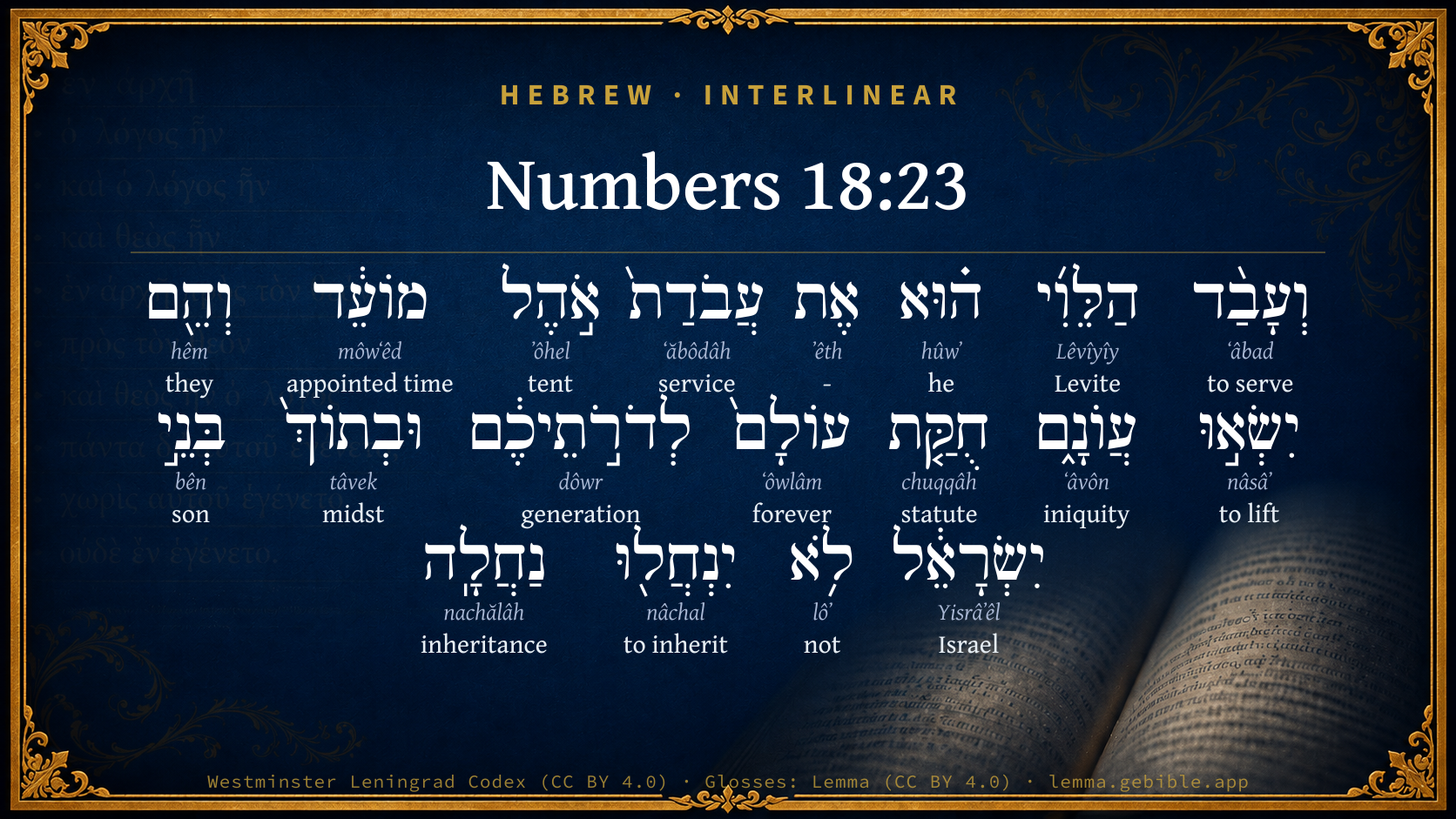
  1. וְעָבַ֨ד ʻâbad H5647 “and · to serve” Conjunction + Verb, Qal, Sequential Perfect, 3rd Person, Masculine, Singular
  2. הַלֵּוִ֜י Lêvîyîy H3881 “the · Levite” Particle, Definite Article + Noun, Gentilic, Masculine, Singular, Absolute
  3. ה֗וּא hûwʼ H1931 “he” Pronoun, Personal, 3rd Person, Masculine, Singular
  4. אֶת ʼêth H853 “-” Particle, Direct Object
  5. עֲבֹדַת֙ ʻăbôdâh H5656 “service of” Noun, Common, Feminine, Singular, Construct
  6. אֹ֣הֶל ʼôhel H168 “tent of” Noun, Common, Masculine, Singular, Construct
  7. מוֹעֵ֔ד môwʻêd H4150 “appointed time” Noun, Common, Masculine, Singular, Absolute
  8. וְהֵ֖ם hêm H1992 “and · they” Conjunction + Pronoun, Personal, 3rd Person, Masculine, Plural
  9. יִשְׂא֣וּ nâsâʼ H5375 “to lift” Verb, Qal, Imperfect, 3rd Person, Masculine, Plural
  10. עֲוֺנָ֑ם ʻâvôn H5771 “iniquity · their” Noun, Common, Both, Singular, Construct + Suffix, Personal, 3rd Person, Masculine, Plural
  11. חֻקַּ֤ת chuqqâh H2708 “statute of” Noun, Common, Both, Singular, Construct
  12. עוֹלָם֙ ʻôwlâm H5769 “forever” Noun, Common, Masculine, Singular, Absolute
  13. לְדֹרֹ֣תֵיכֶ֔ם dôwr H1755 “to/for · generations · your” Preposition + Noun, Common, Masculine, Plural, Construct + Suffix, Personal, 2nd Person, Masculine, Plural
  14. וּבְתוֹךְ֙ tâvek H8432 “and · in/at · midst of” Conjunction + Preposition + Noun, Common, Masculine, Singular, Construct
  15. בְּנֵ֣י bên H1121 “sons of” Noun, Common, Masculine, Plural, Construct
  16. יִשְׂרָאֵ֔ל Yisrâʼêl H3478 “Israel” Noun, Proper
  17. לֹ֥א lôʼ H3808 “not” Particle, Negative
  18. נַחֲלָֽה nachălâh H5159 “inheritance” Noun, Common, Feminine, Singular, Absolute

About this verse

These counts appear in no published source. They are computed here, from the morphology-tagged text and Lemma’s own curated glosses. What Lemma adds →

19
words
19
distinct lemmas
Pentateuch
section

Shared distinctive vocabulary

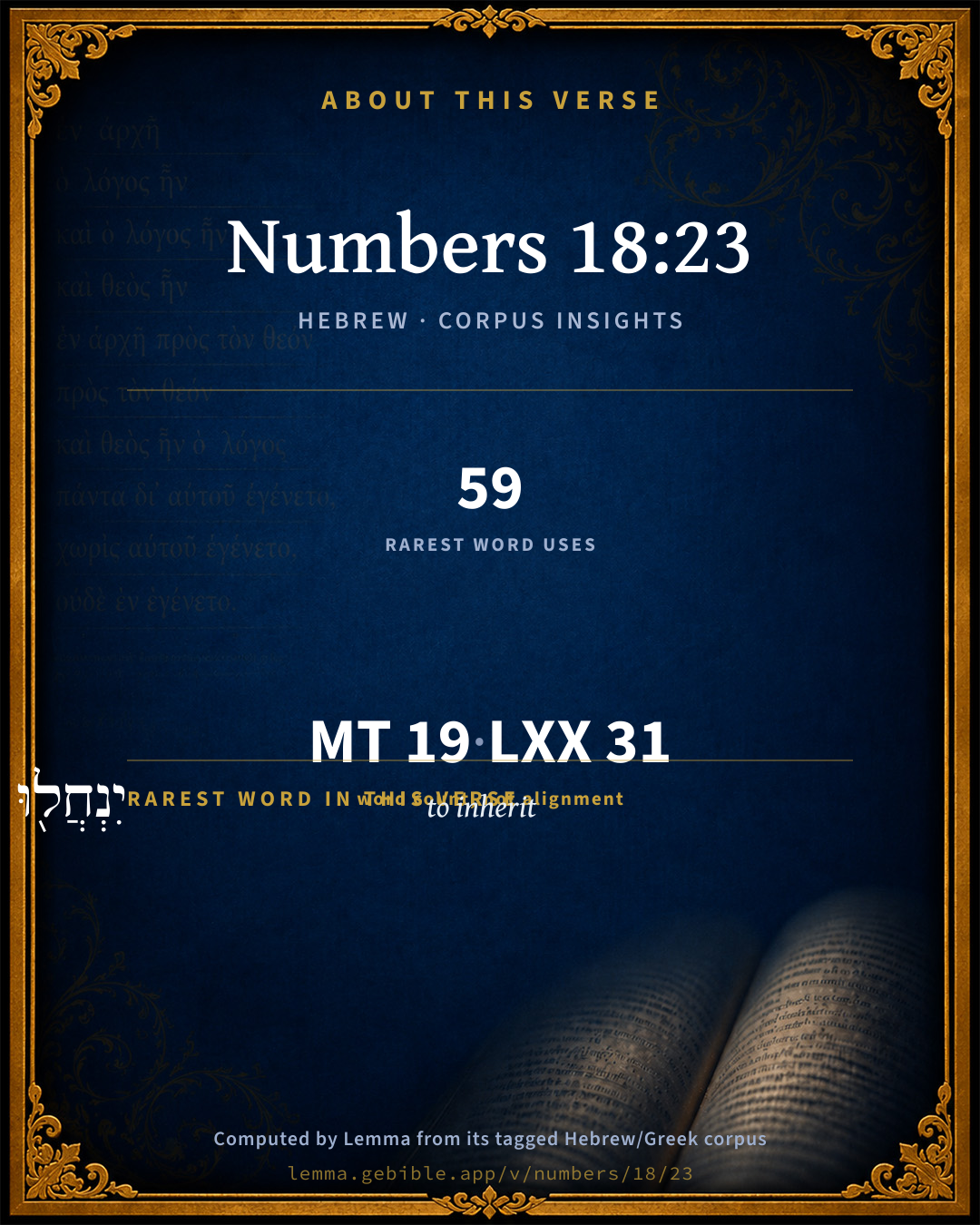
יִנְחֲל֖וּ to inherit H5157 occurs in 57 verses of the Hebrew Bible. Also found in:

Grammatical profile

  • 3 verbs
  • 12 nouns
  • 2 pronouns
  • 2 particles

Verb forms

  • וְעָבַ֨ד Qal · Sequential Perfect
  • יִשְׂא֣וּ Qal · Imperfect
  • יִנְחֲל֖וּ Qal · Imperfect

Hebrew & Septuagint length

In English translation the verse runs 38 words from the Hebrew and 42 from the Septuagint (LXX English) — closely comparable.

A rough comparison of the two English renderings, which tokenize alike — not a word-level alignment.

Word counts can differ between the Hebrew and the Greek without any difference in meaning — e.g. the Hebrew direct-object marker אֵת has no separate Greek word, and Greek often adds the article ὁ.

In the original languages it is 19 Hebrew tokens and 31 Greek tokens — but the two are counted differently (Hebrew bundles its prefixes and suffixes into one token; the Greek is in lemma form), so that isn’t a like-for-like length.

Cross-references

3

Topical passages linked to Numbers 18:23 in the Treasury of Scripture Knowledge — connected by theme and wording, ordered by reader-vote popularity; previews shown in the World English Bible.

  • Numbers 3:7 They shall keep his charge, and the charge of the whole congregation before the Tent of Meeting, to do the service of the tabernacle.
  • Numbers 18:1 Yahweh said to Aaron, You and your sons and your fathers' house with you shall bear the iniquity of the sanctuary; and you and your sons with you shall bear the iniquity of your priesthood.
  • Numbers 18:20 Yahweh said to Aaron, You shall have no inheritance in their land, neither shall you have any portion among them: I am your portion and your inheritance among the children of Israel.

Cross-references courtesy of OpenBible.info (CC BY 4.0).

Hebrew and Greek witnesses Masoretic Hebrew ↔ Greek Septuagint

The same verse in the two great witnesses to the Old Testament, shown verse-for-verse.

These are two independent witnesses, not word-aligned to each other, and the Septuagint is shown in lemma (dictionary) form.

Hebrew Numbers 18:23 Masoretic · Westminster Leningrad Codex

וְעָבַ֨ד הַלֵּוִ֜י ה֗וּא אֶת עֲבֹדַת֙ אֹ֣הֶל מוֹעֵ֔ד וְהֵ֖ם יִשְׂא֣וּ עֲוֺנָ֑ם חֻקַּ֤ת עוֹלָם֙ לְדֹרֹ֣תֵיכֶ֔ם וּבְתוֹךְ֙ בְּנֵ֣י יִשְׂרָאֵ֔ל לֹ֥א יִנְחֲל֖וּ נַחֲלָֽה

But the Levites shall do the service of the tent of meeting, and they shall bear their iniquity: it shall be a statute forever throughout your generations; and among the children of Israel they shall have no inheritance.

World English Bible · Public Domain

Greek LXX Numbers 18:23 Septuagint · lemma form

καί λειτουργέω ὁ λευίτης αὐτός ὁ λειτουργία ὁ σκηνή ὁ μαρτύριον καί αὐτός λαμβάνω ὁ ἁμάρτημα αὐτός νόμιμος αἰώνιος εἰς ὁ γενεά αὐτός καί ἐν μέσος υἱός ἰσραήλ οὐ κληρονομέω κληρονομία

And the Levite himself shall perform the service of the tabernacle of witness; and they shall bear their iniquities, it is a perpetual statute throughout their generations; and in the midst of the children of Israel they shall not receive an inheritance.

LXX2012 (modern English Septuagint) · Public Domain

Hebrew: Westminster Leningrad Codex (CC BY 4.0). Greek: Septuagint (public domain); English from LXX2012 (modern English Septuagint) (Public Domain). How the Septuagint differs from the Hebrew →

Targum (Aramaic paraphrase)

2

The Targum is the ancient Jewish Aramaic paraphrase of the Hebrew Scriptures — an interpretive translation, not the Hebrew text itself. Onkelos (literal) and Pseudo-Jonathan (expansive) render the Torah, and Jonathan the Prophets. Coverage is partial: where no permissively-licensed English translation exists for a verse, only the Aramaic is shown. This is verse-level text, not a word-by-word alignment to the Hebrew.

  1. Targum Onkelos Torah (Genesis–Deuteronomy)
    וְיִפְלְחוּן לֵוָאֵי אִינוּן יָת פּוּלְחַן מַשְׁכַּן זִמְנָא וְאִינוּן יְקַבְּלוּן חוֹבֵיהוֹן קְיַם עֲלָם לְדָרֵיכוֹן וּבְגוֹ בְּנֵי יִשְׂרָאֵל לָא יַחְסְנוּן אַחְסָנָא

    (no public-domain English translation for this verse)

    Targum Onkelos — Aramaic: “Onkelos Genesis” (public domain); “Onkelos Exodus” (public domain); “Onkelos Leviticus” (public domain); “Onkelos Numbers” (public domain); “Onkelos Deuteronomy” (public domain). English: “Sefaria Community Translation” (CC0 1.0 (public-domain dedication)); “J.W. Etheridge. The Targums of Onkelos and Jonathan Ben Uzziel on the Pentateuch. London: Longmans, Green, 1862” (public domain). Text via Sefaria.

  2. Targum Pseudo-Jonathan Torah (Genesis–Deuteronomy)
    וְיִפְלְחוּן לֵיוָאֵי הִינוּן יַת פּוּלְחַן מַשְׁכַּן זִמְנָא וְהִינוּן יְקַבְּלוּן יַת חוֹבֵיהוֹן אִין לָא מִזְדַהֲרִין בְּפוּלְחַנְהוֹן קְיַים עֲלָם לְדָרֵיכוֹן וּבְגוֹ בְּנֵי יִשְרָאֵל לָא יַחְסְנוּן אַחְסָנָא

    but the Levites shall minister in the work of the tabernacle, and shall bear their sin if they be not diligent in their work. It is an everlasting statute for your generations; but among the sons of Israel they shall have no possession.

    Targum Pseudo-Jonathan — Aramaic: “Targum Jonathan on Genesis” (public domain); “Targum Jonathan on Exodus” (public domain); “Targum Jonathan on Leviticus” (public domain); “Targum Jonathan on Numbers” (public domain); “Targum Jonathan on Deuteronomy” (public domain). English: “The Targum of Jonathan ben Uzziel, trans. J. W. Etheridge, London, 1862” (public domain). Text via Sefaria.

Commentary

Notes on Numbers 18:23 from classic Christian and Jewish commentators (each source and its license shown beneath its notes). The classic Christian expositions comment on the surrounding passage and are grouped to its opening verse, so a note may address several verses; the Jewish commentaries on the Tanakh (Rashi and others) are per-verse, so they appear only where the commentator wrote on this verse.

Lemma curates 59 commentaries, every one of them public domain or Creative Commons licensed, each selected and text-cleaned for this edition rather than reprinted as found. About our sources →

John Gill's Exposition

But the tithe of the children of Israel,.... The tenth of the produce of their land, as before:

which they offer as an heave offering unto the Lord: by way of gratitude to him for giving them the land, and for making it so fruitful to them, and as an acknowledgment of his being the sovereign Lord and proprietor of it:

I have given to the Levites to inherit; so that the Levites had the tithe not immediately from the Israelites, nor were they dependent on them for them; but they were first given to the Lord, and then by him to the Levites, who held them of him, and not of the Israelites; and were a portion and an inheritance, settled upon them by the Lord himself, which they had as good a right and title unto as the rest of the tribes had to their several inheritances:

therefore have I said unto them, among the children, of Israel they shall have no inheritance; as in Num 18:23.

John Gill's Exposition of the Whole Bible (1746–1763) — public domain (CC PDM 1.0). Text via the HelloAO Bible API.

Joseph Benson's Commentary

Num 18:23. Their iniquity — The punishment due not only for their own, but also for the people’s miscarriage, if it be committed through their connivance or negligence. And this was the reason why the priests withstood King Uzziah, when he would have burnt incense to the Lord.

Joseph Benson's Commentary on the Old and New Testaments (1811–1818) — public domain. Text from a community e-Sword module.

Tyndale Open Study Notes

Tyndale Open Resources

18:23-24 The Israelites’ tithes were one tenth of the year’s production of goods (see Deut 14:22-29; 26:12; Neh 10:35-39; Mal 3:8-12; Matt 23:23; cp. Gen 14:17-20; Heb 7:5-10).

Tyndale Open Study Notes — © Tyndale Open Resources, licensed CC BY-SA 4.0. Text via the HelloAO Bible API.

Geneva Bible (1599)

Geneva Bible translators

If they fail in their office, they shall be punished.

Geneva Bible (1599) marginal notes — public domain. Text via Bolls.life.

Jamieson, Fausset & Brown

Robert Jamieson, A. R. Fausset & David Brown

But the Levites shall do the service of the tabernacle of the congregation: they shall bear their iniquity--They were to be responsible for the right discharge of those duties that were assigned to them, and consequently to bear the penalty that was due to negligence or carelessness in the guardianship of the holy things.

Jamieson, Fausset & Brown — Commentary Critical and Explanatory on the Whole Bible (1871) — public domain (CC PDM 1.0). Text via the HelloAO Bible API.

Albert Barnes' Notes on the Bible

Bear their iniquity - The words probably refer to the iniquity of the people; who would, had they approached the tabernacle have fallen, from their proneness to transgress, into overt acts of offence. Against such a result they were, through the ministrations of the Levites, mercifully protected. Compare Num 18:1.

Albert Barnes' Notes on the Bible (1834–1885) — public domain. Text from a community e-Sword/MySword module.

Haydock's Catholic Bible Commentary

People; or the Hebrew may be also, "they shall bear their own iniquity." If they prove negligent in performing their duty they shall be punished; and if they do not restrain the people from approaching the tabernacle, they shall be answerable for their offence, and both shall incur death. (Calmet) --- They shall, however, save their own souls, if they have not been deficient in instructing the people, and in doing their utmost to prevent any profanation. (Haydock)

George Leo Haydock (1774–1849), Haydock's Catholic Family Bible and Commentary, 1859 edition — public domain. Excludes Psalms (Douay-Rheims chapter numbering differs from Protestant) and Deuterocanonical books (Catholic canon only).

Matthew Poole's English Annotations

Their iniquity, i.e. the punishment due not only for their own, but also for the people’s miscarriage, if it be committed through their connivance or negligence. And this was the reason why the priests withstood king Uzziah, when he would have burnt incense to the Lord, 2Ch 26:17,18.

Matthew Poole's English Annotations on the Holy Bible (1683–1685) — public domain. Text from a community e-Sword/MySword module.

Whedon's Commentary on the Bible

Daniel D. Whedon

23. Do the service of the tabernacle — The Levites were the bearers and custodians of the tabernacle. They assisted the priests, but never sprinkled blood nor burned incense.

They shall bear their iniquity — Here is the idea of a vicarious atonement plainly expressed. The people had attempted to bear their own sins into the presence of God, and to make atonement, and the yawning earth, the fire, and the plague had swept away thousands. This was to teach them that holy persons were needful to purify the unholy by expiation. The people must be taught, at whatever cost, the difference between holy and unholy. Hence the presumptuous are consumed in the act of holding up their sins before Jehovah, a work for which Aaron and his sons had been specially consecrated. They could draw near the tabernacle as the representatives of Israel, taking upon themselves and bearing the iniquity of the congregation. Thus the need of a holy Mediator is prefigured, even Jesus Christ, “who appears in heaven for us.”

Daniel D. Whedon (gen. ed.), Commentary on the Old and New Testaments (1874–1909) — public domain. Text from a community e-Sword module.

The Pulpit Commentary

And they shall bear (Wacyi) their iniquity. The Levites were to take the responsibility of the general iniquity so far as approach to the tabernacle was concerned. They have no inheritance. Like the priests, they had homes and cities, and they had pasturages attached to these cities, but no separate territory.

The Pulpit Commentary (1880–1919), ed. H.D.M. Spence-Jones & Joseph S. Exell — public domain. Text from a community e-Sword module.

John Wesley's Explanatory Notes

Their iniquity - The punishment due not only for their own, but also for the people's miscarriage, if it be committed through their connivance or negligence. And this was the reason why the priests withstood King Uzziah, when he would have burnt incense to the Lord.

John Wesley, Explanatory Notes Upon the Whole Bible (1754–1765) — public domain. Text via the GEBible commentary corpus.

unfoldingWord translationNotes

Door43 World Missions Community

Connecting Statement:

God continues speaking to Aaron.

Among the people of Israel they must have no inheritance

God speaks of the land that the other people of Israel will possess as if they will inherit it. The Levites would not receive any of the land. AT: "they must not have any of the land that the other people of Israel receive" (See: Metaphor)

as their inheritance

God speaks of what Aaron and his descendants will receive as if they will inherit it. AT: "as their portion of what I give to all Israel" (See: Metaphor)

translationWords

law, laws

generation

unfoldingWord translationNotes — © Distant Shores Media and the Door43 World Missions Community, licensed CC BY-SA 4.0. Source: git.door43.org/Door43/en_tn.

Rashi

Rabbi Shlomo Yitzchaki (Rashi)

והם [BUT THE LEVITES SHALL PERFORM THE SERVICE OF THE APPOINTED TENT] AND THEY SHALL BEAR THEIR INIQUITY — “They” means the Levites; they shall bear the iniquity of the children of Israel, because upon them (the Levites) lies the duty to warn them (the Israelites) not to come near unto them.

Rashi on the Tanakh — English translations: “The Judaica Press complete Tanach with Rashi, translated by A. J. Rosenberg” (CC BY 4.0); “Pentateuch with Rashi's commentary by M. Rosenbaum and A.M. Silbermann, 1929-1934” (public domain); “The Metsudah Tanach series, Lakewood, N.J” (CC BY 4.0); and “The Book of Joshua, Metsudah Publications, 1997” (CC BY 4.0). Text via Sefaria.

Lesson kit

Teaching starters — assembled from the data on this page, not authored interpretation. Every prompt links to the verse data it draws on. Edit before teaching.

Numbers, in the Pentateuch, opens this verse with 19 words (19 distinct Hebrew lemmas). Its most distinctive word is nâchal (“to inherit”). A historical commentator’s framing appears above. Read the whole chapter for the surrounding context.

Discussion questions

  1. How does “to inherit” (nâchal) shape what this verse is saying?
  2. Exodus 23:30 shares the word «to inherit» with this verse. How do the two illuminate each other?
  3. The translations on this page render this verse differently — a whole-verse word diff, not a word-by-word alignment. What might account for the different wordings?
  4. The verb «וְעָבַ֨ד» is Qal Sequential Perfect. How does its form color the action?
  5. Reading how John Gill's Exposition and Joseph Benson's Commentary read this verse, where do the two commentators agree and where do they part?

Things to notice

Reading settings

Reading text

Shown beneath each verse's original-language words.

Old Testament
Old Testament edition

Read the OT as the Masoretic Hebrew (MT) or the Greek Septuagint (LXX).

English shown for the Greek Septuagint (in the Hebrew ↔ Greek comparison).

Comparing translations? Open the Compare panel on any verse page to stack up to four side by side.