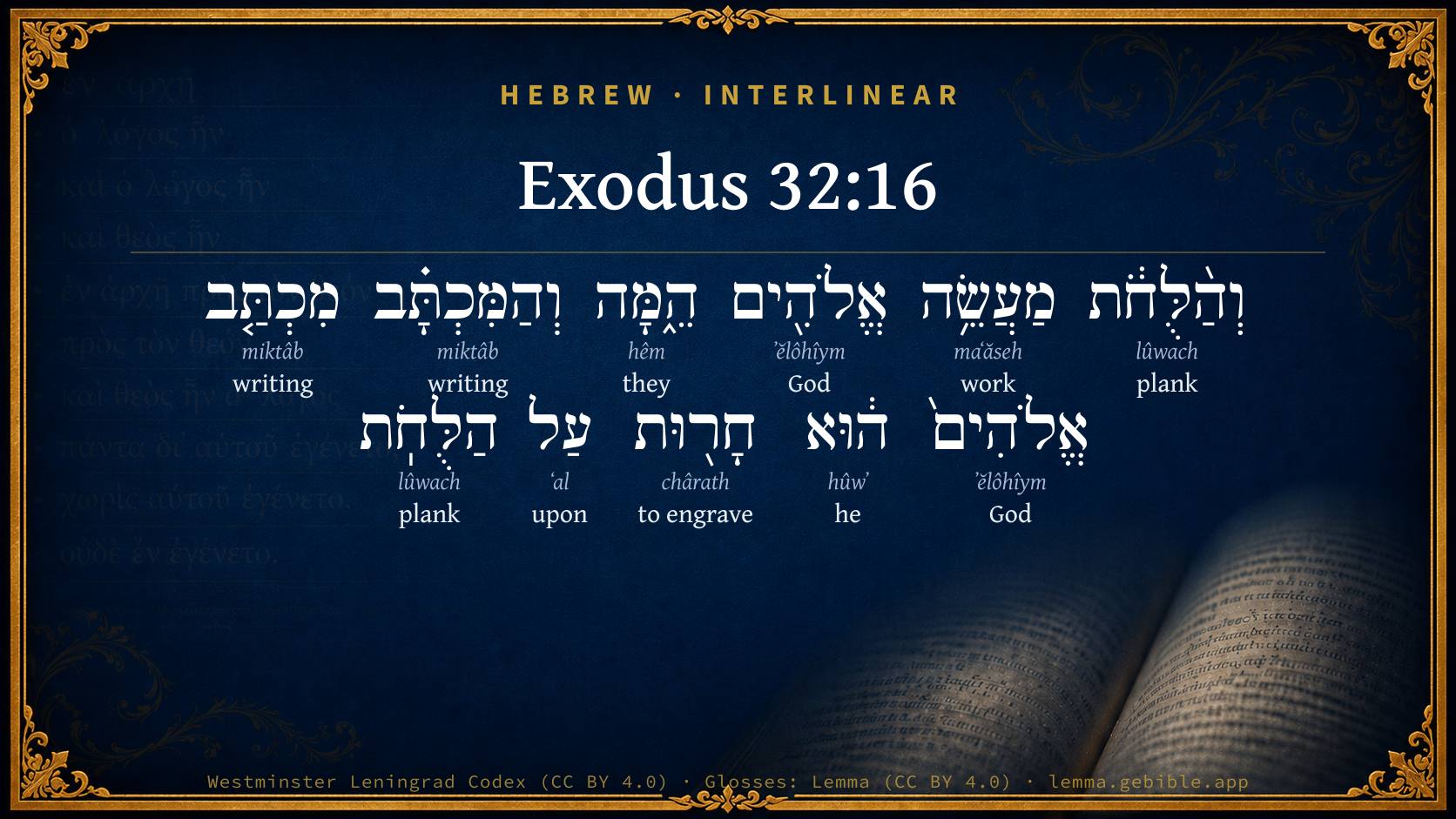
Exodus 32:16

Hebrew (Westminster Leningrad Codex) Exodus 32:16 appears in the Hebrew Old Testament. The text above is from the Westminster Leningrad Codex. Each word links to its Strong’s number, a concise gloss, and parsing drawn from the Open Scriptures Hebrew Bible morphology. Click any word for its full Brown-Driver-Briggs (BDB) entry.
Download image
Cite this verse

Exodus 32:16 (World English Bible). Public Domain. Lemma interlinear Bible study tool, https://lemma.gebible.app/v/exodus/32/16.

Show BibTeX & RIS
BibTeX
RIS
English Translation
The tablets were the work of God, and the writing was the writing of God, engraved on the tables.
World English Bible · Public Domain
Highlights
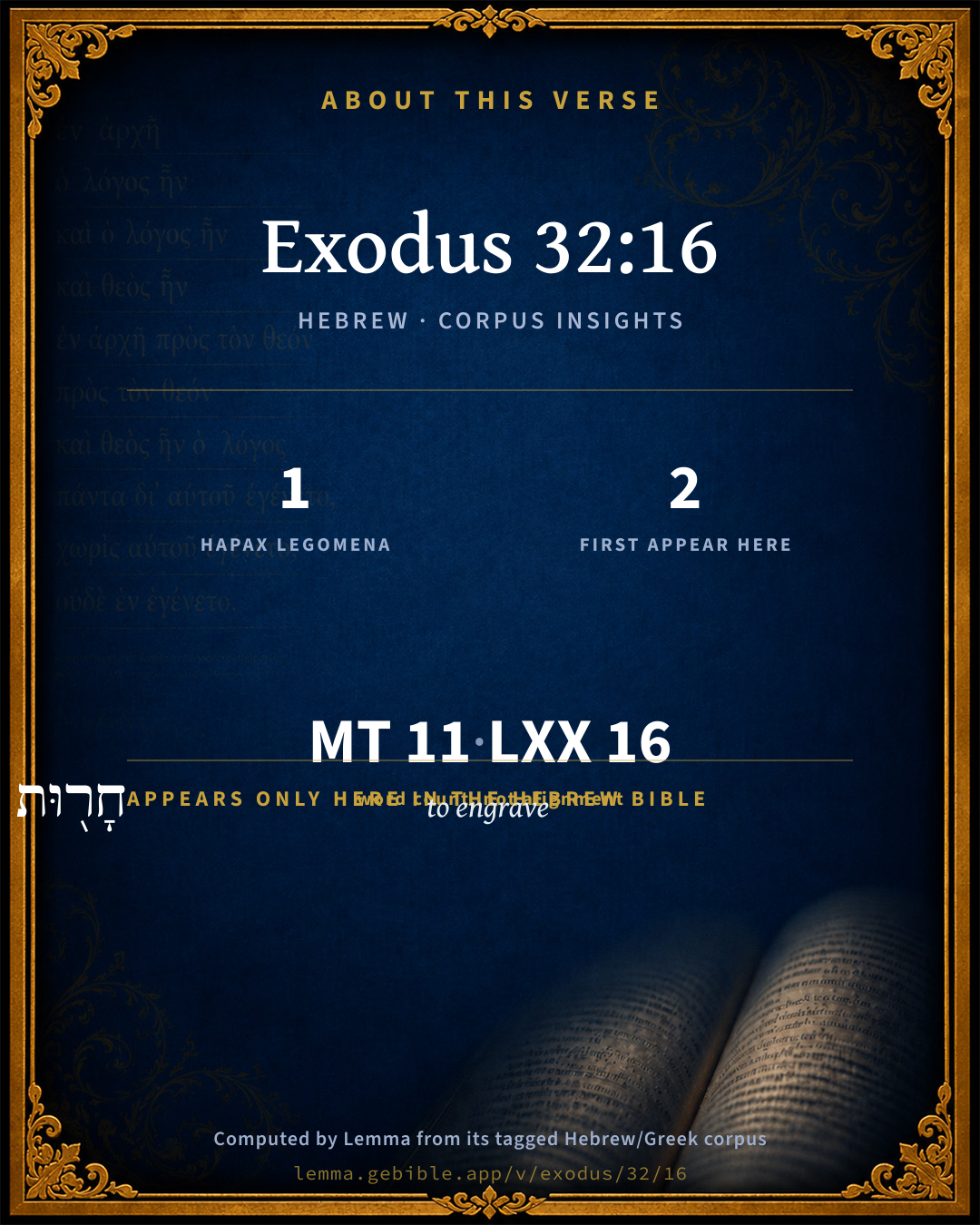
  • 1 hapax legomenon — only here in the Hebrew Bible
  • 2 first appearances in the Hebrew Bible
Full analysis ↓
Download a study sheet

One document with this verse’s original text, its word-by-word gloss line, the meaning frame, cross-references with their text, attributed commentary, and full source and license credits — printable, and it pastes into notes with its structure intact.

This verse Autodidact and up

Study sheet (.html) Plain text (.txt)

A passage Seminary Student

Up to 50 verses in one chapter. A passage sheet keeps up to 6 commentary sources and 12 cross-references per verse, in the order this page ranks them, and says so on the sheet whenever that leaves anything out. Ask for a single verse and you get the Autodidact verse sheet above.

Everything on this page stays free to read, with no account — the sheet is a download of what is already on screen, not access to it.

Want to remove ads? Support Godless Engineer
Compare translations 3

The same verse in 3 English versions, stacked beneath the original-language interlinear above. Click any original word for its lexicon entry.

Each is an independent rendering of the whole verse — the interlinear is not word-aligned to these translations.

Highlighted words mark where these versions differ — a whole-verse word diff, not a word-by-word alignment.

  • World English Bible Public Domain
    The tablets were the work of God, and the writing was the writing of God, engraved on the tables.
  • King James Version Public Domain
    And the tables were the work of God, and the writing was the writing of God, graven upon the tables.
  • unfoldingWord Literal Text CC BY-SA 4.0
    And the tablets, they the work of God. And the writing, it the writing of God, was engraved on the tablets.

unfoldingWord Literal Text — © unfoldingWord, licensed CC BY-SA 4.0. Word-aligned USFM3 via Door43 (git.door43.org/unfoldingWord/en_ult).

Versions to compare (up to 4)

3 of 4 selected

Show all 18 translations

Every available English version of this verse, each an independent rendering of the whole verse.

  • World English Bible Public Domain
    The tablets were the work of God, and the writing was the writing of God, engraved on the tables.
  • Berean Standard Bible Public Domain
    The tablets were the work of God, and the writing was the writing of God, engraved on the tablets.
  • Majority Standard Bible Public Domain
    The tablets were the work of God, and the writing was the writing of God, engraved on the tablets.
  • King James Version Public Domain
    And the tables were the work of God, and the writing was the writing of God, graven upon the tables.
  • American Standard Version (1901) Public Domain
    And the tables were the work of God, and the writing was the writing of God, graven upon the tables.
  • Revised Version (1885) Public Domain
    And the tables were the work of God, and the writing was the writing of God, graven upon the tables.
  • Geneva Bible (1599) Public Domain
    And these Tables were the worke of God, and this writing was the writing of God grauen in the Tables.
  • Douay-Rheims (1899) Public Domain
    And made by the work of God: the writing also of God was graven in the tables.
  • Young's Literal Translation Public Domain
    and the tables are the work of God, and the writing is the writing of God, graven on the tables.
  • Literal Standard Version CC BY-SA 4.0
    and the tablets are the work of God, and the writing is the writing of God, engraved on the tablets.
  • Unlocked Literal Bible CC BY-SA 4.0
    The tablets were God's own work, and the writing was God's own writing, engraved on the tablets.
  • unfoldingWord Literal Text CC BY-SA 4.0
    And the tablets, they the work of God. And the writing, it the writing of God, was engraved on the tablets.
  • Darby Bible Public Domain
    And the tables [were] God's work, and the writing was God's writing, engraven on the tables.
  • World Messianic Bible Public Domain
    The tablets were the work of God, and the writing was the writing of God, engraved on the tablets.
  • Webster's Bible Public Domain
    And the tables were the work of God, and the writing was the writing of God, graven upon the tables.
  • Free Bible Version CC BY-SA 4.0
    God had made the tablets, and God had engraved the writing himself.
  • Bible in Basic English Public Domain
    The stones were the work of God, and the writing was the writing of God, cut on the stones.
  • JPS Tanakh (1917) Public Domain
    And the tables were the work of God, and the writing was the writing of God, graven upon the tables.

Literal Standard Version (2020), Covenant Press — licensed CC BY-SA 4.0. Text via the HelloAO Bible API (eBible.org). Unlocked Literal Bible (unfoldingWord) — licensed CC BY-SA 4.0. Text via the HelloAO Bible API (eBible.org). unfoldingWord Literal Text — © unfoldingWord, licensed CC BY-SA 4.0. Word-aligned USFM3 via Door43 (git.door43.org/unfoldingWord/en_ult). Free Bible Version, Dr. Jonathan Gallagher — licensed CC BY-SA 4.0. Text via the HelloAO Bible API (eBible.org).

Word by word

More ways to search: Search by grammar → Find every occurrence → Compare this word →

Practice this passage: Drill this verse → Learn its vocabulary →

חָר֖וּת
chârath
H2801
“engraved”
Verb, Qal, Participle Passive, Masculine, Singular, Absolute
Part of Speech
Verb
Stem
Qal
Form
Participle Passive
Gender
Masculine
Number
Singular
State
Absolute
Full BDB Definition

Origin: a primitive root

TWOT: 764

(Qal) to engrave, graven
  1. וְהַ֨לֻּחֹ֔ת lûwach H3871 “and · the · planks” Conjunction + Particle, Definite Article + Noun, Common, Masculine, Plural, Absolute
  2. מַעֲשֵׂ֥ה maʻăseh H4639 “work of” Noun, Common, Masculine, Singular, Construct
  3. אֱלֹהִ֖ים ʼĕlôhîym H430 “God(s)” Noun, Common, Masculine, Plural, Absolute
  4. הֵ֑מָּה hêm H1992 “they” Pronoun, Personal, 3rd Person, Masculine, Plural
  5. וְהַמִּכְתָּ֗ב miktâb H4385 “and · the · writing” Conjunction + Particle, Definite Article + Noun, Common, Masculine, Singular, Absolute
  6. מִכְתַּ֤ב miktâb H4385 “writing of” Noun, Common, Masculine, Singular, Construct
  7. אֱלֹהִים֙ ʼĕlôhîym H430 “God(s)” Noun, Common, Masculine, Plural, Absolute
  8. ה֔וּא hûwʼ H1931 “he” Pronoun, Personal, 3rd Person, Masculine, Singular
  9. עַל ʻal H5921 “upon” Preposition
  10. הַלֻּחֹֽת lûwach H3871 “the · planks” Particle, Definite Article + Noun, Common, Masculine, Plural, Absolute

About this verse

These counts appear in no published source. They are computed here, from the morphology-tagged text and Lemma’s own curated glosses. What Lemma adds →

11
words
8
distinct lemmas
Pentateuch
section

Notable vocabulary

1 hapax legomenon — a word that appears only here in the entire Hebrew Bible:

  • חָר֖וּת to engrave H2801

First appearance in Scripture

These words make their first canonical appearance in the Hebrew Bible here:

  • וְהַמִּכְתָּ֗ב writing H4385
  • חָר֖וּת to engrave H2801

Shared distinctive vocabulary

וְהַמִּכְתָּ֗ב writing H4385 occurs in 8 verses of the Hebrew Bible. Also found in:

Grammatical profile

  • 1 verb
  • 7 nouns
  • 2 pronouns
  • 1 preposition

Verb forms

  • חָר֖וּת Qal · Participle Passive

Repetition

Words recur within this verse — often emphatic in Hebrew:

  • וְהַ֨לֻּחֹ֔ת plank H3871 ×2
  • אֱלֹהִ֖ים God H430 ×2
  • וְהַמִּכְתָּ֗ב writing H4385 ×2

Hebrew & Septuagint length

In English translation the verse runs 19 words from the Hebrew and 19 from the Septuagint (LXX English) — the same length.

A rough comparison of the two English renderings, which tokenize alike — not a word-level alignment.

Word counts can differ between the Hebrew and the Greek without any difference in meaning — e.g. the Hebrew direct-object marker אֵת has no separate Greek word, and Greek often adds the article ὁ.

In the original languages it is 11 Hebrew tokens and 16 Greek tokens — but the two are counted differently (Hebrew bundles its prefixes and suffixes into one token; the Greek is in lemma form), so that isn’t a like-for-like length.

Cross-references

9

Topical passages linked to Exodus 32:16 in the Treasury of Scripture Knowledge — connected by theme and wording, ordered by reader-vote popularity; previews shown in the World English Bible.

  • Exodus 31:18 He gave to Moses, when he finished speaking with him on Mount Sinai, the two tablets of the testimony, stone tablets, written with God's finger.
  • Hebrews 8:10 "For this is the covenant that I will make with the house of Israel. After those days," says the Lord; "I will put my laws into their mind, I will also write them on their heart. I will be to them a God, And they will be to me a people.
  • Exodus 34:1 Yahweh said to Moses, "Chisel two stone tablets like the first: and I will write on the tablets the words that were on the first tablets, which you broke.
  • Exodus 34:4 He chiseled two tablets of stone like the first; and Moses rose up early in the morning, and went up to Mount Sinai, as Yahweh had commanded him, and took in his hand two stone tablets.
  • Deuteronomy 9:9–11 When I was gone up onto the mountain to receive the tables of stone, even the tables of the covenant which Yahweh made with you, then I stayed on the mountain forty days and forty nights; I did neither eat bread nor drink water.
  • Deuteronomy 9:15 So I turned and came down from the mountain, and the mountain was burning with fire: and the two tables of the covenant were in my two hands.
  • Deuteronomy 10:1 At that time Yahweh said to me, Hew you two tables of stone like the first, and come up to me onto the mountain, and make an ark of wood.
  • 2 Corinthians 3:3 being revealed that you are a letter of Christ, ministered by us, written not with ink, but with the Spirit of the living God; not in tablets of stone, but in tablets that are hearts of flesh.
  • 2 Corinthians 3:7 But if the service of death, written engraved on stones, came with glory, so that the children of Israel could not look steadfastly on the face of Moses for the glory of his face; which was passing away:

Cross-references courtesy of OpenBible.info (CC BY 4.0).

Hebrew and Greek witnesses Masoretic Hebrew ↔ Greek Septuagint

The same verse in the two great witnesses to the Old Testament, shown verse-for-verse.

These are two independent witnesses, not word-aligned to each other, and the Septuagint is shown in lemma (dictionary) form.

Hebrew Exodus 32:16 Masoretic · Westminster Leningrad Codex

וְהַ֨לֻּחֹ֔ת מַעֲשֵׂ֥ה אֱלֹהִ֖ים הֵ֑מָּה וְהַמִּכְתָּ֗ב מִכְתַּ֤ב אֱלֹהִים֙ ה֔וּא חָר֖וּת עַל הַלֻּחֹֽת

The tablets were the work of God, and the writing was the writing of God, engraved on the tables.

World English Bible · Public Domain

Greek LXX Exodus 32:16 Septuagint · lemma form

καί ὁ πλάξ ἔργον θεός εἰμί καί ὁ γραφή γραφή θεός εἰμί κολάπτω ἐν ὁ πλάξ

And the tables were the work of God, and the writing the writing of God written on the tables.

LXX2012 (modern English Septuagint) · Public Domain

Hebrew: Westminster Leningrad Codex (CC BY 4.0). Greek: Septuagint (public domain); English from LXX2012 (modern English Septuagint) (Public Domain). How the Septuagint differs from the Hebrew →

Targum (Aramaic paraphrase)

2

The Targum is the ancient Jewish Aramaic paraphrase of the Hebrew Scriptures — an interpretive translation, not the Hebrew text itself. Onkelos (literal) and Pseudo-Jonathan (expansive) render the Torah, and Jonathan the Prophets. Coverage is partial: where no permissively-licensed English translation exists for a verse, only the Aramaic is shown. This is verse-level text, not a word-by-word alignment to the Hebrew.

  1. Targum Onkelos Torah (Genesis–Deuteronomy)
    וְלוּחַיָא עוֹבָדָא דַיְיָ אִנוּן וּכְתָבָא כְּתָבָא דַיְיָ הוּא מְפָרַשׁ עַל לוּחַיָא:

    (no public-domain English translation for this verse)

    Targum Onkelos — Aramaic: “Onkelos Genesis” (public domain); “Onkelos Exodus” (public domain); “Onkelos Leviticus” (public domain); “Onkelos Numbers” (public domain); “Onkelos Deuteronomy” (public domain). English: “Sefaria Community Translation” (CC0 1.0 (public-domain dedication)); “J.W. Etheridge. The Targums of Onkelos and Jonathan Ben Uzziel on the Pentateuch. London: Longmans, Green, 1862” (public domain). Text via Sefaria.

  2. Targum Pseudo-Jonathan Torah (Genesis–Deuteronomy)
    וְלוּחַיָא עוּבְדָא דַיְיָ הִינִין וּכְתָבָא כְּתָבָא דַיְיָ הוּא חָקִיק וּמְפָרַשׁ עַל לוּחַיָא

    And the tables were the work of the Lord, and the writing was the Lord's writing, inscribed and manifested upon the tables.

    Targum Pseudo-Jonathan — Aramaic: “Targum Jonathan on Genesis” (public domain); “Targum Jonathan on Exodus” (public domain); “Targum Jonathan on Leviticus” (public domain); “Targum Jonathan on Numbers” (public domain); “Targum Jonathan on Deuteronomy” (public domain). English: “The Targum of Jonathan ben Uzziel, trans. J. W. Etheridge, London, 1862” (public domain). Text via Sefaria.

Commentary

Notes on Exodus 32:16 from classic Christian and Jewish commentators (each source and its license shown beneath its notes). The classic Christian expositions comment on the surrounding passage and are grouped to its opening verse, so a note may address several verses; the Jewish commentaries on the Tanakh (Rashi and others) are per-verse, so they appear only where the commentator wrote on this verse.

Lemma curates 59 commentaries, every one of them public domain or Creative Commons licensed, each selected and text-cleaned for this edition rather than reprinted as found. About our sources →

Trapp's Complete Commentary

John Trapp

Exo 32:16 And the tables [were] the work of God, and the writing [was] the writing of God, graven upon the tables.

Ver. 16. The work of God.] The greater was the people’s loss, brought upon them by their sin.

John Trapp, A Commentary or Exposition upon All the Books of the Old and New Testament (1647–1656) — public domain. Text from a community e-Sword module.

Tyndale Open Study Notes

Tyndale Open Resources

32:16 These tablets were God’s work: The covenant was not merely a human agreement.

Tyndale Open Study Notes — © Tyndale Open Resources, licensed CC BY-SA 4.0. Text via the HelloAO Bible API.

Geneva Bible (1599)

Geneva Bible translators

All these repetitions show how excellent a thing they defrauded themselves of by their idolatry.

Geneva Bible (1599) marginal notes — public domain. Text via Bolls.life.

Adam Clarke's Commentary

Verse 16. The tables were the work of God] Because such a law could proceed from none but himself; God alone is the fountain and author of LAW, of what is right, just, holy, and good. See the meaning of the word LAW, Ex 12:49. See Clarke on Ex 12:49.

The writing was the writing of God] For as he is the sole author of law and justice, so he alone can write them on the heart of man. This is agreeable to the spirit of the new covenant which God had promised to make with men in the latter days: I will make a new covenant with the house of Israel - I will PUT MY LAWS IN THEIR MINDS, AND WRITE THEM IN THEIR HEARTS, Jer 31:33; Heb 8:10; 2Co 3:3. That the writing of these tables was the writing of God, see proved at the conclusion of the last chapter.

Adam Clarke's Commentary on the Bible (1810–1826) — public domain. Text from a community e-Sword/MySword module.

Ellicott's Commentary for English Readers

(16) The tables were the work of God.—Rosenmüller supposes this to mean merely that the size and shape of the stones was prescribed to Moses by God; but the natural meaning of the words is that God Himself fashioned them. This was not the case with the second tables (Exo_34:1; Exo_34:4).

The writing was the writing of God.—See Note 3 on Exo_31:18.

A Bible Commentary for English Readers, edited by Charles John Ellicott (1878–1897) — public domain. Text from a community e-Sword module.

The Cambridge Bible for Schools and Colleges

gen. ed. J. J. S. Perowne

16. the work of God, &c.] See Exo_24:12, Exo_31:18 b.

The Cambridge Bible for Schools and Colleges (gen. ed. J. J. S. Perowne; Cambridge University Press, 1878–1918) — public domain. Text from a community e-Sword module.

John Gill's Exposition

And when Joshua heard the noise of the people, as they shouted,.... Dancing about the calf: when Moses went up into the mount, Joshua went with him, and tarried in a lower part of the mount all the forty days until he returned, see Exo 24:13 though not so low as the bottom of the mount where the people were, nor so near it as to know what they did there, for of their affairs he seems to be entirely ignorant; nor so high as where Moses was, or, however, not in the cloud where he conversed with God, for of what passed between them he had no knowledge, until declared by Moses:

he said unto Moses, there is a noise of war in the camp; such a noise as soldiers make in an onset for battle; he supposed that some enemy was come upon and had attacked the people, and that this noise was the noise of the enemy, or of the Israelites, or both, just beginning the battle; or on the finishing of it on the account of victory on one side or the other; and as he was the general of the army, it must give him a concern that he should be absent at such a time.

John Gill's Exposition of the Whole Bible (1746–1763) — public domain (CC PDM 1.0). Text via the HelloAO Bible API.

Whedon's Commentary on the Bible

Daniel D. Whedon

16. Work of God — They were miracles in stone, and so monumental witnesses of the supernatural origin of the commandments. See on Exo_31:18.

Daniel D. Whedon (gen. ed.), Commentary on the Old and New Testaments (1874–1909) — public domain. Text from a community e-Sword module.

The Pulpit Commentary

The tables were the work of God. Shaped, i.e. , by the same power by which the commandments were inscribed upon them; not, necessarily, of matter newly created for the purpose.

The Pulpit Commentary (1880–1919), ed. H.D.M. Spence-Jones & Joseph S. Exell — public domain. Text from a community e-Sword module.

John Wesley's Explanatory Notes

The writing of God - Very probably the first writing in the world.

John Wesley, Explanatory Notes Upon the Whole Bible (1754–1765) — public domain. Text via the GEBible commentary corpus.

Scofield Reference Notes

C. I. Scofield

tables

(See Scofield "Exo 20:4").

The Scofield Reference Bible (1917 edition), notes by C. I. Scofield — public domain. Text from a community e-Sword module.

Rashi

Rabbi Shlomo Yitzchaki (Rashi)

מעשה אלהים המה [THE TABLETS WERE] THE WORK OF GOD — This means what it literally implies: God Himself (Hebrew: in His glory) made them. Another explanation (taking מעשה in the sense of “occupation”) is: Just as a man says to his fellow, “All that Mr. So-and-so occupies himself with is only with such-and-such a work”, so is the delight of the Holy One, blessed be He, confined to the Torah alone (cf. Proverbs 8:31 the whole of which chapter is taken as a description of God’s relation to the Torah) (Midrash Tanchuma, Ki Tisa 16).

חרות — The expressions חרת (which occurs only here in Scriptures) and חרט have the same meaning, both of them signifying engraving; entailler in old French

Rashi on the Tanakh — English translations: “The Judaica Press complete Tanach with Rashi, translated by A. J. Rosenberg” (CC BY 4.0); “Pentateuch with Rashi's commentary by M. Rosenbaum and A.M. Silbermann, 1929-1934” (public domain); “The Metsudah Tanach series, Lakewood, N.J” (CC BY 4.0); and “The Book of Joshua, Metsudah Publications, 1997” (CC BY 4.0). Text via Sefaria.

Ramban (Nachmanides)

Rabbi Moshe ben Nachman (Ramban / Nachmanides)

AND THE TABLETS WERE THE WORK OF G-D. It would have been proper for Scripture to mention everything connected with the work of the Tablets of the Law in the verse, And He gave unto Moses [… the two Tablets of the Testimony], as He said [there], written with the finger of G-d. It is, however, mentioned here in order to tell of their high distinction [that they were the work of G-d], thus stating that despite all this Moses did not hesitate to break them, because he was angered upon seeing that evil sight and he could not restrain himself from breaking them. Or the matter may be as our Rabbis have mentioned, that the writing vanished from the Tablets as he approached the border [of the camp] where the calf was, the place of defilement and transgression.

Ramban (Nachmanides) on the Tanakh — English translation: “Commentary on the Torah by Ramban (Nachmanides). Translated and annotated by Charles B. Chavel. New York, Shilo Pub. House, 1971-1976” (CC BY 4.0). Text via Sefaria.

Lesson kit

Teaching starters — assembled from the data on this page, not authored interpretation. Every prompt links to the verse data it draws on. Edit before teaching.

Exodus, in the Pentateuch, opens this verse with 11 words (8 distinct Hebrew lemmas). Its most distinctive word is chârath (“to engrave”). A historical commentator’s framing appears above. Read the whole chapter for the surrounding context.

Discussion questions

  1. How does “to engrave” (chârath) shape what this verse is saying?
  2. This verse holds 1 word here found nowhere else in the Hebrew Bible. What might the rare word draw attention to?
  3. 2 words here appear for the first time in Scripture. What is being introduced at this debut?
  4. Exodus 39:30 shares the word «writing» with this verse. How do the two illuminate each other?
  5. “plank” occurs 2× in this one verse. What is the effect of the repetition?
  6. These translations render this verse differently. What is at stake in choosing one wording over another?
  7. The verb «חָר֖וּת» is Qal Participle Passive. How does its form color the action?
  8. Reading how Trapp's Complete Commentary and Tyndale Open Study Notes read this verse, where do the two commentators agree and where do they part?

Things to notice

  • 1 word in this verse appears nowhere else in the Hebrew Bible.
  • 2 words make their first canonical appearance in Scripture here.
  • This verse counts 11 Hebrew ↔ 16 Greek words.
  • These translations choose different wording for 5 words in this verse.
  • “plank” occurs 2× in this single verse.

Reading settings

Reading text

Shown beneath each verse's original-language words.

Old Testament
Old Testament edition

Read the OT as the Masoretic Hebrew (MT) or the Greek Septuagint (LXX).

English shown for the Greek Septuagint (in the Hebrew ↔ Greek comparison).

Comparing translations? Open the Compare panel on any verse page to stack up to four side by side.