
Leviticus 16:4

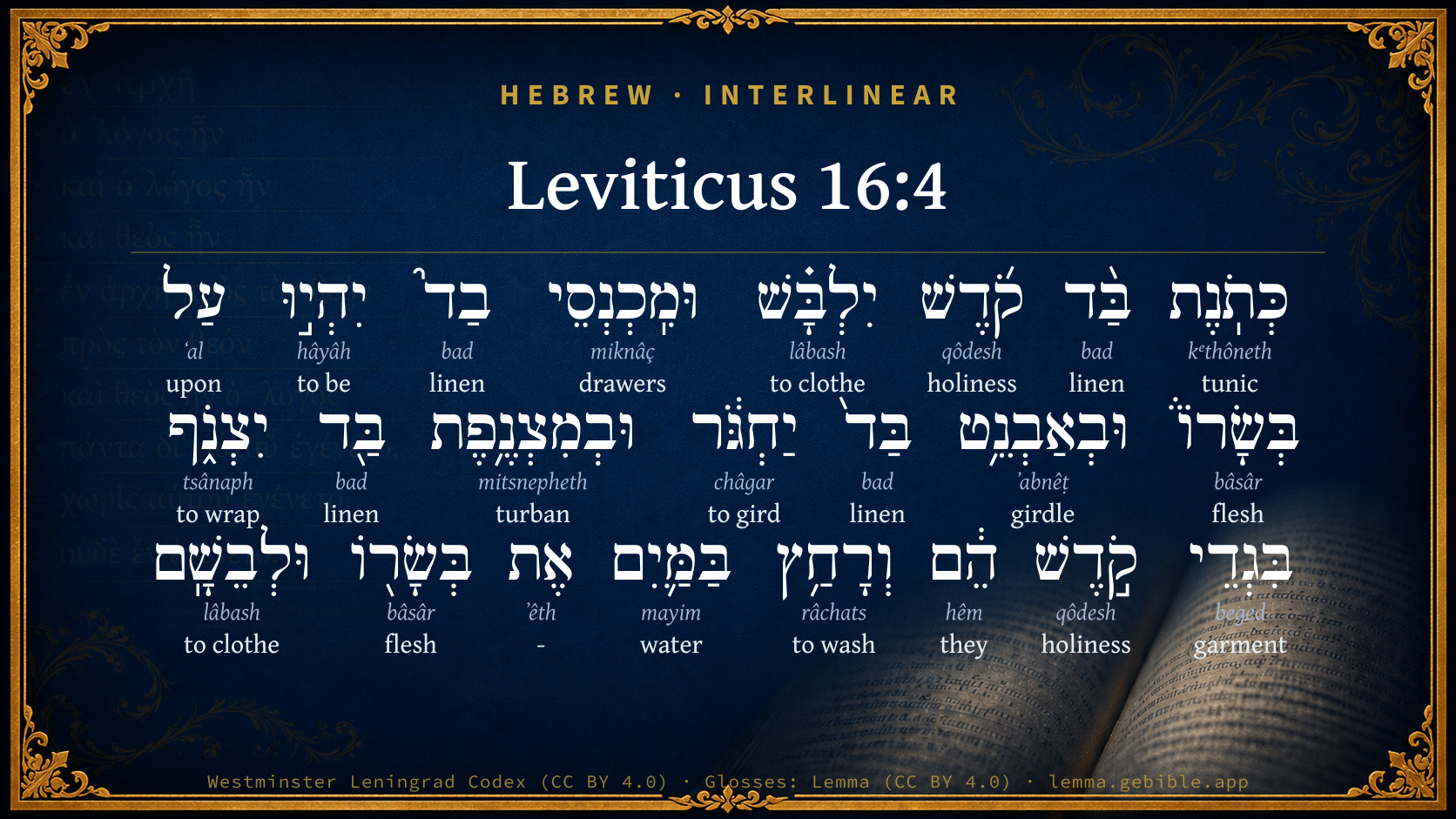
Hebrew (Westminster Leningrad Codex) Leviticus 16:4 appears in the Hebrew Old Testament. The text above is from the Westminster Leningrad Codex. Each word links to its Strong’s number, a concise gloss, and parsing drawn from the Open Scriptures Hebrew Bible morphology. Click any word for its full Brown-Driver-Briggs (BDB) entry.
Download image
Cite this verse

Leviticus 16:4 (World English Bible). Public Domain. Lemma interlinear Bible study tool, https://lemma.gebible.app/v/leviticus/16/4.

Show BibTeX & RIS
BibTeX
RIS
English Translation
He shall put on the holy linen coat, and he shall have the linen breeches on his body, and shall put on the linen sash, and he shall be dressed with the linen turban. They are the holy garments. He shall bathe his body in water, and put them on.
World English Bible · Public Domain
Highlights
  • 1 first appearance in the Hebrew Bible
Full analysis ↓
Download a study sheet

One document with this verse’s original text, its word-by-word gloss line, the meaning frame, cross-references with their text, attributed commentary, and full source and license credits — printable, and it pastes into notes with its structure intact.

This verse Autodidact and up

Study sheet (.html) Plain text (.txt)

A passage Seminary Student

Up to 50 verses in one chapter. A passage sheet keeps up to 6 commentary sources and 12 cross-references per verse, in the order this page ranks them, and says so on the sheet whenever that leaves anything out. Ask for a single verse and you get the Autodidact verse sheet above.

Everything on this page stays free to read, with no account — the sheet is a download of what is already on screen, not access to it.

Want to remove ads? Support Godless Engineer
Compare translations 3

The same verse in 3 English versions, stacked beneath the original-language interlinear above. Click any original word for its lexicon entry.

Each is an independent rendering of the whole verse — the interlinear is not word-aligned to these translations.

Highlighted words mark where these versions differ — a whole-verse word diff, not a word-by-word alignment.

  • World English Bible Public Domain
    He shall put on the holy linen coat, and he shall have the linen breeches on his body, and shall put on the linen sash, and he shall be dressed with the linen turban. They are the holy garments. He shall bathe his body in water, and put them on.
  • King James Version Public Domain
    He shall put on the holy linen coat, and he shall have the linen breeches upon his flesh, and shall be girded with a linen girdle, and with the linen mitre shall he be attired: these are holy garments; therefore shall he wash his flesh in water, and so put them on.
  • unfoldingWord Literal Text CC BY-SA 4.0
    He shall wear a holy linen tunic, and the undergarments of linen shall be on his flesh, and he shall tie the linen sash, and he shall wrap the linen turban. They are clothes of holiness. And he shall bathe his flesh in the water, and he shall wear them.

unfoldingWord Literal Text — © unfoldingWord, licensed CC BY-SA 4.0. Word-aligned USFM3 via Door43 (git.door43.org/unfoldingWord/en_ult).

Versions to compare (up to 4)

3 of 4 selected

Show all 18 translations

Every available English version of this verse, each an independent rendering of the whole verse.

  • World English Bible Public Domain
    He shall put on the holy linen coat, and he shall have the linen breeches on his body, and shall put on the linen sash, and he shall be dressed with the linen turban. They are the holy garments. He shall bathe his body in water, and put them on.
  • Berean Standard Bible Public Domain
    He is to wear the sacred linen tunic, with linen undergarments. He must tie a linen sash around him and put on the linen turban. These are holy garments, and he must bathe himself with water before he wears them.
  • Majority Standard Bible Public Domain
    He is to wear the sacred linen tunic, with linen undergarments. He must tie a linen sash around him and put on the linen turban. These are holy garments, and he must bathe himself with water before he wears them.
  • King James Version Public Domain
    He shall put on the holy linen coat, and he shall have the linen breeches upon his flesh, and shall be girded with a linen girdle, and with the linen mitre shall he be attired: these are holy garments; therefore shall he wash his flesh in water, and so put them on.
  • American Standard Version (1901) Public Domain
    He shall put on the holy linen coat, and he shall have the linen breeches upon his flesh, and shall be girded with the linen girdle, and with the linen mitre shall he be attired: they are the holy garments; and he shall bathe his flesh in water, and put them on.
  • Revised Version (1885) Public Domain
    He shall put on the holy linen coat, and he shall have the linen breeches upon his flesh, and shall be girded with the linen girdle, and with the linen mitre shall he be attired: they are the holy garments; and he shall bathe his flesh in water, and put them on.
  • Geneva Bible (1599) Public Domain
    He shall put on the holy linnen coate, and shall haue linnen breeches vpon his flesh, and shall be girded with a linnen girdle, and shall couer his head with a linnen miter: these are the holy garments: therefore shall hee wash his flesh in water, when he doeth put them on.
  • Douay-Rheims (1899) Public Domain
    He shall be vested with a linen tunick, he shall cover his nakedness with linen breeches: he shall be girded with a linen girdle, and he shall put a linen mitre upon his head: for these are holy vestments: all which he shall put on, after he is washed.
  • Young's Literal Translation Public Domain
    a holy linen coat he putteth on, and linen trousers are on his flesh, and with a linen girdle he girdeth himself, and with a linen mitre he wrappeth himself up; they `are' holy garments; and he hath bathed with water his flesh, and hath put them on.
  • Literal Standard Version CC BY-SA 4.0
    he puts on a holy linen coat, and linen trousers are on his flesh, and he girds himself with a linen girdle, and he wraps himself up with a linen turban; they [are] holy garments; and he has bathed his flesh with water and put them on.
  • Unlocked Literal Bible CC BY-SA 4.0
    He must put on the holy linen tunic, and he must put the linen undergarments on himself, and he must wear the linen sash and linen turban. These are the holy garments. He must bathe his body in water and then dress himself with these clothes.
  • unfoldingWord Literal Text CC BY-SA 4.0
    He shall wear a holy linen tunic, and the undergarments of linen shall be on his flesh, and he shall tie the linen sash, and he shall wrap the linen turban. They are clothes of holiness. And he shall bathe his flesh in the water, and he shall wear them.
  • Darby Bible Public Domain
    A holy linen vest shall he put on, and linen trousers shall be upon his flesh, and he shall be girded with a linen girdle, and with the linen mitre shall he be attired: these are holy garments; and he shall bathe his flesh in water, and put them on.
  • World Messianic Bible Public Domain
    He shall put on the holy linen tunic. He shall have the linen trousers on his body, and shall put on the linen sash, and he shall be clothed with the linen turban. They are the holy garments. He shall bathe his body in water, and put them on.
  • Webster's Bible Public Domain
    He shall put on the holy linen coat, and he shall have the linen breeches upon his flesh, and shall be girded with the linen girdle, and with the linen miter shall he be attired: these are holy garments; therefore shall he wash his flesh in water, and so put them on.
  • Free Bible Version CC BY-SA 4.0
    He is to be wearing the holy linen tunic, with linen underwear. He has to tie a linen sash around him and put on the linen turban. These are holy clothes. He must wash himself with water before he puts them on.
  • Bible in Basic English Public Domain
    Let him put on the holy linen coat, and the linen trousers on his body, and the linen band round him, and the linen head-dress on his head; for this is holy clothing, and before he puts them on his body is to be washed with water.
  • JPS Tanakh (1917) Public Domain
    He shall put on the holy linen tunic, and he shall have the linen breeches upon his flesh, and shall be girded with the linen girdle, and with the linen mitre shall he be attired; they are the holy garments; and he shall bathe his flesh in water, and put them on.

Literal Standard Version (2020), Covenant Press — licensed CC BY-SA 4.0. Text via the HelloAO Bible API (eBible.org). Unlocked Literal Bible (unfoldingWord) — licensed CC BY-SA 4.0. Text via the HelloAO Bible API (eBible.org). unfoldingWord Literal Text — © unfoldingWord, licensed CC BY-SA 4.0. Word-aligned USFM3 via Door43 (git.door43.org/unfoldingWord/en_ult). Free Bible Version, Dr. Jonathan Gallagher — licensed CC BY-SA 4.0. Text via the HelloAO Bible API (eBible.org).

Word by word

More ways to search: Search by grammar → Find every occurrence → Compare this word →

Practice this passage: Drill this verse → Learn its vocabulary →

יִצְנֹ֑ף
tsânaph
H6801
“to wrap”
Verb, Qal, Imperfect, 3rd Person, Masculine, Singular
Part of Speech
Verb
Stem
Qal
Form
Imperfect
Person
3rd Person
Gender
Masculine
Number
Singular
Full BDB Definition

Origin: a primitive root

TWOT: 1940

(Qal) to wrap, wrap or wind up together, wind around
  1. כְּתֹֽנֶת kᵉthôneth H3801 “tunic of” Noun, Common, Feminine, Singular, Construct
  2. בַּ֨ד bad H906 “linen of” Noun, Common, Masculine, Singular, Construct
  3. קֹ֜דֶשׁ qôdesh H6944 “holiness” Noun, Common, Masculine, Singular, Absolute
  4. יִלְבָּ֗שׁ lâbash H3847 “to clothe” Verb, Qal, Imperfect, 3rd Person, Masculine, Singular
  5. וּמִֽכְנְסֵי miknâç H4370 “and · drawers of” Conjunction + Noun, Common, Masculine, Plural, Construct
  6. בַד֮ bad H906 “linen” Noun, Common, Masculine, Singular, Absolute
  7. יִהְי֣וּ hâyâh H1961 “to be” Verb, Qal, Imperfect, 3rd Person, Masculine, Plural
  8. עַל ʻal H5921 “upon” Preposition
  9. בְּשָׂרוֹ֒ bâsâr H1320 “flesh · his” Noun, Common, Masculine, Singular, Construct + Suffix, Personal, 3rd Person, Masculine, Singular
  10. וּבְאַבְנֵ֥ט ʼabnêṭ H73 “and · in/at · girdle of” Conjunction + Preposition + Noun, Common, Masculine, Singular, Construct
  11. בַּד֙ bad H906 “linen” Noun, Common, Masculine, Singular, Absolute
  12. יַחְגֹּ֔ר châgar H2296 “to gird” Verb, Qal, Imperfect, 3rd Person, Masculine, Singular
  13. וּבְמִצְנֶ֥פֶת mitsnepheth H4701 “and · in/at · turban of” Conjunction + Preposition + Noun, Common, Feminine, Singular, Construct
  14. בַּ֖ד bad H906 “linen” Noun, Common, Masculine, Singular, Absolute
  15. בִּגְדֵי beged H899 “garments of” Noun, Common, Masculine, Plural, Construct
  16. קֹ֣דֶשׁ qôdesh H6944 “holiness” Noun, Common, Masculine, Singular, Absolute
  17. הֵ֔ם hêm H1992 “they” Pronoun, Personal, 3rd Person, Masculine, Plural
  18. וְרָחַ֥ץ râchats H7364 “and · to wash” Conjunction + Verb, Qal, Sequential Perfect, 3rd Person, Masculine, Singular
  19. בַּמַּ֛יִם mayim H4325 “in/at the · water(s)” Preposition, Determined + Noun, Common, Masculine, Plural, Absolute
  20. אֶת ʼêth H853 “-” Particle, Direct Object
  21. בְּשָׂר֖וֹ bâsâr H1320 “flesh · his” Noun, Common, Masculine, Singular, Construct + Suffix, Personal, 3rd Person, Masculine, Singular
  22. וּלְבֵשָֽׁם lâbash H3847 “and · to clothe · them” Conjunction + Verb, Qal, Sequential Perfect, 3rd Person, Masculine, Singular + Suffix, Personal, 3rd Person, Masculine, Plural

About this verse

These counts appear in no published source. They are computed here, from the morphology-tagged text and Lemma’s own curated glosses. What Lemma adds →

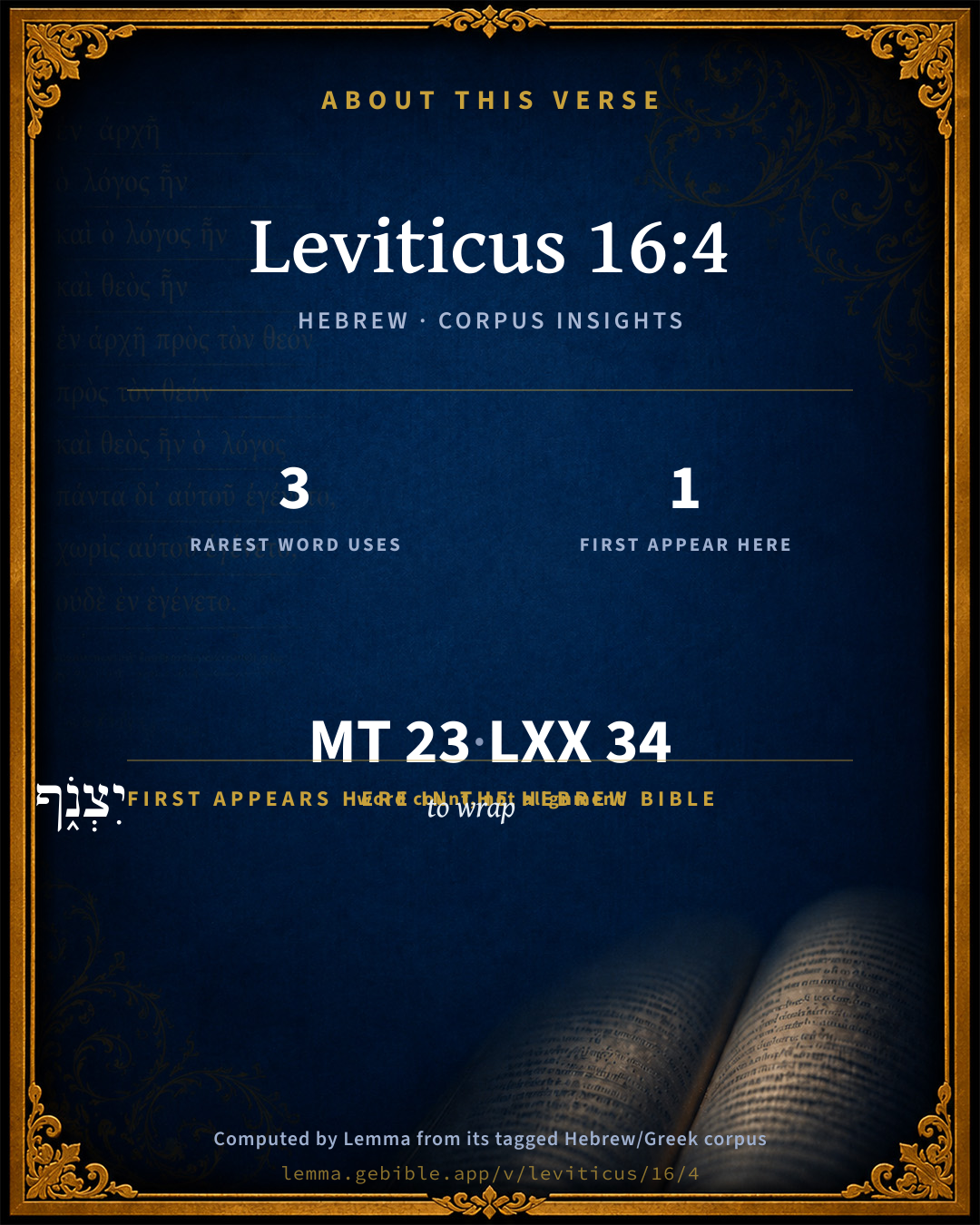
23
words
17
distinct lemmas
Pentateuch
section

Notable vocabulary

The rarest word here is יִצְנֹ֑ף to wrap H6801 — appearing just 3 times in the whole Hebrew Bible.

First appearance in Scripture

This word makes its first canonical appearance in the Hebrew Bible here:

  • יִצְנֹ֑ף to wrap H6801

Shared distinctive vocabulary

יִצְנֹ֑ף to wrap H6801 occurs in 2 verses of the Hebrew Bible. Also found in:

Grammatical profile

  • 6 verbs
  • 14 nouns
  • 1 pronoun
  • 1 preposition
  • 1 particle

Verb forms

  • יִלְבָּ֗שׁ Qal · Imperfect
  • יִהְי֣וּ Qal · Imperfect
  • יַחְגֹּ֔ר Qal · Imperfect
  • יִצְנֹ֑ף Qal · Imperfect
  • וְרָחַ֥ץ Qal · Sequential Perfect
  • וּלְבֵשָֽׁם Qal · Sequential Perfect

Repetition

Words recur within this verse — often emphatic in Hebrew:

  • בַּ֨ד linen H906 ×4
  • קֹ֜דֶשׁ holiness H6944 ×2
  • יִלְבָּ֗שׁ to clothe H3847 ×2
  • בְּשָׂרוֹ֒ flesh H1320 ×2

Hebrew & Septuagint length

In English translation the verse runs 50 words from the Hebrew and 52 from the Septuagint (LXX English) — closely comparable.

A rough comparison of the two English renderings, which tokenize alike — not a word-level alignment.

Word counts can differ between the Hebrew and the Greek without any difference in meaning — e.g. the Hebrew direct-object marker אֵת has no separate Greek word, and Greek often adds the article ὁ.

In the original languages it is 23 Hebrew tokens and 34 Greek tokens — but the two are counted differently (Hebrew bundles its prefixes and suffixes into one token; the Greek is in lemma form), so that isn’t a like-for-like length.

Cross-references

18

Topical passages linked to Leviticus 16:4 in the Treasury of Scripture Knowledge — connected by theme and wording, ordered by reader-vote popularity; previews shown in the World English Bible.

  • Exodus 28:39–43 You shall weave the coat in checker work of fine linen, and you shall make a turban of fine linen, and you shall make a sash, the work of the embroiderer.
  • Exodus 30:20 When they go into the tent of meeting, they shall wash with water, that they not die; or when they come near to the altar to minister, to burn an offering made by fire to Yahweh.
  • Ezekiel 44:17–18 It shall be that, when they enter in at the gates of the inner court, they shall be clothed with linen garments; and no wool shall come on them, while they minister in the gates of the inner court, and within.
  • Hebrews 7:26 For such a high priest was fitting for us: holy, guiltless, undefiled, separated from sinners, and made higher than the heavens;
  • Leviticus 6:10 The priest shall put on his linen garment, and he shall put on his linen breeches upon his body; and he shall remove the ashes from where the fire has consumed the burnt offering on the altar, and he shall put them beside the altar.
  • Leviticus 8:6–7 Moses brought Aaron and his sons, and washed them with water.
  • Exodus 39:27–29 They made the coats of fine linen of woven work for Aaron, and for his sons,
  • Exodus 28:2 You shall make holy garments for Aaron your brother, for glory and for beauty.
  • Exodus 29:4 You shall bring Aaron and his sons to the door of the tent of meeting, and shall wash them with water.
  • Exodus 40:12 You shall bring Aaron and his sons to the door of the tent of meeting, and shall wash them with water.
  • Exodus 40:31–32 Moses, Aaron, and his sons washed their hands and their feet there.
  • Leviticus 16:24 Then he shall bathe himself in water in a holy place, and put on his garments, and come out and offer his burnt offering and the burnt offering of the people, and make atonement for himself and for the people.
  • Isaiah 53:2 For he grew up before him as a tender plant, and as a root out of a dry ground: he has no form nor comeliness; and when we see him, there is no beauty that we should desire him.
  • Luke 1:35 The angel answered her, "The Holy Spirit will come on you, and the power of the Most High will overshadow you. Therefore also the holy one who is born from you will be called the Son of God.
  • Philippians 2:7 but emptied himself, taking the form of a servant, being made in the likeness of men.
  • Hebrews 2:14 Since then the children have shared in flesh and blood, he also himself in like manner partook of the same, that through death he might bring to nothing him who had the power of death, that is, the devil,
  • Hebrews 10:22 let's draw near with a true heart in fullness of faith, having our hearts sprinkled from an evil conscience, and having our body washed with pure water,
  • Revelation 1:5–6 and from Jesus Christ, the faithful witness, the firstborn of the dead, and the ruler of the kings of the earth. To him who loves us, and washed us from our sins by his blood;

Cross-references courtesy of OpenBible.info (CC BY 4.0).

Hebrew and Greek witnesses Masoretic Hebrew ↔ Greek Septuagint

The same verse in the two great witnesses to the Old Testament, shown verse-for-verse.

These are two independent witnesses, not word-aligned to each other, and the Septuagint is shown in lemma (dictionary) form.

Hebrew Leviticus 16:4 Masoretic · Westminster Leningrad Codex

כְּתֹֽנֶת בַּ֨ד קֹ֜דֶשׁ יִלְבָּ֗שׁ וּמִֽכְנְסֵי בַד֮ יִהְי֣וּ עַל בְּשָׂרוֹ֒ וּבְאַבְנֵ֥ט בַּד֙ יַחְגֹּ֔ר וּבְמִצְנֶ֥פֶת בַּ֖ד יִצְנֹ֑ף בִּגְדֵי קֹ֣דֶשׁ הֵ֔ם וְרָחַ֥ץ בַּמַּ֛יִם אֶת בְּשָׂר֖וֹ וּלְבֵשָֽׁם

He shall put on the holy linen coat, and he shall have the linen breeches on his body, and shall put on the linen sash, and he shall be dressed with the linen turban. They are the holy garments. He shall bathe his body in water, and put them on.

World English Bible · Public Domain

Greek LXX Leviticus 16:4 Septuagint · lemma form

καί χιτών λινοῦς ἁγιάζω ἐνδύω καί περισκελής λινοῦς εἰμί ἐπί ὁ χρώς αὐτός καί ζωνή λινοῦς ζωννύω καί κίδαρις λινοῦς περιτίθημι ἱμάτιον ἅγιος εἰμί καί λούω ὕδωρ πᾶς ὁ σῶμα αὐτός καί ἐνδύω αὐτός

And he shall put on the consecrated linen tunic, and he shall have on his flesh the linen drawers, and shall gird himself with a linen girdle, and shall put on the linen cap, they are holy garments; and he shall bathe all his body in water, and shall put them on.

LXX2012 (modern English Septuagint) · Public Domain

Hebrew: Westminster Leningrad Codex (CC BY 4.0). Greek: Septuagint (public domain); English from LXX2012 (modern English Septuagint) (Public Domain). How the Septuagint differs from the Hebrew →

Targum (Aramaic paraphrase)

2

The Targum is the ancient Jewish Aramaic paraphrase of the Hebrew Scriptures — an interpretive translation, not the Hebrew text itself. Onkelos (literal) and Pseudo-Jonathan (expansive) render the Torah, and Jonathan the Prophets. Coverage is partial: where no permissively-licensed English translation exists for a verse, only the Aramaic is shown. This is verse-level text, not a word-by-word alignment to the Hebrew.

  1. Targum Onkelos Torah (Genesis–Deuteronomy)
    כִּתּוּנָא דְבוּצָא קוּדְשָׁא יִלְבָּשׁ וּמִכְנְסִין דְבוּץ יְהוֹן עַל בִּסְרֵהּ וּבְהֶמְיָנָא דְבוּץ יֵסַר וּבְמִצְנֶפְתָּא דְבוּצָא יָחֵת בְּרֵישֵׁהּ לְבוּשֵׁי קוּדְשָׁא אִנוּן וְיַסְחֵי בְמַיָא יָת בִּסְרֵהּ וְיַלְבְּשִׁנוּן

    (no public-domain English translation for this verse)

    Targum Onkelos — Aramaic: “Onkelos Genesis” (public domain); “Onkelos Exodus” (public domain); “Onkelos Leviticus” (public domain); “Onkelos Numbers” (public domain); “Onkelos Deuteronomy” (public domain). English: “Sefaria Community Translation” (CC0 1.0 (public-domain dedication)); “J.W. Etheridge. The Targums of Onkelos and Jonathan Ben Uzziel on the Pentateuch. London: Longmans, Green, 1862” (public domain). Text via Sefaria.

  2. Targum Pseudo-Jonathan Torah (Genesis–Deuteronomy)
    כִּיתוּנָא דְבוּץ מִילַת קוּדְשָׁא יִלְבַּשׁ וְאַווֹרְקְסִין דְבוּץ מִילַת יְהוֹן עַל בִּישְרֵיהּ וּבְקִמוּרָא דְבוּץ מִילַת יֵצֶר וּמַצְנִיפָא דְבוּץ מִילַת נְטִיכַס בְּרֵישֵׁיהּ לְבוּשֵׁי קוּדְשָׁא הִינוּן בְּרַם בִּלְבוּשֵׁי דַהֲבָא לָא יְהֵי עָלֵיל מְטוֹל דְלָא יִדְכַּר חוֹבַת עֵיגְלָא דְדַהֲבָא וּבִזְמַן מֵעֲלֵיהּ יַסְחֵי יַת בִּישְרֵיהּ בְּאַרְבְּעִין סָאוִוין דְמוֹי וְיַלְבֵּישִׁינוּן

    With the vestments of fine linen, the holy robe, shall he be dressed, and linen drawers shall be upon his flesh, and with the girdle of fine linen shall he be bound, and the mitre of fine linen shall be ordained for his head. These are the holy garments; but with the golden robes he shall not enter, that there be not brought to memory the sin of the golden calf; and at the time when he is to enter he shall wash his flesh in forty seahs of water, and attire himself with them.

    Targum Pseudo-Jonathan — Aramaic: “Targum Jonathan on Genesis” (public domain); “Targum Jonathan on Exodus” (public domain); “Targum Jonathan on Leviticus” (public domain); “Targum Jonathan on Numbers” (public domain); “Targum Jonathan on Deuteronomy” (public domain). English: “The Targum of Jonathan ben Uzziel, trans. J. W. Etheridge, London, 1862” (public domain). Text via Sefaria.

Commentary

Notes on Leviticus 16:4 from classic Christian and Jewish commentators (each source and its license shown beneath its notes). The classic Christian expositions comment on the surrounding passage and are grouped to its opening verse, so a note may address several verses; the Jewish commentaries on the Tanakh (Rashi and others) are per-verse, so they appear only where the commentator wrote on this verse.

Lemma curates 59 commentaries, every one of them public domain or Creative Commons licensed, each selected and text-cleaned for this edition rather than reprinted as found. About our sources →

Trapp's Complete Commentary

John Trapp

Lev 16:4 He shall put on the holy linen coat, and he shall have the linen breeches upon his flesh, and shall be girded with a linen girdle, and with the linen mitre shall he be attired: these [are] holy garments; therefore shall he wash his flesh in water, and [so] put them on.

Ver. 4. Therefore shall he wash.] As we must be always holy, so then most when we present ourselves to the holy eyes of our Creator. We wash our hands every day; but when we are to sit with some great person, we scour them with balls. See Lev 16:24.

John Trapp, A Commentary or Exposition upon All the Books of the Old and New Testament (1647–1656) — public domain. Text from a community e-Sword module.

Joseph Benson's Commentary

Lev 16:4. He shall put on the holy linen coat — Upon other days, when the high-priest officiated, he was bound to put on all the garments mentioned Exo 28:4, four of which were called golden garments, because there was a mixture of gold in them; but on this day he put on only the four linen garments here specified, which were common to him with the ordinary priests. The reason whereof was, that this was not a day of feasting and rejoicing, but of mourning and humiliation, at which times people were to lay aside their ornaments. At this solemn season the high- priest was to wear nothing but linen, and that probably not only in token of humiliation, but also because it is a more proper emblem of purity than woollen, as it is more easily cleansed, and washes whiter. These are holy garments — Peculiarly so; to be used only when he was in the exercise of this solemn part of his sacred office. Therefore shall he wash his flesh in water — Besides the washing of his hands and feet, as upon other days, at the beginning of the service, the high-priest was, on this day, to wash his whole body before he put on these holy garments, and entered on the solemn service of the day; which significant rite fitly betokened that peculiar holiness and purity which become all that approach God in his worship, and especially all that minister in holy things.

Joseph Benson's Commentary on the Old and New Testaments (1811–1818) — public domain. Text from a community e-Sword module.

Tyndale Open Study Notes

Tyndale Open Resources

16:4 For most of the ritual of the Day of Atonement, the high priest wore plain linen clothing rather than his normal robes. This seems to symbolize the humility that should characterize all the people on this solemn occasion. When the high priest stood before God on behalf of his people, he had nothing to commend himself or the people. But when he stood before the people on God’s behalf, his official robes reflected the glory and splendor of God (16:23).

Tyndale Open Study Notes — © Tyndale Open Resources, licensed CC BY-SA 4.0. Text via the HelloAO Bible API.

Geneva Bible (1599)

Geneva Bible translators

Or, privities.

Geneva Bible (1599) marginal notes — public domain. Text via Bolls.life.

Adam Clarke's Commentary

Verse 4. He shall put on the holy linen coat] He was not to dress in his pontifical garments, but in the simple sacerdotal vestments, or those of the Levites, because it was a day of humiliation; and as he was to offer sacrifices for his own sins, it was necessary that he should appear in habits suited to the occasion. Hence he has neither the robe, the ephod, the breastplate, the mitre, c. these constituted his dress of dignity as the high priest of God, ministering for others and the representative of Christ: but now he appears, before God as a sinner, offering an atonement for his transgressions, and his garments are those of humiliation.

Adam Clarke's Commentary on the Bible (1810–1826) — public domain. Text from a community e-Sword/MySword module.

Ellicott's Commentary for English Readers

(4) He shall put on the holy linen coat.—Better, a holy linen tunic. The four articles of clothing here mentioned, all of which were of white linen, constituted the sacerdotal “white vestments,” in contra-distinction to “the golden garments.” Of the white garments he possessed two sets, one of Egyptian linen, and the other of Indian and less costly linen. The community allowed the high priest thirty minæ to purchase these garments, and he could add as much as he liked from his own money if he wished them to be more costly, provided the material was linen made of six double twisted threads and of flax. It was the more costly vestments of Egyptian linen which the high priest wore on this occasion. The latter he put on in the after part of the day when he entered the Holy of Holies to bring out the censer. These garments were the same as those of the ordinary priests, except the turban, which was a little taller.

And he shall wash.—He had to bathe his body every time when he changed his vestments.

A Bible Commentary for English Readers, edited by Charles John Ellicott (1878–1897) — public domain. Text from a community e-Sword module.

The Cambridge Bible for Schools and Colleges

gen. ed. J. J. S. Perowne

4. The linen garments here mentioned are the garments described in Exo_28:39-43. Cp. Lev_16:23-24.

The Cambridge Bible for Schools and Colleges (gen. ed. J. J. S. Perowne; Cambridge University Press, 1878–1918) — public domain. Text from a community e-Sword module.

John Gill's Exposition

He shall put on the holy linen coat,.... Which he wore in common with other priests:

and he shall have the linen breeches upon his flesh; upon those parts of his body which are more secret, and less honourable flesh, meaning the same, as in Lev 15:2,

and shall be girded with a linen girdle and with the linen mitre shall he be attired, as the other priests were; which were an emblem of the purity and holiness of Christ, whereby he became a proper and suitable high priest, to make atonement for sin, he having none in himself; and of his mean estate of humiliation afflictions, and sufferings, whereby he expiated sin, and made reconciliation for iniquity; the high priest on the day of atonement not appearing in his golden garments, as the Jews call others worn by him, because there were some gold in them, as being unsuitable to a day of affliction and humiliation, but in garments of flax, a meaner dress; and which also were an emblem of the righteousness of Christ, and his saints, called fine linen, clean and white; which is wrought out by him, as the author of it, is in him as the subject of it, and worn by him as the Lord our righteousness, and in which, as the instilled head and representative of his people, he entered into heaven to show it to his Father, and plead it with him:

these are holy garments; and to be used only in sacred service: there were four more holy garments besides these worn by the high priest, as the breastplate, the ephod, the robe, and the plate of gold, and which also were put on at certain times on this day, as at the offering of the morning and evening sacrifice, and at the slaying and offering of the several creatures on this day (u), see Lev 16:23,

therefore shall he wash his flesh in water, and so put them on; by dipping, and that in forty seahs of water, as the Targum of Jonathan; and this he did as often as he changed his garments, which were no less than five times on this day. The tradition is (w), no man goes into the court for service, even though clean, until he has dipped himself: the high priest dips five times, and sanctifies, i.e. washes his hands and feet ten times on that day, and all are done in the holy place, over the house of Parvah, excepting this only, that is, first here: Jarchi on the text observes, on this day, he (the high priest) is bound to dipping at every change, and five times he changes, and to two washings of his hands and feet at the laver: this washing may be either an emblem of Christ's baptism, which he submitted to before he entered on his public ministry, and was, by dipping; or rather of his being cleared, acquitted, and justified from all sin, upon his resurrection from the dead, after he had made atonement for it, and before his entrance into heaven; as he had no sin of his own he needed not the washing of regeneration, or the water of sanctifying grace to be sprinkled on him, to cleanse him from it but inasmuch as he had sin imputed to him, and which he took upon him to make atonement for, it was proper and necessary, when he had made it, that he should be justified in the Spirit, that so he might enter into heaven without sin imputed, as he will appear without it when he comes a second time.

(u) Misn. Yoma, c. 3. sect. 4, 6. (w) Ib. sect. 3.

John Gill's Exposition of the Whole Bible (1746–1763) — public domain (CC PDM 1.0). Text via the HelloAO Bible API.

Albert Barnes' Notes on the Bible

The high priest when he changed his dress on this day was required to bathe himself. In his “golden garments” he had, on this day, and for the previous week, to offer the regular daily sacrifices, and to perform the other sacerdotal duties of the sanctuary, which were usually performed by a common priest. The dress of white linen, which he now put on, appears to have been like the ordinary dress of the common priests, except in the substitution of a linen mitre for the bonnet (or cap), and of a plain linen girdle for the variegated one (Exo 28:40-43 notes). In preparing to enter the holy of holies, he attired himself in spotless white as a token of the holiness without which none, in a spiritual sense, can enter the divine presence. He thus became a more distinct foreshadow of the greater high priest Heb 7:26; Heb 6:19-20. This significance belonged to the high priest only in his official capacity as mediator: in his own person he had infirmity, and was required “to offer up sacrifice, “first” for his own sins, and then for the people’s.” Heb 7:27. See the notes at Lev 9:7-14. On the same ground it was that, although as a mediator he had to enter the most holy place, as sinful man he needed the cloud of incense as a veil to come between him and the holiness of Yahweh. See Lev 16:13.

Albert Barnes' Notes on the Bible (1834–1885) — public domain. Text from a community e-Sword/MySword module.

Haydock's Catholic Bible Commentary

Washed. On this day the high priest appeared in linen clothes, like one of the inferior priests, without the jewels; thought Josephus (Jewish Wars v. 15,) asserts the contrary. (Calmet) --- This was a feast of sorrow and of penance. (Tirinus) --- Perhaps he put on his more costly attire before he entered the holy of holies, ver. 23, 4[24?]. (Haydock)

George Leo Haydock (1774–1849), Haydock's Catholic Family Bible and Commentary, 1859 edition — public domain. Excludes Psalms (Douay-Rheims chapter numbering differs from Protestant) and Deuterocanonical books (Catholic canon only).

Matthew Poole's English Annotations

It is observable that the high priest did not now use his peculiar and glorious robes, but only his linen garments, which were common to him with the ordinary priests. The reason whereof was, either because this was not a day of feasting and rejoicing, but of mourning and humiliation, at which times people were to lay aside their ornaments, Exo 33:5. Some conceive, that under the linen garments here named are comprehended his more glorious robes also by a synecdoche. But that doth not appear neither from hence, nor from other places alleged. Had only his holy garments been mentioned in general, all might have been understood; but when only the linen apparel is mentioned here, and after, Lev 16:23, and when that is so particularly expressed in four several parts of it, and not a word of the other either here or in the rest of the chapter, it seems presumptuous to add them here without any ground or evidence. Or because it was fit he should not exalt, but abase himself, when he was to appear before the Divine Majesty, and therefore he was to come in the meanest of his priestly habits. Or that it might be an evidence of the imperfection of this priesthood and of the great difference between the Levitical and the true High Priest Christ Jesus, whose prerogative alone it is to go into the true holy of holies with his glorious robes, when this must carry thither the characters of his meanness.

These are holy garments, because appropriated to a holy and religious use, for which reason other things are called holy. See Exo 29:31; 30:25; 2Ch 5:5.

Matthew Poole's English Annotations on the Holy Bible (1683–1685) — public domain. Text from a community e-Sword/MySword module.

Whedon's Commentary on the Bible

Daniel D. Whedon

4. The holy linen coat — This requirement, that Aaron should divest himself of his pontifical robes when he appears before the Lord as a penitent, teaches us that no worldly distinction, no ecclesiastical preferment, is of any avail to avert the wrath of God. When Aaron represents God to men he may well be clothed with splendour, but when as a sinner he stands before the divine holiness, that splendour pales. The day of atonement stained the glory of all flesh by the revelation of Jehovah’s holiness in contrast with man’s guilt.

Breeches — Properly, drawers. See Lev_6:10, note. The high priest is required to appear in the apparel of a common priest, with the addition of a linen mitre, a distinctive badge of the pontificate. This change of raiment represents a humiliation as deep as does the wearing of sackcloth upon the common people.

Wash his flesh — It became the typical high priest to be “holy, harmless, and undefiled,”

that he might fitly prefigure the spotless Son of God. It was customary to remove him from his own house to a chamber in the temple seven days before, lest he should contract any defilement which might entail an uncleanness during those seven days, and he be disqualified for his duty on the great day of atonement. During this time he was exercised in all the various parts of the service, though not entering within the veil. The law relating to his duties was read to him again and again, lest he should make any mistake in his office on that day to his own destruction and the detriment of the people. The elders of the Sanhedrin solemnly adjured him in these words: “We adjure thee, O high priest, our delegate, by Him that caused his name to dwell in this house, that thou alter not any thing of what we have spoken unto thee.”-Delitzsch on the Hebrews, Appendix.

Daniel D. Whedon (gen. ed.), Commentary on the Old and New Testaments (1874–1909) — public domain. Text from a community e-Sword module.

The Pulpit Commentary

His special garments for the occasion are the holy linen coat, ... the linen breeches, ... a linen girdle, ... and the linen mitre. In the original the definite article is not expressed. The reading should therefore be, He shall put on a holy linen coat, and he shall have linen breeches upon his flesh, and shall be girded with a linen girdle, and with a linen mitre shall be attired. The clothing was white from head to foot, differing therein from the dress of the ordinary priest, inasmuch as the sash or girdle of the latter was of variegated materials, and differing also in the shape of the mitre. The white clothing was not intended to symbolize humility and penitence, as some have thought, for white is not the colour in which penitents are naturally dressed. Rather it was symbolical of the purity and holiness which the ceremonies of the day symbolically affected, and which was specially needed to be exhibited in the person of the high priest. In the visions of Ezekiel and Daniel, the angel of God is clothed in linen. (Eze_9:2, Eze_9:3, 11 10:2, 6, 7 Dan_10:5 Dan_12:6, Dan_12:7) And the colour of the angelic raiment is described in the Gospels as white: "his countenance was like lightning, and his raiment white as snow"; (Mat_28:3) "they saw a young man sitting on the right side, clothed in a long white garment"; (Mar_16:5) "two men stood by them in shining garments"; (Luk_24:4) she "seeth two angels in white sitting". (Joh_20:12) So, too, the wife of the Lamb, in tile Book of the Revelation, has it "granted to her that she should be arrayed in fine linen clean and white: for the fine linen is the righteousness of saints". (Rev_19:7, Rev_19:8) The white linen dress of the high priest, therefore (which must have given the appearance of the English surplice tied in at the waist), was intended to symbolize the purity and brightness which forms the characteristic of angels and saints, and, above all, of the King of saints. "The white material of the dress which Aaron wore when performing the highest act of expiation under the Old Testament was a symbolical shadowing forth of the holiness and glory of the one perfect Mediator between God and man, who, being the radiation of the glory of God and the image of his nature, effected by himself the perfect cleansing away of our sin, and who, as the true High Priest, being holy, innocent, unspotted, and separate from sinners, entered once by his own blood into the holy place not made with hands, namely, into heaven itself, to appear before the face of God for us and obtain everlasting redemption" (Heb_1:3 Heb_7:26 Heb_9:12, Heb_9:24) (Keil). The symbolism of the holy garments as indicating holiness and purity, is strengthened by the command that Aaron is to wash his flesh in water, and so put them on.

The high priest"s acts on this day, so far as they are recounted in this chapter, were the following.

1. He bathed.

2. He dressed himself in his white holy garments.

3. He offered or presented at the door of the tabernacle a bullock for a sin offering for himself and his house.

4. He presented at the same place two goats for a sin offering for the congregation.

5. He cast lots on the two goats, one of which was to be sacrificed, the other to he let go into the wilderness.

6. He sacrificed the bullock.

7. He passed from the court through the holy place into the holy of holies with a censer and incense, and filled the space beyond the vail with a cloud of smoke from the incense.

8. He returned to the court, and, taking some of the blood of the bullock, passed again within the vail, and there sprinkled the blood once on the front of the mercy-seat and seven times before it.

9. He came out again into the court, and killed the goat on which the lot for sacrifice had fallen.

10. For the third time he entered the holy of holies, and went through the same process with the goat"s blood as with the bullock"s blood.

11. He purified the other part of the tabernacle, as he had purified the holy of holies, by sprinkling with the atoning blood, as before, and placing some of it on the horns of the altar of incense. (Exo_30:10)

12. He returned to the court, and placed the blood of the bullock and goat upon the horns of the altar of burnt sacrifice, and sprinkled it seven times.

13. He offered to God the remaining goat, laying his hands upon it, confessing and laying the sins of the people upon its head.

14. He consigned the goat to a man, whose business it was to conduct it to the border of the wilderness, and there release it.

15. He bathed and changed his linen vestments for his commonly worn high priest"s dress.

16. He sacrificed, one after the other, the two rams as burnt offerings for himself and for the people.

17. He burnt the fat of the sin offerings upon the altar.

18. He took measures that the remainder of the sin offerings should be burnt without the comp. In Num_29:7-11, twelve sacrifices are commanded to be offered by the high priest on this day, namely, the morning and evening sacrifice; a burnt offering for the people, consisting of one young bullock, one ram (as already stated), and seven lambs; and cue goat for a sin offering; so that in all there were fifteen sacrifices offered, besides the meat and drink offerings. The punctiliousness of the Jews in later times was not content that the ceremonies should begin on the day itself. Preparations commenced a full week previously. On the third day of the seventh month, the high priest moved from his house in the city into the temple, and he was twice sprinkled with the ashes of the red heifer, by way of precaution against defilement. He spent the week in practicing and rehearsing, under the eye of some of the elders of the Sanhedrim, the various acts that he would have to perform on the great day, and on the night immediately preceding it he was not allowed to sleep. In case of his sudden death or disqualification, a substitute was appointed to fulfill his function.

The Pulpit Commentary (1880–1919), ed. H.D.M. Spence-Jones & Joseph S. Exell — public domain. Text from a community e-Sword module.

John Wesley's Explanatory Notes

The linen coat - It is observable, the high-priest did not now use his peculiar and glorious robes, but only his linen garments, which were common to him with the ordinary priests. The reason whereof was, because this was not a day of feasting and rejoicing, but of mourning and humiliation, at which times people were to lay aside their ornaments. These are holy - Because appropriated to an holy and religious use.

John Wesley, Explanatory Notes Upon the Whole Bible (1754–1765) — public domain. Text via the GEBible commentary corpus.

Rashi

Rabbi Shlomo Yitzchaki (Rashi)

'כתנת בד וגו [HE SHALL PUT ON] THE LINEN INNER GARMENTS etc. — This teaches us that he must not officiate in the “Interior" (in the Holy of Holies) robed in the eight garments which were the insignia of the High Priest (cf. Exodus 28:4ff) in which he performed the service outside (in the היכל and the עזרה) and in which there was gold interwoven, — because the prosecuting counsel cannot become the defending counsel) — but in the four garments (cf. Exodus 28:40), like an ordinary priest, all of these being on this occasion entirely of linen (whereas one of the four worn by the ordinary priests, the belt, was a mixture of wool and linen) (Rosh Hashanah 26a).

קדש ילבש HE SHALL PUT ON [THE LINEN INNER GARMENT] OF HOLINESS (or, OF THE SANCTUARY) - This means that they shall be purchased from the Temple treasury (whilst his personal offering mentioned v. 3 had to be of his own) (Sifra, Acharei Mot, Chapter 1 10).

יצנף — Understand this as the Targum does: יחת ברישה which means: he shall place upon his head. Thus, the verb in (Genesis 39:16) ותנח בגדו, is rendered by the Targum ואחתתיה (of the same root as יחת) “and she placed".

ורחץ במים AND HE SHALL LAVE [HIS FLESH] IN WATER — That day he required immersion at each change of his garments! Five times he proceeded alternately from the service in the “Interior" to that performed outside and from the outside service to that in the "Interior", changing from the golden garments into the linen garments or from the linen garments into the golden garments. At each change he required to take an immersion and to wash his hands and his feet twice from the laver (viz., before he took off the garments he was wearing and after he had put on others — in all, 10 times during the day) (Yoma 32a).

Rashi on the Tanakh — English translations: “The Judaica Press complete Tanach with Rashi, translated by A. J. Rosenberg” (CC BY 4.0); “Pentateuch with Rashi's commentary by M. Rosenbaum and A.M. Silbermann, 1929-1934” (public domain); “The Metsudah Tanach series, Lakewood, N.J” (CC BY 4.0); and “The Book of Joshua, Metsudah Publications, 1997” (CC BY 4.0). Text via Sefaria.

Ramban (Nachmanides)

Rabbi Moshe ben Nachman (Ramban / Nachmanides)

HE SHALL PUT ON THE LINEN TUNIC OF ‘KODESH’ (HOLINESS). “This means that they [i.e., all the garments of the High Priest] must be of the Sanctuary [treasury, and not of his own possession].” This is Rashi’s language. Thus the following phrase which states, they are garments of ‘kodesh’ (holiness) must therefore mean that all the garments [even those of the ordinary priests], must come from the Sanctuary [treasury]. And [so] it is stated in the Torath Kohanim: 1:10. “‘Kodesh yilbash’ (‘He shall put on’ the linen tunic ‘of holiness’), this means that these [garments of the High Priest] are to be of the Sanctuary. From this phrase I would only know concerning these garments [i.e., the four garments worn by the High Priest when he ministered in the Holy of Holies on the Day of Atonement]. Whence do I know to include the other garments of the High Priest [i.e., the eight golden garments in which he officiated throughout the year], and the garments of his brethren the priests [that they too must all come from the Temple treasury]? Scripture therefore says, they are garments of ‘kodesh’ (holiness). It is a conclusion by analogy that all garments [worn by all priests] should be of the Temple treasury” [since they all come under the term ‘garments of holiness’].By way of the simple meaning of Scripture, just as He said, and they shall make holy garments for Aaron thy brother, referring to the eight [golden] garments, He states that these [four garments worn by the High Priest on the Day of Atonement] are also holy garments. Their secret is analogous to the man clothed in linen, and therefore He informed him that they are holy garments. And in Vayikra Rabbah the Rabbis have said: “As the Service performed Above, so is the Service below. Just as of the Service Above it is said, one man in the midst of them clothed in linen, so of the Service below it is said, he shall put on the holy linen tunic.

HE SHALL PUT ON … HE SHALL BE GIRDED … HE SHALL BE ATTIRED. The use of the multiple verbs will be explained in the following text from the Torath Kohanim. [The Scriptural use of these multiple expressions is] explained by the Torath Kohanim: 1:14. “Since we are finally bound to include [among the requirements for the Service on the Day of Atonement] another set of [four linen] garments [when he brought out the spoon and censer from the Holy of Holies] in the afternoon of that day, then I might think that if he has no other set of garments he should not put on those he wore in the morning [when he first entered the Holy of Holies]. Scripture therefore says he shall put on … he shall be girded … he shall be attired” [thus indicating by the multiple use of these expressions that the High Priest may wear these vestments again in the afternoon].Now Rashi commented: “‘Yitznoph’ (he shall be attired). [The word is to be understood as the Targum rendered it:] yocheith b’reishei which means “he shall ‘place’ it upon his head.” This is like ‘vatanach’ his garment by her which the Targum rendered ‘v’achthethei,” meaning “and she ‘placed’ [his garment by her].” But Onkelos’ opinion [in translating the Hebrew word yitznoph as “placing”] is not clear to me, for the term tzniphah means “winding” [something] around the head like a turban, so why did he translate it merely as “placing,” and did not render it by an [Aramaic] word which is used specifically for actual “winding”? Perhaps there is no equivalent expression for it in the Aramaic language, for even the expression in [the Book of] Isaiah, ‘hatzniphoth’ and the mantles, is translated “turbans.” Yonathan ben Uziel rendered kitoraya (“crownings” surrounding the head). Thus both [Onkelos and Yonathan] had no Aramaic equivalent for tzniph [in the Book of Isaiah] and mitznepheth [in the Torah — Exodus 28:4], and therefore both of them used the same term derived from the Sacred Language — mitznephta. [in Exodus 28:4] is rendered both by Onkelos and Yonathan as mitznephta, which is basically the same Hebrew word as mitznepheth, since they had no Aramaic word for it.

Ramban (Nachmanides) on the Tanakh — English translation: “Commentary on the Torah by Ramban (Nachmanides). Translated and annotated by Charles B. Chavel. New York, Shilo Pub. House, 1971-1976” (CC BY 4.0). Text via Sefaria.

Lesson kit

Teaching starters — assembled from the data on this page, not authored interpretation. Every prompt links to the verse data it draws on. Edit before teaching.

Leviticus, in the Pentateuch, opens this verse with 23 words (17 distinct Hebrew lemmas). Its most distinctive word is tsânaph (“to wrap”). A historical commentator’s framing appears above. Read the whole chapter for the surrounding context.

Discussion questions

  1. The word tsânaph carries the sense “to wrap.” How does it shape the verse?
  2. This is the first place “to wrap” appears in Scripture (first appears here). What does its debut here establish?
  3. How does Isaiah 22:18, which shares the word «to wrap», read alongside this verse?
  4. What does the repetition of “linen” (4× in this one verse) do in this verse?
  5. The translations on this page render this verse differently — a whole-verse word diff, not a word-by-word alignment. What might account for the different wordings?
  6. «יִלְבָּ֗שׁ» is a Qal Imperfect verb. How does that grammatical form shape the action described?
  7. Compare how Trapp's Complete Commentary and Joseph Benson's Commentary read this verse. Where do they agree or differ?

Things to notice

Reading settings

Reading text

Shown beneath each verse's original-language words.

Old Testament
Old Testament edition

Read the OT as the Masoretic Hebrew (MT) or the Greek Septuagint (LXX).

English shown for the Greek Septuagint (in the Hebrew ↔ Greek comparison).

Comparing translations? Open the Compare panel on any verse page to stack up to four side by side.