
Judges 21:25

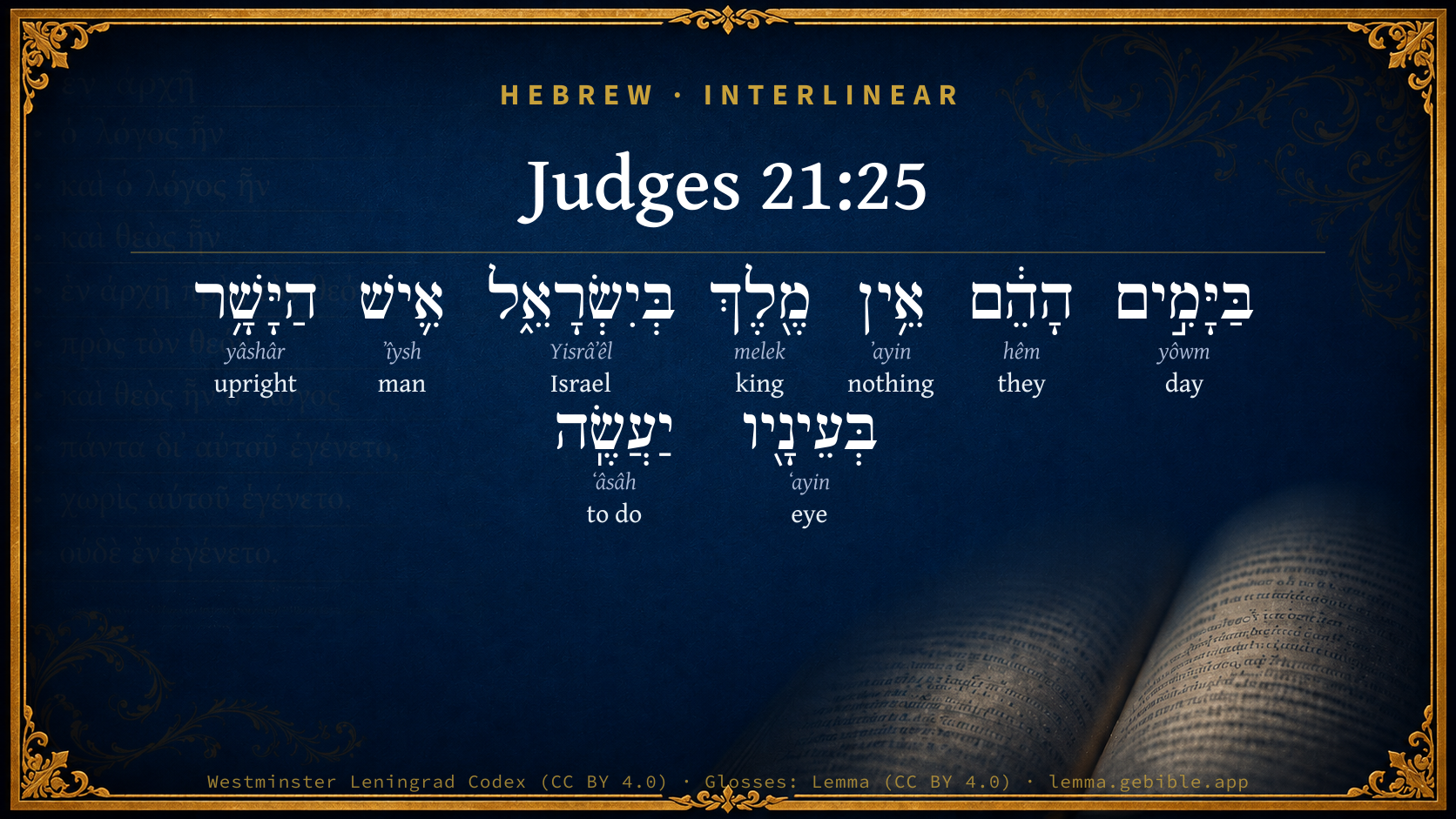
Hebrew (Westminster Leningrad Codex) Judges 21:25 appears in the Hebrew Old Testament. The text above is from the Westminster Leningrad Codex. Each word links to its Strong’s number, a concise gloss, and parsing drawn from the Open Scriptures Hebrew Bible morphology. Click any word for its full Brown-Driver-Briggs (BDB) entry.
Download image
Cite this verse

Judges 21:25 (World English Bible). Public Domain. Lemma interlinear Bible study tool, https://lemma.gebible.app/v/judges/21/25.

Show BibTeX & RIS
BibTeX
RIS
English Translation
In those days there was no king in Israel: every man did that which was right in his own eyes.
World English Bible · Public Domain
Download a study sheet

One document with this verse’s original text, its word-by-word gloss line, the meaning frame, cross-references with their text, attributed commentary, and full source and license credits — printable, and it pastes into notes with its structure intact.

This verse Autodidact and up

Study sheet (.html) Plain text (.txt)

A passage Seminary Student

Up to 50 verses in one chapter. A passage sheet keeps up to 6 commentary sources and 12 cross-references per verse, in the order this page ranks them, and says so on the sheet whenever that leaves anything out. Ask for a single verse and you get the Autodidact verse sheet above.

Everything on this page stays free to read, with no account — the sheet is a download of what is already on screen, not access to it.

Want to remove ads? Support Godless Engineer
Compare translations 3

The same verse in 3 English versions, stacked beneath the original-language interlinear above. Click any original word for its lexicon entry.

Each is an independent rendering of the whole verse — the interlinear is not word-aligned to these translations.

Highlighted words mark where these versions differ — a whole-verse word diff, not a word-by-word alignment.

  • World English Bible Public Domain
    In those days there was no king in Israel: every man did that which was right in his own eyes.
  • King James Version Public Domain
    In those days there was no king in Israel: every man did that which was right in his own eyes.
  • unfoldingWord Literal Text CC BY-SA 4.0
    In those days a king not in Israel. A man did the right in his eyes.

unfoldingWord Literal Text — © unfoldingWord, licensed CC BY-SA 4.0. Word-aligned USFM3 via Door43 (git.door43.org/unfoldingWord/en_ult).

Versions to compare (up to 4)

3 of 4 selected

Show all 17 translations

Every available English version of this verse, each an independent rendering of the whole verse.

  • World English Bible Public Domain
    In those days there was no king in Israel: every man did that which was right in his own eyes.
  • Berean Standard Bible Public Domain
    In those days there was no king in Israel; everyone did what was right in his own eyes.
  • Majority Standard Bible Public Domain
    In those days there was no king in Israel; everyone did what was right in his own eyes.
  • King James Version Public Domain
    In those days there was no king in Israel: every man did that which was right in his own eyes.
  • American Standard Version (1901) Public Domain
    In those days there was no king in Israel: every man did that which was right in his own eyes.
  • Revised Version (1885) Public Domain
    In those days there was no king in Israel: every man did that which was right in his own eyes.
  • Geneva Bible (1599) Public Domain
    In those dayes there was no King in Israel, but euery man did that which was good in his eyes.
  • Young's Literal Translation Public Domain
    In those days there is no king in Israel; each doth that which is right in his own eyes.
  • Literal Standard Version CC BY-SA 4.0
    In those days there is no king in Israel; each does that which is right in his own eyes.
  • Unlocked Literal Bible CC BY-SA 4.0
    In those days there was no king in Israel. Everyone did what was right in his own eyes.
  • unfoldingWord Literal Text CC BY-SA 4.0
    In those days a king not in Israel. A man did the right in his eyes.
  • Darby Bible Public Domain
    In those days there was no king in Israel; every man did what was right in his own eyes.
  • World Messianic Bible Public Domain
    In those days there was no king in Israel. Everyone did that which was right in his own eyes.
  • Webster's Bible Public Domain
    In those days there was no king in Israel: every man did that which was right in his own eyes.
  • Free Bible Version CC BY-SA 4.0
    At that time Israel didn't have a king—everyone did what they themselves thought was the right thing to do.
  • Bible in Basic English Public Domain
    In those days there was no king in Israel: every man did what seemed right to him.
  • JPS Tanakh (1917) Public Domain
    In those days there was no king in Israel; every man did that which was right in his own eyes.

Literal Standard Version (2020), Covenant Press — licensed CC BY-SA 4.0. Text via the HelloAO Bible API (eBible.org). Unlocked Literal Bible (unfoldingWord) — licensed CC BY-SA 4.0. Text via the HelloAO Bible API (eBible.org). unfoldingWord Literal Text — © unfoldingWord, licensed CC BY-SA 4.0. Word-aligned USFM3 via Door43 (git.door43.org/unfoldingWord/en_ult). Free Bible Version, Dr. Jonathan Gallagher — licensed CC BY-SA 4.0. Text via the HelloAO Bible API (eBible.org).

Word by word

More ways to search: Search by grammar → Find every occurrence → Compare this word →

Practice this passage: Drill this verse → Learn its vocabulary →

הַיָּשָׁ֥ר
yâshâr
H3477
“the · upright”
Particle, Definite Article + Adjective, Adjective, Masculine, Singular, Absolute
Part of Speech
Particle + Adjective
Type
Adjective
Gender
Masculine
Number
Singular
State
Absolute
Full BDB Definition

Origin: from H3474

TWOT: 930a

straight, upright, correct, right - straight, level - right, pleasing, correct - straightforward, just, upright, fitting, proper - uprightness, righteous, upright - that which is upright (substantive)
  1. בַּיָּמִ֣ים yôwm H3117 “in/at the · days” Preposition, Determined + Noun, Common, Masculine, Plural, Absolute
  2. הָהֵ֔ם hêm H1992 “the · they” Particle, Definite Article + Pronoun, Personal, 3rd Person, Masculine, Plural
  3. אֵ֥ין ʼayin H369 “nothing” Particle, Negative
  4. מֶ֖לֶךְ melek H4428 “king” Noun, Common, Masculine, Singular, Absolute
  5. בְּיִשְׂרָאֵ֑ל Yisrâʼêl H3478 “in/at · Israel” Preposition + Noun, Proper
  6. אִ֛ישׁ ʼîysh H376 “man” Noun, Common, Masculine, Singular, Absolute
  7. בְּעֵינָ֖יו ʻayin H5869 “in/at · eyes · his” Preposition + Noun, Common, Both, Dual, Construct + Suffix, Personal, 3rd Person, Masculine, Singular
  8. יַעֲשֶֽׂה ʻâsâh H6213 “to do” Verb, Qal, Imperfect, 3rd Person, Masculine, Singular

About this verse

These counts appear in no published source. They are computed here, from the morphology-tagged text and Lemma’s own curated glosses. What Lemma adds →

9
words
9
distinct lemmas
Historical
section

Grammatical profile

  • 1 verb
  • 5 nouns
  • 1 adjective
  • 1 pronoun
  • 1 particle

Verb forms

  • יַעֲשֶֽׂה Qal · Imperfect

Hebrew & Septuagint length

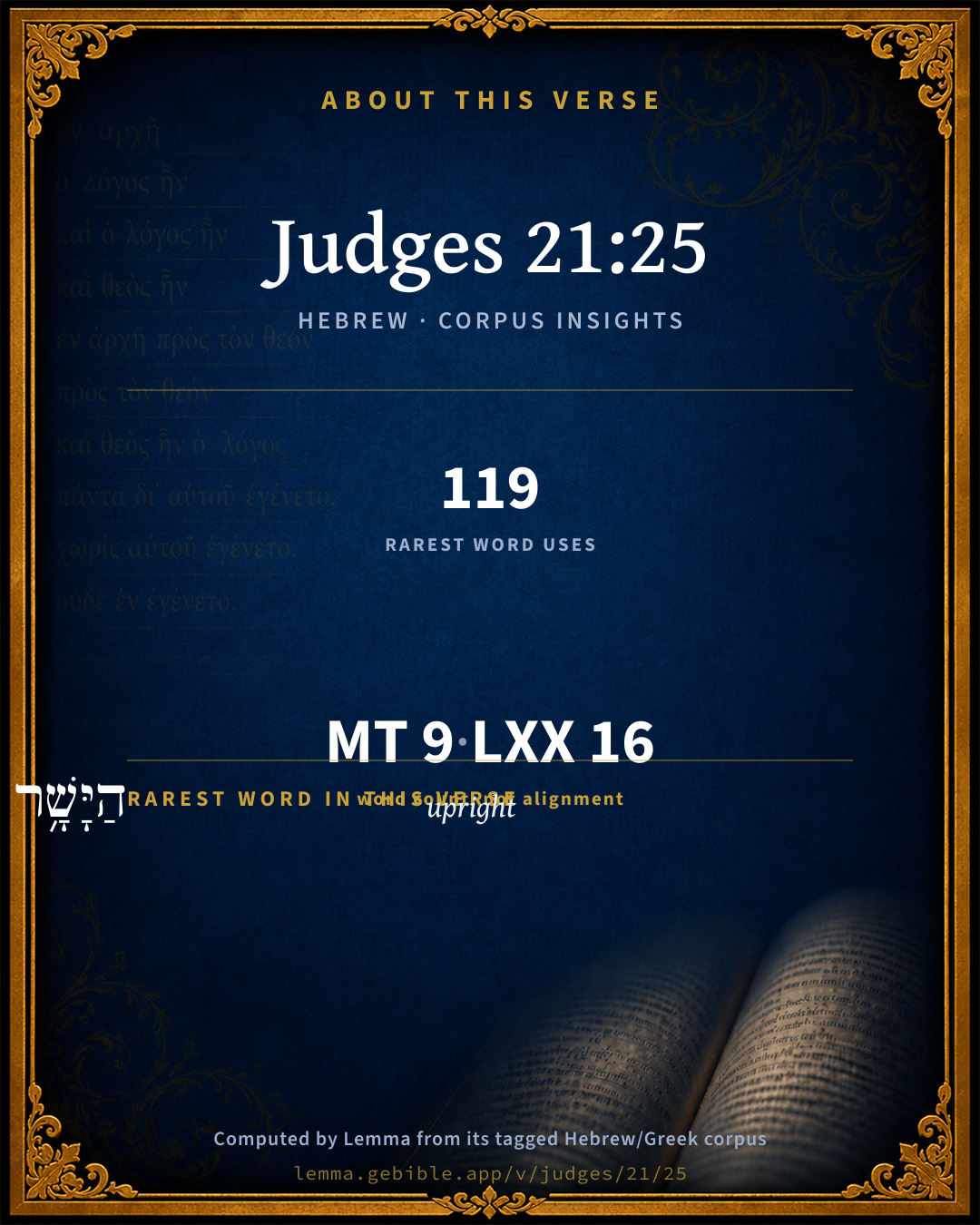
In English translation the verse runs 20 words from the Hebrew and 21 from the Septuagint (LXX English) — closely comparable.

A rough comparison of the two English renderings, which tokenize alike — not a word-level alignment.

Word counts can differ between the Hebrew and the Greek without any difference in meaning — e.g. the Hebrew direct-object marker אֵת has no separate Greek word, and Greek often adds the article ὁ.

In the original languages it is 9 Hebrew tokens and 16 Greek tokens — but the two are counted differently (Hebrew bundles its prefixes and suffixes into one token; the Greek is in lemma form), so that isn’t a like-for-like length.

Cross-references

9

Topical passages linked to Judges 21:25 in the Treasury of Scripture Knowledge — connected by theme and wording, ordered by reader-vote popularity; previews shown in the World English Bible.

  • Deuteronomy 12:8 You shall not do after all the things that we do here this day, every man whatever is right in his own eyes;
  • Judges 17:6 In those days there was no king in Israel: every man did that which was right in his own eyes.
  • Proverbs 3:5 Trust in Yahweh with all your heart, And don't lean on your own understanding.
  • Ecclesiastes 11:9 Rejoice, young man, in your youth, And let your heart cheer you in the days of your youth, And walk in the ways of your heart, And in the sight of your eyes; But know that for all these things God will bring you into judgment.
  • Proverbs 14:12 There is a way which seems right to a man, But in the end it leads to death.
  • Judges 19:1 It happened in those days, when there was no king in Israel, that there was a certain Levite sojourning on the farther side of the hill-country of Ephraim, who took to him a concubine out of Bethlehem Judah.
  • Judges 18:1 In those days there was no king in Israel: and in those days the tribe of the Danites sought them an inheritance to dwell in; for to that day [their] inheritance had not fallen to them among the tribes of Israel.
  • Micah 2:1–2 Woe to those who devise iniquity And work evil on their beds! When the morning is light, they practice it, Because it is in the power of their hand.
  • Psalms 12:4 Who have said, "With our tongue we will prevail. Our lips are our own. Who is lord over us?"

Cross-references courtesy of OpenBible.info (CC BY 4.0).

Hebrew and Greek witnesses Masoretic Hebrew ↔ Greek Septuagint

The same verse in the two great witnesses to the Old Testament, shown verse-for-verse.

These are two independent witnesses, not word-aligned to each other, and the Septuagint is shown in lemma (dictionary) form.

Hebrew Judges 21:25 Masoretic · Westminster Leningrad Codex

בַּיָּמִ֣ים הָהֵ֔ם אֵ֥ין מֶ֖לֶךְ בְּיִשְׂרָאֵ֑ל אִ֛ישׁ הַיָּשָׁ֥ר בְּעֵינָ֖יו יַעֲשֶֽׂה

In those days there was no king in Israel: every man did that which was right in his own eyes.

World English Bible · Public Domain

Greek LXX Judges 21:25 Septuagint · lemma form

ἐν δέ ὁ ἡμέρα ἐκεῖνος οὐ εἰμί βασιλεύς ἐν ἰσραήλ ἀνήρ ὁ εὐθής ἐνώπιον αὐτός ποιέω

And in those days there was no king in Israel; every man did that which was right in his own sight.

LXX2012 (modern English Septuagint) · Public Domain

Hebrew: Westminster Leningrad Codex (CC BY 4.0). Greek: Septuagint (public domain); English from LXX2012 (modern English Septuagint) (Public Domain). How the Septuagint differs from the Hebrew →

Targum (Aramaic paraphrase)

1

The Targum is the ancient Jewish Aramaic paraphrase of the Hebrew Scriptures — an interpretive translation, not the Hebrew text itself. Onkelos (literal) and Pseudo-Jonathan (expansive) render the Torah, and Jonathan the Prophets. Coverage is partial: where no permissively-licensed English translation exists for a verse, only the Aramaic is shown. This is verse-level text, not a word-by-word alignment to the Hebrew.

  1. Targum Jonathan Prophets (Joshua–Malachi)
    בְּיוֹמַיָא הָאִינוּן לֵית מַלְכָּא בְּיִשְׂרָאֵל גְבַר דְכָשַׁר בְּעֵינוֹהִי יַעְבַּד:

    (no public-domain English translation for this verse)

    Targum Jonathan — Aramaic: “Mikraot Gedolot” (public domain). English: “Sefaria Community Translation” (CC0 1.0 (public-domain dedication)); “London "Chaldee Paraphrase," 1871” (public domain). Text via Sefaria.

Commentary

Notes on Judges 21:25 from classic Christian and Jewish commentators (each source and its license shown beneath its notes). The classic Christian expositions comment on the surrounding passage and are grouped to its opening verse, so a note may address several verses; the Jewish commentaries on the Tanakh (Rashi and others) are per-verse, so they appear only where the commentator wrote on this verse.

Lemma curates 59 commentaries, every one of them public domain or Creative Commons licensed, each selected and text-cleaned for this edition rather than reprinted as found. About our sources →

Trapp's Complete Commentary

John Trapp

Jdg 21:25 In those days [there was] no king in Israel: every man did [that which was] right in his own eyes.

Ver. 25. In those days, &c.] See Jdg 17:6.

Every man did that which was right.] Quod sibi placebat, id solebat facere. {a} Had the Israelites been, as some say the Thracians were, αυτονομοι, every man a law to himself, it might have been better with them. But although they lived in God’s good land, yet because not by God’s good laws, nor had at this time any supreme magistrate, therefore all was out of order, and their anarchy begat a general ataxy.

{a} Vatab.

John Trapp, A Commentary or Exposition upon All the Books of the Old and New Testament (1647–1656) — public domain. Text from a community e-Sword module.

Joseph Benson's Commentary

Jdg 21:25. In those days there was no king in Israel — There were elders, (Jdg 21:16,) who had some authority, and there was a high-priest, (Jdg 20:28,) but there was no supreme governor, such as Moses and Joshua were, and after them the judges, and none that had power sufficient to punish public wrongs, whoredoms, and idolatries, and thereby check the progress of vice and profanenness, and keep the people in order. “The sacred writer,” says Dr. Dodd, “no doubt, repeats this observation to account for the disorders and enormities mentioned in the four preceding chapters; which exhibit a most depraved state of things;” every man doing what was right in his own eyes — Or, following his own corrupt passions and inclinations. “It is a natural inference from hence, that men ought to be extremely thankful for lawful authority: and, if they would preserve their felicity, ought to be zealous to support that authority, as well as to discourage all licentious approaches toward its dissolution. The Persians have a custom which justifies this reflection. When any of their kings die, they suffer the people to do as they please for five days, that by the disorders then committed, they may see the necessity of legal government, and learn submission to it. In general, the four chapters which finish this book show us to what a degree the Israelites were degenerated in the short space from the death of Caleb to the election of his younger brother to be their judge: we discover the true cause of the chastisements wherewith God punished them from time to time, though he delivered them from their enemies, under whose yoke they must infallibly have fallen, if God had not beheld them with compassion, and raised them up judges to save them from ruin. We just remark, in conclusion, that it would be unreasonable to draw any inference from the tumultuous and irregular actions of a tribe or people, to the lessening of the authority of the writer of any history. The writer of the present book ought rather to be admired for the impartiality with which he relates facts so little to the credit of his nation.”

Joseph Benson's Commentary on the Old and New Testaments (1811–1818) — public domain. Text from a community e-Sword module.

Adam Clarke's Commentary

Verse 25. In those days there was no king in Israel] Let no one suppose that the sacred writer, by relating the atrocities in this and the preceding chapters, justifies the actions themselves; by no means. Indeed, they cannot be justified; and the writer by relating them gives the strongest proof of the authenticity of the whole, by such an impartial relation of facts that were highly to be discredit of his country.

I HAVE already referred to the rape of the Sabine virgins. The story is told by Livy, Hist. lib. i., cap. 9, the substance of which is as follows: Romulus having opened an asylum at his new-built city of Rome for all kinds of persons, the number of men who flocked to his standard was soon very considerable; but as they had few women, or, as Livy says, penuria mulierum, a dearth of women, he sent to all the neighbouring states to invite them to make inter-marriages with his people. Not one of the tribes around him received the proposal; and some of them insulted his ambassador, and said, Ecquod feminis quoque asylum aperuissent? Id enim demum compar connubium fore? "Why have you not also opened an asylum for WOMEN, which would have afforded you suitable matches?" This exasperated Romulus, but he concealed his resentment, and, having published that he intended a great feast to Neptune Equester, invited all the neighbouring tribes to come to it: they did so, and were received by the Romans with the greatest cordiality and friendship. The Sabines, with their wives and children, came in great numbers, and each Roman citizen entertained a stranger. When the games began, and each was intent on the spectacle before them, at a signal given, the young Romans rushed in among the Sabine women, and each carried off one, whom however they used in the kindest manner, marrying them according to their own rites with due solemnity, and admitting them to all the rights and privileges of the new commonwealth. The number carried off on this occasion amounted to near seven hundred; but this act of violence produced disastrous wars between the Romans and the Sabines, which were at last happily terminated by the mediation of the very women whose rape had been the cause of their commencement. The story may be seen at large in Livy, Plutarch, and others.

Thus ends the book of Judges; a work which, while it introduces the history of Samuel and that of the kings of Judah and Israel, forms in some sort a supplement to the book of Joshua, and furnishes the only account we have of those times of anarchy and confusion, which extended nearly from the times of the elders who survived Joshua, to the establishment of the Jewish monarchy under Saul, David, and their successors. For other uses of this book, see the preface.

MASORETIC NOTES ON THE BOOK OF JUDGES

The number of verses in this book is six hundred and eighteen.

Its Masoretic chapters are fourteen.

And its middle verse is Jdg 10:8: And that year they vexed and oppressed the children of Israel, &c.

Corrected for a new edition, December 1, 1827. - A. C.

Adam Clarke's Commentary on the Bible (1810–1826) — public domain. Text from a community e-Sword/MySword module.

Ellicott's Commentary for English Readers

(25) In those days . . . This verse, already occurring in Jdg_17:6; Jdg_18:1; Jdg_19:1, is here added once more by way of apology for the lawless crimes, terrible disasters, evaded vows, and unhallowed excesses of retribution, which it has been the painful duty of the sacred historian thus faithfully and impartially to narrate. Out of these depths the subsequent Judges, whose deeds have been recorded in the earlier chapters, partially raised their countrymen, until the dread lessons of calamity had been fully learnt, and the nation was ripe for the heroic splendour and more enlightened faithfulness of the earlier monarchy.

A Bible Commentary for English Readers, edited by Charles John Ellicott (1878–1897) — public domain. Text from a community e-Sword module.

The Cambridge Bible for Schools and Colleges

gen. ed. J. J. S. Perowne

25. there was no king in Israel] Cf. Jdg_17:6 n. A suitable transition to the history of Samuel which relates the beginning of the monarchy.

The Cambridge Bible for Schools and Colleges (gen. ed. J. J. S. Perowne; Cambridge University Press, 1878–1918) — public domain. Text from a community e-Sword module.

John Gill's Exposition

In those days there was no king in Israel,.... No supreme magistrate, Joshua being dead, and as yet no judge in Israel had risen up; for all related in the five last chapters of this book were done between the death of Joshua and the time of the judges:

every man did that which was right in his own eyes; there being none to restrain him from it, or punish him for it; and this accounts for the many evil things related, as the idolatry of Micah and the Danites, the base usage of the Levite's concubine, the extreme rigour and severity with which the Israelites treated their brethren the Benjaminites, the slaughter of the inhabitants of Jabeshgilead, and the rape of the daughters of Shiloh.

Next: Ruth Introduction

John Gill's Exposition of the Whole Bible (1746–1763) — public domain (CC PDM 1.0). Text via the HelloAO Bible API.

Albert Barnes' Notes on the Bible

The repetition of this characteristic phrase (compare Jdg 17:6; Jdg 18:1; Jdg 19:1) is probably intended to impress upon us the idea that these disorders arose from the want of a sufficient authority to suppress them. The preservation of such a story, of which the Israelites must have been ashamed, is a striking evidence of the divine superintendence and direction as regards the Holy Scriptures.

Albert Barnes' Notes on the Bible (1834–1885) — public domain. Text from a community e-Sword/MySword module.

Whedon's Commentary on the Bible

Daniel D. Whedon

25. In those days there was no king in Israel — With this familiar text, in part or in whole so frequently repeated in this book, the historian of the Dark Ages of Israel appropriately closes his narrative. And thus, says Wordsworth, “he prepares the way for the record of a better condition of things under David, the king of Judah and Israel, whose genealogy and history are described in the next following books of Ruth and Samuel, and who was the ancestor and type of the Divine King of Israel, JESUS CHRIST, to whom, with the FATHER and the HOLY GHOST, be ascribed all honour and glory, now and forever. Amen.”

Daniel D. Whedon (gen. ed.), Commentary on the Old and New Testaments (1874–1909) — public domain. Text from a community e-Sword module.

The Pulpit Commentary

In those days, etc. See Jud_1:17:6 18:1, etc.

"In those days there was no king in Israel: every man did that which was right in his own eyes.

This is the key-note, as it is the refrain, of the whole book. The point raised is one of great significance in dealing with the foundations of Society and the State.

I THE EVILS ARISING FROM AN EXCESS OF INDIVIDUALISM AMONGST MEN.

II THE NECESSITY FOR SOME COMMON EXTERNAL BOND AND SANCTION FOR CONDUCT AND LIFE. M.

The Pulpit Commentary (1880–1919), ed. H.D.M. Spence-Jones & Joseph S. Exell — public domain. Text from a community e-Sword module.

John Wesley's Explanatory Notes

Right in his own eyes - What wonder was it then, if all wickedness overflowed the land? Blessed be God for magistracy!

John Wesley, Explanatory Notes Upon the Whole Bible (1754–1765) — public domain. Text via the GEBible commentary corpus.

unfoldingWord translationNotes

Door43 World Missions Community

there was no king in Israel

"Israel did not yet have a king"

what was right in his own eyes

The eyes represent seeing, and seeing represents thoughts or judgment. AT: "what he judged to be right" or "what he considered to be right" (See: Metaphor)

translationWords

king

Israel

unfoldingWord translationNotes — © Distant Shores Media and the Door43 World Missions Community, licensed CC BY-SA 4.0. Source: git.door43.org/Door43/en_tn.

Lesson kit

Teaching starters — assembled from the data on this page, not authored interpretation. Every prompt links to the verse data it draws on. Edit before teaching.

Judges, in the Historical, opens this verse with 9 words (9 distinct Hebrew lemmas). Its most distinctive word is yâshâr (“upright”). A historical commentator’s framing appears above. Read the whole chapter for the surrounding context.

Discussion questions

  1. The word yâshâr carries the sense “upright.” How does it shape the verse?
  2. Deuteronomy 12:8 shares this passage’s theme. How do the two illuminate each other?
  3. These translations render this verse differently; the difference is in the English rendering, not the original. What questions does that raise?
  4. The verb «יַעֲשֶֽׂה» is Qal Imperfect. How does its form color the action?
  5. Reading how Trapp's Complete Commentary and Joseph Benson's Commentary read this verse, where do the two commentators agree and where do they part?

Things to notice

Reading settings

Reading text

Shown beneath each verse's original-language words.

Old Testament
Old Testament edition

Read the OT as the Masoretic Hebrew (MT) or the Greek Septuagint (LXX).

English shown for the Greek Septuagint (in the Hebrew ↔ Greek comparison).

Comparing translations? Open the Compare panel on any verse page to stack up to four side by side.