1 Kings 3:2

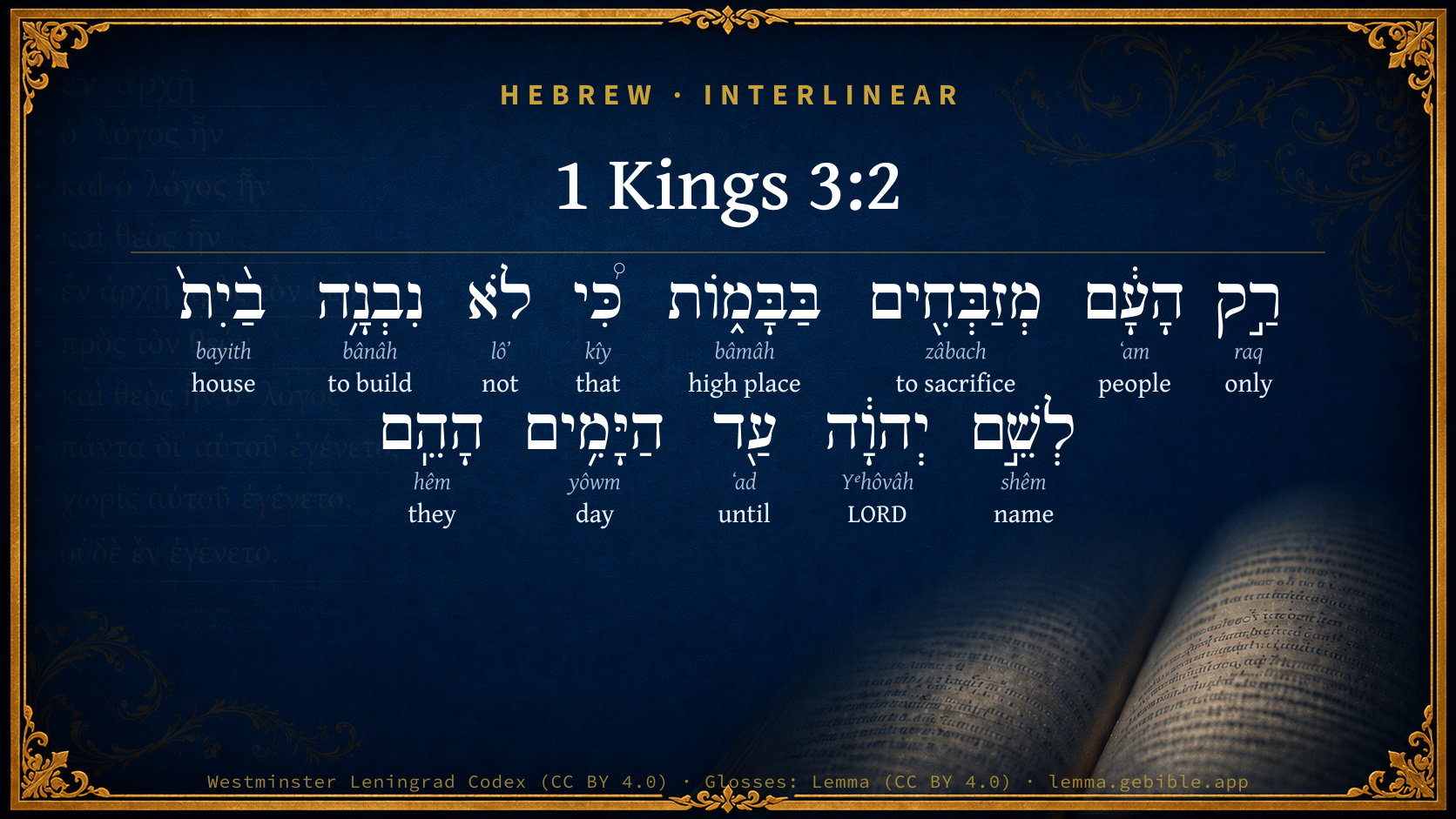
Hebrew (Westminster Leningrad Codex) 1 Kings 3:2 appears in the Hebrew Old Testament. The text above is from the Westminster Leningrad Codex. Each word links to its Strong’s number, a concise gloss, and parsing drawn from the Open Scriptures Hebrew Bible morphology. Click any word for its full Brown-Driver-Briggs (BDB) entry.
Download image
Cite this verse

1 Kings 3:2 (World English Bible). Public Domain. Lemma interlinear Bible study tool, https://lemma.gebible.app/v/1-kings/3/2.

Show BibTeX & RIS
BibTeX
RIS
English Translation
Only the people sacrificed in the high places, because there was no house built for the name of Yahweh until those days.
World English Bible · Public Domain
Download a study sheet

One document with this verse’s original text, its word-by-word gloss line, the meaning frame, cross-references with their text, attributed commentary, and full source and license credits — printable, and it pastes into notes with its structure intact.

This verse Autodidact and up

Study sheet (.html) Plain text (.txt)

A passage Seminary Student

Up to 50 verses in one chapter. A passage sheet keeps up to 6 commentary sources and 12 cross-references per verse, in the order this page ranks them, and says so on the sheet whenever that leaves anything out. Ask for a single verse and you get the Autodidact verse sheet above.

Everything on this page stays free to read, with no account — the sheet is a download of what is already on screen, not access to it.

Want to remove ads? Support Godless Engineer
Compare translations 3

The same verse in 3 English versions, stacked beneath the original-language interlinear above. Click any original word for its lexicon entry.

Each is an independent rendering of the whole verse — the interlinear is not word-aligned to these translations.

Highlighted words mark where these versions differ — a whole-verse word diff, not a word-by-word alignment.

  • World English Bible Public Domain
    Only the people sacrificed in the high places, because there was no house built for the name of Yahweh until those days.
  • King James Version Public Domain
    Only the people sacrificed in high places, because there was no house built unto the name of the LORD, until those days.
  • unfoldingWord Literal Text CC BY-SA 4.0
    However, the people were sacrificing at the high places because a house had not been built for the name of Yahweh up to those days.

unfoldingWord Literal Text — © unfoldingWord, licensed CC BY-SA 4.0. Word-aligned USFM3 via Door43 (git.door43.org/unfoldingWord/en_ult).

Versions to compare (up to 4)

3 of 4 selected

Show all 18 translations

Every available English version of this verse, each an independent rendering of the whole verse.

  • World English Bible Public Domain
    Only the people sacrificed in the high places, because there was no house built for the name of Yahweh until those days.
  • Berean Standard Bible Public Domain
    The people, however, were still sacrificing on the high places because a house for the Name of the LORD had not yet been built.
  • Majority Standard Bible Public Domain
    The people, however, were still sacrificing on the high places because a house for the Name of the LORD had not yet been built.
  • King James Version Public Domain
    Only the people sacrificed in high places, because there was no house built unto the name of the LORD, until those days.
  • American Standard Version (1901) Public Domain
    Only the people sacrificed in the high places, because there was no house built for the name of Jehovah until those days.
  • Revised Version (1885) Public Domain
    Only the people sacrificed in the high places, because there was no house built for the name of the LORD until those days.
  • Geneva Bible (1599) Public Domain
    Only the people sacrificed in the hie places, because there was no house buylt vnto the name of the Lord, vntill those dayes.
  • Douay-Rheims (1899) Public Domain
    But yet the people sacrificed in the high places: far there was no temple built to the name of the Lord until that day.
  • Young's Literal Translation Public Domain
    Only, the people are sacrificing in high places, for there hath not been built a house for the name of Jehovah till those days.
  • Literal Standard Version CC BY-SA 4.0
    Only, the people are sacrificing in high places, for there has not been built a house for the Name of YHWH until those days.
  • Unlocked Literal Bible CC BY-SA 4.0
    The people were sacrificing at the high places, because no house had yet been built for the name of Yahweh.
  • unfoldingWord Literal Text CC BY-SA 4.0
    However, the people were sacrificing at the high places because a house had not been built for the name of Yahweh up to those days.
  • Darby Bible Public Domain
    Only, the people sacrificed on the high places; for there was no house built to the name of Jehovah, until those days.
  • World Messianic Bible Public Domain
    However, the people sacrificed in the high places, because there was not yet a house built for the LORD’s name.
  • Webster's Bible Public Domain
    Only the people sacrificed in high places, because there was no house built to the name of the LORD, until those days.
  • Free Bible Version CC BY-SA 4.0
    In those days, however, the people still sacrificed on the high places because a Temple to honor the Lord hadn't yet been built.
  • Bible in Basic English Public Domain
    But all this time the people were making their offerings in the high places, because no house had been put up to the name of the Lord till those days.
  • JPS Tanakh (1917) Public Domain
    Only the people sacrificed in the high places, because there was no house built for the name of the LORD until those days.

Literal Standard Version (2020), Covenant Press — licensed CC BY-SA 4.0. Text via the HelloAO Bible API (eBible.org). Unlocked Literal Bible (unfoldingWord) — licensed CC BY-SA 4.0. Text via the HelloAO Bible API (eBible.org). unfoldingWord Literal Text — © unfoldingWord, licensed CC BY-SA 4.0. Word-aligned USFM3 via Door43 (git.door43.org/unfoldingWord/en_ult). Free Bible Version, Dr. Jonathan Gallagher — licensed CC BY-SA 4.0. Text via the HelloAO Bible API (eBible.org).

Word by word

More ways to search: Search by grammar → Find every occurrence → Compare this word →

Practice this passage: Drill this verse → Learn its vocabulary →

בַּבָּמ֑וֹת
bâmâh
H1116
“in/at the · high places”
Preposition, Determined + Noun, Common, Feminine, Plural, Absolute
Part of Speech
Preposition + Noun
Type
Common
Gender
Feminine
Number
Plural
State
Absolute
Full BDB Definition

Origin: from an unused root (meaning to be high)

TWOT: 253

high place, ridge, height, bamah (technical name for cultic platform) - high place, mountain - high places, battlefields - high places (as places of worship) - funeral mound?
  1. רַ֣ק raq H7535 “only” Particle, Accusative
  2. הָעָ֔ם ʻam H5971 “the · people” Particle, Definite Article + Noun, Common, Masculine, Singular, Absolute
  3. מְזַבְּחִ֖ים zâbach H2076 “sacrificing” Verb, Piel, Participle Active, Masculine, Plural, Absolute
  4. כִּ֠י kîy H3588 “that” Conjunction
  5. לֹא lôʼ H3808 “not” Particle, Negative
  6. נִבְנָ֥ה bânâh H1129 “to build” Verb, Niphal, Perfect, 3rd Person, Masculine, Singular
  7. בַ֨יִת֙ bayith H1004 “house” Noun, Common, Masculine, Singular, Absolute
  8. לְשֵׁ֣ם shêm H8034 “to/for · name of” Preposition + Noun, Common, Masculine, Singular, Construct
  9. יְהוָ֔ה Yᵉhôvâh H3068 “LORD” Noun, Proper
  10. עַ֖ד ʻad H5704 “until” Preposition
  11. הַיָּמִ֥ים yôwm H3117 “the · days” Particle, Definite Article + Noun, Common, Masculine, Plural, Absolute
  12. הָהֵֽם hêm H1992 “the · they” Particle, Definite Article + Pronoun, Personal, 3rd Person, Masculine, Plural

About this verse

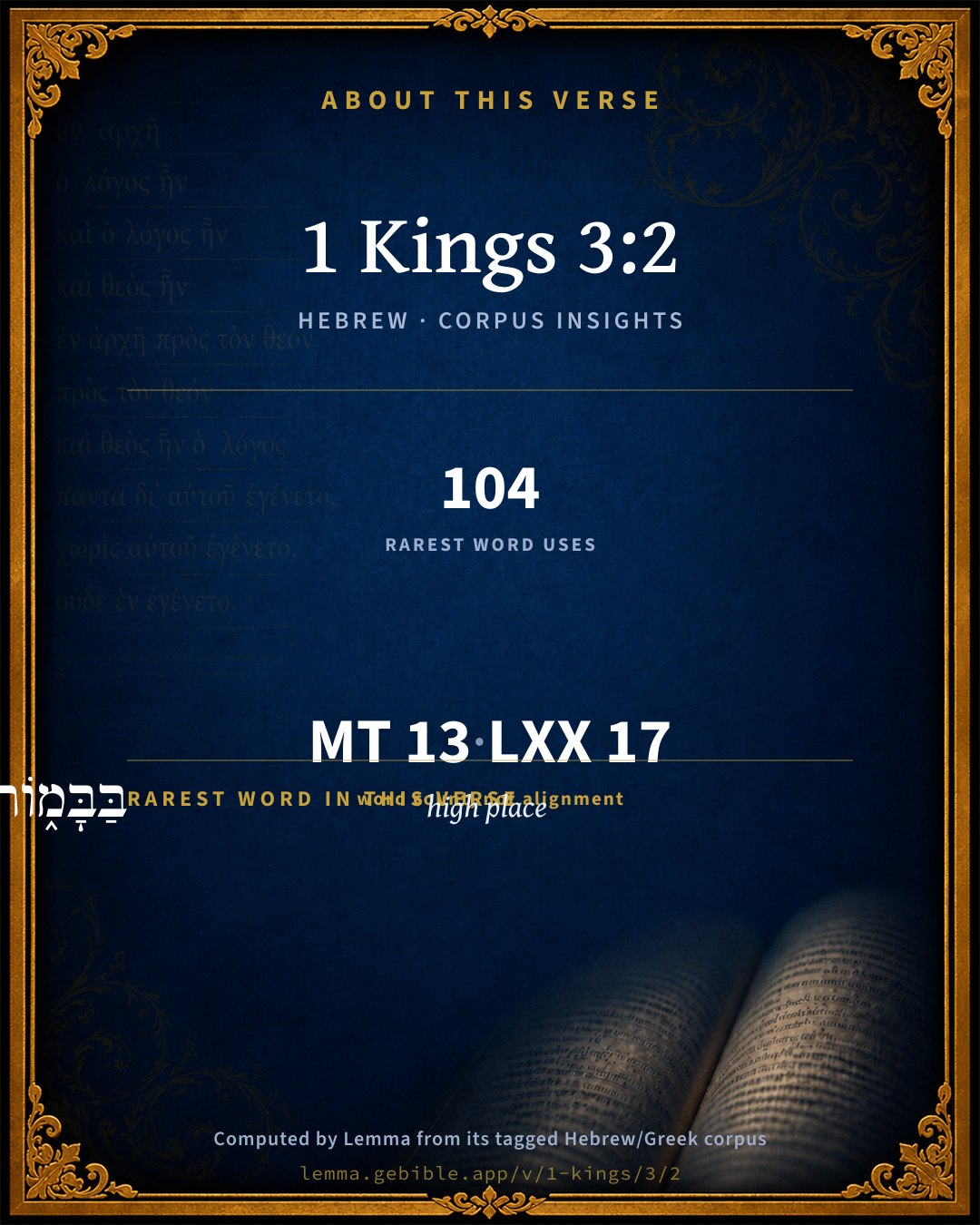
These counts appear in no published source. They are computed here, from the morphology-tagged text and Lemma’s own curated glosses. What Lemma adds →

13
words
13
distinct lemmas
Historical
section

Grammatical profile

  • 2 verbs
  • 6 nouns
  • 1 pronoun
  • 1 preposition
  • 1 conjunction
  • 2 particles

Verb forms

  • מְזַבְּחִ֖ים Piel · Participle Active
  • נִבְנָ֥ה Niphal · Perfect

Hebrew & Septuagint length

In English translation the verse runs 22 words from the Hebrew and 20 from the Septuagint (LXX English) — closely comparable.

A rough comparison of the two English renderings, which tokenize alike — not a word-level alignment.

Word counts can differ between the Hebrew and the Greek without any difference in meaning — e.g. the Hebrew direct-object marker אֵת has no separate Greek word, and Greek often adds the article ὁ.

In the original languages it is 13 Hebrew tokens and 17 Greek tokens — but the two are counted differently (Hebrew bundles its prefixes and suffixes into one token; the Greek is in lemma form), so that isn’t a like-for-like length.

Cross-references

9

Topical passages linked to 1 Kings 3:2 in the Treasury of Scripture Knowledge — connected by theme and wording, ordered by reader-vote popularity; previews shown in the World English Bible.

  • 1 Kings 22:43 He walked in all the way of Asa his father; He didn't turn aside from it, doing that which was right in the eyes of Yahweh: however the high places were not taken away; the people still sacrificed and burnt incense in the high places.
  • 2 Chronicles 33:17 Nevertheless the people sacrificed still in the high places, but only to Yahweh their God.
  • Deuteronomy 12:2–5 You shall surely destroy all the places in which the nations that you shall dispossess served their gods, on the high mountains, and on the hills, and under every green tree:
  • Leviticus 26:30 I will destroy your high places, and cut down your incense altars, and cast your dead bodies upon the bodies of your idols; and my soul will abhor you.
  • Leviticus 17:3–6 Whatever man there is of the house of Israel, who kills an ox, or lamb, or goat, in the camp, or who kills it outside the camp,
  • 1 Kings 5:3 You know how that David my father could not build a house for the name of Yahweh his God for the wars which were about him on every side, until Yahweh put them under the soles of his feet.
  • 1 Chronicles 17:4–6 Go and tell David my servant, Thus says Yahweh, You shall not build me a house to dwell in:
  • 1 Chronicles 28:3–6 But God said to me, You shall not build a house for my name, because you are a man of war, and have shed blood.

Cross-references courtesy of OpenBible.info (CC BY 4.0).

Hebrew and Greek witnesses Masoretic Hebrew ↔ Greek Septuagint

The same verse in the two great witnesses to the Old Testament, shown verse-for-verse.

These are two independent witnesses, not word-aligned to each other, and the Septuagint is shown in lemma (dictionary) form.

Hebrew 1 Kings 3:2 Masoretic · Westminster Leningrad Codex

רַ֣ק הָעָ֔ם מְזַבְּחִ֖ים בַּבָּמ֑וֹת כִּ֠י לֹא נִבְנָ֥ה בַ֨יִת֙ לְשֵׁ֣ם יְהוָ֔ה עַ֖ד הַיָּמִ֥ים הָהֵֽם

Only the people sacrificed in the high places, because there was no house built for the name of Yahweh until those days.

World English Bible · Public Domain

Greek LXX 1 Kings 3:2 Septuagint · lemma form

πλήν ὁ λαός εἰμί θυμιάω ἐπί ὁ ὑψηλός ὅτι οὐ οἰκοδομέω οἶκος ὁ ὄνομα κύριος ἕως νῦν

Nevertheless the people burnt incense on the high places, because a house had not yet been built to the Lord.

LXX2012 (modern English Septuagint) · Public Domain

Hebrew: Westminster Leningrad Codex (CC BY 4.0). Greek: Septuagint (public domain); English from LXX2012 (modern English Septuagint) (Public Domain). How the Septuagint differs from the Hebrew →

Targum (Aramaic paraphrase)

1

The Targum is the ancient Jewish Aramaic paraphrase of the Hebrew Scriptures — an interpretive translation, not the Hebrew text itself. Onkelos (literal) and Pseudo-Jonathan (expansive) render the Torah, and Jonathan the Prophets. Coverage is partial: where no permissively-licensed English translation exists for a verse, only the Aramaic is shown. This is verse-level text, not a word-by-word alignment to the Hebrew.

  1. Targum Jonathan Prophets (Joshua–Malachi)
    לְחוֹד עַמָא מְדַבְּחִין עַל בָּמוֹתָא אֲרֵי לָא אִתְבְּנֵי בֵּיתָא לִשְׁמָא דַייָ עַד יוֹמַיָא הָאִינוּן:

    (no public-domain English translation for this verse)

    Targum Jonathan — Aramaic: “Mikraot Gedolot” (public domain). English: “Sefaria Community Translation” (CC0 1.0 (public-domain dedication)); “London "Chaldee Paraphrase," 1871” (public domain). Text via Sefaria.

Commentary

Notes on 1 Kings 3:2 from classic Christian and Jewish commentators (each source and its license shown beneath its notes). The classic Christian expositions comment on the surrounding passage and are grouped to its opening verse, so a note may address several verses; the Jewish commentaries on the Tanakh (Rashi and others) are per-verse, so they appear only where the commentator wrote on this verse.

Lemma curates 59 commentaries, every one of them public domain or Creative Commons licensed, each selected and text-cleaned for this edition rather than reprinted as found. About our sources →

Trapp's Complete Commentary

John Trapp

1Ki 3:2 Only the people sacrificed in high places, because there was no house built unto the name of the LORD, until those days.

Ver. 2. Only the people sacrificed in high places.] And Solomon not only permitted it - though it were a fault {Lev 17:3-4} - but was himself also in the common error; through a perverse imitation of the ancient patriarchs: yea, and peradventure of the neigbbouring heathens, who did the like, as Xenophon testifieth of the Persians, and Apollonius of the Romans.

Because there was no house.] This excused them a tanto, from so much, but not a toto: from all, for it was no better than will worship. But why was there yet no house built, since Solomon had now reigned three or four years? It was a great work, and required great preparation both at home and abroad, &c. Great bodies, we say, move slowly: neither is it to be doubted but the business was expedited as much as might be, since Nescit tarda molimina Spiritus Sancti gratia. Zeal is of quick despatch.

John Trapp, A Commentary or Exposition upon All the Books of the Old and New Testament (1647–1656) — public domain. Text from a community e-Sword module.

Joseph Benson's Commentary

1Ki 3:2. Only the people sacrificed in high places — Which were groves, or other convenient places upon hills. In such places the patriarchs had been wont to offer up their worship, and sacrifices to God; and from them this custom was derived both to the Gentiles and the Jews; and in them the Gentiles sacrificed to idols, and the Hebrews to the true God. But this custom was expressly forbidden by God to his people, except in some extraordinary cases, and they were commanded to offer their sacrifices and other oblations only in the place which the Lord should choose, and where his tabernacle, altar, and ark should be, Lev 17:3-5; Deu 12:10-14. It is, therefore, here mentioned as an exception to Solomon’s integrity and glory, and the happiness of his reign, and as a blemish to his government, that he permitted and practised what was thus so expressly forbidden. Possibly he permitted it because he thought it better to allow of an error in a circumstance, than occasion a neglect of God’s worship altogether, which he apprehended would follow upon a severe prohibition of that practice. For the people’s hearts were generally and constantly set upon these high places, as appears from the following history; and they were not willing to submit to the trouble and charge which the bringing their sacrifices to one place would cause, nor, indeed, would they yield to it until the temple was built: and, as that was speedily to be done, Solomon seems to have thought it more advisable to delay enforcing obedience to God’s law in this point for the present, than by force to drive them to it. These, however, and all other prudential considerations, ought to have given place to the will and wisdom of God. Because there was no house built to the name of the Lord — For his service, and to the honour, and praise, and glory of his name; that is, of his majesty, and all his perfections, which were to be adored and manifested there. But this reason for their sacrificing in high places was not sufficient; because there was a tabernacle, to which they were as much confined as they were afterward to the temple.

Joseph Benson's Commentary on the Old and New Testaments (1811–1818) — public domain. Text from a community e-Sword module.

Whedon's Commentary on the Bible

Daniel D. Whedon

STATE OF RELIGION AT THE BEGINNING OF SOLOMON’S REIGN, 1Ki_3:2-3.

2. Only — A particle apparently having reference to the last sentence of 1Ki_2:46. The unsettled state of Divine worship was now the only thing that seemed to show that the kingdom was not as thoroughly established as it might be.

The people sacrificed in high places — A practice more or less prevalent in Israel from the time of the Judges. See note on 1Sa_9:12. It brought the Divine service of Israel into a resemblance of the idolatrous practices of the heathen, who always erected their altars on the tops of hills or mountains, presuming they were nearer Deity and heaven. This sacrificing in high places was not idolatry; they worshipped Jehovah, the true God, on elevated spots, and therefore by the high places so frequently mentioned in the following history we must not understand idolatrous shrines. But even this worship of Jehovah, in such places, was fraught with danger on account of its resemblance to heathen customs. There was danger to Israel that this sacrificing on high places might degenerate into heathenish idolatry; and so the kingdom itself was unsafe as long as this state of things continued, for pure religion and appropriate worship of the true God are indispensable supports of a righteous and permanent government.

Because there was no house built — Herein was the reason and excuse for the unsettled state of Divine worship, both at that time and previously. See note on 1Sa_9:12.

Daniel D. Whedon (gen. ed.), Commentary on the Old and New Testaments (1874–1909) — public domain. Text from a community e-Sword module.

Tyndale Open Study Notes

Tyndale Open Resources

3:2-3 The Ark of the Covenant sat in David’s tent in Jerusalem before the Temple was built, and the people . . . sacrificed their offerings at local places of worship (see study note on 8:1). However, this detracted from unified worship at a central sanctuary (12:1-24) and increased the danger of mixing with Canaanite religious practices. Israel’s worship at such places was forbidden (Deut 12:1-14).

Tyndale Open Study Notes — © Tyndale Open Resources, licensed CC BY-SA 4.0. Text via the HelloAO Bible API.

Geneva Bible (1599)

Geneva Bible translators

Where altars were appointed before the temple was built, to offer unto the Lord.

Geneva Bible (1599) marginal notes — public domain. Text via Bolls.life.

Adam Clarke's Commentary

Verse 2. The people sacrificed in high places] Could there be any sin in this, or was it unlawful till after the temple was built? for prophets, judges, the kings which preceded Solomon, and Solomon himself, sacrificed on high places, such as Gibeon, Gilgal, Shiloh, Hebron, Kirjath-jearim, c. But after the temple was erected, it was sinful to offer sacrifices in any other place yet here it is introduced as being morally wrong, and it is introduced, 1Kg 3:3, as being an exceptionable trait in the character of Solomon. The explanation appears to be this: as the ark and tabernacle were still in being, it was not right to offer sacrifices but where they were; and wherever they were, whether on a high place or a plain, there sacrifices might be lawfully offered, previously to the building of the temple. And the tabernacle was now at Gibeon, 2Ch 1:3. Possibly the high places may be like those among the Hindoos, large raised-up terraces, on which they place their gods when they bathe, anoint, and worship them. Juggernaut and Krishnu have large terraces or high places, on which they are annually exhibited. But there was no idol in the above case.

Adam Clarke's Commentary on the Bible (1810–1826) — public domain. Text from a community e-Sword/MySword module.

Ellicott's Commentary for English Readers

(2) In high places.—The historian, writing from the point of view of his own time, when, after the solemn consecration of the Temple, the worship at “the high places,” which form natural sanctuaries, was forbidden, explains that “because there was no house built unto the name of the Lord,” the people, and Solomon himself, sacrificed and burnt incense in the high places. It is clear that these high places were of two kinds—places of sacrifice to false gods, and unauthorised sanctuaries of the Lord, probably associating His worship with visible representations of Deity. The former class were, of course, absolute abominations, like the high places of the Canaanite races, so sternly denounced in Deu_12:2-3. The prohibition of the other class of high places—constantly disobeyed by some even of the better kings—appears to have had two distinct objects—(a) to guard against all local corruptions of God’s service, and all idolatry, worshipping Him (as at Bethel) under visible forms; (b) to prevent the breach of national unity, by the congregation of the separate tribes round local sanctuaries. But besides these objects, it served (c), as a very remarkable spiritual education for the worship of the invisible God, without the aid of local and visible emblems of His presence, in accordance with the higher prophetic teaching, and preparatory for the perfect spirituality of the future. It is, indeed, hardly to be conceived that there should not have been before the Captivity some places of non-sacrificial worship, in some degree like the synagogues of the period after the exile, although not as yet developed into a fully organised system. Unless we refer Psa_74:8 to the Maccabæan times, it must be supposed to describe the Chaldæan invasion, as destroying not only the Temple, but also “all the houses of God”—properly “assemblies,” and in our Bible version actually translated “synagogues “—“in the land.” But these places of prayer and praise and instruction would be different in their whole idea from the “high places” rivalling the Temple. Up to this time it is clear that, even under Samuel and David, sacrificial worship elsewhere than in the Tabernacle was used without scruple, though certainly alien from the spirit of the Mosaic Law as to the supreme sacredness of the “place which God should choose to place his name there.” (See, for example, 1Sa_7:10; 1Sa_13:9; 1Sa_14:35; 1Sa_16:5; 1Ch_21:26.) After the solemn consecration of the Temple, the circumstances and the character of such worship were altogether changed.

A Bible Commentary for English Readers, edited by Charles John Ellicott (1878–1897) — public domain. Text from a community e-Sword module.

The Cambridge Bible for Schools and Colleges

gen. ed. J. J. S. Perowne

2. Only the people sacrificed] The first word here seems to force us to connect this verse with the last clause of the previous chapter. The kingdom was established and all was well in temporal matters, but there was still a part of the Divine appointment not duly observed. There were high places in considerable numbers on which the people offered sacrifices. It was ordained (Deu_12:13-14) that this should not be so. “Offer not thy burnt offerings in every place that thou seest, but in the place which the Lord shall choose in one of thy tribes.’ But as yet this one place had not been fixed. So the previous ordinance of Exodus (1Ki_20:24) intended for an unsettled time was still adhered to. God had there said ‘In all places where I record my name I will come unto thee and I will bless thee.’ An altar of earth was to be erected, and burnt offerings and peace offerings brought thither. This early ordinance was doubtless meant to be superseded as soon as possible after the settlement in Canaan, but events happened which delayed the choice of one place for all offerings, and so we find that God accepts the sacrifice of Gideon at Ophrah (Jdg_6:23), of Manoah at Zorah (Jdg_13:19), while Samuel (1Sa_9:12) offers sacrifice at the high place in the land of Zuph, and many other instances of the worship in the high places are to be found in the books of Samuel, and there is no expression anywhere of God’s disapproval. As soon as we enter on the books of the Kings we find that the writer has another standpoint, and counts it an evil that the high places still remain. Hence the language of this verse.

sacrificed] It is not possible to express the exact force in good English of the participle used both here and in the next verse. It implies the continuance of this custom, both with king and people, of worshipping on the high places. The Hebrew requires both here and in the following verse ‘in the high places.’ They were well-known seats of worship.

unto the name of the Lord] The phrase in the Pentateuch is that God ‘chooses to place His name’ where He desires to be worshipped. Cf. Deu_12:11; Deu_14:23; Deu_16:2; Deu_16:6; Deu_16:11; &c. Hence ‘Name’ came to be synonymous with ‘worship’; nomen gained the sense of numen.

The Cambridge Bible for Schools and Colleges (gen. ed. J. J. S. Perowne; Cambridge University Press, 1878–1918) — public domain. Text from a community e-Sword module.

John Gill's Exposition

Only the people sacrificed in high places,.... On the tops of their houses, on hills and mountains, and particularly at the high place in Gibeon, where the tabernacle was:

because there was no house built unto the name of the Lord until those days; to which they were obliged to repair as afterwards, and there offer their sacrifices, as the Lord had commanded, Deu 12:5.

John Gill's Exposition of the Whole Bible (1746–1763) — public domain (CC PDM 1.0). Text via the HelloAO Bible API.

Albert Barnes' Notes on the Bible

The word “only” introduces a contrast. The writer means to say that there was one exception to the flourishing condition of things which he has been describing, namely, that “the people sacrificed in high-places.” (Compare the next verse.) The Law did not forbid “high-places” directly, but only by implication. It required the utter destruction of all the high-places which had been polluted by idolatrous rites Deu 12:2; and the injunction to offer sacrifices nowhere except at the door of the tabernacle Lev 17:3-5 was an indirect prohibition of them, or, at least, of the use which the Israelites made of them; but there was some real reason to question whether this was a command intended to come into force until the “place” was chosen “where the Lord would cause His name to dwell.” (See Deu 12:11, Deu 12:14.) The result was that high-places were used for the worship of Yahweh, from the time of the Judges downward Jdg 6:25; Jdg 13:16; 1Sa 7:10; 1Sa 13:9; 1Sa 14:35; 1Sa 16:5; 1Ch 21:26, with an entire unconsciousness of guilt on the part of those who used them. And God so far overlooked this ignorance that He accepted the worship thus offered Him, as appears from the vision vouchsafed to Solomon on this occasion. There were two reasons for the prohibition of high-places; first, the danger of the old idolatry creeping back if the old localities were retained for worship; and, secondly, the danger to the unity of the nation if there should be more than one legitimate religious center. The existence of the worship at high places did, in fact, facilitate the division of the kingdom.

Albert Barnes' Notes on the Bible (1834–1885) — public domain. Text from a community e-Sword/MySword module.

Haydock's Catholic Bible Commentary

But yet. It is not clear to what this refers. Hebrew, "for the rest, (Calmet) or only;" (as also ver. 3,) which may signify that the people, and their king, were blamable; or else, that they zealously offered sacrifices to God, even before the temple was erected. (Haydock) --- Those who afterwards left that sacred place, to imitate the conduct of idolaters, or of the ancient patriarchs, which was no longer tolerated, are justly condemned. (Calmet) --- High places. That is, altars where they worshipped the Lord, indeed, but not according to the ordinance of the law; which allowed of no other places for sacrifice but the temple of God. Among these high places, that of Gabaon was the chief, because there was the tabernacle of the testimony wich had been removed from Silo to Nobe, and from Nobe to Gabaon. (Challoner) --- Hither David would have gone, as Solomon did, ver. 4. (Calmet) --- Hence this was not, at least, once of those high places, where it was unlawful to offer sacrifice; as the tabernacle was there, and the altar of holocausts, which Moses had erected. The obligation of sacrificing in no place, except in that which the Lord had appointed, regarded the times while the ark was in the desert, (Haydock) and when it was placed in the temple. While it continued in an unsettled state, people enjoyed more liberty in this respect; (Calmet) particularly when there was a prophet present, to sanction what they did. (Haydock)

George Leo Haydock (1774–1849), Haydock's Catholic Family Bible and Commentary, 1859 edition — public domain. Excludes Psalms (Douay-Rheims chapter numbering differs from Protestant) and Deuterocanonical books (Catholic canon only).

Matthew Poole's English Annotations

Only: this particle is used here and 1Ki 3:3, as an exception to Solomon’s integrity and glory, and as his infirmity, and a blemish to his government, that he himself both permitted and practised this which was expressly forbidden, Lev 17:3,4; Deu 12:13,14, except in some extraordinary cases. Possibly he permitted it because he thought it better to allow an error in a circumstance, than to occasion a neglect of the substance of God’s worship, which he apprehended would follow upon a severe prohibition of that practice, because the people’s hearts were generally and constantly set upon these high places, as appears from all the following history; and they were not willing to submit to so much trouble and charge as the bringing of all their sacrifices to one place would cause; nor would yield to it until the temple was built, which he knew would easily incline and oblige them to it; and that being speedily to be done, he might think it more advisable rather to delay the execution of that law of God for an approaching season, wherein he doubted not they would be sweetly and freely drawn to it, than at present to drive them to it by force; although these and all other prudential considerations should have given place to the will and wisdom of God.

In high places; which were groves, or other convenient places upon hills, in which the patriarchs used to offer up their worship and sacrifices to God; and from them this custom was derived both to the Gentiles and the Jews; and in them the Gentiles sacrificed to idols, Jer 7:31; Eze 6:3,4; Ho 10:8, the Hebrews to the true God.

Because there was no house; which reason was not sufficient, for there was a tabernacle, to which they were as much confined as to the temple, Deu 12, &c.

Unto the name of the Lord; either,

1. To the Lord; the name of the Lord being oft put for the Lord himself, as Deu 28:58; Job 1:21; Psa 7:17; 116:13; 135:1. Or,

2. To the honour, and praise, and service of God; to the glory of his name, i.e. of his majesty, and all his perfections, which shall be adored and manifested there.

Matthew Poole's English Annotations on the Holy Bible (1683–1685) — public domain. Text from a community e-Sword/MySword module.

The Pulpit Commentary

Only The word perhaps signifies "that there was one exception to the flourishing condition of things which the writer has been describing" (Rawlinson), though the people are nowhere blamed for sacrificing on the high places, and Solomon"s sacrifice at "the great high place "was full of blessing. The idea rather is that just as he was obliged to bring his Egyptian wife into the city of David, because his palace was not yet finished, so the people were compelled to sacrifice on the high places, because the temple was not yet built (Keil), and "the place" where God would put His name had only just been chosen (1Ch_22:1) the people sacrificed (Heb. were sacrificing, i.e., habitually, constantly) in high places (All nations have chosen hill tops for acts of worship, perhaps as being nearer heaven. "Even Abraham built an altar to the Lord on a mountain near Bethel." (Gen_12:7, Gen_12:8; cf. Gen_22:2, 9 31:54) And the use of high places for this purpose was not distinctly condemned in the Law. It is true the Hebrews were commanded to have but one place of sacrifice, (Lev_17:9 Deu_12:5, Deu_12:11, Deu_12:13, Deu_12:26, Deu_12:27; cf. Jos_22:29) and this no doubt was, if not an indirect prohibition, a discouragement of such sanctuaries. It has been held, however, that this command was purely prospective, and it is certainly remarkable that even when the Israelites were settled in the promised land, and the tabernacle was set up, (Jos_18:1) altars were constantly built and sacrifices offered on high places, and sometimes, as in the case of Gideon, (Jud_1:6:26) and Manoah, (Jud_1:13:19, 20) by express Divine command. Later on we find Samuel, (1Sa_7:9, 10 11:15 16:5) Saul, (1Sa_13:9 1Sa_14:35) David, (1Ch_21:26) Solomon and Elijah, (1Ki_18:30) offering sacrifices in various places, which they could not possibly have done had it seemed to them that this was condemned beforehand by the Law. It is highly probable, therefore, that though the contemporaries of Joshua took a different view, (as Jos_22:15-31 proves) the men of a later age excused themselves on the ground stated in the text, that "there was no house built unto the name of the Lord." It has been held by some that "had they not sacrificed and burnt incense on high places, they could not have sacrificed or burnt incense at all" (Bp. Horsley); but this seems to overlook the fact that there was one place provided for sacrifices the door of the tabernacle and that for some reason or other they sacrificed elsewhere. And the reason, no doubt, was the one assigned by the historian. It should be added that this term "high place" (hmB) came to be used of all places of worship, not only on heights, but even those in valleys. (2Ki_17:9 Jer_7:31 Jer_32:35) The Bamah sometimes consisted of an altar only, but as a rule, there was a shrine or sanctuary, (erected hard by 1Ki_13:32 2Ki_17:29 2Ki_23:19) the Beth-Bamah, for which the word Bamah is sometimes loosely employed, (1Ki_11:7 1Ki_14:23 2Ki_21:3) because there was no house built unto the name of the Lord until those days.

The Pulpit Commentary (1880–1919), ed. H.D.M. Spence-Jones & Joseph S. Exell — public domain. Text from a community e-Sword module.

John Wesley's Explanatory Notes

Only - This particle is used here, and ver. 3, as an exception to Solomon's integrity and as a blemish to his government, That he himself both permitted and practiced this which was expressly forbidden, Levit xvii, 3, 4 Deut. xii, 13, 14. High places - Which were groves, or other convenient places upon hills, in which the patriarchs used to offer up their sacrifices to God; and from them this custom was derived both to the Gentiles and the Jews: and in them the Gentiles sacrificed to idols, the Hebrew to the true God. Because, &c. - Which reason was not sufficient, for there was a tabernacle, to which they were as much confined as to the temple, Exod. xl, 34-38, &c.

John Wesley, Explanatory Notes Upon the Whole Bible (1754–1765) — public domain. Text via the GEBible commentary corpus.

Scofield Reference Notes

C. I. Scofield

high places

Cf. Lev 26:30; Deu 12:11-14. The use of commanding elevations for altars seems to have been immemorial and universal. In itself the practice was not evil; Gen 12:7; Gen 12:8; Gen 22:2-4; Gen 31:54; Jdg 6:25; Jdg 6:26; Jdg 13:16-23. After the establishment of Mount Moriah and the temple as the centre of divine worship; Deu 12:5; 2Ch 7:12 the pentateuchal prohibition of the use of high places Deu 12:11-14 which had looked forward to the setting up of such a centre, came into effect, and high places became identified with idolatrous practices. The constant recurrence to the use of high places, even for Jehovistic worship (See Scofield "1Ki 15:14") and after the building of the temple, proves how deeply rooted the custom was.

See 2Ki 18:4-22; 2Ki 23:1-37; 2Ch 33:3; 2Ch 33:17; 2Ch 33:19 Note below refers to "Groves." (See Scofield "Jdg 3:7").

The Scofield Reference Bible (1917 edition), notes by C. I. Scofield — public domain. Text from a community e-Sword module.

Rashi

Rabbi Shlomo Yitzchaki (Rashi)

Sacrificed on improvised altars. For the sake of Heaven, each [person] who so desired would build an altar on top of his roof or in his yard.

Rashi on the Tanakh — English translations: “The Judaica Press complete Tanach with Rashi, translated by A. J. Rosenberg” (CC BY 4.0); “Pentateuch with Rashi's commentary by M. Rosenbaum and A.M. Silbermann, 1929-1934” (public domain); “The Metsudah Tanach series, Lakewood, N.J” (CC BY 4.0); and “The Book of Joshua, Metsudah Publications, 1997” (CC BY 4.0). Text via Sefaria.

Lesson kit

Teaching starters — assembled from the data on this page, not authored interpretation. Every prompt links to the verse data it draws on. Edit before teaching.

1 Kings, in the Historical, opens this verse with 13 words (13 distinct Hebrew lemmas). Its most distinctive word is bâmâh (“high place”). A historical commentator’s framing appears above. Read the whole chapter for the surrounding context.

Discussion questions

  1. How does “high place” (bâmâh) shape what this verse is saying?
  2. 1 Kings 22:43 shares this passage’s theme. How do the two illuminate each other?
  3. The translations on this page render this verse differently — a whole-verse word diff, not a word-by-word alignment. What might account for the different wordings?
  4. The verb «מְזַבְּחִ֖ים» is Piel Participle Active. How does its form color the action?
  5. Reading how Trapp's Complete Commentary and Joseph Benson's Commentary read this verse, where do the two commentators agree and where do they part?

Things to notice

Reading settings

Reading text

Shown beneath each verse's original-language words.

Old Testament
Old Testament edition

Read the OT as the Masoretic Hebrew (MT) or the Greek Septuagint (LXX).

English shown for the Greek Septuagint (in the Hebrew ↔ Greek comparison).

Comparing translations? Open the Compare panel on any verse page to stack up to four side by side.