
1 Kings 22:45

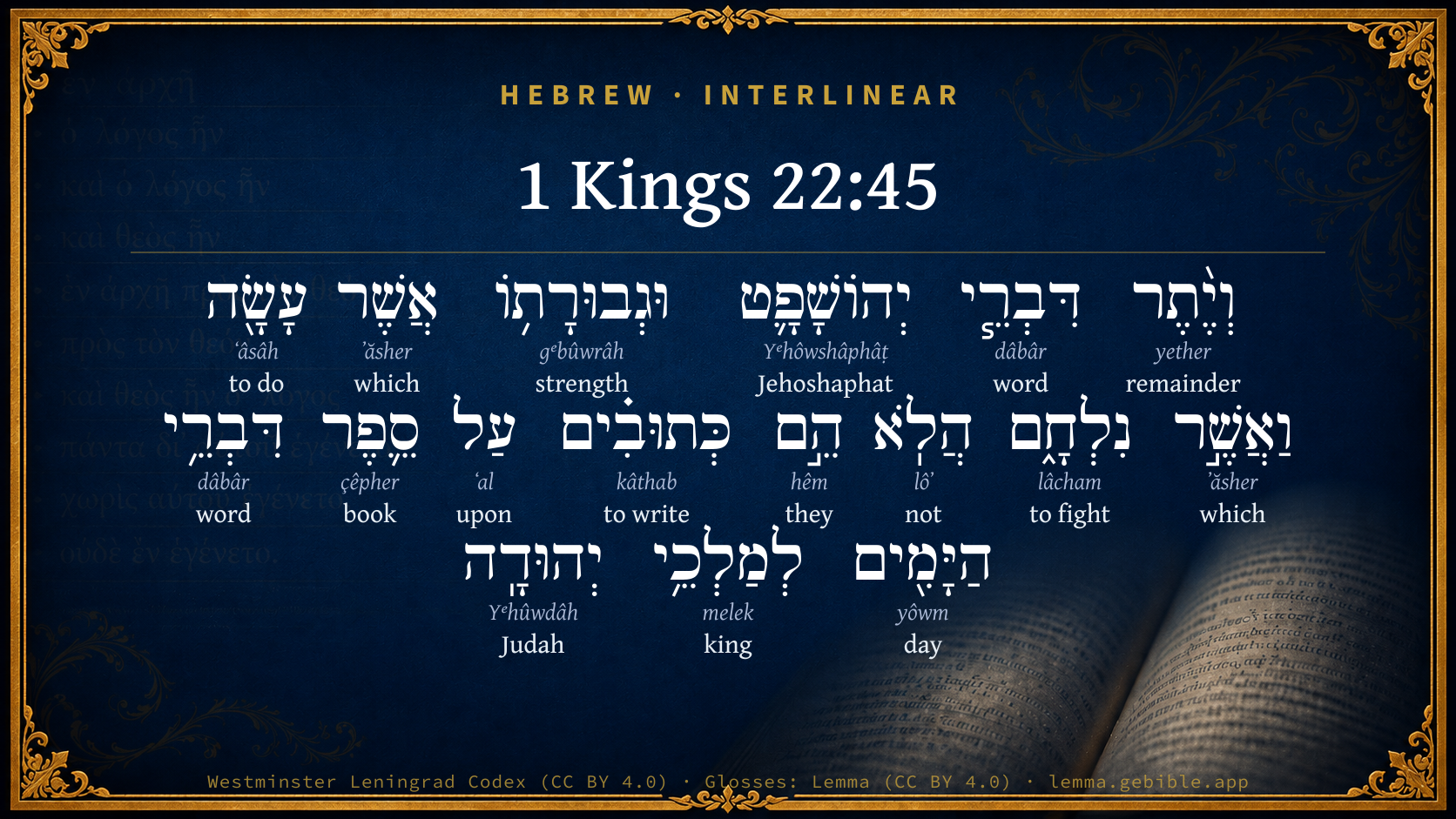
Hebrew (Westminster Leningrad Codex) 1 Kings 22:45 appears in the Hebrew Old Testament. The text above is from the Westminster Leningrad Codex. Each word links to its Strong’s number, a concise gloss, and parsing drawn from the Open Scriptures Hebrew Bible morphology. Click any word for its full Brown-Driver-Briggs (BDB) entry.
Download image
Cite this verse

1 Kings 22:45 (World English Bible). Public Domain. Lemma interlinear Bible study tool, https://lemma.gebible.app/v/1-kings/22/45.

Show BibTeX & RIS
BibTeX
RIS
English Translation
Now the rest of the acts of Jehoshaphat, and his might that he shown, and how he warred, aren't they written in the book of the chronicles of the kings of Judah?
World English Bible · Public Domain
Download a study sheet

One document with this verse’s original text, its word-by-word gloss line, the meaning frame, cross-references with their text, attributed commentary, and full source and license credits — printable, and it pastes into notes with its structure intact.

This verse Autodidact and up

Study sheet (.html) Plain text (.txt)

A passage Seminary Student

Up to 50 verses in one chapter. A passage sheet keeps up to 6 commentary sources and 12 cross-references per verse, in the order this page ranks them, and says so on the sheet whenever that leaves anything out. Ask for a single verse and you get the Autodidact verse sheet above.

Everything on this page stays free to read, with no account — the sheet is a download of what is already on screen, not access to it.

Want to remove ads? Support Godless Engineer
Compare translations 3

The same verse in 3 English versions, stacked beneath the original-language interlinear above. Click any original word for its lexicon entry.

Each is an independent rendering of the whole verse — the interlinear is not word-aligned to these translations.

Highlighted words mark where these versions differ — a whole-verse word diff, not a word-by-word alignment.

  • World English Bible Public Domain
    Now the rest of the acts of Jehoshaphat, and his might that he shown, and how he warred, aren't they written in the book of the chronicles of the kings of Judah?
  • King James Version Public Domain
    Now the rest of the acts of Jehoshaphat, and his might that he showed, and how he warred, are they not written in the book of the chronicles of the kings of Judah?
  • unfoldingWord Literal Text CC BY-SA 4.0
    Now the rest of the matters of Jehoshaphat, and his mighty things that he did and how he fought, are they not written in the book of the matters of the days of the kings of Judah?

unfoldingWord Literal Text — © unfoldingWord, licensed CC BY-SA 4.0. Word-aligned USFM3 via Door43 (git.door43.org/unfoldingWord/en_ult).

Versions to compare (up to 4)

3 of 4 selected

Show all 18 translations

Every available English version of this verse, each an independent rendering of the whole verse.

  • World English Bible Public Domain
    Now the rest of the acts of Jehoshaphat, and his might that he shown, and how he warred, aren't they written in the book of the chronicles of the kings of Judah?
  • Berean Standard Bible Public Domain
    As for the rest of the acts of Jehoshaphat, along with the might he exercised and how he waged war, are they not written in the Book of the Chronicles of the Kings of Judah?
  • Majority Standard Bible Public Domain
    As for the rest of the acts of Jehoshaphat, along with the might he exercised and how he waged war, are they not written in the Book of the Chronicles of the Kings of Judah?
  • King James Version Public Domain
    Now the rest of the acts of Jehoshaphat, and his might that he showed, and how he warred, are they not written in the book of the chronicles of the kings of Judah?
  • American Standard Version (1901) Public Domain
    Now the rest of the acts of Jehoshaphat, and his might that he showed, and how he warred, are they not written in the book of the chronicles of the kings of Judah?
  • Revised Version (1885) Public Domain
    Now the rest of the acts of Jehoshaphat, and his might that he shewed, and how he warred, are they not written in the book of the chronicles of the kings of Judah?
  • Geneva Bible (1599) Public Domain
    Concerning the rest of the actes of Iehoshaphat, and his worthy deedes that he did, and his battels which he fought, are they not written in the booke of the Chronicles of the Kings of Iudah?
  • Douay-Rheims (1899) Public Domain
    And Josaphat had peace with the king of Israel.
  • Young's Literal Translation Public Domain
    and the rest of the matters of Jehoshaphat, and his might that he got, and with which he fought, are they not written on the book of the Chronicles of the kings of Judah?
  • Literal Standard Version CC BY-SA 4.0
    and the rest of the matters of Jehoshaphat, and his might that he exercised, and with which he fought, are they not written on the scroll of the Chronicles of the Kings of Judah?
  • Unlocked Literal Bible CC BY-SA 4.0
    As for the other matters concerning Jehoshaphat, and the might that he showed, and how he waged war, are they not written in the book of the events of the kings of Judah?
  • unfoldingWord Literal Text CC BY-SA 4.0
    Now the rest of the matters of Jehoshaphat, and his mighty things that he did and how he fought, are they not written in the book of the matters of the days of the kings of Judah?
  • Darby Bible Public Domain
    And the rest of the acts of Jehoshaphat, and his might which he shewed, and how he warred, are they not written in the book of the chronicles of the kings of Judah?
  • World Messianic Bible Public Domain
    Now the rest of the acts of Jehoshaphat, and his might that he showed, and how he fought, aren’t they written in the book of the chronicles of the kings of Judah?
  • Webster's Bible Public Domain
    \\22:44\\And Jehoshaphat made peace with the king of Israel.
  • Free Bible Version CC BY-SA 4.0
    The rest of what happened in Jehoshaphat's reign, his great achievements and the wars he fought are recorded in the Book of Chronicles of the Kings of Judah.
  • Bible in Basic English Public Domain
    Now the rest of the acts of Jehoshaphat, and his great power, and how he went to war, are they not recorded in the book of the history of the kings of Judah?
  • JPS Tanakh (1917) Public Domain
    (22-46) Now the rest of the acts of Jehoshaphat, and his might that he showed, and how he warred, are they not written in the book of the chronicles of the kings of Judah?

Literal Standard Version (2020), Covenant Press — licensed CC BY-SA 4.0. Text via the HelloAO Bible API (eBible.org). Unlocked Literal Bible (unfoldingWord) — licensed CC BY-SA 4.0. Text via the HelloAO Bible API (eBible.org). unfoldingWord Literal Text — © unfoldingWord, licensed CC BY-SA 4.0. Word-aligned USFM3 via Door43 (git.door43.org/unfoldingWord/en_ult). Free Bible Version, Dr. Jonathan Gallagher — licensed CC BY-SA 4.0. Text via the HelloAO Bible API (eBible.org).

Word by word

More ways to search: Search by grammar → Find every occurrence → Compare this word →

Practice this passage: Drill this verse → Learn its vocabulary →

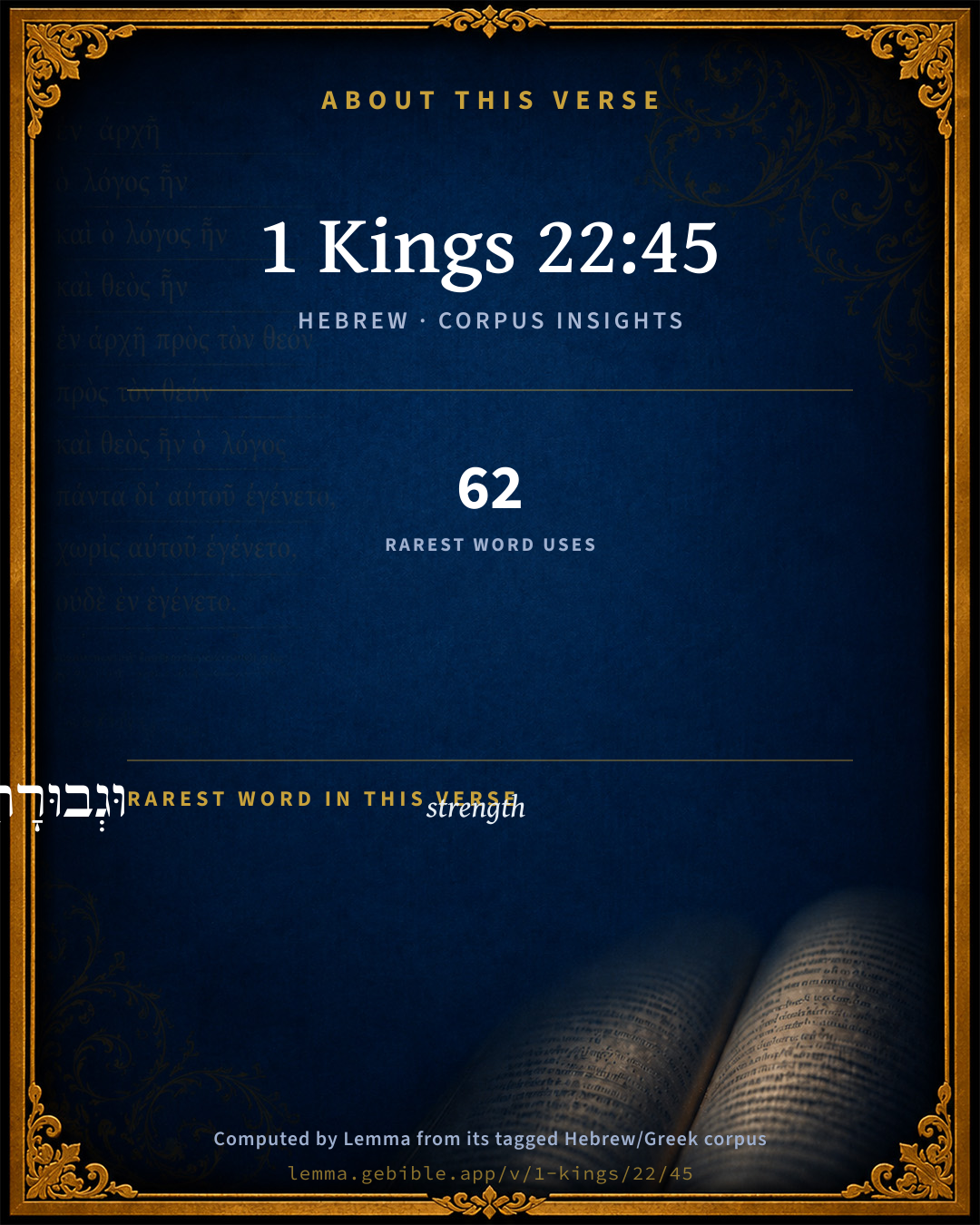
וּגְבוּרָת֥וֹ
gᵉbûwrâh
H1369
“and · strength · his”
Conjunction + Noun, Common, Feminine, Singular, Construct + Suffix, Personal, 3rd Person, Masculine, Singular
Part of Speech
Conjunction + Noun
Type
Common
Gender
Feminine
Number
Singular
State
Construct
Full BDB Definition

Origin: pass. participle from the same as H1368

TWOT: 310c

strength, might - strength - might, valour, bravery - might, mighty deeds (of God)
  1. וְיֶ֨תֶר yether H3499 “and · remainder of” Conjunction + Noun, Common, Masculine, Singular, Construct
  2. דִּבְרֵ֧י dâbâr H1697 “words of” Noun, Common, Masculine, Plural, Construct
  3. יְהוֹשָׁפָ֛ט Yᵉhôwshâphâṭ H3092 “Jehoshaphat” Noun, Proper
  4. אֲשֶׁר ʼăsher H834 “which” Particle, Relative
  5. עָשָׂ֖ה ʻâsâh H6213 “to do” Verb, Qal, Perfect, 3rd Person, Masculine, Singular
  6. וַאֲשֶׁ֣ר ʼăsher H834 “and · which” Conjunction + Particle, Relative
  7. נִלְחָ֑ם lâcham H3898 “to fight” Verb, Niphal, Perfect, 3rd Person, Masculine, Singular
  8. הֲלֹֽא lôʼ H3808 “not” Particle, Interrogative + Particle, Negative
  9. הֵ֣ם hêm H1992 “they” Pronoun, Personal, 3rd Person, Masculine, Plural
  10. כְּתוּבִ֗ים kâthab H3789 “written” Verb, Qal, Participle Passive, Masculine, Plural, Absolute
  11. עַל ʻal H5921 “upon” Preposition
  12. סֵ֛פֶר çêpher H5612 “book of” Noun, Common, Masculine, Singular, Construct
  13. דִּבְרֵ֥י dâbâr H1697 “words of” Noun, Common, Masculine, Plural, Construct
  14. הַיָּמִ֖ים yôwm H3117 “the · days” Particle, Definite Article + Noun, Common, Masculine, Plural, Absolute
  15. לְמַלְכֵ֥י melek H4428 “to/for · kings of” Preposition + Noun, Common, Masculine, Plural, Construct
  16. יְהוּדָֽה Yᵉhûwdâh H3063 “Judah” Noun, Proper

About this verse

These counts appear in no published source. They are computed here, from the morphology-tagged text and Lemma’s own curated glosses. What Lemma adds →

17
words
15
distinct lemmas
Historical
section

Grammatical profile

  • 3 verbs
  • 9 nouns
  • 1 pronoun
  • 1 preposition
  • 3 particles

Verb forms

  • עָשָׂ֖ה Qal · Perfect
  • נִלְחָ֑ם Niphal · Perfect
  • כְּתוּבִ֗ים Qal · Participle Passive

Repetition

Words recur within this verse — often emphatic in Hebrew:

  • דִּבְרֵ֧י word H1697 ×2
  • אֲשֶׁר which H834 ×2

Hebrew & Septuagint length

In English translation the verse runs 32 words from the Hebrew and 10 from the Septuagint (LXX English) — the Septuagint runs noticeably shorter here. See the side-by-side →

A rough comparison of the two English renderings, which tokenize alike — not a word-level alignment.

Word counts can differ between the Hebrew and the Greek without any difference in meaning — e.g. the Hebrew direct-object marker אֵת has no separate Greek word, and Greek often adds the article ὁ.

Cross-references

3

Topical passages linked to 1 Kings 22:45 in the Treasury of Scripture Knowledge — connected by theme and wording, ordered by reader-vote popularity; previews shown in the World English Bible.

  • 1 Kings 11:41 Now the rest of the acts of Solomon, and all that he did, and his wisdom, aren't they written in the book of the acts of Solomon?
  • 1 Kings 14:29 Now the rest of the acts of Rehoboam, and all that he did, aren't they written in the book of the chronicles of the kings of Judah?
  • 2 Chronicles 20:34 Now the rest of the acts of Jehoshaphat, first and last, behold, they are written in the history of Jehu the son of Hanani, which is inserted in the book of the kings of Israel.

Cross-references courtesy of OpenBible.info (CC BY 4.0).

Hebrew and Greek witnesses Masoretic Hebrew ↔ Greek Septuagint

The same verse in the two great witnesses to the Old Testament, shown verse-for-verse.

Here the Septuagint runs noticeably shorter than the Hebrew — LXX2012 (modern English Septuagint) 10 words vs World English Bible 32. A rough length comparison of the two English translations, not a word-level alignment — read both below.

These are two independent witnesses, not word-aligned to each other, and the Septuagint is shown in lemma (dictionary) form.

Hebrew 1 Kings 22:45 Masoretic · Westminster Leningrad Codex

וְיֶ֨תֶר דִּבְרֵ֧י יְהוֹשָׁפָ֛ט וּגְבוּרָת֥וֹ אֲשֶׁר עָשָׂ֖ה וַאֲשֶׁ֣ר נִלְחָ֑ם הֲלֹֽא הֵ֣ם כְּתוּבִ֗ים עַל סֵ֛פֶר דִּבְרֵ֥י הַיָּמִ֖ים לְמַלְכֵ֥י יְהוּדָֽה

Now the rest of the acts of Jehoshaphat, and his might that he shown, and how he warred, aren't they written in the book of the chronicles of the kings of Judah?

World English Bible · Public Domain

Greek LXX 1 Kings 22:45 Septuagint · lemma form

καί εἰρηνεύω ιωσαφατ μετά βασιλεύς ἰσραήλ

And Josaphat was at peace with the king of Israel.

LXX2012 (modern English Septuagint) · Public Domain

On this verse, The Cambridge Bible for Schools and Colleges discusses the Septuagint’s reading. Read the note in Commentary ↓

Hebrew: Westminster Leningrad Codex (CC BY 4.0). Greek: Septuagint (public domain); English from LXX2012 (modern English Septuagint) (Public Domain). How the Septuagint differs from the Hebrew →

Targum (Aramaic paraphrase)

1

The Targum is the ancient Jewish Aramaic paraphrase of the Hebrew Scriptures — an interpretive translation, not the Hebrew text itself. Onkelos (literal) and Pseudo-Jonathan (expansive) render the Torah, and Jonathan the Prophets. Coverage is partial: where no permissively-licensed English translation exists for a verse, only the Aramaic is shown. This is verse-level text, not a word-by-word alignment to the Hebrew.

  1. Targum Jonathan Prophets (Joshua–Malachi)
    וְאַשְׁלֵים יְהוֹשָׁפָט עִם מַלְכָּא דְיִשְׂרָאֵל:

    (no public-domain English translation for this verse)

    Targum Jonathan — Aramaic: “Mikraot Gedolot” (public domain). English: “Sefaria Community Translation” (CC0 1.0 (public-domain dedication)); “London "Chaldee Paraphrase," 1871” (public domain). Text via Sefaria.

Commentary

Notes on 1 Kings 22:45 from classic Christian and Jewish commentators (each source and its license shown beneath its notes). The classic Christian expositions comment on the surrounding passage and are grouped to its opening verse, so a note may address several verses; the Jewish commentaries on the Tanakh (Rashi and others) are per-verse, so they appear only where the commentator wrote on this verse.

Lemma curates 59 commentaries, every one of them public domain or Creative Commons licensed, each selected and text-cleaned for this edition rather than reprinted as found. About our sources →

Trapp's Complete Commentary

John Trapp

1Ki 22:45 Now the rest of the acts of Jehoshaphat, and his might that he shewed, and how he warred, [are] they not written in the book of the chronicles of the kings of Judah?

Ver. 45. And how he warred.] See 2Ch 20:1-25.

John Trapp, A Commentary or Exposition upon All the Books of the Old and New Testament (1647–1656) — public domain. Text from a community e-Sword module.

The Cambridge Bible for Schools and Colleges

gen. ed. J. J. S. Perowne

45. and how he warred] The words are not represented in the LXX. On the wars of Jehoshaphat, see above on 1Ki_22:41, and the chapters in 2 Chronicles there referred to.

in the book of the chronicles of the kings of Judah] The Chronicler gives, as the authority for Jehoshaphat’s history, the book of Jehu, the son of Hanani, who is mentioned in the book of the kings of Israel.

The Cambridge Bible for Schools and Colleges (gen. ed. J. J. S. Perowne; Cambridge University Press, 1878–1918) — public domain. Text from a community e-Sword module.

Albert Barnes' Notes on the Bible

The book of the chronicles ... - Compare 1Ki 22:39 note. The biographer of Jehoshaphat appears to have been Jehu, the son of Hanani 2Ch 20:34.

Albert Barnes' Notes on the Bible (1834–1885) — public domain. Text from a community e-Sword/MySword module.

Haydock's Catholic Bible Commentary

Israel. The five subsequent verses are omitted in the Roman Septuagint.

George Leo Haydock (1774–1849), Haydock's Catholic Family Bible and Commentary, 1859 edition — public domain. Excludes Psalms (Douay-Rheims chapter numbering differs from Protestant) and Deuterocanonical books (Catholic canon only).

Matthew Poole's English Annotations

Whence the most memorable passages were translated into that canonical book of the Chronicles.

Matthew Poole's English Annotations on the Holy Bible (1683–1685) — public domain. Text from a community e-Sword/MySword module.

The Pulpit Commentary

Now the rest of the acts of Jehoshaphat, and his might as 1Ki_15:23, 1Ki_16:27, etc. It is noticeable that this word is not used of Ahab, notwithstanding his wars and victories that he showed see 2Ki_3:9 sqq.; 2Ch_17:12 sqq. His judicial reforms are hardly referred to here and how he warred, (2Ch 18:, 2Ch_18:20) are they not written in the book of he chronicles of the kings of Judah?

The Pulpit Commentary (1880–1919), ed. H.D.M. Spence-Jones & Joseph S. Exell — public domain. Text from a community e-Sword module.

unfoldingWord translationNotes

Door43 World Missions Community

are they not written in the book of the events of the kings of Judah?

This can be expressed in active form and assumes that the answer is positive. The question is rhetorical and is used for emphasis. See how you translated this in 1 Kings 14:29. AT: "they are written in the book of the events of the kings of Judah." or "you can read them in the book of the events of the kings of Judah." (See: Active or Passive and Rhetorical Question)

translationWords

might

prostitute

Edom

rule

unfoldingWord translationNotes — © Distant Shores Media and the Door43 World Missions Community, licensed CC BY-SA 4.0. Source: git.door43.org/Door43/en_tn.

Rashi

Rabbi Shlomo Yitzchaki (Rashi)

Yehoshofot made peace with the king of Yisroel. Since there was war between Asa his father and Basha the king of Yisroel, it was necessary to say this.

Rashi on the Tanakh — English translations: “The Judaica Press complete Tanach with Rashi, translated by A. J. Rosenberg” (CC BY 4.0); “Pentateuch with Rashi's commentary by M. Rosenbaum and A.M. Silbermann, 1929-1934” (public domain); “The Metsudah Tanach series, Lakewood, N.J” (CC BY 4.0); and “The Book of Joshua, Metsudah Publications, 1997” (CC BY 4.0). Text via Sefaria.

Lesson kit

Teaching starters — assembled from the data on this page, not authored interpretation. Every prompt links to the verse data it draws on. Edit before teaching.

1 Kings, in the Historical, opens this verse with 17 words (15 distinct Hebrew lemmas). Its most distinctive word is gᵉbûwrâh (“strength”). The Greek Septuagint runs shorter here. A historical commentator’s framing appears above. Read the whole chapter for the surrounding context.

Discussion questions

  1. What does “strength” (gᵉbûwrâh) contribute to the verse as a whole?
  2. 1 Kings 11:41 shares this passage’s theme. How do the two illuminate each other?
  3. “word” occurs 2× in this one verse. What is the effect of the repetition?
  4. Compared with the Hebrew, the Septuagint runs shorter here. What questions does that raise?
  5. These translations render this verse differently. What is at stake in choosing one wording over another?
  6. The verb «עָשָׂ֖ה» is Qal Perfect. How does its form color the action?
  7. Reading how Trapp's Complete Commentary and The Cambridge Bible for Schools and Colleges read this verse, where do the two commentators agree and where do they part?

Things to notice

Reading settings

Reading text

Shown beneath each verse's original-language words.

Old Testament
Old Testament edition

Read the OT as the Masoretic Hebrew (MT) or the Greek Septuagint (LXX).

English shown for the Greek Septuagint (in the Hebrew ↔ Greek comparison).

Comparing translations? Open the Compare panel on any verse page to stack up to four side by side.