
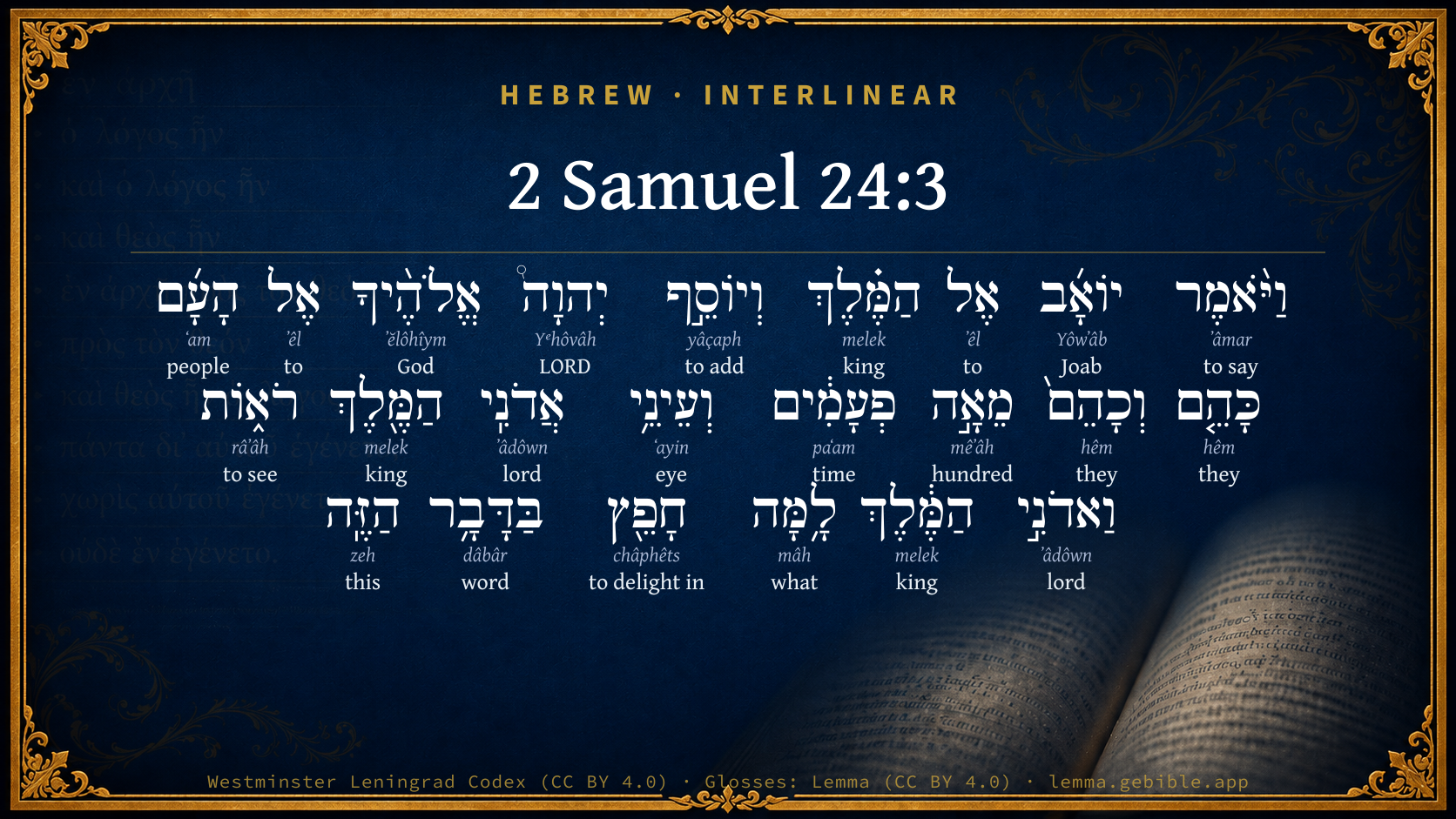
2 Samuel 24:3

Hebrew (Westminster Leningrad Codex) 2 Samuel 24:3 appears in the Hebrew Old Testament. The text above is from the Westminster Leningrad Codex. Each word links to its Strong’s number, a concise gloss, and parsing drawn from the Open Scriptures Hebrew Bible morphology. Click any word for its full Brown-Driver-Briggs (BDB) entry.
Download image
Cite this verse

2 Samuel 24:3 (World English Bible). Public Domain. Lemma interlinear Bible study tool, https://lemma.gebible.app/v/2-samuel/24/3.

Show BibTeX & RIS
BibTeX
RIS
English Translation
Joab said to the king, Now Yahweh your God add to the people, however many they may be, one hundred times; and may the eyes of my lord the king see it: but why does my lord the king delight in this thing?
World English Bible · Public Domain
Download a study sheet

One document with this verse’s original text, its word-by-word gloss line, the meaning frame, cross-references with their text, attributed commentary, and full source and license credits — printable, and it pastes into notes with its structure intact.

This verse Autodidact and up

Study sheet (.html) Plain text (.txt)

A passage Seminary Student

Up to 50 verses in one chapter. A passage sheet keeps up to 6 commentary sources and 12 cross-references per verse, in the order this page ranks them, and says so on the sheet whenever that leaves anything out. Ask for a single verse and you get the Autodidact verse sheet above.

Everything on this page stays free to read, with no account — the sheet is a download of what is already on screen, not access to it.

Want to remove ads? Support Godless Engineer
Compare translations 3

The same verse in 3 English versions, stacked beneath the original-language interlinear above. Click any original word for its lexicon entry.

Each is an independent rendering of the whole verse — the interlinear is not word-aligned to these translations.

Highlighted words mark where these versions differ — a whole-verse word diff, not a word-by-word alignment.

  • World English Bible Public Domain
    Joab said to the king, Now Yahweh your God add to the people, however many they may be, one hundred times; and may the eyes of my lord the king see it: but why does my lord the king delight in this thing?
  • King James Version Public Domain
    And Joab said unto the king, Now the LORD thy God add unto the people, how many soever they be, an hundredfold, and that the eyes of my lord the king may see it: but why doth my lord the king delight in this thing?
  • unfoldingWord Literal Text CC BY-SA 4.0
    And Joab said to the king, “Now may Yahweh your God add to the people like them and like them a hundred times, and may the eyes of my lord the king be seeing. But my lord the king, why does he delight in this matter?”

unfoldingWord Literal Text — © unfoldingWord, licensed CC BY-SA 4.0. Word-aligned USFM3 via Door43 (git.door43.org/unfoldingWord/en_ult).

Versions to compare (up to 4)

3 of 4 selected

Show all 18 translations

Every available English version of this verse, each an independent rendering of the whole verse.

  • World English Bible Public Domain
    Joab said to the king, Now Yahweh your God add to the people, however many they may be, one hundred times; and may the eyes of my lord the king see it: but why does my lord the king delight in this thing?
  • Berean Standard Bible Public Domain
    But Joab replied to the king, “May the LORD your God multiply the troops a hundred times over, and may the eyes of my lord the king see it. But why does my lord the king want to do such a thing?”
  • Majority Standard Bible Public Domain
    But Joab replied to the king, “May the LORD your God multiply the troops a hundred times over, and may the eyes of my lord the king see it. But why does my lord the king want to do such a thing?”
  • King James Version Public Domain
    And Joab said unto the king, Now the LORD thy God add unto the people, how many soever they be, an hundredfold, and that the eyes of my lord the king may see it: but why doth my lord the king delight in this thing?
  • American Standard Version (1901) Public Domain
    And Joab said unto the king, Now Jehovah thy God add unto the people, how many soever they may be, a hundredfold; and may the eyes of my lord the king see it: but why doth my lord the king delight in this thing?
  • Revised Version (1885) Public Domain
    And Joab said unto the king, Now the LORD thy God add unto the people, how many soever they be, an hundredfold, and may the eyes of my lord the king see it: but why doth my lord the king delight in this thing?
  • Geneva Bible (1599) Public Domain
    And Ioab saide vnto the King, The Lord thy God increase the people an hundreth folde more then they be, and that the eyes of my lorde the King may see it: but why doeth my lord the King desire this thing?
  • Douay-Rheims (1899) Public Domain
    And Joab said to the king: The Lord thy God increase thy people, and make them as many more as they are now, and again multiply them a hundredfold in the sight of my lord the king: but what meaneth my lord the king by this kind of thing?
  • Young's Literal Translation Public Domain
    And Joab saith unto the king, `Yea, Jehovah thy God doth add unto the people, as they are, a hundred times, and the eyes of my lord the king are seeing; and my lord the king, why is he desirous of this thing?'
  • Literal Standard Version CC BY-SA 4.0
    And Joab says to the king, “Indeed, your God YHWH adds to the people, as they are, one hundred times, and the eyes of my lord the king are seeing; and my lord the king, why is he desirous of this thing?”
  • Unlocked Literal Bible CC BY-SA 4.0
    Joab said to the king, “May Yahweh your God multiply the number of people a hundred times, and may the eyes of my master the king see it take place. But why does my master the king want this?”
  • unfoldingWord Literal Text CC BY-SA 4.0
    And Joab said to the king, “Now may Yahweh your God add to the people like them and like them a hundred times, and may the eyes of my lord the king be seeing. But my lord the king, why does he delight in this matter?”
  • Darby Bible Public Domain
    And Joab said to the king, May Jehovah thy God even add to the people, how many soever they be, a hundredfold, and that the eyes of my lord the king may see [it]; but why does my lord the king delight in this thing?
  • World Messianic Bible Public Domain
    Joab said to the king, “Now may the LORD your God add to the people, however many they may be, one hundred times; and may the eyes of my lord the king see it. But why does my lord the king delight in this thing?”
  • Webster's Bible Public Domain
    And Joab said to the king, Now the LORD thy God add to the people, how many soever they may be, a hundred-fold, and that the eyes of my lord the king may see it: but why doth my lord the king delight in this thing?
  • Free Bible Version CC BY-SA 4.0
    But Joab replied to the king, “May the Lord multiply his people a hundred times over, Your Majesty, and may you live to see it! But why does Your Majesty want to do this?”
  • Bible in Basic English Public Domain
    And Joab said to the king, Whatever the number of the people, may the Lord make it a hundred times as much, and may the eyes of my lord the king see it: but why does my lord the king take pleasure in doing this thing?
  • JPS Tanakh (1917) Public Domain
    And Joab said unto the king: 'Now the LORD thy God add unto the people, how many soever they may be, a hundredfold, and may the eyes of my lord the king see it; but why doth my lord the king delight in this thing?'

Literal Standard Version (2020), Covenant Press — licensed CC BY-SA 4.0. Text via the HelloAO Bible API (eBible.org). Unlocked Literal Bible (unfoldingWord) — licensed CC BY-SA 4.0. Text via the HelloAO Bible API (eBible.org). unfoldingWord Literal Text — © unfoldingWord, licensed CC BY-SA 4.0. Word-aligned USFM3 via Door43 (git.door43.org/unfoldingWord/en_ult). Free Bible Version, Dr. Jonathan Gallagher — licensed CC BY-SA 4.0. Text via the HelloAO Bible API (eBible.org).

Word by word

More ways to search: Search by grammar → Find every occurrence → Compare this word →

Practice this passage: Drill this verse → Learn its vocabulary →

חָפֵ֖ץ
châphêts
H2654
“to delight in”
Verb, Qal, Perfect, 3rd Person, Masculine, Singular
Part of Speech
Verb
Stem
Qal
Form
Perfect
Person
3rd Person
Gender
Masculine
Number
Singular
Full BDB Definition

Origin: a primitive root

TWOT: 712 , 713

to delight in, take pleasure in, desire, be pleased with - (Qal) - of men - to take pleasure in, delight in - to delight, desire, be pleased to do - of God - to delight in, have pleasure in - to be pleased to do - to move, bend down - (Qal) to bend down
  1. וַיֹּ֨אמֶר ʼâmar H559 “and · to say” Conjunction + Verb, Qal, Sequential Imperfect, 3rd Person, Masculine, Singular
  2. יוֹאָ֜ב Yôwʼâb H3097 “Joab” Noun, Proper
  3. אֶל ʼêl H413 “to” Preposition
  4. הַמֶּ֗לֶךְ melek H4428 “the · king” Particle, Definite Article + Noun, Common, Masculine, Singular, Absolute
  5. וְיוֹסֵ֣ף yâçaph H3254 “and · to add” Conjunction + Verb, Hiphil, Jussive, 3rd Person, Masculine, Singular
  6. יְהוָה֩ Yᵉhôvâh H3068 “LORD” Noun, Proper
  7. אֱלֹהֶ֨יךָ ʼĕlôhîym H430 “God(s) · your” Noun, Common, Masculine, Plural, Construct + Suffix, Personal, 2nd Person, Masculine, Singular
  8. אֶל ʼêl H413 “to” Preposition
  9. הָעָ֜ם ʻam H5971 “the · people” Particle, Definite Article + Noun, Common, Masculine, Singular, Absolute
  10. כָּהֵ֤ם hêm H1992 “like/as · they” Preposition + Pronoun, Personal, 3rd Person, Masculine, Plural
  11. וְכָהֵם֙ hêm H1992 “and · like/as · they” Conjunction + Preposition + Pronoun, Personal, 3rd Person, Masculine, Plural
  12. מֵאָ֣ה mêʼâh H3967 “hundred” Adjective, Cardinal number, Both, Singular, Absolute
  13. פְעָמִ֔ים paʻam H6471 “times” Noun, Common, Feminine, Plural, Absolute
  14. וְעֵינֵ֥י ʻayin H5869 “and · eyes of” Conjunction + Noun, Common, Both, Dual, Construct
  15. אֲדֹנִֽי ʼâdôwn H113 “lord · my” Noun, Common, Masculine, Singular, Construct + Suffix, Personal, 1st Person, Common, Singular
  16. הַמֶּ֖לֶךְ melek H4428 “the · king” Particle, Definite Article + Noun, Common, Masculine, Singular, Absolute
  17. רֹא֑וֹת râʼâh H7200 “seeing” Verb, Qal, Participle Active, Feminine, Plural, Absolute
  18. וַאדֹנִ֣י ʼâdôwn H113 “and · lord · my” Conjunction + Noun, Common, Masculine, Singular, Construct + Suffix, Personal, 1st Person, Common, Singular
  19. הַמֶּ֔לֶךְ melek H4428 “the · king” Particle, Definite Article + Noun, Common, Masculine, Singular, Absolute
  20. לָ֥מָּה mâh H4100 “to/for · what” Preposition + Particle, Interrogative
  21. בַּדָּבָ֥ר dâbâr H1697 “in/at the · word” Preposition, Determined + Noun, Common, Masculine, Singular, Absolute
  22. הַזֶּֽה zeh H2088 “the · this” Particle, Definite Article + Pronoun, Demonstrative, Masculine, Singular

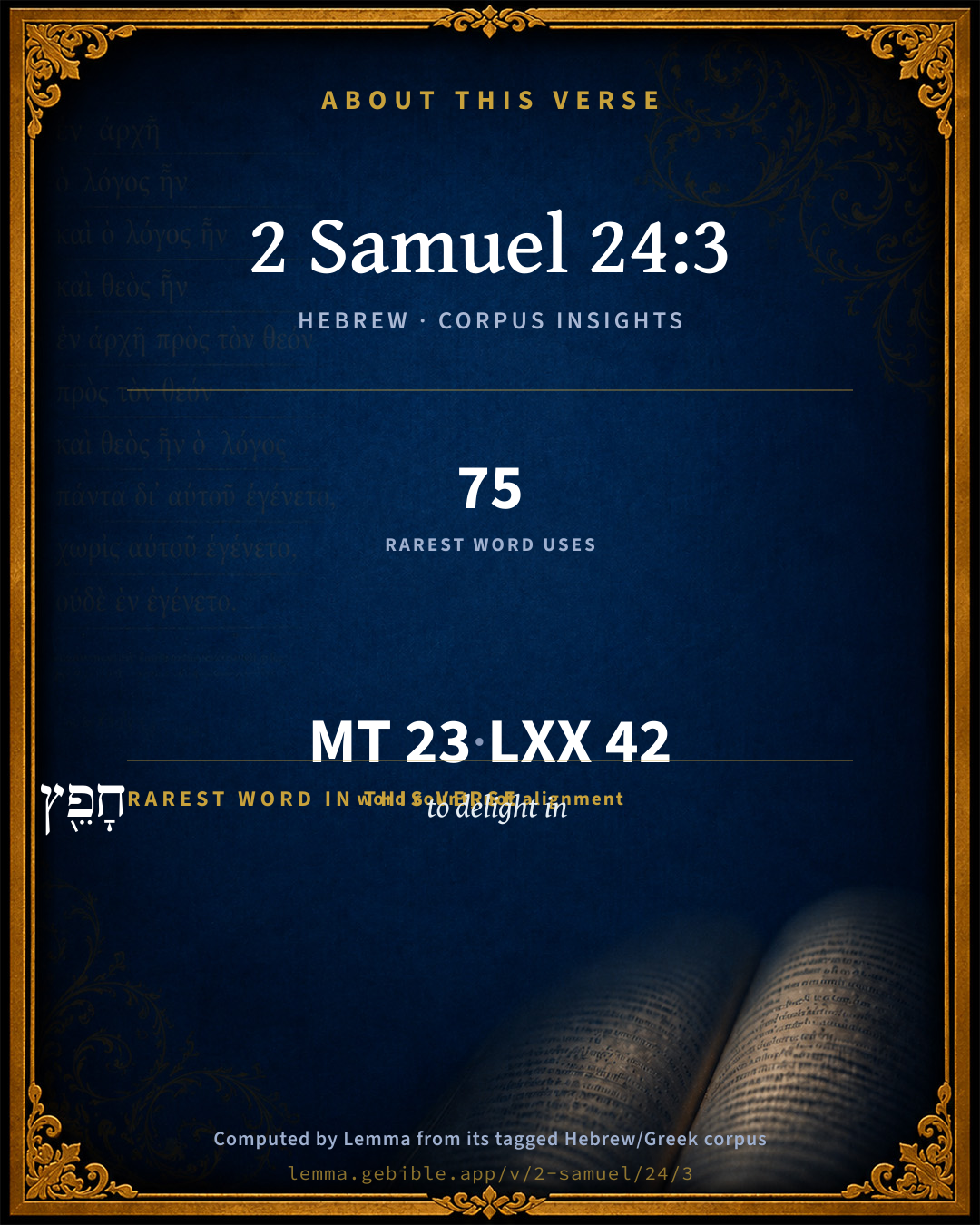
About this verse

These counts appear in no published source. They are computed here, from the morphology-tagged text and Lemma’s own curated glosses. What Lemma adds →

23
words
18
distinct lemmas
Historical
section

Grammatical profile

  • 4 verbs
  • 12 nouns
  • 1 adjective
  • 3 pronouns
  • 2 prepositions
  • 1 particle

Verb forms

  • וַיֹּ֨אמֶר Qal · Sequential Imperfect
  • וְיוֹסֵ֣ף Hiphil · Jussive
  • רֹא֑וֹת Qal · Participle Active
  • חָפֵ֖ץ Qal · Perfect

Repetition

Words recur within this verse — often emphatic in Hebrew:

  • הַמֶּ֗לֶךְ king H4428 ×3
  • אֲדֹנִֽי lord H113 ×2
  • אֶל to H413 ×2
  • כָּהֵ֤ם they H1992 ×2

Hebrew & Septuagint length

In English translation the verse runs 43 words from the Hebrew and 42 from the Septuagint (LXX English) — closely comparable.

A rough comparison of the two English renderings, which tokenize alike — not a word-level alignment.

Word counts can differ between the Hebrew and the Greek without any difference in meaning — e.g. the Hebrew direct-object marker אֵת has no separate Greek word, and Greek often adds the article ὁ.

In the original languages it is 23 Hebrew tokens and 42 Greek tokens — but the two are counted differently (Hebrew bundles its prefixes and suffixes into one token; the Greek is in lemma form), so that isn’t a like-for-like length.

Cross-references

6

Topical passages linked to 2 Samuel 24:3 in the Treasury of Scripture Knowledge — connected by theme and wording, ordered by reader-vote popularity; previews shown in the World English Bible.

  • Deuteronomy 1:11 Yahweh, the God of your fathers, make you a thousand times as many as you are, and bless you, as he has promised you!
  • Psalms 115:14 May Yahweh increase you more and more, You and your children.
  • 2 Samuel 10:12 Be of good courage, and let us play the man for our people, and for the cities of our God: and Yahweh do that which seems him good.
  • 1 Chronicles 21:3–4 Joab said, Yahweh make his people a hundred times as many as they are: but, my lord the king, aren't they all my lord's servants? why does my lord require this thing? why will he be a cause of guilt to Israel?
  • Proverbs 14:28 In the multitude of people is the king's glory, But in the lack of people is the destruction of the prince.
  • Isaiah 60:5 Then you shall see and be radiant, and your heart shall thrill and be enlarged; because the abundance of the sea shall be turned to you, the wealth of the nations shall come to you.

Cross-references courtesy of OpenBible.info (CC BY 4.0).

Hebrew and Greek witnesses Masoretic Hebrew ↔ Greek Septuagint

The same verse in the two great witnesses to the Old Testament, shown verse-for-verse.

These are two independent witnesses, not word-aligned to each other, and the Septuagint is shown in lemma (dictionary) form.

Hebrew 2 Samuel 24:3 Masoretic · Westminster Leningrad Codex

וַיֹּ֨אמֶר יוֹאָ֜ב אֶל הַמֶּ֗לֶךְ וְיוֹסֵ֣ף יְהוָה֩ אֱלֹהֶ֨יךָ אֶל הָעָ֜ם כָּהֵ֤ם וְכָהֵם֙ מֵאָ֣ה פְעָמִ֔ים וְעֵינֵ֥י אֲדֹנִֽי הַמֶּ֖לֶךְ רֹא֑וֹת וַאדֹנִ֣י הַמֶּ֔לֶךְ לָ֥מָּה חָפֵ֖ץ בַּדָּבָ֥ר הַזֶּֽה

Joab said to the king, Now Yahweh your God add to the people, however many they may be, one hundred times; and may the eyes of my lord the king see it: but why does my lord the king delight in this thing?

World English Bible · Public Domain

Greek LXX 2 Samuel 24:3 Septuagint · lemma form

καί εἶπον ιωαβ πρός ὁ βασιλεύς καί προςτίθημι κύριος ὁ θεός σύ πρός ὁ λαός ὥσπερ αὐτός καί ὥσπερ αὐτός ἑκατονταπλασίων καί ὀφθαλμός ὁ κύριος ἐγώ ὁ βασιλεύς ὁράω καί ὁ κύριος ἐγώ ὁ βασιλεύς ἵνα τίς βούλομαι ἐν ὁ λόγος οὗτος

And Joab said to the king, Now may the Lord add to the people one hundred-fold as many as they are, and may the eyes of my lord the king see it: but why does my lord the king desire this thing?

LXX2012 (modern English Septuagint) · Public Domain

Hebrew: Westminster Leningrad Codex (CC BY 4.0). Greek: Septuagint (public domain); English from LXX2012 (modern English Septuagint) (Public Domain). How the Septuagint differs from the Hebrew →

Targum (Aramaic paraphrase)

1

The Targum is the ancient Jewish Aramaic paraphrase of the Hebrew Scriptures — an interpretive translation, not the Hebrew text itself. Onkelos (literal) and Pseudo-Jonathan (expansive) render the Torah, and Jonathan the Prophets. Coverage is partial: where no permissively-licensed English translation exists for a verse, only the Aramaic is shown. This is verse-level text, not a word-by-word alignment to the Hebrew.

  1. Targum Jonathan Prophets (Joshua–Malachi)
    וַאֲמַר יוֹאָב לְמַלְכָּא וְיוֹסֵף יְיָ אֱלָהָךְ עַל עַמָא כְּאִלֵין וּכְאִלֵין מְאָה זִמְנִין וְעֵינֵי רִבּוֹנִי מַלְכָּא חָזָן וְרִבּוֹנִי מַלְכָּא לְמָא אִתְרְעֵי בְּפִתְגָמָא הָדֵין:

    (no public-domain English translation for this verse)

    Targum Jonathan — Aramaic: “Mikraot Gedolot” (public domain). English: “Sefaria Community Translation” (CC0 1.0 (public-domain dedication)); “London "Chaldee Paraphrase," 1871” (public domain). Text via Sefaria.

Commentary

Notes on 2 Samuel 24:3 from classic Christian and Jewish commentators (each source and its license shown beneath its notes). The classic Christian expositions comment on the surrounding passage and are grouped to its opening verse, so a note may address several verses; the Jewish commentaries on the Tanakh (Rashi and others) are per-verse, so they appear only where the commentator wrote on this verse.

Lemma curates 59 commentaries, every one of them public domain or Creative Commons licensed, each selected and text-cleaned for this edition rather than reprinted as found. About our sources →

Trapp's Complete Commentary

John Trapp

2Sa 24:3 And Joab said unto the king, Now the LORD thy God add unto the people, how many soever they be, an hundredfold, and that the eyes of my lord the king may see [it]: but why doth my lord the king delight in this thing?

Ver. 3. And Joab said.] His conscience told him that David did this out of curiosity and vainglory, whereof he foresaw the evil effects, {1Ch 21:3} and therefore doth what he can to dissuade him. And lest David should suspect that he did it out of any disaffection to him, he wisheth an increase of the people’s numbers; and that David might see it to his great joy and comfort.

But why doth my lord the king delight in this thing?] q.d., Why art thou so set upon it, without any colour of cause, and merely for thy mind’s sake? A man that would consult with himself, could not but confess, that both himself and all men and means whereon he reposeth, are as much as nothing. But he doth with them as some folks do by dogs and monkeys; they know they be paltry carrion beasts, yet they set great store by them, and take great delight in them, for their mind’s sake only.

John Trapp, A Commentary or Exposition upon All the Books of the Old and New Testament (1647–1656) — public domain. Text from a community e-Sword module.

Joseph Benson's Commentary

2Sa 24:3-4. And Joab said, Now the Lord thy God add unto the people, &c. — Thus we see that this action of David was thought a very wrong step, even by Joab himself, who remonstrated against it, as apprehensive of the bad consequences that might attend it: and therefore Joab counted not Levi and Benjamin, (1Ch 21:6,) because the king’s word was abominable to him. Probably we do not understand all the circumstances of this affair; but Joab’s sense of it, who was no scrupulous man, shows that David’s conduct in it was extremely imprudent, and might subject his people to very great inconveniences. Against Joab, and against the captains of the host — Who joined, it seems, with Joab to divert the king from his purpose; in which, however, he was fixed and immoveable.

Joseph Benson's Commentary on the Old and New Testaments (1811–1818) — public domain. Text from a community e-Sword module.

Tyndale Open Study Notes

Tyndale Open Resources

24:3 why . . . do you want to do this? Joab either realized that such a move would be unpopular among the people, or he believed that it was wrong before God.

Tyndale Open Study Notes — © Tyndale Open Resources, licensed CC BY-SA 4.0. Text via the HelloAO Bible API.

Adam Clarke's Commentary

Verse 3. Joab said unto the king] This very bad man saw that the measure now recommended by the king was a wrong one, and might be ruinous to the people, and therefore he remonstrates against it in a very sensible speech; but the king was infatuated, and would hear no reason.

Adam Clarke's Commentary on the Bible (1810–1826) — public domain. Text from a community e-Sword/MySword module.

Ellicott's Commentary for English Readers

(3) Why doth my lord?—Even in the eyes of the unscrupulous Joab David’s act was abominable. Joab never gives evidence of being influenced by religious motives, but his natural shrewdness sufficed to show him that David’s act was at variance with the fundamental principle of the national existence. Chronicles adds to Joab’s words, “Why will he be a cause of trespass to Israel?” The strong objection of Joab shows that there was something obviously wrong in the action of David.

And against the captains.—Joab’s objections were sustained by his subordinate officers, and David carried through his sinful act by sheer force of self-will.

A Bible Commentary for English Readers, edited by Charles John Ellicott (1878–1897) — public domain. Text from a community e-Sword module.

The Cambridge Bible for Schools and Colleges

gen. ed. J. J. S. Perowne

3. the Lord thy God add, &c.] Cp. Deu_1:11.

and that the eyes, &c.] That is, may it happen in the king’s life-time.

why doth my lord, &c.] “Why will he be a cause of trespass to Israel?” is the further explanation of Joab’s thoughts given in 1Ch_21:3. It is probable that a shrewd practical man like Joab, whose life shews no signs of being influenced by religious motives, opposed the king’s purpose more from the fear of exciting disaffection among the people by a scheme to increase the burdens of military service, than from a sense that the king’s spirit was displeasing to God, though the latter motive may not have been altogether absent.

The Cambridge Bible for Schools and Colleges (gen. ed. J. J. S. Perowne; Cambridge University Press, 1878–1918) — public domain. Text from a community e-Sword module.

John Gill's Exposition

And Joab said unto the king,.... Not so rudely and insolently as he did on account of his mourning for Absalom, but in a more modest, decent, and polite manner:

now the Lord thy God add unto the people (how many soever they be) an hundredfold; he wished his subjects were an hundred times more numerous than they were:

and that the eyes of my lord the king may see it; that he might live to see with his own eyes so great an increase:

but why doth my lord the king delight in this thing? he being now old, and therefore it might seem strange to indulge such curiosity, pride, and vanity, and besides quite needless and useless: the numbering of them would not make them more or less; and they were all the king's servants, who were ready to obey him whenever he needed them, whether numbered or not; and it might be prejudicial to them, and bring down the wrath of God upon them, as well as be a troublesome and expensive business; all which, though not expressed here, is hinted at in Ch1 21:3.

John Gill's Exposition of the Whole Bible (1746–1763) — public domain (CC PDM 1.0). Text via the HelloAO Bible API.

Haydock's Catholic Bible Commentary

Thing. He speaks in stronger terms, and adds, (1 Paralipomenon xxi. 3,) which may be imputed as a sin to Israel. Joab was not extremely religious: yet he perceived the evil consequences, and, along with the other captains, expressed his sentiments with more respect than on former occasions. (Haydock)

George Leo Haydock (1774–1849), Haydock's Catholic Family Bible and Commentary, 1859 edition — public domain. Excludes Psalms (Douay-Rheims chapter numbering differs from Protestant) and Deuterocanonical books (Catholic canon only).

Matthew Poole's English Annotations

What reason or necessity is there for this action? It is to no purpose, and will be burdensome to thy people, and may offend God, and produce ill effects.

Matthew Poole's English Annotations on the Holy Bible (1683–1685) — public domain. Text from a community e-Sword/MySword module.

Whedon's Commentary on the Bible

Daniel D. Whedon

3. The Lord thy God add unto the people — As much as to say, I delight in the numbers of Israel as much as thou, and pray God to add to them even in thy days a hundred fold.

Why… delight in this thing — Joab knew the king’s motives and opposed his designs, for he clearly saw that they were of evil omen to the nation.

Daniel D. Whedon (gen. ed.), Commentary on the Old and New Testaments (1874–1909) — public domain. Text from a community e-Sword module.

The Pulpit Commentary

Why doth my lord the king delight in this thing? Joab was an unscrupulous and irreligious man; but he was clear headed, and far more statesmanlike than David. (2Sa_19:5-7) He saw whither the king was drifting, and that the increase of the royal power, resulting from successful war, would be fatal to the liberties of Israel. Probably, too, though he had consented to carry out Uriah"s murder, yet he despised David for it. When he had murdered Abner to avenge Asahel, David had deprived him of his command, and he had to endure a long period of disgrace; and now David uses him to murder one altogether innocent. Joab, we may feel sure, noted the degradation of David"s character, and drew the conclusion that he was not the man to be trusted at the head of a military despotism. Warned thus by what he saw, his mind reverted to the principles of the theocracy, and their truth and value became more clear to his understanding; and honourably he remonstrates with David for violating them. Vers. 3, 4 (THE ROYAL COUNCIL CHAMBER.) (1Ch_21:3, 1Ch_21:4)

Unheeded remonstrance.

This was not the first time that Joab remonstrated with David; (2Sa_3:24 2Sa_19:5) but his manner was now very different from what it had been before; arising, perhaps, from his recollection of the consequences of his former rudeness, (2Sa_19:13) and his fear of the displeasure of the king, whose authority was fully restored. His remonstrance appears to have been made in a council of the captains of the army, (2Sa_23:8) to whom the king declared his purpose, and by whom Joab"s objection to it was supported (ver. 4). As often happens in other instances, it was:

1. Greatly needed, on account of a sinful and dangerous course about to be pursued.

(1) Men of the most exalted position and excellent character sometimes go astray from the right path.

(2) The error of their way is often perceived by others, when they are blind to it themselves.

(3) One of the principal means of preventing their continuance therein is to reason, expostulate, and remonstrate with them concerning its real nature and probable consequences. (Psa_141:5)

2. Properly offered.

(1) By those to whom the matter is one of just concern. Joab was captain of the host; and, although a man of depraved character, he possessed a sound practical judgment, and had rendered great services to the nation and the king.

(2) From sincere conviction. "No man is so wicked but that sometimes he will dislike some evil, and it will be abominable (1Ch_21:6) to him" (Guild).

(3) On reasonable grounds. It can neither increase the number of the people (which is with God) nor the power and honour of the king (already supreme, (1Ch_21:3) and it will be "a cause of trespass." "Why doth my lord," etc.? "There are many who can give good counsel to others, for the avoiding of some sins, who in grosset trespasses have not grace to take good counsel themselves". (Mat_7:3)

(4) In a right spirit; devout, loyal, humble, and courteous. There is nothing to indicate that Joab was actuated by sinister motives; and the event justified the wisdom of his counsel.

3. Impatiently received, and imperfectly considered; it may be because of:

(1) Distrust of the person from whom it comes. "Let none look who gives the counsel, but what it is; and, if good, not to reject it for him who gives the same.

(2) A determination to have one"s own way; and the wish to show independence of and superiority to other persons.

(3) Dislike to the nature of the advice itself, and indisposition to abandon a course on which the heart is set.

4. Resolutely rejected and wholly overborne. "The word of the king prevailed," etc. His persistency in his purpose, after the remonstrance,

(1) increases his responsibility,

(2) aggravates his guilt

(3) consummates his transgression. "And Joab and the captains went out from the presence of the king," reluctantly to fulfil their commission; and it was only when it was well nigh accomplished (1Ch_27:24) that he became aware of his sin and folly. "Men seldom accomplish to good purpose those services in which they reluctantly engage; and God does not generally allow those whom he loves the satisfaction which they sinfully covet" (Scott). D.

The Pulpit Commentary (1880–1919), ed. H.D.M. Spence-Jones & Joseph S. Exell — public domain. Text from a community e-Sword module.

unfoldingWord translationNotes

Door43 World Missions Community

multiply ... hundred times

This means "produce 100 more people for every one person there is now." (See: Numbers)

the king's word was final against Joab

Joab and the other commanders of King David's army were not able to convince David to not take a census.

the king's word

This phrase represents the king's command to them. AT: "what the king had commanded" (See: Synecdoche)

translationWords

Joab

king

Yahweh

God

lord

word

people group

unfoldingWord translationNotes — © Distant Shores Media and the Door43 World Missions Community, licensed CC BY-SA 4.0. Source: git.door43.org/Door43/en_tn.

Rashi

Rabbi Shlomo Yitzchaki (Rashi)

Their [current] number. [Yoav meant with] the word כׇּהֵם to convey that their amount should double and the second word וְכָהֵם, to convey a second doubling to have now a total of four times [the original population] and then to again double the [new] total for one hundred times. It follows that Yoav's blessing was more then Moshe's who said, "One thousand times you [current] number". Furthermore, Moshe's blessing was only [to take effect] a long time [into the future] but Yoav's was intended [to take effect] immediately as it says [here], "[With] my master, the king's eyes [being able to] see it."

Rashi on the Tanakh — English translations: “The Judaica Press complete Tanach with Rashi, translated by A. J. Rosenberg” (CC BY 4.0); “Pentateuch with Rashi's commentary by M. Rosenbaum and A.M. Silbermann, 1929-1934” (public domain); “The Metsudah Tanach series, Lakewood, N.J” (CC BY 4.0); and “The Book of Joshua, Metsudah Publications, 1997” (CC BY 4.0). Text via Sefaria.

Lesson kit

Teaching starters — assembled from the data on this page, not authored interpretation. Every prompt links to the verse data it draws on. Edit before teaching.

2 Samuel, in the Historical, opens this verse with 23 words (18 distinct Hebrew lemmas). Its most distinctive word is châphêts (“to delight in”). A historical commentator’s framing appears above. Read the whole chapter for the surrounding context.

Discussion questions

  1. The word châphêts carries the sense “to delight in.” How does it shape the verse?
  2. Deuteronomy 1:11 shares this passage’s theme. How do the two illuminate each other?
  3. “king” occurs 3× in this one verse. What is the effect of the repetition?
  4. These translations render this verse differently. What is at stake in choosing one wording over another?
  5. The verb «וַיֹּ֨אמֶר» is Qal Sequential Imperfect. How does its form color the action?
  6. Reading how Trapp's Complete Commentary and Joseph Benson's Commentary read this verse, where do the two commentators agree and where do they part?

Things to notice

Reading settings

Reading text

Shown beneath each verse's original-language words.

Old Testament
Old Testament edition

Read the OT as the Masoretic Hebrew (MT) or the Greek Septuagint (LXX).

English shown for the Greek Septuagint (in the Hebrew ↔ Greek comparison).

Comparing translations? Open the Compare panel on any verse page to stack up to four side by side.