
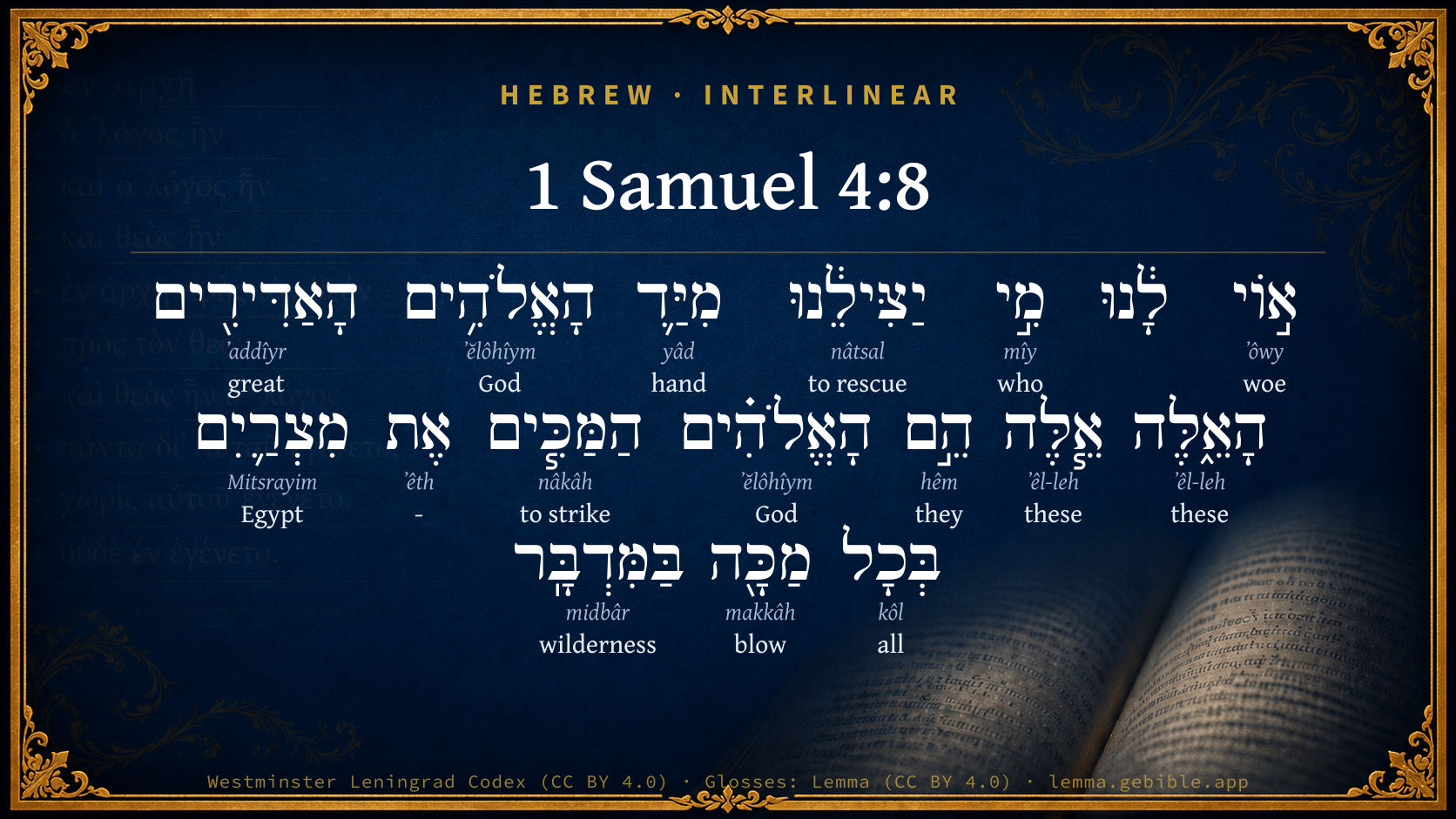
1 Samuel 4:8

Hebrew (Westminster Leningrad Codex) 1 Samuel 4:8 appears in the Hebrew Old Testament. The text above is from the Westminster Leningrad Codex. Each word links to its Strong’s number, a concise gloss, and parsing drawn from the Open Scriptures Hebrew Bible morphology. Click any word for its full Brown-Driver-Briggs (BDB) entry.
Download image
Cite this verse

1 Samuel 4:8 (World English Bible). Public Domain. Lemma interlinear Bible study tool, https://lemma.gebible.app/v/1-samuel/4/8.

Show BibTeX & RIS
BibTeX
RIS
English Translation
Woe to us! who shall deliver us out of the hand of these mighty gods? these are the gods that struck the Egyptians with all manner of plagues in the wilderness.
World English Bible · Public Domain
Download a study sheet

One document with this verse’s original text, its word-by-word gloss line, the meaning frame, cross-references with their text, attributed commentary, and full source and license credits — printable, and it pastes into notes with its structure intact.

This verse Autodidact and up

Study sheet (.html) Plain text (.txt)

A passage Seminary Student

Up to 50 verses in one chapter. A passage sheet keeps up to 6 commentary sources and 12 cross-references per verse, in the order this page ranks them, and says so on the sheet whenever that leaves anything out. Ask for a single verse and you get the Autodidact verse sheet above.

Everything on this page stays free to read, with no account — the sheet is a download of what is already on screen, not access to it.

Want to remove ads? Support Godless Engineer
Compare translations 3

The same verse in 3 English versions, stacked beneath the original-language interlinear above. Click any original word for its lexicon entry.

Each is an independent rendering of the whole verse — the interlinear is not word-aligned to these translations.

Highlighted words mark where these versions differ — a whole-verse word diff, not a word-by-word alignment.

  • World English Bible Public Domain
    Woe to us! who shall deliver us out of the hand of these mighty gods? these are the gods that struck the Egyptians with all manner of plagues in the wilderness.
  • King James Version Public Domain
    Woe unto us! who shall deliver us out of the hand of these mighty Gods? these are the Gods that smote the Egyptians with all the plagues in the wilderness.
  • unfoldingWord Literal Text CC BY-SA 4.0
    Woe to us! Who will deliver us from the hand of these mighty gods? These are they, the gods having struck the Egyptians with every plague in the wilderness.

unfoldingWord Literal Text — © unfoldingWord, licensed CC BY-SA 4.0. Word-aligned USFM3 via Door43 (git.door43.org/unfoldingWord/en_ult).

Versions to compare (up to 4)

3 of 4 selected

Show all 18 translations

Every available English version of this verse, each an independent rendering of the whole verse.

  • World English Bible Public Domain
    Woe to us! who shall deliver us out of the hand of these mighty gods? these are the gods that struck the Egyptians with all manner of plagues in the wilderness.
  • Berean Standard Bible Public Domain
    Woe to us! Who will deliver us from the hand of these mighty gods? These are the gods who struck the Egyptians with all kinds of plagues in the wilderness.
  • Majority Standard Bible Public Domain
    Woe to us! Who will deliver us from the hand of these mighty gods? These are the gods who struck the Egyptians with all kinds of plagues in the wilderness.
  • King James Version Public Domain
    Woe unto us! who shall deliver us out of the hand of these mighty Gods? these are the Gods that smote the Egyptians with all the plagues in the wilderness.
  • American Standard Version (1901) Public Domain
    Woe unto us! who shall deliver us out of the hand of these mighty gods? these are the gods that smote the Egyptians with all manner of plagues in the wilderness.
  • Revised Version (1885) Public Domain
    Woe unto us! who shall deliver us out of the hand of these mighty gods? these are the gods that smote the Egyptians with all manner of plagues in the wilderness.
  • Geneva Bible (1599) Public Domain
    Wo vnto vs, who shall deliuer vs out of the hande of these mightie Gods? these are the Gods that smote the Egyptians with all the plagues in the wildernes.
  • Douay-Rheims (1899) Public Domain
    Woe to us: for there was no such great joy yesterday and the day before: Woe to us. Who shall deliver us from the hand of these high gods? these are the gods that struck Egypt with all the plagues in the desert.
  • Young's Literal Translation Public Domain
    Wo to us, who doth deliver us out of the hand of these honourable gods? these `are' the gods who are smiting the Egyptians with every plague in the wilderness.
  • Literal Standard Version CC BY-SA 4.0
    Woe to us, who delivers us out of the hand of these majestic gods? These [are] the gods who are striking the Egyptians with every plague in the wilderness.
  • Unlocked Literal Bible CC BY-SA 4.0
    Woe to us! Who will protect us from the strength of these mighty gods? These are the gods who attacked the Egyptians with many different kinds of plagues in the wilderness.
  • unfoldingWord Literal Text CC BY-SA 4.0
    Woe to us! Who will deliver us from the hand of these mighty gods? These are they, the gods having struck the Egyptians with every plague in the wilderness.
  • Darby Bible Public Domain
    Woe unto us! who shall deliver us out of the hand of these mighty gods? these are the gods that smote the Egyptians with every plague in the wilderness.
  • World Messianic Bible Public Domain
    Woe to us! Who shall deliver us out of the hand of these mighty gods? These are the gods that struck the Egyptians with all kinds of plagues in the wilderness.
  • Webster's Bible Public Domain
    Woe to us! Who shall deliver us out of the hand of these mighty Gods? these are the Gods that smote the Egyptians with all the plagues in the wilderness.
  • Free Bible Version CC BY-SA 4.0
    This is disaster for us! Who will save us from the power of these mighty gods? These are the gods who attacked the Egyptians with all kinds of plagues in the wilderness.
  • Bible in Basic English Public Domain
    Trouble is ours! Who will give us salvation from the hands of these great gods? These are the gods who sent all sorts of blows on the Egyptians in the waste land.
  • JPS Tanakh (1917) Public Domain
    Woe unto us! who shall deliver us out of the hand of these mighty gods? these are the gods that smote the Egyptians with all manner of plagues and in the wilderness.

Literal Standard Version (2020), Covenant Press — licensed CC BY-SA 4.0. Text via the HelloAO Bible API (eBible.org). Unlocked Literal Bible (unfoldingWord) — licensed CC BY-SA 4.0. Text via the HelloAO Bible API (eBible.org). unfoldingWord Literal Text — © unfoldingWord, licensed CC BY-SA 4.0. Word-aligned USFM3 via Door43 (git.door43.org/unfoldingWord/en_ult). Free Bible Version, Dr. Jonathan Gallagher — licensed CC BY-SA 4.0. Text via the HelloAO Bible API (eBible.org).

Word by word

More ways to search: Search by grammar → Find every occurrence → Compare this word →

Practice this passage: Drill this verse → Learn its vocabulary →

א֣וֹי
ʼôwy
H188
“woe”
Particle, Interjection
Part of Speech
Particle
Type
Interjection
Full BDB Definition

Origin: probably from H183 (in the sense of crying out after)

TWOT: 42

woe! alas! oh! - passionate cry of grief or despair
  1. מִ֣י mîy H4310 “who” Particle, Interrogative
  2. יַצִּילֵ֔נוּ nâtsal H5337 “to rescue · us” Verb, Hiphil, Imperfect, 3rd Person, Masculine, Singular + Suffix, Personal, 1st Person, Common, Plural
  3. מִיַּ֛ד yâd H3027 “from · hand of” Preposition + Noun, Common, Both, Singular, Construct
  4. הָאֱלֹהִ֥ים ʼĕlôhîym H430 “the · God(s)” Particle, Definite Article + Noun, Common, Masculine, Plural, Absolute
  5. הָאַדִּירִ֖ים ʼaddîyr H117 “the · great” Particle, Definite Article + Adjective, Adjective, Masculine, Plural, Absolute
  6. הָאֵ֑לֶּה ʼêl-leh H428 “the · these” Particle, Definite Article + Pronoun, Demonstrative, Common, Plural
  7. אֵ֧לֶּה ʼêl-leh H428 “these” Pronoun, Demonstrative, Common, Plural
  8. הֵ֣ם hêm H1992 “they” Pronoun, Personal, 3rd Person, Masculine, Plural
  9. הָאֱלֹהִ֗ים ʼĕlôhîym H430 “the · God(s)” Particle, Definite Article + Noun, Common, Masculine, Plural, Absolute
  10. הַמַּכִּ֧ים nâkâh H5221 “the · striking” Particle, Definite Article + Verb, Hiphil, Participle Active, Masculine, Plural, Absolute
  11. אֶת ʼêth H853 “-” Particle, Direct Object
  12. מִצְרַ֛יִם Mitsrayim H4714 “Egypt” Noun, Proper
  13. בְּכָל kôl H3605 “in/at · all of” Preposition + Noun, Common, Masculine, Singular, Construct
  14. מַכָּ֖ה makkâh H4347 “blow” Noun, Common, Feminine, Singular, Absolute
  15. בַּמִּדְבָּֽר midbâr H4057 “in/at the · wilderness” Preposition, Determined + Noun, Common, Masculine, Singular, Absolute

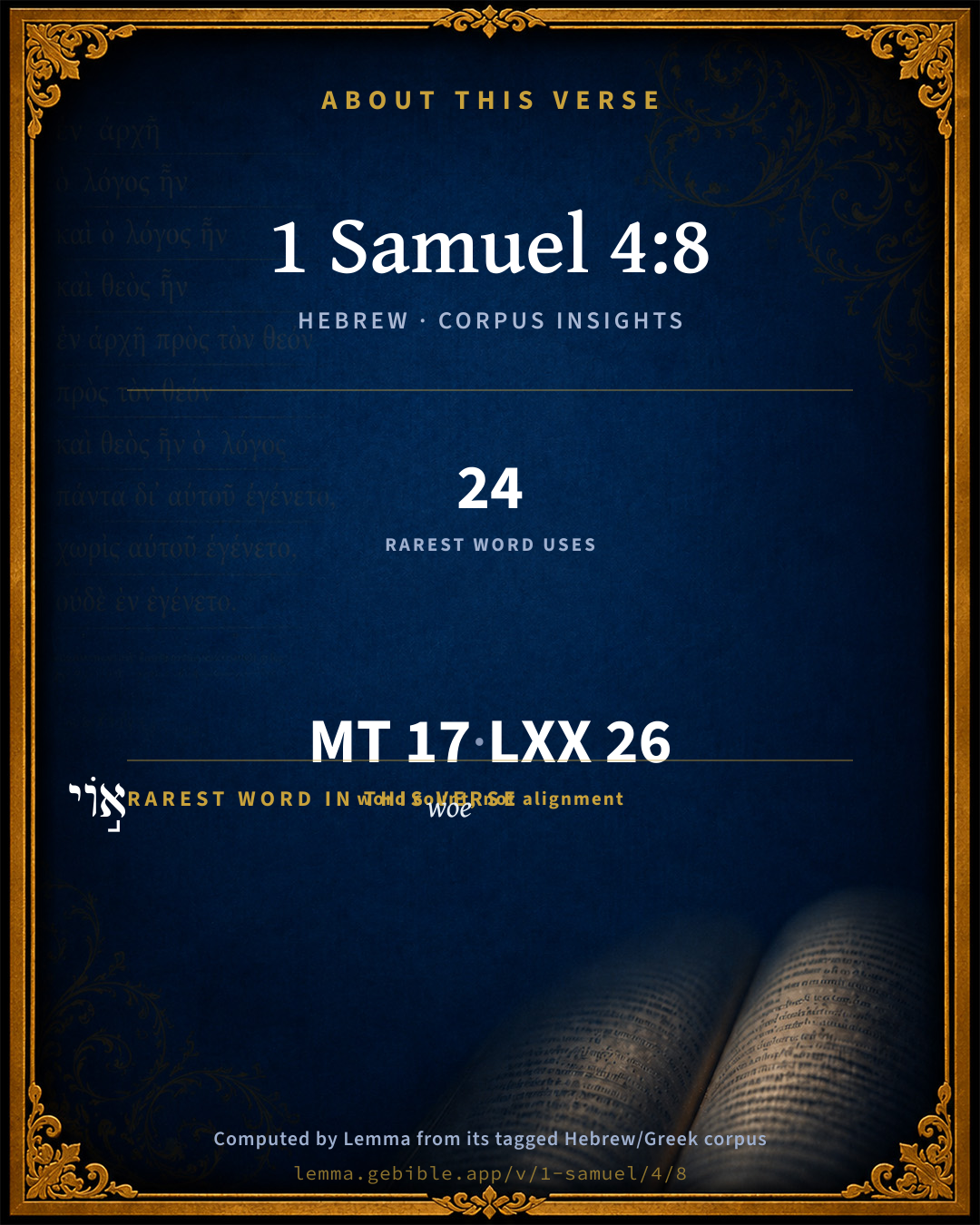
About this verse

These counts appear in no published source. They are computed here, from the morphology-tagged text and Lemma’s own curated glosses. What Lemma adds →

17
words
14
distinct lemmas
Historical
section

Notable vocabulary

The rarest word here is א֣וֹי woe H188 — appearing just 24 times in the whole Hebrew Bible.

Shared distinctive vocabulary

א֣וֹי woe H188 occurs in 23 verses of the Hebrew Bible. Also found in:

Grammatical profile

  • 2 verbs
  • 7 nouns
  • 1 adjective
  • 3 pronouns
  • 1 preposition
  • 3 particles

Verb forms

  • יַצִּילֵ֔נוּ Hiphil · Imperfect
  • הַמַּכִּ֧ים Hiphil · Participle Active

Repetition

Words recur within this verse — often emphatic in Hebrew:

  • הָאֱלֹהִ֥ים God H430 ×2
  • הָאֵ֑לֶּה these H428 ×2

Hebrew & Septuagint length

In English translation the verse runs 31 words from the Hebrew and 45 from the Septuagint (LXX English) — the Septuagint runs noticeably longer here. See the side-by-side →

A rough comparison of the two English renderings, which tokenize alike — not a word-level alignment.

Word counts can differ between the Hebrew and the Greek without any difference in meaning — e.g. the Hebrew direct-object marker אֵת has no separate Greek word, and Greek often adds the article ὁ.

In the original languages it is 17 Hebrew tokens and 26 Greek tokens — but the two are counted differently (Hebrew bundles its prefixes and suffixes into one token; the Greek is in lemma form), so that isn’t a like-for-like length.

Cross-references

3

Topical passages linked to 1 Samuel 4:8 in the Treasury of Scripture Knowledge — connected by theme and wording, ordered by reader-vote popularity; previews shown in the World English Bible.

  • Exodus 7:5 The Egyptians shall know that I am Yahweh, when I stretch forth my hand on Egypt, and bring out the children of Israel from among them."
  • Exodus 9:14 For this time I will send all my plagues against your heart, against your officials, and against your people; that you may know that there is none like me in all the earth.
  • Psalms 78:43–51 How he set his signs in Egypt, His wonders in the field of Zoan,

Cross-references courtesy of OpenBible.info (CC BY 4.0).

Hebrew and Greek witnesses Masoretic Hebrew ↔ Greek Septuagint

The same verse in the two great witnesses to the Old Testament, shown verse-for-verse.

Here the Septuagint runs noticeably longer than the Hebrew — LXX2012 (modern English Septuagint) 45 words vs World English Bible 31. A rough length comparison of the two English translations, not a word-level alignment — read both below.

These are two independent witnesses, not word-aligned to each other, and the Septuagint is shown in lemma (dictionary) form.

Hebrew 1 Samuel 4:8 Masoretic · Westminster Leningrad Codex

א֣וֹי לָ֔נוּ מִ֣י יַצִּילֵ֔נוּ מִיַּ֛ד הָאֱלֹהִ֥ים הָאַדִּירִ֖ים הָאֵ֑לֶּה אֵ֧לֶּה הֵ֣ם הָאֱלֹהִ֗ים הַמַּכִּ֧ים אֶת מִצְרַ֛יִם בְּכָל מַכָּ֖ה בַּמִּדְבָּֽר

Woe to us! who shall deliver us out of the hand of these mighty gods? these are the gods that struck the Egyptians with all manner of plagues in the wilderness.

World English Bible · Public Domain

Greek LXX 1 Samuel 4:8 Septuagint · lemma form

οὐαί ἐγώ τίς ἐκαἱρέω ἐγώ ἐκ χείρ ὁ θεός ὁ στερεός οὗτος οὗτος ὁ θεός ὁ πατάσσω ὁ αἴγυπτος ἐν πᾶς πληγή καί ἐν ὁ ἔρημος

Woe to us, O Lord, deliver us today for such a thing has not happened aforetime: woe to us, who shall deliver us out of the hand of these mighty Gods? these are the Gods that struck Egypt with every plague, and in the wilderness.

LXX2012 (modern English Septuagint) · Public Domain

On this verse, Ellicott's Commentary for English Readers discusses the Septuagint’s reading. Read the note in Commentary ↓

Hebrew: Westminster Leningrad Codex (CC BY 4.0). Greek: Septuagint (public domain); English from LXX2012 (modern English Septuagint) (Public Domain). How the Septuagint differs from the Hebrew →

Targum (Aramaic paraphrase)

1

The Targum is the ancient Jewish Aramaic paraphrase of the Hebrew Scriptures — an interpretive translation, not the Hebrew text itself. Onkelos (literal) and Pseudo-Jonathan (expansive) render the Torah, and Jonathan the Prophets. Coverage is partial: where no permissively-licensed English translation exists for a verse, only the Aramaic is shown. This is verse-level text, not a word-by-word alignment to the Hebrew.

  1. Targum Jonathan Prophets (Joshua–Malachi)
    וַי לָנָא מַן יְשֵׁיזְבִינָנָא מִיַד מֵימְרָא דַייָ דְעוֹבָדוֹהִי רַבְרְבִין הָאִלֵין אִלֵין אִינוּן גְבוּרָתָא דַייָ דִמְחָא יַת מִצְרַיִם בְּכָל מָחָא וּלְעַמֵיהּ עֲבַד פְּרִישָׁן בְּמַדְבְּרָא:

    (no public-domain English translation for this verse)

    Targum Jonathan — Aramaic: “Mikraot Gedolot” (public domain). English: “Sefaria Community Translation” (CC0 1.0 (public-domain dedication)); “London "Chaldee Paraphrase," 1871” (public domain). Text via Sefaria.

Commentary

Notes on 1 Samuel 4:8 from classic Christian and Jewish commentators (each source and its license shown beneath its notes). The classic Christian expositions comment on the surrounding passage and are grouped to its opening verse, so a note may address several verses; the Jewish commentaries on the Tanakh (Rashi and others) are per-verse, so they appear only where the commentator wrote on this verse.

Lemma curates 59 commentaries, every one of them public domain or Creative Commons licensed, each selected and text-cleaned for this edition rather than reprinted as found. About our sources →

Trapp's Complete Commentary

John Trapp

1Sa 4:8 Woe unto us! who shall deliver us out of the hand of these mighty Gods? these [are] the Gods that smote the Egyptians with all the plagues in the wilderness.

Ver. 8. Woe unto us!] So at the siege of Mountabon, in France, when the Popish soldiers heard the people of God within the town singing a psalm, after which they ever expected a sally, they would so quake and tremble, crying, They come, they come! as if the wrath of God had been breaking out upon them. These faithless Philistines, followed by the furies of their own consciences, were woe begone, as we say, at the sight of God’s ark, as being the people of God’s wrath and of his curse.

With all the plagues in the wilderness.] Or, Near the wilderness. That last sweeping plague - the drowning of them in the Red Sea - was near the wilderness of Etham, on the shore whereof their dead carcasses were cast up. {Exo 14:30} Or it may be these frightened Philistines spoke at random, and according to their skill, as Bishop Bonner did when he said the martyrs were like to certain arrant heretics of whom Pliny maketh mention, that they daily sing antelucanos hymnos - psalms before daybreak.

John Trapp, A Commentary or Exposition upon All the Books of the Old and New Testament (1647–1656) — public domain. Text from a community e-Sword module.

Joseph Benson's Commentary

1Sa 4:8. Who shall deliver us, &c. — They had fought with men before; but now they thought they should have to fight with God, before whom none could stand. Here we see their unreasonableness and folly. They secretly confess the Lord to be greater than their gods, and yet presume to oppose him! That smote the Egyptians in the wilderness — They seem to have had but a very imperfect and incorrect knowledge of the Israelitish affairs, and to have supposed that all those plagues which are recorded in their history had fallen on the Egyptians while the Israelites were in the wilderness, where they were when the last of these plagues befell them, and they were drowned in the Red sea. But it is not strange that these heathen should mistake some circumstances relating to the affairs of another people, with whom they had no friendly intercourse, but were in a state of almost continual hostility, especially as some hundreds of years had now elapsed since these events had taken place.

Joseph Benson's Commentary on the Old and New Testaments (1811–1818) — public domain. Text from a community e-Sword module.

Tyndale Open Study Notes

Tyndale Open Resources

4:8 the same gods who destroyed the Egyptians: The Philistines, who worshiped many gods, knew of the Lord’s power. Yet they knew nothing of his nature as the one true God. • destroyed . . . with plagues: The Lord later showed his power against the Philistines similarly (see 5:6–6:6).

Tyndale Open Study Notes — © Tyndale Open Resources, licensed CC BY-SA 4.0. Text via the HelloAO Bible API.

Geneva Bible (1599)

Geneva Bible translators

For in the red sea in the wilderness the Egyptians were destroyed, which was the last of all his plagues.

Geneva Bible (1599) marginal notes — public domain. Text via Bolls.life.

Adam Clarke's Commentary

Verse 8. These mighty Gods] מיד האלהים האדרים miyad haelohim haaddirim, from the hand of these illustrious Gods. Probably this should be translated in the singular, and not in the plural: Who shall deliver us from the hand of this illustrious God?

Adam Clarke's Commentary on the Bible (1810–1826) — public domain. Text from a community e-Sword/MySword module.

Ellicott's Commentary for English Readers

(8) These are the Gods that smote the Egyptians.—No doubt the compiler of these “Memoirs of Samuel” has given us the very words of the Philistines, preserved in their national traditions of this sad time. They are the expression of idolaters who knew of “Gods” and dreaded their malevolent influence, but who had no conception of the One Most High God. The plural form Elohim, so often found in the sacred record for God, is used here; but whereas the inspired compilers would have written their qualifying adjective in the singular, the Philistine idolaters write theirs in the plural—Elohim addirim: Mighty Gods.

It is noticeable that the Philistine exclamation of awe and terror is based outwardly upon the Egyptian traditions of the acts of the Lord. They studiedly ignore what they were all in that camp painfully conscious of—His acts in their own land of Canaan. The Septuagint and Syriac Versions, and some commentators, add “and” before the words “in the wilderness,” to make the Philistine exclamation more in harmony with history, seeing that the plagues were inflicted before the Israelites entered the wilderness; but the very vagueness of the exclamation of fear speaks for its truth. They were little concerned with exact historical accuracy, and were simply conscious of some terrible judgment having fallen on the foes of this Israel, a judgment they not unnaturally connected with the Ark of the Covenant just arrived in the enemy’s camp: that Ark their ancestors remembered so often at the head of the armies of this Israel in their days of triumph.

A Bible Commentary for English Readers, edited by Charles John Ellicott (1878–1897) — public domain. Text from a community e-Sword module.

The Cambridge Bible for Schools and Colleges

gen. ed. J. J. S. Perowne

8. these mighty Gods] The heathen polytheists naturally suppose that Israel like themselves had ‘gods many.’

with all the plagues] Better, with an utter overthrow, lit. ‘with every kind of smiting.’ The word used is the same as that rendered slaughter in 1Sa_4:10, and the allusion is to the overthrow of Pharaoh in the Red Sea, the shores of which are called wilderness in Exo_13:20, not to the ten plagues, for which a different word is used in Exodus. The effect of the news of the destruction of Pharaoh upon the Philistines is alluded to in the Song of Moses, “Sorrow shall take hold upon the inhabitants of Palestina” (Exo_15:14): and Rahab speaks of it as inspiring the Canaanites with terror (Jos_2:9-11).

The Cambridge Bible for Schools and Colleges (gen. ed. J. J. S. Perowne; Cambridge University Press, 1878–1918) — public domain. Text from a community e-Sword module.

John Gill's Exposition

Woe unto us, who shall deliver us out of the hand of these mighty gods?.... Of whom they spoke in an ironical and sneering manner; or if seriously and through fear, they use their own Heathenish language, as if the Israelites had many gods, as they had, though mightier than theirs; though the Syriac and Arabic versions read in the singular, out of the hand of God, or the most strong God; and so the Targum, out of the hand of the Word of the Lord:

these are the gods that smote the Egyptians with all the plagues in the wilderness: the ten plagues were inflicted on the Egyptians in the land of Egypt, and not in the wilderness; wherefore the Philistines may be supposed to be mistaken in this circumstance; which is not to be wondered at, since many historians who have written of the affairs of the Jews have been mistaken in them, as Justin, Tacitus, and others; nay, even Josephus himself in some things: but perhaps respect is had to the drowning of Pharaoh and his host in the Red sea, which had the wilderness of Etham on both sides of it; and this stroke was the finishing one of the plagues on the Egyptians. R. Joseph Kimchi supposes the word for wilderness has the signification of speech, as in Sol 4:3 and that the sense of the Philistines is, that God smote the Egyptians with all the plagues he did by his word, his orders, and commands; but now he was come in person, and would smite them by himself; this sense Abarbinel calls a beautiful one.

John Gill's Exposition of the Whole Bible (1746–1763) — public domain (CC PDM 1.0). Text via the HelloAO Bible API.

Albert Barnes' Notes on the Bible

This is a remarkable testimony on the part of the Philistines to the truth of the events which are recorded in the Pentateuch. The Philistines would of course hear of them, just as Balak and the people of Jericho did Num 22:5; Jos 2:10.

With all the plagues ... - Rather, “with every kind of plague” equivalent to “with utter destruction.

Albert Barnes' Notes on the Bible (1834–1885) — public domain. Text from a community e-Sword/MySword module.

Haydock's Catholic Bible Commentary

Joy. A few days ago the Hebrews were dismayed, now they shout for joy, as they did at the taking of Jericho. Hebrew and Septuagint, "it was not so heretofore." (Haydock) --- Gods. Hebrew may be rendered in the singular, with the Chaldean and Arabic. But the Septuagint and most commentators, explain it in the sense of the Vulgate. The title of high, (adirim) or magnificent, was given by the Philistines to Dagon, whom they styled Atergatis. (Calmet) --- Septuagint Greek: stereon, means, "stable, perfect," &c. (Haydock) --- Plagues, till they were overwhelmed in the Red Sea, which is surrounded with deserts. Some supply, "and (his people) in the desert." (Septuagint, Syriac, &c.) (Calmet)

George Leo Haydock (1774–1849), Haydock's Catholic Family Bible and Commentary, 1859 edition — public domain. Excludes Psalms (Douay-Rheims chapter numbering differs from Protestant) and Deuterocanonical books (Catholic canon only).

Matthew Poole's English Annotations

These mighty Gods; they secretly confess the Lord to be higher and greater than their gods, and yet against their knowledge presume to oppose him. They mention the wilderness, not as if all the plagues of the Egyptians came upon them in the wilderness, but because the last and sorest of all, which is therefore put for all, to wit, the destruction of Pharaoh and all his host, happened in the wilderness, namely, in the Red Sea, which having the wilderness on both sides of it, Exo 13:18,20; 15:3,11; 15:22, &c., may well be said to be in the wilderness. Although it is not strange if these heathens did mistake and misreport some circumstance in a relation of the Israelitish affairs, especially some hundreds of years after they were done, such mistakes being frequent in divers heathen authors treating of those matters, as Justin, and Tacitus, and others.

Matthew Poole's English Annotations on the Holy Bible (1683–1685) — public domain. Text from a community e-Sword/MySword module.

Whedon's Commentary on the Bible

Daniel D. Whedon

8. These mighty Gods — These Philistines speak the language of polytheists, not knowing that the God of Israel is ONE LORD.

Smote the Egyptians with all the plagues — The word rendered plagues means literally smiting, slaughter, and special reference is made to the destruction of Pharaoh and his army in the Red Sea, which was on the border of the desert. In Exo_13:20; Exo_14:3; Exo_14:11-12, the Egyptian shore of the Red Sea is called the wilderness. The other plagues of Egypt may also be included, and the phrase the wilderness need not be pressed, as though these Philistines in such an allusion must needs make precise statements.

Daniel D. Whedon (gen. ed.), Commentary on the Old and New Testaments (1874–1909) — public domain. Text from a community e-Sword module.

The Pulpit Commentary

These mighty Gods. In Hebrew "Elohim, though plural, is used of the one true God, but in this sense has always the verb or adjective belonging to it in the singular. In ver. 7 the Philistines conform to this rule, and say, Elohim is come; but here the verb, pronoun, and adjective are all plural, i.e. they speak as heathen, to whom polytheism was natural (comp. 1Ki_12:28) With all the plagues. Rather, "with every plague," i.e. with every kind of plague. In the wilderness. God did not really smite the Egyptians in the wilderness. The plagues, including the destruction of Pharaoh and his host in the Red Sea, had all happened before the Israelites had entered it. But probably the Philistines confused together the plagues of Egypt and the miracles in the wilderness, and even the conquest of Canaan, in one grand but vague whole, and so were ready to give way to despair, as they called to mind the traditions they had heard of these mighty interpositions of God for his people.

The Pulpit Commentary (1880–1919), ed. H.D.M. Spence-Jones & Joseph S. Exell — public domain. Text from a community e-Sword module.

John Wesley's Explanatory Notes

Wo, &c. - They secretly confess the Lord to be greater than their gods, and yet presume to oppose him. Wilderness - They mention the wilderness, not as if all the plagues of the Egyptians came upon them in the wilderness, but because the last and sorest of all, which is therefore put for all, the destruction of Pharaoh and all his host, happened in the wilderness, namely, in the Red- sea, which having the wilderness on both sides of it, may well be said to be in the wilderness. Altho' it is not strange if these Heathens did mistake some circumstance in relation of the Israelitish affairs, especially some hundreds of years after they were done.

John Wesley, Explanatory Notes Upon the Whole Bible (1754–1765) — public domain. Text via the GEBible commentary corpus.

Rashi

Rabbi Shlomo Yitzchaki (Rashi)

With every sort of plague in the wilderness. By the Sea of Reeds. Targum Yonoson however, renders, 'and for His people He performed wonders in the wilderness.' In Sifrei we learn that this passage is a combination of statements, whoever made one statement did not make the other. The worthy among them said, "Who will save us from the hand of this mighty God?" while the wicked retorted, "This is the God Who smote the Egyptians with every plague. All the plagues which He had, He brought upon the Egyptians. He has no more plagues [to inflict]."

Rashi on the Tanakh — English translations: “The Judaica Press complete Tanach with Rashi, translated by A. J. Rosenberg” (CC BY 4.0); “Pentateuch with Rashi's commentary by M. Rosenbaum and A.M. Silbermann, 1929-1934” (public domain); “The Metsudah Tanach series, Lakewood, N.J” (CC BY 4.0); and “The Book of Joshua, Metsudah Publications, 1997” (CC BY 4.0). Text via Sefaria.

Lesson kit

Teaching starters — assembled from the data on this page, not authored interpretation. Every prompt links to the verse data it draws on. Edit before teaching.

1 Samuel, in the Historical, opens this verse with 17 words (14 distinct Hebrew lemmas). Its most distinctive word is ʼôwy (“woe”). The Greek Septuagint runs longer here. A historical commentator’s framing appears above. Read the whole chapter for the surrounding context.

Discussion questions

  1. What does “woe” (ʼôwy) contribute to the verse as a whole?
  2. Numbers 21:29 shares the word «woe» with this verse. How do the two illuminate each other?
  3. “God” occurs 2× in this one verse. What is the effect of the repetition?
  4. Compared with the Hebrew, the Septuagint runs longer here. What questions does that raise?
  5. These translations render this verse differently; the difference is in the English rendering, not the original. What questions does that raise?
  6. The verb «יַצִּילֵ֔נוּ» is Hiphil Imperfect. How does its form color the action?
  7. Reading how Trapp's Complete Commentary and Joseph Benson's Commentary read this verse, where do the two commentators agree and where do they part?

Things to notice

Reading settings

Reading text

Shown beneath each verse's original-language words.

Old Testament
Old Testament edition

Read the OT as the Masoretic Hebrew (MT) or the Greek Septuagint (LXX).

English shown for the Greek Septuagint (in the Hebrew ↔ Greek comparison).

Comparing translations? Open the Compare panel on any verse page to stack up to four side by side.