Exodus 7:11

Hebrew (Westminster Leningrad Codex) Exodus 7:11 appears in the Hebrew Old Testament. The text above is from the Westminster Leningrad Codex. Each word links to its Strong’s number, a concise gloss, and parsing drawn from the Open Scriptures Hebrew Bible morphology. Click any word for its full Brown-Driver-Briggs (BDB) entry.
Download image
Cite this verse

Exodus 7:11 (World English Bible). Public Domain. Lemma interlinear Bible study tool, https://lemma.gebible.app/v/exodus/7/11.

Show BibTeX & RIS
BibTeX
RIS
English Translation
Then Pharaoh also called for the wise men and the sorcerers. They also, the magicians of Egypt, did in like manner with their enchantments.
World English Bible · Public Domain
Highlights
  • 1 first appearance in the Hebrew Bible
Full analysis ↓
Download a study sheet

One document with this verse’s original text, its word-by-word gloss line, the meaning frame, cross-references with their text, attributed commentary, and full source and license credits — printable, and it pastes into notes with its structure intact.

This verse Autodidact and up

Study sheet (.html) Plain text (.txt)

A passage Seminary Student

Up to 50 verses in one chapter. A passage sheet keeps up to 6 commentary sources and 12 cross-references per verse, in the order this page ranks them, and says so on the sheet whenever that leaves anything out. Ask for a single verse and you get the Autodidact verse sheet above.

Everything on this page stays free to read, with no account — the sheet is a download of what is already on screen, not access to it.

Want to remove ads? Support Godless Engineer
Compare translations 3

The same verse in 3 English versions, stacked beneath the original-language interlinear above. Click any original word for its lexicon entry.

Each is an independent rendering of the whole verse — the interlinear is not word-aligned to these translations.

Highlighted words mark where these versions differ — a whole-verse word diff, not a word-by-word alignment.

  • World English Bible Public Domain
    Then Pharaoh also called for the wise men and the sorcerers. They also, the magicians of Egypt, did in like manner with their enchantments.
  • King James Version Public Domain
    Then Pharaoh also called the wise men and the sorcerers: now the magicians of Egypt, they also did in like manner with their enchantments.
  • unfoldingWord Literal Text CC BY-SA 4.0
    And Pharaoh also called for wise men and sorcerers. And the magicians of Egypt also did so by their magic.

unfoldingWord Literal Text — © unfoldingWord, licensed CC BY-SA 4.0. Word-aligned USFM3 via Door43 (git.door43.org/unfoldingWord/en_ult).

Versions to compare (up to 4)

3 of 4 selected

Show all 18 translations

Every available English version of this verse, each an independent rendering of the whole verse.

  • World English Bible Public Domain
    Then Pharaoh also called for the wise men and the sorcerers. They also, the magicians of Egypt, did in like manner with their enchantments.
  • Berean Standard Bible Public Domain
    But Pharaoh called the wise men and sorcerers and magicians of Egypt, and they also did the same things by their magic arts.
  • Majority Standard Bible Public Domain
    But Pharaoh called the wise men and sorcerers and magicians of Egypt, and they also did the same things by their magic arts.
  • King James Version Public Domain
    Then Pharaoh also called the wise men and the sorcerers: now the magicians of Egypt, they also did in like manner with their enchantments.
  • American Standard Version (1901) Public Domain
    Then Pharaoh also called for the wise men and the sorcerers: and they also, the magicians of Egypt, did in like manner with their enchantments.
  • Revised Version (1885) Public Domain
    Then Pharaoh also called for the wise men and the sorcerers: and they also, the magicians of Egypt, did in like manner with their enchantments.
  • Geneva Bible (1599) Public Domain
    Then Pharaoh called also for the wise men and sorcerers: and those charmers also of Egypt did in like maner with their enchantmens,
  • Douay-Rheims (1899) Public Domain
    And Pharao called the wise men and the magicians: and they also by Egyptian enchantments and certain secrets did in like manner.
  • Young's Literal Translation Public Domain
    And Pharaoh also calleth for wise men, and for sorcerers; and the scribes of Egypt, they also, with their flashings, do so,
  • Literal Standard Version CC BY-SA 4.0
    And Pharaoh also calls for wise men and for sorcerers; and the enchanters of Egypt, they also, with their [enchanting] flames, do so,
  • Unlocked Literal Bible CC BY-SA 4.0
    Then Pharaoh also called for his wise men and sorcerers. They did the same thing by their magic.
  • unfoldingWord Literal Text CC BY-SA 4.0
    And Pharaoh also called for wise men and sorcerers. And the magicians of Egypt also did so by their magic.
  • Darby Bible Public Domain
    And Pharaoh also called the sages and the sorcerers; and they too, the scribes of Egypt, did so with their enchantments:
  • World Messianic Bible Public Domain
    Then Pharaoh also called for the wise men and the sorcerers. They also, the magicians of Egypt, did the same thing with their enchantments.
  • Webster's Bible Public Domain
    Then Pharaoh also called the wise-men, and the sorcerers: now the magicians of Egypt, they also did in like manner with their enchantments.
  • Free Bible Version CC BY-SA 4.0
    But Pharaoh called in wise men and sorcerers, and these Egyptian magicians did the same thing using their magic arts.
  • Bible in Basic English Public Domain
    Then Pharaoh sent for the wise men and the wonder-workers, and they, the wonder-workers of Egypt, did the same with their secret arts.
  • JPS Tanakh (1917) Public Domain
    Then Pharaoh also called for the wise men and the sorcerers; and they also, the magicians of Egypt, did in like manner with their secret arts.

Literal Standard Version (2020), Covenant Press — licensed CC BY-SA 4.0. Text via the HelloAO Bible API (eBible.org). Unlocked Literal Bible (unfoldingWord) — licensed CC BY-SA 4.0. Text via the HelloAO Bible API (eBible.org). unfoldingWord Literal Text — © unfoldingWord, licensed CC BY-SA 4.0. Word-aligned USFM3 via Door43 (git.door43.org/unfoldingWord/en_ult). Free Bible Version, Dr. Jonathan Gallagher — licensed CC BY-SA 4.0. Text via the HelloAO Bible API (eBible.org).

Word by word

More ways to search: Search by grammar → Find every occurrence → Compare this word →

Practice this passage: Drill this verse → Learn its vocabulary →

בְּלַהֲטֵיהֶ֖ם
lahaṭ
H3858
“in/at · flames · their”
Preposition + Noun, Common, Masculine, Plural, Construct + Suffix, Personal, 3rd Person, Masculine, Plural
Part of Speech
Preposition + Noun
Type
Common
Gender
Masculine
Number
Plural
State
Construct
Full BDB Definition

Origin: from H3857

TWOT: 1081a

flame (of an angelic sword)
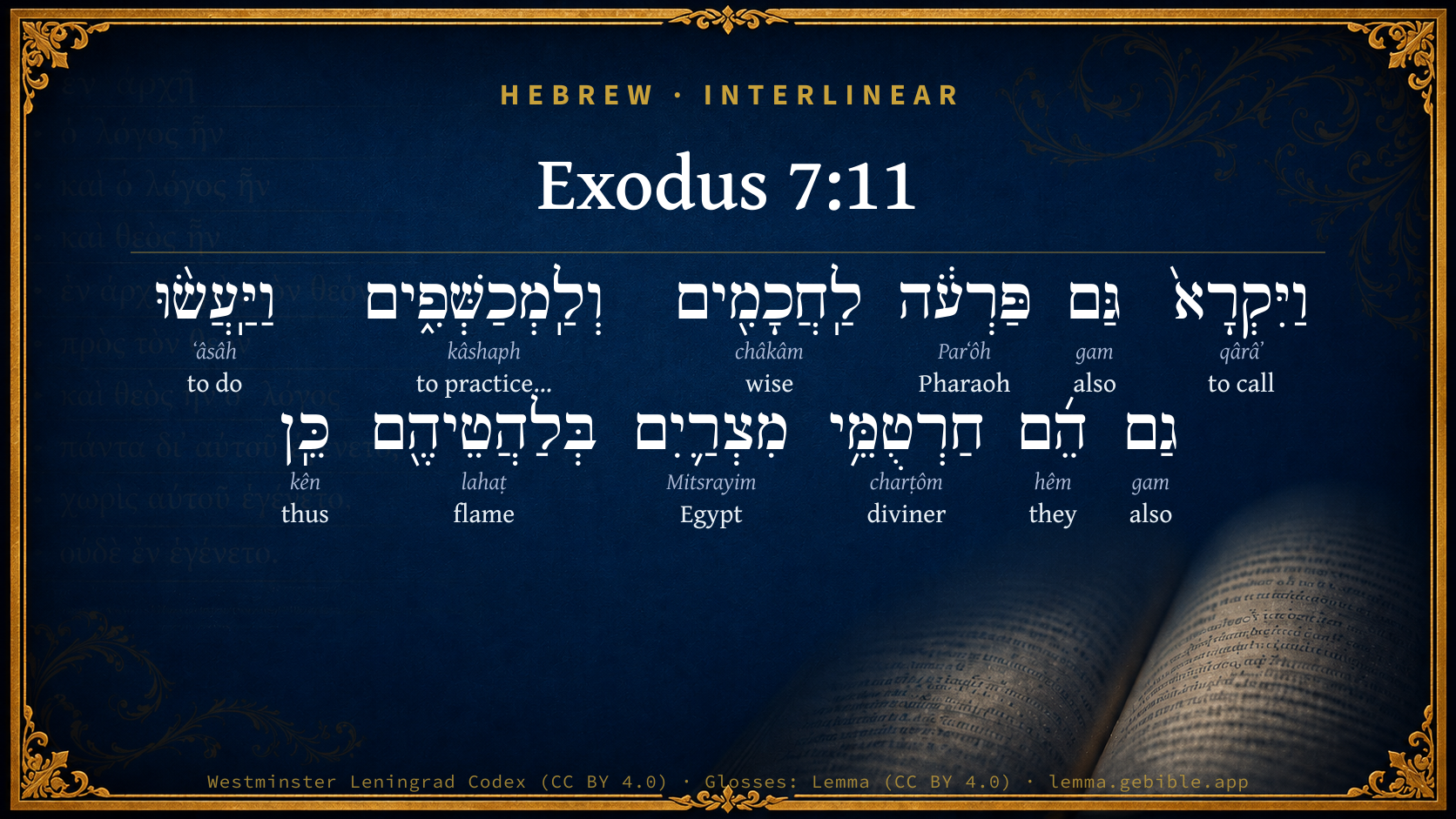
  1. וַיִּקְרָא֙ qârâʼ H7121 “and · to call” Conjunction + Verb, Qal, Sequential Imperfect, 3rd Person, Masculine, Singular
  2. גַּם gam H1571 “also” Particle, Accusative
  3. פַּרְעֹ֔ה Parʻôh H6547 “Pharaoh” Noun, Proper
  4. לַֽחֲכָמִ֖ים châkâm H2450 “to/for the · wise” Preposition, Determined + Adjective, Adjective, Masculine, Plural, Absolute
  5. וְלַֽמְכַשְּׁפִ֑ים kâshaph H3784 “and · to/for the · practicing witchcraft” Conjunction + Preposition, Determined + Verb, Piel, Participle Active, Masculine, Plural, Absolute
  6. וַיַּֽעֲשׂ֨וּ ʻâsâh H6213 “and · to do” Conjunction + Verb, Qal, Sequential Imperfect, 3rd Person, Masculine, Plural
  7. גַם gam H1571 “also” Adverb
  8. הֵ֜ם hêm H1992 “they” Pronoun, Personal, 3rd Person, Masculine, Plural
  9. חַרְטֻמֵּ֥י charṭôm H2748 “diviners of” Noun, Common, Masculine, Plural, Construct
  10. מִצְרַ֛יִם Mitsrayim H4714 “Egypt” Noun, Proper
  11. כֵּֽן kên H3651 “thus” Particle, Demonstrative

About this verse

These counts appear in no published source. They are computed here, from the morphology-tagged text and Lemma’s own curated glosses. What Lemma adds →

12
words
11
distinct lemmas
Pentateuch
section

Notable vocabulary

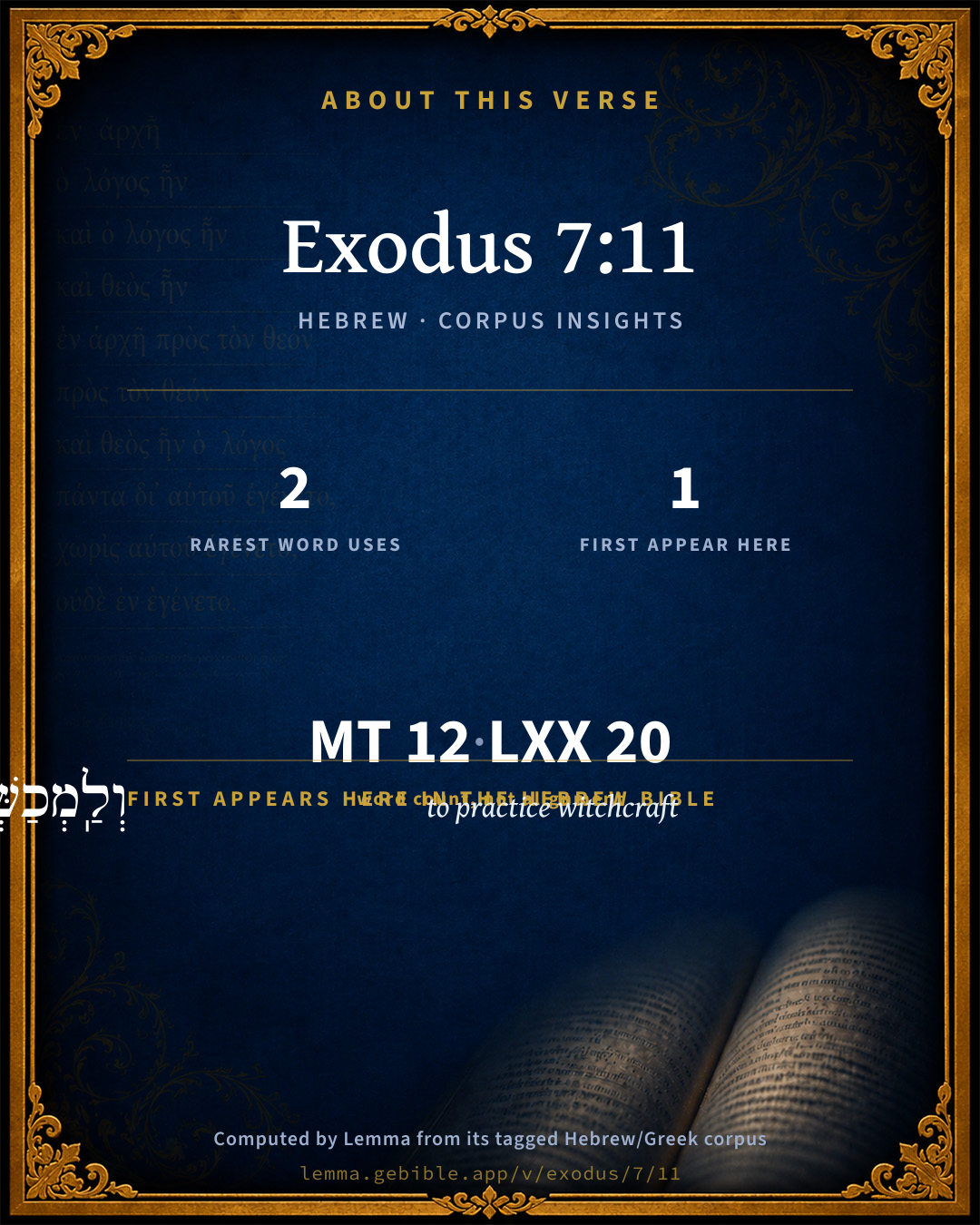
The rarest word here is בְּלַהֲטֵיהֶ֖ם flame H3858 — appearing just 2 times in the whole Hebrew Bible.

First appearance in Scripture

This word makes its first canonical appearance in the Hebrew Bible here:

  • וְלַֽמְכַשְּׁפִ֑ים to practice witchcraft H3784

Shared distinctive vocabulary

בְּלַהֲטֵיהֶ֖ם flame H3858 occurs in 2 verses of the Hebrew Bible. Also found in:

Grammatical profile

  • 3 verbs
  • 4 nouns
  • 1 adjective
  • 1 pronoun
  • 1 adverb
  • 2 particles

Verb forms

  • וַיִּקְרָא֙ Qal · Sequential Imperfect
  • וְלַֽמְכַשְּׁפִ֑ים Piel · Participle Active
  • וַיַּֽעֲשׂ֨וּ Qal · Sequential Imperfect

Repetition

A word recurs within this verse — often emphatic in Hebrew:

  • גַּם also H1571 ×2

Hebrew & Septuagint length

In English translation the verse runs 24 words from the Hebrew and 24 from the Septuagint (LXX English) — the same length.

A rough comparison of the two English renderings, which tokenize alike — not a word-level alignment.

Word counts can differ between the Hebrew and the Greek without any difference in meaning — e.g. the Hebrew direct-object marker אֵת has no separate Greek word, and Greek often adds the article ὁ.

In the original languages it is 12 Hebrew tokens and 20 Greek tokens — but the two are counted differently (Hebrew bundles its prefixes and suffixes into one token; the Greek is in lemma form), so that isn’t a like-for-like length.

Cross-references

20

Topical passages linked to Exodus 7:11 in the Treasury of Scripture Knowledge — connected by theme and wording, ordered by reader-vote popularity; previews shown in the World English Bible.

  • Exodus 7:22 The magicians of Egypt did in like manner with their enchantments; and Pharaoh's heart was hardened, and he didn't listen to them; as Yahweh had spoken.
  • Exodus 8:7 The magicians did in like manner with their enchantments, and brought up frogs on the land of Egypt.
  • Exodus 8:18 The magicians tried with their enchantments to bring forth lice, but they couldn't. There were lice on man, and on animal.
  • 2 Timothy 3:8 Even as Jannes and Jambres opposed Moses, so do these also oppose the truth; men corrupted in mind, reprobate concerning the faith.
  • Genesis 41:8 It happened in the morning that his spirit was troubled, and he sent and called for all the magicians of Egypt, and all the wise men of it. Pharaoh told them his dream, but there was no one who could interpret them to Pharaoh.
  • Daniel 2:2 Then the king commanded to call the magicians, and the enchanters, and the sorcerers, and the Chaldeans, to tell the king his dreams. So they came in and stood before the king.
  • 2 Thessalonians 2:9 even he whose coming is according to the working of Satan with all power and signs and lying wonders,
  • Daniel 5:7 The king cried aloud to bring in the enchanters, the Chaldeans, and the soothsayers. The king spoke and said to the wise men of Babylon, Whoever shall read this writing, and show me the interpretation of it, shall be clothed with purple, and have a chain of gold about his neck, and shall be the third ruler in the kingdom.
  • Ephesians 4:14 that we may no longer be children, tossed back and forth and carried about with every wind of doctrine, by the trickery of men, in craftiness, after the wiles of error;
  • Genesis 41:38–39 Pharaoh said to his servants, "Can we find such a one as this, a man in whom is the Spirit of God?"
  • Deuteronomy 13:1–3 If there arise in the midst of you a prophet, or a dreamer of dreams, and he give you a sign or a wonder,
  • Isaiah 19:11–12 The princes of Zoan are utterly foolish; the counsel of the wisest counselors of Pharaoh is become brutish: how do you say to Pharaoh, I am the son of the wise, the son of ancient kings?
  • Isaiah 47:12–13 Stand now with your enchantments, and with the multitude of your sorceries, in which you have labored from your youth; if so be you shall be able to profit, if so be you may prevail.
  • Daniel 2:27 Daniel answered before the king, and said, The secret which the king has demanded can neither wise men, enchanters, magicians, nor soothsayers, show to the king;
  • Daniel 4:7–9 Then came in the magicians, the enchanters, the Chaldeans, and the soothsayers; and I told the dream before them; but they did not make known to me the interpretation of it.
  • Daniel 5:11 There is a man in your kingdom, in whom is the spirit of the holy gods; and in the days of your father light and understanding and wisdom, like the wisdom of the gods, were found in him; and the king Nebuchadnezzar your father, the king, [I say], your father, made him master of the magicians, enchanters, Chaldeans, and soothsayers;
  • Matthew 24:24 For there will arise false christs, and false prophets, and they will show great signs and wonders, so as to lead astray, if possible, even the chosen ones.
  • Galatians 3:1 Foolish Galatians, who has bewitched you not to obey the truth, before whose eyes Jesus Christ was openly set forth among you as crucified?
  • Revelation 13:11–15 I saw another beast coming up out of the earth. He had two horns like a lamb, and he spoke like a dragon.
  • Revelation 19:20 The beast was taken, and with him the false prophet who worked the signs in his sight, with which he deceived those who had received the mark of the beast and those who worshiped his image. These two were thrown alive into the lake of fire that burns with sulfur.

Cross-references courtesy of OpenBible.info (CC BY 4.0).

Hebrew and Greek witnesses Masoretic Hebrew ↔ Greek Septuagint

The same verse in the two great witnesses to the Old Testament, shown verse-for-verse.

These are two independent witnesses, not word-aligned to each other, and the Septuagint is shown in lemma (dictionary) form.

Hebrew Exodus 7:11 Masoretic · Westminster Leningrad Codex

וַיִּקְרָא֙ גַּם פַּרְעֹ֔ה לַֽחֲכָמִ֖ים וְלַֽמְכַשְּׁפִ֑ים וַיַּֽעֲשׂ֨וּ גַם הֵ֜ם חַרְטֻמֵּ֥י מִצְרַ֛יִם בְּלַהֲטֵיהֶ֖ם כֵּֽן

Then Pharaoh also called for the wise men and the sorcerers. They also, the magicians of Egypt, did in like manner with their enchantments.

World English Bible · Public Domain

Greek LXX Exodus 7:11 Septuagint · lemma form

συνκαλέω δέ φαραώ ὁ σοφιστής αἴγυπτος καί ὁ φαρμακός καί ποιέω καί ὁ ἐπαοιδός ὁ αἰγύπτιος ὁ φαρμακία αὐτός ὡσαύτως

But Pharao called together the wise men of Egypt, and the sorcerers, and the charmers also of the Egyptians did likewise with their sorceries.

LXX2012 (modern English Septuagint) · Public Domain

Hebrew: Westminster Leningrad Codex (CC BY 4.0). Greek: Septuagint (public domain); English from LXX2012 (modern English Septuagint) (Public Domain). How the Septuagint differs from the Hebrew →

Targum (Aramaic paraphrase)

2

The Targum is the ancient Jewish Aramaic paraphrase of the Hebrew Scriptures — an interpretive translation, not the Hebrew text itself. Onkelos (literal) and Pseudo-Jonathan (expansive) render the Torah, and Jonathan the Prophets. Coverage is partial: where no permissively-licensed English translation exists for a verse, only the Aramaic is shown. This is verse-level text, not a word-by-word alignment to the Hebrew.

  1. Targum Onkelos Torah (Genesis–Deuteronomy)
    וּקְרָא אַף פַּרְעֹה לְחַכִּימַיָא וּלְחָרָשַׁיָא וַעֲבָדוּ אַף אִנּוּן חָרָשֵׁי מִצְרַיִם בְּלַחֲשֵׁיהוֹן כֵּן:

    (no public-domain English translation for this verse)

    Targum Onkelos — Aramaic: “Onkelos Genesis” (public domain); “Onkelos Exodus” (public domain); “Onkelos Leviticus” (public domain); “Onkelos Numbers” (public domain); “Onkelos Deuteronomy” (public domain). English: “Sefaria Community Translation” (CC0 1.0 (public-domain dedication)); “J.W. Etheridge. The Targums of Onkelos and Jonathan Ben Uzziel on the Pentateuch. London: Longmans, Green, 1862” (public domain). Text via Sefaria.

  2. Targum Pseudo-Jonathan Torah (Genesis–Deuteronomy)
    וּקְרָא לְחוֹד פַּרְעה לְחַכִּימַיָא וּלְחַרְשַׁיָא וַעֲבָדוּ לְחוֹד הִינוּן יֵנִיס וְיִמְבְּרֵיס חַרְשִׁין דִבְמִצְרַיִם בְּלַחֲשֵׁי קוּסְמֵיהוֹן הֵיכְדֵין

    But Pharoh called the hachems and magicians; and they also, Janis and Jamberes, magicians of Mizraim, did the same by their burnings of divination.

    Targum Pseudo-Jonathan — Aramaic: “Targum Jonathan on Genesis” (public domain); “Targum Jonathan on Exodus” (public domain); “Targum Jonathan on Leviticus” (public domain); “Targum Jonathan on Numbers” (public domain); “Targum Jonathan on Deuteronomy” (public domain). English: “The Targum of Jonathan ben Uzziel, trans. J. W. Etheridge, London, 1862” (public domain). Text via Sefaria.

Commentary

Notes on Exodus 7:11 from classic Christian and Jewish commentators (each source and its license shown beneath its notes). The classic Christian expositions comment on the surrounding passage and are grouped to its opening verse, so a note may address several verses; the Jewish commentaries on the Tanakh (Rashi and others) are per-verse, so they appear only where the commentator wrote on this verse.

Lemma curates 59 commentaries, every one of them public domain or Creative Commons licensed, each selected and text-cleaned for this edition rather than reprinted as found. About our sources →

The Cambridge Bible for Schools and Colleges

gen. ed. J. J. S. Perowne

11. wise men] cf. Gen_41:8, Isa_19:11-12.

magicians] Heb. ḥarṭummim, a word of unknown etymology, but found only in connexion with Egypt (Gen_41:8; Gen_41:24, Exo_7:11; Exo_7:22; Exo_8:7; Exo_8:18-19; Exo_9:11), and (borrowed from Gen.) in Daniel (Exo_1:20, Exo_2:2; Exo_2:10, &c.). RVm. in Genesis sacred scribes: and probably the word did in fact correspond to the Greek ἱερογραμματεῖς,—the term applied by Numenius to Jannes and Jambres. Magic flourished in ancient Egypt; and many magical formulae are known to us from the inscriptions: see Erman, pp. 289, 308, 353 ff., 373.

with their secret arts (RVm.)] i.e. with their usual mystic words or movements. So v. 22, Exo_8:7; Exo_8:18 (not elsewhere in this sense).

The Jerus. Targ., both here and on Exo_1:15, following a Jewish tradition gives the names of the magicians whom Pharaoh called as Jannes and Jambres (cf. 2Ti_3:8): the same two names are also given elsewhere, as Evang. Nicod. 5; Numenius, the Pythagorean philosopher the 2nd cent. a.d., as cited in Eus. Praep. Ev. ix. 8; see also Buxtorf, s.v. יוֹחַנָּא, or Levy, Chald. Wörterb. s.v. יַנִּים; and Schürer, § 32 (ed 3, iii. 292 ff.), with the references.

11, 12. The Egyptian magicians do the same. The art of serpent-charming is indigenous in the East: there are allusions to it in Psa_58:5, Jer_8:17, Ecc_10:11; and it is practised in Egypt to the present day. Modern Egyptian serpent-charmers possess an extraordinary power over serpents, drawing them forth, for instance, by noises made with the lips, from their hiding-places, and by pressure applied to the neck throwing them into such a state of hypnotic rigidity that they can be held as rods by the tip of the tail (Lane, Mod. Eg., ch. 20, in ed. 1871, ii. 93 f.; DB. iii. 889a; EB. iv. 4394: see further references in Di.). The serpent commonly used for the purpose is a species of cobra. As Di., however, remarks, we hear elsewhere only of serpents becoming rods, not of rods becoming serpents: the latter, a also the swallowing up of the magicians’ rods by Aaron’s rod, is ‘peculiar to the Hebrew story (Sage).’

The Cambridge Bible for Schools and Colleges (gen. ed. J. J. S. Perowne; Cambridge University Press, 1878–1918) — public domain. Text from a community e-Sword module.

Trapp's Complete Commentary

John Trapp

Exo 7:11 Then Pharaoh also called the wise men and the sorcerers: now the magicians of Egypt, they also did in like manner with their enchantments.

Ver. 11. The wise men and the sorcerers.] Magic is either pure and natural, or impure and diabolical, which implieth a compact with the devil; either overt or covert. The chief of these magicians here were Jannes and Jambres, {2Ti 3:8} whose names are also mentioned in the Talmud; Tract. de Oblat., cap. 9. Numenius also, the Pythagorean philosopher, speaketh of them.

John Trapp, A Commentary or Exposition upon All the Books of the Old and New Testament (1647–1656) — public domain. Text from a community e-Sword module.

The Biblical Illustrator

Joseph S. Exell

Exo_7:11-12

They also did in like manner with their enchantments.

Moses and the magicians

I. Moses divinely warned of Pharaohs demand for a supernatural credential. When men profess to bring a message from God, they should be prepared to substantiate it by satisfactory evidence.

II. Moses divinely sustained in meeting the demand.

1. God will never forsake those who go forth to implicitly work His will.

2. God often permits His enemies to temporarily triumph.

III. Moses commanded to appeal again to Pharaoh (Exo_7:14-17).

1. Gods knowledge of the human heart.

2. Gods knowledge of the purposes and plans of men.

3. Gods recognition of free agency, and its correlative responsibility.

4. God deals with men on the basis of their moral freedom, and according to their constitutional nature.

Lessons:

1. Here we have a type of the conflict of ages.

(1) In its spirit.

(2) In its aims.

(3) In its result.

2. The side to which we lean, and for which we fight, shows the party to which we really belong. (D. C. Hughes, M. A.)

Lessons

1. Miracles from God will not persuade wicked hearts to believe.

2. Unbelieving sinners are apt to call in all instruments of Satan to gainsay God.

3. Providence hath of old suffered wisdom to be abused to sorcery and pernicious acts (Exo_7:11).

4. God hath suffered creatures by Satans help to do some like things to His miracles.

5. Under Gods permission Satan may work strange changes in creatures, but no miracles.

6. Gods true miracles devour all lying wonders of Satan (Exo_7:12).

7. Wicked hearts harden themselves by lying wonders against God, and therefore are hardened by Him.

8. The fruit of such hardening is rebellion against Gods word and will.

9. Gods word is made good in all the disobedience of the wicked foretold (Exo_7:13). (G. Hughes, B. D.)

Mans effort to repudiate the message of God by an imitation of its miraculous credentials

I. That man has a right to expect that any special revelation from God should be accompanied by infallible and unimpeachable credentials. (Exo_7:9).

1. We require these credentials to vindicate the authority of the speaker. The Bible contains the evidences of its Divine origin on its own pages, for on every page we see the miracle repeated, the rod is turned into a serpent. And the miracles which the book contains, and the miracle which it is in itself, are sufficient token to the honest mind that it comes from God. This evidence is equal to the case. It leaves disobedience without excuse.

2. We require these credentials to vindicate the credibility of the speaker. God would never give men power to work a miracle to authenticate a lie. The miracle not only demonstrated the authority of these men, but also the unimpeachable honesty and verity of their statements. And so men take the Bible to-day; they perhaps say that in general terms the hook has come from God, and has His authority, and yet how many question the verity of its corn tents. They call one part of the message a myth, another part a fable, until, indeed, there is very little remaining as true.

3. That God anticipates these requests on the part of man, and provides His messengers with the needed credentials. Any one who rejects the claims of the Bible, rejects the highest proof, the most reliable evidence; hence his condemnation will be awful as that of the rebellious king.

4. The spirit in which these credentials should be investigated and received--

(1) Thoughtfully.

(2) Devoutly.

(3) Never sceptically.

(4) Remember that the messengers of God can only offer the credentials divinely permitted to them.

II. That men have recourse to many devices to weaken and nullify the credentials which are presented to them in token and support of a Divine message and claim. Then Pharaoh also called the wise men and the sorcerers: now the magicians of Egypt, they also did in like manner with their enchantments.

1. We find that men in the investigation of a Divine message are not satisfied with the evidence they themselves propose. A sceptical mind will not yield even when it has attained evidence for the truth of its own seeking. It is most criminal in its unbelief.

2. We find that men in the investigation of a Divine message often seek others to supply them with sceptical arguments they are not clever enough to produce themselves.

3. We find that men endeavour to confirm their comrades in scepticism by imitating the credentials of the messengers of God. But in vain. The truth-seeker can distinguish between the productions of the two; he never mistakes the enchantment of the Egyptian for the miracle of Moses.

4. That the men who endeavour to confirm their comrades in scepticism respecting the Divine credentials are subject to the truth. The rods of the Egyptian magicians were swallowed up by Aarons rod.

III. That the men who reject the credentials of Divine messengers commence a conflict which will be productive of great woe and of final overthrow to them. And He hardened Pharaohs heart that he hearkened not unto them; as the Lord had said. Lessons:

1. That the messengers of God can always produce Divine credentials.

2. That Divine credentials are often rejected by men of high social position.

3. That a continued rejection of Divine credentials will end in destruction.

4. That the servants of God are often perplexed by the conduct of men in rejecting Divine claims. (J. S. Exell, M. A.)

Imitation of the good

The mode in which the magicians withstood Moses (see 2Ti_3:1-9) was simply by imitating, so far as they were able, whatever he did. From this we learn the solemn truth that the most Satanic resistance to Gods testimony in the world is offered by those who, though they imitate the effects of the truth, have but the form of godliness, and deny the power thereof. Persons of this class can do the same things, adopt the same habits and forms, use the same phraseology, profess the same opinions, as others. How needful to understand this! How important to remember that as Jannes and Jambres withstood Moses, so do those self-loving, world-seeking, pleasure-hunting professors resist the truth! They would not be without a form of godliness; but while adopting the form, because it is customary, they hate the power, because it involves self-denial. The power of godliness involves the recognition of Gods claims, the implanting of His kingdom in the heart, and the consequent exhibition thereof in the whole life and character; but the formalist knows nothing of this, nor does he desire to know it. He does not want his lusts subdued, his pleasures interfered with, his passions curbed, his affections governed, his heart purified. He wants just as much religion as will enable him to make the best of both worlds. (A. Nevin, D. D.)

Egyptian magicians

They must have possessed a knowledge of nature beyond that of their countrymen, who had sufficient experience of the utility of such knowledge to reverence teachers endued with any rare portion of it. The magicians must have considered this knowledge as Divine; and have come more and more to regard the different powers of nature and the different objects in which these powers were exhibited, as themselves Divine. They will have been politicians as well as naturalists, ready to employ their lore and the mastery which it gave them over the things of the earth, to uphold the authority of the monarch, or to promote his plans. They will therefore have fallen into a scheme of trick and dissimulation, which would have been ineffectual and impossible if there had not been some truths lying at the root of it; and some real assurance in their own minds both of those truths and of their own capacities. It is this mixture of faith with insincerity--of actual knowledge with the assumption of knowledge, of genuine power with the desire to make the power felt and worshipped, a readiness therefore to abuse it to low grovelling purposes--which we have to recognize in the impostures of all subsequent ages, and to which we are here introduced in one of its primitive manifestations. It was most natural for a politic monarch to wish that a body of strangers, who were doing little good in a certain portion of his land, should be made slaves, and so become agents in carrying out what seemed to him magnificent projects. It was most natural that a body of politic priests--disliking these strangers, for the traditions and customs which separated them from their influence--should readily co-operate with him in that plan, or should be the first suggesters of it. It is equally natural that his Egyptian subjects should sympathize with the design, and should feel that they were raised in the degradation of another race. But it was impossible that king, priests, and people, should effect this seemingly sage and national purpose, without forging new chains for themselves, without losing some perceptions of a moral order in the world and a moral Ruler of it, which had been implied in their government and worship, and which Josephs arrangements had drawn out; it was impossible but that with the loss of this feeling, they should sink further and further into natural and animal worship. (F. D. Maurice, M. A.)

Aarons rod swallowed up their rods.

The power of Aarons rod

I. Let us turn aside to see this great sight--the Divine triumphant over the diabolical: the spiritual subduing the natural--Aarons rod swallowing all its rivals.

1. Let us take the case of the awakened sinner. That man was, a few days ago, as worldly, as carnal, as stolid, as he well could be. If any one should propose to make that man heavenly-minded, the common observer would say, Impossible! As in old Roman walls, the cement has become so strong, that the stone is no longer a separate piece, but has become a part of the wall itself--so this man is cemented to the world, he cannot lie separated from it. You must break him in pieces with the hammer of death; you cannot separate him in any other way from the cares of life. Ah, but Aarons rod shall swallow up this rod. The man listens to the Word; the truth comes with power into his soul; the Holy Ghost has entered him; and the next day, though he goes to his business, he finds no true contentment in it, for he pants after the living God. Now, his spirit pleads its needs, and outstrips the body in the contest for its warmest love. He spurns the trifles of a day: he seeks the jewels of eternity. Grace has won the day, and the worldling seeks the world to come.

2. The same fact, with equal distinctness, is to be observed in the individual when he becomes a believer in Jesus Christ; his faith destroys all other confidences.

3. The same fact is very manifest after faith in all who truly love the Saviour. They who love Christ aright, love no one in comparison with Him.

4. You will notice this in the man who makes his delight in the Lord Jesus. He who makes his delight in Christ after a true sort, will discover that this delight swallows up all other delights.

5. Yet more is it so in a man who is devoted to Gods service. The service of God swallows up everything else when the man is truly Gods servant. When a man gets fully possessed with an enthusiastic love for Jesus, difficulties to him become only things to be surmounted, dangers become honours, sacrifices pleasures, sufferings delights, weariness rest.

II. We now draw an inference. If it be so, that wherever true religion--the finger of God--comes into a man, it becomes a consuming passion, till the zeal of Gods house eats the man up. Then there are many persons who profess religion, who cannot have found the right thing. Those who are mean, miserly, and miserable in the cause of Christ, whose only expenditure is upon self, and whose main object is gain, what can we say of them? Why, that they look upon religion as some great farmers do upon their little off-hand farms. They think it is well to have a little religion; they can turn to it for amusement sometimes, just to ease them a little of their cares; besides, it may be very well, after having had all in this world, to try to get something in the next. They are moral and decent in all ways; they can pray very nicely in prayer-meetings, yet they never dream of consecrating their secular employments unto God. Aarons rod, in their case, has never swallowed up their rods.

III. Now, I will give some reasons why i put the service of God so prominent, and think that Aarons rod ought to swallow up all other rods. What does the great gospel revelation discover to us? Does it not show us an awful danger, and one only way of escape from it? Does not our religion also reveal to us the joyous reward of another world? It opens to us yonder pearly gates, and bids us gaze on angels and glorified spirits. By hell, and by heaven, therefore, I do entreat you, let Aarons rod swallow up all other rods; and let love and faith in Jesus be the master passion of your soul. Moreover, do we not learn in our holy faith of a love unexampled? Where was there love such as that which brought the Prince of Glory down to the gates of death, and made Him pass the portals amid shame and scoffing? Shall such love as this have half our hearts? (C. H. Spurgeon.)

The Biblical Illustrator, edited by Joseph S. Exell (c. 1880s–1900s) — public domain. Text from a community e-Sword module.

Joseph Benson's Commentary

Exo 7:11. Moses had been originally instructed in the learning of the Egyptians, and was suspected to have improved in magical arts in his long retirement. The magicians are therefore sent for to vie with him. The two chief of them were Jannes and Jambres. Their rods became serpents, probably by the power of evil angels, artfully substituting serpents in the room of the rods, God permitting the delusion to be wrought for wise and holy ends. But the serpent which Aaron’s rod was turned into, swallowed up the others: which was sufficient to have convinced Pharaoh on which side the right lay.

Joseph Benson's Commentary on the Old and New Testaments (1811–1818) — public domain. Text from a community e-Sword module.

Tyndale Open Study Notes

Tyndale Open Resources

7:11 these Egyptian magicians did the same thing (see also 7:22; 8:7): While demonic power might have been involved, it is also possible that some sleight of hand was being practiced. When they could not reproduce the plague of gnats, they declared that it was “the finger of God” (8:19), indicating that their own actions were not a manifestation of divine power. While the Egyptian magicians are not identified by name, tradition gives their names as Jannes and Jambres (see 2 Tim 3:8).

Tyndale Open Study Notes — © Tyndale Open Resources, licensed CC BY-SA 4.0. Text via the HelloAO Bible API.

Geneva Bible (1599)

Geneva Bible translators

It seemeth that these were Jannes and Jambres: read 2 Tim. 3:8, so ever the wicked maliciously resist the truth of God.

Geneva Bible (1599) marginal notes — public domain. Text via Bolls.life.

Jamieson, Fausset & Brown

Robert Jamieson, A. R. Fausset & David Brown

Then Pharaoh also called the wise men and the sorcerers, &c.--His object in calling them was to ascertain whether this doing of Aaron's was really a work of divine power or merely a feat of magical art. The magicians of Egypt in modern times have been long celebrated adepts in charming serpents, and particularly by pressing the nape of the neck, they throw them into a kind of catalepsy, which renders them stiff and immovable--thus seeming to change them into a rod. They conceal the serpent about their persons, and by acts of legerdemain produce it from their dress, stiff and straight as a rod. Just the same trick was played off by their ancient predecessors, the most renowned of whom, Jannes and Jambres (Ti2 3:8), were called in on this occasion. They had time after the summons to make suitable preparations--and so it appears they succeeded by their "enchantments" in practising an illusion on the senses.

Jamieson, Fausset & Brown — Commentary Critical and Explanatory on the Whole Bible (1871) — public domain (CC PDM 1.0). Text via the HelloAO Bible API.

Adam Clarke's Commentary

Verse 11. Pharaoh - called the wise men] חכמים chacamim, the men of learning. Sorcerers, כשפים cashshephim, those who reveal hidden things; probably from the Arabic root [Arabic] kashafa, to reveal, uncover, c., signifying diviners, or those who pretended to reveal what was in futurity, to discover things lost, to find hidden treasures, &c. Magicians, חרטמי chartummey, decypherers of abstruse writings. See Clarke on Ge 41:8.

They also did in like manner with their enchantments.] The word להתים lahatim, comes from להט lahat, to burn, to set on fire and probably signifies such incantations as required lustral fires, sacrifices, fumigations, burning of incense, aromatic and odoriferous drugs, c., as the means of evoking departed spirits or assistant demons, by whose ministry, it is probable, the magicians in question wrought some of their deceptive miracles: for as the term miracle signifies properly something which exceeds the powers of nature or art to produce, (see Ex 7:9,) hence there could be no miracle in this case but those wrought, through the power of God, by the ministry of Moses and Aaron. There can be no doubt that real serpents were produced by the magicians. On this subject there are two opinions:

1st, That the serpents were such as they, either by juggling or sleight of hand, had brought to the place, and had secreted till the time of exhibition, as our common conjurers do in the public fairs, &c.

2dly, That the serpents were brought by the ministry of a familiar spirit, which, by the magic flames already referred to, they had evoked for the purpose.

Both these opinions admit the serpents to be real, and no illusion of the sight, as some have supposed. The first opinion appears to me insufficient to account for the phenomena of the case referred to. If the magicians threw down their rods, and they became serpents after they were thrown down, as the text expressly says, Ex 7:12, juggling or sleight of hand had nothing farther to do in the business, as the rods were then out of their hands. If Aaron's rod swallowed up their rods, their sleight of hand was no longer concerned. A man, by dexterity of hand, may so far impose on his spectators as to appear to eat a rod but for rods lying on the ground to become serpents, and one of these to devour all the rest so that it alone remained, required something more than juggling. How much more rational at once to allow that these magicians had familiar spirits who could assume all shapes, change the appearances of the subjects on which they operated, or suddenly convey one thing away and substitute another in its place! Nature has no such power, and art no such influence as to produce the effects attributed here and in the succeeding chapters to the Egyptian magicians.

Adam Clarke's Commentary on the Bible (1810–1826) — public domain. Text from a community e-Sword/MySword module.

Ellicott's Commentary for English Readers

(11) The magicians of Egypt.—These persons are called indifferently khàkâmim, “wise men,” më-kashshëphim, “mutterers of charms,” and khartum-mim, “scribes,” perhaps “writers of charms.” Magic was very widely practised in Egypt, and consisted mainly in the composition and employment of charms, which were believed to exert a powerful effect, both over man and over the brute creation. A large part of the “Ritual of the Dead” consists of charms, which were to be uttered by the soul in Hades, in order to enable it to pass the various monsters which it would encounter there. Charms were also regarded as potent in this life to produce or remove disease, and avert the attacks of noxious animals. Some Egyptian works are mere collections of magical receipts, and supply strange prescriptions which are to be used, and mystic words which are to be uttered. A Jewish tradition, accepted by the Apostle Paul (2Ti_3:6), spoke of two magicians as the special opponents of Moses, and called them “Jannes and Jambres.” (See the Tar-gums of Jerusalem and of Jonathan, and comp. Numen, ap. Euseb. Prœp. eν. ix. 8.) The former of these, Jannes, obtained fame as a magician among the classical writers, and is mentioned by Pliny (H. N. xxx. 1) and Apuleius (Apolog. p. 108). It has been supposed by some that the magicians were really in possession of supernatural powers, obtained by a connection with evil spirits; but, on the whole, it is perhaps most probable that they were merely persons acquainted with many secrets of nature not generally known, and trained in tricks of sleight-of-hand and conjuring.

They also did in like manner.—The magicians had entered into the royal presence with, apparently, rods in their hands, such as almost all Egyptians carried. These they cast down upon the ground, when they were seen to be serpents. This was, perhaps, the mere exhibition of a trick, well known to Egyptian serpent-charmers in all ages (Description de l’Egypte, vol. i. p. 159), by which a charmed serpent is made to look like a stick for a time, and then disenchanted. Or it may have been effected by sleight-of-hand, which seems to be the true meaning of the word lĕhâtim, translated “enchantments.” (Rosenmüller, Scholia in Exodum, p. 110.)

A Bible Commentary for English Readers, edited by Charles John Ellicott (1878–1897) — public domain. Text from a community e-Sword module.

John Gill's Exposition

Then Pharaoh also called the wise men and the sorcerers,.... The cunning men and wizards, a sort of jugglers and deceivers, who pretended to great knowledge of things, to discover secrets, tell fortunes, and predict things to come, and by legerdemain tricks, and casting a mist before people's eyes, pretended to do very wonderful and amazing things; and therefore Pharaoh sent for these, to exercise their art and cunning, and see if they could not vie with Moses and Aaron:

now the magicians of Egypt, they also did in like manner with their enchantments; or by their secret wiles and juggles, making things seem to appear to the sight when they did not really, but by dazzling the eyes of men by their wicked and diabolical art, they fancied they saw things which they did not; for the word has the signification of flames of fire, or of a flaming sword, or lance, which being brandished to and fro dazzles the sight. The Targum of Jonathan gives the names of two of these magicians, whom he calls Jannes and Jambres, as does the apostle; see Gill on Ti2 3:8. Josephus (t) calls these magicians of Egypt priests, and Artapanus (u) says, they were priests that lived about Memphis. According to the Arabs (w), the name of the place where they lived was Ausana, a city very ancient and pleasant, called the city of the magicians, which lay to the east of the Nile: their name in the Hebrew language is either from a word which signifies a style, or greying tool, as Fuller (x) thinks, because in their enchantments they used superstitious characters and figures; or, as Saadiah Gaon (y), from two words, the one signifying a "hole", and the other "stopped"; because they bored a hole in a tree to put witchcrafts into it, and stopped it up, and then declared what should be, or they had to say.

(t) Antiqu. l. 2. c. 13. sect. 3. (u) Apud Euseb. ut supra. (Praepar. Evangel. l. 9. c. 27. p. 435.) (w) Arab. Geograph. Climat. 2. par. 4. lin. 21. (x) Miscell. Sacr. l. 5. c. 11. (y) Comment. in Dan. i. 20.

John Gill's Exposition of the Whole Bible (1746–1763) — public domain (CC PDM 1.0). Text via the HelloAO Bible API.

Albert Barnes' Notes on the Bible

Three names for the magicians of Egypt are given in this verse. The “wise men” are men who know occult arts. The “sorcerers” are they who “mutter magic formulae,” especially when driving away crocodiles, snakes, asps, etc. It was natural that Pharaoh should have sent for such persons. The “magicians” are the “bearers of sacred words,” scribes and interpreters of hieroglyphic writings. Books containing magic formulae belonged exclusively to the king; no one was permitted to consult them but the priests and wise men, who formed a council or college, and were called in by the Pharaoh on all occasions of difficulty.

The names of the two principal magicians, Jannes and Jambres, who “withstood Moses,” are preserved by Paul, 2Ti 3:8. Both names are Egyptian.

Enchantments - The original expression implies a deceptive appearance, an illusion, a juggler’s trick, not an actual putting forth of magic power. Pharaoh may or may not have believed in a real transformation; but in either case he would naturally consider that if the portent performed by Aaron differed from that of the magicians, it was a difference of degree only, implying merely superiority in a common art. The miracle which followed Exo 7:12 was sufficient to convince him had he been open to conviction. It was a miracle which showed the truth and power of Yahweh in contrast with that of others.

Albert Barnes' Notes on the Bible (1834–1885) — public domain. Text from a community e-Sword/MySword module.

Haydock's Catholic Bible Commentary

Magicians. Jannes and Mambres, or Jambres, 2 Timothy iii. 8. (Challoner) --- The pagans represented Moses as the greatest of magicians. (Pliny, Natural History xxx. 1; Justin xxxvi.) --- They also, &c. Hebrew has three terms, "wise men, diviners, and magicians;" but the two last seem to be of the same import. "The enchanters did the like by their secret practices," either by words or by actions. Some say these operations were real; others affirm they were only apparent, and mere delusions. (Calmet) --- "Whoever believes that any thing can be made, or any creature changed or transmuted into another species or appearance, except by the Creator himself, is undoubtedly an infidel, and worse than a pagan." (Coun.[Council?] of Orange.) See St. Augustine, q. 21, de Trin. iii. 7; St. Thomas Aquinas, [Summa Theologiae] ii. 2, 9, 17, a 2. --- The devil deceived the senses of the beholders; or brought real serpents, &c., thither. (Menochius)

George Leo Haydock (1774–1849), Haydock's Catholic Family Bible and Commentary, 1859 edition — public domain. Excludes Psalms (Douay-Rheims chapter numbering differs from Protestant) and Deuterocanonical books (Catholic canon only).

Matthew Poole's English Annotations

Under the general title of

wise men he seems to comprehend all who were most eminent in any sort of wisdom, either natural, or civil, or divine, who were all called to give their opinion and advice in these matters.

The magicians, the same now called

sorcerers, who acted by the power of the devil, whom by certain rites and ceremonies they engaged to their assistance. Of these the two chief were Jannes and Jambres, 2Ti 3:8.

They also did in like manner, in show and appearance, which was not difficult for the devil to do, either by altering the air and the spectators’ sight, and by causing their rods both to look and move like serpents; or by a sudden and secret conveyance of real serpents thither, and removing the rods. Nor is it strange that God permitted those delusions, partly because it was a just punishment upon the Egyptians for their horrid and manifold idolatry, and barbarous cruelty towards the Israelites, and their other wickedness; and partly because there was a sufficient difference made between their impostures, and the real miracles wrought by Moses and Aaron, as appears from the next verse, and from Exo 8:18, and from other passages. And this is a great evidence of the truth of Scripture story, and that it was not written by fiction and design. For if Moses had written these books to deceive the world, and to advance his own reputation, (as some have impudently said,) it is ridiculous to think that he would have put in this, and many other passages, which might seem so much to eclipse his honour, and the glory of his works.

Matthew Poole's English Annotations on the Holy Bible (1683–1685) — public domain. Text from a community e-Sword/MySword module.

Whedon's Commentary on the Bible

Daniel D. Whedon

11. Then Pharaoh also called the wise men and the sorcerers — Literally, mutterers, (of magic formulas.)

Now the magicians — Priestly scribes who were skilled in the hieroglyphic wisdom.

They also did in like manner with their enchantments — Their secret arts, the black or hidden arts or tricks which constitute magic or sorcery. The Apostle Paul, doubtless following the Jewish traditions, names these magicians Jannes and Jambres, (2Ti_3:8,) and this tradition is found in the Targums and the Talmud.

Daniel D. Whedon (gen. ed.), Commentary on the Old and New Testaments (1874–1909) — public domain. Text from a community e-Sword module.

The Pulpit Commentary

Pharaoh also called the wise men and the sorcerers. That magic was an object of much attention and study in Egypt is abundantly evident from "The tale of Setnau" ("Records of the Past," vol. 4. pp. 133148), "The Magic Papyrus" (ibid. vol. 10. pp. 137-158), and many other writings. It consisted, to a large extent, in charms, which were thought to have power over men and beasts, especially over reptiles. What amount of skill and power the Egyptian magicians possessed may perhaps be doubted. Many commentators believe them to have been in actual communication With the unseen world, and to have worked their wonders by the assistance of evil spirits. Others, who reject this explanation, believe that they themselves were in possession of certain supernatural gifts. But the commonest view at the present day regards them as simply persons who had a knowledge of many secrets of nature which were generally unknown, and who used this knowledge to impress men with a belief in their supernatural power. The words used to express "magicians" and "enchantments" support this view. The magicians are called khakamim, "wise men," "men educated in human and divine wisdom" (Keil and Delitzsch); mekashshephim , "charmers," "mutterers of magic words" (Gesenius); and khartummim, which is thought to mean either "sacred scribes" or "bearers of sacred words" (Cook). The word translated "enchantments" is lehatim, which means "secret" or "hidden arts" (Gesenius). On the whole, we regard it as most probable that the Egyptian "magicians" of this time were jugglers of a high class, well skilled in serpent-charming and other kindred arts, but not possessed of any supernatural powers. The magicians of Egypt did in like manner with their enchantments. The magicians, aware of the wonder which would probably be wrought, had prepared themselves; they had brought serpents, charmed and stiffened so as to look like rods (a common trick in Egypt: "Description de l"Egypte," vol. 1. p. 159) in their hands; and when Aaron"s rod became a serpent, they threw their stiffened snakes upon the ground, and disenchanted them, so that they were seen to be what they were shakos, and not really rods.

The Pulpit Commentary (1880–1919), ed. H.D.M. Spence-Jones & Joseph S. Exell — public domain. Text from a community e-Sword module.

John Wesley's Explanatory Notes

Moses had been originally instructed in the learning of the Egyptians, and was suspected to have improved in magical arts in his long retirement. The magicians are therefore sent for to vie with him. The two chief of them were Jannes and Jambres. Their rods became serpents; probably by the power of evil angels artfully substituting serpents in the room of the rods, God permitting the delusion to be wrought for wise and holy ends. But the serpent which Aaron's rod was turned into, swallowed up the others, which was sufficient to have convinced Pharaoh on which side the right lay.

John Wesley, Explanatory Notes Upon the Whole Bible (1754–1765) — public domain. Text via the GEBible commentary corpus.

Scofield Reference Notes

C. I. Scofield

like CF. 2Ti 3:8; Exo 8:18

Neither Satan nor his tools can create life: Rev 13:15 will be a "lying wonder": 2Th 2:9

The Scofield Reference Bible (1917 edition), notes by C. I. Scofield — public domain. Text from a community e-Sword module.

unfoldingWord translationNotes

Door43 World Missions Community

swallowed up

"ate up" or "devoured"

Pharaoh's heart was hardened

Here "heart" refers to Pharaoh. His stubborn attitude is spoken of as if his heart was hard. AT: "Pharaoh became more defiant" (See: Synecdoche and Metaphor)

translationWords

Pharaoh

wise

sorcerer

magic

staff

heart

Yahweh

unfoldingWord translationNotes — © Distant Shores Media and the Door43 World Missions Community, licensed CC BY-SA 4.0. Source: git.door43.org/Door43/en_tn.

Rashi

Rabbi Shlomo Yitzchaki (Rashi)

בלהטיהם The Targum renders this by בלחשיהון: with their secret spells. There is no other example of this word in the Bible. One may compare it to the first word in (Genesis 3:24) “the להט of the sword that turned round” — it appeared to turn round through some magic spell.

Rashi on the Tanakh — English translations: “The Judaica Press complete Tanach with Rashi, translated by A. J. Rosenberg” (CC BY 4.0); “Pentateuch with Rashi's commentary by M. Rosenbaum and A.M. Silbermann, 1929-1934” (public domain); “The Metsudah Tanach series, Lakewood, N.J” (CC BY 4.0); and “The Book of Joshua, Metsudah Publications, 1997” (CC BY 4.0). Text via Sefaria.

Ramban (Nachmanides)

Rabbi Moshe ben Nachman (Ramban / Nachmanides)

AND THEY ALSO, THE MAGICIANS OF EGYPT, DID IN LIKE MANNER ‘B’LAHATEIHEM’ (WITH THEIR SECRET ARTS). Our Rabbis have said that these are deeds of sorcerers who perform their arts through angels of destruction, the word b’lahateihem being derived from the expressions: eish loheit (flaming fire); the flame ‘t’laheit’ (burned up) the wicked., 106:18. The purport [of the saying of the Sages] is that these deeds of sorcery are done by means of “the flaming ones,” angels of a fire that burns in man, and he does not know that the fire burns in him and pays no attention to it. It is similar in sense to the expression, “And the Eternal opened the eyes of the young man of Elisha, and behold there were horses of fire and chariots of fire.”. Perhaps these are identical with the angels that dwell in the atmosphere of the spheres of the [four] elements, which are called sarim (lords). (lords), the word should be sheidim (demons). The first reading seems to be more correct here. I will explain this theme again [in the Book of Leviticus 17:7] with the help of the Rock.But the word b’lateihem, [mentioned further in 8:3 — And the magicians did in like manner ‘b’lateihem’] — is explained [by the Rabbis] as meaning sheidim (demons) — the word being derived from the Hebrew word lat (secret): Speak with David ‘balat’ (secretly) — since the demons come quietly inasmuch as they are ethereal bodies whose presence is not felt. This is why Scripture states [in Verse 11 before us] that Pharaoh called for the wise men and the sorcerers, for the wise men who knew [the art of] incanting and assembling the demons were the leaders and elders of the Egyptians.The term chartumei mitzrayim (the magicians of Egypt) includes both of them, [i.e., the wise men and the sorcerers]. We do not know the root of the word chartumei. Now Rabbi Abraham ibn Ezra says that it is either an Egyptian or Chaldean word since we find it only mentioned in their accounts. The more likely explanation is that of Rashi, who said that it is an Aramaic compound-word: char tami (those who excite themselves by means of the bones [of the dead]). It is known that the greater part of this craft is one with the bones of dead persons or the bones of animals, just as they mentioned in the case of the yid’oni. takes the bone of a bird [or a beast] called yido’a, puts it into his mouth, burns incense, recites certain prayers, performs a certain ritual until he is in a condition akin to fainting, and falls into a trance in which he predicts the future” (Maimonides,”The Commandments,” Vol. II, p. 10).

Ramban (Nachmanides) on the Tanakh — English translation: “Commentary on the Torah by Ramban (Nachmanides). Translated and annotated by Charles B. Chavel. New York, Shilo Pub. House, 1971-1976” (CC BY 4.0). Text via Sefaria.

Lesson kit

Teaching starters — assembled from the data on this page, not authored interpretation. Every prompt links to the verse data it draws on. Edit before teaching.

Exodus, in the Pentateuch, opens this verse with 12 words (11 distinct Hebrew lemmas). Its most distinctive word is lahaṭ (“flame”). A historical commentator’s framing appears above. Read the whole chapter for the surrounding context.

Discussion questions

  1. How does “flame” (lahaṭ) shape what this verse is saying?
  2. This is the first place “to practice witchcraft” appears in Scripture (first appears here). What does its debut here establish?
  3. How does Genesis 3:24, which shares the word «flame», read alongside this verse?
  4. What does the repetition of “also” (2× in this one verse) do in this verse?
  5. These translations render this verse differently. What is at stake in choosing one wording over another?
  6. «וַיִּקְרָא֙» is a Qal Sequential Imperfect verb. How does that grammatical form shape the action described?
  7. Compare how The Cambridge Bible for Schools and Colleges and Trapp's Complete Commentary read this verse. Where do they agree or differ?

Things to notice

Reading settings

Reading text

Shown beneath each verse's original-language words.

Old Testament
Old Testament edition

Read the OT as the Masoretic Hebrew (MT) or the Greek Septuagint (LXX).

English shown for the Greek Septuagint (in the Hebrew ↔ Greek comparison).

Comparing translations? Open the Compare panel on any verse page to stack up to four side by side.