
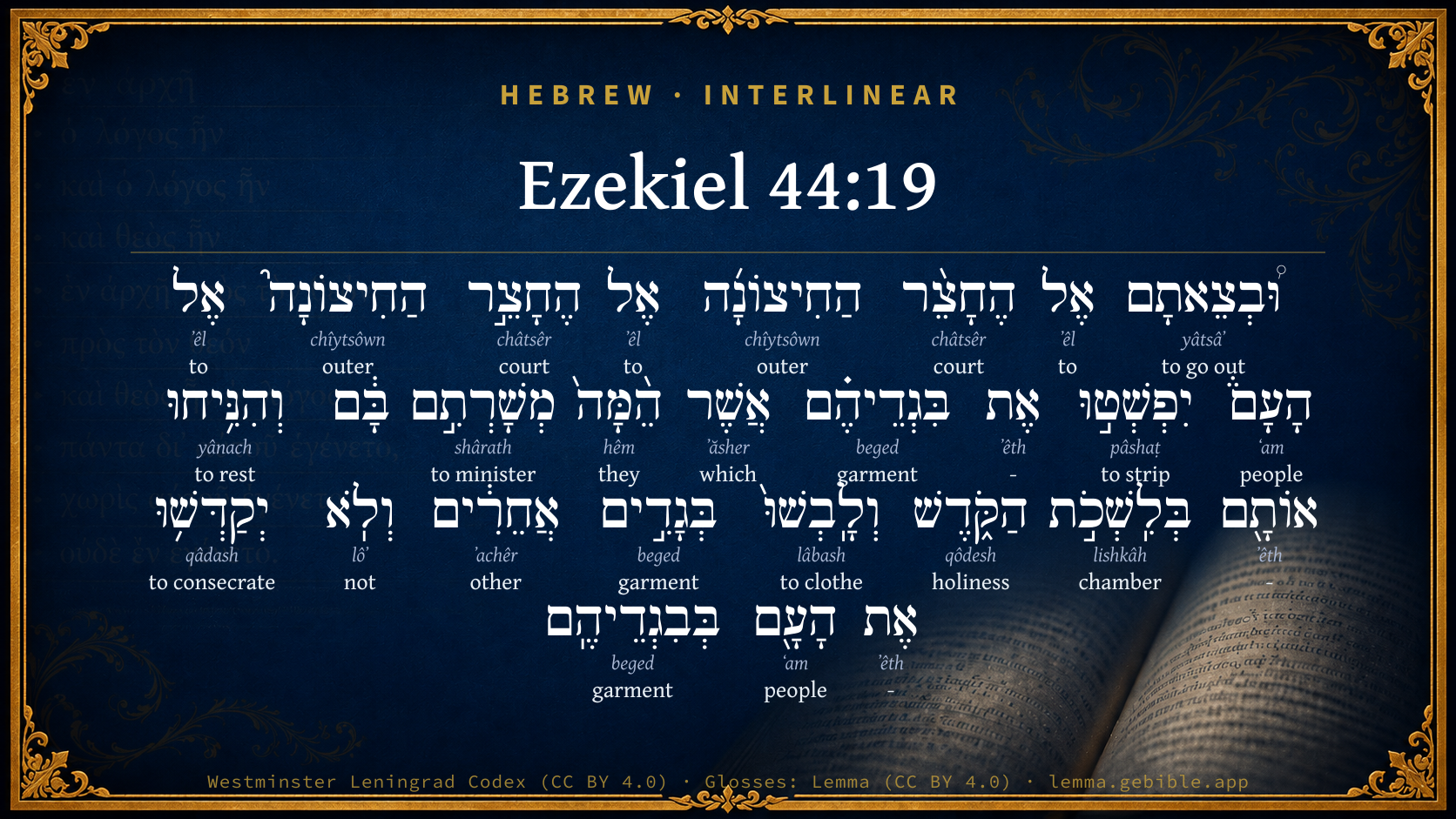
Ezekiel 44:19

Hebrew (Westminster Leningrad Codex) Ezekiel 44:19 appears in the Hebrew Old Testament. The text above is from the Westminster Leningrad Codex. Each word links to its Strong’s number, a concise gloss, and parsing drawn from the Open Scriptures Hebrew Bible morphology. Click any word for its full Brown-Driver-Briggs (BDB) entry.
Download image
Cite this verse

Ezekiel 44:19 (World English Bible). Public Domain. Lemma interlinear Bible study tool, https://lemma.gebible.app/v/ezekiel/44/19.

Show BibTeX & RIS
BibTeX
RIS
English Translation
When they go forth into the outer court, even into the outer court to the people, they shall put off their garments in which they minister, and lay them in the holy chambers; and they shall put on other garments, that they not sanctify the people with their garments.
World English Bible · Public Domain
Download a study sheet

One document with this verse’s original text, its word-by-word gloss line, the meaning frame, cross-references with their text, attributed commentary, and full source and license credits — printable, and it pastes into notes with its structure intact.

This verse Autodidact and up

Study sheet (.html) Plain text (.txt)

A passage Seminary Student

Up to 50 verses in one chapter. A passage sheet keeps up to 6 commentary sources and 12 cross-references per verse, in the order this page ranks them, and says so on the sheet whenever that leaves anything out. Ask for a single verse and you get the Autodidact verse sheet above.

Everything on this page stays free to read, with no account — the sheet is a download of what is already on screen, not access to it.

Want to remove ads? Support Godless Engineer
Compare translations 3

The same verse in 3 English versions, stacked beneath the original-language interlinear above. Click any original word for its lexicon entry.

Each is an independent rendering of the whole verse — the interlinear is not word-aligned to these translations.

Highlighted words mark where these versions differ — a whole-verse word diff, not a word-by-word alignment.

  • World English Bible Public Domain
    When they go forth into the outer court, even into the outer court to the people, they shall put off their garments in which they minister, and lay them in the holy chambers; and they shall put on other garments, that they not sanctify the people with their garments.
  • King James Version Public Domain
    And when they go forth into the utter court, even into the utter court to the people, they shall put off their garments wherein they ministered, and lay them in the holy chambers, and they shall put on other garments; and they shall not sanctify the people with their garments.
  • unfoldingWord Literal Text CC BY-SA 4.0
    When they go out to the outer courtyard, to the outer courtyard in order to go to the people, they must take off the clothes they wore when they served; they must take them off and lay them down in a holy room, so they do not make other people holy by contact with their special clothing.

unfoldingWord Literal Text — © unfoldingWord, licensed CC BY-SA 4.0. Word-aligned USFM3 via Door43 (git.door43.org/unfoldingWord/en_ult).

Versions to compare (up to 4)

3 of 4 selected

Show all 18 translations

Every available English version of this verse, each an independent rendering of the whole verse.

  • World English Bible Public Domain
    When they go forth into the outer court, even into the outer court to the people, they shall put off their garments in which they minister, and lay them in the holy chambers; and they shall put on other garments, that they not sanctify the people with their garments.
  • Berean Standard Bible Public Domain
    When they go out to the outer court, to the people, they are to take off the garments in which they have ministered, leave them in the holy chambers, and dress in other clothes so that they do not transmit holiness to the people with their garments.
  • Majority Standard Bible Public Domain
    When they go out to the outer court, to the people, they are to take off the garments in which they have ministered, leave them in the holy chambers, and dress in other clothes so that they do not transmit holiness to the people with their garments.
  • King James Version Public Domain
    And when they go forth into the utter court, even into the utter court to the people, they shall put off their garments wherein they ministered, and lay them in the holy chambers, and they shall put on other garments; and they shall not sanctify the people with their garments.
  • American Standard Version (1901) Public Domain
    And when they go forth into the outer court, even into the outer court to the people, they shall put off their garments wherein they minister, and lay them in the holy chambers; and they shall put on other garments, that they sanctify not the people with their garments.
  • Revised Version (1885) Public Domain
    And when they go forth into the outer court, even into the outer court to the people, they shall put off their garments wherein they minister, and lay them in the holy chambers, and they shall put on other garments, that they sanctify not the people with their garments.
  • Geneva Bible (1599) Public Domain
    But when they goe foorth into the vtter court, euen to the vtter court to the people, they shall put off their garments, wherein they ministred, and lay them in the holy chambers, and they shall put on other garments: for they shall not sanctifie the people with their garments.
  • Douay-Rheims (1899) Public Domain
    And when they shall go forth to the outward court to the people, they shall put off their garments wherein they ministered, and lay them up in the store chamber of the sanctuary, and they shall clothe themselves with other garments: and they shall not sanctify the people with their vestments.
  • Young's Literal Translation Public Domain
    And in their going forth unto the outer court -- unto the outer court unto the people -- they strip off their garments, in which they are ministering, and have placed them in the holy chambers, and have put on other garments; and they do not sanctify the people in their own garments.
  • Literal Standard Version CC BY-SA 4.0
    And in their going forth to the outer court—to the outer court to the people—they strip off their garments, in which they are ministering, and have placed them in the holy chambers, and have put on other garments; and they do not sanctify the people in their own garments.
  • Unlocked Literal Bible CC BY-SA 4.0
    When they go out to the outer courtyard, to the outer courtyard in order to go to the people, they must take off the clothes they wore when they served; they must take them off and lay them down in a holy room, so they do not make other people holy by contact with their special clothing.
  • unfoldingWord Literal Text CC BY-SA 4.0
    When they go out to the outer courtyard, to the outer courtyard in order to go to the people, they must take off the clothes they wore when they served; they must take them off and lay them down in a holy room, so they do not make other people holy by contact with their special clothing.
  • Darby Bible Public Domain
    And when they go forth into the outer court, into the outer court to the people, they shall put off their garments wherein they ministered, and lay them in the holy cells; and they shall put on other garments, that they may not hallow the people with their garments.
  • World Messianic Bible Public Domain
    When they go out into the outer court, even into the outer court to the people, they shall put off their garments in which they minister and lay them in the holy rooms. They shall put on other garments, that they not sanctify the people with their garments.
  • Webster's Bible Public Domain
    And when they go forth into the outer court, even into the outer court to the people, they shall put off their garments in which they ministered, and lay them in the holy chambers, and they shall put on other garments; and they shall not sanctify the people with their garments.
  • Free Bible Version CC BY-SA 4.0
    When they go to the outer court where the people are, they must take off their priestly clothes they wore when they were serving, and leave them in the holy rooms. They are to put on other clothes so that they don't carry holiness to the people with their clothing.
  • Bible in Basic English Public Domain
    And when they go out into the outer square to the people, they are to take off the robes in which they do the work of priests, and put them away in the holy rooms, and put on other clothing, so that the people may not be made holy by their robes.
  • JPS Tanakh (1917) Public Domain
    And when they go forth into the outer court, even into the outer court to the people, they shall put off their garments wherein they minister, and lay them in the holy chambers, and they shall put on other garments, that they sanctify not the people with their garments.

Literal Standard Version (2020), Covenant Press — licensed CC BY-SA 4.0. Text via the HelloAO Bible API (eBible.org). Unlocked Literal Bible (unfoldingWord) — licensed CC BY-SA 4.0. Text via the HelloAO Bible API (eBible.org). unfoldingWord Literal Text — © unfoldingWord, licensed CC BY-SA 4.0. Word-aligned USFM3 via Door43 (git.door43.org/unfoldingWord/en_ult). Free Bible Version, Dr. Jonathan Gallagher — licensed CC BY-SA 4.0. Text via the HelloAO Bible API (eBible.org).

Word by word

More ways to search: Search by grammar → Find every occurrence → Compare this word →

Practice this passage: Drill this verse → Learn its vocabulary →

הַחִיצוֹנָ֜ה
chîytsôwn
H2435
“the · outer”
Particle, Definite Article + Adjective, Adjective, Feminine, Singular, Absolute
Part of Speech
Particle + Adjective
Type
Adjective
Gender
Feminine
Number
Singular
State
Absolute
Full BDB Definition

Origin: from H2434

TWOT: 627b

outer, external, outward
  1. וּ֠בְצֵאתָם yâtsâʼ H3318 “and · in/at · to go out · them” Conjunction + Preposition + Verb, Qal, Infinitive Construct + Suffix, Personal, 3rd Person, Masculine, Plural
  2. אֶל ʼêl H413 “to” Preposition
  3. הֶחָצֵ֨ר châtsêr H2691 “the · court” Particle, Definite Article + Noun, Common, Both, Singular, Absolute
  4. אֶל ʼêl H413 “to” Preposition
  5. הֶחָצֵ֣ר châtsêr H2691 “the · court” Particle, Definite Article + Noun, Common, Both, Singular, Absolute
  6. הַחִיצוֹנָה֮ chîytsôwn H2435 “the · outer” Particle, Definite Article + Adjective, Adjective, Feminine, Singular, Absolute
  7. אֶל ʼêl H413 “to” Preposition
  8. הָעָם֒ ʻam H5971 “the · people” Particle, Definite Article + Noun, Common, Masculine, Singular, Absolute
  9. יִפְשְׁט֣וּ pâshaṭ H6584 “to strip” Verb, Qal, Imperfect, 3rd Person, Masculine, Plural
  10. אֶת ʼêth H853 “-” Particle, Direct Object
  11. בִּגְדֵיהֶ֗ם beged H899 “garments · their” Noun, Common, Masculine, Plural, Construct + Suffix, Personal, 3rd Person, Masculine, Plural
  12. אֲשֶׁר ʼăsher H834 “which” Particle, Relative
  13. הֵ֨מָּה֙ hêm H1992 “they” Pronoun, Personal, 3rd Person, Masculine, Plural
  14. מְשָׁרְתִ֣ם shârath H8334 “ministering” Verb, Piel, Participle Active, Masculine, Plural, Absolute
  15. וְהִנִּ֥יחוּ yânach H3240 “and · to rest” Conjunction + Verb, Hiphil, Sequential Perfect, 3rd Person, Common, Plural
  16. אוֹתָ֖ם ʼêth H853 “- · them” Particle, Direct Object + Suffix, Personal, 3rd Person, Masculine, Plural
  17. בְּלִֽשְׁכֹ֣ת lishkâh H3957 “in/at · chambers of” Preposition + Noun, Common, Feminine, Plural, Construct
  18. הַקֹּ֑דֶשׁ qôdesh H6944 “the · holiness” Particle, Definite Article + Noun, Common, Masculine, Singular, Absolute
  19. וְלָֽבְשׁוּ֙ lâbash H3847 “and · to clothe” Conjunction + Verb, Qal, Sequential Perfect, 3rd Person, Common, Plural
  20. בְּגָדִ֣ים beged H899 “garments” Noun, Common, Masculine, Plural, Absolute
  21. אֲחֵרִ֔ים ʼachêr H312 “other” Adjective, Adjective, Masculine, Plural, Absolute
  22. וְלֹֽא lôʼ H3808 “and · not” Conjunction + Particle, Negative
  23. יְקַדְּשׁ֥וּ qâdash H6942 “to consecrate” Verb, Piel, Imperfect, 3rd Person, Masculine, Plural
  24. אֶת ʼêth H853 “-” Particle, Direct Object
  25. הָעָ֖ם ʻam H5971 “the · people” Particle, Definite Article + Noun, Common, Masculine, Singular, Absolute
  26. בְּבִגְדֵיהֶֽם beged H899 “in/at · garments · their” Preposition + Noun, Common, Masculine, Plural, Construct + Suffix, Personal, 3rd Person, Masculine, Plural

About this verse

These counts appear in no published source. They are computed here, from the morphology-tagged text and Lemma’s own curated glosses. What Lemma adds →

28
words
18
distinct lemmas
Prophets
section

Notable vocabulary

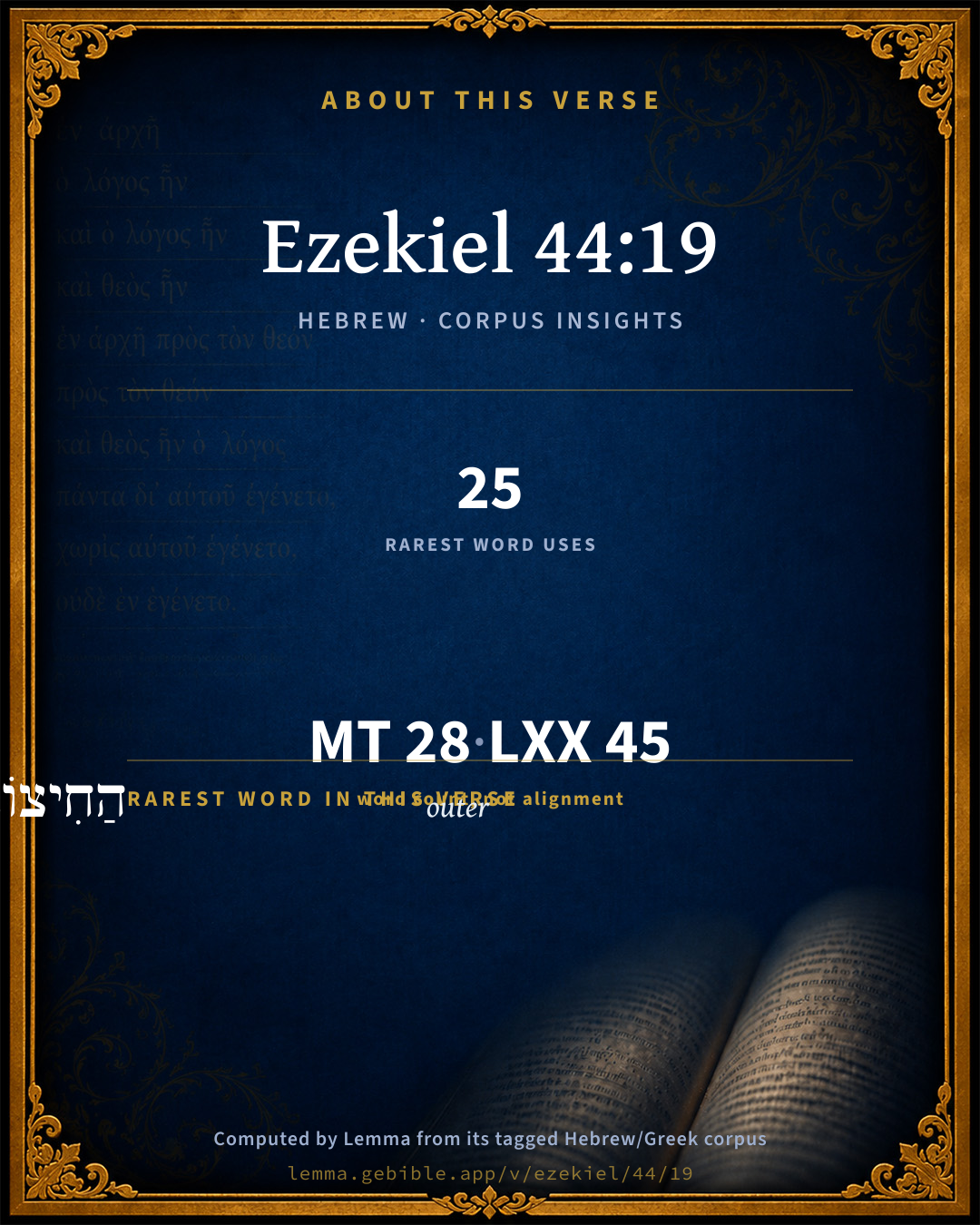
The rarest word here is הַחִיצוֹנָ֜ה outer H2435 — appearing just 25 times in the whole Hebrew Bible.

Shared distinctive vocabulary

הַחִיצוֹנָ֜ה outer H2435 occurs in 24 verses of the Hebrew Bible. Also found in:

Grammatical profile

  • 6 verbs
  • 9 nouns
  • 3 adjectives
  • 1 pronoun
  • 4 prepositions
  • 5 particles

Verb forms

  • וּ֠בְצֵאתָם Qal · Infinitive Construct
  • יִפְשְׁט֣וּ Qal · Imperfect
  • מְשָׁרְתִ֣ם Piel · Participle Active
  • וְהִנִּ֥יחוּ Hiphil · Sequential Perfect
  • וְלָֽבְשׁוּ֙ Qal · Sequential Perfect
  • יְקַדְּשׁ֥וּ Piel · Imperfect

Repetition

Words recur within this verse — often emphatic in Hebrew:

  • בִּגְדֵיהֶ֗ם garment H899 ×3
  • הֶחָצֵ֨ר court H2691 ×2
  • הַחִיצוֹנָ֜ה outer H2435 ×2
  • הָעָם֒ people H5971 ×2
  • אֶל to H413 ×3

Hebrew & Septuagint length

In English translation the verse runs 49 words from the Hebrew and 50 from the Septuagint (LXX English) — closely comparable.

A rough comparison of the two English renderings, which tokenize alike — not a word-level alignment.

Word counts can differ between the Hebrew and the Greek without any difference in meaning — e.g. the Hebrew direct-object marker אֵת has no separate Greek word, and Greek often adds the article ὁ.

In the original languages it is 28 Hebrew tokens and 45 Greek tokens — but the two are counted differently (Hebrew bundles its prefixes and suffixes into one token; the Greek is in lemma form), so that isn’t a like-for-like length.

Cross-references

8

Topical passages linked to Ezekiel 44:19 in the Treasury of Scripture Knowledge — connected by theme and wording, ordered by reader-vote popularity; previews shown in the World English Bible.

  • Leviticus 6:27 Whatever shall touch its flesh shall be holy. When there is any of its blood sprinkled on a garment, you shall wash that on which it was sprinkled in a holy place.
  • Ezekiel 46:20 He said to me, This is the place where the priests shall boil the trespass-offering and the sin-offering, [and] where they shall bake the meal-offering; that they not bring them forth into the outer court, to sanctify the people.
  • Leviticus 6:10–11 The priest shall put on his linen garment, and he shall put on his linen breeches upon his body; and he shall remove the ashes from where the fire has consumed the burnt offering on the altar, and he shall put them beside the altar.
  • Exodus 29:37 Seven days you shall make atonement for the altar, and sanctify it: and the altar shall be most holy; whatever touches the altar shall be holy.
  • Exodus 30:29 You shall sanctify them, that they may be most holy. Whatever touches them shall be holy.
  • Matthew 23:17–19 You blind fools! For which is greater, the gold, or the temple that sanctifies the gold?
  • Ezekiel 42:13–14 Then said he to me, The north chambers and the south chambers, which are before the separate place, they are the holy chambers, where the priests who are near to Yahweh shall eat the most holy things: there shall they lay the most holy things, and the meal-offering, and the sin-offering, and the trespass-offering; for the place is holy.
  • 1 Corinthians 3:5–6 Who then is Apollos, and who is Paul, but servants through whom you believed; and each as the Lord gave to him?

Cross-references courtesy of OpenBible.info (CC BY 4.0).

Hebrew and Greek witnesses Masoretic Hebrew ↔ Greek Septuagint

The same verse in the two great witnesses to the Old Testament, shown verse-for-verse.

These are two independent witnesses, not word-aligned to each other, and the Septuagint is shown in lemma (dictionary) form.

Hebrew Ezekiel 44:19 Masoretic · Westminster Leningrad Codex

וּ֠בְצֵאתָם אֶל הֶחָצֵ֨ר הַחִיצוֹנָ֜ה אֶל הֶחָצֵ֣ר הַחִיצוֹנָה֮ אֶל הָעָם֒ יִפְשְׁט֣וּ אֶת בִּגְדֵיהֶ֗ם אֲשֶׁר הֵ֨מָּה֙ מְשָׁרְתִ֣ם בָּ֔ם וְהִנִּ֥יחוּ אוֹתָ֖ם בְּלִֽשְׁכֹ֣ת הַקֹּ֑דֶשׁ וְלָֽבְשׁוּ֙ בְּגָדִ֣ים אֲחֵרִ֔ים וְלֹֽא יְקַדְּשׁ֥וּ אֶת הָעָ֖ם בְּבִגְדֵיהֶֽם

When they go forth into the outer court, even into the outer court to the people, they shall put off their garments in which they minister, and lay them in the holy chambers; and they shall put on other garments, that they not sanctify the people with their garments.

World English Bible · Public Domain

Greek LXX Ezekiel 44:19 Septuagint · lemma form

καί ἐν ὁ ἐκπορεύομαι αὐτός εἰς ὁ αὐλή ὁ ἐξώτερος πρός ὁ λαός ἐκδύω ὁ στολή αὐτός ἐν ὅς αὐτός λειτουργέω ἐν αὐτός καί τίθημι αὐτός ἐν ὁ ἐξέδρα ὁ ἅγιος καί ἐνδύω στολή ἕτερος καί οὐ μή ἁγιάζω ὁ λαός ἐν ὁ στολή αὐτός

And when they go out into the outer court to the people, they shall put off their robes, in which they minister; and they shall lay them up in the chambers of the sanctuary, and shall put on other robes, and they shall not sanctify the people with their robes.

LXX2012 (modern English Septuagint) · Public Domain

On this verse, The Cambridge Bible for Schools and Colleges discusses the Septuagint’s reading. Read the note in Commentary ↓

Hebrew: Westminster Leningrad Codex (CC BY 4.0). Greek: Septuagint (public domain); English from LXX2012 (modern English Septuagint) (Public Domain). How the Septuagint differs from the Hebrew →

Targum (Aramaic paraphrase)

1

The Targum is the ancient Jewish Aramaic paraphrase of the Hebrew Scriptures — an interpretive translation, not the Hebrew text itself. Onkelos (literal) and Pseudo-Jonathan (expansive) render the Torah, and Jonathan the Prophets. Coverage is partial: where no permissively-licensed English translation exists for a verse, only the Aramaic is shown. This is verse-level text, not a word-by-word alignment to the Hebrew.

  1. Targum Jonathan Prophets (Joshua–Malachi)
    וּבְמִיפַקְהוֹן מִדַרְתָּא דְקוּדְשָׁא לְדַרְתָּא בָרַיְתָא לְאִיתְעָרָבָא עִם עַמָא יִשְׁלְחוּן יַת לְבוּשֵׁיהוֹן דִי אִינוּן מְשַׁמְשִׁין בְּהוֹן וְיַחֲתוּן יַתְהוֹן בְּלִשְׁכַת קוּדְשָׁא וְיִלְבְּשׁוּן לְבוּשִׁין אוֹחֲרָנִין וְלָא יִתְעָרְבוּן עִם עַמָא בִּלְבוּשֵׁיהוֹן:

    (no public-domain English translation for this verse)

    Targum Jonathan — Aramaic: “Mikraot Gedolot” (public domain). English: “Sefaria Community Translation” (CC0 1.0 (public-domain dedication)); “London "Chaldee Paraphrase," 1871” (public domain). Text via Sefaria.

Commentary

Notes on Ezekiel 44:19 from classic Christian and Jewish commentators (each source and its license shown beneath its notes). The classic Christian expositions comment on the surrounding passage and are grouped to its opening verse, so a note may address several verses; the Jewish commentaries on the Tanakh (Rashi and others) are per-verse, so they appear only where the commentator wrote on this verse.

Lemma curates 59 commentaries, every one of them public domain or Creative Commons licensed, each selected and text-cleaned for this edition rather than reprinted as found. About our sources →

Trapp's Complete Commentary

John Trapp

Eze 44:19 And when they go forth into the utter court, [even] into the utter court to the people, they shall put off their garments wherein they ministered, and lay them in the holy chambers, and they shall put on other garments; and they shall not sanctify the people with their garments.

Ver. 19. They shall put off their garments.] See Eze 42:14.

They shall not sanctify the people with their garments,] i.e., By the touch of their garments. See Exo 29:37; Exo 30:29 Eze 46:20. To "sanctify the people," in this text, is to persuade them that they are sanctified by the touch or sight of the priestly vestments. The monks at this day make the silly people believe that they cannot be damned when they die if they be buried in a Franciscan’s cowl.

John Trapp, A Commentary or Exposition upon All the Books of the Old and New Testament (1647–1656) — public domain. Text from a community e-Sword module.

Jamieson, Fausset & Brown

Robert Jamieson, A. R. Fausset & David Brown

not sanctify the people with their garments--namely, those peculiarly priestly vestments in which they ministered in the sanctuary.

Jamieson, Fausset & Brown — Commentary Critical and Explanatory on the Whole Bible (1871) — public domain (CC PDM 1.0). Text via the HelloAO Bible API.

Ellicott's Commentary for English Readers

(19) They shall put off their garments.—The requirement that the priests shall wear their official dress only when engaged in official duty, putting it on when they entered the inner court, and putting it off when they went out, which is only implied in Exodus and Leviticus, is here expressly enjoined. Utter here, as elsewhere, means outer.

A Bible Commentary for English Readers, edited by Charles John Ellicott (1878–1897) — public domain. Text from a community e-Sword module.

The Cambridge Bible for Schools and Colleges

gen. ed. J. J. S. Perowne

19. The sacred garments shall be worn only in the inner court, and in service. Before going out into the outer court the priests shall put them off and deposit them in the sacred cells, Eze_42:13-14.

sanctify the people] i.e. by bringing that which is holy in contact with them. The enactment is not a precaution against defilement of the holy garments, at least in form, though it may be a precaution against confusion of the sacred and the common. Cf. Eze_46:20; Exo_29:37; Exo_30:29; Lev_6:27. The words “even into the utter court” are probably an accidental repetition. LXX. omits.

The Cambridge Bible for Schools and Colleges (gen. ed. J. J. S. Perowne; Cambridge University Press, 1878–1918) — public domain. Text from a community e-Sword module.

John Gill's Exposition

And when they go forth into the utter court,.... Out of the inner court where they minister, when they have done their service:

even into the utter court to the people; out of the church into the world, where the people are, doing their business, whether good men or bad:

they shall put off their garments wherein they ministered, and lay them in the holy chambers; the north and south chambers; See Gill on Eze 42:13, Eze 42:14,

and they shall put on other garments; which are their outward conversation garments, which are proper to appear in before men, for the honour of religion; though not sufficient to appear in before God, and render acceptable unto him:

and they shall not sanctify the people with their garments; the garments of the priesthood were reckoned holy, whatsoever was holy, that which it touched accounted holy also; and therefore, to preserve a difference between the priests and the common people, they were not to wear their holy garments but in the time of service; or lest any superstitious notion should obtain among the people, that they were sanctified by touching their clothes; as the Papists give out, that if a man is buried in a monk's cowl, he shall be saved: or the sense is, that they should not possess the minds of the people with a notion of any real sanctity in their garments; or that their conversation garments, or good works, can be of any service to them: this may be opposed to works of supererogation.

John Gill's Exposition of the Whole Bible (1746–1763) — public domain (CC PDM 1.0). Text via the HelloAO Bible API.

Haydock's Catholic Bible Commentary

Sanctify, by exposing them to the danger of touching the sacred vestments, which none were to touch but they that were sanctified. (Challoner) --- Sanctify here means to defile, Exodus xxx. 29., (Calmet) and xxix. 37. Holy things must be done in holy places. (Worthington) --- Divine religion has different clothing for the ministry, from what is used in common life. (St. Jerome) (Exodus xxviii. 40.) (Calmet)

George Leo Haydock (1774–1849), Haydock's Catholic Family Bible and Commentary, 1859 edition — public domain. Excludes Psalms (Douay-Rheims chapter numbering differs from Protestant) and Deuterocanonical books (Catholic canon only).

Matthew Poole's English Annotations

See Eze 42:14, where this verse is explained, yet here are two things that verse hath not, of which a word. The utter court: this tells us in which court stood the chambers, wherein the priests did attire themselves, into which also they retired to unclothe themselves of the priestly garments. The chambers were in the court next to the court of the people, as Eze 42:14. They shall not sanctify: by the law, common things touching holy things became consecrate, and to be no more for common use. If the priests’ consecrated clothes touched the people’s, they must part with them, this would be inconvenient; so some. Or lost the people should think themselves the holier for such contact, and grow proud of it; so others. The Chaldee paraphrast frames it to the last clause of the 14th verse of the 42nd chapter, they in holy vests shall not intermix with the people; this would be a profaning the holy vests. Or else thus, they shall not come out to bless the people in their priestly garments, but, having finished the sacrifice and all belonging thereto, they should change garments, and in their ordinary garments come out to the people, and bless them in that form, Num 6:23,24.

Matthew Poole's English Annotations on the Holy Bible (1683–1685) — public domain. Text from a community e-Sword/MySword module.

The Pulpit Commentary

When the priests retired from the inner court, and before they passed into the outer court to mingle with the people, they were enjoined to lay aside their official robes, depositing them in the holy chambers already described, (Eze_42:1-14) and to put on other, i.e. their ordinary, clothes. (comp. Lev_6:11) The reason for this injunction was that they might not sanctify the people (comp. Eze_46:20) through the people"s coming in contact with their garments. These, being in a manner, i.e. ceremonially, holy, would impart to the people a levitical or ritualistic sanctity which would disqualify them, for a time, at least, from attending to the common duties of life, as under the Law those were who touched the sacrificial flesh, (Lev_6:18, Lev_6:27) the altar, (Exo_29:37) and the vessels of the sanctuary. (Exo_30:29)

The Pulpit Commentary (1880–1919), ed. H.D.M. Spence-Jones & Joseph S. Exell — public domain. Text from a community e-Sword module.

John Wesley's Explanatory Notes

Shall not sanctify - By the law, common things, touching holy things, became consecrated, and no more fit for common use.

John Wesley, Explanatory Notes Upon the Whole Bible (1754–1765) — public domain. Text via the GEBible commentary corpus.

unfoldingWord translationNotes

Door43 World Missions Community

General Information:

Yahweh continues giving Ezekiel his message to the house of Israel about how the descendants of Zadok who serve as priests are to do their duties.

outer courtyard

See how you translated this in Ezekiel 10:5.

translationWords

servant

holy

unfoldingWord translationNotes — © Distant Shores Media and the Door43 World Missions Community, licensed CC BY-SA 4.0. Source: git.door43.org/Door43/en_tn.

Rashi

Rabbi Shlomo Yitzchaki (Rashi)

into the Outer Court, into the Outer Court Since he was speaking of the Heichal and the Inner Sanctum, and he called them the “Inner Court,” and in relation to them, he should call the Israelites’ Court an “Outer Court,” he therefore had to double it twice to say that he is speaking of the Men’s Court, the area that all Israel enter.

and place them in chambers belonging to the Sanctuary as stated by our master Moses, may he rest in peace (Lev. 16:23): “after that, he shall take off the linen garments which he had put on, etc., and he shall leave them there.”

and they shall not sanctify the people [Heb. וְלֹא יְקַדְשׁוּ אֶתהָעָם, lit. they shall not sanctify the people.] Jonathan renders: and they shall not mingle with the people in their garments, [i.e.,] they shall not touch the people with their holy garments, for ordinary garments are not ritually clean as regards [contaminating] holy garments.

Rashi on the Tanakh — English translations: “The Judaica Press complete Tanach with Rashi, translated by A. J. Rosenberg” (CC BY 4.0); “Pentateuch with Rashi's commentary by M. Rosenbaum and A.M. Silbermann, 1929-1934” (public domain); “The Metsudah Tanach series, Lakewood, N.J” (CC BY 4.0); and “The Book of Joshua, Metsudah Publications, 1997” (CC BY 4.0). Text via Sefaria.

Lesson kit

Teaching starters — assembled from the data on this page, not authored interpretation. Every prompt links to the verse data it draws on. Edit before teaching.

Ezekiel, in the Prophets, opens this verse with 28 words (18 distinct Hebrew lemmas). Its most distinctive word is chîytsôwn (“outer”). A historical commentator’s framing appears above. Read the whole chapter for the surrounding context.

Discussion questions

  1. The word chîytsôwn carries the sense “outer.” How does it shape the verse?
  2. How does 1 Kings 6:29, which shares the word «outer», read alongside this verse?
  3. What does the repetition of “garment” (3× in this one verse) do in this verse?
  4. The translations on this page render this verse differently — a whole-verse word diff, not a word-by-word alignment. What might account for the different wordings?
  5. «וּ֠בְצֵאתָם» is a Qal Infinitive Construct verb. How does that grammatical form shape the action described?
  6. Compare how Trapp's Complete Commentary and Jamieson, Fausset & Brown read this verse. Where do they agree or differ?

Things to notice

Reading settings

Reading text

Shown beneath each verse's original-language words.

Old Testament
Old Testament edition

Read the OT as the Masoretic Hebrew (MT) or the Greek Septuagint (LXX).

English shown for the Greek Septuagint (in the Hebrew ↔ Greek comparison).

Comparing translations? Open the Compare panel on any verse page to stack up to four side by side.