
Numbers 11:16

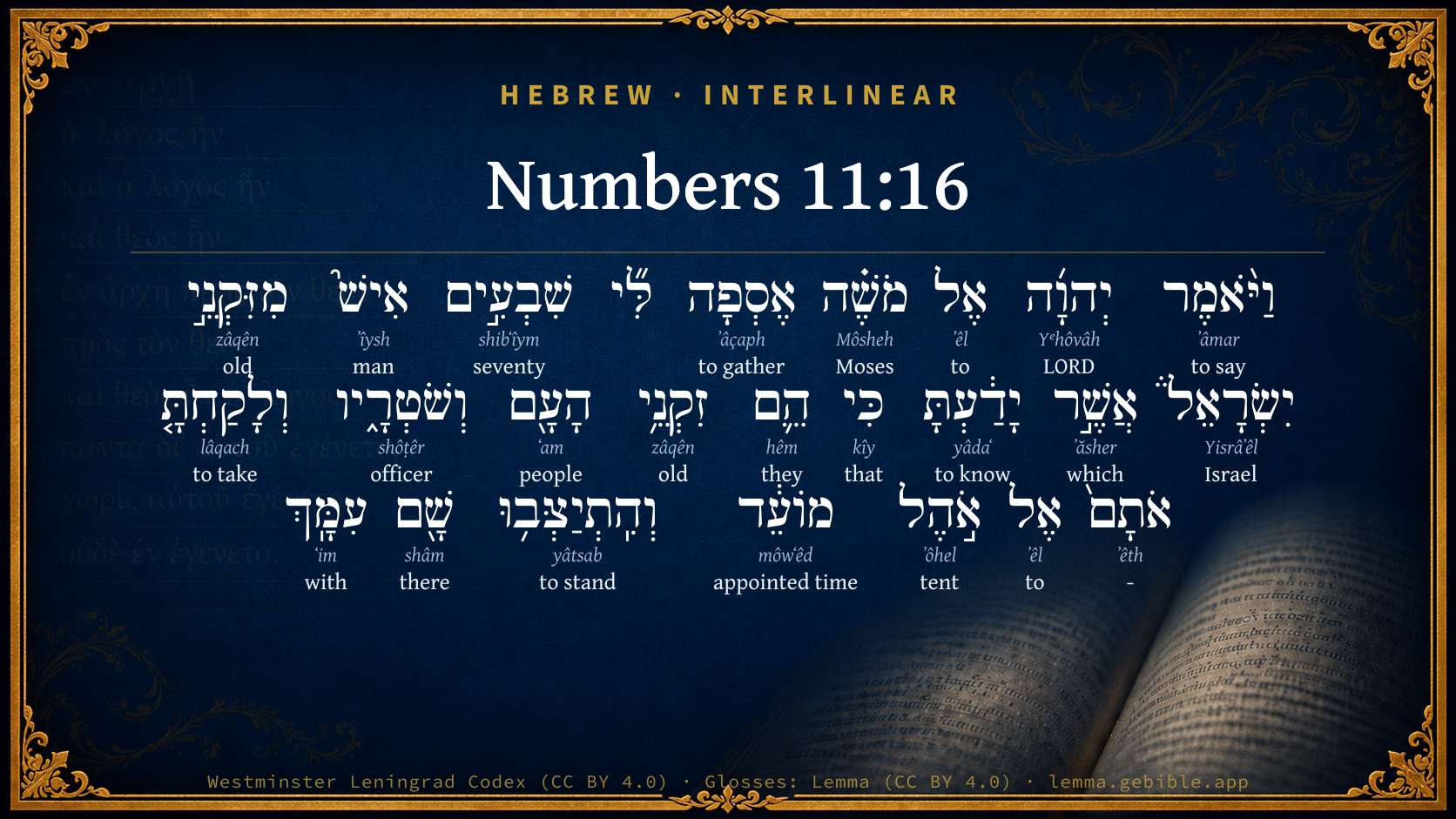
Hebrew (Westminster Leningrad Codex) Numbers 11:16 appears in the Hebrew Old Testament. The text above is from the Westminster Leningrad Codex. Each word links to its Strong’s number, a concise gloss, and parsing drawn from the Open Scriptures Hebrew Bible morphology. Click any word for its full Brown-Driver-Briggs (BDB) entry.
Download image
Cite this verse

Numbers 11:16 (World English Bible). Public Domain. Lemma interlinear Bible study tool, https://lemma.gebible.app/v/numbers/11/16.

Show BibTeX & RIS
BibTeX
RIS
English Translation
Yahweh said to Moses, Gather to me seventy men of the elders of Israel, whom you know to be the elders of the people, and officers over them; and bring them to the tent of meeting, that they may stand there with you.
World English Bible · Public Domain
Download a study sheet

One document with this verse’s original text, its word-by-word gloss line, the meaning frame, cross-references with their text, attributed commentary, and full source and license credits — printable, and it pastes into notes with its structure intact.

This verse Autodidact and up

Study sheet (.html) Plain text (.txt)

A passage Seminary Student

Up to 50 verses in one chapter. A passage sheet keeps up to 6 commentary sources and 12 cross-references per verse, in the order this page ranks them, and says so on the sheet whenever that leaves anything out. Ask for a single verse and you get the Autodidact verse sheet above.

Everything on this page stays free to read, with no account — the sheet is a download of what is already on screen, not access to it.

Want to remove ads? Support Godless Engineer
Compare translations 3

The same verse in 3 English versions, stacked beneath the original-language interlinear above. Click any original word for its lexicon entry.

Each is an independent rendering of the whole verse — the interlinear is not word-aligned to these translations.

Highlighted words mark where these versions differ — a whole-verse word diff, not a word-by-word alignment.

  • World English Bible Public Domain
    Yahweh said to Moses, Gather to me seventy men of the elders of Israel, whom you know to be the elders of the people, and officers over them; and bring them to the tent of meeting, that they may stand there with you.
  • King James Version Public Domain
    And the LORD said unto Moses, Gather unto me seventy men of the elders of Israel, whom thou knowest to be the elders of the people, and officers over them; and bring them unto the tabernacle of the congregation, that they may stand there with thee.
  • unfoldingWord Literal Text CC BY-SA 4.0
    And Yahweh said to Moses, “Gather for me 70 men from the elders of Israel whom you know that they elders of the people and its officers, and you shall take them to the tent of meeting, and they shall station themselves there with you.

unfoldingWord Literal Text — © unfoldingWord, licensed CC BY-SA 4.0. Word-aligned USFM3 via Door43 (git.door43.org/unfoldingWord/en_ult).

Versions to compare (up to 4)

3 of 4 selected

Show all 18 translations

Every available English version of this verse, each an independent rendering of the whole verse.

  • World English Bible Public Domain
    Yahweh said to Moses, Gather to me seventy men of the elders of Israel, whom you know to be the elders of the people, and officers over them; and bring them to the tent of meeting, that they may stand there with you.
  • Berean Standard Bible Public Domain
    Then the LORD said to Moses, “Bring Me seventy of the elders of Israel known to you as leaders and officers of the people. Bring them to the Tent of Meeting and have them stand there with you.
  • Majority Standard Bible Public Domain
    Then the LORD said to Moses, “Bring Me seventy of the elders of Israel known to you as leaders and officers of the people. Bring them to the Tent of Meeting and have them stand there with you.
  • King James Version Public Domain
    And the LORD said unto Moses, Gather unto me seventy men of the elders of Israel, whom thou knowest to be the elders of the people, and officers over them; and bring them unto the tabernacle of the congregation, that they may stand there with thee.
  • American Standard Version (1901) Public Domain
    And Jehovah said unto Moses, Gather unto me seventy men of the elders of Israel, whom thou knowest to be the elders of the people, and officers over them; and bring them unto the tent of meeting, that they may stand there with thee.
  • Revised Version (1885) Public Domain
    And the LORD said unto Moses, Gather unto me seventy men of the elders of Israel, whom thou knowest to be the elders of the people, and officers over them; and bring them unto the tent of meeting, that they may stand there with thee.
  • Geneva Bible (1599) Public Domain
    Then the Lord said vnto Moses, Gather vnto me seuetie men of ye Elders of Israel, whome thou knowest, that they are the Elders of the people, and gouernonrs ouer them, and bring them vnto the Tabernacle of the Congregation, and let them stand there with thee,
  • Douay-Rheims (1899) Public Domain
    And the Lord said to Moses: Gather unto me seventy men of the ancients of Israel, whom thou knowest to be ancients and masters of the people: and thou shalt bring them to the door of the tabernacle of the covenant, and shalt make them stand there with thee,
  • Young's Literal Translation Public Domain
    And Jehovah saith unto Moses, `Gather to Me seventy men of the elders of Israel, whom thou hast known that they are elders of the people, and its authorities; and thou hast taken them unto the tent of meeting, and they have stationed themselves there with thee,
  • Literal Standard Version CC BY-SA 4.0
    And YHWH says to Moses, “Gather to Me seventy men from [the] elderly of Israel, whom you have known that they are [the] elderly of the people, and its authorities; and you have taken them to the Tent of Meeting, and they have stationed themselves there with you,
  • Unlocked Literal Bible CC BY-SA 4.0
    Yahweh said to Moses, “Bring to me seventy of Israel's elders. Be sure that they are elders and officers of the people. Bring them to the tent of meeting to stand there with you.
  • unfoldingWord Literal Text CC BY-SA 4.0
    And Yahweh said to Moses, “Gather for me 70 men from the elders of Israel whom you know that they elders of the people and its officers, and you shall take them to the tent of meeting, and they shall station themselves there with you.
  • Darby Bible Public Domain
    And Jehovah said to Moses, Gather unto me seventy men of the elders of Israel, whom thou knowest to be the elders of the people, and their officers; and take them to the tent of meeting, and they shall stand there with thee.
  • World Messianic Bible Public Domain
    The LORD said to Moses, “Gather to me seventy men of the elders of Israel, whom you know to be the elders of the people and officers over them; and bring them to the Tent of Meeting, that they may stand there with you.
  • Webster's Bible Public Domain
    And the LORD said to Moses, Gather to me seventy men of the elders of Israel, whom thou knowest to be the elders of the people, and officers over them; and bring them to the tabernacle of the congregation, that they may stand there with thee.
  • Free Bible Version CC BY-SA 4.0
    The Lord told Moses, “Bring before me seventy Israelite elders who you know are respected as leaders by the people. Take them to the Tent of Meeting. They will stand there with you.
  • Bible in Basic English Public Domain
    And the Lord said to Moses, Send for seventy of the responsible men of Israel, who are in your opinion men of weight and authority over the people; make them come to the Tent of meeting and be there with you.
  • JPS Tanakh (1917) Public Domain
    And the LORD said unto Moses: 'Gather unto Me seventy men of the elders of Israel, whom thou knowest to be the elders of the people, and officers over them; and bring them unto the tent of meeting, that they may stand there with thee.

Literal Standard Version (2020), Covenant Press — licensed CC BY-SA 4.0. Text via the HelloAO Bible API (eBible.org). Unlocked Literal Bible (unfoldingWord) — licensed CC BY-SA 4.0. Text via the HelloAO Bible API (eBible.org). unfoldingWord Literal Text — © unfoldingWord, licensed CC BY-SA 4.0. Word-aligned USFM3 via Door43 (git.door43.org/unfoldingWord/en_ult). Free Bible Version, Dr. Jonathan Gallagher — licensed CC BY-SA 4.0. Text via the HelloAO Bible API (eBible.org).

Word by word

More ways to search: Search by grammar → Find every occurrence → Compare this word →

Practice this passage: Drill this verse → Learn its vocabulary →

וְשֹׁטְרָ֑יו
shôṭêr
H7860
“and · officers · his”
Conjunction + Noun, Common, Masculine, Plural, Construct + Suffix, Personal, 3rd Person, Masculine, Singular
Part of Speech
Conjunction + Noun
Type
Common
Gender
Masculine
Number
Plural
State
Construct
Full BDB Definition

Origin: act part of an otherwise unused root probably meaning to write

TWOT: TWOT - 2374a

(Qal) official, officer
  1. וַיֹּ֨אמֶר ʼâmar H559 “and · to say” Conjunction + Verb, Qal, Sequential Imperfect, 3rd Person, Masculine, Singular
  2. יְהוָ֜ה Yᵉhôvâh H3068 “LORD” Noun, Proper
  3. אֶל ʼêl H413 “to” Preposition
  4. מֹשֶׁ֗ה Môsheh H4872 “Moses” Noun, Proper
  5. אֶסְפָה ʼâçaph H622 “gather” Verb, Qal, Imperative, 2nd Person, Masculine, Singular + Suffix, h
  6. שִׁבְעִ֣ים shibʻîym H7657 “seventy” Adjective, Cardinal number, Both, Plural, Absolute
  7. אִישׁ֮ ʼîysh H376 “man” Noun, Common, Masculine, Singular, Absolute
  8. מִזִּקְנֵ֣י zâqên H2205 “from · old of” Preposition + Adjective, Adjective, Masculine, Plural, Construct
  9. יִשְׂרָאֵל֒ Yisrâʼêl H3478 “Israel” Noun, Proper
  10. אֲשֶׁ֣ר ʼăsher H834 “which” Particle, Relative
  11. יָדַ֔עְתָּ yâdaʻ H3045 “to know” Verb, Qal, Perfect, 2nd Person, Masculine, Singular
  12. כִּי kîy H3588 “that” Conjunction
  13. הֵ֛ם hêm H1992 “they” Pronoun, Personal, 3rd Person, Masculine, Plural
  14. זִקְנֵ֥י zâqên H2205 “old of” Adjective, Adjective, Masculine, Plural, Construct
  15. הָעָ֖ם ʻam H5971 “the · people” Particle, Definite Article + Noun, Common, Masculine, Singular, Absolute
  16. וְלָקַחְתָּ֤ lâqach H3947 “and · to take” Conjunction + Verb, Qal, Sequential Perfect, 2nd Person, Masculine, Singular
  17. אֹתָם֙ ʼêth H853 “- · them” Particle, Direct Object + Suffix, Personal, 3rd Person, Masculine, Plural
  18. אֶל ʼêl H413 “to” Preposition
  19. אֹ֣הֶל ʼôhel H168 “tent of” Noun, Common, Masculine, Singular, Construct
  20. מוֹעֵ֔ד môwʻêd H4150 “appointed time” Noun, Common, Masculine, Singular, Absolute
  21. וְהִֽתְיַצְּב֥וּ yâtsab H3320 “and · to stand” Conjunction + Verb, Hithpael, Sequential Perfect, 3rd Person, Common, Plural
  22. שָׁ֖ם shâm H8033 “there” Adverb
  23. עִמָּֽךְ ʻim H5973 “with · you” Preposition + Suffix, Personal, 2nd Person, Feminine, Singular

About this verse

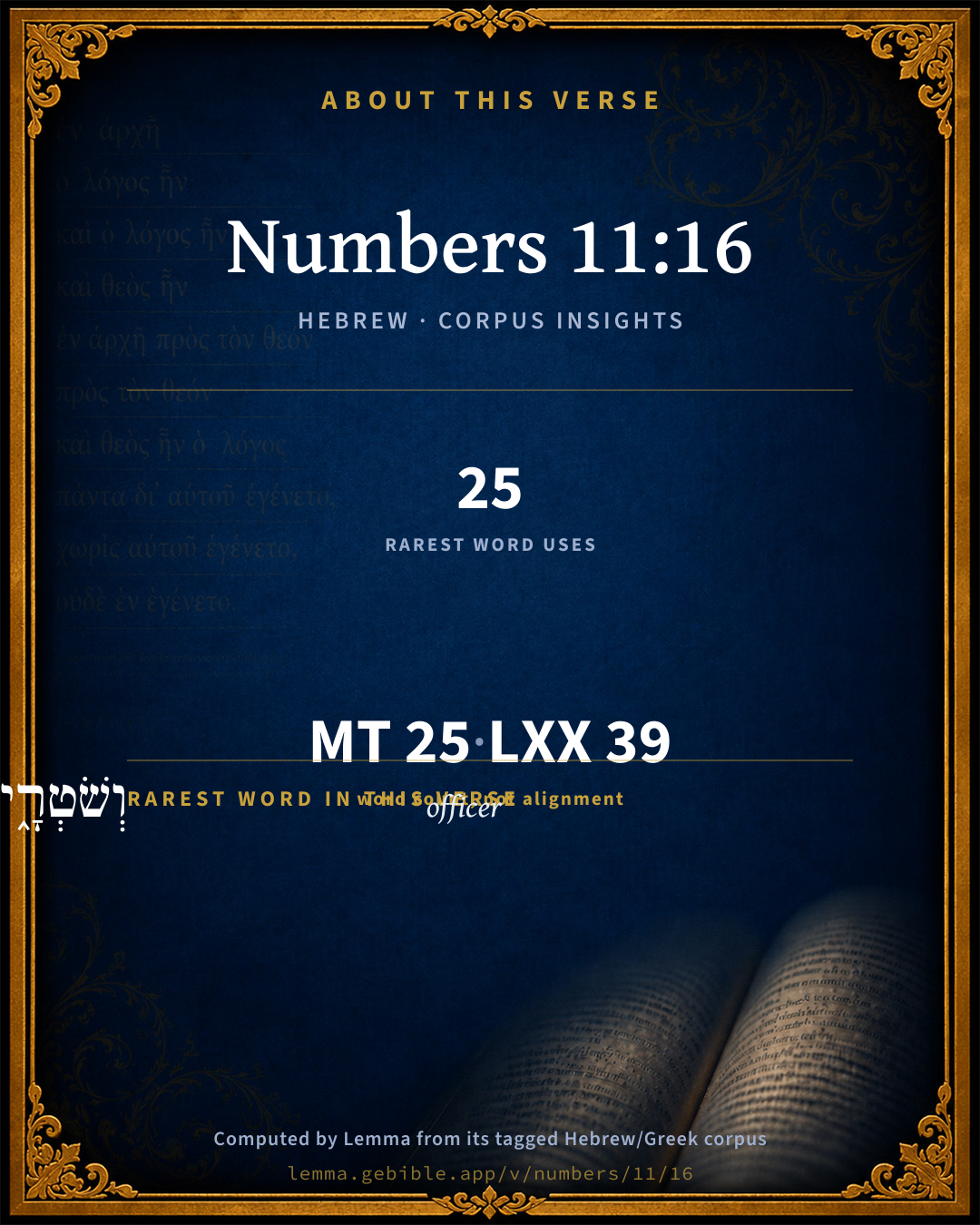
These counts appear in no published source. They are computed here, from the morphology-tagged text and Lemma’s own curated glosses. What Lemma adds →

25
words
22
distinct lemmas
Pentateuch
section

Notable vocabulary

The rarest word here is וְשֹׁטְרָ֑יו officer H7860 — appearing just 25 times in the whole Hebrew Bible.

Shared distinctive vocabulary

וְשֹׁטְרָ֑יו officer H7860 occurs in 25 verses of the Hebrew Bible. Also found in:

Grammatical profile

  • 5 verbs
  • 8 nouns
  • 3 adjectives
  • 1 pronoun
  • 4 prepositions
  • 1 conjunction
  • 1 adverb
  • 2 particles

Verb forms

  • וַיֹּ֨אמֶר Qal · Sequential Imperfect
  • אֶסְפָה Qal · Imperative
  • יָדַ֔עְתָּ Qal · Perfect
  • וְלָקַחְתָּ֤ Qal · Sequential Perfect
  • וְהִֽתְיַצְּב֥וּ Hithpael · Sequential Perfect

Repetition

Words recur within this verse — often emphatic in Hebrew:

  • מִזִּקְנֵ֣י old H2205 ×2
  • אֶל to H413 ×2

Hebrew & Septuagint length

In English translation the verse runs 43 words from the Hebrew and 47 from the Septuagint (LXX English) — closely comparable.

A rough comparison of the two English renderings, which tokenize alike — not a word-level alignment.

Word counts can differ between the Hebrew and the Greek without any difference in meaning — e.g. the Hebrew direct-object marker אֵת has no separate Greek word, and Greek often adds the article ὁ.

In the original languages it is 25 Hebrew tokens and 39 Greek tokens — but the two are counted differently (Hebrew bundles its prefixes and suffixes into one token; the Greek is in lemma form), so that isn’t a like-for-like length.

Cross-references

10

Topical passages linked to Numbers 11:16 in the Treasury of Scripture Knowledge — connected by theme and wording, ordered by reader-vote popularity; previews shown in the World English Bible.

  • Exodus 24:1 He said to Moses, "Come up to Yahweh, you, and Aaron, Nadab, and Abihu, and seventy of the elders of Israel; and worship from a distance.
  • Exodus 24:9 Then Moses, Aaron, Nadab, Abihu, and seventy of the elders of Israel went up.
  • Genesis 46:27 The sons of Joseph, who were born to him in Egypt, were two souls. All the souls of the house of Jacob, who came into Egypt, were seventy.
  • Deuteronomy 1:15 So I took the heads of your tribes, wise men, and known, and made them heads over you, captains of thousands, and captains of hundreds, and captains of fifties, and captains of tens, and officers, according to your tribes.
  • Deuteronomy 16:18 Judges and officers shall you make you in all your gates, which Yahweh your God gives you, according to your tribes; and they shall judge the people with righteous judgment.
  • Luke 10:1 Now after these things, the Lord also appointed seventy others, and sent them two by two ahead of him into every city and place, where he was about to come.
  • Luke 10:17 The seventy returned with joy, saying, "Lord, even the demons are subject to us in your name!"
  • Exodus 4:29 Moses and Aaron went and gathered together all the elders of the children of Israel.
  • Ezekiel 8:11 There stood before them seventy men of the elders of the house of Israel; and in the midst of them stood Jaazaniah the son of Shaphan, every man with his censer in his hand; and the odor of the cloud of incense went up.
  • Deuteronomy 31:28 Assemble to me all the elders of your tribes, and your officers, that I may speak these words in their ears, and call heaven and earth to witness against them.

Cross-references courtesy of OpenBible.info (CC BY 4.0).

Hebrew and Greek witnesses Masoretic Hebrew ↔ Greek Septuagint

The same verse in the two great witnesses to the Old Testament, shown verse-for-verse.

These are two independent witnesses, not word-aligned to each other, and the Septuagint is shown in lemma (dictionary) form.

Hebrew Numbers 11:16 Masoretic · Westminster Leningrad Codex

וַיֹּ֨אמֶר יְהוָ֜ה אֶל מֹשֶׁ֗ה אֶסְפָה לִּ֞י שִׁבְעִ֣ים אִישׁ֮ מִזִּקְנֵ֣י יִשְׂרָאֵל֒ אֲשֶׁ֣ר יָדַ֔עְתָּ כִּי הֵ֛ם זִקְנֵ֥י הָעָ֖ם וְשֹׁטְרָ֑יו וְלָקַחְתָּ֤ אֹתָם֙ אֶל אֹ֣הֶל מוֹעֵ֔ד וְהִֽתְיַצְּב֥וּ שָׁ֖ם עִמָּֽךְ

Yahweh said to Moses, Gather to me seventy men of the elders of Israel, whom you know to be the elders of the people, and officers over them; and bring them to the tent of meeting, that they may stand there with you.

World English Bible · Public Domain

Greek LXX Numbers 11:16 Septuagint · lemma form

καί εἶπον κύριος πρός μωυσῆς συνἄγω ἐγώ ἑβδομήκοντα ἀνήρ ἀπό ὁ πρεσβύτερος ἰσραήλ ὅς αὐτός σύ οἶδα ὅτι οὗτος εἰμί πρεσβύτερος ὁ λαός καί γραμματεύς αὐτός καί ἄγω αὐτός πρός ὁ σκηνή ὁ μαρτύριον καί ἵστημι ἐκεῖ μετά σύ

And the Lord said to Moses, Gather me seventy men from the elders of Israel, whom you yourself know that they are the elders of the people, and their scribes; and you shall bring them to the tabernacle of witness, and they shall stand there with you.

LXX2012 (modern English Septuagint) · Public Domain

On this verse, The Pulpit Commentary discusses the Septuagint’s reading. Read the note in Commentary ↓

Hebrew: Westminster Leningrad Codex (CC BY 4.0). Greek: Septuagint (public domain); English from LXX2012 (modern English Septuagint) (Public Domain). How the Septuagint differs from the Hebrew →

Targum (Aramaic paraphrase)

2

The Targum is the ancient Jewish Aramaic paraphrase of the Hebrew Scriptures — an interpretive translation, not the Hebrew text itself. Onkelos (literal) and Pseudo-Jonathan (expansive) render the Torah, and Jonathan the Prophets. Coverage is partial: where no permissively-licensed English translation exists for a verse, only the Aramaic is shown. This is verse-level text, not a word-by-word alignment to the Hebrew.

  1. Targum Onkelos Torah (Genesis–Deuteronomy)
    וַאֲמַר יְיָ לְמשֶׁה כְּנוֹשׁ קֳדָמַי שַׁבְעִין גַבְרָא מִסָבֵי יִשְׂרָאֵל דִי יְדַעַתְּ אֲרֵי אִנוּן סָבֵי עַמָא וְסַרְכוֹהִי וְתַדְבֵּר יָתְהוֹן לְמַשְׁכַּן זִמְנָא וְיִתְעַתְּדוּן תַּמָן עִמָךְ

    (no public-domain English translation for this verse)

    Targum Onkelos — Aramaic: “Onkelos Genesis” (public domain); “Onkelos Exodus” (public domain); “Onkelos Leviticus” (public domain); “Onkelos Numbers” (public domain); “Onkelos Deuteronomy” (public domain). English: “Sefaria Community Translation” (CC0 1.0 (public-domain dedication)); “J.W. Etheridge. The Targums of Onkelos and Jonathan Ben Uzziel on the Pentateuch. London: Longmans, Green, 1862” (public domain). Text via Sefaria.

  2. Targum Pseudo-Jonathan Torah (Genesis–Deuteronomy)
    וַאֲמַר יְיָ לְמשֶׁה כְּנוֹשׁ לִשְׁמִי שׁוּבְעִין גוּבְרִין זַכָּאִין מִסָבֵי יִשְרָאֵל דִיְדַעְתְּ דְהִינוּן הֲווֹ סָבֵי עַמָא וְסַרְכוֹי בְּמִצְרַיִם וְתִדְבַּר יַתְהוֹן לְמַשְׁכַּן זִמְנָא וְיִתְעַתְּדוּן תַּמָן עִמָךְ

    Then spake the Lord unto Mosheh, Gather together in My name seventy righteous men of the elders of Israel, whom thou knowest to be elders of the people, and who were set over them in Mizraim, and bring them to the taberncle to stand there with thee.

    Targum Pseudo-Jonathan — Aramaic: “Targum Jonathan on Genesis” (public domain); “Targum Jonathan on Exodus” (public domain); “Targum Jonathan on Leviticus” (public domain); “Targum Jonathan on Numbers” (public domain); “Targum Jonathan on Deuteronomy” (public domain). English: “The Targum of Jonathan ben Uzziel, trans. J. W. Etheridge, London, 1862” (public domain). Text via Sefaria.

Commentary

Notes on Numbers 11:16 from classic Christian and Jewish commentators (each source and its license shown beneath its notes). The classic Christian expositions comment on the surrounding passage and are grouped to its opening verse, so a note may address several verses; the Jewish commentaries on the Tanakh (Rashi and others) are per-verse, so they appear only where the commentator wrote on this verse.

Lemma curates 59 commentaries, every one of them public domain or Creative Commons licensed, each selected and text-cleaned for this edition rather than reprinted as found. About our sources →

Matthew Henry's Commentary

We have here God's gracious answer to both the foregoing complaints, wherein his goodness takes occasion from man's badness to appear so much the more illustrious.

I. Provision is made for the redress of the grievances Moses complains of. If he find the weight of government lie too heavy upon him, though he was a little too passionate in his remonstrance, yet he shall be eased, not by being discarded from the government himself, as he justly might have been if God had been extreme to mark what he said amiss, but by having assistants appointed him, who should be, as the apostle speaks (Co1 12:28), helps, governments (that is, helps in government), not at all to lesson or eclipse his honour, but to make the work more easy to him, and to bear the burden of the people with him. And that this provision might be both agreeable and really serviceable,

1. Moses is directed to nominate the persons, Num 11:16. The people were too hot and heady and tumultuous to be entrusted with the election; Moses must please himself in the choice, that he may not afterwards complain. The number he is to choose is seventy men, according to the number of the souls that went down into Egypt. He must choose such as he knew to be elders, that is, wise and experienced men. Those that had acquitted themselves best, as rulers of thousands and hundreds (Exo 18:25), purchase to themselves now this good degree. "Choose such as thou knowest to be elders indeed, and not in name only, officers that execute their office." We read of the same number of elders (Exo 24:1) that went up with Moses to Mount Sinai, but they were distinguished only for that occasion, these for a perpetuity; and, according to this constitution, the Sanhedrim, or great council of the Jews, which in after ages sat at Jerusalem, and was the highest court of judgment among them, consisted of seventy men. Our Saviour seems to have had an eye to it in the choice of seventy disciples, who were to be assistants to the apostles, Lu. 10.

2. God promises to qualify them. If they were not found fit for the employ, they should be made fit, else they might prove more a hindrance than a help to Moses, Num 11:17. Though Moses had talked too boldly with God, yet God does not therefore break off communion with him; he bears a great deal with us, and we must with one another: I will come down (said God) and talk with thee, when thou art more calm and composed; and I will take of the same spirit of wisdom, and piety, and courage, that is upon thee, and put it upon them. Not that Moses had the less of the Spirit for their sharing, nor that they were hereby made equal with him; Moses was still unequalled (Deu 34:10), but they were clothed with a spirit of government proportionable to their place, and with a spirit of prophecy to prove their divine call to it, the government being a Theocracy. Note, (1.) Those whom God employs in any service he qualifies for it, and those that are not in some measure qualified cannot think themselves duly called. (2.) All good qualifications are from God; every perfect gift is from the Father of lights.

II. Even the humour of the discontented people shall be gratified too, that every mouth may be stopped. They are ordered to sanctify themselves (Num 11:18), that is, to put themselves into a posture to receive such a proof of God's power as should be a token both of mercy and judgment. Prepare to meet thy God, O Israel, Amo 4:12.

1. God promises (shall I say?) - he threatens rather, that they shall have their fill of flesh, that for a month together they shall not only be fed, but feasted, with flesh, besides their daily manna; and, if they have not a better government of their appetites than now it appears they have they shall be surfeited with it (Num 11:19, Num 11:20): You shall eat till it come out at your nostrils, and become loathsome to you. See here, (1.) The vanity of all the delights of sense; they will cloy, but not satisfy: spiritual pleasures are the contrary. As the world passes away, so do the lusts of it, Jo1 2:17. What was greedily coveted in a little time comes to be nauseated. (2.) What brutish sins (and worse than brutish) gluttony and drunkenness are; they put a force upon nature, and make that the sickness of the body which should be its health; they are sins that are their own punishments, and yet not the worst that attend them. (3.) What a righteous thing it is with God to make that loathsome to men which they have inordinately lusted after. God could make them despise flesh as much as they had despised manna.

2. Moses objects the improbability of making good this word, Num 11:21, Num 11:22. It is an objection like that which the disciples made, Mar 8:4, Whence can a man satisfy these men? Some excuse Moses here, and construe what he says as only a modest enquiry which way the supply must be expected; but it savours too much of diffidence and distrust of God to be justified. He objects the number of the people, as if he that provided bread for them all could not, by the same unlimited power, provide flesh too. He reckons it must be the flesh either of beasts or fishes, because they are the most bulky animals, little thinking that the flesh of birds, little birds, should serve the purpose. God sees not as man sees, but his thoughts are above ours. He objects the greediness of the people's desires in that word, to suffice them. Note, Even true and great believers sometimes find it hard to trust God under the discouragements of second causes, and against hope to believe in hope. Moses himself could scarcely forbear saying, Can God furnish a table in the wilderness? when this had become the common cry. No doubt this was his infirmity.

3. God gives a short but sufficient answer to the objection in that question, Has the Lord's hand waxed short? Num 11:23. If Moses had remembered the years of the right hand of the Most High, he would not have started all these difficulties; therefore God reminds him of them, intimating that this objection reflected upon the divine power, of which he himself had been so often, not only the witness, but the instrument. Had he forgotten what wonders the divine power had wrought for that people, when it inflicted the plagues of Egypt, divided the sea, broached the rock, and rained bread from heaven? Had that power abated? Was God weaker than he used to be? Or was he tired with what he had done? Whatever our unbelieving hearts may suggest to the contrary, it is certain, (1.) That God's hand is not short; his power cannot be restrained in the exerting of itself by any thing but his own will; with him nothing is impossible. That hand is not short which measures the waters, metes out the heavens (Isa 40:12), and grasps the winds, Pro 30:4. (2.) That it has not waxed short. He is as strong as ever he was, fainteth not, neither is weary. And this is sufficient to silence all our distrusts when means fail us, Is any thing too hard for the Lord? God here brings Moses to this first principle, sets him back in his lesson, to learn the ancient name of God, The Lord God Almighty, and puts the proof upon the issue: Thou shalt see whether my word shall come to pass or not. This magnifies God's word above all his name, that his works never come short of it. If he speaks, it is done.

Matthew Henry's Commentary on the Whole Bible (1708–1710) — public domain (CC PDM 1.0). Text via the HelloAO Bible API.

Trapp's Complete Commentary

John Trapp

Num 11:16 And the LORD said unto Moses, Gather unto me seventy men of the elders of Israel, whom thou knowest to be the elders of the people, and officers over them; and bring them unto the tabernacle of the congregation, that they may stand there with thee.

Ver. 16. Gather unto me seventy men.] Here, say some, began the Sanhedrim, that is, the great council of the Jews, consisting of seventy seniors and one president. It continued till the time of Herod the Great, who took it away, and changed the form of it.

John Trapp, A Commentary or Exposition upon All the Books of the Old and New Testament (1647–1656) — public domain. Text from a community e-Sword module.

The Biblical Illustrator

Joseph S. Exell

Num_11:16-20

Gather unto Me seventy men of the elders.

The answer of God to the appeals of men

I. The Lords answer to the appeal of his much-tried servant.

1. The number of the assistants.

2. Their selection.

3. The qualification imparted to them.

II. The Lords answer to the appeal of his perverse people.

1. Recognises the sinful character of their appeal.

2. Demands preparation for the granting of their appeal.

3. Promises the most abundant bestowment of that which they had so passionately and sinfully desired.

Conclusion: Mark well--

1. The disgusting nature of the sins of gluttony and drunkenness.

2. The necessity of firmly controlling carnal desires. Even those animal appetites which are lawful must be kept subordinate to higher things.

3. The necessity of submissiveness in prayer. (W. Jones.)

The seventy elders

I. The calling of the seventy elders is an instance of the organising action of the spirit of God.

1. A new want needed a remedy.

2. The remedy supplied.

3. The remedy for the want extraordinary.

4. The remedy had its counterpart in--

(1) The mission of the seventy disciples.

(2) The ordination of the seven deacons.

II. The holy spirit still carries on the same work.

1. The Church has new needs. She must pray as Moses prayed, and realising the presence of the Holy Ghost, set herself to meet these new demands on her energies, in scattered hamlet and crowded alley, where Christ Himself would come.

2. Would that all the Lords people were prophets! Each Christian is a Spirit-bearer. Is he conscious of this dignity and responsibility? Each has his special gifts. (W. Walters, M. A.)

Helpers for Moses

A gracious God and most sweet Father is moved with the complaint and grief of His servant, pitying him and yielding presently helpers to bear this burden with him that he may have more comfort. Who would not joy in so sweet a judge, no sooner hearing but helping His servant oppressed with a froward charge. Be we faithful then in our places ever, and if we be too weak for them some way or other the Lord will help. These seventy men He will have furnished with His Spirit, never placing any to do a duty to whom He giveth not some measure of ability to do the same. But when it is said He will take off the Spirit which is upon Moses and put upon them, we may not think that He lessened His grace to Moses; but the meaning is, I will give to them of the same Spirit a portion, whereof I have distributed to him so great a measure; thine I will not diminish, and yet they shall have what shall be fit. (Bp. Babington.)

Dainties for the people

O sweet God! Moses He will comfort by adding helpers unto him, and the people also He will satisfy in giving them flesh which they so lusted for, and that not ordinary flesh, nor gross meat, but quails, which to this day are accounted dainties. And not for a meal or two, or a day or two, but a whole month together, &c. How showeth this the truth of that Psalm which after in his time was made (Psa_1:1-6.). Nay, how showeth this that whatsoever He will, that can He do both in heaven and earth; and therefore blessed is the man that putteth his trust in Him. Remember what you read in the holy gospel (Mat_6:25). What dearth so great, what penury so pinching, wherein the Lord cannot help us either ordinarily or extraordinarily? Can He thus glut His great host with dainty quails, and cannot He send you and yours bread? Fear not, but cleave unto Him fast, and even past hope if the case should be such, yet under hope believe all the Scriptures, and that He will never leave you succourless that openeth His hand and filleth all things with plenteousness. Only consider that many ways He ever exerciseth the faith of His children and their patience, whose duty is to bear with contentment what He sendeth, praying to Him to remember mercy, and to lay no more upon us than we are able to bear, as He hath promised, use such means as you can by just and honest labour or otherwise; and be assured, in goodness He will step in when He seeth time. (Bp. Babington.)

The Biblical Illustrator, edited by Joseph S. Exell (c. 1880s–1900s) — public domain. Text from a community e-Sword module.

Joseph Benson's Commentary

Num 11:16. To be elders — Whom thou by experience discernest to be elders, not only in years and name, but also in wisdom and authority with the people. And according to this constitution, the sanhedrim, or great council of the Jews, which in after ages sat at Jerusalem, and was the highest court of judgment among them, consisted of seventy men.

Joseph Benson's Commentary on the Old and New Testaments (1811–1818) — public domain. Text from a community e-Sword module.

Whedon's Commentary on the Bible

Daniel D. Whedon

THE SEVENTY ELDERS APPOINTED — THE QUAILS PROMISED, Num_11:16-23.

Though Jehovah might have said to Moses, “My grace is sufficient for thee,” he chose to give the sinking faith of his servant a visible prop in the election of a council of seventy to share his responsibility. When the Lord stations a man at a post of duty he fits him for it if he trust in him, and maintains him in it by raising up coadjutors.

16. Whom thou knowest to be the elders — Something in addition to mature age is evidently sought, namely, the qualities which properly belong to advancing years — gravity, wisdom, and piety. Out of an existing class of elders the seventy were to be chosen by Moses. See Exo_24:1.

Officers — Hebrew, shoterim. These were not judges, (Deu_16:18,) but writers who kept the genealogical registers on which all hereditary succession and ancestral fame depended. Hence the office was fully as dignified as that of a judge. In subsequent times the Levites, the scholastic tribe, supplied most of these scribes. See Exo_5:6-9, notes. These were brought unto the tabernacle, that they might be first separated from secular employments and then be filled with the Spirit.

After this public inauguration there could be no doubt among the people as to their authority. If this body of elders was designed to be a permanent council — the Sanhedrim of the New Testament — it is remarkable that no further mention is made of it in the Old Testament during the fifteen intervening centuries. Hence we conclude that this senate was designed only to afford temporary relief to Moses amid the extraordinary perplexities of the sojourn in the wilderness.

Daniel D. Whedon (gen. ed.), Commentary on the Old and New Testaments (1874–1909) — public domain. Text from a community e-Sword module.

Keil & Delitzsch

C. F. Keil & F. Delitzsch

There was good ground for his complaint. The burden of the office laid upon the shoulders of Moses was really too heavy for one man; and even the discontent which broke out in the complaint was nothing more than an outpouring of zeal for the office assigned him by God, under the burden of which his strength would eventually break down, unless he received some support. He was not tired of the office, but would stake his life for it if God did not relieve him in some way, as office and life were really one in him. Jehovah therefore relieved him in the distress of which he complained, without blaming the words of His servant, which bordered on despair. "Gather unto Me," He said to Moses (Num 11:16, Num 11:17), "seventy men of the elders of Israel, whom thou knowest as elders and officers (shoterim, see Exo 5:6) of the people, and bring them unto the tabernacle, that they may place themselves there with thee. I will come down (see at Num 11:25) and speak with thee there, and will take of the spirit which is upon thee, and will put it upon them, that they may bear the burden of the people with thee."

Keil & Delitzsch — Biblical Commentary on the Old Testament (1861–1891) — public domain (CC PDM 1.0). Text via the HelloAO Bible API. (Old Testament only.)

Tyndale Open Study Notes

Tyndale Open Resources

11:16-30 When Jethro proposed a judicial hierarchy (Exod 18:13-26), he was concerned with practical matters, as were the tribal leaders who helped Moses with the registration (Num 1:5-15). By contrast, this group of seventy . . . elders would provide Israel with spiritual guidance. They needed a share of God’s Spirit that already rested upon Moses and made him the Lord’s special spokesman. Their capacity as leaders depended on the presence of God’s Spirit (cp. 1 Sam 10:6; 19:20; Joel 2:28; Acts 2:16-18; 1 Cor 12:10; 2 Pet 1:20-21).

Tyndale Open Study Notes — © Tyndale Open Resources, licensed CC BY-SA 4.0. Text via the HelloAO Bible API.

Jamieson, Fausset & Brown

Robert Jamieson, A. R. Fausset & David Brown

the Lord said unto Moses, Gather unto me seventy men of the elders-- (Exo 3:16; Exo 5:6; Exo 24:9; Exo 18:21, Exo 18:24; Lev 4:15). An order of seventy was to be created, either by a selection from the existing staff of elders or by the appointment of new ones, empowered to assist him by their collective wisdom and experience in the onerous cares of government. The Jewish writers say that this was the origin of the Sanhedrin, or supreme appellate court of their nation. But there is every reason to believe that it was only a temporary expedient, adopted to meet a trying exigency.

Jamieson, Fausset & Brown — Commentary Critical and Explanatory on the Whole Bible (1871) — public domain (CC PDM 1.0). Text via the HelloAO Bible API.

Ellicott's Commentary for English Readers

(16) Seventy men of the elders of Israel . . . —We find mention made of elders of the people in Exo_3:16, and of officers (shoterim) in Exo_5:16;

also of seventy elders in Exo_24:1. Frequent mention is made in Scripture of the number seventy—a number which is composed of the two sacred numbers seven and ten—the former being the seal of the covenant, and the latter probably denoting perfection. The seventy who were chosen on the present occasion may have consisted of some of those who were appointed as judges at the suggestion of Jethro, but there is no evidence of their identity with any persons previously selected.

A Bible Commentary for English Readers, edited by Charles John Ellicott (1878–1897) — public domain. Text from a community e-Sword module.

The Cambridge Bible for Schools and Colleges

gen. ed. J. J. S. Perowne

16. the elders of the people and their officers] The institution of these officials, with an authority inferior to that of Moses, is related in Exodus 18, which originally stood after the account of the giving of the law at Sinai (see Driver, Exodus, p. 162), and therefore in close juxtaposition to the present narrative.

17a. come down and talk with thee there] Cf. Exo_33:9; Exo_33:11.

take of the spirit which is upon thee] This expresses the primitive notion that ‘spirit’ (in the sense of an inspiration which imparts wisdom or intellectual ability) came upon a person from without, and could be thought of quantitatively. Moses was endued with such a large share of it that some could be taken from him and put upon others. Cf. 2Ki_2:9.

17b. and they shall bear &c.] This half-verse was probably not part of the original narrative. It seems to have been added by a later writer who thought that the inspiration of the elders was the answer to Moses’ complaint of the burden of the people. See above.

(I) 18–24a. The Quails. The continuation of Num_11:13.

The Cambridge Bible for Schools and Colleges (gen. ed. J. J. S. Perowne; Cambridge University Press, 1878–1918) — public domain. Text from a community e-Sword module.

John Gill's Exposition

And the Lord said unto Moses,.... Without making any reflection upon him, or upbraiding him with his unbecoming speeches to him, but in a kind and tender manner directs for his assistance and case:

gather unto me seventy men of the elders of Israel; out from among them, such as were not only men in years, but men of gravity, prudence, and wisdom; elders there were among the people in Egypt, Exo 3:16; and it was from among such as those the seventy men were to be taken; we read of seventy elders before this time, that went up to the mount with Moses, Exo 24:1; but they are supposed only to be selected for that purpose at that time, and did not continue as a separate body, or in any office: according to this number seventy, the great sanhedrim, or court of judicature the sat at Jerusalem in later times, consisted of seventy persons, with a prince or president at the head of them, as Moses was at the head of those: and so our Lord, besides his twelve apostles, sent out seventy disciples to be assisting in his work and service, Luk 10:1,

whom thou knowest to be elders of the people; either in age, or in some sort of office and authority among them, or, however, to be good and just men, and had a considerable share of knowledge, understanding, and wisdom:

and officers over them; such as Jethro advised to constitute, Exo 18:21; and it is not improbable that these seventy were chosen out of them:

and bring them unto the tabernacle of the congregation, that they may stand there with thee; and be seen by all the people what honour was done them, what authority was conferred upon them, and what gifts were bestowed on them, qualifying them for their office, in which they were to be treated with respect by them.

John Gill's Exposition of the Whole Bible (1746–1763) — public domain (CC PDM 1.0). Text via the HelloAO Bible API.

Haydock's Catholic Bible Commentary

Seventy men. This was the first institution of the council or senate, called the Sanhedrim, consisting of seventy, or seventy-two senators or counselors. (Challoner) --- Calmet calls this in question. (Dissert. on the Police, &c.) Moses chose these senators from among the officers, whom he had before set over the people, (Exodus xviii.) or from those who had superintended their affairs in Egypt, according to the Rabbins, (Exodus iii. 14,) who say that the traditions explaining the law were entrusted to them. (Jarchi, &c.) --- Ancients; a title of authority in the East. See Genesis l. 7. It was not so necessary that they should be far advanced in year, as that they should be men of prudence and of consummate virtue. These qualifications received a great increase, when they were filled with the spirit of God. (Calmet) --- They were thus authorized to decide controversies peremptorily, and to consult God, like Moses, being endued also with a prophetic spirit. (Menochius)

George Leo Haydock (1774–1849), Haydock's Catholic Family Bible and Commentary, 1859 edition — public domain. Excludes Psalms (Douay-Rheims chapter numbering differs from Protestant) and Deuterocanonical books (Catholic canon only).

Matthew Poole's English Annotations

Of whom see Exo 3:16; 5:6; Lev 4:15; Deu 16:18.

Whom thou knowest to be the elders; whom thou by experience discernest to be elders not only in years, and name, and place, but also in wisdom, and gravity, and authority with the people.

Matthew Poole's English Annotations on the Holy Bible (1683–1685) — public domain. Text from a community e-Sword/MySword module.

The Pulpit Commentary

And the Lord said unto Moses. The Divine dignity and goodness of this answer, if not an absolutely conclusive testimony, are at least a very strong one, to the genuineness of this record. Of what god, except the Father of our Lord Jesus Christ, was it ever witnessed, or could it have been ever imagined, that he should answer the passionate injustice of his servant with such forbearance and kindness? The one thing in Moses" prayer which was reasonable he allowed at once; the rest he passed over without answer or reproof, as though it had never been uttered. Gather unto me seventy men of the elders of Israel. That the number seventy has a symbolic significance in Scripture will hardly be denied, (cf. Exo_1:5 Dan_9:2, 24 Luk_10:1) although it is probably futile to affix any precise meaning to it. Perhaps the leading idea of seventy is fullness, as that of twelve is symmetry. (see on Exo_15:27) The later Jews believed that there were seventy nations in the world. There is no reason, except a reckless desire to confound the sacred narrative, to identify this appointment with that narrated in Exo_18:21, sq. and Deu_1:9, sq. The circumstances and the purposes appear quite distinct: those were appointed to assist Moses in purely secular matters, to share his burden as a judge; these to assist him in religious matters, to support him as a mediator; those used the ordinary gifts of wisdom, discretion, and personal authority; these the extraordinary gifts of the Spirit. It is more reasonable to suppose that these seventy were the same men that went up into Mount Sinai with Moses, and saw the God of Israel, and ate of the consecrated meal of the covenant, about a year before. Unless there was some decisive reason against it, an elder who had been chosen for that high religious privilege could hardly fail to be chosen on this occasion also; an interview with God himself, so mysteriously and awfully significant, must surely have left an ineffaceable stamp of sanctity on any soul at all worthy of it. It would be natural to suppose that while the present selection was made de novo, the individuals selected were personally the same. Compare note on chapter 1:5, and for "the elders of Israel" see on Exo_3:16. Whom thou knowest to be elders of the people, and officers over them. On the officers (Hebrew, shoterim), an ancient order in the national organization of Israel, continued from the days of bondage, see Exo_5:6. The Targ. Pal. paraphrases the word shoterim by "who were set over them in Mizraim." The Septuagint has hero presbuteroi tou laou kai grummateiv autwn , words so familiar to the reader of the Greek Gospels. The later Jews traced back their Sanhedrim, or grand council of seventy, to this appointment, and found their eiders and scribes in this verse. There was, however, no further historical connection between the two bodies than this that when the monarchy failed and prophecy died out, the ecclesiastical leaders of the Jews modeled their institutions upon, and adapted their titles to, this Divinely-ordered original.

HOMILIES BY W. BINNIE Vers. 16, 17, 24, 25. The seventy elders, and how they were fitted for their high office.

The murmuring of the people so soon after setting out on the march from Horeb reminded Moses again, very painfully, what a heavy burden had been laid upon him in the leadership of so great a multitude of people newly escaped from slavery. He complained to the Lord. His complaint was graciously heard. He was directed to gather around him a company of seventy elders, who might aid him with their counsel, and share his burden.

I Regarding THE STATUS AND FUNCTIONS OF THIS COMPANY OF SEVENTY there have been many debates. Some have identified them with the Sanhedrim or Council of Seventy whom we meet with so often in the Gospels and the Acts. Passing by these questions, let us note the facts recorded in the text itself. What was wanted was not the appointment of ordinary rulers or judges. Every tribe had already a prince, a body of elders and officers, and rulers of tens and fifties and hundreds and thousands, who judged between man and man. What was wanted was a council to aid Moses with their advice and assistance in the administration of the national affairs. (Compare the Governors and Council in a British dependency.)

II THE MANNER OF THE APPOINTMENT OF THE SEVENTY IS CAREFULLY DESCRIBED.

1. No one was appointed who was not in public office already. "Gather unto me seventy men, whom thou knowest to be the elders of the people, and officers over them;" i.e., they were not to be raw, inexperienced, untried men. Only those were eligible who had given proof of ability and faithfulness in the public service, either as elders or as officers (i.e., writers or scriveners this is the literal meaning of the Hebrew shoterim. The reference is to professional scribes, the assessors of non-professional magistrates, such as the Hebrew elders were). This rule was a good one. No man should be raised at one bound to high office, either in Church or State.

2. They were nominated by Moses. In this respect the procedure was exceptional. There was far less of centralization in the government of Israel than a modern and Western reader of the Bible is apt to think. To be sure, there were no representative bodies such as we are familiar with. Nevertheless, the government was truly popular. Even in Egypt the people were ruled, in the first instance, by their own elders the beads of families and tribes; and this primitive system was continued in a more perfect form in Palestine. But although local government could be best administered by local magistrates, it was otherwise with the supreme and central government with which Moses was charged. A council such as he required could only be had by freely calling forth men of outstanding ability and approved wisdom.

3. They were invested with office in the face of the congregation, and before the Lord. In the face of the congregation, to remind them that they were to act for the public good, and not in pursuance of any private interest. Before the Lord, to remind them that "there is no power but of God;" their authority is from God, and is to be used as they shall answer to him.

4. They were endowed from above with new gifts to qualify them for their new office. When Moses gathered them before the tabernacle, "the Lord came down in a cloud, and spoke unto him, and took of the spirit that was upon him, and gave it unto the seventy elders." This has been interpreted to mean that there was abstracted from Moses some part of the spirit by which he had hitherto been sustained. But that is certainly a perverse misinterpretation. Twenty lamps may be lighted from one lamp without diminishing its brightness. (cf. 2Ki_2:9) God sendeth no man to warfare at his own charges. When he calls any man to public service, whether in Church or State, the man so called may, without doubting, ask and expect the wisdom, strength, courage which the service requires. (Jam_1:5-8)

III The most picturesque feature in the narrative is that which remains yet to be noticed THE STRIKING SIGN BY WHICH NOTIFICATION WAS GIVEN THAT THE SEVENTY ELDERS HAD TRULY BEEN CALLED BY GOD AND WOULD BE COUNTENANCED BY HIM. "When the Spirit rested on them, they prophesied, and added no more" (such is the rendering now preferred by all the best translators). "They prophesied," that is, they spoke as men who were for the time lifted above themselves as men under the influence of an irresistible power external to themselves. We may presume that what they did say would be of such a kind as to make it plain that the power acting upon them was Divine and heavenly. This prophesying was intended to signalize the inward gifts with which the newly-appointed elders were now being endowed. This is plain from the parallel case related in 1Sa

10. The Lord in appointing Saul be king over Israel promised "to be with him; to give him another heart," so that he should "be turned into another man." With the kingly office he was to get from the Lord the kingly mind. In token of this, the Spirit came upon him, and he prophesied. (cf. Act_2:3, 4 10:44-47) The impulse was only a transient one. "They prophesied, and added no more." The miracle, having served its purpose, ceased; but the spiritual endowment of which it was the token remained. This prophesying, if you consider it well, will be seen to be more than a token. Besides notifying the Lord s approval of the elders, and assuring them of help, it suggested much instruction regarding the principles which should regulate their administration. The tongues of fire and the rapturous speaking with tongues on the day of Pentecost, we know what that miracle meant. It admonished the disciples that the warfare of Christ"s kingdom is to be accomplished not with the sword, but with the tongue; not with violence and bloodshed, but by the earnest and living manifestation of the truth. It was a lesson of the same kind which the Lord suggested by the miracle wrought on the seventy elders in front of the tabernacle. They were admonished that in their administration of affairs they ought to make use rather of wise and persuasive speech than of brute force. And is not this a lesson for us also? The time is not come yet perhaps will never come in the present state for rulers to lay aside the sword altogether. Violent men, if they will not listen to reason, must be restrained with violence. Nevertheless, even for civil rulers, the employment of force is the less honourable function of their office. Better to restrain and guide and govern men with wise, firm, persuasive words than with the sword. B.

Vers. 16, 17. The answer of God.

1. He does not openly and directly reprove the reckless language of his servant. Both Moses and the people had sinned, but with such a difference that while God visits the people with immediate and condign punishment he stretches forth his hand to Moses, even as Jesus did to Peter sinking in the sea. God treated Moses here very much as he treated the complaining Elijah. (1Ki 19) Moses was just the sort of man who might be trusted to rebuke himself, and bitterly repent all the unjust and unbelieving thoughts, which, upon this sudden temptation, had come into his mind.

2. The first word of God tends to bring Moses to a calmer mind. It sets before him something practical and not very difficult. Left to himself, he knows not how to begin dealing with this anarchy, especially with his own mind in such a distressed state. But it was a task quite within his reach, to pick out from a limited and probably well-known circle, seventy elders, official and experienced men. As he went through this work, he would be brought to feel, and not without a sense of shame, that he had been overtaken by panic. He has talked about sucking children; he now hears that there are at least seventy elders upon whose experience and influence he can lean. We soon find out, if we only listen to God, that temporal troubles are never so bad as they seem.

3. The way in which this help was made as effectual as possible. As God had given a certain spirit to Moses, so he would give it also to these seventy assistant elders. This was a reminder that he had not afflicted his servant and frowned upon him, as he so recklessly said (verse 11). We often murmur and complain against Providence for neglecting us, when the real neglect is with ourselves in making a bad use of gifts bestowed. God never tells his people to do things beyond natural strength, without first assuring a sufficiency of power for the thing commanded. "I can do all things, through Christ who inwardly strengthens me," said Paul There is further encouragement in God"s promise here, as being an illustration of how the spirit is given without measure. There was not a certain limited manifestation to Moses, so that if others shared the spirit with him, he must have less. Neither his power nor his honour were one whir diminished. The question always is, What is the need of men in the sight of God? Then, according to that need, and never coming short of it, are the communications of his Holy Spirit. Moses, instead of being poorer, was really richer, for the spirit was working in a mind to which a precious experience had been added.

4. In the sight of these directions we are reminded how Moses spoke out of a comparative inexperience of the burden. Moses said there was nothing left for him but to die. The history tells us that so far from dying, he had yet in him nearly forty years of honourable mediatorship between God and men. His proper word was, "I shall not die, but live, and declare the works of the Lord". (Psa_118:17) It is marvelous to think what some men have gone through in the way of difficulties, losses, and trials. Even the natural man has greater strength in the hour of trouble than at first he is conscious of a great deal of trouble, when it is once fairly over, comes in the course of time to look a very small thing and if we have God"s strength, then we shall not merely endure tribulation, but glory in it. Front these words of Moses and the practical gentle reply of God, learn one great lesson how easy it is to exaggerate our difficulties and underrate our resources. Y.

The Pulpit Commentary (1880–1919), ed. H.D.M. Spence-Jones & Joseph S. Exell — public domain. Text from a community e-Sword module.

John Wesley's Explanatory Notes

To be elders - Whom thou by experience discernest to be elders not only in years, and name, but also in wisdom and authority with the people. And according to this constitution, the Sanhedrim, or great council of the Jews, which in after-ages sat at Jerusalem, and was the highest court of the judgment among them, consisted of seventy men.

John Wesley, Explanatory Notes Upon the Whole Bible (1754–1765) — public domain. Text via the GEBible commentary corpus.

unfoldingWord translationNotes

Door43 World Missions Community

some of the Spirit that is on you

The "Spirit" here represents the power that God's Spirit had given to Moses so that Moses could do what God told him to do. AT: "some of the power that the Spirit has given you" (See: Metonymy)

They will bear the burden of the people with you

God speaks of the responsibility of leading and providing for the people as if it were a burden that Moses and the leaders would carry. AT: "They will help you care for the people" (See: Metaphor)

You will not have to bear it alone

God speaks of the responsibility of leading and providing for the people as if it were a burden that Moses and the leaders would carry. AT: "You will not care for them alone" (See: Metaphor)

translationWords

Yahweh

Moses

Israel

elder

tent of meeting

spirit

burden

unfoldingWord translationNotes — © Distant Shores Media and the Door43 World Missions Community, licensed CC BY-SA 4.0. Source: git.door43.org/Door43/en_tn.

Rashi

Rabbi Shlomo Yitzchaki (Rashi)

אספה לי GATHER UNTO ME [SEVENTY MEN OF THE ELDERS OF ISRAEL] — "This" — the Lord said — “is the reply to your complaint which you uttered (v. 14) I am not able to bear all this people alone”’ (cf. Sifrei Bamidbar 92). But where were the first elders, that God commanded him to gather elders anew? Had they not sat as judges together with them (with Moses and Aaron) in Egypt, as it is stated, (Exodus 3:16) “Go and gather the elders of Israel together”? But these had died by the consuming fire of Taberah (v. 3). They really had deserved this for their conduct at Sinai, as it is said, (Exodus 24:11) "And they beheld God” which means, that they comported themselves irreverently towards God — like a person who nibbles his bread and at the same time addresses the king — for this is the meaning of the words, “[And they saw God] and ate and drank”. The Holy One, blessed be He, however, did not wish to give any cause for mourning at the joyous event of the Lawgiving, and therefore punished them here (at Taberah) (Midrash Tanchuma, Beha'alotcha 16).

אשר ידעת כי הם וגו׳ WHOM THOU KNOWEST TO BE [THE ELDERS OF THE PEOPLE, AND BAILIFFS OVER THEM] — i.e. them whom thou knowest to have been appointed officers (שמרים) over them (the Israelites) in Egypt in connection with the rigorous labour imposed on them, but they pitied them and were smitten by the Egyptian taskmasters on their account — as it is said, (Exodus 5:14) “and the officers of (שמד) the children of Israel were smitten”. Now they were to become officers in their greatness (now when the Israelites had become great) just as they had suffered when they (the Israelites) were in distress (cf. Sifrei Bamidbar 92).

ולקחת אתם AND TAKE THEM [UNTO THE APPOINTED TENT] — win them over with fine words: “Happy are you that you are appointed chiefs over the children of the Omnipresent God” (cf. Sifrei Bamidbar 92).

והתיצבו שם עמך AND LET THEM PLACE THEMSELVES THERE WITH THEE, in order that the Israelites may see it and do them high esteem and honour, saying, “Beloved indeed must these be since they may enter together with Moses to hear Divine utterance from the mouth of the Holy One, blessed be He!” (Sifrei Bamidbar 92).

Rashi on the Tanakh — English translations: “The Judaica Press complete Tanach with Rashi, translated by A. J. Rosenberg” (CC BY 4.0); “Pentateuch with Rashi's commentary by M. Rosenbaum and A.M. Silbermann, 1929-1934” (public domain); “The Metsudah Tanach series, Lakewood, N.J” (CC BY 4.0); and “The Book of Joshua, Metsudah Publications, 1997” (CC BY 4.0). Text via Sefaria.

Ramban (Nachmanides)

Rabbi Moshe ben Nachman (Ramban / Nachmanides)

AND THE ETERNAL SAID UNTO MOSES: GATHER UNTO ME SEVENTY MEN OF THE ELDERS OF ISRAEL. Our Rabbis have already mentioned that there are seventy nations with seventy languages, each one having a constellation in the heavens with a prince above it, as it is said in the Book of Daniel, and the prince of the kingdom of Persia, and it is [further] written with reference to the kings of Greece, lo, the prince of Greece shall come; and it is about this that Scripture states, And the Eternal will punish the host of the high heaven on high. The Rabbis have also said that the [seventy] bullocks [brought as offerings on the seven days] of the Festival of Tabernacles allude to them. [A similar reference to the seventy princes we find, in connection with the Tower of Babel] in the Pirkei d’Rabbi Eliezer: “Said the Holy One, blessed be He, to the seventy kings that surround the throne of His Glory: ‘Let us come and confound their language.’” It was for this reason that the number of those who went down to Egypt was seventy, 46:27. and that He commanded that there should be this number of judges in Israel [as is stated in the verse before us], for this number includes all opinions [that are possible in a given case] since it comprises all powers, and there will not be anything too hard for them. etc. — and go to the judges of the Great Sanhedrin and they will answer you. The point is thus clear: there will not be anything “too hard” for them. Similarly at the Giving of the Torah [special prominence was given to] seventy elders of Israel, and it is fitting that the Glory of the Divine Presence should rest upon [a group of] this perfect number, since it is [comparable to] the camp on high, for Israel are the hosts of the Eternal, 12:41. See also Vol. I, p. 393. on earth, just as the ark and its cover and the Tabernacle were all made in the likeness of those that minister [before Him] on high. So also were the [four] standards made in the image of the Divine Chariot which Ezekiel saw, in order that the Divine Presence should rest upon them on earth as it is present in the heavens.Now Moses was above the seventy elders [in authority], thus alluding to Israel, a nation one in the earth. And our Rabbis have received by tradition that every Sanhedrin (Great Court) that sits in G-d’s House in the place which He shall choose on which to rest His Presence, should consist of this number, seventy, with the head [of the Court] above them [in authority] like Moses our teacher, and thus they comprise [a Court] a seventy-one [judges, and with the Divine Presence in their midst they are seventy-two]. Similarly the letters in the Great Ineffable Divine Name are seventy-two, corresponding to the seventy princes [of the seventy nations, together with Israel, making seventy-one nations], and the One G-d who is the sole Master over all. It is to this that Scripture hints in saying, G-d standeth in the congregation of G-d; in the midst of the judges He judgeth, for the Divine Presence is with them to assent to their judgment. And Scripture further states, How long will ye judge unjustly?, Verse 2. thus admonishing [and saying] that since the Glorious Name is with them in giving judgment, how can you not be fearful of Him when you pervert justice, as in the expression, the people that provoke Me to My face continually. And it states furthermore [in that psalm], “I said: Ye are godlike beings, and all of you sons of the Most High, for your number is the same as the number of the princes above and the One Master, and so I said that you will sit in the seat of G-d on earth. But ‘k’adam’ ye shall die — like the first man [Adam] who was driven from his glorious place [in the Garden of Eden] and died, so will you [who judge unjustly] be driven out of the House of G-d and die. And like one of the princes on high you were, but you fell from that high position.” I have already mentioned something of this matter in Seder V’eileh Hamishpatim. — Exodus 21:1. The verse referred to is ibid., 6.

Ramban (Nachmanides) on the Tanakh — English translation: “Commentary on the Torah by Ramban (Nachmanides). Translated and annotated by Charles B. Chavel. New York, Shilo Pub. House, 1971-1976” (CC BY 4.0). Text via Sefaria.

Lesson kit

Teaching starters — assembled from the data on this page, not authored interpretation. Every prompt links to the verse data it draws on. Edit before teaching.

Numbers, in the Pentateuch, opens this verse with 25 words (22 distinct Hebrew lemmas). Its most distinctive word is shôṭêr (“officer”). A historical commentator’s framing appears above. Read the whole chapter for the surrounding context.

Discussion questions

  1. The word shôṭêr carries the sense “officer.” How does it shape the verse?
  2. How does Exodus 5:6, which shares the word «officer», read alongside this verse?
  3. What does the repetition of “old” (2× in this one verse) do in this verse?
  4. These translations render this verse differently; the difference is in the English rendering, not the original. What questions does that raise?
  5. «וַיֹּ֨אמֶר» is a Qal Sequential Imperfect verb. How does that grammatical form shape the action described?
  6. Compare how Matthew Henry's Commentary and Trapp's Complete Commentary read this verse. Where do they agree or differ?

Things to notice

Reading settings

Reading text

Shown beneath each verse's original-language words.

Old Testament
Old Testament edition

Read the OT as the Masoretic Hebrew (MT) or the Greek Septuagint (LXX).

English shown for the Greek Septuagint (in the Hebrew ↔ Greek comparison).

Comparing translations? Open the Compare panel on any verse page to stack up to four side by side.