
Genesis 19:29

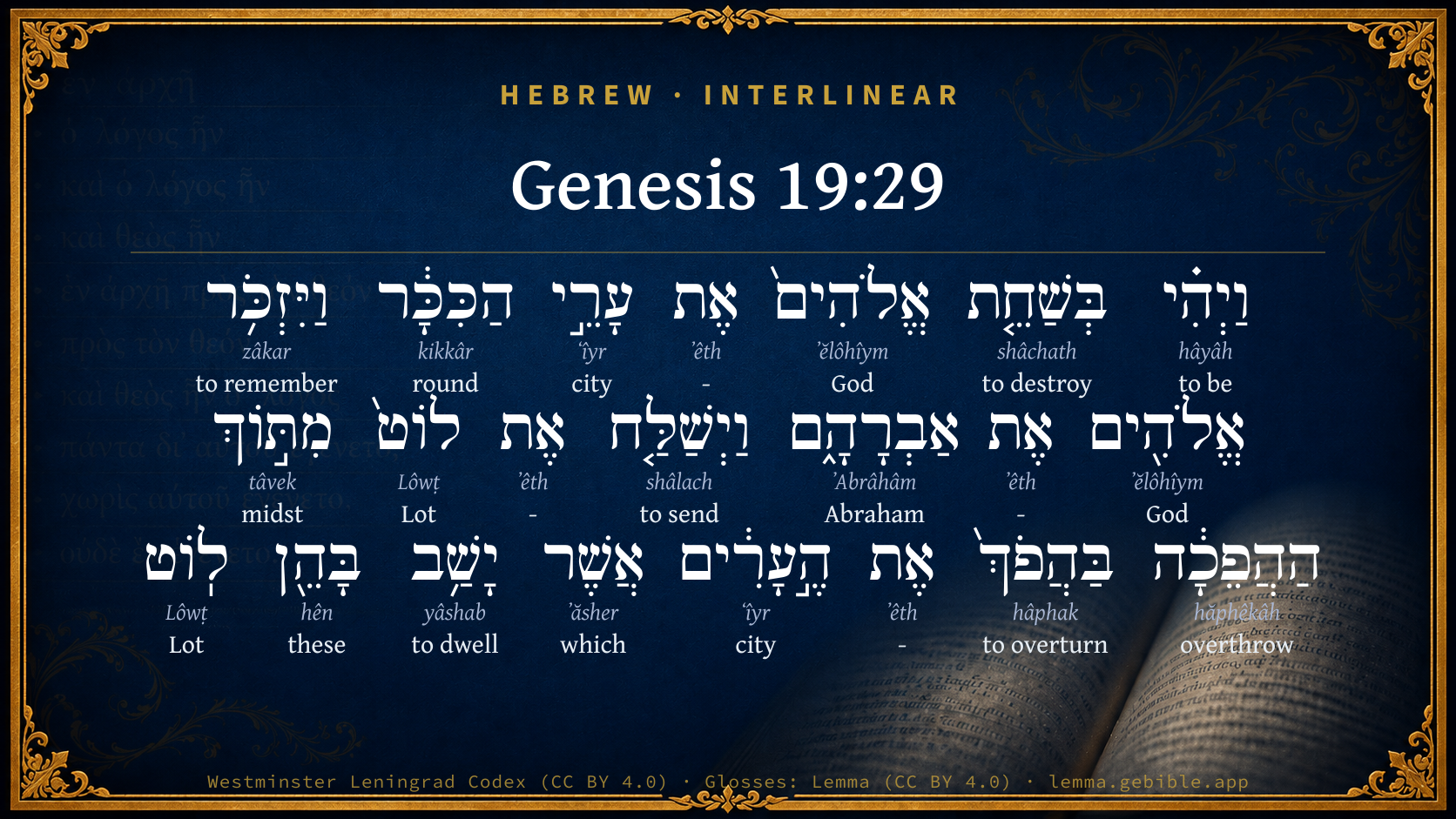
Hebrew (Westminster Leningrad Codex) Genesis 19:29 appears in the Hebrew Old Testament. The text above is from the Westminster Leningrad Codex. Each word links to its Strong’s number, a concise gloss, and parsing drawn from the Open Scriptures Hebrew Bible morphology. Click any word for its full Brown-Driver-Briggs (BDB) entry.
Download image
Cite this verse

Genesis 19:29 (World English Bible). Public Domain. Lemma interlinear Bible study tool, https://lemma.gebible.app/v/genesis/19/29.

Show BibTeX & RIS
BibTeX
RIS
English Translation
It happened, when God destroyed the cities of the plain, that God remembered Abraham, and sent Lot out of the midst of the overthrow, when he overthrew the cities in which Lot lived.
World English Bible · Public Domain
Highlights
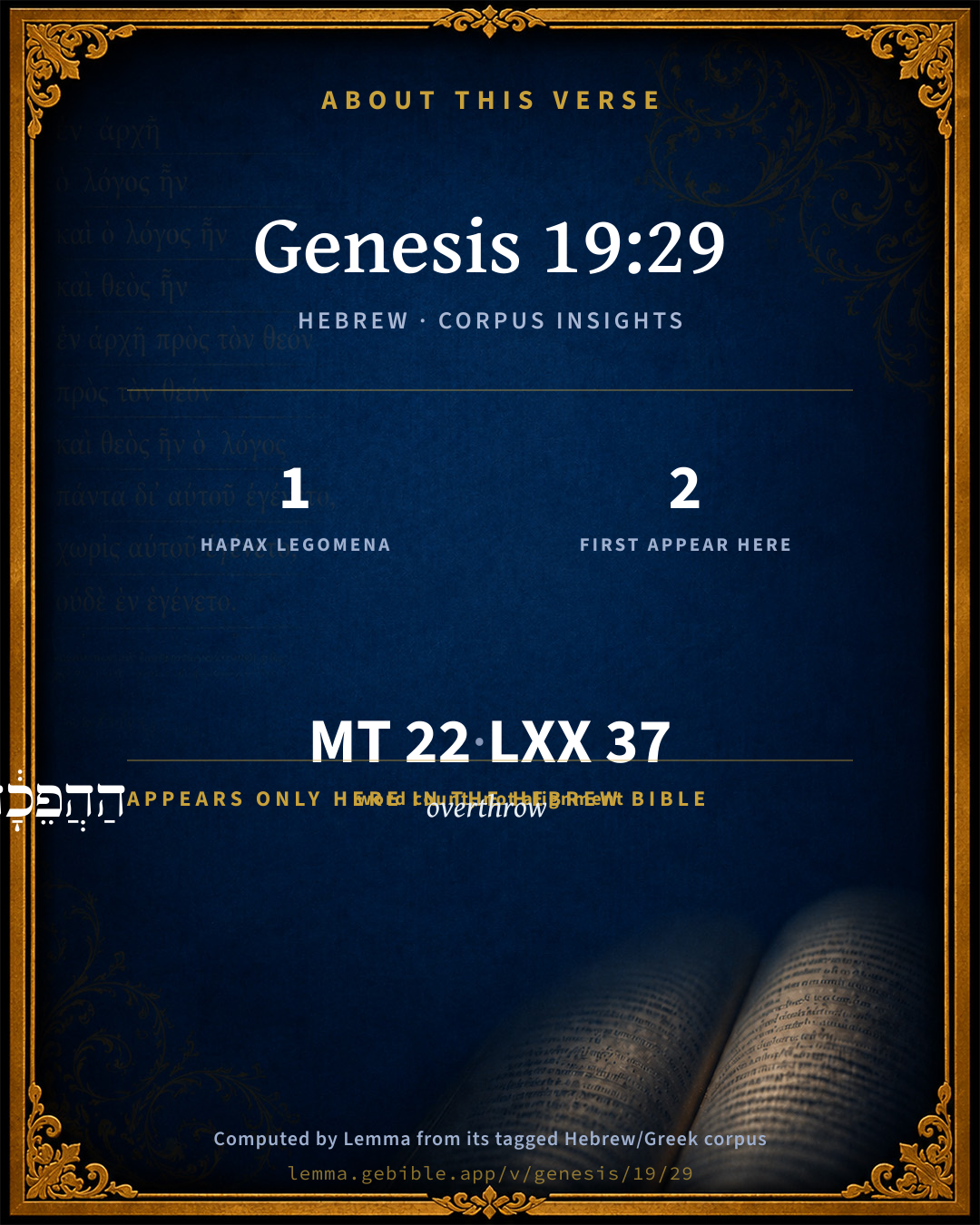
  • 1 hapax legomenon — only here in the Hebrew Bible
  • 2 first appearances in the Hebrew Bible
Full analysis ↓
Download a study sheet

One document with this verse’s original text, its word-by-word gloss line, the meaning frame, cross-references with their text, attributed commentary, and full source and license credits — printable, and it pastes into notes with its structure intact.

This verse Autodidact and up

Study sheet (.html) Plain text (.txt)

A passage Seminary Student

Up to 50 verses in one chapter. A passage sheet keeps up to 6 commentary sources and 12 cross-references per verse, in the order this page ranks them, and says so on the sheet whenever that leaves anything out. Ask for a single verse and you get the Autodidact verse sheet above.

Everything on this page stays free to read, with no account — the sheet is a download of what is already on screen, not access to it.

Want to remove ads? Support Godless Engineer
Compare translations 3

The same verse in 3 English versions, stacked beneath the original-language interlinear above. Click any original word for its lexicon entry.

Each is an independent rendering of the whole verse — the interlinear is not word-aligned to these translations.

Highlighted words mark where these versions differ — a whole-verse word diff, not a word-by-word alignment.

  • World English Bible Public Domain
    It happened, when God destroyed the cities of the plain, that God remembered Abraham, and sent Lot out of the midst of the overthrow, when he overthrew the cities in which Lot lived.
  • King James Version Public Domain
    And it came to pass, when God destroyed the cities of the plain, that God remembered Abraham, and sent Lot out of the midst of the overthrow, when he overthrew the cities in the which Lot dwelt.
  • unfoldingWord Literal Text CC BY-SA 4.0
    So it was, when God destroyed the cities of the plain, that God remembered Abraham and sent Lot out of the middle of the overthrow, when he overthrew the cities which Lot had lived in. Lot’s Descendants from His Daughters 19:30-38

unfoldingWord Literal Text — © unfoldingWord, licensed CC BY-SA 4.0. Word-aligned USFM3 via Door43 (git.door43.org/unfoldingWord/en_ult).

Versions to compare (up to 4)

3 of 4 selected

Show all 18 translations

Every available English version of this verse, each an independent rendering of the whole verse.

  • World English Bible Public Domain
    It happened, when God destroyed the cities of the plain, that God remembered Abraham, and sent Lot out of the midst of the overthrow, when he overthrew the cities in which Lot lived.
  • Berean Standard Bible Public Domain
    So when God destroyed the cities of the plain, He remembered Abraham, and He brought Lot out of the catastrophe that destroyed the cities where he had lived.
  • Majority Standard Bible Public Domain
    So when God destroyed the cities of the plain, He remembered Abraham, and He brought Lot out of the catastrophe that destroyed the cities where he had lived.
  • King James Version Public Domain
    And it came to pass, when God destroyed the cities of the plain, that God remembered Abraham, and sent Lot out of the midst of the overthrow, when he overthrew the cities in the which Lot dwelt.
  • American Standard Version (1901) Public Domain
    And it came to pass, when God destroyed the cities of the Plain, that God remembered Abraham, and sent Lot out of the midst of the overthrow, when he overthrew the cities in which Lot dwelt.
  • Revised Version (1885) Public Domain
    And it came to pass, when God destroyed the cities of the Plain, that God remembered Abraham, and sent Lot out of the midst of the overthrow, when he overthrew the cities in the which Lot dwelt.
  • Geneva Bible (1599) Public Domain
    But yet when God destroyed the cities of the plaine, God thought vpon Abraham, and sent Lot out from the middes of the destruction, when he ouerthrewe the cities, wherein Lot dwelled.
  • Douay-Rheims (1899) Public Domain
    Now when God destroyed the cities of that country, remembering Abraham, he delivered Lot out of the destruction of the cities wherein he had dwelt.
  • Young's Literal Translation Public Domain
    And it cometh to pass, in God's destroying the cities of the circuit, that God remembereth Abraham, and sendeth Lot out of the midst of the overthrow in the overthrowing of the cities in which Lot dwelt.
  • Literal Standard Version CC BY-SA 4.0
    And it comes to pass, in God’s destroying the cities of the circuit, that God remembers Abraham, and sends Lot out of the midst of the overthrow in the overthrowing of the cities in which Lot dwelt.
  • Unlocked Literal Bible CC BY-SA 4.0
    So when God destroyed the cities of the plain, God called Abraham to mind. He sent Lot out of the midst of the destruction when he destroyed the cities in which Lot had lived.
  • unfoldingWord Literal Text CC BY-SA 4.0
    So it was, when God destroyed the cities of the plain, that God remembered Abraham and sent Lot out of the middle of the overthrow, when he overthrew the cities which Lot had lived in. Lot’s Descendants from His Daughters 19:30-38
  • Darby Bible Public Domain
    And it came to pass when God destroyed the cities of the plain, that God remembered Abraham, and sent Lot out of the midst of the overthrow, when he overthrew the cities in which Lot dwelt.
  • World Messianic Bible Public Domain
    When God destroyed the cities of the plain, God remembered Abraham, and sent Lot out of the middle of the overthrow, when he overthrew the cities in which Lot lived.
  • Webster's Bible Public Domain
    And it came to pass, when God destroyed the cities of the plain, that God remembered Abraham, and sent Lot out of the midst of the overthrow, when he overthrew the cities in which Lot dwelt.
  • Free Bible Version CC BY-SA 4.0
    When God destroyed the towns of the valley he didn't forget the promise he made Abraham, and he saved Lot from the destruction of the towns where Lot was living.
  • Bible in Basic English Public Domain
    So it came about that when God sent destruction on the towns of the lowland, he kept his word to Abraham, and sent Lot safely away when he put an end to the towns where he was living.
  • JPS Tanakh (1917) Public Domain
    And it came to pass, when God destroyed the cities of the Plain, that God remembered Abraham, and sent Lot out of the midst of the overthrow, when He overthrew the cities in which Lot dwelt.

Literal Standard Version (2020), Covenant Press — licensed CC BY-SA 4.0. Text via the HelloAO Bible API (eBible.org). Unlocked Literal Bible (unfoldingWord) — licensed CC BY-SA 4.0. Text via the HelloAO Bible API (eBible.org). unfoldingWord Literal Text — © unfoldingWord, licensed CC BY-SA 4.0. Word-aligned USFM3 via Door43 (git.door43.org/unfoldingWord/en_ult). Free Bible Version, Dr. Jonathan Gallagher — licensed CC BY-SA 4.0. Text via the HelloAO Bible API (eBible.org).

Word by word

More ways to search: Search by grammar → Find every occurrence → Compare this word →

Practice this passage: Drill this verse → Learn its vocabulary →

הַהֲפֵכָ֔ה
hăphêkâh
H2018
“the · overthrow”
Particle, Definite Article + Noun, Common, Feminine, Singular, Absolute
Part of Speech
Particle + Noun
Type
Common
Gender
Feminine
Number
Singular
State
Absolute
Full BDB Definition

Origin: from H2016

TWOT: 512b

overthrow
  1. וַיְהִ֗י hâyâh H1961 “and · to be” Conjunction + Verb, Qal, Sequential Imperfect, 3rd Person, Masculine, Singular
  2. בְּשַׁחֵ֤ת shâchath H7843 “in/at · to destroy” Preposition + Verb, Piel, Infinitive Construct
  3. אֱלֹהִים֙ ʼĕlôhîym H430 “God(s)” Noun, Common, Masculine, Plural, Absolute
  4. אֶת ʼêth H853 “-” Particle, Direct Object
  5. עָרֵ֣י ʻîyr H5892 “cities of” Noun, Common, Feminine, Plural, Construct
  6. הַכִּכָּ֔ר kikkâr H3603 “the · round” Particle, Definite Article + Noun, Common, Both, Singular, Absolute
  7. וַיִּזְכֹּ֥ר zâkar H2142 “and · to remember” Conjunction + Verb, Qal, Sequential Imperfect, 3rd Person, Masculine, Singular
  8. אֱלֹהִ֖ים ʼĕlôhîym H430 “God(s)” Noun, Common, Masculine, Plural, Absolute
  9. אֶת ʼêth H853 “-” Particle, Direct Object
  10. אַבְרָהָ֑ם ʼAbrâhâm H85 “Abraham” Noun, Proper
  11. וַיְשַׁלַּ֤ח shâlach H7971 “and · to send” Conjunction + Verb, Piel, Sequential Imperfect, 3rd Person, Masculine, Singular
  12. אֶת ʼêth H853 “-” Particle, Direct Object
  13. לוֹט֙ Lôwṭ H3876 “Lot” Noun, Proper
  14. מִתּ֣וֹךְ tâvek H8432 “from · midst of” Preposition + Noun, Common, Masculine, Singular, Construct
  15. בַּהֲפֹךְ֙ hâphak H2015 “in/at · to overturn” Preposition + Verb, Qal, Infinitive Construct
  16. אֶת ʼêth H853 “-” Particle, Direct Object
  17. הֶ֣עָרִ֔ים ʻîyr H5892 “the · cities” Particle, Definite Article + Noun, Common, Feminine, Plural, Absolute
  18. אֲשֶׁר ʼăsher H834 “which” Particle, Relative
  19. יָשַׁ֥ב yâshab H3427 “to dwell” Verb, Qal, Perfect, 3rd Person, Masculine, Singular
  20. בָּהֵ֖ן hên H2004 “in/at · them” Preposition + Suffix, Personal, 3rd Person, Feminine, Plural
  21. לֽוֹט Lôwṭ H3876 “Lot” Noun, Proper

About this verse

These counts appear in no published source. They are computed here, from the morphology-tagged text and Lemma’s own curated glosses. What Lemma adds →

22
words
16
distinct lemmas
Pentateuch
section

Notable vocabulary

1 hapax legomenon — a word that appears only here in the entire Hebrew Bible:

  • הַהֲפֵכָ֔ה overthrow H2018

First appearance in Scripture

These words make their first canonical appearance in the Hebrew Bible here:

  • הַהֲפֵכָ֔ה overthrow H2018
  • בָּהֵ֖ן these H2004

Shared distinctive vocabulary

בָּהֵ֖ן these H2004 occurs in 14 verses of the Hebrew Bible. Also found in:

Grammatical profile

  • 6 verbs
  • 10 nouns
  • 1 preposition
  • 5 particles

Verb forms

  • וַיְהִ֗י Qal · Sequential Imperfect
  • בְּשַׁחֵ֤ת Piel · Infinitive Construct
  • וַיִּזְכֹּ֥ר Qal · Sequential Imperfect
  • וַיְשַׁלַּ֤ח Piel · Sequential Imperfect
  • בַּהֲפֹךְ֙ Qal · Infinitive Construct
  • יָשַׁ֥ב Qal · Perfect

Repetition

Words recur within this verse — often emphatic in Hebrew:

  • אֱלֹהִים֙ God H430 ×2
  • עָרֵ֣י city H5892 ×2
  • לוֹט֙ Lot H3876 ×2

Hebrew & Septuagint length

In English translation the verse runs 33 words from the Hebrew and 40 from the Septuagint (LXX English) — closely comparable.

A rough comparison of the two English renderings, which tokenize alike — not a word-level alignment.

Word counts can differ between the Hebrew and the Greek without any difference in meaning — e.g. the Hebrew direct-object marker אֵת has no separate Greek word, and Greek often adds the article ὁ.

In the original languages it is 22 Hebrew tokens and 37 Greek tokens — but the two are counted differently (Hebrew bundles its prefixes and suffixes into one token; the Greek is in lemma form), so that isn’t a like-for-like length.

Cross-references

16

Topical passages linked to Genesis 19:29 in the Treasury of Scripture Knowledge — connected by theme and wording, ordered by reader-vote popularity; previews shown in the World English Bible.

  • Genesis 8:1 God remembered Noah, all the animals, and all the cattle that were with him in the ark; and God made a wind to pass over the earth. The waters subsided.
  • Genesis 18:23–33 Abraham drew near, and said, "Will you consume the righteous with the wicked?
  • Deuteronomy 9:5 Not for your righteousness, or for the uprightness of your heart, do you go in to possess their land; but for the wickedness of these nations Yahweh your God does drive them out from before you, and that he may establish the word which Yahweh swore to your fathers, to Abraham, to Isaac, and to Jacob.
  • Psalms 25:7 Don't remember the sins of my youth, nor my transgressions. Remember me according to your loving kindness, For your goodness' sake, Yahweh.
  • Psalms 105:42 For he remembered his holy word, And Abraham, his servant.
  • Psalms 106:4 Remember me, Yahweh, with the favor that you show to your people. Visit me with your salvation,
  • Psalms 145:20 Yahweh preserves all those who love him, But all the wicked he will destroy.
  • Hosea 11:8 "How can I give you up, Ephraim? How can I hand you over, Israel? How can I make you like Admah? How can I make you like Zeboiim? My heart is turned within me, My compassion is aroused.
  • 2 Peter 2:7 and delivered righteous Lot, who was very distressed by the lustful life of the wicked
  • Genesis 12:2 I will make of you a great nation. I will bless you, and make your name great. You will be a blessing.
  • Genesis 30:22 God remembered Rachel, and God listened to her, and opened her womb.
  • Nehemiah 13:14 Remember me, my God, concerning this, and don't wipe out my good deeds that I have done for the house of my God, and for the observances of it.
  • Nehemiah 13:22 I commanded the Levites that they should purify themselves, and that they should come and keep the gates, to sanctify the Sabbath day. Remember to me, my God, this also, and spare me according to the greatness of your loving kindness.
  • Psalms 136:23 Who remembered us in our low estate; For his loving kindness endures forever;
  • Ezekiel 36:31–32 Then shall you remember your evil ways, and your doings that were not good; and you shall loathe yourselves in your own sight for your iniquities and for your abominations.
  • Psalms 105:8 He has remembered his covenant forever, The word which he commanded to a thousand generations,

Cross-references courtesy of OpenBible.info (CC BY 4.0).

Hebrew and Greek witnesses Masoretic Hebrew ↔ Greek Septuagint

The same verse in the two great witnesses to the Old Testament, shown verse-for-verse.

These are two independent witnesses, not word-aligned to each other, and the Septuagint is shown in lemma (dictionary) form.

Hebrew Genesis 19:29 Masoretic · Westminster Leningrad Codex

וַיְהִ֗י בְּשַׁחֵ֤ת אֱלֹהִים֙ אֶת עָרֵ֣י הַכִּכָּ֔ר וַיִּזְכֹּ֥ר אֱלֹהִ֖ים אֶת אַבְרָהָ֑ם וַיְשַׁלַּ֤ח אֶת לוֹט֙ מִתּ֣וֹךְ הַהֲפֵכָ֔ה בַּהֲפֹךְ֙ אֶת הֶ֣עָרִ֔ים אֲשֶׁר יָשַׁ֥ב בָּהֵ֖ן לֽוֹט

It happened, when God destroyed the cities of the plain, that God remembered Abraham, and sent Lot out of the midst of the overthrow, when he overthrew the cities in which Lot lived.

World English Bible · Public Domain

Greek LXX Genesis 19:29 Septuagint · lemma form

καί γίγνομαι ἐν ὁ ἐκτρίβω κύριος πᾶς ὁ πόλις ὁ περίοικος μιμνήσκω ὁ θεός ὁ αβρααμ καί ἐκ ἀποστέλλω ὁ λωτ ἐκ μέσος ὁ καταστροφή ἐν ὁ καταστρέφω κύριος ὁ πόλις ἐν ὅς καταοἰκέω ἐν αὐτός λωτ

And it came to pass that when God destroyed all the cities of the region round about, God remembered Abraam, and sent Lot out of the midst of the overthrow, when the Lord overthrew those cities in which Lot lived.

LXX2012 (modern English Septuagint) · Public Domain

On this verse, Keil & Delitzsch discusses the Septuagint’s reading. Read the note in Commentary ↓

Hebrew: Westminster Leningrad Codex (CC BY 4.0). Greek: Septuagint (public domain); English from LXX2012 (modern English Septuagint) (Public Domain). How the Septuagint differs from the Hebrew →

Targum (Aramaic paraphrase)

2

The Targum is the ancient Jewish Aramaic paraphrase of the Hebrew Scriptures — an interpretive translation, not the Hebrew text itself. Onkelos (literal) and Pseudo-Jonathan (expansive) render the Torah, and Jonathan the Prophets. Coverage is partial: where no permissively-licensed English translation exists for a verse, only the Aramaic is shown. This is verse-level text, not a word-by-word alignment to the Hebrew.

  1. Targum Onkelos Torah (Genesis–Deuteronomy)
    וַהֲוָה בְּחַבָּלוּת (נ''י כַּד חֲבַל) יְיָ יָת קִרְוֵי מֵישְׁרָא וּדְכִיר יְיָ יָת אַבְרָהָם וְשַׁלַּח יָת לוֹט מִגּוֹ הֲפֶכְתָּא כַּד הֲפַךְ יָת קִרְוַיָּא דִּי הֲוָה יָתֵב בְּהֵן לוֹט

    (no public-domain English translation for this verse)

    Targum Onkelos — Aramaic: “Onkelos Genesis” (public domain); “Onkelos Exodus” (public domain); “Onkelos Leviticus” (public domain); “Onkelos Numbers” (public domain); “Onkelos Deuteronomy” (public domain). English: “Sefaria Community Translation” (CC0 1.0 (public-domain dedication)); “J.W. Etheridge. The Targums of Onkelos and Jonathan Ben Uzziel on the Pentateuch. London: Longmans, Green, 1862” (public domain). Text via Sefaria.

  2. Targum Pseudo-Jonathan Torah (Genesis–Deuteronomy)
    וַהֲוָה בְּחַבְּלוּת יְיָ יַת קִירְוֵי מֵישְׁרָא וּדְכִיר יְיָ יַת זְכוּתֵיהּ דְאַבְרָהָם וּשְׁלַח יַת לוֹט מִגוֹ הֲפֵיכְתָּא כַּד הָפַךְ יַת קִירְוַיָא דִי הֲוָה יָתִיב בְּהוֹן לוֹט

    And it was when the Lord destroyed the cities of the plain, that He remembered the righteousness of Abraham, and sent forth Lot from the midst of the overthrow, when He overthrew the cities wherein Lot had dwelt.

    Targum Pseudo-Jonathan — Aramaic: “Targum Jonathan on Genesis” (public domain); “Targum Jonathan on Exodus” (public domain); “Targum Jonathan on Leviticus” (public domain); “Targum Jonathan on Numbers” (public domain); “Targum Jonathan on Deuteronomy” (public domain). English: “The Targum of Jonathan ben Uzziel, trans. J. W. Etheridge, London, 1862” (public domain). Text via Sefaria.

Commentary

Notes on Genesis 19:29 from classic Christian and Jewish commentators (each source and its license shown beneath its notes). The classic Christian expositions comment on the surrounding passage and are grouped to its opening verse, so a note may address several verses; the Jewish commentaries on the Tanakh (Rashi and others) are per-verse, so they appear only where the commentator wrote on this verse.

Lemma curates 59 commentaries, every one of them public domain or Creative Commons licensed, each selected and text-cleaned for this edition rather than reprinted as found. About our sources →

Trapp's Complete Commentary

John Trapp

Gen 19:29 And it came to pass, when God destroyed the cities of the plain, that God remembered Abraham, and sent Lot out of the midst of the overthrow, when he overthrew the cities in the which Lot dwelt.

Ver. 29. God remembered Abraham, &c.] And shall he forget us, who have Christ to intercede for us?

John Trapp, A Commentary or Exposition upon All the Books of the Old and New Testament (1647–1656) — public domain. Text from a community e-Sword module.

Whedon's Commentary on the Bible

Daniel D. Whedon

LOT’S INFAMOUS DAUGHTERS, Gen_19:29-38.

29. God remembered Abraham, and sent Lot out — Thus Lot’s rescue is attributed to Abraham’s prayer. This was Lot’s second rescue by the help of Abraham. See Gen_14:16.

Daniel D. Whedon (gen. ed.), Commentary on the Old and New Testaments (1874–1909) — public domain. Text from a community e-Sword module.

The Pulpit Commentary

CHAPTER 19:29-38

And it came to pass not a pluperfect (Rosenm as if a direct continuation of the preceding narrative, but a preterit, being the commencement of a new subdivision of the history in which the writer treats of Lot"s residence in Zoarwhen God Elohim. Hence, as a fragment of the original Elohist"s composition, the present verse is by the pseudo-criticism connected with; (Gen_17:27) (Ilgen, Tuch, Block) but "a greater abruptness of style and a more fragmentary mode of composition" than this would indicate "could not easily be imagined" (Kalisch). The change in the Divine name is sufficiently explained by the supposition that the destruction of the cities of the plain was not at the moment viewed by the writer in its connection with the Abrahamic covenant and intercession, but as a sublime vindication of Divine justice (cf. Quarry, p. 444)destroyed (literally, in he destroying, by Elohim, or in Elohim s destroying) the cities of the plain, that God remembered Abraham. If the narrative containing the intercession of Abraham and the overthrow of Sodom was due to the Jehovist, how came the earlier author to know anything about those events? The obvious allusions to them in the present verse could only have been made by one acquainted with them. Either, therefore, the present verse proceeded from the hand of the so-called Jehovist, or it requires explanation how in the original document this should be the first and only occasion on which they are referred to (cf. Quarry, p. 445). And in answer to Abatham"s prayer. (Gen_18:23) sent Lot out of the midst of the overthrow (there is no reason to suppose that Abraham was aware of his nephew"s escape), when he overthrew literally, in the overthrowing of the cities, the inf. being construed with the case of its verb (vide Gesenius, 133)the cities in the which one of which (cf. Jud_1:15:7) Lot dwelt.

Ver. 29.

The last days of Lot.

I HAUNTED BY TERROR.

1. The terror of Divine judgment. The appalling spectacle of Sodom"s overthrow had no doubt filled him with alarm. And so are God s judgments in the earth designed to put the souls of men in fear. (Psa_9:20 Psa_46:8-10 Psa_119:120)

2. The terror of men. Dwelling in Zoar, he apprehended an outburst of wrath from the citizens, who probably regarded him as the cause of the ruin which had invaded Sodom. So are better men than Lot sometimes overtaken by the fear of man (2Sa_22:5; Psa_18:4) though they should not. (Isa_51:12)

3. The terror of conscience. That Lot enjoyed while in Zoar a calm and undisturbed repose of heart and mind is scarcely supposable. Rather it may be safely conjectured that after the storm and the fire and the earthquake through which he had lately passed, the still small voice of conscience spoke to him in awe-inspiring accents, unveiling his past life, reproving him of sin, and piercing him through with many sorrows; and that under the agitations produced by its accusations and reproaches he became afraid, and withdrew to the mountains. "Thus conscience doth make cowards of us all.

II SOUNDING THE LOWER DEEPS.

1. Descending into unbelief. God had promised to spare Zoar for him, and him in Zoar, and one would have thought Lot had been sufficiently warned of the sin of distrusting God. Yet he is scarcely established in the city which God had granted in response to his own prayer than he begins to think it hardly safe to remain within its precincts. How inveterate is unbelief!

2. Plunging into sin. The details of the present story clearly show that Lot, when he went to the mountain cave, endeavored to escape from his terrors not by carrying them to God"s throne, but by drowning them in dissipation. The wretched man, who had once been a saint in God"s Church, must have been in the habit of drinking to excess, else his daughters would never have thought of their abominable stratagem. Only one little gleam of virtue can be detected as entitled to be laid to Lot"s account, viz., that his daughters apparently believed that unless their father was drunk he would never be brought to assent to their lewd proposal.

3. Sinking into shame. Twice overcome by wine, he is twice in succession dishonored by his daughters; and twice over, while in his drink stupor, he allows himself to commit an act which almost out-Sodoms Sodom. To what depths a saint may fall when once he turns his back on God!

III DISAPPEARING INTO OBLIVION. Nothing could more distinctly mark the Divine disapprobation with Lots conduct than the fact that after this he was suffered

1. To live an unrecorded life, being never heard of again in the pages of Holy Scripture.

2. To die an unnoticed death. Where and how he met his end the historian does not condescend to state.

3. To sink into an unknown grave. Whether buried in his mountain cave or entombed in the Jordan valley no man knoweth unto this day.

See

1. The danger of turning aside from God and good men. (Heb_3:12 Heb_10:25)

1. The melancholy end of a worldly life. (1Co_10:6; Php_3:19; 2Ti_4:10)

2. The bitter fruits of parental neglect (1Sa_2:27-36; Pro_29:15-17)

HOMILIES BY W. ROBERTS Ver. 29.

The destruction of Sodom and Gomorrah

I THE VISIBLE JUDGMENT. "God overthrew the destruction of Sodom and Gomorrah the cities in which Lot dwelt.

1. The reason.

2. The instrumentality.

3. The reality.

4. The lessons of the overthrow.

II THE UNKNOWN MERCY. "He sent Lot out of the midst of the overthrow." To Abraham this was

1. A great mercy.

2. A mercy granted in answer to prayer. But

3. An unknown mercy, there being no reason to believe that Abraham ever saw Lot again, or knew of his deliverance.

Learn

1. That God always mixes-mercy with his judgments.

2. That his mercies are not always so perceptible to the eye of sense and reason as his judgments.

3. That God"s people get more mercies poured into their cups than they are at all times cognizant of. W.

The Pulpit Commentary (1880–1919), ed. H.D.M. Spence-Jones & Joseph S. Exell — public domain. Text from a community e-Sword module.

Tyndale Open Study Notes

Tyndale Open Resources

19:29 God honored Abraham’s intercession (cp. 18:23-32), but Lot’s entire world was gone because he lived by instinct and desire, not by faith in God. He could no longer live in the good land he selfishly chose for himself (13:10-13; cp. Matt 16:26; 2 Cor 5:7).

Tyndale Open Study Notes — © Tyndale Open Resources, licensed CC BY-SA 4.0. Text via the HelloAO Bible API.

Jamieson, Fausset & Brown

Robert Jamieson, A. R. Fausset & David Brown

when God destroyed the cities, &c.--This is most welcome and instructive after so painful a narrative. It shows if God is a "consuming fire" to the wicked [Deu 4:24; Heb 12:29], He is the friend of the righteous. He "remembered" the intercessions of Abraham, and what confidence should not this give us that He will remember the intercessions of a greater than Abraham in our behalf.

Next: Genesis Chapter 20

Jamieson, Fausset & Brown — Commentary Critical and Explanatory on the Whole Bible (1871) — public domain (CC PDM 1.0). Text via the HelloAO Bible API.

Adam Clarke's Commentary

Verse 29. God remembered Abraham] Though he did not descend lower than ten righteous persons, (see Ge 18:32,) yet the Lord had respect to the spirit of his petitions, and spared all those who could be called righteous, and for Abraham's sake offered salvation to all the family of Lot, though neither his sons-in-law elect nor his own wife ultimately profited by it. The former ridiculed the warning; and the latter, though led out by the hands of the angel, yet by breaking the command of God perished with the other gainsayers.

Adam Clarke's Commentary on the Bible (1810–1826) — public domain. Text from a community e-Sword/MySword module.

John Calvin's Commentaries

29. God remembered Abraham. Although Moses does not assert that the deliverance of Abraham’s nephew was made known to him; yet since he says, that Lot was saved from destruction for Abraham’s sake, it is probable that he was not deprived of that consolation which he most needed; and that he was conscious of the benefit, for which it became him to give thanks. If it seems to any one absurd, that the holy man Lot should be granted for the sake of another; as if the Lord had not respect to his own piety: I answer, these two things well agree with each other; that the Lord, since he is wont to aid his own people, cared for Lot, whom he had chosen, and whom he governed by his Spirit; and yet that, at the same time, he would show, in the preservation of his life, how greatly he loved Abraham, to whom he not only granted personal protection, but also the deliverance of others. It is however right to observe, that what the Lord does gratuitously, — induced by no other cause than his own goodness, — is ascribed to the piety or the prayers of men, for this reason; that we may be stirred up to worship God, and to pray to him. We have seen, a little while before, how merciful God proved himself to be, in preserving Lot; and truly, he would not have perished, even if he had not been the nephew of Abraham. Yet Moses says, it was a favor granted to Abraham, that Lot was not consumed in the same destruction with Sodom. But if the Lord extended the favor which he had vouchsafed to his servant, to the nephew also, who now was as a stranger from his family; how much more confidently ought every one of the faithful to expect, that the same grace shall, by no means be wanting to his own household? And, if the Lord, when he favors us, embraces others also who are connected with us, for our sake, how much more will he have respect to ourselves? In saying that Lot dwelt in those cities, the figure synecdoche, which puts the whole for a part, is used, but it is expressly employed to make the miracle more illustrious; because it happened, only by the singular providence of God, that when five cities were destroyed a single person should escape.

John Calvin's Commentaries (1540-1563) — public domain. Text from the Calvin Translation Society English edition (1840s-50s) via the Christian Classics Ethereal Library (ccel.org). Calvin's coverage is partial (roughly two-thirds of the Bible); uncommented books and verses are honest gaps, never fabricated. The 19th-century editor's footnotes and remarks are omitted so the notes are faithfully Calvin's own voice.

John Gill's Exposition

And Lot went up out of Zoar,.... Which lay in the plain, and therefore when he went from thence to the mountain, it was by an ascent:

and dwelt in the mountain; which the Lord had directed him to go to before, but was unwilling, and chose Zoar, and desired he might flee thither, and that that might be spared; but now he likes God's advice for him better than his own, and therefore betook himself to the mountain, where he might think himself safest, and where he continued; very probably this was the mountain Engaddi, under which Zoar is said to lie by Adrichomius (n):

and his two daughters with him: his wife was turned into a pillar of salt, and these two were all of his family that with him were saved from the destruction; and these are the rather mentioned for the sake of an anecdote hereafter related:

for he feared to dwell in Zoar; it being near to Sodom; and the smoke of that city and the rest might not only be terrible but troublesome to him, and the tremor of the earth might continue and reach as far as Zoar; and perceiving the waters to rise and overflow the plain, which formed the lake where the cities stood, he might fear they would reach to Zoar and swallow up that; and especially his fears were increased, when he found the inhabitants were as wicked as those of the other cities, and were unreformed by the judgment on them; and so he might fear that a like shower of fire would descend on them and destroy them, as it had the rest, though it had been spared for a while at his intercession; and, according to the Jewish writers (o), it remained but one year after Sodom:

and he dwelt in a cave, he and his two daughters; which was in the mountain, the mountain of Engedi. Josephus (p) makes mention of the mountains of Engedi; and here was a cave, where David with six hundred men were, in the sides of it, when Saul went into it, Sa1 24:1; and perhaps may be the same cave where Lot and his two daughters lived.

(n) Theatrum Terrae S. p. 54. (o) Juchasin, fol. 8. 1. (p) Antiqu. l. 6. c. 13. sect. 4.

John Gill's Exposition of the Whole Bible (1746–1763) — public domain (CC PDM 1.0). Text via the HelloAO Bible API.

Haydock's Catholic Bible Commentary

Lot. Even he owed his safety to the merits of Abraham.

George Leo Haydock (1774–1849), Haydock's Catholic Family Bible and Commentary, 1859 edition — public domain. Excludes Psalms (Douay-Rheims chapter numbering differs from Protestant) and Deuterocanonical books (Catholic canon only).

Matthew Poole's English Annotations

God remembered Abraham; either,

1. The promise made to Abraham, Gen 12:3. Or,

2. The prayer made by Abraham, Gen 18:23-32, who doubtless in his prayers for Sodom would not forget Lot, though his prayer for him be not there mentioned. And hereby it is insinuated, that Lot, though he was a righteous man, and should be saved eternally, yet deserved to perish temporarily with those wicked people, to whom he associated himself merely for worldly advantages, and should have done so, if Abraham had not hindered it by his prayers.

Matthew Poole's English Annotations on the Holy Bible (1683–1685) — public domain. Text from a community e-Sword/MySword module.

John Wesley's Explanatory Notes

God remembered Abraham, and for his sake sent Lot out of the overthrow - God will certainly give an answer of peace to the prayer of faith in his own way and time.

John Wesley, Explanatory Notes Upon the Whole Bible (1754–1765) — public domain. Text via the GEBible commentary corpus.

Keil & Delitzsch

C. F. Keil & F. Delitzsch

For on the destruction of these cities, God had thought of Abraham, and rescued Lot. This rescue is attributed to Elohim, as being the work of the Judge of the whole earth (Gen 18:25), and not to Jehovah the covenant God, because Lot was severed from His guidance and care on his separation from Abraham. The fact, however, is repeated here, for the purpose of connecting with it an event in the life of Lot of great significance to the future history of Abraham's seed.

Gen 19:30-35

From Zoar Lot removed with his two daughters to the (Moabitish) mountains, for fear that Zoar might after all be destroyed, and dwelt in one of the caves (מערה with the generic article), in which the limestone rocks abound (vid., Lynch), and so became a dweller in a cave. While there, his daughters resolved to procure children through their father; and to that end on two successive evenings they made him intoxicated with wine, and then lay with him in the might, one after the other, that they might conceive seed. To this accursed crime they were impelled by the desire to preserve their family, because they thought there was no man on the earth to come in unto them, i.e., to marry them, "after the manner of all the earth." Not that they imagined the whole human race to have perished in the destruction of the valley of Siddim, but because they were afraid that no man would link himself with them, the only survivors of a country smitten by the curse of God. If it was not lust, therefore, which impelled them to this shameful deed, their conduct was worthy of Sodom, and shows quite as much as their previous betrothal to men of Sodom, that they were deeply imbued with the sinful character of that city. The words of Gen 19:33 and Gen 19:35, "And he knew not of her lying down and of her rising up," do not affirm that he was in an unconscious state, as the Rabbins are said by Jerome to have indicated by the point over בּקוּמה: "quasi incredibile et quod natura rerum non capiat, coire quempiam nescientem." They merely mean, that in his intoxicated state, though not entirely unconscious, yet he lay with his daughters without clearly knowing what he was doing.

Gen 19:36-38

But Lot's daughters had so little feeling of shame in connection with their conduct, that they gave names to the sons they bore, which have immortalized their paternity. Moab, another form of מאב "from the father," as is indicated in the clause appended in the lxx: λέγουσα ἐκ τοῦ πατρός μου, and also rendered probable by the reiteration of the words "of our father" and "by their father" (Gen 19:32, Gen 19:34, and Gen 19:36), as well as by the analogy of the name Ben-Ammi = Ammon, Ἀμμάν, λέγουσα Υἱος γένους μου (lxx). For עמּון, the sprout of the nation, bears the same relation to עם, as אגמון, the rush or sprout of the marsh, to אגם Delitzsch). - This account was neither the invention of national hatred to the Moabites and Ammonites, nor was it placed here as a brand upon those tribes. These discoveries of a criticism imbued with hostility to the Bible are overthrown by the fact, that, according to Deu 2:9, Deu 2:19, Israel was ordered not to touch the territory of either of these tribes because of their descent from Lot; and it was their unbrotherly conduct towards Israel alone which first prevented their reception into the congregation of the Lord, Deu 23:4-5. - Lot is never mentioned again. Separated both outwardly and inwardly from Abraham, he was of no further importance in relation to the history of salvation, so that even his death is not referred to. His descendants, however, frequently came into contact with the Israelites; and the history of their descent is given here to facilitate a correct appreciation of their conduct towards Israel.

Keil & Delitzsch — Biblical Commentary on the Old Testament (1861–1891) — public domain (CC PDM 1.0). Text via the HelloAO Bible API. (Old Testament only.)

Scofield Reference Notes

C. I. Scofield

when God

(See Scofield "Gen 19:36").

The Scofield Reference Bible (1917 edition), notes by C. I. Scofield — public domain. Text from a community e-Sword module.

unfoldingWord translationNotes

Door43 World Missions Community

General Information:

Verse 29 is a summary of this chapter.

God called Abraham to mind

This tells why God rescued Lot. To "call to mind" is a way of saying "remember." This does not imply that God forgot about Abraham. It means he considered Abraham and had mercy on him. AT: "God thought about Abraham and had mercy on him" (See: Idiom)

out of the midst of the destruction

"away from the destruction" or "away from danger"

translationWords

Abraham

mind

Lot

unfoldingWord translationNotes — © Distant Shores Media and the Door43 World Missions Community, licensed CC BY-SA 4.0. Source: git.door43.org/Door43/en_tn.

Rashi

Rabbi Shlomo Yitzchaki (Rashi)

ויזכר אלהים את אברהם GOD REMEMBERED ABRAHAM — What bearing has God’s remembering Abraham upon the rescue of Lot? He remembered that Lot knew that Sarah was Abraham’s wife and that when he heard that Abraham said in Egypt regarding Sarah, “She is my sister”, he did not betray him because he had sympathy with him. For this reason God had mercy upon him (Lot) (Genesis Rabbah 51:6).

Rashi on the Tanakh — English translations: “The Judaica Press complete Tanach with Rashi, translated by A. J. Rosenberg” (CC BY 4.0); “Pentateuch with Rashi's commentary by M. Rosenbaum and A.M. Silbermann, 1929-1934” (public domain); “The Metsudah Tanach series, Lakewood, N.J” (CC BY 4.0); and “The Book of Joshua, Metsudah Publications, 1997” (CC BY 4.0). Text via Sefaria.

Ramban (Nachmanides)

Rabbi Moshe ben Nachman (Ramban / Nachmanides)

AND G-D REMEMBERED ABRAHAM, AND SENT LOT OUT FROM THE CATASTROPHE. The purport of this verse is that Lot had shown kindness towards the righteous one by going with him and roaming here and there, following him wherever he went. This is the intent of the verse, And Lot went with him, meaning that he went at Abraham’s command. Therefore he had the merit to be saved on account of Abraham’s meritoriousness as it was on account of him that he lived in Sodom, and were it not for Abraham he would have still been in Haran with his family. Now it is inconceivable that some evil should overtake him [Lot] because of Abraham who had left his country at his Creator’s command. This was also the reason why Abraham endangered himself by pursuing the kings on account of him., 14:14.

Ramban (Nachmanides) on the Tanakh — English translation: “Commentary on the Torah by Ramban (Nachmanides). Translated and annotated by Charles B. Chavel. New York, Shilo Pub. House, 1971-1976” (CC BY 4.0). Text via Sefaria.

Radak

Rabbi David Kimhi (Radak)

ויהי בשחת, the reason why the Torah phrases this thus is to remind us that Lot’s having been saved was due to the merit of Avraham. Even though, by comparison to the people of Sodom he was relatively righteous, he was not righteous enough to have deserved G’d extending Himself to save him as a result of his own merits. G’d now wanted to put Avraham’s mind at rest by indicating to him that Lot had indeed been saved from this conflagration.

וישלח את לוט מתוך ההפכה, He had sent away from the midst of this upheaval, i.e. immediately preceding it.

בהפך את הערים, when He was about to turn these cities inside out, for the angel had told Lot that he could not carry out his task until he had brought Lot to safety. (verse 22).

Radak on the Tanakh — English translations: “Sefaria Community Translation” (CC0 1.0 (public-domain dedication)); “Eliyahu Munk, HaChut Hameshulash” (CC BY 4.0); “Rabbi Mike Feuer, Jerusalem Anthology” (CC BY 4.0); and “R. David Kimhi on the first book of Psalms, Translated by R.G. Finch, London, 1919” (public domain). Text via Sefaria.

Lesson kit

Teaching starters — assembled from the data on this page, not authored interpretation. Every prompt links to the verse data it draws on. Edit before teaching.

Genesis, in the Pentateuch, opens this verse with 22 words (16 distinct Hebrew lemmas). Its most distinctive word is hăphêkâh (“overthrow”). A historical commentator’s framing appears above. Read the whole chapter for the surrounding context.

Discussion questions

  1. What does “overthrow” (hăphêkâh) contribute to the verse as a whole?
  2. 1 word here appears nowhere else in the Hebrew Bible. Why might the author reach for such rare wording?
  3. 2 words make their first appearance in Scripture here. What does this debut establish?
  4. How does Genesis 30:26, which shares the word «these», read alongside this verse?
  5. What does the repetition of “God” (2× in this one verse) do in this verse?
  6. These translations render this verse differently. What is at stake in choosing one wording over another?
  7. «וַיְהִ֗י» is a Qal Sequential Imperfect verb. How does that grammatical form shape the action described?
  8. Compare how Trapp's Complete Commentary and Whedon's Commentary on the Bible read this verse. Where do they agree or differ?

Things to notice

  • 1 word in this verse appears nowhere else in the Hebrew Bible.
  • 2 words make their first canonical appearance in Scripture here.
  • This verse counts 22 Hebrew ↔ 37 Greek words.
  • These translations choose different wording for 12 words in this verse.
  • “God” occurs 2× in this single verse.

Reading settings

Reading text

Shown beneath each verse's original-language words.

Old Testament
Old Testament edition

Read the OT as the Masoretic Hebrew (MT) or the Greek Septuagint (LXX).

English shown for the Greek Septuagint (in the Hebrew ↔ Greek comparison).

Comparing translations? Open the Compare panel on any verse page to stack up to four side by side.