Judges 8:19

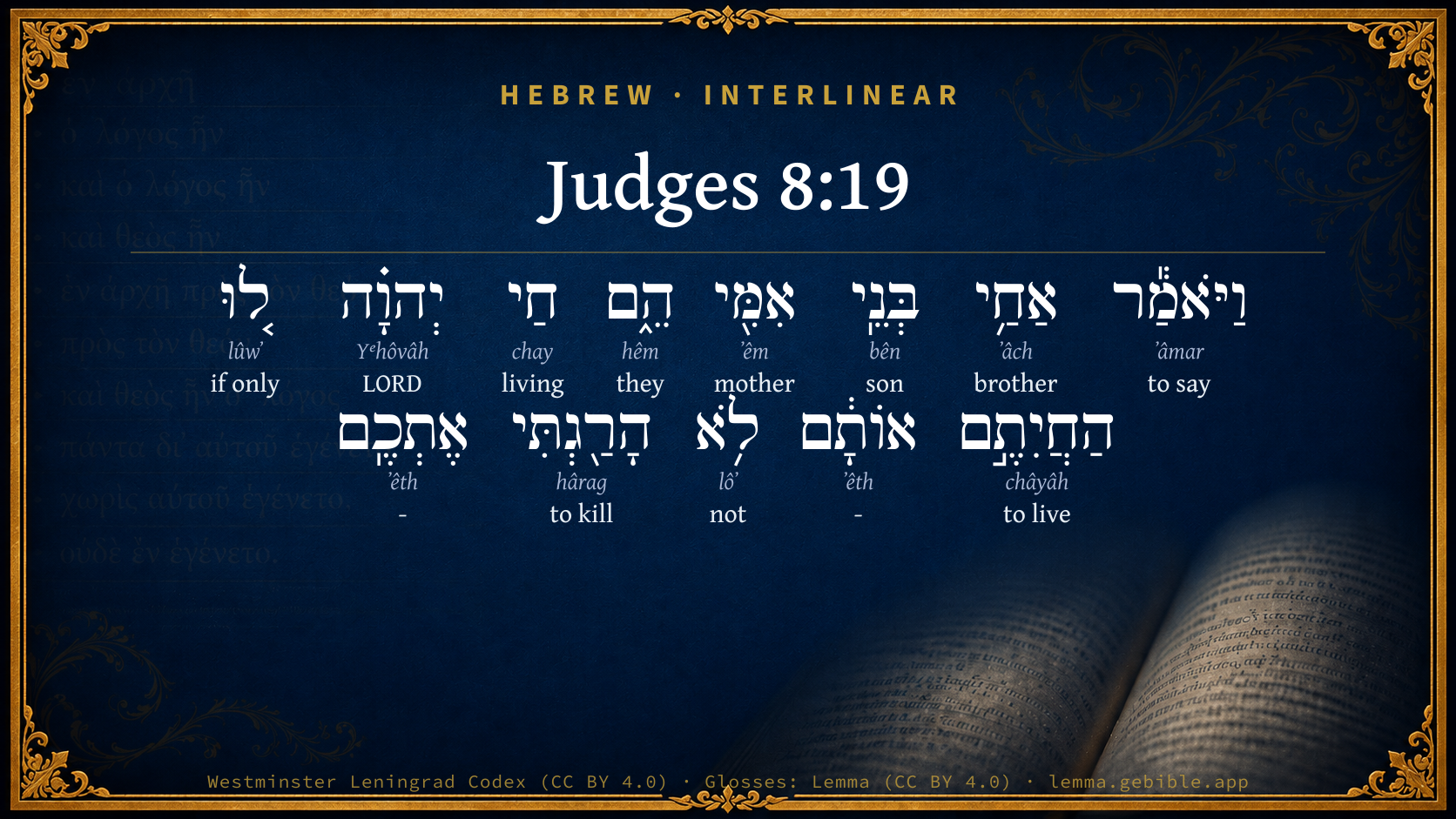
Hebrew (Westminster Leningrad Codex) Judges 8:19 appears in the Hebrew Old Testament. The text above is from the Westminster Leningrad Codex. Each word links to its Strong’s number, a concise gloss, and parsing drawn from the Open Scriptures Hebrew Bible morphology. Click any word for its full Brown-Driver-Briggs (BDB) entry.
Download image
Cite this verse

Judges 8:19 (World English Bible). Public Domain. Lemma interlinear Bible study tool, https://lemma.gebible.app/v/judges/8/19.

Show BibTeX & RIS
BibTeX
RIS
English Translation
He said, They were my brothers, the sons of my mother: as Yahweh lives, if you had saved them alive, I would not kill you.
World English Bible · Public Domain
Download a study sheet

One document with this verse’s original text, its word-by-word gloss line, the meaning frame, cross-references with their text, attributed commentary, and full source and license credits — printable, and it pastes into notes with its structure intact.

This verse Autodidact and up

Study sheet (.html) Plain text (.txt)

A passage Seminary Student

Up to 50 verses in one chapter. A passage sheet keeps up to 6 commentary sources and 12 cross-references per verse, in the order this page ranks them, and says so on the sheet whenever that leaves anything out. Ask for a single verse and you get the Autodidact verse sheet above.

Everything on this page stays free to read, with no account — the sheet is a download of what is already on screen, not access to it.

Want to remove ads? Support Godless Engineer
Compare translations 3

The same verse in 3 English versions, stacked beneath the original-language interlinear above. Click any original word for its lexicon entry.

Each is an independent rendering of the whole verse — the interlinear is not word-aligned to these translations.

Highlighted words mark where these versions differ — a whole-verse word diff, not a word-by-word alignment.

  • World English Bible Public Domain
    He said, They were my brothers, the sons of my mother: as Yahweh lives, if you had saved them alive, I would not kill you.
  • King James Version Public Domain
    And he said, They were my brethren, even the sons of my mother: as the LORD liveth, if ye had saved them alive, I would not slay you.
  • unfoldingWord Literal Text CC BY-SA 4.0
    And he said, “They my brothers, the sons of my mother! The life of Yahweh, if you had let them live, I would not have killed you.”

unfoldingWord Literal Text — © unfoldingWord, licensed CC BY-SA 4.0. Word-aligned USFM3 via Door43 (git.door43.org/unfoldingWord/en_ult).

Versions to compare (up to 4)

3 of 4 selected

Show all 18 translations

Every available English version of this verse, each an independent rendering of the whole verse.

  • World English Bible Public Domain
    He said, They were my brothers, the sons of my mother: as Yahweh lives, if you had saved them alive, I would not kill you.
  • Berean Standard Bible Public Domain
    “They were my brothers,” Gideon replied, “the sons of my mother! As surely as the LORD lives, if you had let them live, I would not kill you.”
  • Majority Standard Bible Public Domain
    “They were my brothers,” Gideon replied, “the sons of my mother! As surely as the LORD lives, if you had let them live, I would not kill you.”
  • King James Version Public Domain
    And he said, They were my brethren, even the sons of my mother: as the LORD liveth, if ye had saved them alive, I would not slay you.
  • American Standard Version (1901) Public Domain
    And he said, They were my brethren, the sons of my mother: as Jehovah liveth, if ye had saved them alive, I would not slay you.
  • Revised Version (1885) Public Domain
    And he said, They were my brethren, the sons of my mother: as the LORD liveth, if ye had saved them alive, I would not slay you.
  • Geneva Bible (1599) Public Domain
    And he said, They were my brethren, euen my mothers children: as the Lord liueth, if ye had saued their liues, I would not slay you.
  • Douay-Rheims (1899) Public Domain
    He answered them: They were my brethren, the sons of my mother. As the Lord liveth, if you had saved them, I would not kill you.
  • Young's Literal Translation Public Domain
    And he saith, `My brethren -- sons of my mother -- they; Jehovah liveth, if ye had kept them alive -- I had not slain you.'
  • Literal Standard Version CC BY-SA 4.0
    And he says, “They [were] my brothers—sons of my mother; YHWH lives, if you had kept them alive—I would not kill you.”
  • Unlocked Literal Bible CC BY-SA 4.0
    Gideon said, “They were my brothers, the sons of my mother. As Yahweh lives, if you had saved them alive, I would not kill you.”
  • unfoldingWord Literal Text CC BY-SA 4.0
    And he said, “They my brothers, the sons of my mother! The life of Yahweh, if you had let them live, I would not have killed you.”
  • Darby Bible Public Domain
    And he said, "They were my brothers, the sons of my mother; as the LORD lives, if you had saved them alive, I would not slay you."
  • World Messianic Bible Public Domain
    He said, “They were my brothers, the sons of my mother. As the LORD lives, if you had saved them alive, I would not kill you.”
  • Webster's Bible Public Domain
    And he said, They were my brethren, even the sons of my mother: as the LORD liveth, if ye had saved them alive, I would not slay you.
  • Free Bible Version CC BY-SA 4.0
    “Those were my brothers, my mother's sons,” Gideon burst out. “As the Lord lives, if you had let them live, I wouldn't kill you!”
  • Bible in Basic English Public Domain
    And he said, They were my brothers, my mother's sons: by the life of the Lord, if you had kept them safe, I would not put you to death.
  • JPS Tanakh (1917) Public Domain
    And he said: 'They were my brethren, the sons of my mother; as the LORD liveth, if ye had saved them alive, I would not slay you.'

Literal Standard Version (2020), Covenant Press — licensed CC BY-SA 4.0. Text via the HelloAO Bible API (eBible.org). Unlocked Literal Bible (unfoldingWord) — licensed CC BY-SA 4.0. Text via the HelloAO Bible API (eBible.org). unfoldingWord Literal Text — © unfoldingWord, licensed CC BY-SA 4.0. Word-aligned USFM3 via Door43 (git.door43.org/unfoldingWord/en_ult). Free Bible Version, Dr. Jonathan Gallagher — licensed CC BY-SA 4.0. Text via the HelloAO Bible API (eBible.org).

Word by word

More ways to search: Search by grammar → Find every occurrence → Compare this word →

Practice this passage: Drill this verse → Learn its vocabulary →

ל֚וּ
lûwʼ
H3863
“if only”
Conjunction
Part of Speech
Conjunction
Full BDB Definition

Origin: a conditional particle

TWOT: 1085

if, oh that!, if only! - if (unlikely condition) - if only!, oh that!, would that!
  1. וַיֹּאמַ֕ר ʼâmar H559 “and · to say” Conjunction + Verb, Qal, Sequential Imperfect, 3rd Person, Masculine, Singular
  2. אַחַ֥י ʼâch H251 “brothers · my” Noun, Common, Masculine, Plural, Construct + Suffix, Personal, 1st Person, Common, Singular
  3. בְּנֵֽי bên H1121 “sons of” Noun, Common, Masculine, Plural, Construct
  4. אִמִּ֖י ʼêm H517 “mother · my” Noun, Common, Feminine, Singular, Construct + Suffix, Personal, 1st Person, Common, Singular
  5. הֵ֑ם hêm H1992 “they” Pronoun, Personal, 3rd Person, Masculine, Plural
  6. חַי chay H2416 “living” Adjective, Adjective, Masculine, Singular, Absolute
  7. יְהוָ֗ה Yᵉhôvâh H3068 “LORD” Noun, Proper
  8. הַחֲיִתֶ֣ם châyâh H2421 “to live” Verb, Hiphil, Perfect, 2nd Person, Masculine, Plural
  9. אוֹתָ֔ם ʼêth H853 “- · them” Particle, Direct Object + Suffix, Personal, 3rd Person, Masculine, Plural
  10. לֹ֥א lôʼ H3808 “not” Particle, Negative
  11. הָרַ֖גְתִּי hârag H2026 “to kill” Verb, Qal, Perfect, 1st Person, Common, Singular
  12. אֶתְכֶֽם ʼêth H853 “- · you” Particle, Direct Object + Suffix, Personal, 2nd Person, Masculine, Plural

About this verse

These counts appear in no published source. They are computed here, from the morphology-tagged text and Lemma’s own curated glosses. What Lemma adds →

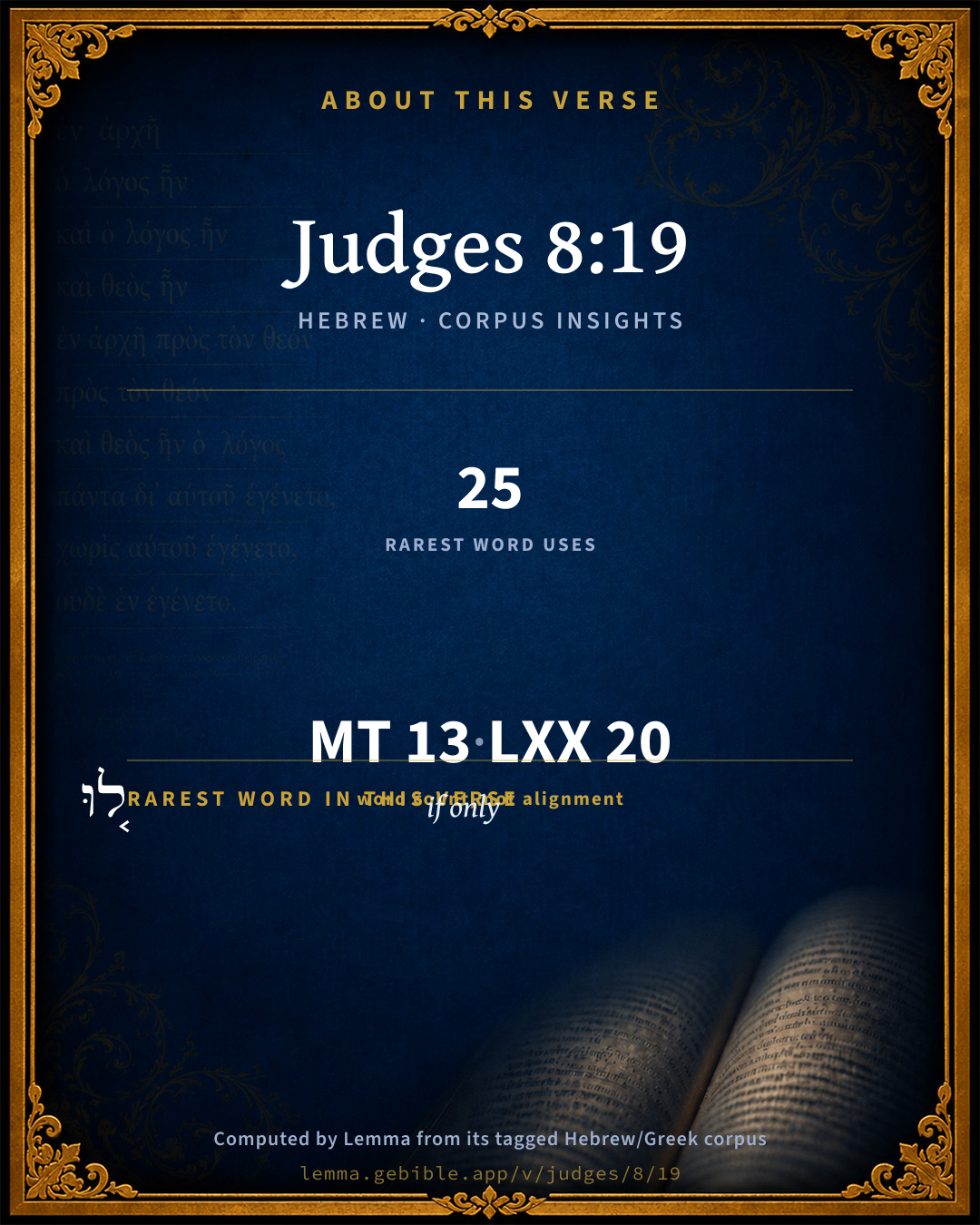
13
words
12
distinct lemmas
Historical
section

Notable vocabulary

The rarest word here is ל֚וּ if only H3863 — appearing just 25 times in the whole Hebrew Bible.

Shared distinctive vocabulary

ל֚וּ if only H3863 occurs in 22 verses of the Hebrew Bible. Also found in:

Grammatical profile

  • 3 verbs
  • 4 nouns
  • 1 adjective
  • 1 pronoun
  • 1 conjunction
  • 3 particles

Verb forms

  • וַיֹּאמַ֕ר Qal · Sequential Imperfect
  • הַחֲיִתֶ֣ם Hiphil · Perfect
  • הָרַ֖גְתִּי Qal · Perfect

Hebrew & Septuagint length

In English translation the verse runs 25 words from the Hebrew and 29 from the Septuagint (LXX English) — closely comparable.

A rough comparison of the two English renderings, which tokenize alike — not a word-level alignment.

Word counts can differ between the Hebrew and the Greek without any difference in meaning — e.g. the Hebrew direct-object marker אֵת has no separate Greek word, and Greek often adds the article ὁ.

In the original languages it is 13 Hebrew tokens and 20 Greek tokens — but the two are counted differently (Hebrew bundles its prefixes and suffixes into one token; the Greek is in lemma form), so that isn’t a like-for-like length.

Hebrew and Greek witnesses Masoretic Hebrew ↔ Greek Septuagint

The same verse in the two great witnesses to the Old Testament, shown verse-for-verse.

These are two independent witnesses, not word-aligned to each other, and the Septuagint is shown in lemma (dictionary) form.

Hebrew Judges 8:19 Masoretic · Westminster Leningrad Codex

וַיֹּאמַ֕ר אַחַ֥י בְּנֵֽי אִמִּ֖י הֵ֑ם חַי יְהוָ֗ה ל֚וּ הַחֲיִתֶ֣ם אוֹתָ֔ם לֹ֥א הָרַ֖גְתִּי אֶתְכֶֽם

He said, They were my brothers, the sons of my mother: as Yahweh lives, if you had saved them alive, I would not kill you.

World English Bible · Public Domain

Greek LXX Judges 8:19 Septuagint · lemma form

καί εἶπον γεδεων ἀδελφός ἐγώ καί υἱός ὁ μήτηρ ἐγώ εἰμί ζάω κύριος εἰ ζωογονέω αὐτός οὐ ἄν ἀποκτείνω σύ

And Gedeon said, They were my brethren and the sons of my mother: as the Lord lives, if you⌃ had preserved them alive, I would not have slain you.

LXX2012 (modern English Septuagint) · Public Domain

Hebrew: Westminster Leningrad Codex (CC BY 4.0). Greek: Septuagint (public domain); English from LXX2012 (modern English Septuagint) (Public Domain). How the Septuagint differs from the Hebrew →

Targum (Aramaic paraphrase)

1

The Targum is the ancient Jewish Aramaic paraphrase of the Hebrew Scriptures — an interpretive translation, not the Hebrew text itself. Onkelos (literal) and Pseudo-Jonathan (expansive) render the Torah, and Jonathan the Prophets. Coverage is partial: where no permissively-licensed English translation exists for a verse, only the Aramaic is shown. This is verse-level text, not a word-by-word alignment to the Hebrew.

  1. Targum Jonathan Prophets (Joshua–Malachi)
    וַאֲמַר אַחַי בְּנֵי אִמָא אִנוּן קַיָם הוּא יְיָ אֵלוּ קַיֵמְתּוּן יַתְהוֹן לָא קַטְלֵית יַתְכוֹן:

    (no public-domain English translation for this verse)

    Targum Jonathan — Aramaic: “Mikraot Gedolot” (public domain). English: “Sefaria Community Translation” (CC0 1.0 (public-domain dedication)); “London "Chaldee Paraphrase," 1871” (public domain). Text via Sefaria.

Commentary

Notes on Judges 8:19 from classic Christian and Jewish commentators (each source and its license shown beneath its notes). The classic Christian expositions comment on the surrounding passage and are grouped to its opening verse, so a note may address several verses; the Jewish commentaries on the Tanakh (Rashi and others) are per-verse, so they appear only where the commentator wrote on this verse.

Lemma curates 59 commentaries, every one of them public domain or Creative Commons licensed, each selected and text-cleaned for this edition rather than reprinted as found. About our sources →

Trapp's Complete Commentary

John Trapp

Jdg 8:19 And he said, They [were] my brethren, [even] the sons of my mother: [as] the LORD liveth, if ye had saved them alive, I would not slay you.

Ver. 19. I would not slay you.] As now I must, both as an avenger of blood {Num 25:7-8} and as a magistrate; for Bonis nocet qui malis parcit, to restrain justice is to support sin: and not to correct, is to consent to the crime.

John Trapp, A Commentary or Exposition upon All the Books of the Old and New Testament (1647–1656) — public domain. Text from a community e-Sword module.

Joseph Benson's Commentary

Jdg 8:19. If ye had saved them alive, &c. — For, as they were not Canaanites, he was not obliged by any command of God to put them to death: but as they had killed his brethren, and that, it seems, in cold blood, he was, by God’s law, the avenger of their death, being their near kinsman.

Joseph Benson's Commentary on the Old and New Testaments (1811–1818) — public domain. Text from a community e-Sword module.

Geneva Bible (1599)

Geneva Bible translators

We came all out of one belly: therefore I will be revenged.

Geneva Bible (1599) marginal notes — public domain. Text via Bolls.life.

Jamieson, Fausset & Brown

Robert Jamieson, A. R. Fausset & David Brown

They were my brethren, even the sons of my mother--That is, uterine brothers; but, in all countries where polygamy prevails, "the son of my mother" implies a closeness of relationship and a warmth of affection never awakened by the looser term, "brother."

Jamieson, Fausset & Brown — Commentary Critical and Explanatory on the Whole Bible (1871) — public domain (CC PDM 1.0). Text via the HelloAO Bible API.

Ellicott's Commentary for English Readers

(19) The sons of my mother.—Comp. Gen_43:29.

As the Lord liveth.—Rth_3:13; 1Sa_14:41. (Comp. Æn. xii. 949.)

A Bible Commentary for English Readers, edited by Charles John Ellicott (1878–1897) — public domain. Text from a community e-Sword module.

The Cambridge Bible for Schools and Colleges

gen. ed. J. J. S. Perowne

19. the sons of my mother] and not only of the same father; they were therefore specially dear, cf. Gen_43:29. On Gideon as next of kin fell the duty of avenging his brothers’ blood; cf. 2Sa_3:27; 2Sa_3:30; 2Sa_14:7; 2Sa_21:5-6. The execution was a judicial act, even an act of religious obligation.

The Cambridge Bible for Schools and Colleges (gen. ed. J. J. S. Perowne; Cambridge University Press, 1878–1918) — public domain. Text from a community e-Sword module.

John Gill's Exposition

And he said, they were my brethren, even the sons of my mother,.... His brethren by his mother's side, but not by his father's side; or the phrase

the sons of my mother is added, to show that he did not mean brethren in a large sense, as all the Israelites were, but in a strict sense, being so nearly related as his mother's children:

as the Lord liveth, if ye had saved them alive, I would not slay you; for not being Canaanites, he was not obliged by the law of God to put them to death, and by the law of nations, as they had surrendered themselves, and were made prisoners of war, they ought to have been saved; but as they appeared to be murderers, and had slain the Israelites in cold blood, they deserved to die; and the persons they had slain being Gideon's brethren, he was the avenger of blood, and it became him to put them to death.

John Gill's Exposition of the Whole Bible (1746–1763) — public domain (CC PDM 1.0). Text via the HelloAO Bible API.

Albert Barnes' Notes on the Bible

The sons of my mother - A much closer relation than that of brothers by the father only. (Compare Gen 43:29; Deu 13:6; Psa 69:8). This is the only hint preserved of the transaction. We cannot say exactly when the slaughter of Gideon’s brethren on Mount Tabor took place, whether before the outbreak of the war Jdg 6:33, or in the retreat and flight of the Midianites Jdg 7:22.

Albert Barnes' Notes on the Bible (1834–1885) — public domain. Text from a community e-Sword/MySword module.

Haydock's Catholic Bible Commentary

Kill you. They were not included in the number of the seven devoted nations, (Worthington) and the precept for destroying the Madianites no longer subsisted, Numbers xxxi. 17. (Menochius) --- The laws of war permitted the Hebrews to kill their prisoners, if they thought proper. No public executioner was necessary. Samuel killed Agag, 1 Kings xv. 32. See 3 Kings ii. 25., and 2 Kings i. 15. (Calmet) --- Gedeon had a mind to make his son partake in the victory, and punish these kings for an unjust murder of his relations. He would also inure him to fight against the enemies of God, &c. (Menochius)

George Leo Haydock (1774–1849), Haydock's Catholic Family Bible and Commentary, 1859 edition — public domain. Excludes Psalms (Douay-Rheims chapter numbering differs from Protestant) and Deuterocanonical books (Catholic canon only).

Matthew Poole's English Annotations

For being not Canaanites he was not obliged to kill them; but they having killed his brethren, and that in cool blood, he was by law the avenger of their blood.

Matthew Poole's English Annotations on the Holy Bible (1683–1685) — public domain. Text from a community e-Sword/MySword module.

John Wesley's Explanatory Notes

I would not slay - For being not Canaanites, he was not obliged to kill them; but they having killed his brethren, and that in cool blood, he was by law the avenger of their blood.

John Wesley, Explanatory Notes Upon the Whole Bible (1754–1765) — public domain. Text via the GEBible commentary corpus.

Lesson kit

Teaching starters — assembled from the data on this page, not authored interpretation. Every prompt links to the verse data it draws on. Edit before teaching.

Judges, in the Historical, opens this verse with 13 words (12 distinct Hebrew lemmas). Its most distinctive word is lûwʼ (“if only”). A historical commentator’s framing appears above. Read the whole chapter for the surrounding context.

Discussion questions

  1. What does “if only” (lûwʼ) contribute to the verse as a whole?
  2. Genesis 17:18 shares the word «if only» with this verse. How do the two illuminate each other?
  3. These translations render this verse differently; the difference is in the English rendering, not the original. What questions does that raise?
  4. The verb «וַיֹּאמַ֕ר» is Qal Sequential Imperfect. How does its form color the action?
  5. Reading how Trapp's Complete Commentary and Joseph Benson's Commentary read this verse, where do the two commentators agree and where do they part?

Things to notice

Reading settings

Reading text

Shown beneath each verse's original-language words.

Old Testament
Old Testament edition

Read the OT as the Masoretic Hebrew (MT) or the Greek Septuagint (LXX).

English shown for the Greek Septuagint (in the Hebrew ↔ Greek comparison).

Comparing translations? Open the Compare panel on any verse page to stack up to four side by side.