Joshua 11:4

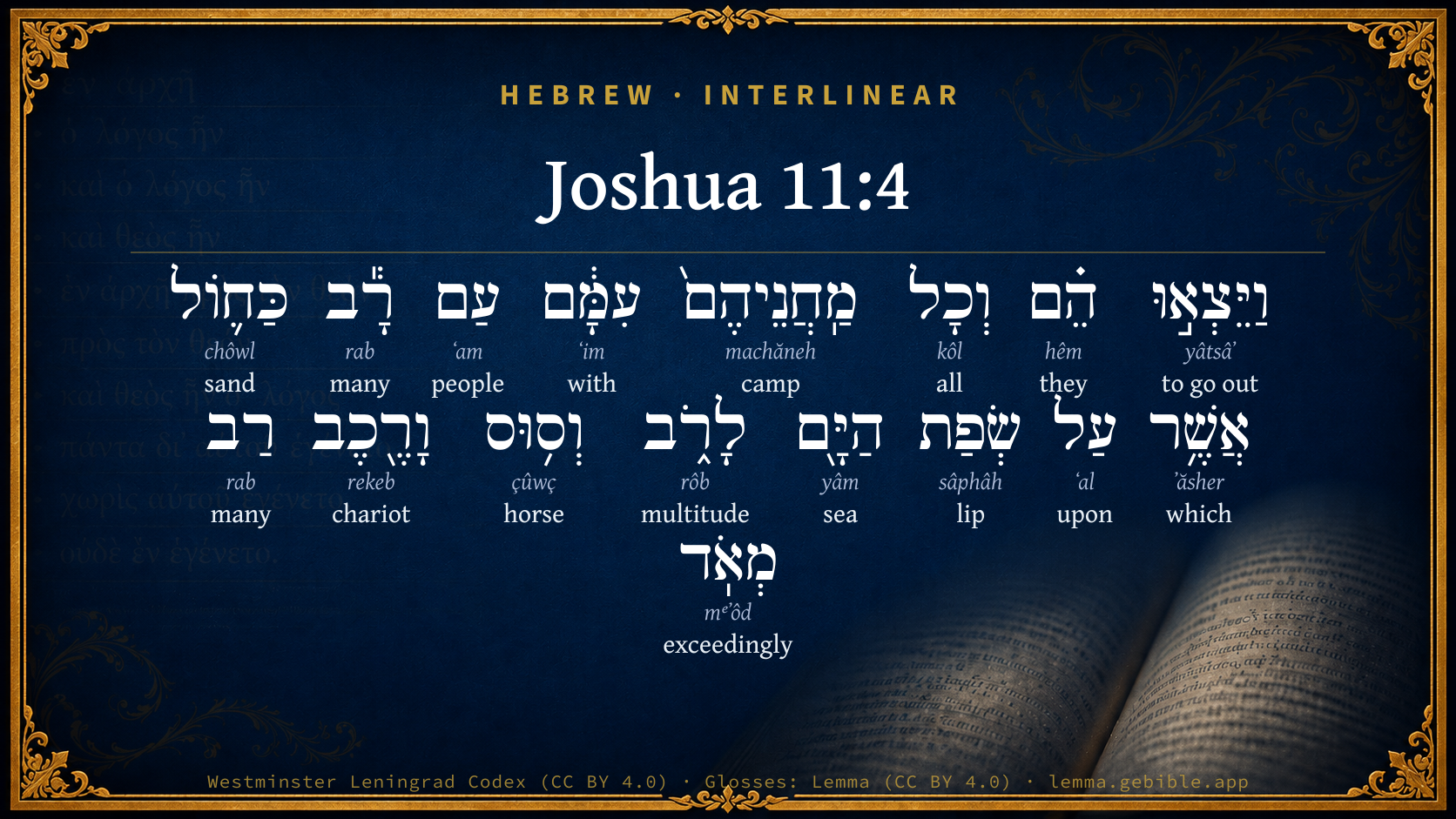
Hebrew (Westminster Leningrad Codex) Joshua 11:4 appears in the Hebrew Old Testament. The text above is from the Westminster Leningrad Codex. Each word links to its Strong’s number, a concise gloss, and parsing drawn from the Open Scriptures Hebrew Bible morphology. Click any word for its full Brown-Driver-Briggs (BDB) entry.
Download image
Cite this verse

Joshua 11:4 (World English Bible). Public Domain. Lemma interlinear Bible study tool, https://lemma.gebible.app/v/joshua/11/4.

Show BibTeX & RIS
BibTeX
RIS
English Translation
They went out, they and all their hosts with them, much people, even as the sand that is on the sea-shore in multitude, with horses and chariots very many.
World English Bible · Public Domain
Download a study sheet

One document with this verse’s original text, its word-by-word gloss line, the meaning frame, cross-references with their text, attributed commentary, and full source and license credits — printable, and it pastes into notes with its structure intact.

This verse Autodidact and up

Study sheet (.html) Plain text (.txt)

A passage Seminary Student

Up to 50 verses in one chapter. A passage sheet keeps up to 6 commentary sources and 12 cross-references per verse, in the order this page ranks them, and says so on the sheet whenever that leaves anything out. Ask for a single verse and you get the Autodidact verse sheet above.

Everything on this page stays free to read, with no account — the sheet is a download of what is already on screen, not access to it.

Want to remove ads? Support Godless Engineer
Compare translations 3

The same verse in 3 English versions, stacked beneath the original-language interlinear above. Click any original word for its lexicon entry.

Each is an independent rendering of the whole verse — the interlinear is not word-aligned to these translations.

Highlighted words mark where these versions differ — a whole-verse word diff, not a word-by-word alignment.

  • World English Bible Public Domain
    They went out, they and all their hosts with them, much people, even as the sand that is on the sea-shore in multitude, with horses and chariots very many.
  • King James Version Public Domain
    And they went out, they and all their hosts with them, much people, even as the sand that is upon the sea shore in multitude, with horses and chariots very many.
  • unfoldingWord Literal Text CC BY-SA 4.0
    And they went out, they and all of their camps with them, many people, like the sand that on the shore of the sea for multitude, and a horse and a chariot, very many.

unfoldingWord Literal Text — © unfoldingWord, licensed CC BY-SA 4.0. Word-aligned USFM3 via Door43 (git.door43.org/unfoldingWord/en_ult).

Versions to compare (up to 4)

3 of 4 selected

Show all 18 translations

Every available English version of this verse, each an independent rendering of the whole verse.

  • World English Bible Public Domain
    They went out, they and all their hosts with them, much people, even as the sand that is on the sea-shore in multitude, with horses and chariots very many.
  • Berean Standard Bible Public Domain
    So these kings came out with all their armies, a multitude as numerous as the sand on the seashore, along with a great number of horses and chariots.
  • Majority Standard Bible Public Domain
    So these kings came out with all their armies, a multitude as numerous as the sand on the seashore, along with a great number of horses and chariots.
  • King James Version Public Domain
    And they went out, they and all their hosts with them, much people, even as the sand that is upon the sea shore in multitude, with horses and chariots very many.
  • American Standard Version (1901) Public Domain
    And they went out, they and all their hosts with them, much people, even as the sand that is upon the sea-shore in multitude, with horses and chariots very many.
  • Revised Version (1885) Public Domain
    And they went out, they and all their hosts with them, much people, even as the sand that is upon the sea shore in multitude, with horses and chariots very many.
  • Geneva Bible (1599) Public Domain
    And they came out and all their hostes with them, many people as the sande that is on the sea shore for multitude, with horses and charets exceeding many.
  • Douay-Rheims (1899) Public Domain
    And they all came out with their troops, a people exceeding numerous as the sand that is on the sea shore, their horses also and chariots a very great multitude,
  • Young's Literal Translation Public Domain
    and they go out, they and all their camps with them, a people numerous, as the sand which `is' on the sea-shore for multitude, and horse and charioteer very many;
  • Literal Standard Version CC BY-SA 4.0
    and they go out, they and all their camps with them, a people numerous, as the sand which [is] on the seashore for multitude, and [with] very many horse and charioteer;
  • Unlocked Literal Bible CC BY-SA 4.0
    All their armies came out with them, a great number of soldiers, in number like the sand on the seashore. They had a great number of horses and chariots.
  • unfoldingWord Literal Text CC BY-SA 4.0
    And they went out, they and all of their camps with them, many people, like the sand that on the shore of the sea for multitude, and a horse and a chariot, very many.
  • Darby Bible Public Domain
    And they went out, they and all their armies with them, a people numerous as the sand that is on the seashore in multitude, with horses and chariots very many.
  • World Messianic Bible Public Domain
    They went out, they and all their armies with them, many people, even as the sand that is on the seashore in multitude, with very many horses and chariots.
  • Webster's Bible Public Domain
    And they went out, they and all their hosts with them, many people, even as the sand that is upon the sea-shore in multitude, with horses and chariots very numerous.
  • Free Bible Version CC BY-SA 4.0
    All their armies assembled together, a vast horde as numberless as the sand of the seashore, together with many, many horses and chariots.
  • Bible in Basic English Public Domain
    And they went out, they and all their armies with them, a great people, in number like the sand on the seaside, with horses and war-carriages in great number.
  • JPS Tanakh (1917) Public Domain
    And they went out, they and all their hosts with them, much people, even as the sand that is upon the sea-shore in multitude, with horses and chariots very many.

Literal Standard Version (2020), Covenant Press — licensed CC BY-SA 4.0. Text via the HelloAO Bible API (eBible.org). Unlocked Literal Bible (unfoldingWord) — licensed CC BY-SA 4.0. Text via the HelloAO Bible API (eBible.org). unfoldingWord Literal Text — © unfoldingWord, licensed CC BY-SA 4.0. Word-aligned USFM3 via Door43 (git.door43.org/unfoldingWord/en_ult). Free Bible Version, Dr. Jonathan Gallagher — licensed CC BY-SA 4.0. Text via the HelloAO Bible API (eBible.org).

Word by word

More ways to search: Search by grammar → Find every occurrence → Compare this word →

Practice this passage: Drill this verse → Learn its vocabulary →

כַּח֛וֹל
chôwl
H2344
“like/as the · sand”
Preposition, Determined + Noun, Common, Masculine, Singular, Absolute
Part of Speech
Preposition + Noun
Type
Common
Gender
Masculine
Number
Singular
State
Absolute
Full BDB Definition

Origin: from H2342

TWOT: 623a

sand
  1. וַיֵּצְא֣וּ yâtsâʼ H3318 “and · to go out” Conjunction + Verb, Qal, Sequential Imperfect, 3rd Person, Masculine, Plural
  2. הֵ֗ם hêm H1992 “they” Pronoun, Personal, 3rd Person, Masculine, Plural
  3. וְכָל kôl H3605 “and · all of” Conjunction + Noun, Common, Masculine, Singular, Construct
  4. מַֽחֲנֵיהֶם֙ machăneh H4264 “camps · their” Noun, Common, Both, Plural, Construct + Suffix, Personal, 3rd Person, Masculine, Plural
  5. עִמָּ֔ם ʻim H5973 “with · them” Preposition + Suffix, Personal, 3rd Person, Masculine, Plural
  6. עַם ʻam H5971 “people” Noun, Common, Masculine, Singular, Absolute
  7. רָ֕ב rab H7227 “many” Adjective, Adjective, Masculine, Singular, Absolute
  8. אֲשֶׁ֥ר ʼăsher H834 “which” Particle, Relative
  9. עַל ʻal H5921 “upon” Preposition
  10. שְׂפַת sâphâh H8193 “lip of” Noun, Common, Feminine, Singular, Construct
  11. הַיָּ֖ם yâm H3220 “the · sea” Particle, Definite Article + Noun, Common, Masculine, Singular, Absolute
  12. לָרֹ֑ב rôb H7230 “to/for · multitude” Preposition + Noun, Common, Both, Singular, Absolute
  13. וְס֥וּס çûwç H5483 “and · horse” Conjunction + Noun, Common, Masculine, Singular, Absolute
  14. וָרֶ֖כֶב rekeb H7393 “and · chariot” Conjunction + Noun, Common, Masculine, Singular, Absolute
  15. רַב rab H7227 “many” Adjective, Adjective, Masculine, Singular, Absolute
  16. מְאֹֽד mᵉʼôd H3966 “exceedingly” Adverb

About this verse

These counts appear in no published source. They are computed here, from the morphology-tagged text and Lemma’s own curated glosses. What Lemma adds →

17
words
16
distinct lemmas
Historical
section

Notable vocabulary

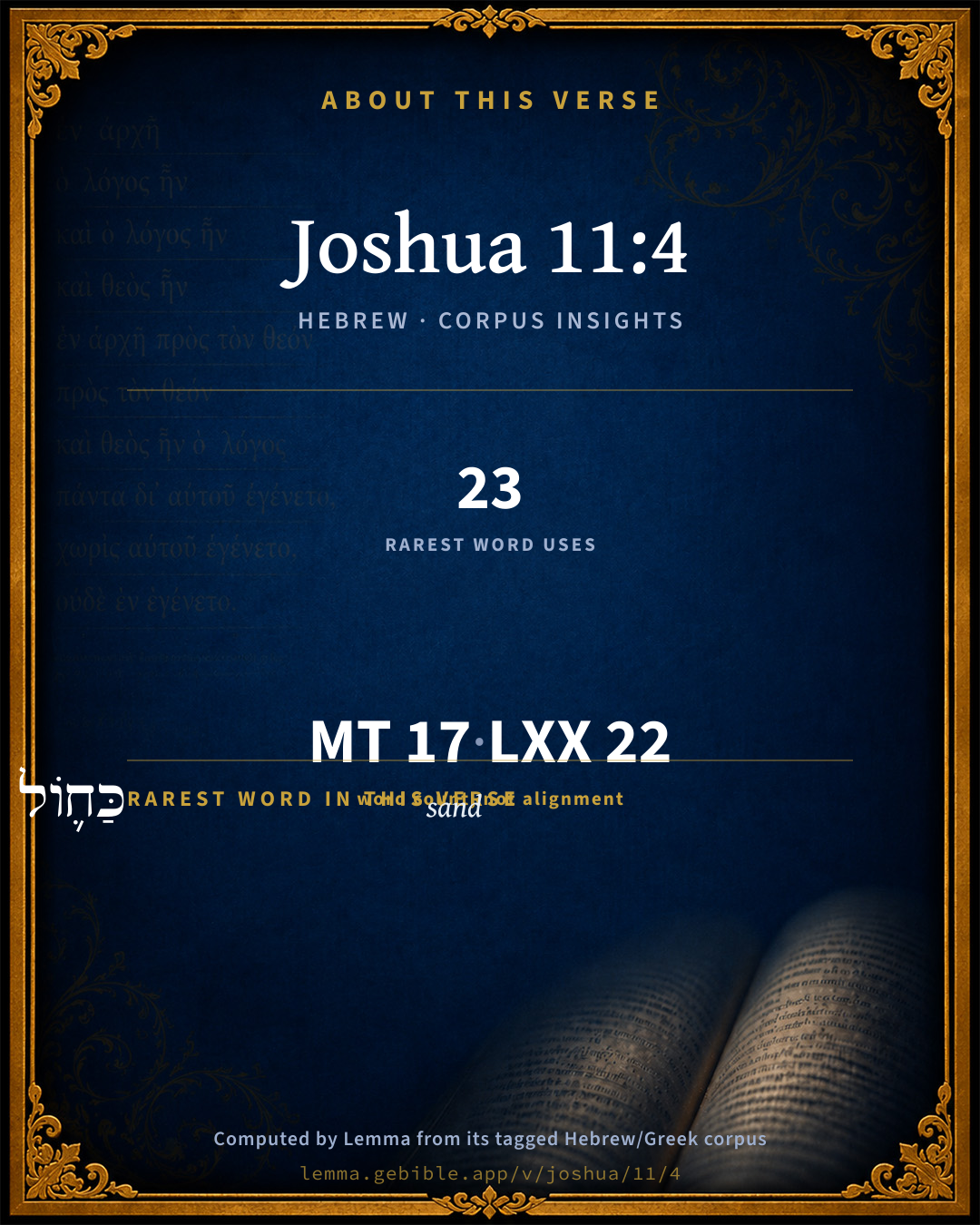
The rarest word here is כַּח֛וֹל sand H2344 — appearing just 23 times in the whole Hebrew Bible.

Shared distinctive vocabulary

כַּח֛וֹל sand H2344 occurs in 23 verses of the Hebrew Bible. Also found in:

Grammatical profile

  • 1 verb
  • 9 nouns
  • 2 adjectives
  • 1 pronoun
  • 2 prepositions
  • 1 adverb
  • 1 particle

Verb forms

  • וַיֵּצְא֣וּ Qal · Sequential Imperfect

Repetition

A word recurs within this verse — often emphatic in Hebrew:

  • רָ֕ב many H7227 ×2

Hebrew & Septuagint length

In English translation the verse runs 29 words from the Hebrew and 23 from the Septuagint (LXX English) — closely comparable.

A rough comparison of the two English renderings, which tokenize alike — not a word-level alignment.

Word counts can differ between the Hebrew and the Greek without any difference in meaning — e.g. the Hebrew direct-object marker אֵת has no separate Greek word, and Greek often adds the article ὁ.

In the original languages it is 17 Hebrew tokens and 22 Greek tokens — but the two are counted differently (Hebrew bundles its prefixes and suffixes into one token; the Greek is in lemma form), so that isn’t a like-for-like length.

Cross-references

6

Topical passages linked to Joshua 11:4 in the Treasury of Scripture Knowledge — connected by theme and wording, ordered by reader-vote popularity; previews shown in the World English Bible.

  • Judges 7:12 The Midianites and the Amalekites and all the children of the east lay along in the valley like locusts for multitude; and their camels were without number, as the sand which is on the sea-shore for multitude.
  • 1 Samuel 13:5 The Philistines assembled themselves together to fight with Israel, thirty thousand chariots, and six thousand horsemen, and people as the sand which is on the sea-shore in multitude: and they came up, and encamped in Michmash, eastward of Beth Aven.
  • Genesis 22:17 that in blessing I will bless you, and in multiplying I will multiply your seed as the stars of the heavens, and as the sand which is on the seashore. Your seed will possess the gate of his enemies.
  • Genesis 32:12 You said, 'I will surely do you good, and make your seed as the sand of the sea, which can't be numbered because there are so many.'"
  • 2 Samuel 17:11 But I counsel that all Israel be gathered together to you, from Dan even to Beersheba, as the sand that is by the sea for multitude; and that you go to battle in your own person.
  • 1 Kings 4:20 Judah and Israel were many as the sand which is by the sea in multitude, eating and drinking and making merry.

Cross-references courtesy of OpenBible.info (CC BY 4.0).

Hebrew and Greek witnesses Masoretic Hebrew ↔ Greek Septuagint

The same verse in the two great witnesses to the Old Testament, shown verse-for-verse.

These are two independent witnesses, not word-aligned to each other, and the Septuagint is shown in lemma (dictionary) form.

Hebrew Joshua 11:4 Masoretic · Westminster Leningrad Codex

וַיֵּצְא֣וּ הֵ֗ם וְכָל מַֽחֲנֵיהֶם֙ עִמָּ֔ם עַם רָ֕ב כַּח֛וֹל אֲשֶׁ֥ר עַל שְׂפַת הַיָּ֖ם לָרֹ֑ב וְס֥וּס וָרֶ֖כֶב רַב מְאֹֽד

They went out, they and all their hosts with them, much people, even as the sand that is on the sea-shore in multitude, with horses and chariots very many.

World English Bible · Public Domain

Greek LXX Joshua 11:4 Septuagint · lemma form

καί ἐκἔρχομαι αὐτός καί ὁ βασιλεύς αὐτός μετά αὐτός ὥσπερ ὁ ἄμμος ὁ θάλασσα ὁ πλῆθος καί ἵππος καί ἅρμα πολύς σφόδρα

And they and their kings with them went forth, as the sand of the sea in multitude, and horses, and very many chariots.

LXX2012 (modern English Septuagint) · Public Domain

On this verse, The Pulpit Commentary discusses the Septuagint’s reading. Read the note in Commentary ↓

Hebrew: Westminster Leningrad Codex (CC BY 4.0). Greek: Septuagint (public domain); English from LXX2012 (modern English Septuagint) (Public Domain). How the Septuagint differs from the Hebrew →

Targum (Aramaic paraphrase)

1

The Targum is the ancient Jewish Aramaic paraphrase of the Hebrew Scriptures — an interpretive translation, not the Hebrew text itself. Onkelos (literal) and Pseudo-Jonathan (expansive) render the Torah, and Jonathan the Prophets. Coverage is partial: where no permissively-licensed English translation exists for a verse, only the Aramaic is shown. This is verse-level text, not a word-by-word alignment to the Hebrew.

  1. Targum Jonathan Prophets (Joshua–Malachi)
    וּנְפָקוּ אִינוּן וְכָל מַשִׁרְיַתְהוֹן עִמְהוֹן עַם סַגִי כְּחָלָא דְעַל כֵּיף יַמָא לִסְגֵי וְסוּסְוַן וּרְתִיכוּן סַגִי לַחֲדָא:

    (no public-domain English translation for this verse)

    Targum Jonathan — Aramaic: “Mikraot Gedolot” (public domain). English: “Sefaria Community Translation” (CC0 1.0 (public-domain dedication)); “London "Chaldee Paraphrase," 1871” (public domain). Text via Sefaria.

Commentary

Notes on Joshua 11:4 from classic Christian and Jewish commentators (each source and its license shown beneath its notes). The classic Christian expositions comment on the surrounding passage and are grouped to its opening verse, so a note may address several verses; the Jewish commentaries on the Tanakh (Rashi and others) are per-verse, so they appear only where the commentator wrote on this verse.

Lemma curates 59 commentaries, every one of them public domain or Creative Commons licensed, each selected and text-cleaned for this edition rather than reprinted as found. About our sources →

Trapp's Complete Commentary

John Trapp

Jos 11:4 And they went out, they and all their hosts with them, much people, even as the sand that [is] upon the sea shore in multitude, with horses and chariots very many.

Ver. 4. They and all their hosts.] These were, as one said of Carthage, half destroyed, Morientium ferarum ultimi nixus, et violentiores morsus, the last spruntings and bitings of these dying beasts.

And chariots very many.] Chariots armed with scythes and hooks: concerning which Vegetius saith, that at first they were a terror, and afterwards a scorn.

John Trapp, A Commentary or Exposition upon All the Books of the Old and New Testament (1647–1656) — public domain. Text from a community e-Sword module.

Tyndale Open Study Notes

Tyndale Open Resources

11:4 In the ancient Near East at this time, horses only pulled chariots; cavalry and mounted bowmen did not appear until centuries later. • Israel probably faced chariots for the first time in this battle against the northern coalition, where the land was flatter than in southern Canaan. As the heavy weapons of the battlefield, chariots easily overpowered foot soldiers. Scythes were often attached to the axles, and charioteers drove at opposing infantry to mow them down.

Tyndale Open Study Notes — © Tyndale Open Resources, licensed CC BY-SA 4.0. Text via the HelloAO Bible API.

Jamieson, Fausset & Brown

Robert Jamieson, A. R. Fausset & David Brown

they went out, . . . as the sand that is upon the sea-shore in multitude--The chiefs of these several tribes were summoned by Jabin, being all probably tributary to the kingdom of Hazor. Their combined forces, according to JOSEPHUS, amounted to three hundred thousand infantry, ten thousand cavalry, and twenty thousand war chariots.

with horses and chariots very many--The war chariots were probably like those of Egypt, made of wood, but nailed and tipped with iron. These appear for the first time in the Canaanite war, to aid this last determined struggle against the invaders; and "it was the use of these which seems to have fixed the place of rendezvous by the lake Merom (now Huleh), along whose level shores they could have full play for their force." A host so formidable in numbers, as well as in military equipments, was sure to alarm and dispirit the Israelites. Joshua, therefore, was favored with a renewal of the divine promise of victory (Jos 11:6), and thus encouraged, he, in the full confidence of faith, set out to face the enemy.

Jamieson, Fausset & Brown — Commentary Critical and Explanatory on the Whole Bible (1871) — public domain (CC PDM 1.0). Text via the HelloAO Bible API.

Adam Clarke's Commentary

Verse 4. Much people, even as the sand] This form of speech, by some called a hyperbole, conveys simply the idea of a vast or unusual number - a number of which no regular estimate could be easily formed. Josephus, who seldom finds difficulties in such cases, and makes no scruple of often speaking without book, tells us that the allied armies amounted to 300,000 foot 10,000 horse, and 20,000 chariots of war. Antiq. lib. v., c. 1.

That chariots were frequently used in war, all the records of antiquity prove; but it is generally supposed that among the Canaanites they were armed with iron scythes fastened to their poles and to the naves of their wheels. Terrible things are spoken of these, and the havoc made by them when furiously driven among the ranks of infantry. Of what sort the cavalry was, we know not; but from the account here given we may see what great advantages these allies possessed over the Israelites, whose armies consisted of infantry only.

Adam Clarke's Commentary on the Bible (1810–1826) — public domain. Text from a community e-Sword/MySword module.

The Cambridge Bible for Schools and Colleges

gen. ed. J. J. S. Perowne

4. And they went out] “As the British chiefs were driven to the Land’s End before the advance of the Saxon, so at this Land’s End of Palestine were gathered for this last struggle, not only the kings of the north in the immediate neighbourhood, but from the desert valley of the Jordan south of the Sea of Galilee, from the maritime plain of Philistia, from the heights above Sharon, and from the still unconquered Jebus.” Stanley, Lectures, 1:259.

as the sand] “as the grauel that is in the brenk of the see,” Wyclif. Comp. the description (a) of the hosts of the Midianites and Amalekites in the time of Gideon (Jdg_7:12); and (b) of the Philistines in the time of Saul (1Sa_13:5).

with horses and chariots very many] These now for the first time appear in Canaanite warfare, and “it was the use of these which probably fixed the scene of the encampment by the lake, along whose level shores they could have full play for their force.”

The Cambridge Bible for Schools and Colleges (gen. ed. J. J. S. Perowne; Cambridge University Press, 1878–1918) — public domain. Text from a community e-Sword module.

John Gill's Exposition

And they went out,.... The several kings and people sent to; these went out from the places they inhabited:

they and all their hosts with them; the kings of those several places, with their armies:

much people, even as the sand that is upon the seashore in multitude; a proverbial expression, to denote an exceeding great number:

with horses and chariots very many; being supplied with horses from Egypt, and their chariots were chariots of iron; see Jdg 4:3; Josephus (z) gives us the number of this great army, and says it consisted of three hundred thousand footmen, ten thousand horse, and thirty thousand chariots; some copies read only twenty thousand; and these chariots were armed with iron hooks or scythes, to cut down men as they drove along, and so were very terrible.

(z) Antiqu. l. 5. c. 1. sect. 18.

John Gill's Exposition of the Whole Bible (1746–1763) — public domain (CC PDM 1.0). Text via the HelloAO Bible API.

Haydock's Catholic Bible Commentary

Shore. The Scripture sometimes uses an hyperbole, as well as the other figures of speech. (St. Augustine, City of God xvi. 21.) Josephus says they had 300,000 foot, 10,000 horse, and 20,000 chariots. These were frequently armed with scythes. The ancient heroes often fought on chariots of a different kind. (Calmet)

George Leo Haydock (1774–1849), Haydock's Catholic Family Bible and Commentary, 1859 edition — public domain. Excludes Psalms (Douay-Rheims chapter numbering differs from Protestant) and Deuterocanonical books (Catholic canon only).

Whedon's Commentary on the Bible

Daniel D. Whedon

4. Even as the sand that is upon the sea shore — This exaggerated comparison is in perfect keeping with the style of the Oriental writers. It is to be interpreted rhetorically, and not literally. It is to be expected that an inspired writer will employ the style of his country and age. Josephus reckons this army at three hundred thousand foot, ten thousand horse, and twenty thousand chariots. Anciently chariots supplied the place of artillery in modern times, so that among the Egyptians and Syrians the number of these indicated their military power. The Hebrews, having been forbidden to multiply horses, did not to any great extent provide themselves with chariots of war till the reign of David. By reason of this lack of chariots in Joshua’s army the odds were heavily against him, so that there was occasion for the encouragement which the Lord gives in Jos_11:6.

Daniel D. Whedon (gen. ed.), Commentary on the Old and New Testaments (1874–1909) — public domain. Text from a community e-Sword module.

The Pulpit Commentary

And they went out. Dean Stanley (Lectures, 1:259) compares this "last struggle" of the Canaanites with the conflict between the Saxons and the British chiefs "driven to the Land"s End." The comparison is more picturesque than accurate. In the first place, it was by no means a "last struggle" (see ver. 21; Jos_18:3 Jos_19:47 Jud_1:4 throughout). In the next, the Britons were never driven to the Land"s End, but Dorsetshire, which retained its independence for 200 years, was treated by Ina as Gezer, (Jos_16:10) was treated by the Ephraimites, while Devonshire and Cornwall came very gradually and almost peacefully under the hands of the conquerors. And thirdly, even had it been otherwise, there is a vast difference between a handful of desperate men driven to bay on a tongue of land surrounded nearly on every side by the sea, and a powerful, though defeated, nation with a vast continent in its rear. Yet there are many features common to the history of the Israelites in Canaan, and of the Teutonic tribes in Britain (see Introduction). As the sand that is upon the sea shore. This poetic phrase is common in the Hebrew writings. (see Gen_22:17 Gen_32:12 Jud_1:7:12 1Sa_13:5 1Ki_4:20, etc.) Solomon"s capacious intellect is compared to the sand on the sea shore, in 1Ki_4:29. The word translated "shore" is "lip" in the original, a word which adds to the poetry of the passage. And horses and chariots very many. Literally, many ex ceedingly. The Israelites appear to have held cavalry and chariots in great awe. (see Exo_14:18, and the song of triumph in Ex 15; cf. also Jos_17:16, 18 Jud_1:19 4:3) In later times they appear to have become more used to them. See, for instance, 1Sa_13:5, where the historian gives their number, large as it was, instead of regarding it as past all computation.

This battle must have taken place on level ground, or the chariots would have been useless. Accordingly the historian fixes its scene on the banks of "the waters of Merom," where such ground is to be found another instance of his historical accuracy (see Vandevelde, Journey 2:413, who places the battle on the great plain southwest of the latter). The use of chariots in battle dates from an early period. Homer"s heroes are described as driven to battle in them. But perhaps the scythe chariots are here meant, which are not found on early Egyptian monuments, but which Xenophon in his Cyropaedia says were introduced By Cyrus. We find them, however, in use in Britain, in the days of Julius Caesar, and they could hardly have obtained the idea from the Persians. Potter (Antiquities, bk. 3. ch. 1.) says that they were gradually abandoned when they were found more dangerous to those who used them than to the enemy. That this kind of chariot is here meant seems pretty certain from the alarm they caused. No such alarm would have been caused by chariots simply used to convey the chieftains to the fight. (see Gesenius, s.v. Xenophon, Cyr. 6:4; and RAPC 2Ma 13:2) All their hosts. The LXX reads mhykelm their kings, for

The Pulpit Commentary (1880–1919), ed. H.D.M. Spence-Jones & Joseph S. Exell — public domain. Text from a community e-Sword module.

unfoldingWord translationNotes

Door43 World Missions Community

General Information:

All the Canaanite kings attack Joshua and the nation of Israel.

a great number of soldiers, in number like the sand on the seashore

No one can count the grains of sand on the seashore. This exaggeration emphasizes the very large number of soldiers that these kings assembled. AT: "such a great number of soldiers that there appeared to be as many of them as there are grains of sand on the seashore" (See: Hyperbole and Generalization)

Merom

This is the name of a place. (See: How to Translate Names)

translationWords

chariot

king

appoint

Israel

unfoldingWord translationNotes — © Distant Shores Media and the Door43 World Missions Community, licensed CC BY-SA 4.0. Source: git.door43.org/Door43/en_tn.

Lesson kit

Teaching starters — assembled from the data on this page, not authored interpretation. Every prompt links to the verse data it draws on. Edit before teaching.

Joshua, in the Historical, opens this verse with 17 words (16 distinct Hebrew lemmas). Its most distinctive word is chôwl (“sand”). A historical commentator’s framing appears above. Read the whole chapter for the surrounding context.

Discussion questions

  1. How does “sand” (chôwl) shape what this verse is saying?
  2. Genesis 22:17 shares the word «sand» with this verse. How do the two illuminate each other?
  3. “many” occurs 2× in this one verse. What is the effect of the repetition?
  4. These translations render this verse differently. What is at stake in choosing one wording over another?
  5. The verb «וַיֵּצְא֣וּ» is Qal Sequential Imperfect. How does its form color the action?
  6. Reading how Trapp's Complete Commentary and Tyndale Open Study Notes read this verse, where do the two commentators agree and where do they part?

Things to notice

Reading settings

Reading text

Shown beneath each verse's original-language words.

Old Testament
Old Testament edition

Read the OT as the Masoretic Hebrew (MT) or the Greek Septuagint (LXX).

English shown for the Greek Septuagint (in the Hebrew ↔ Greek comparison).

Comparing translations? Open the Compare panel on any verse page to stack up to four side by side.